1. 2. 3. 4. REGULAR CALLED MEETING of the SPECIAL EVENTS TASK FORCE JULY 20, 2022 – 2:00 P.M. PERMITTING AND DEVELOPMENT CENTER – ROOM 1401 6310 WILHEMINA DELCO DRIVE AUSTIN, TEXAS Some members of the BOARD/COMMISSION may be participating by videoconference. Public comment will be allowed in-person or remotely via telephone. Speakers may only register to speak on an item once either in-person or remotely and will be allowed up to three minutes to provide their comments. Registration no later than noon the day before the meeting is required for remote participation by telephone. To register to speak remotely, call or email Brydan Summers, 512-974-4854, Brydan.summers@austintexas.gov CURRENT BOARD MEMBERS/COMMISSIONERS: James Russell, Co-Chair Jeff Smith, Co-Chair Dan Carroll Bobby Garza Cindy Lo Shelley Phillips AGENDA CALL TO ORDER PUBLIC COMMUNICATION: GENERAL Heath Riddles-Sanchez Mandi Thomas Frances Thompson Ingrid Weigand Laurel White Speakers signed up prior to the meeting being called to order will each be allowed a three-minute allotment to address their concerns regarding items not posted on the agenda. APPROVAL OF MINUTES Approve the minutes of the Special Events Task Force regular meeting on June 15, 2022. DISCUSSION AND ACTION ITEMS Update from Organizers Currently Planning Events Review of Previously Approved Recommendations to Determine When They Should Be Sent to Council Sale of Goods Font Size: 12; Font: Times New Roman; Font Style: Regular An Expedited Process for Special Event Permitting ACE Regulations of High-Capacity Venues Discussion on Changes to Special Event Fees 5. 6. 7. FUTURE AGENDA ITEMS ADJOURNMENT The City of Austin is committed to compliance with the American with Disabilities Act. Reasonable modifications and equal access to communications will be provided upon request. Meeting locations are planned with wheelchair access. If requiring Sign Language Interpreters or alternative formats, please give notice at least 2 days (48 hours) before the meeting date. Please call Brydan Summers at Development Services Department, at 512-974-4854, Brydan.summers@austintexas.gov for additional information; TTY users route through Relay Texas at 711. For more information on the Special Events Task Force please contact Brydan Summers at 512- 974-4854, Brydan.summers@austintexas.gov Font Size: 12; Font: Times New Roman; Font Style: Regular
Special Called Meeting of the Water and Wastewater Commission July 20, 2022 — 6:00 pm Permitting & Development Center – Room 1405 6310 Wilhelmina Delco Dr. Austin, Texas Some members may be participating by videoconference. The meeting may be viewed online at: http://www.austintexas.gov/page/watch-atxn-live For more information go to: http://www.austintexas.gov/wwc Public comment will be allowed in-person or remotely by telephone. Speakers may only register to speak on an item once either in-person or remotely and will be allowed up to three minutes to provide their comments. Registration no later than noon the day before the meeting is required for remote participation. To register, call or email the board liaison at 512-972-0115 or Blanca.Madriz@austintexas.gov . To register to speak in person, people must sign up at least ten minutes before the meeting is called to order. Commissioners: William Moriarty (Mayor) Jesse Penn (District 1) Alex Navarro (District 2) Travis Michel (District 3) Chien Lee, Chair (District 4) Christianne Castleberry, Vice Chair (District 5) Vacant (District 6) Judy Musgrove (District 7) Christy Williams (District 8) Grant Fisher (District 9) Susan Turrieta (District 10) CALL TO ORDER PUBLIC COMMUNICATION: GENERAL APPROVAL OF MINUTES 1. Approval of minutes from the June 8, 2022, regular meeting of the Water and Wastewater Commission. DISCUSSION AND POSSIBLE ACTION ON RECOMMENDATIONS TO COUNCIL 2. Recommend approval to negotiate and execute a contract with Environmental Improvements Inc., to provide parts for chemical feed pumps, for a term of five years in an amount not to exceed $860,000. 3. Recommend approval to award and execute a construction contract with Santa Clara Construction, Ltd., for Wastewater Line Renewal and Spot Rehab Service Contract (2023 to 2025) Indefinite Delivery/Indefinite Quantity contract in the amount of $3,200,000 for an initial 1-year term, with two 12-month extension options of $3,200,000, for a total contract amount not to exceed $9,600,000. (Districts 1-10) 4. Recommend approval to award and execute a construction contract with Facilities Rehabilitation, Inc., for the Truman Heights Water and Wastewater Pipeline Rehabilitation project in the amount of $3,597,261 plus a $359,726.10 contingency, for a total contract amount not to exceed $3,956,987.10. (District 1) The City of Austin is committed to compliance with the American with Disabilities Act. Reasonable modifications and equal access to communications will be provided upon request. Meeting locations are planned with wheelchair access. If requiring Sign Language Interpreters or alternative formats, please give notice at least 2 days (48 hours) …
Item 14 Water & Wastewater Commission: July 20, 2022 Council: August 17, 2022 Posting Language Recommend approval of Austin Water’s Fiscal Year 2022-2023 Proposed Operating Budget, Capital Budget, new appropriations, and 5-Year Capital Improvement (CIP) spending plan. MBE/WBE N/A Lead Department Austin Water Client Department Austin Water Assistant Director of Financial Services, Joseph Gonzales Fiscal Note N/A Purchasing Language: N/A Council Committee, Boards and Commission Action: July 20, 2022 - To be reviewed by the Water & Wastewater Commission. Additional Backup Information: This action authorizes approval of Austin Water’s Fiscal Year 2022-2023 Operating Budget, Capital Budget Appropriations and 5-year Capital Improvement Projects spending plan. Council is scheduled to adopt the budget on three readings on August17, 2022 through August 19, 2022. The City Code in Section 15-9-3 specifically requires a public hearing prior to the City Council approving any changes in electric, water, wastewater, and garbage collection rates. Austin Water has not proposed water or wastewater service rate changes for Fiscal Year 2022-2023. Strategic Outcome(s): Government That Works for All.
Item 10 # 22-2423 Water & Wastewater Commission: July 20, 2022 Council: July 28, 2022 Posting Language Recommend approval to negotiate and execute a Construction Manager at Risk Agreement with MGC Contractor’s Inc. for preconstruction and construction phase services for the Walnut Creek Primary Clarifier and Flow Equalization Basin Rehab project in an amount not to exceed $32,700,000. (District 1). MBE/WBE This contract will be awarded in compliance with City Code Chapter 2-9A (Minority Owned and Women Owned Business Enterprise Procurement Program) by meeting the goals with 16.77% MBE, and 3.79% WBE participation. Lead Department Financial Services Department Client Department Austin Water Assistant Director of Engineering Services, Shay Ralls Roalson Fiscal Note Funding is available in the Capital Budget of Austin Water. Purchasing Language: Best value to the City of one offer received. A complete solicitation package, including a tabulation of the bids received, is available for viewing, is available for viewing on the City’s Financial Services, website, Austin Finance Online. Link: Solicitation Document. Prior Council Action: March 3, 2022 – City Council authorized negotiation and execution of an amendment to the professional services agreement with Black & Veatch Corp. for professional engineering services for the Walnut Creek Primary Clarifier and Flow Equalization Basin Rehab project in the amount of $4,100,000 for a total contract amount not to exceed $5,100,000. December 9, 2021 – Council approved the use of the Construction Manager at Risk alternative delivery method of contracting. March 26, 2020 – City Council authorized negotiation and execution of a professional services agreement with Black & Veatch Corporation (staff recommendation) for Request for Qualifications Solicitation No. CLMP284 to provide engineering services for the Walnut Creek Wastewater Treatment Plant Primary Clarifier and Flow Equalization Basin Rehab project in an amount not to exceed $1,000,000. Council Committee, Boards and Commission Action: July 20, 2022 - To be reviewed by the Water & Wastewater Commission. Additional Backup Information: The Walnut Creek Wastewater Treatment Plant (WWTP) receives wastewater flow from Austin Water's wastewater collection system. The plant was originally built in 1977. Over the years, the Item 10 # 22-2423 Water & Wastewater Commission: July 20, 2022 Council: July 28, 2022 treatment plant has undergone numerous improvements and upgrades to modernize treatment methods as well as expand treatment capacity to 75 million gallons per day (MGD) with a 2-hour peak flow of 165 MGD. Treated plant effluent is discharged into the Colorado River. …
Item 11 # 22-2364 Water & Wastewater Commission: July 20, 2022 Council: July 28, 2022 Posting Language Recommend approval to negotiate and execute a cost participation agreement with Stillwater Capital Investments, LLC for the City to reimburse the developer for an amount not to exceed $409,975 for costs associated with the design and construction of an oversized water main related to Service Extension Request No. 5077 that will provide water service to a proposed industrial development located at 13338 Old San Antonio Road. Lead Department Austin Water. Client Department Austin Water Assistant Director of Environmental, Planning and Development Services Kevin Critendon Fiscal Note Funding is available in the Fiscal Year 2021-2022 Capital Budget of Austin Water. Council Committee, Boards and Commission Action: July 20, 2022 – To be reviewed by the Water and Wastewater Commission. Additional Backup Information: The Stillwater Old San Antonio Rd project consists of approximately 59 acres of land located at 13338 Old San Antonio Road (the “Property”). The Property is located within the City of Austin’s (the “City”) 2-mile Extra-Territorial Jurisdiction, Impact Fee Boundary, Austin Water’s service area for water, the Desired Development Zone, and the Onion Creek Watershed. A map of the property location is attached. Stillwater Capital Investments, LLC (the “Applicant”) is proposing to develop approximately 641,280 square feet of office-warehouse. The Applicant requested that the City provide water utility service to the Property as proposed in Service Extension Request (SER) No. 5077. The Applicant has requested Austin Water also provide retail wastewater service to the Property. In accordance with Chapter 25-9 of the City Code, the City has asked the Applicant to oversize the water main in order to serve additional properties within the South water pressure zone consistent with the City’s long range planning goals for this area. If approved by City Council, the City will cost participate in this construction project only to the extent of the City’s proportionate share of the oversized water main. The proposed oversized improvements include construction of approximately 3,100 feet of 16-inch water main from the existing 16-inch water main in Avenida Mercado St and extend south along Old San Antonio Rd to the Property. The City will reimburse the Applicant for an overall total amount not to exceed $409,975 for hard costs and soft costs. Hard costs include, but are not limited to, construction and materials. Soft costs include, but are not limited to, preliminary …
Item 12 # 22-2367 Water & Wastewater Commission: July 20, 2022 Council: July 28, 2022 Posting Language Recommend an increase to the City’s participation in the cost participation agreement with Stillwater Capital Investments, LLC for the City to reimburse the developer for an amount not to exceed $2,886,408 for costs associated with the design and construction of an oversized lift station and force main related to Service Extension Request No. 5078R that will provide wastewater service to a proposed industrial development located at 13338 Old San Antonio Road. Lead Department Austin Water. Client Department Austin Water Assistant Director of Environmental, Planning and Development Services, Kevin Critendon Fiscal Note Funding is available in the Fiscal Year 2021-2022 Capital Budget of Austin Water. Prior Council Action: August 26, 2021 – Council authorized the negotiation and execution of a cost reimbursement agreement. Council Committee, Boards and Commission Action: July 20, 2022 – To be reviewed by the Water and Wastewater Commission. Additional Backup Information: The Stillwater Old San Antonio Rd project consists of approximately 59 acres of land located at 13338 Old San Antonio Road (the “Property”). The Property is located within the City of Austin’s (the “City”) 2-mile Extra-Territorial Jurisdiction, Impact Fee Boundary, Austin Water’s service area for wastewater, the Desired Development Zone, and the Onion Creek Watershed. A map of the property location is attached. Stillwater Capital Investments, LLC (the “Applicant”) is proposing to develop approximately 641,280 square feet of office-warehouse within the Property. Service Extension Request (SER) No. 5078 was approved to extend City wastewater utility service to approximately 36-acres of the Property; however, that wastewater service plan is now being amended as proposed in SER No. 5078R. The Applicant has requested to incorporate their additional approximately 23-acre tract into SER-5078R (previously submitted under separate SER application, SER No. 5085). Additionally, the Applicant now proposes an entirely industrial development instead of the previously anticipated mix of residential development on the 36-acre tract and industrial development on the 23-acre tract. The Applicant has requested Austin Water also provide retail water service to the Property. Prior Council Action: City Council on August 26, 2021, authorized the negotiation and execution of a Cost Reimbursement Agreement (“Agreement”) between the City and the Applicant to allow for reimbursement up to $1,930,850.00 for hard costs and soft costs for the oversized portion of the wastewater improvements required in the original SER-5078. The original required oversized improvements …
Item 13 # 22-2368 Water & Wastewater Commission: July 20, 2022 Council: July 28, 2022 Posting Language Recommend approval of Service Extension Request No. 5313 for wastewater service to a 4.44-acre tract located at 8738 W US 290 Hwy within the Drinking Water Protection Zone, the City’s 2-mile Extra-Territorial Jurisdiction and Austin Water’s service area. Lead Department Austin Water. Client Department Austin Water Assistant Director of Environmental, Planning and Development Services, Kevin Critendon Fiscal Note There is no anticipated fiscal impact. Council Committee, Boards and Commission Action: July 20, 2022 - To be reviewed by the Water & Wastewater Commission June 1, 2022 – Recommended by the Environmental Commission Additional Backup Information: The Austin Ready Mix project consists of approximately 4.44 acres of land located at 8738 W US 290 Hwy (the “Property”). The Property is located entirely within the City of Austin’s (the “City”) 2- mile Extra-Territorial Jurisdiction, Impact Fee Boundary, Austin Water’s service area for wastewater, the Drinking Water Protection Zone, and the Slaughter Creek Watershed. A map of the property location is attached. Applicant: Brett Denton (the “Applicant”) is proposing to develop 82,000 sq. ft. of office warehouse. The Applicant requested that the City provide wastewater utility service to the Property and Austin Water has determined the service requirements as proposed in Service Extension Request (SER) No. 5313. Austin Water will provide retail water service to the Property. City Code § 25-9-35 requires City Council approval for this SER because the Property is located within the Drinking Water Protection Zone and outside the City’s full-purpose corporate limits. The City will not cost participate on this project. Infrastructure Improvements: To serve the Property, the Applicant will be required to construct approximately 810 feet of appropriately sized force main from the existing 8-inch gravity wastewater main (Project No. 2009- 0588; MH# 240183) located in Circle Dr. near South Bend Ave. west along Circle Dr. then south and west along South Bend Ave. to the Property. The proposed wastewater improvements are sized to serve the needs of the Property and will conform to all City Code requirements. These improvements will be designed in accordance with City’s Environmental Criteria Manual and Utilities Criteria Manual and will be inspected by the City’s Development Services Department. The Applicant will construct all required improvements at Item 13 # 22-2368 Water & Wastewater Commission: July 20, 2022 Council: July 28, 2022 their cost and dedicate …
Item 15 # 22-2409 Water &Wastewater Commission: July 20, 2022 Council: July 28, 2022 Posting Language Recommend approval to ratify a contract with John Zamora Jr. d/b/a King Daddy Distribution LLC. for bottled and canned drinking water in the amount of $247,824. MBE/WBE This contract is exempt from the City Code Chapter 2-9D Minority Owned and Women Owned Business Enterprise Procurement Program; therefore, no subcontracting goals were established Lead Department Financial Services Department Client Department Austin Water Assistant Director of Financial Services, Joseph Gonzales Fiscal Note Funding was available in the Fiscal Year 2021-2022 Operating Budget of Austin Water. Purchasing Language: Ratification Council Committee, Boards and Commission Action: July 20, 2022 - To be reviewed by the Water & Wastewater Commission. Additional Backup Information: On February 5, 2022, Austin Water issued a boil water notice for all of its customers because of an emergency with the water system due to water quality degradation impacting a water treatment plant’s production. This resulted in an urgent need for the immediate distribution of clean drinking water until the boil water notice was lifted. The contract provided for bottled and canned water which was distributed at various locations across the City. Due to the urgent situation, an emergency was declared, and the purchase was made immediately in order to protect the health and safety of residents. This request is for ratification of the emergency contract. Strategic Outcome(s): Safety, Government that Works for All.
Item 18 Water & Wastewater Commission: July 20, 2022 Council: July 28, 2022 Posting Language Recommend approval of Austin Water Capital Improvements Projects located in the Drinking Water Protection Zone for inclusion in Austin Water’s 5-year Capital spending plan as required by Financial Policy No. 8 Lead Department Austin Water Client Department Austin Water Assistant Director of Financial Services, Joseph Gonzales Council Committee, Boards and Commission Action: April 19, 2022 – Recommended by the Resource Management Commission on an 8-0 vote, with Commissioner Davis abstaining, Commissioner Chavarria absent, and one vacancy. May 4, 2022 – Recommended by the Environmental Commission on a 10-0 vote, Commissioner Thompson was absent. July 20, 2022 - To be reviewed by the Water & Wastewater Commission. Additional Backup Information: In accordance with Austin Water's financial policies, the Boards and Commissions review process and the City’s annual budget review process provides citizens an opportunity to comment on growth-related projects within the Drinking Water Protection Zone (DWPZ). Capital improvement projects for new water and wastewater treatment plants, capital expansions, and growth- related projects that are located in the DWPZ were identified and submitted, as part of the annual budget process, to the following Boards and Commissions: Water and Wastewater Commission, Resource Management Commission, and the Environmental Board. These Boards and Commissions reviewed growth-related DWPZ capital projects spending plans, provided input, reviewed consistency with Imagine Austin comprehensive plan, reviewed effect on growth within the DWPZ, and made recommendation on project approval for inclusion in Austin Water’s 5-year capital spending plan. Strategic Outcome(s): Government That Works for All. Memorandum To: Boards and Commissions From: Greg Meszaros, Director, Austin Water Date: March 23, 2022 Subject: Board and Commission and Citizen Review of new Growth-related Capital Improvement Projects in Drinking Water Protection Zone The Austin City Council approved an amendment to Austin Water’s (AW) Financial Policy No. 8 to provide for enhanced Board and Commission and citizen reviews of AW’s new growth-related capital improvement projects (CIP) located in the Drinking Water Protection Zone (DWPZ). The previous ordinance (No. 20130117-017) took effect on January 28, 2013 and on August 11, 2021 ordinance (No. 20210811-001) amended the DWPZ financial policy. AW is presenting the new growth-related projects to Boards and Commissions as set forth in the ordinance. The revised Financial Policy No. 8 reads as follows: Capital improvement projects for new water and wastewater treatment plants, capital expansions, and growth-related projects that are …
Item 2 # 22-2264 Water & Wastewater Commission: July 20, 2022 Council: July 28, 2022 Posting Language Recommend approval to negotiate and execute a contract with Environmental Improvements Inc. to provide parts for chemical feed pumps, for a term of five years in an amount not to exceed $860,000. MBE/WBE Sole source contracts are exempt from the City Code Chapter 2-9D Minority Owned and Women Owned Business Enterprise Procurement Program; therefore, no subcontracting goals were established. Lead Department Financial Services Department Client Department Austin Water Assistant Director of Financial Services, Joseph Gonzales Fiscal Note Funding in the amount of $28,667 is available in the Fiscal Year 2021-2022 Operating Budget of Austin Water. Funding for the remaining contract term is contingent upon available funding in future budgets. Purchasing Language: Sole Source Council Committee, Boards and Commission Action: July 20, 2022 - To be reviewed by the Water & Wastewater Commission. Additional Backup Information: The contract will provide proprietary, industry-standard parts for critical equipment used to feed numerous treatment chemicals such as chlorinators, ammoniators, and Encore 700 pumps. Because these parts are used at both water and wastewater plants, it is of utmost importance Austin Water maintains a reliable inventory at City facilities. Environmental Improvements Inc. is the sole authorized water and wastewater distributor representative in the state of Texas. The current contract expires on August 3, 2022. The requested authorization amount was determined using a departmental estimate based on historical spend and future usage. The recommended contractor is the current provider for these services. Strategic Outcome(s): Health and Environment.
Item 3 # 22-2389 Water &Wastewater Commission: July 20, 2022 Council: July 28, 2022 Posting Language Recommend approval to award and execute a construction contract with Santa Clara Construction, Ltd. for the Wastewater Line Renewal and Spot Rehab Service (2023 to 2025) Indefinite Delivery/Indefinite Quantity contract in the amount of $3,200,000 for an initial 1-year term, with two 12-month extension options of $3,200,000, for a total contract amount not to exceed $9,600,000. MBE/WBE This contract will be awarded in compliance with City Code Chapter 2-9A (Minority Owned and Women Owned Business Enterprise Procurement Program) by meeting the goals with 1.75% MBE and 1.07% WBE participation. Lead Department Financial Services Department Client Department Austin Water Assistant Director of Engineering Services, Shay Ralls Roalson Fiscal Note Funding is contingent upon available funds in future Austin Water Capital budgets. Purchasing Language: Lowest responsive bid of two bids received through a competitive Invitation for Bid solicitation. A complete solicitation package, including a tabulation of the bids received, is available for viewing on the City’s Financial Services website, Austin Finance Online. Link: Solicitation Documents. Council Committee, Boards and Commission Action: July 20, 2022 - To be reviewed by the Water & Wastewater Commission. Additional Backup Information: Indefinite Delivery/Indefinite Quantity contracts provide for an indefinite quantity of services for a fixed time, usually an initial term with extension options. They are commonly used when precise quantities of supplies or services, above a specified minimum, cannot be determined. Indefinite Delivery/Indefinite Quantity contracts help streamline the contract process and service delivery and allow the City the flexibility to add work as needs arise or change. As each project is defined, a specific work assignment will be given to the contractor who will complete the scope of work for the unit prices included in the contract. Work deadlines will be established for each work assignment. As needed and required, this contract is for the repair and replacement of deteriorated wastewater mains throughout the city including performing emergency repairs on wastewater mains and the wastewater collection system. In general, projects are larger or more complex than Austin Water (AW) crews can complete, but too small, isolated, or time sensitive to competitively bid as individual construction contracts. Item 3 # 22-2389 Water &Wastewater Commission: July 20, 2022 Council: July 28, 2022 The wastewater collection system is essential for conveying wastewater to the treatment plants. Due to growth in Austin and deterioration …
Item 4 # 22-2390 Water &Wastewater Commission: July 20, 2022 Council: July 28, 2022 Posting Language Recommend approval to award and execute a construction contract with Facilities Rehabilitation, Inc., for the Truman Heights Water and Wastewater Pipeline Rehabilitation project in the amount of $3,597,261 plus a $359,726.10 contingency, for a total contract amount not to exceed $3,956,987.10. (District 1) MWBE This contract will be awarded in compliance with City Code Chapter 2-9A (Minority Owned and Women Owned Business Enterprise Procurement Program) by meeting the goals with 98.89% MBE and 1.11% WBE participation. Lead Department Financial Services Department Client Department Austin Water Assistant Director of Engineering Services, Shay Ralls Roalson. Fiscal Note Funding is available in the Capital Budget of Austin Water. Purchasing Language: Lowest responsive bid of three bids received through a competitive Invitation for Bid solicitation. A complete solicitation package, including a tabulation of the bids received, is available for viewing on the City’s Financial Services, website, Austin Finance Online. Link: Solicitation Documents. Council Committee, Boards and Commission Action: July 20, 2022 − To be reviewed by the Water and Wastewater Commission. Additional Backup Information: The Truman Heights Water and Wastewater Pipeline Rehabilitation project is part of the Renewing Austin Program. The Renewing Austin Program is an ongoing effort to replace, and upgrade deteriorated and aging water mains with a documented history of multiple breaks, that are in poor condition, and that impact service delivery. In addition, the program coordinates and includes wastewater lines in poor condition and in need of replacement within the project area. This project consists of the repair and replacement of existing water and wastewater mains located within the Truman Heights Neighborhood. Construction is to occur on the following streets: Samuel Huston Avenue, Bunche Road, Downs Drive, Hillcrest Lane, Woodmoor Drive, Woodmoor Circle, Stonegate Drive, Stonegate Circle, and Elmsgrove Drive. The work consists of the construction of approximately 5,058 linear feet of 8-inch waterline and 1,963 linear feet of 8-inch wastewater line including manholes, valves, and service lines to individual properties. Construction will include pavement repair for all trenches and revegetation of all disturbed areas. Due to the potential for encountering unknown underground utilities during construction, a 10% contingency in funding has been included to allow for the expeditious processing of any change orders. A contingency is an additional amount of money added to the construction budget to cover Item 4 # 22-2390 Water &Wastewater …
Item 5 # 22-2392 Water &Wastewater Commission: July 20, 2022 Council: July 28, 2022 Posting Language Recommend approval to award and execute a construction contract with Excel Construction Services, LLC, for the Rock Harbour Lift Station Improvements project in the amount of $6,036,600 plus a $603,660 contingency, for a total contract amount not to exceed $6,640,260. (District 10) MWBE This contract will be awarded in compliance with City Code Chapter 2-9A (Minority Owned and Women Owned Business Enterprise Procurement Program) by meeting the goals with 7.23% MBE and 2.54% WBE participation. Lead Department Financial Services Department Client Department Austin Water Assistant Director of Engineering Services, Shay Ralls Roalson. Fiscal Note Funding is available in the Capital Budget of Austin Water. Purchasing Language: Lowest responsive bid of four bids received through a competitive Invitation for Bid solicitation. A complete solicitation package, including a tabulation of the bids received, is available for viewing on the City’s Financial Services website, Austin Finance Online. Link: Solicitation Document. Council Committee, Boards and Commission Action: July 20, 2022 — To be reviewed by the Water and Wastewater Commission. Additional Backup Information: The Rock Harbour Lift Station was constructed in 1997, population growth in the area requires expansion of the lift station to convey increased wastewater flow. The lift station has exceeded its design capacity, resulting in significantly increased maintenance challenges and odor issues. The Rock Harbour Lift Station is part of the Austin Water wastewater collection system consisting of over 130 Lift Stations, 78 miles of force mains, and 2,900 miles of gravity lines. Lift Stations are typically mechanical systems of pumps, pipes and controls that lift and convey wastewater from lower to higher elevations within hilly terrain. The purpose of this project is to construct a new lift station to meet demand and reduce maintenance and odor problems. The new lift station design includes a wet well, valve vault, odor control equipment, screening equipment, electrical improvements to meet current Austin Water standards, a natural gas generator, and a retaining wall. Construction of these improvements will allow Austin Water to continue to provide wastewater services to the increasing population in the area as well as reduce the release of odor into the local neighborhood. Due to the potential for unknown conditions when working in an operating wastewater facility and the need to minimize equipment downtime, a 10% contingency in funding has been included to allow for …
Item 6 # 22-2393 Water &Wastewater Commission: July 20, 2022 Council: July 28, 2022 Posting Language Recommend approval to award and execute a construction contract with PGC General Contractors, LLC, for the 2021 Facilities – Large Facilities Indefinite Delivery/Indefinite Quantity contract in the amount of $5,000,000 for an initial 1-year term, with two 1-year extension options of $5,000,000, for a total contract amount not to exceed $15,000,000. MWBE This contract will be awarded in compliance with City Code Chapter 2-9A (Minority Owned and Women Owned Business Enterprise Procurement Program) by meeting the goals with 6.28% MBE and 1.35% WBE participation. Lead Department Financial Services Department Client Department Austin Water Assistant Director of Engineering Services, Shay Ralls Roalson Fiscal Note Funding for the initial amount of $5,000,000 is available in the Capital Budget of Austin Water. Purchasing Language: Lowest responsive bid of one bid received through a competitive Invitation for Bid solicitation. A complete solicitation package, including a tabulation of the bids received, is available for viewing, is available for viewing on the City’s Financial Services, website, Austin Finance Online. Link: Solicitation Document. Council Committee, Boards and Commission Action: July 20, 2022 – To be reviewed by the Water and Wastewater Commission Additional Backup Information: Previous Indefinite Delivery/Indefinite Quantity contracts were developed to support facility needs such as emergency response services and non-emergency improvements for components of the Austin Water system. Those contracts have been completed and fully expended. Indefinite Delivery/Indefinite Quantity contracts provide for an indefinite quantity of services for a fixed time, usually an initial term with extension options. They are commonly used when precise quantities of supplies or services, above a specified minimum, cannot be determined. Indefinite Delivery/Indefinite Quantity contracts help streamline the contract process and service delivery and allow the City the flexibility to add work as needs arise or change. As each project is defined, a specific work assignment will be assigned to the contractor who will complete the scope of work for the unit prices included in the contract. Work deadlines will be established for each work assignment. The work covered under this contract consists of providing services for operations support and the rehabilitation of existing large facility projects. The contractor will provide service to repair/replace components of the facilities due to issues such as deterioration, damage, or obsolescence. Consultant design efforts shall be used when required by the scope of the needed work, but …
Item 7 # 22-2394 Water &Wastewater Commission: July 20, 2022 Council: July 28, 2022 Posting Language Recommend approval to negotiate and execute amendments to the professional services agreements with K Friese and Associates, Inc. (WBE) and CAS Consulting and Services, Inc. (MBE) for engineering services for the Oltorf Street Reclaimed Water Main Phase 1 & 2 projects in the amount of $334,395.94, for a total contract amount not to exceed $1,695,395.94. (Districts 3 and 9) MBE/WBE This amendment will be awarded in compliance with City Code 2-9B (Minority Owned and Women Owned Business Enterprise Procurement Program). Current participation to date for K Friese and Associates, Inc. is 58.45% MBE and 26.447% WBE. Current participation to date for CAS Consulting and Services, Inc. is 68.37% MBE and 22.59% WBE. Lead Department Financial Services Department Client Department Austin Water Assistant Director of Engineering Services, Shay Ralls Roalson Fiscal Note Funding in the amount of $334,395.94 is available in the Capital Budget of Austin Water. Purchasing Language: Original contracts were awarded through a qualifications-based selection process. A complete solicitation package, including a tabulation of the bids received, is available for viewing on the City’s Financial Services website, Austin Finance Online. Link: Solicitation Documents. Prior Council Action: May 23, 2019 – Council approved a professional services agreement with K Friese & Associates, Inc. for the Oltorf Street Reclaimed Water Main Phases 1 & 2 in an amount not to exceed $1,300,000. Council Committee, Boards and Commission Action: July 20, 2022 - To be reviewed by the Water & Wastewater Commission. May 8, 2019 - No Recommendation by the Water and Wastewater Commission due to a lack of quorum votes. Commissioner Ho motioned to approve, Commissioner Schmitt second. Commissioners Moriarty, Schmitt, and Ho approved; Commissioners Penn, Lee, Turrieta, Williams and Michel recused, and Commissioners Castleberry, Parton and Grant were absent Additional Backup Information: The Oltorf Street Reclaimed Water Main Phases 1 & 2 projects were identified in Austin Water’s 2013 Completing the Core plan as a near-term construction project necessary to complete a core loop through downtown and east Austin. Completing the core loop interconnects Austin Water’s reclaimed water system north and south of the Colorado River, adds customers, and builds economies of scale. These are two of a total of five projects required to loop Austin Water’s reclaimed water distribution system north of the river to the system south of the river. Item 7 …
Item 8 # 22-2395 Water &Wastewater Commission: July 20, 2022 Council: July 28, 2022 Posting Language Recommend approval to negotiate and execute an amendment to the professional services agreement with AECOM Technical Services, Inc., for engineering services for the Walnut Creek Wastewater Treatment Plant Expansion to 100 million gallons per day project in the amount of $45,000,000 for a total contract amount not to exceed $60,000,000. MWBE • This amendment will be awarded in compliance with City Code 2-9B (Minority Owned and Women Owned Business Enterprise Procurement Program). Current participation to date is 15.80% MBE and 15.80% WBE. Lead Department Financial Services Department Client Department Austin Water Assistant Director of Engineering Services, Shay Ralls Roalson. Fiscal Note Funding is available in the Capital Budget of Austin Water. Purchasing Language: Original contract was awarded through a qualifications-based selection process. A complete solicitation package, including a tabulation of the bids received, is available for viewing on the City’s Financial Services website, Austin Finance Online. Link: Solicitation Documents. Prior Council Action: July 29, 2020 – Council approved a professional services agreement with AECOM Technical Services, Inc. for the Walnut Creek Wastewater Treatment Plant Expansion to 100 million gallons per day in an amount not to exceed $15,000,000. Council Committee, Boards and Commission Action: July 20, 2022 — To be reviewed by the Water & Wastewater Commission. Additional Backup Information: The Walnut Creek Wastewater Treatment Plant is permitted to treat and discharge an average daily flow of 75 million gallons per day (MGD) and a two-hour peak flow of 165 MGD. The treated plant effluent discharges into Segment No. 1428 of the Colorado River Basin. A portion of the plant’s effluent is used for non-potable water on the plant site and supplies much of the City’s growing Reclaimed Water Program. The Texas Commission on Environmental Quality (TCEQ) regulates the quality of effluent discharged into the Colorado River and the quality of reclaimed water. This project will expand the plant to treat and discharge an annual average daily flow of 100 MGD and a two-hour peak flow of 300 MGD. The expansion is needed based on projected future flows of wastewater into the plant, in accordance with TCEQ regulations and the requirements of the Texas Administrative Code. The project will implement additional treatment processes in the existing Item 8 # 22-2395 Water &Wastewater Commission: July 20, 2022 Council: July 28, 2022 facilities to meet more …
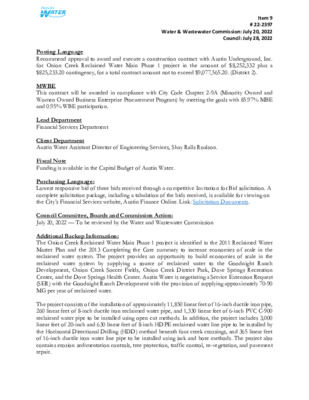
Item 9 # 22-2397 Water & Wastewater Commission: July 20, 2022 Council: July 28, 2022 Posting Language Recommend approval to award and execute a construction contract with Austin Underground, Inc. for Onion Creek Reclaimed Water Main Phase 1 project in the amount of $8,252,332 plus a $825,233.20 contingency, for a total contract amount not to exceed $9,077,565.20. (District 2). MWBE This contract will be awarded in compliance with City Code Chapter 2-9A (Minority Owned and Women Owned Business Enterprise Procurement Program) by meeting the goals with 85.97% MBE and 0.95% WBE participation. Lead Department Financial Services Department Client Department Austin Water Assistant Director of Engineering Services, Shay Ralls Roalson. Fiscal Note Funding is available in the Capital Budget of Austin Water. Purchasing Language: Lowest responsive bid of three bids received through a competitive Invitation for Bid solicitation. A complete solicitation package, including a tabulation of the bids received, is available for viewing on the City’s Financial Services website, Austin Finance Online. Link: Solicitation Documents. Council Committee, Boards and Commission Action: July 20, 2022 — To be reviewed by the Water and Wastewater Commission Additional Backup Information: The Onion Creek Reclaimed Water Main Phase 1 project is identified in the 2011 Reclaimed Water Master Plan and the 2013 Completing the Core summary to increase economies of scale in the reclaimed water system. The project provides an opportunity to build economies of scale in the reclaimed water system by supplying a source of reclaimed water to the Goodnight Ranch Development, Onion Creek Soccer Fields, Onion Creek District Park, Dove Springs Recreation Center, and the Dove Springs Health Center. Austin Water is negotiating a Service Extension Request (SER) with the Goodnight Ranch Development with the provision of supplying approximately 70-90 MG per year of reclaimed water. The project consists of the installation of approximately 11,850 linear feet of 16-inch ductile iron pipe, 260 linear feet of 8-inch ductile iron reclaimed water pipe, and 1,330 linear feet of 6-inch PVC C-900 reclaimed water pipe to be installed using open cut methods. In addition, the project includes 3,000 linear feet of 20-inch and 630 linear feet of 8-inch HDPE reclaimed water line pipe to be installed by the Horizontal Directional Drilling (HDD) method beneath four creek crossings, and 365 linear feet of 16-inch ductile iron water line pipe to be installed using jack and bore methods. The project also contains erosion sedimentation controls, tree protection, …
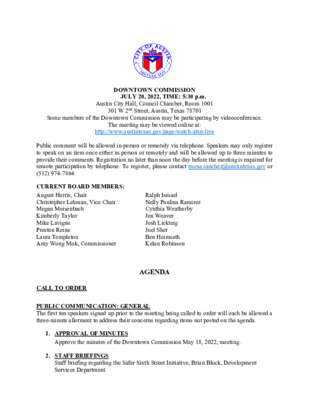
DOWNTOWN COMMISSION JULY 20, 2022, TIME: 5:30 p.m. Austin City Hall, Council Chamber, Room 1001 301 W 2nd Street, Austin, Texas 78701 Some members of the Downtown Commission may be participating by videoconference. The meeting may be viewed online at: http://www.austintexas.gov/page/watch-atxn-live Public comment will be allowed in-person or remotely via telephone. Speakers may only register to speak on an item once either in-person or remotely and will be allowed up to three minutes to provide their comments. Registration no later than noon the day before the meeting is required for remote participation by telephone. To register, please contact mona.sanchez@austintexas.gov or (512) 974-7864. CURRENT BOARD MEMBERS: August Harris, Chair Christopher Lehman, Vice Chair Megan Meisenbach Kimberly Taylor Mike Lavigne Preston Reine Laura Templeton Amy Wong Mok, Commissioner CALL TO ORDER Ralph Ismael Nelly Paulina Ramirez Cynthia Weatherby Jen Weaver Josh Lickteig Joel Sher Ben Heimsath Kelan Robinson AGENDA PUBLIC COMMUNICATION: GENERAL The first ten speakers signed up prior to the meeting being called to order will each be allowed a three-minute allotment to address their concerns regarding items not posted on the agenda. 1. APPROVAL OF MINUTES Approve the minutes of the Downtown Commission May 18, 2022, meeting. 2. STAFF BRIEFINGS Staff briefing regarding the Safer Sixth Street Initiative, Brian Block, Development Services Department. 3. DISCUSSION AND ACTION ITEMS a. Discussion and possible action on the City of Austin Arts in Public Places Program b. Discussion and possible action on the Safer Sixth Street Initiative c. Discussion and possible action on the Downtown Commission Annual Internal Review and Report 4. DISCUSSION ITEMS a. Discussion of recent activities and actions taken by the Design Commission b. Discussion of recent activities and actions taken by the Historic Landmark c. Discussion of recent activities and actions taken by the Urban Transportation d. Discussion of recent activities and actions taken by the Arts Commission e. Discussion of recent activities and actions taken by the Music Commission f. Discussion of recent activities and actions taken by the Parks & Recreation Board g. Discussion of recent activities and actions taken by the Public Safety Commission Commission Commission 5. WORKING GROUP/COMMITTEE UPDATES a. Update from Convention Center Expansion Working Group 6. FUTURE AGENDA ITEMS ADJOURNMENT The City of Austin is committed to compliance with the American with Disabilities Act. Reasonable modifications and equal access to communications will be provided upon request. Meeting locations are planned with wheelchair access. …
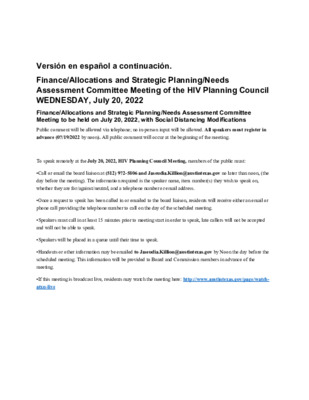
Versión en español a continuación. Finance/Allocations and Strategic Planning/Needs Assessment Committee Meeting of the HIV Planning Council WEDNESDAY, July 20, 2022 Finance/Allocations and Strategic Planning/Needs Assessment Committee Meeting to be held on July 20, 2022, with Social Distancing Modifications Public comment will be allowed via telephone; no in-person input will be allowed. All speakers must register in advance (07/19/2022 by noon). All public comment will occur at the beginning of the meeting. To speak remotely at the July 20, 2022, HIV Planning Council Meeting, members of the public must: •Call or email the board liaison at (512) 972-5806 and Jaseudia.Killion@austintexas.gov no later than noon, (the day before the meeting). The information required is the speaker name, item number(s) they wish to speak on, whether they are for/against/neutral, and a telephone number or email address. •Once a request to speak has been called in or emailed to the board liaison, residents will receive either an email or phone call providing the telephone number to call on the day of the scheduled meeting. •Speakers must call in at least 15 minutes prior to meeting start in order to speak, late callers will not be accepted and will not be able to speak. •Speakers will be placed in a queue until their time to speak. •Handouts or other information may be emailed to Jaseudia.Killion@austintexas.gov by Noon the day before the scheduled meeting. This information will be provided to Board and Commission members in advance of the meeting. •If this meeting is broadcast live, residents may watch the meeting here: http://www.austintexas.gov/page/watch- atxn-live la junta en Reunión del Finance/Allocations Meeting of the HIV Planning Council Miercoles, 20 de Julio, 2022 FECHA de la reunion (20 de Julio, 2022) La junta se llevará con modificaciones de distanciamiento social Se permitirán comentarios públicos por teléfono; no se permitirá ninguna entrada en persona. Todos los oradores deben registrarse con anticipación (07/19/22 antes del mediodía). Todos los comentarios públicos se producirán al comienzo de la reunión. Para hablar de forma remota en la reunión, los miembros del público deben: • Llame o envíe un correo electrónico al enlace de (512) 972-5806 and Jaseudia.Killion@austintexas.gov a más tardar al mediodía (el día antes de la reunión). La información requerida es el nombre del orador, los números de artículo sobre los que desean hablar, si están a favor / en contra / neutrales, y un número de teléfono o dirección de correo …
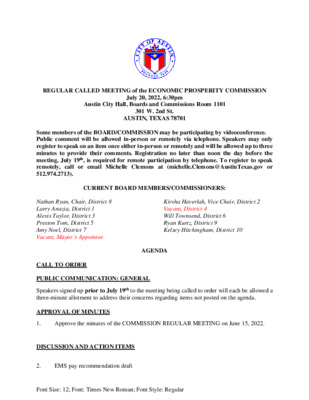
1. 2. REGULAR CALLED MEETING of the ECONOMIC PROSPERITY COMMISSION July 20, 2022, 6:30pm Austin City Hall, Boards and Commissions Room 1101 301 W. 2nd St. AUSTIN, TEXAS 78701 Some members of the BOARD/COMMISSION may be participating by videoconference. Public comment will be allowed in-person or remotely via telephone. Speakers may only register to speak on an item once either in-person or remotely and will be allowed up to three minutes to provide their comments. Registration no later than noon the day before the meeting, July 19th, is required for remote participation by telephone. To register to speak remotely, call or email Michelle Clemons at (michelle.Clemons@AustinTexas.gov or 512.974.2713). CURRENT BOARD MEMBERS/COMMISSIONERS: Nathan Ryan, Chair, District 8 Larry Anazia, District 1 Alexis Taylor, District 3 Preston Tom, District 5 Amy Noel, District 7 Vacant, Mayor’s Appointee CALL TO ORDER Kirsha Haverlah, Vice Chair, District 2 Vacant, District 4 Will Townsend, District 6 Ryan Kurtz, District 9 Kelsey Hitchingham, District 10 AGENDA PUBLIC COMMUNICATION: GENERAL Speakers signed up prior to July 19th to the meeting being called to order will each be allowed a three-minute allotment to address their concerns regarding items not posted on the agenda. APPROVAL OF MINUTES Approve the minutes of the COMMISSION REGULAR MEETING on June 15, 2022. DISCUSSION AND ACTION ITEMS EMS pay recommendation draft Font Size: 12; Font: Times New Roman; Font Style: Regular WORKING GROUP/COMMITTEE UPDATES (Discussion & possible action) 3. 4. City of Austin 2022-2023 budget from the Commissioners Update from Intercommission Committee representatives Update from EPC representative Alexis Taylor on the Joint Sustainability Commission a. Rain to River Presentation b. Zero Waste and Circular Economy Presentation c. Austin Regional Food Plan d. Fayette Power Plant Recommendation Update from Reproductive Health Working Group 5. WORKING GROUP RECOMMENDATIONS (Discussion & possible action) EPC commissioner survey results related to 2022 agenda focuses Report of recommendations by Joint Suitability Committee Report of recommendations for Joint Cultural Committee Creation of additional working groups if needed. 6. 7. 8. FUTURE AGENDA ITEMS 9. ADJOURNMENT The City of Austin is committed to compliance with the American with Disabilities Act. Reasonable modifications and equal access to communications will be provided upon request. Meeting locations are planned with wheelchair access. If requiring Sign Language Interpreters or alternative formats, please give notice at least 2 days (48 hours) before the meeting date. Please call Michelle Clemons at Economic Development Department, at (512.974.2713), for …