
REGULAR MEETING OF THE JOINT SUSTAINABILITY COMMITTEE WEDNESDAY, October 28rd, 2026, AT 6 PM CITY HALL, COUNCIL CHAMBERS 301 W 2ND ST AUSTIN, TEXAS 78701 Some members of the Joint Sustainability Committee may be participating by videoconference. The meeting may be viewed online at: http://www.austintexas.gov/page/watch-atxn-live Public comment will be allowed in-person or remotely via telephone. Speakers may only register to speak on an item once either in-person or remotely and will be allowed up to three minutes to provide their comments. Registration no later than noon the day before the meeting is required for remote participation by remotely, contact Amanda Mortl (amanda.mortl@austintexas.gov or 512-974-2651). telephone. To to speak register CURRENT JOINT SUSTAINABILITY COMMITTEE MEMBERS Home Commission Member Alternate Electric Utility Commission Kaiba White (Chair) Al Braden Economic Prosperity Commission Aaron Gonzales (Vice- Chair) Zain Pleuthner Resource Management Commission Charlotte Davis GeNell Gary Urban Transportation Commission Varun Prasad Justin Jacobson Environmental Commission Haris Qureshi Zero Waste Advisory Commission Iris Suddaby Community Development Commission Jo Anne Ortiz Richard Brimer Caitlin Griffith Valerie Menard Austin Travis County Food Policy Board Melody McClary Marissa Bell Water & Wastewater Commission Chris Maxwell-Gaines Michael "Mike" Reyes Parks & Recreation Board Luai Abou-Emara Shelby Orme Design Commission Planning Commission Austin/Travis County Public Health Commission City Council Mayor’s Representative Mayor’s Representative Jon Salinas Josh Hiller Vacant Vacant Rodrigo Leal Anna Scott Mayor’s Representative Mridula Madipakkam Mayor’s Representative Chris Campbell Mayor’s Representative Diana Wheeler Evgenia Murkes Peter Breton Vacant Vacant N/A N/A N/A N/A N/A AGENDA CALL TO ORDER PUBLIC COMMUNICATION: GENERAL The first 10 speakers signed up prior to the meeting being called to order will each be allowed a three- minute allotment to address their concerns regarding items not posted on the agenda. APPROVAL OF MINUTES 1. Approve the minutes of the Joint Sustainability Committee Meeting on September 23rd, 2026. STAFF BRIEFINGS 2. 3. 4. Staff briefing on Austin Fleet Electrification Process. Presentation by Rick Harland, Deputy Director, Austin Fleet Mobility Services Staff briefing on the Austin Climate Revolving Fund. Presentation by Phillip Duran, Senior Climate Analyst, Austin Climate Action and Resilience Staff Briefing on Austin Zoning process introduction. Presentation by Jonathan Tomko, AICP, Planner Principal, Austin Planning HOME COMMISSION UPDATES 5. Community Solar meeting report by Kaiba White, Electric Utility Commission FUTURE AGENDA ITEMS ADJOURNMENT The City of Austin is committed to compliance with the Americans with Disabilities Act. Reasonable modifications and equal access to communications …

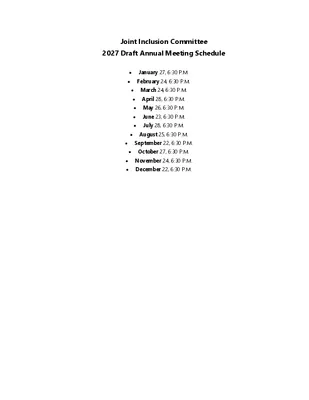
REGULAR MEETING OF THE JOINT INCLUSION COMMITTEE WEDNESDAY, OCTOBER 28, 2026, 6:00 P.M. PERMITTING AND DEVELOPMENT CENTER, ROOM 1401/1402 6310 WILHELMINA DELCO DR AUSTIN, TEXAS Some members of the Joint Inclusion Committee may be participating by videoconference. Public comment will be allowed in-person or remotely via telephone. Speakers may only register to speak on an item once either in-person or remotely and will be allowed up to three minutes to provide their comments. Registration no later than noon the day before the meeting is required for remote participation by telephone. To register to speak remotely, contact Ryan Sperling, 512-974-3568, ryan.sperling@austintexas.gov CURRENT COMMITTEE MEMBERS: Primary Representative: Justin Parsons (Chair) Nirali J Thakkar Member Commission: African American Resource Advisory Commission Asian American Quality of Life Advisory Commission Tasha Billett Commission for Women Commission on Aging Richard Bondi Commission on Immigrant Affairs Diane Kanawati Commission on Veterans Affairs Early Childhood Council Hispanic/Latino Quality of Life Resource Advisory Commission Human Rights Commission LGBTQ Quality of Life Advisory Commission Mayor’s Committee for People with Disabilities Cameron Wilson VACANT Amanda Afifi Tannya Oliva-Martínez Jerry Joe Benson (Vice Chair) Lisa Chang Alternate Representative: Alexandria Anderson VACANT Alicia Ramirez Teresa Ferguson Azeem Edwin VACANT Delphi Alvizo Dulce Castañeda Lila Igram Asher Knutson Gabriel Arrellano AGENDA CALL TO ORDER PUBLIC COMMUNICATION: GENERAL The first ten speakers signed up prior to the meeting being called to order will each be allowed a three-minute allotment to address their concerns regarding items not posted on the agenda. APPROVAL OF MINUTES 1. Approve the minutes of the Joint Inclusion Committee regular meeting on September 23, 2026. STAFF BRIEFINGS 2. Briefing regarding progress on the development of the Central City District Plan. [Olivia Beams, Senior Planner and Romina Tafazzoli, Senior Planner, Austin Planning.] DISCUSSION ITEMS 3. Mayor’s Committee for People with Disabilities update, including accomplishments over the last year, current projects, and future goals. 4. Discussion regarding Austin Police Department’s protocols regarding ADA compliance, medical aid, and accommodations when assisting on transferring individuals with disabilities or those injure during an arrest to ICE custody. 5. Discussion regarding the Open Government Partnership and potential collaborations. DISCUSSION AND ACTION ITEMS 6. Discuss potential meeting locations for next year and approve the Joint Inclusion Committee’s 2027 Annual Meeting Schedule. FUTURE AGENDA ITEMS ADJOURNMENT The City of Austin is committed to compliance with the Americans with Disabilities Act. Reasonable modifications and equal access to communications will be provided …

JOINT INCLUSION COMMITTEE MEETING MINUTES WEDNESDAY, SEPTEMBER 23, 2026 JOINT INCLUSION COMMITTEE REGULAR MEETING MINUTES WEDNESDAY, SEPTEMBER 23, 2026 The Joint Inclusion Committee convened in a regular meeting on Wednesday, September 23, 2026, at the Permitting and Development Center, 6310 Wilhelmina Delco Dr.. in Austin, Texas. Chair Parsons called the Joint Inclusion Meeting to order at 6:04 p.m. Commissioners in Attendance: Justin Parsons (Chair) Jerry Joe Benson (Vice Chair) Richard Bondi Commissioners in Attendance Remotely: Amanda Afifi Lisa Chang Diane Kanawati Tannya Oliva-Martínez Nirali Thakkar PUBLIC COMMUNICATION: GENERAL None. APPROVAL OF MINUTES 1. 2. Approve the minutes of the Joint Inclusion Committee regular meeting on August 26, 2026. Items 1 and 2 were taken up at the same time. The August 26, 2026 minutes were approved on Commissioner Bondi’s motion, Commissioner Chang’s second on a 7-0 vote. Vice Chair Benson was off the dais. Commissioners Alvizo, McNary, and Ramirez were absent. Approve the minutes of the Joint Inclusion Committee special called meeting on August 12, 2026. Items 1 and 2 were taken up at the same time. 1 JOINT INCLUSION COMMITTEE MEETING MINUTES WEDNESDAY, SEPTEMBER 23, 2026 The August 12, 2026 minutes were approved on Commissioner Bondi’s motion, Commissioner Chang’s second on a 7-0 vote. Vice Chair Benson was off the dais. Commissioners Alvizo, McNary, and Ramirez were absent. STAFF BRIEFINGS 3. Staff briefing regarding the Creative Reset Phase II: Reimagining Austin’s Cultural Facilities and Museums. Briefing by Candice Cooper, Interim Chief Administrative Officer, ACME. The briefing was made by Candice Cooper, Interim Chief Administrative Officer, and Matrex Kilgore, Division Manager, Cultural Education & Programs, ACME. DISCUSSION ITEMS 4. 5. Discussion regarding the final schedule for home commission updates to the Joint Inclusion Committee. Discussion was held. Discussion regarding potential meeting dates and times for next year’s annual schedule. Discussion was held. WORKING GROUP RECOMMENDATIONS 6. Report from the FY2026-27 Budget Follow-Up Working Group regarding the status of budget recommendations. Report by Vice Chair Benson. DISCUSSION AND ACTION ITEMS 7. Approve a recommendation regarding recognition of recent Austin Police Department shooting and supporting measures to provide public accountability. There was a motion by Vice Chair Benson, seconded by Commissioner Thakkar, to amend the recommendation to insert: “5. Austin City Council should urge the City Manager to direct the Austin Police Department to conduct a comprehensive evaluation of its existing de-escalation training, policies, and procedures and to prioritize improvements where deficiencies …
Central City District Plan Austin Planning | October 2026 Team Introductions Shanisha Johnson, PMP Project Lead/Principal Planner, City of Austin Romina Tafazzoli GIS Analyst/Senior Planner, City of Austin Chris Ryerson Division Manager, City of Austin Olivia Beams Senior Planner, City of Austin 2 Agenda 01 About the Project 02 Feedback to Future 03 Key Plan Content 04 Next Steps 3 About the Project Central City District Plan Lamar Blvd. University Area Downtown Austin I-35 South Central Waterfront About the Central City District Plan The 2011 Downtown Austin Plan is being updated as the Central City District Plan, including the University of Texas area and the South Central Waterfront. The Plan will create a 10-year blueprint for future growth and investments with a unified vision for improving land use, mobility, public spaces, and economic and cultural vibrancy in our urban core. It will align with existing citywide strategic plans and policies and seeks to build consensus for effective implementation. What Will This Plan Achieve? Community-informed vision and goals Place Types mapping to inform future development patterns Public realm and multimodal improvements Program, policy, project, and partnership recommendations Implementation Strategies 5 Plan Alignment Comprehensive Plan •Citywide guidance to foster a complete city •Citywide land use vision: Place Types Map Citywide Initiatives District Plans Small Area Plans •Recent Council policy frameworks for housing, transportation, and more •Citywide strategies applied to smaller areas in Austin •Plans for specific sites, such as high-capacity transit station areas or Downtown’s Palm District 6 From Feedback to the Future Vision on the Ground Future of the Central City District Vision, Goals, Objectives, and Actions Online surveys, popups, and community open houses Stakeholder Advisory Group feedback Planning analysis Imagine Austin Place Types Existing projects and policies Interagency Technical Advisory Group feedback Central City District Plan 8 Growth Concept Map Existing Character: Areas expected to generally maintain their existing character and development pattern. Mid to High Density Mixed Use: Areas expected to accommodate the greatest residential growth while supporting existing nonresidential uses, particularly around light rail expansion and other infrastructure investments. Cultural & Entertainment: Areas that reinforce Austin’s cultural and entertainment focus, with development supporting community events, activities, retail, and dining. Transitional Mixed Use: Areas that provide transitions in development intensity through a mix of uses and densities, while maintaining existing scale and adapting existing structures where appropriate Adaptive Reuse: Areas with concentrations …
REGULAR MEETING OF THE ETHICS REVIEW COMMISSION OCTOBER 28, 2026, AT 6:00 P.M. AUSTIN CITY HALL, BOARDS & COMMISSIONS ROOM, #1101 301 W 2ND STREET AUSTIN, TEXAS 78701 Some members of the Ethics Review Commission may be participating by videoconference. The meeting may be viewed online at: http://www.austintexas.gov/page/watch-atxn-live Public comment will be allowed in-person or remotely via telephone. Speakers may only register to speak on an item once, either in-person or remotely, and will be allowed up to three minutes to provide their comments. Registration no later than noon the day before the meeting is required for remote participation by telephone. To register to speak remotely, contact Lizette Benitez at (512) 974-2915 or Lizette.benitez@austintexas.gov. CURRENT COMMISSIONERS: William Ross Pumfrey, Chair Luis Figueroa Haksoon Andrea Low Cynthia Soliz Brittany Sharkey, Vice Chair Patrick Keel Lyssa Zotlen Jeffrey Campbell Michael Lawson William King Brian McGiverin AGENDA CALL TO ORDER PUBLIC COMMUNICATION: GENERAL The first 10 speakers signed up prior to the meeting being called to order will each be allowed a three- minute allotment to address their concerns regarding items not posted on the agenda. APPROVAL OF MINUTES 1. Approve the minutes of the Ethics Review Commission Special Called Meeting on September 23, 2026. BRIEFINGS 2. Briefing from the Austin City Auditor’s Office regarding its duties and procedures and potential role in providing investigation assistance to the Ethics Review Commission. DISCUSSION AND ACTION ITEMS 3. Set and adopt the Ethics Review Commission regular meeting calendar for 2027. Page 1 of 2 FUTURE AGENDA ITEMS ADJOURNMENT The City of Austin is committed to compliance with the Americans with Disabilities Act. Reasonable modifications and equal access to communications will be provided upon request. For assistance, please contact the Liaison or TTY users’ route through 711. A person may request language access accommodations no later than 48 hours before the scheduled meeting. Please call or email Lizette Benitez or Victoria Hayslett at the Law Department, at (512) 974-2518, to request service or for additional information; TTY users’ route through Relay Texas at 711. For more information on the Ethics Review Commission, please contact Victoria Hayslett at (512) 974-2518. For the 2026 meeting schedule, agendas, and additional information about the Commission, see: Ethics Review Commission | AustinTexas.gov. ERC STANDARD PUBLIC COMMUNICATION INSTRUCTIONS NOTICE Regarding Public Communication Sign-in required: If appearing in person at the meeting, please sign in to speak with the staff liaison prior to …
REGULAR MEETING OF THE BUILDING AND STANDARDS COMMISSION WEDNESDAY, OCTOBER 28, 2026, AT 6:30 P.M. PERMITTING AND DEVELOPMENT CENTER, ROOM 1405 6310 WILHELMINA DELCO DRIVE AUSTIN, TEXAS Some members of the Building and Standards Commission may be participating by videoconference. The meeting may be viewed online at: http://www.austintexas.gov/page/watch-atxn-live Public comment will be allowed in-person or remotely via telephone. Speakers may only register to speak on an item once either in-person or remotely and will be allowed up to three minutes to provide their comments. Registration no later than noon the day before the meeting is required for remote participation by telephone. To register to speak remotely, contact Melanie Alley, 512-974-2679, dsdcredbsc@austintexas.gov. CURRENT COMMISSIONERS: Michael Francis, Chair Lisa Garza Myra Martinez Carrie Stewart, Fire Marshal (Ex Officio) Jeffrey Musgrove, Vice Chair Grant Gilker Manesh Nair Harrison Brown Mia Ibarra Raisch Tomlanovich AGENDA CALL TO ORDER PUBLIC COMMUNICATION: GENERAL The first five speakers signed up prior to the meeting being called to order will each be allowed a three- minute allotment to address their concerns regarding items not posted on the agenda. APPROVAL OF MINUTES 1. Approve the minutes of the Building and Standards Commission Regular meeting on September 23, 2026. PUBLIC HEARINGS New Case(s) The Commission will hear the following cases concerning alleged violations of the City’s Property Maintenance Code and may issue an order to vacate, relocate occupants, repair, demolish, or secure the premises; and may assess civil penalties: 2. Case Number: CL 2026-041399 Property address: 11215 Prairie Dove Circle / Owner: Lloyd Alan Ewing Staff presenter: Christopher McFarland Staff recommendation: Repair fire-damaged residential structure 3. 4. 5. Case Number: CL 2026-084049 Property address: 7307 Fire Cove / Owner: Stephen V. Jacobs Staff presenter: Jose Castillo Staff recommendation: Demolish fire-damaged residential structure Case Number: CL 2026-094450 Property address: 7306 Bethune Avenue / Owner: Carolyn Ward Staff presenter: Jason Henley Staff recommendation: Demolish fire-damaged residential structure Case Number: CL 2026-114601 Property address: 10304 Brownie Drive Owner: Andy Tong aka Thinh Tong Staff presenter: Courtney Britt Staff recommendation: Repair commercial multi-family structure Returning Case(s) The Commission will hear the following cases concerning alleged violations of the City’s Property Maintenance Code and may issue an order to vacate, relocate occupants, repair, demolish, or secure the premises; and may assess or modify a civil penalty: 6. 7. 8. Case Number: CL 2026-026484 Property address: 1015 E 10th Street, aka 916 Waller Street / Owner: …
REGULAR MEETING OF THE BUILDING AND STANDARDS COMMISSION WEDNESDAY, OCTOBER 28, 2026, AT 6:30 P.M. PERMITTING AND DEVELOPMENT CENTER, ROOM 1405 6310 WILHELMINA DELCO DRIVE AUSTIN, TEXAS Some members of the Building and Standards Commission may be participating by videoconference. The meeting may be viewed online at: http://www.austintexas.gov/page/watch-atxn-live Public comment will be allowed in-person or remotely via telephone. Speakers may only register to speak on an item once either in-person or remotely and will be allowed up to three minutes to provide their comments. Registration no later than noon the day before the meeting is required for remote participation by telephone. To register to speak remotely, contact Melanie Alley, 512-974-2679, dsdcredbsc@austintexas.gov. CURRENT COMMISSIONERS: Michael Francis, Chair Lisa Garza Myra Martinez Carrie Stewart, Fire Marshal (Ex Officio) Jeffrey Musgrove, Vice Chair Grant Gilker Manesh Nair Harrison Brown Mia Ibarra Raisch Tomlanovich REVISED AGENDA CALL TO ORDER PUBLIC COMMUNICATION: GENERAL The first five speakers signed up prior to the meeting being called to order will each be allowed a three- minute allotment to address their concerns regarding items not posted on the agenda. APPROVAL OF MINUTES 1. Approve the minutes of the Building and Standards Commission Regular meeting on September 23, 2026. PUBLIC HEARINGS New Case(s) The Commission will hear the following cases concerning alleged violations of the City’s Property Maintenance Code and may issue an order to vacate, relocate occupants, repair, demolish, or secure the premises; and may assess civil penalties: 2. Case Number: CL 2026-041399 Property address: 11215 Prairie Dove Circle / Owner: Lloyd Alan Ewing Staff presenter: Christopher McFarland Staff recommendation: Repair fire-damaged residential structure 3. 4. 5. Case Number: CL 2026-084049 Property address: 7307 Fire Cove / Owner: Stephen V. Jacobs Staff presenter: Jose Castillo Staff recommendation: Demolish fire-damaged residential structure Case Number: CL 2026-094450 Property address: 7306 Bethune Avenue / Owner: Carolyn Ward Staff presenter: Jason Henley Staff recommendation: Demolish fire-damaged residential structure Case Number: CL 2026-114601 Property address: 10304 Brownie Drive Owner: Andy Tong aka Thinh Tong Staff presenter: Courtney Britt Staff recommendation: Repair fire-damaged commercial multi-family structure Returning Case(s) The Commission will hear the following cases concerning alleged violations of the City’s Property Maintenance Code and may issue an order to vacate, relocate occupants, repair, demolish, or secure the premises; and may assess or modify a civil penalty: 6. 7. 8. Case Number: CL 2026-026484 Property address: 1015 E 10th Street, aka 916 Waller Street …
REGULAR MEETING OF THE PLANNING COMMISSION TUESDAY, OCTOBER 27, 2026, AT 6 P.M. AUSTIN CITY HALL, COUNCIL CHAMBERS, ROOM 1001 301 WEST 2ND STREET AUSTIN, TEXAS Some members of the Planning Commission may be participating by videoconference. The meeting may be viewed online at: http://www.austintexas.gov/page/watch-atxn-live Public comment will be allowed in-person or remotely via telephone. Speakers may only register to speak on an item once either in-person or remotely and will be allowed up to three minutes to provide their comments. Registration no later than 2 p.m. on the day of the meeting is required for remote participation by telephone. To register to speak remotely, please use the QR code or link at the end of this document. If you have questions regarding speaker registration, please contact Ella Garcia, Staff Liaison, at LandUseLiaison@austintexas.gov or by phone at 512-978-0821. CURRENT COMMISSIONERS: Alice Woods, Chair (District 2) Casey Haney, Vice Chair (Mayor’s Representative) Felicity Maxwell, Secretary (District 5) Imad Ahmed, Parliamentarian (District 6) Anna Lan (Mayor’s Representative) Kyndel Bennett (Mayor’s Representative) Chris Gannon (District 1) EX-OFFICIO MEMBERS: Nadia Barrera-Ramirez (District 3) Brian Bedrosian (District 4) Adam Powell (District 7) Peter Breton (District 8) Danielle Skidmore (District 9) Joshua Hiller (District 10) Jeffery Bowen, Chair of Board of Adjustment TC Broadnax, City Manager Candace Hunter, A.I.S.D. Board of Trustees Richard Mendoza, Director of Transportation and Public Works Staff Liaison: Destiny Brown, 512-974-7196 Attorney: Steve Maddoux, 512-974-6080 Page 1 of 8 AGENDA CALL TO ORDER PUBLIC COMMUNICATION: GENERAL The first four speakers signed up prior to the meeting being called to order will each be allowed a three-minute allotment to address their concerns regarding items not posted on the agenda. APPROVAL OF MINUTES 1. Approve the minutes of the Planning Commission regular meeting on Tuesday, October 13, 2026. PUBLIC HEARINGS 2. Plan Amendment: NPA-2025-0018.02 - Airport and Koenig Multifamily; District 4 Location: 5768 ½, 5800, 5826, 5900, 5900 ½, and 5908 Airport Boulevard, Tannehill Branch Watershed; Brentwood/Highland Combined Neighborhood Planning Area Owner/Applicant: Caliber Partners LLC, a Texas limited liability company; Anchor-SH, LLC, a Texas limited liability company, and 5800 Airport, LLC, a Texas limited liability company DuBois, Bryant & Campbell, L.L.P. (David Hartman) Commercial to Mixed Use land use Recommendation pending Maureen Meredith, 512-974-2695, maureen.meredith@austintexas.gov Austin Planning Agent: Request: Staff Rec.: Staff: 3. Rezoning: Location: C14-2025-0115 - Airport and Koenig Multifamily; District 4 5768 ½, 5800, 5826, 5900, 5900 ½, and 5908 Airport Boulevard, …
SPEAKER REGISTRATION All participants wishing to address the commission must register to speak. Public participation is available by teleconference or in-person. Presentations and handouts are requested to be e- mailed by 1:00 p.m. on the day of the meeting. TELECONFERNCE REGISTRATION Registration for participation by teleconference closes at 2:00 p.m., the day of the meeting. Teleconference code and additional information to be provided after the closing of the teleconference registration period. IN-PERSON REGISTRATION While in-person registrants are encouraged to register in advance of the meeting, in-person registration closes at 5:30 p.m., the day of the meeting. Please scan the QR code below with a mobile device or click on the link below. Mobile devices will also be available at the meeting for public use for the purpose of speaker registration. SPEAKER DONATION OF TIME For discussion cases, speaker donation of time is an available option for in-person participants. Both the registered speaker donating time and the speaker recipient must be present when the public hearing is conducted. See chart below regarding speaker time allotments. SPEAKING ORDER The speaking order is determined by the order in which individuals register to speak and is conducted on a first-come, first-served basis. If multiple speakers register as the Primary Speaker, the first to register is allotted the additional speaking time. Participants who are part of a group or organization and wish to request a specific speaking order must contact Ella Garcia, Staff Liaison, at LandUseLiaison@austintexas.gov or 512-978-0821 as soon as possible, and no later than 2:00 p.m. on the day of the meeting. Click on the link below or scan the QR code and submit the form to register to speak. Speakers should submit a separate registration form for each item of interest. https://forms.office.com/g/W9r6dSSkUG SPEAKER TESTIMONY TIME ALLOCATION PUBLIC HEARING CASES – CONSENT ITEMS *Donation of time is not an option for consent items. All speakers in favor or opposed 2 minutes each PUBLIC HEARING CASES – DISCUSSION ITEMS The applicant/speaker designated by the applicant or the primary speaker in favor Primary speaker opposed All other speakers in favor or opposed 5 minutes; up to 9 minutes total with donated time, plus a 2 minute rebuttal 5 minutes; up to 9 minutes total with donated time 2 minutes each; up to 6 minutes total with donated time DISCUSSION POSTPONEMENT *Donation of time is not an option for discussion postponement. The applicant/speaker designated by the …
City of Austin Austin Planning 6310 Wilhelmina Delco Drive, Austin, TX 78752 P.O. Box 1088, Austin, TX 78767-1088 (512) 974-2000 ♦ h ttp s:/ / w w w.au st in tex a s .g ov / d epar tm e n t/ plan n in g- de part men t MEMORANDUM TO: Alice Woods, Chair & Planning Commission Members FROM: Maureen Meredith, Senior Planner, Long-Range Planning Division Jonathan Tomko, Principal Planner, Current Planning Division Austin Planning DATE: October 21, 2026 RE: NPA-2025-0018.02 and C14-2025-0115 5768 ½, 5800, 5826, 5900, 5900 ½, and 5908 AIRPORT BLVD Brentwood/Highland Combined Planning Area The Applicant requests a postponement of the above-referenced cases from the October 27, 2026 Planning Commission hearing to the December 8, 2026 hearing date. Please see attached email from David Hartman. Please contact Maureen Meredith at Maureen.Meredith@austintexas.gov or at (512) 974-2695 if you have any questions. The postponement request was made in a timely manner and meets the Planning Commission’s policy. Attachments: David Hartman’s email Plan Amendment Map Zoning Map The City of Austin is committed to compliance with the Americans with Disabilities Act and will provide reasonable modifications and equal access to communications upon request. 02 NPA-2025-0018.02 - Airport and Koenig Multifamily; District 41 of 4 From: David Hartman < Sent: Wednesday, October 21, 2026 1:24 PM To: Tomko, Jonathan <Jonathan.Tomko@austintexas.gov> Cc: Meredith, Maureen <Maureen.Meredith@austintexas.gov> Subject: RE: Airport & Koenig Cases (C14-2025-0115, NPA-2025-0018.02) - Applicant Postponement from 10-27-26 PC mtg. to 12-8-26 PC mtg. Good afternoon: I just learned that the 11-17-26 PC mtg. is scheduled to be a “consent only” meeting that will occur at 5pm. In light of that fact, I respectfully request that these cases be postponed from the 10-27-26 PC mtg. to the 12-8-26 PC mtg. (rather than postponing to the 11-17-26 PC mtg). Best, David David Hartman Partner DuBOIS BRYANT & CAMPBELL 303 Colorado, Suite 2300 Austin, TX 78701 O:(512) 457-8000 D:(512) 685-3409 M:(512) 297-5640 F:(512) 457-8008 bio vcard The City of Austin is committed to compliance with the Americans with Disabilities Act and will provide reasonable modifications and equal access to communications upon request. 02 NPA-2025-0018.02 - Airport and Koenig Multifamily; District 42 of 4 The City of Austin is committed to compliance with the Americans with Disabilities Act and will provide reasonable modifications and equal access to communications upon request. 02 NPA-2025-0018.02 - Airport and Koenig Multifamily; District 43 of 4 The City …
City of Austin Austin Planning 6310 Wilhelmina Delco Drive, Austin, TX 78752 P.O. Box 1088, Austin, TX 78767-1088 (512) 974-2000 ♦ h ttp s:/ / w w w.au st in tex a s .g ov / d epar tm e n t/ plan n in g- de part men t MEMORANDUM TO: Alice Woods, Chair & Planning Commission Members FROM: Maureen Meredith, Senior Planner, Long-Range Planning Division Jonathan Tomko, Principal Planner, Current Planning Division Austin Planning DATE: October 21, 2026 RE: NPA-2025-0018.02 and C14-2025-0115 5768 ½, 5800, 5826, 5900, 5900 ½, and 5908 AIRPORT BLVD Brentwood/Highland Combined Planning Area The Applicant requests a postponement of the above-referenced cases from the October 27, 2026 Planning Commission hearing to the December 8, 2026 hearing date. Please see attached email from David Hartman. Please contact Maureen Meredith at Maureen.Meredith@austintexas.gov or at (512) 974-2695 if you have any questions. The postponement request was made in a timely manner and meets the Planning Commission’s policy. Attachments: David Hartman’s email Plan Amendment Map Zoning Map The City of Austin is committed to compliance with the Americans with Disabilities Act and will provide reasonable modifications and equal access to communications upon request. 03 C14-2025-0115 - Airport and Koenig Multifamily; District 41 of 4 From: David Hartman < Sent: Wednesday, October 21, 2026 1:24 PM To: Tomko, Jonathan <Jonathan.Tomko@austintexas.gov> Cc: Meredith, Maureen <Maureen.Meredith@austintexas.gov> Subject: RE: Airport & Koenig Cases (C14-2025-0115, NPA-2025-0018.02) - Applicant Postponement from 10-27-26 PC mtg. to 12-8-26 PC mtg. Good afternoon: I just learned that the 11-17-26 PC mtg. is scheduled to be a “consent only” meeting that will occur at 5pm. In light of that fact, I respectfully request that these cases be postponed from the 10-27-26 PC mtg. to the 12-8-26 PC mtg. (rather than postponing to the 11-17-26 PC mtg). Best, David David Hartman Partner DuBOIS BRYANT & CAMPBELL 303 Colorado, Suite 2300 Austin, TX 78701 O:(512) 457-8000 D:(512) 685-3409 M:(512) 297-5640 F:(512) 457-8008 bio vcard The City of Austin is committed to compliance with the Americans with Disabilities Act and will provide reasonable modifications and equal access to communications upon request. 03 C14-2025-0115 - Airport and Koenig Multifamily; District 42 of 4 The City of Austin is committed to compliance with the Americans with Disabilities Act and will provide reasonable modifications and equal access to communications upon request. 03 C14-2025-0115 - Airport and Koenig Multifamily; District 43 of 4 The City …

-NEIGHBORHOOD PLAN AMENDMENT REVIEW SHEET NEIGHORHOOD PLAN: East Riverside/Oltorf Combined (Riverside) CASE#: NPA-2026-0021.03 DATE FILED: May 28, 2026 PROJECT NAME: 1221 S IH-35 Rezoning PC DATE: October 27, 2026 October 13, 2026 September 22, 2026 September 8, 2026 ADDRESS/ES: 1400 Lupine Lane DISTRICT AREA: 9 SITE AREA: 0.1518 acres OWNER/APPLICANT: Aztecas de Juventino Rosas, LLC AGENT: Husch Blackwell, LLP (Lindsey Walker) CASE MANAGER: Maureen Meredith PHONE: (512) 974-2695 STAFF EMAIL: Maureen.Meredith@austintexas.gov TYPE OF AMENDMENT: Change in Future Land Use Designation From: Single Family To: Commercial Base District Zoning Change Related Zoning Case: C14-2026-0040 (Nancy Estrada, Case Manager) From: SF-3-NP & LR-NP To: CS-NP NEIGHBORHOOD PLAN ADOPTION DATE: November 16, 2006 CITY COUNCIL DATE: TBD ACTION: 04 NPA-2026-0021.03 - 1221 S IH-35 Rezoning; District 91 of 48 PLANNING COMMISSION RECOMMENDATION: October 27, 2026 – (action pending) October 13, 2026 – Postponed to the October 13, 2026 hearing on the consent agenda at the request of the Applicant. [D. Skidmore – 1st; I. Ahmed – 2nd] Vote: 9-0 [C. Haney, A. Powell, and P. Breton absent. One vacancy on the dais.] September 22, 2026 – Postponed to the October 13, 2026 hearing on the consent agenda at the request of the Neighborhood. [B. Bedrosian – 1st; C. Haney – 2nd] Vote: 10-0 [F. Maxwell and A. Powell off the dais. One vacancy on the dais.] September 8, 2026 - Postponed to the September 22, 2026 hearing date on the consent agenda at the request of the Applicant. [C. Haney – 1st; F. Maxwell – 2nd] Vote: 11-0 [P. Breton absent. One vacancy on the dais.] STAFF RECOMMENDATION: Staff supports the applicant’s request for Commercial land use. BASIS FOR STAFF’S RECOMMENDATION: The zoning case includes two tracts, one at 1221 S IH-35 SVRD NB which has Commercial land use and is not part of the plan amendment application. The second tract is 1400 Lupine Lane which has Single Family land use and is proposed for Commercial land use which is consistent with the Commercial land use at 1221 S IH-35 SVRD NB. Staff supports the Applicant’s request for Commercial land use at 1400 Lupine Lane because the two tracts will be developed together for the proposed Transportation Terminal use. Although the proposed Commercial land use appears to be encroaching into a residential area, the property is essentially part of 1221 S IH-35 and is primarily a retaining wall that is not developable for …
City of Austin Austin Planning 6310 Wilhelmina Delco Drive, Austin, TX 78752 P.O. Box 1088, Austin, TX 78767-1088 (512) 974-2000 ♦ h ttp s:/ / w w w.au st in tex a s .g ov / d epa r tm e n t/ plan n in g - de part men t MEMORANDUM TO: Alice Woods, Chair & Planning Commission Members FROM: Maureen Meredith, Senior Planner, Long-Range Planning Division Austin Planning DATE: October 20, 2026 RE: NPA-2026-0023.01_3405 and 3405 1/2 Steck Ave Staff requests a postponement of the above-referenced case from the October 27, 2026 Planning Commission hearing to the November 10, 2026 hearing date. Please contact Maureen Meredith at Maureen.Meredith@austintexas.gov or at (512) 974-2695 if you have any questions. The postponement request was made in a timely manner and meets the Planning Commission’s policy. Attachment : Plan Amendment Property Map The City of Austin is committed to compliance with the Americans with Disabilities Act and will provide reasonable modifications and equal access to communications upon request. 06 NPA-2026-0031.01 - 3405 and 3405 ½ Steck Ave Rezoning; District 71 of 2 The City of Austin is committed to compliance with the Americans with Disabilities Act and will provide reasonable modifications and equal access to communications upon request. 06 NPA-2026-0031.01 - 3405 and 3405 ½ Steck Ave Rezoning; District 72 of 2
MEMORANDUM To: From: Alice Woods, Chair Planning Commission Members Sherri Sirwaitis, Case Manager Austin Planning Date: October 20, 2026 Subject: C14-2026-0047 - 3405 and 3405 ½ Steck Ave Rezoning - Postponement Request The purpose of this memorandum is for the staff to request a postponement of the above referenced rezoning case to November 10, 2026. The postponement will allow time for the staff to complete our review of this rezoning request. Should you have any questions or concerns, please contact Sherri Sirwaitis, Austin Planning, at sherri.sirwaitis@austintexas.gov or 512-974-3057. 07 C14-2026-0047 - 3405 and 3405 ½ Steck Ave Rezoning; District 71 of 2 Date: Subject: Month Date, Year Sample Subject Page 2 of 2 07 C14-2026-0047 - 3405 and 3405 ½ Steck Ave Rezoning; District 72 of 2
ZONING CHANGE REVIEW SHEET CASE: C14-2026-0050 - 2020 West Anderson Lane DISTRICT: 4 ADDRESS: 2020 W. Anderson Lane ZONING FROM: GR-CO-NP TO: GR-DBC60-NP GR-DBC45-NP* SITE AREA: 4.959 acres (216,014.04 sq. ft.) PROPERTY OWNER: CMLH Anderson Lane, LLC (Clay Morgan, Manager) APPLICANT/AGENT: Alice Glasco Consulting (Alice Glasco) CASE MANAGER: Sherri Sirwaitis (512-974-3057, sherri.sirwaitis@austintexas.gov) STAFF RECOMMEDATION: Staff recommends GR-DBC45-NP, Community Commercial-Citywide Density Bonus 45-Neighborhood Plan Combining District, zoning. PLANNING COMMISSION ACTION / RECOMMENDATION: September 22, 2026: Postponed to October 27, 2026 at the applicant and the neighborhood's request (9-0, Maxwell and Powell-absent); Bedrosian-1st, Haney-2nd. October 27, 2026 CITY COUNCIL ACTION: ORDINANCE NUMBER: 09 C14-2026-0050 - 2020 West Anderson Lane; District 41 of 23 C14-2026-0050 ISSUES: 2 *On September 3, 2026, the applicant submitted an e-mail asking to amend their rezoning request from GR-DBC60-NP to the staff’s recommendation of GR-DBC45-NP. Please see Updated Summary Letter – Exhibit D. On January 2, 2025, staff published the Comprehensive Analysis of Density Bonus Programs report. This report evaluated the performance of existing density bonus programs and recommended changes to improve their overall performance. One of the major recommendations coming out of this study was to combine, streamline, and consolidate density bonus programs to the extent practicable. Bonus height entitlements that are more or less than 30 feet; Minimum affordability requirements that are calibrated and informed by the Therefore, on June 5, 2025, Council approved Resolution No. 20250605-080 that initiated land development code amendments to create a variety of density bonus combining districts that consider: • • Comprehensive Analysis of Density Bonus Programs report; Additional community benefit requirements such as ground floor activation, • minimum commercial and civic space, onsite beneficial reuse, updated design standards, and others; • • Modified compatibility regulations; and Redevelopment requirements, including considering one-to-one unit replacement. On September 1, 2025, a slate of new state laws went into effect that were passed during the 89th Legislative Session, including Senate Bill 840 (SB 840). SB 840 aims to increase housing stock by allowing more market-rate housing to be built on most property zoned commercial, by right. This new legislation reduces incentives to participate in voluntary density bonus programs for many properties, unless an applicant seeks additional modifications of development standards such as additional height. This may result in fewer income-restricted affordable housing units being included in new developments. However, the City remains committed to growing affordable housing availability using a variety of tools, including …

ZONING CHANGE REVIEW SHEET CASE: C14-2026-0056 - W. 35th DISTRICT: 10 ZONING FROM: LO-NP ZONING TO: LR-CO-NP ADDRESS: 1721 West 35th Street PROPERTY OWNER: Zahnarzt Properties LLC AGENT: Keepers Land Planning (Ricca Keepers) SITE AREA: 0.27 acres (11, 591 sq. ft.) CASE MANAGER: Cynthia Hadri 512-974-7620, Cynthia.hadri@austintexas.gov STAFF RECOMMENDATION: The staff recommendation is to grant neighborhood commercial – conditional overlay – neighborhood plan (LR-CO-NP) combining district zoning. The conditional overlay will prohibit service station. PLANNING COMMISSION ACTION / RECOMMENDATION: October 27, 2026: CITY COUNCIL ACTION: ORDINANCE NUMBER: ISSUES: The applicant is amenable to the staff recommendation LR-CO-NP with service station as a prohibited use. CASE MANAGER COMMENTS: The property in question is approximately 0.75 acres located at 1712 West 35th Street. West 35th Street is a Level 3 roadway per the Austin Strategic Mobility Plan (ASMP), an Imagine Austin Corridor and Core Transit Corridor. The site is currently developed with two structures, is zoned Limited Office-Neighborhood Plan (LO-NP) and is designated neighborhood commercial on the Future Land Use Map (FLUM). The property is located within the Central West Austin Combined Neighborhood Planning Area, specifically the Windsor Road Neighborhood Plan area. The surrounding land uses are mixed use which 10 C14-2026-0056 - W. 35th; District 101 of 11 C14-2026-0056 2 include single family residential, multifamily residential, retail and various commercial uses (SF-3-NP; MF-3; LR; LO-NP; LR-NP; LO-MU-CO-DB90-NP; CS-NP). Please refer to Exhibits A (Zoning Map) and B (Aerial View). The applicant is requesting LR-NP, neighborhood commercial-neighborhood plan combined district zoning to allow for the reuse of the existing structures for a small local jewelry store. The requested zoning is consistent with the Future Land Use Map designation (FLUM) of Neighborhood Commercial, and a neighborhood plan amendment is not required. The staff is recommending LR-CO-NP as it aligns with the Future Land Use Map designation of Neighborhood Commercial and provides opportunities for neighborhood serving commercial uses along a Level 3 roadway and Imagine Austin Corridor. The request would allow for the reuse of the existing structures for neighborhood office and commercial uses and is consistent with the surrounding development and rezoning patterns along West 35th Street. The Conditional Overlay would prohibit Service Station, further limiting a use that may be less compatible with the surrounding area. The applicant is in agreement with the staff recommendation. BASIS OF RECOMMENDATION: 1. The proposed zoning should be consistent with the purpose statement of the district …

EXHIBIT A-1 – USES RESIDENTIAL USES Bed & Breakfast (Group 1 & 2) Single-Family Attached Residential Condominium Duplex Residential Retirement Housing (Large and Small Sites) Single-Family Residential Three-Unit Residential Townhouse Residential Residential Group Residential Multifamily Residential Small Lot Single- Family Residential Two-Unit Residential COMMERCIAL USES Administrative and Business Offices Art Gallery Art Workshop Automotive Rentals Business or Trade School Indoor Sports and Recreation Laundry Services Life Sciences Liquor Sales Medical Offices Business Support Services Communications Services Consumer Repair Services Cocktail Lounge Marina Consumer Convenience Services Exterminating Services Off-Site Accessory Parking Outdoor Entertainment Outdoor Sports and Recreation Pawn Shop Services Financial Services Food Preparation Performance Venue Personal Improvement Services Food Sales Funeral Services Personal Services Pet Services General Retail Sales (Convenience) General Retail Sales (General) Hotel-Motel Research Testing Services Indoor Entertainment Restaurant (General and Limited) Printing and Publishing Professional Office Research Assembly Services Research Services Software Development Theater 14 Muny Interlocal Agreement Amendments Briefing1 of 4 EXHIBIT A-1 – USES INDUSTRIAL USES Custom Manufacturing Light Manufacturing Community Garden Urban Farm AGRICULTURAL USES CIVIC USES Administrative Services Adult Care Services (General and Limited) Guidance Services Hospital Services (General and Limited) Child Care Services (General) Child Care Services (Limited) College and University Facilities Communication Service Facilities Community Recreation (Private) Community Recreation (Public) Congregate Living Convalescent Services Local Utility Services Major Public or Utility Facilities Park and Recreation Services (General and Special) Private Primary Educational Facilities Public Primary Educational Facilities Postal Facilities Private Secondary Educational Facilities Public Secondary Educational Facilities Counseling Services Cultural Services Religious Assembly Residential Treatment 14 Muny Interlocal Agreement Amendments Briefing2 of 4 EXHIBIT A-2 RESIDENTIAL Bed & Breakfast Duplex Residential Multifamily Residential Townhouse Residential (Group 1) Bed & Breakfast Single-Family (Group 2) Attached Residential Condominium Group Residential Residential Conservation Mobile Home Single Family Residential Residential Retirement Housing (Large and Small Site) Three-Unit Residential Single-Family Residential Two-Unit Residential Small Lot Single-Family Residential COMMERICAL Administrative and Financial Services Pedicab Storage and Printing and Publishing Business Offices Dispatch Art Gallery Food Sales Personal Improvement Services Professional Office Art Workshop General Retail Sales Personal Services Restaurant (Convenience and General) (General and Limited) Service Station Consumer Convenience Services Medical Offices Pet Services Software Development Consumer Repair Services Off-Site Accessory Parking Plant Nursery Theater 14 Muny Interlocal Agreement Amendments Briefing3 of 4 AGRICULTURAL Community Garden Urban Farm EXHIBIT A-2 CIVIC USES Administrative College and Guidance Services Public Secondary Educational Services University Facilities Facilities Adult Care Services …


Proposed Amendments to the BDA with the University of Texas Page 1 of 5 Non-Regulatory Elements - Convey Muny to the City; - Replace existing affordable student housing on University property (not necessarily in the BDA area); - Vacate rights-of-way listed in Exhibit B if (a) reasonably feasible and public safety can be maintained; and (b) UT covers expenses to relocate utilities. Compensation for these ROWs is captured within this transaction. - Amend the University’s lease at Mueller to adjust timelines and add (1) residential uses; (2) childcare; (3) other uses that support University’s students, staff, or faculty; and (4) some non-University uses if that can be achieved without giving a gift of public funds as part of the larger transaction; and For non-University projects in BDA: (a) Establish a tax increment reinvestment zone (TIRZ) that complies with the City’s TIRZ policy on affordable housing but not - requiring the affordable housing within the TIRZ area; (b) Create a local government corporation (LGC); and (c) Adopt a regulating plan that mirrors the BDA (as amended). 14 Muny Interlocal Agreement Amendments Briefing1 of 5 Proposed Amendments to the BDA with the University of Texas Page 2 of 5 Regulatory Elements As Applied to Non-UT Projects Summary of Primary Development Standards Entire area = 190.26 acres FAR for the entire area is .6:1 • But because of setbacks from the river, a tributary, and Lake Austin Blvd, the amount of land that can be developed is less than 190.26 acres. • Since the land that can be developed is less than 190.26 acres, the per site development can exceed .6:1 FAR; however, no site can exceed 5:1 FAR unless Council authorizes an increase in FAR for the site using the process to rezone property. • The University understands that the FAR for sites developed later may be less than .6:1 or may be undevelopable because of the FAR limitation as it is applied to the entire area. The University agrees that the City is not responsible for resolving any disputes that may arise due to a lack of remaining FAR. In no instance can a building be taller than 65 feet when measured from LAB. • Max height for buildings constructed contiguous to LAB and north of LAB is 65 feet except that development can utilize Section 25- 2-531 (Height Limit Exception). • Max height for buildings constructed south of LAB but …
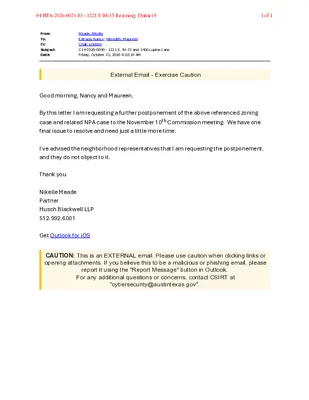
From: To: Cc: Subject: Date: Meade, Nikelle Estrada, Nancy; Meredith, Maureen Chall, Lindsey C14-2026-0040 - 1221 S. IH-35 and 1400 Lupine Lane Friday, October 23, 2026 8:26:16 AM External Email - Exercise Caution Good morning, Nancy and Maureen, By this letter I am requesting a further postponement of the above referenced zoning case and related NPA case to the November 10th Commission meeting. We have one final issue to resolve and need just a little more time. I’ve advised the neighborhood representatives that I am requesting the postponement, and they do not object to it. Thank you. Nikelle Meade Partner Husch Blackwell LLP 512.992.6001 Get Outlook for iOS CAUTION: This is an EXTERNAL email. Please use caution when clicking links or opening attachments. If you believe this to be a malicious or phishing email, please report it using the "Report Message" button in Outlook. For any additional questions or concerns, contact CSIRT at "cybersecurity@austintexas.gov". 04 NPA-2026-0021.03 - 1221 S IH-35 Rezoning; District 91 of 1
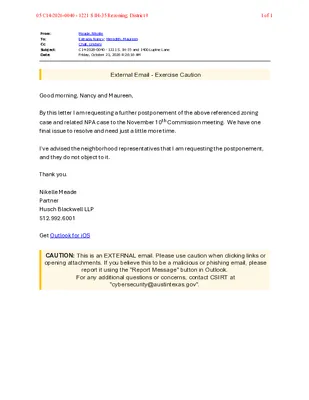
From: To: Cc: Subject: Date: Meade, Nikelle Estrada, Nancy; Meredith, Maureen Chall, Lindsey C14-2026-0040 - 1221 S. IH-35 and 1400 Lupine Lane Friday, October 23, 2026 8:26:16 AM External Email - Exercise Caution Good morning, Nancy and Maureen, By this letter I am requesting a further postponement of the above referenced zoning case and related NPA case to the November 10th Commission meeting. We have one final issue to resolve and need just a little more time. I’ve advised the neighborhood representatives that I am requesting the postponement, and they do not object to it. Thank you. Nikelle Meade Partner Husch Blackwell LLP 512.992.6001 Get Outlook for iOS CAUTION: This is an EXTERNAL email. Please use caution when clicking links or opening attachments. If you believe this to be a malicious or phishing email, please report it using the "Report Message" button in Outlook. For any additional questions or concerns, contact CSIRT at "cybersecurity@austintexas.gov". 05 C14-2026-0040 - 1221 S IH-35 Rezoning; District 91 of 1
ZONING CHANGE REVIEW SHEET CASE: C14-2025-0051 (Woodward Mixed Use Flats) DISTRICT: 3 ADDRESS: 1710, 1712, 1714, 1716, 1718, 1720, 1722, 1724 Woodward Street and 3426 ½ Parker Lane ZONING FROM: MF-3 TO: GR-DBC30 SITE AREA: approximately 12.61 acres (approximately 549,292 square feet) PROPERTY OWNER: Flats on Woodward LLC (Greg Bruggeman) AGENT: Thrower Design, LLC (Victoria Haase) CASE MANAGER: Jonathan Tomko, AICP (512) 974-1057, jonathan.tomko@austintexas.gov STAFF RECOMMEDATION: Staff does not recommend granting community commercial-citywide density bonus 30 (GR-DBC30) combining district zoning and offers an alternative recommendation of community commercial-conditional overlay-citywide density bonus 30 (GR-CO-DBC30) combining district zoning. The conditional overlay ( CO) would prohibit a height over 45 feet if the tract is not developed to the Citywide Density Bonus (DBC) standards. DBC is a voluntary incentive program that provides modifications to site development regulations or other regulatory- related benefits in exchange for community benefits, such as income restricted housing units. PLANNING COMMISSION ACTION / RECOMMENDATION: October 28, 2025: Staff postponement to November 13, 2025 Planning Commission, granted. November 13, 2025: Staff postponement to December 9, 2025 Planning Commission, granted. December 9, 2025: Staff postponement to January 27, 2026 Planning Commission, granted. January 27, 2026: Staff postponement to March 10, 2026 Planning Commission, granted. March 10, 2026: Applicant postponement to April 14, 2026 Planning Commission, granted. April 14, 2026: Staff postponement to June 9, 2026 Planning Commission, granted. June 9, 2026: Staff postponement to July 28, 2026 Planning Commission, granted. July 28, 2026: Applicant postponement to August 25, 2026 Planning Commission, granted. August 25, 2026: Staff postponement to September 8, 2026 Planning Commission, granted. September 8, 2026: Staff postponement to September 22, 2026 Planning Commission, granted. September 22, 2026: Neighborhood postponement to October 27, 2026 Planning Commission, granted. October 27, 2026: Case is scheduled to be heard by Planning Commission. CITY COUNCIL ACTION: TBD ORDINANCE NUMBER: TBD 08 C14-2025-0051 - Woodward Mixed Use Flats; District 31 of 26 ISSUES: The site currently has approximately 241 multifamily units constructed in approximately 1968. The site is developed at a density of approximately 19 units per acre which is substantially less dense than other multifamily properties that are redeveloping in central Austin. Lower density development patterns support auto centricity and can be detrimental to transit ridership where such public assets exist. The applicant revised their request on July 31, 2026, from GR-DB90 to GR-DBC30. The revised request has redevelopment requirements which include Chapter 4-18 …
REGULAR MEETING OF THE HISPANIC LATINO QUALITY OF LIFE RESOURCE ADVISORY COMMISSION TUESDAY, OCTOBER 27, 2026, 6:00 PM AUSTIN CITY HALL, BOARDS AND COMMISSIONS ROOM 1101 301 W 2nd STREET AUSTIN, TEXAS Some members of the Hispanic Latino Quality of Life Resource Advisory Commission may be participating by videoconference. Public comment will be allowed in-person or remotely via telephone. Speakers may only register to speak on an item once either in-person or remotely and will be allowed up to three minutes to provide their comments. Registration no later than noon the day before the meeting is required for remote participation by telephone. To register to speak remotely, contact Nekaybaw Watson at nekaybaw.watson@austintexas.gov or 512-974-2562. CURRENT COMMISSIONERS: Lyssette Galvan, Chair, D6 Amanda Afifi, D2 Andrea Flores, D1 Yesenia Ramos, D7 Dulce Castañeda, Vice Chair, D10 Elizabeth Morales, D5 Jesús Perales, D8 Melissa Ruiz, D3 AGENDA CALL TO ORDER PUBLIC COMMUNICATION: GENERAL The first ten speakers signed up prior to the meeting being called to order will each be allowed a three-minute allotment to address their concerns regarding items not posted on the agenda. APPROVAL OF MINUTES 1. Approve the minutes of the Hispanic Latino Quality of Life Resource Advisory Commission special called meeting on September 29, 2026. STAFF BRIEFING 2. Staff briefing regarding Human Rights Impact Review and Report. Presented by Dr. Lindsey Wilson, Director, Austin Equity and Inclusion and Shafina Khaki, Human Rights Officer, Austin Equity and Inclusion. 3. Staff briefing regarding immigration related resources. Presented by Houmma Garba, Immigrant Affairs Manager and DACA Liaison Officer, Austin Equity and Inclusion and Shafina Khaki, Human Rights Officer, Austin Equity and Inclusion. DISCUSSION ITEMS 4. Presentation from Proyecto Teatro regarding the Community Navigator Contract. Presentation by Raquel Rivera, Hector Ordaz, and Luis Ordaz. 5. Discussion regarding the recommendation to support the family and community affected by the September 20, 2026 ICE- involved shooting in Austin. 6. Discussion regarding the 2027 budget recommendations meeting. 7. Discussion regarding the 2027 goals and objectives of the commission. DISCUSSION AND ACTION ITEMS 8. Approve the 2027 Annual Meeting Schedule for the Hispanic/Latino Quality of Life Resource Advisory Commission. FUTURE AGENDA ITEMS ADJOURNMENT The City of Austin is committed to compliance with the Americans with Disabilities Act. Reasonable modifications and equal access to communications will be provided upon request. For assistance, please contact the Liaison or TTY users’ route through 711. A person may request language access …
Hispanic/Latino Quality of Life Resource Advisory Commission September 29, 2026 HISPANIC/LATINO QUALITY OF LIFE RESOURCE ADVISORY COMMISSION SPECIAL CALLED MEETING MINUTES TUESDAY, SEPTEMBER 29, 2026 The Hispanic/Latino Quality of Life Resource Advisory Commission convened in a special called meeting on Tuesday, September 29, 2026, at Austin Permitting and Development Center, room 1401. Chair Galvan called the Hispanic/Latino Quality of Life Resource Advisory Commission Meeting to order at 5:02 p.m. Commissioners in Attendance: Lysette Galvan, Chair, D6 Elizabeth Morales, D5 Yesenia Ramos, D7 Commissioners in Attendance Remotely: Dulce Castañeda, Vice Chair, D10 Andrea Flores, D1 Jesús Perales, D8 Melissa Ruiz, D3 PUBLIC COMMUNICATION : GENERAL None. APPROVAL OF MINUTES 1. Approve the minutes of the Hispanic Latino Quality of Life Resource Advisory Commission regular meeting on September 22, 2026. The minutes of the September 22, 2026 regular meeting of the Hispanic/Latino Quality of Life Resource Advisory Commission were approved during the September 29, 2026 special called meeting of the Hispanic/Latino Quality of Life Resource Advisory Commission on Commissioner Perales’ motion, Vice Chair Castañeda’s second on a 7-0 vote. Commissioner Afifi was absent. 1 Hispanic/Latino Quality of Life Resource Advisory Commission September 29, 2026 DISCUSSION AND ACTION ITEMS 2. Approve a Recommendation to Council to Support the Family and Community Affected by the September 20, 2026 Shooting. The motion to approve a recommendation to council to support the family and community affected by the September 20, 2026 shooting as amended was approved on Commissioner Morales’ motion, Commissioner Ramos’ second on a 7-0 vote. Commissioner Afifi was absent. The motion to approve the amendment to insert “recommending that ICE cease operations in Austin and the need for accountability and transparency.”, was approved on Commissioner Flores’ motion, Commissioner Perales’ second on a 7-0 vote. Commissioner Afifi was absent. The motion to approve the amendment to insert “Increase transparency to the Austin community regarding ICE involved shootings and activity in the City of Austin, including potential threats to community safety.”, was approved on Commissioner Morales’ motion, Chair Galvan’s second on a 7-0 vote. Commissioner Afifi was absent. The motion to approve the amendment to insert “Increase outreach and training for Know Your Rights workshops across Austin communities.”, was approved on Commissioner Ramos’ motion, Chair Galvan’s second on a 7-0 vote. Commissioner Afifi was absent. The motion to approve the amendment to insert “The City Council and City Manager’s office should mandate regular public reporting on …
REGULAR MEETING OF THE PARKS AND RECREATION BOARD OCTOBER 26, 2026 – 6:00 PM CITY HALL COUNCIL CHAMBERS, ROOM 1001 301 W. 2ND STREET AUSTIN, TEXAS 78701 Some members of the Parks and Recreation Board may be participating by videoconference. The meeting may be viewed online at: http://www.austintexas.gov/page/watch-atxn-live Public comment will be allowed in-person or remotely via telephone. Speakers may only register to speak on an item once either in-person or remotely and will be allowed up to three minutes to provide their comments. Registration no later than noon the day before the meeting is required for remote participation by telephone. To register to speak, click here: https://forms.cloud.microsoft/g/WFF8ic6H7M or call or email Tim Dombeck, (512) 974-6716, Tim.Dombeck@austintexas.gov. CURRENT BOARD MEMBERS: Stephanie Bazan (D-5), Chair Lane Becker (Mayor), Vice Chair Shelby Orme (D-1) Pedro Villalobos (D-2) Nicole Merritt (D-3) Maritza Kelley (D-4) Luai Abou-Emara (D-6) Diane Kearns-Osterweil (D-7) AGENDA Kim Taylor (D-8) Jennifer Franklin (D-9) Ted Eubanks (D-10) CALL TO ORDER PUBLIC COMMUNICATION: GENERAL The first 10 speakers signed up prior to the meeting being called to order will each be allowed a three-minute allotment to address their concerns regarding items not posted on the agenda. APPROVAL OF MINUTES 1. Approve the minutes of the Parks and Recreation Board regular meeting of September 28, 2026. DISCUSSION AND ACTION ITEMS 2. 3. Presentation, discussion and approve letters of support for Austin Parks and Recreation’s Community Recreation staff who worked to create the MLS GO youth soccer program. (Sponsors: Bazan, Becker) Presenter(s): David Crabb, Community Recreation Division Manager, Austin Parks and Recreation. Presentation, discussion, and approve a recommendation for City Council to authorize negotiation and execution of an interlocal cooperation agreement with the Austin Independent School District to support the Literacy First Program and Tutoring Intervention Program for a 12-month term though September 30, 2027, in an amount not to exceed $100,000, with four 12-month renewal options in amounts not to exceed $100,000 per Page 1 of 2 renewal option, for a total agreement amount not to exceed $500,000. (Sponsors: Bazan, Becker) Presenter(s): David Crabb, Community Recreation Division Manager, Austin Parks and Recreation. Presentation, discussion and approve a recommendation for City Council to authorize a change in use of dedicated parkland, known as Waller Beach at Town Lake Metro Park (East Avenue,) to permanently use approximately 7,475 sq. ft. and temporarily use approximately 3,590 sq. ft. of parkland in order to construct Austin …

PARKS AND RECREATION BOARD MEETING MINUTES SEPTEMBER 28, 2026 PARKS AND RECREATION BOARD REGULAR MEETING MINUTES SEPTEMBER 28, 2026 The PARKS AND RECREATION BOARD convened in a REGULAR meeting on SEPTEMBER 28, 2026 at 301 W 2nd Street in Austin, Texas. Chair Bazan called the PARKS AND RECREATION BOARD Meeting to order at 6:04 p.m. Board Members in Attendance: Stephanie Bazan, Luai Abou-Emara, Ted Eubanks, Diane Kearns- Osterweil, Nicole Merritt, Maritza Kelley. Board Members in Attendance Remotely: Lane Becker, Jennifer Franklin, Shelby Orme, Pedro Villalobos. Board Members Absent: Kim Taylor. PUBLIC COMMUNICATION: GENERAL Abby Ruiz - Givens Recreation Center Commercial Kitchen Ursula Carter - Givens Recreation Center Commercial Kitchen Charlisa McCool - Givens Recreation Center Commercial Kitchen and grease trap Julie Fisher - The Trail Conservancy Barry Rivera - Austin Parks Foundation Seth Johnson - Skaters for Austin Skateparks Cary Jackson - Skaters for Austin Skateparks Patricia Bobeck - Fishing gear, ACL and Barton Springs Bob Bowdon - Red Bud Isle security request Reese Herd II - Givens Recreation Center Commercial Kitchen and grease trap APPROVAL OF MINUTES 1. Approve the minutes of the Parks and Recreation Board regular meeting of August 24, 2026. The motion to approve the minutes of the Parks and Recreation Board regular meeting of August 24, 2026 was approved on Board Member Orme’s motion, Board Member Kearns- Osterweil’s second on a 10-0 vote. Board Member Taylor absent. DISCUSSION AND ACTION ITEMS 2. Presentation, discussion and approve letters of support for Austin Parks and Recreation’s Capital Improvement and Land Acquisition staff, who dedicated years to the research, analysis and development of the Council approved 2026 Park Bond Program. Page 1 of 3 PARKS AND RECREATION BOARD MEETING MINUTES SEPTEMBER 28, 2026 Liana Kallivoka, Assistant Director and Alyssa Tharrett, Project Management Supervisor, Austin Parks and Recreation gave a presentation. The motion to approve letters of support for Austin Parks and Recreation’s Capital Improvement and Land Acquisition staff, who dedicated years to the research, analysis and development of the Council approved 2026 Park Bond Program was approved on Board Member Eubanks’ motion, Board Member Merritt’s second on a 10-0 vote. Board Member Taylor absent. 3. Presentation, discussion and approve a recommendation for City Council to authorize a change in use of dedicated parkland, known as Hancock Golf Course, to temporarily use approximately 9,482 square feet of parkland in order to construct Austin Water infrastructure and associated improvements. Total …
Interlocal Cooperation Agreement: Literacy First Program Between the City of Austin and Austin Independent School District Austin Parks and Recreation Department Purpose of the Agreement The City of Austin supports Literacy First, a reading and writing tutoring program for students in grades K-2. Through an interlocal agreement with Austin Independent School District (AISD): The City provides $100,000 to support the program. AISD must fairly compensate the performing party for services provided under the agreement.* *Local Government Code, Chapter 791 2 Who Does Literacy First Serve? Serves Four AISD Title I Schools Allison Elementary School Ortega Elementary School Sanchez Elementary School Zavala Elementary School PR funding supported 151 AISD students in 2025–26 3 Agreement Term and History In effect since fiscal year 2006-2007 Initial term: October 1, 2026- September 30, 2027 4 AISD Services AISD shall make Literacy First available to at least 200 students attending Title I elementary schools. AISD shall waive rental fees for the City’s Creativity Club After-School Program at Oak Hill Elementary School for the duration of the Agreement. AISD shall waive rental fees and ancillary costs for City public-purpose use of identified AISD facilities. AISD shall make high school baseball fields available for public recreation during offseasons and after regular school hours through a transparent, publicly accessible reservation system. 5 AISD Services, cont’d AISD shall provide transportation for students participating in PARD after-school programs: AISD shall assist with marketing PARD programs and employment opportunities and provide current AISD staff contacts who will assist. 6 AISD Deliverables AISD shall provide the City pre- and post-program reports assessing program success, identifying issues, and recommending changes for the next mentoring year. AISD shall submit the final report to APR’s Contract Manager within 60 days after the program closes. 7 City of Austin Deliverables The City will reimburse AISD up to $100,000 per school year for Literacy First services and deliverables. Payment shall be made within 30 calendar days after program completion and receipt of: A complete and valid invoice from AISD with the program report APR Contract Manager confirmation that AISD achieved the program’s goals and objectives 8 Board Recommendation The Parks and Recreation Board recommends that City Council authorize the negotiation and execution of an interlocal cooperation agreement with AISD to support the …
CHAPTER 26 APPLICATION IH-35 CAPITAL EXPRESS CENTRAL IMPROVEMENTS REQUESTED PARKLAND DECLARATIONS OF USE Waller Beach at Town Lake Metro Park (East Avenue) Austin Parks & Recreation Board | October 2026 Mark Stanko, Project Manager, WSP Kevin Koeller, P.E. A D N E G A 1. Project Summary 2. Project Objectives 3. Stakeholder Engagement • Bi-weekly meetings • On-site meeting • Public Involvement (PI) interagency meeting • Community engagement • Verify environmental clearance and process 4. Parkland Declaration of Use Summary 5. Waller Beach at Town Lake Metro Park (East Avenue) 15” Wastewater Line Declaration of Use • • Subterranean 15” Wastewater Line Declaration of Use • Temporary Construction Declaration of Use 6. Summary of Requested Parkland Declaration of Use WSP | CAPEX Chapter 26 Application | October 2026 2 Project summary • The Capital Expressway Austin Water Standalone Utility Project (CAPEX-AWS) requires relocation of over 45,000 linear feet of water and wastewater utilities to mitigate conflicts with the proposed improvements to IH-35 by the Texas Department of Transportation (TxDOT). • These relocations are primarily in City of Austin right-of-way (ROW) but some work in private land and parkland is required. WSP | CAPEX Chapter 26 Application | October 2026 Proposed Water and Wastewater lines for the CAPEX AWS project. 3 Project Objectives • Improve safety and mobility in Austin • Provide Austin Water customers with a reliable water and wastewater system that is accessible • Relocate water and wastewater lines impacted by proposed IH-35 CapEx Project WSP | CAPEX Chapter 26 Application | October 2026 4 3. Stakeholder Engagement Meetings held to date: ▪ Bi-weekly meetings since June 2026 between TxDOT, Austin Parks and Recreation (APR), Forestry, Austin Water (AW), and other City departments. ▪ An on-site meeting with APR, AW, and TxDOT for the East Avenue Declaration of Use areas on May 29, 2026. ▪ A coordination meeting with APR and Local Parks Stewardship Coordinator from Texas Parks & Wildlife Department (TPWD) to confirm Section 6(f) requirements on May 29, 2026. ▪ A PI interagency meeting on Wednesday, June 17, 2026, with APR, AW and TxDOT. ▪ Public Involvement (PI) interagency meeting on Wednesday, July 29, 2026, with APR, AW, and TxDOT. WSP | CAPEX Chapter 26 Application | October 2026 5 Summary of stakeholder engagement efforts East Avenue stakeholder engagement – June 2026 Onward: • AW and TxDOT has engaged with stakeholders in and around the East Avenue …

Date: Subject: Month Date, Year IH-35 CapEx – East Ave To: From: Date: Subject: MEMORANDUM OF UNDERSTANDING Shay Ralls Roalson, P.E., Director, Austin Water Jesús Aguirre, MBA, CPRE, Director, Austin Parks and Recreation Department [Month Day, Year] IH-35 CapEx – East Ave; M.O.U.# 26-002; FDU# 3920 2207 8397 and 4480 2307 5411; Project I.D. 3212.200 The purpose of this memorandum is to outline an understanding between Austin Parks and Recreation (APR) and Austin Water (AW) for the non-recreational use of parkland at Waller Beach at Town Lake Metro Park. Project Details AW is authorized to use the parkland located at Waller Beach at Town Lake Metro Park, 30 East Ave for construction of a wastewater line as indicated on Attachment “1” (Location Map). For the construction of the wastewater line, the parkland is requested for permanent and temporary use in association with the TXDOT IH35 CapEx Downtown Advance Construction (DTAC) AW Standalone Relocations: MLK to Holly Street Project. The requested area is: Permanent Wastewater Use: Permanent Subterranean Wastewater Use: Temporary Staging Use: 5,980 sq. ft. = $892,233 1,495 sq. ft. = $63,731 3,590 sq. ft. = $99,476 AW is in an agreement to provide the following mitigation ($1,055,440) in return for the permanent use and temporary use of the parkland after City Council has approved this request. The project start date is May 2030. The date of final completion is October 2030. The temporary use of parkland is approved for 156 days. 1 of 2 Date: Subject: Month Date, Year IH-35 CapEx – East Ave Requesting Department Responsibilities This MOU and associated Declaration of Use are necessitated by TxDOT’s IH-35 expansion project. The terms established in this MOU between AW and APR have been reviewed and agreed to by TxDOT. All construction work on parkland will be executed by TxDOT’s contractors, and construction documents will include language agreed to by TxDOT and the City of Austin (COA). The COA will make every effort to coordinate and enforce the terms of this MOU with TxDOT and their designated contractors. APR will continue to coordinate directly with TxDOT regarding these activities, recognizing that successful implementation is achieved through collaboration among all parties involved. It is the responsibility of the AW Project Manager and/or the Capital Delivery Services (CDS) Project Manager to notify APR of the Notice to Proceed 60 days prior to start of construction on-site. Extension/modification of parkland use must receive …
ATTACHMENT 2 Plan Sheets ≻ ≻ ≻ ≻ I.H. 3 5 ≻ ≻ ≻ 0 VERTICAL SCALE IN FEET 40 80 HORIZONTAL SCALE IN FEET LEGEND PROPOSED WASTEWATER EASEMENT (COA) Driskill St y St ain R e PROPOSED TEMP CONSTRUCTION EASEMENT (COA) River St PROPOSED WATER/WASTEWATER EASEMENT (COA) PROPOSED WASTEWATER SUBTERRANEAN EASEMENT (COA) EXISTING WASTEWATER EASEMENT (COA) PARKS DEPARTMENT PROPERTY EXISTING ROW PROPOSED ROW EXISTING EASEMENT E 11th St e r St d Riv e R e St bin a S 5 I.H. 3 t S s o c r a M n a S E 7th St E 6th St E 9th St t S r e l l a W t S a i d y L s St e h c e N E 9th St E 8th St E 7th St E 6th St E 5th St E 4th St rinity St E Cesar Chavez St T E 3rd St E 5th St E 4th St E 3rd St a y c St Atta E Cesar Chavez St Willow St Spence St Cantebury St Garden St ota St s a v a N aller St W E 2nd St East Ave I . H . 3 5 Red River St Holly St Haskell St al St m o C COLORADO RIVER LOCATION MAP NOT-TO-SCALE REV DATE BY DESCRIPTION WC 56 EAST AVENUE LLC TCAD PROPERTY ID: 190874 BEGIN PROP 72" WWL-404 ≻ WW ≻ ◯◯ ≻ PROP 72" FRPM WWL-403 LAMBIE ST ≻ ≻ ≻ ≻ ≻ ≻ ≻ ≻ ≻ PROP 72" FRPM WWL-404 ◯◯ ◯◯ ////////// / / ◯◯ / / / // / / / / / / / / // ◯◯ ◯◯ ////////////// / ◯◯ / / / / / / / / / / / / / / / / / / BRAY WILLIAM TERRY TRUSTEE TCAD PROPERTY ID: 188029 ◯◯ ◯◯ ◯◯ ◯◯ ◯◯ ◯◯ ≻ ◯◯ ◯◯ ≻ ≻ EXISTING DRAINAGE AND PUBLIC UTILITY EASEMENT DOCUMENT NO. 61/22 ≻ ≻ ≻ ≻ EXISTING DRAINAGE AND PUBLIC UTILITY EASEMENT DOCUMENT NO. 82/79 PROP 72" FRPM WWL-403 ≻ ≻ ≻ ≻ WILLIAMS ALLAN L & ANDREW J FO TCAD PROPERTY ID: 188028 ///////// / / / / / / TURNER BENJAMIN B JR TRUSTEE TCAD PROPERTY ID: 188027 / / / //////// / / / / / / / TOWN LAKE CONDOMINIUMS INC TCAD PROPERTY ID: 188213 SEE NOTE 1 / …

ATTACHMENT "A" - M.O.U. MITIGATION FEES CALCULATION WORKSHEET - SUMMARY Mitigation Worksheet Summary Project: Park: Requesting Department: MOU #: IH-35 CapEx - East Ave - Waller Beach Waller Beach at Town Lake Metro Park Austin Water 26-002 Use Type Permanent Use Temporary Use TOTAL Credit for Park Improvements TOTAL Calculated Fee $955,964 $99,476 $1,055,440 $0 $1,055,440 Mitigation Worksheet for Permanent Use Project: Park: Requesting Department: MOU #: IH-35 CapEx - East Ave - Waller Beach Waller Beach at Town Lake Metro Park Austin Water 26-002 Geographic Area Code DT Identified by requested area site geography Average Value per Square Foot. ($): $426.29 Calculated by Geographic Area average Wastewater Permanent Use (sq. ft.): 5,980 Submitted by Requesting Department/Entity Preliminary Mitigation Value ($): $2,549,235 Requested Area multiplied by the Value per Square Foot Disturbance Value (%): 35.00% Based on limitations on future development for that portion of parkland (see table below) Park Use Factor (%): 0.00% Based on the recreational or park value of the proposed use. Final Mitigation Value ($): $ 892,233 Preliminary Mitigation Value multiplied by the Disturbance Value Percentage of Fee 10% 25% 35% 50% 65% 75% 90% 100% Comments Nominal effect on use and utility Subsurface or air rights that have minimal effect on use and utility Location along a property line or non usable land area Balanced use by both owner and easement holder Some impact on surface use and conveyance of ingress/egress rights Major impact on surface use and conveyance of future uses Severe impact on surface use and conveyance of future uses Permanently dedicated to installation Disturbance Values Example Uses Small subsurface water or sewer line Larger subsurface water or sewer line with minimal impacts on future development Water or sewer line, cable lines or other subsurface use with limited impacts on developable area Water or sewer line, cable lines with exceptions in the DOU allowing parklike amenities Pipelines or other limited surface impacts with maintenance requirements and limited development potential Pipelines, drainage easements, flowage easements that restrict future use Overhead electric, drainage easements, or other use with restrictions on future use ROW or other use with surface impact on parkland Areas within an existing easement or declaration of use are limited to the remaining eligible percentage. Adapted From: Right of Way Magazine "Easement Valuation" Sherwood, May/June 2006. Provided by City of Austin Office of Real Estate Mitigation Worksheet for Permanent Use Project: Park: Requesting …