Updates, Reports and Briefings Austin Animal Services | September 14, 2026 Spay/Neuter Numbers from Contracts Information from FY2026 Monica Dangler, Director Two clinics $342,858.00* 1,226 Nov. 1,000 Feb. Wellness is included in the flat-rate payment. *Total does not include soft/supporting costs (e.g. dumpsters, staff time, restrooms, other rentals, etc.) Spay/neuter $535,537.00 2,263 dogs 2,836 cats Wellness $368,629.92 Spay/neuter $184,950.00 2,055 cats Wellness $27,078.00 Total $904,166.92 Total $212,028.00 Contracts in FY26 October 2025 – August 2026 Austin Animal Services provides spay/neuter and wellness (vaccinations, preventative services, etc.) to community-owned animals. Wellness costs represent a critically important (but overlooked) aspect of Austin’s No Kill plan. Helping families keep their animals healthy through low- cost/free services means keeping animals in their forever home! Vendor Emancipet Austin Humane Society Greater Good (GoodFix) Totals S/N Totals 5,099 2,055 2,226 9,380 S/N Costs $535,537.00 $184,950.00 $342,858.00 Wellness Costs $368,629.92 $27,078.00 * $1,063,345.00 $395,707.92 3 Monthly Reporting August 2026 Jason Garza, Assistant Director 1,126 animals were impounded this month. Animals Impounded A breakdown of impounded animals by species and/or age. Wildlife 56 Critters 3 Puppies 107 1,034 5-year average 1,009 903 August Intake Over Time This chart shows the number of animals impounded this month, ranked by fiscal year. Cats 268 Kittens 384 Dogs 308 6 2 Y F 5 2 Y F 4 2 Y F 5 August 2026 had a live-release rate of 97.28 percent. Live Outcomes by Animal Type This chart shows how many of each animal type had a positive or live outcome during August. Breakdown per Outcome Type This chart shows the breakdown of each kind of live outcome by the number of animals with that live outcome. Each bar is equal to 100% of the outcome category. Puppies 92 Dogs 318 Critters 10 Kittens 400 Cats 326 Puppies 1 Kittens 1 Cats 15 Dogs 66 Critters 7 Kittens 229 Puppies 56 Cats 198 Dogs 213 Kittens 1 Critters 3 Kittens 169 Cats 29 Puppies 35 Cats 1 Cats 83 Dogs 39 Adopted Returned to Owner Returned to Habitat Rescue Transfer Escaped 6 704 animals were adopted this month. Adoptions Over Time (Month, Fiscal Year) This chart shows the number of adoptions per month, ranked by fiscal year. FY24 | 735 FY26 | 704 FY25 | 695 FY23 | 661 Adoptions by Type (Age, Breed) This chart shows the total number of adoptions per animal type. Critters 7 Kittens 229 Puppies 56 …
REGULAR MEETING OF THE MAYOR’S COMMITTEE FOR PEOPLE WITH DISABILITIES FRIDAY, SEPTEMBER 11, 2026, AT 5:30PM AUSTIN CITY HALL, BOARDS AND COMMISSIONS ROOM 1101 301 W 2nd STREET AUSTIN, TEXAS Some members of the Mayor’s Committee for People with Disabilities may be participating by videoconference. The meeting may be viewed online at: http://www.austintexas.gov/page/watch- atxn-live Public comment will be allowed in-person or remotely via telephone. Speakers may only register to speak on an item once either in-person or remotely and will be allowed up to three minutes to provide their comments. Registration no later than noon the day before the meeting is required for remote participation by telephone. To register to speak remotely, contact Nekaybaw Watson, Nekaybaw.watson@austintexas.gov, 512-974-2562. CURRENT COMMISSIONERS: Lisa Chang, Chair Alejandro San Martin, Vice Chair Gabriel Arellano DeLawnia Comer-HaGans CALL TO ORDER PUBLIC COMMUNICATION: GENERAL AGENDA Lynn Murphy Katie Simon Elizabeth Slade Kristen Vassallo The first ten speakers signed up prior to the meeting being called to order will each be allowed a three-minute allotment to address their concerns regarding items not posted on the agenda. APPROVAL OF MINUTES 1. Approve the minutes of the Mayor’s Committee for People with Disabilities regular meeting on August 14th , 2026. STAFF BRIEFINGS 2. Staff briefing regarding processing times of rape kits and abuse reporting. Presentation by Dr. Dana Kadavy, Forensic Science Director, Austin Police and Kachina Clark, Division Manager, Austin Police. DISCUSSION ITEMS 3. Presentation from SAFE ATX regarding SAFE’s disability program, interpersonal violence in the disability community and current gaps in resources. Presentation by Pierre Berastain, CEO, SAFE ATX and Serena Villa, Disability Services Project Coordinator and Educator, SAFE ATX. 4. Discussion on creating Budget Recommendation Workshops. FUTURE AGENDA ITEMS ADJOURNMENT The City of Austin is committed to compliance with the Americans with Disabilities Act. Reasonable modifications and equal access to communications will be provided upon request. For assistance, please contact the Liaison or TTY users’ route through 711. A person may request language access accommodations no later than 48 hours before the scheduled meeting. Please call or email Nekaybaw Watson or nekaybaw.watson@austintexas.gov to request service or for additional information. Austin City Clerk’s Office, 512-974-2562 at at For more information on the Mayor’s Committee for People with Disabilities, please contact Nekaybaw Watson at nekaybaw.watson@austintexas.gov.
MAYOR’S COMMITTEE FOR PEOPLE WITH DISABILITIES REGULAR MEETING MINUTES FRIDAY, AUGUST 14, 2026 The Mayor’s Committee for People with Disabilities convened in a regular meeting on Friday, August 14, 2026, at 301 W 2nd St. in Austin, Texas. Chair Chang called the Mayor’s Committee for People with Disabilities meeting to order at 5:57 p.m. Commissioners in Attendance: Lisa Chang, Chair Alejandro San Martin, Vice Chair Katie Simon Commissioners in Attendance Remotely: DeLawnia Comer-HaGans Elizabeth Slade Kristen Vassallo Commissioners Absent: Gabriel Arellano Lynn Murphy PUBLIC COMMUNICATION: GENERAL None. APPROVAL OF MINUTES 1. Approve the minutes of the Mayor’s Committee for People with Disabilities Regular Meeting on June 12, 2026. The motion to approve the minutes of the June 12, 2026, regular meeting of the Mayor’s Committee for People with Disabilities was approved on Commissioner Vassallo’s motion, Vice Chair San Martin second on a 6-0 vote. Commissioners Arellano and Murphy were absent. 1 STAFF BRIEFING 2. Staff briefing regarding the New Officer Involved Shooting Dashboard. Presentation by Sara Peralta, Public Information and Marketing Program Manager, Austin Police Oversight and Katrina Dorsey, Community Engagement Specialist, Austin Police Oversight. Withdrawn. 3. Staff briefing regarding fair housing and disability rights. Presentation by Enrique Serrano, Civil Rights Officer, Austin Equity and Inclusion. This item was taken fourth. Briefing given by Enrique Serrano, Civil Rights Officer, Austin Equity and Inclusion. DISCUSSION ITEMS 4. Presentation from the Travis County Clerk’s Office regarding election building accessibility requirements. Presentation by Dyana Limon-Mercado, Travis County Clerk, Travis County Clerk’s Office. This item was taken second. Presentation given by Dyana Limon-Mercado, Travis County Clerk, Travis County Clerk’s Office. 5. Discussion regarding the commission’s interest in a presentation from CapMetro. This item was taken third. Discussion was held. FUTURE AGENDA ITEMS - ADJOURNMENT The meeting was adjourned without objection on Vice Chair San Martin’s motion, Commissioner Vassallo’s second at 7:17 pm. 2
Committee Update Austin Forensic Science | September 11th, 2026 Sexual Assault Kit Testing Update Department Key Performance Indicator FY25 Actual FY26 Target FY26 Q1 FY26 Q2 FY26 Q3 Percent of sexual assault kit DNA analysis requests completed (analyzed) within 90 days 97% ≥ 95% 98% 96% 100% Department Performance Metric FY25 Actual FY26 Target FY26 Q1 FY26 Q2 FY26 Q3 Average Turn Around Time in Days 68 90 68 64 63 2
Safety Should Be Accessible to Everyone Mayor's Committee for People with Disabilities A homegrown institution where public safety, public health, and housing meet. 2 Integration Is the Intervention Prevent Violence Respond in Crisis Heal & Access Justice Build Lasting Stability • Expect Respect • SAFEline • Youth and community education • Deaf SHARE • Emergency shelter • Trafficking response • Sexual assault advocacy • Counseling and children's services • Permanent supportive housing • Legal and systems • SAFE Futures advocacy • Disability-accessible services • Planet SAFE • Family stabilization Human lives are continuous. Our response must be, too. 3 Every Day, SAFE Responds 26,000+ ~5,800 SAFEline calls, texts, and chats annually People served in a typical year ~1,000 People housed or sheltered nightly as we expand 8,000+ Students, parents, and educators reached annually Children now comprise roughly two-thirds of shelter residents: 88 children and 35 adults at one recent moment. Source: SAFE internal data; current estimates, September 2026. 4 STANFORD SOCIAL INNOVATION REVIEW Paying for Public Failure Isn't Always Charity Published February 26, 2026 The system always collects its debt. The question is when, where, and at what cost. SAFE Creates Public Value Across Its Entire Ecosystem ENTIRE SAFE ECOSYSTEM ~$120M Estimated annually ~$4 modeled value per $1 SAFE HOUSING PROGRAMS $50.3M $6.37 modeled savings per $1 Based on $7.9M invested RESEARCH BENCHMARK • $33,637 per person annually • Higher-quality Housing First studies Housing is one lens within the broader economic case. These estimates are not additive. SAFE scenario analysis; R360 application; NLIHC systematic-review summary. Modeled estimates. 8 Government Should Sustain the Foundation. Philanthropy Makes Transformation Possible. ~50% / ~50% Immediate impact + strategic flexibility + leverage Government: essential infrastructure Philanthropy: direct services now Government: reliable scale Philanthropy: fill urgent gaps Government: durable responsibility Philanthropy: strengthen what works Government-funded vs. raised annually through philanthropy Immediate safety today. Stronger systems tomorrow. Current funding mix: SAFE FY2026-27 budget. 9 People with Disabilities Experience Disproportionate Rates of Violence 40% G R E A T E R R I S K Women with disabilities had a 40% greater risk of violence than women without disabilities.* 50%+ 80% Research indicates that more than half of women with disabilities experience intimate partner violence during their lifetimes.* Some studies estimate that 80% of women with disabilities have experienced sexual assault. B O T T O M L I N E The risk is higher. The consequences can …

REGULAR MEETING OF THE COLLEGE STUDENT COMMISSION FRIDAY, SEPTEMBER 11, 2026, AT 3:00 P.M. CITY HALL, BOARDS AND COMMISSIONS ROOM 301 W 2ND ST AUSTIN, TEXAS Some members of the College Student Commission may be participating by videoconference. The meeting may be viewed online at: http://www.austintexas.gov/page/watch-atxn-live Public comment will be allowed in-person or remotely via telephone. Speakers may only register to speak on an item once either in-person or remotely and will be allowed up to three minutes to provide their comments. Registration no later than noon the day before the meeting is required for remote participation by telephone. To register to speak remotely, contact Abrianna Citta, 210-232-4773, abrianna.citta01@austintexas.gov. CURRENT COMMISSIONERS: Aidan Cournoyer, Chair, University of Texas at Austin Samuel Huron, University of Texas at Austin Andrew Lyon, Vice Chair, Austin Community College Suyeon Hong, Austin Community College Kinnin (Joshua) Phillips, Austin Community College Mekides Guta, Concordia University Lorian Lopez, Concordia University Grant Zeller, Concordia University Isiah Graham, Huston-Tillotson University Olivia Hexsel, St. Edward’s University Saundra Yelenic, St. Edward’s University AGENDA CALL TO ORDER PUBLIC COMMUNICATION: GENERAL The first ten speakers signed up prior to the meeting being called to order will each be allowed a three-minute allotment to address their concerns regarding items not posted on the agenda. APPROVAL OF MINUTES 1. Approve the minutes of the College Student Commission Special Called meeting on April 28, 2026. DISCUSSION ITEMS 2. Discussion of new working group ideas. DISCUSSION & ACTION ITEMS 3. 4. 5. Assignment of new commissioners to the transportation working group. Assignment of new commissioners to the mental health working group. Assignment of new commissioners to the housing working group. WORKING GROUP UPDATE 6. 7. 8. Update from TRANSPORTATION working group on their priorities for the school year. Update from MENTAL HEALTH working group on their priorities for the school year. Update from HOUSING working group on their priorities for the school year. FUTURE AGENDA ITEMS ADJOURNMENT The City of Austin is committed to compliance with the Americans with Disabilities Act. Reasonable modifications and equal access to communications will be provided upon request. For assistance, please contact the Liaison or TTY users’ route through 711. A person may request language access accommodations no later than 48 hours before the scheduled meeting. Please call or email Dr. Chiquita Eugene at the Youth Initiatives Office, at chiquita.eugene@austintexas.gov or (512-972- 5003) to request service or for additional information. For more information …

COLLEGE STUDENT COMMISSION MEETING MINUTES Tuesday, April 28, 2026 COLLEGE STUDENT COMMISSION MINUTES SPECIAL CALL TUESDAY, APRIL 28, 2026 The College Student Commission convened in a Special Call meeting on 28, April, 2026, at 301 W 2nd St in Austin, Texas. Chair Lyon called the College Student Commission Meeting to order at 3:29 p.m. Commissioners in Attendance: Andrew Lyon, Aidan Cournoyer, Mekides Guta Commissioners in Attendance Remotely: Caleb Brizuela, Caroline Colin, Carson Domey, Elisha MacGregor, Caroline Schilling PUBLIC COMMUNICATION: GENERAL None present. APPROVAL OF MINUTES 1. Approve the minutes of the College Student Commission Regular Meeting on March 6, 2026 The minutes from the College Student Commission regular meeting on March 6, 2026 were approved on Commissioner Cournoyer’s motion, Commissioner Guta’s second on a 8-0 vote. Commissioners Lopez, Ogle, Ramesh, and Zuniga were absent. DISCUSSION ITEMS 2. Discussion on recommendations 20260306-002 and 20260306-003 updates. Update given by Commissioner Cournoyer. DISCUSSION AND ACTION ITEMS 3. 4. Approve a recommendation to Council on Student Housing Needs. The motion to approve the recommendation to Student Housing Needs was approved on Commissioner Cournoyer’s motion, Commissioner Guta’s second on a 8-0 vote. Commissioners Lopez, Ogle, Ramesh, and Zuniga were absent. Chair and Vice Chair elections. Commissioner Cournoyer was voted chair on a 5-3 vote. 1 COLLEGE STUDENT COMMISSION MEETING MINUTES Tuesday, April 28, 2026 Commissioner Lyon was voted vice chair on a 7-1 vote. Commissioners Brizuela, Colin, Ogle, and Ramesh were absent. WORKING GROUP UPDATES Update from Transportation working group regarding their priorities. The update was given by Commissioner Guta. Update from Mental Health working group regarding their priorities. The update was given by Chair Lyon. Update from Housing working on their work around student housing availability. The update was given by Chair Lyon. Chair Lyon adjourned the meeting at 3:53 p.m. without objection. The minutes were approved at the April 28, 2026, meeting on Commissioner Cournoyer’s motion, Commissioner Guta’s second on a 8-0 vote. 2



REGULAR MEETING OF THE HISTORIC LANDMARK COMMISSION ARCHITECTURAL REVIEW COMMITTEE THURSDAY, SEPTEMBER 10, 2026, AT 4:00 P.M. PERMITTING AND DEVELOPMENT CENTER, CONFERENCE ROOM 1401 6310 WILHELMINA DELCO DR AUSTIN, TEXAS Some members of the Historic Landmark Commission may be participating by videoconference. Public comment will be allowed in-person or remotely via telephone. Speakers may only register to speak once either in-person or remotely and will be allowed up to three minutes to provide their comments. Registration no later than noon the day before the meeting is required for remote participation by telephone. To register to speak remotely, please use the QR code or link at the end of this document. For questions, please email preservation@austintexas.gov. KEVIN KOCH JAIME ALVAREZ HARMONY GROGAN CURRENT COMMISSIONERS AGENDA CALL TO ORDER PUBLIC COMMUNICATION: GENERAL The first 10 speakers signed up prior to the meeting being called to order are allowed three minutes to speak on items not posted to the agenda. APPROVAL OF MINUTES 1. Approve the minutes of the Architectural Review Committee regular meeting on August 12, 2026. DISCUSSION ITEMS 2. 3. 4. 5. 6. 7. 608 Blanco St. Castle Hill Local Historic District Council District 9 Proposal: Raise the porch and rebuild the railing, install planters, install an ADA lift, and reinstall decorative trim of a contributing building. Applicant: Scott Magic 704 Baylor St. Castle Hill Local Historic District Council District 9 Proposal: Construct a second-story addition on a contributing building. Applicant: Tisha Ritta C14H-1976-0024 – 1006 Congress Ave. Lundberg Bakery Council District 9 Proposal: Rehabilitate and construct an addition to a landmark. Applicant: Sue Hagerty C14H-2020-0087 – 3908 Avenue B Baker School Council District 9 Proposal: Place three 40ft shipping containers on the property with no alterations to the landmarked building. Applicant: Brittany Garcia C14H-2015-0001 – 908 E. 11th St. Dedrick-Hamilton House Council District 1 Proposal: Install accessibility improvements and expand porch access at a landmarked building. Applicant: DJ Scales C14H-2018-0010 – 3952 Berkman Dr. Mueller Air Control Tower Council District 9 Proposal: Install emergency cell service atop control tower. Applicant: Marilee Archer 8. 9. 10. HR-2026-101908 – 1614 Preston Ave. Old West Austin National Register Historic District Council District 10 Proposal: Rehabilitate the exterior of a contributing building and construct a second-story addition. Applicant: Arielle Marie Lawrence Yadhati SP-2026-035365; HR-2026-070009 – 611 West Lynn St. West Line National Register Historic District Council District 9 Proposal: Construct new residences. Applicant: Casey …

REGULAR MEETING OF THE HISTORIC LANDMARK COMMISSION ARCHITECTURAL REVIEW COMMITTEE WEDNESDAY, AUGUST 12, 2026, AT 4:00 P.M. PERMITTING AND DEVELOPMENT CENTER, CONFERENCE ROOM 4001 6310 WILHELMINA DELCO DR AUSTIN, TEXAS Some members of the Historic Landmark Commission may be participating by videoconference. Public comment will be allowed in-person or remotely via telephone. Speakers may only register to speak once either in-person or remotely and will be allowed up to three minutes to provide their comments. Registration no later than noon the day before the meeting is required for remote participation by telephone. To register to speak remotely, please use the QR code or link at the end of this document. For questions, please email preservation@austintexas.gov. X KEVIN KOCH X JAIME ALVAREZ X HARMONY GROGAN CURRENT COMMISSIONERS DRAFT MINUTES CALL TO ORDER: 4PM PUBLIC COMMUNICATION: GENERAL The first 10 speakers signed up prior to the meeting being called to order are allowed three minutes to speak on items not posted to the agenda. APPROVAL OF MINUTES 1. Approve the minutes of the Architectural Review Committee regular meeting on July 8, 2026. MOTION: Approve the July 8, 2026 meeting minutes. Motion by Commissioner Alvarez. Commissioner Koch seconded the motion. Vote 3-0. The motion passed. DISCUSSION ITEMS 2. 3. 4. 5. 6. 4550 Mueller Blvd. Council District 9 Proposal: Remodel the Browning hangar for adaptive reuse. Applicant: Sergio Negrete The applicant presented their proposal. The committee provided feedback. C14H-2000-2268 – 2303 Rio Grande St. Kuehne-Moore House Council District 9 Proposal: Discuss the 2303 Rio Grande Historical Designation including options to remove, rename, or relocate. Applicant: Ashley Fisher The applicant presented their proposal. The committee provided feedback. C14H-1982-0001-h – 920 Congress Ave. Larmour Block (H) Council District 9 Proposal: Discuss new building signage. Applicant: Patrick Georgiou The applicant presented their proposal. The committee provided feedback. C14H-2020-0087 – 3908 Avenue B Baker School Council District 9 Proposal: Place three 40ft shipping containers on the property with no alterations to the landmarked building. Applicant: Brittany Garcia The applicant presented their proposal. The committee provided feedback. C14H-1991-0002 – 109 E. 10th St. Wooten Medical Offices Council District 9 Proposal: Restore and rehabilitate a landmark including structural stabilization and other capital improvements. Applicant: John Nelson The applicant did not attend. 7. 8. 9. 10. 11. 12. C14H-2025-0086 – 1712 Rio Grande St. Malcolm and Margaret Badger Reed House Council District 9 Proposal: Remodel a landmark and remove non-historic …
WM 41 LAPORTE RE, LLC CALLED 0.145 ACRES DOC. NO. 2023063292 O.P.R.T.C.T. T.J. CHAMBERS SURVEY ABSTRACT NO. 7 LOT 1, OUTLOT 3 DIVISION Z (S62°23'32"E 125.00') 4 8 4 3 8 4 2 8 4 S 65° 00' 54'' E 125.19' 612 BLANCO, LLC CALLED 0.200 ACRES DOC. NO. 2021210014 O.P.R.T.C.T. 2 3 1007 1 8 4 AZALEA-HARTHAN, LLC CALLED 0.11 ACRES DOC. NO. 2020070012 O.P.R.T.C.T. 30349 480.40 Sprinkler Control Valve Box IC 3 9 . 9 ' 3 0 4 8 6 4 8 1 . 0 2 G a s M e t e r 3 0 4 8 4 4 8 0 . 8 8 3 0 4 8 5 4 8 0 . 6 3 G a s M e t e r G a s M e t e r 6 . 4 ' 30435 485.83 EDCK1 30434 485.89 EDCK1 B 30436 485.87 EDCK1 7 . 0 ' ' 2 . 3 ' 2 . 3 30473 484.23 Sprinkler Control Valve Box IC 30474 484.30 Sprinkler Control Valve Box IC CALLED 0.190 ACRES LOT 5 BROOKS AND SHELLY SUBDIVISION VOL. 197, PG. 525 P.R.T.C.T. ' 6 . 0 1 7 . 9 ' 1 7 . 9 ' ) ' 0 0 . 9 6 ' E " 1 3 1 4 ° 0 3 N ( ' 0 0 . 9 6 E ' ' 6 5 ' 9 5 ° 7 2 N ' 3 . 8 1 2 0 . 6 ' FFE = 486.38' FFE = 486.38' 608 Blanco h c r o P d e r e v o C FFE = 486.35' FFE = 486.35' Height: 2 Stories Type of Construction: V-B-S Fire Sprinkler System FFE = 486.44' FFE = 486.44' Down 30437 485.85 EDCK1 ' 5 . 9 3 Use: M General Retail 4 FRANCES TOEPPERWEIN HORNUNG MAGEE CALLED 0.07 ACRES DOC. NO. 2008009361 O.P.R.T.C.T. Carport 30551 486.56 EDCK FFE = 486.04' FFE = 486.04' 30542 Electric Meter 485.35 EM 5 3 . 3 ' 30439 486.01 EDCK1 E 30438 485.98 EDCK1 Sign PRIVATE PROPERTY NO PARKING 30518 484.76 Sign PRIVATE PROPERTY NO PARKING 30517 483.93 30367 481.58 Sprinkler Control Valve Box IC 1-2in Iron Rod Found with Cap Stamped "HOLT CARSON " 628 492.40 Power Pole OHE2 B CPN30932P1 30932 491.01 31061 490.69 Sign NO PARKING MAG Nail Found 4W ARD CONTROL 114 490.37 N 85° 55' …

Old Bakery & Emporium Restoration & ADA Feasibility Study Stakeholder Meeting / Open House July 14, 2026 Restoration & ADA Feasibility StudyHistoric Landmark Commission Architectural Review Committee Sept.10 2026 Old Bakery & Emporium • • The Old Bakery & Emporium Building is a nationally, state, and locally designated building. Built by Swedish immigrant Charles Lundberg in 1876 as the "New Orleans Bakery." The City of Austin acquired the building and property in 1980. The Old Bakery & Emporium functions as: • Art gallery • Artisan emporium • Visitor and information center • Historical center that celebrates not only Austin’s immigrant history, but also the diversity and artistic vision of artisans over the age of fifty. Historic Preservation / Cultural Resources The Old Bakery & Emporium Building has several historic designations which will require compliance with applicable regulatory agencies prior to any modifications to the building. • Local: City of • State: State Antiquities • Federal: listed in National Austin Landmark. • Requires coordination with the Landmarks Commission and Office of Historic Preservation. Landmark (SAL), Recorded Texas Historic Landmark (RTHL). • Requires coordination/approval from the Texas Historical Commission. Register of Historic Places as a contributing building to the Congress Avenue Historic District. • Requires coordination with the Texas Historical Commission/ State Historic Perseveration Office. Renovation & Expansion Goals • Improve separation of public and private spaces • Convert current gallery spaces into multi-purpose workshop spaces • Create new art gallery spaces • Create additional offices and storage areas • Improve kitchen space • Revise outdoor event / food truck vendor space • Mechanical, electrical, and plumbing systems upgrades throughout • Historic Preservation / Cultural Resources compliance • Provide sustainability guidance Historic oven at Old Bakery & Emporium. View from Old Bakery & Emporium front entrance. 5 4 3 s e h c n I 1 2 / 1 4 / 1 0 t v r . 5 2 R _ m u i r o p m E & y r e k a B d O \ T V R _ 1 0 \ M B D A C _ 4 0 \ y t i l i - I l i b s a e F m u i r o p m E d n a y r e k a B d O A o C _ 0 9 6 1 3 1 0 0 1 \ …

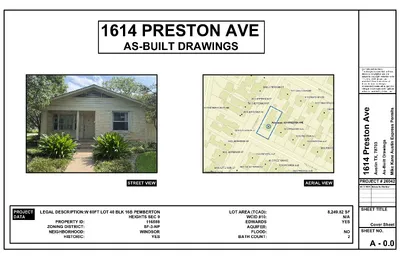
1614 PRESTON AVENUE HR - 2026 – 101908 Meeting of the Historic Landmark Commission September 2, 2026 Presentation Materials & Reference Appendix EXHIBIT NAVIGATION A CLARIFICATIONS B MASONRY C LOT RESTRICTIONS D JEFFERSON ST. E FRONT ALTERNATES F SUMMARY 1614 PRESTON AVENUE HR - 2026 – 101908 EX HI B I T A : MI N OR C L A R I FI C A TI ON S TO S TA FF R EPOR T AS DESCRIBED IN STAFF REPORT “demolish front porch” (V1 – Corrected V2) “doubling the footprint” “doubling the size of the house” “remove existing windows” AS DRAWN FILE REFERENCE Front porch retained in full Current Foundation → Proposed = 2,261 → 2,295 sq. ft. = +34 sq. ft. (+1.5%) Current (existing living + convertible) → Proposed = 2,184 → 3,300 sq. ft. = +1,116 sq. ft. (+51%) *Excluding convertible: = 1,789 → 3,300 sq. ft. (+84%) Existing windows are not original (high confidence) to 1939 structure. Submitted Backup, Plans, “First Floor” (p.12) Submitted Backup, Plans, “Existing / Demo Plan” (p.11) Submitted Backup, Plans, “Existing / Demo Plan” (p.11) See Appendix A.1 and A.2 (following Exhibits) for window inspection details and photographs. “new windows, both in fixture and location, are proposed” Existing window locations are reused with framing adjustments in 75% of street-frontage locations. See Appendix A.3 (following Exhibits) for comparison of first-story window locations with street frontage. With exception of a 34 sq. ft. foundation area and garage conversion, all exterior walls are to be retained in place, and on existing foundations. EXHIBIT NAVIGATION A CLARIFICATIONS B MASONRY C LOT RESTRICTIONS D JEFFERSON ST. E FRONT ALTERNATES F SUMMARY EX HI B I T B : MA S O N R Y C ON DI TI ON 1614 PRESTON AVENUE HR - 2026 – 101908 SLAB AREA 1 SLAB AREA 2 ORIGINAL PIER-AND- BEAM J E F F E R S O N S T R E E T LOCATION OF EXISTING MASONRY PRESTON AVENUE “Correcting this issue requires remediation of the wall assembly, which requires removal of the stone.” Excerpt from Contractor Letter ACTIVE STRUCTURAL MOVEMENT Stepped crack tracking the mortar joints across three courses. Front elevation. PRIOR REPAIR HAS ALREADY FAILED Cementitious patch at the chimney junction, cracked through since repair. Jefferson side. MORTAR LOSS – OPEN BED JOINT Mortar entirely absent across the joint, leaving a direct water path. Jefferson side. CHRONIC MOISTURE …

August 20, 2026 Historic Preservation Office City of Austin, Texas preservation@austintexas.gov RE: Condition of Existing Masonry at 1614 Preston Avenue, Austin, Texas 78703 Mr. Lukes and Members of the Historic Landmark Commission, I am the general contractor for the proposed renovation and second-story addition at 1614 Preston Avenue. I have over 20 years of experience in residential construction in Austin and Central Texas, including work on homes of this era, and with the kinds of masonry challenges present at 1614 Preston. This letter details my professional assessment of the condition of the existing masonry, the origin of the present issues, and my recommendation. On the structural questions, I have relied on the concurring opinion of the project’s structural engineer, Bradley Shaw. The existing stone masonry at 1614 Preston does not extend around the building. The stone is present on the front and along a little more than half of the left side. The remaining walls are not stone- clad. In my assessment, significant portions of this masonry do not appear original to the 1939 structure. This is most apparent at the chimney and along the Jefferson Street side. This conclusion is based on the variation in the stone’s cut and color, differences in coursing and mortar, and the way the stonework terminates, particularly at and around the chimney and the earlier addition area. These observations are consistent with the property’s other evidence of prior additions, as well as the structural engineer’s findings. The existing masonry is deteriorating and cannot be reliably stabilized. I observe cracking and displacement within the stonework, failed mortar joints, and clear evidence of chronic moisture intrusion. This evidence includes staining, dampness, and heavy biofilm growth in areas that appear to remain persistently wet rather than occasionally damp. The concentration of biofilm at grade and across the lower half of the wall is consistent with water collecting and remaining at the base of the wall, from ground contact, splashback, and the lack of appropriate base flashing. At the chimney, the biofilm marks sustained water entry at a junction that is a common source of leaks. Mortar loss and stone decay are most advanced in these same areas. In my experience, the cause is most often the manner of construction. A masonry wall always takes on some water. Without sufficient weather-resistive barriers, drainage cavities, flashing, or weep systems, water is held against the back of the stone and …
REGULAR MEETING OF THE COMMISSION ON IMMIGRANT AFFAIRS THURSDAY, SEPTEMBER 10, 2026, AT 6:30 PM PERMITTING AND DEVELOPMENT CENTER, ROOM 1406 6310 WILHELMINA DELCO DRIVE AUSTIN, TEXAS Some members of the Commission on Immigrant Affairs may be participating by videoconference. Public comment will be allowed in-person or remotely via telephone. Speakers may only register to speak on an item once either in-person or remotely and will be allowed up to three minutes to provide their comments. Registration no later than noon the day before the meeting is required for remote participation by telephone. To register to speak remotely, contact Nekaybaw Watson, 512-974-2562, nekaybaw.watson@austintexas.gov. CURRENT COMMISSIONERS : Miriam Dorantes, Chair Adrian De La Rosa Aditi Joshi Diane Kanawati Melissa Ortega Yohana Saucedo AGENDA CALL TO ORDER PUBLIC COMMUNICATION: GENERAL Alondra Johnson, Vice-Chair Azeem Edwin Jeanne “Canan” Kaba Wilson Ramirez Meghna Roy Caroline Solis The first ten speakers signed up prior to the meeting being called to order will each be allowed a three-minute allotment to address their concerns regarding items not posted on the agenda. APPROVAL OF MINUTES 1. Approve the minutes of the Commission on Immigrant Affairs regular meeting on August 3rd, 2026. STAFF BRIEFING 2. Staff briefing from Austin Equity and Inclusion regarding the goals and priorities of the Immigrant Affairs Manager. Briefing by Shafina Khaki, Human Rights Officer, Austin Equity and Inclusion and Houmma Garba, Immigration Affairs Manager, Austin Equity and Inclusion. DISCUSSION ITEMS 3. Create a list of questions and discussion items for City of Austin Departments for future presentations. 4. Discussion of the strategic impact of the commission and ideas for organizations to invite, recommendations to consider, and future discussions to have. 5. Discussion on emergency relief funding and resources due to detentions resulting in family separation. WORKING GROUP UPDATES 6. Update from the Joint Inclusion Committee (JIC) representative regarding August meeting of the JIC. 7. Update from Quality-of-Life Study Working group regarding recent meetings and study progress. (Current Members: Vice Chair Johnson, Commissioners: Edwin, Kaba, Kanawati, Joshi and Ortega) FUTURE AGENDA ITEMS ADJOURNMENT The City of Austin is committed to compliance with the Americans with Disabilities Act. Reasonable modifications and equal access to communications will be provided upon request. For assistance, please contact the Liaison or TTY users’ route through 711. A person may request language access accommodations no later than 48 hours before the scheduled meeting. Please call or email Nekaybaw Watson at Austin …
REGULAR MEETING of the TOURISM COMMISSION WEDNESDAY, September 9, 2026, AT 2:30 P.M. CITY HALL, COUNCIL CHAMBERS ROOM 1001 300 W. 2ND STREET AUSTIN, TEXAS Some members of the Tourism Commission may be participating by videoconference. The meeting may be viewed online at: http://www.austintexas.gov/page/watch-atxn-live Public comment will be allowed in-person or remotely via telephone. Speakers may only register to speak on an item once either in-person or remotely and will be allowed up to three minutes to provide their comments. Registration no later than noon the day before the meeting is required for remote participation by telephone. To register to speak remotely, contact April Thedford, (512) 404-4054 or april.thedford@austintexas.gov CURRENT COMMISSIONERS: Ed Bailey, Chair, District 5 Greg Chanon, District 2 Francisco “Cisco” Gamez, District 1 Stefani Mathis, District 8 Maxwell "Max" Pearce, District 7 Catherine Whited, District 9 AGENDA CALL TO ORDER PUBLIC COMMUNICATION: GENERAL Cristina Masters, Vice Chair, District 10 Bishop Chappell, District 6 Sophia Gonzalez, District 4 Anna Panossian, Mayoral Dani Pruitt, District 3 The first 10 speakers signed up prior to the meeting being called to order will each be allowed a three- minute allotment to address their concerns regarding items not posted on the agenda. APPROVAL OF MINUTES 1. Approve the minutes of the Tourism Commission Regular Meeting on July 8, 2026. DISCUSSION ITEMS 2. Presentation by SXSW regarding SXSW’s Economic Impact, Opportunities and Challenges related to the Convention Center construction, insights into SXSW Global Expansion, and Media Acquisition Benefits. Presentation by Peter Lewis, Chief Commercial Officer. 3. Presentation by Circuit of the Americas regarding COTA’s Economic and Visitor Impact, and Expansion Opportunities. Presentation by John Villarreal, Director of Government Relations. WORKING GROUP UPDATE 4. Update from Hotel Occupancy Tax (H.O.T.) Grant Programs Working Group. FUTURE AGENDA ITEMS ADJOURNMENT The City of Austin is committed to compliance with the Americans with Disabilities Act. Reasonable modifications and equal access to communications will be provided upon request. For assistance, please contact the Liaison or TTY users’ route through 711. A person may request language access accommodation no later than 48 hours before the scheduled meeting. Please call or email April Thedford at Austin Convention Center, at (512) 404-4054 or april.thedford@austintexas.gov to request service or for additional information. For more information on the Tourism Commission please contact April Thedford at (512) 404-4054 or april.thedford@austintexas.gov. The next Tourism Commission meeting will be on October 14, 2026.
TOURISM COMMISSION REGULAR MEETING MINUTES WEDNESDAY, July 8, 2026 The Tourism Commission convened in a Regular meeting on Wednesday, July 8, 2026, at 301 W. 2nd Street in Austin, Texas. Chair Ed Bailey called the Tourism Commission Meeting to order at 2:35 p.m. Commissioners in Attendance: • Ed Bailey, Chair, District 5 • Cristina Masters, Vice Chair, District 10 • Greg Chanon, District 2 • Francisco “Cisco” Gomez, District 1 • Sophia Gonzalez, District 4 • Stefani Mathis, District 8 • Anna Panossian, Mayoral • Dani Pruitt, District 3 • Catherine Whited, District 9 PUBLIC COMMUNICATION: GENERAL None present. APPROVAL OF MINUTES 1. Approve the minutes of the Tourism Commission Regular Meeting on June 10, 2026. The minutes from the Tourism Commission regular meeting on June 10, 2026, were approved on Commissioner Channon’s motion, Vice Chair Masters’s second on a 9-0 vote, Commissioner Chappell and Commissioner Pearce were absent. DISCUSSION ITEMS 2. Presentation by Austin Arts, Culture, Music, and Entertainment, regarding an overview of the Hotel Occupancy Tax Grants. The presentation was made by Laura Odegaard, Acting Division Manager. 1 Discussed. 3. Presentation by Austin Woman’s Club, 2026 Heritage Preservation Capital Grant recipient, regarding an overview of the organization, its role in the tourism industry and plans for their heritage grant. The presentation was made by Mary Ann Golden, President. Discussed. 4. Presentation by Preservation Austin, 2026 Heritage Event Grant recipient, regarding an overview of the organization, its role in the tourism industry and plans for their heritage grant. The presentation was made by Bridget Gayle Ground, Learning and Engagement Manager. Discussed. DISCUSSION AND POSSIBLE ACTION ITEMS 5. Discuss and approve the annual report of the Tourism Commission. Discussed. No action taken. WORKING GROUP UPDATE 6. Commissioner Pruitt provided an update from the Hotel Occupancy Tax Grant Programs Working Group. The working group is continuing to reviewing the grant application process; collecting and reviewing data received from grant recipients; and learning more about the grant recipients. The working group will continue to meet and will provide an update at the next monthly meeting. STAFF BRIEFING 7. Staff briefing on commission deadlines and resources. The presentation was made by April Thedford, Commission Liaison. Chair Bailey adjourned the meeting at 4:35 p.m. without objection. 2

SXSW 2027 SXSW 2027 A brief overview of SXSW for the Austin Tourism Commission 1 Where the world convenes Where the world convenes Every March since 1987, SXSW turns Austin into the meeting place for the people shaping what's next. Four festivals — Music, Film & TV, Innovation, and Comedy — run at once across downtown, so a filmmaker, a founder, a marketer, and a musician all move through the same seven days. That convergence creates maximum impact for our attendees and our city. 2 SXSW INNOVATION CONFERENCE SXSW MUSIC FESTIVAL & CONFERENCE SXSW FILM & TV FESTIVAL & CONFERENCE SXSW COMEDY FESTIVAL The ideas, technology, and founders defining the next decade of business and culture. A must attend for brands, marketers, and creators. Seven nights of showcases and the discovery that breaks tomorrow's headliners. Not just a festival, it’s the industry event for the music business. Premieres, screenings, and the creators redefining how stories get made and seen. It’s up-and-coming talent crossing red carpet paths with Oscar-winners. The comics and shows setting the tone for what the culture laughs at next. Comedy is a sharp filter on what’s next in culture. 3 SXSW by the numbers SXSW by the numbers 200K+ 75+ 2,000+ $375M+ Creators, founders, and executives converge on Austin across the conference and festivals. Countries represented — a genuinely global room your delegation steps into. Conference sessions across four festivals — a full week to build a schedule around. Annual economic impact — the scale of the platform your group plugs into. 4 Economic Impact Economic Impact 'South By,' as Austin residents call it, has become an economic powerhouse, its effect on the local economy akin to hosting a Super Bowl, reaching $356 million last year...” -The New York Times 5 1 in 4 attendees travel internationally, from 75+ countries. Delegations arrive from Canada, the UK, Brazil, Mexico, Germany, Japan, and Australia — allowing you access to a worldwide cohort. 1 in 4 attendees travel internationally, from 75+ countries. Delegations arrive from Canada, the UK, Brazil, Mexico, Germany, Japan, and Australia — allowing you access to a worldwide cohort. 6 SXSW 2026 Demographics SXSW 2026 Demographics Gender Female Male Other Includes non-binary, gender fluid and transmasculine Education 4-year (BA, BS) college degree Graduate degree Some college PhD Associate's degree High school graduate/GED 51% 46% 3 % 42% 38% 7% 7% 3 % 3 % Age Under 21 …
REGULAR MEETING SMALL AREA PLANNING JOINT COMMITTEE Wednesday, September 9th, 2026 11:30 AM Permitting and Development Center (PDC), Rm. 3002 6310 Wilhelmina Delco Drive Austin, TX 78752 Some members of the Small Area Plan Joint Committee may be participating by video conference. Public comment will be allowed in-person or remotely by telephone. Speakers may only register to speak on an item once, either in-person or remotely, and will be allowed up to three minutes to provide their comments. Registration no later than noon the day before the meeting is required for remote participation. To register, call or email the board liaisons at 512-974-3170 or Samuel.Gonsoulin@austintexas.gov. CURRENT COMMISSIONERS: Ryan Puzycki, Chair Casey Haney, Vice Chair Christian A Tschoepe Nadia Barrera-Ramirez Brian C Bedrosian Luis D Osta Lugo Danielle Skidmore AGENDA CALL TO ORDER PUBLIC COMMUNICATION: GENERAL The first 3 speakers who sign up by noon (12:00 PM) the day before the meeting, being called to order will each be allowed a three-minute allotment to address their concerns regarding items not posted on the agenda. APPROVAL OF MINUTES 1. Approve the minutes of the Small Area Planning Joint Committee meeting on May 6th, 2026. 1 DISCUSSION ITEMS 2. Discussion of how the Small Area Planning Joint Committee (SAPJC) would like to be briefed on future small area planning efforts. FUTURE AGENDA ITEMS ADJOURNMENT The City of Austin is committed to compliance with the American with Disabilities Act. Reasonable modifications and equal access to communications will be provided upon request. Meeting locations are planned with wheelchair access. If requiring Sign Language Interpreters or alternative formats, please give notice at least 2 days (48 hours) before the meeting date. Please call Mark Walters at the Housing and Planning Department, at 512-974-7695, for additional information; TTY users route through Relay Texas at 711. For more information on the Small Area Planning Joint Committee, please contact the liaison, Chase Gonsoulin at 512-974-3170, Samuel.Gonsoulin@austintexas.gov; or Donna Arwood at 512- 974-3440, donna.arwood@austintexas.gov. 2
SMALL AREA PLANNING JOINT COMMITTEE MINUTES REGULAR MEETING WEDNESDAY, MAY 6, 2026 The SMALL AREA PLANNING JOINT COMMITTEE convened in a REGULAR MEETING on WEDNESDAY, MAY 6, 2026, at Permitting and Development Center (PDC) Rm. 3004 6310 Wilhelmina Delco Drive in Austin, Texas. Chair Ryan Puzycki called the SMALL AREA PLANNING JOINT COMMITTEE meeting to order at 11:34 a.m. Commissioners in Attendance: Ryan Puzycki, Chair Christian A Tschoepe Brian C Bedrosian Commissioners in Attendance Remotely: Nadia Barrera-Ramirez Danielle Skidmore Note that Christian A Tschoepe was listed as Vice Chair on this meeting’s agenda in error. Casey Haney is the Vice Chair of the SAPJC. PUBLIC COMMUNICATION: GENERAL None present. APPROVAL OF MINUTES 1. Approve the minutes of the SMALL AREA PLANNING JOINT COMMITTEE REGULAR Meeting on WEDNESDAY, March 10, 2026. The minutes from the SMALL AREA PLANNING JOINT COMMITTEE REGULAR MEETING on WEDNESDAY, March 10, 2026, were approved on Commissioner Christian A Tschoepe’s motion, Commissioner Nadia Barrera-Ramirez’s second on a 5-0 vote. Commissioner Luis D Osta Lugo and Commissioner Casey Haney were absent. DISCUSSION AND ACTION ITEMS 1 2. Discussion and possible action on a recommendation on case number C814-2008- 0087.02, South Shore PUD Addition. Austin Planning Staff: Jonathan Tomko, AICP, jonathan.tomko@austintexas.gov, (512) 974-1057. The motion to approve the recommendation to Council on case number C814-2008- 0087.02 was approved on Commissioner Danielle Skidmore’s motion, Commissioner Casey Haney’s second on a 5-0 vote. Commissioner Luis D Osta Lugo and Commissioner Casey Haney were absent. Chair Ryan Puzycki adjourned the meeting at 11:52 a.m. without objection on a 5-0 vote. 2
REGULAR MEETING OF THE COMMISSION ON AGING WEDNESDAY, SEPTEMBER 9, 2026, 12:00 P.M. AUSTIN CITY HALL, BOARDS & COMMISSIONS ROOM 301 W 2ND ST AUSTIN, TEXAS 78701 Some members of the Commission on Aging may be participating by videoconference. Public comment will be allowed in-person or remotely via telephone. Speakers may only register to speak on an item once either in-person or remotely and will be allowed up to three minutes to provide their comments. Registration no later than noon the day before the meeting is required for remote participation by telephone. To register to speak remotely, call or email Ryan Sperling, 512-974-3568, Ryan.Sperling@austintexas.gov. CURRENT COMMISSIONERS: Richard Bondi, Chair Teresa Ferguson, Vice Chair Suzanne Anderson Martin Kareithi Faith Lane Fred Lugo Angie Ozarowski Jennifer Scott Luan Tran AGENDA CALL TO ORDER PUBLIC COMMUNICATION: GENERAL Preston Tyree Henry Van de Putte Selina Yee Xiaoyi Zeng The first ten speakers signed up prior to the meeting being called to order will each be allowed a three-minute allotment to address their concerns regarding items not posted on the agenda. APPROVAL OF MINUTES 1. Approve the minutes of the regular meeting of the Commission of Aging on August 12, 2026. DISCUSSION ITEMS 2. Discussion on the wrapping up of proclamations recommended at the June meeting. 3. Review of revised bluelines for Age Friendly Action Plan (AFAP) Focus Areas One and Two. 4. Discussion regarding AFAP Focus Area Three 5. Discussion regarding potential updates to the previously approved Commission on 2026- 2030 internal framework. 6. Update on Joint Inclusion Committee discussions at the August 26 meeting. DISCUSSION AND ACTION ITEMS 7. Approve a recommendation to Council for a proclamation on National Adult Day Services Week – September 20-26. 8. Approve a recommendation to Council for a proclamation on Health Literacy Month – October. 9. Approve a recommendation to Council for a proclamation on Veterans Day – November 11. 10. Approve a recommendation to Council for a proclamation on Home Care Aide Day – November 18. 11. Approve a recommendation to Council for a proclamation on National Care at Home Month – November. 12. Approve a recommendation to Council for a proclamation on National Family Caregivers Month – November. 13. Approve the formation of a working group to propose budget recommendations for the FY2027-28 Budget Cycle. 14. Approve updates to working group membership. WORKING GROUP UPDATES 15. Update from the Quality of Life Study Analysis Working …
COMMISSION ON AGING MINUTES REGULAR MEETING WEDNESDAY, AUGUST 12, 2026 The Commission on Aging convened in a regular meeting on Wednesday, August 12, 2026, at Austin City Hall, Boards and Commissions Room 1101, 301 W 2nd Street in Austin, Texas. Chair Bondi called the Commission on Aging Meeting to order at p.m. Commissioners in Attendance: Richard Bondi (Chair) Preston Tyree Fred Lugo Luan Tran Xiaoyi Zeng Commissioners in Attendance Remotely: Teresa Ferguson (Vice Chair) Suzanne Anderson Martin Kareithi Henry Van de Putte Jennifer Scott Call to order 12:24 P.M. PUBLIC COMMUNICATION: GENERAL Carlos Soto – Community Advancement Network Work Events APPROVAL OF MINUTES 1. Approve the minutes of the Commission on Aging regular meeting of July 8, 2026. The July 8, 2026 minutes were approved on Commissioner Lugo’s motion, Vice Chair Ferguson’s second on a 10-0 vote. Commissioners Lane, Ozarowski, and Yee were absent. DISCUSSION ITEMS 1. Discussion regarding Chair Bondi’s orientation sessions for new commission members. Update by Chair Bondi. 2. Update on the status of the proclamation recommendations approved at the June 10, 2026 meeting. Update by Chair Bondi. Item 2 was taken up after Item 4 without objection. 1 3. Discussion regarding the proposed City of Austin FY2026-27 budget and the status of commission recommendations. Update by Chair Bondi. 4. Discussion on the closed out 2021-2025 Age Friendly Austin Progress Report. Update by Chair Bondi. DISCUSSION AND ACTION ITEMS 5. Review and document changes to the draft version of the Age Friendly Action Plan (AFAP) 2026-2030 Focus Area 1, discuss impacts on commission work, and approve the commission’s Focus Area One Work Plan. The Commission’s Focus Area One Work Plan was approved on Commissioner Scott’s motion, Commissioner Tyree’s second on a 10-0 vote. Commissioners Lane, Ozarowski, and Yee were absent. 6. Review and document changes to the draft version of AFAP 2026-2030 Focus Area 2, discuss impacts on commission work, and approve the Commission’s Focus Area Two Work Plan. The Commission’s Focus Area Two Work Plan was approved on Commissioner Van de Putte’s motion, Commissioner Anderson’s second on a 10-0 vote. Commissioners Lane, Ozarowski, and Yee were absent. 7. Discussion regarding commission priorities for AFAP 2026-2030 Focus Area 3 and possible action to approve a list of priorities. Postponed to September without objection. 8. Discussion and possible action to approve an internal framework that guides the Commission’s priorities for the next five years, to build, bridge, and …
BOARD/COMMISSION RECOMMENDATION Commission on Aging Recommendation Number: 20260909-010: Home Care Aide Day – November 18 WHEREAS, home care aides provide essential hands-on assistance that enables older adults and people with disabilities to live safely and independently in their homes and communities; and WHEREAS, home care aides assist individuals with activities of daily living and provide companionship, personal care, and other supports that contribute to health, dignity, safety, and quality of life; and WHEREAS, the 2025 Austin Older Adult Quality of Life Study recommends that the City “explore systemic supports for caregivers to balance caregiving responsibilities with paid employment” 1 and improve caregiver supports; and WHEREAS, the Austin Older Adult Quality of Life Study also reports that “most older adult caregivers are working full-time,” 2 illustrating the importance of a strong network of paid care professionals and community supports; and WHEREAS, recognizing and supporting the direct care workforce is increasingly important as the number of older adults in Austin and Central Texas continues to grow 3. NOW, THEREFORE, BE IT RESOLVED that the Commission on Aging encourages the Austin City Council to recognize November 18, 2026, as "Home Care Aide Day" in Austin and to honor home care aides for their essential contributions to the health, independence, dignity, and quality of life of older adults and people with disabilities. Date of Approval: _______________________________ Record of the vote: Attest: _____________________________________________ 1 Austin Older Adults Quality of Life At-A-Glance, Caregivers, p. 1 2 Austin Older Adults Quality of Life At-A-Glance, Caregivers, p. 1 3 City of Austin, Council Resolution No. 20250605-084
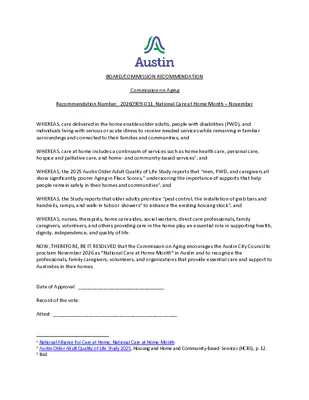
BOARD/COMMISSION RECOMMENDATION Commission on Aging Recommendation Number: 20260909-011: National Care at Home Month – November WHEREAS, care delivered in the home enables older adults, people with disabilities (PWD), and individuals living with serious or acute illness to receive needed services while remaining in familiar surroundings and connected to their families and communities; and WHEREAS, care at home includes a continuum of services such as home health care, personal care, hospice and palliative care, and home- and community-based services1; and WHEREAS, the 2025 Austin Older Adult Quality of Life Study reports that “men, PWD, and caregivers all show significantly poorer Aging in Place Scores,” underscoring the importance of supports that help people remain safely in their homes and communities2; and WHEREAS, the Study reports that older adults prioritize “pest control, the installation of grab bars and handrails, ramps, and walk-in tubs or showers” to enhance the existing housing stock3; and WHEREAS, nurses, therapists, home care aides, social workers, direct care professionals, family caregivers, volunteers, and others providing care in the home play an essential role in supporting health, dignity, independence, and quality of life. NOW, THEREFORE, BE IT RESOLVED that the Commission on Aging encourages the Austin City Council to proclaim November 2026 as "National Care at Home Month" in Austin and to recognize the professionals, family caregivers, volunteers, and organizations that provide essential care and support to Austinites in their homes. Date of Approval: _______________________________ Record of the vote: Attest: _____________________________________________ 1 National Alliance for Care at Home, National Care at Home Month 2 Austin Older Adult Quality of Life Study 2025, Housing and Home and Community-Based Services (HCBS), p. 12. 3 Ibid.

BOARD/COMMISSION RECOMMENDATION Commission on Aging Recommendation Number: 20260909-012: National Family Caregivers Month – November WHEREAS, family caregivers provide essential unpaid support to older adults, people with disabilities, children, and individuals living with chronic illness, helping people remain connected to their homes, families, and communities; and WHEREAS, caregiving may include assistance with meals, transportation, medications, personal care, household activities, healthcare coordination, financial responsibilities, and emotional support; and WHEREAS, the 2025 Austin Older Adult Quality of Life Study reports that “approximately 19% reported being a paid or unpaid caregiver for an adult aged 50 or older”1 and that “the remaining 88% of caregivers were 50 years or older”2; and WHEREAS, the 2025 Austin Older Adult Quality of Life Study recommends that the City “explore systemic supports for caregivers to balance caregiving responsibilities with paid employment”3 and “explore effective methods of outreach surrounding availability of and enrollment in respite care programming and other caregiver supports”4; and WHEREAS, the Austin Families with Young Children study found that “79% of caregivers reported some level of difficulty paying for childcare,”5 demonstrating that caregiving challenges extend across the lifespan. NOW, THEREFORE, BE IT RESOLVED that the Commission on Aging encourages the Austin City Council to proclaim November 2026 as "National Family Caregivers Month" in Austin and to recognize family caregivers for their essential contributions while encouraging greater awareness of respite, education, workplace supports, and community resources available to caregivers. Date of Approval: _______________________________ Record of the vote: 1 Austin Older Adult Quality of Life Study 2025, Findings: Caregivers, p. 86. 2 Ibid. 3 Austin Older Adults Quality of Life: Caregivers At-A-Glance, p. 1. 4 Ibid. 5 Bright Beginnings: Experiences of Families with Young Children in Austin, TX, Summary Report of Findings (2025), Childcare findings, p. 30. Attest: _____________________________________________

Draft Age Friendly Austin Action Plan: 2026-2030 Last Updated: July 9, 2026 August 24, 2026 Focus Area One: Social Engagement, Connection, & Inclusion Aligns with Domains: 4-Social Participation, 5-Respect & Social Inclusion, 7-Communication & Information Framework for the 2026-2030 Action Plan Understanding the Indicators The 2026-2030 Action Plan establishes measurable benchmarks for the first time by incorporating baseline scores. These indicators are derived directly from the Austin Older Adult Quality of Life Study conducted in 2025. By using community survey data to quantify how older adults currently rate their experiences, spanning from transportation satisfaction to health and food insecurity, these baselines provide a starting point. Establishing these scores allows the City of Austin and its partners to measure the effectiveness of their strategies and track year-over-year progress more accurately. Alignment with the Previous Plan's Domains When this plan notes that a section aligns with domains, it bridges our current goals to the AARP and World Health Organization’s Eight Domains of Livability. These eight domains served as the structural foundation for the city's previous age- friendly plans. To create a more targeted, efficient, and intersectional approach for 2026-2030, the City has consolidated those original eight domains into three comprehensive focus areas. Social Engagement, Connection, & Inclusion Aligns with Domains: Social Participation, Respect & Social Inclusion, Communication & Information This focus area addresses the critical need for older adults to feel valued, informed, and connected to their community. The consolidation of these domains was driven by recent quality of life findings revealing high risks of social isolation, particularly among LGBTQIA+ seniors, lower-income older adults, and individuals with disabilities. Furthermore, it targets communication hurdles, as recent data highlights that a lack of affordable internet and language barriers severely limit how homebound and multilingual seniors access essential city resources. By grouping these areas, the plan aims to build a more inclusive environment that proactively bridges the digital divide, tackles discrimination, and fosters meaningful community participation. Excerpted from: July 9, 2026 Final Draft Age Friendly Austin Action Plan: 2026-2030 Page 1 of 13 August 24, 2026 Draft Age Friendly Austin Action Plan: 2026-2030 Last Updated: July 9, 2026 August 24, 2026 Focus Area One: Social Engagement, Connection, & Inclusion Aligns with Domains: 4-Social Participation, 5-Respect & Social Inclusion, 7-Communication & Information Goal 1: Improve access to technology and community information Objective 1: Empower seniors through access to internet, digital devices, and training to use them …

Draft Age Friendly Austin Action Plan: 2026-2030 Last Updated: July 9, 2026 August 24, 2026 Focus Area Three: Housing & Economic Security Aligns with Domains: 3-Housing and 6-Civic Engagement & Employment Housing & Economic Security Aligns with Domains: Housing, Civic Engagement & Employment This focus area recognizes that safe, affordable housing and economic stability are the foundation of aging in place. It consolidates housing and employment to tackle the intense financial pressures older adults face in a rapidly changing, increasingly expensive landscape. With nearly 30% of housed seniors worrying about losing their homes, and utility insecurity disproportionately affecting seniors with disabilities and communities of color, basic economic survival is a pressing challenge. By also addressing the 19% of older adults who desire to work but cannot find employment, this section comprehensively targets the financial and residential stability required for Austin's seniors to thrive. Goal 1: Increase housing security and access to home modification and repair programs to support seniors aging in place. Objective 1: Increase annual participation in city-funded home repair and modification programs for older adults. Strategy 1: Develop multi-lingual outreach campaigns to bridge the gap between service awareness and access. Partners: Austin Housing, APH, ACE, ASC Deadline: 2027 Metrics: Translated materials created Outreach campaign launched. Strategy 2: Prioritize housing interventions that specifically address the top home repair and modification needs identified by Excerpted from: July 9, 2026 Final Draft Age Friendly Austin Action Plan: 2026-2030 Page 1 of 11 August 1124, 2026 Draft Age Friendly Austin Action Plan: 2026-2030 Last Updated: July 9, 2026 August 24, 2026 Focus Area Three: Housing & Economic Security Aligns with Domains: 3-Housing and 6-Civic Engagement & Employment seniors: pest control, grab bars/handrails, ramps, and accessible showers. Partners: Austin Housing, Meals on Wheels, Rebuilding Together. Deadline: 2028 Metrics: Annual # of targeted home modifications completed. Strategy 3: Conduct a geographic gap analysis of city-funded home repair programs to identify underserved neighborhoods and populations. Partners: Austin Housing, APH. Deadline: 2027 Metric: Gap analysis completed. Excerpted from: July 9, 2026 Final Draft Age Friendly Austin Action Plan: 2026-2030 Page 2 of 11 August 1124, 2026 Draft Age Friendly Austin Action Plan: 2026-2030 Last Updated: July 9, 2026 August 24, 2026 Focus Area Three: Housing & Economic Security Aligns with Domains: 3-Housing and 6-Civic Engagement & Employment Goal 1: Increase housing security and access to home modification and repair programs to support seniors aging in place. …
Draft Age Friendly Austin Action Plan: 2026-2030 Last Updated: July 9, 2026 August 24, 2026 Focus Area Two: Health, Mobility, and Accessibility Aligns with Domains: 8-Community & Health Services, 2-Transportation, and 1-Outdoors Spaces & Buildings Health, Mobility, and Accessibility Aligns with Domains: Community & Health Services, Transportation, and Outdoors Spaces & Buildings Physical well-being and the ability to safely navigate the city are linked, which is why health, transportation, and the built environment are combined in this section. This focus area responds to community data showing that adults ages 50 to 64 experience increased health insecurity, and that more than a quarter of participants have recently struggled to access necessary medical care. It also addresses significant concerns regarding pedestrian safety and the accessibility of recreational spaces for seniors with mobility challenges. Integrating these domains ensures a holistic approach to creating safe, accessible infrastructure that supports both the physical health and mobility of Austin's senior population. Indicators: Health Insecurity Score (Baseline: 8.85/20) Food Insecurity Score (Baseline: 3.82/6) Excerpted from: July 9, 2026 Final Draft Age Friendly Austin Action Plan: 2026-2030 Page 1 of 14 August 11 24, 2026 Draft Age Friendly Austin Action Plan: 2026-2030 Last Updated: July 9, 2026 August 24, 2026 Focus Area Two: Health, Mobility, and Accessibility Aligns with Domains: 8-Community & Health Services, 2-Transportation, and 1-Outdoors Spaces & Buildings Goal 1: Increase awareness and access to health, safety, and accessibility resources. Objective 1: Reduce use of non-urgent emergency services among seniors. Strategy 1: Support and increase capacity of the Senior Home Safety Program. Partners: Austin-Travis County Emergency Medical Services (ATCEMS), Commission on Aging, Austin Fire, Austin Police.3-1-1, APR, APL Deadline: 2029 Metric: Year-over-year % decrease in non-injury fall calls for residents 55+. Strategy 2: Develop partnerships to recruit and train volunteers to conduct initial basic home assessments. Partners: University of St. Augustine for Health Sciences, ATCEMS, Austin-Travis County Medical Reserve Corps(MRC). Deadline: 2029 Metrics: # of partnerships developed. # of assessments completed by volunteers annually. Strategy 3: Implement senior specific pop-up resource clinics. Partners: ATCEMS, APH (Mobile Van Program and Community Health Worker Hub), APR, APL Deadline: 2029 Metrics: # of seniors served annually by pop-up resource clinics # of pop-up clinics held annually. Excerpted from: July 9, 2026 Final Draft Age Friendly Austin Action Plan: 2026-2030 Page 2 of 14 August 11 24, 2026 Draft Age Friendly Austin Action Plan: 2026-2030 Last Updated: July 9, 2026 …
Commission on Aging 2026-2030 Priority Framework The Commission on Aging adopts this Build and Bridge Framework to help refine and prioritize its work within its responsibilities under City Code. The Framework borrows the three focus areas of the Age-Friendly Austin Action Plan (AFAP) 2026–2030 as a useful way of organizing and narrowing that work. The Commission's responsibilities are established by City Code and include serving as an advisory body to the Austin City Council concerning the quality of life of older adults in the Austin area and helping ensure that older adults are productive, independent, and healthy. The AFAP does not alter or limit those responsibilities. The Commission's Age Friendly Advisory Committee provides oversight of the AFAP consistent with the responsibilities established for the Committee in the Commission's bylaws: monitoring progress, championing older adult involvement in plan development and implementation, reviewing and recommending revisions, and helping ensure community alignment through collaboration with City departments and the older adult community. City Council's adoption of Resolution No. 20250605-084 strengthened the City's commitment to older adults, including directing City departments to incorporate an age-friendly perspective and the AFAP into how they fulfill their missions. This creates additional opportunities for the Commission to engage City departments on issues within the Commission's responsibilities. Build and Bridge Using the three AFAP focus areas, the Commission will identify areas within its City Code responsibilities where focused attention can have a meaningful impact. For each selected area, the Commission may identify one or both of the following roles: Build – Develop or contribute to Commission activities addressing an identified area of focus. Bridge – Convene stakeholders, facilitate collaboration, share information, or strengthen connections addressing an identified area of focus. Build and Bridge describe ways the Commission may approach its work. They do not assign responsibility to the Commission for implementing the AFAP. The Commission's Build and Bridge selections are not intended to encompass every issue affecting older adults or the full scope of its responsibilities. They identify areas where the Commission believes sustained attention can have the greatest impact. Using the Build and Bridge Selections The Build and Bridge selections adopted within each of the three focus areas shall help prioritize and inform: Compiled by: Richard Bondi Page 1 of 2 09/08/2026 Commission on Aging 2026-2030 Priority Framework • Commission meeting agendas and work sessions; • Invited presentations and guest speakers; • Recommendations to the Austin City Council; …
BOARD/COMMISSION RECOMMENDATION Commission on Aging Recommendation Number: 20260909-007: National Adult Day Services Week – September 20–26 WHEREAS, adult day services provide “health, therapeutic, and social services for older adults and individuals with disabilities, helping them maintain independence while supporting caregivers” 1 and other supports for older adults and adults with disabilities while helping individuals remain connected to their families and communities; and WHEREAS, National Adult Day Services Week traces its history to 1983, when Congress enacted House Joint Resolution 132, designating the week beginning September 25 as “National Adult Day Care Center Week,” 2 and President Ronald Reagan issued Proclamation 5107 recognizing that adult day care centers enable individuals to receive needed care without institutionalization and “offer needed respite to families” 3 caring for relatives at home; and WHEREAS, adult day services can provide essential respite and support to family caregivers, helping them balance caregiving responsibilities, employment, personal health, and other obligations; and WHEREAS, the 2025 Austin Older Adult Quality of Life Study found that “88% of older adult caregivers are themselves age 50 or older” and recommends that programs and initiatives “address caregivers’ dual identities - as both caregivers and older adults” 4; and WHEREAS, the Study further recommends that the community “explore effective methods of outreach surrounding availability of and enrollment in respite care programming and other caregiver supports” 5; and WHEREAS, adult day services are an important component of home- and community-based services that can support independence, social connection, caregiver well-being, and the ability of older adults and adults with disabilities to remain in their communities. NOW, THEREFORE, BE IT RESOLVED that the Commission on Aging encourages the Austin City Council to recognize September 20–26, 2026, as “National Adult Day Services Week” in Austin and to recognize the contributions of adult day service providers, direct care professionals, family caregivers, and community organizations that support older adults and adults with disabilities. 1 AGE of Central Texas, Adult Day Health Care 2 Proclamation 5107 -- National Adult Day Care Center Week, 1983 3 Ibid. 4 Austin Older Adults Quality of Life: Caregivers At-A-Glance, p. 1. 5 Ibid. Page 1 of 2 Date of Approval: _______________________________ Record of the vote: Attest: _____________________________________________ Page 2 of 2
BOARD/COMMISSION RECOMMENDATION Commission on Aging Recommendation Number: 20260909-008: Health Literacy Month – October WHEREAS, health literacy includes the ability to find, understand, and use information and services to make health-related decisions, and clear and accessible health information is essential to navigating health care and maintaining individual and community health; and WHEREAS, the U. S. Department of Health and Human Services, Office of Disease Prevention and Health Promotion has identified a National Action Plan to improve health literacy 1, underscoring the importance of this issue, and WHEREAS, October has been recognized as Health Literacy Month since 1999 to increase awareness of the importance of making health information easier to understand and health systems easier to navigate 2; and WHEREAS, the 2025 Austin Women and Girls Quality of Life Study recommends: “Provide language accessible materials of resources to all Austin residents by translating all materials available through the City of Austin in multiple languages and tailored to varying literacy levels” 3; and WHEREAS, the 2025 Austin Older Adult Quality of Life Study reports that “41% of older adults rate their internet as fair or poor” and identifies “digital literacy programs” among needed interventions 4; and WHEREAS, the Austin LGBTQIA+ Quality of Life Study states that “there is a great need to access high- quality, affordable, culturally responsive, comprehensive health care for LGBTQIA+ individuals” 5. NOW, THEREFORE, BE IT RESOLVED that the Commission on Aging encourages the Austin City Council to proclaim October 2026 as "Health Literacy Month" in Austin and encourages City departments, healthcare providers, community organizations, and residents to promote clear, accessible, culturally responsive, and understandable health information for people of all ages and abilities. 1 U. S. Department of Health and Human Services, Office of Disease Prevention and Health Promotion, National Action Plan to Improve Health Literacy 2 Health Literacy Solutions Center 3 Commission for Women-Final Report, November 2025, Findings: Public Services, Digital Divide in Internet Access, p. 82. 4 Austin Older Adult Quality of Life Study 2025, Findings: Public Services, Digital Divide in Internet Access, p. 117. 5 ShoutOut Austin LGBTQIA+ Quality of Life Study (2021), Key Themes, p. 7. Date of Approval: _______________________________ Record of the vote: Attest: _____________________________________________
BOARD/COMMISSION RECOMMENDATION Commission on Aging Recommendation Number: 20260909-009: Veterans Day – November 11 WHEREAS, generations of Americans have served in the United States Armed Forces, making profound contributions and sacrifices in defense of the nation; and WHEREAS, since 1919, the United States of Americans have honored veterans of our armed forces, officially recognized by the United States Congress on June 4, 1926, with these words: Whereas the 11th of November 1918 1; and WHEREAS, nearly 31,000 veterans live in Austin2, representing approximately 4% of the 18 and over population and the City of Austin has long recognized the contributions of veterans to our community, including through its annual Veterans Day observances and its employment of more than 1,600 military veterans Austin3; and WHEREAS, the U.S. Department of Veterans Affairs recognizes that later life can bring challenges for veterans, including “vision or hearing loss or a chronic medical condition,” changes in roles and relationships, “financial or housing issues,” and the need to provide or receive additional help4; and WHEREAS, ensuring that older veterans can access appropriate services and remain connected to their communities supports dignity, independence, and healthy aging; and WHEREAS, recognizing veterans also provides an opportunity to acknowledge the families and caregivers who support those who have served. NOW, THEREFORE, BE IT RESOLVED that the Commission on Aging encourages the Austin City Council to recognize November 11, 2026, as "Veterans Day" in Austin, honoring veterans of all generations for their service and sacrifice and encouraging continued efforts to ensure that veterans and their families can access the services, supports, and opportunities they need throughout their lives. 1 U. S. Dept of Veterans Affairs, History of Veterans Day 2 United States Census Bureau, Quick Facts Austin, TX - Veterans 3 Austin Human Resources, Talent Strategy Division 4 U.S. Department of Veterans Affairs, Resources for Older Veterans Date of Approval: _______________________________ Record of the vote: Attest: _____________________________________________
BOARD/COMMISSION RECOMMENDATION Commission on Aging Recommendation Number: 20260909-007: National Adult Day Services Week – September 20–26 WHEREAS, adult day services provide “health, therapeutic, and social services for older adults and individuals with disabilities, helping them maintain independence while supporting caregivers” 1 and other supports for older adults and adults with disabilities while helping individuals remain connected to their families and communities; and WHEREAS, National Adult Day Services Week traces its history to 1983, when Congress enacted House Joint Resolution 132, designating the week beginning September 25 as “National Adult Day Care Center Week,” 2 and President Ronald Reagan issued Proclamation 5107 recognizing that adult day care centers enable individuals to receive needed care without institutionalization and “offer needed respite to families” 3 caring for relatives at home; and WHEREAS, adult day services can provide essential respite and support to family caregivers, helping them balance caregiving responsibilities, employment, personal health, and other obligations; and WHEREAS, the 2025 Austin Older Adult Quality of Life Study found that “88% of older adult caregivers are themselves age 50 or older” and recommends that programs and initiatives “address caregivers’ dual identities - as both caregivers and older adults” 4; and WHEREAS, the Study further recommends that the community “explore effective methods of outreach surrounding availability of and enrollment in respite care programming and other caregiver supports” 5; and WHEREAS, adult day services are an important component of home- and community-based services that can support independence, social connection, caregiver well-being, and the ability of older adults and adults with disabilities to remain in their communities. NOW, THEREFORE, BE IT RESOLVED that the Commission on Aging encourages the Austin City Council to recognize September 20–26, 2026, as “National Adult Day Services Week” in Austin and to recognize the contributions of adult day service providers, direct care professionals, family caregivers, and community organizations that support older adults and adults with disabilities. 1 AGE of Central Texas, Adult Day Health Care 2 Proclamation 5107 -- National Adult Day Care Center Week, 1983 3 Ibid. 4 Austin Older Adults Quality of Life: Caregivers At-A-Glance, p. 1. 5 Ibid. Page 1 of 2 Date of Approval: September 9, 2026 Motioned By: Commissioner Scott Seconded By: Commissioner Anderson Vote: 10-0 For: Chair Bondi, Commissioners Anderson, Kareithi, Lane, Lugo, Ozarowski, Scott, Tyree, Yee, Zeng Against: None Abstain: None Off the dais: None Absent: Vice Chair Ferguson, Commissioners Tran and Van de Putte Attest: …