Item 4 Posting Language ..Title Authorize two contracts for 19 percent aqueous ammonia, required for the catalytic reduction systems to operate properly, for Austin Energy with Baker Services, Inc. and GC3 Specialty Chemicals Inc., for an initial term of two years with up to three one-year extension options in an amount not to exceed $1,210,000. Funding: $20,167 is available in the Operating Budget of Austin Energy. $242,000 is available in the Fiscal Year 2026-2027 Operating Budget of Austin Energy. Funding for the remaining contract term is contingent upon available funding in future budgets. ..Body Lead Department Austin Financial Services. Client Department(s) Austin Energy. Fiscal Note Funding in the amount of $20,167 is available in the Fiscal Year 2025-2026 Operating Budget of Austin Energy. $242,000 is available in the Fiscal Year 2026-2027 Operating Budget of Austin Energy. Funding for the remaining contract term is contingent upon available funding in future budgets. Procurement Language: Austin Financial Services issued an Invitation for Bids solicitation IFB 1100 AGM1006 for these goods and services. The solicitation was published on May 11, 2026, and closed on June 9, 2026. Of the seven offers received, the recommended contractors submitted the lowest responsive offers. A complete solicitation package, including a tabulation of the bids rece ived, is available for viewing on the City’s website. This information can currently be found at https://financeonline.austintexas.gov/afo/account_services/solicitation/solicitation_details.cfm?sid=143951 . MBE/WBE: This contract will be awarded in compliance with the City Code Chapter 2-9B (Minority-Owned and Women- Owned Business Enterprise Procurement Program). For the goods and services required for this solicitation, there were no subcontracting opportunities; therefore, no subcontracting goals were established. For More Information: Direct questions regarding this Recommendation for Council Action to Austin Financial Services - Central Procurement at: FSDCentralProcurementRCAs@austintexas.gov or 512-974-2500. Respondents to the solicitation and their Agents should direct all questions to the Authorized Contact Person identified in the solicitation. Council Committee, Boards and Commission Action: September 14, 2026 - To be reviewed by the Electric Utility Commission. Additional Backup Information: The contract will provide bulk aqueous ammonia for Sand Hill Energy Center on an as-needed basis. Aqueous ammonia is used to reduce nitrous oxide emissions by converting it to nitrogen and water. Aqueous ammonia is required for the catalytic reduction systems to operate properly. These new contracts will replace the existing contract, which expires August 24, 2027, but is being resolicited early because Austin Energy expects to exhaust the contract's …
Item 5 Posting Language ..Title Authorize five contracts for distribution electrical services for Austin Energy with Gridco, Inc., MasTec North America, Inc., Pike Corporation d/b/a Pike Electric LLC or Power Contracting LLC, Renegade Group, LLC d/b/a Renegade Well Services, LLC or Renegade Well Services, and Southeast Power Corporation, for an initial term of two years with up to three one-year extension options in an amount not to exceed $200,000,000, divided among the contracts. Funding: $80,000,000 is available in the Capital Budget of Austin Energy. Funding for the remaining contract term is contingent upon available funding in future budgets. ..Body Lead Department Austin Financial Services. Client Department(s) Austin Energy. Fiscal Note Funding in the amount of $80,000,000 is available in the Capital Budget of Austin Energy. Funding for the remaining contract term is contingent upon available funding in future budgets. Procurement Language: Austin Financial Services issued a Request for Proposals solicitation RFP 1100 LLM3007 for these services. The solicitation was published on March 30, 2026, and closed on May 12, 2026. Of the 13 offers received, the proposals submitted by the recommended contractors represented best value to the City based on the solicitation’s evaluation criteria. A complete solicitation package, including a log of offers received, is available for viewing on the City’s website. This information can currently be found at https://financeonline.austintexas.gov/afo/account_services/solicitation/solicitation_details.cfm?sid=143796 . MBE/WBE: These contracts will be awarded in compliance with the City Code Chapter 2-9B (Minority-Owned and Women-Owned Business Enterprise Procurement Program) by meeting the combined MBE/WBE goal with 1.83% participation. For More Information: Direct questions regarding this Recommendation for Council Action to the Austin Financial Services - Central Procurement at: FSDCentralProcurementRCAs@austintexas.gov or 512-974-2500. Respondents to the solicitation and their Agents should direct all questions to the Authorized Contact Person identified in the solicitation. Council Committee, Boards and Commission Action: September 14, 2026 - To be reviewed by the Electric Utility Commission. Additional Backup Information: The contract will provide staff augmentation to support distribution electrical services for Austin Energy. It supplements Austin Energy’s workforce by supplying qualified contract labor, equipment, and resources necessary to perform critical utility operations. These resources support Austin Energy’s Electric Systems Resiliency Plan and Development Process initiatives and enhance readiness for emergency response. The scope of the contract has been expanded to address growing operational demands associated with third- party projects, grid hardening, and load growth. This additional support will help Austin Energy maintain Item 5 …
Posting Language ..Title Authorize a contract for generator rotor purchase and assembly for Austin Energy with WEG Electric Corp., in an amount not to exceed $1,750,000. Funding: $550,000 is available in the Capital Budget. $1,200,000 is available in the Operating Budget of Austin Energy. Item 6 ..Body Lead Department Austin Financial Services. Client Department(s) Austin Energy. Fiscal Note Funding in the amount of $550,000 is available in the Capital Budget. Funding in the amount of $1,200,000 is available in the Fiscal Year 2025-2026 Operating Budget of Austin Energy. Procurement Language: Sole Source. MBE/WBE: Sole source contracts are exempt from the City Code Chapter 2-9B (Minority-Owned and Women-Owned Business Enterprise Procurement Program); therefore, no subcontracting goals were established. For More Information: Direct questions regarding this Recommendation for Council Action to Austin Financial Services - Central Procurement at: FSDCentralProcurementRCAs@austintexas.gov or 512-974-2500. Council Committee, Boards and Commission Action: September 14, 2026 - To be reviewed by the Electric Utility Commission. Additional Backup Information: This contract provides for the purchase of one complete, spare rotor assembly. Although Austin Energy is committed to using these units as little as possible, a spare rotor assembly will enable Austin Energy to increase reliability and availability during critical periods of peak power demand. The authorized repair facility for the Decker Creek Power Station, Pratt & Whitney FT4 generation units is in Massachusetts and the process to ship, repair and return a rotor takes minimally five months. Maintaining a fully assembled spare rotor will minimize repair downtime, maintain black-start capability, and strengthen reliability. WEG Electric Machinery is the original equipment manufacturer of the Pratt & Whitney FT4 and is the sole source of proprietary drawings, material specifications, dimensional tolerances, and design criteria required to manufacture the generator rotor assembly. Without this contract, Austin Energy would not have a spare rotor assembly on hand to respond quickly to a rotor failure.
Posting Language ..Title Authorize a contract for fiber network services for Austin Energy with Logix Holding Company d/b/a Logix Fiber Networks, for an initial term of one year with up to one one-year extension option in an amount not to exceed $600,000. Funding: $25,000 is available in the Operating Budget of Austin Energy. $300,000 is available in the Fiscal Year 2026-2027 Operating Budget of Austin Energy. Funding for the remaining contract term is contingent upon available funding in future budgets. Item 7 Lead Department Austin Financial Services. Client Department(s) Austin Energy. Fiscal Note Funding in the amount of $25,000 is available in the Fiscal Year 2025-2026 Operating Budget of Energy. $300,000 is available the Fiscal Year 2026-2027 Operating Budget of Austin Energy. Funding for the remaining contract term is contingent upon available funding in future budgets. Procurement Language: Austin Energy is designating this purchase as a Critical Business Need in accordance with Senate Bill 7, as adopted by the City as Resolution No. 040610-02. MBE/WBE: This contract is exempt from the City Code Chapter 2-9B (Minority-Owned and Women-Owned Business Enterprise Procurement Program); therefore, no subcontracting goals were established. For More Information: Direct questions regarding this Recommendation for Council Action to Austin Financial Services - Central Procurement at: FSDCentralProcurementRCAs@austintexas.gov or 512-974-2500. Council Committee, Boards and Commission Action: September 14, 2026 - To be reviewed by the Electric Utility Commission. Additional Backup Information: This contract will provide Austin Energy with continued access to two critical fiber optic connections. The dedicated connections serve as the foundation for enterprise-wide systems, including telephony, internet access, and essential applications such as the Customer Care & Billing system and allow for redundancy in disaster recovery situations. The connections are vital to both internal operations and customer-facing services, and any disruption to this infrastructure would significantly impact billing processes, service reliability, compliance obligations, and customer experience. This two-year contract will ensure Austin Energy can rely on this infrastructure while concurrently preparing for a competitive solicitation. Without this contract, Austin Energy would lose connection to its off-site cloud systems, which support critical operations and services that directly affect customers. Contract Details: Contract Term Initial Term Optional Extension 1 Length of Term 1 year 1 year Contract Authorization $300,000 $300,000 Total 2 years $600,000 Note: Contract Authorization amounts are based on the City’s estimated annual usage. Item 7
Posting Language ..Title Authorize a contract for emergency and non-emergency spill response, clean-up and restoration services for Austin Energy with Triumvirate Environmental Services, LLC for an initial term of two years with up to three additional one-year extension options in an amount not to exceed $2,500,000. Funding: $350,000 is available in the Operating Budget of Austin Energy. Funding for the remaining contract term is contingent upon available funding in future budgets. Item 8 ..Body Lead Department Austin Financial Services. Client Department(s) Austin Energy. Fiscal Note Funding in the amount of $350,000 is available in the Fiscal Year 2026-2027 Operating Budget of Austin Energy. Funding for the remaining contract term is contingent upon available funding in future budgets. Procurement Language: Austin Financial Services issued a Request for Proposals solicitation RFP 1100 DCM3046 for these services. The solicitation was published on April 13, 2026, and closed on May 28, 2026. Of the four offers received, the proposal submitted by the recommended contractor represented best value to the City based on the solicitation’s evaluation criteria. A complete solicitation package, including a log of offers received, is available for viewing on the City’s website. This information can currently be found at: https://financeonline.austintexas.gov/afo/account_services/solicitation/solicitation_details.cfm?sid=14340. MBE/WBE: This contract will be awarded in compliance with the City Code Chapter 2-9B (Minority-Owned and Women- Owned Business Enterprise Procurement Program). For the service required for this solicitation, there were no subcontracting opportunities; therefore, no subcontracting goals were established. For More Information: Direct questions regarding this Recommendation for Council Action to the Austin Financial Services - Central Procurement at: FSDCentralProcurementRCAs@austintexas.gov or 512-974-2500. Respondents to the solicitation and their Agents should direct all questions to the Authorized Contact Person identified in the solicitation. Council Committee, Boards and Commission Action: September 14, 2026 - To be reviewed by the Electric Utility Commission. Additional Backup Information: The purpose of this contract is to provide emergency and non-emergency response, clean-up and restoration services for both hazardous and non-hazardous oil and chemical spills. Response services include oil spills from electrical equipment (which may contain Polychlorinated Biphenyls ), hazardous materials spills, clean- up and restoration of contaminated areas, and other environmental project support tasks that require trained environmental technicians. This is replacing the current contract which expires on November 8, 2026. The recommended contractor is the current provider for these services. An evaluation team with expertise in this area evaluated the offers and scored Triumvirate Environmental Item …
Posting Language ..Title Authorize an amendment to a contract for continued data acquisition and handling system technical emissions monitoring software support services for Austin Energy with CEMTEK Environmental, Inc./KVB Enertec, to increase the amount by $550,000 for a revised total contract amount not to exceed $860,749. Funding: $550,000 is available in the Capital Budget of Austin Energy. Item 9 ..Body Lead Department Austin Financial Services. Client Department(s) Austin Energy. Fiscal Note Funding in the amount of $550,000 is available in the Capital Budget of Austin Energy. Procurement Language: Contract Amendment. MBE/WBE: Sole source contracts are exempt from the City Code Chapter 2-9B (Minority-Owned and Women-Owned Business Enterprise Procurement Program); therefore, no subcontracting goals were established. For More Information: Direct questions regarding this Recommendation for Council Action to Austin Financial Services - Central Procurement at: FSDCentralProcurementRCAs@austintexas.gov or 512-974-2500. Council Committee, Boards and Commission Action: September 14, 2026 - To be reviewed by the Electric Utility Commission. Additional Backup Information: This contract is for maintenance and service, spare parts, and software support for the Continuous Emissions Monitoring System (CEMS) equipment at Decker Creek Power Station and Sand Hill Energy Center. The CEMS includes analyzers used to measure stack emissions and related equipment, proprietary programmable logic controllers, and a proprietary data acquisition and handling system software platform. Units 5, 6, & 7 at Sand Hill Energy Center are in need of upgrades on the analyzers and controllers due to obsolete parts and software. The three units combine for total of 400 megawatts of generation with Unit 5 representing over 300MWs alone and lead times on parts have continued to increase. The Continuous Emissions System including analyzer operation and emissions recording and reporting are regulated by the Texas Commission on Environmental Quality and the Environmental Protection Agency. Failure to have a working CEMS system in place can result in regulatory punitive measures including monetary penalties. Item 9 Contract Details: Contract Term Length of Term Contract Authorization Initial Term Contract Amendment Total 5 years 5 years $310,749 $310,749 Requested Additional Authorization Revised Total Authorization $500,000 $500,000 $310,749 $500,000 $810,749 Note: Contract Authorization amounts are based on the City’s estimated annual usage.
REGULAR MEETING OF THE BOARD OF ADJUSTMENT MONDAY, September 14, 2026 AT 5:30 P.M. AUSTIN CITY HALL, COUNCIL CHAMBERS, ROOM 1001 301 WEST 2ND STREET AUSTIN, TEXAS Some members of the BOARD OF ADJUSTMENT may be participating by videoconference. The meeting may be viewed online at: http://www.austintexas.gov/page/watch-atxn-live Public comment will be allowed in-person or remotely via telephone. Speakers may only register to speak on an item once either in-person or remotely and will be allowed up to three minutes to provide their comments. Registration no later than noon the day before the meeting is required for remote participation by telephone. To register to speak remotely, contact Elaine Ramirez at 512-974-2202 or email elaine.ramirez@austintexas.gov. CURRENT BOARD MEMBERS: ___Jeffery Bowen (Chair) ___Margaret Shahrestani (Vice-Chair) ___Haseeb Abdullah ___Thomas Ates ___Sameer S Birring ___Melissa Hawthorne ___VACANT CALL TO ORDER PUBLIC COMMUNICATION: GENERAL ___Yung-ju Kim ___Bianca A Medina-Leal ___Brian Poteet ___Michael Von Ohlen ___Corry L Archer-McClellan (Alternate) ___Suzanne Valentine (Alternate) AGENDA The first 4 speakers signed up/register prior (no later than noon the day before the meeting) to the meeting being called to order will each be allowed a three-minute allotment to address their concerns regarding items not posted on the agenda. APPROVAL OF MINUTES 1. Approve the minutes of the Board of Adjustment Regular meeting on August 10, 2026 On-Line Link: ITEM01 August 10, 2026 draft minutes PUBLIC HEARINGS Discussion and action on the following cases Previous Postponed cases: 2. C15-2026-0029 Stephen Hawkins for Agustin Gonzalez 3011 Westlake Drive On-Line Link: ITEM02 ADV PACKET; PRESENTATION The applicant has requested variance(s) from the Land Development Code, Section 25-2- 1176 (Site Development Regulations for Docks, Marinas, and Other Lakefront Uses) (A) (1) to increase the dock length from 30 feet (required) to fifty feet (50’) (requested), in order to erect a boat dock in a “LA” Lake Austin zoning district. Note: Land Development Code, 25-2-1176 Site Development Regulations for Docks, Marinas, and Other Lakefront Uses (A) (1) A dock may extend up to 30 feet from the shoreline, except that the director may require a dock to extend a lesser or greater distance from the shoreline if deemed necessary to ensure navigation safety. A dock or similar structure must comply with the requirements of this subsection. New variance cases: 3. C15-2026-0030 Xiao Huang 2805 Saratoga Drive On-Line Link: ITEM03 ADV PACKET; PRESENTATION The applicant is requesting a variance(s) from the Land Development Code, Section 25-2-492 (Site …
BOARD OF ADJUSTMENT REGULAR MEETING MINUTES Monday, August 10, 2026 The BOARD OF ADJUSTMENT convened in a Regular meeting on Monday, August 10, 2026, at 301 West 2nd Street in Austin, Texas. Chair Jeffery Bowen called the Board of Adjustment Meeting to order at 5:38 PM. Board Members/Commissioners in Attendance in-Person: Jeffery Bowen-Chair, Sameer S Birring, Bianca A. Medina-Leal, Michael Von Ohlen, Corry Archer- McClellan-Alternate Board Members/Commissioners in Attendance Remotely: Maggie Shahrestani-Vice Chair, Melissa Hawthorne, Yung-ju Kim, Brian Poteet, Suzanne Valentine- Alternate Board Members/Commissioners Absent: Tommy Ates, Haseeb Abdullah APPROVAL OF MINUTES 1. Approve the minutes of the Board of Adjustment Regular meeting on July 13, 2026 On-Line Link: ITEM01 July 13, 2026 draft minutes The minutes from the meeting on July 13, 2026, were approved on Board Member Melissa Hawthorne, Board Member Corry Archer-McClellan second, on 9-0-1 Vote (Vice Chair Maggie Shahrestani abstained). PUBLIC HEARINGS Discussion and action on the following cases Previous Postponed cases: 2. C15-2026-0021 George Siddall 2101 Arpdale Street On-Line Link: ITEM02 ADV PACKET; PRESENTATION The applicant is requesting a variance(s) from the Land Development Code, Section 25-2- 492 (Site Development Regulations) (D) from setback requirements for a street side setback of 15 feet (required) to 0 feet (requested) in order to maintain a Carport in a “SF-3”, Single- Family zoning district The public hearing was closed by Chair Jeffery Bowen, Board Member Michael Von Ohlen’s motion to approve to 0 feet setback, Board member Melissa Hawthorne second on 10-0 votes; GRANTED. 3. C15-2026-0023 Samantha Riddell for John L Lohr 2205 Quarry Road On-Line Link: ITEM03 ADV PACKET; PRESENTATION The applicant is requesting a variance(s) from the Land Development Code, Section 25-2-515 (Rear Yard of a Through Lot) from setback requirements to decrease the minimum rear yard setback (adjacent to W 12th St) from 25 feet (required) to 20 feet (requested) in order to rebuild a detached garage in an “SF-3-NP”, Single-Family Residence-Neighborhood Plan zoning district. (West Austin Neighborhood Group) Note: Per LDC 25-2-515 Rear Yard of Through Lot for a Through Lot, a rear yard must comply with the minimum requirements applicable to a front yard. The public hearing was closed by Chair Jeffery Bowen, Board Member Michael Von Ohlen’s motion to approve, Board member Melissa Hawthorne second on 10-0 votes; GRANTED. 4. C15-2026-0027 Jacob Rogers for Paul & Heather Fink 6302 Shadow Valley Drive On-Line Link: ITEM04 ADV PACKET PART1, PART2 ; PART3; PRESENTATION …
CITY OF AUSTIN Board of Adjustment Decision Sheet ITEM05 DATE: Monday August 10, 2026 CASE NUMBER: C15-2026-0029 __-_____Thomas Ates (D1) OUT __Y_____Bianca A Medina-Leal (D2) __-_____Jessica Cohen (D3) RESIGNED __Y_____Yung-ju Kim (D4) __Y_____Melissa Hawthorne (D5) __-_____Haseeb Abdullah (D6) OUT __Y_____Sameer S Birring (D7) __Y_____Margaret Shahrestani (D8) __Y_____Brian Poteet (D9) __Y_____Michael Von Ohlen (D10) __Y_____Jeffery L Bowen (M) __Y_____Corry L Archer-MccClellan (Alternate) (M) __Y_____Suzanne Valentine (Alternate) (M) __-_____VACANT (Alternate) (M) APPLICANT: Stephen Hawkins OWNER: Agustin Gonzalez ADDRESS: 3011 WESTLAKE DR VARIANCE REQUESTED: The applicant has requested variance(s) from the Land Development Code, Section 25-2-1176 (Site Development Regulations for Docks, Marinas, and Other Lakefront Uses) (A) (1) to increase the dock length from 30 feet (required) to fifty feet (50’) (requested), in order to erect a boat dock in a “LA” Lake Austin zoning district. Note: Land Development Code, 25-2-1176 Site Development Regulations for Docks, Marinas, and Other Lakefront Uses (A) (1) A dock may extend up to 30 feet from the shoreline, except that the director may require a dock to extend a lesser or greater distance from the shoreline if deemed necessary to ensure navigation safety. A dock or similar structure must comply with the requirements of this subsection. BOARD’S DECISION: AUGUST 10, 2026 The public hearing was closed by Chair Jeffery Bowen, Board Member Michael Von Ohlen’s motion to postpone to September 14, 2026, Board member Melissa Hawthorne second on 10-0 votes; POSTPONED TO SEPTEMBER 14, 2026. FINDING: 1. The Zoning regulations applicable to the property do not allow for a reasonable use because: 2. (a) The hardship for which the variance is requested is unique to the property in that: ITEM02/1 (b) The hardship is not general to the area in which the property is located because: 3. The variance will not alter the character of the area adjacent to the property, will not impair the use of adjacent conforming property, and will not impair the purpose of the regulations of the zoning district in which the property is located because: Elaine Ramirez Executive Liaison Jeffery Bowen Chairman forITEM02/2 AQUA PERMITS LLC | 3011 WESTLAKE DRIVE Dredge Volume Calculation Report | SP-2025-0386D AQUA PERMITS LLC Dredge Volume Calculation Report 3011 Westlake Drive, Austin, Texas 78746 City File No. SP-2025-0386D Prepared for Austin Development Services Department Prepared by Aqua Permits LLC Engineering reference Plans produced in conjunction with Daniel P. Hamm, Texas Registered Professional Engineering Firm F-23857 Report date …

BOA Variance for 3011 Westlake Drive Seeking Variance From To Allow For LDC 2521176A1 Proposed New Boat Dock "A dock may extend up to 30 feet from the shoreline [into the lake], except that the director may require a dock to extend a lesser or greater distance from the shoreline if deemed necessary to ensure navigation safety." The permitting and construction of a NEW boat dock extending 50ʼ0ˮ from the shoreline into the lake to ensure safety and navigability. ITEM02/1-PRESENTATION 3011 Westlake Drive ITEM02/2-PRESENTATION 3011 Westlake Drive 3015 Westlake Drive: 3009 Westlake Drive: ITEM02/3-PRESENTATION Aqua Permits • Variance Presentation 3011 Westlake Drive C1520260029 ITEM02/4-PRESENTATION

BOA GENERAL REVIEW COVERSHEET CASE: C15-2026-0030 BOA DATE: Monday, September 14th, 2026 ADDRESS: 2805 Saratoga Dr OWNER: Xiao Huang COUNCIL DISTRICT: 10 AGENT: N/A ZONING: LA LEGAL DESCRIPTION: LOT 7 BLK 10 AUSTIN LAKE ESTATES SEC 2 VARIANCE REQUEST: LDC, Section 25-2-492 (Site Development Regulations) (D) from setback requirements for a front setback of 40 feet (required) to 7 feet (requested) SUMMARY: erect a four-foot high (4') attached uncovered wood deck ISSUES: pre-dates current setback requirements ZONING LAND USES LA Site North LA South LA East West LA; 2 mi ETJ LA Single-Family Single-Family Single-Family Single-Family Single-Family NEIGHBORHOOD ORGANIZATIONS: City of Rollingwood Friends of Austin Neighborhoods Save Our Springs Alliance ITEM03/1 July 29, 2026 Xiao Huang 2805 Saratoga Dr Austin TX, 78733 Property Description: LOT 7 BLK 10 AUSTIN LAKE ESTATES SEC 2 Re: C15-2026-0030 Dear Xiao, Austin Energy (AE) has reviewed your application for the above referenced property, requesting that the Board of Adjustment consider a variance request from LDC Section 25-2-492 at 2805 Saratoga Dr. Austin Energy does not oppose the request, provided that any proposed or existing improvements follow Austin Energy’s Clearance & Safety Criteria, the National Electric Safety Code, and OSHA requirements. All signage will need to stay out of Austin Energy easements and 5’ from existing underground electric lines. Any removal or relocation of existing facilities will be at the owner’s/applicant’s expense. Please use this link to be advised of our clearance and safety requirements which are additional conditions of the above review action: https://library.municode.com/tx/austin/codes/utilities_criteria_manual?nodeId=S1AUENDECR_1 .10.0CLSARE If you require further information or have any questions regarding the above comments, please contact our office. Thank you for contacting Austin Energy. Ashleigh Woolf, Project Assistant Austin Energy Public Involvement | Real Estate Services 4815 Mueller Blvd. Austin, Texas 78723 (512) 972-8400 ITEM03/2 Board of Adjustment General/Parking Variance Application DevelopmentATX.com | Phone: 311 (or 512-974-2000 outside Austin) For submittal and fee information, see austintexas.gov/digitaldevelopment WARNING: Filing of this appeal stops all affected construction activity. This application is a fillable PDF that can be completed electronically. To ensure your information is saved, click here to Save the form to your computer, then open your copy and continue. The Tab key may be used to navigate to each field; Shift + Tab moves to the previous field. The Enter key activates links, emails, and buttons. Use the Up & Down Arrow keys to scroll through drop-down lists and check boxes, …
C15-2026-0030 2805 Saratoga Dr Board of Variance Meeting September 2026 ITEM03/1-PRESENTATION 40-Foot Front Yard Setback Line — Shown in Red ITEM03/2-PRESENTATION Current Status of the Uncovered Deck ITEM03/3-PRESENTATION

BOA GENERAL REVIEW COVERSHEET CASE: C15-2026-0034 BOA DATE: Monday, September 14th, 2026 ADDRESS: 14200 Flat Top Ranch Rd OWNER: Trent Trawick COUNCIL DISTRICT: 10 AGENT: Ricca Keepers ZONING: LA LEGAL DESCRIPTION: LOT 258 BLK A STEINER RANCH PHS 1 SEC 6C VARIANCE REQUEST: Land Development Code: Section 25-2-551 (Lake Austin (LA) District Regulations) (C)(2) (a) from impervious requirements to increase the maximum impervious cover on a slope with a gradient of 25 percent or less from 20 percent (maximum allowed) to 26 percent (requested) and Section 25-2-551 (Lake Austin (LA) District Regulations) (E)(2) to decrease the impervious cover on a slope with a gradient of more than 35 percent from 2% to 0% (requested) SUMMARY: complete a remodel addition ISSUES: easement on property causing overage of impervious coverage ZONING LAND USES Site LA; 2-mi ETJ North LA; 2-mi ETJ South LA; 2-mi ETJ East West 2-mi ETJ LA Single-Family Single-Family Single-Family Single-Family Single-Family NEIGHBORHOOD ORGANIZATIONS: 2222 Coalition of Neighborhood Associations, Inc Friends of Austin Neighborhoods Long Canyon Homeowners Assn Steiner Ranch Community Association ITEM04/1 August 26, 2026 Ricca Keepers 14200 Flat Top Ranch Rd Austin TX, 78732 Property Description: LOT 258 BLK A STEINER RANCH PHS 1 SEC 6C Re: C15-2026-0034 Dear Ricca, Austin Energy (AE) has reviewed your application for the above referenced property, requesting that the Board of Adjustment consider a variance request from LDC Section 25-2-551-C-2 and 25-2-551-E-2 at 14200 FLAT TOP RANCH ROAD Austin Energy does not oppose the request, provided that any proposed or existing improvements follow Austin Energy’s Clearance & Safety Criteria, the National Electric Safety Code, and OSHA requirements. All signage will need to stay out of Austin Energy easements and 5’ from existing underground electric lines. Any removal or relocation of existing facilities will be at the owner’s/applicant’s expense. Please use this link to be advised of our clearance and safety requirements which are additional conditions of the above review action: https://library.municode.com/tx/austin/codes/utilities_criteria_manual?nodeId=S1AUENDECR_1 .10.0CLSARE If you require further information or have any questions regarding the above comments, please contact our office. Thank you for contacting Austin Energy. Ashley Robinson, Planner III Austin Energy Public Involvement | Real Estate Services 2500 Montopolis Drive Austin, TX 78741 (512) 322-6050 ITEM04/2 (cid:2)(cid:3)(cid:4)(cid:1) (cid:1)(cid:8)(cid:6)(cid:2)(cid:4)(cid:3)(cid:5)(cid:7) (cid:11)(cid:4)(cid:10)(cid:15)(cid:5)(cid:3)(cid:4)(cid:12)(cid:6)(cid:4)(cid:9)(cid:2)(cid:10)(cid:13)(cid:7)(cid:4)(cid:8)(cid:14) (cid:16)(cid:17)(cid:1) (cid:32)(cid:16)(cid:17)(cid:37)(cid:11)(cid:35)(cid:38)(cid:18)(cid:19)(cid:1)(cid:50) (cid:42) (cid:12)(cid:39)(cid:48)(cid:46)(cid:30)(cid:51)(cid:43) (cid:20)(cid:21)(cid:22)(cid:14)(cid:36) (cid:33)(cid:9)(cid:15)(cid:8)(cid:31)(cid:7)(cid:26) (cid:13)(cid:34)(cid:23)(cid:24)(cid:29)(cid:44)(cid:25)(cid:26)(cid:27) (cid:28)(cid:6)(cid:10) (cid:3)(cid:2)(cid:41)(cid:4)(cid:5)(cid:47)(cid:40)(cid:49)(cid:45) (cid:3)(cid:22)(cid:7)(cid:24)(cid:9) (cid:22)(cid:12) (cid:2)(cid:10)(cid:27)(cid:25)(cid:26)(cid:19)(cid:11)(cid:20)(cid:26) (cid:4)(cid:11)(cid:20)(cid:11)(cid:24)(cid:7)(cid:17)(cid:1)(cid:5)(cid:7)(cid:24)(cid:16)(cid:14)(cid:20)(cid:13) (cid:6)(cid:7)(cid:24)(cid:14)(cid:7)(cid:20)(cid:8)(cid:11) (cid:2)(cid:23)(cid:23)(cid:18)(cid:14)(cid:8)(cid:7)(cid:26)(cid:15)(cid:22)(cid:21) (cid:22)(cid:35)(cid:67)(cid:35)(cid:42)(cid:54)(cid:7)(cid:48)(cid:36)(cid:51)(cid:65)(cid:21)(cid:27)(cid:28)(cid:6)(cid:32)(cid:54)(cid:49) (cid:24) (cid:25)(cid:38)(cid:54)(cid:52)(cid:35) (cid:16)(cid:9)(cid:10) (cid:1)(cid:54)(cid:55) (cid:18)(cid:11)(cid:14)(cid:4)(cid:20)(cid:19)(cid:17)(cid:5)(cid:15)(cid:8)(cid:8)(cid:8) (cid:54)(cid:66)(cid:63)(cid:62)(cid:12)(cid:33)(cid:35)(cid:21)(cid:66)(cid:60)(cid:45)(cid:46)(cid:53)(cid:2) (cid:23)(cid:54)(cid:56) (cid:61)(cid:66)(cid:31)(cid:57)(cid:59)(cid:64)(cid:64)(cid:29)(cid:43) (cid:30)(cid:52)(cid:33) (cid:37)(cid:35)(cid:35) (cid:39)(cid:52)(cid:37)(cid:54)(cid:58)(cid:50)(cid:30)(cid:63)(cid:40)(cid:54)(cid:52)(cid:3) (cid:62)(cid:35)(cid:35) (cid:30)(cid:66)(cid:62)(cid:63)(cid:41)(cid:52)(cid:63)(cid:35)(cid:68)(cid:30)(cid:62) (cid:26)(cid:13)(cid:12)(cid:63)(cid:30)(cid:44)(cid:34)(cid:35)(cid:67)(cid:35)(cid:44)(cid:54)(cid:47) …

BOA GENERAL REVIEW COVERSHEET CASE: C15-2026-0035 BOA DATE: Monday, September 14th, 2026 ADDRESS: 4523 Avenue G OWNER: Victoria Goodman & Mark Sainsbury COUNCIL DISTRICT: 9 AGENT: N/A ZONING: SF-3-NCCD-NP (Hyde Park NP) LEGAL DESCRIPTION: LOT 4 *& N 40FT OF LOT 5 & S 47.5FT LOT 3 BLK 1 HYDE PARK ANNEX VARIANCE REQUEST: LDC, Section 25-2-899 (Fences as Accessory Uses) to increase the height from eight (8’) feet (maximum allowed) to nine feet (9’) (requested) (6 ft. solid + 3 ft. trellis) SUMMARY: maintain an 8 ft fence ISSUES: swimming pool ZONING LAND USES Site North South East West SF-3-NCCD-NP SF-3-NCCD-NP SF-3-NCCD-NP SF-3-NCCD-NP SF-3-NCCD-NP Single-Family Single-Family Single-Family Single-Family Single-Family NEIGHBORHOOD ORGANIZATIONS: Austin Neighborhoods Council Friends of Austin Neighborhoods Friends of Hyde Park Homeless Neighborhood Association Hyde Park Neighborhood Assn. Hyde Park Neighborhood Plan Contact Team North Austin Neighborhood Alliance Preservation Austin ITEM05/1 August 27, 2026 Victoria Goodman 4523 Avenue G Austin TX, 78751 Property Description: LOT 4 *& N 40FT OF LOT 5 & S 47.5FT LOT 3 BLK 1 HYDE PARK ANNEX Re: C15-2026-0035 Dear Victoria, Austin Energy (AE) has reviewed your application for the above referenced property, requesting that the Board of Adjustment consider a variance request from LDC Section 25-2-899 at 4523 AVENUE G. Austin Energy does not oppose the request, provided that any proposed or existing improvements follow Austin Energy’s Clearance & Safety Criteria, the National Electric Safety Code, and OSHA requirements. All signage will need to stay out of Austin Energy easements and 5’ from existing underground electric lines. Any removal or relocation of existing facilities will be at the owner’s/applicant’s expense. Please use this link to be advised of our clearance and safety requirements, which are additional conditions of the above review action: https://library.municode.com/tx/austin/codes/utilities_criteria_manual?nodeId=S1AUENDECR_1 .10.0CLSARE If you require further information or have any questions regarding the above comments, please contact our office. Thank you for contacting Austin Energy. Ashley Robinson, Planner III Austin Energy Public Involvement | Real Estate Services 2500 Montopolis Drive Austin, TX 78741 (512) 322-6050 ITEM05/2 ITEM05/3 ITEM05/4 ITEM05/5 Section 3: Applicant Certificate I affirm that my statements contained in the complete application are true and correct to the best of my knowledge and belief. Applicant Signature: ____________________________________________ Date: _____________ Applicant Name (typed or printed): ___________________________________________________ Applicant Mailing Address: __________________________________________________________ City: ________________________________________ State: ________________ Zip: _______ Phone (will be public information): ______________________________________ Email (optional – will be public information): ____________________________________________ …

NEW FENCE LOOKING FROM NORTH NEIGHBOR (marked in red on survey) ITEM05/14 NEIGHBOR’S FENCE AT 4527 AVE G approx. same height (9 ft) as new fence for which we are applying for a variance (shown on right of image). “…will not alter the character of the area adjacent to the property…” ITEM05/15 ITEM05/16 ITEM05/17 ITEM05/18
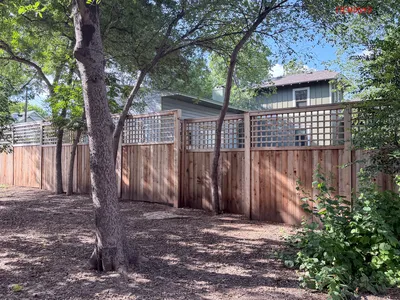
Variance request: fencing at 4523 Avenue G Victoria Goodman & Mark Sainsbury Owners ITEM05/1-PRESENTATION Background: pool • Because of the pool we built, we constructed a new fence along our southern and eastern boundaries for which we received variance C15-2009-0013 (unanimous approval). • Along our eastern boundary the total height of the 2009 fence is 9 feet: 6 feet solid topped by 3 feet ornamental trellis. • When we acquired the immediately adjacent property to our north, we extended the eastern fence and continued it along our northern boundary, with an exactly matching 9 foot fence: 6 feet solid topped by 3 feet ornamental trellis. • That is the fence for which we now seek a variance. ITEM05/2-PRESENTATION ITEM05/3-PRESENTATION Photos ITEM05/4-PRESENTATION ITEM05/5-PRESENTATION ITEM05/6-PRESENTATION ITEM05/7-PRESENTATION ITEM05/8-PRESENTATION ITEM05/9-PRESENTATION ITEM05/10-PRESENTATION ITEM05/11-PRESENTATION Justification • We have an in-ground swimming pool, with no cover, and open all year. • The 9 foot fence has prevented children accessing the pool and possibly harming themselves. • A lower fence would be less safe. ITEM05/12-PRESENTATION Good fences make good neighbors • We consulted our immediate neighbors before construction and they were, and, as the letters we’ve submitted show, still are, enthusiastic: they regard the new fence as a great improvement. • We hope we can keep it. ITEM05/13-PRESENTATION
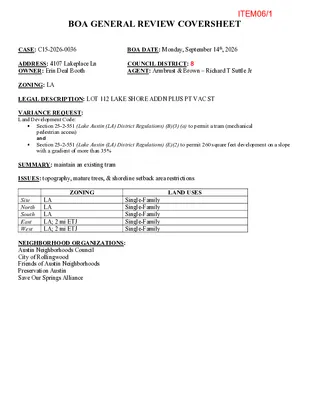
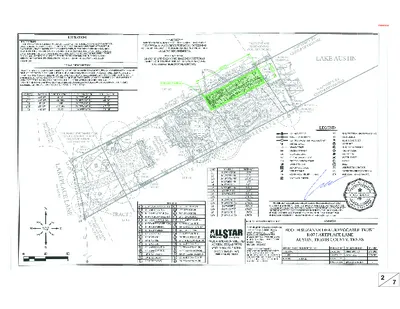
BOA GENERAL REVIEW COVERSHEET CASE: C15-2026-0036 BOA DATE: Monday, September 14th, 2026 ADDRESS: 4107 Lakeplace Ln OWNER: Erin Deal Booth COUNCIL DISTRICT: 8 AGENT: Armbrust & Brown – Richard T Suttle Jr ZONING: LA LEGAL DESCRIPTION: LOT 112 LAKE SHORE ADDN PLUS PT VAC ST VARIANCE REQUEST: Land Development Code: Section 25-2-551 (Lake Austin (LA) District Regulations) (B)(3) (a) to permit a tram (mechanical pedestrian access) and Section 25-2-551 (Lake Austin (LA) District Regulations) (E)(2) to permit 260 square feet development on a slope with a gradient of more than 35% SUMMARY: maintain an existing tram ISSUES: topography, mature trees, & shoreline setback area restrictions ZONING LAND USES Site LA North LA South LA East West LA; 2 mi ETJ LA; 2 mi ETJ Single-Family Single-Family Single-Family Single-Family Single-Family NEIGHBORHOOD ORGANIZATIONS: Austin Neighborhoods Council City of Rollingwood Friends of Austin Neighborhoods Preservation Austin Save Our Springs Alliance ITEM06/1 August 24, 2026 Amanda Morrow 4107 Lakeplace Ln Austin TX, 78746 Property Description: LOT 112 LAKE SHORE ADDN PLUS PT VAC ST Re: C15-2026-0036 Dear Amanda, Austin Energy (AE) has reviewed your application for the above referenced property, requesting that the Board of Adjustment consider a variance(s) from – LDC 25-2-551(B)(3)(a) and LDC 25- 2-551(E)(2) at address 4107 LakePlace Ln, Austin, Texas, 78746. Austin Energy does not oppose the request, provided that any proposed or existing improvements follow Austin Energy’s Clearance & Safety Criteria, the National Electric Safety Code, and OSHA requirements. All signage will need to stay out of Austin Energy easements and 5’ from existing underground electric lines. Any removal or relocation of existing facilities will be at the owner’s/applicant’s expense. Please use this link to be advised of our clearance and safety requirements, which are additional conditions of the above review action: https://library.municode.com/tx/austin/codes/utilities_criteria_manual?nodeId=S1AUENDECR_1 .10.0CLSARE If you require further information or have any questions regarding the above comments, please contact our office. Thank you for contacting Austin Energy. Ashleigh Woolf, Project Assistant Austin Energy Infrastructure Support Services 4815 Mueller Blvd Austin, TX 78723 (512) 972-8400 ITEM06/2 ITEM06/3 Portion of the City of Austin Land Development Code applicant is seeking a variance from: 1. Variance from Section 25-2-551 B) 3)(a Lake Austin District Re ulations to permit mechanical pedestrian access in a Lake Austin ("LA") zoning district. 2. Variance from Section 25-2-551 (E)(2) (Lake Austin District Regulations) to permit develop111eI1t 011 a slope witlr a g1adient of I110Ie tliarr …

C15-2026-0036 4107 Lakeplace Lane ITEM06/1-PRESENTATION ITEM06/2-PRESENTATION Existing tram was constructed in approximately 2001 by a previous owner. ITEM06/3-PRESENTATION ITEM06/4-PRESENTATION ITEM06/5-PRESENTATION ITEM06/6-PRESENTATION Variances Requested: 1. Variance from Section 25-2-551(B)(3)(a) (Lake Austin District Regulations) to permit mechanical pedestrian ("LA") zoning district. access in a Lake Austin 2. Variance from Section 25-2-551(E)(2) (Lake Austin District Regulations) to permit development on a slope with a gradient of more than 35 percent. ITEM06/7-PRESENTATION Variances Findings: Reasonable Use: The zoning regulations applicable to the property do not allow for a reasonable use because: The shoreline setback area restrictions and additional development standards based on slope gradient regulations are only applicable to properties zoned Lake Austin residence district ("LA") and do not apply to other zoning districts along Lake Austin. Without the variances the property owner would not be able to access all areas of the property. ITEM06/8-PRESENTATION Variances Findings: Hardship: a. The hardship for which the variance is requested is unique to the property in that: The topography of the property between the residence and Lake Austin is steeply sloped and varies from 35% to over 1,500% with a vertical drop in excess of 60 feet which makes it extremely difficult to access the entire property without a tram. ITEM06/9-PRESENTATION Variances Findings: Hardship: b. The hardship is not general to the area in which the property is located because: The property sits on a sheer vertical cliff verses rolling slopes that are more common along Lake Austin. There is also an abundance of large, mature tress that are heavily concentrated along the lake side. ITEM06/10-PRESENTATION Variances Findings: Area Character: The variance will not alter the character of the area adjacent to the property, will not impair the use of adjacent conforming property, and will not impair the purpose of the regulations of the zoning district in which the property is located because: These variances would not alter the character of adjacent properties nor impair their use of their own property because the tram is located within a heavily vegetated area and cannot be seen by the adjacent neighbors. LA zoning allows for roads and driveways to be located within the shoreline setback area with a gradient of more than 35%, but due to the extreme topography on the subject property, these types of improvements are not feasible. A tram is required to access all of the property. ITEM06/11-PRESENTATION

BOA GENERAL REVIEW COVERSHEET ITEM07/1 CASE: C15-2026-0037 BOA DATE: Monday, September 14th, 2026 ADDRESS: 714 Post Oak St OWNER: Soren Aandahl COUNCIL DISTRICT: 9 AGENT: Shesh Aandahl ZONING: SF-3-NP (Bouldin Creek) LEGAL DESCRIPTION: LOT 10 CONVENIENT COURTS VARIANCE REQUEST: Land Development Code, Section 25-2-779 (Small Lot Single-Family Residential Use) (J)(4) from gross floor area requirements to increase unit size from 2,300 square feet (maximum allowed) to 2,886 square feet (requested). SUMMARY: enclose an existing balcony to create new, conditioned bedroom space. ISSUES: small lot, partially in both the 25-year & 100-year floodplain Site North South East West ZONING SF-3-NP SF-3-NP; MF-3-ETOD- DBETOD-NP SF-3-NP SF-3-NP; MF-3-ETOD- DBETOD-NP SF-3-NP LAND USES Single-Family Single-Family; Multi-Family Single-Family Single-Family; Multi-Family Single-Family NEIGHBORHOOD ORGANIZATIONS: Austin Neighborhoods Council Bouldin Creek Neighborhood Association Bouldin Creek Neighborhood Plan Contact Team Bouldin Creek Zoning Committee Friends of Austin Neighborhoods Homeless Neighborhood Association Preservation Austin South Central Coalition ITEM07/2 August 24, 2026 Heidi Goebel 714 Post Oak St Austin TX, 78704 Property Description: LOT 10 CONVENIENT COURTS Re: C15-2026-0037 Dear Heidi, Austin Energy (AE) has reviewed your application for the above referenced property, requesting that the Board of Adjustment consider a variance(s) from – LDC, Section 25-2-779 at address 714 Post Oak St. Austin Energy does not oppose the request, provided that any proposed or existing improvements follow Austin Energy’s Clearance & Safety Criteria, the National Electric Safety Code, and OSHA requirements. All signage will need to stay out of Austin Energy easements and 5’ from existing underground electric lines. Any removal or relocation of existing facilities will be at the owner’s/applicant’s expense. Please use this link to be advised of our clearance and safety requirements, which are additional conditions of the above review action: https://library.municode.com/tx/austin/codes/utilities_criteria_manual?nodeId=S1AUENDECR_1 .10.0CLSARE If you require further information or have any questions regarding the above comments, please contact our office. Thank you for contacting Austin Energy. Ashleigh Woolf, Project Assistant Austin Energy Infrastructure Support Services 4815 Mueller Blvd Austin, TX 78723 (512)972-8400 ITEM07/3 ITEM07/4 (cid:39)(cid:82)(cid:70)(cid:88)(cid:86)(cid:76)(cid:74)(cid:81)(cid:3)(cid:40)(cid:81)(cid:89)(cid:72)(cid:79)(cid:82)(cid:83)(cid:72)(cid:3)(cid:44)(cid:39)(cid:29)(cid:3)(cid:19)(cid:25)(cid:38)(cid:21)(cid:38)(cid:25)(cid:21)(cid:27)(cid:16)(cid:23)(cid:22)(cid:23)(cid:39)(cid:16)(cid:27)(cid:26)(cid:41)(cid:38)(cid:16)(cid:27)(cid:19)(cid:19)(cid:38)(cid:16)(cid:36)(cid:38)(cid:19)(cid:25)(cid:25)(cid:37)(cid:26)(cid:36)(cid:20)(cid:25)(cid:25)(cid:40)(cid:3) ITEM07/5 (cid:36)(cid:85)(cid:72)(cid:68)(cid:3)(cid:38)(cid:75)(cid:68)(cid:85)(cid:68)(cid:70)(cid:87)(cid:72)(cid:85)(cid:3) (cid:55)(cid:75)(cid:72)(cid:3)(cid:89)(cid:68)(cid:85)(cid:76)(cid:68)(cid:81)(cid:70)(cid:72)(cid:3)(cid:90)(cid:76)(cid:79)(cid:79)(cid:3)(cid:81)(cid:82)(cid:87)(cid:3)(cid:68)(cid:79)(cid:87)(cid:72)(cid:85)(cid:3)(cid:87)(cid:75)(cid:72)(cid:3)(cid:70)(cid:75)(cid:68)(cid:85)(cid:68)(cid:70)(cid:87)(cid:72)(cid:85)(cid:3)(cid:82)(cid:73)(cid:3)(cid:87)(cid:75)(cid:72)(cid:3)(cid:68)(cid:85)(cid:72)(cid:68)(cid:3)(cid:68)(cid:71)(cid:77)(cid:68)(cid:70)(cid:72)(cid:81)(cid:87)(cid:3)(cid:87)(cid:82)(cid:3)(cid:87)(cid:75)(cid:72)(cid:3)(cid:83)(cid:85)(cid:82)(cid:83)(cid:72)(cid:85)(cid:87)(cid:92)(cid:15)(cid:3)(cid:90)(cid:76)(cid:79)(cid:79)(cid:3)(cid:81)(cid:82)(cid:87)(cid:3)(cid:76)(cid:80)(cid:83)(cid:68)(cid:76)(cid:85)(cid:3)(cid:87)(cid:75)(cid:72)(cid:3)(cid:88)(cid:86)(cid:72)(cid:3)(cid:82)(cid:73)(cid:3) (cid:68)(cid:71)(cid:77)(cid:68)(cid:70)(cid:72)(cid:81)(cid:87)(cid:3)(cid:70)(cid:82)(cid:81)(cid:73)(cid:82)(cid:85)(cid:80)(cid:76)(cid:81)(cid:74)(cid:3)(cid:83)(cid:85)(cid:82)(cid:83)(cid:72)(cid:85)(cid:87)(cid:92)(cid:15)(cid:3)(cid:68)(cid:81)(cid:71)(cid:3)(cid:90)(cid:76)(cid:79)(cid:79)(cid:3)(cid:81)(cid:82)(cid:87)(cid:3)(cid:76)(cid:80)(cid:83)(cid:68)(cid:76)(cid:85)(cid:3)(cid:87)(cid:75)(cid:72)(cid:3)(cid:83)(cid:88)(cid:85)(cid:83)(cid:82)(cid:86)(cid:72)(cid:3)(cid:82)(cid:73)(cid:3)(cid:87)(cid:75)(cid:72)(cid:3)(cid:85)(cid:72)(cid:74)(cid:88)(cid:79)(cid:68)(cid:87)(cid:76)(cid:82)(cid:81)(cid:86)(cid:3)(cid:82)(cid:73)(cid:3)(cid:87)(cid:75)(cid:72)(cid:3)(cid:93)(cid:82)(cid:81)(cid:76)(cid:81)(cid:74)(cid:3)(cid:71)(cid:76)(cid:86)(cid:87)(cid:85)(cid:76)(cid:70)(cid:87)(cid:3) (cid:76)(cid:81)(cid:3)(cid:90)(cid:75)(cid:76)(cid:70)(cid:75)(cid:3)(cid:87)(cid:75)(cid:72)(cid:3)(cid:83)(cid:85)(cid:82)(cid:83)(cid:72)(cid:85)(cid:87)(cid:92)(cid:3)(cid:76)(cid:86)(cid:3)(cid:79)(cid:82)(cid:70)(cid:68)(cid:87)(cid:72)(cid:71)(cid:3)(cid:69)(cid:72)(cid:70)(cid:68)(cid:88)(cid:86)(cid:72)(cid:29)(cid:3) (cid:55)(cid:75)(cid:72)(cid:3)(cid:68)(cid:71)(cid:71)(cid:72)(cid:71)(cid:3)(cid:86)(cid:84)(cid:88)(cid:68)(cid:85)(cid:72)(cid:3)(cid:73)(cid:72)(cid:72)(cid:87)(cid:3)(cid:82)(cid:73)(cid:3)(cid:86)(cid:72)(cid:70)(cid:82)(cid:81)(cid:71)(cid:3)(cid:73)(cid:79)(cid:82)(cid:82)(cid:85)(cid:3)(cid:69)(cid:72)(cid:71)(cid:85)(cid:82)(cid:82)(cid:80)(cid:3)(cid:86)(cid:83)(cid:68)(cid:70)(cid:72)(cid:3)(cid:76)(cid:86)(cid:3)(cid:70)(cid:82)(cid:81)(cid:86)(cid:87)(cid:85)(cid:88)(cid:70)(cid:87)(cid:72)(cid:71)(cid:3)(cid:82)(cid:81)(cid:3)(cid:86)(cid:83)(cid:68)(cid:70)(cid:72)(cid:3)(cid:87)(cid:75)(cid:68)(cid:87)(cid:3)(cid:76)(cid:86)(cid:3)(cid:70)(cid:88)(cid:85)(cid:85)(cid:72)(cid:81)(cid:87)(cid:79)(cid:92)(cid:3)(cid:68)(cid:3) (cid:86)(cid:72)(cid:70)(cid:82)(cid:81)(cid:71)(cid:3)(cid:73)(cid:79)(cid:82)(cid:82)(cid:85)(cid:3)(cid:69)(cid:68)(cid:79)(cid:70)(cid:82)(cid:81)(cid:92)(cid:17)(cid:3) (cid:55)(cid:75)(cid:76)(cid:86)(cid:3)(cid:86)(cid:83)(cid:68)(cid:70)(cid:72)(cid:3)(cid:76)(cid:86)(cid:3)(cid:81)(cid:82)(cid:87)(cid:3)(cid:89)(cid:76)(cid:86)(cid:76)(cid:69)(cid:79)(cid:72)(cid:3)(cid:73)(cid:85)(cid:82)(cid:80)(cid:3)(cid:68)(cid:79)(cid:79)(cid:3)(cid:68)(cid:71)(cid:77)(cid:68)(cid:70)(cid:72)(cid:81)(cid:87)(cid:3)(cid:83)(cid:85)(cid:82)(cid:83)(cid:72)(cid:85)(cid:87)(cid:76)(cid:72)(cid:86)(cid:3)(cid:90)(cid:76)(cid:87)(cid:75)(cid:3)(cid:72)(cid:91)(cid:70)(cid:72)(cid:83)(cid:87)(cid:76)(cid:82)(cid:81)(cid:3)(cid:82)(cid:73)(cid:3)(cid:82)(cid:81)(cid:72)(cid:3) (cid:86)(cid:80)(cid:68)(cid:79)(cid:79)(cid:3)(cid:86)(cid:72)(cid:70)(cid:87)(cid:76)(cid:82)(cid:81)(cid:3)(cid:82)(cid:81)(cid:3)(cid:87)(cid:75)(cid:72)(cid:3)(cid:79)(cid:72)(cid:73)(cid:87)(cid:3)(cid:86)(cid:76)(cid:71)(cid:72)(cid:3)(cid:82)(cid:73)(cid:3)(cid:87)(cid:75)(cid:72)(cid:3)(cid:69)(cid:68)(cid:79)(cid:70)(cid:82)(cid:81)(cid:92)(cid:3)(cid:87)(cid:75)(cid:68)(cid:87)(cid:3)(cid:73)(cid:68)(cid:70)(cid:72)(cid:86)(cid:3)(cid:82)(cid:81)(cid:72)(cid:3)(cid:81)(cid:72)(cid:76)(cid:74)(cid:75)(cid:69)(cid:82)(cid:85)(cid:17)(cid:3) (cid:55)(cid:75)(cid:76)(cid:86)(cid:3)(cid:86)(cid:80)(cid:68)(cid:79)(cid:79)(cid:3)(cid:86)(cid:83)(cid:68)(cid:70)(cid:72)(cid:3)(cid:82)(cid:81)(cid:3)(cid:87)(cid:75)(cid:72)(cid:3) (cid:86)(cid:76)(cid:71)(cid:72)(cid:3)(cid:82)(cid:73)(cid:3)(cid:87)(cid:75)(cid:72)(cid:3)(cid:75)(cid:82)(cid:88)(cid:86)(cid:72)(cid:3)(cid:76)(cid:86)(cid:3)(cid:89)(cid:76)(cid:86)(cid:76)(cid:69)(cid:79)(cid:72)(cid:3)(cid:69)(cid:88)(cid:87)(cid:3)(cid:76)(cid:87)(cid:3)(cid:76)(cid:86)(cid:3)(cid:68)(cid:81)(cid:3)(cid:72)(cid:91)(cid:68)(cid:70)(cid:87)(cid:3)(cid:72)(cid:91)(cid:87)(cid:72)(cid:81)(cid:86)(cid:76)(cid:82)(cid:81)(cid:3)(cid:82)(cid:73)(cid:3)(cid:87)(cid:75)(cid:72)(cid:3)(cid:70)(cid:88)(cid:85)(cid:85)(cid:72)(cid:81)(cid:87)(cid:3)(cid:86)(cid:76)(cid:71)(cid:76)(cid:81)(cid:74)(cid:17)(cid:3) (cid:44)(cid:87)(cid:3)(cid:76)(cid:86)(cid:3)(cid:85)(cid:72)(cid:68)(cid:79)(cid:79)(cid:92)(cid:3)(cid:81)(cid:82)(cid:87)(cid:3) (cid:81)(cid:82)(cid:87)(cid:76)(cid:70)(cid:72)(cid:68)(cid:69)(cid:79)(cid:72)(cid:17)(cid:3) (cid:51)(cid:68)(cid:85)(cid:78)(cid:76)(cid:81)(cid:74)(cid:3)(cid:11)(cid:68)(cid:71)(cid:71)(cid:76)(cid:87)(cid:76)(cid:82)(cid:81)(cid:68)(cid:79)(cid:3)(cid:70)(cid:85)(cid:76)(cid:87)(cid:72)(cid:85)(cid:76)(cid:68)(cid:3)(cid:73)(cid:82)(cid:85)(cid:3)(cid:83)(cid:68)(cid:85)(cid:78)(cid:76)(cid:81)(cid:74)(cid:3)(cid:89)(cid:68)(cid:85)(cid:76)(cid:68)(cid:81)(cid:70)(cid:72)(cid:86)(cid:3)(cid:82)(cid:81)(cid:79)(cid:92)(cid:12)(cid:3) (cid:53)(cid:72)(cid:84)(cid:88)(cid:72)(cid:86)(cid:87)(cid:3)(cid:73)(cid:82)(cid:85)(cid:3)(cid:68)(cid:3)(cid:83)(cid:68)(cid:85)(cid:78)(cid:76)(cid:81)(cid:74)(cid:3)(cid:89)(cid:68)(cid:85)(cid:76)(cid:68)(cid:81)(cid:70)(cid:72)(cid:3)(cid:85)(cid:72)(cid:84)(cid:88)(cid:76)(cid:85)(cid:72)(cid:86)(cid:3)(cid:87)(cid:75)(cid:72)(cid:3)(cid:37)(cid:82)(cid:68)(cid:85)(cid:71)(cid:3)(cid:87)(cid:82)(cid:3)(cid:80)(cid:68)(cid:78)(cid:72)(cid:3)(cid:68)(cid:71)(cid:71)(cid:76)(cid:87)(cid:76)(cid:82)(cid:81)(cid:68)(cid:79)(cid:3)(cid:73)(cid:76)(cid:81)(cid:71)(cid:76)(cid:81)(cid:74)(cid:86)(cid:17)(cid:3)(cid:55)(cid:75)(cid:72)(cid:3)(cid:37)(cid:82)(cid:68)(cid:85)(cid:71)(cid:3)(cid:80)(cid:68)(cid:92)(cid:3)(cid:74)(cid:85)(cid:68)(cid:81)(cid:87)(cid:3) (cid:68)(cid:3)(cid:89)(cid:68)(cid:85)(cid:76)(cid:68)(cid:81)(cid:70)(cid:72)(cid:3)(cid:87)(cid:82)(cid:3)(cid:68)(cid:3)(cid:85)(cid:72)(cid:74)(cid:88)(cid:79)(cid:68)(cid:87)(cid:76)(cid:82)(cid:81)(cid:3)(cid:83)(cid:85)(cid:72)(cid:86)(cid:70)(cid:85)(cid:76)(cid:69)(cid:72)(cid:71)(cid:3)(cid:76)(cid:81)(cid:3)(cid:87)(cid:75)(cid:72)(cid:3)(cid:38)(cid:76)(cid:87)(cid:92)(cid:3)(cid:82)(cid:73)(cid:3)(cid:36)(cid:88)(cid:86)(cid:87)(cid:76)(cid:81)(cid:3)(cid:47)(cid:68)(cid:81)(cid:71)(cid:3)(cid:39)(cid:72)(cid:89)(cid:72)(cid:79)(cid:82)(cid:83)(cid:80)(cid:72)(cid:81)(cid:87)(cid:3)(cid:38)(cid:82)(cid:71)(cid:72)(cid:3)(cid:38)(cid:75)(cid:68)(cid:83)(cid:87)(cid:72)(cid:85)(cid:3)(cid:21)(cid:24)(cid:16)(cid:25)(cid:15)(cid:3) (cid:36)(cid:83)(cid:83)(cid:72)(cid:81)(cid:71)(cid:76)(cid:91)(cid:3)(cid:36)(cid:3)(cid:90)(cid:76)(cid:87)(cid:75)(cid:3)(cid:85)(cid:72)(cid:86)(cid:83)(cid:72)(cid:70)(cid:87)(cid:3)(cid:87)(cid:82)(cid:3)(cid:87)(cid:75)(cid:72)(cid:3)(cid:81)(cid:88)(cid:80)(cid:69)(cid:72)(cid:85)(cid:3)(cid:82)(cid:73)(cid:3)(cid:82)(cid:73)(cid:73)(cid:16)(cid:86)(cid:87)(cid:85)(cid:72)(cid:72)(cid:87)(cid:3)(cid:83)(cid:68)(cid:85)(cid:78)(cid:76)(cid:81)(cid:74)(cid:3)(cid:86)(cid:83)(cid:68)(cid:70)(cid:72)(cid:86)(cid:3)(cid:82)(cid:85)(cid:3)(cid:79)(cid:82)(cid:68)(cid:71)(cid:76)(cid:81)(cid:74)(cid:3)(cid:73)(cid:68)(cid:70)(cid:76)(cid:79)(cid:76)(cid:87)(cid:76)(cid:72)(cid:86)(cid:3)(cid:85)(cid:72)(cid:84)(cid:88)(cid:76)(cid:85)(cid:72)(cid:71)(cid:3)(cid:76)(cid:73)(cid:3)(cid:76)(cid:87)(cid:3) (cid:80)(cid:68)(cid:78)(cid:72)(cid:86)(cid:3)(cid:73)(cid:76)(cid:81)(cid:71)(cid:76)(cid:81)(cid:74)(cid:86)(cid:3)(cid:82)(cid:73)(cid:3)(cid:73)(cid:68)(cid:70)(cid:87)(cid:3)(cid:87)(cid:75)(cid:68)(cid:87)(cid:3)(cid:87)(cid:75)(cid:72)(cid:3)(cid:73)(cid:82)(cid:79)(cid:79)(cid:82)(cid:90)(cid:76)(cid:81)(cid:74)(cid:3)(cid:68)(cid:71)(cid:71)(cid:76)(cid:87)(cid:76)(cid:82)(cid:81)(cid:68)(cid:79)(cid:3)(cid:70)(cid:76)(cid:85)(cid:70)(cid:88)(cid:80)(cid:86)(cid:87)(cid:68)(cid:81)(cid:70)(cid:72)(cid:86)(cid:3)(cid:68)(cid:79)(cid:86)(cid:82)(cid:3)(cid:68)(cid:83)(cid:83)(cid:79)(cid:92)(cid:29)(cid:3) (cid:20)(cid:17) (cid:49)(cid:72)(cid:76)(cid:87)(cid:75)(cid:72)(cid:85)(cid:3)(cid:83)(cid:85)(cid:72)(cid:86)(cid:72)(cid:81)(cid:87)(cid:3)(cid:81)(cid:82)(cid:85)(cid:3)(cid:68)(cid:81)(cid:87)(cid:76)(cid:70)(cid:76)(cid:83)(cid:68)(cid:87)(cid:72)(cid:71)(cid:3)(cid:73)(cid:88)(cid:87)(cid:88)(cid:85)(cid:72)(cid:3)(cid:87)(cid:85)(cid:68)(cid:73)(cid:73)(cid:76)(cid:70)(cid:3)(cid:89)(cid:82)(cid:79)(cid:88)(cid:80)(cid:72)(cid:86)(cid:3)(cid:74)(cid:72)(cid:81)(cid:72)(cid:85)(cid:68)(cid:87)(cid:72)(cid:71)(cid:3)(cid:69)(cid:92)(cid:3)(cid:87)(cid:75)(cid:72)(cid:3)(cid:88)(cid:86)(cid:72)(cid:3)(cid:82)(cid:73)(cid:3)(cid:87)(cid:75)(cid:72)(cid:3)(cid:86)(cid:76)(cid:87)(cid:72)(cid:3)(cid:82)(cid:85)(cid:3)(cid:87)(cid:75)(cid:72) (cid:88)(cid:86)(cid:72)(cid:86)(cid:3)(cid:82)(cid:73)(cid:3)(cid:86)(cid:76)(cid:87)(cid:72)(cid:86)(cid:3)(cid:76)(cid:81)(cid:3)(cid:87)(cid:75)(cid:72)(cid:3)(cid:89)(cid:76)(cid:70)(cid:76)(cid:81)(cid:76)(cid:87)(cid:92)(cid:3)(cid:85)(cid:72)(cid:68)(cid:86)(cid:82)(cid:81)(cid:68)(cid:69)(cid:79)(cid:92)(cid:3)(cid:85)(cid:72)(cid:84)(cid:88)(cid:76)(cid:85)(cid:72)(cid:3)(cid:86)(cid:87)(cid:85)(cid:76)(cid:70)(cid:87)(cid:3)(cid:82)(cid:85)(cid:3)(cid:79)(cid:76)(cid:87)(cid:72)(cid:85)(cid:68)(cid:79)(cid:3)(cid:76)(cid:81)(cid:87)(cid:72)(cid:85)(cid:83)(cid:85)(cid:72)(cid:87)(cid:68)(cid:87)(cid:76)(cid:82)(cid:81)(cid:3)(cid:68)(cid:81)(cid:71)(cid:3)(cid:72)(cid:81)(cid:73)(cid:82)(cid:85)(cid:70)(cid:72)(cid:80)(cid:72)(cid:81)(cid:87)(cid:3)(cid:82)(cid:73) (cid:87)(cid:75)(cid:72)(cid:3)(cid:86)(cid:83)(cid:72)(cid:70)(cid:76)(cid:73)(cid:76)(cid:70)(cid:3)(cid:85)(cid:72)(cid:74)(cid:88)(cid:79)(cid:68)(cid:87)(cid:76)(cid:82)(cid:81)(cid:3)(cid:69)(cid:72)(cid:70)(cid:68)(cid:88)(cid:86)(cid:72)(cid:29) (cid:16)(cid:16)(cid:3) (cid:81)(cid:82)(cid:87)(cid:3)(cid:68)(cid:83)(cid:83)(cid:79)(cid:76)(cid:68)(cid:70)(cid:68)(cid:69)(cid:79)(cid:72)(cid:3) (cid:21)(cid:17) (cid:55)(cid:75)(cid:72)(cid:3)(cid:74)(cid:85)(cid:68)(cid:81)(cid:87)(cid:76)(cid:81)(cid:74)(cid:3)(cid:82)(cid:73)(cid:3)(cid:87)(cid:75)(cid:76)(cid:86)(cid:3)(cid:89)(cid:68)(cid:85)(cid:76)(cid:68)(cid:81)(cid:70)(cid:72)(cid:3)(cid:90)(cid:76)(cid:79)(cid:79)(cid:3)(cid:81)(cid:82)(cid:87)(cid:3)(cid:85)(cid:72)(cid:86)(cid:88)(cid:79)(cid:87)(cid:3)(cid:76)(cid:81)(cid:3)(cid:87)(cid:75)(cid:72)(cid:3)(cid:83)(cid:68)(cid:85)(cid:78)(cid:76)(cid:81)(cid:74)(cid:3)(cid:82)(cid:85)(cid:3)(cid:79)(cid:82)(cid:68)(cid:71)(cid:76)(cid:81)(cid:74)(cid:3)(cid:82)(cid:73)(cid:3)(cid:89)(cid:72)(cid:75)(cid:76)(cid:70)(cid:79)(cid:72)(cid:86)(cid:3)(cid:82)(cid:81)(cid:3)(cid:83)(cid:88)(cid:69)(cid:79)(cid:76)(cid:70) (cid:86)(cid:87)(cid:85)(cid:72)(cid:72)(cid:87)(cid:86)(cid:3)(cid:76)(cid:81)(cid:3)(cid:86)(cid:88)(cid:70)(cid:75)(cid:3)(cid:68)(cid:3)(cid:80)(cid:68)(cid:81)(cid:81)(cid:72)(cid:85)(cid:3)(cid:68)(cid:86)(cid:3)(cid:87)(cid:82)(cid:3)(cid:76)(cid:81)(cid:87)(cid:72)(cid:85)(cid:73)(cid:72)(cid:85)(cid:72)(cid:3)(cid:90)(cid:76)(cid:87)(cid:75)(cid:3)(cid:87)(cid:75)(cid:72)(cid:3)(cid:73)(cid:85)(cid:72)(cid:72)(cid:3)(cid:73)(cid:79)(cid:82)(cid:90)(cid:3)(cid:82)(cid:73)(cid:3)(cid:87)(cid:85)(cid:68)(cid:73)(cid:73)(cid:76)(cid:70)(cid:3)(cid:82)(cid:73)(cid:3)(cid:87)(cid:75)(cid:72)(cid:3)(cid:86)(cid:87)(cid:85)(cid:72)(cid:72)(cid:87)(cid:86)(cid:3)(cid:69)(cid:72)(cid:70)(cid:68)(cid:88)(cid:86)(cid:72)(cid:29) (cid:16)(cid:16)(cid:3) (cid:81)(cid:82)(cid:87)(cid:3)(cid:68)(cid:83)(cid:83)(cid:79)(cid:76)(cid:68)(cid:70)(cid:68)(cid:69)(cid:79)(cid:72)(cid:3) (cid:22)(cid:17) (cid:55)(cid:75)(cid:72)(cid:3)(cid:74)(cid:85)(cid:68)(cid:81)(cid:87)(cid:76)(cid:81)(cid:74)(cid:3)(cid:82)(cid:73)(cid:3)(cid:87)(cid:75)(cid:76)(cid:86)(cid:3)(cid:89)(cid:68)(cid:85)(cid:76)(cid:68)(cid:81)(cid:70)(cid:72)(cid:3)(cid:90)(cid:76)(cid:79)(cid:79)(cid:3)(cid:81)(cid:82)(cid:87)(cid:3)(cid:70)(cid:85)(cid:72)(cid:68)(cid:87)(cid:72)(cid:3)(cid:68)(cid:3)(cid:86)(cid:68)(cid:73)(cid:72)(cid:87)(cid:92)(cid:3)(cid:75)(cid:68)(cid:93)(cid:68)(cid:85)(cid:71)(cid:3)(cid:82)(cid:85)(cid:3)(cid:68)(cid:81)(cid:92)(cid:3)(cid:82)(cid:87)(cid:75)(cid:72)(cid:85)(cid:3)(cid:70)(cid:82)(cid:81)(cid:71)(cid:76)(cid:87)(cid:76)(cid:82)(cid:81)(cid:3)(cid:76)(cid:81)(cid:70)(cid:82)(cid:81)(cid:86)(cid:76)(cid:86)(cid:87)(cid:72)(cid:81)(cid:87) (cid:90)(cid:76)(cid:87)(cid:75)(cid:3)(cid:87)(cid:75)(cid:72)(cid:3)(cid:82)(cid:69)(cid:77)(cid:72)(cid:70)(cid:87)(cid:76)(cid:89)(cid:72)(cid:86)(cid:3)(cid:82)(cid:73)(cid:3)(cid:87)(cid:75)(cid:76)(cid:86)(cid:3)(cid:50)(cid:85)(cid:71)(cid:76)(cid:81)(cid:68)(cid:81)(cid:70)(cid:72)(cid:3)(cid:69)(cid:72)(cid:70)(cid:68)(cid:88)(cid:86)(cid:72)(cid:29) (cid:16)(cid:16)(cid:3) (cid:81)(cid:82)(cid:87)(cid:3)(cid:68)(cid:83)(cid:83)(cid:79)(cid:76)(cid:68)(cid:70)(cid:68)(cid:69)(cid:79)(cid:72)(cid:3) (cid:23)(cid:17) (cid:55)(cid:75)(cid:72)(cid:3)(cid:89)(cid:68)(cid:85)(cid:76)(cid:68)(cid:81)(cid:70)(cid:72)(cid:3)(cid:90)(cid:76)(cid:79)(cid:79)(cid:3)(cid:85)(cid:88)(cid:81)(cid:3)(cid:90)(cid:76)(cid:87)(cid:75)(cid:3)(cid:87)(cid:75)(cid:72)(cid:3)(cid:88)(cid:86)(cid:72)(cid:3)(cid:82)(cid:85)(cid:3)(cid:88)(cid:86)(cid:72)(cid:86)(cid:3)(cid:87)(cid:82)(cid:3)(cid:90)(cid:75)(cid:76)(cid:70)(cid:75)(cid:3)(cid:76)(cid:87)(cid:3)(cid:83)(cid:72)(cid:85)(cid:87)(cid:68)(cid:76)(cid:81)(cid:86)(cid:3)(cid:68)(cid:81)(cid:71)(cid:3)(cid:86)(cid:75)(cid:68)(cid:79)(cid:79)(cid:3)(cid:81)(cid:82)(cid:87)(cid:3)(cid:85)(cid:88)(cid:81)(cid:3)(cid:90)(cid:76)(cid:87)(cid:75)(cid:3)(cid:87)(cid:75)(cid:72)(cid:3)(cid:86)(cid:76)(cid:87)(cid:72) (cid:69)(cid:72)(cid:70)(cid:68)(cid:88)(cid:86)(cid:72)(cid:29) (cid:16)(cid:16)(cid:3) (cid:81)(cid:82)(cid:87)(cid:3)(cid:68)(cid:83)(cid:83)(cid:79)(cid:76)(cid:68)(cid:70)(cid:68)(cid:69)(cid:79)(cid:72)(cid:3) (cid:38)(cid:76)(cid:87)(cid:92)(cid:3)(cid:82)(cid:73)(cid:3)(cid:36)(cid:88)(cid:86)(cid:87)(cid:76)(cid:81)(cid:3)(cid:95)(cid:3)(cid:37)(cid:82)(cid:68)(cid:85)(cid:71)(cid:3)(cid:82)(cid:73)(cid:3)(cid:36)(cid:71)(cid:77)(cid:88)(cid:86)(cid:87)(cid:80)(cid:72)(cid:81)(cid:87)(cid:3)(cid:42)(cid:72)(cid:81)(cid:72)(cid:85)(cid:68)(cid:79)(cid:18)(cid:51)(cid:68)(cid:85)(cid:78)(cid:76)(cid:81)(cid:74)(cid:3)(cid:57)(cid:68)(cid:85)(cid:76)(cid:68)(cid:81)(cid:70)(cid:72)(cid:3)(cid:36)(cid:83)(cid:83)(cid:79)(cid:76)(cid:70)(cid:68)(cid:87)(cid:76)(cid:82)(cid:81)(cid:3) (cid:21)(cid:18)(cid:28)(cid:18)(cid:21)(cid:21)(cid:3)(cid:95)(cid:3)(cid:51)(cid:68)(cid:74)(cid:72)(cid:3)(cid:25)(cid:3)(cid:82)(cid:73)(cid:3)(cid:27)(cid:3) (cid:39)(cid:82)(cid:70)(cid:88)(cid:86)(cid:76)(cid:74)(cid:81) (cid:40)(cid:81)(cid:89)(cid:72)(cid:79)(cid:82)(cid:83)(cid:72) (cid:44)(cid:39)(cid:29) (cid:19)(cid:25)(cid:38)(cid:21)(cid:38)(cid:25)(cid:21)(cid:27)(cid:16)(cid:23)(cid:22)(cid:23)(cid:39)(cid:16)(cid:27)(cid:26)(cid:41)(cid:38)(cid:16)(cid:27)(cid:19)(cid:19)(cid:38)(cid:16)(cid:36)(cid:38)(cid:19)(cid:25)(cid:25)(cid:37)(cid:26)(cid:36)(cid:20)(cid:25)(cid:25)(cid:40) Section 3: Applicant Certificate ITEM07/6 (cid:44) (cid:68)(cid:73)(cid:73)(cid:76)(cid:85)(cid:80) (cid:87)(cid:75)(cid:68)(cid:87) (cid:80)(cid:92) (cid:86)(cid:87)(cid:68)(cid:87)(cid:72)(cid:80)(cid:72)(cid:81)(cid:87)(cid:86) (cid:70)(cid:82)(cid:81)(cid:87)(cid:68)(cid:76)(cid:81)(cid:72)(cid:71) (cid:76)(cid:81) (cid:87)(cid:75)(cid:72) (cid:70)(cid:82)(cid:80)(cid:83)(cid:79)(cid:72)(cid:87)(cid:72) (cid:68)(cid:83)(cid:83)(cid:79)(cid:76)(cid:70)(cid:68)(cid:87)(cid:76)(cid:82)(cid:81) (cid:68)(cid:85)(cid:72) (cid:87)(cid:85)(cid:88)(cid:72) (cid:68)(cid:81)(cid:71) (cid:70)(cid:82)(cid:85)(cid:85)(cid:72)(cid:70)(cid:87) (cid:87)(cid:82) (cid:87)(cid:75)(cid:72) (cid:69)(cid:72)(cid:86)(cid:87) (cid:82)(cid:73)(cid:3) (cid:80)(cid:92)(cid:3)(cid:78)(cid:81)(cid:82)(cid:90)(cid:79)(cid:72)(cid:71)(cid:74)(cid:72)(cid:3)(cid:68)(cid:81)(cid:71)(cid:3)(cid:69)(cid:72)(cid:79)(cid:76)(cid:72)(cid:73)(cid:17) (cid:36)(cid:83)(cid:83)(cid:79)(cid:76)(cid:70)(cid:68)(cid:81)(cid:87)(cid:3)(cid:54)(cid:76)(cid:74)(cid:81)(cid:68)(cid:87)(cid:88)(cid:85)(cid:72)(cid:29)(cid:3) (cid:39)(cid:68)(cid:87)(cid:72)(cid:29)(cid:3) (cid:36)(cid:83)(cid:83)(cid:79)(cid:76)(cid:70)(cid:68)(cid:81)(cid:87)(cid:3)(cid:49)(cid:68)(cid:80)(cid:72)(cid:3)(cid:11)(cid:87)(cid:92)(cid:83)(cid:72)(cid:71)(cid:3)(cid:82)(cid:85)(cid:3)(cid:83)(cid:85)(cid:76)(cid:81)(cid:87)(cid:72)(cid:71)(cid:12)(cid:29)(cid:3)(cid:54)(cid:75)(cid:72)(cid:86)(cid:75)(cid:3)(cid:36)(cid:68)(cid:81)(cid:71)(cid:68)(cid:75)(cid:79) …

Variance Presentation for Case Number C15-0037/714 Post Oak St. Meeting date September 14, 2026 Good evening. My name is Ms. Shesh Aandahl. Photo #1. The subject house is highlighted. The variance is a request to make the existing balcony into bedroom conditioned space. Photo #2. This is the front view of the house. It’s cute. Photo #3. house on the right varies from three to two stories. This is the rear view of the house. The house to the left is a one story. The Photo #4. The backyard faces a creek and is green year around. Photo #5. The space is just over 5 feet wide. This is the only part of the second floor balcony that is visible to a neighbor. First, the good news about this variance is that it is simply changing already existing balcony space to conditioned bedroom space. Second, this change can only be seen minutely by the neighbor in the three story home next door. Third, this request complies with all LDC setback codes. The footprint of the house is not being expanded at all. Fourth, there will be no nature, home characteristics, or neighborhood alterations or impacts. Fifth, this request complies with LDC Code #25-2-779, Small Lot Single Family Residential Use, subsections (D) #9, maximum building coverage of 55 percent, and (J) #1, #2 and #3. However, subsection (J) #4 makes the gross floor area stipulated in subsections (D) #9 and (J) #3 unavailable. Please help us rectify this hardship. Thank you. ITEM07/1-PRESENTATION #1 ITEM07/2-PRESENTATION #2 ITEM07/3-PRESENTATION #3 ITEM07/4-PRESENTATION #4 ITEM07/5-PRESENTATION #5 ITEM07/6-PRESENTATION
BOA Monthly Report July 2026-June 2027 August 10, 2026 Granted 4 1. 25-2-492 (Site Development Regulations) (D) from setback requirements for a street side setback 2. 25-2-515 (Rear Yard of a Through Lot) from setback requirements to decrease the minimum rear yard setback 3. 25-2-492 (Site Development Regulations) from impervious coverage requirements to increase I.C. 4. 25-2-492 Site Development Regulations)(D) from lot size requirements to decrease minimum lot size Postponed 1 1. 25-2-1176 (Site Development Regulations for Docks, Marinas, and Other Lakefront Uses) (A) (1) to increase the dock length Withdrawn Denied 0 0 Discussion Items 5 AUG 2026 Interpretations AUG 2026 BAAP 0 new inquiries 0 (Added AUG10# 2026) The deposition of the case items: Granted Postponed Withdrawn Denied Discussion Items 5 4 0 0 10 Board members absent: Tommy Ates, Jessica Cohen (resigned), Haseeb Abdullah (1 vacant alternate position) July 13, 2026 Granted 1 1. 25-2-492 (Site Development Regulations) from impervious coverage requirements to increase I.C. Postponed 3 (due to only 9 board members present-voting purposes) 1. 25-2-515 (Rear Yard of a Through Lot) from setback requirements to decrease the minimum rear yard setback 2. 25-2-492 (Site Development Regulations) from impervious coverage requirements to increase I.C. 3. 25-2-492 (Site Development Regulations) (D) from setback requirements for a street side setback Withdrawn Denied 0 0 Discussion Items 5 JUL 2026 Interpretations JUL 2026 BAAP 0 new inquiries 0 (Added JUL13# 2026) The deposition of the case items: Granted Postponed Withdrawn Denied Discussion Items 1 3 0 0 5 Board members absent: Tommy Ates, Jessica Cohen (resigned), Maggie Shahrestani, Michael Von Ohlen (1 vacant alternate position)
REGULAR MEETING OF THE AUSTIN-TRAVIS COUNTY FOOD POLICY BOARD MONDAY, SEPTEMBER 14, 2026, AT 5:00 P.M. PERMITTING AND DEVELOPMENT CENTER, ROOM 1406 6310 WILHELMINA DELCO DRIVE, AUSTIN, TEXAS Some members of the Austin-Travis County Food Policy Board may be participating by videoconference. Public comment will be allowed in-person or remotely via telephone. Speakers may only register to speak on an item once either in-person or remotely and will be allowed up to three minutes to provide their comments. Registration no later than noon the day before the meeting is required for remote participation by telephone. To register to speak remotely, contact Amanda Rohlich, (512) 974-1364, Amanda.Rohlich@austintexas.gov. CURRENT AUSTIN-TRAVIS COUNTY FOOD POLICY BOARD MEMBERS: Lisa Barden, Chair Maggie Amaku Andrea Abel Beth Corbett Nitza Cuevas Kacey Hanson Alexandra “Lexie” Lewis Seanna Marceaux Melody McClary Natalie Poulos Amanda Wadsworth AGENDA CALL TO ORDER Board Member roll call and introduction of new and existing board members. PUBLIC COMMUNICATION: GENERAL The first 10 speakers signed up prior to the meeting being called to order will each be allowed a three- minute allotment to address their concerns regarding items not posted on the agenda. APPROVAL OF MINUTES 1. Approve the minutes of the Austin-Travis County Food Policy Board Regular Meeting on Monday, August 10, 2026. STAFF BRIEFINGS 2. Staff and quarterly consultant briefing regarding Austin-Travis County Food Plan Implementation. Presentation by Edwin Marty, Food Policy Manager, Austin Climate Action & Resilience, Yaira Robinson, Assistant Director of Environmental Programs, Travis County, and Kelly Nichols, Principal at Woollard, Nichols & Torres. DISCUSSION ITEMS 3. 4. 5. 6. 7. Presentation and discussion regarding the impacts to SNAP and cost share, Jamie Olson, Feeding Texas Presentation and discussion regarding the working group to expand access to nutritious foods through improvement to existing materials and resources and explore alternate or expanded hours for existing resources. Presentation and discussion regarding the working group to participate in the USDA Regional Conservation Partnership Program (RCPP) application for funding for conservation easements as a regional partnership. Update on Healthy Food Worker Rebate advocacy including three meetings on September 1st with D2, D7, D9 offices. The item will be posted to the October 8 City Council meeting for discussion and possible action. Review Board Member Assignments. DISCUSSION AND POSSIBLE ACTION ITEMS 8. Discuss and take possible action on a Vice-Chair appointment. FUTURE AGENDA ITEMS ADJOURNMENT The City of Austin is committed to compliance with the …
Austin-Travis County Food Plan ATCFPB September 2026 – Staff Update City of Austin Food Plan Updates City Staff Updates ● City staff sent City Council a Food Plan Update Memo on May 5th 2026. Next Memo in October. ● Funding from the MUFPP Award will be released via a RFA in fall 2026 ● ACAR has hired a new Food and Climate Program Coordinator - Mali Calvo ● Social Service contracts are being reviewed and finalized. Staff will report back in October. City Staff Updates Implementation Collab ● To be covered by WNT City of Austin 2026 Budget Next Steps ● Council approved the budget on August 12th ● Austin Public Health has sent a communication to all funded social services regarding their FY27 allocations. ● APH Chronic Disease has cut $400,000 in funding for ‘Fresh for Less’ in FY27, including contracts with Farmshare Austin, CTFB, and UT Public Health. ● During FY27, the City of Austin will conduct a Council-directed evaluation and redesign of its social services portfolio. As a part of this process, all agreements, regardless of their renewal date, will end on September 30, 2027. ● In the coming months, new solicitations will be issued for services to begin on October 1, 2027. City of Austin 2026 Bond - Next Steps ● August 6th 2026: City Council voted for a $295 million bond proposition, focused exclusively on Park and libraries. ○ Parks and Recreation - $260 million ○ Libraries - $35 million ● November 3, 2026: Bond election Travis County Food Plan Updates County Budget Process Update, FY27 ● Fiscal Year 2027 Budget Development & Tax Rate Information landing page ● Next steps: ○ September 15th: Tax Rate Adopted ○ September 29th: FY27 Budget Adopted Thank You! www.austintexas.gov/food /austinsustainability
REGULAR MEETING OF THE ART IN PUBLIC PLACES PANEL MONDAY, SEPTEMBER 14, 2026, AT 6:00 P.M. VIRTUAL MEETING Art in Public Places Panel may be participating by videoconference. The meeting may be viewed online at: Art in Public Places Panel: September Virtual Meeting | Meeting-Join | Microsoft Teams. Public comment will be allowed in-person or remotely via telephone. Speakers may only register to speak on an item once either in-person or remotely and will be allowed up to three minutes to provide their comments. Registration no later than noon the day before the meeting is required for remote participation by telephone. To register to speak remotely, contact Art in Public Places Manager Jaime Castillo at jaime.castillo@austintexas.gov or (512) 974-7852. CURRENT PANEL MEMBERS: Kristi-Anne Shaer, Chair Heidi Schmalbach, Arts Commission Liaison Andrew Danziger Camille Jobe AGENDA CALL TO ORDER PUBLIC COMMUNICATION: GENERAL Lindsey Millikan, Vice Chair Fatima Carbajal Bernardo Diaz The first 10 speakers signed up prior to the meeting being called to order will each be allowed a three-minute allotment to address their concerns regarding items not posted on the agenda. APPROVAL OF MINUTES 1. Approve the minutes of the Art in Public Places Panel Regular meeting August 3, 2026. STAFF BRIEFINGS 2. Staff briefing regarding Art in Public Places Program, including Conservation, Current Projects and Milestones. Presentation by Jaime Castillo, AIPP Manager, Austin Arts, Culture, Music, and Entertainment. DISCUSSION ITEMS 3. 4. 5. 6. 7. Discussion of Arts Commission Liaison Report on Action Items from August 17, 2026, Arts Commission Meeting. Presentation by Heidi Schmalbach, Arts Commission Liaison. Discussion of Austin Arts, Culture, Music, and Entertainment Creative Reset. Presentation by Candice Cooper, Interim Chief Administrative Officer, and Morgan Messick, Assistant Director, Austin Arts, Culture, Music, and Entertainment. Discussion of the Northeast Service Center: Garage Façade Art in Public Places Concept Design. Presentation by Bridge Projects, Art in Public Places Artist, and Rebecca Rende, Art in Public Places Coordinator Senior, Arts, Culture, Music, and Entertainment. Discussion of the Austin-Bergstrom International Airport Art in Public Places Projects 50% Final Design Update. Presentation by Alex Irrera, Art in Public Places Coordinator Senior, Austin Arts, Culture, Music and Entertainment. Discussion of the Austin-Bergstrom International Airport Uplifted Ground Art in Public Places Project. Presentation by Jaime Castillo, Art in Public Places Manager, Arts, Culture, Music and Entertainment. DISCUSSION AND ACTION ITEMS 8. 9. 10. Approve a recommendation to Arts Commission for the AFD / …

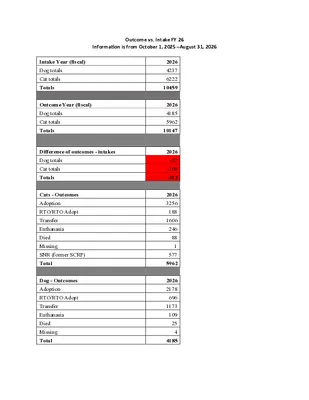
REGULAR MEETING OF THE ANIMAL ADVISORY COMMISSION MONDAY, SEPTEMBER 14, 2026, AT 6:00 P.M. AUSTIN CITY HALL, ROOM 1101 301 WEST 2ND STREET AUSTIN, TEXAS Some members of the Animal Advisory Commission may be participating by videoconference. The meeting may be viewed online at: http://www.austintexas.gov/page/watch-atxn-live Public comment will be allowed in-person or remotely via telephone. Speakers may only register to speak on an item once either in-person or remotely and will be allowed up to three minutes to provide their comments. Registration no later than noon the day before the meeting is required for remote participation by telephone. To register to speak remotely, contact Nekaybaw Watson at nekaybaw.watson@austintexas.gov or 512-974-2562. CURRENT COMMISSIONERS: Jules Maron, Chair, D3 Jo Anne Norton, Vice Chair, D7 Jennifer Daniel, Parliamentarian, D6 Beatriz Dulzaides, D2 Erin Ferguson, D8 Whitney Holt, D5 Sarah Huddleston, D9 David Loignon, D10 Dr. Paige Nilson, D4 Sonal Patel, Travis County Nancy Nemer, Travis County Erin Van Landingham, D1 CALL TO ORDER PUBLIC COMMUNICATION: GENERAL AGENDA The first 10 speakers signed up prior to the meeting being called to order will each be allowed a three- minute allotment to address their concerns regarding items not posted on the agenda. APPROVAL OF MINUTES 1. Approve the minutes of the Animal Advisory Commission Regular meeting on August 10, 2026. STAFF BRIEFINGS 2. Staff briefing regarding monthly reports and dog breed labeling. Presentation by Monica Dangler, Director, Austin Animal Services and Jason Garza, Assistant Director, Austin Animal Services. DICUSSION AND ACTION ITEMS 3. 4. Approve the creation of a working group exploring compliance with the Texas Health and Safety Chapter 8-23. Approve the creation of a working group to study the impact of and write recommendations to Council regarding Feline Leukemia Virus (FeLV) and Feline Immunodeficiency Virus (FIV) combo testing. FUTURE AGENDA ITEMS ADJOURNMENT The City of Austin is committed to compliance with the Americans with Disabilities Act. Reasonable modifications and equal access to communications will be provided upon request. For assistance, please contact the Liaison or TTY users’ route through 711. A person may request language access accommodations no later than 48 hours before the scheduled meeting. Please email or call Nekaybaw Watson at Austin City Clerk’s Office, at nekaybaw.watson@austintexas.gov or 512-974- 2562 to request service or for additional information. For more information on the Animal Advisory Commission, please contact Nekaybaw Watson at nekaybaw.watson@austintexas.gov or 512-974-2562.
ANIMAL ADVISORY COMMISSION REGULAR MEETING MINUTES AUGUST 10, 2026 The Animal Advisory Commission convened in a regular meeting on Monday, August 10, 2026, at Austin City Hall, Boards and Commissions Room 301 W 2nd Street in Austin, Texas. Chair Maron called the Animal Advisory Commission Meeting to order at 6:00 pm. Commissioners in Attendance: Jules Maron, Chair, D3 Jo Anne Norton, Vice Chair, D7 Jennifer Daniel, Parliamentarian, D6 Erin Van Landingham, D1 Commissioners in Attendance Remotely: Koby Ahmed, Mayor Beatriz Dulzaides, D2 Erin Ferguson, D8 David Loignon, D10 Nancy Nemer, Travis County Dr. Paige Nilson, D4 Commissioners Absent: Whitney Holt, D5 Sarah Huddleston, D9 PUBLIC COMMUNICATION: GENERAL Max Oliver – Long Stay Concerns Julie Oliver – Better coding for current dog tracking program Suzie Chase – Austin Pets Alive! Progress Pat Valls-Trelles – Donation Fund and Agenda Item Discussion Requests 1 APPROVAL OF MINUTES 1. Approve the minutes of the Animal Advisory Commission Regular Meeting on July 13, 2026. The minutes of the July 13th regular meeting of the Animal Advisory Commission as were approved during the August 10th meeting on Vice Chair Norton’s motion, Parliamentarian Daniel’s second on a 10-0 vote. Commissioners Holt and Huddleston were absent. STAFF BRIEFINGS 2. 3. Staff briefing regarding monthly reports and budget breakdown. Presentation by Monica Dangler, Director, Austin Animal Services and Jason Garza, Assistant Director, Austin Animal Services. Presentation given by Monica Dangler, Director, Austin Animal Services and Jason Garza, Assistant Director, Austin Animal Services. Staff briefing regarding Dangerous and Vicious Dog classification, declaration, and processing out of shelters. Presentation by Monica Dangler, Director, Austin Animal Services and Rebekha Montie, Program Manager II, Austin Animal Services. Presentation given by Monica Dangler, Director, Austin Animal Services and Rebekha Montie, Program Manager II, Austin Animal Services. DISCUSSION ITEMS 4. 5. Quarterly report from Austin Pets Alive! Presentation by Mara Hartsell, Quality of Care Director, Austin Pets Alive! and Rory Adams, Director of Strategic Customer Service, Austin Pets Alive! This item was taken up fifth. Presentation given by Mara Hartsell, Quality of Care Director, Austin Pets Alive! Discussion regarding the Feline Leukemia (FeLV) and Feline Immunodeficiency Virus (FIV) Intake Testing Policy for cats Austin Animmal Services memo. This item was taken up fourth. Discussion held by Monica Dangler, Director, Austin Animal Services and Dr. Debbie Elliot, Program Manager, Veterinary Services. WORKING GROUP RECOMMENDATIONS 6. Final update from the off-leash dog working group regarding their final …
REGULAR MEETING OF THE ANIMAL ADVISORY COMMISSION NO KILL COMMITTEE MONDAY, SEPTEMBER 14, 2026, AT 4:00PM AUSTIN CITY HALL, BOARDS AND COMMISSIONS ROOM 1101 301 W 2nd STREET AUSTIN, TEXAS Some members of the No Kill Committee may be participating by videoconference. Public comment will be allowed in-person or remotely via telephone. Speakers may only register to speak on an item once either in-person or remotely and will be allowed up to three minutes to provide their comments. Registration no later than noon the day before the meeting is required for remote participation by telephone. To register to speak remotely, contact Nekaybaw Watson, nekaybaw.watson@austintexas.gov, 512-974-2562. CURRENT COMMISSIONERS: Nancy Nemer, Travis County, Chair Beatriz Dulzaides, D2 Erin Ferguson, D8 Whitney Holt, D5 David Loignon, D10 Erin Van Landingham, D1 CALL TO ORDER PUBLIC COMMUNICATION: GENERAL The first 10 speakers signed up prior to the meeting being called to order will each be allowed a three- minute allotment to address their concerns regarding items not posted on the agenda. APPROVAL OF MINUTES 1. Approve the minutes of the special called meeting of the Animal Advisory Commission’s No Kill Committee on July 13, 2026. DISCUSSION ITEMS 2. Discussion of definition of no kill thresholds. 3. Discussion regarding ways to increase the overnight Emergency Services budget for Austin Animal Services and other solutions for injured homeless animals in Austin/Travis County for afterhours services. 4. Discussion regarding ways to open intake at Austin Animal Services. DISCUSSION AND ACTION ITEMS 5. Approve the change in meeting frequency from every other month to once a quarter. FUTURE AGENDA ITEMS ADJOURNMENT The City of Austin is committed to compliance with the Americans with Disabilities Act. Reasonable modifications and equal access to communications will be provided upon request. For assistance, please contact the Liaison or TTY users’ route through 711. A person may request language access accommodations no later than 48 hours before the scheduled meeting. Please call or email Nekaybaw Watson at Austin City Clerk’s Office Department, at 512-974-2562 or nekaybaw.watson@austintexas.gov, to request service or for additional information. For more information on the No Kill Committee please contact Nekaybaw Watson at 512-974-2562 or nekaybaw.watson@austintexas.gov.
ANIMAL ADVISORY COMMISSION NO KILL COMMITTEE SPECIAL CALLED MEETING MINUTES JULY 13, 2026 The Animal Advisory Commission No Kill Committee convened in a special called meeting on Monday, July 13, 2026, at Austin City Hall, Boards and Commissions Room 301 W 2nd Street in Austin, Texas. Chair Holt called the Animal Advisory Commission No Kill Committee Meeting to order at 4:03 pm. Commissioners in Attendance: Whitney Holt, Chair, D5 Beatriz Dulzaides, D2 Erin Ferguson, D8 David Loignon, D10 Erin Van Landingham, D1 Commissioners in Attendance Remotely: Nancy Nemer, Travis County PUBLIC COMMUNICATION: GENERAL Robyn Katz – No Kill Concerns DISCUSSION ITEMS 1. Discussion of definition of no kill thresholds. Discussion was taken second. 1 DISCUSSION AND ACTION ITEMS 2. Approve an Annual Schedule for the No Kill Committee. This item was taken first. The motion to approve an annual meeting schedule for the Animal Advisory Commission No Kill Subcommittee to occur every other month was approved on Commissioner Dulzaides’ motion, Commissioner Loignon’s second on a 6-0 vote. FUTURE AGENDA ITEMS The meeting of the Animal Advisory Commission No Kill Subcommittee was adjourned on Commissioner Loignon’s motion, Commissioner Dulzaides’ second without objection at 5:18PM. 2
Animal Services Office Statistical Report – August2024-2026 August 2026 Intake August2025 Intake August2024 Intake August 2026 Adoption August2025 Adoptions August2024 Adoptions August 2026 RTOs August2025 RTOs August2024 RTOs August 2026 Animal Euthanized August2025 Animals Euthanized August2024 Animals Euthanized August 2026 Live Release Rate August2025 Total Live Release Rate August2024 Total Live Release Rate August 2026 Vaccinations – 2985 vaccinations were provided to animals in care of Austin Animal Services. August2025 Vaccinations - 2954 vaccinations were provided to animals in care of Austin Animal Services. August2024 Animal Vaccinations August 2026 – Spay/Neuter at AAC August2025 Spayed/Neuter at AAC August2024 Spayed/Neutered at AAC August 2026 Deaths in Care August2025 Animal Deaths at AAC/Foster August2024 Animal Deaths at AAC/Foster August 2026 Animals Transferred (includes 55 cats that went through SNR) August2025 Animals Transferred (includes 64 cats that went through SNR : August2024 Animals Transferred August 2026 Animals Lost, Stolen or Missing August2025 Animal Lost, Stolen or Missing August2024 Animals Lost, Stolen or Missing August 2026 SNR Program – As noted above, 55 cats went through SNR August2025 SNR Program – As noted above, 64 cats went through SNR August2024 SNR Program August 2026 Intact Animals Adopted/RTO August2025 Intact Animals Adopted/RTO August2024 Intact Animals Adopted/RTO