Play video — original link
Play video
Play video

BOARD/COMMISSION RECOMMENDATION Resource Management Commission Recommendation No. 20261020-004 Recommendation Requesting Independent Analysis of Carbon-Free Resources Addressing Austin Energy’s 400-Megawatt Reliability Need Consistent With Climate Equity Plan and Clean Energy Goals WHEREAS, the Austin Climate Equity Plan (2021) and Austin Energy's Resource, Generation, and Climate Protection Plan to 2035 — adopted unanimously by the Austin City Council in December 2024 — commit the City and its municipal utility to 100% carbon-free generation by 2035 and net-zero emissions by 2040, and direct all procurement and investment decisions to align with those goals; and WHEREAS, Austin Energy has identified approximately 575 annual reliability risk hours in the Austin load zone and determined that approximately 400 megawatts of additional dispatchable capacity is needed by 2035 or earlier to address that risk, with an estimated budget of approximately $1 billion — a commitment of sufficient scale to warrant rigorous, independent evaluation of all available pathways. This anticipated resource need and the number of hours of annual reliability risk are likely to increase over time, making 400 megawatts a floor rather than ceiling on future Austin Energy resource needs; and WHEREAS, Austin Energy’s Resource, Generation and Climate Protection Plan to 2035, and the Austin City Council’s approval of Austin Energy’s proposed new gas-fired peaker plant, is based upon resource and fuel cost, technology and availability assumptions dating back to mid-2024. WHEREAS, since mid-2024 multiple characteristics of resource and fuel have changed significantly over the past two years, including multiple factors that render the assumptions underlying the gas peaker plant outdated: • A 64% increase in Henry Hub natural gas prices between August 2024 and October 2026; • A 40 to 50% higher increase in single-cycle gas turbine and 40 to 66 percent increase in combined-cycle turbine costs from August 2024 to October 2026, with lead times for delivery extending for five years or more due to the huge demand for new turbines and turbine generator sets from data center owners, utilities, and independent power producers; • A 15 to 25% increase in the cost of acquiring large generator step-up transformers, with lead times from order to delivery extending three to four years; and WHEREAS, these cost increases and delivery delays could significantly raise the costs of and delay the construction and operation of Austin Energy’s newly approved gas-fired peaker plant; and WHEREAS, Austin Energy should reexamine the availability and feasibility of a suite of alternative technology …

REGULAR MEETING OF THE AUSTIN AREA HIV PLANNING COUNCIL EXECUTIVE COMMITTEE MEETING TUESDAY, OCTOBER 20TH, 2026, 5:00 P.M. PERMITTING AND DEVELOPMENT CENTER ROOM 1203 6310 WILHELMINA DELCO DRIVE AUSTIN, TEXAS Some members of the HIV PLANNING COUNCIL may be participating by videoconference. The meeting may be viewed online at: Join the meeting now Public comment will be allowed in person or remotely via telephone or Teams. Speakers may only register to speak on an item once either in person or remotely and will be allowed up to three minutes to provide their comments. Registration no later than noon the day before the meeting is required for remote participation. To register to speak, call or email the Office of Support, (737)- 825-1684 or hivplanningcouncil@austintexas.gov CURRENT HIV PLANNING COUNCIL EXECUTIVE COMMITTEE MEMBERS: Kelle’ Martin, Chair Marquis Goodwin, Vice-Chair Kristina McRae-Thompson, Secretary Drew Kyler, Treasurer AGENDA CALL TO ORDER PUBLIC COMMUNICATION: GENERAL The first 10 speakers signed up no later than noon on 10/19/2026 will each be allowed a three- minute allotment to address their concerns regarding items not posted on the agenda. APPROVAL OF MINUTES 1. Approve the minutes of the HIV Planning Council regular meeting of the Executive Committee on September 15th, 2026 CONFLICT OF INTEREST DECLARATIONS 2. Members will declare conflict of interest with relevant agenda items, service categories, and/or service standards. STAFF BRIEFINGS 3. Introductions/Announcements 4. Office of Support Staff Briefing 5. Administrative Agent Staff Briefing DISCUSSION ITEMS 6. Discussion of member reflectiveness report 7. Discussion of member attendance report 8. Discussion of Fiscal Year 2027 (FY27) kickoff agenda and date DISCUSSION AND ACTION ITEMS 9. Discussion and approval of prospective HIV Planning Council member a. Kimberly Jones 10. Discussion and approval of the removal of HIV Planning Council member a. Issac Jeremy Caballero 11. Discussion and approval of meeting time and day for FY2027 COMMITTEE UPDATES 12. Care Strategies and Engagement Committee 13. Finance and Assessment Committee FUTURE AGENDA ITEMS 14. Discussion of workplan and social calendar ADJOURNMENT Indicative of action items The City of Austin is committed to compliance with the American with Disabilities Act. Reasonable modifications and equal access to communications will be provided upon request. Meeting locations are planned with wheelchair access. If requiring Sign Language Interpreters or alternative formats, please give notice at least 2 days (48 hours) before the meeting date. TTY users’ route through Relay Texas at 711. For More Information on …

REGULAR MEETING OF THE ASIAN AMERICAN QUALITY OF LIFE ADVISORY COMMISSION TUESDAY, OCTOBER 20, 6:00 PM PERMITTING AND DEVELOPMENT CENTER, ROOM 1406, 6310 WILHELMINA DELCO DR., AUSTIN, TEXAS Some members of the Asian American Quality of Life Commission may be participating by videoconference. The meeting may be viewed online at: http://www.austintexas.gov/page/watch- atxn-live Public comment will be allowed in-person or remotely via telephone. Speakers may only register to speak on an item once either in-person or remotely and will be allowed up to three minutes to provide their comments. Registration no later than noon the day before the meeting is required for remote participation by telephone. To register to speak remotely, contact Chelsea Pfeifer at chelsea.pfeifer@austintexas.gov or 512-974-2498. CURRENT COMMISSIONERS: Padmini Jambulapati, Chair Alka Bhanot Sarah Xiyi Chen Hanna Huang Ahmed Moledina Alpha Shrestha Kuo Yang CALL TO ORDER Nirali Thakkar, Vice-Chair Sarah Chen Zachary Dolling Hugh Li Bhumika Purohit Nayer Sikder PUBLIC COMMUNICATION: GENERAL The first ten speakers signed up prior to the meeting being called to order will each be allowed a three-minute allotment to address their concerns regarding items not posted on the agenda. APPROVAL OF MINUTES 1. Approve the minutes of the Asian American Quality of Life Advisory Commission regular meeting on September 15, 2026. DISCUSSION ITEMS 2. 3. Presentation by Yesterday’s Gone 501c3 regarding current work, programs and initiatives. Presented by Loree Tamayo, Executive Director, Yesterday’s Gone 501c3. Presentation by Asian Texans for Justice regarding trends in voting preferences and GOTV efforts. Presentation by Sarah Xiyi Chen, Commissioner, Asian American Quality of Life Advisory Commission. DISCUSSION AND ACTION ITEMS 4. Approve the 2027 annual schedule of the Asian American Quality of Life Advisory Commission. WORKING GROUP UPDATE 5. 6. 7. Update from Community Engagement Working Group regarding recent Community Engagement efforts. Update from the Asian American Resource Center working group regarding facility updates. Update from Joint Inclusion Committee regarding recent Austin Arts, Culture, Music, Entertainment presentation. FUTURE AGENDA ITEMS ADJOURNMENT The City of Austin is committed to compliance with the Americans with Disabilities Act. Reasonable modifications and equal access to communications will be provided upon request. For assistance, please contact the Liaison or TTY users’ route through 711. A person may request language access accommodations no later than 48 hours before the scheduled meeting. Please call or email Chelsea Pfeifer at the Austin City Clerk’s Office, at 512-974-2498 or chelsea.pfeifer@austintexas.gov to request service or for additional …

Asian American Quality of Life Advisory Commission Regular Meeting Minutes Tuesday, September 15, 2026 The Asian American Quality of Life Advisory Commission convened in a regular meeting on Tuesday, September 15, 2026 at the Permitting and Development Center, room #1406, 6310 Wilhelmina Delco Drive in Austin, Texas. Chair Jambulapati called the Asian American Quality of Life Advisory Commission Meeting to order at 6:05 p.m. COMMISSIONERS IN ATTENDANCE: Padmini Jambulapati, Chair Nirali Thakkar, Vice Chair Hanna Huang COMMISSIONERS IN ATTENDANCE REMOTELY: Sarah Chen Sarah Xiyi Chen Zachary Dolling Hugh Li Nayer Sikder Bhumika Purohit PUBLIC COMMUNICATION: GENERAL None present. APPROVAL OF MINUTES 1. Approve the minutes of the Asian American Quality of Life Advisory Commission regular meeting on August 18, 2026. The minutes were approved with the following amendment: “The Asian American Quality of Life Advisory Commission convened in a regular meeting on Tuesday, January August 18, 2026 at 301 W. 2nd Street in Austin, Texas the Permitting and Development Center, Room #1406, 6310 Wilhelmina Delco Drive, Austin TX.” ASIAN AMERICAN QUALITY OF LIFE ADVISORY COMMISSION MEETING MINUTES Tuesday, September 15, 2026 on Commissioner Huang’s motion, Vice Chair Thakkar’s second on an 8-0 vote. Commissioner Purohit was off the dais. Commissioners Moledina, Shrestha and Yang were absent. STAFF BRIEFINGS 2. 3. 4. Staff briefing regarding Varsity Generation Programming and Austin’s aging Asian American community. Presentation by Kelly Maltsberger, Assistant Director, Austin Parks and Recreation and Jesus Aguirre, Director, Austin Parks and Recreation. The presentation was made by Kelly Maltsberger, Assistant Director, Austin Parks and Recreation and Jesus Aguirre, Director, Austin Parks and Recreation. Staff briefing regarding facilities updates to the Asian American Resource Center (AARC). Presentation by Darrell Alexander, Director, Austin Facilities Management. The presentation was made by Darrell Alexander, Director, Austin Facilities Management. Staff briefing regarding the Creative Reset II Initiative and the AARC. Presented by Candice Cooper, Chief Administrative Officer, Austin Arts, Culture, Music and Entertainment. The presentation was made by Candice Cooper, Chief Administrative Officer, Austin Arts, Culture, Music and Entertainment (ACME), Matrix Kilgore, Division Manager, ACME, and Leila Grace Pandy, Supervisor of Culture and Arts Education, Austin Parks and Recreation. DISCUSSION AND ACTION ITEMS 5. 6. Approve a nomination of stakeholder member to the Asian American Quality of Life Advisory Commission. The motion to approve the nomination of stakeholder member Alka Bhanot was approved on Commissioner Huang’s motion, Vice Chair Thakkar’s second on a 9-0 vote. Commissioners …
Play audio

Yesterday’s Gone Women’s Shelter A Place to Live | A Place to Heal YeYY sterday’s’ Gone ofo fff eff rsrr a one-year Yesterday’s Gone offers a one-year transitional housing program along trarr nsitional housingn progo rarr m alongn with resource coordination services for with resource coordination services foff r women, their children, and their pets. women,n their children,n and their petstt . yesterdaysgone.org The impact of Yesterday’s Gone’s programs in 2025 is seen in the research, TTTTTTTTThhhhhhhhheeeeeeee iiiiiiiimmmmmmmmpppppppppaaaaaaaaaccccccccttttttttt oooooooofffffffff YYYYYYYYYeeeeeeeessssssssttttttttteeeeeeeerrrrrrrrrdddddddddaaaaaaaayyyyyyyyy’’’’sssssss GGGGGGGGGoooooooonnnnnnnneeeeeeee’’’’sssssss ppppppppprrrrrrrrroooooooogggggggrrrrrrrrraaaaaaaammmmmmmmssssssss iiiiiiiinnnnnnnnn 22222222000000002222222255555555 iiiiiiiissssssss sssssssseeeeeeeeeeeeeeeennnnnnnnn iiiiiiiinnnnnnnn tttttttthhhhhhhhheeeeeeee rrrrrrrrreeeeeeeesssssssseeeeeeeeaaaaaaaarrrrrrrrrcccccccchhhhhhhhh,,,, goal documentation, surveys, and testimonies from the women that we serve. gggggggooooooooaaaaaaaallllllll dddddddddooooooooccccccccuuuuuuummmmmmmmeeeeeeeennnnnnnntttttttttaaaaaaaattttttttiiiiiiiioooooooonnnnnnnn,,,, ssssssssuuuuuuurrrrrrrrrvvvvvvvvveeeeeeeeyyyyyyyyysssssss,,,, aaaaaaaannnnnnnnddddddddd ttttttttteeeeeeeesssssssstttttttttiiiiiiiimmmmmmmmoooooooonnnnnnnniiiiiiiieeeeeeeessssssss fffffffffrrrrrrrrrfff oooooooommmmmmmm tttttttthhhhhhhhheeeeeeee wwwwwwwwwoooooooommmmmmmmeeeeeeeennnnnnnn tttttttthhhhhhhhhaaaaaaaattttttttt wwwwwwwwweeeeeeee sssssssseeeeeeeerrrrrrrrrvvvvvvvvveeeeeeee.... 4,317 4,317 Saffee Nighttss ffor Women Safe Nights for Women & Their Childrreen & Their Children 1,431 1,431 Saffee Nighttss ffor Our Safe Nights for Our Guesttss’ Pettss Guests’ Pets The impact of Yesterday’s Gone’s programs in 2025 is seen in the research, TTTTTTTTThhhhhhhhheeeeeeee iiiiiiiimmmmmmmmpppppppppaaaaaaaaaccccccccttttttttt oooooooofffffffff YYYYYYYYYeeeeeeeessssssssttttttttteeeeeeeerrrrrrrrrdddddddddaaaaaaaayyyyyyyyy’’’’sssssss GGGGGGGGGoooooooonnnnnnnneeeeeeee’’’’sssssss ppppppppprrrrrrrrroooooooogggggggrrrrrrrrraaaaaaaammmmmmmmssssssss iiiiiiiinnnnnnnnn 22222222000000002222222255555555 iiiiiiiissssssss sssssssseeeeeeeeeeeeeeeennnnnnnnn iiiiiiiinnnnnnnn tttttttthhhhhhhhheeeeeeee rrrrrrrrreeeeeeeesssssssseeeeeeeeaaaaaaaarrrrrrrrrcccccccchhhhhhhhh,,,, goal documentation, surveys, and testimonies from the women that we serve. gggggggooooooooaaaaaaaallllllll dddddddddooooooooccccccccuuuuuuummmmmmmmeeeeeeeennnnnnnntttttttttaaaaaaaattttttttiiiiiiiioooooooonnnnnnnn,,,, ssssssssuuuuuuurrrrrrrrrvvvvvvvvveeeeeeeeyyyyyyyyysssssss,,,, aaaaaaaannnnnnnnddddddddd ttttttttteeeeeeeesssssssstttttttttiiiiiiiimmmmmmmmoooooooonnnnnnnniiiiiiiieeeeeeeessssssss fffffffffrrrrrrrrrfff oooooooommmmmmmm tttttttthhhhhhhhheeeeeeee wwwwwwwwwoooooooommmmmmmmeeeeeeeennnnnnnn tttttttthhhhhhhhhaaaaaaaattttttttt wwwwwwwwweeeeeeee sssssssseeeeeeeerrrrrrrrrvvvvvvvvveeeeeeee.... Recorded Support Groups & Educational Programs; Recorded Support Groups & Educational Programs; Trauma-infoff rmed yoga, self-ff defeff nse, and lifeff skills sessions. Trauma-informed yoga, self-defense, and life skills sessions. 839 9 839 hrrss s hrs Recorded Lifeff Coach & Recorded Life Coach & Case Management sessions. Case Management sessions. 717 717 hrrss hrs Recorded Lifeff Coach & Recorded Life Coach & Counseling sessions foff r all Counseling sessions for all guests. guests. 271 271 hrrss hrs In 2025, Yesterday’s Gone guests reported improvements in the following areas: 44% 44% Anxiettyy Anxiety (GAD7) (GAD7) 50% 50% Deprreession Depression (PHQ9) (PHQ9) Our Programs Life Coach Life Skills Support Groups Education Our full-time Life Coach helps women manage emotions, build necessary life skills, and provides emotional support. Foundational life skills focused on financial stewardship, parenting support, effective time management and planning, and holistic mental and medical self- care. Our support groups offer a safe, healing space for women to share, reflect, and grow alongside others who understand their journey. Guests are also required to have a support system outside of our program. Supports women in earning a higher education, personal finance, and job readiness. Our Programs Employment Counseling Physical Health Spiritual Assistance in finding suitable employment, including résumé development and interview preparation. …

2027 Meeting Dates for Asian American Quality of Life Advisory Commission Location and Time TBD January 19 February 16 March 16 April 20 May 18 June 15 July 20 August 17 September 21 October 19 November 16 December 14

REGULAR MEETING OF THE URBAN RENEWAL BOARD MONDAY OCTOBER 19, 2026, AT 6:00 P.M. STREET JONES BUILDING, ROOM 400A 1000 EAST 11TH ST, AUSTIN, TEXAS 78702 Some members of the Urban Renewal Board may be participating by videoconference and a quorum will be present at the location identified above. Public comment will be allowed in-person or remotely via telephone. Speakers may only register to speak on an item once either in-person or remotely and will be allowed up to three minutes to provide their comments. Registration no later than noon the day before the meeting is required for remote participation by telephone. To register to speak remotely, call or email Hunter Maples, (512) 974- 3120 or hunter.maples@austintexas.gov. The Urban Renewal Board reserves the right to go into closed session to discuss any of the items on this agenda as permitted by the Texas Open Meetings Act, Chapter 551 of the Texas Government Code. CURRENT BOARD MEMBERS/COMMISSIONERS: Manuel Escobar, Chair Harrison Brown Amit Motwani Darrell W, Pierce, Vice Chair Byron Davis Kobla Tetey AGENDA CALL TO ORDER PUBLIC COMMUNICATION: GENERAL The first 10 speakers signed up no later than noon the day before the meeting being called to order will each be allowed a three-minute allotment to address their concerns regarding items not posted on the agenda. APPROVAL OF MINUTES 1. Approve the minutes of the Urban Renewal Board’s (URB’s) regular-called meeting on September 21, 2026 1 of 2 DISCUSSION ITEMS 2. Discussion related to updates on future development of Blocks 16 & 18 from Pleasant Hill Collaborative and Rally Austin, including project status and anticipated timeline (Pleasant Hill Collaborative) DISCUSSION AND ACTION ITEMS 3. Discussion and approval of Temporary Access & Construction Agreement with the African American Cultural & Heritage Facility regarding artificial turf installation and drainage repair on Block 16. EXECUTIVE SESSION 4. 5. Discuss legal matters related to the purchase, exchange, lease, or value of an interest in Blocks 16 and 18 located on East 11th Street in Austin (Private consultation with legal counsel - Section 551.071 of the Texas Government Code) Discuss real estate matters related to the purchase, exchange, lease, or value of an interest in Blocks 16 and 18 located on East 11th Street in Austin (Real Property - Section 551.072 of the Texas Government Code) FUTURE AGENDA ITEMS ADJOURNMENT The City of Austin is committed to compliance with the Americans with Disabilities Act. Reasonable …

REGULAR MEETING OF THE LGBTQ QUALITY OF LIFE ADVISORY COMMISSION MONDAY, OCTOBER 19, 2026 AT 6:30 P.M. AUSTIN CITY HALL, BOARDS & COMMISSIONS ROOM 1101 301 W 2ND ST. AUSTIN, TEXAS Public comment will be allowed in-person or remotely via telephone. Speakers may only register to speak on an item once either in-person or remotely and will be allowed up to three minutes to provide their comments. Registration no later than noon the day before the meeting is required for remote participation by telephone. To register to speak remotely, contact Ryan Sperling at 512-974-3568 or ryan.sperling@austintexas.gov. CURRENT COMMISSIONERS: Commissioner Appointment Commissioner Kitty McLeod, Vice Chair (she/they) District 1 Mariana Krueger (she/her) Appointment District 9 KC Shepherd Coyne, Chair (they/he) District 2 Devan Daniel (he/him) District 10 Steven Rivas (he/him) District 3 Rocío Fierro-Pérez (she/her/ella) Mayor Brigitte Bandit (they/she) District 4 Morgan Davis (he/him) Jerry Joe Benson, Secretary (he/him) District 5 Randy Pituk (he/him) Asher Knutson (he/him) District 6 Marlon Johnson (he/him) J. Scott Neal (he/him) District 7 Anna Nguyen (she/her) Garry Brown District 8 Stakeholder Stakeholder Stakeholder Stakeholder AGENDA CALL TO ORDER PUBLIC COMMUNICATION: GENERAL The first ten speakers signed up prior to the meeting being called to order will each be allowed a three-minute allotment to address their concerns regarding items not posted on the agenda. APPROVAL OF MINUTES 1. Approve the minutes of the LGBTQ Quality of Life Advisory Commission regular meeting on September 21, 2026. STAFF BRIEFINGS 2. 3. Staff briefing regarding the Officer Shooting Dashboard. [Sara Peralta, Public Information and Marketing Program Manager, Austin Police Oversight (APO) and Crystal Kimbrough, Policy Compliance Consultant, APO]. Staff briefing regarding the Creative Reset Phase II: Reimagining Austin’s Cultural Facilities and Museums. [Marjorie Flanagan, Division Manager, Cultural Education & Programs, Austin Arts, Culture, Music, and Entertainment (ACME)]. DISCUSSION ITEMS 4. 5. Presentation regarding Rainbow Safety Squad’s vision, accomplishments, and future plans. Presentation by Sweet Gwendolyn and Dan, Rainbow Safety Squad. Discussion regarding tools for tracking commission recommendations. DISCUSSION AND ACTION ITEMS 6. 7. Approve a recommendation regarding support for prospective measures being implemented to protect cultural establishments within the Red River Cultural District. Approve the LGBTQ QoL Advisory Commission’s 2027 Annual Meeting Schedule. WORKING GROUP UPDATES 8. 9. 10. Update from the Cultural Center Working Group regarding coalition building, design charette, and council advocacy actions. Update from the Public Safety Working Group regarding a potential Austin Police Department training academy …
Play audio
. RECOMMENDATION TO COUNCIL LGBTQ Quality of Life Advisory Commission Recommendation Number: 20261019-006: Red River Cultural District Preservation A RECOMMENDATION REQUESTING THE AUSTIN CITY COUNCIL TO ADVANCE CULTURAL PRESERVATION POLICIES FOR THE RED RIVER CULTURAL DISTRICT, RECOGNIZING ITS HISTORIC AND ONGOING IMPORTANCE TO AUSTIN'S LGBTQ+ COMMUNITY, AND PRIORITIZING THE PROTECTION OF CULTURAL SPACES, INDEPENDENT MUSIC VENUES, AND LGBTQ+ CULTURAL HERITAGE AMID DOWNTOWN REDEVELOPMENT. WHEREAS, the Red River Cultural District is one of Austin's most significant concentrations of independent music venues, creative businesses, and cultural spaces, contributing to the City's identity as the Live Music Capital of the World while providing essential opportunities for artistic expression, community connection, and cultural exchange; and WHEREAS, the Red River Cultural District has a longstanding and significant connection to Austin's LGBTQ+ history, serving for decades as a home for queer nightlife, lesbian-owned establishments, drag performance, alternative music, and communities that have historically faced exclusion from more traditional cultural and social spaces; and WHEREAS, the address at 900 Red River Street exemplifies this cultural legacy, having housed Chances, a pioneering lesbian bar and music venue from 1982 to 1994, and serving since 2014 as the home of Cheer Up Charlies, a prominent LGBTQ+-owned and operated venue that continues the location's tradition of creating space for queer community, artistic expression, and cultural celebration; and WHEREAS, venues throughout the district, including Cheer Up Charlies, Elysium, Barbarella, and Swan Dive, have supported LGBTQ+ performers, drag artists, DJs, musicians, and community events, providing important platforms for queer visibility, creative expression, and economic opportunity; and WHEREAS, LGBTQ+ cultural spaces serve functions extending far beyond entertainment, providing opportunities for community organizing, mutual support, identity affirmation, intergenerational connection, and belonging, particularly for LGBTQ+ people who may experience discrimination or social isolation elsewhere; and WHEREAS, preserving these spaces is especially important amid ongoing political and social pressures affecting LGBTQ+ Texans, as the loss of physical places for queer gathering and expression represents . not only cultural and economic displacement but also a loss of community infrastructure, history, visibility, and belonging; and WHEREAS, Austin's rapid downtown redevelopment, increasing property values, rising operating costs, and loss of independent venues threaten the continued existence of the cultural ecosystem that has supported generations of artists, workers, small businesses, and LGBTQ+ communities along Red River Street; and WHEREAS, recent closures within the district, including Empire Control Room & Garage, Koriente, Feels So Good, and Marlow, together with the announced …

LGBTQ QUALITY OF LIFE ADVISORY COMMISSION REGULAR MEETING MINUTES MONDAY, SEPTEMBER 21, 2026 The LGBTQ Quality of Life Advisory Commission convened in a special called meeting on Monday, September 21, 2026 at 6:30 PM at Austin City Hall, 301 W 2nd St., Austin, Texas 78701, Boards & Commissions Room 1101. Commissioners in attendance in person: KC Shepherd Coyne (Chair) Jerry Joe Benson (Secretary) Garry Brown Marlon Johnson Asher Knutson J. Scott Neal Randy Pituk Steven Rivas Commissioners in attendance remotely: Kitty McLeod (Vice Chair) Brigitte Bandit Devan Daniel Rocio Fierro-Pérez Anna Nguyen Mariana Krueger Chair Coyne called the meeting to order at 6:31 P.M. PUBLIC COMMUNICATION: GENERAL Yasir Imam – “As I am: unfiltered lives, unheard stories” book APPROVAL OF MINUTES 1. Approve the minutes of the LGBTQ Quality of Life Advisory Commission regular meeting on August 17, 2026. There was a motion to approve the minutes with the below amendment by Commissioner Brown, seconded by Secretary Benson. The motion was approved on a 12-0 vote. Commissioners Fierro-Pérez and Knutson were off the dais. Commissioner Davis was absent. The amendment was to strike “Zachary Henry-Lichliter, AIA, 2026 Chair-Elect", and insert “Stephanie Almendarez”. STAFF BRIEFINGS 2. 3. Briefing regarding the status of grant funding related to HIV/STI public health services. Presentation by Cassandra DeLeon, Deputy Director, Austin Public Health. The presentation was made by Cassandra DeLeon, Deputy Director, Austin Public Health. Briefing regarding the Human Rights Impact Review. Presentation by Shafina Khaki, Human Rights Officer, Austin Equity & Inclusion The presentation was made by by Shafina Khaki, Human Rights Officer, Austin Equity & Inclusion, and Dr. Lindsey Wilson, Director, Austin Equity & Inclusion. DISCUSSION ITEMS 4. 5. Discussion regarding potential support for businesses in the Red River Cultural District that provide critical LGBTQ+ gathering and performance space. Discussion was held. Discussion on a panel for former commission members, including possible discussion questions and invitees. Discussion was held. WORKING GROUP UPDATES 6. 7. Update from the cultural center working group on next steps and continued advocacy on the LGBTQ Cultural Center. Update by Chair Coyne. Update from the community safety working group on progress on their working group goals Update by Secretary Benson. 8. Update from the trans resource guide working group regarding their progress on forming and distributing a trans resource guide. Update by Commissioner Bandit. WORKING GROUP RECOMMENDATIONS 9. 10. Report from the budget follow-up working group regarding the implementation …

Officer Involved Shooting Dashboard Austin Police Oversight About Austin Police Oversight Austin Police Oversight is a separate and independent department from APD created to provide impartial oversight of the Austin Police Department’s conduct, practices, and policies to enhance accountability, inform the public to increase transparency and create sustainable partnerships throughout the community. ACCOUNTABILITY TRANSPARENCY PARTNERSHIPS 2 About Austin Police Oversight WHAT WE DO WHAT WE DO NOT DO ✓ Separate, independent, civilian oversight ✓ Review all community complaints ✓ We have full access to all APD databases ✓ Make recommendations to the Chief of Police & City Manager related to discipline, administrative policies and training ✓ Educate community members about the complaint process, our reports and recommendations, and their rights when interacting with law enforcement We do NOT work for or report to APD or the Chief of Police We do NOT oversee other law enforcement agencies We do NOT oversee criminal cases We do NOT administer discipline to officers We are NOT the final decision-makers on issues related to discipline and training 3 OFFICER-INVOLVED SHOOTING DASHBOARD View Online 4 About Officer Involved Shootings ▪ An officer involved shooting is when an APD officer discharges their firearm. ▪ APO’s last OIS report was released in June 2020. 5 Making Information More Accessible The new Officer-Involved Shooting Dashboard was created to: • Transform historical reports into an interactive tool • • Increase transparency Improve public access to information • Support public understanding with data-driven insights What's included: Demographics (subject & officers) Incident Summaries Use of Force Details Trends over time Geographic Mapping Filter by district, year, etc. 6 Data Governance Incident summaries (date, location, outcome) Demographics (subjects & officers) Use-of-force details (weapon type etc) Trends over time (currently 5 years, 2018-2025) Geographic mapping of incidents Filters (year, district, etc.) Data Validation Processes ▪ Critical Incident Briefing (CIB) Info ▪ SIU Yearly Spreadsheets ▪ Internal Affairs (IA ) Case Files 7 Overview Page 8 Officer Insights 9 Subject Insights 10 Incident Details 11 Spanish Dashboard 12 User Accessibility and Testing ▪ English and Spanish language dashboard launched simultaneously ▪ User testing performed by APO staff and volunteers from the City’s Shared Voices program ▪ Logical tab order, high contrast alternative color themes etc. ▪ Meets Federal web accessibility requirements (WCAG 2.1) 13 What’s Next? • Establish a process for updating and maintaining the dashboard. • Present dashboard to community and commissions. • …

The Creative Reset Phase II Reimagining Austin’s Cultural Facilities and Museums Arts, Culture, Music, and Entertainment July 2026 Why Now? Austin Has Changed. Our Cultural System Must Change With It. ▪ Austin's population continues to grow and diversify. ▪ Community expectations have shifted from simply preserving facilities to actively programming and activating them. ▪ Residents expect welcoming, accessible, vibrant public spaces that are open, responsive, and community-centered. ▪ The Creative Reset presented an opportunity to rethink how our facilities operate, not just maintain the status quo. Emma S Barrientos Mexican American Cultural Center 2 Our Community Spaces Cultural Centers and Entertainment Complex Millennium Youth Entertainment Complex African American Cultural & Heritage Facility + Dedrick Hamilton House Asian American Resource Center Connelly-Yerwood “Pink” House Emma S Barrientos Mexican American Cultural Center George Washington Carver Museum, Cultural + Genealogy Center Museums and Art Center Montopolis Negro School Zilker Hillside Theater Dougherty Arts Center Elisabet Ney Museum UMLAUF Sculpture Garden & Museum Susanna Dickinson Museum O. Henry Museum Old Bakery & Emporium 23rd Street Renaissance Artist Market 3 Our Approach The Creative Reset Phase II Reimagining Austin’s Cultural Facilities and Museums Beverly Sheffield Hillside Theater Our Approach We designed this process around listening. Community Engagement Internal Assessment Staff Visioning Site Identity Exercise Operational Review Recommendations Implementation Plan Evaluation 5 Nearly a year of engagement ensured that our recommendations reflect both community priorities and operational realities. Elisabeth Ney Museum 6 Community: What We Heard The Creative Reset Phase II Reimagining Austin’s Cultural Facilities and Museums ACME Creative Reset Engagement Community: What We Heard Activate our facilities More activity, more energy, more opportunities. Expand partnerships Collaborate with artists, nonprofits, schools, and community organizations. Improve customer experience Create welcoming, consistent, easy-to-access spaces. Reduce barriers Simplify processes and increase accessibility. Celebrate each site's unique identity Honor history while creating new opportunities. Brush Square Pun-Off Event 8 Staff: What We Learned The Creative Reset Phase II Reimagining Austin’s Cultural Facilities and Museums Dougherty Arts Center Staff: What We Learned ▪ Staff are passionate and deeply committed to serving the community. ▪ Operational processes vary significantly across facilities. ▪ Administrative responsibilities often limit time available for programming and community engagement. ▪ Greater collaboration, shared services, and consistent expectations can improve efficiency while preserving each site's unique identity. ▪ Our facilities are aging. Staff Engagement Event 10 Our New Operating Model The Creative Reset Phase II Reimagining Austin’s Cultural Facilities …
RECOMMENDATION NO. ____________ A RECOMMENDATION REQUESTING THE AUSTIN CITY COUNCIL TO ADVANCE CULTURAL PRESERVATION POLICIES FOR THE RED RIVER CULTURAL DISTRICT, RECOGNIZING ITS HISTORIC AND ONGOING IMPORTANCE TO AUSTIN'S LGBTQ+ COMMUNITY, AND PRIORITIZING THE PROTECTION OF CULTURAL SPACES, INDEPENDENT MUSIC VENUES, AND LGBTQ+ CULTURAL HERITAGE AMID DOWNTOWN REDEVELOPMENT. WHEREAS, the Red River Cultural District is one of Austin's most significant concentrations of independent music venues, creative businesses, and cultural spaces, contributing to the City's identity as the Live Music Capital of the World while providing essential opportunities for artistic expression, community connection, and cultural exchange; and WHEREAS, the Red River Cultural District has a longstanding and significant connection to Austin's LGBTQ+ history, serving for decades as a home for queer nightlife, lesbian-owned establishments, drag performance, alternative music, and communities that have historically faced exclusion from more traditional cultural and social spaces; and WHEREAS, the address at 900 Red River Street exemplifies this cultural legacy, having housed Chances, a pioneering lesbian bar and music venue from 1982 to 1994, and serving since 2014 as the home of Cheer Up Charlies, a prominent LGBTQ+-owned and operated venue that continues the location's tradition of creating space for queer community, artistic expression, and cultural celebration; and WHEREAS, venues throughout the district, including Cheer Up Charlies, Elysium, Barbarella, and Swan Dive, have supported LGBTQ+ performers, drag artists, DJs, musicians, and community events, providing important platforms for queer visibility, creative expression, and economic opportunity; and WHEREAS, LGBTQ+ cultural spaces serve functions extending far beyond entertainment, providing opportunities for community organizing, mutual support, identity affirmation, intergenerational connection, and belonging, particularly for LGBTQ+ people who may experience discrimination or social isolation elsewhere; and WHEREAS, preserving these spaces is especially important amid ongoing political and social pressures affecting LGBTQ+ Texans, as the loss of physical places for queer gathering and expression represents not only cultural and economic displacement but also a loss of community infrastructure, history, visibility, and belonging; and WHEREAS, Austin's rapid downtown redevelopment, increasing property values, rising operating costs, and loss of independent venues threaten the continued existence of the cultural ecosystem that has supported generations of artists, workers, small businesses, and LGBTQ+ communities along Red River Street; and WHEREAS, recent closures within the district, including Empire Control Room & Garage, Koriente, Feels So Good, and Marlow, together with the announced closure of Valhalla and the listing for sale of the property housing Elysium and The 13th …
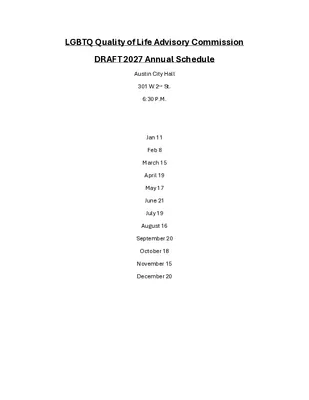
LGBTQ Quality of Life Advisory Commission DRAFT 2027 Annual Schedule Austin City Hall 301 W 2nd St. 6:30 P.M. Jan 11 Feb 8 March 15 April 19 May 17 June 21 July 19 August 16 September 20 October 18 November 15 December 20

MEETING OF THE ELECTRIC UTILITY COMMISSION October 19, 2026 ▪ 6:00 PM AUSTIN ENERGY HEADQUARTERS/SHUDDE FATH CONFERENCE ROOM 4815 MUELLER BLVD AUSTIN, TEXAS Some members of the Electric Utility Commission maybe participating by videoconference. The meeting may be viewed online at: http://www.austintexas.gov/page/watch-atxn-live Public comment will be allowed in-person or remotely by telephone. Speakers may only register to speak on an item once either in-person or remotely and will be allowed up to three minutes to provide their comments. Registration no later than noon the day before the meeting is required for remote participation. To register to speak remotely, contact Nici Huff, at Nici.Huff@AustinEnergy.com or via phone at 512-972-8621. Members: Dave Tuttle, Chair (District 10) Al Braden, Vice Chair (District 7) Raul Alvarez (District 3) Lauren Bellomy (Mayor) Cesar Benavides (District 4) Jonathon Blackburn (District 5) CALL TO ORDER Chris Gillett (District 6) Chris Kirksey (District 8) Ellu Nasser (District 1) Cyrus Reed (District 9) Kaiba White (District 2) AGENDA PUBLIC COMMUNICATION: GENERAL The first 5 speakers signed up prior to the meeting being called to order will each be allowed a three- minute allotment to address their concerns regarding items not posted on the agenda. APPROVAL OF MINUTES 1. Approve the minutes of the Electric Utility Commission Regular Called Meeting on September 14, 2026. DISCUSSION AND ACTION ITEMS 2. Recommend approval authorizing an amendment to a contract for continued NetBrain Software Platform services used for network management for Austin Energy and Austin Aviation with FreeIt Data Solutions Inc. to extend the term for one year for an additional $423,110 and to add another one-year extension option for an additional $423,109 for a revised total contract amount not to exceed $1,034,943. Funding: $245,000 is available in the Operating Budget of Austin Energy. $100,000 is available in the Operating Budget of Austin Aviation. Funding for the remaining contract term is contingent upon available funding in future budgets. 3. Recommend approval authorizing five contracts for three-phase distribution pad-mount transformers designed for underground distribution electrical facilities for Austin Energy with CribProcure Inc., Kllen Group America, Inc., Techline Inc., Texas Electric Cooperatives, and Texas Meter & Device Co. LLC d/b/a Texas Meter & Device, for an initial term of two years in an estimated amount of $20,000,000 with up to three one-year extension options each in an estimated amount of $10,000,000 for a total contract amount not to exceed $50,000,000, divided among the contractors. Funding: …
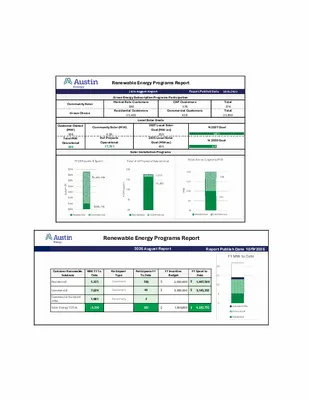
IA Austin Energy Community Solar Green Choice Renewable Energy Programs Report . ... . . . : . ... Green Energy Subscription Programs Participation Market Rate Customers 196 Residential Customers 21,422 CAP Customers 178 Commercial Customers 428 Customer Owned (MW) 166 Total MW Ooerational 200 Community Solar (MW) 4.35 # of Projects Operational 17,701 Local Solar Goals 2027 Local Solar Goal (MW-ac) 205 2035 Local Solar Goal(MW-ac) 405 Solar Installation Programs •. . . . . . Total 374 Total 21,850 %2027Goal %2035Goal FY26 Rebate $ Spent Total# of Projects Operational Total Active Capacity MW $7M $6M $5M � $4M � $3M 0 $2M $1M $OM $5,645,449 $985,740 20k 15k 1,319 16,382 � l 10k 0 � 5k Ok 200 150 ,: :,: 100 50 100 101 ■ Residential �Commercial ■ Residential � Commercial ■ Residential �Commercial !A:Austin Energy Renewable Energy Programs Report Customer Renewable Solutions MW FY To Date Residential Commercial Commercial Standard Offer Solar Energy TOTAL Participant Type Customers Customers 5.225 7.624 1.081 Third-Party 2026 August Report Report Publish Date 10/9/2026 FY MW to Date 20 15 10 Participants FY To Date FY Incentive Budget FY Spent to Date 536 44 2 $ $ $ 2,000,000 $ 1,047,500 5,300,000 $ 3,145,292 7,300,000 ■Standard Offer lilCommercial ■ Residential

Customer Energy Solutions FY26 YTD MW Savings Report As of August 2026 Energy Efficiency Services EES- Appliance Efficiency Program EES- Home Energy Savings - Rebate EES- AE Weatherization & CAP Weatherization - D.I. * EES- School Based Education * EES- Strategic Partnership Between Utilities & Retailers * EES- Multifamily Rebates EES- Multifamily WX-D.I.+ EES- Commercial Rebate EES- Small Business Energy Efficiency TOTAL Demand Response (DR) - Annual Incremental DR- Power Partner DR- Commercial Demand Response (frmly Load Coop) Demand Response (DR) TOTAL Green Building GB- Residential Ratings GB- Residential Energy Code GB- Multifamily Ratings GB- Multifamily Energy Code GB- Commercial Ratings GB- Commercial Energy Code Green Building TOTAL MW Goal 2.00 0.65 0.55 0.30 1.75 1.50 1.00 4.20 1.00 12.95 MW Goal 6.40 2.00 10.40 MW Goal 0.29 2.15 1.90 2.67 3.89 2.53 13.43 MW To Date 1.58 0.40 0.42 0.13 1.34 0.37 1.23 3.36 0.63 9.46 MW To Date 12.37 7.78 20.15 MW To Date 0.19 2.06 1.23 2.19 2.07 1.82 9.56 Thermal Energy Storage TOTAL 0.00 0.00 Percentage 79% 62% 76% 45% 77% 24% 123% 80% 63% Participant Type Customers Customers Customers Products Products Apartments Apartments Customers Customers Participants To Date MWh To Date 2,338 374 491 3,127 112,242 1,286 3,832 104 57 11,609 3,256.15 574.02 802.70 701.88 9,747.26 957.00 3,660.17 8,108.00 939.00 28,746.18 Rebate Budget $ 1,200,000 $ 1,550,000 $ 5,613,500 $ 350,000 $ 1,250,000 $ 1,280,000 $ 2,250,000 $ 2,325,000 $ 650,000 $ 16,468,500 Spent to Date $ 1,165,775 $ 1,212,050 $ 4,465,207 $ 83,470 $ 1,396,342 $ 560,822 $ 2,344,594 $ 1,608,465 $ 397,461 $ 13,234,186 Percentage 124% 389% Participant Type Devices Customers Participants To Date MWh To Date 7,753 190 7,943 0 0 0.00 Rebate Budget $ 2,497,600 $ 2,000,000 $ 4,497,600 Spent to Date $ 1,126,840 $ 1,002,885 $ 2,129,725 Percentage 67% 96% 65% 82% 53% 72% Participant Type Customers Customers Dwellings Dwellings 1,000 sf 1,000 sf Participants To Date MWh To Date Rebate Budget Spent to Date 288 2,494 3,399 4,847 3,884 5,007 11,028 0 200 2,499 3,303 3,241 4,014 6,150 19,408 $ - $ - $ - $ - 0 $ - $ - CES MW Savings Grand TOTAL Residential Totals Commercial Totals MW Goal 36.78 MW To Date 39.17 Percentage Participant Type Participants To Date MWh To Date 30,580 48,153.86 Rebate Budget $ 20,966,100 Spent to Date $ 15,363,911 18.59 18.19 20.09 19.08 108% 105% 134,225 17,488 22398.86 25755.00 $ …

Item 2 Posting Language ..Title Authorize an amendment to a contract for continued NetBrain Software Platform services used for network management for Austin Energy and Austin Aviation with FreeIt Data Solutions Inc. to extend the term for one year for an additional $423,110 and to add another one-year extension option for an additional $423,109 for a revised total contract amount not to exceed $1,034,943. Funding: $245,000 is available in the Operating Budget of Austin Energy. $100,000 is available in the Operating Budget of Austin Aviation. Funding for the remaining contract term is contingent upon available funding in future budgets. ..Body Lead Department Austin Financial Services. Client Department(s) Austin Energy, Austin Aviation. Fiscal Note Funding in the amount of $245,000 is available in the Fiscal Year 2026-2027 Operating Budget of Austin Energy. Funding in the amount of $100,000 is available in the Fiscal Year 2026-2027 Operating Budget of Austin Aviation. Funding for the remaining contract term is contingent upon available funding in future budgets. Procurement Language: Contract Amendment. MBE/WBE: Cooperative Agreement contracts are exempt from the City Code Chapter 2-9B (Minority-Owned and Women-Owned Business Enterprise Procurement Program); therefore, no subcontracting goals were established. For More Information: Direct questions regarding this Recommendation for Council Action to Austin Financial Services - Central Procurement at: FSDCentralProcurementRCAs@austintexas.gov or 512-974-2500. Council Committee, Boards and Commission Action: October 14, 2026 - To be reviewed by the Airport Advisory Commission October 19, 2026 - To be reviewed by the Electric Utility Commission. Additional Backup Information: This amendment is for the continued use of NetBrain, a network and operations software platform, by Austin Energy and to extend use of the platform to Austin Aviation. NetBrain enhances the reliability and efficiency of Information Technology (IT) infrastructure by providing visuals showing network connections and provides network management and support through quick identification of potential problems, highlighting where an issue is happening, to aid in resolution of network outages. The platform also provides automation of utility infrastructure environment updates and enables the utility to automate change-tracking which improves Cybersecurity posture and supports compliance obligations. It reduces manual tasks, improves consistency and helps prevent network incidents that may impact business operations. It delivers accurate inventory and visibility, improving troubleshooting efficiency and overall Item 2 reliability. This enables proactive issue resolution, reduces downtime, and enhances overall network reliability. Austin Aviation’s network diagrams are currently maintained manually and often lack accuracy when needed for troubleshooting, …

Item 3 Posting Language ..Title Authorize five contracts for three-phase distribution pad-mount transformers designed for underground distribution electrical facilities for Austin Energy with CribProcure Inc., Kllen Group America, Inc., Techline Inc., Texas Electric Cooperatives, and Texas Meter & Device Co. LLC d/b/a Texas Meter & Device, for an initial term of two years in an estimated amount of $20,000,000 with up to three one-year extension options each in an estimated amount of $10,000,000 for a total contract amount not to exceed $50,000,000, divided among the contractors. Funding: $10,000,000 is available in the Operating Budget of Austin Energy. Funding for the remaining contract term is contingent upon available funding in future budgets. ..Body Lead Department Austin Financial Services. Client Department(s) Austin Energy. Fiscal Note Funding in the amount of $10,000,000 is available in the Fiscal Year 2026-2027 Operating Budget of Austin Energy. Funding for the remaining contract term is contingent upon available funding in future budgets. Procurement Language: Austin Financial Services issued a Request for Proposals solicitation RFP 1100 EAL3030 for these goods. The solicitation was published on March 30, 2026, and closed on April 21, 2026. Of the twenty-five offers received, the proposals submitted by the recommended contractors represented best value to the City based on the solicitation’s evaluation criteria. A complete solicitation package, including a log of offers received, is available for viewing on the City’s website. This information can currently be found at https://financeonline.austintexas.gov/afo/account_services/solicitation/solicitation_details.cfm?sid=143886 . MBE/WBE: This contract will be awarded in compliance with the City Code Chapter 2-9B (Minority-Owned and Women- Owned Business Enterprise Procurement Program). For the goods required for this solicitation, there were no subcontracting opportunities; therefore, no subcontracting goals were established. For More Information: Direct questions regarding this Recommendation for Council Action to the Austin Financial Services - Central Procurement at: FSDCentralProcurementRCAs@austintexas.gov or 512-974-2500. Respondents to the solicitation and their Agents should direct all questions to the Authorized Contact Person identified in the solicitation. Council Committee, Boards and Commission Action: October 19, 2026 - To be reviewed by the Electric Utility Commission. Additional Backup Information: The contract will provide three-phase pad-mount distribution transformers to Austin Energy on an as needed basis. These transformers are intended for use on concrete slabs and are designed for underground distribution electrical facilities. Contracting with multiple vendors will allow Austin Energy to diversify its supplier base in the event of delays, shortages or price increases. Item 3 Three-phase pad-mount …
Item 4 Posting Language ..Title Authorize an amendment to a contract for continued internet-based telecommunication services for Austin Energy with Windstream Holding Inc. d/b/a Windstream, to extend the term for one year for an additional $100,000 and add another one-year extension option for an additional $100,000 for a revised total contract amount not to exceed $717,000. Funding: $100,000 is available in the Fiscal Year 2026-2027 Operating Budget of Austin Energy. Funding for the remaining contract term is contingent upon available funding in future budgets. ..Body Lead Department Austin Financial Services. Client Department(s) Austin Energy. Fiscal Note Funding in the amount of $100,000 is available in the Fiscal Year 2026-2027 Operating Budget of Austin Energy. Funding for the remaining contract term is contingent upon available funding in future budgets. Procurement Language: Contract Amendment. MBE/WBE: This contract was awarded in compliance with the City Code Chapter 2-9B (Minority-Owned and Women- Owned Business Enterprise Procurement Program). For the services required for this contract, there were no subcontracting opportunities; therefore, no subcontracting goals were established. Prior Council Action: April 7, 2022 - Council approved an amendment to a contract for Voice over Internet Protocol trunk transition services with Windstream Holding Inc. For More Information: Direct questions regarding this Recommendation for Council Action to Austin Financial Services - Central Procurement at: FSDCentralProcurementRCAs@austintexas.gov or 512-974-2500. Council Committee, Boards and Commission Action: October 19, 2026 - To be reviewed by the Electric Utility Commission. Additional Backup Information: The proposed amendment will provide Austin Energy with continued internet-based telecommunications services via Voice over Internet Protocol (VoIP) and session initiation protocol (SIP) trunks. VoIP SIP trunks unify voice, data, equipment, and applications, resulting in increased reliability, decreased capacity issues, and reduced costs. Services include provisioning and maintenance and support. The SIP platform is a dynamic solution containing redundancy and disaster recovery features that ensure consistent telecommunication capabilities for Austin Energy. The current contract expires October 30, 2026, this amendment will ensure uninterrupted operations while Austin Energy pursues a consolidated master agreement for several related connectivity services planned for 2028. Previous solicitations for a multi-year contract failed to result in an award, and Austin Energy has determined that a single integrated contract would provide a more streamlined, efficient, and cost-effective approach. Item 4 Without this contract, Austin Energy will experience a loss of phone services, including control rooms and Cisco phone users for all on-site employees. Contract Details: Contract Term …
Item 5 Posting Language Authorize a contract for a statistical analysis system, analytics software support, and maintenance, used for business intelligence analysis and consumption and billing data reporting, for Austin Energy with Executive Information Systems LLC, for an initial term of one year in an estimated amount of $96,000 with up to four one-year extension options each in an estimated amount of $96,000 for a total contract amount not to exceed $480,000. Funding: $88,000 is available in the Fiscal Year 2026-2027 Operating Budget of Austin Energy. Funding for the remaining contract term is contingent upon available funding in future budgets. Lead Department Austin Financial Services. Client Department(s) Austin Energy. Fiscal Note Funding in the amount of $88,000 is available in the Fiscal Year 2026-2027 Operating Budget of Austin Energy. Funding for the remaining contract term is contingent upon available funding in future budgets. Procurement Language: Multiple cooperative purchase programs were reviewed for these services. Austin Financial Services and Austin Energy have determined that this contractor best meets the needs of Austin Energy to provide these services required for the City. MBE/WBE: Cooperative Agreement contracts are exempt from the City Code Chapter 2-9B (Minority-Owned and Women-Owned Business Enterprise Procurement Program); therefore, no subcontracting goals were established. For More Information: Direct questions regarding this Recommendation for Council Action to Austin Financial Services - Central Procurement at: FSDCentralProcurementRCAs@austintexas.gov or 512-974-2500. Council Committee, Boards and Commission Action: October 19, 2026 - To be reviewed by the Electric Utility Commission. Additional Backup Information: The contract will provide continued maintenance and support to manage Austin Energy’s Statistical Analysis System (SAS) software platform. The SAS data analytics platform and server are used for complex business intelligence analysis that supports Austin Energy operations and strategic objectives, including transforming complex data sets for analysis of consumer consumption projections and making consumption and billing data available to customers. The SAS solution provides an end-to-end analytical platform that allows Austin Energy to collaborate, manage and report on the analysis of large data sets in real-time, and automate workflows. The Texas Department of Information Resources is a cooperative purchasing association recognized under Texas procurement statutes. Cooperative associations, themselves or using a lead government, competitively solicit and award contracts that are eligible for use by other qualified state and local governments. Due to their substantial volumes, larger than any one government could achieve independently, cooperative contracts routinely include superior terms, conditions, and pricing. …
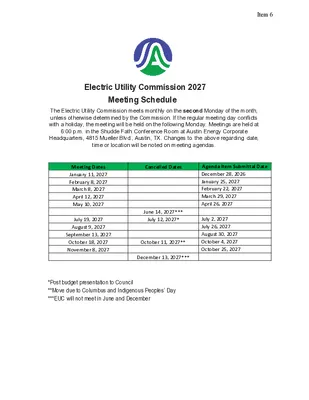
Electric Utility Commission 2027 Meeting Schedule The Electric Utility Commission meets monthly on the second Monday of the month, unless otherwise determined by the Commission. If the regular meeting day conflicts with a holiday, the meeting will be held on the following Monday. Meetings are held at 6:00 p.m. in the Shudde Fath Conference Room at Austin Energy Corporate Headquarters, 4815 Mueller Blvd., Austin, TX. Changes to the above regarding date, time or location will be noted on meeting agendas. Meeting Dates January 11, 2027 February 8, 2027 March 8, 2027 April 12, 2027 May 10, 2027 July 19, 2027 August 9, 2027 September 13, 2027 October 18, 2027 November 8, 2027 Cancelled Dates Agenda Item Submittal Date December 28, 2026 January 25, 2027 February 22, 2027 March 29, 2027 April 26, 2027 June 14, 2027*** July 12, 2027* October 11, 2027** December 13, 2027*** July 2, 2027 July 26, 2027 August 30, 2027 October 4, 2027 October 25, 2027 *Post budget presentation to Council **Move due to Columbus and Indigenous Peoples’ Day ***EUC will not meet in June and December Item 6
Advanced Metering Infrastructure What’s New and Next for Austin Energy’s AMI Network October 19, 2026 © Austin Energy William Kelly Distribution Process Manager Advanced Grid Technologies Item 7 AMI @ Austin Energy History and Current State Network Optimization More than a Meter Visibility & Awareness During Outages Questions 2 History of Advanced Metering Infrastructure 1-Way AMR 2001 Austin Energy deploys ~100k one- way communicating Automated Meter Reading (AMR) meters 1-Way AMR 2-Way AMI 2006 Austin Energy transitions to deploying a blended one-way and two-way communicating network 2-Way Simple AMI 2015 Austin Energy sunsets one-way AMR technology, transitions to a full “simple” two-way communicating network – Advanced Metering Infrastructure 2-Way Advanced AMI 2019 Austin Energy completes its transition to a full “advanced” two-way communicating network TODAY Austin Energy operates one of the highest performing AMI networks in the country. • Network is radio frequency mesh • Managed service – Austin-based L+G program office maintains and operates the field network and the back-office control system • 10-year agreement: 2024-2034 • Performance-based contract • Industry leading service level agreement and performance Note: Meters purchased via a separate contract 590,000+ Electric Utility Meters 1,500+ AMI field network devices Program Enhancements Service Level Agreements & Key Performance Indicators Network centric performance measure: (5 "hop" average network) impacts all-around performance rather than read delivery Future Proof New network equipment is ready to support a next generation Internet Protocol (IP) Mesh based communication technology Redundancy Lesson learned from winter storms: build a redundant meter network with increased density offering tier-one, blue-sky-day performance and protection against mass-scale circuit outages Cost Reduction 10-year partnership provides a reduction in per read pricing, all while securing stricter performance measures and an enhanced, redundant, future-proof network 5 Network Optimization September 2025 — March 2026 • Doubled the density of and optimized the Advance Metering Infrastructure network • Upgraded 915 routers during the project Gateways Radio frequency mesh information hubs that act as the first – and last – point of data delivery between the utility and the field network Routers Network repeaters that relay data packets across the wireless mesh network between the meter and the gateway 57 205 Sept. 2025 March 2026 1273 Sept. 2025 1385 March 2026 More than a Meter AMI meters are health monitoring devices for the distribution system, capable of recording hundreds of alarms, events, flags and readings AMI Meters Provide • Real-time outage and restoration information …
Fast Charging Overview Electric Vehicles & Emerging Technologies Heidi Kasper Director, Green Building & Emerging Technologies October 19, 2026 © Austin Energy Item 8 Agenda • Current Portfolio • Operational Report • Private Sector Growth • Vision for Growth 2 Current Portfolio 1,300+ charging stations • Public, workplace and fleet charging • 30 DC (Direct Current) fast chargers ▪ 26 public chargers – most deployed through Texas Commission on Environmental Quality Grant ▪ Four dedicated for municipal fleet Current Hardware: ChargePoint Express 250 3 Operational Report DC Fast Chargers Maintaining operational uptime is an extremely active function and a challenge • Standard maintenance contract and extended service offering with ChargePoint Assure • 95.1% uptime (up from 89% a year ago) Usage data for DC fast charger network • 230 MWh each month • 2.8 GWh last year • 9.9 million electric miles driven • Peak usage hour: 6-7 p.m. 100% 95% 90% 85% 80% DC Fast Chargers Uptime 12-month rolling average 89% 90% 92% 94% 95% Q4 FY 25 Q1 FY26 Q2 FY26 Q3 FY26 Q4 FY 26 4 Private Sector Growth • 343 Public DC Fast Chargers currently in the Austin/Round Rock area • Increased Investment auto manufacturers, private companies and fleets • 700 DC Fast Chargers in Pipeline for energization in the last few years ⅔ for fleet electrification ⅓ for public use 92 MW of capacity in study, design or construction Hurdles: • matching land acquisition to capacity availability • expectation for energization timelines • Major Role in capacity studies, energization and electric rate structures 5 Vision for Growth City of Austin Role • Market supports charging at most public places • City facilities for visitors, fleet vehicles, workforce • Low-to-moderate income areas Rate Structures • Time-based rates vs. volumetric rates • Idling fees • What is the private sector doing? Technology Selection • Analyze vendor landscape • Faster charging speeds • Connector standards • Highest hardware reliability Resiliency • Peak load strategy for emergency situations • Vehicle to grid integration 6 ©Austin Energy. All rights reserved. Austin Energy and the Austin Energy logo and combinations thereof are trademarks of Austin Energy, the electric department of the City of Austin, Texas. Other names are for informational purposes only and may be trademarks of their respective owners.
Play video
REGULAR MEETING of the ARTS COMMISSION October 19, 2026, at 6:00 PM Austin City Hall, Council Chambers, Room 1001. 301 West 2nd Street, Austin, Texas 78701 Some members of the ARTS COMMISSION may be participating by videoconference. The meeting may be viewed online at: http://www.austintexas.gov/page/watch-atxn- live Public comment will be allowed in-person or remotely via telephone. Speakers may only register to speak on an item once either in-person or remotely and will be allowed up to three minutes to provide their comments. Registration no later than Noon the day before the meeting is required for remote participation by telephone. To register to speak remotely, call or email Jesús Varela at Austin Arts, Culture, Music and Entertainment (ACME), at jesus.varela@austintexas.gov or at 512-974-2444. CURRENT COMMISSIONERS: Gina Houston - Chair, Muna Hussaini - Vice Chair, Keyheira Keys, Monica Maldonado, Heidi Schmalbach, Kirtana Banskota, Bailey Pownall, Faiza Kracheni, Sharron B Anderson, Nagavalli Medicharla AGENDA CALL TO ORDER PUBLIC COMMUNICATION: GENERAL The first 10 speakers signed up prior to the meeting being called to order will each be allowed a three-minute allotment to address their concerns regarding items not posted on the agenda. APPROVAL OF MINUTES 1. Approve the minutes of the Arts Commission Regular Meeting on July 20, 2026. DISCUSSION ITEMS 2. Update on actions taken at the October 5th Art in Public Places Panels by Commissioner Schmalbach. 3. Update on actions taken at the September 16th Downtown Commission meeting by Commissioner Houston. STAFF BRIEFINGS 4. Staff briefing regarding an update on the Hotel Occupancy Tax by Jesús Pantel, ACME Cultural Funding Supervisor. 5. Staff briefing regarding update on the Cultural Arts Funding Programs by Jesús Pantel, ACME Cultural Funding Supervisor. 6. Staff briefing regarding an update on the ACME Funding Programs by Laura Odegaard, ACME Division Manager, Cultural Affairs & Investments. 7. Staff briefing regarding an update on Art in Public Places by Jaime Castillo, ACME Art in Public Places Manager. DISCUSSION AND ACTION ITEMS 8. Establish an Austin Arts, Culture, Music, and Entertainment (ACME) Funding Appeals Working Group to review appeals from organizations who were not chosen for funding. 9. Approve a recommendation for the Northeast Service Center: Suspended 3D Art in Public Places Artist Selection. 10. Approve a recommendation for the Northeast Service Center: Cistern Murals Art Call. 11. Approve a recommendation of the Special Meeting of the Art in Public Places Deaccession Review, Art in Public Places artworks at …
Play video

Hotel Occupancy Tax Update Austin Arts, Culture, Music and Entertainment | October 16, 2026 Hotel Occupancy Tax – September 2026 Approved Budget September Year-to-date H/MOT Penalties & Interest Hotel/Motel Occupancy Tax Total Revenue $511,252 $166,777,013 $167,288,265 Transfer to Cultural Arts Fund $15,968,425 $19,027 $387,821 $406,848 $38,854 $814,970 $172,916,688 $173,324,810 $16,592,241 • Total HOT Collections September 2026 = $406,848 4% above FY26 Approved Budget of $167,288,265 • • Cultural Arts Fund September 2026 = $38,854 • 4% above FY26 Approved Budget of $15,968,425 2 Hotel Occupancy Collections – Significant Contributing Events • Austin Pride Parade & Festival • Zilker Summer Musical • The Drop-In, a Levitt VIBE Austin Music Series, powered by KUTX AUS Passenger arrivals: 874,638 (Aug 2026) 3 HOT Cultural Arts Fund – Quarterly Comparison $18,000,000 $16,000,000 $14,000,000 $12,000,000 $10,000,000 $8,000,000 $6,000,000 $15.65 M $15.57 M $15.34 M $12.9 M $3,967,678 $4,181,190 $4,014,342 $16.59 M $4,303,843 $4,317,350 $3,112,547 $4,298,427 $4,045,329 $4,150,573 $4,529,604 $3,982,424 $4,075,609 $4,112,939 $4,397,401 Q4 (July, Aug, Sept) Q3 (April, May, June) Q2 (Jan, Feb, Mar) Q1 (Oct, Nov, Dec) $4,000,000 $3,066,137 $2,000,000 $0 $2,374,915 $3,398,832 $3,266,808 $3,058,166 $3,361,392 FY22 FY23 FY24 FY25 FY26 4 Questions? 5

Funding Programs Update Arts, Culture, Music, and Entertainment | Oct 19, 2026 FY26 Funding Disbursement Status (as of 10/16/26) Program Total Awardees Total Funds # of Awardees Paid % of Awardees Paid $ of funds disbursed % of funds disbursed ALMF Elevate CSAP HPG Thrive Nexus 396 277 22 22 35 76 $7,045,000 $12,616,773 $1,320,000 $3,000,274 $3,850,000 $505,000 385 273 21 20 32 61 97% 99% 95% 91% 91% 80% $4,695,000 $11,000,089 $919,741 $1,904,021 $3,208,500 $374,500 TOTAL 829 $28,337,047 792 96% $22,101,851 67% 87% 70% 63% 83% 74% 78% 2 2027 ACME Grants Applications Window: July 7, 2026 – August 18, 2026, at 6:59 PM Contract Period: January 1, 2027 – December 31, 2027 (or December 2028 for 2-year contracts) 2027 Grant Panel Process! ▪ 60 Panels (Elevate, Heritage Preservation, Thrive) ▪ 330+ trained Panelists (panelists score against a detailed rubric) ▪ 900+ applications moved to Panel Process ▪ 12-26 applications reviewed per Panel Meeting ▪ 20 interpreters scheduled throughout the month (Spanish and American Sign Language) ▪ 5-8 Panelists review every application (Olympic scoring before final scores) ▪ 2-3 Panels Meetings per day ▪ 5 weeks (Tues-Saturday) ▪ NOTE: Full Scores, Comments, and Panel Meeting Recordings will be available to applicants when Notification letters go out in November. 4 120 Ineligible Applicants (not moving to Panel Meetings) Elevate (88 ineligible) Thrive (19 ineligible) • Insufficient 2-year Austin-based • Annual expenses below arts production history • Not primarily arts-focused • Unclear or unverifiable documentation (un-dated or incomplete work samples) • Ineligible activities proposed (studio build out, events outside the Austin, events not open to the public) $60,000. This was verified with documented IRS filings. • Geographic ineligibility (outside the Austin MSA) • Not meeting the definition of an arts nonprofit • Duplicate lead applicants Heritage Preservation (13 ineligible) • Sites not historically designated, or lack of evidence confirming eligibility status. • Incomplete bid packages or missing required documentation. • Applicant type not eligible under program rules. • Insufficient organizational operating history. • Activities proposed outside the contract period. 5 $23 Million in Funds Available in 2027 $65+ million in requests Austin Live Music Fund Elevate Heritage Preservation Thrive • $6 million • $11 million • $3 million • $3 million • ~290 awards ($5k - $70k) • 1,044 Applicants • 56 Venues • 65 Promoters • 923 Musicians • ~250 awards($30k- $80k) • 854 Applicants • 257 Arts 501c3s • …

Arts Commission Staff Briefings Arts, Culture, Music and Entertainment Arts Commission | October 19, 2026 Exhibition Updates Two Live by Star, Angel Alcala AIPP Exhibition Update People’s Gallery at City Hall Opening Reception - October 2, 2026 782 attendees Exhibition runs October – May 2028 Over 150 of Artworks 105 artists + 2 community organizations 3 Collection Updates Nightwing, Dale Whistler Collection Updates Item 11 Deaccessions at AUS • Timeline implications • Relocation options • Legal and regulatory considerations • Funding and feasibility • Artist follow up 5 Project Updates The Gathering Place, Samara Barks Absolute Equality: Unity Tunnel by Reginald Adams 2026 CODAworx Winner for Best Collaboration! The CODAawards honor excellence in commissioned art around the world. This year’s jurors were particularly impressed by the collaborative spirit behind “Unity Tunnel,” describing the project as “the very definition of collaboration.” 7 Absolute Equality: Unity Tunnel by Reginald Adams 2026 IAP2 Project of the Year for Creativity and Innovation! The IAP2 judges highlighted the project’s innovative use of sound baths, quiet reflection, and guided meditation to build trust and create culturally appropriate spaces for community voice, an approach they described as both unique and deeply effective. They noted that community enthusiasm “went above and beyond decision-making and led to their investment into the art-making,” resulting in physical contributions literally embedded into the final artwork. 8 Diplomatic Souvenir Sanctuary Collection by Lys Santamaria Artist Narrative: These handcrafted souvenirs represent Austin’s spirit of migration, diversity, connection, and community, offering international partners a meaningful piece of Austin to take with them. • Monarch Butterfly: A symbol of migration, hope, freedom, and the universal search for belonging and sanctuary. • Open Hands: Represent Austin’s diverse community and the exchange of giving and receiving between people and the land. • Together: The imagery reflects Austin as a place where individual journeys are celebrated and communities come together to create a more connected future. 9 Program Updates Tau Ceti by Josef Kristofoletti AIPP Resolution No. 20250306-029 Economic Opportunity Committee September 25, 2026 Art in Public Places Panel Arts Commission City Council October 5, 2026 October 19, 2026 October 22, 2026 November 5, 2026 11
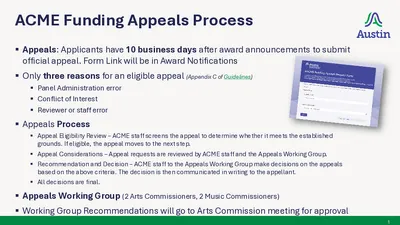
ACME Funding Appeals Process ▪ Appeals: Applicants have 10 business days after award announcements to submit official appeal. Form Link will be in Award Notifications ▪ Only three reasons for an eligible appeal (Appendix C of Guidelines) ▪ Panel Administration error ▪ Conflict of Interest ▪ Reviewer or staff error ▪ Appeals Process ▪ Appeal Eligibility Review – ACME staff screens the appeal to determine whether it meets the established grounds. If eligible, the appeal moves to the next step. ▪ Appeal Considerations – Appeal requests are reviewed by ACME staff and the Appeals Working Group. ▪ Recommendation and Decision – ACME staff to the Appeals Working Group make decisions on the appeals based on the above criteria. The decision is then communicated in writing to the appellant. ▪ All decisions are final. ▪ Appeals Working Group (2 Arts Commissioners, 2 Music Commissioners) ▪ Working Group Recommendations will go to Arts Commission meeting for approval 1

NESC Suspended 3D Artwork Artist Selection Arts, Culture, Music and Entertainment Art in Public Places Panel | October 5, 2026 Item # 5 Artist Selection October 5, 2026 Tau Ceti by Josef Kristofoletti NESC Suspended 3D Artwork Project Phase Selecting: Artist Selection Artist(s) Name Digital Artist (Carlyn Ray) Art Commission $300,000 Funding Type CIP/Bond Sponsor Dept Austin Resource Recovery Austin Fleet Mobility Services Managing Dept Austin Financial Services Council District 1 NESC location: 8301 Johnny Morris Rd 3 NESC Project Overview Northeast Service Center: • Public Private Partnership (P3) • AFS: managing dept, Austin Public Facilities Corporation • New campus will consolidate services to one location • ARR: trash collection, recycling, composting, large brush collection and bulk items • AFMS: vehicle maintenance needs for City of Austin AIPP Participation: • Second AIPP project within P3 delivery model • $3 million in Art Commissions • AIPP developed opportunities & budgets • Phased approach: second oppoertunity, additional opportunities in 2026 NESC location: 8301 Johnny Morris Rd 4 NESC Site & AIPP Opportunities North Campus: Austin Resource Recovery Garage Façade Interior Hanging Artwork $1,800,000 $ 300,000 Cistern Murals x 2 Sculptures x 5 Total AIPP Opportunities South Campus: Austin Fleet Mobility Services $ 300,000 $ 600,000 $3,000,000 5 NESC Suspended Artwork – Art Call Scope of Work: • Site-specific permanent artwork • Suspended 3D artwork on the grand staircase • Encouraged use of recycled materials • Engage stakeholders and community • Artwork integrated into building design, including coordination with project team • Artist(s) that can meet installation timeline Considerations: • Users and visitors of the site (administrative building is open to the public) • Longterm maintenance, building is open 24/7 Eligibility: • Texas-based mid-career public artist Administrative Building Lobby, Grand Staircase Mid-career: public artists are recognized in their fields and have a track record of exhibits, engaging communities, and completed projects in the public art realm. Minimum of five relevant completed projects with budgets up to $100,000. 6 NESC Suspended Artwork – Art Call Artwork location on grand staircase in administrative building lobby 7 NESC: Suspended 3D Artwork Artist Selection Panelists Voting Panelists: Megan Echols, Austin Visual Artist Ender Martos, Austin Visual Artist Kimberly Mirelez, Art Administrator, San Antonio Public Art Program Manager Advisors (non-voting panelists): Richard McHale, ARR Director, Sponsor Representative Rick Harland, AFMS Assistant Director, Sponsor Representative Paul Suttles, STG Design, Design Team Representative AIPP …
OPEN CALL FOR PUBLIC ART Art in Public Places Project Northeast Service Center Cistern Murals - District #1 Call open – [DAY, DATE] Deadline for Submissions – [DAY, DATE, TIME CENTRAL] Submit all information via PublicArtist.org Call Summary Austin Arts, Culture, Music, and Entertainment’s Art in Public Places (AIPP) Program in partnership with Austin Financial Services (AFS), Austin Resource Recovery (ARR) and Austin Fleet Mobility Services Department (AFMS), seeks to commission one Austin-based emerging artist or artist team to work with our partners, design team and community stakeholders to design, fabricate, and install a two murals on cisterns sited at the north and south campus for the new Northeast Service Center (NESC) campus at 8301 Johnny Morris Rd, Austin, TX 78724. Budget Description | Budget $300,000 As per City of Austin Ordinance, 2% of capital project costs are set aside to commission public art through the AIPP Program. The total award for the artist contract is $300,000 ($150,000 per mural) and is paid over the course of the commission with milestones at community engagement, design, fabrication, installation, and closing. AIPP recommends that selected artist or artist-led teams budget 10% for contingency, and budget the remainder for all other project expenses including but not limited to: insurance, promotion, community engagement, design, all engineering, fabrication, materials, subcontractors, travel, transportation, shipping, permits and installation. Project Description AIPP in partnership with AFS, ARR, and AFMS seeks an artist or artist team to create two site-specific murals for the NESC campus. The selected artist will work with ARR, AFMS, other City Departments, project consultants, and community stakeholders to develop, design, fabricate and install artworks to enhance the NESC campus. The public art opportunity includes two site-specific artworks that will be applied to new corrugated metal water tanks (cisterns). The two cisterns are located at the north and south campus and can be seen from Johnny Morris Road. The two murals should stand alone and work together with a cohesive theme. The selected artist should take into consideration the users of the site, public who visit the site, as well as pedestrian and vehicular traffic from the street. Additionally, the selected artist will be asked to take into consideration themes of the campus mission and goals when developing an artwork theme. The campus completed design and began construction in 2025 with a tentative operation start date for August 2027. The selected artist is responsible for all …

(cid:0)(cid:2)(cid:3)(cid:4)(cid:5)(cid:6)(cid:7)(cid:8)(cid:4)(cid:9)(cid:10)(cid:6)(cid:3)(cid:11)(cid:12)(cid:13)(cid:6)(cid:9)(cid:14)(cid:6)(cid:15)(cid:4)(cid:6)(cid:3)(cid:9) (cid:19)(cid:3)(cid:4)(cid:9)(cid:14)(cid:7)(cid:18)(cid:18) (cid:14)(cid:12)(cid:8)(cid:4)(cid:6)(cid:3)(cid:15)(cid:9)(cid:16)(cid:17)(cid:3)(cid:7)(cid:18)(cid:8) (cid:24)(cid:25)(cid:26)(cid:9)(cid:27)(cid:28)(cid:9)(cid:29)(cid:30)(cid:31) (cid:27)!(cid:9)(cid:29) "!#$(cid:9)%(cid:9)(cid:9)&!(cid:26)’(cid:31)#(cid:25)(cid:9)()(cid:9)*+*, (cid:19)(cid:3)(cid:4)(cid:8)(cid:20)(cid:9)(cid:14)(cid:17)(cid:18)(cid:4)(cid:17)(cid:3)(cid:6)(cid:20)(cid:9)(cid:16)(cid:17)(cid:8)(cid:12)(cid:13)(cid:9)(cid:7)(cid:15)(cid:21)(cid:9)(cid:22)(cid:15)(cid:4)(cid:6)(cid:3)(cid:4)(cid:7)(cid:12)(cid:15)(cid:23)(cid:6)(cid:15)(cid:4) (cid:17)(cid:11)(cid:18)(cid:19)(cid:10)(cid:20)(cid:9)(cid:6)(cid:17)(cid:21)(cid:15)(cid:8)(cid:10)(cid:6) (cid:22)(cid:23)(cid:24)(cid:25)(cid:26)(cid:27)(cid:28)(cid:6)(cid:29)(cid:30)(cid:31) (cid:6)!"##$ %(cid:11)(cid:9)(cid:7)(cid:8)(cid:9)&(cid:8)’(cid:6)(cid:2)(cid:15)((cid:10)(cid:6) )*+ (cid:2)(cid:3)(cid:4)(cid:5)(cid:6)(cid:5)(cid:7)(cid:8)(cid:9)(cid:10)(cid:11)(cid:12)(cid:6)(cid:13)(cid:14)(cid:11)(cid:15)(cid:16)(cid:8) %(cid:11)(cid:9)(cid:6)(cid:5)(cid:18)(((cid:7)(cid:8)(cid:8)(cid:7)(cid:18)(cid:12)(cid:6) ,-../... 0(cid:14)(cid:12)1(cid:7)(cid:12)2(cid:6)345(cid:10)(cid:6) !678*(cid:24)(cid:27)9 (cid:4)5(cid:18)(cid:12)(cid:8)(cid:18)(cid:11)(cid:6):(cid:10)5(cid:9)(cid:6) (cid:30);< (cid:26)(cid:27)(cid:6)=><(cid:24);(cid:31)(cid:23)>(cid:6)=>(cid:23)(cid:24)?>(cid:31)@ (cid:6) (cid:30);< (cid:26)(cid:27)(cid:6)A#>> (cid:6)B(cid:24)C(cid:26)#(cid:26) @(cid:6)(cid:22)>(cid:31)?(cid:26)(cid:23)>< (cid:13)(cid:15)(cid:12)(cid:15)2(cid:7)(cid:12)2(cid:6):(cid:10)5(cid:9)(cid:6) (cid:30);< (cid:26)(cid:27)(cid:6)A(cid:26)(cid:27)"(cid:27)(cid:23)(cid:26)"#(cid:6)(cid:22)>(cid:31)?(cid:26)(cid:23)>< (cid:5)(cid:18)(cid:14)(cid:12)(cid:20)(cid:7)(cid:16)(cid:6):(cid:7)(cid:8)(cid:9)(cid:11)(cid:7)(cid:20)(cid:9)(cid:6) D EF(cid:22)!(cid:6)#(cid:24)(cid:23)" (cid:26)(cid:24)(cid:27)G(cid:6)H-.D(cid:6)I(cid:24)J(cid:27)(cid:27)@(cid:6)B(cid:24)(cid:31)(cid:31)(cid:26)<(cid:6)=9 (cid:0) (cid:7)(cid:8)(cid:9)(cid:10)(cid:11)(cid:12)(cid:13)(cid:6)(cid:14)(cid:15)(cid:11)(cid:8)(cid:15)(cid:16)(cid:11)(cid:17)(cid:18)(cid:6) (cid:19) (cid:20)(cid:21)(cid:22)(cid:23)(cid:24)(cid:6)(cid:25)(cid:26)(cid:27)(cid:27)(cid:6)(cid:28)(cid:22)(cid:29)(cid:30)(cid:31) (cid:24)(cid:6)!(cid:21)(cid:24)"(cid:21)#(cid:6)(cid:27)(cid:0)(cid:6)$(cid:31)%(cid:21)&(cid:31)(cid:22)’(cid:6)((cid:29)$(cid:31)% (cid:19) )(cid:0)(cid:6)((cid:21)%%(cid:21)(cid:29)#(cid:6)(cid:21)#(cid:6)(cid:25)(cid:22)(cid:24)(cid:6)*(cid:29)(((cid:21)(cid:23)(cid:23)(cid:21)(cid:29)#(cid:23) (cid:19) (cid:25)(cid:26)(cid:27)(cid:27)(cid:6)$(cid:31)&(cid:31)%(cid:29)(cid:28)(cid:31)$(cid:6)(cid:29)(cid:28)(cid:28)(cid:29)(cid:22)(cid:24)+#(cid:21)(cid:24)(cid:21)(cid:31)(cid:23)(cid:6),(cid:6)-+$.(cid:31)(cid:24)(cid:23) (cid:7)(cid:8)(cid:9)(cid:10)(cid:11)(cid:12)(cid:13)(cid:6)/(cid:9)012(cid:18)(cid:6) (cid:2)(cid:3)(cid:4)(cid:5)(cid:6)(cid:7)(cid:8)(cid:9)(cid:10)(cid:11)(cid:12)(cid:13)(cid:6)(cid:14)(cid:15)(cid:11)(cid:8)(cid:15)(cid:16)(cid:11)(cid:17)(cid:6) (cid:19) 3(cid:31)!(cid:6) 4((cid:28)+(cid:23)(cid:6)!(cid:21)%%(cid:6) (cid:29)#(cid:23)(cid:29)%(cid:21)$4(cid:24)(cid:31)(cid:6)(cid:23)(cid:31)(cid:22)&(cid:21) (cid:31)(cid:23)(cid:6)(cid:24)(cid:29)(cid:6) (cid:19) (cid:25)556(cid:6)(cid:24)(cid:22)4(cid:23)"(cid:6) (cid:29)%%(cid:31) (cid:24)(cid:21)(cid:29)#7(cid:6)(cid:22)(cid:31) ’ %(cid:21)#.7(cid:6) (cid:29)#(cid:31)(cid:6)%(cid:29) 4(cid:24)(cid:21)(cid:29)# (cid:29)((cid:28)(cid:29)(cid:23)(cid:24)(cid:21)#.7(cid:6)%4(cid:22).(cid:31)(cid:6)-(cid:22)+(cid:23)"(cid:6) (cid:29)%%(cid:31) (cid:24)(cid:21)(cid:29)#(cid:6)4#$(cid:6) -+%8(cid:6)(cid:21)(cid:24)(cid:31)((cid:23) (cid:19) (cid:25)(cid:20)9:6(cid:6)&(cid:31)"(cid:21) %(cid:31)(cid:6)(4(cid:21)#(cid:24)(cid:31)#4# (cid:31)(cid:6)#(cid:31)(cid:31)$(cid:23)(cid:6);(cid:29)(cid:22)(cid:6)*(cid:21)(cid:24)’(cid:6) (cid:29);(cid:6)(cid:25)+(cid:23)(cid:24)(cid:21)# <(cid:16)=(cid:11)1(cid:16)>(cid:11)(cid:18) (cid:19) (cid:27)"4(cid:23)(cid:31)$(cid:6)4(cid:28)(cid:28)(cid:22)(cid:29)4 "6(cid:6) (cid:21)(cid:23)(cid:24)(cid:31)(cid:22)#(cid:6)(+(cid:22)4%(cid:23)(cid:6)(cid:21)(cid:23)(cid:6)(cid:24)"(cid:31)(cid:6);(cid:29)+(cid:22)(cid:24)"(cid:6)(cid:28)(cid:22)(cid:29)(cid:30)(cid:31) (cid:24) (cid:19) *(cid:29)#(cid:23)(cid:24)(cid:22)+ (cid:24)(cid:21)(cid:29)#(cid:6)-(cid:31).4#(cid:6);4%%(cid:6)?@?A (cid:19) *4((cid:28)+(cid:23)(cid:6)(cid:29)(cid:28)(cid:31)#(cid:21)#.(cid:6);4%%(cid:6)?@?B 3(cid:29)(cid:22)(cid:24)"(cid:6)*4((cid:28)+(cid:23)6(cid:6)(cid:25)+(cid:23)(cid:24)(cid:21)#(cid:6)5(cid:31)(cid:23)(cid:29)+(cid:22) (cid:31)(cid:6)5(cid:31) (cid:29)&(cid:31)(cid:22)’(cid:6) (cid:0) ABCD(cid:7)2344(cid:7)566.7/89:/:;<(cid:7)5E;7E:;F(cid:7) (cid:26)(cid:3)(cid:23)(cid:5)(cid:6)(cid:7)(cid:8)(cid:9)(cid:10)(cid:11)(cid:4)(cid:12)(cid:13)(cid:7)(cid:14)(cid:4)(cid:12)(cid:5)(cid:15)(cid:16)(cid:7)(cid:27)(cid:19)(cid:12)(cid:3)(cid:4)(cid:23)(cid:25)(cid:19)(cid:7)(cid:27)(cid:19)(cid:25)(cid:3)(cid:24)(cid:19)(cid:23)(cid:22)(cid:7) (cid:2)(cid:3)(cid:4)(cid:5)(cid:6)(cid:7)(cid:8)(cid:9)(cid:10)(cid:11)(cid:4)(cid:12)(cid:13)(cid:7)(cid:14)(cid:4)(cid:12)(cid:5)(cid:15)(cid:16)(cid:7)(cid:17)(cid:18)(cid:19)(cid:19)(cid:5)(cid:7)(cid:20)(cid:3)(cid:21)(cid:15)(cid:18)(cid:15)(cid:5)(cid:22)(cid:7)(cid:2)(cid:19)(cid:23)(cid:24)(cid:15)(cid:25)(cid:19)(cid:12) (cid:28)(cid:9)(cid:23)(cid:9)(cid:29)(cid:19)(cid:7)(cid:17)(cid:9)(cid:30)(cid:9)(cid:31)(cid:19)(cid:7) !"#$$"$$$ %(cid:16)(cid:5)(cid:19)(cid:23)(cid:15)(cid:3)(cid:23)(cid:7)(cid:2)(cid:4)(cid:12)(cid:11)(cid:19)(cid:16)(cid:31)(cid:19)(cid:31)(cid:7)(cid:14)(cid:23)(cid:5)&(cid:3)(cid:23)’(cid:7) (cid:7)(cid:7)(cid:7)($$"$$$ (cid:8)(cid:15)(cid:12)(cid:5)(cid:19)(cid:23)(cid:16)(cid:7)(cid:20)(cid:4)(cid:23)(cid:9)(cid:18)(cid:12)(cid:7))(cid:7)*(cid:7) (cid:2)(cid:25)(cid:4)(cid:18)(cid:11)(cid:5)(cid:4)(cid:23)(cid:19)(cid:12)(cid:7))(cid:7)+(cid:7) -./01(cid:7)2344(cid:7)566.7/89:/:;<(cid:7) (cid:7)(cid:7)(cid:7)($$"$$$ (cid:0) (cid:7)(cid:7)(cid:7),$$"$$$ =>?@@@?@@@ ’ ((cid:6)(cid:21)(cid:20)(cid:22)(cid:23))(cid:21)(cid:30)(cid:23)*(cid:20)+(cid:20)*(cid:6)(cid:30)(cid:23)(cid:24)(cid:29)(cid:28)(cid:25)(cid:23)(cid:25)(cid:22)(cid:6)(cid:28)(cid:24)(cid:22),-(cid:24). (cid:4) !"(cid:10)(cid:6)!#(cid:6)$!(cid:11)%&(cid:6) ’ (/(cid:6)(cid:29)0(cid:24)(cid:28)(cid:31)(cid:6)(cid:28)(cid:30)(cid:30)(cid:31)(cid:20)(cid:23)1(cid:6)(cid:22)-(cid:6)(cid:29)(cid:23)(cid:22)(cid:28)(cid:31)(cid:6),(cid:28)(cid:22)(cid:23)(cid:24)(cid:6)(cid:22)(cid:28)(cid:25).(cid:6)2*(cid:20)(cid:21)(cid:22)(cid:23)(cid:24)(cid:25)(cid:21)3 ’ 4(cid:24)(cid:22),-(cid:24).(cid:21)(cid:6)(cid:21)5-0(cid:31)1(cid:6)(cid:21)(cid:22)(cid:28)(cid:25)1(cid:6)(cid:28)(cid:31)-(cid:25)(cid:23)(cid:6)(cid:28)(cid:25)1(cid:6),-(cid:24).(cid:6)(cid:22)-6(cid:23)(cid:22)5(cid:23)(cid:24) ’ 4(cid:24)(cid:22),-(cid:24).(cid:6)(cid:22)5(cid:23)(cid:29)(cid:23)(cid:21)(cid:6)(cid:21)5-0(cid:31)1(cid:6)*-(cid:25)(cid:21)(cid:20)1(cid:23)(cid:24)(cid:6)(cid:28)(cid:6)*(cid:23)(cid:25)(cid:22)(cid:24)(cid:28)(cid:31)(cid:6)+-*0(cid:21)(cid:6) (cid:2)(cid:3)(cid:4)(cid:5)(cid:6)(cid:5)(cid:7)(cid:8)(cid:9)(cid:10)(cid:11)(cid:12)(cid:6)(cid:13)(cid:14)(cid:11)(cid:15)(cid:16)(cid:8)(cid:6)(cid:17)(cid:6)(cid:18)(cid:11)(cid:9)(cid:6)(cid:5)(cid:15)(cid:16)(cid:16) ’ (cid:26)(cid:25)6(cid:28)6(cid:23)(cid:6)(cid:21)(cid:22)(cid:28).(cid:23)5-(cid:31)1(cid:23)(cid:24)(cid:21)(cid:6)(cid:28)(cid:25)1(cid:6)*-(cid:29)(cid:29)0(cid:25)(cid:20)(cid:22); ’ 4(cid:24)(cid:22),-(cid:24).(cid:6)(cid:20)(cid:25)(cid:22)(cid:23)6(cid:24)(cid:28)(cid:22)(cid:23)1(cid:6)(cid:20)(cid:25)(cid:22)-(cid:6)*(cid:28)(cid:29)(cid:30)0(cid:21)(cid:6)1(cid:23)(cid:21)(cid:20)6(cid:25)<(cid:6)(cid:20)(cid:25)*(cid:31)01(cid:20)(cid:25)6(cid:6) *--(cid:24)1(cid:20)(cid:25)(cid:28)(cid:22)(cid:20)-(cid:25)(cid:6),(cid:20)(cid:22)5(cid:6)(cid:30)(cid:24)-=(cid:23)*(cid:22)(cid:6)(cid:22)(cid:23)(cid:28)(cid:29)(cid:6)(cid:28)(cid:25)1(cid:6)4>??(cid:6)(cid:28)(cid:24)(cid:22)(cid:20)(cid:21)(cid:22)(cid:21)(cid:6) -(cid:25)(cid:6)(cid:22)5(cid:23)(cid:6)(cid:23)(cid:21)(cid:21)(cid:23)(cid:25)(cid:22)(cid:20)(cid:28)(cid:31)(cid:6),-(cid:24).(cid:23)(cid:24)(cid:21)(cid:6)-+(cid:6)477(cid:6)(cid:28)(cid:25)1(cid:6)489: ’ A(cid:21)(cid:23)(cid:24)(cid:21)(cid:6)(cid:28)(cid:25)1(cid:6)B(cid:20)(cid:21)(cid:20)(cid:22)-(cid:24)(cid:21)(cid:6)-+(cid:6)(cid:22)5(cid:23)(cid:6)(cid:21)(cid:20)(cid:22)(cid:23)(cid:6) (cid:5)!(cid:12)(cid:8)(cid:7)@(cid:10)(cid:11)(cid:15)(cid:9)(cid:7)!(cid:12)(cid:8)& ’ C-(cid:25)6(cid:22)(cid:23)(cid:24)(cid:29)(cid:6)(cid:29)(cid:28)(cid:20)(cid:25)(cid:22)(cid:23)(cid:25)(cid:28)(cid:25)*(cid:23) ’ (cid:19)(cid:28)(cid:29)(cid:30)0(cid:21)(cid:6)(cid:20)(cid:21)(cid:6)-(cid:30)(cid:23)(cid:25)(cid:6)(DEF(cid:6) (cid:19)(cid:20)(cid:21)(cid:22)(cid:23)(cid:24)(cid:25)(cid:6)(cid:26)(cid:27)(cid:28)(cid:29)(cid:30)(cid:31)(cid:23) 40(cid:21)(cid:22)(cid:20)(cid:25))J(cid:28)(cid:21)(cid:23)1(cid:6)B(cid:20)(cid:21)0(cid:28)(cid:31)(cid:6)(cid:28)(cid:24)(cid:22)(cid:20)(cid:21)(cid:22)(cid:21)(cid:6),5-(cid:6)(cid:24)(cid:23)(cid:21)(cid:20)1(cid:23)(cid:6)(cid:20)(cid:25)(cid:6)(cid:22)5(cid:23)(cid:6)(cid:21)(cid:23)B(cid:23)(cid:25)(cid:6)*-0(cid:25)(cid:22)(cid:20)(cid:23)(cid:21)(cid:6)J-0(cid:25)1(cid:20)(cid:25)6(cid:6)(cid:22)5(cid:23)(cid:6)40(cid:21)(cid:22)(cid:20)(cid:25)(cid:6)(cid:29)(cid:23)(cid:22)(cid:24)-(cid:6)(cid:28)(cid:24)(cid:23)(cid:28)(cid:6)2K(cid:24)(cid:28)B(cid:20)(cid:21)<(cid:6) L(cid:28);(cid:21)<(cid:6)M(cid:20)(cid:31)(cid:31)(cid:20)(cid:28)(cid:29)(cid:21)-(cid:25)<(cid:6)N(cid:28)(cid:21)(cid:22)(cid:24)-(cid:30)<(cid:6)(cid:19)(cid:28)(cid:31)1,(cid:23)(cid:31)(cid:31)<(cid:6)N0(cid:24)(cid:25)(cid:23)(cid:22)<(cid:6)(cid:28)(cid:25)1(cid:6)N(cid:31)(cid:28)(cid:25)*-(cid:6)*-0(cid:25)(cid:22)(cid:20)(cid:23)(cid:21)3 OPQRSTUSV(cid:6)WXYZT[(cid:6)\R]T^]^(cid:6)^_‘a(cid:6)WR‘bQ^^T‘U\Z(cid:6)\[_TQcQPQU](cid:6)\Ud(cid:6)\RQ(cid:6)dQcQZ‘WTUS(cid:6)eX\ZTbT[\]T‘U^(cid:6)]_\](cid:6)^_‘a(cid:6)^TSUTbT[\U](cid:6)W‘]QU]T\Z(cid:6)TU(cid:6)]_Q(cid:6) (cid:3)(cid:16)(cid:7)G(cid:7)H(cid:7)(cid:16)(cid:7)(cid:9)I&(cid:6)(cid:6) bTQZd(cid:6)‘b(cid:6)WXYZT[(cid:6)\R]f(cid:6)gTUTPXP(cid:6)‘b(cid:6)‘UQ(cid:6)RQZQc\U](cid:6)[‘PWZQ]Qd(cid:6)WR‘hQ[](cid:6)aT]_(cid:6)\(cid:6)YXdSQ](cid:6)XW(cid:6)]‘(cid:6)ijklkkk(cid:6) (cid:0) $H(cid:5)(cid:15)(cid:7)N(cid:15)IO(cid:15)(cid:4)HIP(cid:13) (cid:2)G$(cid:8)(cid:7)(cid:8)H(cid:13)(cid:5)(cid:15)(cid:4)I(cid:7)J(cid:12)(cid:4)(cid:9)K(cid:13)(cid:7)L(cid:7)M(cid:4)(cid:5)(cid:7)(cid:8)(cid:9)KK (cid:2)(cid:3)(cid:4)(cid:5)(cid:6)(cid:7)(cid:8)(cid:9)(cid:10)(cid:11)(cid:12)(cid:13)(cid:7)(cid:14)(cid:6)(cid:15)(cid:10)(cid:15)(cid:16)(cid:7) (cid:17)(cid:18)(cid:19)(cid:20)(cid:21)(cid:22)(cid:23)(cid:24)(cid:7)(cid:25)(cid:23)(cid:19)(cid:26)(cid:24)(cid:27)(cid:28)(cid:7)(cid:29)(cid:18)(cid:25)(cid:30)(cid:20)(cid:7)(cid:27)(cid:24)(cid:18)(cid:30)(cid:19)(cid:22)(cid:7)(cid:31) (cid:7)(cid:20)(cid:30)(cid:25)!(cid:7)(cid:27)(cid:20)(cid:7)(cid:24)(cid:23)(cid:25)"(cid:25)(cid:28)(cid:21)(cid:19)#(cid:7) (cid:27)(cid:19)(cid:22)(cid:7)(cid:24)(cid:23)(cid:30)(cid:20)(cid:23) $(cid:3)(cid:12)(cid:5)(cid:6)(cid:7)(cid:8)(cid:9)(cid:10)(cid:11)(cid:12)(cid:13)(cid:7)(cid:14)(cid:6)(cid:15)(cid:10)(cid:15)(cid:16)(cid:7) (cid:17)(cid:18)(cid:19)(cid:20)(cid:21)(cid:22)(cid:23)(cid:24)(cid:7)(cid:25)(cid:23)(cid:19)(cid:26)(cid:24)(cid:27)(cid:28)(cid:7)(cid:29)(cid:18)(cid:25)(cid:30)(cid:20)(cid:7)(cid:27)(cid:24)(cid:18)(cid:30)(cid:19)(cid:22)(cid:7)(cid:31)%&’(cid:7)(cid:20)(cid:30)(cid:25)!(cid:7)(cid:27)(cid:20)(cid:7)((cid:18))(cid:21)(cid:28)(cid:21)(cid:26)"*(cid:7) ((cid:18)+(cid:23)((cid:23)(cid:19)(cid:26)*(cid:7)(cid:25)(cid:18)(cid:19)(cid:19)(cid:23)(cid:25)(cid:26)(cid:21)+(cid:21)(cid:26)"*(cid:7),(cid:23)(cid:18),(cid:28)(cid:23)(cid:7)(cid:27)(cid:19)(cid:22)(cid:7)(cid:25)(cid:18)(((cid:30)(cid:19)(cid:21)(cid:26)"(cid:7)(cid:26)!(cid:23)"(cid:7) (cid:20)(cid:23)(cid:24)+(cid:23)- (cid:0) ./0123045(cid:7)563789(cid:7):;(cid:7)<887510=1<>;(cid:7)=?9(cid:7)0;@0;5;?1=1<>;(cid:7)3A(cid:7)16;(cid:7);55;?1<=8(cid:7)2304(cid:7)2<16<?(cid:7)BCDE(cid:7)>5(cid:7)8<1;0=8(cid:7)0;@0;5;?1=1<3?F (cid:22) (cid:23)(cid:24)(cid:25)(cid:26)(cid:27)(cid:25)(cid:26)(cid:28)(cid:6)(cid:29)(cid:30)(cid:24)(cid:26)(cid:25)(cid:31)(cid:6)(cid:28)(cid:24)(cid:30) (cid:25)(cid:26)!(cid:30)(cid:6)(cid:28) " (cid:28)(cid:26)(cid:25)#(cid:31)(cid:6) $%(cid:6)(cid:25)(cid:30)(cid:28)&$(cid:26)(cid:28) ’(cid:6)(cid:30)("(cid:30)(cid:24)(cid:25)(cid:26)(cid:27)(cid:30)(cid:6))*(cid:6)" (cid:27)(cid:25)(cid:6)+)(cid:24),(cid:6)-./01 (cid:4)(cid:10)(cid:16)(cid:10)(cid:18)(cid:9)(cid:7)(cid:19)(cid:12)(cid:6)(cid:5)(cid:11)(cid:7)(cid:9)(cid:10)(cid:11)(cid:7)(cid:15)(cid:21)(cid:6)(cid:6) (cid:2)(cid:3)(cid:4)(cid:5)(cid:6)(cid:5)(cid:7)(cid:8)(cid:9)(cid:10)(cid:11)(cid:12)(cid:6)(cid:13)(cid:14)(cid:11)(cid:15)(cid:16)(cid:8) (cid:17)(cid:11)(cid:9)(cid:7)(cid:8)(cid:9)(cid:6)(cid:4)(cid:10)(cid:16)(cid:10)(cid:18)(cid:9)(cid:7)(cid:19)(cid:12)(cid:6)(cid:20)(cid:11)(cid:19)(cid:18)(cid:10)(cid:8)(cid:8) (cid:22) 2$(cid:25)&3(cid:27)(cid:26) (cid:27)(cid:29)(cid:6) $%(cid:6) 4(cid:26)’(cid:26)(cid:25)#(cid:6)(cid:26)$(cid:6)(cid:28)(cid:24)(cid:30) (cid:25)(cid:26)$5(cid:6)(cid:27)(cid:26)(cid:25)(cid:30)6(cid:27)"(cid:30)(cid:28)(cid:26)*(cid:26)(cid:28)(cid:6)"34’(cid:26)(cid:28)(cid:6) (cid:24)(cid:25)+)(cid:24),(cid:6) $%(cid:6)+)(cid:24),(cid:26)$5(cid:6) +(cid:26)(cid:25)&(cid:6)’)(cid:28) ’(cid:6)(cid:28))(cid:29)(cid:29)3$(cid:26)(cid:25)(cid:26)(cid:30)(cid:27)(cid:6)-7/01 (cid:22) 8(cid:30)(cid:29))$(cid:27)(cid:25)(cid:24) (cid:25)(cid:30)%(cid:6)(cid:30)("(cid:30)(cid:24)(cid:26)(cid:30)$(cid:28)(cid:30)(cid:6)(cid:26)$(cid:6)(cid:25)&(cid:30)(cid:6)*(cid:26)(cid:30)’%(cid:6))*(cid:6)"34’(cid:26)(cid:28)(cid:6) (cid:24)(cid:25)(cid:6)-./01(cid:6) (cid:22)9(cid:25)(cid:26)’(cid:26):(cid:30)(cid:6)(cid:25)&(cid:30)(cid:6);34’(cid:26)(cid:28)(cid:6)(cid:23)(cid:24)(cid:25)(cid:26)(cid:27)(cid:25)(cid:6)<(cid:30)( (cid:27)(cid:6);(cid:24)(cid:30)6=3 ’(cid:26)*(cid:26)(cid:30)%(cid:6)>(cid:26)(cid:27)(cid:25) (cid:17)(cid:11)(cid:9)(cid:7)(cid:8)(cid:9)(cid:6)(cid:4)(cid:10)(cid:16)(cid:10)(cid:18)(cid:9)(cid:7)(cid:19)(cid:12)(cid:6)(cid:20)(cid:11)(cid:19)(cid:18)(cid:10)(cid:8)(cid:8)(cid:21) (cid:22)?%(cid:30)$(cid:25)(cid:26)*#(cid:6)(cid:27)&)(cid:24)(cid:25)’(cid:26)(cid:27)(cid:25)(cid:6))*(cid:6) (cid:24)(cid:25)(cid:26)(cid:27)(cid:25)(cid:27) (cid:22)?$%(cid:30)"(cid:30)$%(cid:30)$(cid:25)(cid:6)(cid:27)(cid:28))(cid:24)(cid:26)$5(cid:6)-(cid:27)(cid:30)’(cid:30)(cid:28)(cid:25)(cid:26))$(cid:6)" $(cid:30)’(cid:26)(cid:27)(cid:25)(cid:27)1 (cid:22)@(cid:30)’(cid:30)(cid:28)(cid:25)(cid:26))$(cid:6); $(cid:30)’(cid:6)A(cid:30)(cid:30)(cid:25)(cid:26)$5 (cid:22)B(cid:30)!(cid:26)(cid:30)+(cid:6)(cid:28))(cid:29)4(cid:26)$(cid:30)%(cid:6) !(cid:30)(cid:24) 5(cid:30)%(cid:6)(cid:27)(cid:28))(cid:24)(cid:30)(cid:27) (cid:22)8(cid:30)’(cid:26)4(cid:30)(cid:24) (cid:25)(cid:30)(cid:6) $%(cid:6)(cid:24)(cid:30)(cid:28))(cid:29)(cid:29)(cid:30)$%(cid:6)C(cid:6) (cid:24)(cid:25)(cid:26)(cid:27)(cid:25)(cid:6) $%(cid:6)C(cid:6) ’(cid:25)(cid:30)(cid:24)$ (cid:25)(cid:30)(cid:6) (cid:0) (cid:10)(cid:11)(cid:12)(cid:3)(cid:13)(cid:11)(cid:14)(cid:3)(cid:15)(cid:6)(cid:16)(cid:9)(cid:17)(cid:18)(cid:19)(cid:3)(cid:20)(cid:5)(cid:6)(cid:5)(cid:21)(cid:6)(cid:20)(cid:22)(cid:23)(cid:14)(cid:24)(cid:3)(cid:25)(cid:26) (cid:27)(cid:28)(cid:29)(cid:30)(cid:30)(cid:6)(cid:30)(cid:31) !"(cid:6)#(cid:28)$%(cid:6)&(cid:31)""’(cid:6) (cid:2)(cid:3)(cid:4)(cid:5)(cid:6)(cid:7)(cid:5)(cid:3)(cid:8)(cid:9) (cid:27)(cid:28)$%1(cid:6)&*223113* (cid:6)#(cid:28)$%(cid:6)&(cid:31)""’(cid:6) (cid:27)(cid:28)$%31%(cid:6)5!"!)%3* (cid:6)(cid:30)$*)!11(cid:6) (cid:27)(cid:28)$%31%(cid:6)93):;(<<(cid:6) @(cid:20)(cid:5)(cid:11)(cid:21)(cid:14)(cid:6)(cid:14)(cid:3)(cid:3)A(cid:3)A(cid:26)(cid:6) B(cid:6)CDEFDG(cid:6)ED(cid:6)HIJDCCIGKIK(cid:6)ELI(cid:6)MNNHDOMP(cid:6)DQ(cid:6)ELI(cid:6)BHE(cid:6)RMPP(cid:6)QDH(cid:6)STUR(cid:6)RFVEIHG(cid:6)WXHMPVY(cid:6)BHE(cid:6) FG(cid:6)ZX[PFJ(cid:6)ZPMJIV(cid:6)ZHD\IJE(cid:6)ED(cid:6)ELI(cid:6)BHEV(cid:6)RDCCFVVFDG](cid:6) ()%*+!$(cid:6),-(cid:6)./.0 ()%*+!$(cid:6)4(cid:0)-(cid:6)./.0 6(cid:31)""(cid:6)7(cid:6)83 %!$(cid:6)./.0 =>(cid:31)$%!$(cid:6)4(cid:6)./.? (cid:0)

To: Arts Commission From: Art in Public Places Panel Date: October 14, 2026 Re: Recommendation on Art in Public Places Ordinance Amendments The Art in Public Places (AIPP) Panel recommends that Council preserve its preferred allocation of 2% of total capital project cost, with no deductions, and adopt the administrative improvements proposed in the ordinance update. Recognizing the need to resolve the ongoing disagreement over the calculation method and establish a clear, consistent, auditable policy, the Panel is also presenting a compromise: an allocation of 1.75% of total capital project cost, with no deductions. This compromise accepts a reduction in the percentage in exchange for a transparent formula applied consistently across City capital projects. It does not represent the Panel's preferred outcome, nor does it diminish the need to reconcile historical discrepancies in AIPP allocations. The Panel has unanimously voted on three occasions not to accept the proposed ordinance amendments. Our disagreement has been narrow and specific: the proposed changes to the allocation calculation and the addition of eligible cost deductions, in the context of unresolved discrepancies and incomplete historical accounting. The information provided by City staff indicates a meaningful gap between the intent of the current ordinance and the allocations recorded in practice. Without a complete reconciliation, the Panel cannot confidently determine the full extent of that gap or establish that the proposed calculation will correct it. The Panel is concerned that the proposed amendments could formalize a calculation that further reduces the effective investment in public art without first resolving these discrepancies. The Panel recommends one clear formula: calculate the AIPP allocation as a fixed percentage of the total capital project cost, without deducting categories of expense before applying that percentage. This approach provides a consistent, auditable standard for every department and every eligible capital project. The Panel's compromise of 1.75% is not offered lightly. It represents a meaningful concession intended to resolve the disagreement over the calculation base while preserving a substantial and predictable investment in public art. We ask Council to consider this compromise rather than adopt a construction- cost calculation that risks further reducing the program's allocation. The City's own benchmarking supports a simplified calculation. According to the City's survey of peer cities, more than 70% calculate their public art allocation on total project cost without first carving out categories of expense. A consistent, no-deduction formula would align Austin with this prevailing approach while making …

Art in Public Places Resolution No. 20250306-29 Arts, Culture, Music and Entertainment Arts Commission October 19, 2026 Resolution No. 20250306-029 Directives Policy Updates Include 2% Public-Private Partnerships Encourage 2% Other Private Developments Allow flexible use of funds for artwork care, relocation, and re-installation Art Placement Flexibility Curatorial Services for major projects Programmatic Updates Communication Updates Address obstacles to local participation Clearly explain rights & responsibilities to artists Support for artists on private property Engage stakeholders (artwork removal) Chapter 7-2 review and associated program 2 Stakeholder Engagement External Engagement AIPP Panel Working Group + Arts Commission • Community advisory committee of the Arts Commission • Austin community arts professionals in design/architecture and visual arts fields Targeted focus groups and 1-1 conversations • Artists who experienced deaccessions, removals, and relocation of artworks • Curators, fabricators, and developers working in public art Internal Engagement Cross-Departmental Working Group • 17 departments reviewed recommended changes City Council Offices + CMO • Mayor Watson, Mayor Pro Tem Vela, Council Members Alter, Qadri, and Ellis Improve program clarity and communications Key Takeaways • • Clarity around the AIPP program • Define roles and responsibilities • Where to find resources • Simplified visual flowcharts • Information sessions 3 Public-Private Partnership (P3s) Directive: Include public-private partnership capital projects (P3), while exempting affordable housing costs, where applicable, and providing a process for alternative compliance that meets or exceeds City standards • AFS explained what city council referred to as a P3 project is more accurately described as an alternate delivery model that utilizes a Public Facilities Corporation. • Ordinance update requiring capital projects utilizing alternate delivery models (including the use of a Public Facilities Corporation); allocate 2% of project cost (affordable housing exempt) • Policy updates to incorporate clear definitions (Public Facilities Corporation) • Allow alternate delivery models to utilize AIPP’s prequalified artist pool for faster delivery method • Develop a decision tree to collaborate with AFS Redevelopment team for AIPP inclusion Big Chiller Buses by Ann Adame; Austin Convention Center 4 Alternate compliance fees (donation to public art fund) collected can be utilized for maintenance of the AIPP collection Private Developments Directive: Include a review of public art requirements in other private development regulations and programs, including but not limited to planned unit developments, density bonus programs, and Cultural Districts • Ordinance update encouraging private developments to incorporate public art, providing an option to incorporate public art into the …

Art in Public Places Panel Panelist Reappointment Arts, Culture, Music and Entertainment Arts Commission | October 19, 2026 Bernardo Diaz – Artist / Art Professor Art in Public Places - Panel Applicants Bernardo Diaz – Artist / Art Professor Art in Public Places - Panel Applicants Bernardo Diaz – Artist / Art Professor CV – Bernardo Diaz, b. 1983 Rochelle, IL Southern Methodist University – Master of Fine Arts – 2011 Texas A&M University – Corpus Christi – Master of Arts – 2009 Texas A&M International University – Bachelor of Arts – 2007 Solo Exhibitions – 2014 - 2024 Group Exhibitions – 2008 – 2023 Juried Exhibitions – 2008 – 2021 Projects – 2011 – 2020 #1 Please describe your past experience with or interest in public art: I have a strong interest in public art and public space, both formally and theoretically. My experience includes community arts and socially engaged art initiatives with grassroots organizations, non-profits, and higher education institutions. This work earned me a nomination for Texan of the Year by Loray Polk and the Dallas Morning Times. I have taught courses in Art as Social Practice at SMU and currently serve as an Art Appreciation Professor. In my lectures and discussions, I cover topics such as the rhetoric of art and space, murals, graffiti, street art, public art and performances, land art, and issues related to hostile architecture. While I'm not as familiar, I also have a growing interest in the role of new media processes in public space, especially as it relates to nomadic deployment of new media works. Art in Public Places - Panel Applicants Bernardo Diaz – Artist / Art Professor #2 Describe any special qualifications or experience you have that is related to the duties of an AIPP Panel member: With a BA, MA, and MFA in Studio Art, I bring a comprehensive knowledge base that may complement that of the current AIPP Panel Members. My experience as a juror and curator for various art projects is detailed in my CV and I can happily share more details about these experiences. I have also been a practicing artist for over two decades, not including my early creative endeavors as a child. :) #3 Please indicate your affiliations with any arts organization(s) and your role, such as Board of Directors, Advisory board, Staff, Member, or Volunteer. Please also indicate if any are Austin org. …