BOARD/COMMISSION RECOMMENDATION Commission on Aging Recommendation Number: 20260909-008: Health Literacy Month – October WHEREAS, health literacy includes the ability to find, understand, and use information and services to make health-related decisions, and clear and accessible health information is essential to navigating health care and maintaining individual and community health; and WHEREAS, the U. S. Department of Health and Human Services, Office of Disease Prevention and Health Promotion has identified a National Action Plan to improve health literacy 1, underscoring the importance of this issue, and WHEREAS, October has been recognized as Health Literacy Month since 1999 to increase awareness of the importance of making health information easier to understand and health systems easier to navigate 2; and WHEREAS, the 2025 Austin Women and Girls Quality of Life Study recommends: “Provide language accessible materials of resources to all Austin residents by translating all materials available through the City of Austin in multiple languages and tailored to varying literacy levels” 3; and WHEREAS, the 2025 Austin Older Adult Quality of Life Study reports that “41% of older adults rate their internet as fair or poor” and identifies “digital literacy programs” among needed interventions 4; and WHEREAS, the Austin LGBTQIA+ Quality of Life Study states that “there is a great need to access high- quality, affordable, culturally responsive, comprehensive health care for LGBTQIA+ individuals” 5. NOW, THEREFORE, BE IT RESOLVED that the Commission on Aging encourages the Austin City Council to proclaim October 2026 as "Health Literacy Month" in Austin and encourages City departments, healthcare providers, community organizations, and residents to promote clear, accessible, culturally responsive, and understandable health information for people of all ages and abilities. 1 U. S. Department of Health and Human Services, Office of Disease Prevention and Health Promotion, National Action Plan to Improve Health Literacy 2 Health Literacy Solutions Center 3 Commission for Women-Final Report, November 2025, Findings: Public Services, Digital Divide in Internet Access, p. 82. 4 Austin Older Adult Quality of Life Study 2025, Findings: Public Services, Digital Divide in Internet Access, p. 117. 5 ShoutOut Austin LGBTQIA+ Quality of Life Study (2021), Key Themes, p. 7. Date of Approval: September 9, 2026 Motioned By: Commissioner Lugo Seconded By: Commissioner Scott Vote: 10-0 For: Chair Bondi, Commissioners Anderson, Kareithi, Lane, Lugo, Ozarowski, Scott, Tyree, Yee, Zeng Against: None Abstain: None Off the dais: None Absent: Vice Chair Ferguson, Commissioners Tran and Van de Putte Attest: _____________________________________________ …
BOARD/COMMISSION RECOMMENDATION Commission on Aging Recommendation Number: 20260909-009: Veterans Day – November 11 WHEREAS, generations of Americans have served in the United States Armed Forces, making profound contributions and sacrifices in defense of the nation; and WHEREAS, since 1919, the United States of Americans have honored veterans of our armed forces, officially recognized by the United States Congress on June 4, 1926, with these words: Whereas the 11th of November 1918 1; and WHEREAS, nearly 31,000 veterans live in Austin2, representing approximately 4% of the 18 and over population and the City of Austin has long recognized the contributions of veterans to our community, including through its annual Veterans Day observances and its employment of more than 1,600 military veterans Austin3; and WHEREAS, the U.S. Department of Veterans Affairs recognizes that later life can bring challenges for veterans, including “vision or hearing loss or a chronic medical condition,” changes in roles and relationships, “financial or housing issues,” and the need to provide or receive additional help4; and WHEREAS, ensuring that older veterans can access appropriate services and remain connected to their communities supports dignity, independence, and healthy aging; and WHEREAS, recognizing veterans also provides an opportunity to acknowledge the families and caregivers who support those who have served. NOW, THEREFORE, BE IT RESOLVED that the Commission on Aging encourages the Austin City Council to recognize November 11, 2026, as "Veterans Day" in Austin, honoring veterans of all generations for their service and sacrifice and encouraging continued efforts to ensure that veterans and their families can access the services, supports, and opportunities they need throughout their lives. 1 U. S. Dept of Veterans Affairs, History of Veterans Day 2 United States Census Bureau, Quick Facts Austin, TX - Veterans 3 Austin Human Resources, Talent Strategy Division 4 U.S. Department of Veterans Affairs, Resources for Older Veterans Date of Approval: September 9, 2026 Motioned By: Commissioner Tyree Seconded By: Commissioner Anderson Vote: 10-0 For: Chair Bondi, Commissioners Anderson, Kareithi, Lane, Lugo, Ozarowski, Scott, Tyree, Yee, Zeng Against: None Abstain: None Off the dais: None Absent: Vice Chair Ferguson, Commissioners Tran and Van de Putte Attest: _____________________________________________ (Ryan Sperling, Staff Liaison)
BOARD/COMMISSION RECOMMENDATION Commission on Aging Recommendation Number: 20260909-010: Home Care Aide Day – November 18 WHEREAS, home care aides provide essential hands-on assistance that enables older adults and people with disabilities to live safely and independently in their homes and communities; and WHEREAS, home care aides assist individuals with activities of daily living and provide companionship, personal care, and other supports that contribute to health, dignity, safety, and quality of life; and WHEREAS, the 2025 Austin Older Adult Quality of Life Study recommends that the City “explore systemic supports for caregivers to balance caregiving responsibilities with paid employment” 1 and improve caregiver supports; and WHEREAS, the Austin Older Adult Quality of Life Study also reports that “most older adult caregivers are working full-time,” 2 illustrating the importance of a strong network of paid care professionals and community supports; and WHEREAS, recognizing and supporting the direct care workforce is increasingly important as the number of older adults in Austin and Central Texas continues to grow 3. NOW, THEREFORE, BE IT RESOLVED that the Commission on Aging encourages the Austin City Council to recognize November 18, 2026, as "Home Care Aide Day" in Austin and to honor home care aides for their essential contributions to the health, independence, dignity, and quality of life of older adults and people with disabilities. 1 Austin Older Adults Quality of Life At-A-Glance, Caregivers, p. 1 2 Austin Older Adults Quality of Life At-A-Glance, Caregivers, p. 1 3 City of Austin, Council Resolution No. 20250605-084 Date of Approval: September 9, 2026 Motioned By: Commissioner Anderson Seconded By: Commissioner Ozarowski Vote: 10-0 For: Chair Bondi, Commissioners Anderson, Kareithi, Lane, Lugo, Ozarowski, Scott, Tyree, Yee, Zeng Against: None Abstain: None Off the dais: None Absent: Vice Chair Ferguson, Commissioners Tran and Van de Putte Attest: _____________________________________________ (Ryan Sperling, Staff Liaison)
BOARD/COMMISSION RECOMMENDATION Commission on Aging Recommendation Number: 20260909-011: National Care at Home Month – November WHEREAS, care delivered in the home enables older adults, people with disabilities (PWD), and individuals living with serious or acute illness to receive needed services while remaining in familiar surroundings and connected to their families and communities; and WHEREAS, care at home includes a continuum of services such as home health care, personal care, hospice and palliative care, and home- and community-based services1; and WHEREAS, the 2025 Austin Older Adult Quality of Life Study reports that “men, PWD, and caregivers all show significantly poorer Aging in Place Scores,” underscoring the importance of supports that help people remain safely in their homes and communities2; and WHEREAS, the Study reports that older adults prioritize “pest control, the installation of grab bars and handrails, ramps, and walk-in tubs or showers” to enhance the existing housing stock3; and WHEREAS, nurses, therapists, home care aides, social workers, direct care professionals, family caregivers, volunteers, and others providing care in the home play an essential role in supporting health, dignity, independence, and quality of life. NOW, THEREFORE, BE IT RESOLVED that the Commission on Aging encourages the Austin City Council to proclaim November 2026 as "National Care at Home Month" in Austin and to recognize the professionals, family caregivers, volunteers, and organizations that provide essential care and support to Austinites in their homes. 1 National Alliance for Care at Home, National Care at Home Month 2 Austin Older Adult Quality of Life Study 2025, Housing and Home and Community-Based Services (HCBS), p. 12. 3 Ibid. Date of Approval: September 9, 2026 Motioned By: Commissioner Yee Seconded By: Commissioner Tyree Vote: 10-0 For: Chair Bondi, Commissioners Anderson, Kareithi, Lane, Lugo, Ozarowski, Scott, Tyree, Yee, Zeng Against: None Abstain: None Off the dais: None Absent: Vice Chair Ferguson, Commissioners Tran and Van de Putte Attest: _____________________________________________ (Ryan Sperling, Staff Liaison)
BOARD/COMMISSION RECOMMENDATION Commission on Aging Recommendation Number: 20260909-012: National Family Caregivers Month – November WHEREAS, family caregivers provide essential unpaid support to older adults, people with disabilities, children, and individuals living with chronic illness, helping people remain connected to their homes, families, and communities; and WHEREAS, caregiving may include assistance with meals, transportation, medications, personal care, household activities, healthcare coordination, financial responsibilities, and emotional support; and WHEREAS, the 2025 Austin Older Adult Quality of Life Study reports that “approximately 19% reported being a paid or unpaid caregiver for an adult aged 50 or older”1 and that “the remaining 88% of caregivers were 50 years or older”2; and WHEREAS, the 2025 Austin Older Adult Quality of Life Study recommends that the City “explore systemic supports for caregivers to balance caregiving responsibilities with paid employment”3 and “explore effective methods of outreach surrounding availability of and enrollment in respite care programming and other caregiver supports”4; and WHEREAS, the Austin Families with Young Children study found that “79% of caregivers reported some level of difficulty paying for childcare,”5 demonstrating that caregiving challenges extend across the lifespan. NOW, THEREFORE, BE IT RESOLVED that the Commission on Aging encourages the Austin City Council to proclaim November 2026 as "National Family Caregivers Month" in Austin and to recognize family caregivers for their essential contributions while encouraging greater awareness of respite, education, workplace supports, and community resources available to caregivers. 1 Austin Older Adult Quality of Life Study 2025, Findings: Caregivers, p. 86. 2 Ibid. 3 Austin Older Adults Quality of Life: Caregivers At-A-Glance, p. 1. 4 Ibid. 5 Bright Beginnings: Experiences of Families with Young Children in Austin, TX, Summary Report of Findings (2025), Childcare findings, p. 30. Date of Approval: September 9, 2026 Motioned By: Commissioner Lane Seconded By: Commissioner Zeng Vote: 10-0 For: Chair Bondi, Commissioners Anderson, Kareithi, Lane, Lugo, Ozarowski, Scott, Tyree, Yee, Zeng Against: None Abstain: None Off the dais: None Absent: Vice Chair Ferguson, Commissioners Tran and Van de Putte Attest: _____________________________________________ (Ryan Sperling, Staff Liaison)
REGULAR MEETING OF THE PUBLIC SAFETY COMMISSION TUESDAY, SEPTEMBER 8, 2026, 4:00 PM PERMITTING AND DEVELOPMENT CENTER, ROOM #1405 6310 WILHELMINA DELCO DRIVE AUSTIN, TEXAS 78752 Some members of the Public Safety Commission may be participating by videoconference. The meeting may be viewed online at: http://www.austintexas.gov/page/watch-atxn-live Public comment will be allowed in-person or remotely via telephone. Speakers may only register to speak on an item once either in-person or remotely and will be allowed up to three minutes to provide their comments. Registration no later than noon the day before the meeting is required for remote participation by telephone. To register to speak remotely, contact Chelsea Pfeifer at chelsea.pfeifer@austintexas.gov or 512-974-2498. CURRENT COMMISSIONERS: Enrique Duran II, Chair Rebecca Bernhardt Daniel Godwin David Holmes Michael Sierra-Arévalo CALL TO ORDER PUBLIC COMMUNICATION: GENERAL Nelly Paulina Ramírez, Vice Chair Denise L Eger Kimberly Hidrogo Timothy Ruttan Yasmine Smith The first 5 speakers signed up prior to the meeting being called to order will each be allowed a three- minute allotment to address their concerns regarding items not posted on the agenda. APPROVAL OF MINUTES 1. Approve the minutes of the Public Safety Commission regular meeting on August 3, 2026. DISCUSSION ITEMS 2. 3. Quarterly Report with Austin Travis County Emergency Medical Services. Presented by Wesley Hopkins, Chief of Staff, Austin Travis County Emergency Medical Services. Discussion with Auditor’s Office regarding recent Mental Health Audit. Presented by Kathie Harrison, Assistant City Auditor, Austin City Auditor’s Office and Mariel Dempster, Auditor II, Austin City Auditor’s Office. 4. Discussion regarding the TRUST act and its application to public safety technologies and data sharing between governmental entities. Presented by Mackenzie Rhine, Attorney and Board Member, Electric Frontier Foundation. DISCUSSION AND ACTION ITEMS 5. 6. Approve a recommendation to Council regarding public safety surveillance technology and data sharing. Approve a recommendation to Council regarding the Mental Health Audit. FUTURE AGENDA ITEMS ADJOURNMENT The City of Austin is committed to compliance with the Americans with Disabilities Act. Reasonable modifications and equal access to communications will be provided upon request. For assistance, please contact the Liaison or TTY users’ route through 711. A person may request language access accommodations no later than 48 hours before the scheduled meeting. Please call or email Chelsea Pfeifer at the Austin City Clerk’s Office, at 512-974-2498 or chelsea.pfeifer@austintexas.gov to request service or for additional information. For more information on the Public Safety Commission please …
PUBLIC SAFETY COMMISSION REGULAR CALLED MEETING MINUTES Monday, August 3, 2026 The Public Safety Commission convened in a regular called meeting on Monday, August 3, 2026, at Austin City Hall, 301 W. 2nd Street in Austin, Texas. Chair Duran called the Public Safety Commission Meeting to order at 4:00 p.m. Commissioners in Attendance: Enrique Duran II, Chair Nelly Paulina Ramírez, Vice Chair Rebecca Bernhardt Michael Sierra-Arévalo Commissioners in Attendance Remotely: Daniel Godwin David Holmes Kimberly Hidrogo Yasmine Smith PUBLIC COMMUNICATION: GENERAL Carlos León- Law breaking and gangstalking David Girouard- FY 27 Proposed Budget (Fire) Stephanie Ryan- general remarks APPROVAL OF MINUTES 1. Approve the minutes of the Public Safety Commission Regular Called Meeting on July 6, 2026. The minutes from the Public Safety Commission regular meeting on July 6, 2026 were approved on Chair Duran’s motion, Vice Chair Ramírez’s second on a 7-0 vote. Commissioner Smith abstained. Commissioners Eger and Ruttan were absent. PUBLIC SAFETY COMMISSION MEETING MINUTES MONDAY AUGUST 3, 2026 DISCUSSION ITEMS 2. 3. 4. 5. Quarterly Report from Austin Fire Department. Presentation by Chief Tom Vocke, Chief of Staff, Austin Fire. The presentation was made by Tom Vocke, Chief of Staff, Ausin Fire. Presentation by Austin Equity Inclusion regarding the Human Rights Impact Review. Presented by Shafina Khaki, Human Rights Officer, Austin Equity and Inclusion. The presentation was made by Dr. Lindsey Wilson, Director, Austin Equity and Inclusion and Shafina Khaki, Human Rights Officer, Austin Equity and Inclusion. Discussion regarding the TRUST act and its application to public safety technologies and data sharing between governmental entities. Presented by Mackenzie Rhine, Attorney and Board Member, Electric Frontier Foundation. Withdrawn without objection. Discussion regarding Key Performance Indicators as a part of the City Budget for Safety Departments. Presented by Lee Rogers, Chief of Staff, Austin Police, Wesley Hopkins, Chief of Staff, Austin-Travis County EMS, Tom Vocke, Chief of Staff, Austin Fire. The presentation was made by Lee Rogers, Chief of Staff, Austin Police, Wesley Hopkins, Chief of Staff, Austin-Travis County EMS, Tom Vocke, Chief of Staff, Austin Fire. DISCUSSION AND ACTION ITEMS 6. Approve a recommendation to the Austin City Council Regarding Austin Police Department’s 2027 Budget and Lack of Performance Metrics for the Austin Police Department Training Academy. The motion to approve a recommendation to the Austin City Council regarding Austin Police Department’s 2027 Budget and Lack of Performance Metrics for the Austin Police Department Training Academy was …
Sworn Public Safety Employee Mental Health Audit Austin City Auditor’s Office | September 8, 2026 Background Public safety employees are critical to the safety of Austin 3,300+ sworn employees September 2026 | Austin City Auditor 2 Image sources: City of Austin Digital Asset Manager. What we found 2 Findings 1 Additional Observation 5 Recommendations September 2026 | Austin City Auditor 3 Finding 1 The City provides mental health supports for public safety employees, but some employees are hesitant to use them or feel they do not address the root causes of stress. September 2026 | Austin City Auditor 4 Austin provides resources in line with peer cities and best practices Public Safety Wellness Center Image source: City Auditor’s Office. Peer Support Teams Licensed Mental Health Providers Medical Services Chaplains Fitness Services Pet Therapy Team September 2026 | Austin City Auditor 5 Despite some satisfaction with resources employees may not feel supported % of survey respondents who felt their peers versus department leadership cared for their mental health and well-being AFD APD EMS 95% 88% 78% 21% 25% 21% Peers Leadership Peers Leadership Peers Leadership September 2026 | Austin City Auditor 6 Some employees reported concerns about using resources 30% had concerns about the confidentiality of City resources “[The resources] come from the sources of the stress, so the same offices that are causing the issues are pushing out the solutions.” -APD Employee “No one really trusts those services and there is a general feeling that it does not matter.” -AFD Employee “We can’t speak up if we're afraid of being stigmatized” -EMS Employee September 2026 | Austin City Auditor 7 Significant sources of stress may not be addressed by available supports Workload and schedule Sleep and rest Cumulative stress September 2026 | Austin City Auditor 8 Finding 2 Public safety employees may not receive consistent or proactive mental health support across departments. September 2026 | Austin City Auditor 9 Resources and access may vary across departments September 2026 | Austin City Auditor 10 Resources and access may vary across departments September 2026 | Austin City Auditor 11 Resources and access may vary across departments September 2026 | Austin City Auditor 12 Resources and access may vary across departments September 2026 | Austin City Auditor 13 Resources and access may vary across departments September 2026 | Austin City Auditor 14 Proactive interventions could be enhanced • More than 50% of respondents …
REGULAR MEETING OF THE PLANNING COMMISSION TUESDAY, SEPTEMBER 8, 2026, AT 6 P.M. AUSTIN CITY HALL, COUNCIL CHAMBERS, ROOM 1001 301 WEST 2ND STREET AUSTIN, TEXAS Some members of the Planning Commission may be participating by videoconference. The meeting may be viewed online at: http://www.austintexas.gov/page/watch-atxn-live Public comment will be allowed in-person or remotely via telephone. Speakers may only register to speak on an item once either in-person or remotely and will be allowed up to three minutes to provide their comments. Registration no later than 2 p.m. on the day of the meeting is required for remote participation by telephone. To register to speak remotely, please use the QR code or link at the end of this document. If you have questions regarding speaker registration, please contact Ella Garcia, Staff Liaison, at LandUseLiaison@austintexas.gov or by phone at 512-978-0821. CURRENT COMMISSIONERS: Alice Woods, Chair (District 2) Casey Haney, Vice Chair (Mayor’s Representative) Felicity Maxwell, Secretary (District 5) Imad Ahmed, Parliamentarian (District 6) Anna Lan (Mayor’s Representative) Vacant (Mayor’s Representative) Chris Gannon (District 1) EX-OFFICIO MEMBERS: Nadia Barrera-Ramirez (District 3) Brian Bedrosian (District 4) Adam Powell (District 7) Peter Breton (District 8) Danielle Skidmore (District 9) Joshua Hiller (District 10) Jeffery Bowen, Chair of Board of Adjustment TC Broadnax, City Manager Candace Hunter, A.I.S.D. Board of Trustees Richard Mendoza, Director of Transportation and Public Works Staff Liaison: Ella Garcia, 512-978-0821 Attorney: AJ Urteaga, 512-974-2386 Page 1 of 7 AGENDA CALL TO ORDER PUBLIC COMMUNICATION: GENERAL The first four speakers signed up prior to the meeting being called to order will each be allowed a three-minute allotment to address their concerns regarding items not posted on the agenda. APPROVAL OF MINUTES 1. Approve the minutes of the Planning Commission regular meeting on Tuesday, August 25, 2026. PUBLIC HEARINGS 2. Plan Amendment: NPA-2025-0018.02 - Airport and Koenig Multifamily; District 4 Location: 5768 ½, 5800, 5826, 5900, 5900 ½ , and 5908 Airport Boulevard, Tannehill Branch Watershed; Brentwood/Highland Combined Neighborhood Planning Area Owner/Applicant: Caliber Partners LLC, a Texas limited liability company; Anchor-SH, LLC, a Texas limited liability company, and 5800 Airport, LLC, a Texas limited liability company DuBois, Bryant & Campbell, L.L.P. (David Hartman) Commercial to Mixed Use land use Applicant postponement request to September 22, 2026 Maureen Meredith, 512-974-2695, maureen.meredith@austintexas.gov Austin Planning Agent: Request: Staff Rec.: Staff: 3. Rezoning: Location: C14-2025-0115 - Airport and Koenig Multifamily; District 4 5768 ½, 5800, 5826, 5900, 5900 …

SPEAKER REGISTRATION All participants wishing to address the commission must register to speak. Public participation is available by teleconference or in-person. Presentations and handouts are requested to be e- mailed by 1:00 p.m. on the day of the meeting. TELECONFERNCE REGISTRATION Registration for participation by teleconference closes at 2:00 p.m., the day of the meeting. Teleconference code and additional information to be provided after the closing of the teleconference registration period. IN-PERSON REGISTRATION While in-person registrants are encouraged to register in advance of the meeting, in-person registration closes at 5:30 p.m., the day of the meeting. Please scan the QR code below with a mobile device or click on the link below. Mobile devices will also be available at the meeting for public use for the purpose of speaker registration. SPEAKER DONATION OF TIME For discussion cases, speaker donation of time is an available option for in-person participants. Both the registered speaker donating time and the speaker recipient must be present when the public hearing is conducted. See chart below regarding speaker time allotments. SPEAKING ORDER The speaking order is determined by the order in which individuals register to speak and is conducted on a first-come, first-served basis. If multiple speakers register as the Primary Speaker, the first to register is allotted the additional speaking time. Participants who are part of a group or organization and wish to request a specific speaking order must contact Ella Garcia, Staff Liaison, at LandUseLiaison@austintexas.gov or 512-978-0821 as soon as possible, and no later than 2:00 p.m. on the day of the meeting. Click on the link below or scan the QR code and submit the form to register to speak. Speakers should submit a separate registration form for each item of interest. https://forms.office.com/g/W9r6dSSkUG SPEAKER TESTIMONY TIME ALLOCATION PUBLIC HEARING CASES – CONSENT ITEMS *Donation of time is not an option for consent items. All speakers in favor or opposed 2 minutes each PUBLIC HEARING CASES – DISCUSSION ITEMS The applicant/speaker designated by the applicant or the primary speaker in favor Primary speaker opposed All other speakers in favor or opposed 5 minutes; up to 9 minutes total with donated time, plus a 2 minute rebuttal 5 minutes; up to 9 minutes total with donated time 2 minutes each; up to 6 minutes total with donated time DISCUSSION POSTPONEMENT *Donation of time is not an option for discussion postponement. The applicant/speaker designated by the …
City of Austin Austin Planning 6310 Wilhelmina Delco Drive, Austin, TX 78752 P.O. Box 1088, Austin, TX 78767-1088 (512) 974-2000 ♦ h ttp s:/ / w w w.au st in tex a s .g ov / d epa r tm e n t/ plan n in g - de part men t MEMORANDUM TO: Chair & Planning Commission Members FROM: Maureen Meredith, Senior Planner, Long-Range Planning Division Jonathan Tomko, Principal Planner, Current Planning Division Austin Planning DATE: September 1, 2026 RE: NPA-2025-0018.02 and C14-2025-0115 5768 ½, 5800, 5826, 5900, 5900 ½, and 5908 AIRPORT BLVD Brentwood/Highland Combined Planning Area The Applicant requests a postponement of the above-referenced cases from the September 8, 2026 Planning Commission hearing to the September 22, 2026 hearing date. Please see attached email from David Hartman. The postponement request was made in a timely manner and meets the Planning Commission’s policy. Attachments: David Hartman’s email Plan Amendment Map Zoning Map The City of Austin is committed to compliance with the Americans with Disabilities Act and will provide reasonable modifications and equal access to communications upon request. 02 NPA-2025-0018.02 - Airport and Koenig Multifamily; District 41 of 4 From: David Hartman < Sent: Tuesday, September 1, 2026 10:30 AM To: Tomko, Jonathan <Jonathan.Tomko@austintexas.gov> Cc: Meredith, Maureen <Maureen.Meredith@austintexas.gov>; LandUseLiaison <LandUseLiaison@austintexas.gov> Subject: Re: Airport & Koenig Cases - Applicant Postponement? To clarify Please postpone these cases from September 8 to September 22 2026 to allow more dialogue with the neighborhood. Sent from my iPhone David Hartman Partner DuBOIS BRYANT & CAMPBELL 303 Colorado, Suite 2300 Austin, TX 78701 O:(512) 457-8000 D:(512) 685-3409 M:(512) 297-5640 F:(512) 457-8008 bio vcard Confidentiality Notice This communication and any accompanying documents are confidential and privileged. They are intended for the sole use of the addressee. If you receive this transmission in error, you are advised that any disclosure, copying, distribution, or the taking of any action in reliance upon this communication or any attached document is strictly prohibited. Moreover, any such disclosure shall not compromise or waive the attorney- client or other privileges as to this communication or otherwise. If you have received this communication in error, please contact me by reply email and destroy all copies of the original message and any attached documents. The City of Austin is committed to compliance with the Americans with Disabilities Act and will provide reasonable modifications and equal access to communications upon request. 02 NPA-2025-0018.02 - …
City of Austin Austin Planning 6310 Wilhelmina Delco Drive, Austin, TX 78752 P.O. Box 1088, Austin, TX 78767-1088 (512) 974-2000 ♦ h ttp s:/ / w w w.au st in tex a s .g ov / d epa r tm e n t/ plan n in g - de part men t MEMORANDUM TO: Chair & Planning Commission Members FROM: Maureen Meredith, Senior Planner, Long-Range Planning Division Jonathan Tomko, Principal Planner, Current Planning Division Austin Planning DATE: September 1, 2026 RE: NPA-2025-0018.02 and C14-2025-0115 5768 ½, 5800, 5826, 5900, 5900 ½, and 5908 AIRPORT BLVD Brentwood/Highland Combined Planning Area The Applicant requests a postponement of the above-referenced cases from the September 8, 2026 Planning Commission hearing to the September 22, 2026 hearing date. Please see attached email from David Hartman. The postponement request was made in a timely manner and meets the Planning Commission’s policy. Attachments: David Hartman’s email Plan Amendment Map Zoning Map The City of Austin is committed to compliance with the Americans with Disabilities Act and will provide reasonable modifications and equal access to communications upon request. 03 C14-2025-0115 - Airport and Koenig Multifamily; District 41 of 4 From: David Hartman < Sent: Tuesday, September 1, 2026 10:30 AM To: Tomko, Jonathan <Jonathan.Tomko@austintexas.gov> Cc: Meredith, Maureen <Maureen.Meredith@austintexas.gov>; LandUseLiaison <LandUseLiaison@austintexas.gov> Subject: Re: Airport & Koenig Cases - Applicant Postponement? To clarify Please postpone these cases from September 8 to September 22 2026 to allow more dialogue with the neighborhood. Sent from my iPhone David Hartman Partner DuBOIS BRYANT & CAMPBELL 303 Colorado, Suite 2300 Austin, TX 78701 O:(512) 457-8000 D:(512) 685-3409 M:(512) 297-5640 F:(512) 457-8008 bio vcard Confidentiality Notice This communication and any accompanying documents are confidential and privileged. They are intended for the sole use of the addressee. If you receive this transmission in error, you are advised that any disclosure, copying, distribution, or the taking of any action in reliance upon this communication or any attached document is strictly prohibited. Moreover, any such disclosure shall not compromise or waive the attorney- client or other privileges as to this communication or otherwise. If you have received this communication in error, please contact me by reply email and destroy all copies of the original message and any attached documents. The City of Austin is committed to compliance with the Americans with Disabilities Act and will provide reasonable modifications and equal access to communications upon request. 03 C14-2025-0115 - …
City of Austin Austin Planning 6310 Wilhelmina Delco Drive, Austin, TX 78752 P.O. Box 1088, Austin, TX 78767-1088 (512) 974-2000 ♦ h ttp s:/ / w w w.au st in tex a s .g ov / d epar tm e n t/ plan n in g- de part men t MEMORANDUM TO: Chair & Planning Commission Members FROM: Maureen Meredith, Senior Planner, Long-Range Planning Division Nancy Estrada, Principal Planner, Current Planning Division Austin Planning DATE: September 1, 2026 RE: NPA-2026-0021.03_1400 Lupine Lane C14-2026-0040_1221 South IH-35 SVRD NB and 1400 Lupine Lane East Riverside/Oltorf Combined Planning Area The Applicant requests a postponement of the above-referenced cases from the September 8, 2026 Planning Commission hearing to the September 22, 2026 hearing date. See Nikelle Meade’s email that is attached. The postponement request was made in a timely manner and meets the Planning Commission’s policy. Attachments: Nikelle Meade’s email Plan Amendment Map Zoning Map The City of Austin is committed to compliance with the Americans with Disabilities Act and will provide reasonable modifications and equal access to communications upon request. 04 NPA-2026-0021.03 - 1221 S IH-35 Rezoning; District 91 of 4 From: Meade, Nikelle < > Sent: Monday, August 31, 2026 5:42 PM To: Meredith, Maureen <Maureen.Meredith@austintexas.gov>; Walker, Lindsey <Lindsey.Walker@huschblackwell.com>; Yanock, Lucy <Lucy.Yanock@huschblackwell.com>; Pardo, Jovita <Jovita.Pardo@huschblackwell.com> Cc: McMichael, Reese <reese.mcmichael@austintexas.gov>; Harden, Joi <Joi.Harden@austintexas.gov>; Thomas, Eric <Eric.Thomas@austintexas.gov>; LandUseLiaison <LandUseLiaison@austintexas.gov> Subject: RE: 1221 S. IH-35 / 1400 Lupine Lane (Aztecas) - Follow-Up Meeting Regarding Neighborhood Concerns Maureen, Rachel and I have discussed this, and she is tied up with something and not able to deal with this right now. So, we (applicant) will go ahead and request the postponement to 9/22. Nikelle Meade Partner Mobile: 512-992-6001 Direct: 512-479-1147 The City of Austin is committed to compliance with the Americans with Disabilities Act and will provide reasonable modifications and equal access to communications upon request. 04 NPA-2026-0021.03 - 1221 S IH-35 Rezoning; District 92 of 4 The City of Austin is committed to compliance with the Americans with Disabilities Act and will provide reasonable modifications and equal access to communications upon request. 04 NPA-2026-0021.03 - 1221 S IH-35 Rezoning; District 93 of 4 The City of Austin is committed to compliance with the Americans with Disabilities Act and will provide reasonable modifications and equal access to communications upon request. 04 NPA-2026-0021.03 - 1221 S IH-35 Rezoning; District 94 of 4
City of Austin Austin Planning 6310 Wilhelmina Delco Drive, Austin, TX 78752 P.O. Box 1088, Austin, TX 78767-1088 (512) 974-2000 ♦ h ttp s:/ / w w w.au st in tex a s .g ov / d epar tm e n t/ plan n in g- de part men t MEMORANDUM TO: Chair & Planning Commission Members FROM: Maureen Meredith, Senior Planner, Long-Range Planning Division Nancy Estrada, Principal Planner, Current Planning Division Austin Planning DATE: September 1, 2026 RE: NPA-2026-0021.03_1400 Lupine Lane C14-2026-0040_1221 South IH-35 SVRD NB and 1400 Lupine Lane East Riverside/Oltorf Combined Planning Area The Applicant requests a postponement of the above-referenced cases from the September 8, 2026 Planning Commission hearing to the September 22, 2026 hearing date. See Nikelle Meade’s email that is attached. The postponement request was made in a timely manner and meets the Planning Commission’s policy. Attachments: Nikelle Meade’s email Plan Amendment Map Zoning Map The City of Austin is committed to compliance with the Americans with Disabilities Act and will provide reasonable modifications and equal access to communications upon request. 05 C14-2026-0040 - 1221 S IH-35 Rezoning; District 91 of 4 From: Meade, Nikelle < > Sent: Monday, August 31, 2026 5:42 PM To: Meredith, Maureen <Maureen.Meredith@austintexas.gov>; Walker, Lindsey <Lindsey.Walker@huschblackwell.com>; Yanock, Lucy <Lucy.Yanock@huschblackwell.com>; Pardo, Jovita <Jovita.Pardo@huschblackwell.com> Cc: McMichael, Reese <reese.mcmichael@austintexas.gov>; Harden, Joi <Joi.Harden@austintexas.gov>; Thomas, Eric <Eric.Thomas@austintexas.gov>; LandUseLiaison <LandUseLiaison@austintexas.gov> Subject: RE: 1221 S. IH-35 / 1400 Lupine Lane (Aztecas) - Follow-Up Meeting Regarding Neighborhood Concerns Maureen, Rachel and I have discussed this, and she is tied up with something and not able to deal with this right now. So, we (applicant) will go ahead and request the postponement to 9/22. Nikelle Meade Partner Mobile: 512-992-6001 Direct: 512-479-1147 The City of Austin is committed to compliance with the Americans with Disabilities Act and will provide reasonable modifications and equal access to communications upon request. 05 C14-2026-0040 - 1221 S IH-35 Rezoning; District 92 of 4 The City of Austin is committed to compliance with the Americans with Disabilities Act and will provide reasonable modifications and equal access to communications upon request. 05 C14-2026-0040 - 1221 S IH-35 Rezoning; District 93 of 4 The City of Austin is committed to compliance with the Americans with Disabilities Act and will provide reasonable modifications and equal access to communications upon request. 05 C14-2026-0040 - 1221 S IH-35 Rezoning; District 94 of 4

ZONING CHANGE REVIEW SHEET CASE: C14-2026-0008 (1900 Rosewood Block) DISTRICT: 3 ADDRESS: 1900, 1902, 1904 and 1906 Rosewood Avenue; 1152 Poquito Street; 1155 Chicon Street ZONING FROM: CS-MU-V-CO-NP TO: CS-MU-V-CO-DB90-NP SITE AREA: approximately 0.75 acres (approximately 32,670 square feet) PROPERTY OWNER: 2019 Bagels, LP and Poquito Chicon, LP AGENT: Armbrust & Brown, PLLC (Michael J. Whellan) CASE MANAGER: Jonathan Tomko, AICP (512) 974-1057, jonathan.tomko@austintexas.gov STAFF RECOMMEDATION: Staff recommends granting general commercial services-mixed use-vertical mixed use- conditional overlay-density bonus 90-neighborhood plan (CS-MU-V-CO-DB90-NP) combining district zoning. The conditional overlay would not limit the height of the building to 40-feet per the Conditional Overlay in Ordinance No. 020110-17; however, it would prohibit the following 18 uses: - Adult oriented businesses - Automotive washing (of any type) - Commercial off-street parking - Construction sales and services - Custom manufacturing - Equipment sales - Laundry service - Maintenance and service facilities - Service station -Agricultural sales and services - Campground - Commercial blood plasma center - Convenience storage - Drop-off recycling collection facility - Equipment repair services - Limited warehouse and distribution - Pawn shop services - Vehicle storage And would conditionally allow the following 6 uses: - Automotive sales - Kennels - Outdoor sports and recreation - Exterminating services - Hotel-motel - Monument retail sales PLANNING COMMISSION ACTION / RECOMMENDATION: July 28, 2026: Applicant postponement to September 8, 2026, granted. September 8, 2026: Case is scheduled to be heard by Planning Commission. CITY COUNCIL ACTION: 06 C14-2026-0008 - 1900 Rosewood Block; District 11 of 13 C14-2026-0008 TBD ORDINANCE NUMBER: TBD 2 ISSUES: In December 2023, Ordinance No. 20220609-080, Ordinance No. 20221201-056 and Ordinance No. 20221201-055 were invalidated. On March 11, 2024, Ordinance No. 20240229-073, was enacted to create the “DB90” combining district, which amended City Code Title 25 (Land Development) to create a new zoning district for a density bonus program that grants 30 feet in height above the base zoning district, to a maximum of 90 feet, and modifies site development regulations including compatibility standards. CASE MANAGER COMMENTS: The property in question is currently an approximately 1,300 square foot single-story bagel shop constructed in approximately 1944, a gravel parking lot, and undeveloped land just northeast of the intersection of Rosewood Avenue and Chicon Street. To the north, across an alley from the subject tract is a small commercial store (Triple Crown Tattoo Parlor), three duplexes, and three single family homes. To the east, …
To: From: Date: MEMORANDUM Planning Commission Members Jonathan Tomko, AICP, Planner Principal, Austin Planning September 1, 2026 Subject: Staff Postponement Request Woodward Mixed Use Flats (C14-2025-0051) The case above has been scheduled for a public hearing during the September 8, 2026, Planning Commission Meeting. Staff requests a postponement of the above-referenced rezoning case to the September 22, 2026, Planning Commission Meeting. This will ensure that staff can re-notice this case with the applicant’s revised request. This postponement request was made in a timely manner and meets the Planning Commission’s policy. cc: Joi Harden, AICP, Acting Assistant Director 07 C14-2025-0051 - Woodward Mixed Use Flats; District 31 of 1
PLANNING COMMISSION SITE PLAN EXTENSION REVIEW SHEET CASE NUMBER: SP-2017-0484C(XT3) PC HEARING DATE: September 8, 2026 PROJECT NAME: Sunridge Condominiums Site Plan Extension ADDRESS OF SITE: 2701 Sunridge Drive COUNCIL DISTRICT: 3 NEIGHBORHOOD PLANNING AREA: East Riverside/Oltorf Combined NPA WATERSHED: Country Club West Watershed JURISDICTION: Full-Purpose APPLICANT/ OWNER: AGENT: Urban InTown Homes Ltd. Leah Bojo, Drenner Group, PC 2705 Bee Caves Rd #100 Austin, TX 78746 (512) 807-2918 CASE MANAGER: Jennifer Bennett jennifer.bennett@austintexas.gov (512) 974-9002 PROPOSED DEVELOPMENT: The applicant is requesting a five-year extension to a previously approved site plan. The proposed development consists of 64 detached residential/condominium units and associated improvements. SUMMARY STAFF RECOMMENDATION: Staff recommends that the Planning Commission consider the extension of this site plan permit by five years, from October 26, 2026 to October 26, 2031, based on the criteria from LDC Section 25-5-62(C)(1). 25-5-63(C) Extension of released site plan by the Land Use Commission: “the Land Use Commission may extend the expiration date of a released site plan beyond the date established by this chapter if the Land Use Commission determines that the request complies with the requirements for extension by the director under 25-5-62 (Extension of Released Site Plan by Director).” 25-5-62(C) The director may extend the expiration date of a released administrative site plan one time for a period of one year if the director determines that there is good cause for the requested extension; and (1) the director determines that: a) the site plan substantially complies with the requirements that apply to a new application for site plan approval; b) the applicant filed the original application for site plan approval with the good faith expectation that the site plan would be constructed; c) the applicant constructed at least one structure shown on the original site plan that is suitable for permanent occupancy; or d) the applicant has constructed a significant portion of the infrastructure required for development of the original site plan; and 08 SP-2017-0484C(XT3) - Sunridge Condominiums Site Plan Extension; District 11 of 6 SP-2017-0484C(XT3) Sunridge Condominiums Site Plan Extension SUMMARY OF SITE PLAN: LAND USE: The site is zoned MF-2-NP. All site calculations are within the allowed amount. TRANSPORTATION: All transportation comments have been cleared. PREVIOUS APPROVALS 10/30/2018 05/08/2023 10/24/2023 Site Plan administrative approval. Permit expiration: 03/01/2022 One-year administrative extension approved. Permit expiration moved to 03/01/2023. Three-year Planning Commission extension approved. Permit expiration moved to 10/26/2026. PROJECT INFORMATION SITE AREA …
1900 Rosewood Ave Austin TX 78702 (347) 393-6816 rockstarbagels@yahoo.com Mayor and City Council Members Austin City Hall 301 W. 2nd St. Austin, Texas 78701 Re: Rezoning of 1900 Rosewood; Landlord’s Professionalism Dear Mayor and City Council Members: I am the owner of Rockstar Bagels, a small business located at 1900 Rosewood. I wanted to be sure you knew that the landlord of the property has treated Rockstar Bagels fairly. The landlord has kept us informed concerning the rezoning and after our lease expired in February 2026 the landlord allowed us to continue on a month-to-month basis, as we look for a larger space to rent. Although the landlord has offered to provide comparable space nearby, we are looking to expand and will now require more space than the landlord has available elsewhere. Nevertheless, there is time and the landlord has agreed to continue the month- to-month lease arrangement for at least another year and to help us find a larger home. We are grateful for the communication and professionalism that the landlord has shown. Very truly yours, Joe Humel 06 C14-2026-0008 - 1900 Rosewood Block; District 11 of 1
PLANNING COMMISSION MEETING MINUTES Tuesday, August 25, 2026 PLANNING COMMISSION MEETING MINUTES REGULAR MEETING TUESDAY, AUGUST 25, 2026 The Planning Commission convened in a regular meeting on Tuesday, August 25, 2026, at Austin City Hall, Boards and Commissions, Room 1101, 301 W. Second Street, in Austin, Texas. Chair Woods called the Planning Commission Meeting to order at 6:00 p.m. Commissioners in Attendance: Alice Woods, Chair Casey Haney, Vice Chair Brian Bedrosian Peter Breton Joshua Hiller Danielle Skidmore Commissioners in Attendance Remotely: Imad Ahmed, Parliamentarian Nadia Barrera-Ramirez Chris Gannon Anna Lan Adam Powell Commissioners Absent: Felicity Maxwell, Secretary Ex-Officio Members Absent: Jeffery Bowen TC Broadnax Candace Hunter Richard Mendoza 1 Vacancy on the Dais 1 PLANNING COMMISSION MEETING MINUTES Tuesday, August 25, 2026 PUBLIC COMMUNICATION: GENERAL None. APPROVAL OF MINUTES 1. Approve the minutes of the Planning Commission regular meeting on Tuesday, August 11, 2026. The minutes from the meeting of Tuesday, August 11, 2026, were approved on the consent agenda on Commissioner Skidmore’s motion, Commissioner Breton’s second, on an 11-0 vote. Secretary Maxwell was absent. PUBLIC HEARINGS 2. Plan Amendment: NPA-2025-0020.04 - Congress Views; District 2 Location: 6111, 6113, and 6119 South Congress Avenue, Williamson Creek Watershed; South Congress Combined (Sweetbriar) Neighborhood Planning Area Owner/Applicant: Congress Corner, LLC (Reza Habibi-Paydar) Agent: Request: Staff Rec.: Staff: Alice Glasco Consulting (Alice Glasco) Mobile Homes and Higher Density Single Family to Mixed Use land use Recommended Maureen Meredith, 512-974-2695, maureen.meredith@austintexas.gov Austin Planning The motion to approve the Applicant’s indefinite postponement request was approved on the consent agenda on Commissioner Skidmore’s motion, Commissioner Breton’s second, on an 11-0 vote. Secretary Maxwell was absent. 3. Rezoning: Location: C14-2025-0096 - Congress Views; District 2 6111, 6113, and 6119 South Congress Avenue, Williamson Creek Watershed; South Congress Combined (Sweetbriar) Neighborhood Planning Area Owner/Applicant: Congress Corner, LLC (Reza Habibi-Paydar) Agent: Request: Staff Rec.: Staff: Alice Glasco Consulting (Alice Glasco) MH-NP to GR-DB90-NP Staff recommends GR-CO-DB90-NP Nancy Estrada, 512-974-7617, nancy.estrada@austintexas.gov Austin Planning The motion to approve the Applicant’s indefinite postponement request was approved on the consent agenda on Commissioner Skidmore’s motion, Commissioner Breton’s second, on an 11-0 vote. Secretary Maxwell was absent. 2 PLANNING COMMISSION MEETING MINUTES Tuesday, August 25, 2026 4. Plan Amendment: NPA-2026-0009.01 - Wesley Relocation Project; District 1 Location: 1187 Navasota Street, Waller Creek Watershed; Central East Austin Neighborhood Planning Area Owner/Applicant: Wesley United Methodist Church Hasan Lewis Agent: Single Family to Neighborhood Mixed Use land …
PLANNING COMMISSION MEETING MINUTES Tuesday, September 8, 2026 PLANNING COMMISSION MEETING MINUTES REGULAR MEETING TUESDAY, SEPTEMBER 8, 2026 The Planning Commission convened in a regular meeting on Tuesday, September 8, 2026, at Austin City Hall, Boards and Commissions, Room 1101, 301 W. Second Street, in Austin, Texas. Chair Woods called the Planning Commission Meeting to order at 6:00 p.m. Commissioners in Attendance: Alice Woods, Chair Casey Haney, Vice Chair Felicity Maxwell, Secretary Brian Bedrosian Chris Gannon Anna Lan Commissioners in Attendance Remotely: Imad Ahmed, Parliamentarian Nadia Barrera-Ramirez Joshua Hiller Adam Powell Danielle Skidmore Commissioners Absent: Peter Breton Ex-Officio Members Absent: Jeffery Bowen TC Broadnax Candace Hunter Richard Mendoza 1 Vacancy on the Dais 1 PLANNING COMMISSION MEETING MINUTES Tuesday, September 8, 2026 PUBLIC COMMUNICATION: GENERAL None. APPROVAL OF MINUTES 1. Approve the minutes of the Planning Commission regular meeting on Tuesday, August 25, 2026. The minutes from the meeting of Tuesday, August 25, 2026, were approved on the consent agenda on Vice Chair Haney’s motion, Secretary Maxwell’s second, on an 11-0 vote. Commissioner Breton was absent. 2. Plan Amendment: NPA-2025-0018.02 - Airport and Koenig Multifamily; District 4 Location: 5768 ½, 5800, 5826, 5900, 5900 ½ , and 5908 Airport Boulevard, Tannehill Branch Watershed; Brentwood/Highland Combined Neighborhood Planning Area Owner/Applicant: Caliber Partners LLC, a Texas limited liability company; Anchor-SH, LLC, a Agent: Request: Staff Rec.: Staff: Texas limited liability company, and 5800 Airport, LLC, a Texas limited liability company DuBois, Bryant & Campbell, L.L.P. (David Hartman) Commercial to Mixed Use land use Applicant postponement request to September 22, 2026 Maureen Meredith, 512-974-2695, maureen.meredith@austintexas.gov Austin Planning The motion to approve the Applicant’s postponement request to September 22, 2026, was approved on the consent agenda on Vice Chair Haney’s motion, Secretary Maxwell’s second, on an 11-0 vote. Commissioner Breton was absent. 3. Rezoning: Location: C14-2025-0115 - Airport and Koenig Multifamily; District 4 5768 ½, 5800, 5826, 5900, 5900 ½, and 5908 Airport Boulevard, Tannehill Branch Watershed; Brentwood/Highland Combined Neighborhood Planning Area Owner/Applicant: Caliber Partners LLC, a Texas limited liability company; Anchor-SH, LLC, a Agent: Request: Staff Rec.: Staff: Texas limited liability company, and 5800 Airport, LLC, a Texas limited liability company DuBois, Bryant & Campbell, L.L.P. (David Hartman) CS-NP to LI-PDA-NP Applicant postponement request to September 22, 2026 Jonathan Tomko, AICP, 512-974-1057, jonathan.tomko@austintexas.gov Austin Planning The motion to approve the Applicant’s postponement request to September 22, 2026, was approved on the consent agenda …
COMMUNITY DEVELOPMENT COMMISSION (CDC) MEETING September 8, 2026 – 6:30 PM AUSTIN CITY HALL, BOARDS AND COMMISSIONS - ROOM 1101 301 W 2ND STREET, 78701 AUSTIN, TEXAS Some members of the CDC may be participating by videoconference. The meeting may be viewed online at: http://www.austintexas.gov/page/watch-atxn-live Public comment will be allowed in-person or remotely via telephone. Speakers may only register to speak on an item once either in-person or remotely and will be allowed up to three minutes to provide their comments. Registration no later than noon the day before the meeting is required for remote participation by telephone. To register to speak remotely, contact Miguel Lopez, (512) 975-1575, Miguel.lopez@austintexas.gov. CURRENT COMMISSIONERS: Noe Elias, Chair, Montopolis Jenny E. Achilles, Private Sector Omar Gamboa, Public Sector Cynthia Jaso, Dove Springs Sonia Martinez, East Austin Valerie Menard, St. John’s CALL TO ORDER PUBLIC COMMUNICATION: GENERAL Lyric E. Wardlow, Vice Chair, Public Sector Taniquewa S. Brewster, Rosewood-Zaragosa Tisha-Vonique Hood, Public Sector Raul E. Longoria, South Austin Cassandra Medrano, South Austin Jo Anne Ortiz, Public Sector AGENDA The first 10 speakers signed up prior to the meeting being called to order will each be allowed a three- minute allotment to address their concerns regarding items not posted on the agenda. APPROVAL OF MINUTES 1. Approve the minutes of the CDC Regular meeting on August 14, 2026. STAFF BRIEFINGS 2. Staff briefing regarding Community Services Block Grant (CSBG) activities and outcomes. Presentation by Angel Zambrano, Program Manager III, Austin Public Health (APH). DISCUSSION ITEMS 3. 4. Discussion on the recent meeting of the Housing Investment Review Committee (HIRC). Discussion led by Commissioner Valeria Menard. Update and discussion of the CDC Election process. Discussion led by Chair Noe Elias. DISCUSSION AND ACTION ITEMS 5. 6. Discussion and action on the election and nomination process for APH concerning Public Sector and Private Sector Appointees. Presentation by Angel Zambrano, Program Manager III, Austin Public Health. Discussion and possible approval of a recommendation regarding the Dog’s Head Development. Discussion led by Commissioner Valeria Menard. WORKING GROUP UPDATES FUTURE AGENDA ITEMS ADJOURNMENT The City of Austin is committed to compliance with the Americans with Disabilities Act. Reasonable modifications and equal access to communications will be provided upon request. For assistance, please contact the Liaison or TTY users’ route through 711. A person may request language access accommodations no later than 48 hours before the scheduled meeting. Please call or email Miguel …
. RECOMMENDATION TO COUNCIL Community Development Commission Recommendation 20260722-001: Dog’s Head Development WHEREAS, the Community Development Commission was informed about the Dog’s Head project by the Environmental Commission, city staff, and more than 35 concerned citizens at the June 17, 2026, Environmental Commission meeting; and WHEREAS, the Environmental Commission formed a working group to advise and make recommendations regarding the environmental aspects of the project; and WHEREAS, the working group, comprised of commissioners and citizens, met on June 22, 24, and 29; and WHEREAS, the working group was informed that the City of Austin has not conducted an Environmental Assessment Study or an Environmental Resource Inventory, or Tree Survey, or worked with the state to assess the existing pollutants on the property; and WHEREAS, the City of Austin is recommending expanding access to the Dog’s Head by at least 3 bridges across the Colorado River as part of the infrastructure package, yet has not conducted an Environmental Assessment or Impact Study; and WHEREAS, the Community Development Commission disagrees with the statements made by the developer that the ENTIRE property is “bombed out” or totally degraded to the point that it 100% has to be restored; however, we do agree major restoration is necessary and should be guided by the City’s policies and practices; and WHEREAS, Travis County and the State Historical Commission, via the Hicks Report, recognized portions of this property to have existing historic structures from earlier farms and ranching efforts in the 1850s, and adjacent properties that are still in ranching production; and WHEREAS, the Community Development Commission recognizes this project falls in the blackland prairie ecoregion, and that the Texas Parks and Wildlife Department states that less than 1% of this region is left in Texas; and WHEREAS, the Community Development Commission acknowledges the project is habitat for hundreds of species of migratory and resident birds that bring in birders from around the world every year who contribute millions to the regional economy; and . WHEREAS, the Community Development Commission understands the project encompasses the alluvial aquifers that store and filter water along the river to provide drinking water for Austin’s Colony, Manor, Travis County, downstream counties, livestock, and wildlife; and WHEREAS, on November 6, 2024, the Environmental Commission passed a recommendation concerning the Colorado River Code Amendment, and subsequently the City Council passed Ordinance 20250327-084, amending section 27-7-32 of the Land Development Code as the “Colorado …
Austin Public Health Report on PY26 Community Action Plan MISSION: To prevent disease, promote health, and protect the well-being of our community. TOP 5 NEEDS: Housing; Basic Needs; Employment; Health; Income Community Services Block Grant 2026 Contract Programmatic/Financial Report September 8th, 2026 The Community Services Block Grant funds the delivery of services to low-income Texas residents in all 254 counties. These funds support a variety of direct services in addition to helping maintain the core administrative elements of community action agencies. For the City of Austin, the grant provides funding for the delivery of basic needs, case management, preventive health and employment support services through the City’s seven (7) Neighborhood Centers. Mission: The Neighborhood Services Unit aims to improve the lives and health of people experiencing poverty by providing public health and social services and connecting residents of Austin and Travis County to community resources. ◼ Basic Needs (food, clothing, information and referral, notary services, transportation, car safety education and car seats, tax preparation, fans, Thanksgiving food baskets and other seasonal activities); ◼ Preventive Health (screenings for blood pressure, blood sugar including a1C, and cholesterol; pregnancy testing; health promotion presentations, coordination and participation in health fairs, immunizations, coordination of wellness activities, linkages to medical home providers and diabetes case management); ◼ Case Management (individual/family support counseling, advocacy, self-sufficiency case management, crisis intervention, linkages with employers, educational opportunities and training, and working with individuals on quality-of-life issues); ◼ Employment Support (intake, assessment and goal setting, job readiness training, job placement assistance, and job retention services) Expenditures Categories Personnel Fringe Benefits Other Total 2026 Contract Budget $ $ $ $1,148,214 Cumulative Expenditures through 7/31/26 $439,803.50 $242,134.53 $ $681,938.03 Percent of Total 59% 1 Neighborhood Services Unit Success Stories From the social worker’s own words: Self-Sufficiency Case Management Success Story At the start of services, the client had been unemployed for over a year and had a history of difficulty maintaining employment beyond six months. The client also identified goals related to improving social skills, increasing volunteer engagement, and securing stable employment. Through consistent one-on-one case management, we worked to build social confidence, participated in group outings to strengthen interpersonal skills, and developed a structured and realistic job-search plan. Each session included reviewing job opportunities, discussing application strategies, and setting attainable goals to support continued progress. As a result of these efforts, the client obtained employment in their field of interest within IT. …
COMMUNITY DEVELOPMENT COMMISSION REGULAR MEETING MINUTES TUESDAY, AUGUST 11TH, 2026 The COMMUNITY DEVELOPMENT COMMISSION convened in a REGULAR MEETING on TUESDAY, AUGUST 11TH, 2026, at CITY HALL, BOARDS AND COMMISSION ROOM in Austin, Texas. Some members of the commission participated by video conference. Board Members/Commissioners in Attendance: Noe Elias, Chair Jenny E. Achilles Cynthia Jaso Raul E. Longoria Board Members/Commissioners in Attendance Remotely: Lyric Wardlow, Vice Chair Tisha-Vonique Hood Sonia Martinez Valerie Menard Jo Anne Ortiz Staff Members in Attendance: Jill Smith Nefertitti Jackmon Marla Torrado Miguel Lopez Angel Zambrano CALL TO ORDER Chair Noe Elias called the meeting to order at 6:32 PM. PUBLIC COMMUNICATION: GENERAL The first 10 speakers signed up prior to the meeting being called to order will each be allowed a three-minute allotment to address their concerns regarding items not posted on the agenda. APPROVAL OF MINUTES 1. Approve the minutes of the CDC Regular meeting on July 14, 2026. The minutes from the Community Development Commission regular meeting on August 11, 2026, were approved on Commissioner Longoria’s motion, Commissioner Achilles’ second, on a 7-0-1 vote with the amendments listed below. Commissioner Jaso abstained. Endorsing Commissioners for the Special Called Meeting: Commissioners Brewster, Longoria, and Menard. Public Communication speakers to be listed as Dr. Maria Del Carmine Unde and Marianna Kruger STAFF BRIEFINGS 2. Staff briefing regarding Community Services Block Grant (CSBG) activities and outcomes. Presentation by Angel Zambrano, Program Manager III, Austin Public Health. The presentation was made by Angel Zambrano, Program Manager III, Austin Public Health. DISCUSSION ITEMS 3. Presentation and discussion on the Down Payment Assistance (DPA) program. Presentation by Nicole Joslin, Housing and Community Development Officer, and Chanda Gaither, Housing Development Manager, Austin Housing. The presentation was made by Chanda Gather, Housing Development Manager, Austin Housing. 4. Presentation and discussion on the Digital Equity Assessment Survey. Presentation by Jesse Rodriguez, Program Manager II, Austin Economic Development. The presentation was made by Jesse Rodriguez, Program Manager II, Austin Economic Development. 5. Update and discussion of the CDC Election process. Discussion led by Chair Noe Elias. This item was tabled for the CDC General Meeting set to be held on Tuesday, September 8, 2026. 6. Discussion concerning the Dog’s Head Development. Discussion led by Commissioner Valerie Menard. This item was tabled for the CDC General Meeting set to be held on Tuesday, September 8, 2026. DISCUSSION AND ACTION ITEMS 7. Discussion and action …
REGULAR MEETING OF THE AFRICAN AMERICAN RESOURCE ADVISORY COMMISSION TUESDAY, SEPTEMBER 8, 2026, AT 5:30 PM PERMITTING AND DEVELOPMENT CENTER ROOM 1406 6310 WILHELMINA DELCO DR AUSTIN, TEXAS Some members of the African American Resource Advisory Commission may be participating by videoconference. Public comment will be allowed in-person or remotely via telephone. Speakers may only register to speak on an item once either in-person or remotely and will be allowed up to three minutes to provide their comments. Registration no later than noon the day before the meeting is required for remote participation by telephone. To register to speak remotely, contact Nekaybaw Watson, 512-974-2562, nekaybaw.watson@austintexas.gov. CURRENT COMMISSIONERS: Alexandria Anderson, Chair Roger Davis Dr. Chiquita Eugene Joi Harden Daryl Horton Nelson Linder Mueni Rudd Justin Parsons, Vice Chair Sophia Dozier Emmy Goss Weisberg Kyron Hayes Antony Jackson Antonio Ross Greg Smith AGENDA CALL TO ORDER PUBLIC COMMUNICATION: GENERAL The first ten speakers signed up prior to the meeting being called to order will each be allowed a three-minute allotment to address their concerns regarding items not posted on the agenda. APPROVAL OF MINUTES 1. Approve the minutes of the African American Resource Advisory Commission regular meeting on August 4th , 2026. DISCUSSION ITEMS 2. Presentation from the Department of Family and Protective Services (DFPS) regarding their relationships with African American families in Austin. Presentation by Stephanie Hennes, Faith- Based and Community Engagement, DFPS. 3. Presentation from Community Advancement Network (CAN) regarding their programming and priorities. Presentation from Jelina Tunstill, CAN Program & Operations Coordinator. DISCUSSION AND ACTION ITEMS 4. Approve the creation of a public health working group that creates recommendations regarding Black maternal health and improving the social determinants of life for Black Austinites. 5. Approve the creation of a public safety working group that focuses on community policing, conflict resolution, decreasing gun violence and job training and employment opportunities. 6. Approve the creation of a cultural competency working group that creates a document to share with presenters to gather information regarding their data surrounding Black Austinites and tracking demographic metrics of Black Austinites to share with the commission. 7. Approve the creation of an employment working group that creates a grant training workshop. 8. Approve the creation of a housing working group that writes recommendations to expand access to affordable quality housing for Black families and individuals, supports policies and programs that prevent displacement and combat gentrification in historically …
AFRICAN AMERICAN RESOURCE ADVISORY COMMISSION REGULAR MEETING MINUTES TUESDAY, AUGUST 4, 2026 The African American Resource Advisory Commission convened in a regular meeting on Tuesday, August 4, 2026, at the Permitting and Development Center. Chair Anderson called the African American Resource Advisory Commission Meeting to order at 5:43 p.m. Commissioners in Attendance: Alexandria Anderson, Chair Justin Parsons, Vice Chair Roger Davis Emmy Goss Weisberg Daryl Horton Nelson Linder Commissioners in Attendance Remotely: Sophia Dozier Joi Harden Kyron Hayes Antony Jackson Greg Smith Commissioners Absent: Dr. Chiquita Eugene Antonio Ross Mueni Rudd PUBLIC COMMUNICATION: GENERAL Jelina Tunstill – Community Advancement Network APPROVAL OF MINUTES 1. Approve the minutes of the African American Resource Advisory Commission regular meeting on July 7th , 2026. 1 The minutes of the July 7, 2026, regular meeting of the African American Resource Advisory Commission were approved during the August 4th meeting on Vice Chair Parsons’ motion, Commissioner Goss Weisberg’s second on a 10-0 vote. Commissioner Horton was off dais. Commissioners Eugene, Ross, and Rudd were absent. STAFF BRIEFING 2. 3. 4. 5. Staff briefing regarding the New Officer Involved Shooting Dashboard. Presentation by Sara Peralta, Public Information and Marketing Program Manager, Austin Police Oversight and Crystal Kimbrough, Policy Compliance Consultant, Austin Police Oversight. Briefing given by Sara Peralta, Public Information and Marketing Program Manager, Austin Police Oversight and Crystal Kimbrough, Policy Compliance Consultant, Austin Police Oversight. Staff briefing regarding an introduction of the Interim Chief Equity Officer. Presentation by Dr. Lindsey Wilson, Director, Austin Equity and Inclusion and Dr. Joseph Allen, Interim Chief Equity Officer, Austin Equity and Inclusion. Briefing given by Dr. Lindsey Wilson, Director, Austin Equity and Inclusion and Dr. Joseph Allen, Interim Chief Equity Officer, Austin Equity and Inclusion. Staff briefing regarding the Human Rights Impact Review. Presentation by Dr. Lindsey Wilson, Director, Austin Equity and Inclusion and Shafina Khaki, Human Rights Officer, Austin Equity and Inclusion. Briefing given by Dr. Lindsey Wilson, Director, Austin Equity and Inclusion and Shafina Khaki, Human Rights Officer, Austin Equity and Inclusion. Staff briefing regarding the East Austin Historic Resource Survey. Presentation by Sofia Wagner, Planner III, Historic Preservation Office. Briefing given by Sofia Wagner, Planner III, Historic Preservation Office. DISCUSSION AND ACTION ITEMS 6. 7. 8. 9. Approve the creation of a public health working group that creates recommendations regarding Black maternal health and improving the social determinants of life for Black Austinites. Chair Anderson postponed …
Rider 30 Report – Travis County Fiscal Year 2025 Stephanie Hennes Faith-Based and Community Engagement Specialist Rachel Duer Faith-Based and Community Engagement Director History of Work at DFPS • • In 2005, SB 6 passed by the 79th Texas Legislature mandated DFPS to review data to assess for disproportionality in the Texas child welfare system and, if found, develop a remediation plan This work has been done via multiple divisions and offices, most recently from 2022 – 2025 via the Office for Addressing Disproportionality and Disparities • As of 2026, the work is carried forward by the Workforce Development Division (Human Resources, Learning and Development) as well as program (CPI/CPS) and the Single Source Continuum Contractors (SSCCs) in community- based care regions Family Code, Chapter 264, Child Welfare Services • Sec. 264.2041. Cultural Awareness. The department shall: (1) develop and deliver cultural competency training to all service delivery staff; (2) increase targeted recruitment efforts for foster and adoptive families who can meet the needs of children and youth who are waiting for permanent homes; (3) target recruitment efforts to ensure diversity among department staff; and, (4) develop collaborative partnerships with community groups, agencies, faith-based organizations, and other community organizations to provide culturally competent services to children and families of every race and ethnicity. Added by Acts 2005, 79th Leg., Ch. 268 (S.B.6), Sec. 1.54, effective 9/1/2005 Rider 30 State of Texas – FY 2025 Rider 30 Travis County FY 2025 FY25 African American Children in Foster Care FY25 Category Children in Care Waiting for Foster or Adoptive Family Reunified with Birth Family Aged Out of Care # of Travis Co. Foster Children 111 13 29 7 FY25 % of Travis County Foster Children 26% 6% 12% Aged Out of Care Reunified with Birth Family Waiting for Foster or Adoptive Family Most children achieved either family reunification or continued care while working toward permanency. However, there is community need as 13 children were still waiting for a foster or adoptive family. Source: https://www.dfps.texas.gov/About_DFPS/Data_Book/Child_Protective_Servi ces/Family_Preservation/Children_in_Services_Aug31.asp Travis County Snapshot | August 25, 2026 139 African American children from Travis County were in foster care as of August 25, 2026. • 105 children (76%) were living in Region 7, which includes Travis County and surrounding Central Texas communities. The largest placement type was: • Unverified Kinship Homes: 52 • Basic Foster Homes: 24 • Specialized Foster Homes: 20 More than half of all children …
REGULAR MEETING OF THE AUSTIN TRAVIS COUNTY PUBLIC HEALTH COMMISSION WEDNESDAY, SEPTEMBER 2nd, 2026, AT 2:30 P.M. CITY HALL, BOARD & COMMISSION ROOM, ROOM 1101 301 W. 2nd STREET AUSTIN, TEXAS Some members of the Austin Travis County Public Health Commission may be participating by videoconference. The meeting may be viewed online at: http://www.austintexas.gov/page/watch- atxn-live Public comment will be allowed in-person or remotely via telephone. Speakers may only register to speak on an item once either in-person or remotely and will be allowed up to three minutes to provide their comments. Registration no later than noon the day before the meeting is required for remote participation by remotely, contact Daniela Romero, daniela.romero@austintexas.gov or Juanita Jackson at Juanita.jackson@austintexas.gov. telephone. To to speak register CURRENT BOARD MEMBERS OR COMMISSIONERS: Cara Dahlhausen, Chair Jawad Ali Martha Lujan William Rice Jacob Whitty EX-OFFICIO BOARD MEMBERS/COMMISSIONERS: Adrienne Sturrup, Director, Austin Public Health Dr. Desmar Walkes, Austin/Travis County Public Health Authority Ana Almaguel, Division Director, Travis County Health & Human Services Perla Cavazos, Deputy Administrator, Central Health AGENDA CALL TO ORDER PUBLIC COMMUNICATION: GENERAL The first 5 speakers signed up prior to the meeting being called to order will each be allowed a three- minute allotment to address their concerns regarding items not posted on the agenda. APPROVAL OF MINUTES 1. Approve the minutes of the Public Health Commission Regular Meeting on June 3rd, 2026. DISCUSSION AND ACTION ITEMS 2. 3. 4. Conduct officer election for Chair and Vice Chair. Approve the 2027 annual schedule of the Austin Travis County Public Health Commission. Discuss and approve draft recommendation “Sexual Health Funding” created by Commissioner Jacob Whitty. FUTURE AGENDA ITEMS ADJOURNMENT The City of Austin is committed to compliance with the Americans with Disabilities Act. Reasonable modifications and equal access to communications will be provided upon request. For assistance, please contact the Liaison or TTY users’ route through 711. A person may request language access accommodations no later than 48 hours before the scheduled meeting. Please contact Daniela Romero at Austin Public Health, at daniela.romero@austintexas.gov, or Juanita Jackson at Juanita.jackson@austintexas.gov to request service or for additional information. For more information on the Public Health Commission, please contact Daniela Romero at daniela.romero@austintexas.gov or Juanita Jackson at Juanita.jackson@austintexas.gov.

RECOMMENDATION TO COUNCIL Austin Travis County Public Health Commission Recommendation Number: [20260902-004]: Sexual Health Funding Preservation Date of Approval: Wednesday, September 2nd, 2026 Recommendation: This recommendation seeks to stabilize long-term funding sources to address sexually transmitted infections (STIs) and Human Immunodeficiency Virus (HIV) in the Austin/Travis County area through prevention, testing, linkage to care, treatment, retention, and supportive services. This recommendation directly addresses priorities outlined by Austin/Travis County as a Fast-Track City to end urban HIV epidemics, including goals to reach 95% of people living with HIV knowing their status, 95% are on treatment, and 95% maintain viral suppression by 2030. Description of Recommendation to Council: WHEREAS gonorrhea, chlamydia, syphilis, and HIV infections are reportable conditions to Austin Public Health (APH), WHEREAS APH provides core public health services not covered by other STI/HIV service providers, WHEREAS there is an overburdened demand for STI/HIV testing and treatment in Austin/Travis County for local service providers, WHEREAS trends for congenital syphilis cases have increased across Texas, leading to preventable infant illness and death, WHEREAS incidence rates for HIV are higher in Texas than the national average, WHEREAS gonorrhea, chlamydia, and syphilis co-infections are more common in people living with HIV and those at highest risk of acquiring HIV, WHEREAS STI/HIV incidence rates are consistently higher in Black and Hispanic people compared with White people, WHEREAS STI/HIV incidence rates are higher in men who have sex with men (MSM) and transgender people compared with their heterosexual and cisgender counterparts, WHEREAS investing in STI/HIV prevention efforts is more cost-effective than treatment, WHEREAS preventing one new HIV infection yields an estimated $300,000+ cost saved for lifetime medical costs, WHEREAS APH’s funding for STI/HIV programs is largely grant-reliant, and Disease Intervention Specialists (DIS)/Public Health Follow-up (PHFU) and HIV Surveillance are completely reliant on grant funding, WHEREAS Austin Public Health performs DIS/PHFU Surveillance for all of Travis County, WHEREAS federal budget negotiations demonstrate a shift in funding priorities and potential loss of STI/HIV funding, WHEREAS federal directives have threatened or already removed targeted approaches that serve people most disproportionately impacted by HIV, WHEREAS STI/HIV community partners are experiencing financial setbacks due to loss of funding and changing federal initiatives, WHEREAS vulnerable populations are at-risk for worse health outcomes with loss of funding, WHEREAS loss of grant funding for DIS/PHFU and HIV Surveillance would affect partner investigations, handling outbreaks, and community health data, WHEREAS any reduction to STI/HIV funding …
RECOMMENDATION TO COUNCIL Austin Travis County Public Health Commission Recommendation Number: [20260902-004]: Sexual Health Funding Preservation Date of Approval: Wednesday, September 2nd, 2026 Recommendation: This recommendation seeks to stabilize long-term funding sources to address sexually transmitted infections (STIs) and Human Immunodeficiency Virus (HIV) in the Austin/Travis County area through prevention, testing, linkage to care, treatment, retention, and supportive services. This recommendation directly addresses priorities outlined by Austin/Travis County as a Fast-Track City to end urban HIV epidemics, including goals to reach 95% of people living with HIV knowing their status, 95% are on treatment, and 95% maintain viral suppression by 2030. Description of Recommendation to Council: WHEREAS gonorrhea, chlamydia, syphilis, and HIV infections are reportable conditions to Austin Public Health (APH), WHEREAS APH provides core public health services not covered by other STI/HIV service providers, WHEREAS there is an overburdened demand for STI/HIV testing and treatment in Austin/Travis County for local service providers, WHEREAS trends for congenital syphilis cases have increased across Texas, leading to preventable infant illness and death, WHEREAS incidence rates for HIV are higher in Texas than the national average, WHEREAS gonorrhea, chlamydia, and syphilis co-infections are more common in people living with HIV and those at highest risk of acquiring HIV, WHEREAS STI/HIV incidence rates are consistently higher in Black and Hispanic people compared with White people, WHEREAS STI/HIV incidence rates are higher in men who have sex with men (MSM) and transgender people compared with their heterosexual and cisgender counterparts, WHEREAS investing in STI/HIV prevention efforts is more cost-effective than treatment, WHEREAS preventing one new HIV infection yields an estimated $300,000+ cost saved for lifetime medical costs, WHEREAS APH’s funding for STI/HIV programs is largely grant-reliant, and Disease Intervention Specialists (DIS)/Public Health Follow-up (PHFU) and HIV Surveillance are completely reliant on grant funding, WHEREAS Austin Public Health performs DIS/PHFU Surveillance for all of Travis County, WHEREAS federal budget negotiations demonstrate a shift in funding priorities and potential loss of STI/HIV funding, WHEREAS federal directives have threatened or already removed targeted approaches that serve people most disproportionately impacted by HIV, WHEREAS STI/HIV community partners are experiencing financial setbacks due to loss of funding and changing federal initiatives, WHEREAS vulnerable populations are at-risk for worse health outcomes with loss of funding, WHEREAS loss of grant funding for DIS/PHFU and HIV Surveillance would affect partner investigations, handling outbreaks, and community health data, WHEREAS any reduction to STI/HIV funding …
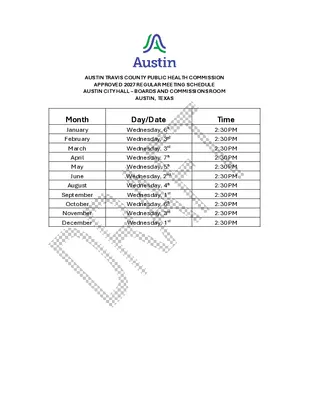
AUSTIN TRAVIS COUNTY PUBLIC HEALTH COMMISSION APPROVED 2027 REGULAR MEETING SCHEDULE AUSTIN CITY HALL – BOARDS AND COMMISSIONS ROOM AUSTIN, TEXAS Month January February March April May June August September October November December Day/Date Wednesday, 6th Wednesday, 3rd Wednesday, 3rd Wednesday, 7th Wednesday, 5th Wednesday, 2nd Wednesday, 4th Wednesday, 1st Wednesday, 6th Wednesday, 3rd Wednesday, 1st Time 2:30 PM 2:30 PM 2:30 PM 2:30 PM 2:30 PM 2:30 PM 2:30 PM 2:30 PM 2:30 PM 2:30 PM 2:30 PM
REGULAR MEETING OF THE EMMA S. BARRIENTOS MEXICAN AMERICAN CULTURAL CENTER ADVISORY BOARD WEDNESDAY, SEPTEMBER 2, 2026, AT 6:00 P.M. EMMA S. BARRIENTOS MEXICAN AMERICAN CULTURAL CENTER 600 RIVER STREET AUSTIN, TEXAS 78701 Some members of the Emma S. Barrientos Mexican American Cultural Center may be participating by videoconference. Public comment will be allowed in-person or remotely via telephone. Speakers may only register to speak on an item once either in-person or remotely and will be allowed up to three minutes to provide their comments. Registration no later than noon the day before the meeting is required for remote participation by telephone. To register to speak remotely, contact Michelle Rojas, 512-974-3771, Michelle.Rojas@austintexas.gov. CURRENT BOARD MEMBERS: Angelica Navarro (D-8), Chair Hilario “Larry” Amaro (D-10), Member Lynda Quintana (D-6), Member Noemi Castro (D-2), Member Raul “Roy” Reyna (D-1), Member Alexander “Al” Duarte (D-7), Member Selma Sanchez (D-9), Member John Estrada (D-3), Member Vacant (D-4), Member Cynthia “Cy” Herrera (D-5), Member Lillian “Lily” Zamarripa-Saenz (Mayor), Vice Chair AGENDA CALL TO ORDER PUBLIC COMMUNICATION: GENERAL The first 10 speakers signed up prior to the meeting being called to order will each be allowed a three-minute allotment to address their concerns regarding items not posted on the agenda. APPROVAL OF MINUTES 1. Approve the minutes of the Emma S. Barrientos Mexican American Cultural Center (ESB- MACC) regular meeting of July 8, 2026. STAFF BRIEFINGS 2. Staff briefing on July, August, and September programs, marketing and outreach efforts, signature event planning, and staffing updates. (Sponsors: Navarro, Zamarripa-Saenz) Presenter(s): Olivia Tamzarian, ESB-MACC Culture and Arts Education Marketing & Outreach Representative, Austin Arts Culture, Music, and Entertainment & Michelle Rojas, ESB-MACC Culture and Arts Education Manager, Austin Arts Culture, Music, and Entertainment DISCUSSION ITEMS 3. 4. Presentation on the Process for Renaming City of Austin Facility Spaces. (Sponsors: Amaro, Navarro) Presenter(s): Michelle Rojas, ESB-MACC Culture and Arts Education Manager, Austin Arts Culture, Music, and Entertainment Presentation on Creative Reset Phase II. (Sponsors: Navarro, Zamarripa-Saenz) Presenter(s): Michelle Rojas, ESB-MACC Culture and Arts Education Manager, Austin Arts Culture, Music, and Entertainment WORKING GROUP UPDATES 5. Update from the Strategic Planning Working Group (Sponsors: Herrera, Zamarripa-Saenz) FUTURE AGENDA ITEMS ADJOURNMENT The City of Austin is committed to compliance with the Americans with Disabilities Act. Reasonable modifications and equal access to communications will be provided upon request. For assistance, please contact the Liaison or TTY users’ route through 711. A person may …
Naming and Renaming of Park Facilities ACME | September 2, 2026 Naming and Renaming of Park Facilities Ordinance No. 20160324-021 • City of Austin • Effective April 4, 2016 • Overview of policies, eligibility, and approval process • https://services.austintexas.gov/edims/d ocument.cfm?id=421661 Purpose of the Ordinance • Establish a standardized process for naming park facilities. • Encourage transparency and community participation. • Define eligibility criteria. • Differentiate between park facilities and park features. • Clarify approval authority. Key Definitions Park Facility Includes: • Parks • Significant buildings • Recreation centers • Cultural centers • Senior centers • Sports complexes • Pools • Trails Park Feature Examples include: • Playgrounds • Gardens • Pavilions • Memorials • Other major recreational improvements 4 Park Naming Policy A park feature may recognize: Individuals Groups Cultural significance Valuable community contributions Recognition may include: Plaques Feature naming - without renaming the overall park facility. 5 Who May Be Honored? A park facility may be named for: Individuals with valuable service to the City and park system Individuals or entities donating: • • • Land At least 50% of development costs Twenty-year maintenance endowment Individuals or entities with culturally significant contributions 6 Application Requirements Applicants must provide: • Application fee • Public support documentation • Required nomination information • Sign fabrication fee (after approval) Federal Tax Consideration The City may reject a proposed name if necessary to protect the federal tax- exempt status of financing used for the facility. 7 Naming a Park Feature Nomination includes: • Biography (if honoring an individual) • Justification • Cultural or historic significance (when applicable) Process: Nomination → Director Review → Administrative Approval No City Council action required. 8 Naming or Renaming a Park Facility Nomination must include: • Biography or organizational background • Community contributions • Connection to the facility • Cultural significance (if applicable) 9 Public Engagement Process The Public Information Officer: Announces the naming opportunity Notifies affected communities Shares nomination deadlines Promotes public participation Nomination period: 90 days 10 Approval Process 11 Roles and Responsibilities ACME Director Accepts nominations Reviews applications Determines completeness City Manager Transmits recommendation Places item on Council agenda City Council Parks & Recreation Board / MACC Board Final approval authority Conducts public hearing Makes recommendation May establish alternative procedures 12 Key Takeaways • Clear and consistent …