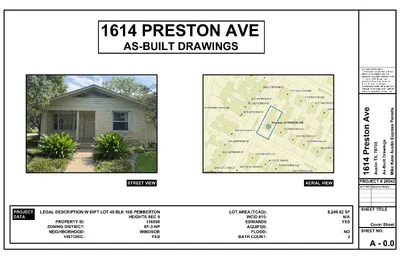


HISTORIC LANDMARK COMMISSION Applications for Permits in National Register Historic Districts September 2, 2026 HR-2026-101908 Old West Austin Historic District 1614 Preston Avenue 12 – 1 Proposal Construct a two-story addition at a contributing property. Project Specifications 1) Remove or cover existing stone exterior cladding, demolish front porch, and remove existing windows. 2) Construct a second floor addition above the existing house, doubling the footprint. Architecture This house is a single-story, stone clad residence with an inset porch and modest decoration at the corner of Preston Avenue and Jefferson Street. The front elevation is dominated by a large picture window at the rear of the porch and a broad low-pitch gable roof above. The house is set slightly above grade on an elevated foundation, with the stone cladding extending to the ground. At the side street, a two car garage is present behind the house and attached to the main house by a non-original conditioned space. Research For at least the first two decades after its construction, this property was owned by pastors from the University Christian Church in Austin. There is no record that this was ever designated as an official residence, and deed details show that each of the pastors owned the property outright. It is likely that the first owners, Lawrence & Letha Bash, sold the property upon the installment of Dr. William Gibble to the same position, at which point the former owners moved. Design Standards The City of Austin’s Historic Design Standards (March 2021) are based on the Secretary of the Interior’s Standards for Rehabilitation and are used to evaluate projects in National Register districts. The following standards apply to the proposed project: Residential additions 1. Location The second story addition extends roughly the entire floorplate of the ground floor, approximately doubling the square footage of the property. A small setback from the front of the house is proposed at the first floor of roughly the same depth as the porch. There is no setback proposed at the street-facing side of the property. 2. Scale, massing, and height By doubling the size of the house, the addition does not propose a similar scale to the existing. There are examples of other properties in the district having large additions constructed above or to a side of the main building, but this proposal is very apparent without setbacks or being pushed back from the front as much …
HISTORIC LANDMARK COMMISSION Applications for Permits in National Register Historic Districts September 2, 2026 PR-2026-007559; HR-2026-096250 Travis Heights-Fairview Park Historic District 1908 Kenwood Avenue 13 – 1 Proposal Reconstruct a carport and storage building, as well as replace non-historic material. Project Specifications 1) Demolish and reconstruct a rear carport with a storage building at one side. Both carport and storage will share a roof with the main house. 2) Replace vinyl siding with fiber cement siding. Architecture This 1934 house is described in the Travis Heights-Fairview Park National Register as being asymmetrical in plan and having no overarching stylistic influences. The façade is clad on all sides in buff and tan brick, with wood fascia and gable ends. Due to local elevation, the house reads as one-story from Mariposa Street and two-stories from Kenwood Avenue. On the latter façade, a second-floor porch is present that spans two thirds of the façade, with a projecting ground-floor gable at the right. A front entry is located on the Mariposa Street elevation, which is fronted by a winding walkway from the street. As a whole, the house retains good integrity and not much alteration is apparent. Research After being constructed in 1934, the house at 1908 Kenwood Avenue was owned by Earl and Caroline Howell. They raised their daughter Carolyn in the house, where she graduated from the University of Texas. By the 1960s, they had moved out and Mr. and Mrs. J.K. Green owned the house, where they welcomed a daughter of their own. There is little known information about what line of work these owners did during these years. Design Standards The City of Austin’s Historic Design Standards (March 2021) are based on the Secretary of the Interior’s Standards for Rehabilitation and are used to evaluate projects in National Register districts. The following standards apply to the proposed project: Repair and alterations 1. General standards Most repair and alteration work will be located at the rear of the main house, at the location of an existing carport. Some roof shingle replacement is also included in the scope. The reconstruction will be in the same location and of a comparable size, though there will be some visual changes when viewed form the side street. 3. Roofs Shingle replacement is proposed at the main structure. At the carport, a new flat roof structure is proposed, which will not exceed the height of the …

RECARPORTATION 1908 KENWOOD AVENUE, AUSTIN, TEXAS 78604 ARCHITECTURAL AND CONSULTANT ARCHITECTURAL PLANS DOCUMENT INDEX 34 RT 2024 GENERAL G1.1 PROJECT INFORMATION AND SURVEY SITE & LANDSCAPE L1.1 SETBACK PLANE COMPLIANCE PLAN L2.1 PROPOSED SITE PLOT PLAN L2.2 TREE PROTECTION PLAN ARCHITECTURAL A0.1 WINDOW & DOOR SCHEDULES A1.1 AS BUILT & DEMOLITION A1.2 FLOOR PLAN & A1.3 ROOF PLAN A1.4 VISITABILITY PLAN A2.1hEXISTING EXT. ELEVATIONS A2.1 EXTERIOR ELEVATIONS A2.2hEXISTING EXT. ELEVATIONS A2.2 EXTERIOR ELEVATIONS MEP1.1 ELECTRICAL LAYOUT STRUCTURAL& ENGINERING A6.1 FRAMING PLANS A6.2 BRACING PLANS S0.0 GENERAL NOTES S1.0 FOUNDATION PLAN S2.0 FOUNDATION DETAILS S2.1 FOUNDATION DETAILS 7.23.2026 VERDANT SPACES, LLC 105 La Vista Street Austin, Texas 78704 Ph: 512.698.6948 34 RT 2024 NOTE ALL CONSTRUCTION SHALL COMPLY WITH 2024 IRC AND CITY OF AUSTIN AMENDMENTS THERETO. LOT INFORMATION PROJECT ADDRESS: 1908 Kenwoood Avenue Austin, Texas 78704 LEGAL DISCRIPTION: LOT 1&2 BLK 34 Travis Heights Volume 3, Page 15, Travis Couty SF-3 - NP ZONING: 1 SETBACK PLANE COMPLIANCE PLAN 1" = 15' @ 22x34 PAGE SIZE 1" = 13' @ 11x17 PAGE SIZE I N O T A T R O P R A C E R - - e u n e v A d o o w n e K 8 0 9 1 4 0 7 8 7 s a x e T , n i t s u A POLAR NORTH REVISIONS REV: 12 / 10 / 2025 REV: 07 / 23 / 2026 EXIST SITE & PROTECTION 1 . 1 L o.e. 5' Chain-link construction fence o.e. o.e. 594' o.e. PORTION 2 S 66° 10' 5" W 139.87' (140') PORTION 1 590' 39-'9" from P.L. to Build line per plat G 592.75' 591.25' 5' SIDE YARD SETBACK @50.71'<N80d04'30"E SYM. SITE LEGEND IRON ROD FOUND SPINDLE FOUND SILT FENCE 5' CHAIN LINK CONSTRUCTION FENCE PROPERTY LINE SETBACK LINE EASEMENT LINE / PUE ELEVATION CONTOUR LINE OE/UE OVERHEAD ELECTRIC POWER POLE ELECTRICAL METER AND BASE G W W GAS METER WATER METER POTABLE WATER LINE (APPROXIMATED) GP GRINDER PUMP LOCATION SS SANITARY SEWER / WASTE WATER LINE POLAR NORTH SPOT ELEVATION POINT BENCHMARK ELEVATION 3" ELEVATION CHANGE W/ DIMENSION EXISTING TREE (SEE 'TREE LIST') SITE LAYOUT LEGEND KEY DISCRIPTION DIRECTION OF WATER FLOW 7'-6" Sky to ground radius from nearest conductor based on 8' conductor width provided by AE. Re. A2.1 and A2.2 for elevation clearances. Existing overhead power and 8' wide arm at 36' above adjacent …
HISTORIC LANDMARK COMMISSION Applications for Demolition and Relocation Permits September 2, 2026 PR-2026-040403 1808 East Cesar Chavez Street 14 – 1 Proposal Demolish a ca. 1930 structure. Architecture The existing structure is a two story commercial structure with two storefront entries side-by-side on the main elevation. There is a small, metal clad awning above the ground floor entryways. Above, two sets of paired, wood- frame windows are present at the second floor, with a moderately pitched hipped roof with exposed rafter tails above. The roof material is metal standing seam, and all exterior walls are clad in thin teardrop siding. While several of the windows are currently boarded over or otherwise inaccessible, images from the past decade would indicate that the existing material is largely intact, if in need of repair. Research This property has a long history of commercial tenants who served the East Austin community. For several decades after construction, it was home to a beauty parlor, a barber shop, and a shoe repair shop. By the 1950s, one or more of these tenants had vacated the building, but there was always at least one occupied storefront at the property. Newspaper records feature advertisements for Smith’s Barber Shop, Guarantee Wave Shop, and Carlson’s Shoe Repair Shop. The latter of these was owned by Reverend E. A. Carlson, formerly a Swedish Baptist minister, for 31 years until his death in 1964. Department Comments Two permits were issued for the property in 1999, though there are no digitized records of the application material. However, summary descriptions are available in city records. One permit described work to remodel the building’s interior & exterior to create a duplex. The second permit from the same year is summarized as, “Add 1st floor stair tower, porch, and 2nd floor extension.” There are no records of this property being surveyed in the 1980 East Austin historic resource survey or the 1984 citywide comprehensive resource survey. At time of writing, no photos of the property can be found prior to the 1999 permits. This application will time out on October 13, 2026. Property Evaluation The 2016 East Austin historic resource survey lists the property as eligible as a City of Austin landmark, as well as contributing to a potential local or National Register historic district. Designation Criteria—Historic Landmark 1) The building is more than 50 years old. 2) The building appears to retain moderate integrity. 3) …
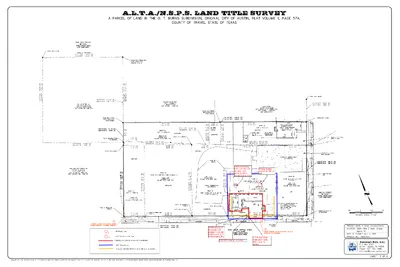
A.L.T.A./N.S.P.S. LAND TITLE SURVEY 2 1 1 2 29" Pecan Tree 20.5" American Elm Tree Buildings & Covered Area to be Demolished LOC: Demolition Erosion Controls: Silt fence or mulch sock, as needed Boundary Boys, LLC
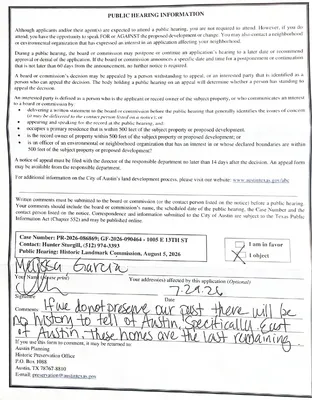
HISTORIC LANDMARK COMMISSION Applications for Demolition and Relocation Permits September 2, 2026 PR-2026-086869; GF-2026-090464 1005 E. 13th Street 15 – 1 Proposal Demolish a ca. 1910 house. Architecture This wide, single-story house was built with National Folk elements and features an inset porch at the northeast corner. The porch is supported by a single metal support structure in the front corner which is attached to a short metal rail. The front door is set at the rear of the porch, next to a single-hung window. A tripartite window assembly is present at the other half of the front façade, surrounded by ample wood trim painted blue. Narrow wood siding clads the entire house and, while sagging in some areas, is overall in repairable condition. Due to the width of the house, the moderately pitched hipped roof form visually dominates over the property. It is clad in composition shingle and features a rectangular dormer at the front, which itself is topped with a hipped roof assembly. The foundation is pier and beam. Research The longtime owner of this property upon construction was Henry Williams, who worked various roles as a fireman, porter, farmer, and oil mill worker. By 1918, he lived with his wife Eliza Williams, and the two raised a family at the house. In 1926, Henry Williams was shot in rural Travis County and recovered, and in 1930, he was again injured as a result of a wind storm while working at an oil mill. After his death around 1944, Eliza Williams remained at the address until at least 1949, after which the property was purchased by Abe & Bobbie Smith, who had at least one child while living at the property. Department Comments This application will time out on October 19, 2026. Property Evaluation The 2016 East Austin historic resource survey lists the property as eligible as a local landmark as well as contributing to a potential local or National Register district. Designation Criteria—Historic Landmark 1) The building is more than 50 years old. 2) The building appears to retain moderate-to-high integrity. 3) Properties must meet two criteria for landmark designation (LDC §25-2-352). Staff has evaluated the property and determined that it does not meet two criteria for landmark designation: a. Architecture. The building is a good example of surviving National Folk architecture in this area of the city, and is notable for its large size and overall …
HISTORIC LANDMARK COMMISSION Demolition and Relocation Permits September 2, 2026 PR-2026-091653; GF-2026-100925 2204 Chestnut Avenue 16 – 1 Proposal Demolish a ca. 1949 house. Architecture One-story bungalow with inset porch, horizontal wood siding, and gabled roof. Research The house at 2204 Chestnut Avenue was built in 1949. For at least ten years, it was owned by Willie and Callie Phillips. Mr. Phillips worked as a porter, first for the railroad and then for the Pi Phi sorority. Department Comments The Historic Landmark Commission’s 75-day timeline for action begins on September 2, 2026 and ends on November 16, 2026. Property Evaluation The 2016 East Austin lists the property as contributing to potential local and National Register historic districts. Designation Criteria—Historic Landmark 1) The building is more than 50 years old. 2) The building appears to retain integrity, though windows have been replaced. 3) Properties must meet two criteria for landmark designation (LDC §25-2-352). Staff has evaluated the property and determined that it does not meet two criteria for landmark designation: a. Architecture. The building does not appear to convey architectural significance. b. Historical association. The property does not appear to have significant historical associations. c. Archaeology. The property was not evaluated for its potential to yield significant data concerning the human history or prehistory of the region. d. Community value. The property does not possess a unique location, physical characteristic, or significant feature that contributes to the character, image, or cultural identity of the city, the neighborhood, or a particular demographic group. e. Landscape feature. The property is not a significant natural or designed landscape with artistic, aesthetic, cultural, or historical value to the city. Staff Recommendation Encourage rehabilitation and adaptive reuse, relocation, or deconstruction and salvage over demolition, but approve the demolition permit application upon completion of a City of Austin Documentation Package. Location Map 16 – 2 Property Information Photos 16 – 3 16 – 4 Demolition permit application, 2026 Occupancy History City Directory Research, August 2026 1959 1955 1952 1949 Willie and Callie Phillips, owners – porter, Pi Phi Sorority Willie and Callie Phillips, owners – porter, MKT Railroad Willie and Callie Phillips, owners – porter Not listed Historical Information 16 – 5 The Austin Statesman (1921-1973); Austin, Tex.. 02 Mar 1956: 19 The Austin Statesman (1921-1973); Austin, Tex.. 29 May 1964: 8. Permits
HISTORIC LANDMARK COMMISSION Applications for Demolition and Relocation Permits September 2, 2026 PR-2026-091947; GF-2026-101729 2507 E. 2nd Street 17 – 1 Proposal Relocate a ca. 1929 house outside the city limits. Architecture One-story Craftsman bungalow with partial-width porch, double front-gabled roofline, and decorative vents and brackets at gable ends. Eaves have been boxed but rafter tails remain. Research The house at 2507 E. 2nd Street was built around 1929. Its first occupants were short-term renters, though by the 1930s longer-term renters Eunice and Arthur Cooper resided there. Gus and Annie Johnson purchased the property in the 1940s and rented it to several occupants, including bookstore owner and friend of O. Henry, Richard Corner. By the 1950s, Andrew C. Mendoza, Jr. and his wife, Tommie, had purchased the home. Andrew Mendoza worked as a clerk at the Capitol Casket Company. Department Comments The Historic Landmark Commission’s 75-day timeline for action begins on September 2, 2026, and ends November 16, 2026. Property Evaluation The 2016 East Austin survey recommends the property as eligible for potential local and National Register historic districts. Designation Criteria—Historic Landmark 1) The building is more than 50 years old. 2) The building appears to retain some integrity, but modifications to windows may preclude its eligibility. Alterations to porch posts appeared to have taken place during period of significance. Siding has been replaced. Windows and doors have been replaced, but original openings have not been modified. 3) Properties must meet two criteria for landmark designation (LDC §25-2-352). Staff have evaluated the property and determined that it does not meet two criteria for landmark designation: a. Architecture. The building does not appear to convey architectural significance. b. Historical association. The property does not appear to have significant historical associations. c. Archaeology. The property was not evaluated for its potential to yield significant data concerning the human history or prehistory of the region. d. Community value. The property was not evaluated for its ability to possess a unique location, physical characteristic, or significant feature that contributes to the character, image, or cultural identity of the city, the neighborhood, or a particular demographic group. e. Landscape feature. The property is not a significant natural or designed landscape with artistic, aesthetic, cultural, or historical value to the city. Staff Recommendation Encourage rehabilitation and adaptive reuse, but approve the relocation permit application upon completion of a City of Austin Documentation Package. Location Map 17 …
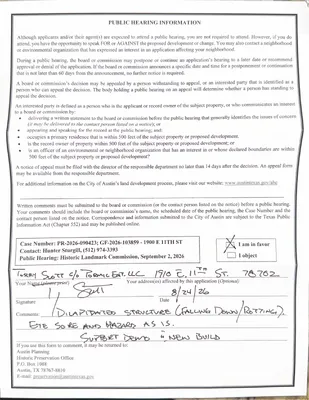
HISTORIC LANDMARK COMMISSION Applications for Demolition and Relocation Permits August 5, 2026 PR-2026-090423 1900 E. 11th Street 18 – 1 Proposal Demolish a ca. 1903-1916 house. No changes are proposed to the commercial structure at the rear of the lot, addressed as 1103 Chicon St. Architecture One-story bungalow with full-width porch, side-gabled roof with exposed rafter tails and decorative brackets at gable ends, horizontal wood siding, two brick chimneys, and 1:1 replacement windows. Research The house at 1900 E. 11th Street was built between around 1903 and 1916, with a smaller vernacular structure likely enlarged and adorned with Craftsman stylistic elements closer to 1916. The home’s early owners were mostly short- term owners who worked as laborers at nearby warehouses or household staff. After 1916, it was purchased by Alfred and Frances Merida. After working as a porter for several years, Alfred Merida opened the grocery store at 1103 Chicon in 1922. Joseph and Marcelina Johnson purchased the home and store between 1922 and 1926. One year after they began leasing equipment to sell kerosene from the Pierce Petroleum Company, the Johnsons’ store burned to the ground. Joe Johnson built a new corrugated metal store in its place in 1927. The Johnsons operated the grocery and variety store until at least 1961, when Mr. Johnson died. By 1973, the Johnsons’ daughter Lucille Haywood had moved into the house and converted the store to a sandwich shop. Mrs. Haywood operated the shop until the mid-1980s, when it was sold and converted into a barbecue restaurant. Department Comments An application for demolition was submitted in 2020 (PR-2020-143082) and referred for Commission review; however, the application expired before the Commission hearing could occur. The owner/applicant met with Historic Preservation Office staff to discuss the application process for historic landmark zoning for the rear store building, which appears to meet designation criteria. A demolition order for the residential property has been issued by the Building and Standards Commission. Per Code records, the building has been vacant and in disrepair since 1996, with intermittent repairs. Property Evaluation The 2016 East Austin survey lists the property as contributing to potential local and National Register historic districts. Designation Criteria—Historic Landmark 1) The building is more than 50 years old. 2) The building appears to retain partial integrity, though the porch railings and windows have been replaced with incompatible materials outside the period of significance. The building’s condition …
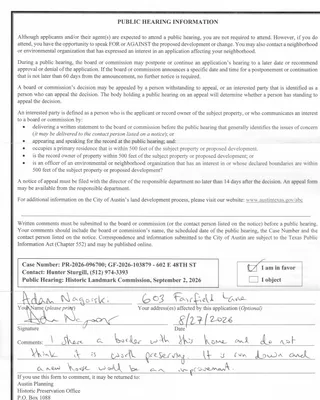
HISTORIC LANDMARK COMMISSION Applications for Demolition and Relocation Permits September 2, 2026 PR-2026-096700; GF-2026-103879 602 E. 48th Street 19 – 1 Proposal Demolish a ca. 1946 house Architecture One-story cross-gabled Minimal Traditional house with added carport, asbestos shingle siding, partial-width porch, and 6:6 screened wood windows. Research The house at 602 E. 48th Street was constructed in 1946. It was owned by Archie and Frankie Nosek, who stayed in the home until their respective deaths in 1964 and 1965. Archie Nosek worked as a manager for the American Standard Wholesale Plumbing Company. Department Comments The Historic Landmark Commission’s 75-day timeline for action begins on September 2, 2026, and ends November 16, 2026. Property Evaluation The 2020 North Central Austin survey lists the property as contributing to potential local and National Register historic districts. Designation Criteria—Historic Landmark 1) The building is more than 50 years old. 2) The building appears to retain integrity. 3) Properties must meet two criteria for landmark designation (LDC §25-2-352). Staff has evaluated the property and determined that it does not meet two criteria for landmark designation: a. Architecture. The building is a good example of the Minimal Traditional style. b. Historical association. The property does not appear to have significant historical associations. c. Archaeology. The property was not evaluated for its potential to yield significant data concerning the human history or prehistory of the region. d. Community value. The property does not possess a unique location, physical characteristic, or significant feature that contributes to the character, image, or cultural identity of the city, the neighborhood, or a particular demographic group. e. Landscape feature. The property is not a significant natural or designed landscape with artistic, aesthetic, cultural, or historical value to the city. Staff Recommendation Encourage rehabilitation and adaptive reuse, relocation, or deconstruction and salvage over demolition, but approve the demolition permit application upon completion of a City of Austin Documentation Package. Location Map 19 – 2 Property Information Photos 19 – 3 North University-Windsor-Hyde Park Historic Resources Survey, 2020 19 – 4 Occupancy History City Directory Research, August, 2026 Demolition permit application, 2026 1959 1952 1949 1947 Archie T. and Frankie Nosek, owners – manager, Amstan Supply Division Archie T. and Frankie Nosek, owners – manager, American Radiator and Standard Sanitary Archie T. and Frankie Nosek, owners – manager, American Radiator and Standard Sanitary Not listed Historical Information The Austin Statesman (1921-1973); Austin, Tex.. 24 …

HISTORIC LANDMARK COMMISSION Applications for Demolition and Relocation Permits September 2, 2026 PR-2026-095892; GF-2026-103846 3014 Windsor Road 20 – 1 Proposal Demolish a ca. 1939 house. Architecture One-story Tudor-styled Minimal Traditional house with stucco cladding, shallow eaves, arched entryway, a tapering exterior chimney, and cross-gabled roofline. Windows have been replaced. Research The house at 3014 Windsor Road was built around 1939. Its earliest residents were the Baggett family. Charles Baggett and his brother, Jim, operated the real estate firm of Baggett and Baggett in the 1920s and 1930s; his son later joined the firm, and its name was changed briefly to Baggett, Bagget, and Baggett and finally to Baggett and Son. Before the Baggett family moved to Windsor Road, both Charles and Jim Baggett had been named as suspects, along with 17 other businessmen, in the 1921 shooting death of taxicab driver Peeler Clayton. This notable case was one of the first to highlight the increasing violence of the Ku Klux Klan in Austin, as Clayton purportedly took a bullet meant for anti-KKK activist and former district attorney John Shelton. Those arrested had been seen in or near a notorious Klan meeting place at the time of the shooting. Though Charles Baggett was one of the first whose charges were dismissed, the remaining suspects—plus four additional federal and state law enforcement officers— appeared before a grand jury in 1922. The investigation soon focused on two confirmed Klansmen, but unfortunately the shooter was never identified and the suspects were released.1 2 Neither Baggetts’ affiliation with the KKK was ever substantiated or refuted in news coverage of the case, and the family continued operating a successful real estate business into the 1940s. After about eight years, the Baggetts sold the Windsor Road house to Max and Nolie Hoegerl. Max Hoegerl worked for the Austin Statesman as an advertising salesman. Nolie Hoegerl Parker was a beautician who operated the nearby Tarrytown Beauty Salon. Max Hoegerl died suddenly in 1963. Nolie Hoegerl Parker remarried and remained in the house until her own death in 1975. Department Comments The Historic Landmark Commission’s 75-day timeline for action begins on September 2, 2026, and ends November 16, 2026. Property Evaluation Designation Criteria—Historic Landmark 1) The building is more than 50 years old. 2) The building appears to retain integrity. Windows have been replaced but original openings remain. 3) Properties must meet two criteria for landmark designation (LDC …
REGULAR MEETING OF THE HISTORIC LANDMARK COMMISSION WEDNESDAY, AUGUST 5, 2026, AT 6:00 P.M. CITY HALL, COUNCIL CHAMBERS 301 W. 2ND STREET AUSTIN, TEXAS Some members of the Historic Landmark Commission may be participating by videoconference. The meeting may be viewed online at: http://www.austintexas.gov/page/watch-atxn-live CURRENT COMMISSIONERS X BEN HEIMSATH, CHAIR (D-8) X CARL LAROSCHE (D-6) X ROXANNE EVANS, VICE CHAIR (D-2) X AUGUST HARRIS III (D-10) X JEFFREY ACTON (MAYOR) X TONYA PLEASANT-WRIGHT (D-1) X JAIME ALVAREZ (D-7) AB JUDAH RICE (D-4) X HARMONY GROGAN (D-5) X BAT TANIGUCHI (D-9) X KEVIN KOCH (D-3) Commissioners in Attendance Remotely: Vice Chair Evans, Commissioner Larosche, Commissioner Grogan DRAFT MINUTES CALL TO ORDER: 6:00PM PUBLIC COMMUNICATION: GENERAL The first 10 speakers signed up prior to the meeting being called to order will each be allowed a three- minute allotment to address their concerns regarding items not posted on the agenda. Anne-Marie McKaskle-Davis gave updates on the Heritage Preservation Grant. APPROVAL OF MINUTES 1. Approve the minutes of the Historic Landmark Commission regular meeting on July 1, 2026. MOTION: Approve the minutes per passage of the consent agenda, on a motion by Commissioner Larosche. Commissioner Acton seconded the motion. Vote 10-0. The motion passed. BRIEFINGS 2. 3. Staff briefing on 1906-1908 Nueces St. regarding administrative approval of religious-owned property per State law by Austin Lukes, Planner Senior, Historic Preservation Office, Austin Planning. Briefing regarding updates on the project at 1010 E. Cesar Chavez St. by Ingrid Gonzalez Featherston, AIA, Senior Architect, MF Architecture. PUBLIC HEARINGS/DISCUSSION ITEMS Historic Landmark and Local Historic District Applications 4. 5. PR-2026-008188 – 1005 E. 8th St. – POSTPONED BY APPLICANT Robertson/Stuart & Mair Local Historic District Council District 1 Proposal: Demolish a contributing building. (Postponed by applicant on July 1, 2026) Applicant: Robbie MacGregor City Staff: Austin Lukes, Historic Preservation Office, 512-978-0766 Staff Recommendation: Consider backup provided to determine need for total demolition versus opportunity for partial demolition or repair to the damaged existing structure. If more information or discussion is needed, postpone the public hearing to the September 2, 2026 Historic Landmark Commission meeting. MOTION: Postpone the public hearing to September 2, 2026 meeting per passage of the consent postponement agenda, on a motion by Commissioner Koch. Commissioner Larosche seconded the motion. Vote 10-0. The motion passed. HR-2026-090085 – 4412 Avenue B Hyde Park Local Historic District Council District 9 Proposal: Rehabilitate the exterior of a contributing building …
HISTORIC LANDMARK COMMISSION Applications for Certificate of Appropriateness September 2, 2026 PR-2026-008188; GF-2026-025308 Robertson/Stuart & Mair Historic District 1005 East 8th Street 3 – 1 Proposal Demolish a ca. 1906 house listed as contributing to a local historic district. Architecture The house at 1005 East 8th St. was likely originally constructed as a single story building, with the sloping elevation of the site creating a crawlspace or cellar to the east side of the building footprint. Since its construction, this has been enclosed, and a rear addition built, increasing the enclosed area of the building. However, the U-shaped form and Folk Victorian elements still read legibly, and decorative elements, especially at the front porch and gable ends, remain present. The integrity of the architecture is strong and the property remains contributing to the Robertson/Stuart & Mair historic district. Research For the first 30 years after construction, the property went through a series of renters, made up of families and individuals employed by various local industries and services, including carpenters, foundry workers, and porters. The first long term owners were Ernest & Marie Kemp, who operated a local grocery. Marie Kemp continued to live at the address after her husband’s death, but by the 1950s, the property was vacant before becoming subdivided for oil industry and other professional offices. A third housing unit was added in 1970, indicating that this property continued use as residential rentals. An overnight fire occurred at the property on November 12th, 20251. Department Comments This application will time out on October 13, 2026. Property Evaluation The property contributes to the Robertson/Stuart & Mair Historic District. Staff Recommendation Grant the applicant requested postponement to the October 7, 2026 Historic Landmark Commission meeting. 1 “Firefighter injured in East Austin house fire, investigation underway”. https://cbsaustin.com/news/local/afd-responding-to- house-fire-in-east-austin-no-injuries-reported Location Map 3 – 2 Property Information Photos 3 – 3 Texas Historical Commission, photograph, May 29, 1975. The Portal to Texas History. Google Streetview, 2024 3 – 4 Site visit, showing fire damage (see backup for additional photos), May 2026 Occupancy History City Directory Research, March 2026 1959 1957 1955 1952 1949 1947 1944 1941 1939 1935 1932 1929 1927 1924 Offices: Norman Texas Company; Roche Oil Company; Pierre Aubuchon, engineer; Hamco Oil & Drilling Vacant Vacant Joseph & Maria Tamayo, owners; painter at South Lamar Automotive Service Same as above Alfredo, Joseph, and Maria Tamayo, renters; mechanic at Bergstrom Airfield Anna …

Steering Committee Members: Stephen L. Amos, Chair Mark Ashby, Jeff Callahan, Scott Campbell, Marc Carlson, Hunter Coleman, Evelyn Fujimoto, Adrienne Goldsberry, Nick Mehl, William Osborn, Charlie Rice, Paul Shattuck, Shawn Shillington September 1, 2026 Historic Landmark Commission 6310 Wilhelmina Delco Drive Austin, TX 78752 Re: Item 8 - HR-2026-070009 - 611 West Lynn St. Dear Chair Heimsath and HLC Commissioners, The OWANA Zoning Committee has reviewed the proposed eight-unit development at 611 West Lynn and would like to raise several concerns regarding the project’s front setback, scale, massing, height, and compatibility with the immediate block. Our primary concern is that the proposed building, in its current configuration, appears substantially out of scale with the surrounding homes. The immediate context of the site is particularly important when evaluating compatibility, and we believe the proposal should be considered primarily in relation to the contributing structures that directly surround it. Scale and Massing The proposed eight-unit development, at its current height and bulk, appears significantly larger than the established scale of this portion of West Lynn. The applicant’s renderings (attached) illustrate the proposed building rising substantially above the one-story cottages immediately adjacent at 613, 615, and 617 West Lynn, as well as the neighboring condominium buildings. This contrast is particularly striking from the street and raises concerns about whether the proposed massing appropriately responds to the established character and scale of this portion of the block (OWANA Design guidelines 1.0 Promote prevailing neighborhood character, 1.2 Maintain consistent mass and scale, and 2.2 Minimize driveway width and curb cuts) Front Setback We respectfully request that the applicant provide a dimensioned site plan clearly identifying the proposed front setback and demonstrating how it compares with the established setbacks of the contributing homes on the block. The front setback is an important component of the established development pattern and should be evaluated in the context of the surrounding properties. The project materials should clearly demonstrate how the proposed setback relates to the prevailing setback pattern of this portion of West Lynn. (OWANA Design guideline 3.1 Maintain street setback lines) Height and Immediate Context We believe height and massing should be evaluated primarily in relation to the adjacent contributing structures and the immediate block, rather than against isolated examples from elsewhere in the district. The larger structures cited by the applicant are scattered throughout, and in some cases outside, the district. Many are also single-family homes situated …
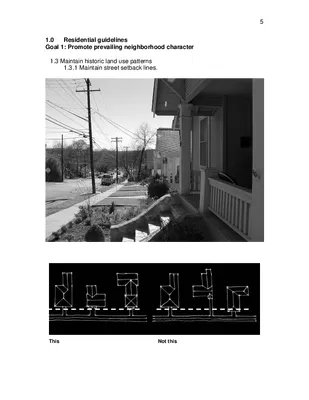
1.0 Residential guidelines Goal 1: Promote prevailing neighborhood character 1.3 Maintain historic land use patterns 1.3 .1 Maintain street setback lines. 5 This Not this
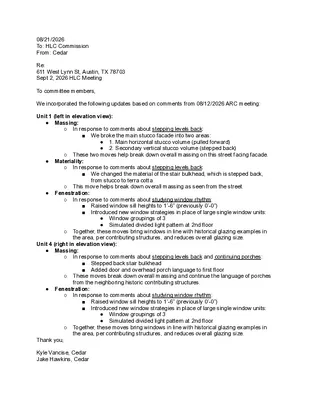
HISTORIC LANDMARK COMMISSION Applications for Permits in National Register Historic Districts September 2, 2026 HR-2026-101908 Old West Austin Historic District 1614 Preston Avenue 12 – 1 Proposal Construct a two-story addition at a contributing property. Project Specifications 1) Remove or cover existing stone exterior cladding and remove existing windows. 2) Construct a second floor addition above the existing house, doubling the footprint. Architecture This house is a single-story, stone clad residence with an inset porch and modest decoration at the corner of Preston Avenue and Jefferson Street. The front elevation is dominated by a large picture window at the rear of the porch and a broad low-pitch gable roof above. The house is set slightly above grade on an elevated foundation, with the stone cladding extending to the ground. At the side street, a two car garage is present behind the house and attached to the main house by a non-original conditioned space. Research For at least the first two decades after its construction, this property was owned by pastors from the University Christian Church in Austin. There is no record that this was ever designated as an official residence, and deed details show that each of the pastors owned the property outright. It is likely that the first owners, Lawrence & Letha Bash, sold the property upon the installment of Dr. William Gibble to the same position, at which point the former owners moved. Design Standards The City of Austin’s Historic Design Standards (March 2021) are based on the Secretary of the Interior’s Standards for Rehabilitation and are used to evaluate projects in National Register districts. The following standards apply to the proposed project: Residential additions 1. Location The second story addition extends roughly the entire floorplate of the ground floor, approximately doubling the square footage of the property. A small setback from the front of the house is proposed at the first floor of roughly the same depth as the porch. There is no setback proposed at the street-facing side of the property. 2. Scale, massing, and height By doubling the size of the house, the addition does not propose a similar scale to the existing. There are examples of other properties in the district having large additions constructed above or to a side of the main building, but this proposal is very apparent without setbacks or being pushed back from the front as much as possible. 3. …

August 20, 2026 Historic Preservation Office City of Austin, Texas preservation@austintexas.gov RE: Condition of Existing Masonry at 1614 Preston Avenue, Austin, Texas 78703 Mr. Lukes and Members of the Historic Landmark Commission, I am the general contractor for the proposed renovation and second-story addition at 1614 Preston Avenue. I have over 20 years of experience in residential construction in Austin and Central Texas, including work on homes of this era, and with the kinds of masonry challenges present at 1614 Preston. This letter details my professional assessment of the condition of the existing masonry, the origin of the present issues, and my recommendation. On the structural questions, I have relied on the concurring opinion of the project’s structural engineer, Bradley Shaw. The existing stone masonry at 1614 Preston does not extend around the building. The stone is present on the front and along a little more than half of the left side. The remaining walls are not stone- clad. In my assessment, significant portions of this masonry do not appear original to the 1939 structure. This is most apparent at the chimney and along the Jefferson Street side. This conclusion is based on the variation in the stone’s cut and color, differences in coursing and mortar, and the way the stonework terminates, particularly at and around the chimney and the earlier addition area. These observations are consistent with the property’s other evidence of prior additions, as well as the structural engineer’s findings. The existing masonry is deteriorating and cannot be reliably stabilized. I observe cracking and displacement within the stonework, failed mortar joints, and clear evidence of chronic moisture intrusion. This evidence includes staining, dampness, and heavy biofilm growth in areas that appear to remain persistently wet rather than occasionally damp. The concentration of biofilm at grade and across the lower half of the wall is consistent with water collecting and remaining at the base of the wall, from ground contact, splashback, and the lack of appropriate base flashing. At the chimney, the biofilm marks sustained water entry at a junction that is a common source of leaks. Mortar loss and stone decay are most advanced in these same areas. In my experience, the cause is most often the manner of construction. A masonry wall always takes on some water. Without sufficient weather-resistive barriers, drainage cavities, flashing, or weep systems, water is held against the back of the stone and …
1614 PRESTON AVENUE HR - 2026 – 101908 Meeting of the Historic Landmark Commission September 2, 2026 Presentation Materials & Reference Appendix EXHIBIT NAVIGATION A CLARIFICATIONS B MASONRY C LOT RESTRICTIONS D JEFFERSON ST. E FRONT ALTERNATES F SUMMARY 1614 PRESTON AVENUE HR - 2026 – 101908 EX HI B I T A : MI N OR C L A R I FI C A TI ON S TO S TA FF R EPOR T AS DESCRIBED IN STAFF REPORT “demolish front porch” (V1 – Corrected V2) “doubling the footprint” “doubling the size of the house” “remove existing windows” AS DRAWN FILE REFERENCE Front porch retained in full Current Foundation → Proposed = 2,261 → 2,295 sq. ft. = +34 sq. ft. (+1.5%) Current (existing living + convertible) → Proposed = 2,184 → 3,300 sq. ft. = +1,116 sq. ft. (+51%) *Excluding convertible: = 1,789 → 3,300 sq. ft. (+84%) Existing windows are not original (high confidence) to 1939 structure. Submitted Backup, Plans, “First Floor” (p.12) Submitted Backup, Plans, “Existing / Demo Plan” (p.11) Submitted Backup, Plans, “Existing / Demo Plan” (p.11) See Appendix A.1 and A.2 (following Exhibits) for window inspection details and photographs. “new windows, both in fixture and location, are proposed” Existing window locations are reused with framing adjustments in 75% of street-frontage locations. See Appendix A.3 (following Exhibits) for comparison of first-story window locations with street frontage. With exception of a 34 sq. ft. foundation area and garage conversion, all exterior walls are to be retained in place, and on existing foundations. EXHIBIT NAVIGATION A CLARIFICATIONS B MASONRY C LOT RESTRICTIONS D JEFFERSON ST. E FRONT ALTERNATES F SUMMARY EX HI B I T B : MA S O N R Y C ON DI TI ON 1614 PRESTON AVENUE HR - 2026 – 101908 SLAB AREA 1 SLAB AREA 2 ORIGINAL PIER-AND- BEAM J E F F E R S O N S T R E E T LOCATION OF EXISTING MASONRY PRESTON AVENUE “Correcting this issue requires remediation of the wall assembly, which requires removal of the stone.” Excerpt from Contractor Letter ACTIVE STRUCTURAL MOVEMENT Stepped crack tracking the mortar joints across three courses. Front elevation. PRIOR REPAIR HAS ALREADY FAILED Cementitious patch at the chimney junction, cracked through since repair. Jefferson side. MORTAR LOSS – OPEN BED JOINT Mortar entirely absent across the joint, leaving a direct water path. Jefferson side. CHRONIC MOISTURE …

Old Bakery & Emporium Restoration & ADA Feasibility Study Stakeholder Meeting / Open House July 14, 2026 Restoration & ADA Feasibility StudyHistoric Landmark Commission ReviewSept. 2.2026 Old Bakery & Emporium • • The Old Bakery & Emporium Building is a nationally, state, and locally designated building. Built by Swedish immigrant Charles Lundberg in 1876 as the "New Orleans Bakery." The City of Austin acquired the building and property in 1980. The Old Bakery & Emporium functions as: • Art gallery • Artisan emporium • Visitor and information center • Historical center that celebrates not only Austin’s immigrant history, but also the diversity and artistic vision of artisans over the age of fifty. Historic Preservation / Cultural Resources The Old Bakery & Emporium Building has several historic designations which will require compliance with applicable regulatory agencies prior to any modifications to the building. • Local: City of • State: State Antiquities • Federal: listed in National Austin Landmark. • Requires coordination with the Landmarks Commission and Office of Historic Preservation. Landmark (SAL), Recorded Texas Historic Landmark (RTHL). • Requires coordination/approval from the Texas Historical Commission. Register of Historic Places as a contributing building to the Congress Avenue Historic District. • Requires coordination with the Texas Historical Commission/ State Historic Perseveration Office. Renovation & Expansion Goals • Improve separation of public and private spaces • Convert current gallery spaces into multi-purpose workshop spaces • Create new art gallery spaces • Create additional offices and storage areas • Improve kitchen space • Revise outdoor event / food truck vendor space • Mechanical, electrical, and plumbing systems upgrades throughout • Historic Preservation / Cultural Resources compliance • Provide sustainability guidance Historic oven at Old Bakery & Emporium. View from Old Bakery & Emporium front entrance. 5 4 3 s e h c n I 1 2 / 1 4 / 1 0 t v r . 5 2 R _ m u i r o p m E & y r e k a B d O \ T V R _ 1 0 \ M B D A C _ 4 0 \ y t i l i - I l i b s a e F m u i r o p m E d n a y r e k a B d O A o C _ 0 9 6 1 3 1 0 0 1 \ : J l …
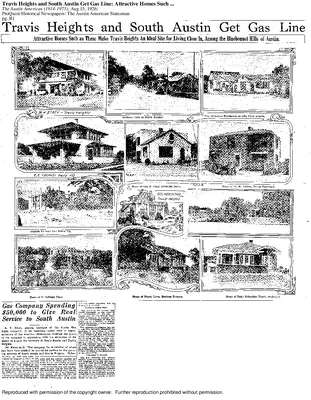
Travis Heights and South Austin Get Gas Line: Attractive Homes Such ... The Austin American (1914-1973); Aug 15, 1926; ProQuest Historical Newspapers: The Austin American Statesman pg. B1 Reproduced with permission of the copyright owner. Further reproduction prohibited without permission.

Kerbey Lane Residence 3209 Kerbey Lane Austin, Texas 78703 USA symbol legend vicinity map sheet index abbreviations A0 cover sheets and COA cover sheet A000 A1 plans A100 A101 A102 A103 A104 A110 A111 A113 demolition site plan demolition 1st floor plan demolition 2nd floor plan demolition roof plan proposed site plan proposed 1st floor plan proposed 2nd floor plan proposed roof plan A2 elevations A201 A202 A203 elevations elevations elevations project team owner #Client Full Name Austin, TX architect + contractor Moontower Design Build 828 Airport Blvd. Austin TX 78702 contact: Amber Dudley amber@moontoweraustin.com 512.953.9261 structural engineer #### #### contact: #### #### #### geotechnical engineer #### #### contact: #### #### #### surveyor #### #### #### project description drawing name scale: 1/2" = 1'-0" 1 drawing id N 1 A200 1 A300 1 4 A400 2 3 #DrgID #LayID 2/A400 1 A500 date living room <ID> <ID> <ID> <ID> <ID> <ID> north arrow building elevation tag (arrow points in direction of view) building section tag (arrow points in direction of view) interior elevation tag (arrow points in direction of view) wall section tag (arrow points in direction of view) 0" spot elevation tag 10' elevation tag detail tag revision tag room tag surface tag N window tag door tag wall tag plumbing fixture tag appliance tag GSPublisherVersion 2210.4.48.11 Air Handler a/h Condenser a/c Above Finish Floor a.f.f. Beverage Refrigerator bev. Bottom Of b.o. Ceiling clg. Concrete Masonry Unit cmu Column col. Cooktop ctop Diameter dia. Dishwasher dw Dimension dim. Down DN Dryer dry. Equal eq. Finished Face or Finish Floor f.f. Finish Floor Elevations f.f.e. Freezer frez. Gas Line gas Gypsum Wall Board gwb Hose Bib h/b h2o Water Line hood Vent Hood Ice Maker ice max. Maximum mech. Mechanical mfr. micro. Microwave min. ptd. range Range rcp ref. fridge. Refrigerator furn. r.o. sf spec. struct. t.o. t&g typ. u.n.o. Unless Noted Otherwise v.i.f. Verify In Field wine Wine Refrigerator w/d w/h wash. Washing Machine Furnace Rough Opening Square Feet Specification Structural Engineer Top Of Tongue and Groove Typical Stacked washer and dryer Water Heater Reflected Ceiling Plan Reference Minimum Painted Manufacturer general notes •All conflicts to be brought to the attention of the Architect prior to performing work. • The dimensions are to face of framing and/or masonry, exterior face of fascia, and centerline of column and/or beam, unless noted otherwise. • The Builder to field verify all dimensions …
REGULAR MEETING OF THE COMMISSION FOR WOMEN WEDNESDAY, SEPTEMBER 2, 12:00 PM AUSTIN CITY HALL, BOARDS AND COMMISSIONS ROOM, #1101 301 WEST 2ND STREET AUSTIN, TEXAS 78701 Some members of the Commission for Women may be participating by videoconference. The meeting may be viewed online at: http://www.austintexas.gov/page/watch-atxn-live Public comment will be allowed in-person or remotely via telephone. Speakers may only register to speak on an item once either in-person or remotely and will be allowed up to three minutes to provide their comments. Registration no later than noon the day before the meeting is required for remote participation by telephone. To register to speak remotely, contact Chelsea Pfeifer at chelsea.pfeifer@austintexas.gov or 512-974-2498. CURRENT COMMISSIONERS: Alexandria Anderson, Chair Lauren Adams Vanessa Bissereth Angela Harris Alicia Ramirez Shaimaa Zayan CALL TO ORDER PUBLIC COMMUNICATION: GENERAL Jocelyn Tau, Vice Chair Tasha Billet Becky Bullard Diana Melendez Rabia Shaik The first ten speakers signed up prior to the meeting being called to order will each be allowed a three-minute allotment to address their concerns regarding items not posted on the agenda. APPROVAL OF MINUTES 1. Approve the minutes of the Commission for Women regular meeting on August 5, 2026. DISCUSSION ITEMS 2. Presentation on Collective Sex Crime Response Model. Presentation by Hanna Senko, Consultant, CSCRM Working Group, Silvana Giono, Supervisor of Victim Services, Austin Police, Catherine Hutchins, Sergeant, Austin Police, Marcy Alonzo, Austin/Travis County Sexual Assault Rapid Response Team Coordinator, Austin Police, and Allison Roper, Business Process Consultant, Austin Police. DISCUSSION AND ACTION ITEMS 3. 4. 5. Approve a recommendation to Council regarding funding for Communities In Schools. Approve a recommendation to Council regarding funding for SAFE Alliance. Approve a nomination of a primary member of the Commission For Women to the Joint Inclusion Committee. FUTURE AGENDA ITEMS ADJOURNMENT The City of Austin is committed to compliance with the Americans with Disabilities Act. Reasonable modifications and equal access to communications will be provided upon request. For assistance, please contact the Liaison or TTY users’ route through 711. A person may request language access accommodations no later than 48 hours before the scheduled meeting. Please call or email Chelsea Pfeifer at the Austin City Clerk’s Office, at 512-974-2498 or chelsea.pfeifer@austintexas.gov to request service or for additional information. For more information on the Commission for Women please contact Chelsea Pfeifer at 512-974- 2498 or chelsea.pfeifer@austintexas.gov.
Commission for Women Regular Meeting Minutes Wednesday, August 5, 2026 The Commission for Women convened in a regular meeting on Wednesday, August 5, 2026 at Austin City Hall, 301 W 2nd Street in Austin, Texas. Chair Anderson called the Commission for Women Meeting to order at 12:07 p.m. Commissioners in Attendance: Alexandria Anderson, Chair Commissioners in Attendance Remotely: Jocelyn Tau, Vice Chair Lauren Adams Alicia Ramirez Rabia Shaik Angela Harris Diana Melendez Shaimaa Zayan PUBLIC COMMUNICATION: GENERAL None. APPROVAL OF MINUTES 1. Approve the minutes of the Commission for Women Regular Meeting on June 3, 2026. The minutes from the Commission for Women regular meeting on June 3, 2026 were approved on Commissioner Harris’ motion, Commissioner Ramirez’s second on a 6-0 vote. Commissioners Adams and Melendez were off the dais. Commissioners Billet, Bissereth, and Bullard were absent. STAFF BRIEFINGS 2. Staff briefing regarding the Austin Human Rights Impact report. Presentation by Dr. Lindsey Wilson, Director, Austin Equity and Inclusion, Shafina Khaki, Human Rights Officer, Austin Equity and Inclusion. The presentation was made by Dr. Lindsey Wilson, Director, Austin Equity and Inclusion, Shafina Khaki, Human Rights Officer, Austin Equity and Inclusion. COMMISSION FOR WOMEN MEETING MINUTES WEDNESDAY, AUGUST 5, 2026 DISCUSSION ITEMS 3. Presentation regarding GenATX, Mayor Kirk Watson’s movement to make Austin the best place in America to be a kid. Presentation by Jasmine Stoughton, Policy Advisor in the Office of Mayor Watson. The presentation was made by Jasmine Stoughton, Policy Advisor in the Office of Mayor Watson. DISCUSSION AND ACTION ITEMS 4. 5. 6. 7. Approve two nominations of members of the Commission For Women to the Joint Inclusion Committee. The motion to approve the nomination of Commissioner Ramirez as an alternate member of the Joint Inclusion Committee passes on Chair Anderson’s motion, Vice Chair Tau’s second on an 8-0 vote. Commissioners Billet, Bissereth and Bullard were absent. The second member (primary) received no nominations and will be brought back as a Discussion and Action item at the next meeting. Approve a recommendation to Council Opposing Proposed $5.1 Million Cut to Social Service Contracts in the City of Austin FY27 Budget and Highlighting Equity Impacts. The motion to approve a recommendation to Council Opposing Proposed $5.1 Million Cut to Social Service Contracts in the City of Austin FY27 Budget and Highlighting Equity Impacts was approved on Commissioner Ramirez’s motion, Commissioner Zayan’s second on a 6-0 vote. Commissioners Melendez and …
Collective Sex Crimes Response Model (CSCRM) Project Status Update – Q2 2026 Austin Police | Date Background & Project Overview 2 History & Background The Collective Sex Crimes Response Model (CSCRM) project was born in 2023 out of many challenges experienced by the Austin Police (APD) Sex Crimes Unit (SCU) in the last decade, including: 2016: Systemic issues in its DNA lab that ultimately led to its closure; 2017: The withdrawal of APD from the Austin/Travis County Sexual Assault Response and Resource Team (A/TC SARRT); 2018: An investigative report that highlighted APD’s improper use of Exceptional Clearance in the closure of sexual assault cases; 2018 & 2020: Two class-action lawsuits filed against the city for the improper handling of sexual assault investigations (Smith v COA, Senko v COA); and 2022: Over 100 recommendations for change were reported by the Police Executive Research Forum (PERF) after a comprehensive and multi-year assessment of APD’s SCU. Q2 2026 Status Update 3 Project Overview A formal project was needed due to… The deep history The lack of trust and constrained relationships The need for formal communications and status updates The size, complexity, and importance of the work Project Scope (123 items): PERF report recommendations – 103 items Survivor lawsuit settlement – 16 items Project scope addition – 4 item Workgroup Model: Each item of scope has been assigned to one of the five Workgroups Each Workgroup is led by two co-chairs (1 APD Individual, 1 Non-APD Individual) 1. Project Management 2. Policy, Response, & Investigation 3. 4. Data & Metrics 5. Outreach & Partnerships Training Q2 2026 Status Update Policy, Response, & Investigations Outreach & Partnerships Project Management Training Data & Metrics 4 Project Team Members Engagement with community advocates and partners is a priority. The project team includes 32 total members: APD Sworn (x8) APD Victim Services (x8) APD Civilian (x3) Community Advocates & Partners (x13) Asian Family Support Services of Austin (AFSSA) Austin/Travis County Sexual Assault Response and Resource Team (SARRT) Independent Subject Matter Experts (Ind.) SAFE Alliance (SAFE) Survivors Travis County Attorney’s Office (TCAO) Travis County District Attorney’s Office (TCDAO) Texas Legal Services Center (TLSC) RACI Model: (R)esponsible = APD (A)ccountable = APD (C)onsulted = Project Members, Project Workgroups, Project Steering Committee …
. RECOMMENDATION TO COUNCIL Commission For Women Recommendation Number: [YYYYMMDD-XXX]: Recommendation to the Austin City Council for the allocation of funding to Communities In Schools of Central Texas to support programs enhancing the academic and personal success of young girls in the Austin Independent School District. WHEREAS, the City of Austin Commission for Women is tasked with advising the City Council on issues affecting the economic security, health, and well-being of women and girls in our community; and WHEREAS, research, including the recently released Harvard Impact Study, demonstrates that personalized, integrated student supports lead to stronger academic outcomes, higher lifetime earnings, and increased local tax contributions; and WHEREAS, young girls in Central Texas, particularly those from under-resourced backgrounds, face unique barriers to education including lack of access to mental health services, basic needs, and mentorship; and WHEREAS, Communities In Schools (CIS) of Central Texas provides a proven “ecosystem of support” by placing dedicated program managers directly on campuses to provide case management, crisis intervention, and academic guidance; and WHEREAS, the support provided by CIS has been shown to empower young girls by improving attendance, graduation rates, and self-efficacy, thereby reducing their long-term involvement with public assistance systems; and WHEREAS, the City of Austin is committed to a Racial Equity Plan that seeks to eliminate disparities in outcomes for all residents, with education being a primary driver of such equity. NOW, THEREFORE, BE IT RESOLVED that the Commission recommends the Austin City Council allocate funding—specifically as part of the Social Services budget—to Communities In Schools of Central Texas to sustain and expand its campus-based services. BE IT FURTHER RESOLVED that funding be prioritized for Communities In Schools of Central Texas ensuring they have the mental health and academic resources necessary to achieve economic independence and long-term success. Date of Approval: Motioned By: Vote: Seconded By: . For: Against: Abstain: Off the dais: Absent: Attest: _____________________________________________
RECOMMENDATION TO COUNCIL Commission For Women Recommendation Number: [YYYYMMDD-XXX]: Funding for SAFE Alliance Eloise House and Shelters Date of Approval: Recommendation: The City of Austin Commission for Women urges City Council to provide emergency funding to keep the forensic exam program running at Eloise House and to right-size funding for SAFE shelters (increasing the current grant by $200,000). Rationale: Eloise House provides 95% of forensic exams in Travis County, a critical service for survivors and public safety, and is slated to close June 8th due to funding cuts. The trauma-informed care SAFE provides is nationally and internationally recognized. Quickly kicking these services to the overstrained Emergency Rooms with unspecialized staff and 5 or 10 hour wait times is not an appropriate substitute and will undoubtedly lead to less reporting, on top of the underreporting we know happens in sexual assault cases. Austin does not have enough shelter beds and SAFE is currently expanding services to assist with this gap. The community shelters that will close in October without increased funding support currently house about 88 children and 35 adults, all of whom are in imminent threat of serious harm, including murder. Closing the existing community shelters will leave these children and adults with nowhere to go. Survivors also have a statutory right to victim advocates. No one else provides them at the scale that SAFE currently does. Reduced funding for SAFE’s programs will result in higher crisis costs across public systems: emergency rooms, courts and jails, law enforcement, child welfare, homelessness systems, schools, crisis mental health. SAFE estimates that every dollar invested prevents $4 in downstream costs. The most fiscally responsible AND humane course of action is to invest in safety, survivor support, and homicide prevention by renewing and right-sizing the City’s financial support of SAFE programs. Motioned By: Seconded By: Vote: For: Against: Abstain: Off the dais: Absent: Attest: __________________________________
REGULAR MEETING OF THE ZONING AND PLATTING COMMISSION TUESDAY, SEPTEMBER 1, 2026, AT 6 P.M. AUSTIN CITY HALL, COUNCIL CHAMBERS, ROOM 1001 301 WEST 2ND STREET AUSTIN, TEXAS Some members of the Zoning and Platting Commission may be participating by videoconference. The meeting may be viewed online at: http://www.austintexas.gov/page/watch-atxn-live Public comment will be allowed in-person or remotely via telephone. Speakers may only register to speak on an item once either in-person or remotely and will be allowed up to three minutes to provide their comments. Registration no later than 2 p.m. on the day of the meeting is required for remote participation by telephone. To register to speak remotely, please use the QR code or link at the end of this document. If you have questions regarding speaker registration, please contact Ella Garcia, Staff Liaison, at LandUseLiaison@austintexas.gov or by phone at 512-978-0821. CURRENT COMMISSIONERS: Hank Smith, Chair (District 8) Betsy Greenberg, Vice Chair (District 10) Ryan Puzycki, Secretary (District 7) Alejandra Flores, Parliamentarian (District 5) Luis Osta Lugo (Mayor’s Representative) Scott Boone (District 1) David Fouts (District 2) Lonny Stern (District 3) Andrew Cortes (District 4) Christian Tschoepe (District 6) Taylor Major (District 9) Staff Liaison: Ella Garcia, 512-978-0821 Attorney: Steve Maddoux, 512-974-6080 Page 1 of 5 AGENDA CALL TO ORDER PUBLIC COMMUNICATION: GENERAL The first four speakers signed up prior to the meeting being called to order will each be allowed a three-minute allotment to address their concerns regarding items not posted on the agenda. APPROVAL OF MINUTES 1. Approve the minutes of the Zoning and Platting Commission regular meeting on Tuesday, August 18, 2026. PUBLIC HEARINGS 2. Site Plan SP-2021-0395C(XT2) - Indian Hills Multifamily Phase 1; District 1 Extension: Location: Owner/Applicant: Club Deal 116 Indian Hills TX LP Agent: Request: 11900 Decker Lake Road, Decker Creek 360 Professional Services, Inc. (Scott Foster, PE) The applicant requests a 5-year extension to an approved site plan from March 11, 2027 to March 11, 2032. Recommended Jennifer Bennett, 512-974-9002, jennifer.bennett@austintexas.gov Austin Development Services Staff Rec.: Staff: PERMANENT COMMITTEE UPDATES 3. Codes and Ordinances Joint Committee – Update pertaining to recommendations to the Planning Commission regarding proposed amendments to the Land Development Code for which review is required under Section 25-1-502 (Amendment; Review); requests to initiate amendments to the Land Development Code under Section 25-1-501 (Initiation). (Sponsored by Vice Chair Greenberg, Parliamentarian Flores, and Commissioner Stern) 4. Comprehensive Plan Joint Committee – …
SPEAKER REGISTRATION All participants wishing to address the commission must register to speak. Public participation is available by teleconference or in-person. Presentations and handouts are requested to be e- mailed by 1:00 p.m. on the day of the meeting. TELECONFERNCE REGISTRATION Registration for participation by teleconference closes at 2:00 p.m., the day of the meeting. Teleconference code and additional information to be provided after the closing of the teleconference registration period. IN-PERSON REGISTRATION While in-person registrants are encouraged to register in advance of the meeting, in-person registration closes at 5:30 p.m., the day of the meeting. Please scan the QR code below with a mobile device or click on the link below. Mobile devices will also be available at the meeting for public use for the purpose of speaker registration. SPEAKER DONATION OF TIME For discussion cases, speaker donation of time is an available option for in-person participants. Both the registered speaker donating time and the speaker recipient must be present when the public hearing is conducted. See chart below regarding speaker time allotments. SPEAKING ORDER The speaking order is determined by the order in which individuals register to speak and is conducted on a first-come, first-served basis. If multiple speakers register as the Primary Speaker, the first to register is allotted the additional speaking time. Participants who are part of a group or organization and wish to request a specific speaking order must contact Ella Garcia, Staff Liaison, at LandUseLiaison@austintexas.gov or 512-978-0821 as soon as possible, and no later than 2:00 p.m. on the day of the meeting. Click on the link below or scan the QR code and submit the form to register to speak. Speakers should submit a separate registration form for each item of interest. https://forms.office.com/g/Ash1EsNFf4 SPEAKER TESTIMONY TIME ALLOCATION PUBLIC HEARING Speaker Number Time Allocated Total Time Allocated Applicant/Agent or primary speaker in favor Primary speaker in opposition 1 1 6 minutes 9 minutes (with donated time, plus 3-minute rebuttal) 6 minutes 9 minutes (with donated time) All other speakers in favor or opposition Unlimited 3 minutes 6 minutes (with donated time) All speakers are allowed three (3) minutes of donated time from a speaker present during the Public Hearing.