
REGULAR MEETING OF THE JOINT INCLUSION COMMITTEE WEDNESDAY, SEPTEMBER 23, 2026 AT 6:00 P.M. PERMITTING AND DEVELOPMENT CENTER, ROOM 1401/1402 6310 WILHELMINA DELCO DR AUSTIN, TEXAS Some members of the Joint Inclusion Committee may be participating by videoconference. Public comment will be allowed in-person or remotely via telephone. Speakers may only register to speak on an item once either in-person or remotely and will be allowed up to three minutes to provide their comments. Registration no later than noon the day before the meeting is required for remote participation by telephone. To register to speak remotely, contact Ryan Sperling, 512-974-3568, ryan.sperling@austintexas.gov CURRENT COMMITTEE MEMBERS: Primary Representative: Justin Parsons (Chair) Nirali J Thakkar Member Commission: African American Resource Advisory Commission Asian American Quality of Life Advisory Commission VACANT Commission for Women Commission on Aging Richard Bondi Commission on Immigrant Affairs Diane Kanawati Commission on Veterans Affairs Early Childhood Council Hispanic/Latino Quality of Life Resource Advisory Commission Human Rights Commission LGBTQ Quality of Life Advisory Commission Mayor’s Committee for People with Disabilities VACANT Craig McNary Amanda Afifi Tannya Oliva-Martínez Jerry Joe Benson (Vice Chair) Lisa Chang Alternate Representative: Alexandria Anderson VACANT VACANT Teresa Ferguson Azeem Edwin VACANT Delphi Alvizo Dulce Castaneda Lila Igram Asher Knutson Gabriel Arrellano AGENDA CALL TO ORDER PUBLIC COMMUNICATION: GENERAL The first ten speakers signed up prior to the meeting being called to order will each be allowed a three-minute allotment to address their concerns regarding items not posted on the agenda. APPROVAL OF MINUTES 1. 2. Approve the minutes of the Joint Inclusion Committee regular meeting on August 26, 2026. Approve the minutes of the Joint Inclusion Committee special called meeting on August 12, 2026. STAFF BRIEFINGS 3. Staff briefing regarding the Creative Reset Phase II: Reimagining Austin’s Cultural Facilities and Museums. Briefing by Candice Cooper, Interim Chief Administrative Officer, ACME. DISCUSSION ITEMS 4. 5. Discussion regarding the final schedule for home commission updates to the Joint Inclusion Committee Discussion regarding potential meeting dates and times for next year’s annual schedule. WORKING GROUP RECOMMENDATIONS 6. Report from the FY2026-27 Budget Follow-Up Working Group regarding the status of budget recommendations. DISCUSSION AND ACTION ITEMS 7. 8. Approve a recommendation regarding recognition of recent Austin Police Department shooting and supporting measures to provide public accountability. Approve the formation of a working group to formulate budget recommendations for the FY2027-28 budget cycle. FUTURE AGENDA ITEMS ADJOURNMENT The City of Austin …


JOINT INCLUSION COMMITTEE MEETING MINUTES WEDNESDAY, AUGUST 26, 2026 JOINT INCLUSION COMMITTEE MINUTES REGULAR MEETING WEDNESDAY, AUGUST 26, 2026 The Joint Inclusion Committee convened in a regular meeting on Wednesday, August 26, 2026 at the Permitting and Development Center, 6310 Wilhelmina Delco Dr. in Austin, Texas. Chair Parsons called the Joint Inclusion Meeting to order at 6:17 p.m. Commissioners in Attendance: Justin Parsons (Chair) Richard Bondi Lisa Chang Tannya Oliva-Martínez Commissioners in Attendance Remotely: Jerry Joe Benson (Vice Chair) Diane Kanawati PUBLIC COMMUNICATION: GENERAL None. APPROVAL OF MINUTES 1. Approve the minutes of the Joint Inclusion Committee regular meeting on July 22, 2026. The July 22, 2026 minutes were approved on Commissioner Chang’s motion, Commissioner Bondi’s second 6-0 vote. Commissioners Afifi, Alvizo, Castaneda, McNary, and Thakkar were absent. DISCUSSION ITEMS 2. 3. Discussion regarding a schedule of future presentations on the activities of member commissions. Discussion was held. Discussion regarding departments and offices to ask to present at future commission meetings. 1 JOINT INCLUSION COMMITTEE MEETING MINUTES WEDNESDAY, AUGUST 26, 2026 Discussion was held. 4. Discussion regarding a recommendation for the Accessible Austin Certification program and implementation of accessibility requirements. Withdrawn without objection. DISCUSSION AND ACTION ITEMS 5. Approve membership changes and discuss future areas of focus for the commission’s working groups. Discussion was held. No action was taken. FUTURE AGENDA ITEMS Discussion of meeting time and location for next year’s annual schedule - Chang Discussion and possible action regarding APD shooting- Oliva-Martínez Final report from Budget Follow-Up Working Group – Benson Formation of FY2027-2028 Budget Working Group – Benson ADJOURNMENT Chair Parsons adjourned the meeting at 7:21 p.m. without objection. 2
The Creative Reset Phase II Reimagining Austin’s Cultural Facilities and Museums Arts, Culture, Music, and Entertainment July 2026 Why Now? Austin Has Changed. Our Cultural System Must Change With It. ▪ Austin's population continues to grow and diversify. ▪ Community expectations have shifted from simply preserving facilities to actively programming and activating them. ▪ Residents expect welcoming, accessible, vibrant public spaces that are open, responsive, and community-centered. ▪ The Creative Reset presented an opportunity to rethink how our facilities operate, not just maintain the status quo. Emma S Barrientos Mexican American Cultural Center 2 Our Community Spaces Cultural Centers and Entertainment Complex Millennium Youth Entertainment Complex African American Cultural & Heritage Facility + Dedrick Hamilton House Asian American Resource Center Connelly-Yerwood “Pink” House Emma S Barrientos Mexican American Cultural Center George Washington Carver Museum, Cultural + Genealogy Center Museums and Art Center Montopolis Negro School Zilker Hillside Theater Dougherty Arts Center Elisabet Ney Museum UMLAUF Sculpture Garden & Museum Susanna Dickinson Museum O. Henry Museum Old Bakery & Emporium 23rd Street Renaissance Artist Market 3 Our Approach The Creative Reset Phase II Reimagining Austin’s Cultural Facilities and Museums Beverly Sheffield Hillside Theater Our Approach We designed this process around listening. Community Engagement Internal Assessment Staff Visioning Site Identity Exercise Operational Review Recommendations Implementation Plan Evaluation 5 Nearly a year of engagement ensured that our recommendations reflect both community priorities and operational realities. Elisabeth Ney Museum 6 Community: What We Heard The Creative Reset Phase II Reimagining Austin’s Cultural Facilities and Museums ACME Creative Reset Engagement Community: What We Heard Activate our facilities More activity, more energy, more opportunities. Expand partnerships Collaborate with artists, nonprofits, schools, and community organizations. Improve customer experience Create welcoming, consistent, easy-to-access spaces. Reduce barriers Simplify processes and increase accessibility. Celebrate each site's unique identity Honor history while creating new opportunities. Brush Square Pun-Off Event 8 Staff: What We Learned The Creative Reset Phase II Reimagining Austin’s Cultural Facilities and Museums Dougherty Arts Center Staff: What We Learned ▪ Staff are passionate and deeply committed to serving the community. ▪ Operational processes vary significantly across facilities. ▪ Administrative responsibilities often limit time available for programming and community engagement. ▪ Greater collaboration, shared services, and consistent expectations can improve efficiency while preserving each site's unique identity. ▪ Our facilities are aging. Staff Engagement Event 10 Our New Operating Model The Creative Reset Phase II Reimagining Austin’s Cultural Facilities …

RECOMMENDATION TO COUNCIL JOINT INCLUSION COMMITTEE Recommendation 20260923-007: Recognition of Recent APD Shooting & Supporting Measures to Provide Public Accountability WHEREAS, on July 24, 2026, 17-year-old Anthoneil Williams II was fatally shot by Austin Police Department (APD) officers at a neighborhood park near Baden Lane and Dessau Road; and WHEREAS, subsequent official reviews and Austin Police Department disclosures revealed that Anthoneil Williams II was unarmed and the object in his waistband was a water bottle at the time officers discharged their weapons; and WHEREAS, while the shooting remained under active investigation, Austin Police Chief Lisa Davis publicly stated that “all points” indicated the incident was a “suicide by police,” assigning a possible motive to Anthoneil Williams II before the completion of independent and thorough investigations; and WHEREAS, the National Police Accountability Project (NPAP), a national organization dedicated to police accountability and civil rights, specifically criticized APD's rapid characterization of Anthoneil Williams II's death as “suicide by cop,” raising concerns that assigning such a label before a meaningful investigation shifts attention away from questions of de-escalation, use of force, and governmental accountability; and WHEREAS, the Police Executive Research Forum (PERF), a national organization of police executives and law-enforcement professionals, recognizes that encounters involving individuals believed to be seeking a lethal police response should prompt specialized crisis intervention emphasizing time, distance, communication, patience, and de-escalation, and has documented that many such encounters can be resolved without the use of lethal force; and WHEREAS, terminology such as “suicide by cop” or “suicide by police,” particularly when used before an investigation has established a person's intent, risks shifting responsibility for a police- involved death onto the deceased, making that individual the perceived causal actor in their own death while prematurely shaping public understanding of the government's use of deadly force; and WHEREAS, the City of Austin should use neutral, fact-based language when communicating about police-involved deaths and should distinguish between evidence concerning a person's possible mental or behavioral health crisis and the separate question of whether officers' actions, tactics, de-escalation efforts, and use of force were appropriate; and WHEREAS, repeated patterns of officer misconduct, insufficient de-escalation, and unjustified use of force have historically inflicted severe trauma and deadly harm across Austin communities; and WHEREAS, civilian oversight bodies, including the Community Police Review Commission, require unfettered access to all body-worn camera footage, dispatch recordings, internal affairs files, and investigative materials to ensure true transparency, accountability, …

RECOMMENDATION TO COUNCIL JOINT INCLUSION COMMITTEE Recommendation 20260923-007: Recognition of Recent APD Shooting & Supporting Measures to Provide Public Accountability WHEREAS, on July 24, 2026, 17-year-old Anthoneil Williams II was fatally shot by Austin Police Department (APD) officers at a neighborhood park near Baden Lane and Dessau Road; and WHEREAS, subsequent official reviews and Austin Police Department disclosures revealed that Anthoneil Williams II was unarmed and the object in his waistband was a water bottle at the time officers discharged their weapons; and WHEREAS, while the shooting remained under active investigation, Austin Police Chief Lisa Davis publicly stated that “all points” indicated the incident was a “suicide by police,” assigning a possible motive to Anthoneil Williams II before the completion of independent and thorough investigations; and WHEREAS, the National Police Accountability Project (NPAP), a national organization dedicated to police accountability and civil rights, specifically criticized APD's rapid characterization of Anthoneil Williams II's death as “suicide by cop,” raising concerns that assigning such a label before a meaningful investigation shifts attention away from questions of de-escalation, use of force, and governmental accountability; and WHEREAS, the Police Executive Research Forum (PERF), a national organization of police executives and law-enforcement professionals, recognizes that encounters involving individuals believed to be seeking a lethal police response should prompt specialized crisis intervention emphasizing time, distance, communication, patience, and de-escalation, and has documented that many such encounters can be resolved without the use of lethal force; and WHEREAS, terminology such as “suicide by cop” or “suicide by police,” particularly when used before an investigation has established a person's intent, risks shifting responsibility for a police- involved death onto the deceased, making that individual the perceived causal actor in their own death while prematurely shaping public understanding of the government's use of deadly force; and WHEREAS, the City of Austin should use neutral, fact-based language when communicating about police-involved deaths and should distinguish between evidence concerning a person's possible mental or behavioral health crisis and the separate question of whether officers' actions, tactics, de-escalation efforts, and use of force were appropriate; and WHEREAS, repeated patterns of officer misconduct, insufficient de-escalation, and unjustified use of force have historically inflicted severe trauma and deadly harm across Austin communities; and WHEREAS, civilian oversight bodies, including the Community Police Review Commission, require unfettered access to all body-worn camera footage, dispatch recordings, internal affairs files, and investigative materials to ensure true transparency, accountability, …
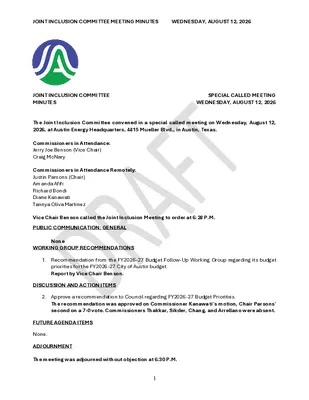
JOINT INCLUSION COMMITTEE MEETING MINUTES WEDNESDAY, AUGUST 12, 2026 JOINT INCLUSION COMMITTEE SPECIAL CALLED MEETING WEDNESDAY, AUGUST 12, 2026 MINUTES The Joint Inclusion Committee convened in a special called meeting on Wednesday, August 12, 2026, at Austin Energy Headquarters, 4815 Mueller Blvd., in Austin, Texas. Commissioners in Attendance: Jerry Joe Benson (Vice Chair) Craig McNary Commissioners in Attendance Remotely: Justin Parsons (Chair) Amanda Afifi Richard Bondi Diane Kanawati Tannya Oliva Martinez Vice Chair Benson called the Joint Inclusion Meeting to order at 6:28 P.M. PUBLIC COMMUNICATION: GENERAL None WORKING GROUP RECOMMENDATIONS 1. Recommendation from the FY2026-27 Budget Follow-Up Working Group regarding its budget priorities for the FY2026-27 City of Austin budget. Report by Vice Chair Benson. DISCUSSION AND ACTION ITEMS 2. Approve a recommendation to Council regarding FY2026-27 Budget Priorities. The recommendation was approved on Commissioner Kanawati’s motion, Chair Parsons’ second on a 7-0 vote. Commissioners Thakkar, Sikder, Chang, and Arrellano were absent. FUTURE AGENDA ITEMS None. ADJOURNMENT The meeting was adjourned without objection at 6:30 P.M. 1

REGULAR MEETING OF THE JOINT INCLUSION COMMITTEE WEDNESDAY, AUGUST 26, 2026, 6:00 P.M. PERMITTING AND DEVELOPMENT CENTER, ROOM 1401/1402 6310 WILHELMINA DELCO DR AUSTIN, TEXAS Some members of the Joint Inclusion Committee may be participating by videoconference. Public comment will be allowed in-person or remotely via telephone. Speakers may only register to speak on an item once either in-person or remotely and will be allowed up to three minutes to provide their comments. Registration no later than noon the day before the meeting is required for remote participation by telephone. To register to speak remotely, contact Ryan Sperling, 512-974-3568, ryan.sperling@austintexas.gov CURRENT COMMITTEE MEMBERS: Primary Representative: Justin Parsons (Chair) Nirali J Thakkar Member Commission: African American Resource Advisory Commission Asian American Quality of Life Advisory Commission VACANT Commission for Women Commission on Aging Richard Bondi Commission on Immigrant Affairs Diane Kanawati Commission on Veterans Affairs Early Childhood Council Hispanic/Latino Quality of Life Resource Advisory Commission Human Rights Commission LGBTQ Quality of Life Advisory Commission Mayor’s Committee for People with Disabilities VACANT Craig McNary Amanda Afifi Tannya Oliva-Martínez Jerry Joe Benson (Vice Chair) Lisa Chang Alternate Representative: Alexandria Anderson Nayer Sikder VACANT Teresa Ferguson Azeem Edwin VACANT Delphi Alvizo Dulce Castaneda Lila Igram Asher Knutson Gabriel Arrellano AGENDA CALL TO ORDER PUBLIC COMMUNICATION: GENERAL The first ten speakers signed up prior to the meeting being called to order will each be allowed a three-minute allotment to address their concerns regarding items not posted on the agenda. APPROVAL OF MINUTES 1. Approve the minutes of the Joint Inclusion Committee regular meeting on July 22, 2026. DISCUSSION ITEMS 2. 3. 4. Discussion regarding a schedule of future presentations on the activities of member commissions. Discussion regarding departments and offices to ask to present at future commission meetings Discussion regarding a recommendation for the Accessible Austin Certification program and implementation of accessibility requirements. DISCUSSION AND ACTION ITEMS 5. Approve membership changes and discuss future areas of focus for the commission’s working groups. FUTURE AGENDA ITEMS ADJOURNMENT The City of Austin is committed to compliance with the Americans with Disabilities Act. Reasonable modifications and equal access to communications will be provided upon request. For assistance, please contact the Liaison or TTY users’ route through 711. A person may request language access accommodations no later than 48 hours before the scheduled meeting. Please call or email Ryan Sperling at Austin City Clerk’s Office, at 512-974-3568 or ryan.sperling@austintexas.gov, …


JOINT INCLUSION COMMITTEE MINUTES REGULAR MEETING WEDNESDAY, JULY 22, 2026 The Joint Inclusion Committee convened in a regular meeting on Wednesday, July 22, 2026 at The Permitting and Development Center, Room #1401/1402, 6310 Wilhelmina Delco Drive in Austin, Texas. Chair Parsons called the Joint Inclusion Committee Meeting to order at 6:03 p.m. Commissioners in Attendance: Justin Parsons (Chair) Richard Bondi Delphi Alvizo Tannya Oliva-Martinez Jerry Joe Benson (Vice Chair) Lisa Chang Commissioners in Attendance Remotely: Nirali J Thakkar Diane Kanawati Amanda Afifi PUBLIC COMMUNICATION: GENERAL Shreyan Khanna- Accessible Austin Policy Proposals APPROVAL OF MINUTES 1. Approve the minutes of the Joint Inclusion Committee Regular Meeting on June 24, 2026. The minutes from the Joint Inclusion Committee Regular meeting on June 24, 2026 were approved on Commissioner Chang’s motion, Vice Chair Benson’s second on a 8-0 vote. Commissioner Oliva-Martinez was off the dais. Commissioner McNary was absent. STAFF BRIEFINGS 2. Briefing regarding the Officer-Involved Shooting Dashboard. Briefing by Sara Peralta, Public Information and Marketing Program Manager, and Crystal Kimbrough, Policy Compliance Consultant, Austin Police Oversight. The presentation was made by Sara Peralta, Public Information and Marketing Program Manager, and Crystal Kimbrough, Policy Compliance Consultant, Austin Police Oversight. 1 DISCUSSION ITEMS 3. 4. Discussion regarding the status of previously approved bylaw amendments and the potential for future amendments. Discussed. Discussion on actions taken, discussion held, and staff briefings received by JIC member commissions at their recent meetings. Discussed. DISCUSSION AND ACTION ITEMS 5. Approve a recommendation for Inclusion of Infrastructure Equity and Medical Resilience in the Pilot Knob Library & Austin Resilience Network Project. The following amendments were made by Commissioner Chang and seconded by Commissioner Bondi. The amendments were to add a fourth bullet under the third WHEREAS to include: • The Mayor’s Committee for People with Disabilities (Recommendation: 20260612- 007) • The Hispanic/Latino Quality of Life Resource Advisory Commission (Recommendation: 20260623-007) • The African American Resource Advisory Commission (Recommendation: 20260707-008) • The Commission of Immigrant Affairs (Recommendation: 20260706-005); and And to insert the following text to the last sentence of NOW, THEREFORE, BE IT RESOLVED: NOW, THEREFORE, BE IT RESOLVED, that the Joint Inclusion Committee endorses and consolidates the recommendations of the Mayor’s Committee for People with Disabilities, the Hispanic/Latino Quality of Life Resource Advisory Commission, and the African American Resource Advisory Commission, and the Commission on Immigrant Affairs; and And to insert the following sentence under the fourth WHEREAS …
JOINT INCLUSION COMMITTEE MEETING MINUTES WEDNESDAY, AUGUST 26, 2026 JOINT INCLUSION COMMITTEE MINUTES REGULAR MEETING WEDNESDAY, AUGUST 26, 2026 The Joint Inclusion Committee convened in a regular meeting on Wednesday, August 26, 2026 at the Permitting and Development Center, 6310 Wilhelmina Delco Dr. in Austin, Texas. Chair Parsons called the Joint Inclusion Meeting to order at 6:17 p.m. Commissioners in Attendance: Justin Parsons (Chair) Richard Bondi Lisa Chang Tannya Oliva-Martínez Commissioners in Attendance Remotely: Jerry Joe Benson (Vice Chair) Diane Kanawati PUBLIC COMMUNICATION: GENERAL None. APPROVAL OF MINUTES 1. Approve the minutes of the Joint Inclusion Committee regular meeting on July 22, 2026. The July 22, 2026 minutes were approved on Commissioner Chang’s motion, Commissioner Bondi’s second 6-0 vote. Commissioners Afifi, Alvizo, Castaneda, McNary, and Thakkar were absent. DISCUSSION ITEMS 2. 3. Discussion regarding a schedule of future presentations on the activities of member commissions. Discussion was held. Discussion regarding departments and offices to ask to present at future commission meetings. 1 JOINT INCLUSION COMMITTEE MEETING MINUTES WEDNESDAY, AUGUST 26, 2026 Discussion was held. 4. Discussion regarding a recommendation for the Accessible Austin Certification program and implementation of accessibility requirements. Withdrawn without objection. DISCUSSION AND ACTION ITEMS 5. Approve membership changes and discuss future areas of focus for the commission’s working groups. Discussion was held. No action was taken. FUTURE AGENDA ITEMS Discussion of meeting time and location for next year’s annual schedule - Chang Discussion and possible action regarding APD shooting- Oliva-Martínez Final report from Budget Follow-Up Working Group – Benson Formation of FY2027-2028 Budget Working Group – Benson ADJOURNMENT Chair Parsons adjourned the meeting at 7:21 p.m. without objection. The minutes were approved at the September 23, 2026 meeting on Commissioner Bondi’s motion, Commissioner Chang’s second on a 7-0 vote. Vice Chair Benson was off the dais. Commissioners Alvizo, McNary, and Ramirez were absent. 2
SPECIAL CALLED MEETING OF THE JOINT INCLUSION COMMITTEE WEDNESDAY, AUGUST 12, 2026, 6:00 P.M. AUSTIN ENERGY HEADQUARTERS, MUELLER ASSEMBLY ROOM 4815 MUELLER BLVD AUSTIN, TEXAS Some members of the Joint Inclusion Committee may be participating by videoconference. Public comment will be allowed in-person or remotely via telephone. Speakers may only register to speak on an item once either in-person or remotely and will be allowed up to three minutes to provide their comments. Registration no later than noon the day before the meeting is required for remote participation by telephone. To register to speak remotely, contact Ryan Sperling, 512-974-3568, ryan.sperling@austintexas.gov CURRENT COMMITTEE MEMBERS: Primary Representative: Justin Parsons (Chair) Nirali J Thakkar Member Commission: African American Resource Advisory Commission Asian American Quality of Life Advisory Commission VACANT Commission for Women Commission on Aging Richard Bondi Commission on Immigrant Affairs Diane Kanawati Commission on Veterans Affairs Early Childhood Council Hispanic/Latino Quality of Life Resource Advisory Commission Human Rights Commission LGBTQ Quality of Life Advisory Commission Mayor’s Committee for People with Disabilities VACANT Craig McNary Amanda Afifi Tannya Oliva-Martínez Jerry Joe Benson (Vice Chair) Lisa Chang Alternate Representative: Alexandria Anderson Nayer Sikder VACANT Teresa Ferguson Azeem Edwin VACANT Delphi Alvizo Dulce Castaneda Lila Igram Asher Knutson Gabriel Arrellano AGENDA CALL TO ORDER PUBLIC COMMUNICATION: GENERAL The first ten speakers signed up prior to the meeting being called to order will each be allowed a three-minute allotment to address their concerns regarding items not posted on the agenda. WORKING GROUP RECOMMENDATIONS 1. Recommendation from the FY2026-27 Budget Follow-Up Working Group regarding its budget priorities for the FY2026-27 City of Austin budget. DISCUSSION AND ACTION ITEMS 2. Approve a recommendation to Council regarding FY2026-27 Budget Priorities. FUTURE AGENDA ITEMS ADJOURNMENT The City of Austin is committed to compliance with the Americans with Disabilities Act. Reasonable modifications and equal access to communications will be provided upon request. For assistance, please contact the Liaison or TTY users’ route through 711. A person may request language access accommodations no later than 48 hours before the scheduled meeting. Please call or email Ryan Sperling at Austin City Clerk’s Office, at 512-974-3568 or ryan.sperling@austintexas.gov, to request service or for additional information. For more information on the Human Rights Committee, please contact Ryan Sperling at 512-974- 3568 or ryan.sperling@austintexas.gov.
FY2026–27 Joint Inclusion Committee Budget Follow-Up This document summarizes the status of budget recommendations advanced by the Joint Inclusion Committee and its member commissions. While some priorities were maintained or partially addressed in the City Manager’s proposed budget, most remain unfunded or lack a clear implementation plan. Departmental support without dedicated funding, responsible staff, and a timeline is not implementation. Council should protect essential services and invest in prevention, including housing stability, healthcare, childcare, nutrition, legal assistance, accessibility, language access, and trusted community outreach. Where full funding is not possible, Council should provide a first-year investment and direct staff to return with a clear, costed path forward. Commission Status and Remaining Priorities African American Resource Advisory Commission ● Status: The proposed budget does not fund the $250,000 Multicultural STEM Symposium, and several Black-serving social-service priorities remain vulnerable to reductions. The City is exploring coordination with existing youth employment programs but has not funded the proposed symposium. ● Ask: Protect social-service contracts serving Black residents and provide a first-year investment or implementation plan for the Multicultural STEM Symposium and other culturally responsive economic-mobility programs. Asian American Quality of Life Advisory Commission ● Status: The AARC operating budget increases modestly, and ACME supports addressing its staffing and senior-service needs, but the proposed budget does not identify dedicated funding for pavilion staffing, temporary workforce support, or expanded senior nutrition. Community Health Navigator and language-access needs also remain unresolved. ● Ask: Restore and expand Community Health Navigator and language-access services, provide an itemized implementation plan for AARC’s unmet needs, and establish a funding timeline for an updated Asian American Quality of Life Study. Commission for Women ● Status: Emergency rental assistance and immigrant legal services remain in the proposed budget, but the full Mama Sana Vibrant Woman maternal-health and housing- stabilization request has not been funded as a dedicated package. ● Ask: Restore Mama Sana Vibrant Woman to the requested $900,000 service level and reverse remaining reductions to immigrant legal-service contracts. Commission on Aging ● Status: Older-adult outreach, in-language communications, and $400,000 in digital- equity programming are supported or maintained. However, the Parks and Recreation allocation associated with older-adult meal services decreases from approximately $666,000 to $572,000, and additional resources are still needed. ● Ask: Protect and expand home-delivered and congregate meal services and require implementation plans for transportation safety, adult-day health services, and employment and volunteer access for older adults. Commission on Immigrant …
RECOMMENDATION REGARDING FY2026-27 JOINT INCLUSION COMMITTEE BUDGET PRIORITIES Recommendation No. 2026________ WHEREAS, the Joint Inclusion Committee and its member commissions submitted budget recommendations addressing housing, healthcare, childcare, legal services, accessibility, public safety, economic opportunity, cultural infrastructure, and other essential community needs; and WHEREAS, the City Manager’s proposed FY2026-27 budget maintains or partially addresses some recommendations, while many others remain unfunded or lack a clear implementation plan; and WHEREAS, investments in prevention and stabilization reduce harm, protect vulnerable residents, and avoid more expensive interventions later; and WHEREAS, departmental support alone does not constitute implementation without identified funding, responsible staff, and a clear timeline; NOW, THEREFORE, BE IT RESOLVED BY THE JOINT INCLUSION COMMITTEE OF THE CITY OF AUSTIN: The Joint Inclusion Committee recommends that the Austin City Council protect essential services and prioritize the remaining budget recommendations advanced by the Committee and its member commissions, including investments in housing stability, healthcare, childcare, nutrition, legal assistance, accessibility, language access, community safety, and economic opportunity. BE IT FURTHER RESOLVED: For recommendations that are supported but not fully funded, the Committee recommends that Council provide a first-year investment or direct the City Manager to identify the responsible department, funding required, implementation timeline, measurable outcomes, and minimum viable path forward. BE IT FINALLY RESOLVED: The Committee requests a written update following budget adoption identifying which recommendations were funded, partially funded, referred for further action, or not included.

. RECOMMENDATION TO COUNCIL Joint Inclusion Committee Recommendation 20260812-002: FY2026-27 Joint Inclusion Committee Budget Priorities WHEREAS, the Joint Inclusion Committee and its member commissions submitted budget recommendations addressing housing, healthcare, childcare, legal services, accessibility, public safety, economic opportunity, cultural infrastructure, and other essential community needs; and WHEREAS, the City Manager’s proposed FY2026-27 budget maintains or partially addresses some recommendations, while many others remain unfunded or lack a clear implementation plan; and WHEREAS, investments in prevention and stabilization reduce harm, protect vulnerable residents, and avoid more expensive interventions later; and WHEREAS, departmental support alone does not constitute implementation without identified funding, responsible staff, and a clear timeline; NOW, THEREFORE, BE IT RESOLVED BY THE JOINT INCLUSION COMMITTEE OF THE CITY OF AUSTIN: The Joint Inclusion Committee recommends that the Austin City Council protect essential services and prioritize the remaining budget recommendations advanced by the Committee and its member commissions, including investments in housing stability, healthcare, childcare, nutrition, legal assistance, accessibility, language access, community safety, and economic opportunity. BE IT FURTHER RESOLVED: For recommendations that are supported but not fully funded, the Committee recommends that Council provide a first-year investment or direct the City Manager to identify the responsible department, funding required, implementation timeline, measurable outcomes, and minimum viable path forward. BE IT FINALLY RESOLVED: The Committee requests a written update following budget adoption identifying which recommendations were funded, partially funded, referred for further action, or not included. . Date of Approval: August 12, 2026 Motioned By: Commissioner Kanawati Seconded By: Chair Parsons Vote: 7-0 For: Chair Parsons, Vice Chair Benson, Commissioners Afifi, Bondi, Kanawati, McNary, Oliva Martinez Against: None Abstain: None Off the dais: None Absent: Commissioners Thakkar, Sikder, Chang, Arrellano Attest: _____________________________________________ (Ryan Sperling, Staff Liaison)
JOINT INCLUSION COMMITTEE MEETING MINUTES WEDNESDAY, AUGUST 12, 2026 JOINT INCLUSION COMMITTEE SPECIAL CALLED MEETING WEDNESDAY, AUGUST 12, 2026 MINUTES The Joint Inclusion Committee convened in a special called meeting on Wednesday, August 12, 2026, at Austin Energy Headquarters, 4815 Mueller Blvd., in Austin, Texas. Commissioners in Attendance: Jerry Joe Benson (Vice Chair) Craig McNary Commissioners in Attendance Remotely: Justin Parsons (Chair) Amanda Afifi Richard Bondi Diane Kanawati Tannya Oliva Martinez Vice Chair Benson called the Joint Inclusion Meeting to order at 6:28 P.M. PUBLIC COMMUNICATION: GENERAL None WORKING GROUP RECOMMENDATIONS 1. Recommendation from the FY2026-27 Budget Follow-Up Working Group regarding its budget priorities for the FY2026-27 City of Austin budget. Report by Vice Chair Benson. DISCUSSION AND ACTION ITEMS 2. Approve a recommendation to Council regarding FY2026-27 Budget Priorities. The recommendation was approved on Commissioner Kanawati’s motion, Chair Parsons’ second on a 7-0 vote. Commissioners Thakkar, Sikder, Chang, and Arrellano were absent. FUTURE AGENDA ITEMS None. ADJOURNMENT The meeting was adjourned without objection at 6:30 P.M. 1 JOINT INCLUSION COMMITTEE MEETING MINUTES WEDNESDAY, AUGUST 12, 2026 The minutes were approved at the September 23, 2026 meeting on Commissioner Bondi’s motion, Commissioner Chang’s second on a 7-0 vote. Vice Chair Benson was off the dais. Commissioners Alvizo, McNary, and Ramirez were absent. 2

REGULAR MEETING OF THE JOINT INCLUSION COMMITTEE WEDNESDAY, JULY 22, 2026, 6:00 P.M. PERMITTING AND DEVELOPMENT CENTER, ROOM 1401/1402 6310 WILHELMINA DELCO DR AUSTIN, TEXAS Some members of the Joint Inclusion Committee may be participating by videoconference. Public comment will be allowed in-person or remotely via telephone. Speakers may only register to speak on an item once either in-person or remotely and will be allowed up to three minutes to provide their comments. Registration no later than noon the day before the meeting is required for remote participation by telephone. To register to speak remotely, contact Ryan Sperling, 512-974-3568, ryan.sperling@austintexas.gov CURRENT COMMITTEE MEMBERS: Primary Representative: Justin Parsons (Chair) Nirali J Thakkar Member Commission: African American Resource Advisory Commission Asian American Quality of Life Advisory Commission VACANT Commission for Women Commission on Aging Richard Bondi Commission on Immigrant Affairs Diane Kanawati Commission on Veterans Affairs Early Childhood Council Hispanic/Latino Quality of Life Resource Advisory Commission Human Rights Commission LGBTQ Quality of Life Advisory Commission Mayor’s Committee for People with Disabilities VACANT Craig McNary Amanda Afifi Tannya Oliva-Martínez Jerry Joe Benson (Vice Chair) Lisa Chang Alternate Representative: Alexandria Anderson Nayer Sikder VACANT Teresa Ferguson Azeem Edwin VACANT Delphi Alvizo Dulce Castaneda Lila Igram VACANT Gabriel Arrelano AGENDA CALL TO ORDER PUBLIC COMMUNICATION: GENERAL The first ten speakers signed up prior to the meeting being called to order will each be allowed a three-minute allotment to address their concerns regarding items not posted on the agenda. APPROVAL OF MINUTES 1. Approve the minutes of the Joint Inclusion Committee regular meeting on June 24, 2026. STAFF BRIEFINGS 2. Briefing regarding the Officer-Involved Shooting Dashboard. Briefing by Sara Peralta, Public Information and Marketing Program Manager, and Crystal Kimbrough, Policy Compliance Consultant, Austin Police Oversight. DISCUSSION ITEMS 3. 4. Discussion regarding the status of previously approved bylaw amendments and the potential for future amendments. Discussion on actions taken, discussion held, and staff briefings received by JIC member commissions at their recent meetings. DISCUSSION AND ACTION ITEMS 5. Approve a recommendation for Inclusion of Infrastructure Equity and Medical Resilience in the Pilot Knob Library & Austin Resilience Network Project. WORKING GROUP UPDATES 6. 7. Update from the Community Engagement Working Group regarding its progress and planned community engagement activities for the remainder of FY2026. Update from the FY2026-27 Budget Follow-Up Working Group regarding its progress on tracking this year’s budget recommendations. FUTURE AGENDA ITEMS ADJOURNMENT The City …
JOINT INCLUSION COMMITTEE MEETING MINUTES WEDNESDAY, JUNE 24, 2026 JOINT INCLUSION COMMITTEE MINUTES REGULAR MEETING WEDNESDAY, JUNE 24, 2026 The Joint Inclusion Committee convened in a regular meeting on Wednesday, June 24, 2026, at the Permitting and Development Center, 6310 Wilhelmina Delco Dr. in Austin, Texas. Chair Parsons called the Joint Inclusion Meeting to order at 6:09 p.m. Commissioners in Attendance: Justin Parsons (Chair) Jerry Joe Benson (Vice Chair) Richard Bondi Lisa Chang Tannya Oliva Martinez Craig McNary Commissioners in Attendance Remotely: Amanda Afifi Nayer Sikder Azeem Edwin PUBLIC COMMUNICATION: GENERAL None APPROVAL OF MINUTES 1. Approve the minutes of the Joint Inclusion Committee regular meeting of May 27, 2026. The minutes were approved on Commissioner Bondi’s motion, Commissioner Chang’s second on an 8-0 vote. Vice Chair Benson was off the dais. Commissioners Kanawati, Laake-Stanfield, Thakkar, and Wilson were absent. STAFF BRIEFINGS 2. Briefing on the Levers of Economic Mobility Index and recap of the 2026 Fair Housing Economic Mobility Conference. Presentation by Gary Aaron, Business Process Consultant Sr., and Shivani Datar, Business Process Specialist, Austin Equity & Inclusion. 1 JOINT INCLUSION COMMITTEE MEETING MINUTES WEDNESDAY, JUNE 24, 2026 The presentation was made by Gary Aaron, Business Process Consultant Sr., and Shivani Datar, Business Process Specialist, Austin Equity & Inclusion. 3. Staff briefing regarding the Human Rights Impact Review. Briefing by Shafina Khaki, Human Rights Office, Austin Equity & Inclusion. The presentation was made by Dr. Lindsey Wilson, Director of Austin Equity and Inclusion, and Shafina Khaki, Human Rights Officer, City of Austin. DISCUSSION ITEMS 4. 5. 6. 7. Introduction of new Equity Officer Dr. Joseph Allen to the committee. Presentation by Dr. Joseph Allen Equity Officer, and Dr. Lindsey Wilson, Director, Austin Equity & Inclusion. The presentation was made by Dr. Joseph Allen, Interim Equity Officer, and Dr. Lindsey Wilson, Director, Austin Equity & Inclusion. Presentation regarding the Austin Police Department (APD) Collective Sex Crimes Unit and discussion of APD engagement with the Joint Inclusion Committee. Presentation by Stephanie Gonzales, Equity and Inclusion Coordinator, APD. Item 5 was taken up before Item 2 without objection. The presentation was made by Stephanie Gonzales, Equity and Inclusion Coordinator, APD. Discussion on the newly established Native American and Indigenous Quality of Life Commission. Discussion was held. Discussion on where commissions stand with the pilot knob recommendation. Discussion was held. DISCUSSION AND ACTION ITEMS 8. Approve a recommendation regarding funding for the SAFE …

. RECOMMENDATION TO COUNCIL Joint Inclusion Committee Recommendation Number: [YYYYMMDD-XXX]: Fiscal Year 2026-2027 Budget & November 2026 Bond Recommendations for Pilot Knob Library & Austin Resilience Network Site WHEREAS, the Joint Inclusion Committee (JIC) serves to advise the Austin City Council on matters of equity, civil rights, quality of life, and full access to city services for all historically marginalized communities across Austin; and WHEREAS, the proposed Pilot Knob Library and Austin Resilience Network Site project in District 2 represents a critical civic anchor serving Southeast Austin—a region along the Eastern Crescent that has historically faced underinvestment in public infrastructure and extreme weather vulnerabilities; and WHEREAS, three advisory bodies represented on the Joint Inclusion Committee have evaluated this project and passed matching resolutions urging immediate city action, specifically: • The Mayor’s Committee for People with Disabilities (Recommendation No. 20260612-007); • The Hispanic/Latino Quality of Life Resource Advisory Commission (Recommendation No. 20260623-007); and • The African American Resource Advisory Commission (Recommendation No. 20260707- 008); and WHEREAS, residents who are medically vulnerable, elderly, living with disabilities, or reliant on power-dependent medical devices (such as oxygen concentrators, home dialysis, and ventilators) face life-threatening consequences during prolonged power outages and extreme thermal events; and WHEREAS, true resilience infrastructure must go beyond basic emergency sheltering by providing real-time medical triage capabilities and equal electrical reliability compared to adjacent new commercial developments; NOW, THEREFORE, BE IT RESOLVED, that the Joint Inclusion Committee endorses and consolidates the recommendations of the Mayor’s Committee for People with Disabilities, the Hispanic/Latino Quality of Life Resource Advisory Commission, and the African American Resource Advisory Commission; and BE IT FURTHER RESOLVED, that the Joint Inclusion Committee recommends that the Austin City Council direct the City Manager to incorporate the following provisions into the FY 2026–2027 Operating Budget and/or the November 2026 Bond Package: . 1. Designation as a Medical Triage Anchor: Capital allocations for the Pilot Knob Library & Austin Resilience Network Site must include high-capacity, redundant power infrastructure, industrial backup generators, and heavy-duty electrical outlets capable of powering and recharging life-sustaining medical equipment during emergency activations. 2. Surrounding Grid Hardening: Direct Austin Energy to prioritize electrical grid hardening and circuit micro-grid development in surrounding legacy Southeast Austin neighborhoods (District 2) to ensure equitable power reliability during extreme weather events. 3. Accessibility & Language Equity: Allocate funding to ensure the Pilot Knob Resilience Network Site provides fully accessible physical space (meeting ADA …
. RECOMMENDATION TO COUNCIL Joint Inclusion Committee Recommendation Number: 20260722-005: Fiscal Year 2026-2027 Budget & November 2026 Bond Recommendations for Pilot Knob Library & Austin Resilience Network Site WHEREAS, the Joint Inclusion Committee (JIC) serves to advise the Austin City Council on matters of equity, civil rights, quality of life, and full access to city services for all historically marginalized communities across Austin; and WHEREAS, the proposed Pilot Knob Library and Austin Resilience Network Site project in District 2 represents a critical civic anchor serving Southeast Austin—a region along the Eastern Crescent that has historically faced underinvestment in public infrastructure and extreme weather vulnerabilities; and WHEREAS, three advisory bodies represented on the Joint Inclusion Committee have evaluated this project and passed matching resolutions urging immediate city action, specifically: • The Mayor’s Committee for People with Disabilities (Recommendation No. 20260612-007); • The Hispanic/Latino Quality of Life Resource Advisory Commission (Recommendation No. 20260623-007); and • The African American Resource Advisory Commission (Recommendation No. 20260707- 008); and • The Commission on Immigrant Affairs (Recommendation No. 20260706-005); and WHEREAS, residents who are medically vulnerable, elderly, living with disabilities, infants, children, and pregnant individuals, or reliant on power-dependent medical devices (such as oxygen concentrators, home dialysis, and ventilators) face life-threatening consequences during prolonged power outages and extreme thermal events; and WHEREAS, true resilience infrastructure must go beyond basic emergency sheltering by providing real-time medical triage capabilities and equal electrical reliability compared to adjacent new commercial developments; NOW, THEREFORE, BE IT RESOLVED, that the Joint Inclusion Committee endorses and consolidates the recommendations of the Mayor’s Committee for People with Disabilities, the Hispanic/Latino Quality of Life Resource Advisory Commission, and the African American Resource Advisory Commission, the Commission on Immigrant Affairs; and . BE IT FURTHER RESOLVED, that the Joint Inclusion Committee recommends that the Austin City Council direct the City Manager to incorporate the following provisions into the FY 2026–2027 Operating Budget and/or the November 2026 Bond Package: 1. Designation as a Medical Triage Anchor: Capital allocations for the Pilot Knob Library & Austin Resilience Network Site must include high-capacity, redundant power infrastructure, industrial backup generators, and heavy-duty electrical outlets capable of powering and recharging life-sustaining medical equipment during emergency activations. 2. Surrounding Grid Hardening: Direct Austin Energy to prioritize electrical grid hardening and circuit micro-grid development in surrounding legacy Southeast Austin neighborhoods (District 2) to ensure equitable power reliability during extreme weather events. 3. Accessibility …
JOINT INCLUSION COMMITTEE MINUTES REGULAR MEETING WEDNESDAY, JULY 22, 2026 The Joint Inclusion Committee convened in a regular meeting on Wednesday, July 22, 2026 at The Permitting and Development Center, Room #1401/1402, 6310 Wilhelmina Delco Drive in Austin, Texas. Chair Parsons called the Joint Inclusion Committee Meeting to order at 6:03 p.m. Commissioners in Attendance: Justin Parsons (Chair) Richard Bondi Delphi Alvizo Tannya Oliva-Martinez Jerry Joe Benson (Vice Chair) Lisa Chang Commissioners in Attendance Remotely: Nirali J Thakkar Diane Kanawati Amanda Afifi PUBLIC COMMUNICATION: GENERAL Shreyan Khanna- Accessible Austin Policy Proposals APPROVAL OF MINUTES 1. Approve the minutes of the Joint Inclusion Committee Regular Meeting on June 24, 2026. The minutes from the Joint Inclusion Committee Regular meeting on June 24, 2026 were approved on Commissioner Chang’s motion, Vice Chair Benson’s second on a 8-0 vote. Commissioner Oliva-Martinez was off the dais. Commissioner McNary was absent. STAFF BRIEFINGS 2. Briefing regarding the Officer-Involved Shooting Dashboard. Briefing by Sara Peralta, Public Information and Marketing Program Manager, and Crystal Kimbrough, Policy Compliance Consultant, Austin Police Oversight. The presentation was made by Sara Peralta, Public Information and Marketing Program Manager, and Crystal Kimbrough, Policy Compliance Consultant, Austin Police Oversight. 1 DISCUSSION ITEMS 3. 4. Discussion regarding the status of previously approved bylaw amendments and the potential for future amendments. Discussed. Discussion on actions taken, discussion held, and staff briefings received by JIC member commissions at their recent meetings. Discussed. DISCUSSION AND ACTION ITEMS 5. Approve a recommendation for Inclusion of Infrastructure Equity and Medical Resilience in the Pilot Knob Library & Austin Resilience Network Project. The following amendments were made by Commissioner Chang and seconded by Commissioner Bondi. The amendments were to add a fourth bullet under the third WHEREAS to include: • The Mayor’s Committee for People with Disabilities (Recommendation: 20260612- 007) • The Hispanic/Latino Quality of Life Resource Advisory Commission (Recommendation: 20260623-007) • The African American Resource Advisory Commission (Recommendation: 20260707-008) • The Commission of Immigrant Affairs (Recommendation: 20260706-005); and And to insert the following text to the last sentence of NOW, THEREFORE, BE IT RESOLVED: NOW, THEREFORE, BE IT RESOLVED, that the Joint Inclusion Committee endorses and consolidates the recommendations of the Mayor’s Committee for People with Disabilities, the Hispanic/Latino Quality of Life Resource Advisory Commission, and the African American Resource Advisory Commission, and the Commission on Immigrant Affairs; and And to insert the following sentence under the fourth WHEREAS …
REGULAR MEETING OF THE JOINT INCLUSION COMMITTEE WEDNESDAY, JUNE 24, 2026, 6:00 P.M. PERMITTING AND DEVELOPMENT CENTER, ROOM 1401/1402 6310 WILHELMINA DELCO DR AUSTIN, TEXAS Some members of the Joint Inclusion Committee may be participating by videoconference. Public comment will be allowed in-person or remotely via telephone. Speakers may only register to speak on an item once either in-person or remotely and will be allowed up to three minutes to provide their comments. Registration no later than noon the day before the meeting is required for remote participation by telephone. To register to speak remotely, contact Ryan Sperling, 512-974-3568, ryan.sperling@austintexas.gov CURRENT COMMITTEE MEMBERS: Primary Representative: Justin Parsons (Chair) Nirali J Thakkar Member Commission: African American Resource Advisory Commission Asian American Quality of Life Advisory Commission VACANT Commission for Women Commission on Aging Richard Bondi Commission on Immigrant Affairs Diane Kanawati Commission on Veterans Affairs Early Childhood Council Hispanic/Latino Quality of Life Resource Advisory Commission Human Rights Commission LGBTQ Quality of Life Advisory Commission Mayor’s Committee for People with Disabilities Tannya Oliva-Martínez Jerry Joe Benson (Vice Chair) Lisa Chang Bryce F Laake-Stanfield Craig McNary Amanda Afifi Alternate Representative: Alexandria Anderson Nayer Sikder VACANT Teresa Ferguson Azeem Edwin Christopher Wilson Delphi Alvizo Dulce Castaneda Lila Igram VACANT Gabriel Arellano AGENDA CALL TO ORDER PUBLIC COMMUNICATION: GENERAL The first ten speakers signed up prior to the meeting being called to order will each be allowed a three-minute allotment to address their concerns regarding items not posted on the agenda. APPROVAL OF MINUTES 1. Approve the minutes of the Joint Inclusion Committee regular meeting of May 27, 2026. STAFF BRIEFINGS 2. 3. Briefing on the Levers of Economic Mobility Index and recap of the 2026 Fair Housing Economic Mobility Conference. Presentation by Gary Aaron, Business Process Consultant Sr., and Shivani Datar, Business Process Specialist, Austin Equity & Inclusion. Staff briefing regarding the Human Rights Impact Review. Briefing by Shafina Khaki, Human Rights Office, Austin Equity & Inclusion. DISCUSSION ITEMS 4. 5. 6. 7. Introduction of new Equity Officer Dr. Joseph Allen to the committee. Presentation by Dr. Joseph Allen, Equity Officer, and Dr. Lindsey Wilson, Director, Austin Equity & Inclusion. Presentation regarding the Austin Police Department (APD) Collective Sex Crimes Unit and discussion of APD engagement with the Joint Inclusion Committee. Presentation by Stephanie Gonzales, Equity and Inclusion Coordinator, APD. Discussion on the newly established Native American and Indigenous Quality of Life Commission. Discussion …

JOINT INCLUSION COMMITTEE MEETING MINUTES WEDNESDAY, MAY 27, 2026 JOINT INCLUSION COMMITTEE MINUTES REGULAR MEETING WEDNESDAY, MAY 27, 2026 The Joint Inclusion Committee convened in a regular meeting on Wednesday, May 27, 2026 at the Permitting and Development Center, 6310 Wilhelmina Delco Dr. in Austin, Texas. Chair Parsons called the Joint Inclusion Meeting to order at 6:02 p.m. Commissioners in Attendance: Justin Parsons (Chair) Jerry Joe Benson (Vice Chair) Richard Bondi Craig McNary Tannya Oliva Martinez Commissioners in Attendance Remotely: Amanda Afifi Lisa Chang Nirali Thakkar PUBLIC COMMUNICATION: GENERAL None present. APPROVAL OF MINUTES 1. Approve the minutes of the Joint Inclusion Committee regular meeting on April 22, 2026. The minutes of the April 22, 2026 meeting were approved on Commissioner Bondi’s motion, Vice Chair Benson’s second on an 8-0 vote. Commissioners Bullard, Edwin, Kanawati, Laake-Stanfield, Melendez, and Wilson were absent. STAFF BRIEFINGS 2. Staff briefing regarding the Austin Resilience Network. Briefing by Austin Emergency Management staff. 1 JOINT INCLUSION COMMITTEE MEETING MINUTES WEDNESDAY, MAY 27, 2026 The briefing was made by Natalie Lyell, Resilience & Partnerships Manager, Austin Emergency Management. DISCUSSION ITEMS 3. 4. 5. Presentation regarding the work of Communities in Schools of Central Texas. Presentation by Jacob Reach, COO, and Sharin Vigil, CEO, Communities in Schools of Central Texas. The presentation was made by Jacob Reach, COO, Communities in Schools of Central Texas. Discussion regarding a potential special called meeting as a retreat for Joint Inclusion Committee members. Items 4 and 5 were taken up together. Discussion was held. Discussion on scheduling a briefing from Austin Police Department, questions to ask, and the potential for a special called meeting. Items 4 and 5 were taken up together. Discussion was held. DISCUSSION AND ACTION ITEMS 6. 7. 8. Approve the formation of a FY2026-27 Budget Follow-Up Working Group to track this year’s budget recommendations across the budget cycle. The motion to approve the formation of a FY2026-27 Budget Follow-Up Working Group to track this year’s budget recommendations across the budget cycle was approved on Commissioner Bondi’s motion, Commissioner McNary’s second on an 8-0 vote. Commissioners Bullard, Edwin, Kanawati, Laake-Stanfield, Melendez, and Wilson were absent. Working Group members: Commissioners Benson and Chang Approve a recommendation regarding a proposed schedule for FY2027-28 Community Engagement. The recommendation regarding a proposed schedule for FY2027-28 Community Engagement was approved on Commissioner Benson’s motion, Commissioner McNary’s second on an 8-0 vote. Commissioners Bullard, Edwin, …

Commission Recommendation Joint Inclusion Committee Recommendation Number 20260624-008: Emergency Funding Recommendation for SAFE Alliance – Eloise House WHEREAS, Eloise House, operated by SAFE Alliance, is the only community-based, non- hospital forensic exam facility in Austin providing sexual assault forensic exams and rape kits at no cost to survivors, in a setting purposely built to provide: 1) Trauma-informed care 2) Outside the emergency room 3) Free from billing and 4) Staffed by advocates who remain with survivors throughout the process; and WHEREAS, Emergency rooms are not trauma-informed environments. Wait times are long, lighting is harsh, and staff rotate through 12-hour shifts without the continuity of care that survivors; and WHEREAS, The Mayor’s May 5, 2026 announcement proposed transitioning forensic nursing services to hospital systems and BRAVE Alliance, a Cedar Park-based organization with no demonstrated capacity at Austin’s scale; and WHEREAS, Eloise House, operated by SAFE Alliance conducts 600 forensic exams per year, serves 700 survivors per day, host 27,000 SAFEline contacts per year, and perform 95% of regional exams; THEREFORE, BE IT RESOLVED, the Joint Inclusion Committee (JIC) recommends that the Austin City Council immediately pause the Mayor’s proposed transition of forensic nursing services to hospital systems and BRAVE Alliance and require a meaningful community input process that centers survivors, advocates, and the communities most impacted before any transition moves forward; and BE IT FURTHER RESOLVED, the JIC recommends Austin City Council and the Mayor’s Office, in partnership with Travis County allocate a minimum of $430,000 in funding to preserve Eloise House as a community-based, non-hospital forensic exam and advocacy center operated by SAFE Alliance from June 9 through September 30, 2026, and $200,000 to keep the SAFE domestic violence shelter open from October 2026 through October 2027; and BE IT FURTHER RESOLVED, that the City commit to a sustainable, multi-year funding strategy that ensures continuity of SAFE’s full wraparound model without displacement into hospital settings. Wrap around services include: 1) Forensic exams 2) Trauma- informed and culturally responsive care and advocacy 3) Shelter 4) Legal services; and BE IT FINALLY RESOLVED, that this approach and intentionality reflect Austin’s commitment to investing into services and organizations that protect and support every Austinite, regardless of race, immigrations status, gender identity, income, or language. Date of Approval: June 24, 2026 Motioned By: Commissioner McNary Seconded By: Commissioner Edwin Vote: 10-0 For: Chair Parsons, Vice Chair Benson, Commissioners Afifi, Bondi, Chang, Edwin, McNary, Oliva …
Economic Mobility: Accelerating Impact Austin Equity & Inclusion June 2026 Agenda • 2026 Fair Housing and Economic Mobility Conference: Recap • Economic Mobility Framework Resources • LEMI in Action: Live Demo • Operational Focus and Next Steps 2 Conference Reflections Keynote Panel Brought together policymakers, advocates, practitioners, community leaders, and business owners to connect efforts around a shared framework for systemic change. Attended by 283 participants 12 breakout sessions 50+ speakers Moderator: Miles Bloxon, Moderator, Producer & Host, KUT New Panelists: • Fran Rosebush Baylor, Senior Director, Asset Funders Network • Carmen Llanes, Executive Director, GAVA • Ingrid Taylor, CEO, United Way for Greater Austin • Henry Van de Putte, CEO, Meals on Wheels Central Texas • Sharon Vigil, CEO, Communities in Schools 3 Economic Mobility Framework: Workshop Recap • Introduced the Economic Mobility Framework and Index • Over 130 minutes, participants explored the tool, engaged in guided discussions, and worked across sectors to identify practical steps that advance economic mobility. 4 Economic Mobility Framework Assets Core Products Communications Technical Users Levers of Economic Mobility Index Report Framework At-a- Glance brochure Technical Document Levers of Economic Mobility Index (LEMI) FAQs LEMI ArcGIS layers StoryMap Tutorial Videos* Raw Data Economic Mobility | Austin Equity and Inclusion | AustinTexas.gov 5 LEMI Walkthrough Advancing Economic Mobility Operationalizing Visualizing Organizing Normalizing 7 Next Steps April 29, 2026 June 2026 August 2026 2026 Fair Housing & Economic Mobility Conference Launch of Levers of Economic Mobility Index (et. al) Boards & Commissions briefings EveryTexan Virtual Sessions Expanded Media Communications Creation of Resource (LEMI) Implementation Guide Resilient Cities Catalyst Austin Energy Affordable Energy Summit Presentation Community Member Virtual Sessions & Workshops Department Working Group Meetings Continuous Engagement Citywide Implementation May 2026 July 2026 September 2026 - 8 Learn More • Economic Mobility Website: • www.austintexas.gov/equity-inclusion/economic-mobility • Austin Equity & Inclusion Newsletter Sign up: • https://www.austintexas.gov/equity-inclusion • Stay tuned for virtual sessions & in-person workshop dates this summer! LEMI Report Index & Story Map Economic Mobility At-a-Glance 9
Human Rights Human Rights Human Rights Impact Review Austin Equity and Inclusion What is a Human Rights Framework? A human rights framework evaluates government performance through the lens of residents’ rights, dignity, and equitable access to services. Rather than asking whether programs exist, it asks whether people's rights are being fulfilled and where barriers remain. Why is it necessary and how does it support the City? Policies and services can exist without reaching those who need them most. A human rights framework helps identify gaps, improve accountability, and ensure that city decisions advance dignity, equity, and access for all residents. 2 Co-Created Impact Review The City engaged Henekom Group, a human rights consulting firm, to conduct an independent Human Rights Impact Review. The review included research across 160+ sources, engagement with more than 300 stakeholders, and a community workshop with 120 participants to identify and prioritize human rights risks and opportunities across 12 key issue areas. The resulting recommendations were co-created, reflecting community input and best practice from international human rights standards. 3 City of Austin - Human Rights Framework "Design and implement a Human Rights framework for assessing existing City services and programs to improve accessibility and responsiveness for residents' needs." 160+ 300+ 120 Sources and commissions reviewed Stakeholders identified and engaged Registered workshop attendees 92 Issues identified 69 Proposed mitigations for salience 4 Steps to Conduct a Human Rights Impact Review Issue Identification → Mitigation Identification → Stakeholder Engagement → Implementation 1 2 3 4 5 6 Desk Research Dec 2025-Jan 2026: 12 issue areas, 160+ sources Issue & Mitigation Identification Defined salient human rights issues and potential mitigations Stakeholder Mapping Built 300+ stakeholder list with community and City Council recommendations Landscape Assessment Reviewed existing programs, initiatives, ordinances, and laws informed by community and City Council Activity Set-Up Designed with pre-identified issues and mitigations, with blank tabs available for write-ins Facilitator Training Trained facilitators with landscape insights to avoid duplicating existing mitigations 7 Human Rights Workshop - Building Consensus Multi-stakeholder dialogue at March 23 workshop, approximately 120 attendees 8 9 10 11 12 HeneKom’s Activity Analysis Scored and identified salient issues and mitigations for priority action Post Workshop Survey Sent to all registered stakeholders unable to attend Human Rights Post Workshop Mitigations Report Developed feasible municipal strategies based on knowledge-based best practices research City of Austin - Cross-Functional Integration Mapped mitigations across City departments City of Austin - …
Collective Sex Crimes Response Model (CSCRM) Project Briefing Joint Inclusion Committee Austin Police | June 24, 2026 Project Background The Collective Sex Crimes Response Model (CSCRM) project was born in 2023 out of many challenges experienced by the Austin Police (APD) Sex Crimes Unit (SCU) in the last decade, including: ▪ 2016: Systemic issues in its DNA lab that ultimately led to its closure; ▪ 2017: The withdrawal of APD sworn from the Austin/Travis County Sexual Assault Response and Resource Team (A/TC SARRT); ▪ 2018: An investigative report that highlighted APD’s improper use of Exceptional Clearance in the closure of sexual assault cases; ▪ 2018 & 2020: Two class-action lawsuits filed against the City for the improper handling of sexual assault investigations (Smith v COA, Senko v COA); and ▪ 2022: Over 100 recommendations for change were reported by the Police Executive Research Forum (PERF) after a comprehensive and multi-year assessment of APD’s SCU. 2 Project Overview A formal project was needed due to… ▪ The deep history ▪ The lack of community trust and constrained relationships ▪ The need for formal communications and status updates ▪ The size, complexity, and importance of the work Project Scope (123 total items): ▪ PERF report recommendations – 103 items ▪ Survivor lawsuit settlement – 16 items ▪ Project scope addition – 4 item Workgroup Model: ▪ Each item of scope has been assigned to one of five Workgroups ▪ Each Workgroup is led by two co-chairs (1 APD Individual, 1 Non-APD Individual) 1. Project Management 2. Policy, Response, & Investigation 3. 4. Data & Metrics 5. Outreach & Partnerships Training Policy, Response, & Investigations Outreach & Partnerships Project Management Training Data & Metrics 3 Project Team Members Engagement with community advocates and partners is a priority. The project team includes 33 total members: ▪ APD Sworn (x8) ▪ APD Victim Services (x8) ▪ APD Civilian (x4) ▪ Community Advocates & Partners (x13) ▪ Asian Family Support Services of Austin (AFSSA) ▪ Austin/Travis County Sexual Assault Response and Resource Team (SARRT) ▪ Independent Subject Matter Experts (Ind.) ▪ SAFE Alliance (SAFE) ▪ Survivors ▪ Travis County Attorney’s Office (TCAO) ▪ Travis County District Attorney’s Office (TCDAO) ▪ Texas Legal Services Center (TLSC) RACI Model: ▪ (R)esponsible = APD ▪ (A)ccountable = APD ▪ (C)onsulted = Project Members, Project Workgroups, Project Steering Committee ▪ (I)nformed = City Council, Commission for Women, Public Safety Commission, …
Joint Inclusion Committee Recommendation Number: 202606242026-001 Date: June 24, 2026 Organization: SAFE Alliance – Eloise House Subject: Emergency Funding Recommendation for SAFE Alliance - Eloise House - DRAFT Recommendation: WHEREAS, Eloise House, operated by SAFE Alliance, is the only community-based, non- hospital forensic exam facility in Austin providing sexual assault forensic exams and rape kits at no cost to survivors, in a setting purposely built to provide: 1) Trauma-informed care 2) Outside the emergency room 3) Free from billing and 4) Staffed by advocates who remain with survivors throughout the process; and WHEREAS, Emergency rooms are not trauma-informed environments. Wait times are long, lighting is harsh, and staff rotate through 12-hour shifts without the continuity of care that survivors; and WHEREAS, The Mayor’s May 5, 2026 announcement proposed transitioning forensic nursing services to hospital systems and BRAVE Alliance, a Cedar Park-based organization with no demonstrated capacity at Austin’s scale; and WHEREAS, Eloise House, operated by SAFE Alliance conducts 600 forensic exams per year, serves 700 survivors per day, host 27,000 SAFEline contacts per year, and perform 95% of regional exams; THEREFORE, BE IT RESOLVED, the Joint Inclusion Committee (JIC) recommends that the Austin City Council immediately pause the Mayor’s proposed transition of forensic nursing services to hospital systems and BRAVE Alliance and require a meaningful community input process that centers survivors, advocates, and the communities most impacted before any transition moves forward; and BE IT FURTHER RESOLVED, the JIC recommends Austin City Council and the Mayor’s Office, in partnership with Travis County allocate a minimum of $430,000 in funding to preserve Eloise House as a community-based, non-hospital forensic exam and advocacy center operated by SAFE Alliance from June 9 through September 30, 2026, and $200,000 to keep the SAFE domestic violence shelter open from October 2026 through October 2027; and BE IT FURTHER RESOLVED, that the City commit to a sustainable, multi-year funding strategy that ensures continuity of SAFE’s full wraparound model without displacement into hospital settings. Wrap around services include: 1) Forensic exams 2) Trauma- informed and culturally responsive care and advocacy 3) Shelter 4) Legal services; and BE IT FINALLY RESOLVED, that this approach and intentionality reflect Austin’s commitment to investing into services and organizations that protect and support every Austinite, regardless of race, immigrations status, gender identity, income, or language.
JOINT INCLUSION COMMITTEE MEETING MINUTES WEDNESDAY, JUNE 24, 2026 JOINT INCLUSION COMMITTEE MINUTES REGULAR MEETING WEDNESDAY, JUNE 24, 2026 The Joint Inclusion Committee convened in a regular meeting on Wednesday, June 24, 2026, at the Permitting and Development Center, 6310 Wilhelmina Delco Dr. in Austin, Texas. Chair Parsons called the Joint Inclusion Meeting to order at 6:09 p.m. Commissioners in Attendance: Justin Parsons (Chair) Jerry Joe Benson (Vice Chair) Richard Bondi Lisa Chang Tannya Oliva Martinez Craig McNary Commissioners in Attendance Remotely: Amanda Afifi Nayer Sikder Azeem Edwin PUBLIC COMMUNICATION: GENERAL None APPROVAL OF MINUTES 1. Approve the minutes of the Joint Inclusion Committee regular meeting of May 27, 2026. The minutes were approved on Commissioner Bondi’s motion, Commissioner Chang’s second on an 8-0 vote. Vice Chair Benson was off the dais. Commissioners Kanawati, Laake-Stanfield, Thakkar, and Wilson were absent. STAFF BRIEFINGS 2. Briefing on the Levers of Economic Mobility Index and recap of the 2026 Fair Housing Economic Mobility Conference. Presentation by Gary Aaron, Business Process Consultant Sr., and Shivani Datar, Business Process Specialist, Austin Equity & Inclusion. 1 JOINT INCLUSION COMMITTEE MEETING MINUTES WEDNESDAY, JUNE 24, 2026 The presentation was made by Gary Aaron, Business Process Consultant Sr., and Shivani Datar, Business Process Specialist, Austin Equity & Inclusion. 3. Staff briefing regarding the Human Rights Impact Review. Briefing by Shafina Khaki, Human Rights Office, Austin Equity & Inclusion. The presentation was made by Dr. Lindsey Wilson, Director of Austin Equity and Inclusion, and Shafina Khaki, Human Rights Officer, City of Austin. DISCUSSION ITEMS 4. 5. 6. 7. Introduction of new Equity Officer Dr. Joseph Allen to the committee. Presentation by Dr. Joseph Allen Equity Officer, and Dr. Lindsey Wilson, Director, Austin Equity & Inclusion. The presentation was made by Dr. Joseph Allen, Interim Equity Officer, and Dr. Lindsey Wilson, Director, Austin Equity & Inclusion. Presentation regarding the Austin Police Department (APD) Collective Sex Crimes Unit and discussion of APD engagement with the Joint Inclusion Committee. Presentation by Stephanie Gonzales, Equity and Inclusion Coordinator, APD. Item 5 was taken up before Item 2 without objection. The presentation was made by Stephanie Gonzales, Equity and Inclusion Coordinator, APD. Discussion on the newly established Native American and Indigenous Quality of Life Commission. Discussion was held. Discussion on where commissions stand with the pilot knob recommendation. Discussion was held. DISCUSSION AND ACTION ITEMS 8. Approve a recommendation regarding funding for the SAFE …
REGULAR MEETING OF THE JOINT INCLUSION COMMITTEE WEDNESDAY, MAY 27, 2026 PERMITTING AND DEVELOPMENT CENTER, ROOM 1401/1402 6310 WILHELMINA DELCO DR AUSTIN, TEXAS Some members of the Joint Inclusion Committee may be participating by videoconference. Public comment will be allowed in-person or remotely via telephone. Speakers may only register to speak on an item once either in-person or remotely and will be allowed up to three minutes to provide their comments. Registration no later than noon the day before the meeting is required for remote participation by telephone. To register to speak remotely, contact Ryan Sperling, 512-974-3568, ryan.sperling@austintexas.gov CURRENT COMMITTEE MEMBERS: Primary Representative: Justin Parsons (Chair) Nirali J Thakkar Member Commission: African American Resource Advisory Commission Asian American Quality of Life Advisory Commission Diana Melendez Commission for Women Commission on Aging Richard Bondi Commission on Immigrant Affairs Diane Kanawati Commission on Veterans Affairs Early Childhood Council Hispanic/Latino Quality of Life Resource Advisory Commission Human Rights Commission LGBTQ Quality of Life Advisory Commission Mayor’s Committee for People with Disabilities Tannya Oliva-Martínez Jerry Joe Benson (Vice Chair) Lisa Chang Bryce F Laake-Stanfield Craig McNary Amanda Afifi Alternate Representative: Alexandria Anderson Nayer Sikder Becky Bullard Teresa Ferguson Azeem Edwin Christopher Wilson Delphi Alvizo Dulce Castaneda Lila Igram VACANT VACANT AGENDA CALL TO ORDER PUBLIC COMMUNICATION: GENERAL The first ten speakers signed up prior to the meeting being called to order will each be allowed a three-minute allotment to address their concerns regarding items not posted on the agenda. APPROVAL OF MINUTES 1. Approve the minutes of the Joint Inclusion Committee regular meeting on April 22, 2026. STAFF BRIEFINGS 2. Staff briefing regarding the Austin Resilience Network. Briefing by Austin Emergency Management staff. DISCUSSION ITEMS 3. 4. 5. Presentation regarding the work of Communities in Schools of Central Texas. Presentation by Jacob Reach, COO, and Sharin Vigil, CEO, Communities in Schools of Central Texas. Discussion regarding a potential special called meeting as a retreat for Joint Inclusion Committee members. Discussion on scheduling a briefing from Austin Police Department, questions to ask, and the potential for a special called meeting. DISCUSSION AND ACTION ITEMS 6. 7. 8. Approve the formation of a FY2026-27 Budget Follow-Up Working Group to track this year’s budget recommendations across the budget cycle. Approve a recommendation regarding a proposed schedule for FY2027-28 Community Engagement. Approve a recommendation for Inclusion of Infrastructure Equity and Medical Resilience in the Pilot Knob Library & …
JOINT INCLUSION COMMITTEE MEETING MINUTES WEDNESDAY, APRIL 22, 2026 JOINT INCLUSION COMMITTEE MINUTES REGULAR MEETING WEDNESDAY, APRIL 22, 2026 The Joint Inclusion Committee convened in a regular meeting on Wednesday, Apri 22, 2026, at the Permitting and Development Center, 6310 Wilhelmina Delco Dr., in Austin, Texas. Chair Afifi called the Joint Inclusion Meeting to order at 6:02 p.m. Commissioners in Attendance: Amanda Afifi (Chair) Richard Bondi (Vice Chair) Jerry Joe Benson Lisa Chang Craig McNary Commissioners in Attendance Remotely: Diane Kanawati Bryce Laake-Stanfield Nirali Thakkar Justin Parsons PUBLIC COMMUNICATION: GENERAL Hector Ordaz – General/Budget APPROVAL OF MINUTES 1. Approve the minutes of the Joint Inclusion Committee regular meeting on March 25, 2026. The minutes of the March 25, 2026 meeting were approved on Commissioner Benson’s motion, Commissioner Chang’s second on a 7-0 vote. Commissioners Parsons and Thakkar were off the dais. Commissioners Melendez, Bullard, Oliva-Martinez, and Igram were absent. STAFF BRIEFINGS 1 JOINT INCLUSION COMMITTEE MEETING MINUTES WEDNESDAY, APRIL 22, 2026 2. Staff briefing regarding an update on the Levers of Economic Mobility Index. Presentation by Gary Aaron, Business Process Consultant Sr., and Shivani Datar, Business Process Specialist, Austin Equity & Inclusion. Withdrawn without objection. DISCUSSION ITEMS 3. Presentation regarding Long Covid awareness and its impact on the LGBTQIA+ community. Presentation by Katie Drackert, Clear the Air ATX, and Dr. Michael Brode, Medical Director, UT Post Covid Clinic. Withdrawn without objection. 4. Discussion to compile questions from commissioners to ask Austin Police Department staff. Discussion was held. WORKING GROUP UPDATES 5. Update from the Community Conversation Working Group on outreach to community members to prepare questions for a quarterly briefing request for Austin Equity and Inclusion. Update by Commissioner Thakkar. DISCUSSION AND ACTION ITEMS 6. Discussion on the commission’s current working groups and whether any should be dissolved, and possible approval of changes to working group membership. Discussion was held. The Independent Equity Office and Human Rights Office Working Group, Budget & Policy Priorities Working Group, and Emergency Preparedness Working Group were dissolved without objection. Craig McNary was added to the Digital Access working group without objection. 7. Discussion regarding the JIC’s recently-approved budget recommendations, and possible approval of the formation of a working group to follow-up on this year’s budget recommendations. Discussion was held. No action was taken. 8. Conduct officer elections for Chair and Vice Chair. Commissioner Laake-Stanfield nominated Chair Afifi to serve as Chair. Chair Afifi did …

. RECOMMENDATION TO COUNCIL Joint Inclusion Committee (JIC) Recommendation Number: [20260527-XXX]: Inclusion of Infrastructure Equity and Medical Resilience in the Pilot Knob Library & Resilience Hub Project WHEREAS, the Pilot Knob area is experiencing a rapid influx of high-density data centers equipped with advanced power hardening, while surrounding legacy residential neighborhoods remain on an aging grid; and WHEREAS, data center industrialization creates voltage fluctuations that pose a high risk of motor failure for standard residential HVAC systems and life-saving medical equipment, such as oxygen concentrators, ventilators, and power chairs; and WHEREAS, the medically vulnerable and disabled community in surrounding Austin neighborhoods, particularly those located within historically underserved District 2, face disproportionate life-safety risks during localized outages, making standard "cooling centers" insufficient for their needs; and WHEREAS, the City must ensure that infrastructure improvements made for industrial growth are extended to residential circuits to prevent vulnerable residents from being left on a "second-class" grid. NOW, THEREFORE, BE IT RESOLVED that the Joint Inclusion Committee (JIC) encourage the Austin City Council to formally include specific language and funding in the November 2026 Bond to ensure the Pilot Knob Library and Resilience Hub serves as a high-capacity "Medical Triage Anchor". This includes scaling the facility for specialized medical plug-in capacity, coordinating with Austin Energy for residential grid hardening, and equipping the hub with industrial-grade redundant power systems to support medical devices. Date of Approval: Motioned By: Vote: For: Against: Abstain: Seconded By: . Off the dais: Absent: Attest: _____________________________________________
Austin Resilience Network Austin Emergency Management | Mass Care Resilience Hub Pilot Program ▪ Austin City Council Resolution ▪ Community Advisory Committee ▪ 6 Focus Areas ▪ Physical Resilience Upgrades to 6 City facilities ▪ 6 Power Backups, 4 Solar & Battery Backups ▪ 6 Mission Ready Packages ▪ 2 Community Gardens ▪ 16 Total Pilot Facilities: recreation, health & neighborhood centers 2 Pilot Program Wrap Up What went well Challenges Opportunities • Community Collaboration • Defining Resilience • Relationship Based • Equity Focus • Community Expectations • Build on Existing Trust • Increased Preparedness • Facilities • Scalable & Flexible • Location Focused 3 Austin Resilience Network (ARN) A network of City and community resources that equitably empower individuals to prepare for, endure, and bounce back stronger from community-wide shocks, stressors, and emergencies. ▪ Collaborative & community led ▪ Complex solutions for complex disasters ▪ Framework for strategic partnerships ▪ Empower organizations & community members ▪ Interagency collaboration 4 ARN Operations: Coordination & Information Sharing Bridge between community-based organizations and government agencies Promote real-time, 2-way information sharing Consolidate & organize information Connect unmet needs with existing resources 5 2025 Network Utilization: May Microburst 6 Who can be a Partner? Any organization willing to collaborate in a synchronized effort towards emergency preparedness, response, and recovery. • Trusted sources of information • Active responders during emergencies • Involved with the community • Engaged in disaster resilience • Provide goods or services to those in need Animal Welfare Sheltering Laundry Networks of organizations Tax Assistance Elder Care Mental Health Support Faith-based organizations Clothing Debris Removal Food Prep & Distribution Healthcare Navigation 7 Process Benefits Metrics 1. Outreach Mass Care Hotline • ARN Partnership Application • Exploratory Meetings • Operational Visits 2. Partnership • Sign an Agreement 3. Database • Dynamic and Real-time Information Information Sharing & Communication Resource Sharing Training 84 Signed ARN Partnership Agreements 70+ Organizations in Active Outreach 17 Operational Visits 8 9 Thank You Austin Emergency Management | May 2026
CIS in Austin Services and Outcomes Joint Inclusion Commission May 27, 2026 Integrated Student Support (ISS) Model Tier 3: Individualized Support • Working one-on-one with students • Intensive mental health supports • Providing basic needs • Home visits Tier 2: Targeted Programs • College campus tours • Self-esteem groups • Leadership groups • Friendship skill development Tier 1: Schoolwide Services • Attendance challenge • Red Ribbon Week • Kindness Week • Career Fairs • Basic Needs 2 Menu of Case Management Services Enrichment: Mental & Behavioral Health: • Behavior Intervention, Skill Building Activities, Conflict Resolution, Crisis Intervention • Mentoring • Professional Mental Health Services • Safety Intervention Student /Teacher Conferences • Field Trips Summer Camps and activities • • Creative Arts/ Recreation activities • Before and after school activities • School Climate activities Case Management/ Academics & Attendance: Goal Setting & Monitoring: • Individual goal setting for academic, attendance, and behavior needs • Goal-related intervention planning with student; monitoring check-ins • Case consultation, staffing, service coordination 3 • Tutoring and Homework Assistance Student / Teacher Conferences • • Attendance Interventions • Language Acquisition Support (Emergent Bilingual) Parent/ Family Engagement: • Home visits • Parent Conferences • Family referrals to community resources • Care Coordination & ASPIRE multi-generational learning programs Health & Human Services: • Basic Needs Assistance: (food, clothing, household, rental assistance, utilities) • Transportation assistance • Independent Living Skills Development • Agency Referrals CIS in Austin: 2025-26 Students and Services 72 Schools served 40,100 Students receive school-wide supports 6,525 Students receive intensive case management $433,000 Direct assistance to students & families 94% Qualify for Free or Reduced Lunch 21% Emergent Bilingual (English Language Learners) 17% Experience Family Conflict or Crisis 16% Special Education Program 5% Experiencing Homelessness 3% Have an incarcerated parent/guardian 94% of student body receiving school- wide supports 4 2024-25 Total Unique Services Provided: 188,173 ➢ 61,657 Behavior/mental health supports ➢ 70,923 Individual case management check-ins ➢ 20,931 Basic Needs Assistance ➢ 5,012 Tutoring/ Homework Assistance Sessions ➢ 3,023 Attendance Interventions ➢ 14,277 Parent/Family Engagement Activities 93,981 5 1,438 Intensive Home Visits 2024-25 Student Outcomes 99.9% 99.3% 90.8% 6 CIS Mental Health and Wellness Unit: Licensed therapists provide up to 12 free counseling sessions for high-need students 93% of students who scored as “moderate” or “severe” on clinical scales of depression and/or anxiety (PHQ9 and GAD7) showed a decrease in symptoms. 96% improved their individual academic, attendance, …
. RECOMMENDATION TO COUNCIL Joint Inclusion Committee (JIC) Recommendation Number: [20260527-XXX]: Joint Inclusion Committee (JIC) Community Engagement Budget Process Schedule WHEREAS, In 2017, City Council passed City Ordinance No. 20170913-001, which included the 2017 Budget Rider Concept Menu Item E-17; and WHEREAS, This City Ordinance directs the Equity Office to “create a new and different process for the City Manager’s proposed budget that advances and incorporates the community’s voices, as expressed through the Quality-of-Life Commissions, into the Budget Process.”; and WHEREAS, after the City Ordinance went into effect and during the FY18 budget process, it equated to “nearly $6,000,000 of the proposed budget [that] went to initiatives recommended by the QOL Commissions, representing a 600% increase over the amount of QOL recommendations that were funded during FY 2017-18.”; and WHEREAS, the JIC exists to advise council on issues pertaining to equity, diversity and inclusion and to promote close cooperation between the council, City management, City boards, commissions, committees and task forces to increase and sustain equity, diversity and inclusion in the city. NOW, THEREFORE, BE IT RESOLVED that the Joint Inclusion Committee (JIC) proposes the following schedule of community engagement budget sessions to gather input and feedback that reflect the needs of community to be considered in the FY28 budget planning. Session Date Format Purpose Approved Budget Adoption: August 12-14 Meeting with Departments “FY28 Kick Off” (Commissioners and City Departments) Saturday, September 26th (ACL festival is the first two weekends in October) Virtual or in person at the PDC Board and Commissions will follow-up on their FY27 budget recommendations FY26-27 Begins: October 1, 2026 . Community Input Session 1 (Commissioners and Community) Community Input Session 2 (Commissioners and Community) Community Input Session 3 (Commissioners and Community) Wednesday, October 7th 6-7:30 p.m. In person, at Gus Garcia Recreation Center Identify priorities in preparing to write FY28 Recommendations. Wednesday, October 14st 6-7:30 p.m. (Could be UT&OU away game - TBD) Virtual, through Zoom Identify priorities in preparing to write FY28 Recommendations. Saturday, October 17th 11 a.m. - 12:30 p.m. In person, at Wildflower* Identify priorities in preparing to write FY28 Recommendations. Election Day: November 3rd November-January 2027 February 2027 March 2027 Commissions Work with City Departments though Briefings Commissions Write Draft FY28 Recommendations Commissions Approve FY28 Recommendations
. RECOMMENDATION TO COUNCIL Joint Inclusion Committee (JIC) Recommendation Number: [20260527-007]: Joint Inclusion Committee (JIC) Community Engagement Budget Process Schedule WHEREAS, In 2017, City Council passed City Ordinance No. 20170913-001, which included the 2017 Budget Rider Concept Menu Item E-17; and WHEREAS, This City Ordinance directs the Equity Office to “create a new and different process for the City Manager’s proposed budget that advances and incorporates the community’s voices, as expressed through the Quality-of-Life Commissions, into the Budget Process.”; and WHEREAS, after the City Ordinance went into effect and during the FY18 budget process, it equated to “nearly $6,000,000 of the proposed budget [that] went to initiatives recommended by the QOL Commissions, representing a 600% increase over the amount of QOL recommendations that were funded during FY 2017-18.”; and WHEREAS, the JIC exists to advise council on issues pertaining to equity, diversity and inclusion and to promote close cooperation between the council, City management, City boards, commissions, committees and task forces to increase and sustain equity, diversity and inclusion in the city. NOW, THEREFORE, BE IT RESOLVED that the Joint Inclusion Committee (JIC) proposes the following schedule of community engagement budget sessions to gather input and feedback that reflect the needs of community to be considered in the FY28 budget planning. Session Date Format Purpose Approved Budget Adoption: August 12-14 Meeting with Departments “FY28 Kick Off” (Commissioners and City Departments) Saturday, September 26th (ACL festival is the first two weekends in October) Virtual or in person at the PDC Board and Commissions will follow-up on their FY27 budget recommendations FY26-27 Begins: October 1, 2026 . Community Input Session 1 (Commissioners and Community) Community Input Session 2 (Commissioners and Community) Community Input Session 3 (Commissioners and Community) Wednesday, October 7th 6-7:30 p.m. In person, at Gus Garcia Recreation Center Identify priorities in preparing to write FY28 Recommendations. Wednesday, October 14st 6-7:30 p.m. (Could be UT&OU away game - TBD) Virtual, through Zoom Identify priorities in preparing to write FY28 Recommendations. Saturday, October 17th 11 a.m. - 12:30 p.m. In person, at Wildflower* Identify priorities in preparing to write FY28 Recommendations. Election Day: November 3rd November-January 2027 February 2027 March 2027 Commissions Work with City Departments though Briefings Commissions Write Draft FY28 Recommendations Commissions Approve FY28 Recommendations Date of Approval: May 27, 2026 Motioned By: Vice Chair Benson Seconded By: Commissioner McNary Vote: 8-0 For: Chair Parsons, Vice Chair Benson, Commissioners Afifi, …