Joint Sustainability Committee RECOMMENDATION 20240327-XX Date: March 27, 2024 Subject: Austin Energy Budget Recommendations Motioned By: Seconded By: Recommendations on the FY 24-25 Budget Description of Recommendation to Council 1. Low-Income Bill Discounts: Austin Energy customers pay a dedicated Customer Assistance Program fee to provide bill discounts for low-income customers. The purpose of this fee is to provide needed support in a transparent way. Forcing solar to pay for low-income discounts (as is the current structure of Austin Energy’s Community Solar program) only serves to slow the transition to clean energy. Low-income discounts are needed regardless of the source of energy. The Joint Sustainability Committee recommends that all bill discounts for lower-income residents be paid from the Customer Assistance Program fund, including bill discounts for low-income Community Solar subscribers. 2. Transmission Improvements: Improvements to Austin Energy’s transmission system are essential for mitigating local congestion that increases costs to the utility and customers and for enabling the transition from fossil fuels to clean energy. Austin Energy commissioned a study that identified five recommended types of transmission upgrades. The Joint Sustainability Committee recommends that these recommended upgrades be implemented as quickly as possible and that sufficient funding be allocated to this need to ensure that that of funds is not a source of delay. 3. Fayette Coal Plant: Austin Energy and the Austin City Council have established that shutting down Austin Energy’s portion of the Fayette coal plant is a top priority. Investing in an asset that the utility is actively trying to shut down is not a prudent use of ratepayer or utility funds. The Joint Sustainability Committee recommends that the budget not include any capital investments in Fayette.
Joint Sustainability Committee RECOMMENDATION 20240327-XX Date: March 27, 2024 Subject: Food Plan Budget Recommendation Motioned By: Seconded By: Recommendations on the FY 24-25 Budget Description of Recommendation to Council Food Plan Implementation: The Austin/Travis County Food Plan will soon be completed. The plan includes a number of strategies that will reduce greenhouse gas emissions. The Austin Climate Equity Plan also includes strategies to reduce greenhouse gas emissions from food consumption and to improve carbon sequestration as part of food production. This work is complex and has the potential to yield significant emissions and equity benefits. The Joint Sustainability Committee recommends that: one (1) Food Plan Project Manager be added to the Office of Sustainability. (est. $150,000) In addition to implementing the Food Plan, this position should be responsible for implementation of the strategies related to food consumption and food production in the Climate Equity Plan.
Joint Sustainability Committee | Navigating Funding Opportunities Council Resolution Key Takeaways • Identify capital improvements and programs that would maximize potential Inflation Reduction Act tax credits, and develop a mechanism for reinvestments of reimbursement from such credits into similarly climate focused capital improvements and programs. • Review and identify which investments from the Committee have the option of being funded through utility rates and fees, general fund expenditures, grants, and/or bond instruments. Resolution: https://services.austintexas.gov/edims/document.cfm?id=424874 Funding Sources FY 2024 All City Operating Funds – $5.5 Billion Convention Center 5% Aviation 5% Austin Water 13% Austin Resource Recovery 2% General Fund Operations 24% GO Debt Service 4% Internal Service Operations 7% Other Expenses 6% Watershed Protection 2% Austin Energy 28% Transportation and Public Works 4% Funding Sources Utility Rates and Fees • $1.7 billion projected revenue for FY 2024. • 90% from rates and 10% from fees. • AE’s major expenditures include power supply costs, wholesale transmission costs, operating and maintenance expenses, debt service, investment in capital improvements, and transfers to the City’s General Fund. • Energy Efficiency Programs funded by the Community Benefit Charge include: • Rebates and incentives for energy efficiency improvements • Rebates for installation of rooftop solar systems • Austin Energy Green Building Program Funding Sources Utility Rates and Fees • $698.2 million projected revenue for FY 2023‐24. AW utilizes water and wastewater rate revenue through their operating budget and capital improvement program. • AW’s major expenditures include operating and maintenance costs, debt service payments, and transfers to other City funds, including the General Fund, Utility Billing Support, and Administrative Support. • GoPurple Program ‐ Increases use of reclaimed water in and around Austin. By 2040, onsite water reuse will save an estimated 6 million gallons of potable water per day. o Funded through a combination of fees and rates. Funding Sources FY 2024 General Fund Revenue – $1.4 Billion Sales Tax 27.8% Other Revenue 13.1% Utility Transfers 12.1% Property Tax 47.0% Funding Sources FY 2024 Budgeted General Fund Expenditures – 1.4 Billion Police 35% Housing and Planning 2% Parks and Recreation 9% Forensic Science 1% Municipal Court 3% Animal Services 2% EMS 9% Transfers & Other 7% Fire 18% Austin Public Health 9% Library 5% Funding Sources General Fund • The General Fund mainly consists of revenue from property taxes, sales taxes, and utility transfers. $1.4 billion projected revenue for FY 2023‐24. • The General Fund can …
Parks and Recreation Board Fiscal Year 24/25 Budget Recommendation: Reed Additional Recommendation #1: Funding for three (3) FTE positions to implement PARD’s Land Management Plan. Rationale: • On Sept. 21, 2023 the Austin City Council approved the Recommended Land Management Strategies and Climate Vulnerability Analysis for Austin Parks and Recreation Department natural areas • Five (5) FTEs needed to implement the plan, 0 FTEs were assigned • 2 FTEs were allocated in FY24 budget amendment • The estimated need is ~$200/ac ongoing for staffing and O&M, based on internal cost estimates and comparisons with similar programs • The Land Management Plan supports Austin’s Climate Equity Plan Goal #1: By 2030, legally protect an additional 20,000 acres of carbon pools on natural lands and manage all new and existing natural areas (approximately 70,000 acres total), focusing on resilience. • The Land Management Plan supports Austin/Travis County Community Wildfire Preparedness Plan (CWPP), Parks and Recreation Long Range Plan for 2020- 2030, and Green Infrastructure Strengths and Gaps Assessment for the City of Austin Reed Additional Recommendation #2: Funding for 14 additional FTEs for PARD Grounds Maintenance Team, to align with same level of service in FY14. Rationale: (This information was provided by my appointing Council Member Alison Alter’s office from research by Budget Office Staff and PARD.) Budget Office and PARD Staffing has identified that funding for CIP (Capital Improvement Projects) has not always included funding for ongoing Operations and Maintenance staff for new projects. PARD has provided data for its ground maintenance team comparing FY14 with FY23 budgeted and actual expenditures. PARD’s analysis shows that attaining ‘ideal’ service levels would require 190.4 FTEs for their grounds maintenance team, an increase of 70.4 FTEs from its current authorization. PARD has provided data for its ground maintenance team comparing FY14 with FY23 budgeted and actual expenditures. Over this nine-year period, the budget for this team has grown from $7,279,052 to $13,296,168, an increase of $6,017,116, or 82.7%. Actual expenses by this team were $7,083,168 in FY14 and $12,960,218 in FY23, an increase of $5,877,050 or 83.0%. This increase was primarily driven by an increase in labor costs associated with significant increases in the City’s living wage. For instance, while Parks Grounds Assistants earned as little as $12.31 per hour in FY14, the current base wage for these positions is $20.80 per hour. PARD has created a model for FY23 based on estimated man …
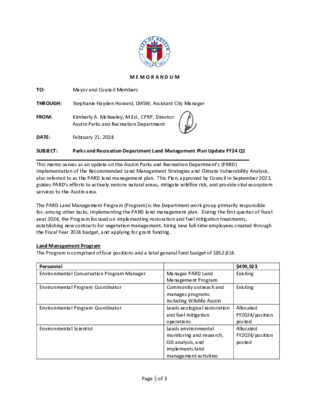
M E M O R A N D U M TO: THROUGH: FROM: Mayor and Council Members Stephanie Hayden Howard, LMSW, Assistant City Manager Kimberly A. McNeeley, M.Ed., CPRP, Director Austin Parks and Recreation Department February 21, 2024 DATE: SUBJECT: Parks and Recreation Department Land Management Plan Update FY24 Q1 _____________________________________________________________________________ This memo serves as an update on the Austin Parks and Recreation Department’s (PARD) implementation of the Recommended Land Management Strategies and Climate Vulnerability Analysis, also referred to as the PARD land management plan. This Plan, approved by Council in September 2023, guides PARD’s efforts to actively restore natural areas, mitigate wildfire risk, and provide vital ecosystem services to the Austin area. The PARD Land Management Program (Program) is the Department work group primarily responsible for, among other tasks, implementing the PARD land management plan. During the first quarter of fiscal year 2024, the Program focused on implementing restoration and fuel mitigation treatments, establishing new contracts for vegetation management, hiring new full-time employees created through the Fiscal Year 2024 budget, and applying for grant funding. Land Management Program The Program is comprised of four positions and a total general fund budget of $852,814. Personnel Environmental Conservation Program Manager Environmental Program Coordinator Environmental Program Coordinator Environmental Scientist Manages PARD Land Management Program Community outreach and manages programs including Wildlife Austin Leads ecological restoration and fuel mitigation operations Leads environmental monitoring and research, GIS analysis, and implements land management activities $499,923 Existing Existing Allocated FY2024/position posted Allocated FY2024/position posted Page 1 of 3 Contracts/Commodities $387,891 Expenses such as contracted restoration work, equipment, tools, safety equipment, fencing, signage, professional development, fuel, utilities, toll charges, vehicle repairs and maintenance, office supplies, and computer equipment. $35,000 852,814 Expense Refund TOTAL Staff from PARD’s Forestry and Park Ranger Programs were temporarily assigned to assist with planning and oversight of contracted fuel mitigation projects while new full-time staff are recruited, hired, and onboarded. First Quarter Fiscal Year 2024 (FY24) Accomplishments 621 acres of prescribed burns have been planned and permitted for completion this year. In November 2023, the Program hosted wildland fire training for Austin Civilian Conservation Corps members and additional staff from PARD, The Nature Conservancy, Austin Water, and the UT Lady Bird Johnson Wildflower Center. These and other organizations assist with prescribed burns on parkland through cooperative agreements. The Program also completed 44 acres of other ecological restoration treatments. Up to 300 acres are …
COLD WEATHER SHELTERS IN PARD Devon Farber, MSRLS, CPRP David Crabb, Division Manager AGENDA • Overview • Summary Data • Clients Served • Program Staff INTRODUCTION • In Fiscal Year 2024, the Parks and Recreation Department provided cold weather shelters to those in need during periods of inclement weather. This presentation will provide an overview of the response, including the number of guests served, the dates of operation, and the staff involved. • The decision to open Cold Weather Shelters is typically made daily in coordination with multiple departments based on temperature thresholds. CWS are activated if the overnight weather meets the activation criteria: •32 degrees or colder overnight •35 degrees, with rain/wet •35 degrees, with wind chill of 32 or colder THE DATA • 12 total days of operation this FY • Jan 13-Jan 20 8 consecutive days Jan 14 - Wed Jan 17 24/7 operation Total served: 3,167 guests • Total staff hours by seasonal staff: 878.5 • 14 Community Rec exempt staff assisted in the efforts • City shelters housed and fed 209, 404, 659, 590 and 405 people per night for a total of 2,267 people served at 7 shelters over 5 days, a record number. • The City partners with the Austin Area Urban League to manage shelter operations at 3 sites, and Cap Metro to coordinate transportation. GUESTS SERVED Total Guests served: 3,167 Men: 2,533 Women: 634 Pets: 27 COMMUNITY RECREATION MANAGERS Devon Farber Delano Brown West Baxter Kelly Maltsberger North District Program Manager Central District Program Manager South District Program Manager Seniors 50+ Program Manager Tamika Bateman Gus Garcia Rec Center Marco Olivares Austin Rec Center Clay Shelton Northwest Rec Center Russell Diggs Dove Springs Rec Center Billy James Turner-Roberts / Parque Zaragoza Rec Center Mark Vasquez Montopolis Rec Center PROGRAM SUPERVISORS OF COLD WEATHER SHELTERS SUMMARY • The FY2024 Parks and Recreation Cold Weather Shelter program has been instrumental in providing relief to thousands of individuals and families during cold weather conditions. With dedicated supervisors and program managers, as well as multiple sites operating efficiently, the initiative has significantly contributed to the welfare of the community during adverse weather situations.
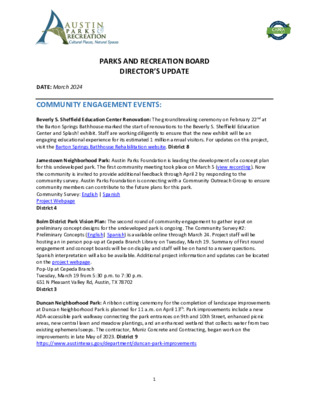
PARKS AND RECREATION BOARD DIRECTOR’S UPDATE DATE: March 2024 COMMUNITY ENGAGEMENT EVENTS: Beverly S. Sheffield Education Center Renovation: The groundbreaking ceremony on February 22nd at the Barton Springs Bathhouse marked the start of renovations to the Beverly S. Sheffield Education Center and Splash! exhibit. Staff are working diligently to ensure that the new exhibit will be an engaging educational experience for its estimated 1 million annual visitors. For updates on this project, visit the Barton Springs Bathhouse Rehabilitation website. District 8 Jamestown Neighborhood Park: Austin Parks Foundation is leading the development of a concept plan for this undeveloped park. The first community meeting took place on March 5 (view recording). Now the community is invited to provide additional feedback through April 2 by responding to the community survey. Austin Parks Foundation is connecting with a Community Outreach Group to ensure community members can contribute to the future plans for this park. Community Survey: English | Spanish Project Webpage District 4 Bolm District Park Vision Plan: The second round of community engagement to gather input on preliminary concept designs for the undeveloped park is ongoing. The Community Survey #2: Preliminary Concepts (English| Spanish) is available online through March 24. Project staff will be hosting an in person pop-up at Cepeda Branch Library on Tuesday, March 19. Summary of first round engagement and concept boards will be on display and staff will be on hand to answer questions. Spanish interpretation will also be available. Additional project information and updates can be located on the project webpage. Pop-Up at Cepeda Branch Tuesday, March 19 from 5:30 p.m. to 7:30 p.m. 651 N Pleasant Valley Rd, Austin, TX 78702 District 3 Duncan Neighborhood Park: A ribbon cutting ceremony for the completion of landscape improvements at Duncan Neighborhood Park is planned for 11 a.m. on April 13th. Park improvements include a new ADA-accessible park walkway connecting the park entrances on 9th and 10th Street, enhanced picnic areas, new central lawn and meadow plantings, and an enhanced wetland that collects water from two existing ephemeral seeps. The contractor, Muniz Concrete and Contracting, began work on the improvements in late May of 2023. District 9 https://www.austintexas.gov/department/duncan-park-improvements 1 The newly improved Duncan Neighborhood Park PLANNING UPDATES: Chapter 26 cases on Braker Lane and Old Lampasas Dam: The Parks and Recreation Department (Department) set public hearings for May 2nd to consider the permanent change of use of an existing …
Code Amendments for Bedroom Window Requirements Engagement Format • Presentation followed by question and answer session • Two ways to participate: - Written questions can be handed in; they will be read aloud and answered live. - Raise your hand. A microphone will be provided for you to ask one question out loud. (We can return to you if you have additional questions) What Prompted the Proposed Changes? • Concerns about UT student housing were shared with Council Member Zo Quadri's office. • The concerns focused on the code compliance of windowless bedrooms. • This led to conversations with DSD and AIA Austin about amending code related to windowless bedrooms and resulted in the creation of an Austin City Council Resolution. Austin City Council Resolution – Sept. 2023 • Initiated Code amendments to require access to natural light for all sleeping rooms in new buildings • The intent of the amendment is to provide natural light to all sleeping rooms in commercial construction, whether it be borrowed or direct light to the outside through a window. • Included proposed language for the Code amendments • Directed the City Manager to bring a proposed ordinance to Council before August 2024 Timeline for Bedroom Window Code Amendment Process* * Dates subject to change Code Adoption Timeline* • If approved in April 2024, the bedroom window amendments will go into effect on May 1, 2024*. • Upon approval these amendments will be carried over to the 2024 Code • If the 2024 code amendments are approved by City Council, it is anticipated that they will go into effect in 2025.* * Dates subject to change 2021 International Bldg Code (IBC) Chapter 2 Definitions Dwelling Unit – A single unit providing complete, independent living facilities for one or more persons, including permanent provisions for living, sleeping, eating, cooking and sanitation. Sleeping Unit - A single unit that provides rooms or spaces for one or more persons, includes permanent provisions for sleeping and can include provisions for living, eating and either sanitation or kitchen facilities but not both. Such rooms and spaces that are also part of a dwelling unit are not sleeping units. 2021 International Bldg Code (IBC) Section 1204 Lighting 1204.1 General Every space intended for human occupancy shall be provided with natural light by means of exterior glazed openings in accordance with Section 1204.2 and shall be provided with artificial light in …
PARKS AND RECREATION BOARD RECOMMENDATION 20240327-5 March 27, 2024 Duct Bank at Waller Beach at Town Lake Metropolitan Park Date: Subject: Motioned By: Kathryn Flowers Recommendation The Parks and Recreation Board recommends to Austin City Council to approve the permanent use and temporary use, not to exceed 160 days, of parkland located at Waller Beach at Town Lake Metropolitan Park (30 East Ave). Total mitigation fee is $1,774,993. Vote Seconded By: Lane Becker The motion to recommend to Austin City Council to approve the permanent use and temporary use, not to exceed 160 days, of parkland located at Waller Beach at Town Lake Metropolitan Park (30 East Ave). Total mitigation fee is $1,774,993 was approved on Vice Chair Flowers’ motion, Board Member Becker’s second on a 9-0 vote with one vacancy. Board Member Bazan absent. For: Pedro Villalobos, Kathryn Flowers, Lane Becker, Jennifer Franklin, Julie Hayes, Nicole Merritt, Shelby Orme, Holly Reed, Kim Taylor. Against: None. Abstain: None. Absent: Stephanie Bazan. Attest: Tim Dombeck, Board and Council Liaison, Parks and Recreation Department.
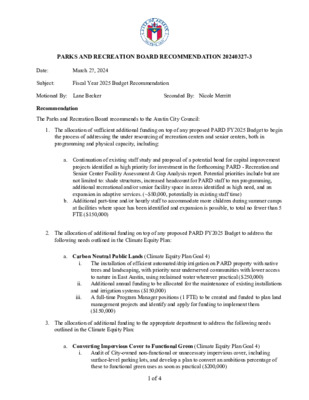
PARKS AND RECREATION BOARD RECOMMENDATION 20240327-3 March 27, 2024 Date: Subject: Motioned By: Lane Becker Recommendation Fiscal Year 2025 Budget Recommendation Seconded By: Nicole Merritt The Parks and Recreation Board recommends to the Austin City Council: 1. The allocation of sufficient additional funding on top of any proposed PARD FY2025 Budget to begin the process of addressing the under resourcing of recreation centers and senior centers, both in programming and physical capacity, including: a. Continuation of existing staff study and proposal of a potential bond for capital improvement projects identified as high priority for investment in the forthcoming PARD - Recreation and Senior Center Facility Assessment & Gap Analysis report. Potential priorities include but are not limited to: shade structures, increased headcount for PARD staff to run programming, additional recreational and/or senior facility space in areas identified as high need, and an expansion in adaptive services. (~$80,000, potentially in existing staff time) b. Additional part-time and/or hourly staff to accommodate more children during summer camps at facilities where space has been identified and expansion is possible, to total no fewer than 5 FTE ($150,000) 2. The allocation of additional funding on top of any proposed PARD FY2025 Budget to address the following needs outlined in the Climate Equity Plan: a. Carbon Neutral Public Lands (Climate Equity Plan Goal 4) i. The installation of efficient automated/drip irrigation on PARD property with native trees and landscaping, with priority near underserved communities with lower access to nature in East Austin, using reclaimed water wherever practical ($250,000) ii. Additional annual funding to be allocated for the maintenance of existing installations and irrigation systems ($150,000) iii. A full-time Program Manager positions (1 FTE) to be created and funded to plan land management projects and identify and apply for funding to implement them ($150,000) 3. The allocation of additional funding to the appropriate department to address the following needs outlined in the Climate Equity Plan: a. Converting Impervious Cover to Functional Green (Climate Equity Plan Goal 4) i. Audit of City-owned non-functional or unnecessary impervious cover, including surface-level parking lots, and develop a plan to convert an ambitious percentage of these to functional green uses as soon as practical ($200,000) 1 of 4 b. No Mow Signage (Climate Equity Plan Goal 4) i. Permanent signage to show city land is not being neglected but rather managed for wildlife. Signage should be prioritized in low income and …
JOINT INCLUSION COMMITTEE (JIC) RECOMMENDATION 20240327-002 AUSTIN BOARD AND COMMISSION BUDGET RECOMMENDATIONS TRACKER Strategic Direction: Government that works for all Date: March 27, 2024 Subject: AUSTIN BOARD AND COMMISSION BUDGET RECOMMENDATIONS TRACKER Strategic Direction: Government that works for all Motioned by: Commissioner Richard Bondi Seconded by: Commissioner Serita Fontanesi Recommendation Austin City Council approves the creation of and regularly updates of a publicly available, digital budget recommendation tracker for each fiscal year. This tracker will include a summary of each budget recommendation for that fiscal year from all of the boards and commissions, along with the status (submitted, in review, etc), and final outcome (edits, rejected, accepted, etc). The tracker can be as simple as an excel spreadsheet and as robust as the Texas Legislature Online Bill Lookup. Background and Rationale Every year Austin Boards and Commissions make budget recommendations to the city council based on commission priorities, community needs, and council goals. Commissioners spend countless hours meeting with council members, city departments, community members, and subject matter experts to craft well-informed and intentional recommendations. While board members and commissioners can follow up with council members for budget recommendations, this is not a sustainable method for update. Additionally, while the approved budget is publicly available and there are various reports shared each fiscal year about the progress various boards and commissions are making, there is no clear and central location for community members, or even commissioners to stay up to date on budget recommendations. Creating a publicly available, digital budget recommendation tracker will not only create more transparency across boards and commissions, the community, and council, it will also create a reference point for future budget processes. Board and commissions will be able to bring more efficiency to their budget recommendation process by having an easily accessible resource 1 available to review past recommendations. This tracker will also help retain institutional knowledge as board and commission members transition from year to year. As liaisons between the city and the community board and commission members will be able to easily direct community members to the tracker when questions related to the budget process and recommendation statuses arise. The goal of Austin’s boards and commissions is to create a space for community members to engage with the council and the city to make our city even better. By providing funding and resources to develop a budget recommendation tracker City Council can increase …
BOARD/COMMISSIONS RECOMMENDATION Joint Inclusion Committee Recommendation Number 20240327-003: Fiscal Year 2024-25 Funding for Collective Sex Crimes Response Model (CSCRM) Actions WHEREAS, the Joint Inclusion Committee (“JIC”) of the City of Austin (“City”) serves as an advisory body that advocates for and inspires the City Council (“Council”) and City Manager on issues pertaining to equity, diversity, and inclusion to promote close cooperation between Council, City Management, City boards, commissions, committees, and taskforces, and individuals, institutions, and agencies to increase and sustain equity, diversity, and inclusion in the city; and WHEREAS, in September 2019, the City Manager’s Office contracted the Police Executive Research Forum (PERF), in conjunction with the Women’s Law Project and the Wellesley Centers for Women, to undertake a comprehensive assessment of the way sexual assaults reported to the Austin Police Department (APD) are investigated and processed; and WHEREAS, sexual assault lawsuits were filed and settlements were approved for Smith et. al. vs City of Austin and Senko et. al. vs City of Austin; and WHEREAS, on November 14, 2022, the final PERF report was released, Austin Police Department (APD) Review, Reported Sexual Assault Comprehensive Evaluation, and included comprehensive findings and over one hundred recommendations; and WHEREAS, the Austin Police Department worked with the Austin/Travis County Sexual Assault Response and Resource Team (SARRT) to address the PERF recommendations and take actions, including revisions to APD policies and procedures; and WHEREAS, the Collective Sex Crimes Response Model (CSCRM) was established in early 2023 to coordinate the full response to the PERF report, and includes representatives from APD, SARRT, nonprofit and community organizations, survivors and survivor advocates; and WHEREAS, the Commission for Women and Public Safety Commission formed a joint working group in 2023 to support and track the work of the CSCRM and report progress to their respective commissions; and WHEREAS, the work of the CSCRM is significant in scope, spanning multiple working groups, and has identified serious unmet funding requirements and additional needs for fiscal year 2024- 2025; and WHEREAS, funding has been allocated to support APD comprehensive sexual assault/trauma curriculum development and delivery, additional detective hours on misdemeanor and cold cases, the hiring of a CSCRM project manager, the implementation of a survivor survey and a stipend for volunteer project members, among others; and WHEREAS, law enforcement staffing shortages and hiring challenges are impacting support for survivors of sexual assault, and training and increased financial support and innovative approaches …
BOARD/COMMISSION RECOMMENDATION Joint Inclusion Committee Budget 20240327-04: Recommendation Regarding Current Early Childhood Investments WHEREAS, the Joint Inclusion Commi that advocates for and inspires the City Counci equity, diversity, and inclusion to promote clo ent, City utions, and agencie boards, commissions, commi and sustain equity, diversity, and inclusion in t n Council, City Managem s to increase he city; and ttees, and task forces, and individuals, instit l (“Council”) and City Manager on issues pertaining t se cooperation betwee o ttee (“JIC”) of the City of Austin (“City”) serves as an advisory body WHEREAS, in the City of Austin, 31% of children under age 6 live in households with low income; and WHEREAS, 90% of the children in households with low income under age 6 are children of color; and decades WHEREAS, world because children birth-weight, at school; and of research prove that disadvantage s begin the moment childre n come into the born into poverty and children of color are disproportionately at low born early, or with chronic illnesses, and are less likely than their peers to be ready for, or successful investments WHEREAS, current City the Austin/Travis designed coordinated table acce systems for equi to coordinate improve child and family ss; and County Success By 6 Strategic efforts, in early childhood programs align with the goals and strategies of Plan - a robust, data-driven plan and as well as build more efficient community strategic outcomes WHEREAS, programs workforce; the federal, state, are expiring and and local economic recovery worker wage stipends funds invested for the early childhood in early childhood systems and in 2024, including essential Child Care Scholarship is closed, WHEREAS, no new funding enrollment amount of time a family applying they could expect through is available for a scholarship to be outreached for enrollment programs time will likely at that and is 24 months; at this time, and as of March 2024, the estimated remain on a wait list before Workforce Solutions Capital Area are at capacity, WHEREAS, region's skilled and trades; the skilled the City of Austin's recently announced Infrastructure is intended to expand the trade sector and access to child care is an obstacle workforce, including Academy for the existing WHEREAS, the Early Childhood Workgroup, and GAVA, all calling sector. Council has had input fro for significantly increased m Success By 6, The Childre n's Funding Project local government investment in the Childcare NOW, THEREFORE, …
BOARDCOMMISSION RECOMMENDATION Joint Inclusion Committee Recommendation Number: (20240327-005): Support for GO Repair Program WHEREAS, the Joint Inclusion Committee (“JIC”) of the City of Austin (“City”) serves as an advisory body that advocates for and inspires the City Council (“Council”) and City Manager on issues pertaining to equity, diversity, and inclusion to promote close cooperation between Council, City Management, City boards, commissions, committees, and task forces, and individuals, institutions, and agencies to increase and sustain equity, diversity, and inclusion in the city; and WHEREAS, those aged 65 years and older, represent the fastest-growing age group in Austin, expanding from 55,695 (7.0% of 2010 population) to 91,733 (9.5% of 2020 population), and growing at a rate of 64.7%; and WHEREAS, the Age-Friendly Austin Community Feedback Survey indicates that 74% of older city residents surveyed want to age in-place for as long as possible and respondents cited needing increased assistance for home repairs and maintenance in order to stay in their homes; and WHEREAS, the City of Austin has funded the GO Repair program with General Obligation bonds that helps low-income homeowners fix serious structural issues like accessibility accommodations, electrical and mechanical repairs, drywall, flooring, siding repairs and more, allowing homeowners to safely stay in their homes with the repair assistance channeled through area nonprofits; and WHEREAS, the current year’s funding of $5 million will assist over 200 households and will run out before the year is over because of strong demand for the program (current wait list top 250). NOW, THEREFORE, BE IT RESOLVED that the Joint Inclusion Committee encourages the Austin City Council to allocate continued General Obligation bond funding and explore all available additional funding avenues to fund the GO Repair program at a more adequate level that will allow the program to continue uninterrupted for all of FY25 ($10-15 million). Date of Approval: March 27, 2024 Record of the vote: 9-0, Commissioners Vargas and Gordon absent (ECC) Attest: _____________________________________________ Vice-Chair
BOARD/COMMISSION RECOMMENDATION Joint Inclusion Committee Recommendation Number: (20240327-006): Pedestrian Signaling WHEREAS, the Joint Inclusion Committee (“JIC”) of the City of Austin (“City”) serves as an advisory body that advocates for and inspires the City Council (“Council”) and City Manager on issues pertaining to equity, diversity, and inclusion to promote close cooperation between Council, City Management, City boards, commissions, committees, and task forces, and individuals, institutions, and agencies to increase and sustain equity, diversity, and inclusion in the city; and WHEREAS, persons aged 65 and older represent the fastest-growing age group in Austin, expanding from 55,695 (7.0% of 2010 population) to 91,733 (9.5% of 2020 population), and growing at a rate of 64.7%; and WHEREAS, the Age-Friendly Austin Community Feedback Survey indicates 23% of respondents were living with disability, including persons with physical issues, persons who are deaf or hard of hearing, and persons with; and persons with psychiatric or mental health issues, etc; and WHEREAS, Leading Pedestrian Interval signals (LPIs) adjust traffic signal timing to allow pedestrians to enter the cross walk five (5) to seven (7) seconds before vehicles get a green signal, allowing drivers in turn lanes to better identify the pedestrians before vehicles are allowed to turn; and WHEREAS, in 2019, the Austin Transportation Department (ATD), through collaboration with ATD Vision Zero staff, traffic signal engineers and public information staff installed LPIs at 110 intersections in Austin’s downtown/Central Business District to improve pedestrian safety in the city’s most active pedestrian zone; and WHEREAS, ATD conducted a survey following implementation to gauge early project feedback on the LPI installations and found that, “87% of respondents either agreed or strongly agreed that they felt safer crossing streets because they had a head start due to the LPI and 60% agreed or strongly agreed that they are more likely to use a crosswalk knowing that it has an LPI.” WHEREAS, Audible Pedestrian Signals (APSs), pedestrian hybrid beacons and countdown clocks provide important feedback to pedestrians, making them aware of the remaining duration of a walk light and enabling them to make better determinations on completing a safe crossing; and WHEREAS, City of Austin staff have cited up to a 25% crash reduction at certain intersections that received countdown clocks. NOW, THEREFORE, BE IT RESOLVED that the Joint Inclusion Committee recommends that the Austin Transportation Department continue data driven approaches and inter-department collaboration to identify and implement Leading Pedestrian Interval signals …
BOARD/COMMISSION RECOMMENDATION Joint Inclusion Committee Recommendation Number: (20240327-007): Parks & Recreation Funding WHEREAS, the Joint Inclusion Committee (“JIC”) of the City of Austin (“City”) serves as an advisory body that advocates for and inspires the City Council (“Council”) and City Manager on issues pertaining to equity, diversity, and inclusion to promote close cooperation between Council, City Management, City boards, commissions, committees, and task forces, and individuals, institutions, and agencies to increase and sustain equity, diversity, and inclusion in the city; and WHEREAS, persons aged 65 and older represent the fastest-growing age group in Austin, expanding from 55,695 (7.0% of 2010 population) to 91,733 (9.5% of 2020 population), and growing at a rate of 64.7%; and WHEREAS, Austin’s Age Friendly Action Plan includes an Outdoor Spaces component, indicating people need public places to gather — indoors and out. Green spaces, seating, and accessible buildings (elevators, zero-step entrances, and ramps) can be used and enjoyed by people of all ages and abilities. Age-friendly communities might require buildings to follow Universal Design Guidelines, a relatively new concept meaning building for people of all abilities including wheelchair users; and WHEREAS, Austin’s Age Friendly Action Plan includes a Social Participation component, indicating that Parks and Recreation Departments as well as local libraries are often the champions of social participation, recreation, and engagement for every community. These two agencies provide multi- generational programs as well as programs geared for specific ages. Their programs are critical for those who may feel the debilitating effects of isolation. Loneliness can be combated by creating opportunities to socialize and the availability of accessible, affordable, and fun social activities; and WHEREAS, Austin’s Age Friendly Action Plan includes a Work and Civic Engagement Spaces component, indicating that an age-friendly community encourages older people to be actively engaged in community life and has opportunities for residents to work for pay or volunteer their skills and that city parks are an excellent location for civic engagement and community engagement; and WHEREAS, the Austin Parks and Recreation Department (PARD) has been the steward of the City of Austin’s public lands since 1928. As such, PARD protects and maintains parkland, preserves trails, and offers a variety of sports, recreation, educational enrichment, arts programs, cultural opportunities, nature and aquatic activities; and WHEREAS, additional funding is crucial to avoid diverting resources from core programs and ensure compliance with safety regulations (NFPA 10, Texas Fire Code); and WHEREAS, increased …
BOARD/COMMISSION RECOMMENDATION Joint Inclusion Committee Recommendation Number: (20240327-008): Outreach for Emergency Preparedness WHEREAS, the Joint Inclusion Committee (“JIC”) of the City of Austin (“City”) serves as an advisory body that advocates for and inspires the City Council (“Council”) and City Manager on issues pertaining to equity, diversity, and inclusion to promote close cooperation between Council, City Management, City boards, commissions, committees, and task forces, and individuals, institutions, and agencies to increase and sustain equity, diversity, and inclusion in the city; and WHEREAS, persons aged 65 and older represent the fastest-growing age group in Austin, expanding from 55,695 (7.0% of 2010 population) to 91,733 (9.5% of 2020 population), and growing at a rate of 64.7%; and WHEREAS, feedback most often received is that Austinites, including older adults lack knowledge about where to find information related emergency preparedness, and often find themselves unprepared; and WHEREAS, in recent years, the winter storms and their aftermath raised concerns about reaching the "harder to reach" older citizens with timely information and assistance, indicating the need for a multi- modal approach to sharing information with older adults and their family caregivers; and WHEREAS, a multi-modal approach to communication would require print, digital and face-to-face communications with attention to language access and access to individuals with disabilities. And in order to be effective, this approach would require earmarked funding for the Age Friendly Coordination team at Austin Public Health; and WHEREAS, the Commission on Aging has identified emergency preparedness as a key priority requiring ongoing multi-modal outreach and communication multiple times each year to ensure consistent messaging and timely public awareness of essential programs and services related to preparedness for older individuals and family caregivers; and WHEREAS, community engagement with older individuals during Older Americans Month and needs assessment activities are essential to the overall public awareness of the growing population of older Austinites and their needs will require additional funding; and WHEREAS, existing effective multi-modal outreach campaigns cost approximately $5,000 per campaign, proposed funding needs will be $30,000 for multiple emergency preparedness campaigns, Older Americans Month, and ongoing community needs assessment activities. NOW, THEREFORE, BE IT RESOLVED that the Joint Inclusion Committee encourages the Austin City Council to allocate $30,000 to support Age Friendly Plan activities, to be allocated to multiple public awareness and educational outreach events related to informing older adults in the Austin area of emergency procedures and ongoing emergency preparedness planning for older …