Parks and Recreation Board Fiscal Year 24/25 Budget Recommendation: Reed Additional Recommendation #1: Funding for three (3) FTE positions to implement PARD’s Land Management Plan. Rationale: • On Sept. 21, 2023 the Austin City Council approved the Recommended Land Management Strategies and Climate Vulnerability Analysis for Austin Parks and Recreation Department natural areas • Five (5) FTEs needed to implement the plan, 0 FTEs were assigned • 2 FTEs were allocated in FY24 budget amendment • The estimated need is ~$200/ac ongoing for staffing and O&M, based on internal cost estimates and comparisons with similar programs • The Land Management Plan supports Austin’s Climate Equity Plan Goal #1: By 2030, legally protect an additional 20,000 acres of carbon pools on natural lands and manage all new and existing natural areas (approximately 70,000 acres total), focusing on resilience. • The Land Management Plan supports Austin/Travis County Community Wildfire Preparedness Plan (CWPP), Parks and Recreation Long Range Plan for 2020- 2030, and Green Infrastructure Strengths and Gaps Assessment for the City of Austin Reed Additional Recommendation #2: Funding for 14 additional FTEs for PARD Grounds Maintenance Team, to align with same level of service in FY14. Rationale: (This information was provided by my appointing Council Member Alison Alter’s office from research by Budget Office Staff and PARD.) Budget Office and PARD Staffing has identified that funding for CIP (Capital Improvement Projects) has not always included funding for ongoing Operations and Maintenance staff for new projects. PARD has provided data for its ground maintenance team comparing FY14 with FY23 budgeted and actual expenditures. PARD’s analysis shows that attaining ‘ideal’ service levels would require 190.4 FTEs for their grounds maintenance team, an increase of 70.4 FTEs from its current authorization. PARD has provided data for its ground maintenance team comparing FY14 with FY23 budgeted and actual expenditures. Over this nine-year period, the budget for this team has grown from $7,279,052 to $13,296,168, an increase of $6,017,116, or 82.7%. Actual expenses by this team were $7,083,168 in FY14 and $12,960,218 in FY23, an increase of $5,877,050 or 83.0%. This increase was primarily driven by an increase in labor costs associated with significant increases in the City’s living wage. For instance, while Parks Grounds Assistants earned as little as $12.31 per hour in FY14, the current base wage for these positions is $20.80 per hour. PARD has created a model for FY23 based on estimated man …
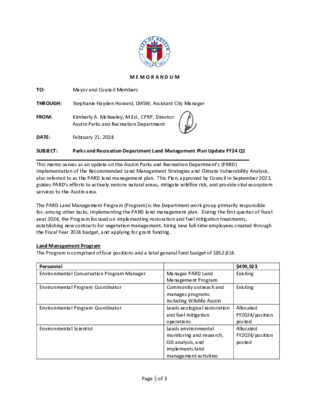
M E M O R A N D U M TO: THROUGH: FROM: Mayor and Council Members Stephanie Hayden Howard, LMSW, Assistant City Manager Kimberly A. McNeeley, M.Ed., CPRP, Director Austin Parks and Recreation Department February 21, 2024 DATE: SUBJECT: Parks and Recreation Department Land Management Plan Update FY24 Q1 _____________________________________________________________________________ This memo serves as an update on the Austin Parks and Recreation Department’s (PARD) implementation of the Recommended Land Management Strategies and Climate Vulnerability Analysis, also referred to as the PARD land management plan. This Plan, approved by Council in September 2023, guides PARD’s efforts to actively restore natural areas, mitigate wildfire risk, and provide vital ecosystem services to the Austin area. The PARD Land Management Program (Program) is the Department work group primarily responsible for, among other tasks, implementing the PARD land management plan. During the first quarter of fiscal year 2024, the Program focused on implementing restoration and fuel mitigation treatments, establishing new contracts for vegetation management, hiring new full-time employees created through the Fiscal Year 2024 budget, and applying for grant funding. Land Management Program The Program is comprised of four positions and a total general fund budget of $852,814. Personnel Environmental Conservation Program Manager Environmental Program Coordinator Environmental Program Coordinator Environmental Scientist Manages PARD Land Management Program Community outreach and manages programs including Wildlife Austin Leads ecological restoration and fuel mitigation operations Leads environmental monitoring and research, GIS analysis, and implements land management activities $499,923 Existing Existing Allocated FY2024/position posted Allocated FY2024/position posted Page 1 of 3 Contracts/Commodities $387,891 Expenses such as contracted restoration work, equipment, tools, safety equipment, fencing, signage, professional development, fuel, utilities, toll charges, vehicle repairs and maintenance, office supplies, and computer equipment. $35,000 852,814 Expense Refund TOTAL Staff from PARD’s Forestry and Park Ranger Programs were temporarily assigned to assist with planning and oversight of contracted fuel mitigation projects while new full-time staff are recruited, hired, and onboarded. First Quarter Fiscal Year 2024 (FY24) Accomplishments 621 acres of prescribed burns have been planned and permitted for completion this year. In November 2023, the Program hosted wildland fire training for Austin Civilian Conservation Corps members and additional staff from PARD, The Nature Conservancy, Austin Water, and the UT Lady Bird Johnson Wildflower Center. These and other organizations assist with prescribed burns on parkland through cooperative agreements. The Program also completed 44 acres of other ecological restoration treatments. Up to 300 acres are …
COLD WEATHER SHELTERS IN PARD Devon Farber, MSRLS, CPRP David Crabb, Division Manager AGENDA • Overview • Summary Data • Clients Served • Program Staff INTRODUCTION • In Fiscal Year 2024, the Parks and Recreation Department provided cold weather shelters to those in need during periods of inclement weather. This presentation will provide an overview of the response, including the number of guests served, the dates of operation, and the staff involved. • The decision to open Cold Weather Shelters is typically made daily in coordination with multiple departments based on temperature thresholds. CWS are activated if the overnight weather meets the activation criteria: •32 degrees or colder overnight •35 degrees, with rain/wet •35 degrees, with wind chill of 32 or colder THE DATA • 12 total days of operation this FY • Jan 13-Jan 20 8 consecutive days Jan 14 - Wed Jan 17 24/7 operation Total served: 3,167 guests • Total staff hours by seasonal staff: 878.5 • 14 Community Rec exempt staff assisted in the efforts • City shelters housed and fed 209, 404, 659, 590 and 405 people per night for a total of 2,267 people served at 7 shelters over 5 days, a record number. • The City partners with the Austin Area Urban League to manage shelter operations at 3 sites, and Cap Metro to coordinate transportation. GUESTS SERVED Total Guests served: 3,167 Men: 2,533 Women: 634 Pets: 27 COMMUNITY RECREATION MANAGERS Devon Farber Delano Brown West Baxter Kelly Maltsberger North District Program Manager Central District Program Manager South District Program Manager Seniors 50+ Program Manager Tamika Bateman Gus Garcia Rec Center Marco Olivares Austin Rec Center Clay Shelton Northwest Rec Center Russell Diggs Dove Springs Rec Center Billy James Turner-Roberts / Parque Zaragoza Rec Center Mark Vasquez Montopolis Rec Center PROGRAM SUPERVISORS OF COLD WEATHER SHELTERS SUMMARY • The FY2024 Parks and Recreation Cold Weather Shelter program has been instrumental in providing relief to thousands of individuals and families during cold weather conditions. With dedicated supervisors and program managers, as well as multiple sites operating efficiently, the initiative has significantly contributed to the welfare of the community during adverse weather situations.
PARKS AND RECREATION BOARD DIRECTOR’S UPDATE DATE: March 2024 COMMUNITY ENGAGEMENT EVENTS: Beverly S. Sheffield Education Center Renovation: The groundbreaking ceremony on February 22nd at the Barton Springs Bathhouse marked the start of renovations to the Beverly S. Sheffield Education Center and Splash! exhibit. Staff are working diligently to ensure that the new exhibit will be an engaging educational experience for its estimated 1 million annual visitors. For updates on this project, visit the Barton Springs Bathhouse Rehabilitation website. District 8 Jamestown Neighborhood Park: Austin Parks Foundation is leading the development of a concept plan for this undeveloped park. The first community meeting took place on March 5 (view recording). Now the community is invited to provide additional feedback through April 2 by responding to the community survey. Austin Parks Foundation is connecting with a Community Outreach Group to ensure community members can contribute to the future plans for this park. Community Survey: English | Spanish Project Webpage District 4 Bolm District Park Vision Plan: The second round of community engagement to gather input on preliminary concept designs for the undeveloped park is ongoing. The Community Survey #2: Preliminary Concepts (English| Spanish) is available online through March 24. Project staff will be hosting an in person pop-up at Cepeda Branch Library on Tuesday, March 19. Summary of first round engagement and concept boards will be on display and staff will be on hand to answer questions. Spanish interpretation will also be available. Additional project information and updates can be located on the project webpage. Pop-Up at Cepeda Branch Tuesday, March 19 from 5:30 p.m. to 7:30 p.m. 651 N Pleasant Valley Rd, Austin, TX 78702 District 3 Duncan Neighborhood Park: A ribbon cutting ceremony for the completion of landscape improvements at Duncan Neighborhood Park is planned for 11 a.m. on April 13th. Park improvements include a new ADA-accessible park walkway connecting the park entrances on 9th and 10th Street, enhanced picnic areas, new central lawn and meadow plantings, and an enhanced wetland that collects water from two existing ephemeral seeps. The contractor, Muniz Concrete and Contracting, began work on the improvements in late May of 2023. District 9 https://www.austintexas.gov/department/duncan-park-improvements 1 The newly improved Duncan Neighborhood Park PLANNING UPDATES: Chapter 26 cases on Braker Lane and Old Lampasas Dam: The Parks and Recreation Department (Department) set public hearings for May 2nd to consider the permanent change of use of an existing …
PARKS AND RECREATION BOARD RECOMMENDATION 20240327-5 March 27, 2024 Duct Bank at Waller Beach at Town Lake Metropolitan Park Date: Subject: Motioned By: Kathryn Flowers Recommendation The Parks and Recreation Board recommends to Austin City Council to approve the permanent use and temporary use, not to exceed 160 days, of parkland located at Waller Beach at Town Lake Metropolitan Park (30 East Ave). Total mitigation fee is $1,774,993. Vote Seconded By: Lane Becker The motion to recommend to Austin City Council to approve the permanent use and temporary use, not to exceed 160 days, of parkland located at Waller Beach at Town Lake Metropolitan Park (30 East Ave). Total mitigation fee is $1,774,993 was approved on Vice Chair Flowers’ motion, Board Member Becker’s second on a 9-0 vote with one vacancy. Board Member Bazan absent. For: Pedro Villalobos, Kathryn Flowers, Lane Becker, Jennifer Franklin, Julie Hayes, Nicole Merritt, Shelby Orme, Holly Reed, Kim Taylor. Against: None. Abstain: None. Absent: Stephanie Bazan. Attest: Tim Dombeck, Board and Council Liaison, Parks and Recreation Department.
PARKS AND RECREATION BOARD RECOMMENDATION 20240327-3 March 27, 2024 Date: Subject: Motioned By: Lane Becker Recommendation Fiscal Year 2025 Budget Recommendation Seconded By: Nicole Merritt The Parks and Recreation Board recommends to the Austin City Council: 1. The allocation of sufficient additional funding on top of any proposed PARD FY2025 Budget to begin the process of addressing the under resourcing of recreation centers and senior centers, both in programming and physical capacity, including: a. Continuation of existing staff study and proposal of a potential bond for capital improvement projects identified as high priority for investment in the forthcoming PARD - Recreation and Senior Center Facility Assessment & Gap Analysis report. Potential priorities include but are not limited to: shade structures, increased headcount for PARD staff to run programming, additional recreational and/or senior facility space in areas identified as high need, and an expansion in adaptive services. (~$80,000, potentially in existing staff time) b. Additional part-time and/or hourly staff to accommodate more children during summer camps at facilities where space has been identified and expansion is possible, to total no fewer than 5 FTE ($150,000) 2. The allocation of additional funding on top of any proposed PARD FY2025 Budget to address the following needs outlined in the Climate Equity Plan: a. Carbon Neutral Public Lands (Climate Equity Plan Goal 4) i. The installation of efficient automated/drip irrigation on PARD property with native trees and landscaping, with priority near underserved communities with lower access to nature in East Austin, using reclaimed water wherever practical ($250,000) ii. Additional annual funding to be allocated for the maintenance of existing installations and irrigation systems ($150,000) iii. A full-time Program Manager positions (1 FTE) to be created and funded to plan land management projects and identify and apply for funding to implement them ($150,000) 3. The allocation of additional funding to the appropriate department to address the following needs outlined in the Climate Equity Plan: a. Converting Impervious Cover to Functional Green (Climate Equity Plan Goal 4) i. Audit of City-owned non-functional or unnecessary impervious cover, including surface-level parking lots, and develop a plan to convert an ambitious percentage of these to functional green uses as soon as practical ($200,000) 1 of 4 b. No Mow Signage (Climate Equity Plan Goal 4) i. Permanent signage to show city land is not being neglected but rather managed for wildlife. Signage should be prioritized in low income and …
PARKS AND RECREATION BOARD MEETING MINUTES MARCH 27, 2024 PARKS AND RECREATION BOARD SPECIAL CALLED MEETING MINUTES MARCH 27, 2024 The PARKS AND RECREATION BOARD convened in a SPECIAL CALLED meeting on March 27, 2024 at 6310 Wilhelmina Delco Drive in Austin, Texas. Chair Villalobos called the PARKS AND RECREATION BOARD Meeting to order at 6:06 p.m. Board Members in Attendance: Pedro Villalobos, Kathryn Flowers, Lane Becker, Stephanie Bazan, Shelby Orme, Holly Reed. Board Members in Attendance Remotely: Jennifer Franklin, Julie Hayes, Nicole Merritt, Kim Taylor. Board Members Absent: None. PUBLIC COMMUNICATION: GENERAL Joe Kendall - Texas River School Aubrea Rudder - Austin Rowing Club Joe Riddell - Waterloo Greenway Conservancy Concerns Joel Manzo - Youth Baseball Advocate Jason Williams - Youth Baseball Advocate, Northwest Park Justin Graber - Youth Baseball Advocate, Garrison Park Horacio Garcia - Youth Baseball Advocate Rob Bluestein - Youth Baseball Advocate Sharon Blythe - Parkland used for infrastructure projects APPROVAL OF MINUTES 1. Approve the minutes of the Parks and Recreation Board regular meetings of February 26, 2024. The motion to approve the minutes of the Parks and Recreation Board regular meeting of February 26, 2024 was approved on Vice Chair Flowers’ motion, Chair Villalobos’ second on a 9-0 vote with one vacancy. Board Member Bazan absent. WORKING GROUP RECOMMENDATIONS 2. Report of recommendations by the Fiscal Year 2024-2025 Budget Working Group. Vice Chair Flowers addressed the Board regarding discussions of the working group, the needs of Austin’s Park system, and how to realistically have the most impact. No action was taken on this item. 1 PARKS AND RECREATION BOARD MEETING MINUTES MARCH 27, 2024 DISCUSSION AND ACTION ITEMS 3. Approve a recommendation to Austin City Council regarding the Austin Parks and Recreation Department’s Fiscal Year 2025 budget. The motion to approve the recommendation as posted in backup was made by Board Member Becker and seconded by Board Member Merritt. The motion to amend the recommendation to include funding for three full-time employee positions to implement PARD’s Land Management Plan was made by Board Member Reed and seconded by Chair Villalobos. Board Members discussed this amendment. Board Member Reed withdrew the motion. The motion to amend the recommendation to add Section 4 to read “The allocation of additional funding on top of any proposed PARD FY2025 Budget to address funding for fourteen additional full-time employees for the PARD Ground Maintenance Team in order to align …
JOINT SUSTAINABILITY COMMITTEE HYBRID MEETING FORMAT March 27th, 2024 at 6pm Council Chambers, City Hall 301 W 2nd St, Austin, TX 78701 Some members of the Committee may be participating by videoconference Public comment will be allowed in-person or remotely via telephone. Speakers may only register to speak on an item once either in-person or remotely and will be allowed up to three minutes to provide their comments. Registration no later than noon the day before the meeting is required for remote participation by telephone. To register to speak remotely, call or email Rohan Lilauwala at (rohan.lilauwala@austintexas.gov or 512-974-9394). CURRENT BOARD MEMBERS: Kaiba White, Chair (Electric Utility Commission) Diana Wheeler, Vice Chair (Urban Transportation Commission) Charlotte Davis (Resource Mgmt. Commission) Richard Brimer (Environmental Commission - Alternate) Melissa Rothrock (Zero Waste Advisory Commission) Bertha Delgado (Community Development Commission) Larry Franklin (Austin Travis County Food Policy Board) Chris Maxwell-Gaines (Water & Wastewater Commission) Amy Noel (Economic Prosperity Commission) Stephanie Bazan (Parks & Recreation Board) Jon Salinas (Design Commission) Vacant (City Council) Alice Woods (Planning Commission) Rodrigo Leal (Mayor’s Representative) Anna Scott (Mayor’s Representative) Heather Houser (Mayor’s Representative) Yureisly Suarez (Mayor’s Representative) Christopher Campbell (Mayor’s Representative) For more information, please visit: www.austintexas.gov/jsc AGENDA CALL TO ORDER PUBLIC COMMUNICATION: GENERAL The first 10 speakers signed up prior to the meeting being called to order will each be allowed a three-minute allotment to address their concerns regarding items not posted on the agenda. APPROVAL OF MINUTES 1. Approval of minutes from the February 28th meeting of the Joint Sustainability Committee. DISCUSSION 2. Presentation on the goals and strategies in the draft Austin-Travis County Food Policy Plan – Sergio Torres-Peralta, Office of Sustainability 3. Navigating Funding Opportunities – Erik Nelson and Belinda Weaver, Financial Services Department. 4. Presentation on the Staff Response to Resolution 20240215-025, the “Environmental Investment Plan” – Zach Baumer, Office of Sustainability. 5. Public Hearing on Resolution 20240215-025, the “Environmental Investment Plan” DISCUSSION AND ACTION ITEMS 6. Approve FY25 budget recommendations to support the implementation of the Austin Climate Equity Plan as it relates to the objectives of the Joint Sustainability Committee. FUTURE AGENDA ITEMS ADJOURNMENT The City of Austin is committed to compliance with the American with Disabilities Act. Reasonable modifications and equal access to communications will be provided upon request. Meeting locations are planned with wheelchair access. If requiring Sign Language Interpreters or alternative formats, please give notice at least 2 …
JOINT SUSTAINABILITY COMMITTEE REGULAR MEETING MEETING MINUTES Feb 28, 2024 The Joint Sustainability Committee convened in a hybrid meeting via videoconferencing and at Permitting and Development Center. Chair Kaiba White called the Board Meeting to order at 6:09 pm. Board Members in Attendance in Person: Kaiba White, Rodrigo Leal, Anna Scott, Jon Salinas, Chris Maxwell-Gaines, Christopher Campbell, Haris Qureshi, Charlotte Davis, Larry Franklin Board Members in Attendance Remotely: Diana Wheeler, Stephanie Bazan, Melissa Rothrock, Amy Noel, Heather Houser, Alberta Phillips Board Members Absent: Yure Suarez, Bertha Delgado City Staff in Attendance: Rohan Lilauwala, Zach Baumer CALL TO ORDER PUBLIC COMMUNICATION • Charlie Mossburger – St. Edwards Civic lab. o Spoke about ‘Get Fertilizer Wiser’ program to replace plants that have low fertilizer requirements • Chioma Okoro – street nurse o Spoke about mental health initiatives 1. Approval of minutes from the Jan 24th meeting of the Joint Sustainability Committee. • Qureshi motions to approve, Davis seconds, passes on 13-0 vote (Franklin, Phillips off dais) 2. Discussion on the benefits of adopting and implementing the Great Streets Initiative –Kevin Howard • Presentation on Great Streets Initiative • Commissioners discussed details and logistics of supporting a measure at length. 15. Approve a recommendation supporting adoption and implementation of the Great Streets Initiative. • Proposed amendments to clarify goals, add safety for bicycles and peds. • Salinas motions to support goals of Great Streets Initiative. Salinas motions, Davis seconds, passes 14-0 (Phillips off dais). 3. Discussion of next steps on the Environmental Investment Plan Resolution (Item 25 from 2/15 Council Meeting). • JSC will need to hold public hearing in May/Apr • Mar – broad, public input • Apr – narrow, possible staff draft list • May 1 – JSC presentation due; May 30 – staff response due • This is parallel with budget recommendations • JSC has commissioners over many of the plans. Homework for March meeting – each working group to look at each of the plans related to their group. • White to write a short message to share with home commissions 16. Creation of working group to advise on public input and recommendations that are responsive to the Environmental Investment Plan (Item 25 passed by the Austin City Council on 2/15). • Office of Sustainability staff support for working group • White, Leal, Scott, Qureshi, Davis, Salinas, Campbell, Franklin volunteer to be on • White motions to create a …
A Food Plan for Austin-Travis County Find your seat at the table Some Food for Thought Developing a Food Plan What is a Food Plan & why do we need one? ● A Food Plan sets clear Goals and Strategies to move toward a more equitable, sustainable & resilient food system ● The Food Plan builds on several other initiatives made by the County, City, and Communities to tackle key food system issues. ● The Food Plan centers equity and the lived expertise of those most impacted by the current food system Good to Know ● On June 2021 Austin City Council directed the City Manager to initiate a planning process ● Travis County Commissioners Court approved formal participation in the plan in fall 2022 ● A draft was released on March 18th and it’s now open for public comment. Link to full resolution Project Timeline Phase 0: Planning for the Plan Phase 1: Vision Development Phase 2: Goal & Strategy Development Phase 3: Review and Ground truthing September 2021 - January 2023 March - August 2023 September 2023 - February 2024 February - Summer/Fall 2024 We are here ● ● ● ● Building Community Awareness 📰 Release of State of the Food System Report 📚 Onboarding Planning Consultant⭐ Recruitment of Community Teams🚀 ● Website launch 📶 ● World Cafe’s ☕ ● ● ● ● Listening Sessions & Tabling at events 📞 Equity Grounding Workshops 🤝 Community Circles 👐 Selecting Issue Area Groups🍽 ● ● ● ● Issue Area Group Meetings 🏘 Develop Goals and Strategies 🎯 Review Goals and Strategies Develop a draft for the Food Plan 🖊 ● ● ● ● Community Review of Plan 👀 Council and Commissioner Review ⚖ Approval 👍 Adoption 🏁 Co-creating the plan ● Planning Team: Coordinating and managing all moving parts ○ Includes: ■ ■ ■ ■ ■ ■ City of Austin staff Travis County staff Consultant Team Equity Consultants Austin Travis Food Policy Board Executive Leadership Team ● Community Advisory Committee: Advisory body overseeing the planning process ● Issue Area Groups: Developing goals and strategies for the plan ● Community Food Ambassadors: Connecting the plan to our communities ● Broader community feedback: Provide input at different stages of the plan Food Plan Structure ● Vision: Describes and articulates our shared aim - the kind of future we agree we would like to move toward together. ● Objectives: The ends towards …
20240215-025 “Environmental Investment Plan” March 27, 2024 1 Resolution 20240215-025 Reaffirm commitment to net-zero by 2040, act with urgency. Prepare options and costs of capital improvements or programs that would: 1. Reduce carbon emissions 2. Decrease water usage and improve water quality and detention 3. Advance the sustainability of City Operations, and 4. Improve Community Resilience Public hearing of the JSC in March (27) / April (24) to gather input from the public JSC to submit any recommendations for investments to Council by May 1 Review whether recommendations can be funded through: - Utility rates and fees - General Fund Expenditures - Grants - General Obligation Bonds (may include Nov 2024) 2 Resolution 20240215-025 Analyze investments needed to fulfill the following adopted plans: - Climate Equity Plan - Water Forward - Watershed Protection Strategic Plan - Green Infrastructure Strengths and Gaps Assessment - One Austin: Climate Resilience Action Plan - Austin Strategic Mobility Plan - ARR Comprehensive Plan - AE Resource Generation Plan - - Austin Travis County Wildfire Preparedness Plan - Central Texas Regional Air Quality Plan - Urban Forest Plan - Austin Travis County Food Plan, State of the Food System Report, & Supply Chain Vulnerability PARD Land Management Plan and Long Range Plan Assessment Analysis should also identify options for fulfilling either all or specific elements of these plans before their current target date. 3 Resolution 20240215-025 Identify capital improvements and programs that would maximize potential Inflation Reduction Act tax credits, and to develop a mechanism for reinvestment of reimbursement from such credits into similarly climate-focused capital improvements and programs, where appropriate. Provide information detailing recommendations or actions taken to promote inter-departmental coordination to ensure that departments have an aligned approach to combating the threats of the climate crisis and natural hazards, including wildfire and flooding. Present to the City Council on or before May 30,2024, with an update of the Austin Climate Equity Plan dashboard, a combined inventory of plan recommendations, and a briefing or memo on applications and opportunities for federal funding relevant to an environmental investment plan. Public hearing on May 30 to consider this Environmental Investment Plan 4 What are they really looking for? Council Member R. Alter’s Office communicated that: - They’re not looking for business as usual spending. - They’re not looking for spending to make annual incremental progress. - They’re looking for the DELTA between our current trajectory and fully …
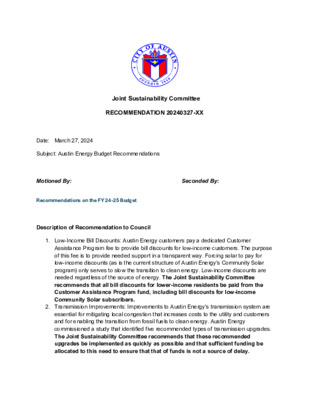
Joint Sustainability Committee RECOMMENDATION 20240327-XX Date: March 27, 2024 Subject: Austin Energy Budget Recommendations Motioned By: Seconded By: Recommendations on the FY 24-25 Budget Description of Recommendation to Council 1. Low-Income Bill Discounts: Austin Energy customers pay a dedicated Customer Assistance Program fee to provide bill discounts for low-income customers. The purpose of this fee is to provide needed support in a transparent way. Forcing solar to pay for low-income discounts (as is the current structure of Austin Energy’s Community Solar program) only serves to slow the transition to clean energy. Low-income discounts are needed regardless of the source of energy. The Joint Sustainability Committee recommends that all bill discounts for lower-income residents be paid from the Customer Assistance Program fund, including bill discounts for low-income Community Solar subscribers. 2. Transmission Improvements: Improvements to Austin Energy’s transmission system are essential for mitigating local congestion that increases costs to the utility and customers and for enabling the transition from fossil fuels to clean energy. Austin Energy commissioned a study that identified five recommended types of transmission upgrades. The Joint Sustainability Committee recommends that these recommended upgrades be implemented as quickly as possible and that sufficient funding be allocated to this need to ensure that that of funds is not a source of delay. 3. Fayette Coal Plant: Austin Energy and the Austin City Council have established that shutting down Austin Energy’s portion of the Fayette coal plant is a top priority. Investing in an asset that the utility is actively trying to shut down is not a prudent use of ratepayer or utility funds. The Joint Sustainability Committee recommends that the budget not include any capital investments in Fayette.
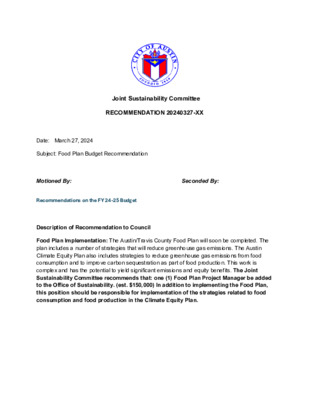
Joint Sustainability Committee RECOMMENDATION 20240327-XX Date: March 27, 2024 Subject: Food Plan Budget Recommendation Motioned By: Seconded By: Recommendations on the FY 24-25 Budget Description of Recommendation to Council Food Plan Implementation: The Austin/Travis County Food Plan will soon be completed. The plan includes a number of strategies that will reduce greenhouse gas emissions. The Austin Climate Equity Plan also includes strategies to reduce greenhouse gas emissions from food consumption and to improve carbon sequestration as part of food production. This work is complex and has the potential to yield significant emissions and equity benefits. The Joint Sustainability Committee recommends that: one (1) Food Plan Project Manager be added to the Office of Sustainability. (est. $150,000) In addition to implementing the Food Plan, this position should be responsible for implementation of the strategies related to food consumption and food production in the Climate Equity Plan.
Joint Sustainability Committee | Navigating Funding Opportunities Council Resolution Key Takeaways • Identify capital improvements and programs that would maximize potential Inflation Reduction Act tax credits, and develop a mechanism for reinvestments of reimbursement from such credits into similarly climate focused capital improvements and programs. • Review and identify which investments from the Committee have the option of being funded through utility rates and fees, general fund expenditures, grants, and/or bond instruments. Resolution: https://services.austintexas.gov/edims/document.cfm?id=424874 Funding Sources FY 2024 All City Operating Funds – $5.5 Billion Convention Center 5% Aviation 5% Austin Water 13% Austin Resource Recovery 2% General Fund Operations 24% GO Debt Service 4% Internal Service Operations 7% Other Expenses 6% Watershed Protection 2% Austin Energy 28% Transportation and Public Works 4% Funding Sources Utility Rates and Fees • $1.7 billion projected revenue for FY 2024. • 90% from rates and 10% from fees. • AE’s major expenditures include power supply costs, wholesale transmission costs, operating and maintenance expenses, debt service, investment in capital improvements, and transfers to the City’s General Fund. • Energy Efficiency Programs funded by the Community Benefit Charge include: • Rebates and incentives for energy efficiency improvements • Rebates for installation of rooftop solar systems • Austin Energy Green Building Program Funding Sources Utility Rates and Fees • $698.2 million projected revenue for FY 2023‐24. AW utilizes water and wastewater rate revenue through their operating budget and capital improvement program. • AW’s major expenditures include operating and maintenance costs, debt service payments, and transfers to other City funds, including the General Fund, Utility Billing Support, and Administrative Support. • GoPurple Program ‐ Increases use of reclaimed water in and around Austin. By 2040, onsite water reuse will save an estimated 6 million gallons of potable water per day. o Funded through a combination of fees and rates. Funding Sources FY 2024 General Fund Revenue – $1.4 Billion Sales Tax 27.8% Other Revenue 13.1% Utility Transfers 12.1% Property Tax 47.0% Funding Sources FY 2024 Budgeted General Fund Expenditures – 1.4 Billion Police 35% Housing and Planning 2% Parks and Recreation 9% Forensic Science 1% Municipal Court 3% Animal Services 2% EMS 9% Transfers & Other 7% Fire 18% Austin Public Health 9% Library 5% Funding Sources General Fund • The General Fund mainly consists of revenue from property taxes, sales taxes, and utility transfers. $1.4 billion projected revenue for FY 2023‐24. • The General Fund can …
Joint Sustainability Committee RECOMMENDATION 20240327-006 Date: March 27, 2024 Subject: Joint Sustainability Committee Budget Recommendations (Part 2) Recommendations on the FY 24-25 Budget Description of Recommendation to Council 1. Low-Income Bill Discounts: Austin Energy customers pay a dedicated Customer Assistance Program fee to provide bill discounts for low-income customers. The purpose of this fee is to provide needed support in a transparent way. Forcing solar to pay for low-income discounts (as is the current structure of Austin Energy’s Community Solar program) only serves to slow the transition to clean energy. Low-income discounts are needed regardless of the source of energy. The Joint Sustainability Committee recommends that all bill discounts for lower-income residents be paid from the Customer Assistance Program fund, including bill discounts for low-income Community Solar subscribers. Motion: Christopher Campbell Second: Amy Noel Vote: 12-0 Yes: Kaiba White, Rodrigo Leal, Anna Scott, Jon Christopher Campbell, Richard Brimer, Charlotte Davis, Diana Wheeler, Chris Maxwell-Gaines, Craig Nazor, Jon Salinas, Amy Noel, Alice Woods, Chris Campbell Off Dais: Anna Scott Absent: Yure Suarez, Heather Houser, Bertha Delgado, Stephanie Bazan 2. Transmission Improvements: Improvements to Austin Energy’s transmission system are essential for mitigating local congestion that increases costs to the utility and customers and for enabling the transition from fossil fuels to clean energy. Austin Energy commissioned a study that identified five recommended types of transmission upgrades. The Joint Sustainability Committee recommends that these recommended upgrades be implemented as quickly as possible, by 2030, and that sufficient funding be allocated to this need to ensure that that of funds is not a source of delay. Motion: Christopher Campbell Second: Amy Noel Vote: 12-0 Yes: Kaiba White, Rodrigo Leal, Anna Scott, Jon Christopher Campbell, Richard Brimer, Charlotte Davis, Diana Wheeler, Chris Maxwell-Gaines, Craig Nazor, Jon Salinas, Amy Noel, Alice Woods, Chris Campbell Off Dais: Anna Scott Absent: Yure Suarez, Heather Houser, Bertha Delgado, Stephanie Bazan 3. Fayette Coal Plant: Austin Energy and the Austin City Council have established that shutting down Austin Energy’s portion of the Fayette coal plant is a top priority. Investing in an asset that the utility is actively trying to shut down is not a prudent use of ratepayer or utility funds. The Joint Sustainability Committee recommends that the budget not include any capital investments in Fayette. The Joint Sustainability Committee also recommends allocating $175,000 to support water quality monitoring and remediation. Motion: Christopher Campbell Second: Amy Noel Vote: 12-0 …
JOINT SUSTAINABILITY COMMITTEE REGULAR MEETING MEETING MINUTES Mar 27, 2024 The Joint Sustainability Committee convened in a hybrid meeting via videoconferencing and City Hall. Chair Kaiba White called the Board Meeting to order at 6:20 pm. Board Members in Attendance in Person: Kaiba White, Rodrigo Leal, Anna Scott, Richard Brimer, Charlotte Davis, Diana Wheeler, Chris Maxwell-Gaines, Craig Nazor, Jon Salinas Board Members in Attendance Remotely: Amy Noel, Alice Woods, Chris Campbell Board Members Absent: Heather Houser, Bertha Delgado, Stephanie Bazan, Yure Suarez, Melissa Rothrock City Staff in Attendance: Rohan Lilauwala, Zach Baumer, Leti Alvarez, Sergio Torres-Peralta, Erik Nelson, Belinda Weaver CALL TO ORDER Chair Kaiba White called the meeting to order at 6:20 pm. PUBLIC COMMUNICATION 1. Approval of minutes from the Feb 28th meeting of the Joint Sustainability Committee. Brimer motions to approve, Maxwell-Gaines seconds, passes on 10-0 vote (Scott, Salinas off dais) 3. Navigating Funding Opportunities – Erik Nelson and Belinda Weaver, Financial Services Department Presentation on how the city budget works, and sources of revenue and how they function. White: are any revenue sources constrained? Nelson: general fund tight due to lege constraints, ways to override. Other sources have legal limitations on what they can be used for. 2. Presentation on the goals and strategies in the draft Austin-Travis County Food Policy Plan – Sergio Torres-Peralta, Office of Sustainability Presentation on high level food planning process, structure, goals, objectives Campbell: what are some hurdles to implement the plan? Torres: need to find a balance between community desires and what is feasible and can go in the plan. 4. Presentation on the Staff Response to Resolution 20240215-025, the “Environmental Investment Plan” – Zach Baumer, Office of Sustainability JSC will need 5. Public Hearing on Resolution 20240215-025, the “Environmental Investment Plan” Ted Eubanks – need to balance green with density (acres purchased and restored, wetland preserved, etc.). Inventory public lands, convert to green space, no net loss for green space, etc. Bobby Levinski, representing SOS Alliance – support Rewilding goals + programs to improve water quality. Protect land, water-smart infrastructure, smart mowing, study and mitigate damage from Fayette coal plant Spencer Schumacher – in support of ATX Walk Bike Roll, actionable items that can meet goals of ACEP and ASMP. $211 million delta between goals and funded items in mobility bonds. Tanya Payne – Rewilding ATX sent 10 recommendations. …
REGULAR MEETING of the JOINT INCLUSION COMMITTEE (JIC) WEDNESDAY, MARCH 27TH, 2024, at 3:00 P.M. CST CITY HALL, BOARDS & COMMISSIONS RM #1101 301 W. 2ND STREET, AUSTIN, TX 78701 MEETING AGENDA Some members of the Joint Inclusion Committee may be participating by videoconference. Public comment will be allowed in person or remotely via telephone. Speakers may only register to speak on an item once either in-person or remotely and will be allowed up to three minutes to provide their comments. Registration no later than noon the day before the meeting is required for remote participation by telephone. To register to speak remotely, call or email Alejandra Mireles (512) 978-1793 or (Community Services Program Coordinator, Equity Office) at alejandra.mireles@austintexas.gov. CURRENT JIC MEMBER COMMISSIONS & REPRESENTATIVES: Member Commission: African American Resource Advisory Commission Asian American Quality-of-Life Advisory Commission Commission for Women Commission on Aging Commission on Immigrant Affairs Early Childhood Council Hispanic/Latino Quality-of-Life Resource Advisory Commission Human Rights Commission LGBTQ+ Quality-of-Life Advisory Commission Mayor’s Committee for People with Disabilities Primary Representative: Serita Fontanesi Alternate Representative: Antonio Ross Sonny Sin Nayer Sikder Julie Glasser Richard Bondi (Vice-Chair) Teresa Ferguson Melissa Ortega Rebecca Austen Jose Caceres Leonor Vargas Amanda Afifi (Chair) Eliza Gordon Ivana Neri Morgan Davis Charles Curry Muneeb "Meebs" Aslam Melissa Taylor Jennifer Powell Lira Ramirez 1 AGENDA CALL TO ORDER PUBLIC COMMUNICATION The first ten speakers signed up prior to the meeting being called to order will each be allowed a three-minute allotment to address their concerns regarding items not posted on the agenda. APPROVAL OF MINUTES 1. Approve the minutes of the COMMITTEE’s REGULAR MEETING on February 28th, 2024. DISCUSSION ITEMS DISCUSSION AND ACTION ITEMS 2. Approve a recommendation for an Austin Board and Commission Budget Recommendations Tracker. Approve a recommendation for joint endorsement of the Commission for Women’s recommendation on the FY 2024-25 Budget for Funding Collective Sex Crimes Response Model (CSCRM) Action. Approve a recommendation for joint endorsement of the Early Childhood Council’s recommendation on the FY 2024-25 Budget for Current Early Childhood Investments. Approve a recommendation for joint endorsement of the Commission on Aging’s recommendation on the FY 2024-25 Budget for Funding for the GO Repair Program. Approve a recommendation for joint endorsement of the Commission on Aging’s recommendation on the FY 2024-25 Budget for Pedestrian Signaling. Approve a recommendation for joint endorsement of the Commission on Aging’s recommendation on the FY 2024-25 Budget for Parks …
ASIAN AMERICAN QUALITY-OF-LIFE ADVISORY COMMISSION RECOMMENDATION 20240319-011 Date: March 19, 2024 Subject: Recommendation on the FY 2024-25 Budget related to Austin Public Health Immigrant Legal Services Motioned by: Commissioner Satyajeet Dodia Seconded By: Commissioner Zahra Shakur Jamal-Hassan Austin Public Health Immigrant Legal Services Description The Asian American Quality-of-Life Advisory Commission (AAQoL) strongly recommends continued funding for the Austin Public Health (APH) Immigrant Legal Services program in the FY 2024-25 budget. This program plays a critical role in supporting the well-being of Austin's immigrant population. APH Immigrant Legal Services currently has 2 contracts in place for American Gateways and 1 contract in place for Catholic Charities, all of which are set to expire at the end of the current fiscal year. The recent closure of Refugee Services of Texas has further reduced options for legal immigration assistance available in the community for refugees, many of whom are from Asian and Middle Eastern countries. Currently, we are aware that American Gateways does not have sufficient resources to serve those needing immigrant legal services and has a waitlist. We strongly recommend continued funding for the APH Immigrant Legal Services program at a level that allows it to meet the growing needs of Austin's immigrant population. Contractors for this program provide critical legal assistance to immigrants in Austin. The program helps immigrants navigate the complex legal system, with a focus on areas like citizenship, deportation defense, and access to public benefits. Recommendation Ongoing funding of $700,000 is recommended to continue services currently being provided along with a suggested $150,000 increase to meet community legal needs from the closure of nonprofits serving refugees in our community. Department Austin Public Health (APH) Alignment with Council Strategic Priorities Government that works for all; Equity of City programs and resource allocation; Safety: Fair administration of justice Vote: 12-0 For: Chair Hanna Huang, Vice Chair Sarah Chen, Commissioners Satyajeet Dodia, Padmini Jambulapati, Anna Lan, Pierre Nguyen, Sabrina Sha, Zahra Shakur Jamal-Hassan, Nayer Sikder, Seonhye “Sonny” Sin, Luan Tran, and Lily Trieu Against: None Abstain: None Absent: Commissioners Mohsin Lari and Kuo Yang Attest: ______________________________ Eric Anderson, Staff Liaison
ASIAN AMERICAN QUALITY-OF-LIFE ADVISORY COMMISSION RECOMMENDATION 20240319-010 Date: March 19, 2024 Subject: Recommendation on the FY 2024-25 Budget for an Equity Office Data Analyst Associate position Motioned by: Vice Chair Sarah Chen Equity Office Data Analyst Associate position Seconded By: Commissioner Sonny Sin Description Data Equity for the Asian American, Native Hawaiian, and Pacific Islander (AANHPI) communities is a pressing issue that affects and informs the services we receive or do not. It is defined by the group AAPI Data as 1) inclusion and incorporation of community expertise and research expertise to 2) ensure equity in all stages and aspects of data and research, including: ● design and development ● collection, compilation, processing, ● analysis, dissemination, and preservation The AAQoL has received various staff and program presentations since our creation and one of the leading trends we see is that there is very little data collection that speaks to the nuances of how or if our broad AANHPI community is served. A Data Analyst Associate FTE position is recommended to be added to the Equity Office to complement the work they are doing with a data analyst associate that can assist in helping the Equity Office stay up to date on national data equity trends, assist with data analysis that can provide deeper insight into systematic issues and trends in available City data, and/or consult with other departments on data equity models and trends. Recommendation An ongoing amount of $95,000 is recommended to cover 1 Data Analyst Associate FTE. Department Equity Office Vote: 12-0 Alignment with Council Strategic Priorities Government that works for all; Equity of City programs and resource allocation For: Chair Hanna Huang, Vice Chair Sarah Chen, Commissioners Satyajeet Dodia, Padmini Jambulapati, Anna Lan, Pierre Nguyen, Sabrina Sha, Zahra Shakur Jamal-Hassan, Nayer Sikder, Seonhye “Sonny” Sin, Luan Tran, and Lily Trieu Against: None Abstain: None Absent: Commissioners Mohsin Lari and Kuo Yang Attest: ______________________________ Eric Anderson, Staff Liaison
ASIAN AMERICAN QUALITY-OF-LIFE ADVISORY COMMISSION RECOMMENDATION 20240319-015 Date: March 19, 2024 Subject: Recommendation on the FY 2024-25 Budget for the We All Belong Austin Against Hate Campaign Motioned by: Commissioner Pierre Nguyen We All Belong Austin Against Hate Campaign Seconded By: Commissioner Sonny Sin Description July 2023, the City launched an anti-hate education and outreach initiative called “We All Belong” to streamline access to tools to report hate crimes and incidents, making it easier for community members to keep Austin safe. This was during a disturbing upward trend that has continued in hate crimes in the city that were anti-Semitic, racist, and homophobic and was as directed by council in a 2021 resolution. Just in February of this year, a stabbing attack in West Campus of a group of South Asians was classified as a hate crime after the Council on American Islamic Relations (CAIR) issued a wide- alert about the context around the crime and held a press release at City Hall following it. Prior to that, news reports did not mention the use of racial slurs and targeting of the victim, who is Palestinian American. Our commission sees the continued need for the We All Belong Austin against the hate campaign and wants to see it continue its reach to along with staying current and updated with current news communities targeted disproportionately for their race, ethnicity, or religion. Recommendation $350,000 in one-time funding is recommended to sustain the program and campaign Department Communications & Public Information Office Alignment with Council Strategic Priorities Government that works for all; Equity of City programs and resource allocation, Safety, Proactive Prevention, Community Trust & Relationships Vote: 12-0 For: Chair Hanna Huang, Vice Chair Sarah Chen, Commissioners Satyajeet Dodia, Padmini Jambulapati, Anna Lan, Pierre Nguyen, Sabrina Sha, Zahra Shakur Jamal-Hassan, Nayer Sikder, Sonny Sin, Luan Tran, and Lily Trieu Against: None Abstain: None Absent: Commissioners Mohsin Lari and Kuo Yang Attest: ______________________________ Eric Anderson, Staff Liaison
COMMISSION FOR WOMEN RECOMMENDATION Commission for Women Recommendation Number 20240306-004: Fiscal Year 2024-25 Funding for Collective Sex Crimes Response Model (CSCRM) Actions WHEREAS, the Commission for Women (“Commission”) of the City of Austin (“City”) serves as an advisory body that advocates for and inspires the City Council (“Council”) and City Manager to prioritize women’s quality of life, so that Austin becomes the most equitable city in the nation for women and girls; and WHEREAS, in September 2019, the City Manager’s Office contracted the Police Executive Research Forum (PERF), in conjunction with the Women’s Law Project and the Wellesley Centers for Women, to undertake a comprehensive assessment of the way sexual assaults reported to the Austin Police Department (APD) are investigated and processed; and WHEREAS, sexual assault lawsuits were filed and settlements were approved for Smith et. al. vs City of Austin and Senko et. al. vs City of Austin; and WHEREAS, on November 14, 2022, the final PERF report was released, Austin Police Department (APD) Review, Reported Sexual Assault Comprehensive Evaluation, and included comprehensive findings and over one hundred recommendations; and WHEREAS, the Austin Police Department worked with the Austin/Travis County Sexual Assault Response and Resource Team (SARRT) to address the PERF recommendations and take actions, including revisions to APD policies and procedures; and WHEREAS, the Collective Sex Crimes Response Model (CSCRM) was established in early 2023 to coordinate the full response to the PERF report, and includes representatives from APD, SARRT, nonprofit and community organizations, survivors and survivor advocates; and WHEREAS, the Commission for Women and Public Safety Commission formed a joint working group in 2023 to support and track the work of the CSCRM and report progress to their respective commissions; and WHEREAS, the work of the CSCRM is significant in scope, spanning multiple working groups, and has identified serious unmet funding requirements and additional needs for fiscal year 2024- 2025; and WHEREAS, funding has been allocated to support APD comprehensive sexual assault/trauma curriculum development and delivery, additional detective hours on misdemeanor and cold cases, the hiring of a CSCRM project manager, the implementation of a survivor survey and a stipend for volunteer project members, among others; and WHEREAS, law enforcement staffing shortages and hiring challenges are impacting support for survivors of sexual assault, and training and increased financial support and innovative approaches are needed to overcome these shortfalls; and WHEREAS, the SAFE Alliance forensic nursing program is …
BOARD/COMMISSION RECOMMENDATION Commission on Aging Recommendation Number: (20240313‐5v): Additional Immunization Funding WHEREAS, persons aged 65 and older represent the fastest‐growing age group in Austin, expanding from 55,695 (7.0% of 2010 population) to 91,733 (9.5% of 2020 population), and growing at a rate of 64.7%; and WHEREAS, Austin Public Health Immunizations Unit aims to provide a vaccine safety net for vulnerable Travis County Residents; and WHEREAS, Adults ‐ in particular older adults, as noted the fastest growing age group in Austin, with the Asian older population exhibiting the fastest growth‐‐have limited options for free and low‐cost vaccinations in Austin/Travis County; and WHEREAS, the Adult Safety Net (ASN) program removed the shingles vaccine (Shingrix) in September of 2021 due to lack of funds; and WHEREAS, the ASN program removed the pneumococcal pneumonia vaccine (PCV20) in August of 2023 due to lack of funds; and WHEREAS, both of these vaccines are primarily recommended for older adults, with Shingrix being recommended for adults over 50 only; and WHEREAS, the APH Immunizations Unit purchased and administered over 900 shingles vaccines at a cost of approximately $180,000 including 300 shingles vaccines purchased so far in FY24 at a cost of $59,360; and WHEREAS, since August 2023 the APH Immunizations Unit purchased and administered over 170 doses of pneumococcal vaccine for a total of $44,465; and WHEREAS, the above purchases of these two vaccines have all been administered, the APH Immunizations Unit no longer has quantities available as a safety net for vulnerable residents; and WHEREAS, after the above dosages were administered, there’s an additional estimated unmet need of 3,500 Shingrix doses annually, representing 1,750 clients annually (Shingrix is a two‐dose series); and WHEREAS, after the above dosages were administered, there’s an additional estimated unmet need of 2,200 Pneumococcal vaccine doses annual, representing 2,200 clients annually; and WHEREAS, pricing for Shingrix vaccine is $1,862.19 for 10 doses as of 3/4/24; and WHEREAS, pricing for the PCV20 vaccine is $2,437.18 for 10 doses as of 3/4/24. NOW, THEREFORE, BE IT RESOLVED that the Commission on Aging encourages the Austin City Council to earmark and allocate $308,500 for the purchase of 1,000 additional Shringrix shingles (at two doses per person) and 500 additional PCV20 vaccines to help support at risk older adults in the Austin area. For: Bondi, Flatau, Adams, Angel, De Maria Nicola, Ferguson, Gonzalez, Lugo, Tyree, and Van de Putte Date of Approval: March 13th, 2024 Record …
BOARD/COMMISSION RECOMMENDATION Commission on Aging Recommendation Number: 20240313‐5ix Budget Reporting WHEREAS, the City of Austin’s Boards and Commissions are tasked with making annual budget recommendations to City Council; and WHEREAS, there is currently not a central, easily accessible, publicly available repository for board and commission budget recommendations; and WHEREAS, there is currently not a central, easily accessible, publicly available way to track the status of board and commission recommendations within a fiscal year, or year over year; and WHEREAS, the City of Austin’s Boards and Commissions serve as a liaison between city government and community members, using community guidance to inform council budget recommendations, and council budget decisions to educate community members on council priorities; and WHEREAS, the City of Austin’s Boards and Commissions experience term limits, transitions in leadership as well as membership, and changing priorities, all of which lead to a loss in institutional knowledge; and WHEREAS, Austin is the state capital, home of the state’s legislature, many of the legislature’s staff, and local as well as state policy advocates; and WHEREAS, it is reasonable that our city has the talent, skills, and resources necessary to develop a board and commission recommendation budget tracker. NOW THEREFORE, BE IT RESOLVED, the Commission on Aging recommends funding and staffing to create a digital, user friendly, publicly available board and commission budget recommendation tracker. BE IT FURTHER RESOLVED, this digital tracker can be as simple as a regularly updated excel spreadsheet on the board and commission’s website, or as robust as the Texas Legislature Online Bill Lookup website dependent on available funding and staff capacity. BE IT FURTHER RESOLVED, this digital tracker will be a resource for budget recommendations for each fiscal year, starting with the FY2024 budget cycle. BE IT FURTHER RESOLVED, this digital tracker will provide a brief summary of each recommendation with a link to the full recommendation, status update of where in the budget processes it is (submitted, under review by council, etc.), and a final outcome (accepted, rejected, modified, etc.), including any revised versions of the original recommendation. BE IT FURTHER RESOLVED, this digital tracker will be a tool to increase transparency and engagement in the budget process amongst boards and commissions, city council, and the communities across Austin, furthering a shared goal of government that works for all. Date of Approval: March 13th, 2024 Record of the vote: Motioned by: Flatau Seconded by: Van de …
BOARD/COMMISSION RECOMMENDATION Commission on Aging Recommendation Number: (20240313‐5vii): Equity Office Funding WHEREAS, persons aged 65 and older represent the fastest‐growing age group in Austin, expanding from 55,695 (7.0% of 2010 population) to 91,733 (9.5% of 2020 population), and growing at a rate of 64.7%; and WHEREAS the latest City of Austin Planning Department show Austin residents are 48% white, 32% Hispanic/Latina/o/x, 8% Asian/Asian American, 7% Black/African American, and 4% Multiracial; and WHEREAS, a recent survey by the City of Austin Office of Police Oversight indicated 22% of respondents identified as part of the LGBTQIA+ community; and WHEREAS, the Age‐Friendly Austin Community Feedback Survey indicates 23% of respondents were living with a disability; and WHEREAS, while not an all‐inclusive list, all of the demographics specified above are at risk for discrimination and being targeted, generally the older adults in those populations are the most vulnerable; and WHEREAS, in the last twelve months, the City of Austin has seen an increase in discrimination, targeting and persecution of multiple ethnicities; and WHEREAS, the Equity Office mission is “To provide leadership, guidance, and insight on equity to improve the quality of life for Austinites and achieve the vision of making Austin the most livable city in the nation for ALL;” and WHEREAS, the City of Austin Equity Office is currently operating without a permanently appointed Equity Officer; and WHEREAS, there are initiatives within the City of Austin to consolidate the Equity Office with other group(s). NOW, THEREFORE, BE IT RESOLVED that the Commission on Aging encourages the Austin City Council to act to maintain the autonomy of the Equity Office and further, to ensure adequate funding to hire and maintain an Equity Officer, and to designate adequate resources to Austin residents who may be experiencing discrimination, marginalization, hate crimes or persecution. NOW, THEREFORE, BE IT FURTHER RESOLVED that the Commission on Aging encourages the Austin City Council to support the Equity Office’s ongoing work to address the needs of Austinites and continue to convey that equity in Austin remains a high priority by retaining the Equity Office’s originally chartered autonomy. For: Bondi, Flatau, Adams, Angel, De Maria Nicola, Ferguson, Gonzalez, Lugo, Tyree, and Van de Putte Date of Approval: March 13th, 2024 Record of the vote: Motioned by: Van de Putte Seconded by: Tyree Against: None Abstain: None Attest: _____________________________________________ Richard Bondi, Chair Commission on Aging
. BOARD/COMMISSION RECOMMENDATION Commission on Aging Recommendation Number: (20240313‐5iv): Expansion of Emergency Housing and Rental Assistance Program WHEREAS, those aged 65 years and older, represent the fastest‐growing age group in Austin, expanding from 55,695 (7.0% of 2010 population) to 91,733 (9.5% of 2020 population), and growing at a rate of 64.7%; and WHEREAS, Austin continues to face a housing affordability crisis, particularly impacting renters that have seen multiple years of rental increases, and WHEREAS, the Age‐Friendly Austin Community Feedback Survey indicates that older city residents want to age in‐place for as long as possible and respondents who are experiencing unstable housing cited this was due to lack of affordability and gentrification; and WHEREAS, the City of Austin has provided funding for the RENT program, now referred to as “I Belong in Austin” which has successfully provided renters emergency assistance for rent, moving, and storage/relocation to prevent eviction, displacement, and homelessness; and WHEREAS, I Belong in Austin served a significant number of Austin individuals over 60 (14% of the total served) and continues to have an extensive waitlist, over 800 people when the program began this year and quickly grow to 4,000 before being capped indicating the continuing need for assistance. NOW, THEREFORE, BE IT RESOLVED that the Commission on Aging encourages the Austin City Council to allocate $15 million to support I Belong in Austin in the next fiscal year based on an evaluation of the program’s effectiveness in mitigating the affordability crisis and accomplish strategic goals related to housing stabilization, economic opportunity, and affordability. Date of Approval: March 13th, 2024 Record of the vote: Motioned by: Van de Putte Seconded by: Gonzalez For: Bondi, Flatau, Adams, Angel, De Maria Nicola, Ferguson, Gonzalez, Lugo, Tyree, and Van de Putte Against: None Abstain: None . Attest: _____________________________________________ Richard Bondi, Chair Commission on Aging
BOARD/COMMISSION RECOMMENDATION Commission on Aging Recommendation Number: (20240313‐5iii): Gus Garcia Recreation Center Temporary Expansion Space WHEREAS, persons aged 65 and older represent the fastest‐growing age group in Austin, expanding from 55,695 (7.0% of 2010 population) to 91,733 (9.5% of 2020 population), and growing at a rate of 64.7%; and WHEREAS, the Asian American population was the fastest‐growing race/ethnicity group among the Austin older population. The Asian American older population more than doubled from 2,051 in 2010 to 4,829 in 2020; and WHEREAS, the Gus Garcia Recreation Center currently serves a large percentage of Asian American older adults, aged 65 and older; and WHEREAS, 20231 participants at of all ages have increased significantly at the Gus Garcia Recreation Center over pre‐pandemic levels: Youth Programs 107%+ over 2019 levels Teen Programs 433%+ over 2019 levels Adult Programs 612% over 2019 levels Older Adult Programs 295% over 2019 levels; and WHEREAS, the physical space at the Gus Garcia Recreation Center is filled to capacity, with classes frequently having to occur in the lobby or programs being cancelled; and WHEREAS, due to space limitations, the older adult activities are severely curtailed during the months when the Summer Youth Programs are in operation, preventing expansion of adult and older adult programs that enrich the lives of adults and older adults; and WHEREAS, PARD is recommending expansion of the Gus Garcia Recreation Center to accommodate the vibrant and ethnically diverse older adult community that currently utilize the location; and WHEREAS, any permanent expansion will require a bond issue, which will likely delay opening of an expanded facility until 2028 at best. 1 These are incomplete counts for 2023 program participants at the Gus Garcia Recreation Center. NOW, THEREFORE, BE IT RESOLVED that the ______Commission on Aging_____________________ encourages the Austin City Council to allocate $30,000 annually for a 12’ x 60’ temporary space at the Gus Garcia Recreation Center to continue to encourage the participation of the diverse older adult community at that location. For: Bondi, Flatau, Adams, Angel, De Maria Nicola, Ferguson, Gonzalez, Lugo, Tyree, and Van de Putte Date of Approval: March 13th, 2024 Record of the vote: Motioned by: Ferguson Seconded by: Flatau Against: None Abstain: None Attest: _____________________________________________ Richard Bondi, Chair Commission on Aging
BOARD/COMMISSION RECOMMENDATION Commission on Aging Recommendation Number: (20240313‐5i): Outreach for Emergency Preparedness WHEREAS, persons aged 65 and older represent the fastest‐growing age group in Austin, expanding from 55,695 (7.0% of 2010 population) to 91,733 (9.5% of 2020 population), and growing at a rate of 64.7%; and WHEREAS, feedback most often received is that Austinites, including older adults lack knowledge about where to find information related emergency preparedness, and often find themselves unprepared; and WHEREAS, in recent years, the winter storms and their aftermath raised concerns about reaching the "harder to reach" older citizens with timely information and assistance, indicating the need for a multi‐ modal approach to sharing information with older adults and their family caregivers; and WHEREAS, a multi‐modal approach to communication would require print, digital and face‐to‐face communications with attention to language access and access to individuals with disabilities. And in order to be effective, this approach would require earmarked funding for the Age Friendly Coordination team at Austin Public Health; and WHEREAS, the Commission on Aging has identified emergency preparedness as a key priority requiring ongoing multi‐modal outreach and communication multiple times each year to ensure consistent messaging and timely public awareness of essential programs and services related to preparedness for older individuals and family caregivers; and WHEREAS, community engagement with older individuals during Older Americans Month and needs assessment activities are essential to the overall public awareness of the growing population of older Austinites and their needs will require additional funding; and WHEREAS, existing effective multi‐modal outreach campaigns cost approximately $5,000 per campaign, proposed funding needs will be $30,000 for multiple emergency preparedness campaigns, Older Americans Month, and ongoing community needs assessment activities. NOW, THEREFORE, BE IT RESOLVED that the Commission on Aging encourages the Austin City Council to earmark and allocate $30,000 to support Age Friendly Plan activities, to be allocated to multiple public awareness and educational outreach events related to informing older adults in the Austin area of emergency procedures and ongoing emergency preparedness planning for older adults and their family caregivers. For: Bondi, Flatau, Adams, Angel, De Maria Nicola, Ferguson, Gonzalez, Lugo, Tyree, and Van de Putte Date of Approval: March 13th, 2024 Record of the vote: Motioned by: Flatau Seconded by: Van de Putte Against: None Abstain: None Attest: _____________________________________________ Richard Bondi, Chair Commission on Aging
BOARD/COMMISSION RECOMMENDATION Commission on Aging Recommendation Number: (20240313‐5viii): Parks & Recreation Funding WHEREAS, persons aged 65 and older represent the fastest‐growing age group in Austin, expanding from 55,695 (7.0% of 2010 population) to 91,733 (9.5% of 2020 population), and growing at a rate of 64.7%; and WHEREAS, one mains focus of the Commission on Aging is furthering Austin’s Age Friendly Action Plan; and WHEREAS, Austin’s Age Friendly Action Plan includes an Outdoor Spaces component, indicating people need public places to gather — indoors and out. Green spaces, seating, and accessible buildings (elevators, zero‐step entrances, and ramps) can be used and enjoyed by people of all ages and abilities. Age‐friendly communities might require buildings to follow Universal Design Guidelines, a relatively new concept meaning building for people of all abilities including wheelchair users; and WHEREAS, Austin’s Age Friendly Action Plan includes a Social Participation component, indicating that Parks and Recreation Departments as well as local libraries are often the champions of social participation, recreation, and engagement for every community. These two agencies provide multi‐ generational programs as well as programs geared for specific ages. Their programs are critical for those who may feel the debilitating effects of isolation. Loneliness can be combated by creating opportunities to socialize and the availability of accessible, affordable, and fun social activities; and WHEREAS, Austin’s Age Friendly Action Plan includes a Work and Civic Engagement Spaces component, indicating that an age‐friendly community encourages older people to be actively engaged in community life and has opportunities for residents to work for pay or volunteer their skills and that city parks are an excellent location for civic engagement and community engagement; and WHEREAS, the Austin Parks and Recreation Department (PARD) has been the steward of the City of Austin’s public lands since 1928. As such, PARD protects and maintains parkland, preserves trails, and offers a variety of sports, recreation, educational enrichment, arts programs, cultural opportunities, nature and aquatic activities; and WHEREAS, only half of PARD sites have full‐time administrative support, which creates inconsistency for customers and disrupts service due to high turnover however, consistent, dedicated site specialists are crucial for building relationships and providing seamless customer experiences with PARD’s complex system; and WHEREAS, additional funding is crucial to avoid diverting resources from core programs and ensure compliance with safety regulations (NFPA 10, Texas Fire Code); and WHEREAS, standardizing PARD’s marketing processes is crucial for consistent, high‐quality materials across …
BOARD/COMMISSION RECOMMENDATION Commission on Aging Recommendation Number: (20240313‐5vi): Pedestrian Signaling WHEREAS, persons aged 65 and older represent the fastest‐growing age group in Austin, expanding from 55,695 (7.0% of 2010 population) to 91,733 (9.5% of 2020 population), and growing at a rate of 64.7%; and WHEREAS, the Age‐Friendly Austin Community Feedback Survey indicates 23% of respondents were living with disability, including persons with physical issues, persons who are deaf or hard of hearing, and persons with; and persons with psychiatric or mental health issues, etc; and WHEREAS, Leading Pedestrian Interval signals (LPIs) adjust traffic signal timing to allow pedestrians to enter the cross walk five (5) to seven (7) seconds before vehicles get a green signal, allowing drivers in turn lanes to better identify the pedestrians before vehicles are allowed to turn; and WHEREAS, in 2019, the Austin Transportation Department (ATD), through collaboration with ATD Vision Zero staff, traffic signal engineers and public information staff installed LPIs at 110 intersections in Austin’s downtown/Central Business District to improve pedestrian safety in the city’s most active pedestrian zone; and WHEREAS, ATD conducted a survey following implementation to gauge early project feedback on the LPI installations and found that, “87% of respondents either agreed or strongly agreed that they felt safer crossing streets because they had a head start due to the LPI and 60% agreed or strongly agreed that they are more likely to use a crosswalk knowing that it has an LPI.” WHEREAS, Audible Pedestrian Signals (APSs), pedestrian hybrid beacons and countdown clocks provide important feedback to pedestrians, making them aware of the remaining duration of a walk light and enabling them to make better determinations on completing a safe crossing; and WHEREAS, City of Austin staff have cited up to a 25% crash reduction at certain intersections that received countdown clocks. NOW, THEREFORE, BE IT RESOLVED that the Commission on Aging recommends that the Austin Transportation Department continue data driven approaches and inter‐department collaboration to identify and implement Leading Pedestrian Interval signals at locations outside of downtown that are adjacent to pedestrian attractors for older adults to promote the safe pedestrian travel and healthy aging of older adults. NOW, THEREFORE, BE IT FURTHER RESOLVED that the Commission on Aging recommends the Austin Transportation Department expand the installation of audible pedestrian signals, pedestrian hybrid beacons and countdown clocks at additional intersections across the city that need pedestrian safety improvements and that are …
BOARD/COMMISSION RECOMMENDATION Commission on Aging_ Recommendation Number: (20240313‐5ii): Support for GO Repair Program WHEREAS, those aged 65 years and older, represent the fastest‐growing age group in Austin, expanding from 55,695 (7.0% of 2010 population) to 91,733 (9.5% of 2020 population), and growing at a rate of 64.7%; and WHEREAS, the Age‐Friendly Austin Community Feedback Survey indicates that 74% of older city residents surveyed want to age in‐place for as long as possible and respondents cited needing increased assistance for home repairs and maintenance in order to stay in their homes; and WHEREAS, the City of Austin has funded the GO Repair program with General Obligation bonds that helps low‐income homeowners fix serious structural issues like accessibility accommodations, electrical and mechanical repairs, drywall, flooring, siding repairs and more, allowing homeowners to safely stay in their homes with the repair assistance channeled through area nonprofits; and WHEREAS, the current year’s funding of $5 million will assist over 200 households and will run out before the year is over because of strong demand for the program (current waitlists top 250). NOW, THEREFORE, BE IT RESOLVED that the Commission on Aging encourages the Austin City Council to allocate continued General Obligation bond funding and explore all available additional funding avenues to fund the GO Repair program at a more adequate level that will allow the program to continue uninterrupted for all of FY25 ($10‐15 million). Date of Approval: March 13th, 2024 Record of the vote: Motioned by: Fred Lugo Seconded by: Angel Against: None For: Bondi, Flatau, Adams, Angel, De Maria Nicola, Ferguson, Gonzalez, Lugo, and Tyree Abstain: Van de Puttee Attest: _____________________________________________ Richard Bondi, Chair Commission on Aging
HISPANIC/LATINO QUALITY OF LIFE RESOURCE ADVISORY COMMISSION RECOMMENDATION 20240326-10 Seconded By: Motioned By: Date: March 26, 2024 Subject: FY25 Budget Recommendations Family Stabilization Program as a Mechanism for Promoting Housing Stability Recommendation Affordability is an issue that continues to come up year after year, and it was the most common issue expressed by residents at all three Quality of Life Townhalls. People continue to see increases in rent and housing costs. The family stabilization program offers more flexible access to housing support, accords more choice and dignity, reduces discrimination, and offers more efficient and cost-effective housing. The current pilot shows funds are primarily helping Latino/a/x and Black families in the Eastern crescent. Gentrification has pushed families out of the areas they have been living in, some for generations. These permanent funds help keep people in their communities. Additionally, the program is also helping families whose communication is in a language other than English. Spanish was the second most common language requested on enrollment forms. D R A F T Rationale: According to findings from a recent brief from the Urban Institute titled Guaranteed Income as a Mechanism for Promoting Housing Stability, unrestricted cash investment addresses gaps and deficits in policies designed to address America’s housing affordability crisis. The brief reported, “Insights from a research review and policymaker interviews suggest that strategically applied cash relief could accomplish the following: ● Establish the Family Stabilization Grants as a permanent City of Austin program ● Expand funding to $3 million 1. Offer renters facing one-time or intermittent housing shocks more flexible access to Description of Recommendation to Council 2. Accord more choice and dignity to any renter in need of housing support. 3. Reduce exposure to voucher discrimination and offer more housing choices to housing support. marginalized populations. 4. Provide increased housing access to excluded workers. 5. Offer more efficient and cost-effective housing help to those in urgent need now.” According to UpTogether’s Central Texas 12-Month Pilot of the Strength-Based Approach: Final Report, “Between July 2021 and March 2022 members decreased their reliance on government subsidies. Fewer members applied for subsidies, vouchers, or other similar housing assistance (from 27% to 19%). The percentage of members receiving any type of government housing assistance was cut by half (16% to 8%).” Cash is an efficient and equitable form of housing assistance. UpTogether uncovered on a previous report that only 16% of members were receiving housing …
Motioned By: Date: March 26, 2024 HISPANIC/LATINO QUALITY OF LIFE RESOURCE ADVISORY COMMISSION RECOMMENDATION 20240326-13 Supporting Early Childhood Education and Development Funding Subject: FY24 Budget Recommendations Description of Recommendation to Council ● $1.5 M Austin Public Health multi-year allocation to Early Childhood Education and Recommendation Early childhood educators, caregivers and parents of young children deserve livable wages and affordable childcare: the two are not mutually exclusive. Local governments are crucial to investing/highlighting early childhood educators especially when state and federal governments are not. Childcare is a public good, it is economic infrastructure. Seconded By: D R A F T parents with high needs they are available ○ $500,000 Pilot early childhood mini-grants providing emergency financial relief for home-based licensed providers and Family, Friend, and Neighbor (FFN) caregivers; Center Based Care ○ Earmark $250,000 to fund a future contract with a qualified nonprofit, selected through a competitive bidding process, to provide health insurance support and ACA website navigation assistance, specifically for the early childhood workforce. Support specific to Early Childhood providers can include, but is not limited to: ■ Education on required documentation ■ Ability to schedule appointments with Early Childhood providers when care providers and families (toys, curriculum, technology, etc) available at APH Neighborhood Centers and APL branch libraries. ○ $250,000 to establish a no-cost lending library & EC resource center for child ■ Directly dispersed to childcare centers & registered licensed to support ○ $500,000 Early childhood education and development scholarships Development funding: ● Recommend updating the eligibility focus to include home-based childcare providers (licensed and FFN). Rationale: The cost of childcare is one of the biggest expenses families face. It is a daunting task to find affordable, high quality childcare. According to UT News, “The average cost for infant care in Texas is $777 per month, or $9,324 per year — nearly 14% of the state’s median household income of $67,321 and more expensive than a year of in-state tuition at a four-year public college.” Every child in Austin should be able to access high quality childcare without causing financial strain on the family. Childcare providers may encounter financial burdens that make it difficult for them to provide services on a consistent basis. Unexpected issues can derail childcare services. It can take time to navigate insurance claims while continuing to try and run a business. There are times the home-based childcare center may have to close as a …
HISPANIC/LATINO QUALITY OF LIFE RESOURCE ADVISORY COMMISSION RECOMMENDATION 20240326-10 Family Stabilization Program as a Mechanism for Promoting Housing Stability Date: March 26, 2024 Subject: FY25 Budget Recommendations Motioned By: We continue to hear from the community concerns regarding underfunding of immigration legal services. Only a small number of individuals are served with the current funding. There are very few organizations in Austin that have the ability to provide legal services to our immigrant communities pro bono. One of the service providers is American Gateways. They are currently only able to meet 25% of the need. The need for legal services continues to expand due to the complicated immigration legal system. Seconded By: D R A F T WHEREAS, we continue to hear from the community that legal services funding is crucial; and WHEREAS, there are immigrants who need access to counsel, and cannot afford attorneys. This is especially so for immigrants facing removal proceedings; and WHEREAS, in a time of changes in immigration policy, people have more need for legal representation, as it has become very complicated; and WHEREAS, it is essential that immigrant communities obtain accurate advice and assistance; and WHEREAS, the people most impacted by the complicated changes in immigration policy are low-income immigrants; and WHEREAS, the City of Austin funds legal services for low income immigrants who are Austin residents, and there is still unmet need; NOW, THEREFORE, BE IT RESOLVED that the Hispanic Latino Quality of Life recommends that the $490,000 allocated in FY 2023-2024 for immigration legal services become a permanent budget allocation in FY 2024-2025 and beyond. Vote For: Against: Abstain: Absent: Attest: Amanda Afifi, Chair Commissioner Neri, Commissioner Silva, Commissioner Afifi, Commissioner Vargas, Commissioner Perales, Commissioner Castañeda, Commissioner Galvan, Commissioner Jackson Jr., Commissioner May, Commissioner Vigil, Commissioner Maldonado D R A F T
LGBTQ QUALITY OF LIFE ADVISORY COMMISSION RECOMMENDATION 2 0 2 3 0 2 1 2 ‐ 6 FOR Budget for LGBTQIA+ AFFIRMING MENTAL HEALTHCARE WHEREAS the City of Austin’s 2021 LGBTQIA+ Quality of Life Study identified that the Austin‐Round Rock‐Georgetown metropolitan area had the 3rd largest percentage of LGBTQIA+ people in the United States, with about 5.0% or 90,000 people identifying as LGBTQIA+; and WHEREAS the City of Austin currently has an estimated 475‐person waitlist for LGBTQIA+‐focused mental health services; and WHEREAS the City of Austin’s 2021 LGBTQIA+ Quality of Life Study found that respondents are at high risk for serious mental health issues, including 42% for depression and 12% for suicidal ideation; and WHEREAS the City of Austin’s 2021 LGBTQIA+ Quality of Life Study respondents reported having to put off getting health‐related services in the past 12 months because of the cost of dental care (29%), mental health care (21%), medical care (18%), and gender‐affirming care (9%) among the top services avoided due to cost; and WHEREAS the City of Austin’s 2021 LGBTQIA+ Quality of Life Study respondents were asked about how they rate their overall mental health since the pandemic, more than half (52%) of the 1,882 respondents rated their mental health as fair, poor, or very poor, a sizeable increase in mental health concerns; and WHEREAS nearly half (45%) of respondents in the Austin‐based QWELL Community Foundation’s 2021 survey rated their mental health as poor or fair; and WHEREAS according to the 2022 Austin Public Health Community Health Assessment, there exists significant mental health needs including stigma and limited access to mental health care. Among Travis County residents, the suicide rate was 12.2 deaths per 100,000 population and highest among males (18.5 deaths per 100,000 population) and White residents (17.1 deaths per 100,000 population) in 2016‐ 2020. In 2020, a higher percentage of females (33.0%) compared to males (20.9%) reported poor mental health, and the prevalence of poor mental health days has increased by 7 overall for both genders. In the same year, a higher percentage of Hispanic/Latino adults (31.5%) reported poor mental health compared to White (26.3%) and Black/African American (22.9%) adults. In 2020, the highest proportion of adults experiencing poor mental health was seen among adults aged 18‐29 (32.6%) and 30‐44 years of age (34.3%); and WHEREAS, of the seven million dollars of mental health funding in FY24 social service contracts, only $161,673 (2%) provides …
RECOMMENDATION 03112023‐2 Funding for Emergency Housing Assistance WHEREAS Aus(cid:415)n con(cid:415)nues to face a housing affordability crisis par(cid:415)cularly impac(cid:415)ng renters that have seen mul(cid:415)ple years of rental increases, and WHEREAS the LGBTQ Quality of Life Study noted that the increased cost of rental housing was the highest‐ranked domain of priority for par(cid:415)cipants in the town hall mee(cid:415)ngs, and WHEREAS, in the referenced Study, 10% of respondents indicated they had been homeless in the last 5 years, 65% of respondents spent 30% or more of their income on housing while 9% spent more than half of their income, and WHEREAS the City of Aus(cid:415)n provided funding for a program en(cid:415)tled “I Belong in Aus(cid:415)n” to provide emergency assistance for renters in danger of losing their housing including short‐term rental assistance as well as moving and storage expenses to lessen the impact of forced reloca(cid:415)on, and WHEREAS “I Belong in Aus(cid:415)n” had over 800 people on the wai(cid:415)ng list when the program began this year, and that wai(cid:415)ng list quickly grew to 4,000 before being capped at that number indica(cid:415)ng the con(cid:415)nuing need for this assistance, NOW, THEREFORE, BE IT RESOLVED that the LGBTQ Quality of Life Commission recommends that the Aus(cid:415)n City Council approve con(cid:415)nued funding in the next fiscal year based on an evalua(cid:415)on of the program’s effec(cid:415)veness in preven(cid:415)ng homelessness for diverse clients to mi(cid:415)gate the affordability crisis and accomplish strategic goals related to housing stabiliza(cid:415)on, economic opportunity, and affordability.