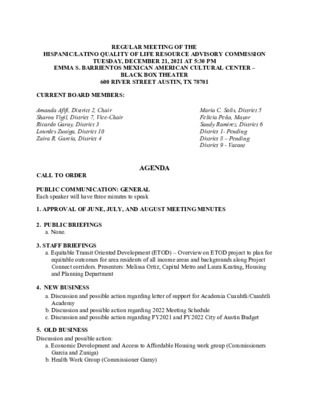
REGULAR MEETING OF THE HISPANIC/LATINO QUALITY OF LIFE RESOURCE ADVISORY COMMISSION TUESDAY, DECEMBER 21, 2021 AT 5:30 PM EMMA S. BARRIENTOS MEXICAN AMERICAN CULTURAL CENTER – BLACK BOX THEATER 600 RIVER STREET AUSTIN, TX 78701 CURRENT BOARD MEMBERS: Amanda Afifi, District 2, Chair Sharon Vigil, District 7, Vice-Chair Ricardo Garay, District 3 Lourdes Zuniga, District 10 Zaira R. Garcia, District 4 CALL TO ORDER PUBLIC COMMUNICATION: GENERAL Each speaker will have three minutes to speak Maria C. Solis, District 5 Felicia Peña, Mayor Sandy Ramirez, District 6 District 1- Pending District 8 – Pending District 9 - Vacant AGENDA 1. APPROVAL OF JUNE, JULY, AND AUGUST MEETING MINUTES 2. PUBLIC BRIEFINGS a. None. 3. STAFF BRIEFINGS a. Equitable Transit Oriented Development (ETOD) – Overview on ETOD project to plan for equitable outcomes for area residents of all income areas and backgrounds along Project Connect corridors. Presenters: Melissa Ortiz, Capital Metro and Laura Keating, Housing and Planning Department 4. NEW BUSINESS a. Discussion and possible action regarding letter of support for Academia Cuauhtli/Cuauhtli Academy b. Discussion and possible action regarding 2022 Meeting Schedule c. Discussion and possible action regarding FY2021 and FY2022 City of Austin Budget 5. OLD BUSINESS Discussion and possible action: a. Economic Development and Access to Affordable Housing work group (Commissioners Garcia and Zuniga) b. Health Work Group (Commissioner Garay) c. Representatives to Joint Inclusion Committee (Chair Afifi and Vice-Chair Vigil) d. Representatives to Commission on Seniors (Commissioner Solis) e. Budget and Policy Priorities Work Group (Chair Afifi, Vice-Chair Vigil, Commissioners Peña and Zuniga) f. COVID-19 Work Group (Commissioner Zuniga) g. Education Work Group (Chair Afifi, Vice-Chair Vigil, Commissioners Zuniga and Garcia) h. Public Safety Work Group (Chair Afifi and Commissioner Peña) i. Arts and Culture Work Group (Chair Afifi) j. Strategic Initiatives and HLQOL Report (All Commissioners) FUTURE AGENDA ITEMS ADJOURNMENT The City of Austin is committed to compliance with the American with Disabilities Act. Reasonable modifications and equal access to communications will be provided upon request. Meeting locations are planned with wheelchair access. If requiring Sign Language Interpreters or alternative formats, please give notice at least 2 days (48 hours) before the meeting date. Please call Amanda Jasso at City of Austin Equity Office at 512-974-9107 for additional information; TTY users route through Relay Texas at 711. For more information on the Hispanic/Latino Quality of Life Resource Advisory Commission please contact Amanda Jasso at Amanda.Jasso@austintexas.gov
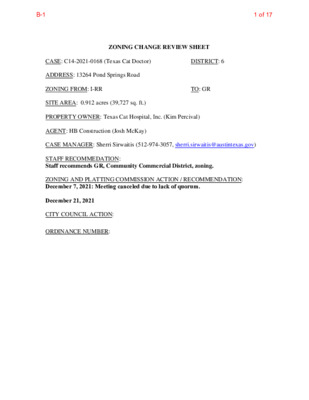
ZONING CHANGE REVIEW SHEET CASE: C14-2021-0168 (Texas Cat Doctor) DISTRICT: 6 ADDRESS: 13264 Pond Springs Road ZONING FROM: I-RR TO: GR SITE AREA: 0.912 acres (39,727 sq. ft.) PROPERTY OWNER: Texas Cat Hospital, Inc. (Kim Percival) AGENT: HB Construction (Josh McKay) CASE MANAGER: Sherri Sirwaitis (512-974-3057, sherri.sirwaitis@austintexas.gov) STAFF RECOMMEDATION: Staff recommends GR, Community Commercial District, zoning. ZONING AND PLATTING COMMISSION ACTION / RECOMMENDATION: December 7, 2021: Meeting canceled due to lack of quorum. December 21, 2021 CITY COUNCIL ACTION: ORDINANCE NUMBER: 1 of 17B-1 C14-2021-0168 2 ISSUES: N/A CASE MANAGER COMMENTS: The property in question is a 0.912 acre lot located at the southwest corner of Roxie Drive and Pond Springs Road that contains a one-story veterinary clinic. The lots to the north, across Pond Springs Road, contain a cemetery and duplex residences. To the south, there is an industrial park along Roxie Drive and Boardwalk Drive. The properties to the east are developed with industrial office and warehouse uses. To the west, there is an office use and equipment rental business. The applicant is asking to establish permanent zoning on this lot to bring the existing Pet Services use into conformance with requirements of the Land Development Code. The staff recommends GR, Community Commercial District, zoning because the site under consideration meets the intent of the requested district. The property is located at the entrance to an industrial park. The proposed zoning is consistent with surrounding land use and zoning patterns as there are office, commercial and industrial uses located to the south, east and west. GR zoning will permit the applicant to bring the veterinary clinic into conformance with land use regulations specified in the Code. The applicant agrees with the staff’s recommendation. BASIS OF RECOMMENDATION: 1. The proposed zoning is consistent with the purpose statement of the district sought. The Community commercial (GR) district is the designation for an office or other commercial use that serves neighborhood and community needs and that generally is accessible from major traffic ways. The property is located on Pond Springs Road, a minor arterial roadway. There is a public transit stop is located 0.20 linear miles from the subject property. 2. The proposed zoning promotes consistency and orderly planning. The proposed zoning is consistent with surrounding land use patterns as there is an industrial park with commercial and industrial uses to the south and east and office and commercial uses along …
ZONING CHANGE REVIEW SHEET SITE AREA: 0.85 acres (37,026 square feet) DISTRICT: 5 ZONING TO: CS CASE: C14-2021-0151 – AR - JR .85 ZONING FROM: I-SF-2 ADDRESS: 11501 Menchaca Road PROPERTY OWNER: AR & JR Real Estate Holdings (Charles Norris) AGENT: Bennett Consulting (Rodney Bennett) CASE MANAGER: Wendy Rhoades (512-974-7719, wendy.rhoades@austintexas.gov) STAFF RECOMMENDATION: The Staff recommendation is to grant community commercial – conditional overlay (GR-CO) combining district zoning. The Conditional Overlay prohibits the following uses: automotive washing (of any type), bail bond services, commercial off-street parking, drop-off recycling collection facility, exterminating services, funeral services, outdoor entertainment, outdoor sports and recreation, pawn shop services, and service station. For a summary of the basis of Staff’s recommendation, see pages 2-3. ZONING AND PLATTING COMMISSION ACTION / RECOMMENDATION: December 21, 2021: December 7, 2021: MEETING CANCELLED; RENOTIFICATION REQUIRED CITY COUNCIL ACTION: January 27, 2022: ORDINANCE NUMBER: ISSUES: The Applicant is in agreement with the Staff recommendation of GR-CO district zoning. CASE MANAGER COMMENTS: The subject four platted lots are located at the southeast corner of Menchaca Road and Chappell Lane, and also have frontage on Easy Street. The property is accessed via one driveway to Menchaca Road, and there is fencing along the east half of Chappell and the entire Easy Street frontage. The lots contain a vacant equipment rental use that occupied an office / warehouse building and a second warehouse structure, both one-story. The property and adjacent commercial properties on Menchaca Road to the south were annexed into the City limits on November 20, 2017 and assigned interim – single family residence - standard 1 of 14B-4 C14-2021-0151 Page 2 lot (I-SF-2) zoning at that time. In May 2008, prior to annexation, a “D” (non-land use) site plan was approved for the equipment rental business (SP-2007-0653D). There is a walking trail, condominiums and a single family residential subdivision to the north (SF-6-CO; I-SF-2); single family residences, manufactured homes and undeveloped land to the east (County); automotive sales and a commercial building containing a tattoo business, barber shop, and retail sales uses on Menchaca Road to the south (I-SF-2), and commercial uses across Menchaca to the west (GR-CO; CS-1-CO; CS-CO). Please refer to Exhibits A (Zoning Map) and A-1 (Aerial View). The Applicant proposes to zone the property to the general commercial services (CS) district so that the existing buildings can be converted to an automotive repair business. As information, an auto …
ZONING CHANGE REVIEW SHEET SITE AREA: 8.977 acres ZONING TO: MF-4 CASE: C14-2021-0161 – West William Cannon Housing DISTRICT: 5 ZONING FROM: LO-CO ADDRESS: 3101 West William Cannon Drive PROPERTY OWNER: Jubilee Christian Center (Jimmy R. Seal) AGENT: Armbrust & Brown, PLLC (Michael J. Whellan) CASE MANAGER: Wendy Rhoades (512-974-7719, wendy.rhoades@austintexas.gov) STAFF RECOMMENDATION: The Staff recommendation is to grant multifamily residence – moderate-high density (MF-4) district zoning. For a summary of the basis of Staff’s recommendation, see page 2. ZONING AND PLATTING COMMISSION ACTION / RECOMMENDATION: December 21, 2021: December 7, 2021: MEETING CANCELLED; RENOTIFICATION REQUIRED CITY COUNCIL ACTION: January 27, 2022: ORDINANCE NUMBER: ISSUES: The Applicant has met with representatives of the Persimmon Hollow Condominiums on William Cannon, the adjacent community to the west. Petition information is attached and the results will be certified upon receipt of original signatures from adjacent property owners. All correspondence received from adjacent residents is attached at the back of the Staff report. CASE MANAGER COMMENTS: The subject undeveloped property consists of seven platted lots and a vacated right-of-way with approximately 1,450 linear feet of frontage on West William Cannon Drive. The westernmost lot has frontage on Stage Coach Trail, a 200-foot long public street that provides vehicular access to the Persimmon Hollow Condominiums to the west. Two 1995- 1996 rezoning cases (which occurred prior to the right-of-way vacation) covered the west and east portions of the property and Council approved the limited office – conditional 1 of 33B-5 C14-2021-0161 Page 2 overlay (LO-CO) district for each case. The Conditional Overlay limits the number of vehicle trips to 2,000 per day on each case, and prohibits vehicular access to Stage Coach Trail on the western case. City maps show a creek buffer area running in a northerly to southerly direction through the western portion of the site and continuing to the 147 acre Stephenson Preserve to the south. Creek Buffers are unbuildable areas. There are single family residences in the Western Hills at Cherry Creek subdivision and apartments across William Cannon to the north (SF-3; SF-2; MF-2-CO), undeveloped land and a church to the east (LO-CO; LO); the Stephenson Preserve to the south (PUD), and attached condominiums across Stage Coach Trail to the west that also have frontage on William Cannon (SF-3). The Imagine Austin Growth Concept Map identifies West William Cannon Drive as an Activity Corridor which is a reflection of both land …
MEMORANDUM ************************************************************************ TO: Zoning and Platting Commission Members FROM: Sherri Sirwaitis Housing and Planning Department DATE: November 29, 2021 RE: ************************************************************************ The staff would like to request an indefinite postponement of the above mentioned case. The staff is asking for this postponement to complete our review of this PUD rezoning request. The postponement request was made in a timely manner and meets the Zoning and Platting Commission’s policy. C814-96-0003.18 (Pioneer Crossing PUD Amendment #18) Postponement Request 1 of 1B-7
ENVIRONMENTAL COMMISSION MOTION 20211103 002a Date: November 3, 2021 Seconded by: Perry Bedford Subject: Park 183 Buildings 6 & 7 (SP-2021-0072C) Motion by: Kevin Ramberg RATIONALE: WHEREAS, the Environmental Commission recognizes the applicant is requesting a variance from 25-8-342 to allow fill over four feet to seventeen feet, and WHEREAS, the Environmental Commission recognizes that staff recommends these variances (with one condition) having determined the required Findings of Fact have been met. THEREFORE, the Environmental Commission recommends the variance request with the following Staff Conditions: 1. Applicant will provide structural containment of fill with retaining walls. For: Bedford, Qureshi, Scott, Barrett Bixler, Bristol, Ramberg, Guerrero, and Brimer Against: None Abstain: None Recuse: None Absent: Thompson VOTE 8-0 Approved By: Linda Guerrero, Environmental Commission Chair 1 of 44B-8 ITEM FOR ENVIRONMENTAL COMMISSION AGENDA COMMISSION MEETING DATE: 11/03/2021 Park 183 Buildings 6 & 7 (SP-2021-0072C) Nick Brown, P.E., LDC COUNCIL DISTRICT: 4800 Distribution Drive & 7900 Industry Way NAME & NUMBER OF PROJECT: NAME OF APPLICANT OR ORGANIZATION: LOCATION: ENVIRONMENTAL REVIEW STAFF: WATERSHED: REQUEST: STAFF RECOMMENDATION: District 2 Tunde Daramola, Environmental Review Specialist Senior, DSD, 512-974-6316, Babatunde.Daramola@austintexas.gov Onion Creek Watershed, Suburban, Desired Development Zone Variance request is as follows: Request to vary from LDC 25-8-342 to allow fill over 4 feet up to 17 feet Staff recommends this variance, having determined the findings of fact to have been met. STAFF CONDITION: Provide structural containment of fill with retaining walls. 2 of 44B-8 Development Services Department Staff Recommendations Concerning Required Findings Project Name: Ordinance Standard: Watershed Protection Ordinance / Comprehensive Watershed Park 183 Buildings 6 & 7 Variance Request: Ordinance / Other To allow for fill exceeding 4ft for building construction Include an explanation with each applicable finding of fact. A. Land Use Commission variance determinations from Chapter 25-8-41 of the City Code: 1. 2. The requirement will deprive the applicant of a privilege available to owners of similarly situated property with approximately contemporaneous development subject to similar code requirements. Yes. The variance will not be providing a special privilege to the applicant. The proposed buildings are similar in size to similarly situated property. The style of the building proposes a single finished floor building with a 4 -foot loading dock and flat truck court. In order to facilitate this type of development, significant levelling is required to enhance maneuverability into the loading docks, allowing trucks to operate safely on site. The limits …
ZONING AND PLATTING COMMISSION- SITE PLAN- EXTENSION REVIEW SHEET SPC-2007-0497C(XT3) CASE NUMBER: PROJECT NAME: Offices at Ribelin Ranch- Phase 1; The ADDRESS OF SITE: 7016 Ribelin Ranch Drive WATERSHED: Bull Creek (Water supply suburban) Tom Stacy, Austin Baptist Church 9003 Waterford Centre Blvd, Ste 100 Austin, TX 78717 Richard Suttle, Armbrust & Brown 100 Congress Ave, Ste. 1300 Austin, TX 78701 APPLICANT/ OWNER: ZAP HEARING DATE: Dec. 21, 2021 COUNCIL DISTRICT: 10 JURISDICTION: Full Purpose (512) 435-2378 (512) 974-2784 rosemary.avila@austintexas.gov AGENT: CASE MANAGER: Rosemary Avila PROPOSED DEVELOPMENT: The applicant is requesting a fifteen year extension to a previously approved site plan. The proposed development is religious assembly. SUMMARY STAFF RECOMMENDATION: Staff does not recommend approval of a fifteen year extension. Staff recommends a ten year extension the to this site plan permit expiration. 25-5-63(C) Extension of released site plan by the Land Use Commission: “the Land Use Commission may extend the expiration date of a released site plan beyond the date established by this chapter if the Land Use Commission determines that the request complies with the requirements for extension by the director under 25-5-62 (Extension of Released Site Plan by Director).” 25-5-62(C) The director may extend the expiration date of a released administrative site plan one time for a period of one year if the director determines that there is good cause for the requested extension; and “ (1) the director determines that: (a) the site plan substantially complies with the requirements that apply to a new application for site plan approval; (b) the applicant filed the original application for site plan approval with the good faith expectation that the site plan would be constructed; (c) the applicant constructed at least one structure shown on the original site plan that is suitable for permanent occupancy; or (d) the applicant has constructed a significant portion of the infrastructure required for development of the original site plan; and” SUMMARY OF SITE PLAN: LAND USE: The site is zoned PUD, all site calculations are within the allowed amount. The applicant filed the original application for site plan approval with the good faith expectation that the site plan would 1 of 6B-9 Site Plan administrative approval, permit expiration 09/13/2010 One year Site Plan Extension administrative approval, permit expiration 08/31/2011 SPC-2007-0497C(XT3) Offices at Ribelin Ranch- Phase 1; The be constructed. ENVIRONMENTAL: All environmental comments have been cleared. AUSTIN TRANSPORTATION DEPT: All ATD comments have …
ZONING AND PLATTING COMMISSION HILL COUNTRY ROADWAY SITE PLAN REVIEW SHEET 6 620 Volvo 23.08 acres 10600 FM 620 North Lake Travis (Water Supply Rural) SPC-2019-0394C ZAP COMMISSION DATE: December 21, 2021 David Stein Budget Leasing, Inc. 5735 E US 290 Hwy Austin, TX 78724 Keith Parkan LandDev Consulting, LLC 5508 W US 290 Hwy, Ste. 150 Austin, Texas 78735 CASE NUMBER: PROJECT NAME: ADDRESS: DISTRICT: WATERSHED: AREA: APPLICANT: AGENT: CASE MANAGER: Christine Barton-Holmes, CNUa, LEED AP (512) 974-2788 christine.barton-holmes@austintexas.gov EXISTING ZONING: GR-MU-CO/LO-MU-CO The applicant proposes to construct a car dealership with associated PROPOSED USE: improvements within the Moderate Intensity Zone of the RM 620 Hill Country Roadway Corridor. The project is located at the front of the site in the GR-MU-CO district, where the use is permitted, and outside of the buffers for the Critical Environmental Features onsite. REQUEST: The site is located within the Moderate Intensity Zone of the RM 620 Hill Country Roadway Corridor, and must be presented to the Zoning and Platting Commission for approval, a Hill Country Roadway Ordinance requirement. WAIVER REQUEST: There are no waiver requests with this application. SUMMARY STAFF RECOMMENDATION FOR HCRC SITE PLAN: Staff recommends approval of this Hill Country Roadway site plan. The site plan complies will all other applicable requirements of the Land Development Code including all Hill Country Roadway Corridor development regulations, and was rezoned with Ordinance 20181213-075 to expand permissible uses. All comments have been cleared. The question is to grant or deny; additional conditions may not be imposed. 1 of 7B-10 PROPOSED PARKING:108 PROPOSED USE: Auto Sales PROPOSED F.A.R.: .03:1 PROPOSED HEIGHT: 26’ PROPOSED BLDG. CVRG: 3% PROPOSED IMP. CVRG.: 18.35%) ZONING AND PLATTING COMMISSION ACTION: NA LEGAL DESCRIPTION: Tract 1: 24.987 acres of land, more or less, according to the deed recorded in document 2016 EXIST. ZONING: GR-MU-CO ALLOWED F.A.R.: 0.25:1 ALLOWED HEIGHT: 28’ MAX. BLDG. COVERAGE: 75% MAX. IMPERV. CVRG.: 95% MIN. REQ. HC NATURAL AREA: 1.25 ac PROVIDED: 1.75 ac REQUIRED PARKING: 92 Environmental: This site is located in the Lake Travis watershed, and is subject to Water Supply Rural Watershed regulations. All environmental comments have been addressed and cleared. There are CEF’s on the subject site, but they are not affected by the proposed development. Transportation: Access to the proposed site will be taken from RM 620 and Buckner Road. The site plan will comply with all transportation requirements prior to release. …
SUBDIVISION REVIEW SHEET CASE NO.: C8-2021-0090.0A COMMISSION DATE: December 21, 2021 SUBDIVISION NAME: Maxwell Subdivision ADDRESS: 2114 Maxwell Lane APPLICANT/AGENT: Sergio Lozano-Sanchez, P.E. (LOC Consultants Civil Division, Inc.) ZONING: SF-3 (Family Residence) NEIGHBORHOOD PLAN: Montopolis AREA: 0.59 acres (25,700 sf) LOTS: 5 COUNTY: Travis DISTRICT: 3 WATERSHED: Carson Creek JURISDICTION: Full Purpose VARIANCE: None DEPARTMENT COMMENTS: STAFF RECOMMENDATION: The request is for Final Plat approval for 5 Single Family lots comprised of 3 Cottage Special Use Single Family lots and 2 regular Single Family lots on 0.50 acres (25,700 sf). Staff recommends disapproval of the Final Plat for the reasons listed in the master comment report dated December 16, 2021, and attached as Exhibit C. The plat does not comply with the criteria for approval in LDC 25-4-84(B) and staff recommends disapproval for the reasons listed in the attached master comment report. An application that has been disapproved with reasons may be updated to address those reasons until the application expires. If the applicant submits an update to address the reasons for disapproval, that update will be presented to the Land Use Commission within fifteen days of submittal. CASE MANAGER: Juan Enriquez, Senior Planner PHONE: 512-974-2767 E-mail: juan.enriquez@austintexas.gov ATTACHMENTS Exhibit A: Vicinity Map Exhibit B: Proposed Final Plat Exhibit C: Comment Report Dated December 16, 2021 1 of 10 2 of 10 TRAVIS COUNTY CONSUMER PROTECTION NOTICE TO HOME BUYERS: IF YOU ARE BUYING A LOT IN THIS SUBDIVISION, YOU SHOULD DETERMINE WHETHER THE SUBDIVISION AND THE LAND AROUND IT ARE INSIDE OR OUTSIDE THE CITY LIMITS. THIS CAN AFFECT THE ENJOYMENT AND VALUE OF YOUR HOME. DEPENDING ON STATE LAW AND OTHER FACTORS, LAND OUTSIDE THE CITY LIMITS MAY BE SUBJECT TO FEWER LOCAL GOVERNMENT CONTROLS OVER THE DEVELOPMENT AND USE OF LAND THAN INSIDE THE CITY LIMITS. THE SUBDIVISION'S RESTRICTIVE COVENANTS MAY CREATE PRIVATELY ENFORCEABLE RESTRICTIONS INCOMPATIBLE LAND USES WITHIN THE AGAINST SUBDIVISION, WHETHER IT IS INSIDE OR OUTSIDE THE CITY LIMITS. DEPENDING ON STATE LAW AND OTHER FACTORS, HOWEVER, OUTSIDE THE CITY LIMITS NEITHER PRIVATE NOR GOVERNMENTAL RESTRICTIONS MAY BE AVAILABLE TO (1) RESTRICT EITHER THE NATURE OR EXTENT OF DEVELOPMENT NEAR THE SUBDIVISION, OR (2) PROHIBIT LAND USES NEAR THE SUBDIVISION THAT ARE INCOMPATIBLE WITH A RESIDENTIAL NEIGHBORHOOD. 3 of 10 9.2 0' 0.40' 0.60' LOT 1 JESSE TORRES SUBDIVISION BOOK 56, PAGE 27 T.C.P.R. (EASTERLY 130') S64°36'39"E 130.10' LOT 5 5,872.45 SF=0.13 ACRES C A …
ZONING AND PLATTING COMMISSION- SITE PLAN- EXTENSION REVIEW SHEET SP-2007-0549B(XT3) CASE NUMBER: PROJECT NAME: Kallestad Laboratories, Inc. - PRA Site Plan ADDRESS OF SITE: 10010 FM 2222 Road WATERSHED: ZAP HEARING DATE: Dec. 21, 2021 COUNCIL DISTRICT: 10 JURISDICTION: Full Purpose APPLICANT/ OWNER: Bull Creek (Water supply suburban) Tom Stacy, Austin Baptist Church 9003 Waterford Centre Blvd, Ste 100 Austin, TX 78717 Richard Suttle, Armbrust & Brown 100 Congress Ave, Ste. 1300 Austin, TX 78701 (512) 435-2378 (512) 974-2784 rosemary.avila@austintexas.gov AGENT: CASE MANAGER: Rosemary Avila PROPOSED DEVELOPMENT: The applicant is requesting a fifteen year extension to a previously approved site plan. The proposed development is religious assembly. SUMMARY STAFF RECOMMENDATION: Staff does not recommend approval of a fifteen year extension. Staff recommends a ten year extension the to this site plan permit expiration. 25-5-63(C) Extension of released site plan by the Land Use Commission: “the Land Use Commission may extend the expiration date of a released site plan beyond the date established by this chapter if the Land Use Commission determines that the request complies with the requirements for extension by the director under 25-5-62 (Extension of Released Site Plan by Director).” 25-5-62(C) The director may extend the expiration date of a released administrative site plan one time for a period of one year if the director determines that there is good cause for the requested extension; and “ (1) the director determines that: (a) the site plan substantially complies with the requirements that apply to a new application for site plan approval; (b) the applicant filed the original application for site plan approval with the good faith expectation that the site plan would be constructed; (c) the applicant constructed at least one structure shown on the original site plan that is suitable for permanent occupancy; or (d) the applicant has constructed a significant portion of the infrastructure required for development of the original site plan; and” SUMMARY OF SITE PLAN: LAND USE: The site is zoned R&D-PDA, all site calculations are within the allowed amount. The 1 of 7B-12 SP-2007-0549B(XT3) Kallestad Laboratories, Inc. - PRA Site Plan Site Plan administrative approval, permit 3 year expiration 02/27/2011 One year Site Plan Extension administrative approval, permit expiration 02/27/2012 9 year 6 month extension granted by ZAP, permit expiration 08/31/2020 applicant filed the original application for site plan approval with the good faith expectation that the site plan would be constructed. ENVIRONMENTAL: …
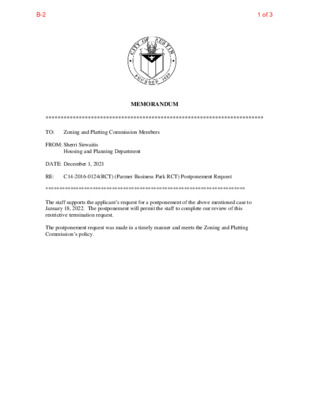
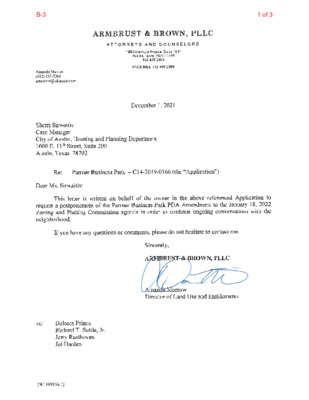
ZONING & PLATTING COMMISSION AGENDA Tuesday, December 21, 2021 The Zoning and Platting Commission will convene at 6:00 PM on Tuesday, December 21, 2021 at Austin City Hall, Council Chambers, Room 1001 301 W. Second Street, Austin, TX. Some members of the Zoning and Platting Commission may be participating by videoconference. The meeting may be viewed online at: http://www.austintexas.gov/page/watch-atxn-live Cesar Acosta Nadia Barrera-Ramirez – Chair Timothy Bray Ann Denkler – Parliamentarian Betsy Greenberg David King – Secretary Jolene Kiolbassa – Vice-Chair Hank Smith Carrie Thompson Roy Woody Scott Boone EXECUTIVE SESSION (No public discussion) The Zoning & Platting Commission will announce it will go into Executive Session, if necessary, pursuant to Chapter 551 of the Texas Government Code, to receive advice from Legal Counsel on matters specifically listed on this agenda. The commission may not conduct a closed meeting without the approval of the city attorney. Private Consultation with Attorney – Section 551.071 CITIZEN COMMUNICATION The first four (4) speakers signed up prior to the speaker registration deadline will each be allowed a three-minute allotment to address their concerns regarding items not posted on the agenda. A. APPROVAL OF MINUTES 1. Approval of minutes from November 16, 2021. 2. Approval of minutes from Special Called Meeting November 29, 2021. 3. Approval of minutes from Joint Special Called Meeting November 29, 2021. Attorney: Steven Maddoux 512-974-6080 Commission Liaison: Andrew Rivera, 512-974-6508 B. PUBLIC HEARINGS 1. Zoning: 2. Restrictive Covenant Termination: Location: C14-2021-0168 - Texas Cat Doctor; District 6 13264 Pond Springs Road, Lake Creek Watershed Location: Owner/Applicant: Texas Cat Hospital, Inc. (Kim Percival) Agent: Request: Staff Rec.: Staff: HB Construction (Josh McKay) I-RR to GR Recommended Sherri Sirwaitis, 512-974-3057, sherri.sirwaitis@austintexas.gov Housing and Planning Department C14-2016-0124(RCT) - Parmer Business Park RCT, District 1 13000, 13100 and 13106 1/2 Harris Ridge Boulevard, Harris Branch Watershed Owner/Applicant: Karlin McCallen Pass, LLC (Matthew Schwab) Agent: Request: Armbrust & Brown, PLLC (Richard T. Suttle) The applicant is requesting a termination of the restrictive covenant conditions for this property. Pending Sherri Sirwaitis, 512-974-3057, sherri.sirwaitis@austintexas.gov Housing and Planning Department Request by Applicant for postponement to January 18, 2022 Staff Rec.: Staff: Postponement Request: C14-2019-0166 - Parmer Business Park, District 1 13000, 13100 and 13106 1/2 Harris Ridge Boulevard, Harris Branch Watershed Owner/Applicant: Karlin McCallen Pass, LLC (Matthew Schwab) Agent: Request: Staff Rec.: Staff: Armbrust & Brown, PLLC (Richard T. Suttle) LI-PDA to LI-PDA, to change a condition of …
ZONING CHANGE REVIEW SHEET 1 CASE: C14-90-0003.21 -- Harris Branch PUD Amendment 21 DISTRICT: 1 ZONING FROM: PUD TO: PUD, to change a condition of zoning ADDRESS: US Highway 290 and Harris Branch Parkway SITE AREA: +/-2,100 Acres PROPERTY OWNER/APPLICANT: Austin HB Residential Properties, Ltd. AGENT: Coats Rose PC (John M. Joseph) CASE MANAGER: Heather Chaffin (512-974-2122, heather.chaffin@austintexas.gov) STAFF RECOMMENDATION: Staff supports the Applicant’s request to modify the PUD to allow building height to be measured in feet (40’ maximum) instead of feet and stories (40’ and 3 stories maximum). The amendment only applies to parcels in the PUD that are designated as LO, LR, MF-2 and MF-3. For a summary of the basis of staff’s recommendation, see case manager comments on page 2. ZONING AND PLATTING COMMISSION ACTION/ RECOMMENDATION: December 21, 2021: CITY COUNCIL ACTION: January 27, 2022: ORDINANCE NUMBER: B-61 of 26 C14-90-0003.21 2 ISSUES: Under the current PUD zoning, building height is measured in feet and stories—40’ and 3 stories. The request would allow buildings to be measured in feet only (remaining 40’) but eliminating the story requirement. The amendment only applies to parcels in the PUD that are designated as LO, LR, MF-2 and MF-3. The amendment is based in part on construction differences and market demands that have changed since the original ordinance in 1990. The rezoning request was initially determined by Staff to be an administrative amendment which does not require Commission or Council review. After additional review, it was determined that the amendment would need to be approved by City Council because the amendment affects items that are located in the ordinance and not on the PUD land use plan. No other changes to the PUD are requested with this amendment. CASE MANAGER COMMENTS: Harris Branch Planned Unit Development (PUD) was created in 1990 in northeast Austin. The PUD is generally located northwest of the intersection of US Highway 290 and State Highway 130. Harris Branch includes over 2,000 acres and includes parcels with a wide range of zoning designations. Zoning designations range from SF-2 to LI and include most other residential, office, and commercial designations, as well as P zoned tracts for parkland and infrastructure. More than half of the original 2,000 acres has already been developed. Please see Exhibit A— Zoning Map. As stated in the Issues section, the PUD measures building height in feet and stories—40’ and 3 stories. The …
ZONING AND PLATTING COMMISSION- SITE PLAN- EXTENSION REVIEW SHEET SPC-2007-0497C(XT3) CASE NUMBER: PROJECT NAME: Offices at Ribelin Ranch- Phase 1; The ADDRESS OF SITE: 7016 Ribelin Ranch Drive WATERSHED: Bull Creek (Water supply suburban) Tom Stacy, Austin Baptist Church 9003 Waterford Centre Blvd, Ste 100 Austin, TX 78717 Richard Suttle, Armbrust & Brown 100 Congress Ave, Ste. 1300 Austin, TX 78701 APPLICANT/ OWNER: ZAP HEARING DATE: Dec. 21, 2021 COUNCIL DISTRICT: 10 JURISDICTION: Full Purpose (512) 435-2378 (512) 974-2784 rosemary.avila@austintexas.gov AGENT: CASE MANAGER: Rosemary Avila PROPOSED DEVELOPMENT: The applicant is requesting a ten year extension to a previously approved site plan. The proposed development is religious assembly. SUMMARY STAFF RECOMMENDATION: Staff recommends a ten year extension to this site plan permit expiration. 25-5-63(C) Extension of released site plan by the Land Use Commission: “the Land Use Commission may extend the expiration date of a released site plan beyond the date established by this chapter if the Land Use Commission determines that the request complies with the requirements for extension by the director under 25-5-62 (Extension of Released Site Plan by Director).” 25-5-62(C) The director may extend the expiration date of a released administrative site plan one time for a period of one year if the director determines that there is good cause for the requested extension; and “ (1) the director determines that: (a) the site plan substantially complies with the requirements that apply to a new application for site plan approval; (b) the applicant filed the original application for site plan approval with the good faith expectation that the site plan would be constructed; (c) the applicant constructed at least one structure shown on the original site plan that is suitable for permanent occupancy; or (d) the applicant has constructed a significant portion of the infrastructure required for development of the original site plan; and” SUMMARY OF SITE PLAN: LAND USE: The site is zoned PUD, all site calculations are within the allowed amount. The applicant filed the original application for site plan approval with the good faith expectation that the site plan would be constructed. Site Plan administrative approval, permit expiration 09/13/2010 One year Site Plan Extension administrative approval, permit expiration 08/31/2011 SPC-2007-0497C(XT3) Offices at Ribelin Ranch- Phase 1; The ENVIRONMENTAL: All environmental comments have been cleared. AUSTIN TRANSPORTATION DEPT: All ATD comments have been cleared. PREVIOUS APPROVALS 02/25/2008 08/01/2010 12/13/2012 MGA approved to extend permit expiration to …
ZONING AND PLATTING COMMISSION- SITE PLAN- EXTENSION REVIEW SHEET SP-2007-0549B(XT3) CASE NUMBER: PROJECT NAME: Kallestad Laboratories, Inc. - PRA Site Plan ADDRESS OF SITE: 10010 FM 2222 Road WATERSHED: ZAP HEARING DATE: Dec. 21, 2021 COUNCIL DISTRICT: 10 JURISDICTION: Full Purpose APPLICANT/ OWNER: Bull Creek (Water supply suburban) Tom Stacy, Austin Baptist Church 9003 Waterford Centre Blvd, Ste 100 Austin, TX 78717 Richard Suttle, Armbrust & Brown 100 Congress Ave, Ste. 1300 Austin, TX 78701 (512) 435-2378 (512) 974-2784 rosemary.avila@austintexas.gov AGENT: CASE MANAGER: Rosemary Avila PROPOSED DEVELOPMENT: The applicant is requesting a ten year extension to a previously approved site plan. The proposed development is religious assembly. SUMMARY STAFF RECOMMENDATION: Staff recommends a ten year extension to this site plan permit expiration. 25-5-63(C) Extension of released site plan by the Land Use Commission: “the Land Use Commission may extend the expiration date of a released site plan beyond the date established by this chapter if the Land Use Commission determines that the request complies with the requirements for extension by the director under 25-5-62 (Extension of Released Site Plan by Director).” 25-5-62(C) The director may extend the expiration date of a released administrative site plan one time for a period of one year if the director determines that there is good cause for the requested extension; and “ (1) the director determines that: (a) the site plan substantially complies with the requirements that apply to a new application for site plan approval; (b) the applicant filed the original application for site plan approval with the good faith expectation that the site plan would be constructed; (c) the applicant constructed at least one structure shown on the original site plan that is suitable for permanent occupancy; or (d) the applicant has constructed a significant portion of the infrastructure required for development of the original site plan; and” SUMMARY OF SITE PLAN: LAND USE: The site is zoned R&D-PDA, all site calculations are within the allowed amount. The applicant filed the original application for site plan approval with the good faith expectation that the site SP-2007-0549B(XT3) Kallestad Laboratories, Inc. - PRA Site Plan Site Plan administrative approval, permit 3 year expiration 02/27/2011 One year Site Plan Extension administrative approval, permit expiration 02/27/2012 9 year 6 month extension granted by ZAP, permit expiration 08/31/2020 plan would be constructed. ENVIRONMENTAL: All environmental comments have been cleared. AUSTIN TRANSPORTATION DEPT: All ATD comments have been …
SUBDIVISION REVIEW SHEET CASE NO.: C8-2019-0112.1A COMMISSION DATE: December 21, 2021 SUBDIVISION NAME: Twilight Gardens ADDRESS: 8316 Twilight Terrace Dr. APPLICANT: Twilight Estates LLC AGENT: Jerome Perales (Perales Land Development LLC) ZONING: SF-1-CO-NP (single family residence) NEIGHBORHOOD PLAN: West Oak Hill AREA: 17.92 acre (780,595 sf) LOTS: 19 COUNTY: Travis DISTRICT: 8 WATERSHED: Williamson Creek JURISDICTION: Full Purpose VARIANCES: none DEPARTMENT COMMENTS: The request is for the approval of the Twilight Gardens subdivision comprised of 19 lots on 17.92 acres (780,595 sf). Staff recommends approval of the plat, subject to the conditions listed in the attached comment report. After the conditions are met, the plat will comply with LDC 25-4-84(B). The conditions include completing water quality requirements, parkland requirements, completing easement, updating plan notes, cost estimate, and posting fiscal. These are administrative actions that require no discretionary review. An application that has been approved with conditions may be updated to address those conditions until the application expires and the plan does not need to be heard before the Commission again. STAFF RECOMMENDATION: Staff recommends approval of the plat, subject to the conditions listed in the comment report dated December 16, 2021, and attached as Exhibit C. CASE MANAGER: Cesar Zavala E-mail: cesar.zavala@austintexas.gov PHONE: 512-974-3404 ATTACHMENTS Exhibit A: Vicinity map Exhibit B: Proposed plat Exhibit C: Comment report dated December 16, 2021 Location Map 8316 Twilight Terrace Dr, Austin, TX 78737 0' SCALE : 1''=100' 100' 300' 200' AREA BEING PLATTED A 17.991 ACRE TRACT OF LAND OUT OF THE JESSE WILLIAMS SURVEY NO. 62, ABSTRACT 788 AND BEING COMPRISED OF A 10.002 ACRE TRACT OF LAND AND A 7.989 ACRE TRACT OF LAND CONVEYED TO SEVEN HOMES LLC OF RECORD IN DOCUMENT 2015025092 OF THE OFFICIAL PUBLIC RECORDS OF TRAVIS COUNTY, TEXAS. HIGHWAY 290 8 2 8 F.M. 1 TWILIGHT M E S A D R . PROJECT LOCATION TWILIGHT GARDENS PLAT OF A 17.991 ACRE TRACT OF LAND COMPRISED OF A 10.002 ACRE TRACT OF LAND AND A 7.989 ACRE TRACT OF LAND OWNERDEVELOPER: ESSEN-PARMER LLC. R. CRAIG SMITH 5153 BLUE BONNET BLVD. BATON ROUGE, LA 70809 PHONE: (225)-769-2950 LOCATION MAP NOT TO SCALE LOCATION MAP LOT 13 DRAINAGE LOT AND DRAINAGE EASEMENT LOT 12 30' INGRESS AND EGRESS EASEMENT (VOLUME 2714 PAGE 275 O.P.R.) 15.02' S61° 39' 22"E 268.04' 5.119 ACRE TRACT AILEEN M. HOOKS AND RAY N. DONLEY (VOLUME 12604 PAGE 984 O.P.R.) LOT 1 DRAINAGE LOT …
SUBDIVISION REVIEW SHEET CASE NO.: C8-2019-0124.0A COMMISSION DATE: December 7, 2021 SUBDIVISION NAME: Rayviva Price Tract ADDRESS: 7651 Delwau Lane APPLICANT: Everett C. Price, Jr. AGENT: Dunway (J. Segura) ZONING: SF-2 NEIGHBORHOOD PLAN: n/a AREA: 9.559 acres (416,390 sf) LOTS: 5 COUNTY: Travis DISTRICT: 1 WATERSHED: Boggy Creek JURISDICTION: Full Purpose VARIANCES: none DEPARTMENT COMMENTS: The request is for the approval of theRayviva Price Tract subdivision, the applicant proposes to resubdivide an existing lot and unplatted property into a 5 lot subdivision on 9.559 acres. STAFF RECOMMENDATION: Staff recommends approval of the subdivision case, the plat meets City of Austin code requirements. CASE MANAGER: Cesar Zavala E-mail: cesar.zavala@austintexas.gov PHONE: 512-974-3404 ATTACHMENTS Exhibit A: Vicinity map Exhibit B: Proposed plat Legend Council District Jurisdiction FULL PURPOSE LIMITED PURPOSE OTHER CITY LIMITS OTHER CITIES ETJ Jurisdiction FULL PURPOSE LIMITED PURPOSE OTHER CITY LIMITS OTHER CITIES ETJ Zoning Text EXTRATERRITORIAL JURISDICTION 2 MILE ETJ AGRICULTURAL AGREEMENT EXTRATERRITORIAL JURISDICTION 2 MILE ETJ AGRICULTURAL AGREEMENT 0.3 0 0.17 0.3 Miles NAD_1983_StatePlane_Texas_Central_FIPS_4203_Feet Date Printed: This product is for informational purposes and may not have been prepared for or be suitable for legal, engineering, or surveying purposes. It does not represent an on-the-ground survey. This product has been produced by the City of Austin for the sole purpose of geographic reference. No warranty is made by the City of Austin regarding specific accuracy or completeness. 1: 11,015 Notes Case # C8-2019-0124.0A Address: 7651 Dlewau Lane
SUBDIVISION REVIEW SHEET CASE NO.: C8-2020-0501 COMMISSION DATE: December 21, 2021 SUBDIVISION NAME: Mountain Crest Preliminary Plan ADDRESS: 8722 W. Highway 71 APPLICANT: LMC Sky Mountain Holdings, LLC (Ben Breunig) AGENT: LJA Engineering, Inc. (Reese B. Hurley, P.E.) ZONING: LR-MU-NP (Neighborhood Commercial- Mixed Use) NEIGHBORHOOD PLAN: MLK-183 AREA: 5.53 acre (240,886 sf) LOTS: 1 COUNTY: Travis DISTRICT: 8 WATERSHED: Williamson Creek JURISDICTION: Full Purpose VARIANCES: none DEPARTMENT COMMENTS: The request is for the approval of the Mountain Crest Preliminary Plan comprised of 1 lot on 5.53 acres (240,886 sf). Staff recommends approval of the plan, subject to the conditions listed in the attached comment report. After the conditions are met, the plat will comply with LDC 25-4-84(B). The conditions include completing drainage and water quality requirements, cost estimate, and updating plan notes. These are administrative actions that require no discretionary review. An application that has been approved with conditions may be updated to address those conditions until the application expires and the pla n does not need to be heard before the Commission again. STAFF RECOMMENDATION: Staff recommends approval of the plat, subject to the conditions listed in the comment report dated December 15, 2021, and attached as Exhibit C. CASE MANAGER: Cesar Zavala E-mail: cesar.zavala@austintexas.gov PHONE: 512-974-3404 ATTACHMENTS Exhibit A: Vicinity map Exhibit B: Proposed plan Exhibit C: Comment report dated December 15, 2021 O L D B E E C A V E S R D H W Y 7 1 S O U T H W E S T P K W Y S W O D A H AIN S T N U O M R E D G RID D B E R E V O C OK RD TRAVIS CO PROJECT LOCATION N R L E H C T E L F 1200 600 0 1200 2400 SCALE IN FEET LJA Engineering, Inc. 7500 Rialto Boulevard Building II, Suite 100 Austin, Texas 78735 Phone 512.439.4700 Fax 512.439.4716 FRN - F-1386 MOUNTAIN CREST PRELIMINARY PLAN & FINAL PLAT LOCATION MAP EXHIBIT # 1 OF 1 MOUNTAIN CREST PRELIMINARY PLAN 8722 W SH 71 AUSTIN, TX 78735 Sheet List Table SHEET NO. DESCRIPTION TITLE 1 2 CV01 PP01 COVER SHEET PRELIMINARY PLAN WATERSHED STATUS: THIS SITE IS LOCATED WITHIN THE WILLIAMSON CREEK WATERSHED, WHICH IS CLASSIFIED AS BARTON SPRINGS ZONE, AND IS LOCATED WITHIN THE EDWARD'S AQUIFER CONTRIBUTING ZONE ACCORDING TO TCEQ AND CITY OF AUSTIN …