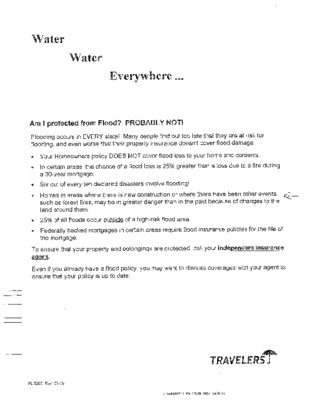
Flood Insurance Flier — original pdf
Backup
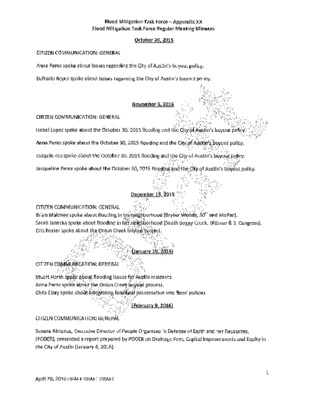
Backup
Backup
2. Identify available funds, including federal, state, and local sources as well as prioritizing future capital investment for flood mitigation and management.1 Recommendations: 1. Consider issuing debt consistent with the recommendations in this report. 2. Investigate opportunities for grants or cost sharing with US Geological Survey to install additional flood-hardened rainfall and stage gauges throughout the City. 3. Evaluate and identify opportunities to share costs with private development to upgrade outdated drainage systems. 4. Examine budgetary requests of other City Departments to identify projects less critical to public safety than flood mitigation and reallocate these resources to increase staff and resources of WPD. Council should prioritize capital spending in future budgets to focus spending on mitigating the most critical flood mitigation projects and to fund necessary maintenance operations over spending money on non-critical projects that do not impact public health and safety to reduce the fiscal impact to citizens. 5. Evaluate opportunities to leverage volunteer activities to encourage greater citizen participation in keeping waterways clear. Examples include Keep Austin Beautiful and the Colorado River Alliance. Understanding that the structure may be overly complex, Council should also explore simple straightforward financial incentives to spur citizen engagement, which could occur in the form of a tax credit or similar. 6. Leverage local funding with state and federal programs and funding options where practicable; however, take into considerations potential project delays or additional project needs/spending that may be part of the matching funds. Seek additional sources of funds for acquiring properties such as the Stafford Act’s Hazard Mitigation Grant Program (HMGP), the HUD’s Community Development Block Grant Program (CDBG), Flood Mitigation Assistance Program (FMAP), Executive Order 12898 (Environmental Justice) funding (where applicable), and private partnerships. 1 The Drainage Master Plan and on-going planning activities being conducted by the Watershed Department have and continue to identify and define where the creek and local flooding problems are, the root cause of the flooding, and feasible mitigation alternatives to be considered. While the residents of Austin have expressed a strong desire to move faster to implement flood mitigation projects, there remains a need to continue planning and studies necessary to bring future projects to fruition. However, the biggest challenge has always been and will continue to be funding to implement the full scope of the Drainage Master Plan. Watershed staff provided a summary of Drainage and Watershed Bonds 1975-2015 and reported that the citizens of Austin …
3. PEER CITIES – Evaluating best practices in peer cities with similar climate and flood issues. AUSTIN: 2014 Population 912,791 Square miles 271.8 The following cites have similar climate and flood issues as Austin and have experienced major flood events and implemented flood mitigation solutions that may be of interest and benefit to the City of Austin, 1. TULSA: 2014 Population 399,682 Square miles 196.8 Tulsa has a similar flood history as Austin with frequent flooding, rapid growth and a general denial of the possibility that floods could reoccur until their “year of the floods” in 1974 and 1984 Memorial Day flood, which killed 14, injured 288, damaged or destroyed nearly 7,000 buildings and did $180 million in damages. Following that flood, Tulsa appears to have taken the initiative to prevent future flooding and relocation of people through a series of policies and ongoing actions. Actions taken included: 1. 1984 flood caused relocation of 300 flooded homeowners & a mobile home park and damaged or destroyed 7,000 buildings; 2. Introduced a total capital program for flood control and master drainage plans. 3. City Commissioners enacted a floodplain building moratorium following the 1976 flood. 4. Created Dept. of Storm water Management to centralize flood, drainage and storm water programs and funded by the City budget. 5. Storm water utility fee created to be utilized exclusively for maintenance of storm water detention facilities, stream channels, pumping stations, culverts, ditches and other drainage facilities. The current fee is $5.43 per month, based on cost of clearing 2,650 square feet of property. 6. Storm drainage management is now part of the Streets and Storm water Dept. 7. After storms & when needed, crews clear the streams and detention sites also utilizing storm water fees. On average, they clean more than 22 miles of ditches and clear about 5 miles of drainage pipe each year. 8. Phased implementation programs for large capital projects are funded by storm water fees, sales tax revenues or bond issues and utilized for acquisition of lands & construction of large water retention facilities, major drainage basin improvements and other related projects. 1 9. Building parks in the floodplains, sports fields in storm water detention locations and greenway trails on creek banks. 10. “In Tulsa, growth is welcomed – so long as it will not flood or cause flooding elsewhere.” 11. Tulsa now has the lowest flood insurance rates in the …
4.0 ONION CREEK RECOMMENDATIONS October 30, 2015, marked the latest in a series of flooding disasters that have created serious property damage and loss of life along Onion Creek over the years. Prior to this, there was the Halloween Flood 2013, in which the flood waters reached a record level of 41 feet and, for the first time, severely damaged and destroyed homes in the Upper Onion Creek neighborhood in addition to lower Onion Creek. The 2013 Halloween Flood had destroyed or severely damaged homes in Onion Creek at a total estimated cost of well over $150 million, including some city services. This dollar loss was probably much higher due to the lack of complete data from the city and affected counties. In response to the 2013 Halloween Flood on Onion Creek, the City Council had passed Resolution 20140515-028 directing the City Manager to, among other things, provide a report to Council regarding the costs associated with the purchase of homes in the Lower Onion Creek floodplain around the William Cannon Drive and Pleasant Valley Road area as well as funding options and an evaluation of the drainage fee. The 2013 and 2015 floods resulted in a need to redraw the floodplain map, but also to look more closely at possible ways to reduce the impact of future floods and preclude the need for extensive buyouts in the future. The goal of the current Onion Creek Floodplain and Flood Mitigation Study, in addition to redrawing the floodplain maps, was to eliminate potential inundation of buildings during a 1% annual chance event (ACE). It was determined by the consultants that a 3 to 5 foot reduction in the peak would be needed to achieve the target of reducing flood risk by 30%. The specific focus area of the Study was IH35 to E. Slaughter Lane, known as Upper Onion Creek, but we suggest that attention should continue to be directed to both Upper and Lower Onion Creek. In reading the Study and the cover letter from Watershed, we feel that a good job has been done by Halff Engineering, but it is still preliminary and needs further work, especially concerning upstream detention and the future issues to be faced if impervious cover controls are not implemented throughout the Onion Creek floodplain. This should be considered a high priority. Options evaluated in the study for Upper Onion Creek included: 1. Property Buyouts …
5. Collaborating with the City’s Environmental Commission (4/25/2016) The Environmental Commission has oversight of the Watershed Protection Department. On January 13, 2016, a Mmembers of the Flood Mitigation Task Force briefed the Commission on January 13, 2016 about on the progress of the FMTF, with the intent to follow up with the Commission upon completion of the final report. The FMTF recommendation for the Environment Commission are: 1. When considering acquiring properties for green space or environmental protection, consider include the benefits of flood mitigation. 2. Ensure the Watershed Protection Department is funded and staffed at a level that ensures the maintenance and upkeep of the open and closed storm water systems to ensure public safety during massive rain events. 3. Review vegetation and riparian policies along open water drainage systems to ensure the policies are benefiting the public and not causing flooding, stoppage or backups of flood water. 4. Create a public forum whereby citizens can address the oversight body of the Watershed Protection Department to voice grievances, and seek avenues for navigating the bureaucracy. 5. Develop a process for tracking and following up on citizens’ grievances and concerns. Request an annual report on the status of grievances presented to the Environmental Commission. 6. As the oversight committee of the Watershed Protection Department, review the effectiveness and efficiency of the WPD’s performance measures.
Section 6. Collaborating with other jurisdictions and agencies that have interest, expertise, and investment authority regarding flood mitigation potentially impacting areas inside and outside of the City of Austin as well as with work groups or other regional initiatives focused on flood issues and storm water management. Recommendations: 1. Form a regional council or task force comprised of water management, safety and environmental organizations to look at regional storm water management. There does not appear to be a regional authority or strategy to manage flooding incidents. City of Austin Watershed Protection Master Plan 2015 Update recommends Watershed Protection continue to partner with other jurisdictions to achieve watershed protection goals, but there is no recommendation to partner with other jurisdictions to achieve regional storm water management and flood mitigation strategies. 2. Consider partnering with the following organizations to develop the council or task force. • Hays County and its municipalities • Travis County and its municipalities • Bastrop County and its municipalities • Blanco County and its municipalities • Williamson County and its municipalities • Lower Colorado River Authority • Barton Springs/Edwards Aquifer Conservation District • Texas Department of Transportation • Texas Commission on Environmental Quality • Texas Water Development Board • Texas Facilities Commission • Texas General Land Office • Texas Parks and Wildlife • Texas Division of Emergency Management • U.S. Environmental Protection Agency • NOAA, National Weather Service • U.S. Geological Survey • U.S. International Boundary and River Commission • U.S. Army Corps of Engineers • U.S. Bureau of Reclamation • Department of Homeland Security • Federal Emergency Management Agency • Texas Medical Center-Houston Weather Alert System • Environmental Systems Research Institute @ Pickle Research Campus • Texas Tech University – TxDOT and hydrology research. • Texas A&M University – flood forecasting. • Rice University – post hurricane flood research. • Texas Floodplain Managers Association (TFMA) • American Society of Civil Engineers (ASCE)/Environmental & Water Resources Institute (EWRI)And other appropriate agencies 3. Form a Regional Flood Control District to focus on flood mitigation and stormwater management, and to fund flood mitigation programs. 4. Investigate flood management programs used by El Paso County Water Improvement District, Elephant Butte (New Mexico) Irrigation District, Tulsa, Oklahoma, City of El Paso, Texas and Louisville, Kentucky. See recommendations in Section 3. Peer Cities. 5. Encourage surrounding communities to adopt floodplain and storm drainage policies comparable to the levels of City of Austin. 6. …
Flood Mitigation Task Force 1b – Flood plain variances and flood buyout policy FLOODPLAIN VARIANCES A floodplain variance is an exception to the standard development regulations for properties within the floodplain. There is a standard process for granting administrative variances by the Watershed Protection Department Director, when a development meets all of the administrative variance criteria. When a project does not conform to the requirements for an administrative variance, the Austin City Council may take action to grant a floodplain variance to the property owner/developer. It is important to note that there are other types of variances to environmental and drainage regulations which may be granted (e.g., variances to impervious cover limitations, variances to detention and/or water quality requirements). The request for a floodplain variance should not be conflated with these other types of variances. For example, a property can be within the allowable impervious cover limits and still require a floodplain variance in order to get a development permit to remodel a bathroom, to build a second story, or to add a carport. On average, there are 3 administrative variances are granted per year (based on 2004-2015), and there is an average of 6 requests per year to Council to grant floodplain variances (based on 1995-2015). Floodplain Variances Recommendations: 1. Continue current floodplain policy as it relates to FEMA National Flood Insurance Program and Community Rating System to help reduce flood hazard insurance rates for all homeowners and property owners. 2. Continue the current floodplain policies, except as modified below, while allowing a variance process for many of the existing homes to remain or be modified in a reasonably safe manner and without damage to others. a. Require public notice for Council floodplain variances. Notice should be given to Neighborhood Groups as well as potentially-affected property owners. b. Expand the requirements of the City Code section of the floodplain management regulations that explains floodplain variances (Chapter 25-12-3 Appendix G, Sections G105) to include additional information commonly discussed at past floodplain variance hearings as defined in the Buyouts Work Group report. 3. Implement additional flood mitigation requirements if development or redevelopment is allowed in a floodplain such as: a. education for safe evacuation and safely sheltering in place. b. disclosure by seller/owner (or their representative) and education for buyer/renter of property that has been granted a floodplain variance that may constitute a health and safety risk. 1 Flood Mitigation Task …
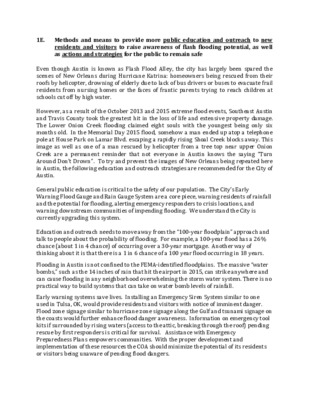
1E. Methods and means to provide more public education and outreach to new residents and visitors to raise awareness of flash flooding potential, as well as actions and strategies for the public to remain safe Even though Austin is known as Flash Flood Alley, the city has largely been spared the scenes of New Orleans during Hurricane Katrina: homeowners being rescued from their roofs by helicopter, drowning of elderly due to lack of bus drivers or buses to evacuate frail residents from nursing homes or the faces of frantic parents trying to reach children at schools cut off by high water. However, as a result of the October 2013 and 2015 extreme flood events, Southeast Austin and Travis County took the greatest hit in the loss of life and extensive property damage. The Lower Onion Creek flooding claimed eight souls with the youngest being only six months old. In the Memorial Day 2015 flood, somehow a man ended up atop a telephone pole at House Park on Lamar Blvd. escaping a rapidly rising Shoal Creek blocks away. This image as well as one of a man rescued by helicopter from a tree top near upper Onion Creek are a permanent reminder that not everyone in Austin knows the saying “Turn Around Don’t Drown”. To try and prevent the images of New Orleans being repeated here in Austin, the following education and outreach strategies are recommended for the City of Austin. General public education is critical to the safety of our population. The City’s Early Warning Flood Gauge and Rain Gauge System are a core piece, warning residents of rainfall and the potential for flooding, alerting emergency responders to crisis locations, and warning downstream communities of impending flooding. We understand the City is currently upgrading this system. Education and outreach needs to move away from the “100-year floodplain” approach and talk to people about the probability of flooding. For example, a 100-year flood has a 26% chance (about 1 in 4 chance) of occurring over a 30-year mortgage. Another way of thinking about it is that there is a 1 in 6 chance of a 100 year flood occurring in 18 years. Flooding in Austin is not confined to the FEMA-identified floodplains. The massive “water bombs,” such as the 14 inches of rain that hit the airport in 2015, can strike anywhere and can cause flooding in any neighborhood overwhelming the …
TASK FORCE ON COMMUNITY ENGAGEMENT MARCH 24, 2016, 6:00 – 9:00 PM STREET-JONES BUILDING, ROOM 400A 1000 E. 11th STREET AUSTIN, TEXAS 78702 CURRENT TASK FORCE MEMBERS: Celso Baez III Michael Clark-Madison Margarita Decierdo Richard Fonte Andrea Hamilton Claudia Herrington Chris Howe Christopher Ledesma Koreena Malone Ken Rigsbee Navvab Taylor Sara Torres AGENDA CALL TO ORDER – 6:00 PM 1. OPENING REMARKS a. Diane Miller, Task Force Facilitator with Civic Collaboration, will discuss the outline of the meeting. 2. CITIZEN COMMUNICATION: GENERAL a. Citizens wishing to speak will need to sign up ten minutes before the meeting is called to order. Citizen communications will be limited to the first five (5) speakers and each citizen communicator will be given three (3) minutes to speak. Everyone will provide a sticky note to write their input which will later be sent to all of the Task Force members. 3. APPROVAL OF MINUTES a. Consider approving the minutes from the Task Force on Community Engagement (TFCE) regular meeting on March 10, 2016. b. Review notes from the March 10, 2016 TFCE Regular Meeting. 4. NEW BUSINESS: a. Discussion and possible action on briefing from Communications and Public Information Office staff of fiscal implications of recommendations thus far. b. Discussion and possible action on top three recommendations from each Task Force member. c. Discussion and possible action of the approach and timeframe for each recommendation within the report. d. Discussion and possible action of the remaining work and timeline. Determine if another Task Force meeting is required and schedule future meetings if necessary. e. Discuss and evaluate the entire Task Force Process. 5. FUTURE AGENDA ITEMS: a. Discussion of topics for future TFCE Meetings. 6. ADJOURNMENT The City of Austin is committed to compliance with the American with Disabilities Act. Reasonable modifications and equal access to communications will be provided upon request. Meeting locations are planned with wheelchair access. If requiring Sign Language Interpreters or alternative formats, please give notice at least 2 days (48 hours) before the meeting date. Please call Matthew Chustz at the Communications & Public Information Office, at (512) 974-7270, Matthew.Chustz@austintexas.gov, for additional information; TTY users route through Relay Texas at 711. For more information on the Task Force on Community Engagement, please contact Matthew Chustz at (512) 974-7270, Matthew.Chustz@austintexas.gov.
TASK FORCE ON COMMUNITY ENGAGEMENT MEETING MINUTES (March 24, 2016) 1 Task Force on Community Engagement REGULAR MEETING MINUTES March 24, 2016 The Task Force on Community Engagement convened in a regular meeting on March 24, 2016 at Street-Jones Building, Room 400A, 1000 E. 11th Street, in Austin, Texas. Facilitator Diane Miller, with Civic Collaboration, called the Task Force Meeting to order at 6:08 p.m. Task Force Members in Attendance: Michael Clark-Madison, Richard Fonte, Chris Howe, Christopher Ledesma, Sara Torres, Navvab Taylor, Ken Rigsbee Staff in Attendance: Matthew Chustz, Doug Matthews, Larry Schooler 1. OPENING REMARKS a. Diane Miller provided an overview of the meeting agenda. 2. CITIZEN COMMUNICTION: GENERAL a. None 3. APPROVAL OF MINUTES a. The Task Force approved, by consensus, the minutes from the March 10, 2016 Task Force on Community Engagement (TFCE) Regular Meeting. b. The Task Force reviewed the March 10, 2016 TFCE Regular Meeting notes provided by the facilitator. 4. NEW BUSINESS a. Fiscal Implication of Recommendations Task Force members discussed with staff from the Communications & Public Information Office the fiscal implications of the recommendations. b. Recommendations from each Task Force Member Task Force members discussed the top three recommendations from each task force member. c. Timeframe and Approach for each recommendation within report Task Force members discussed the approach and timeframe for each recommendation within the report. d. Discussion of Remaining Workload and future meetings The task force members reviewed the remaining work and determined that it was not necessary to hold another task force meeting. TASK FORCE ON COMMUNITY ENGAGEMENT MEETING MINUTES (March 24, 2016) 2 e. Task Force Process Evaluation The facilitators lead the TFCE members in an evaluation of overall process of the task force. f. Meeting Evaluation (standing agenda item) The facilitators lead the TFCE members in an evaluation of the meeting. 6. ADJOURNMENT Facilitator, Diane Miller adjourned the meeting at 9:00 p.m. without objection.
Compilation of consensus recommendations of Task Force on Community Engagement Draft dated 3/10/16 Compiled by Diane Miller TFCE Consensus Recommendations as of 3-10-16.docx Page 1 of 4 Consensus Recommendations for Theme #1: Make information clear, relevant and easily accessible. A. Implement a website redesign that includes the following: 1. mobile friendly 2. multi-lingual with professional translation [Open question remains about what pages and what languages] with attention to limited English proficiency users for pages that deal with city services, events or that seek engagement. 3. accessibility for those who are visually impaired 4. an enhanced search function that works and search engine optimization. 5. a centralized community calendar with filters by topic and/or district. Examine the criteria for inclusion of events on the calendar. 6. Use analytics to develop the home page and use a User Experience professional for the redesign. 7. Dynamic, timely content on the home page 8. Prominent invitation to engage on the home page. B. Publish content in a standardized machine-readable format to a data portal in real time. C. Recreate the Community Registry to: 1. create an easier way to ensure it stays current. 2. Allow people to use the registry to choose what they want information about. 3. Link the Registry to other City communication channels with ways to opt in and out. 4. Consider moving management of the Registry to the Neighborhood Assistance Center. 5. Include information about the type or category of each group (e.g. neighborhood, non-profit, etc.) 6. Include a way to find groups that operate in your area. 7. Use a map-based interface as well as a list. D. Aspire to effective, useful, consistent accommodations for those with disabilities. 1. Provide onscreen closed captioning for all videos on ATXN (both published and streaming). 2. Include closed captioning during presentation (i.e. slide show) portions. 3. Include a scroll function on the website for transcripts. 4. Review ADA requirements and ensure that the City meets them. E. Create an Austin 101 to provide high-level information about how the City works. 1. Expand City Works Academy to include online and virtual classes and modules that are available to everyone. F. Implement a content-creation policy that helps ensure: 1. Clear communication in everyday language across all media types. 2. Improve the clarity of legal public notices regarding land use cases. 3. Create explanatory pieces (e.g. glossary) about the topics being discussed. G. Create better …
TASK FORCE ON COMMUNITY ENGAGEMENT MEETING MINUTES (March 10, 2015) 1 Task Force on Community Engagement REGULAR MEETING MINUTES March 10, 2016 The Task Force on Community Engagement convened in a regular meeting on March 10, 2016 at the Leadership Austin office, 1609 Shoal Creek Blvd., Suite 202, in Austin, Texas. Facilitator Diane Miller, with Civic Collaboration, called the Task Force Meeting to order at 6:27 p.m. Task Force Members in Attendance: Celso Baez III (via phone), Michael Clark-Madison, Andrea Hamilton, Chris Howe, Koreena Malone (via phone), Ken Rigsbee, Navvab Taylor Staff in Attendance: Matthew Chustz, Doug Matthews, Larry Schooler Facilitators in Attendance: Diane Miller, Juli Fellows 1. OPENING REMARKS a. Diane Miller provided an overview of the meeting agenda. 2. CITIZEN COMMUNICTION: GENERAL a. None 3. APPROVAL OF MINUTES a. The Task Force approved, by consensus, the minutes from the February 25, 2016 Task Force on Community Engagement (TFCE) Regular Meeting. b. The Task Force reviewed the February 25, 2016 TFCE Regular Meeting notes provided by the facilitator. 4. NEW BUSINESS a. Seek consensus on recommendations to Council by topic. Task Force members discussed the recommendations from theme five (5) of the five (5) main themes/topics identified in the needs assessment. b. Organizing the recommendations within the final report Task Force members discussed how to organize the recommendations within the final report. c. Fiscal Implications within the report Task Force members agreed that Doug Matthews should review the recommendations and identify any known fiscal implications and present at the March 24, 2016 TFCE Meeting. d. Prioritizing recommendations within the final report TASK FORCE ON COMMUNITY ENGAGEMENT MEETING MINUTES (March 10, 2015) 2 Each member will present their top three priority recommendations at the March 24, 2016 TFCE Meeting. e. Meeting Evaluation (standing agenda item) The facilitators lead the TFCE members in an evaluation of the meeting. 5. Future Agenda Items a. Discuss prioritization of recommendations b. Discuss fiscal implications 6. ADJOURNMENT Facilitator, Diane Miller adjourned the meeting at 9:00 p.m. without objection.
Created by Juli Fellows, Diane Miller March 11, 2016 Task Force on Community Engagement Meeting Notes: March 10, 2016 1 Created 3/14/2016 TFCE3.10.16_V2MeetingNotes.docx Contents Executive Summary ............................................................................................................................................................... 2 Member Attendance List ................................................................................................................................................... 3 Action Items ........................................................................................................................................................................... 3 Detailed Meeting Notes ......................................................................................................................................................... 3 Citizen Input ....................................................................................................................................................................... 3 Discussion of Content for Executive Summary .................................................................................................................. 3 Discussion of Theme 5 ....................................................................................................................................................... 3 Consensus Recommendations, Theme #5: Ensure that City staff have the support, training, tools and resources to do engagement well. .............................................................................................................................................................. 3 Meeting Evaluation ............................................................................................................................................................... 4 2 Created 3/14/2016 TFCE3.10.16_V2MeetingNotes.docx Executive Summary The meeting convened on March 10, 2016, at 6:30 p.m. with a quorum of six members. This meeting was conducted at Leadership Austin. There was no citizen comment. The February 25, 2016 minutes were approved with no changes. The task force completed their recommendations on Theme #5 – Ensure that City staff have the support, training, tools and resources to do engagement well. 5A. Provide ongoing training to public-facing city staff who engage with the public so they can provide useful feedback and capture public input. • There should be tiers of training by role, with the greatest depth of training being delivered to communications or community engagement-specific roles and project managers, planners and others who do Departmental community engagement. Training for these roles should include how to design and facilitate community engagement. 5B. Department heads and administrators should promote and encourage best practices in community engagement and should participate in trainings in order to lead by example. 5C. It should be equally important to every Department that the people they serve should BE meaningfully engaged and should FEEL meaningfully engaged in developing and implementing Department programs and services. 5D. Help staff reach deeper into communities and get the word out by having a database of local grassroots leaders that all staff can access. (See recommendation 1C.) 5E. All community engagement efforts should be evaluated on the basis of three factors – participant demographics mirror that of the city, all districts are equally represented and participants are satisfied with the engagement. The results of these evaluations should be part of the overall evaluation of each Department. (Note: Communications and Public Information Office can help, as can independent third parties.) The group made decisions about how to organize the recommendations. They will continue to be organized by theme, with symbols that indicate the approach (technology, methods or culture), the RELATIVE …
Created by Diane Miller, Pat Korbus March 25, 2016 Task Force on Community Engagement Meeting Notes: March 24, 2016 1 3/30/16 TFCE3.24.16_V4MeetingNotes.docx Contents Executive Summary ............................................................................................................................................................... 2 Member Attendance List ................................................................................................................................................... 4 Action Items ........................................................................................................................................................................... 4 Meeting Notes ....................................................................................................................................................................... 4 Citizen Input ....................................................................................................................................................................... 4 Recommendations Meriting Special Attention in the Final Report ................................................................................... 4 Clarification in Recommendations language: .................................................................................................................... 3 Fiscal Implications .............................................................................................................................................................. 4 Fiscal, Type of Approach and Time Frame Descriptors ...................................................................................................... 4 Miscellaneous .................................................................................................................................................................... 5 Future Meetings ................................................................................................................................................................ 5 Overall Evaluation of the Task Force Experience ............................................................................................................... 6 2 3/30/16 TFCE3.24.16_V4MeetingNotes.docx Executive Summary The meeting convened on March 24, 2016, at 6:30pm with nine members in attendance. This meeting was conducted at the 1000 E. 11th Street, Austin. There was no citizen comment. The March 10, 2016 meeting minutes were approved with no changes. The Task Force reached consensus on their “recommendations meriting special attention” in the following order of importance: Theme Recommendation 1 - Make information clear, relevant and easily accessible 1A – Implement a website redesign 4 - Ensure that everyone who cares about an issue or is impacted has the opportunity to engage 4A - Invest in creating capacity and trust with under-represented communities. 5 - Ensure that City staff have the support, training, tools and resources to do engagement well 5A - Provide ongoing training to public-facing city staff who engage with the public so they can provide useful feedback and capture public input. 2 - Make it easier for people to give input in ways that are convenient, accessible and appropriate for them. 2F – Sufficiently fund, prioritize, and implement during FY2017 on-line agenda commenting system for community members to give input to Council, Commissions, Boards, and Task Forces on city issues. 3 - Explain how input will be used and show how that input had an impact on the decision made 3A – When the City designs an engagement opportunity, provide feedback in a timely manner to participants on what was heard and how the input is being used to inform future decisions. Also make this information easily available to the general public. 2 - Make it easier for people to give input in ways that are convenient, accessible and appropriate for them. 2G – Sufficiently fund, prioritize and implement during FY2017 an online engagement platform that has the following (listed in recommendation) capabilities. 1 - Make information clear, relevant and easily …
STAFF RESPONSE TO TASK FORCE ON COMMUNITY ENGAGEMENT RECOMMENDATIONS 1) Make information clear, relevant and easily accessible. a. Implement a website redesign. This work is currently funded and underway. CPIO has been working with Communications and Technology Management (CTM) on the migration of both the employee Intranet and the external-facing website to a third-party provider that has deep experience hosting sites that use our current Content Management System (CMS). The redesign will provide an opportunity to address concerns regarding mobile compatibility, ADA accessibility, site search, improved calendars and dynamic content. CPIO hired a specialist with user interface design experience in February, and is currently recruiting for a digitally-focused design professional to assist with this work. Providing natural-language translation of the website is not funded, but would be a priority for CPIO given the resources to do so. We estimate, based on the current site content, a contract cost of $300,000 to $400,000 for initial translation and annual costs of $70,000 to maintain, add and alter translated content over time. b. Publish content in a standardized machine-readable format to an open data portal in real-time. Discussions with the Task Force centered on publishing content related to the proceedings of Council and related boards and commissions. Some of this may become possible as we evaluate new agenda management systems this year. In addition, CPIO has begun to experiment with publishing aggregated feedback from engagement activities on the data portal. If this proves successful, we hope to make it a matter of practice for future engagement activities. c. Recreate the Community Registry. As it currently exists, the Community Registry fulfills a core requirement (development notifications) but falls short as a tool for capacity building, general notifications or opt-in notifications for interested groups or individuals. Part of this could be the lack of specific guidelines regarding the Community Registry, either in the code, by local resolution or through administrative policy. This presents a compelling opportunity for innovation and possible local development partnerships. Our best estimate to develop a more robust online resource is $30,000 to $50,000 using a combination of internal talent, open data and local partners. d. Aspire to effective, useful, consistent accommodations for those with disabilities. Some of the items mentioned have already been addressed (like captioning during presentations). The estimated cost to provide closed captioning for all ATXN videos (meetings, original programming, press conferences, etc.) is an additional $120,000 annually. Staff …
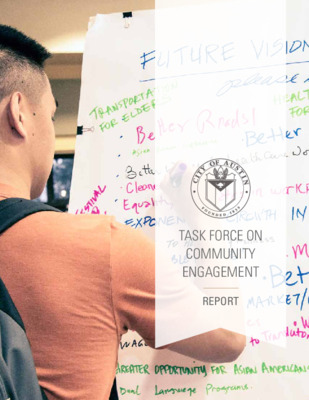
TASK FORCE ON COMMUNITYENGAGEMENTREPORT 2CITY OF AUSTIN TASK FORCE ON COMMUNITY ENGAGEMENTFinal Report | May 6, 2016Executive Summary3Summary narrativePriority recommendationsThe Formation and Foundations of the Task Force6Task Force composition and scope of workKey Elements of Community Engagement Identified by the Task ForceProcess and Input GatheringWhat the Task Force Learned Through Its Efforts13Needs Assessment ThemesRecommendations18Task Force recommendations at a glanceRecommendations in depth for each theme:Theme 1: Make information clear, relevant and easily accessible.Theme 2: Make it easier for people to give input in ways that are convenient, accessible and appropriate for them.Theme 3: Explain how input will be used and show how that input has an impact on the decisions made.Theme 4: Ensure that everyone who cares about an issue or is impacted has the opportunity to engage.Theme 5: Ensure that City staff has the support, training, tools and resources to do engagement well.Appendix 33Task Force MembersCity Council Resolutions Survey QuestionsSurvey ResultsWorkgroup DataOutreach ListsPromotional FliersCity of Austin Community Engagement Current Practices DocumentSpecial Request Report on Public Engagement in Peer CitiesResources Reviewed 3EXECUTIVE SUMMARYAs Austin moved into its new era of 10-1 district representation at City Hall, members of the public, community leaders, candidates, and eventually the newly elected City Council identified both unmet needs and new opportunities to improve Austin’s community engagement. At its first meeting in January 2015, the new Council created by resolution the Task Force on Community Engagement. Over the next few months, the scope of the Task Force was further refined and structured and appointments were made by each Council office and the Mayor’s office.The Task Force formally began its work in July 2015 and, assisted by City staff support from the Communications and Public Information Office and a team of facilitators, met through March 2016 to develop the findings and recommendations presented in this report. This work proceeded through four stages:1. Understanding and defining key elements of effective community engagement the Task Force thought should shape its recommendations for Austin.2. Conducting original research and gathering input from the public, key external community stakeholders, and internal City stakeholders, using a variety of methods including surveys, focus groups, interviews, Conversation Corps sessions and direct testimony to the (public) meetings of the Task Force.3. Using its key elements and the input gathered, developing a needs assessment that included five key themes.4. Making specific recommendations for programs, policies, practices and strategies that could address the identified themes.All decisions made by …
The City of Austin is committed to compliance with the Americans with Disabilities Act. Reasonable modifications and equal access to communications will be provided upon request. MEMORANDUM TO: Mayor and City Council FROM: Doug Matthews, Chief Communications Director DATE: May 11, 2016 RE: Final Report & Staff Analysis of Task Force Recommendations The final recommendations of the Task Force on Community Engagement are attached. This is the culmination of nine months of work by a remarkable group of Austin residents. We felt that providing the recommendations document in advance of the Task Force presentation on Tuesday would help ensure a productive discussion at Work Session. To help in your discussion of these recommendations from the Task Force on Community Engagement, we have reviewed all recommendations and provided some additional context, observations and, where possible, cost estimates. In general, the Communications and Public Information Office (CPIO) agrees with many, if not most, of the recommendations included in the report. In fact, the office has been working to implement a number of these recommendations already – or were working on solutions prior to the convening of the Task Force. From a staff perspective, there are several key opportunities in the recommendations that could have measurable short- and medium-term impacts if supported and funded. Those with the most potential for transformative impact: - Natural-language translation of the City website as part of the current redesign effort. - Development of a more comprehensive and robust community registry/notification system. - Purchase and/or development of a replacement virtual/online engagement system. - Resourcing the Community Engagement division to be able to more effectively “close the loop” by providing timely, public feedback and updates on engagement activities. Many of these items require resourcing to implement, which we are happy to discuss during or after the Task Force presentation on May 17. This is an excellent starting point for discussion and we are extremely thankful for the time, thought and effort the Task Force put in to their work. By The City of Austin is committed to compliance with the Americans with Disabilities Act. Reasonable modifications and equal access to communications will be provided upon request. our observation, each member truly cares about the future of engagement in Austin and was fully committed to the conversations. We look forward to continued discussion of our future engagement activities, and thank you all for making this dialogue a priority. Please let …
Task Force on Community EngagementReport to City CouncilMay 17, 2016 The Task Force1MemberAppointed byMargarita DecierdoCouncilmember HoustonSara TorresCouncilmember GarzaClaudia Herrington *Councilmember RenteriaChristopher LedesmaCouncilmember CasarNavvabTaylorCouncilmember KitchenChris HoweCouncilmember ZimmermanMike Clark-Madison (Chair)Councilmember PoolKen Rigsbee**Councilmember TroxclairKoreenaMaloneMayorPro-TemTovoRichard FontéCouncilmember GalloCelsoBaez IIIMayor Adler Andrea HamiltonMayor AdlerIrfanSyedMayor Adler* Replaced Joseph Green as D3 appointee** Replaced Jason Bram as D8 appointee The Assignment•Existing City engagement tools and practices•Innovative techniques used elsewhere•Fiscal implications•Specific considerations:–Disability accommodations–Foreign language access–Virtual/online participation–District/neighborhood-centered alternatives–Public hearing notification process2 Key Elements of Effective Engagement3 Key Elements of Effective Engagement4 The Timeline•Biweekly meetings July 2015 -March 2016 (384 in-meeting volunteer hours):–Fall 2015: Input and data gathering•Workgroups and focus groups•Community surveys•Testimony before the Task Force–Winter 2016: Needs assessment and key themes•Based on input•Reflecting innovative approaches/best practices–Spring 2016: Development of final recommendations 5 The Working Groups•Neighbors and neighborhoods•Businesses (including chambers/trade groups)•Civic volunteers and nonprofits, including:–Environmental community–Human/social services•Underrepresented populations•Boards and commissions•City departments6 Community Feedback•Focus groups with community leaders•Conversation Corps (September 2015)•Community surveys (General public; Organizational leaders; Boards and commissions; English, Spanish, Asian languages)•In-depth interviews/feedback from members of the City Council and City engagement specialists•Testimony before the Task Force7 Five Key Themes1.Make information clear, relevant and easily accessible.2.Make it easier for people to give input in ways that are convenient, accessible and appropriate for them.3.Explain how input will be used and show how that input had an impact on the decision made.8 Five Key Themes4.Ensure that everyone who cares about an issue or is impacted has the opportunity to engage.5.Ensure that City staff have the support, training, tools and resources to do engagement well.9 Theme One:Making information clear10 Theme One: Selected Comments•“Make information accessible to those with special needs.”•“People want information about what is happening in their district or what directly affects them.”•“… [no] online tool that meets everyone’s needs and the City’s website is not meeting needs.•“People are not aware of communication and engagement tools.”•“People want multiple channels and the City as a whole needs to provide multiple channels.”•“Being able to filter for information on issues you care about…not a ‘fire hose.’”•“Find ways to maximize the impact of City communication that is put out by our strategic partners, e.g. neighbors and other organizations.”11 Theme One: Selected Comments•“A decentralized system results in inconsistency, information being scattered and hard to find, reinventing the wheel each time and no citywide database of people who engage and what they care about.”•“There is a need for localization of information and sources need to be trustworthy.”•“There is an …
TASK FORCE ON COMMUNITY ENGAGEMENT MARCH 10, 2016, 6:00 – 9:00 PM LEADERSHIP AUSTIN 1609 SHOAL CREEK BLVD., SUITE 202 AUSTIN, TEXAS 78701 CURRENT TASK FORCE MEMBERS: Celso Baez III Michael Clark-Madison Margarita Decierdo Richard Fonte Andrea Hamilton Claudia Herrington Chris Howe Christopher Ledesma Koreena Malone Ken Rigsbee Navvab Taylor Sara Torres AGENDA CALL TO ORDER – 6:00 PM 1. OPENING REMARKS a. Diane Miller, Task Force Facilitator with Civic Collaboration, will discuss the outline of the meeting. 2. CITIZEN COMMUNICATION: GENERAL a. Citizens wishing to speak will need to sign up ten minutes before the meeting is called to order. Citizen communications will be limited to the first five (5) speakers and each citizen communicator will be given three (3) minutes to speak. Everyone will provide a sticky note to write their input which will later be sent to all of the Task Force members. 3. APPROVAL OF MINUTES: a. Consider approving the minutes from the Task Force on Community Engagement (TFCE) regular meeting on February 25, 2016. b. Review notes from the February 25, 2016 TFCE Regular Meeting. 4. NEW BUSINESS: a. Draft the recommendations to Council for Theme 5. b. Discussion and possible action on organizing the recommendations within the final report. c. Discussion and possible action on the Fiscal Implications within the final report. d. Discussion and possible action on prioritizing recommendations within the final report. e. Discuss next steps and evaluate meeting. 5. FUTURE AGENDA ITEMS: a. Discussion of topics for future TFCE Meetings. 6. ADJOURNMENT The City of Austin is committed to compliance with the American with Disabilities Act. Reasonable modifications and equal access to communications will be provided upon request. Meeting locations are planned with wheelchair access. If requiring Sign Language Interpreters or alternative formats, please give notice at least 2 days (48 hours) before the meeting date. Please call Matthew Chustz at the Communications & Public Information Office, at (512) 974-7270, Matthew.Chustz@austintexas.gov, for additional information; TTY users route through Relay Texas at 711. For more information on the Task Force on Community Engagement, please contact Matthew Chustz at (512) 974-7270, Matthew.Chustz@austintexas.gov.
TASK FORCE ON COMMUNITY ENGAGEMENT MEETING MINUTES (March 10, 2016) 1 Task Force on Community Engagement REGULAR MEETING MINUTES March 10, 2016 The Task Force on Community Engagement convened in a regular meeting on March 10, 2016 at the Leadership Austin office, 1609 Shoal Creek Blvd., Suite 202, in Austin, Texas. Facilitator Diane Miller, with Civic Collaboration, called the Task Force Meeting to order at 6:27 p.m. Task Force Members in Attendance: Celso Baez III (via phone), Michael Clark-Madison, Andrea Hamilton, Chris Howe, Koreena Malone (via phone), Ken Rigsbee, Navvab Taylor Staff in Attendance: Matthew Chustz, Doug Matthews, Larry Schooler Facilitators in Attendance: Diane Miller, Juli Fellows 1. OPENING REMARKS a. Diane Miller provided an overview of the meeting agenda. 2. CITIZEN COMMUNICTION: GENERAL a. None 3. APPROVAL OF MINUTES a. The Task Force approved, by consensus, the minutes from the February 25, 2016 Task Force on Community Engagement (TFCE) Regular Meeting. b. The Task Force reviewed the February 25, 2016 TFCE Regular Meeting notes provided by the facilitator. 4. NEW BUSINESS a. Seek consensus on recommendations to Council by topic. Task Force members discussed the recommendations from theme five (5) of the five (5) main themes/topics identified in the needs assessment. b. Organizing the recommendations within the final report Task Force members discussed how to organize the recommendations within the final report. c. Fiscal Implications within the report Task Force members agreed that Doug Matthews should review the recommendations and identify any known fiscal implications and present at the March 24, 2016 TFCE Meeting. d. Prioritizing recommendations within the final report TASK FORCE ON COMMUNITY ENGAGEMENT MEETING MINUTES (March 10, 2016) 2 Each member will present their top three priority recommendations at the March 24, 2016 TFCE Meeting. e. Meeting Evaluation (standing agenda item) The facilitators lead the TFCE members in an evaluation of the meeting. 5. Future Agenda Items a. Discuss prioritization of recommendations b. Discuss fiscal implications 6. ADJOURNMENT Facilitator, Diane Miller adjourned the meeting at 9:00 p.m. without objection.
TASK FORCE ON COMMUNITY ENGAGEMENT MEETING MINUTES (February 25, 2015) 1 Task Force on Community Engagement REGULAR MEETING MINUTES February 25, 2016 The Task Force on Community Engagement convened in a regular meeting on February 25, 2016 at the Street-Jones Building, 1000 E 11th Street, Room 400A, in Austin, Texas. Facilitator Julie Fellows, with Civic Collaboration, called the Task Force Meeting to order at 6:07 p.m. Task Force Members in Attendance: Celso Baez III, Michael Clark-Madison, Margarita Decierdo, Richard Fonte, Andrea Hamilton, Chris Howe, Christopher Ledesma, Koreena Malone, Navvab Taylor Staff in Attendance: Matthew Chustz, Doug Matthews, Larry Schooler Facilitators in Attendance: Julie Fellows, Pat Korbus 1. OPENING REMARKS a. Julie Fellows provided an overview of the meeting agenda. 2. CITIZEN COMMUNICTION: GENERAL a. None 3. APPROVAL OF MINUTES a. The Task Force approved, by consensus, the minutes from the February 11, 2016 Task Force on Community Engagement (TFCE) Regular Meeting. b. The Task Force reviewed the February 11, 2016 TFCE Regular Meeting notes provided by the facilitator. 4. NEW BUSINESS a. Amending the Task Force Guidelines for Quorum The Task Force members came to consensus to amend the group guidelines regarding the number of members necessary to make quorum. Since the number of members on the Task Force is now 12 instead of 13, the group agreed that the new quorum number should be six (6) members instead of the original seven (7). The group also agreed that quorum could also be reached if a Task Force member participates via telephone. b. Seek consensus on recommendations to Council by topic. Task Force members began discussing the recommendations from theme four (4) of the five (5) main themes/topics identified in the needs assessment. The group will continue to develop recommendations on the themes at the next Task Force Meeting on March 10, 2016. TASK FORCE ON COMMUNITY ENGAGEMENT MEETING MINUTES (February 25, 2015) 2 c. Meeting Evaluation (standing agenda item) The facilitators lead the TFCE members in an evaluation of the meeting. 5. Future Agenda Items a. Seek consensus on recommendations to Council by topic/theme remaining theme 6. ADJOURNMENT Facilitator, Julie Fellows adjourned the meeting at 8:50 p.m. without objection.
Created by Juli Fellows, Pat Korbus February 25, 2016 Task Force on Community Engagement Meeting Notes: February 25, 2016 1 2/29/16 TFCE2.25.16_V1MeetingNotes.docx Contents Executive Summary ............................................................................................................................................................... 2 Member Attendance List ................................................................................................................................................... 3 Action Items ........................................................................................................................................................................... 3 Meeting Notes ....................................................................................................................................................................... 3 Citizen Input ....................................................................................................................................................................... 3 Decision about Quorum ..................................................................................................................................................... 3 Consensus Recommendations, Theme 3 continued .......................................................................................................... 3 Modification in Language of Theme #4: Ensure that everyone who cares about an issue or is impacted has the opportunity to engage and that some voices don’t count more than others. .................................................................. 3 Consensus Recommendations, Theme #4: Ensure that everyone who cares about an issue or is impacted has the opportunity to engage. ...................................................................................................................................................... 3 Discussion Theme 4 related to balancing public input ...................................................................................................... 3 Considering the Financial Investments of Recommendations .......................................................................................... 3 Decision: Financial Considerations .................................................................................................................................... 3 Meeting Evaluation ............................................................................................................................................................ 3 2 2/29/16 TFCE2.25.16_V1MeetingNotes.docx Executive Summary The meeting convened on February 25, 2016, at 6:30pm with a quorum. This meeting was conducted at the 11th Street location. There was no citizen comment. The February 11, 2016 minutes were approved with no changes. The group decided to change the number for quorum to six (6), since the Task Force now consists of 12 members after the resignation of one member. Quorum will include members present, as well as members who call in by phone. The task force completed their recommendations on Theme #3 – Explain how input will be used and show how that input had an impact on the decision made. C) Always give feedback to people who provide input. D) All boards and commissions will be structured to take public input, by including this directive in the by-laws E) By-laws will be enforced. The Task Force modified the language for Theme #4 From: Ensure that everyone who cares about an issue or is impacted has the opportunity to engage and that some voices don’t count more than others. To: Ensure that everyone who cares about an issue or is impacted has the opportunity to engage. The consensus was that the concern for getting balanced voices is addressed by recommendations in Theme 4 and under the other themes. The group completed recommendations for Theme #4 - Ensure that everyone who cares about an issue or is impacted has the opportunity to engage. A) Invest in creating capacity and trust with under-represented communities. 1. Connect with, or provide, an advocate/organizer for affected populations. This …
Task Force on Community Engagement Thirteenth Meeting March 10, 2016 6-9 p.m. Leadership Austin 1609 Shoal Creek Blvd., Suite 202 3/9/2016. Created by Diane Miller and Juli Fellows FourteenthMeetingDetails.docx Meeting Goals 1. Seek consensus on recommendations for Theme 5. (Ensure that City staff have the support, training, tools and resources to do engagement well.) 2. Decide if the group wants to organize the recommendations for the final report in any manner other than listing them by theme. 3. Decide how and when how to accomplish the task of assigning relative costs (per discussion on 2/25) to the recommendations. 4. Decide whether the group wants, on 3/24/16, to prioritize the recommendations. If so, identify the interests vis-à-vis prioritization and seek agreement on a method. Agenda 6:00 Overview – review goals, agenda and discussion guidelines 6:03 Citizen Input Three minutes per person for the first five people. Everyone will be provided a sticky note to write their input which can be posted on wall and later sent to all the TF members. 6:10 Approve Minutes 6:15 Seek consensus on recommendations for Theme 5 7:15 Discuss organization of recommendations 7:30 Break 7:40 Begin work on organization of recommendations 8:15 Discuss Fiscal Implications 8:30 Seek agreement on whether to prioritize the recommendations 8:55 Next Steps and Evaluate the meeting (plus/delta) 9:00 Adjourn
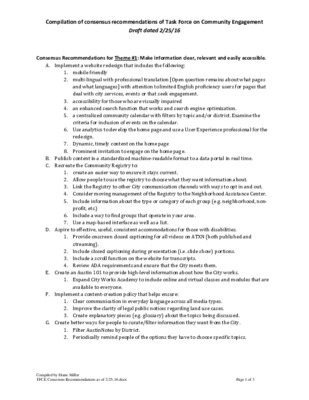
Compilation of consensus recommendations of Task Force on Community Engagement Draft dated 2/25/16 Compiled by Diane Miller TFCE Consensus Recommendations as of 2-25-16.docx Page 1 of 3 Consensus Recommendations for Theme #1: Make information clear, relevant and easily accessible. A. Implement a website redesign that includes the following: 1. mobile friendly 2. multi‐lingual with professional translation [Open question remains about what pages and what languages] with attention to limited English proficiency users for pages that deal with city services, events or that seek engagement. 3. accessibility for those who are visually impaired 4. an enhanced search function that works and search engine optimization. 5. a centralized community calendar with filters by topic and/or district. Examine the criteria for inclusion of events on the calendar. 6. Use analytics to develop the home page and use a User Experience professional for the redesign. 7. Dynamic, timely content on the home page 8. Prominent invitation to engage on the home page. B. Publish content in a standardized machine‐readable format to a data portal in real time. C. Recreate the Community Registry to: 1. create an easier way to ensure it stays current. 2. Allow people to use the registry to choose what they want information about. 3. Link the Registry to other City communication channels with ways to opt in and out. 4. Consider moving management of the Registry to the Neighborhood Assistance Center. 5. Include information about the type or category of each group (e.g. neighborhood, non‐profit, etc.) 6. Include a way to find groups that operate in your area. 7. Use a map‐based interface as well as a list. D. Aspire to effective, useful, consistent accommodations for those with disabilities. 1. Provide onscreen closed captioning for all videos on ATXN (both published and streaming). 2. Include closed captioning during presentation (i.e. slide show) portions. 3. Include a scroll function on the website for transcripts. 4. Review ADA requirements and ensure that the City meets them. E. Create an Austin 101 to provide high‐level information about how the City works. 1. Expand City Works Academy to include online and virtual classes and modules that are available to everyone. F. Implement a content‐creation policy that helps ensure: 1. Clear communication in everyday language across all media types. 2. Improve the clarity of legal public notices regarding land use cases. 3. Create explanatory pieces (e.g. glossary) about the topics being discussed. G. Create better …
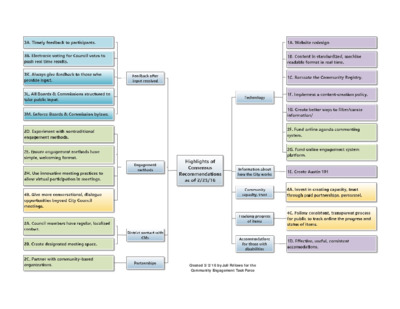
Created 3/2/16 byJuliFellows for theCommunity Engagement Task Force
TASK FORCE ON COMMUNITY ENGAGEMENT February 25, 2016, 6:00 – 9:00 PM STREET-JONES BUILDING, ROOM 400A 1000 E. 11th STREET AUSTIN, TEXAS 78702 CURRENT TASK FORCE MEMBERS: Celso Baez III Michael Clark-Madison Margarita Decierdo Richard Fonte Andrea Hamilton Claudia Herrington Chris Howe Christopher Ledesma Koreena Malone Ken Rigsbee Irfan Syed Navvab Taylor Sara Torres AGENDA CALL TO ORDER – 6:00 PM 1. OPENING REMARKS a. Diane Miller, Task Force Facilitator with Civic Collaboration, will discuss the outline of the meeting. 2. CITIZEN COMMUNICATION: GENERAL a. Citizens wishing to speak will need to sign up ten minutes before the meeting is called to order. Citizen communications will be limited to the first five (5) speakers and each citizen communicator will be given three (3) minutes to speak. Everyone will provide a sticky note to write their input which will later be sent to all of the Task Force members. 3. APPROVAL OF MINUTES a. Consider approving the minutes from the Task Force on Community Engagement (TFCE) regular meeting on February 11, 2016. b. Review notes from the February 11, 2016 TFCE Regular Meeting. 4. NEW BUSINESS: a. Discussion and possible action on amending the Task Force guidelines to reduce the number of members needed to make quorum. b. Draft the recommendations to Council by theme. c. Discuss next steps and evaluate meeting. 5. FUTURE AGENDA ITEMS: a. Discussion of topics for future TFCE Meetings. 6. ADJOURNMENT The City of Austin is committed to compliance with the American with Disabilities Act. Reasonable modifications and equal access to communications will be provided upon request. Meeting locations are planned with wheelchair access. If requiring Sign Language Interpreters or alternative formats, please give notice at least 2 days (48 hours) before the meeting date. Please call Matthew Chustz at the Communications & Public Information Office, at (512) 974-7270, Matthew.Chustz@austintexas.gov, for additional information; TTY users route through Relay Texas at 711. For more information on the Task Force on Community Engagement, please contact Matthew Chustz at (512) 974-7270, Matthew.Chustz@austintexas.gov.
TASK FORCE ON COMMUNITY ENGAGEMENT MEETING MINUTES (February 25, 2016) 1 Task Force on Community Engagement REGULAR MEETING MINUTES February 25, 2016 The Task Force on Community Engagement convened in a regular meeting on February 25, 2016 at the Street-Jones Building, 1000 E 11th Street, Room 400A, in Austin, Texas. Facilitator Julie Fellows, with Civic Collaboration, called the Task Force Meeting to order at 6:07 p.m. Task Force Members in Attendance: Celso Baez III, Michael Clark-Madison, Margarita Decierdo, Richard Fonte, Andrea Hamilton, Chris Howe, Christopher Ledesma, Koreena Malone, Navvab Taylor Staff in Attendance: Matthew Chustz, Doug Matthews, Larry Schooler Facilitators in Attendance: Juli Fellows, Pat Korbus 1. OPENING REMARKS a. Juli Fellows provided an overview of the meeting agenda. 2. CITIZEN COMMUNICTION: GENERAL a. None 3. APPROVAL OF MINUTES a. The Task Force approved, by consensus, the minutes from the February 11, 2016 Task Force on Community Engagement (TFCE) Regular Meeting. b. The Task Force reviewed the February 11, 2016 TFCE Regular Meeting notes provided by the facilitator. 4. NEW BUSINESS a. Amending the Task Force Guidelines for Quorum The Task Force members came to consensus to amend the group guidelines regarding the number of members necessary to make quorum. Since the number of members on the Task Force is now 12 instead of 13, the group agreed that the new quorum number should be six (6) members instead of the original seven (7). The group also agreed that quorum could also be reached if a Task Force member participates via telephone. b. Seek consensus on recommendations to Council by topic. Task Force members began discussing the recommendations from theme four (4) of the five (5) main themes/topics identified in the needs assessment. The group will continue to develop recommendations on the themes at the next Task Force Meeting on March 10, 2016. TASK FORCE ON COMMUNITY ENGAGEMENT MEETING MINUTES (February 25, 2016) 2 c. Meeting Evaluation (standing agenda item) The facilitators lead the TFCE members in an evaluation of the meeting. 5. Future Agenda Items a. Seek consensus on recommendations to Council by topic/theme remaining theme 6. ADJOURNMENT Facilitator, Juli Fellows adjourned the meeting at 8:50 p.m. without objection.
Task Force on Community Engagement Thirteenth Meeting February 25, 2016 6-9 p.m. Street Jones Bldg, 4th fl conference room 2/19/2016. Created by Diane Miller and Juli Fellows ThirteenthMeetingDetails.docx Meeting Goals 1. Seek consensus on whether to change the number of members considered quorum. 2. Seek consensus on additional recommendations for Theme 3. (Explain how input used…). 3. Seek consensus on recommendations for Theme 4. (Ensure that everyone who cares about an issue or is impacted has the opportunity to engage and that some voices don’t count more than others.) 4. Time permitting, discuss what the group wants to do about their charge to “consider fiscal implications of recommendations”. Agenda Agenda 6:00 Overview – review goals, agenda and discussion guidelines 6:03 Citizen Input 6:10 Approve Minutes 6:15 Seek consensus on whether to change number required for quorum. 6:30 Seek consensus on recommendations by topic – finalize theme 3 and work on theme 4 7:30 Break 7:40 Continue working on recommendations 8:55 Discuss next steps and evaluate the meeting 9:00 Adjourn
TASK FORCE ON COMMUNITY ENGAGEMENT MEETING MINUTES (February 11, 2015) 1 Task Force on Community Engagement REGULAR MEETING MINUTES February 11, 2016 The Task Force on Community Engagement convened in a regular meeting on February 11, 2016 at the Leadership Austin office, 1609 Shoal Creek Blvd., Suite 202, in Austin, Texas. Facilitator Diane Miller, with Civic Collaboration, called the Task Force Meeting to order at 7:40 p.m. and went beyond the 15 minute deadline for cancelling a meeting for lack of quorum at the request of the Task Force Members that were present. Task Force Members in Attendance: Celso Baez III, Richard Fonte, Claudia Herrington, Chris Howe, Koreena Malone (phone), Navvab Taylor, Sara Torres Staff in Attendance: Matthew Chustz, Doug Matthews, Larry Schooler Facilitators in Attendance: Julie Fellows, Diane Miller 1. OPENING REMARKS a. Diane Miller provided an overview of the meeting agenda. 2. CITIZEN COMMUNICTION: GENERAL a. Citizen comment was provided by Jeff Jack. 3. APPROVAL OF MINUTES a. The Task Force approved, by consensus, the minutes from the January 28, 2016 Task Force on Community Engagement (TFCE) Regular Meeting. b. The Task Force reviewed the January 28, 2016 TFCE Regular Meeting notes provided by the facilitator. 4. OLD BUSINESS a. Community Engagement Survey Results Facilitators provided a high-level overview of additional Community Engagement survey results. b. Finalize recommendations from theme two Task Force members reached consensus and finalized the recommendation from theme two. 5. NEW BUSINESS a. Responding to request for input on Audit of Neighborhood Planning Task Force members agreed to send Michael McGill, Senior Auditor with the City of Austin, a written summary of their informal discussion in response to the question proposed. TASK FORCE ON COMMUNITY ENGAGEMENT MEETING MINUTES (February 11, 2015) 2 b. Seek consensus on recommendations to Council by topic. Task Force members began discussing the recommendations from theme three (3) of the five (5) main themes/topics identified in the needs assessment. The group will continue to develop recommendations on the themes at the next Task Force Meeting on February 25, 2016. c. Meeting Evaluation (standing agenda item) The facilitators lead the TFCE members in an evaluation of the meeting. 6. Future Agenda Items a. Seek consensus on recommendations to Council on theme three (3) b. Seek consensus on recommendations to Council by topic/theme (remaining 2 themes). c. Discuss amending the Task Force guidelines to lower the number of members needed to make …
Created by Juli Fellows, Diane Miller February 12, 2016 Task Force on Community Engagement Meeting Notes: February 11, 2016 1 2/12/2016 TFCE2.11.16_V5MeetingNotes.docx Contents Executive Summary ............................................................................................................................................................... 2 Member Attendance List ................................................................................................................................................... 2 Action Items ....................................................................................................................................................................... 3 Meeting Notes ....................................................................................................................................................................... 3 Citizen Input ....................................................................................................................................................................... 3 Discussion Notes on City Auditor’s Request ...................................................................................................................... 3 Additional Consensus Recommendation for Theme #2: Make it easier for community/public to give input .................. 4 Consensus Recommendation for Theme #3: Explain how input will be used and show how that input had an impact on the decision made. ............................................................................................................................................................ 3 Discussion of possible Theme 3 recommendation concerning Bds & Commissions ......................................................... 3 Discussion of possible Theme 3 recommendation concerning reporting to Council on public input – timing and requirement for serious engagement. .............................................................................................................................. 3 Meeting Evaluation ............................................................................................................................................................ 3 2 2/12/2016 TFCE2.11.16_V5MeetingNotes.docx Executive Summary On February 11, 2016 the meeting convened at 7:40 p.m. when a quorum of seven members was achieved. The meeting was held at the offices of Leadership Austin. Citizen comment was provided by Jeff Jack. The group approved the January 28, 2016 minutes with no changes. The group agreed to send Michael McGill, senior auditor with the City of Austin, a written summary of their informal discussion in response to the question “Are the City’s communication and governance structures effective in supporting neighborhood planning efforts?” The input would not be characterized as coming from the entire Task Force, but names of those participating in the discussion would be listed. Notes on this informal discussion are shown on pages 3-4. There was grave concern about the lack of a quorum interfering with the group’s ability to accomplish their work by the deadline. The group asked Diane Miller to contact City Council members whose appointees have missed a number of meetings, to let them know that this is a concern. At the next meeting the group will also take up the issue of changing the number required for a quorum because at least one more member appears to have resigned, bringing the active membership to 12. The group concluded their recommendations on Theme #2 - Make it easier for community/public to give input. They added the following recommendation. (H) Use innovative meeting practices that enable online or virtual participation during live meetings. (This should include meetings of the City Council, Boards and Commissions, town hall meetings, and other City engagement activities.) They also agreed on two …
Compilation of consensus recommendations of Task Force on Community Engagement Draft dated 2/15/16 Compiled by Diane Miller TFCE Consensus Recommendations as of 2-15-16.docx Page 1 of 3 Consensus Recommendations for Theme #1: Make information clear, relevant and easily accessible. A. Implement a website redesign that includes the following: 1. mobile friendly 2. multi-lingual with professional translation [Open question remains about what pages and what languages] with attention to limited English proficiency users for pages that deal with city services, events or that seek engagement. 3. accessibility for those who are visually impaired 4. an enhanced search function that works and search engine optimization. 5. a centralized community calendar with filters by topic and/or district. Examine the criteria for inclusion of events on the calendar. 6. Use analytics to develop the home page and use a User Experience professional for the redesign. 7. Dynamic, timely content on the home page 8. Prominent invitation to engage on the home page. B. Publish content in a standardized machine-readable format to a data portal in real time. C. Recreate the Community Registry to: 1. create an easier way to ensure it stays current. 2. Allow people to use the registry to choose what they want information about. 3. Link the Registry to other City communication channels with ways to opt in and out. 4. Consider moving management of the Registry to the Neighborhood Assistance Center. 5. Include information about the type or category of each group (e.g. neighborhood, non-profit, etc.) 6. Include a way to find groups that operate in your area. 7. Use a map-based interface as well as a list. D. Aspire to effective, useful, consistent accommodations for those with disabilities. 1. Provide onscreen closed captioning for all videos on ATXN (both published and streaming). 2. Include closed captioning during presentation (i.e. slide show) portions. 3. Include a scroll function on the website for transcripts. 4. Review ADA requirements and ensure that the City meets them. E. Create an Austin 101 to provide high-level information about how the City works. 1. Expand City Works Academy to include online and virtual classes and modules that are available to everyone. F. Implement a content-creation policy that helps ensure: 1. Clear communication in everyday language across all media types. 2. Improve the clarity of legal public notices regarding land use cases. 3. Create explanatory pieces (e.g. glossary) about the topics being discussed. G. Create better …
TASK FORCE ON COMMUNITY ENGAGEMENT February 11, 2016, 6:00 – 9:00 PM LEADERSHIP AUSTIN 1609 SHOAL CREEK BLVD., SUITE 202 AUSTIN, TEXAS 78701 CURRENT TASK FORCE MEMBERS: Celso Baez III Michael Clark-Madison Margarita Decierdo Richard Fonte Andrea Hamilton Claudia Herrington Chris Howe Christopher Ledesma Koreena Malone Ken Rigsbee Irfan Syed Navvab Taylor Sara Torres AGENDA CALL TO ORDER – 6:00 PM 1. OPENING REMARKS a. Diane Miller, Task Force Facilitator with Civic Collaboration, will discuss the outline of the meeting. 2. CITIZEN COMMUNICATION: GENERAL a. Citizens wishing to speak will need to sign up ten minutes before the meeting is called to order. Citizen communications will be limited to the first five (5) speakers and each citizen communicator will be given three (3) minutes to speak. Everyone will provide a sticky note to write their input which will later be sent to all of the Task Force members. 3. APPROVAL OF MINUTES a. Consider approving the minutes from the Task Force on Community Engagement (TFCE) regular meeting on January 14, 2016. b. Review notes from the January 14, 2016 TFCE Regular Meeting. 4. OLD BUSINESS: a. Facilitators will provide a high-level overview of additional Community Engagement survey results. b. Review of theme 2 recommendations and ensure clarity of online tool recommendations and seek consensus on finalizing recommendations from theme two. 5. NEW BUSINESS: a. Seek consensus on process for responding to request for input on Audit of Neighborhood Planning. b. Draft the recommendations to Council by theme. c. Discuss next steps and evaluate meeting. 6. FUTURE AGENDA ITEMS: a. Discussion of topics for future TFCE Meetings. ADJOURNMENT The City of Austin is committed to compliance with the American with Disabilities Act. Reasonable modifications and equal access to communications will be provided upon request. Meeting locations are planned with wheelchair access. If requiring Sign Language Interpreters or alternative formats, please give notice at least 2 days (48 hours) before the meeting date. Please call Matthew Chustz at the Communications & Public Information Office, at (512) 974-7270, Matthew.Chustz@austintexas.gov, for additional information; TTY users route through Relay Texas at 711. For more information on the Task Force on Community Engagement, please contact Matthew Chustz at (512) 974-7270, Matthew.Chustz@austintexas.gov.
TASK FORCE ON COMMUNITY ENGAGEMENT MEETING MINUTES (February 11, 2015) 1 Task Force on Community Engagement REGULAR MEETING MINUTES February 11, 2016 The Task Force on Community Engagement convened in a regular meeting on February 11, 2016 at the Leadership Austin office, 1609 Shoal Creek Blvd., Suite 202, in Austin, Texas. Facilitator Diane Miller, with Civic Collaboration, called the Task Force Meeting to order at 7:40 p.m. and went beyond the 15 minute deadline for cancelling a meeting for lack of quorum at the request of the Task Force Members that were present. Task Force Members in Attendance: Celso Baez III, Richard Fonte, Claudia Herrington, Chris Howe, Koreena Malone (phone), Navvab Taylor, Sara Torres Staff in Attendance: Matthew Chustz, Doug Matthews, Larry Schooler Facilitators in Attendance: Julie Fellows, Diane Miller 1. OPENING REMARKS a. Diane Miller provided an overview of the meeting agenda. 2. CITIZEN COMMUNICTION: GENERAL a. Citizen comment was provided by Jeff Jack. 3. APPROVAL OF MINUTES a. The Task Force approved, by consensus, the minutes from the January 28, 2016 Task Force on Community Engagement (TFCE) Regular Meeting. b. The Task Force reviewed the January 28, 2016 TFCE Regular Meeting notes provided by the facilitator. 4. OLD BUSINESS a. Community Engagement Survey Results Facilitators provided a high-level overview of additional Community Engagement survey results. b. Finalize recommendations from theme two Task Force members reached consensus and finalized the recommendation from theme two. 5. NEW BUSINESS a. Responding to request for input on Audit of Neighborhood Planning Task Force members agreed to send Michael McGill, Senior Auditor with the City of Austin, a written summary of their informal discussion in response to the question proposed. TASK FORCE ON COMMUNITY ENGAGEMENT MEETING MINUTES (February 11, 2015) 2 b. Seek consensus on recommendations to Council by topic. Task Force members began discussing the recommendations from theme three (3) of the five (5) main themes/topics identified in the needs assessment. The group will continue to develop recommendations on the themes at the next Task Force Meeting on February 25, 2016. c. Meeting Evaluation (standing agenda item) The facilitators lead the TFCE members in an evaluation of the meeting. 6. Future Agenda Items a. Seek consensus on recommendations to Council on theme three (3) b. Seek consensus on recommendations to Council by topic/theme (remaining 2 themes). c. Discuss amending the Task Force guidelines to lower the number of members needed to make …
Created by Diane Miller, Pat Korbus January 29, 2016 Task Force on Community Engagement Meeting Notes: January 28, 2016 1 2/8/2016 TFCE1.28.16Notes_V3.docx Contents Executive Summary ................................................................................................................................................................. 2 Member Attendance List .................................................................................................................................................... 2 Action Items ........................................................................................................................................................................ 2 Meeting Notes ........................................................................................................................................................................ 3 Citizen input ........................................................................................................................................................................ 3 Consensus Process Used by the Group ............................................................................................................................... 3 Global Criteria for Recommendations ................................................................................................................................ 3 Consensus Recommendations for Theme #2: Make it easier for community/public to give input ................................... 3 Recommendation for Theme #5 ......................................................................................................................................... 4 Notes to include in Executive Summary of Recommendations Report .............................................................................. 5 Meeting Evaluation ............................................................................................................................................................. 5 2 2/8/2016 TFCE1.28.16Notes_V3.docx Executive Summary On January 28, 2016 eight of the thirteen members of the Task Force on Community Engagement (TFCE) attended the meeting at the Street-Jones Building. Citizen comment was provided by Mateo Clarke of Open Austin which is requesting that the Task Force consider their recommendations related to open data and the use of technology for open governance. They will provide a written summary of their recommendations to be shared with Task Force members via the Bloomfire site. The group approved the January14, 2015 minutes with no changes. Recommendations continue to be based on the group’s previously identified global criteria they wanted their consensus recommendations to meet: It’s legal. It’s an improvement. It’s easy enough to implement (in our view). Whenever possible, it addresses a problem presented to the TF. The City has the resources, or it may involve the reasonable allocation of resources, to do it (money, staff, skills, etc.). The recommendation is quantifiable, measurable. It produces a good return on investment. It’s based on data. The group worked on Theme 2 from the needs assessment: “Make it easier for people to give input in ways that are convenient, accessible and appropriate for them.” Recommendations on this topic fell into three major categories: meeting community members where they usually gather, using mobile options (e.g., in-district office hours, frequent in-district town halls, a roaming “engagement” bus, kiosks) partnering with existing community organizations to better reach community residents robust, current, easy-to-use, on-line technology that is made widely available The group agreed to come to the February 11, 2016 meeting prepared to propose their top recommendation in each of the remaining three theme areas and that they will start with Theme 3: “Explain how input will be used and show how that input had …
TASK FORCE ON COMMUNITY ENGAGEMENT MEETING MINUTES (January 28, 2015) 1 Task Force on Community Engagement REGULAR MEETING MINUTES January 28, 2016 The Task Force on Community Engagement convened in a regular meeting on January 28, 2016 at the Street-Jones Building, 1000 E 11th Street, Room 400A, in Austin, Texas. Facilitator Diane Miller, with Civic Collaboration, called the Task Force Meeting to order at 6:14 p.m. Task Force Members in Attendance: Richard Fonte, Andrea Hamilton, Claudia Herrington, Chris Howe, Koreena Malone, Ken Rigsbee, Navvab Taylor, Sara Torres Staff in Attendance: Matthew Chustz, Doug Matthews, Larry Schooler Facilitators in Attendance: Pat Korbus, Diane Miller 1. OPENING REMARKS a. Diane Miller provided an overview of the meeting agenda. 2. CITIZEN COMMUNICTION: GENERAL a. One citizen spoke. Mateo Clarke of Open Austin requested that the Task Force consider their recommendations related to open data and the use of technology for open governance. Mr. Clark will provide a written summary of their recommendations to be shared with Task Force members via the Bloomfire site. 3. APPROVAL OF MINUTES a. The Task Force approved, by consensus, the minutes from the January 14, 2016 Task Force on Community Engagement (TFCE) Regular Meeting. b. The Task Force reviewed the January 14, 2016 TFCE Regular Meeting notes provided by the facilitator. 4. NEW BUSINESS a. Seek consensus on recommendations to Council by topic. Task Force members reached consensus on the recommendations to Council for one (1) of the five (5) main themes/topics identified in the needs assessment. The group will continue to develop recommendations on the themes at the next Task Force Meeting on February 11, 2016. b. Meeting Evaluation (standing agenda item) The facilitators lead the TFCE members in an evaluation of the meeting. TASK FORCE ON COMMUNITY ENGAGEMENT MEETING MINUTES (January 28, 2015) 2 5. Future Agenda Items a. Seek consensus on recommendations to Council by topic/theme (remaining 3 themes). 6. ADJOURNMENT Facilitator, Diane Miller adjourned the meeting at 9:00 p.m. without objection.
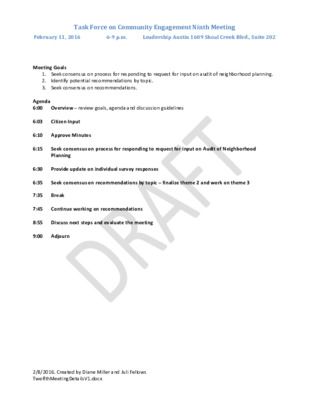
Task Force on Community Engagement Ninth Meeting February 11, 2016 6-9 p.m. Leadership Austin 1609 Shoal Creek Blvd., Suite 202 2/8/2016. Created by Diane Miller and Juli Fellows TwelfthMeetingDetailsV1.docx Meeting Goals 1. Seek consensus on process for responding to request for input on audit of neighborhood planning. 2. Identify potential recommendations by topic. 3. Seek consensus on recommendations. Agenda 6:00 Overview – review goals, agenda and discussion guidelines 6:03 Citizen Input 6:10 Approve Minutes 6:15 Seek consensus on process for responding to request for input on Audit of Neighborhood Planning 6:30 Provide update on individual survey responses 6:35 Seek consensus on recommendations by topic – finalize theme 2 and work on theme 3 7:35 Break 7:45 Continue working on recommendations 8:55 Discuss next steps and evaluate the meeting 9:00 Adjourn
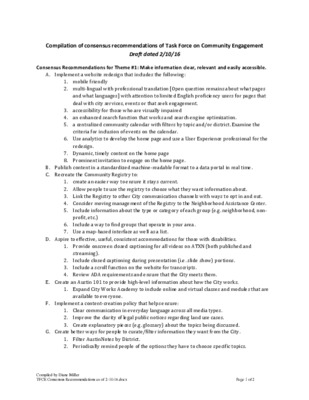
Compiled by Diane Miller TFCE Consensus Recommendations as of 2-10-16.docx Page 1 of 2 Compilation of consensus recommendations of Task Force on Community Engagement Draft dated 2/10/16 Consensus Recommendations for Theme #1: Make information clear, relevant and easily accessible. A. Implement a website redesign that includes the following: 1. mobile friendly 2. multi-lingual with professional translation [Open question remains about what pages and what languages] with attention to limited English proficiency users for pages that deal with city services, events or that seek engagement. 3. accessibility for those who are visually impaired 4. an enhanced search function that works and search engine optimization. 5. a centralized community calendar with filters by topic and/or district. Examine the criteria for inclusion of events on the calendar. 6. Use analytics to develop the home page and use a User Experience professional for the redesign. 7. Dynamic, timely content on the home page 8. Prominent invitation to engage on the home page. B. Publish content in a standardized machine-readable format to a data portal in real time. C. Recreate the Community Registry to: 1. create an easier way to ensure it stays current. 2. Allow people to use the registry to choose what they want information about. 3. Link the Registry to other City communication channels with ways to opt in and out. 4. Consider moving management of the Registry to the Neighborhood Assistance Center. 5. Include information about the type or category of each group (e.g. neighborhood, non-profit, etc.) 6. Include a way to find groups that operate in your area. 7. Use a map-based interface as well as a list. D. Aspire to effective, useful, consistent accommodations for those with disabilities. 1. Provide onscreen closed captioning for all videos on ATXN (both published and streaming). 2. Include closed captioning during presentation (i.e. slide show) portions. 3. Include a scroll function on the website for transcripts. 4. Review ADA requirements and ensure that the City meets them. E. Create an Austin 101 to provide high-level information about how the City works. 1. Expand City Works Academy to include online and virtual classes and modules that are available to everyone. F. Implement a content-creation policy that helps ensure: 1. Clear communication in everyday language across all media types. 2. Improve the clarity of legal public notices regarding land use cases. 3. Create explanatory pieces (e.g. glossary) about the topics being discussed. G. Create better …
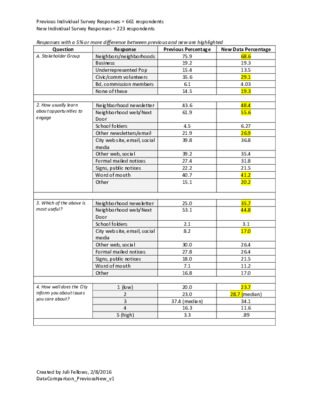
Previous Individual Survey Responses = 661 respondents New Individual Survey Responses = 223 respondents Created by Juli Fellows, 2/8/2016 DataComparison_PreviousNew_v1 Responses with a 5% or more difference between previous and new are highlighted Question Response Previous Percentage New Data Percentage A. Stakeholder Group Neighbors/neighborhoods 75.9 68.6 Business 19.2 19.3 Underrepresented Pop 15.4 13.5 Civic/comm volunteers 35.6 29.1 Bd, commission members 6.1 4.03 None of these 14.5 19.3 2. How usually learn about opportunities to engage Neighborhood newsletter 43.6 48.4 Neighborhood web/Next Door 61.9 55.6 School folders 4.5 6.27 Other newsletters/email 21.9 26.9 City web site, email, social media 39.8 36.8 Other web, social 39.2 35.4 Formal mailed notices 27.4 31.8 Signs, public notices 22.2 21.5 Word of mouth 40.7 41.2 Other 15.1 20.2 3. Which of the above is most useful? Neighborhood newsletter 25.0 35.7 Neighborhood web/Next Door 53.1 44.8 School folders 2.1 3.1 City web site, email, social media 8.2 17.0 Other web, social 30.0 26.4 Formal mailed notices 27.8 26.4 Signs, public notices 18.0 21.5 Word of mouth 7.1 11.2 Other 16.8 17.0 4. How well does the City inform you about issues you care about? 1 (low) 20.0 23.7 2 23.0 28.7 (median) 3 37.4 (median) 34.1 4 16.3 11.6 5 (high) 3.3 .89 Previous Individual Survey Responses = 661 respondents New Individual Survey Responses = 223 respondents Created by Juli Fellows, 2/8/2016 DataComparison_PreviousNew_v1 5. How well does the City tell you how to get involved? 1 (low) 24.8 28.7 2 24.1 (median) 33.6 (median) 3 31.6 25.5 4 15.4 10.3 5 (high) 4.1 .89 7. How frequently do you take advantage of opportunities … 1 (low) 17.4 12.0 2 21.9 26.9 3 30.6 (median) 34.5(median) 4 21.0 18.4 5 (high) 9.1 7.2 11. How satisfied that you have fair, transparent and sufficient ability to engage… 1 (low) 24.4 25.1 2 19.4 22.4 3 31.9 (median) 33.6 (median) 4 18.0 14.3 5 (high) 6.4 3.1 12. How satisfied with outcomes of engagement? 1 (low) 24.5 30.9 2 23.8 23.3 (median) 3 35.1 (median) 34.0 4 13.2 12.1 5 (high) 3.5 1.8
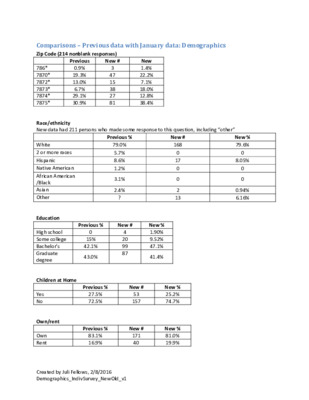
Created by Juli Fellows, 2/8/2016 Demographics_IndivSurvey_NewOld_v1 Comparisons – Previous data with January data: Demographics Zip Code (214 nonblank responses) Previous New # New 786* 0.9% 3 1.4% 7870* 19.3% 47 22.2% 7872* 13.0% 15 7.1% 7873* 6.7% 38 18.0% 7874* 29.1% 27 12.8% 7875* 30.9% 81 38.4% Race/ethnicity New data had 211 persons who made some response to this question, including “other” Previous % New # New % White 79.0% 168 79.6% 2 or more races 5.7% 0 0 Hispanic 8.6% 17 8.05% Native American 1.2% 0 0 African American /Black 3.1% 0 0 Asian 2.4% 2 0.94% Other ? 13 6.16% Education Previous % New # New % High school 0 4 1.90% Some college 15% 20 9.52% Bachelor’s 42.1% 99 47.1% Graduate degree 43.0% 87 41.4% Children at Home Previous % New # New % Yes 27.5% 53 25.2% No 72.5% 157 74.7% Own/rent Previous % New # New % Own 83.1% 171 81.0% Rent 16.9% 40 19.9%