DOWNTOWN DENSITY BONUS PROGRAM (DDBP) SUBMITTAL APPLICATION INSTRUCTIONS A property owner (Owner) or his/her representative (Applicant) acting on behalf of the Owner can initiate an administrative request to the Director of Planning (Director) seeking additional Floor-to-Area (FAR) entitlements as outlined in the Downtown Density Bonus Program as approved by Ordinance No. 20140227-054. In order for the Director to conduct an administrative review, the requirements listed below must be submitted. Once an application is deemed complete, the Director will inform the Applicant of review commencement. The following submittals are required in a complete PDF package of no more than 10 Mb in size with sheets no larger than 11x17 inches: 1. Completed DDBP Application; 2. Vicinity plan locating the project in its context, and showing a minimum 9 block area around the project; Location and nature of nearby transit facilities; 3. 4. Drawings (submitted drawings should demonstrate compliance with Subchapter E Design Standards, as applicable): o Site plan; o Floor plans; o Exterior elevations (all sides); o Three-dimensional views; 5. As part of the gatekeeper requirements, o Urban Design Guidelines checklist; o Great Streets; o 2 Star Austin Energy Green Building rating - submit copy of the projects signed Austin Energy Green Building Letter of Intent and Austin Energy Green Building checklist.; 6. Other items that may be submitted but not required: Narrative / graphics / photos to further describe the project. 7. CoordinationmemoacknowledgmentfromtheCityofAustin’sHousing and Planning Department for detailing of affordable housing community benefits. Please contact Alex Radtke for more information. DOWNTOWN DENSITY BONUS PROGRAM (DDBP) SUBMITTAL APPLICATION 1.Project Name: 4th & Brazos (SP-2020-0056C) 2.Property Owner 4th & Brazos, LLC 216 E. 4th Street, Austin, Texas 78701 3.Applicant/Authorized Agent Richard T. Suttle, Jr., Armbrust & Brown, PLLC 100 Congress Avenue, Suite 1300, Austin, Texas 78701 512-435-2310 rsuttle@abaustin.com 4.Anticipated Project Address: 204-208 E. 4th Street; 409 Brazos Street; 404 San Jacinto Blvd. Page 1 of 9 Name: Address: Phone: E-mail: Name: Address: Phone: E-mail: 5.Site Information a. Lot area (also include on site plan): 35,371 SF (0.81 AC.) b. Existingzoning(includeanyzoningsuffixessuchas“H,”“CO,”etc.Ifthe property has a conditional overlay (CO), provide explanation of conditions (attach additional pages as necessary): Central Business District (CBD) c. Existing entitlements: I. Current floor to area (FAR) limitation: II. Current height limitation (in feet) : 8:1 None for CBD III. Affected by Capitol View Corridors (CVCs) Yes/No? Yes No If yes, please provide specify height allowed under CVC: N/A 6.Existing Deed …
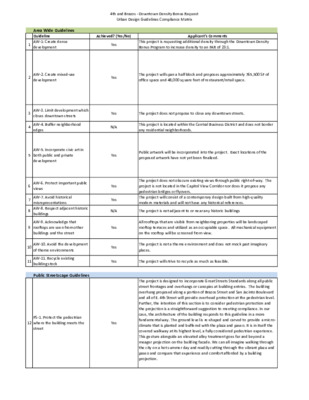
4th and Brazos - Downtown Density Bonus Request Urban Design Guidelines Compliance Matrix Area Wide Guidelines Guideline AW-1: Create dense development 1 Achieved? (Yes/No) Applicant's Comments This project is requesting additional density through the Downtown Density Bonus Program to increase density to an FAR of 23:1. 2 AW-2. Create mixed-use development The project will span a half block and proposes approximately 765,500 SF of office space and 48,000 square feet of restaurant/retail space. Yes Yes Yes N/A Yes Yes Yes N/A Yes Yes Yes Yes 3 4 5 6 7 8 9 10 11 AW-3. Limit development which closes downtown streets AW-4. Buffer neighborhood edges AW-5. Incorporate civic art in both public and private development AW-6. Protect important public views AW-7. Avoid historical misrepresentations AW-8. Respect adjacent historic buildings AW-9. Acknowledge that rooftops are seen from other buildings and the street AW-10. Avoid the development of theme environments AW-11. Recycle existing building stock Public Streetscape Guidelines 12 PS-1. Protect the pedestrian where the building meets the street The project does not propose to close any downtown streets. This project is located within the Central Business District and does not border any residential neighborhoods. Public artwork will be incorporated into the project. Exact locations of the proposed artwork have not yet been finalized. The project does not obscure existing views through public right-of-way. The project is not located in the Capitol View Corridor nor does it propose any pedestrian bridges or flyovers. The project will consist of a contemporary design built from high-quality modern materials and will not have any historical references. The project is not adjacent to or near any historic buildings All rooftops that are visible from neighboring properties will be landscaped rooftop terraces and utilized as an occupiable space. All mechanical equipment on the rooftop will be screened from view. The project is not a theme environment and does not mock past imaginary places. The project will strive to recycle as much as feasible. The project is designed to incorporate Great Streets Standards along all public street frontages and overhangs or canopies at building entries. The building overhang proposed along a portion of Brazos Street and San Jacinto Boulevard and all of E. 4th Street will provide overhead protection at the pedestrian level. Further, the intention of this section is to consider pedestrian protection and the projection is a straightforward suggestion to meeting compliance. In our case, the …
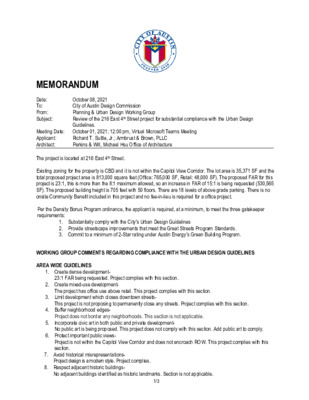
MEMORANDUM Date: To: From: Subject: October 08, 2021 City of Austin Design Commission Planning & Urban Design Working Group Review of the 216 East 4th Street project for substantial compliance with the Urban Design Guidelines. Meeting Date: October 01, 2021; 12:00 pm, Virtual Microsoft Teams Meeting Applicant: Architect: Richard T. Suttle, Jr.; Armbrust & Brown, PLLC Perkins & Will, Michael Hsu Office of Architecture The project is located at 216 East 4th Street. Existing zoning for the property is CBD and it is not within the Capitol View Corridor. The lot area is 35,371 SF and the total proposed project area is 813,000 square feet (Office: 765,000 SF, Retail: 48,000 SF). The proposed FAR for this project is 23:1, this is more than the 8:1 maximum allowed, so an increase in FAR of 15:1 is being requested (530,565 SF). The proposed building height is 705 feet with 50 floors. There are 18 levels of above grade parking. There is no onsite Community Benefit included in this project and no fee-in-lieu is required for a office project. Per the Density Bonus Program ordinance, the applicant is required, at a minimum, to meet the three gatekeeper requirements: 1. Substantially comply with the City’s Urban Design Guidelines 2. Provide streetscape improvements that meet the Great Streets Program Standards. 3. Commit to a minimum of 2-Star rating under Austin Energy’s Green Building Program. WORKING GROUP COMMENTS REGARDING COMPLIANCE WITH THE URBAN DESIGN GUIDELINES AREA WIDE GUIDELINES 1. Create dense development- 23:1 FAR being requested. Project complies with this section. 2. Create mixed-use development- The project has office use above retail. This project complies with this section. 3. Limit development which closes downtown streets- This project is not proposing to permanently close any streets. Project complies with this section. 4. Buffer neighborhood edges- 5. Project does not border any neighborhoods. This section is not applicable. Incorporate civic art in both public and private development- No public art is being proposed. This project does not comply with this section. Add public art to comply. 6. Protect important public views- Project is not within the Capitol View Corridor and does not encroach ROW. This project complies with this section. 7. Avoid historical misrepresentations- Project design is a modern style. Project complies. 8. Respect adjacent historic buildings- No adjacent buildings identified as historic landmarks. Section is not applicable. 1/3 9. Acknowledge that rooftops are seen from other buildings …
DESIGN COMMISSION MONDAY, August 23, 2021 5:30 PM VIA REMOTE WebEx Meeting Minutes Call to order by: Chair D. Carroll at 5:34 p.m. X X X Member List David Carroll – Chair (District 1) Jessica Rollason – Vice-Chair (District 7) Martha Gonzalez (District 2) Samuel Franco (District 3) Josue Meiners (District 4) Evan Taniguchi (Mayor) “X” Denote Commission Members who were in attendance X Jorge E. Rousselin, Executive Liaison X Aaron D. Jenkins, Staff Liaison X Art Zamorano, Staff Liaison CITIZEN COMMUNICATION: None. 1. NEW BUSINESS (Discussion and Possible Action): CITY OF AUSTIN HOUSING AND PLANNING STAFF X Melissa Hanao-Robledo (District 5) X X X X Jen Weaver (District 6) Aan Coleman (District 8) Bart Whatley (District 9) Ben Luckens (District 10) a. Discussion and possible action on recommendations whether the Elisabet Ney Museum Building Restoration and Site Improvements, addressed at 304 E. 44th Street, complies with the City Design and Sustainability Standards, for the City of Austin; Nick Faust The Lawrence Group, Christina Bies City of Austin Parks and Recreation Department, George Maldonado City of Austin Parks and Recreation Department • Ellen Cofax, and Christina Bies City of Austin Parks and Recreation Department and Nick Faust The Lawrence Group presented and addressed questions. Page 1 of 3 • Commissioner J. Meiners made a motion to support the project as presented as it complies with the City’s Design and Sustainability Standards, seconded by Commissioner E. Taniguchi. • The motion was approved [ 6 ayes, 0 nays] 2. COMMISSION-SPECIFIC BUSINESS (Discussion and possible action): a. Approval of June 28th and August 5th meeting minutes. • Commissioner E. Taniguchi made a motion to approve the June 28th and August 5th meeting minutes as distributed. Commissioner J. Meiners seconded. • The motion was approved [ 6 ayes, 0 nays] b. Discussion and Possible action on recommendations related to the Downtown Density Bonus Program. • Chair D. Carroll reiterated, that at the August 5th Special Called Meeting regarding the Downtown Density Bonus program, 2 of the 3 resolutions passed. The third resolution has been re-worded by Commissioners J. Weaver to address the concerns from the August 5th meeting. 6:20 PM Commissioner A. Coleman joined the meeting 6:22 PM Commissioner B. Luckens joined the meeting. • Commissioner B. Whatley made a motion to approve the Resolution regarding the Downtown Density Bonus Program as amended. Commissioner E. Taniguchi seconded. • The motion was approved [ 7 …
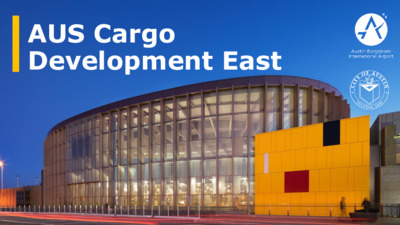
AUS Cargo Development East • EXPANSION OF CARGO APRON CAPACITY • 89,400 SF PEMB Cargo Facility • Expansion of Air Side Pavement • New Truck Loading Dock • 158 Space Employee Parking • Austin Energy Green Building 3-Star • New Water Quality/Detention Pond • Landscaping, Yardscape & Sidewalks • Energy Efficiency • Water use reduction (indoor and outdoor) • Electric vehicle charging (capable spaces and electric GSE) • Heat island reduction • Access to quality drinking water • Low Emitting Materials, Construction Waste Management, and Local Art 1 PROJECT LOCATION 2 Project includes expansion of cargo processing capacity at the southeast corner of the existing cargo apron. Improvements are consistent with the adopted ABIA Master Plan. OVERALL SITE PLAN 3 20.5-acre limit of construction Constructed around southeast corner of existing cargo apron Project frontage on both Freight Lane and Cargo Avenue ISOMETRIC VIEWS 4 Pre-Engineered Metal Building Truck loading dock on the south side Aircraft cargo operations on the north side SOUTHEAST PERSPECTIVE 5 Pre-Engineered Metal Building Entry plazas on the east elevation and on the east end of the south elevation Metal building with CMU skirt OVERALL FLOOR PLAN 6 Finished break and office space east end, App. 9,400 SF Balance of building cargo operations Total size approximately 89,400 SF AEGB 3-Star Rating FINISHED SPACE FLOOR PLAN Restrooms, break areas & lunch area Transfer space is considered secure area of ABIA On-site office space and driver lounge 7 LANDSCAPE PLAN 1 8 FAA compliant landscaping Break area at northeast corner of building Landscaped parking area LANDSCAPE PLAN 2 9 Break area at southeast corner of building Landscaped entry courtyard No landscaping on air side of project 10
City of Austin - Design Commission Project Review Application The Design Commission provides advisory recommendations to the City Council to assist in developing public policy and to promote excellence in the design and development of the urban environment. The Design Commission reviews three types of projects: 1. City projects (see page ii for process) The Commission reviews all municipal buildings and associated site plans to ensure they demonstrate compliance with city design and sustainability standards (Council Resolution No. 20071129-046), including those seeking Subchapter E Design Standards Alternative Equivalent Compliance (AEC) (Council Resolution No. 20100923-086). 2. Destiny Bonus projects (see page iv for process) The Commission reviews density bonus projects for substantial compliance with the Urban Design Guidelines for Austin in accordance with the Gatekeeper requirements of LDC 25-2-586 for the Downtown Density Bonus Program. 3. Advisory Recommendations for Private projects (see page ii for process) The Commission will consider Project Review Applications from private projects during its regularly scheduled monthly public meetings and may issue an advisory recommendation in the form of a Project Review Letter to the Applicant. This Project Review Application must be submitted before your project can be presented to the Design Commission for their review. Design Commission requests project be presented in their Conceptual/Schematic Design phase. This application primarily addresses inhabited buildings and structures and their effect on the public realm; please refer to Appendix A for infrastructure type projects. The Commission's review of projects is based on the planning/design principles in the Urban Design Guidelines for Austin. Ensure that all applicable principles are addressed in the application questions and in your presentation. https://www.austintexas.gov/sites/default/files/files/Boards_and_Commissions/ Design_Commission_urban_design_guidelin es_for_austin.pdf The Design Commission supports the vision and principles of Imagine Austin Comprehensive Plan, especially those that affect the urban environment and fabric. All projects should consider this vision and principles, many of which are similar to the Urban Design Guidelines. Refer to Appendix C for the most pertinent sections of Imagine Austin. The Design Commission expects the applicant’s design team to present their project with those most knowledgeable and encourages the inclusion of sub-consultants at the presentation, when deemed necessary. EXHIBITS TO PRESENT 1) 2) 3) 4) 5) 6) 7) 8) 9) Completed Project Review Application (p.1-6) Existing zoning classification, adjacent zoning & uses, future land use map classification, topography Vicinity plan, including public transportation and connectivity on-site and within quarter mile Site plan and landscape plan Ground level, basement …
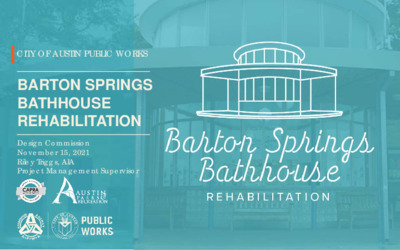
CITY OF AUSTIN PUBLIC WORKS BARTON SPRINGS BATHHOUSE REHABILITATION Design Commission November 15, 2021 Riley Triggs, AIA Project Management Supervisor History • Historic 1947 Bathhouse designed by Dan Driscoll • Bathhouse has City, State, and Federal historic designations • • Design informed by 2008 Barton Springs Master Plan, 2016 Bathhouse Zone Feasibility and 2018 engagement with architecture team Serves as bathhouse, aquatics offices, and “Splash” interpretive space City of Austin | Public Works Department 1 Funding Sources • 2012 General Obligation Bond • Historic Preservation Fund • Barton Springs Conservancy Donation • Texas Parks and Wildlife Department Grant City of Austin | Public Works Department 2 Community Engagement • April 3, 2018 – Design Kick-off meeting • August 14, 2018 – Project Values and Program Workshop • October 18, 2018 – Meeting #3 and Open House Stakeholder Meeting • October 30, 2018 – Open House • October 30, 2019 – Community Meeting #4: Updating the Process City of Austin | Public Works Department 3 Project Scope Water Quality Fire Lane Building City of Austin | Public Works Department 4 Bathhouse Rehabilitation Scope City of Austin | Public Works Department 5 Shower Restoration City of Austin | Public Works Department 12 Shower Restoration City of Austin | Public Works Department 13 Shower Restoration City of Austin | Public Works Department 14 Shower Restoration City of Austin | Public Works Department 15 Rotunda Restoration City of Austin | Public Works Department 16 New West Gate City of Austin | Public Works Department 17 New East Gate + Restoration of Spectator’s Gallery City of Austin | Public Works Department 18 CITY OF AUSTIN PUBLIC WORKS DEPARTMENT CONNECTING YOU ALL AROUND AUSTIN THANK YOU Riley Triggs, AIA Project Management Supervisor Architectural Project Management Division Riley.Triggs@austintexas.gov 512.974.7747
City of Austin - Design Commission Project Review Application The Design Commission provides advisory recommendations to the City Council to assist in developing public policy and to promote excellence in the design and development of the urban environment. The Design Commission reviews three types of projects: 1. City projects (see page ii for process) The Commission reviews all municipal buildings and associated site plans to ensure they demonstrate compliance with city design and sustainability standards (Council Resolution No. 20071129-046), including those seeking Subchapter E Design Standards Alternative Equivalent Compliance (AEC) (Council Resolution No. 20100923-086). 2. Destiny Bonus projects (see page iv for process) The Commission reviews density bonus projects for substantial compliance with the Urban Design Guidelines for Austin in accordance with the Gatekeeper requirements of LDC 25-2-586 for the Downtown Density Bonus Program. 3. Advisory Recommendations for Private projects (see page ii for process) The Commission will consider Project Review Applications from private projects during its regularly scheduled monthly public meetings and may issue an advisory recommendation in the form of a Project Review Letter to the Applicant. This Project Review Application must be submitted before your project can be presented to the Design Commission for their review. Design Commission requests project be presented in their Conceptual/Schematic Design phase. This application primarily addresses inhabited buildings and structures and their effect on the public realm; please refer to Appendix A for infrastructure type projects. The Commission's review of projects is based on the planning/design principles in the Urban Design Guidelines for Austin. Ensure that all applicable principles are addressed in the application questions and in your presentation. https://www.austintexas.gov/sites/default/files/files/Boards_and_Commissions/ Design_Commission_urban_design_guidelin es_for_austin.pdf The Design Commission supports the vision and principles of Imagine Austin Comprehensive Plan, especially those that affect the urban environment and fabric. All projects should consider this vision and principles, many of which are similar to the Urban Design Guidelines. Refer to Appendix C for the most pertinent sections of Imagine Austin. The Design Commission expects the applicant’s design team to present their project with those most knowledgeable and encourages the inclusion of sub-consultants at the presentation, when deemed necessary. EXHIBITS TO PRESENT 1) 2) 3) 4) 5) 6) 7) 8) 9) Completed Project Review Application (p.1-6) Existing zoning classification, adjacent zoning & uses, future land use map classification, topography Vicinity plan, including public transportation and connectivity on-site and within quarter mile Site plan and landscape plan Ground level, basement …
City of Austin Central Fire & EMS Station Design Commission Presentation 25 October 2021 Context Location: 401 E. 5th St Part of a block owned by the city Block includes the O. Henry Museum Project is being coordinated with the development of Brush Square Park, which is a separate project led by the Parks and Recreation Department Introduction Overview Constructed in 1938 Architect: Kreisle and Brooks Constructed under the Public Works Administration (WPA) National Register of Historic Places in 2000 Building History Overview Annex added in 1962 by architect Eugene Wukash Building History Overview Non-historic windows added in 1980s Building History Historic Moderne style (Streamline Moderne) Simplicity of ornamentation Key Features and Stylistic Elements Historic Use of building materials as decoration Subtle patterning Brick coursing Symbolic towers Nickel-finished lights Key Features and Stylistic Elements Historic Curved portico Corner approach Key Features and Stylistic Elements Historic Layering of elements Massing plays with symmetry and asymmetry Key Features and Stylistic Elements Preservation The proposed changes ensure the facility will continue to operate in its historic location efficiently functioning as its original purpose for years into the future. Maintain Original Intended Use Preservation Window replacements will more closely match the original design Original Current Proposed Return to Original Design Elements Preservation Brick will be cleaned and repaired Lintels will be refurbished Eroded plaster on soffits will be replaced Maintenance, Repair, and Replacement Historic Landmark Commission Engagement We presented the design proposal to the Historic Landmark Commission. Commission hearing was conducted on June 28, 2021. Commission was favorable to the programmatically required minor demolition and rear addition. Previous Engagement Program Improved emergency response through bay door height increase to accommodate modern vehicle sizes Interior reconfiguration to accommodate gender equity Existing Proposed End-user’s Long-term Needs Existing Proposed Program Improvement of life safety through sprinklers and additional egress Making the building accessible (ADA and elevator addition) Energy efficiency (Windows, Envelope, and HVAC) Preserve the building’s inclusion on the National Historic Register City’s Objectives Plan Changes Change to Existing Addition Existing First Floor 558 SF (4.6%) Proposed Plan Changes Change to Existing Addition Existing Second Floor 558 SF (4.6%) Proposed Façade Changes Change to Existing Addition Existing E. 5th Street Proposed Façade Changes Change to Existing Addition Trinity Street Existing Proposed Addition Minimize the addition to only what is programmatically necessary Original=12,031 SF / Addition=515 SF / 4.3% gross square footage increase Keep It Small Addition Use …
City of Austin Central Fire and EMS Station Introductions and Context Alex Janota, Project Manager Flintco General Contractor Historic Landmark Commission – Design Overview Presentations 28 June 2021 Outline Introductions and Context Alex Janota, Project Manager Flintco – General Contractor Historic Significance Donna Carter, President Carter Design Associates – Historic Preservation Changes to Historic Fabric Tim Baisdon, Vice President WestEast Design Group – Architect New Addition Rob Robbins, Studio Director WestEast Design Group – Architect Context Location: 401 E. 5th St Part of a block owned by the city Block includes the O. Henry Museum Project is being coordinated with the development of Brush Square Park, which is a separate project led by the Parks and Recreation Department Introduction Overview Constructed in 1938 Architect: Kreisle and Brooks Constructed under the Public Works Administration (WPA) National Register of Historic Places in 2000 Building History Overview Annex added in 1962 by architect Eugene Wukash Building History Overview Non-historic windows added in 1980s Building History City of Austin Central Fire and EMS Station Historic Significance Donna Carter, President Carter Design Associates Historic Preservation Historic Landmark Commission – Design Overview Presentations 28 June 2021 Historic Moderne style (Streamline Moderne) Simplicity of ornamentation Key Features and Stylistic Elements Historic Use of building materials as decoration Subtle patterning Brick coursing Symbolic towers Nickel-finished lights Key Features and Stylistic Elements Historic Curved portico Corner approach Key Features and Stylistic Elements Historic Layering of elements Massing plays with symmetry and asymmetry Key Features and Stylistic Elements Preservation The proposed changes ensure the facility will continue to operate in its historic location efficiently functioning as its original purpose for years into the future. Maintain Original Intended Use Preservation Window replacements will more closely match the original design Original Current Proposed Return to Original Design Elements Preservation Brick will be cleaned and repaired Lintels will be refurbished Eroded plaster on soffits will be replaced Maintenance, Repair, and Replacement City of Austin Central Fire and EMS Station Changes to Historic Fabric Tim Baisdon, Vice President WestEast Design Group Architect Historic Landmark Commission – Design Overview Presentations 28 June 2021 Program Improved emergency response through bay door height increase to accommodate modern vehicle sizes Interior reconfiguration to accommodate gender equity Existing Proposed End-user’s Long-term Needs Existing Proposed Program Improvement of life safety through sprinklers and additional egress Making the building accessible (ADA and elevator addition) Energy efficiency (Windows, Envelope, and HVAC) Preserve …
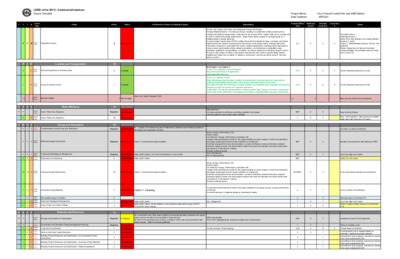
0 1 Design Credit Bicycle Facilities 1 Will not apply Use City of Austin Standard 710S. Arc 0 1 Bike rack and interior accommodations 0 15 0 21 Location and Transportation 18 0 Design Credit Surrounding Density and Diverse Uses 8 Complete 0 Design Credit Access to Quality Transit 7 Complete LEED v4 for ID+C: Commercial Interiors Project Checklist C Y ? N Credit Type Credit Points Status CoA Baseline Criteria for Building Projects Deliverables Project Name: Date Updated: 8/6/2021 City of Austin Central Fire and EMS Station Potential Effort (0-3) Additional Fees $ Potential Cost (0-3) Cost Value $ Notes 1 1 0 Design Credit Integrative Process 2 Not Attempted ALL 0 0 0 •Forms: PIp_Project_Information and Integrative Process Worksheet •Energy-Related Systems - A simple box energy modeling is a preliminary building model used to analyze the building’s energy loads. Project teams can use the EPA’s Target Finder tool or a similar tool in order to benchmark energy performance. Target Finder allows projects to set target goals for a building design’s energy demands. •Owner’s project requirements (OPR) a written document that details the ideas, concepts, and criteria determined by the owner to be important to the success of the project. Basis of design (BOD) the information necessary to accomplish the owner’s project requirements, including system descriptions, indoor environmental quality criteria, design assumptions, and references to applicable codes, standards, regulations, and guidelines. In addition, we need to determine if we will be using IP units or SI units for this project. SI refers to the System International Units, which is just the Metric System updated and made more complete. IP relates to inch-pound. I assume we will be using IP, but I just want to confirm. Both Option 1 and Option 2 •Forms: LTc_Sensitive_Land_Protection •Special Circumstances (if applicable) •Applicable Site Plans ed. •Form: LTc_Quality_Transit •Map: Indicating project location, location of transit stops, routs serving each sstop and the walking routes between the location of the project functional entry and the stops •Schedule: Provide all transit types, provide weekday and weekend route schedules showing the frequency of trips and services in opposite directions •Verification: Provide the planned stops or stations will be sited, funded, and under construction by the date of the certification of occupancy and will be completed within two years of that date •EApc_Energy_Performance_IDC •AEDG Tables •v4_Minimum_Energy_Performance_Calculator-v06 •Target Finder-performance results for the project building (a screen capture or other …
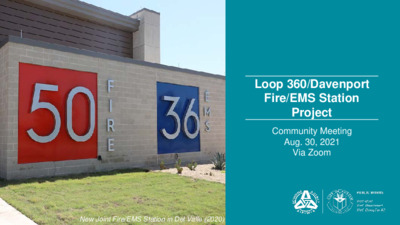
Loop 360/Davenport Fire/EMS Station Project Community Meeting Aug. 30, 2021 Via Zoom New Joint Fire/EMS Station in Del Valle (2020) Meeting Agenda • Meeting Expectations • Welcome and Introductions • Project History and Background • Station Design • Current Status and Next Steps • Questions City of Austin | Public Works Department 1 Meeting Expectations Please… • Keep your microphones muted and cameras off • Place questions in the chat as we move through the presentation • Note that we will answer all questions at the end of the meeting • Note that any questions we’re not able to answer, we’ll provide a written response ASAP • Use the link in the chat to add your email address for future updates about this project City of Austin | Public Works Department 2 Introductions •Alison Alter - •Division Chief Tony Haden •Division Chief Wes Hopkins •Michael Gates •Burton Jones– •Michelle Noriega - •Cris Ruebush •Bryant Bell Council Member, District 10 – Austin Fire Department (AFD) – Emergency Medical Services (ATCEMS) – City of Austin Real Estate Services Office Project Manager, Public Works Project Manager, Public Works – PGAL Architects – GarzaEMC, Civil Engineering Project History and Background • May 2018 - City Council directs the City Manager to build five permanent fire stations in the areas of greatest needs to ensure community safety—including a station to serve the Loop 360/Davenport area Sept. 2018 Jan. 2019 – City begins search for suitable site for new Loop 360/Davenport Fire/EMS Station – First community meeting with Loop 360/Davenport residents; project team asks for community’s • Oct. 2019 help in identifying potential sites July 2020 – Negotiations begin with St. Stephen’s Episcopal School for station on their property • Oct. 2020 – City begins to evaluate proposed site, 4601 Westlake Dr. Jan. 2021 - – 4601 Westlake Dr. is determined to be a feasible location for a new station June 2021 – Development review process begins Residents notified of a site plan being filed for building of new station • • • • • Project History and Background City of Austin | Public Works Department 6 City of Austin | Public Works Department 7 Project History and Background Site Location Conflict with St. Stephens Dr. Too Steep Station Design Station Design Station Design Station Design Station Design Station Design Station Design Station Design Station Design Station Design Station Design Station Design Station Design Station …
Downtown Density Bonus Program November 15 Design Commission Content Program History and Requirements Program Outcomes Fee In-Lieu Recalibration Fee Calibration Methods Discussion Program History and Requirements 3 Downtown Density Bonus Program History 2013: Downtown Density Bonus Ordinance 20130627-105 passes replacing CURE (Central Urban Redevelopment). 2014: Downtown Density Bonus program is updated with a new ordinance 2014022-054 that provides additional definitions and sets up current Rainey Street subdistrict requirements Affordability Requirements Affordability requirements only apply to projects with a residential component 50% of bonus area must be achieved thru affordable housing benefits which can be done through a fee-in-lieu or on-site affordable units Rainey Street Subdistrict is only subdistrict that requires on-site affordable units calculated as 5% of the square footage of dwelling units developed within the FAR ratio of 8:1 and made affordable at 80% MFI or below On-site Affordability Terms Ownership: 120% MFI or below ($118,700 for a household of 4) for 99 years *Rainey Street Subdistrict is an exception with an 80% MFI limit Rental: 80% MFI or below ($79,100 for a household of 4) for 40 years Program Outcomes To Date 6 Project Status *As of 10/18/2021 Overall DDB Program Rainey Street Subdistrict Certified Projects by year Overall DDB Program Rainey Street Subdistrict Program Outcomes Certified Site Plan Under Review Building Permit Issued Project Completed Project Cancelled 4 1 8 4 3 2 0 3 2 2 These totals are only inclusive of projects that included an affordability community benefit contribution and were tracked through the Affordable Housing Inventory. These totals do not include non-residential projects that did not pay a fee in-lieu of Affordable Housing but may have utilized the Downtown Density Bonus Program. 2014 2015 2016 2017 2018 2019 2020 2021 Total 2 2 2 2 2 3 2 5 20 1 0 2 0 1 1 0 4 9 Completed Projects with On-Site Affordable Housing Camden Rainey Street Project includes 16 income- restricted affordable rental units that will be affordable until 2056. The Quincy Project includes 14 rental units that will be income-restricted affordable until 2061. *Both projects are within the Rainey Street Subdistrict. Development Pipeline Overall Downtown Density Bonus Program 3,276 Rainey Street Subdistrict 1,252 1,252 832 41 46 87 45 46 91 Certified/Site Plan Under Review/Building Permit Issued Projects Estimated Total Rental Units Estimated Affordable Rental Units Estimated Total Ownership Units Estimated Affordable Ownership Units Estimated Total Affordable Units …
City of Austin - Design Commission Project Review Application The Design Commission provides advisory recommendations to the City Council to assist in developing public policy and to promote excellence in the design and development of the urban environment. The Design Commission reviews three types of projects: 1. City projects (see page ii for process) The Commission reviews all municipal buildings and associated site plans to ensure they demonstrate compliance with city design and sustainability standards (Council Resolution No. 20071129-046), including those seeking Subchapter E Design Standards Alternative Equivalent Compliance (AEC) (Council Resolution No. 20100923-086). 2. Destiny Bonus projects (see page iv for process) The Commission reviews density bonus projects for substantial compliance with the Urban Design Guidelines for Austin in accordance with the Gatekeeper requirements of LDC 25-2-586 for the Downtown Density Bonus Program. 3. Advisory Recommendations for Private projects (see page ii for process) The Commission will consider Project Review Applications from private projects during its regularly scheduled monthly public meetings and may issue an advisory recommendation in the form of a Project Review Letter to the Applicant. This Project Review Application must be submitted before your project can be presented to the Design Commission for their review. Design Commission requests project be presented in their Conceptual/Schematic Design phase. This application primarily addresses inhabited buildings and structures and their effect on the public realm; please refer to Appendix A for infrastructure type projects. The Commission's review of projects is based on the planning/design principles in the Urban Design Guidelines for Austin. Ensure that all applicable principles are addressed in the application questions and in your presentation. https://www.austintexas.gov/sites/default/files/files/Boards_and_Commissions/ Design_Commission_urban_design_guidelin es_for_austin.pdf The Design Commission supports the vision and principles of Imagine Austin Comprehensive Plan, especially those that affect the urban environment and fabric. All projects should consider this vision and principles, many of which are similar to the Urban Design Guidelines. Refer to Appendix C for the most pertinent sections of Imagine Austin. The Design Commission expects the applicant’s design team to present their project with those most knowledgeable and encourages the inclusion of sub-consultants at the presentation, when deemed necessary. EXHIBITS TO PRESENT 1) 2) 3) 4) 5) 6) 7) 8) 9) Completed Project Review Application (p.1-6) Existing zoning classification, adjacent zoning & uses, future land use map classification, topography Vicinity plan, including public transportation and connectivity on-site and within quarter mile Site plan and landscape plan Ground level, basement …
City of Austin Fire Station 22 / EMS 12 Design Commission Presentation 25 October 2021 Context Location: 5309 Riverside Drive (at Faro Drive) There is an existing, non-historic station at the site that is slated to be demolished Site is between Tokyo Electron and the Colorado River Site has a cell tower at the back (south) and significant trees at the front (north, by Riverside drive) Introduction Concept Statement Concept Example of the duality at the city level showing the site between the two points of civic pride with technology to the south and nature to the north. Overlay Concept Demonstration of how the concept works at multiple levels from the city to the building. Diagram Concept Showing how the concept came together on the site with the individual and technology issues to the south by the cell tower and the collective, nature, and healing areas to the north by the grove of trees. Layout Plan Site Plan First Floor Plan Second Floor Rendering This image shows the public face of the station prominently addressing the major intersection. Corner of Riverside and Faro Rendering Signage and massing combine to make a welcoming, intuitive, and easy-to-find entry. The view through to the apparatus bay creates a literal sense of transparency of the department to the public it serves. Front Façade Rendering The main entry is on axis with the employee entrance coming off the secure parking lot creating a direct connection between the building occupants and the public. Back-illuminated signage connotes pride, purpose, and 24- hour visibility. Main Entry Rendering Employee parking is on the south end of the site next to the cell tower. This is in keeping with the concept of technology being on the opposite end of the site from the trees which represent nature. Employee Parking Rendering After parking, employees enter using a covered walkway that takes them from the individual status of the parking lot to the collective status of the living quarters. The sequence is surrounded by trees on the west side and the purpose of their being there (the apparatus bay) on the east. Employee Entry Sequence Rendering Due to the stress, and even trauma of working in the life-safety field, this walk allows a mental separation between home and work. Covered Walkway Rendering The steel, almost Miesian nature of the covered walkway represents the technology side of the site while the trees to …
LEED v4 for BD+C: New Construction and Major Renovation Project Checklist C Y ? N Credit Type Credit Points Status CoA Baseline Criteria for Building Projects Deliverables Project Name: Austin Fire Station No. 22 / EMS12 Date: 05/25/2021 Potential Effort (0-3) Additional Fees $ Potential Cost (0-3) Cost Value $ Notes 1 0 0 Design Credit Integrative Process 1 Not Attempted Location and Transportation LEED for Neighborhood Development Location 16 16 1 6 0 1 0 2 4 0 0 0 2 24 16 0 2 1 Design Credit Design Credit Design Credit Design Credit Sensitive Land Protection High Priority Site Surrounding Density and Diverse Uses 1 1 2 4 Green Vehicles Design Credit 1 0 0 Design Credit Bicycle Facilities In Progress Use City of Austin Standard 710S. 0 0 1 Design Credit Reduced Parking Footprint 1 0 0 Design Credit Green Vehicles 0 5 3 2 Sustainable Sites Y Y Y Y Construction Activity Pollution Prevention Required Not Attempted 1 0 0 Site Assessment Not Attempted 0 1 1 Site Development - Protect or Restore Habitat Not Attempted Not Elligible Not Attempted Not Elligible In Progress Complete Not Elligible Not Attempted 1 2 5 5 1 1 1 1 2 1 3 2 1 0 2 0 2 0 0 1 0 Open Space Rainwater Management Heat Island Reduction Refer LEED Criteria - Limit development footprint. Exceed zoning requirement for open space SSc_Open_Space Not Attempted Not Elligible Not Attempted Refer LEED Criteria Required Documentation - Project Team Letter • Forms: Sample Form IPc_Integrative_Process • Worksheet: v4_Integrative Process Worksheet_v03 • Special Circumstances (if applicable) • Energy-Related Systems - A simple box energy modeling is a preliminary building model used to analyze the building’s energy loads. Project teams can use the EPA’s Target Finder tool or a similar tool in order to benchmark energy performance. Target Finder allows projects to set target goals for a building design’s energy demands. • Water-Related Systems: EPA Water Budget Tool Forms: LTc_Sensitive_Land_Protection Special Circumstances (if applicable) Applicable Site Plans . OPTION 1 •Forms: LTc_Sensitive_Land_Protection •Special Circumstances (if applicable) •Applicable Site Plans ed. •Form: LTc_Quality_Transit •Map: Indicating project location, location of transit stops, routs serving each sstop and the walking routes between the location of the project functional entry and the stops •Schedule: Provide all transit types, provide weekday and weekend route schedules showing the frequency of trips and services in opposite directions •Verification: Provide …
City of Austin - Design Commission Project Review Application The Design Commission provides advisory recommendations to the City Council to assist in developing public policy and to promote excellence in the design and development of the urban environment. The Design Commission reviews three types of projects: 1. City projects (see page ii for process) The Commission reviews all municipal buildings and associated site plans to ensure they demonstrate compliance with city design and sustainability standards (Council Resolution No. 20071129-046), including those seeking Subchapter E Design Standards Alternative Equivalent Compliance (AEC) (Council Resolution No. 20100923-086). 2. Destiny Bonus projects (see page iv for process) The Commission reviews density bonus projects for substantial compliance with the Urban Design Guidelines for Austin in accordance with the Gatekeeper requirements of LDC 25-2-586 for the Downtown Density Bonus Program. 3. Advisory Recommendations for Private projects (see page ii for process) The Commission will consider Project Review Applications from private projects during its regularly scheduled monthly public meetings and may issue an advisory recommendation in the form of a Project Review Letter to the Applicant. This Project Review Application must be submitted before your project can be presented to the Design Commission for their review. Design Commission requests project be presented in their Conceptual/Schematic Design phase. This application primarily addresses inhabited buildings and structures and their effect on the public realm; please refer to Appendix A for infrastructure type projects. The Commission's review of projects is based on the planning/design principles in the Urban Design Guidelines for Austin. Ensure that all applicable principles are addressed in the application questions and in your presentation. https://www.austintexas.gov/sites/default/files/files/Boards_and_Commissions/ Design_Commission_urban_design_guidelin es_for_austin.pdf The Design Commission supports the vision and principles of Imagine Austin Comprehensive Plan, especially those that affect the urban environment and fabric. All projects should consider this vision and principles, many of which are similar to the Urban Design Guidelines. Refer to Appendix C for the most pertinent sections of Imagine Austin. The Design Commission expects the applicant’s design team to present their project with those most knowledgeable and encourages the inclusion of sub-consultants at the presentation, when deemed necessary. EXHIBITS TO PRESENT 1) 2) 3) 4) 5) 6) 7) 8) 9) Completed Project Review Application (p.1-6) Existing zoning classification, adjacent zoning & uses, future land use map classification, topography Vicinity plan, including public transportation and connectivity on-site and within quarter mile Site plan and landscape plan Ground level, basement …
City of Austin Fire Station No. 3 Architectural Review Committee – Historic Landmark Commission – Design Overview Presentation 12 April 2021 Context Location: 201 West 30th St Currently, all fire trucks are being parked outside of the apparatus bay. Recent changes to the floodplain maps cause a significant portion of the building to be in the floodplain. Introduction Overview Construction completed on February 21, 1957 Architect: Roy Thomas Does not have any Landmark designations at present. Adjacent to the Aldridge Place Historic District Building History Repairable Not Repairable Overview The building has suffered two types of structural damage: 1) General wear and tear based on age. (entire structure) 2) Overstressing of the foundation due to parking trucks that are heavier than the original design load. (apparatus bay only) Structural Damage Shore up and preserve Demolish and replace Overview For the areas that have just suffered age- related wear and tear, the intent is to shore up that portion of the structure and preserve it. For the apparatus bay, the intent is to demolish the portion of the building that is beyond repair and replace it with a new structure that is sensitive but of its time. Project Intent Structural The City of Austin has conducted three studies of the building. Two structural studies and one geotechnical report. The second structural study specifically addressed potential remediation of the existing structure. All reports have been independently reviewed by the current structural engineer, who concurs with the studies’ methodologies and conclusions. Studies Historic An historic survey of the area was conducted. This building was identified in the survey. Recommendations for landmark were included. Reasoning: Possesses integrity and significance in Postwar Infrastructure Expansion. Survey Historic There are two simple paths: 1) The project moves forward without landmark designation. 2) The project moves forward with landmark designation. Two Paths Historic Without designation, the project would need approval for the proposed demolition. With intent for designation, the project would need both approval for the proposed demolition and a Certificate of Appropriateness. Our understanding is that the permitting process would overlap the landmark process if it were pursued by the city. Options Proposal Preservation of original use Carrying of roof line Use of brick Reuse of original signage Maintenance of original setback Compatible massing Use of period-appropriate detailing Preservation of historic fabric that is capable of being saved Design Highlights Proposal Original without emulation. Meets the needs …
City of Austin Fire Station No. 3 Design Commission Presentation 25 October 2021 Context Location: 201 West 30th St Currently, all fire trucks are being parked outside the apparatus bay. Recent changes to the floodplain maps cause a significant portion of the building to be in the floodplain. Introduction Overview Construction completed on February 21, 1957 Architect: Roy Thomas Does not have any Landmark designations at present Adjacent to the Aldridge Place Historic District Building History Historic An historic survey of the area was conducted. This building was identified in the survey. Recommendations for landmark were included. Reasoning: Possesses integrity and significance in Postwar Infrastructure Expansion. Building History Neighborhood Engagement We presented the design proposal to the North University Neighborhood Association (NUNA) and the Aldridge Place Historic District. Meeting conducted through Zoom on May 3, 2021. Follow up questions were answered through email. We received support from both the neighborhood and the historic district. Previous Engagement Historic Landmark Commission Engagement We presented the design proposal to the Historic Landmark Commission. Commission hearing was conducted on May 24, 2021. Commission was favorable to the demolition of the damaged apparatus bay and the replacement design presented. One commissioner stated in the meeting, “Projects such as this are to be celebrated.” Previous Engagement Repairable Not Repairable Damage The building has suffered two types of structural damage: 1) General wear and tear based on age. (entire structure) 2) Overstressing of the foundation due to parking trucks that are heavier than the original design load. (apparatus bay only) Program Shore up and preserve Demolish and replace Intent For the areas that have just suffered age- related wear and tear, the intent is to shore up that portion of the structure and preserve it. For the apparatus bay, the intent is to demolish the portion of the building that is beyond repair and replace it with a new structure that is sensitive but of its time. Program Structural Phase One – Structural Floor System Capacity Assessment CTL Group May 2017 CTL Group August 2017 Phase Two – Feasibility Study Letter of Recommendation Karim Helmi, P.E., City Structural Engineer, CoA Public Works Department September 2017 Geotechnical Report Kleinfelder October 2018 Research and Assessment Site With the designation of the new 100-year floodplain, the remaining buildable area is extremely limited. (Shown in red) This means the only available land for a new apparatus bay is the land where …
City of Austin Fire Station No. 3 Introductions and Context Alex Jenota, Project Manager Flintco – General Contractor Historic Landmark Commission – Design Overview Presentations 24 May 2021 Outline Introductions and Context Alex Janota, Project Manager Flintco – General Contractor Structural Damage Barry Krieger, Principal JQ Infrastructure – Structural Engineer Cost Implications and Alternatives Michelle Noriega, Project Manager City of Austin – Client Design Proposal Rob Robbins, Studio Director WestEast Design Group – Architect The Plan Forward Tony Haden, Division Chief Austin Fire Department – End User Context Location: 201 West 30th St Currently, all fire trucks are being parked outside the apparatus bay. Recent changes to the floodplain maps cause a significant portion of the building to be in the floodplain. Overview Construction completed on February 21, 1957 Architect: Roy Thomas Does not have any Landmark designations at present Adjacent to the Aldridge Place Historic District Historic An historic survey of the area was conducted. This building was identified in the survey. Recommendations for landmark were included. Reasoning: Possesses integrity and significance in Postwar Infrastructure Expansion. Neighborhood Engagement We presented the design proposal to the North University Neighborhood Association (NUNA) and the Aldridge Place Historic District. Meeting conducted through Zoom on May 3, 2021. Follow up questions were answered through email. Repairable Not Repairable Damage The building has suffered two types of structural damage: 1) General wear and tear based on age. (entire structure) 2) Overstressing of the foundation due to parking trucks that are heavier than the original design load. (apparatus bay only) Shore up and preserve Demolish and replace Intent For the areas that have just suffered age- related wear and tear, the intent is to shore up that portion of the structure and preserve it. For the apparatus bay, the intent is to demolish the portion of the building that is beyond repair and replace it with a new structure that is sensitive but of its time. Goals and Objectives 1) Save the historic fabric that can be saved and put it in good structural standing for the future. 2) Preserve the original historic use/function of the building. 3) Provide the Fire Department and EMS with the modern facility they need to operate effectively and efficiently for decades to come thus providing vital life-safety services to the area. 4) Get the fire trucks parked indoors for protection of the equipment, speed of response times, and aesthetic …
City of Austin Fire Station No. 3 NUNA Executive Committee/Aldridge Place Historic District – Design Overview Presentation 3 May 2021 Context Location: 201 West 30th St Currently, all fire trucks are being parked outside the apparatus bay. Recent changes to the floodplain maps cause a significant portion of the building to be in the floodplain. Introduction Overview Construction completed on February 21, 1957 Architect: Roy Thomas Does not have any Landmark designations at present Adjacent to the Aldridge Place Historic District Building History Repairable Not Repairable Overview The building has suffered two types of structural damage: 1) General wear and tear based on age. (entire structure) 2) Overstressing of the foundation due to parking trucks that are heavier than the original design load. (apparatus bay only) Structural Damage Shore up and preserve Demolish and replace Overview For the areas that have just suffered age- related wear and tear, the intent is to shore up that portion of the structure and preserve it. For the apparatus bay, the intent is to demolish the portion of the building that is beyond repair and replace it with a new structure that is sensitive but of its time. Project Intent Structural The City of Austin has conducted three studies of the building. Two structural studies and one geotechnical report. The second structural study specifically addressed potential remediation of the existing structure. All reports have been independently reviewed by the current structural engineer, who concurs with the studies’ methodologies and conclusions. Studies Historic An historic survey of the area was conducted. This building was identified in the survey. Recommendations for landmark were included. Reasoning: Possesses integrity and significance in Postwar Infrastructure Expansion. Survey Objectives 1) Save the historic fabric that can be saved and put it in good structural standing for the future. 2) Preserve the original historic use/function of the building. 3) Provide the Fire Department and EMS with the modern facility they need to operate effectively and efficiently for decades to come thus providing vital life-safety services to the area. 4) Get the fire trucks parked indoors for protection of the equipment, speed of response times, and aesthetic improvement of the neighborhood. 5) Create an addition that is respectful of the original, but not a false recreation of mindless mimicry. Project Goals What we asking for from the neighborhood 1) Input to help the design team fully understand the concerns of all stakeholders. …
City of Austin Design Commission DESIGN COMMISSION RECOMMENDATION 20211115-01B Date: November 19, 2021 Subject: Design Commission recommendations for the City of Austin EMS/Fire Station, located at 4601 Westlake Drive. Bart Whatley Seconded By: Jessica Rollason Motioned By: Recommendation: The City of Austin Design Commission recommends that the City of Austin EMS/Fire Station, located at 4601 Westlake Drive, as presented to us on November 15, 2021 meets the City’s design and sustainability standards. Rationale: Dear Honorable Mayor & City Council, This letter is to confirm the Design Commission’s support of the City of Austin EMS/Fire Station as presented to us. Our review found the following attributes: 1. Project is on track to achieve LEED Silver Certification, including on site solar. 2. Project is not subject to Subchapter E Design Standards. Respectfully, City of Austin Design Commission Vote: For: Jen Weaver, Evan Taniguchi, Melissa Henao-Robledo, David Carroll, Josue Meiners, Bart Whatley, Jessica 8 - 0 - 0 Rollason, Aan Coleman Against: NA Abstain: NA Absent: Samuel Franco, Ben Luckens Attest: David Carroll, Chair of the Design Commission Melissa Henao-Robledo, David Carroll, Chair Jessica Rollason, Vice Chair Aan Coleman Samuel Franco Ben Luckens Josue Meiners Evan Taniguchi Jen Weaver Bart Whatley Jorge E. Rousselin, Executive Liaison Aaron D. Jenkins Staff Liaison Art Zamorano Staff Liaison 1 of 1 Design Commission Recommendation 20211115-01B Davenport Fire Station Page 1
David Carroll, Chair Street. Jessica Rollason, Vice Chair Melissa Henao-Robledo, Aan Coleman Samuel Franco Ben Luckens Josue Meiners Evan Taniguchi Jen Weaver Bart Whatley Jorge E. Rousselin, Executive Liaison Aaron D. Jenkins Staff Liaison Art Zamorano Staff Liaison City of Austin Design Commission DESIGN COMMISSION RECOMMENDATION 20211115-01C Date: November 19, 2021 Subject: Design Commission recommendations for the City of Austin EMS/Fire Station, located at 401 East 5th Seconded By: Bart Whatley Motioned By: Melissa Henao-Robledo Recommendation: The City of Austin Design Commission recommends that the City of Austin Central EMS/Fire Station, located at 401 East 5th Street, as presented to us on November 15, 2021 meets the City’s design and sustainability standards. Rationale: Dear Honorable Mayor & City Council, This letter is to confirm the Design Commission’s support of the City of Austin Central EMS/Fire Station as presented to us. Our review found the following attributes: 1. Protects and restores existing historic structure. 2. Addition is clearly differentiated from existing structure 3. 4. Meets LEED requirements for sustainability 5. Inclusion of public artwork. Increases gender diversity and accessibility within the building Respectfully, City of Austin Design Commission Vote: For: Jen Weaver, Evan Taniguchi, Melissa Henao-Robledo, David Carroll, Josue Meiners, Bart Whatley, Jessica 7 - 0 - 0 Rollason Against: NA Abstain: NA Recused: Aan Coleman Absent: Samuel Franco, Ben Luckens Attest: David Carroll, Chair of the Design Commission 1 of 1 Design Commission Recommendation 20211115-01C Central EMS/Fire Station Page 1
David Carroll, Chair Riverside Drive. Jessica Rollason, Vice Chair Melissa Henao-Robledo, Aan Coleman Samuel Franco Ben Luckens Josue Meiners Evan Taniguchi Jen Weaver Bart Whatley Jorge Rousselin, Executive Liaison Aaron D. Jenkins Staff Liaison Art Zamorano Staff Liaison City of Austin Design Commission DESIGN COMMISSION RECOMMENDATION 20211115-01D Date: November 19, 2021 Subject: Design Commission recommendations for the City of Austin EMS/Fire Station 22, located at 5309 East Jessica Rollason Seconded By: Evan Taniguchi Motioned By: Recommendation: The City of Austin Design Commission recommends that the City of Austin EMS/Fire Station 22, located at 5309 East Riverside Drive, as presented to us on November 15, 2021 meets the City’s design and sustainability standards. Rationale: Dear Honorable Mayor & City Council, This letter is to confirm the Design Commission’s support of the City of Austin EMS/Fire Station 22 as presented to us. Our review found the following attributes: 1. Project is on track for LEED Silver Certification. 2. Public entry is clearly articulated and accessible. 3. Project preserves existing grove of trees along Riverside Drive. 4. Accommodations are gender-neutral. Respectfully, City of Austin Design Commission Vote: For: Jen Weaver, Evan Taniguchi, Melissa Henao-Robledo, David Carroll, Josue Meiners, Bart Whatley, Jessica 7 - 0 - 0 Rollason Against: NA Abstain: NA Recused: Aan Coleman Absent: Samuel Franco, Ben Luckens Attest: David Carroll, Chair of the Design Commission 1 of 1 Design Commission Recommendation 20211115-01D Riverside Fire Station
David Carroll, Chair Street. Jessica Rollason, Vice Chair Melissa Henao-Robledo, Aan Coleman Samuel Franco Ben Luckens Josue Meiners Evan Taniguchi Jen Weaver Bart Whatley Jorge Rousselin, Executive Liaison Aaron D. Jenkins Staff Liaison Art Zamorano Staff Liaison City of Austin Design Commission DESIGN COMMISSION RECOMMENDATION 20211115-01E Date: November 22, 2021 Subject: Design Commission recommendations for the City of Austin Fire Station 03, located at 201 West 30th Bart Whatley Seconded By: Jessica Rollason Motioned By: Recommendation: The City of Austin Design Commission recommends that the City of Austin Fire Station 03, located at 201 West 30th Street, as presented to us on November 15, 2021 meets the City’s design and sustainability standards. Rationale: Dear Honorable Mayor & City Council, This letter is to confirm the Design Commission’s support of the City of Austin Fire Station 03 as presented to us. Our review found the following attributes: 1. New addition respects the historic building design 2. Project is following LEED green building criteria 3. Project preserves relationship to the street 4. Will finally allow the fire trucks to be parked inside apparatus bays, protection valuable city infrastructure. Respectfully, City of Austin Design Commission Vote: For: Jen Weaver, Evan Taniguchi, Melissa Henao-Robledo, David Carroll, Josue Meiners, Bart Whatley, Jessica 7 - 0 - 0 Rollason Against: NA Abstain: NA Recused: Aan Coleman Absent: Samuel Franco, Ben Luckens Attest: David Carroll, Chair of the Design Commission 1 of 1 Design Commission Recommendation 20211115-01E 30th Street Fire Station Page 1
David Carroll, Chair Jessica Rollason, Vice Chair Aan Coleman Samuel Franco Ben Luckens Josue Meiners Evan Taniguchi Jen Weaver Bart Whatley Jorge Rousselin, Executive Liaison Aaron D. Jenkins Staff Liaison Art Zamorano Staff Liaison City of Austin Design Commission DESIGN COMMISSION RECOMMENDATION 20211115-1G Date: November 23, 2021 Subject: Design Commission recommendation for the Zilker Metro Park- Barton Springs Bathhouse Rehabilitation project, located at 2100 Barton Springs Road. Vice-Chair Rollason Seconded By: Commissioner Meiners Motioned By: Recommendation: The Austin Design Commission recommends that the proposed rehabilitation to the Barton Springs Bathhouse, as presented to us on November 15, 2021, comply with the City’s Design and Sustainability Standards. Rationale: Dear Honorable Mayor & City Council, This letter is to confirm the Design Commission’s support of the Barton Springs Bathhouse as presented to us. Our review found the following attributes: Respectfully, City of Austin Design Commission Vote: For: David Carroll, Aan Coleman, Jessica Rollason, Jen Weaver, Melissa Henao-Robledo, Josue Meiners, Bart 8 - 0 - 0 Whatley, Evan Taniguchi Against: n/a Abstain: n/a Absent: Ben Lukens, Samuel Franco Attest: David Carroll, Chair of the Design Commission 1 of 1 Design Commission Recommendation 20211115-01G Barton Springs BathHouse Rehabiliatation Project Melissa Henao-Robledo, 1. Proposed work protects historic structure 2. Existing heritage trees are to be preserved. 3. Project designed to meet green building standards 4. Project will restore original entry procession at rotunda.
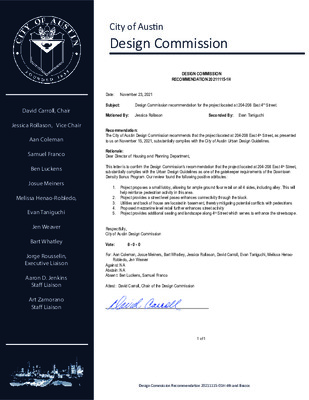
David Carroll, Chair Jessica Rollason, Vice Chair Melissa Henao-Robledo, Aan Coleman Samuel Franco Ben Luckens Josue Meiners Evan Taniguchi Jen Weaver Bart Whatley Jorge Rousselin, Executive Liaison Aaron D. Jenkins Staff Liaison Art Zamorano Staff Liaison City of Austin Design Commission DESIGN COMMISSION RECOMMENDATION 20211115-1H Jessica Rollason Seconded By: Evan Taniguchi Design Commission recommendation for the project located at 204-208 East 4th Street. Date: November 23, 2021 Subject: Motioned By: Recommendation: The City of Austin Design Commission recommends that the project located at 204-208 East 4th Street, as presented to us on November 15, 2021, substantially complies with the City of Austin Urban Design Guidelines. Rationale: Dear Director of Housing and Planning Department, This letter is to confirm the Design Commission’s recommendation that the project located at 204-208 East 4th Street, substantially complies with the Urban Design Guidelines as one of the gatekeeper requirements of the Downtown Density Bonus Program. Our review found the following positive attributes: 1. Project proposes a small lobby, allowing for ample ground floor retail on all 4 sides, including alley. This will help reinforce pedestrian activity in this area. 2. Project provides a street level paseo enhances connectivity through the block. 3. Utilities and back of house are located in basement, thereby mitigating potential conflicts with pedestrians 4. Proposed mezzanine level retail further enhances street activity 5. Project provides additional seating and landscape along 4th Street which serves to enhance the streetscape. Respectfully, City of Austin Design Commission Vote: For: Aan Coleman, Josue Meiners, Bart Whatley, Jessica Rollason, David Carroll, Evan Taniguchi, Melissa Henao- 8 - 0 - 0 Robledo, Jen Weaver Against: NA Abstain: NA Absent: Ben Luckens, Samuel Franco Attest: David Carroll, Chair of the Design Commission 1 of 1 Design Commission Recommendation 20211115-01H 4th and Brazos
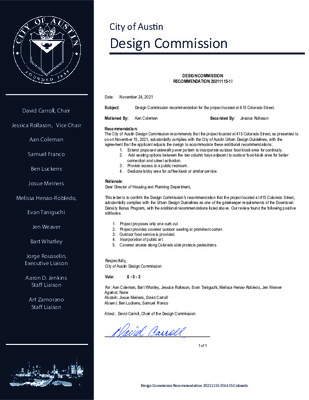
David Carroll, Chair Jessica Rollason, Vice Chair Melissa Henao-Robledo, Aan Coleman Samuel Franco Ben Luckens Josue Meiners Evan Taniguchi Jen Weaver Bart Whatley Jorge Rousselin, Executive Liaison Aaron D. Jenkins Staff Liaison Art Zamorano Staff Liaison City of Austin Design Commission DESIGN COMMISSION RECOMMENDATION 20211115-1I Design Commission recommendation for the project located at 415 Colorado Street. Date: November 24, 2021 Subject: Motioned By: Recommendation: The City of Austin Design Commission recommends that the project located at 415 Colorado Street, as presented to us on November 15, 2021, substantially complies with the City of Austin Urban Design Guidelines, with the agreement that the applicant adjusts the design to accommodate these additional recommendations: Jessica Rollason Seconded By: Aan Coleman 1. Extend proposed sidewalk paver pattern to incorporate outdoor food kiosk area for continuity. 2. Add seating options between the two column bays adjacent to outdoor food kiosk area for better connection and street activation. 3. Provide access to a public restroom. 4. Dedicate lobby area for coffee kiosk or similar service. Rationale: Dear Director of Housing and Planning Department, This letter is to confirm the Design Commission’s recommendation that the project located at 415 Colorado Street, substantially complies with the Urban Design Guidelines as one of the gatekeeper requirements of the Downtown Density Bonus Program, with the additional recommendations listed above. Our review found the following positive attributes: 1. Project proposes only one curb cut 2. Project provides covered outdoor seating at prominent corner. 3. Outdoor food service is provided. 4. 5. Covered arcade along Colorado side protects pedestrians Incorporation of public art 6 - 0 - 2 Respectfully, City of Austin Design Commission Vote: For: Aan Coleman, Bart Whatley, Jessica Rollason, Evan Taniguchi, Melissa Henao-Robledo, Jen Weaver Against: None Abstain: Josue Meiners, David Carroll Absent: Ben Luckens, Samuel Franco Attest: David Carroll, Chair of the Design Commission 1 of 1 Design Commission Recommendation 20211115-01I 415 Colorado
DESIGN COMMISSION Monday, November 15, 2021 6:00 PM Austin Energy Headquarters, Assembly Room 4815 Mueller Blvd, Austin, Texas 78723 Meeting Minutes Call to order by: Chair D. Carroll at 6:07 p.m. X X X X Member List David Carroll – Chair (District 1) Jessica Rollason – Vice-Chair (District 7) Vacant (District 2) Samuel Franco (District 3) Josue Meiners (District 4) Evan Taniguchi (Mayor) “X” Denote Commission Members who were in attendance X Jorge E. Rousselin, Executive Liaison X Aaron D. Jenkins, Staff Liaison X Art Zamorano, Staff Liaison CITIZEN COMMUNICATION: None. 1. NEW BUSINESS (Discussion and Possible Action): CITY OF AUSTIN HOUSING AND PLANNING STAFF X Melissa Hanao-Robledo (District 5) X X X Jen Weaver (District 6) Aan Coleman (District 8) Bart Whatley (District 9) Ben Luckens (District 10) 6:20 PM Commissioner J. Rollason joined the meeting 6:35 PM Commissioner E. Taniguchi joined the meeting. a. Staff Briefing related to the Downtown Density Bonus Program, to be presented by Sam Tedford and Alex Radke– _City of Austin Housing and Planning Department. • Sam Tedford City of Austin Housing and Planning Department presented and addressed questions. Page 1 of 5 b. Discussion and possible action to evaluate and make recommendations regarding whether City of Austin New EMS/Fire Station, located at the intersection of Lop 360 and Westlake Drive, complies with the City Design and Sustainability Standards, for the City of Austin; Cris Ruebush PGAL • Cris Ruebush PGAL presented and addressed questions. • Commissioner B. Whatley made a motion to approve the project as it substantially complies with the Urban Design Guidelines Commissioner J. Rollason seconded. • The motion was approved [8 ayes, 0 nays] c. Discussion and possible action to evaluate and make recommendations regarding whether City of Austin Central EMS Fire EMS Station, located at 401 E. 5th Street, complies with the City Design and Sustainability Standards, for the City of Austin; Rob Robbins West East Design Group • Rob Robbins West East Design Group presented and addressed questions. • Commissioner M. Haneo-Robledo made a motion to approve the project as it complies with the City Design and Sustainability Standards Commissioner B. Whatley seconded. • The motion was approved [7 ayes, 0 nays, 1 Recuse (A. Coleman)] d. Discussion and possible action to evaluate and make recommendations regarding whether City of Austin Fire Station 22 EMS 12, located at 5309 E. Riverside Drive, complies with the City Design and …
ARTS COMMISSION MEETING November 15, 2021 AT 6:00 PM Austin City Hall, Council Chambers, Room 1001 301 W 2nd Street, Austin, Texas 78701 Some members of the Arts Commission may be participating by videoconference. The meeting may be viewed online at: http://www.austintexas.gov/page/watch-atxn-live CURRENT BOARD MEMBERS: Michelle Polgar – Chair, Celina Zisman – Vice Chair, Brett Barnes, Jaime Castillo, Lulu Flores, Felipe Garza, Acia Gray, kYmberly Keeton, Amy Mok, Heidi Schmalbach, Rick Van Dyke AGENDA CALL TO ORDER CITIZEN COMMUNICATION: GENERAL The first 10 speakers who register to speak no later than noon the day before the meeting will be allowed a three-minute allotment to address their concerns regarding items not posted on the agenda. 1. APPROVAL OF MINUTES a. Approve the minutes for the regular Arts Commission meeting on: i. October 18, 2021 2. CHAIR’S REPORT a. Updates b. Art in Public Places Liaison Report - Commissioner Barnes c. AEDC/Cultural Trust Advisory Committee Report – Carl Settles d. Downtown Commission Report – Commissioner Keeton 3. STAFF BRIEFINGS Program Manager Department Director Manager a. ARPA and Non-Profit Relief Funding Update – Laura Odegaard, Cultural Investment b. Hotel Occupancy Tax Update – Sylnovia Holt-Rabb, Acting Economic Development c. Cultural Funding Review Process Update – Meghan Wells, Cultural Arts Division 4. SPECIAL PRESNTATIONS a. AEDC update - board nominations due by mid-January 2022 – David Colligan, Acting Chief Operating Officer, Austin Economic Development Corporation b. Public City – Miriam Conner, The Pillars Project round two opening event c. Creative Consortium Presentation – Cory Baker, President and Chief Executive Officer, The Long Center 5. OLD BUSINESS a. Discussion and Possible Action on Working Groups and Working Group Updates i. Joint Working Group for Joint Cultural Committee with Commission Chair Polgar, Commissioner Castillo (chair) and working group members from the Quality of Life Commissions ii. Joint Music/Arts Commission Working Group to identify additional funding resources and strategies beyond HOT with Commissioner Schmalbach (chair), and Commissioners Castillo, Flores, Zisman and members from the Music Commission iii. Equity Working Group with Community Arts leaders of the BIPOC/LGBTQIA/Disabilities Community/Women with Commissioners Polgar, Castillo, Keeton, Gray, and community members iv. Quarterly Arts Community Commission Meet-ups Working Group with Commissioners Barnes, Castillo, Garza and Gray v. Emergency Funding and Proactive Strategies for Future Funding Working Group with Commissioners Flores, Schmalbach, Van Dyke, and Zisman (chair) with Commissioner Barnes as back-up vi. Public Private Partnership (P3) working group with Commissioners Barnes …
Austin’s Creative Consortium Presented by Cory Baker, CEO Recognizing a Need • Now more than ever, the creative sector in Austin desperately needs a reliable support system with the resources and infrastructure to sustain itself, enabling growth to accommodate and better reflect the rapidly expanding population. • We believe that Austin is missing a critical piece to ensure a healthy creative sector – centralized support and services as called for in the Imagine Austin and Austin Music and Creative Ecosystem Omnibus Resolution: 23. Review the feasibility of existing efforts to partner or support the creation of a music “HUB” that supports the music industry by offering a collection of resources and services for musicians and artists under one roof. (Development a sustainable business model to support the musician and artistic community and the music and creative industry) Opportunity Emulate other organizations across the country that support the creative sector through creating efficiencies, raising revenue and awareness and cultivating collaboration Creative Consortium The Creative Consortium, a new initiative under the umbrella of The Long Center, would be an administrative hub offering services and generating resources for creative and cultural organizations. The Consortium will operate as an equitable and inclusive membership-based hub for the creative sector. Build Support and Revenue for the Creative Sector • Identify new funding to support the creative ecology in Austin that would be unavailable to individual organizations • Leverage scale and visibility of a multi-member consortium to successfully tap into corporate giving • Create a unified plan and voice to market the creative sector and build partnerships with key allies like the hospitality and tourism industries Increase efficiencies & Decrease costs through shared infrastructure • Consolidate and reduce overhead expenses freeing up time and resources for artist pursuits • Maximize savings through pooled purchasing • Provide a level of high caliber infrastructure and business services currently out of reach for many creative organizations, venues and artists Additional Benefits: • Opportunity to prioritize support for under-served and under- represented organizations • Cultivate collaboration and strengthen communication across the Creative Sector • Provide educational resources and best practice recommendations promoting Diversity, Equity & Inclusion • Elevate visibility of and advocacy for the creative sector Potential Consortium Structure • Membership organization with independent advisory board and by-laws • Commitment to intentional Equity and Inclusion • Long Center serves as administrative hub with centralized business unit and staff to manage services …
Hotel Occupancy Tax Update Sylnovia Holt Rabb, Deputy Director Economic Development Department November 15, 2021 C I T Y O F A U S T I N E C O N O M I C D E V E L O P M E N T 1 Hotel Occupancy Tax – October 2021 Hotel Occupancy Tax Fund Month Ended October 31, 2021 Approved Budget Amended Budget October w /Encumb Year-to-date w /Encumb Year-End Estimate Year-End Variance Fav(Unfav) Year-End % Variance Fav(Unfav) Tfr to Cultural Arts Fund 6,660,189 6,660,189 189,819 189,819 6,660,189 0 0.0% C I T Y O F A U S T I N E C O N O M I C D E V E L O P M E N T 2 Questions? C I T Y O F A U S T I N E C O N O M I C D E V E L O P M E N T 3
Selection Process Recommendation Barton Springs Bathhouse Rehabilitation AIPP Project Project Overview: Barton Springs Bathhouse Rehabilitation • Sponsor Department: Parks and Recreation • Estimated Project Completion: 2024 • District 8 • AAC approved Prospectus in May 2020 • Artist Selection: Pre-Qualified Artist Pool - Pandemic/Budget Delays - Pre-Qualified Local Artist Pool Availability - Community Member Artist Selection - Better Alignment with Architect/ Design Team - Leverage AIPP $ for true Project Integration Barton Springs Bathhouse Rehabilitation: Opportunity Budget: $104,000 and is all inclusive, including: • Artist's time; • Fabrication and installation, including engineering/permitting fees; • Travel and shipping expenses; • Insurance; and • Other project-related costs. Opportunity: Floor Artwork - Integrated Barton Springs Project Goals Importance Honors the importance of Barton Springs, including the historic Barton Springs Bathhouse; Environment Fosters stewardship of Barton Springs and the Edwards Aquifer; Historic Consistent with the historic context of the site, possibly illuminating the history experienced by African Americans Integration Conceptualizes a strong overall artwork design approach that integrates with the work of the bathhouse rehabilitation project; Maintenance Be easily maintained and vandal resistant; and Contribution Contributes to the depth/breadth of the City of Austin’s public art collection. Selection Team Voting Community Members: •Mike Cannatti*, Friends of Barton Springs Pool, Barton Springs Conservancy •Emily Little*, Architect, Barton Springs Conservancy, former AIPP Panel member • Mohammad Firoozi, longtime Barton Springs swimmer, artist/musician •Karen Kocher, Living Springs project creator, Barton Springs Conservancy •Courtney Moreau, Barton Springs recreator •Judith Sims, Austin Museum of Art, Barton Springs Conservancy Voting Project Advisors: •Ellen Colfax, PARD PM, Preservation Architect •Jessica Gilzow, PARD, Culture & Arts Program Manager •Sarah Carr, Art in Public Places Panel •Celina Zisman, District 8 Arts Commissioner Non-Voting Project Advisors: •Riley Triggs, Public Works PM •Jodi Jay, PARD Aquatics Manager •Al Godfrey, Architect AIPP Staff: Susan Lambe, Laura Odegaard, Maria Teresa Bonet, Alex Irrera *Mike Cannatti attended Meeting 1 (application review) and was replaced by Emily Little during Meeting 2 (interviews) Selection Process Summary 2020 May 4: Initial Barton Springs Bathhouse Rehabilitation AIPP Project Prospectus approved by AIPP Panel 2021 - Continued August 3: Artist Information Meeting May 18: Initial Prospectus is approved by Arts Commission 2021 February 1: Revised Prospectus approved by AIPP Panel March 15: Revised Prospectus approved by Arts Commission July 20: Request for Opt-In distributed to 164 visual artists and artist teams who live and work in Williamson, Travis, Bastrop, Caldwell, Hays, Burnet and …
Zilker Eagle Mural Detail About Austin Parks Foundation About Austin Parks Foundation • For nearly 30 years, APF has partnered with our community to enhance people’s lives by making our public parks, trails and green spaces better through volunteerism, innovative programming, advocacy and financial support. • With a focus on creating equitable access to great parks for all Austinites, APF is helping fill the city's parks funding and resource gap. Funding initiatives like APF’s community-initiated grants have distributed over $3.5 million since 2006, and the annual flagship volunteer event, It’s My Park Day, results in an average of $650,000 in volunteer labor each year. • APF also fosters unique public/private partnerships like the Zilker Train and empowers neighbors all over the city to create a parks system that serves their needs. About Zilker Eagle About Zilker Eagle • Since 1961, a mini train has run in Zilker Park. The previous train, the Zilker Zephyr, went out of commission in May 2019. • Because of our partnership with the City’s Parks & Recreation Dept., and nearly 30 years of proven results, we were contacted to help find an interim solution while Zilker Park undergoes a vision planning process to build a new, long-term plan for the park. • We will operate the Zilker Eagle with proceeds benefiting parks across Austin, while the community has a chance to determine how the train fits into the new vision for the park and its future. Mural Selection Process Mural Selection Process • • Proposals were requested from April-May of 2021 and shared with artist collectives such as HOPE, SprayTX, and Raasin in the Sun, and with art and park partners as well as shared via APF's website, social media and a press release. • APF received about 20 proposals, and scored them based on our internal rubric which took into account the artists' identity (BIPOC, LGBTQIA+, gender, etc.) as well as the artists' past work and experience, and how well their proposal addressed the stated goals of the work - namely including community members of all backgrounds, bridging the gap between old and new Austin, and a demonstrated understanding of the audiences this piece should appeal to. • Once scored, the top 10 were then ranked by a broad swath of community members including APF board and staff, volunteers, park adopters, community partners, and Austin youth with a focus on bringing in the perspectives …
Joint Prospectus Colony Park Pool, Givens Park and Givens Pool Renovation Art in Public Places Projects (3) NOVEMBER 2021 Colony Park Pool Project Background Pool located S of the District Park Main public access from Loyola Lane AIPP project Peace and Harmony by Tyson Davis located at District Park Area developed in the 70’s and 80’s Austin’s history of red-lining in the Eastern crescent Community need for aquatics facility for many years Amenities include: lap lane pool zero-entry activity pool (tot pool) • • • water slide • • • • • spray ground feature diving board gender-neutral bathhouse + family restrooms deck space training/party room + aquatic office space District 1 Colony Park Pool Project Goals Community feedback for the goals and locations was gathered via virtual meeting on 1/27/21, 4/28/21, approved on 5/17/21. Artist Budget: $135,000 Creates a colorful, family friendly experience that draws inspiration from the facility and its surroundings; Respects and is inclusive of the diversity of the Colony Park community; Integrates nearby icons from nature, the schools and/or peace; Is easily maintained and vandal resistant in an exterior environment; Is unique in its contribution to the depth/breadth of the City of Austin’s public art collection; and Is accessible physically and conceptually by visitors of all ages to the park. Colony Park Pool Possible artwork locations 1. Central parking area 2. Near the entrance landscaped area 3. Exiting the bathhouse/training 4. Far edge of lap pool near the slide Final art location is to be determined by artist in collaboration with community and City stakeholders 4 Givens Park and Pool Project Background Pool located N of the District Park Main public access from E 12th Austin’s history of red-lining in the Eastern crescent Community needs updated aquatics facility (pool developed in 1958) Park Renovation Amenities include: lap lane pool zero-entry activity pool (tot pool) • • • water slide • • • • • spray ground feature diving board gender-neutral bathhouse + family restrooms deck space training/party room + aquatic office space AIPP Givens Pool Project Phase I: Forklift Danceworks Givens Swims Temporary public art by Cindy Elizabeth and Ernesto Hernandez District 1 Honors(cid:3031)the(cid:3031)history, heritage, culture, and stories of the Givens Park(cid:3031)community(cid:3031)(native(cid:3031)Black(cid:3031)and Eastside Austinites); Givens Park and Pool Projects Goals Celebrates the(cid:3031)diverse(cid:3031)and(cid:3031)vibrant(cid:3031)energy of(cid:3031)family(cid:3031)and(cid:3031)togetherness(cid:3031)at a(cid:3031)pool;(cid:3031) Community feedback for the goals and locations was gathered via virtual meeting on 1/26/21, 4/26/21 and revised/approved on 7/1/21. Pool AIPP Artist …