Play video — original link
Play video
Play video
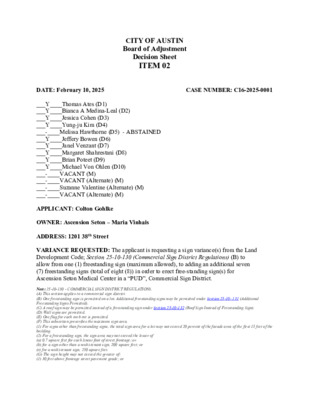
CITY OF AUSTIN Board of Adjustment Decision Sheet ITEM 02 DATE: February 10, 2025 CASE NUMBER: C16-2025-0001 ___Y____Thomas Ates (D1) ___Y____Bianca A Medina-Leal (D2) ___Y____Jessica Cohen (D3) ___Y____Yung-ju Kim (D4) ___-____Melissa Hawthorne (D5) - ABSTAINED ___Y____Jeffery Bowen (D6) ___Y____Janel Venzant (D7) ___Y____Margaret Shahrestani (D8) ___Y____Brian Poteet (D9) ___Y____Michael Von Ohlen (D10) ___-____VACANT (M) ___-____VACANT (Alternate) (M) ___-____Suzanne Valentine (Alternate) (M) ___-____VACANT (Alternate) (M) APPLICANT: Colton Gohlke OWNER: Ascension Seton – Maria Vinhais ADDRESS: 1201 38th Street VARIANCE REQUESTED: The applicant is requesting a sign variance(s) from the Land Development Code; Section 25-10-130 (Commercial Sign District Regulations) (B) to allow from one (1) freestanding sign (maximum allowed), to adding an additional seven (7) freestanding signs (total of eight (8)) in order to erect free-standing sign(s) for Ascension Seton Medical Center in a “PUD”, Commercial Sign District. Note: 25-10-130 - COMMERCIAL SIGN DISTRICT REGULATIONS. (A) This section applies to a commercial sign district. (B) One freestanding sign is permitted on a lot. Additional freestanding signs may be permitted under Section 25-10- 131 (Additional Freestanding Signs Permitted). (C) A roof sign may be permitted instead of a freestanding sign under Section 25-10-132 (Roof Sign Instead of Freestanding Sign). (D) Wall signs are permitted. (E) One flag for each curb cut is permitted. (F) This subsection prescribes the maximum sign area. (1) For signs other than freestanding signs, the total sign area for a lot may not exceed 20 percent of the facade area of the first 15 feet of the building. (2) For a freestanding sign, the sign area may not exceed the lesser of (a) 0.7 square feet for each linear foot of street frontage; or (b) for a sign other than a multi-tenant sign, 200 square feet; or (c) for a multi-tenant sign, 250 square feet. (G) The sign height may not exceed the greater of: (1) 30 feet above frontage street pavement grade; or (2) 6 feet above grade at the base of the sign. Source: Section 13-2-867; Ord. 990225-70; Ord. 031211-11; Ord. No. 20170817-072, Pt. 14, 8-28-17. 25-10-131 - ADDITIONAL FREESTANDING SIGNS PERMITTED. (A) This section applies in the expressway corridor, downtown, and commercial sign districts. (B) In this section, "lot" includes contiguous lots used for a single use or unified development. (C) For a lot with total street frontage of more than 400 feet, two freestanding signs are permitted. (D) For a lot fronting on two streets, one …
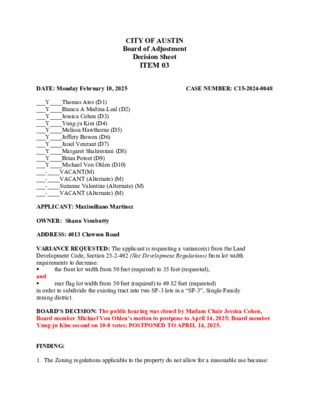
CITY OF AUSTIN Board of Adjustment Decision Sheet ITEM 03 DATE: Monday February 10, 2025 CASE NUMBER: C15-2024-0048 ___Y____Thomas Ates (D1) ___Y____Bianca A Medina-Leal (D2) ___Y____Jessica Cohen (D3) ___Y____Yung-ju Kim (D4) ___Y____Melissa Hawthorne (D5) ___Y____Jeffery Bowen (D6) ___Y____Janel Venzant (D7) ___Y____Margaret Shahrestani (D8) ___Y____Brian Poteet (D9) ___Y____Michael Von Ohlen (D10) ___-____VACANT(M) ___-____VACANT (Alternate) (M) ___-____Suzanne Valentine (Alternate) (M) ___-____VACANT (Alternate) (M) APPLICANT: Maximiliano Martinez OWNER: Shaun Vembutty ADDRESS: 4013 Clawson Road VARIANCE REQUESTED: The applicant is requesting a variance(s) from the Land Development Code, Section 25-2-492 (Site Development Regulations) from lot width requirements to decrease: and rear flag lot width from 50 feet (required) to 49.82 feet (requested) in order to subdivide the existing tract into two SF-3 lots in a “SF-3”, Single-Family zoning district. BOARD’S DECISION: The public hearing was closed by Madam Chair Jessica Cohen, Board member Michael Von Ohlen’s motion to postpone to April 14, 2025; Board member Yung-ju Kim second on 10-0 votes; POSTPONED TO APRIL 14, 2025. FINDING: 1. The Zoning regulations applicable to the property do not allow for a reasonable use because: the front lot width from 50 feet (required) to 35 feet (requested), 2. (a) The hardship for which the variance is requested is unique to the property in that: (b) The hardship is not general to the area in which the property is located because: 3. The variance will not alter the character of the area adjacent to the property, will not impair the use of adjacent conforming property, and will not impair the purpose of the regulations of the zoning district in which the property is located because: Elaine Ramirez Executive Liaison Jessica Cohen Madam Chair Diana Ramirez for
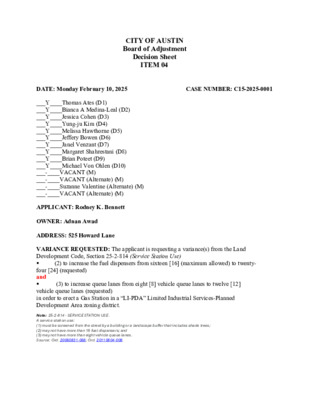
CITY OF AUSTIN Board of Adjustment Decision Sheet ITEM 04 DATE: Monday February 10, 2025 CASE NUMBER: C15-2025-0001 ___Y____Thomas Ates (D1) ___Y____Bianca A Medina-Leal (D2) ___Y____Jessica Cohen (D3) ___Y____Yung-ju Kim (D4) ___Y____Melissa Hawthorne (D5) ___Y____Jeffery Bowen (D6) ___Y____Janel Venzant (D7) ___Y____Margaret Shahrestani (D8) ___Y____Brian Poteet (D9) ___Y____Michael Von Ohlen (D10) ___-____VACANT (M) ___-____VACANT (Alternate) (M) ___-____Suzanne Valentine (Alternate) (M) ___-____VACANT (Alternate) (M) APPLICANT: Rodney K. Bennett OWNER: Adnan Awad ADDRESS: 525 Howard Lane VARIANCE REQUESTED: The applicant is requesting a variance(s) from the Land Development Code, Section 25-2-814 (Service Station Use) four [24] (requested) and vehicle queue lanes (requested) in order to erect a Gas Station in a “LI-PDA” Limited Industrial Services-Planned Development Area zoning district. (3) to increase queue lanes from eight [8] vehicle queue lanes to twelve [12] (2) to increase the fuel dispensers from sixteen [16] (maximum allowed) to twenty- Note: 25-2-814 - SERVICE STATION USE. A service station use: (1) must be screened from the street by a building or a landscape buffer that includes shade trees; (2) may not have more than 16 fuel dispensers; and (3) may not have more than eight vehicle queue lanes. Source: Ord. 20060831-068; Ord. 20110804-008. BOARD’S DECISION: The public hearing was closed by Madam Chair Jessica Cohen, Board member Michael Von Ohlen’s motion to Approve; Vice-Chair Melissa Hawthorne second on 10-0 votes; GRANTED. FINDING: 1. The Zoning regulations applicable to the property do not allow for a reasonable use because: as previously evidenced by multiple variance requests, the city’s queuing design is outdated, the new normal for convenience stores is a larger experience. 2. (a) The hardship for which the variance is requested is unique to the property in that: the lot has an oddly shaped and wide waste water easement that restricts the design. (b) The hardship is not general to the area in which the property is located because: at 2800 S Heatherwilde they were approved for 12 queuing spaces, at 12401Techridge they were approved for 12 queuing spaces, at 1701 E Howard Lane they were approved for 12 queuing spaces. 3. The variance will not alter the character of the area adjacent to the property, will not impair the use of adjacent conforming property, and will not impair the purpose of the regulations of the zoning district in which the property is located because: the adjoining neighbors are commercial and because the vehicles have …
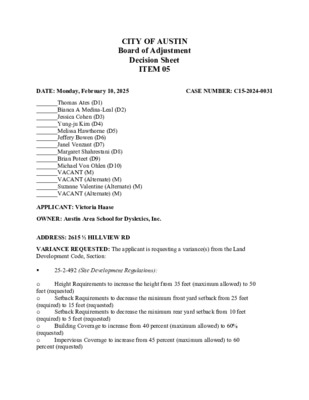
CITY OF AUSTIN Board of Adjustment Decision Sheet ITEM 05 DATE: Monday, February 10, 2025 CASE NUMBER: C15-2024-0031 _______Thomas Ates (D1) _______Bianca A Medina-Leal (D2) _______Jessica Cohen (D3) _______Yung-ju Kim (D4) _______Melissa Hawthorne (D5) _______Jeffery Bowen (D6) _______Janel Venzant (D7) _______Margaret Shahrestani (D8) _______Brian Poteet (D9) _______Michael Von Ohlen (D10) _______VACANT (M) _______VACANT (Alternate) (M) _______Suzanne Valentine (Alternate) (M) _______VACANT (Alternate) (M) APPLICANT: Victoria Haase OWNER: Austin Area School for Dyslexics, Inc. ADDRESS: 2615 ½ HILLVIEW RD VARIANCE REQUESTED: The applicant is requesting a variance(s) from the Land Development Code, Section: o feet (requested) o (required) to 15 feet (requested) o (required) to 5 feet (requested) o (requested) o percent (requested) Impervious Coverage to increase from 45 percent (maximum allowed) to 60 Setback Requirements to decrease the minimum rear yard setback from 10 feet Building Coverage to increase from 40 percent (maximum allowed) to 60% 25-2-492 (Site Development Regulations): Setback Requirements to decrease the minimum front yard setback from 25 feet Height Requirements to increase the height from 35 feet (maximum allowed) to 50 25-2-832 (Private Schools) (1) a site must be located on a street that has a paved width of at least 40 feet (required) to 30 feet (requested) from the site to where it connects with another street that has a paved width of at least 40 feet (required) to 30 feet (requested) in order to erect school buildings and structured sub-grade parking facilities in a “SF-3- NP”, Single-Family-Neighborhood Plan zoning district (West Austin Neighborhood Group). BOARD’S DECISION: POSTPONED TO November 14, 2024, BY APPLICANT; November 14, 2024 Postponed to December 9, 2024 due to the absence of a sufficient number of Board Members required for a formal vote on each case; December 9, 2024 POSPONED TO JANUARY 13, 2025; January 13, 2025 POSTPONEMENT REQUEST TO FEBRUARY 10, 2025; FEB 10, 2025 POSTPONED TO MAY 12, 2025 FINDING: 1. The Zoning regulations applicable to the property do not allow for a reasonable use because: 2. (a) The hardship for which the variance is requested is unique to the property in that: (b) The hardship is not general to the area in which the property is located because: 3. The variance will not alter the character of the area adjacent to the property, will not impair the use of adjacent conforming property, and will not impair the purpose of the regulations of the zoning district in …
CITY OF AUSTIN Board of Adjustment Decision Sheet ITEM 06 DATE: Monday February 10, 2025 CASE NUMBER: C15-2024-0040 _______Thomas Ates (D1) _______Bianca A Medina-Leal (D2) _______Jessica Cohen (D3) _______Yung-ju Kim (D4) _______Melissa Hawthorne (D5) _______Jeffery Bowen (D6) _______Janel Venzant (D7) _______Margaret Shahrestani (D8) _______Brian Poteet (D9) _______Michael Von Ohlen (D10) _______VACANT (M) _______VACANT (Alternate) (M) _______Suzanne Valentine (Alternate) (M) _______VACANT (Alternate) (M) APPLICANT: Leah Bojo OWNER: Chris Affinito ADDRESS: 600 CUMBERLAND RD VARIANCE REQUESTED The applicant is requesting a variance(s) from the Land Development Code: Article 3, Additional Requirements for Certain Districts, Division 5 –Combining and Overlay Districts, Section 25-2-654 (Density Bonus ETOD (DBETOD) Combining District Regulations: (H) Compatibility Requirements (3) Any structure that is located less than 50 feet from any part of a triggering property may not exceed 60 feet (maximum allowed) to 2 feet -4 27/32 inches – 5 feet 6 inches (requesting) from 25 feet (minimum width allowed) to 2 feet -4 27/32 inches – 5 feet -6 inches (requesting), in order to erect a Condominium Residential Building in a “GR-V-ETOD, DBETOD and GR-ETOD-DBETOD”, Community Commercial-Vertical Mixed-Use Building-Equitable Transit-Oriented Development and Community Commercial-Equitable Transit-Oriented Development-Density Bonus ETOD. (H) Compatibility Requirements (4) (a) from compatibility buffer to decrease the Note: The Land Development Code Section 25-2-654 (Density Bonus ETOD (DBETOD) Combining District Regulations This section applies to a property with density bonus ETOD (DBETOD) combining district zoning. (A) This section governs over a conflicting provision of this title or other ordinance. (B) Compatibility Requirements. (H) (1) A building is not required to comply with Article 10 (Compatibility Standards) in Subchapter C. (2) In this subsection, (a) TRIGGERING PROPERTY means a site: (i) with at least one dwelling unit but less than four dwelling units; and (ii) is zoned urban family residence (SF-5) district or more restrictive; and (b) STRUCTURE includes a portion of a structure. (3) Any structure that is located less than 50 feet from any part of a triggering property may not exceed 60 feet. (4) Compatibility Buffer. A compatibility buffer is required along a site's property line that is shared with a triggering property. (a) The minimum width of a compatibility buffer is 25 feet. (b) A compatibility buffer must comply with Section 25-8-700 (Minimum Requirements for Compatibility Buffers). BOARD’S DECISION: November 14, 2024 Postponed to December 9, 2024 due to the absence of a sufficient number of Board Members required for …
REGULAR MEETING of the AUSTIN-TRAVIS COUNTY FOOD POLICY BOARD MONDAY, FEBRUARY 10, 2025, 6:00 PM CITY OF AUSTIN PERMITTING AND DEVELOPMENT CENTER, ROOM 1406 6310 WILHELMINA DELCO DRIVE AUSTIN, TEXAS Some members of the Austin Travis County Food Policy Board may be participating by videoconference. Public comment will be allowed in-person or remotely via telephone. Speakers may only register to speak on an item once either in-person or remotely and will be allowed up to three minutes to provide their comments. Registration no later than noon the day before the meeting is required for remote participation by telephone. To register to speak remotely, call or email Amanda Rohlich, 512-974-1364, Amanda.Rohlich@austintexas.gov. CURRENT BOARD MEMBERS: Andrea Abel Lisa Barden, Vice-Chair Marissa Bell Mark Bethell Joi Chevalier, Chair Beth Corbett Larry Franklin Hilda Gutierrez Kacey Hanson Natalie Poulos Matt Simon Andrew Smith AGENDA CALL TO ORDER Board member roll call. PUBLIC COMMUNICATION: GENERAL The first 10 speakers signed up prior to the meeting being called to order will each be allowed a three-minute allotment to address their concerns regarding items not posted on the agenda. APPROVAL OF MINUTES Approve the minutes of the Austin-Travis County Food Policy Board Regular Meeting from Monday, January 13, 2025. 1. 2. STAFF BRIEFING Briefing on Austin-Travis County Food Plan Implementation, Edwin Marty, Food Policy Manager at City of Austin and Yaira Robinson, Assistant Director of Environmental Programs at Travis County DISCUSSION AND ACTION ITEMS 3. 4. 5. 6. 7. 8. 9. Discuss and take possible action on the recommendation to support Goal 1, Strategy 1.12 of the Austin Travis County Food Plan: Fully fund City and County park plans that include strategies to support community agriculture (such as the Vision Plan at John Trevino Jr. Metropolitan Park) and include support for staff to implement community agriculture programs in these locations and distribute food grown to surrounding communities. Board Member Andrea Abel and Board Member Lisa Barden. Discuss and take possible action on the recommendation to support Goal 1 of the Austin Travis County Food Plan: Expand community food production, preserve agricultural lands, and increase the amount of farmland dedicated to regenerative food production long-term in Austin/Travis County, Board Member Marissa Bell (land acquisition) and Board Member Matt Simon (regenerative agriculture). Discuss and take possible action on the recommendation to support Goal 4 of the Austin Travis County Food Plan: Establish and fund a resilient, inclusive, and accessible …
BOARD/COMMISSION RECOMMENDATION Austin Travis County Food Policy Board Recommendation Number: (YYYYMMDD-XXX) (XXX is the agenda item number): Support for community agriculture on City parkland WHEREAS, the Austin/Travis County Food Plan was approved by City Council on October 10, 2024; and WHEREAS, Goal 1 of the Food Plan is to expand community food production, preserve agricultural lands, and increase the amount of farmland dedicated to regenerative food production long-term in Austin/Travis County which includes Strategy 1.12 to “fully fund City and County park plans that include strategies to support community agriculture (such as the Vision Plan at John Treviño Jr. Metropolitan Park) and include support for staff to implement community agriculture programs in these locations and distribute food grown to surrounding communities”; and WHEREAS, the John Treviño Jr. Metropolitan Park Vision Plan was adopted by the Austin City Council on October 15, 2020 with one of the defined values to adapt the heritage of the site by carrying the site’s productive agricultural heritage into the present and future by exploring possibilities for food production and agricultural education, and includes “The Farm” in the design of the park to to connect local food production and education with opportunities for multi-generational participation; and WHEREAS, Austin Parks and Recreation Department (PARD) has funding and is in the design process for Phase I of the Treviño Vision Plan which includes basic park infrastructure to be able to open the park to the public, and Phase II of the Treviño Vision Plan could include community agriculture at the park; and WHEREAS, the City of Austin’s 2024 Environmental Investment Plan recommends $10 million in funding for Phase II of the Treviño Vision Plan; and WHEREAS, the City of Austin already has a Community Gardens Program (started in 2009 when the Austin City Council passed the Urban Farm Ordinance) to establish a single point of contact and streamline the process for establishing community gardens on city land; and WHEREAS community survey responses for Our Parks, Our Future, the City of Austin Parks & Recreation Department’s Long Range Plan names the following strategies: 4.4 “Increase the number of dedicated park staff for the community garden program”, 4.4.1. “Consider creating a ‘community gardener’ position” 4.5.2. “Proactively identify potential sites for new community gardens and food forests.”; and WHEREAS, the Austin-Travis County Food Policy Board’s Recommendation Number 20240318-7 urged the City of Austin to allocate funds and create a full-time equivalent …
BOARD/COMMISSION RECOMMENDATION Austin Travis County Food Policy Board Recommendation Number: (YYYYMMDD-XXX) (XXX is the agenda item number): Support for Access to Farmland for New Farmers WHEREAS, the Austin/Travis County Food Plan was approved by City Council on October 10, 2024; and WHEREAS, Goal 2 of the Food Plan is to “(i)ncrease access to and stewardship of land for regenerative food production by increasing the number of Austin/Travis County farms that are owned by economically disadvantaged farmers and rancher” and includes Strategy 2.3 to “(c)reate a local farm incubator program to support farmers who practice regenerative food production through the first 3-5 years of business with a focus on reducing barriers for underrepresented farm owner and workers, including offering beginning farmer training and financing support”; and WHEREAS, access to land is the number one barrier to farming for new farmers according to a 2022 survey of new farmers conducted by the National Young Farmers Coalition; and WHEREAS, 16.8 acres of viable farmland are lost every day in Travis County (City of Austin, Office of Sustainability, State of the Food System Report, 2022); and WHEREAS, the average age of a farmer in Texas in 2022 is 60 years old, compared to 59 years old in 2017; and WHEREAS, farmers and farmland are the foundation of a resilient and sustainable food system, a key element for emergency preparedness; and WHEREAS, the Austin-Travis County Food Policy Board’s Recommendation Number 20240318-7 urged the City of Austin to allocate funds and create a full-time equivalent (FTE) position to support the implementation of the Food Plan; and WHEREAS, Goal 2 of the Austin Climate Equity Plan is to by 2030, protect 500,000 acres of farmland from development in the five-county region through legal protections or regenerative agriculture programs by 2030; and WHEREAS, three Central Texas farm incubator programs launched in 2025. The Central Texas Farm Incubator Collaborative (Farmshare Austin, Green Gate Farms, and Hope Full Farm) offers land and mentorship for advanced beginning farmers with access to up to 0.5 acres of land and will serve at least 15 farmers in the first three years. Austin Community College Elgin Farm Incubator Program (FIP) provides beginning farmers enrolled in ACC access to .15 and .25 acres plots. The Refugee Collective is piloting a Farm Business Incubator and has one acre available. NOW, THEREFORE, BE IT RESOLVED that the Austin Travis County Food Policy Board encourages the Austin City …
BOARD/COMMISSION RECOMMENDATION Austin-Travis County Food Policy Board Recommendation Number: (YYYYMMDD-XXX) (XXX is the agenda item number): Support for Agricultural Land Acquisition and Preservation in Austin, Texas WHEREAS, the 2022 City of Austin State of the Food System Report indicates that less than 0.6% of the food consumed in Travis County is produced locally, and that approximately 16.8 acres of farmland are lost daily to development pressures, underscoring the critical need for dedicated agricultural land preservation efforts; and WHEREAS, land in Austin-Travis County is continuing to increase in value and decrease in quantity, it is imperative to act quickly as the cost of action will only increase over time; and WHEREAS, agricultural lands are vital to local food security, environmental sustainability, emergency preparedness, and climate resilience; and WHEREAS, the Austin/Travis County Food Plan, approved by the Austin City Council in October 2024, includes strategic, measurable, and time-bound goals and strategies to strengthen food security, promote environmental sustainability, and address climate change; and WHEREAS, the Austin/Travis County Food Plan’s Goal 1 prioritizes expanding community food production, preserving agricultural lands, and increasing the amount of farmland dedicated to regenerative food production long-term in Austin and Travis County; and WHEREAS, Strategy 1.1 of the Food Plan calls for the preservation of land for food production in Central Texas through conservation easements, fee-simple purchases, and land-banking, ensuring that farmland remains dedicated to agricultural use; and WHEREAS, Strategy 1.2 directs the City of Austin and Travis County to pursue capital funding sources to finance the conservation of land for agricultural use through conservation easements or direct purchases; and WHEREAS, preserving agricultural land also supports the goals of the Austin Climate Equity Plan by promoting sustainable land use, strengthening local food systems, and reducing carbon footprints through localized food production; and WHEREAS, Natural Systems Goal 2 of the Austin Climate Equity Plan aims to protect 500,000 acres of farmland across the five-county region through legal conservation or regenerative agriculture programs by 2030; and WHEREAS, the City of Austin currently lacks a dedicated mechanism to effectively manage and prioritize the preservation of agricultural lands; and WHEREAS, the Austin-Travis County Food Policy Board’s Recommendation Number 20240318-7 urged the City of Austin to allocate funds and create a full-time equivalent (FTE) position to support the implementation of the Food Plan; and NOW, THEREFORE, BE IT RESOLVED that the Austin-Travis County Food Policy Board encourages the Austin City Council to allocate …
BOARD/COMMISSION RECOMMENDATION Austin-Travis County Food Policy Board Recommendation Number: (YYYYMMDD-XXX) (XXX is the agenda item number): Support for Farmland Acquisition and Preservation in Travis County WHEREAS, the 2022 City of Austin State of the Food System Report indicates that less than 0.6% of the food consumed in Travis County is produced locally, and that approximately 16.8 acres of farmland are lost daily to development pressures, underscoring the critical need for dedicated agricultural land preservation efforts; and WHEREAS, land in Austin-Travis County is continuing to increase in value and decrease in quantity, it is imperative to act quickly as the cost of action will only increase over time; and WHEREAS, agricultural lands are vital to local food security, environmental sustainability, emergency preparedness, and climate resilience; and WHEREAS, the Travis County Commissioners Court passed a Resolution of Support for the Austin-Travis County Food Plan on October 29, 2024, whose goals and strategies prioritize addressing local food security and environmental sustainability; and WHEREAS, the Austin/Travis County Food Plan’s Goal 1 prioritizes expanding community food production, preserving agricultural lands, and increasing the amount of farmland dedicated to regenerative food production long-term in Austin and Travis County; and WHEREAS, Strategy 1.1 of the Food Plan calls for the preservation of land for food production in Central Texas through conservation easements, fee-simple purchases, and land-banking, ensuring that farmland remains dedicated to agricultural use; and WHEREAS, Strategy 1.2 directs the City of Austin and Travis County to pursue capital funding sources to finance the conservation of land for agricultural use through conservation easements or direct purchases; and WHEREAS, Travis County has successfully managed agricultural leases on 845 acres of agricultural land through the Parks Land Stewardship Program; and WHEREAS, Travis County currently operates a Conservation Easement Program allowing landowners to preserve agricultural, natural, or cultural resources while retaining ownership of their property. This program, funded by voter-approved bond funds and supplemented by donations, has successfully preserved significant tracts of land and helps protect vital resources such as watersheds, wildlife habitats, and agricultural lands; and WHEREAS, the Conservation Easement Program has been a key tool for Travis County in its efforts to protect land from development, with more than $24.9 million approved by voters between 2011 and 2017 for the purchase of easements. The program prioritizes properties in conservation corridors and those with significant environmental or agricultural value, aligning with the broader goals of the Austin/Travis County Food …
BOARD/COMMISSION RECOMMENDATION Austin Travis County Food Policy Board Recommendation Number: (YYYYMMDD-XXX) (XXX is the agenda item number): Support for Access to Farmland for New Farmers WHEREAS, the Travis County Commissioners Court passed a Resolution of Support for the Austin-Travis County Food Plan on October 29, 2024, whose goals and strategies prioritize addressing local food security and environmental sustainability; and WHEREAS, Goal 2 of the Food Plan is to “(i)ncrease access to and stewardship of land for regenerative food production by increasing the number of Austin/Travis County farms that are owned by economically disadvantaged farmers and rancher” and includes Strategy 2.3 to “(c)reate a local farm incubator program to support farmers who practice regenerative food production through the first 3-5 years of business with a focus on reducing barriers for underrepresented farm owner and workers, including offering beginning farmer training and financing support”; and WHEREAS, access to land is the number one barrier to farming for new farmers according to a 2022 survey of new farmers conducted by the National Young Farmers Coalition; and WHEREAS, 16.8 acres of viable farmland are lost every day in Travis County (City of Austin, Office of Sustainability, State of the Food System Report, 2022); and WHEREAS, the average age of a farmer in Texas in 2022 is 60 years old, compared to 59 years old in 2017; and WHEREAS, farmers and farmland are the foundation of a resilient and sustainable food system, a key element for emergency preparedness; and WHEREAS, the Austin-Travis County Food Policy Board’s Recommendation Number: 20240318-8 urged the Travis County to allocate funds and create a full-time equivalent (FTE) position to support the implementation of the Food Plan; and WHEREAS, Goal 2 of the Austin Climate Equity Plan is to by 2030, protect 500,000 acres of farmland from development in the five-county region through legal protections or regenerative agriculture programs by 2030; and WHEREAS, three Central Texas farm incubator programs launched in 2025. The Central Texas Farm Incubator Collaborative (Farmshare Austin, Green Gate Farms, and Hope Full Farm) offers land and mentorship for advanced beginning farmers with access to up to 0.5 acres of land and will serve at least 15 farmers in the first three years. Austin Community College Elgin Farm Incubator Program (FIP) provides beginning farmers enrolled in ACC access to .15 and .25 acres plots. The Refugee Collective is piloting a Farm Business Incubator and has one acre available. …
BOARD/COMMISSION RECOMMENDATION Austin-Travis County Food Policy Board Recommendation Number: (YYYYMMDD-XXX) (XXX is the agenda item number): Defining and Supporting Regenerative Agriculture NOTE: The “WHEREAS”s should give the background and the “NOW, THEREFORE,” should state what the board is requesting Council to do. WHEREAS, the 2022 City of Austin State of the Food System Report indicates that 21% of all greenhouse gas emissions in our community are related to the food supply chain; and WHEREAS, implementing Regenerative Agriculture supports the goals of the Austin Climate Equity Plan, which aims to ensure that by 2030, 100% of Austinites, especially those who are food insecure, can access a pro-climate, pro-health food systems that prioritize regenerative agriculture; and WHEREAS, the goals and strategies in the Austin/Travis County Food Plan, approved by the Austin City Council in October 2024, prioritize regenerative agriculture implementation, with reference to regenerative agriculture and food systems occurring 44 times throughout the document; and WHEREAS, the Austin/Travis County Food Plan states that a specific definition of Regenerative food production may need to be adopted to implement strategies under Goal 1, which pertain to agricultural land use (1.1,1.2) and community food systems support (1.6,1.12); and WHEREAS, a more specific definition is contained within the Resilient Farm Planning framework, which utilizes Conservation Practice Standards codified by the USDA Natural Resource Conservation Service (NRCS) and quantifies the resulting greenhouse gas benefits; and WHEREAS, the Resilient Farm Planning process has seen wide adoption and proof of concept in California for over a decade, with 137 Resilient Farm Plans (called Carbon Farm Plans in California) encompassing 71,440 acres; and WHEREAS, the Resilient Farm Planning process can be also be applied to outdoor spaces such as parks, flood plain, and greenbelts; and WHEREAS, the City of Austin Office of Sustainability has previously allocated funds for Texas’ First Resilient Farm plan at the Refugee Collective Farm, establishing a precedent of city support for plan implementation; and WHEREAS, the City of Austin currently lacks a dedicated mechanism to assist with the writing and implementation of Resilient Farm Plans; and WHEREAS, the Austin-Travis County Food Policy Board’s Recommendation Number 20240318-7 urged the City of Austin to allocate funds and create a full-time equivalent (FTE) position to support the implementation of the Food Plan; NOW, THEREFORE, BE IT RESOLVED that the Austin-Travis County Food Policy Board encourages the Austin City Council to adopt the Resilient Farm Planning Framework and its subsequent …
TEMPLATE FOR BOARD/COMMISSION RECOMMENDATIONS BOARD/COMMISSION RECOMMENDATION Austin-Travis County Food Policy Board Recommendation Number: (YYYYMMDD-XXX) (XXX is the agenda item number): Defining and Supporting Regenerative Agriculture NOTE: The “WHEREAS”s should give the background and the “NOW, THEREFORE,” should state what the board is requesting Council to do. WHEREAS, the 2020 Travis County Climate Action Plan prioritizes a goal of reducing greenhouse gas emissions to 40% below 2005 levels by 2030; and WHEREAS, the goals and strategies in the Austin/Travis County Food Plan, passed through a Resolution of Support by the Travis County Commissioner’s Court in October 2024, prioritize regenerative agriculture implementation, with reference to regenerative agriculture and food systems occurring 44 times throughout the document; and WHEREAS, the Austin/Travis County Food Plan states that a specific definition of Regenerative food production may need to be adopted to implement strategies under Goal 1, which pertain to agricultural land use (1.1,1.2) and community food systems support (1.6,1.12); and WHEREAS, a more specific definition is contained within the Resilient Farm Planning framework, which utilizes Conservation Practice Standards codified by the USDA Natural Resource Conservation Service (NRCS) and quantifies the resulting greenhouse gas benefits; and WHEREAS, the Resilient Farm Planning process has seen wide adoption and proof of concept in California for over a decade, with 137 Resilient Farm Plans (called Carbon Farm Plans in California) encompassing 71,440 acres; and WHEREAS, Travis County has previously allocated funds for cheaper and longer leases on county owned agricultural lands if producers adopt regenerative practices, establishing a precedent of county support for Regenerative Agriculture; and WHEREAS, the Resilient Farm Planning process can be also be applied to outdoor spaces such as parks, flood plain, and greenbelts, as well as on residential lots; and WHEREAS, the Travis County Transportation and Natural Resources Office has been tasked with creating a Community Climate Action Plan; and WHEREAS, the Travis County Agricultural Extension Office provides educational services to the public on how to steward their residential environments; NOW, THEREFORE, BE IT RESOLVED that the Austin-Travis County Food Policy Board encourages Travis County to adopt the Resilient Farm Planning Framework and its subsequent NRCS Conservation Practice Standards as the specific definition of Regenerative Agriculture in the County, and to codify this definition in the upcoming Travis County Community Climate Action Plan; and BE IT RESOLVED that the Austin-Travis County Food Policy Board encourages Travis County to train Agricultural Extension Agents in the writing …
TEMPLATE FOR BOARD/COMMISSION RECOMMENDATIONS BOARD/COMMISSION RECOMMENDATION (Austin-Travis County Food Policy Board) Recommendation Number: (YYYYMMDD-XXX) (XXX is the agenda item number): Preparing Culturally and Medically Appropriate Supply Side Nutrition, Provision and Distribution Access During Disasters, Disruptions, and Emergencies WHEREAS, food insecurity already disproportionately affects vulnerable populations in Austin/Travis County, creating significant barriers to nutritious food access for individuals and households with limited resources and most acutely during emergencies, significant weather events, or disasters; and WHEREAS, the Austin Travis County Food Plan, adopted by City Council in October 2024, includes the goal of establishing and funding a resilient, inclusive, and accessible emergency food provision system that ensure all community members, regardless of cultural background or medical needs, have access to safe, nutritious, and culturally relevant food during disasters and emergencies (Goal 4); and WHEREAS, it is essential to develop and fund a coordinated emergency food access response plan that ensures that City and County community centers and resilience networks have access to water, culturally and medically appropriate food, proper storage, and inventory management practices (Strategy 4.3); and WHEREAS, having preparedness teams and partners be able to meet dietary needs during emergencies, including culturally relevant and medically appropriate food preparation, and for emergency staff and volunteers to have training in such (Strategy 4.4); and WHEREAS, it will be necessary, as part of the preparedness ecosystem, to work with community partners to have a real-time inventory management system to track emergency food availability, expiration dates, and replenishment needs to ensure a steady supply during emergencies while minimizing food waste (Strategy 4.5) and WHEREAS, it is essential and critical to create a diverse and reliable food supply by establishing partnerships with a wide range of local suppliers and develop contingency plans for food supply chain disruptions, including alternative sourcing strategies (Strategy 4.6); and Commented [1]: See above comment for "Whereas." Need to add "Resolved" pertaining to 6.1 Food Retail and 6.6 school meal and summer food service programs. WHEREAS, there is a significant need to create mechanism that improves emergency response and preparedness for major power outages that impact the food supply at all stages of the food system (Strategy 4.7). NOW, THEREFORE, BE IT RESOLVED that the Austin-Travis County Food Policy Board recommends the following actions: 1. Establish Pre-Existing, Prepared Trusted Community Partners o Build upon Mass Care’s ecosystem survey, identify key partners to establish preexisting procurement relationships through Austin Finance Online o Prioritize …
BOARD/COMMISSION RECOMMENDATION (Austin-Travis County Food Policy Board) Recommendation Goal 6.1, 6.5, 6.6: • Actively establish culturally relevant, affordable, community-backed or -driven retail options in areas experiencing food insecurity or facing barriers to food access, including replication and expansion of existing food retail initiatives in the City and County • Expand benefits and access to nutritious foods through programs that amplify and supplement the purchasing power of individuals and households facing food and nutrition insecurity and explore the feasibility of creating a locally funded nutrition incentive program with less restrictive eligibility criteria than SNAP/WIC Increase utilization of publicly administered programs that improve food access, such as SNAP, WIC, the national school breakfast/lunch program, and summer food service program. • WHEREAS, food insecurity disproportionately affects vulnerable populations in Austin/Travis County, creating significant barriers to nutritious food access for individuals and households with limited resources; WHEREAS, where value multiplying programs are an effective model of extending purchasing power for nutritious foods, allowing SNAP recipients to double their spending on fruits and vegetables at local farmers markets; WHEREAS, the need for culturally relevant nutrition education and cooking skills training, can empower community members to make healthy, affordable food choices; WHEREAS, current food assistance programs often have restrictive eligibility criteria that exclude many community members experiencing economic hardship; WHEREAS, technological barriers and limited digital literacy can further complicate access to food assistance resources and online food shopping options; WHEREAS, language and disability barriers continue to create additional challenges for individuals seeking food assistance and nutrition support; WHEREAS, existing successful local programs like Double Up Food Bucks and The Happy Kitchen provide valuable frameworks for expanding food access and nutrition education; new programs can and need to be created; NOW, THEREFORE, BE IT RESOLVED that the Austin-Travis County Food Policy Board recommends the following actions: 1. Expand and Enhance Nutrition Incentive Programs: o Build upon the successful value purchasing models to create a locally funded nutrition incentive program o Develop more flexible eligibility criteria that complement existing federal/state/local assistance programs o Provide additional purchasing power for nutritious foods, particularly fresh produce and local agricultural products o Create mechanisms to support both farmers and food-insecure households 2. Strengthen Nutrition Education and Skill-Building: o Expand programs that provide culturally relevant food and cooking/nutrition education Multilingual cooking classes Nutrition education workshops Skill-building for affordable, healthy meal preparation o Develop technology-integrated education modules to support online food …
BOARD/COMMISSION RECOMMENDATION (Austin-Travis County Food Policy Board) Recommendation Number: (YYYYMMDD-XXX) (XXX is the agenda item number): Support for the Development of Local Food Hubs and Strengthening Regional Food Systems WHEREAS, the 2022 City of Austin State of the Food System Report states that less than 0.6% of the food consumed in Travis County is produced locally, and that approximately 16.8 acres of farmland are lost daily to development pressures, underscoring the critical need to support regional food systems; and WHEREAS, schools in the Austin-Travis County region spend millions of dollars annually on food, most of which is sourced from large-scale distributors that typically obtain their products from farms outside of Texas. Even when Texas-produced food is available, it is often sourced from regions outside of Central Texas, resulting in long supply chains, a larger carbon footprint, and a missed opportunity for local farmers in the Central Texas region; and WHEREAS, The Austin-Travis County Food Plan, approved by the Austin City Council in October 2024, calls for the development and support of central aggregation, processing, and distribution facilities (food hubs) to supply regional institutional purchasers with local agricultural goods, ensuring the stability and resilience of the food system in Austin/Travis County (Goal 5, Strategy 5.1); and WHEREAS, the Austin Climate Equity Plan calls for supporting institutions and developing supply-chain infrastructure and regional food networks to facilitate large-scale pro-climate, pro-health food procurement, supporting regenerative agricultural producers and increasing access to sustainable, healthy food options (Goal 1, Strategy 1, Food and Product Consumption); and WHEREAS, In 2019, the Sustainable Food Center (SFC) conducted a Central Texas food hub feasibility study and concluded that the most effective path forward at the time was to leverage existing intermediaries rather than invest in a new brick-and-mortar facility. The study recommended immediate actions, including: ● Matchmaking between producers and institutional buyers to build relationships and strengthen ● Establishing micro-aggregation nodes to create distribution models that could evolve into a local supply chains. larger hub-and-spoke system; and WHEREAS, Since 2019, SFC has facilitated supplier-buyer matchmaking, and a food hub pilot program has been launched in partnership between the Central Texas Food Bank and Central Texas school districts including Lake Travis ISD, Manor ISD, and Florence ISD. However, significant barriers persist in scaling institutional procurement of local food; and WHEREAS, The landscape of local food procurement has changed significantly since 2019. Key developments include: ● Loss of Key Supply …
Austin-Travis County Food Plan ATCFPB February 2024 – Staff Update City of Austin Food Plan Updates Report back to Council in Spring 2025 ● City staff will provide a Memo to Council in spring 2025 ○ Updates on Strategy progress including defined leadership roles and responsibilities for implementation of the various strategies within the Plan ○ Funding needs in the Fiscal Year 2025-2026 budget for investment in and implementation of the Plan and to identify strategy priorities to be included as part of the next bond package ○ Updates on a Food Plan Dashboard ○ Updates on an Implementation Coalition Dashboard Preview Implementation Coalition ● City and County staff are exploring a funding opportunity to support a Food Plan implementation coalition (Strategy 9.1) ● Staff are scoping and negotiating specifics and hope to have an Interlocal Agreement complete in spring 2025 ● RFP for support of an implementation coalition will be released in mid-2025 ● City staff are seeking ATCFPB input on the RFP. Travis County Food Plan Updates Exploring Departmental Alignment ● Travis County Staff Food Plan Team Updates ○ Briefed County Executives on outreach plan: 1/24/2025 ○ Next step: consulting with departmental staff leaders to explore Food Plan goal & strategy alignment with departmental goals ○ Goal: share top-aligned goals & strategies with Commissioners Court members, Spring 2025 ● Travis County Comprehensive Parks Plan Community Engagement ○ Please participate! https://outdoorengage.mysocialpinpoint.com/travis ○ Open now through February 13, 2025 Thank You! Travis County Environmental Quality: Sustainability Programs www.austintexas.gov/food /austinsustainability
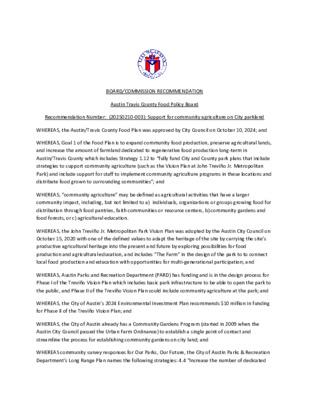
BOARD/COMMISSION RECOMMENDATION Austin Travis County Food Policy Board Recommendation Number: (20250210-003): Support for community agriculture on City parkland WHEREAS, the Austin/Travis County Food Plan was approved by City Council on October 10, 2024; and WHEREAS, Goal 1 of the Food Plan is to expand community food production, preserve agricultural lands, and increase the amount of farmland dedicated to regenerative food production long-term in Austin/Travis County which includes Strategy 1.12 to “fully fund City and County park plans that include strategies to support community agriculture (such as the Vision Plan at John Treviño Jr. Metropolitan Park) and include support for staff to implement community agriculture programs in these locations and distribute food grown to surrounding communities”; and WHEREAS, “community agriculture” may be defined as agricultural activities that have a larger community impact, including, but not limited to a) individuals, organizations or groups growing food for distribution through food pantries, faith communities or resource centers, b) community gardens and food forests, or c) agricultural education. WHEREAS, the John Treviño Jr. Metropolitan Park Vision Plan was adopted by the Austin City Council on October 15, 2020 with one of the defined values to adapt the heritage of the site by carrying the site’s productive agricultural heritage into the present and future by exploring possibilities for food production and agricultural education, and includes “The Farm” in the design of the park to to connect local food production and education with opportunities for multi-generational participation; and WHEREAS, Austin Parks and Recreation Department (PARD) has funding and is in the design process for Phase I of the Treviño Vision Plan which includes basic park infrastructure to be able to open the park to the public, and Phase II of the Treviño Vision Plan could include community agriculture at the park; and WHEREAS, the City of Austin’s 2024 Environmental Investment Plan recommends $10 million in funding for Phase II of the Treviño Vision Plan; and WHEREAS, the City of Austin already has a Community Gardens Program (started in 2009 when the Austin City Council passed the Urban Farm Ordinance) to establish a single point of contact and streamline the process for establishing community gardens on city land; and WHEREAS community survey responses for Our Parks, Our Future, the City of Austin Parks & Recreation Department’s Long Range Plan names the following strategies: 4.4 “Increase the number of dedicated park staff for the community garden program”, 4.4.1. “Consider …
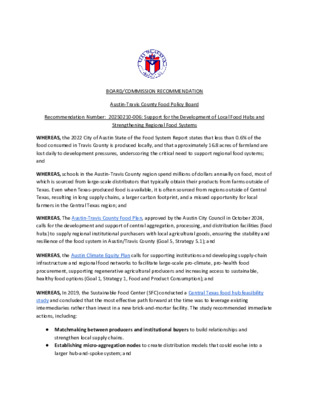
BOARD/COMMISSION RECOMMENDATION Austin-Travis County Food Policy Board Recommendation Number: 20250210-006: Support for the Development of Local Food Hubs and Strengthening Regional Food Systems WHEREAS, the 2022 City of Austin State of the Food System Report states that less than 0.6% of the food consumed in Travis County is produced locally, and that approximately 16.8 acres of farmland are lost daily to development pressures, underscoring the critical need to support regional food systems; and WHEREAS, schools in the Austin-Travis County region spend millions of dollars annually on food, most of which is sourced from large-scale distributors that typically obtain their products from farms outside of Texas. Even when Texas-produced food is available, it is often sourced from regions outside of Central Texas, resulting in long supply chains, a larger carbon footprint, and a missed opportunity for local farmers in the Central Texas region; and WHEREAS, The Austin-Travis County Food Plan, approved by the Austin City Council in October 2024, calls for the development and support of central aggregation, processing, and distribution facilities (food hubs) to supply regional institutional purchasers with local agricultural goods, ensuring the stability and resilience of the food system in Austin/Travis County (Goal 5, Strategy 5.1); and WHEREAS, the Austin Climate Equity Plan calls for supporting institutions and developing supply-chain infrastructure and regional food networks to facilitate large-scale pro-climate, pro-health food procurement, supporting regenerative agricultural producers and increasing access to sustainable, healthy food options (Goal 1, Strategy 1, Food and Product Consumption); and WHEREAS, In 2019, the Sustainable Food Center (SFC) conducted a Central Texas food hub feasibility study and concluded that the most effective path forward at the time was to leverage existing intermediaries rather than invest in a new brick-and-mortar facility. The study recommended immediate actions, including: ● Matchmaking between producers and institutional buyers to build relationships and ● Establishing micro-aggregation nodes to create distribution models that could evolve into a strengthen local supply chains. larger hub-and-spoke system; and WHEREAS, Since 2019, SFC has facilitated supplier-buyer matchmaking, and a food hub pilot program has been launched in partnership between the Central Texas Food Bank and Central Texas school districts including Lake Travis ISD, Manor ISD, and Florence ISD. However, significant barriers persist in scaling institutional procurement of local food; and WHEREAS, The landscape of local food procurement has changed significantly since 2019. Key developments include: ● Loss of Key Supply Infrastructure: The largest local farm in …
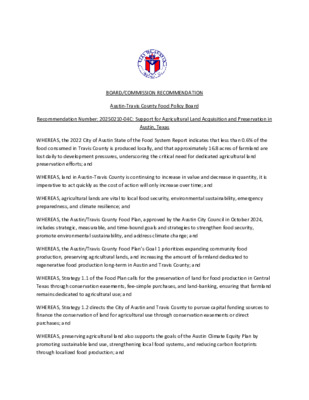
BOARD/COMMISSION RECOMMENDATION Austin-Travis County Food Policy Board Recommendation Number: 20250210-04C: Support for Agricultural Land Acquisition and Preservation in Austin, Texas WHEREAS, the 2022 City of Austin State of the Food System Report indicates that less than 0.6% of the food consumed in Travis County is produced locally, and that approximately 16.8 acres of farmland are lost daily to development pressures, underscoring the critical need for dedicated agricultural land preservation efforts; and WHEREAS, land in Austin-Travis County is continuing to increase in value and decrease in quantity, it is imperative to act quickly as the cost of action will only increase over time; and WHEREAS, agricultural lands are vital to local food security, environmental sustainability, emergency preparedness, and climate resilience; and WHEREAS, the Austin/Travis County Food Plan, approved by the Austin City Council in October 2024, includes strategic, measurable, and time-bound goals and strategies to strengthen food security, promote environmental sustainability, and address climate change; and WHEREAS, the Austin/Travis County Food Plan’s Goal 1 prioritizes expanding community food production, preserving agricultural lands, and increasing the amount of farmland dedicated to regenerative food production long-term in Austin and Travis County; and WHEREAS, Strategy 1.1 of the Food Plan calls for the preservation of land for food production in Central Texas through conservation easements, fee-simple purchases, and land-banking, ensuring that farmland remains dedicated to agricultural use; and WHEREAS, Strategy 1.2 directs the City of Austin and Travis County to pursue capital funding sources to finance the conservation of land for agricultural use through conservation easements or direct purchases; and WHEREAS, preserving agricultural land also supports the goals of the Austin Climate Equity Plan by promoting sustainable land use, strengthening local food systems, and reducing carbon footprints through localized food production; and WHEREAS, Natural Systems Goal 2 of the Austin Climate Equity Plan aims to protect 500,000 acres of farmland across the five-county region through legal conservation or regenerative agriculture programs by 2030; and WHEREAS, the City of Austin currently lacks a dedicated mechanism to effectively manage and prioritize the preservation of agricultural lands; and WHEREAS, the Austin-Travis County Food Policy Board’s Recommendation Number 20240318-7 urged the City of Austin to allocate funds and create a full-time equivalent (FTE) position to support the implementation of the Food Plan; and NOW, THEREFORE, BE IT RESOLVED that the Austin-Travis County Food Policy Board encourages the Austin City Council to allocate funds and explore all available means …
BOARD/COMMISSION RECOMMENDATION Austin-Travis County Food Policy Board Recommendation Number: 20250210-04D: Support for Farmland Acquisition and Preservation in Travis County WHEREAS, the 2022 City of Austin State of the Food System Report indicates that less than 0.6% of the food consumed in Travis County is produced locally, and that approximately 16.8 acres of farmland are lost daily to development pressures, underscoring the critical need for dedicated agricultural land preservation efforts; and WHEREAS, land in Austin-Travis County is continuing to increase in value and decrease in quantity, it is imperative to act quickly as the cost of action will only increase over time; and WHEREAS, agricultural lands are vital to local food security, environmental sustainability, emergency preparedness, and climate resilience; and WHEREAS, the Travis County Commissioners Court passed a Resolution of Support for the Austin-Travis County Food Plan on October 29, 2024, whose goals and strategies prioritize addressing local food security and environmental sustainability; and WHEREAS, the Austin/Travis County Food Plan’s Goal 1 prioritizes expanding community food production, preserving agricultural lands, and increasing the amount of farmland dedicated to regenerative food production long-term in Austin and Travis County; and WHEREAS, Strategy 1.1 of the Food Plan calls for the preservation of land for food production in Central Texas through conservation easements, fee-simple purchases, and land-banking, ensuring that farmland remains dedicated to agricultural use; and WHEREAS, Strategy 1.2 directs the City of Austin and Travis County to pursue capital funding sources to finance the conservation of land for agricultural use through conservation easements or direct purchases; and WHEREAS, Travis County has successfully managed agricultural leases on 845 acres of agricultural land through the Parks Land Stewardship Program; and WHEREAS, Travis County currently operates a Conservation Easement Program allowing landowners to preserve agricultural, natural, or cultural resources while retaining ownership of their property. This program, funded by voter-approved bond funds and supplemented by donations, has successfully preserved significant tracts of land and helps protect vital resources such as watersheds, wildlife habitats, and agricultural lands; and WHEREAS, the Conservation Easement Program has been a key tool for Travis County in its efforts to protect land from development, with more than $24.9 million approved by voters between 2011 and 2017 for the purchase of easements. The program prioritizes properties in conservation corridors and those with significant environmental or agricultural value, aligning with the broader goals of the Austin/Travis County Food Plan to protect farmland for regenerative …
Play audio
Play audio
MEETING MINUTES February 10, 2025 Austin/Travis County Food Policy Board The Austin/Travis County Food Policy Board (ATCFPB) convened on Monday, February 10, at the City of Austin Permitting and Development Center, 6310 Wilhelmina Delco Dr, Room 1406, Austin, TX 78752. Board Members in Attendance: Andrea Abel, Lisa Barden, Marissa Bell, Mark Bethell, Joi Chevalier, Beth Corbett, Hilda Gutierrez, Kacey Hanson, Natalie Poulos, Matt Simon, Andy Smith Board Members Absent: Larry Franklin, Staff in Attendance: Edwin Marty (City of Austin), Amanda Rohlich (City of Austin), Angela Baucom (City of Austin), Yaira Robinson (Travis County) CALL TO ORDER Chair Joi Chevalier called the meeting to order at 6:01 p.m. PUBLIC COMMUNICATION None Andy Smith joined the dais at 6:03 pm APPROVAL OF MINUTES 1. Board Member Andrea Abel motioned to approve the meeting minutes from the Regular Meeting on January 13, 2025, with Board Member Marissa Bell, seconding the motion. Minutes passed on an 11-0 vote. STAFF BRIEFING DISCUSSION AND ACTION ITEMS 2. Briefing on Austin-Travis County Food Plan Implementation, Edwin Marty, Food Policy Manager at City of Austin and Yaira Robinson, Assistant Director of Environmental Programs at Travis County (see back-up materials for presentation). 3. Discuss and take possible action on the recommendation to support Goal 1, Strategy 1.12 of the Austin Travis County Food Plan: Fully fund City and County park plans that include strategies to support community agriculture (such as the Vision Plan at John Trevino Jr. Metropolitan Park) and include support for staff to implement community agriculture programs in these locations and distribute food grown to surrounding communities. Board Member Andrea Abel and Board Member Lisa Barden. a. Suggestion to clarify and define what community agriculture includes possibly referencing the food plan definitions (pg. 29 mentions “community food production”) b. Kacey Hanson made a motion to submit the recommendation with some edits to include definition of community agriculture and Andy Smith seconded the motion. The recommendation passed on an 11-0 vote. 4. Discuss and take possible action on the recommendation(s) to support Goal 1 of the Austin Travis County Food Plan: Expand community food production, preserve agricultural lands, and increase the amount of farmland dedicated to regenerative food production long-term in Austin/Travis County, Board Member Andrea Abel and Matt Simon (support for farmland for new farmers), Board Member Marissa Bell (land acquisition) and Board Member Matt Simon (regenerative agriculture). a. Recommendation: Support for Access to Farmland for New …
REGULAR MEETING of the ANIMAL ADVISORY COMMISSION February 10, 2025, 6 p.m. Austin City Hall, Room 1101 301 W. 2nd St Austin, Texas 78701 Some members of the Animal Advisory Commission may be participating by videoconference. The meeting may be viewed online at: http://www.austintexas.gov/page/watch-atxn-live Public comment will be allowed in-person or remotely via telephone. Speakers may only register to speak on an item once either in-person or remotely and will be allowed up to three minutes to provide their comments. Registration no later than noon the day before the meeting is required for remote participation by telephone. To register to speak remotely, contact Christi Vitela at christi.vitela@austintexas.gov or (512) 974-2792. CURRENT COMMISSIONERS: Ryan Clinton, Chair, Travis County Nancy Nemer, Travis County Lotta Smagula, D1 Beatriz Dulzaides, D2 Ann Linder, Vice Chair, D3 Dr. Paige Nilson, D4 Whitney Holt, D5 Luis Herrera, D6 Larry Tucker, D7 Sarah Huddleston, D9 Laura Hoke, Mayor CALL TO ORDER PUBLIC COMMUNICATION: GENERAL AGENDA The first 10 speakers signed up prior to the meeting being called to order will each be allowed a three-minute allotment to address their concerns regarding items not posted on the agenda. APPROVAL OF MINUTES 1. Approve the minutes of the Animal Advisory Commission Regular Meeting on January 13, 2025. STAFF BRIEFING 2. Staff briefing regarding monthly reports provided by the Animal Service Center. DISCUSSION ITEMS 3. Presentation by Austin Pets Alive! regarding license agreements reports. 4. Discussion of the draft Animal Services Strategic Plan. DISCUSSION AND ACTION ITEMS 5. Approve a Recommendation to Council regarding the draft Animal Services Strategic Plan. 6. Approve the formation of a Community Cat Processing Working Group. FUTURE AGENDA ITEMS ADJOURNMENT The City of Austin is committed to compliance with the American with Disabilities Act. Reasonable modifications and equal access to communications will be provided upon request. Meeting locations are planned with wheelchair access. If requiring Sign Language Interpreters or alternative formats, please give notice at least 2 days (48 hours) before the meeting date. Please contact Christi Vitela, Office of the City Clerk at (512) 974-2792 or christi.vitela@austintexas.gov for additional information; TTY users route through Relay Texas at 711. For more information on the Animal Advisory Commission, please contact Christi Vitela at (512) 974-2792 or christi.vitela@austintexas.gov.
ANIMAL ADVISORY COMMISSION REGULAR MEETING MINUTES JANUARY 13, 2025 The Animal Advisory Commission convened in a regular meeting on January 13, 2025, at 301 W. 2nd St in Austin, Texas. Chair Clinton called the Animal Advisory Commission Meeting to order at 6:04 p.m. Commissioners in Attendance: Ryan Clinton, Chair, Travis County Ann Linder, Vice Chair, D3 Sarah Huddleston, D9 Beatriz Dulzaides, D2 Dr. Paige Nilson, D4 Commissioners in Attendance Remotely: Nancy Nemer, Travis County Luis Herrera, D6 Whitney Holt, D5 Larry Tucker, D7 Commissioners Absent: Laura Hoke, Mayor’s Appointee Lotta Smagula, D1 PUBLIC COMMUNICATION: GENERAL Kayla Murray – Adoption difficulties Pat Valls-Trelles – Animal Services Budget Laura Ransan Nesmith - TNR Wendy Weiss – TNR Deborah Ro – TNR Rochelle Vickery – Abandoned Dogs 1 Robert Corbin – Off leash dogs APPROVAL OF MINUTES 1. Approve the minutes of the Animal Advisory Commission Regular Meeting on December 9, 2024 The motion to approve the minutes from the meeting of December 9, 2024, was approved on Vice Chair Linder’s motion, Commissioner Huddleston’s second on an 8-0 vote. Commissioner Nilson abstained. Commissioners Hoke and Smagula were absent. The motion to take up Item 3 before Item 2 was approved on Vice Chair Linder’s motion, Commissioner Huddleston’s second on a 9-0 vote. Commissioners Hoke and Smagula were absent. STAFF BRIEFING 3. Staff briefing on the draft Animal Services Office Strategic Plan 2025-2030. The presentation was made by Susana Carbajal, Assistant City Manager, Don Bland, Chief Animal Services Officer, Animal Service Office, and Audrey Muntz, Budget and Performance Manager, Financial Services Department. Vice Chair Linder requested that staff provide the introduction and background for the Strategic Plan and any additional language that precedes the Strategic Plan. DISCUSSION ITEM 2. Receive feedback from members of the public regarding the draft Animal Services Office Strategic Plan 2025-2030. Discussed. FUTURE AGENDA ITEMS Community cat processing Working Group (Clinton, Huddleston) A motion to adjourn the meeting at 7:24 p.m. was approved on Commissioner Nilson’s motion, Commissioner Dulzaides’ second on a 9-0 vote. Commissioners Hoke and Smagula were absent. 2 The minutes were approved at the XX, meeting on Commissioner XX’s motion, Commissioner XX’s second on a X-X vote. 3
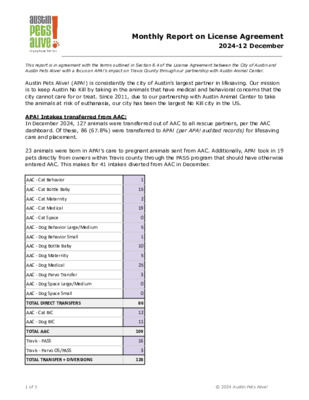
Monthly Report on License Agreement 2024-12 December This report is in agreement with the terms outlined in Section 8.4 of the License Agreement between the City of Austin and Austin Pets Alive! with a focus on APA!’s impact on Travis County through our partnership with Austin Animal Center. Austin Pets Alive! (APA!) is consistently the city of Austin’s largest partner in lifesaving. Our mission is to keep Austin No Kill by taking in the animals that have medical and behavioral concerns that the city cannot care for or treat. Since 2011, due to our partnership with Austin Animal Center to take the animals at risk of euthanasia, our city has been the largest No Kill city in the US. APA! Intakes transferred from AAC: In December 2024, 127 animals were transferred out of AAC to all rescue partners, per the AAC dashboard. Of these, 86 (67.8%) were transferred to APA! (per APA! audited records) for lifesaving care and placement. 23 animals were born in APA!’s care to pregnant animals sent from AAC. Additionally, APA! took in 19 pets directly from owners within Travis county through the PASS program that should have otherwise entered AAC. This makes for 41 intakes diverted from AAC in December. AAC - Cat Behavior AAC - Cat Bottle Baby AAC - Cat Maternity AAC - Cat Medical AAC - Cat Space AAC - Dog Behavior Large/Medium AAC - Dog Behavior Small AAC - Dog Bottle Baby AAC - Dog Maternity AAC - Dog Medical AAC - Dog Parvo Transfer AAC - Dog Space Large/Medium AAC - Dog Space Small TOTAL DIRECT TRANSFERS AAC - Cat BIC AAC - Dog BIC TOTAL AAC Travis - PASS Travis - Parvo OS/PASS TOTAL TRANSFER + DIVERSIONS 1 15 2 19 0 5 1 10 5 25 3 0 0 86 12 11 109 16 3 128 1 of 5 © 2024 Austin Pets Alive! 328 420 748 Operations Comparison APA and AAC serve the community in tandem and our combined efforts impact the live release rate across the city, county and surrounding areas. For December 2024: Intake (cats & dogs) S/N at shelter Adoptions In Foster AAC APA! 789 563 TOTAL 1,352 n/a n/a 668 641 1,309 APA! Transfers from AAC as % of AAC Prior Year Intakes APA must: (a) select a sufficient number of animals from the At-Risk List so that at the end of each year …
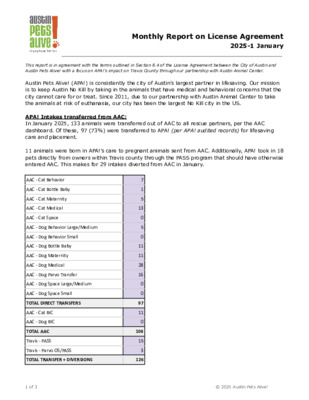
Monthly Report on License Agreement 2025-1 January This report is in agreement with the terms outlined in Section 8.4 of the License Agreement between the City of Austin and Austin Pets Alive! with a focus on APA!’s impact on Travis County through our partnership with Austin Animal Center. Austin Pets Alive! (APA!) is consistently the city of Austin’s largest partner in lifesaving. Our mission is to keep Austin No Kill by taking in the animals that have medical and behavioral concerns that the city cannot care for or treat. Since 2011, due to our partnership with Austin Animal Center to take the animals at risk of euthanasia, our city has been the largest No Kill city in the US. APA! Intakes transferred from AAC: In January 2025, 133 animals were transferred out of AAC to all rescue partners, per the AAC dashboard. Of these, 97 (73%) were transferred to APA! (per APA! audited records) for lifesaving care and placement. 11 animals were born in APA!’s care to pregnant animals sent from AAC. Additionally, APA! took in 18 pets directly from owners within Travis county through the PASS program that should have otherwise entered AAC. This makes for 29 intakes diverted from AAC in January. AAC - Cat Behavior AAC - Cat Bottle Baby AAC - Cat Maternity AAC - Cat Medical AAC - Cat Space AAC - Dog Behavior Large/Medium AAC - Dog Behavior Small AAC - Dog Bottle Baby AAC - Dog Maternity AAC - Dog Medical AAC - Dog Parvo Transfer AAC - Dog Space Large/Medium AAC - Dog Space Small TOTAL DIRECT TRANSFERS AAC - Cat BIC AAC - Dog BIC TOTAL AAC Travis - PASS Travis - Parvo OS/PASS TOTAL TRANSFER + DIVERSIONS 13 7 1 5 0 5 0 11 11 28 16 0 0 97 11 0 108 15 3 126 1 of 3 © 2025 Austin Pets Alive! 207 368 575 Operations Comparison APA and AAC serve the community in tandem and our combined efforts impact the live release rate across the city, county and surrounding areas. For December 2024: Intake (cats & dogs) S/N at shelter Adoptions In Foster AAC APA! 824 683 TOTAL 1,507 311 606 917 595 490 1,085 APA! Transfers from AAC as % of AAC Intakes APA must: (a) select a sufficient number of animals from the At-Risk List so that at the end of each year of …
ANIMAL SERVICES OFFICE STRATEGIC PLAN 2025-2030 DRAFT SUBJECT TO FURTHER REVIEW AND REVISION BY THE ANIMAL ADVISORY COMMISSION, CITY MANAGEMENT, AND AUSTIN CITY COUNCIL. FEBRUARY 6, 2025 DRAFT TABLE OF CONTENTS 1 Introduction .............................................................................................2-4 Message from the Chief Animal Services Officer ...........................................5 Strategic Planning Background & Overview .............................................6-9 ASO Strategic Plan 2025-2030 ..............................................................10-21 Humane Care................................................................................10-12 Spay Neuter.......................................................................................13 Open Intake...................................................................................14-15 Live Release..................................................................................16-17 Public Health & Safety...................................................................18-19 Staff & Volunteers .......................................................................20-21 Acknowledgements..............................................................................22 Appendix..........................................................................................23-32 Measuring Success......................................................................23-30 Glossary..............................................................................31-32 2 INT RO DUCT IO N ABOUT THE AUSTIN ANIMAL SERVICES OFFICE The City of Austin Animal Services Office (ASO) operates the Austin Animal Center, the municipal shelter for the city of Austin and unincorporated Travis County, one of the largest no-kill shelters in the nation. Throughout the year, the Austin Animal Center is a temporary home for thousands of pets, working to place all adoptable pets in homes. Animal Services emphasizes a prevention based, educational approach by enforcing animal- related ordinances and by connecting residents with resources to care for animals in the community. WHAT IS THE ASO STRATEGIC PLAN? The ASO Strategic Plan provides a clear and actionable framework to guide the organization’s efforts in achieving its goals and realizing its vision over the next five years. ASO staff and City of Austin leadership will use this plan to: Establish a roadmap for departmental initiatives Guide operational, resource allocation, and budgeting decisions Track and evaluate progress toward goals and performance targets Communicate ASO’s vision and priorities to stakeholders Identify opportunities to collaborate with stakeholders to advance ASO’s goals and vision INT RO DUCTION 3 COMPONENTS OF THE ASO STRATEGIC PLAN THE ASO STRATEGIC PLAN INCLUDES THE FOLLOWING COMPONENTS: VISION: A shared idea of what the community will experience when ASO implements this plan. MISSION: The core purpose and role ASO serves in supporting the community and achieving its vision. ASO’s mission was not updated as part of this process. FOCUS AREAS: This plan has six focus areas representing ASO’s high-level priorities. These foundational elements guide ASO in advancing its mission and achieving its vision. DESCRIPTION: A brief overview of each focus area. GOALS: A shared idea of what the community will experience when ASO implements this plan. STRATEGIES: The core purpose and role ASO serves in supporting the community and achieving its vision. ASO’s mission was not updated as part of this process. MEASURES: Each goal has associated measures which can be found in …
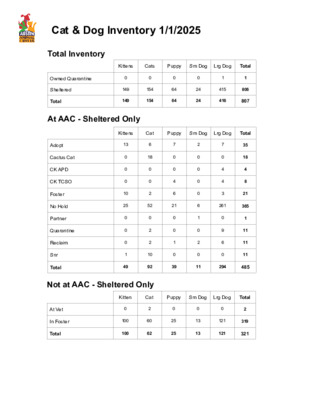
Cat & Dog Inventory 1/1/2025 Total Inventory Owned Quarantine Sheltered Total 0 149 149 0 154 154 At AAC - Sheltered Only Kittens Cats Puppy Sm Dog Lrg Dog Total Kittens Cat Puppy Sm Dog Lrg Dog Total 52 21 261 0 64 64 7 0 0 4 6 0 0 1 0 0 25 25 0 24 24 2 0 0 0 0 6 1 0 2 0 0 13 13 1 415 416 7 0 4 4 3 0 9 6 0 1 806 807 35 18 4 8 21 365 1 11 11 11 0 121 121 2 319 321 13 10 25 0 0 0 0 0 0 1 49 0 100 100 18 6 0 0 2 0 2 2 10 92 2 60 62 39 11 294 485 Not at AAC - Sheltered Only Kitten Cat Puppy Sm Dog Lrg Dog Total Adopt Cactus Cat CK APD CK TCSO Foster No Hold Partner Quarantine Reclaim Snr Total At Vet In Foster Total Cat & Dog Intakes & Outcomes 12/31/2024 Intakes Owner Surrender Public Assist Stray - ACO Stray - Citizen Total Outcomes ADOPTION Euthanasia Return to Owner RTO-ADOPT TRANSFER Total Difference Kittens Cat Puppy Sm Dog Lrg Dog Others Total 7 7 3 9 13 39 0 0 0 0 1 1 1 0 0 1 12 14 0 2 0 3 3 8 6 0 0 0 0 6 1 0 0 3 4 8 4 0 0 0 0 4 2 4 1 2 5 14 15 3 1 1 2 22 0 1 2 1 0 4 1 2 0 0 1 4 4 0 0 0 0 4 38 6 1 1 4 50 Kittens Cat Puppy Sm Dog Lrg Dog Total Kittens Cats Puppies Sm Dog Lrg Dogs Total Total 13 -2 -4 8 4 19
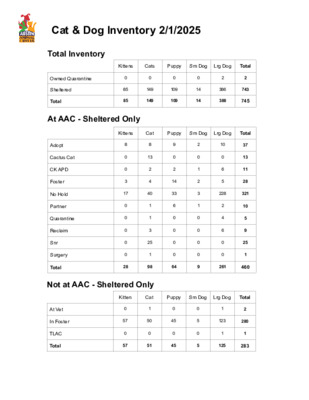
Cat & Dog Inventory 2/1/2025 Total Inventory Owned Quarantine Sheltered Total Kittens Cats Puppy Sm Dog Lrg Dog Total 0 149 149 0 109 109 0 14 14 At AAC - Sheltered Only Kittens Cat Puppy Sm Dog Lrg Dog Total 17 40 228 0 85 85 8 0 0 3 0 0 0 0 0 0 57 0 57 13 8 2 4 1 1 3 25 1 98 1 50 0 51 14 33 9 0 2 6 0 0 0 0 0 45 0 45 2 0 1 2 3 1 0 0 0 0 9 0 5 0 5 2 386 388 10 0 6 5 2 4 6 0 0 1 1 2 743 745 321 10 37 13 11 28 5 9 25 1 2 1 123 280 125 283 28 64 261 460 Not at AAC - Sheltered Only Kitten Cat Puppy Sm Dog Lrg Dog Total Adopt Cactus Cat CK APD Foster No Hold Partner Reclaim Snr Surgery Total Quarantine At Vet In Foster TLAC Total Cat & Dog Intakes & Outcomes 01/31/2025 Intakes Owner Surrender Stray - ACO Stray - Citizen Total Outcomes ADOPTION DIED Return to Owner RTO-ADOPT TRANSFER Total Difference Kittens Cat Puppy Sm Dog Lrg Dog Others Total 2 17 12 15 46 0 2 0 4 6 5 0 0 0 0 5 0 5 1 10 16 7 1 1 0 1 15 0 6 8 1 7 0 0 0 3 0 3 1 0 4 6 0 2 1 3 10 10 12 0 1 2 0 3 0 0 1 0 0 1 2 0 0 0 2 25 1 4 1 7 38 Kittens Cat Puppy Sm Dog Lrg Dog Total Kittens Cats Puppies Sm Dog Lrg Dogs Total Total -1 -7 -5 8 7 2
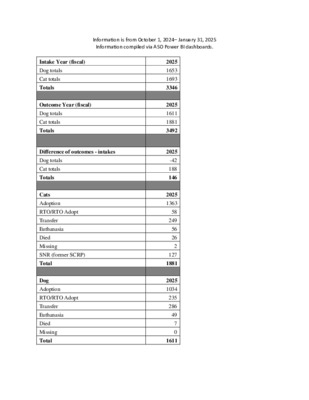
Information is from October 1, 2024– January 31, 2025 Information compiled via ASO Power BI dashboards. Difference of outcomes - intakes Outcome Year (fiscal) Intake Year (fiscal) Dog totals Cat totals Totals Dog totals Cat totals Totals Dog totals Cat totals Totals Cats Adoption Transfer Euthanasia Died Missing Total Dog Adoption Transfer Euthanasia Died Missing Total RTO/RTO Adopt SNR (former SCRP) RTO/RTO Adopt 2025 1653 1693 3346 2025 1611 1881 3492 2025 -42 188 146 2025 1363 58 249 56 26 2 127 1881 2025 1034 235 286 49 7 0 1611
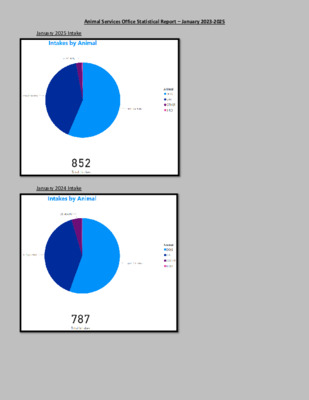
Animal Services Office Statistical Report – January 2023-2025 January 2025 Intake January 2024 Intake January 2023 Intake January 2025 Adoptions January 2024 Adoptions January 2023 Adoptions January 2024 RTOs January 2023 RTOs January 2023 RTOs January 2025 Animals Euthanized January 2024 Animals Euthanized January 2023 Animals Euthanized January 2025 Total Live Release Rate January 2024 Total Live Release Rate January 2023 Total Live Release Rate January 2025 Animal Vaccinations January 2024 Animal Vaccinations January 2023 Animal Vaccinations January 2025 Spayed/Neuter at AAC January 2024 Spayed/Neutered at AAC January 2023 Spayed/Neutered at AAC January 2025 Animal Deaths at AAC/Foster January 2024 Animal Deaths at AAC/Foster January 2023 Animal Deaths at AAC/Foster January 2025 Animals Transferred: January 2024 Animals Transferred January 2023 Animals Transferred January 2025 Animal Lost, Stolen or Missing January 2024 Animals Lost, Stolen or Missing January 2023 Animals Lost, Stolen or Missing January 2025 SNR Program January 2024 SNR Program January 2023 SNR Program January 2025 Intact Animals Adopted/RTO January 2024 Intact Animals Adopted/RTO January 2023 Intact Animals Adopted/RTO
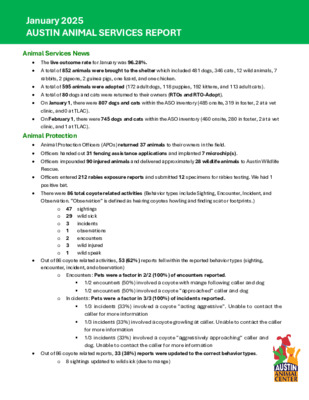
January 2025 AUSTIN ANIMAL SERVICES REPORT 1 Animal Services News • The live outcome rate for January was 96.28%. • A total of 852 animals were brought to the shelter which included 481 dogs, 346 cats, 12 wild animals, 7 rabbits, 2 pigeons, 2 guinea pigs, one lizard, and one chicken. • A total of 595 animals were adopted (172 adult dogs, 118 puppies, 192 kittens, and 113 adult cats). • A total of 80 dogs and cats were returned to their owners (RTOs and RTO-Adopt). • On January 1, there were 807 dogs and cats within the ASO inventory (485 onsite, 319 in foster, 2 at a vet • On February 1, there were 745 dogs and cats within the ASO inventory (460 onsite, 280 in foster, 2 at a vet clinic, and 0 at TLAC). clinic, and 1 at TLAC). Animal Protection • Animal Protection Officers (APOs) returned 37 animals to their owners in the field. • Officers handed out 31 fencing assistance applications and implanted 7 microchip(s). • Officers impounded 90 injured animals and delivered approximately 28 wildlife animals to Austin Wildlife Rescue. positive bat. • Officers entered 212 rabies exposure reports and submitted 12 specimens for rabies testing. We had 1 • There were 86 total coyote related activities (Behavior types include Sighting, Encounter, Incident, and Observation. “Observation” is defined as hearing coyotes howling and finding scat or footprints.) o 47 sightings o 29 wild sick o 3 incidents o 1 observations o 2 encounters o 3 wild injured o 1 wild speak • Out of 86 coyote related activities, 53 (62%) reports fell within the reported behavior types (sighting, encounter, incident, and observation) o Encounters: Pets were a factor in 2/2 (100%) of encounters reported. ▪ 1/2 encounters (50%) involved a coyote with mange following caller and dog ▪ 1/2 encounters (50%) involved a coyote “approached” caller and dog o Incidents: Pets were a factor in 3/3 (100%) of incidents reported. ▪ 1/3 incidents (33%) involved a coyote “acting aggressive”. Unable to contact the ▪ 1/3 incidents (33%) involved a coyote growling at caller. Unable to contact the caller caller for more information for more information ▪ 1/3 incidents (33%) involved a coyote “aggressively approaching” caller and dog. Unable to contact the caller for more information • Out of 86 coyote related reports, 33 (38%) reports were updated to the correct behavior types. o 8 …
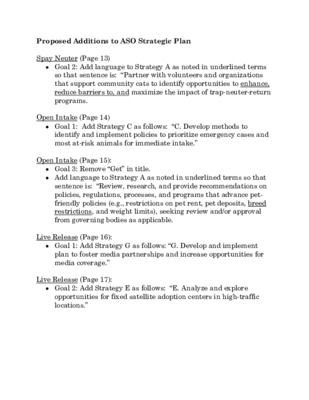
Proposed Additions to ASO Strategic Plan Spay Neuter (Page 13) • Goal 2: Add language to Strategy A as noted in underlined terms so that sentence is: “Partner with volunteers and organizations that support community cats to identify opportunities to enhance, reduce barriers to, and maximize the impact of trap-neuter-return programs. Open Intake (Page 14) Open Intake (Page 15): • Goal 1: Add Strategy C as follows: “C. Develop methods to identify and implement policies to prioritize emergency cases and most at-risk animals for immediate intake.” • Goal 3: Remove “Get” in title. • Add language to Strategy A as noted in underlined terms so that sentence is: “Review, research, and provide recommendations on policies, regulations, processes, and programs that advance pet- friendly policies (e.g., restrictions on pet rent, pet deposits, breed restrictions, and weight limits), seeking review and/or approval from governing bodies as applicable. Live Release (Page 16): Live Release (Page 17): • Goal 1: Add Strategy G as follows: “G. Develop and implement plan to foster media partnerships and increase opportunities for media coverage.” • Goal 2: Add Strategy E as follows: “E. Analyze and explore opportunities for fixed satellite adoption centers in high-traffic locations.”
Play video
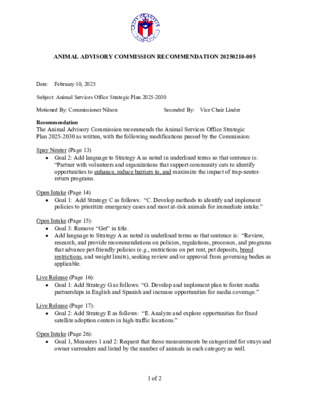
ANIMAL ADVISORY COMMISSION RECOMMENDATION 20250210-005 Date: February 10, 2025 Subject: Animal Services Office Strategic Plan 2025-2030 Motioned By: Commissioner Nilson Recommendation The Animal Advisory Commission recommends the Animal Services Office Strategic Plan 2025-2030 as written, with the following modifications passed by the Commission: Seconded By: Vice Chair Linder Spay Neuter (Page 13) • Goal 2: Add language to Strategy A as noted in underlined terms so that sentence is: “Partner with volunteers and organizations that support community cats to identify opportunities to enhance, reduce barriers to, and maximize the impact of trap-neuter- return programs. Open Intake (Page 14) Open Intake (Page 15): Live Release (Page 16): Live Release (Page 17): Open Intake (Page 26): • Goal 1: Add Strategy C as follows: “C. Develop methods to identify and implement policies to prioritize emergency cases and most at-risk animals for immediate intake.” • Goal 3: Remove “Get” in title. • Add language to Strategy A as noted in underlined terms so that sentence is: “Review, research, and provide recommendations on policies, regulations, processes, and programs that advance pet-friendly policies (e.g., restrictions on pet rent, pet deposits, breed restrictions, and weight limits), seeking review and/or approval from governing bodies as applicable. • Goal 1: Add Strategy G as follows: “G. Develop and implement plan to foster media partnerships in English and Spanish and increase opportunities for media coverage.” • Goal 2: Add Strategy E as follows: “E. Analyze and explore opportunities for fixed satellite adoption centers in high-traffic locations.” • Goal 1, Measures 1 and 2: Request that those measurements be categorized for strays and owner surrenders and listed by the number of animals in each category as well. 1 of 2 Vote For: Chair Clinton, Vice Chair Linder, Commissioners Dulzaides, Herrera, Huddleston, Nemer, Nilson, Smagula, and Tucker. Against: n/a Abstain: n/a Absent: Commissioner Hoke Recuse: Commissioner Holt Attest: [Staff or board member can sign] Christi Vitela Animal Advisory Staff Liaison 2 of 2
ANIMAL ADVISORY COMMISSION REGULAR MEETING MINUTES FEBRUARY 10, 2025 The Animal Advisory Commission convened in a regular meeting on February 10, 2025, at 301 W. 2nd St in Austin, Texas. Chair Clinton called the Animal Advisory Commission Meeting to order at 6:00 p.m. Commissioners in Attendance: Ryan Clinton, Chair, Travis County Sarah Huddleston, D9 Dr. Paige Nilson, D4 Larry Tucker, D7 Commissioners in Attendance Remotely: Ann Linder, Vice Chair, D3 Beatriz Dulzaides, D2 Nancy Nemer, Travis County Luis Herrera, D6 Whitney Holt, D5 Commissioners Absent: Laura Hoke, Mayor’s Appointee PUBLIC COMMUNICATION: GENERAL Rochelle Vickery – Dogs Pat Valls-Trelles – Performance Measures APPROVAL OF MINUTES 2025. 1 1. Approve the minutes of the Animal Advisory Commission Regular Meeting on January 13, The motion to approve the minutes from the meeting on January 13, 2025, was approved on Commissioner Nilson’s motion, Commissioner Huddleston’s second, on a 10-0 vote. Commissioner Hoke was absent. STAFF BRIEFING DISCUSSION ITEMS 2. Staff briefing regarding monthly reports provided by the Animal Service Center. The presentation was made by Don Bland, Chief Animal Services Officer, Austin Animal Services. 3. Presentation by Austin Pets Alive! regarding license agreements reports. The presentation was made by Stephanie Bilbro, Austin Pets Alive! Director of Operations. 4. Discussion of the draft Animal Services Strategic Plan. The presentation was made by Susana Carbajal, Assistant City Manager, Audrey Muntz, Budget and Performance Manager, Financial Services Department, Don Bland, Chief Animal Services Officer, Austin Animal Services. DISCUSSION AND ACTION ITEMS 5. Approve a Recommendation to Council regarding the draft Animal Services Strategic Plan. The motion to amend the Animal Services Office Strategic Plan 2025-2030 with the titled “Proposed Additions to ASO Strategic Plan” was made by Vice Chair Linder, seconded by Commissioner Huddleston. The amendments were as follows: “Spay Neuter (Page 13) • Goal 2: Add language to Strategy A as noted in underlined terms so that sentence is: “Partner with volunteers and organizations that support community cats to identify opportunities to enhance, reduce barriers to, and maximize the impact of trap-neuter-return programs. Goal 1: Add Strategy C as follows: “C. Develop methods to identify and Open Intake (Page 14) • implement policies to prioritize emergency cases and most at-risk animals for immediate intake.” Open Intake (Page 15): • Goal 3: Remove “Get” in title. 2 • Add language to Strategy A as noted in underlined terms so that sentence is: “Review, research, and provide recommendations …
REGULAR CALLED MEETING OF THE MAYOR’S COMMITTEE FOR PEOPLE WITH DISABILITIES Friday, February 7, 2025, 5:30pm Austin City Hall, Boards and Commissions Room #1101 301 West 2nd Street Austin, Texas 78701 Some members of the Mayor’s Committee for People with Disabilities may be participating by videoconference. The meeting may be viewed online at: http://www.austintexas.gov/page/watch- atxn-live Public comment will be allowed in-person or remotely via telephone. Speakers may only register to speak on an item once either in-person or remotely and will be allowed up to three minutes to provide their comments. Registration no later than noon the day before the meeting is required for remote participation by telephone. To register to speak remotely, call or email Christi Vitela, 512- 974-2792, christi.vitela@austintexas.gov. Conor Kelly Jennifer Powell Pete Salazar Kristen Vassallo CURRENT COMMISSIONERS: Elisabeth Meyer, Chair Jonathan Franks, Vice Chair Gabriel Arellano Lisa Chang Mickey Fetonte CALL TO ORDER PUBLIC COMMUNICATION: GENERAL AGENDA The first ten speakers signed up prior to the meeting being called to order will each be allowed a three-minute allotment to address their concerns regarding items not posted on the agenda. APPROVAL OF MINUTES 1. Approve the minutes of the Mayor’s Committee for People with Disabilities regular meeting on December 13, 2024. STAFF BRIEFING 2. 3. 4. 5. 6. 7. Staff briefing regarding the City of Austin emergency language access plan from the Communications and Public Information Office and the Office of Homeland Security and Emergency Management. DISCUSSION ITEMS Discussion of the Equity Office’s Undoing Institutional Racism Training, including the feasibility of attendance and accessibility considerations. Discussion of bringing awareness to 2025 disability events in the Austin area. Discussion of scooters impeding the walkways on sidewalks. DISCUSSION AND ACTION ITEMS Discussion of ways the Mayor’s Committee for People with Disabilities can work with and advise the City of Austin Human Resources Department and formation of a Working Group to develop a training on City Code Chapter 5-6. Discussion of the City of Austin Budget process and formation of a Working Group to research and write budget recommendations. FUTURE AGENDA ITEMS ADJOURNMENT The City of Austin is committed to compliance with the American with Disabilities Act. Reasonable modifications and equal access to communications will be provided upon request. Meeting locations are planned with wheelchair access. If requiring Sign Language Interpreters or alternative formats, please give notice at least 2 days (48 hours) before the meeting date. Please call Christi …