Item 4b-Late Backup-Amendment to Amendment_Lanetta Cooper — original pdf
Backup
Backup
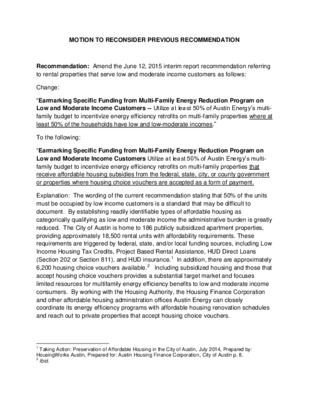
MOTION TO RECONSIDER PREVIOUS RECOMMENDATION Recommendation: Amend the June 12, 2015 interim report recommendation referring to rental properties that serve low and moderate income customers as follows: Change: “Earmarking Specific Funding from Multi-Family Energy Reduction Program on Low and Moderate Income Customers -- Utilize at least 50% of Austin Energy’s multi-family budget to incentivize energy efficiency retrofits on multi-family properties where at least 50% of the households have low and low-moderate incomes.” To the following: “Earmarking Specific Funding from Multi-Family Energy Reduction Program on Low and Moderate Income Customers Utilize at least 50% of Austin Energy’s multi-family budget to incentivize energy efficiency retrofits on multi-family properties that receive affordable housing subsidies from the federal, state, city, or county government or properties where housing choice vouchers are accepted as a form of payment. Explanation: The wording of the current recommendation stating that 50% of the units must be occupied by low income customers is a standard that may be difficult to document. By establishing readily identifiable types of affordable housing as categorically qualifying as low and moderate income the administrative burden is greatly reduced. The City of Austin is home to 186 publicly subsidized apartment properties, providing approximately 18,500 rental units with affordability requirements. These requirements are triggered by federal, state, and/or local funding sources, including Low Income Housing Tax Credits, Project Based Rental Assistance, HUD Direct Loans (Section 202 or Section 811), and HUD insurance.1 In addition, there are approximately 6,200 housing choice vouchers available.2 Including subsidized housing and those that accept housing choice vouchers provides a substantial target market and focuses limited resources for multifamily energy efficiency benefits to low and moderate income consumers. By working with the Housing Authority, the Housing Finance Corporation and other affordable housing administration offices Austin Energy can closely coordinate its energy efficiency programs with affordable housing renovation schedules and reach out to private properties that accept housing choice vouchers. 1 Taking Action: Preservation of Affordable Housing in the City of Austin, July 2014, Prepared by: HousingWorks Austin, Prepared for: Austin Housing Finance Corporation, City of Austin p. 8. 2 Ibid.
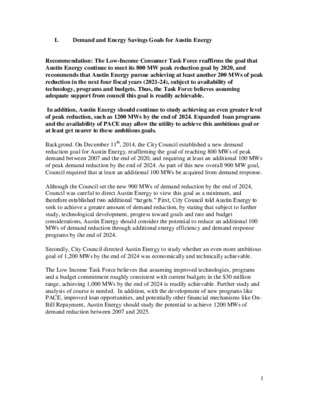
1 I. Demand and Energy Savings Goals for Austin Energy Recommendation: The Low-Income Consumer Task Force reaffirms the goal that Austin Energy continue to meet its 800 MW peak reduction goal by 2020, and recommends that Austin Energy pursue achieving at least another 200 MWs of peak reduction in the next four fiscal years (2021-24), subject to availability of technology, programs and budgets. Thus, the Task Force believes assuming adequate support from council this goal is readily achievable. In addition, Austin Energy should continue to study achieving an even greater level of peak reduction, such as 1200 MWs by the end of 2024. Expanded loan programs and the availability of PACE may allow the utility to achieve this ambitious goal or at least get nearer to these ambitious goals. Backgrond. On December 11th, 2014, the City Council established a new demand reduction goal for Austin Energy, reaffirming the goal of reaching 800 MWs of peak demand between 2007 and the end of 2020, and requiring at least an additional 100 MWs of peak demand reduction by the end of 2024. As part of this new overall 900 MW goal, Council required that at least an additional 100 MWs be acquired from demand response. Although the Council set the new 900 MWs of demand reduction by the end of 2024, Council was careful to direct Austin Energy to view this goal as a minimum, and therefore established two additional “targets.” First, City Council told Austin Energy to seek to achieve a greater amount of demand reduction, by stating that subject to further study, technological development, progress toward goals and rate and budget considerations, Austin Energy should consider the potential to reduce an additional 100 MWs of demand reduction through additional energy efficiency and demand response programs by the end of 2024. Secondly, City Council directed Austin Energy to study whether an even more ambitious goal of 1,200 MWs by the end of 2024 was economically and technically achievable. The Low Income Task Force believes that assuming improved technologies, programs and a budget commitment roughly consistent with current budgets in the $30 million range, achieving 1,000 MWs by the end of 2024 is readily achievable. Further study and analysis of course is needed. In addition, with the development of new programs like PACE, improved loan opportunities, and potentially other financial mechanisms like On-Bill Repayment, Austin Energy should study the potential to achieve …
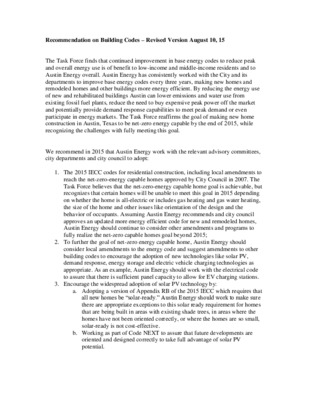
Recommendation on Building Codes – Revised Version August 10, 15 The Task Force finds that continued improvement in base energy codes to reduce peak and overall energy use is of benefit to low-income and middle-income residents and to Austin Energy overall. Austin Energy has consistently worked with the City and its departments to improve base energy codes every three years, making new homes and remodeled homes and other buildings more energy efficient. By reducing the energy use of new and rehabilitated buildings Austin can lower emissions and water use from existing fossil fuel plants, reduce the need to buy expensive peak power off the market and potentially provide demand response capabilities to meet peak demand or even participate in energy markets. The Task Force reaffirms the goal of making new home construction in Austin, Texas to be net-zero energy capable by the end of 2015, while recognizing the challenges with fully meeting this goal. We recommend in 2015 that Austin Energy work with the relevant advisory committees, city departments and city council to adopt: 1. The 2015 IECC codes for residential construction, including local amendments to reach the net-zero-energy capable homes approved by City Council in 2007. The Task Force believes that the net-zero-energy capable home goal is achievable, but recognizes that certain homes will be unable to meet this goal in 2015 depending on whether the home is all-electric or includes gas heating and gas water heating, the size of the home and other issues like orientation of the design and the behavior of occupants. Assuming Austin Energy recommends and city council approves an updated more energy efficient code for new and remodeled homes, Austin Energy should continue to consider other amendments and programs to fully realize the net-zero capable homes goal beyond 2015; 2. To further the goal of net-zero energy capable home, Austin Energy should consider local amendments to the energy code and suggest amendments to other building codes to encourage the adoption of new technologies like solar PV, demand response, energy storage and electric vehicle charging technologies as appropriate. As an example, Austin Energy should work with the electrical code to assure that there is sufficient panel capacity to allow for EV charging stations. 3. Encourage the widespread adoption of solar PV technology by: a. Adopting a version of Appendix RB of the 2015 IECC which requires that all new homes be “solar-ready.” Austin Energy should …
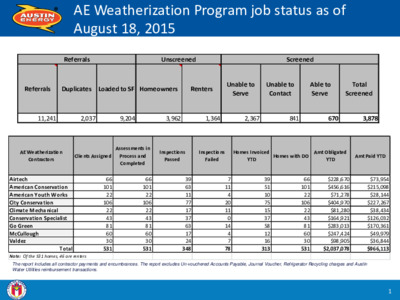
AE Weatherization Program job status as of August 18, 2015 1 ReferralsDuplicates Loaded to SFHomeownersRentersUnable to ServeUnable to Contact Able to ServeTotal Screened11,2412,0379,2043,9621,3642,3678416703,878ReferralsUnscreenedScreenedAE Weatherization ContractorsClients AssignedAssessments in Process and CompletedInspections PassedInspections FailedHomes Invoiced YTDHomes with DOAmt Obligated YTDAmt Paid YTDAirtech66663973966$228,670$73,954American Conservation101101631151101$456,616$215,098American Youth Works22221141022$71,278$28,144City Conservation 106106772075106$404,970$227,267Climate Mechanical222217111522$81,280$38,434Conservation Specialist43433703743$164,921$126,032Go Green818163145881$283,013$170,361McCullough60601741260$247,424$49,979Valdez30302471630$98,905$36,844Total53153134878313531$2,037,078$966,113Note: Of the 531 homes, 46 are rentersThe report includes all contractor payments and encumbrances. The report excludes Un-vouchered Accounts Payable, Journal Voucher, Refrigerator Recycling charges and Austin Water Utilities reimbursement transactions.
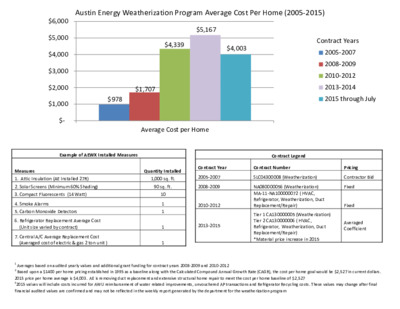
Austin Energy Weatherization Program Average Cost Per Home (2005-2015) 1 Averages based on audited yearly values and additional grant funding for contract years 2008-2009 and 2010-2012 2 Based upon a $1400 per home pricing established in 1995 as a baseline along with the Calculated Compound Annual Growth Rate (CAGR), the cost per home goal would be $2,527 in current dollars. 2015 price per home average is $4,003. AE is removing duct replacement and extensive structural home repair to meet the cost per home baseline of $2,527 32015 values will include costs incurred for AWU reimbursement of water related improvements, unvouchered AP transactions and Refrigerator Recycling costs. These values may change after final financial audited values are confirmed and may not be reflected in the weekly report generated by the department for the weatherization program $978 $1,707 $4,339 $5,167 $4,003 $- $1,000 $2,000 $3,000 $4,000 $5,000 $6,000Average Cost per Home2005-20072008-20092010-20122013-20142015 through JulyExample of AEWX Installed Measures Measures Quantity Installed 1. Attic Insulation (AE Installed 27R) 1,000 sq. ft. 2. Solar Screens (Minimum 60% Shading) 90 sq. ft. 3. Compact Fluorescents (14 Watt) 10 4. Smoke Alarms 1 5. Carbon Monoxide Detectors 1 6. Refrigerator Replacement Average Cost (Unit size varied by contract) 1 7. Central A/C Average Replacement Cost (Averaged cost of electric & gas 2 ton unit ) 1 Contract Legend Contract Year Contract Number Pricing 2005-2007 SLC04300008 (Weatherization) Contractor Bid 2008-2009 NA080000056 (Weatherization) Fixed 2010-2012 MA-11-NA100000072 ( HVAC, Refrigerator, Weatherization, Duct Replacement/Repair) Fixed 2013-2015 Tier 1 CA130000005 (Weatherization) Tier 2 CA130000006 ( HVAC, Refrigerator, Weatherization, Duct Replacement/Repair) *Material price increase in 2015 Averaged Coefficient Contract Years
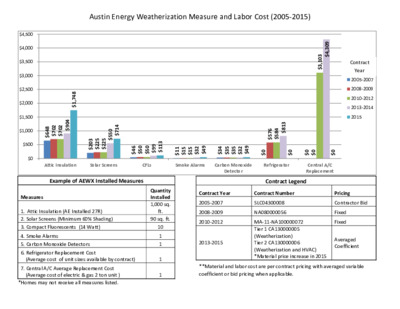
Austin Energy Weatherization Measure and Labor Cost (2005-2015) *Homes may not receive all measures listed. $648 $203 $46 $11 $34 $0 $0 $702 $225 $50 $15 $35 $576 $0 $702 $225 $50 $15 $35 $584 $3,103 $904 $550 $99 $32 $32 $813 $4,309 $1,748 $714 $113 $49 $49 $0 $0 $0$500$1,000$1,500$2,000$2,500$3,000$3,500$4,000$4,500Attic InsulationSolar ScreensCFLsSmoke AlarmsCarbon MonoxideDetectorRefrigeratorCentral A/CReplacement2005-20072008-20092010-20122013-20142015Contract Legend Contract Year Contract Number Pricing 2005-2007 SLC04300008 Contractor Bid 2008-2009 NA080000056 Fixed 2010-2012 MA-11-NA100000072 Fixed 2013-2015 Tier 1 CA130000005 (Weatherization) Tier 2 CA130000006 (Weatherization and HVAC) *Material price increase in 2015 Averaged Coefficient Example of AEWX Installed Measures Measures Quantity Installed 1. Attic Insulation (AE Installed 27R) 1,000 sq. ft. 2. Solar Screens (Minimum 60% Shading) 90 sq. ft. 3. Compact Fluorescents (14 Watt) 10 4. Smoke Alarms 1 5. Carbon Monoxide Detectors 1 6. Refrigerator Replacement Cost (Average cost of unit sizes available by contract) 1 7. Central A/C Average Replacement Cost (Average cost of electric & gas 2 ton unit ) 1 Contract Year **Material and labor cost are per contract pricing with averaged variable coefficient or bid pricing when applicable.
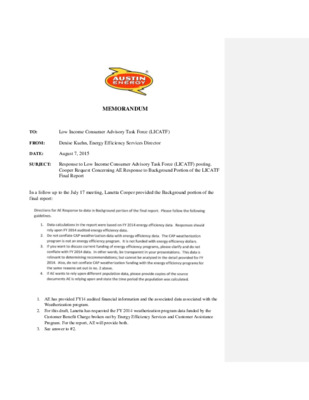
MEMORANDUM TO: Low Income Consumer Advisory Task Force (LICATF) FROM: Denise Kuehn, Energy Efficiency Services Director DATE: August 7, 2015 SUBJECT: Response to Low Income Consumer Advisory Task Force (LICATF) posting. Cooper Request Concerning AE Response to Background Portion of the LICATF Final Report In a follow up to the July 17 meeting, Lanetta Cooper provided the Background portion of the final report: 1. AE has provided FY14 audited financial information and the associated data associated with the Weatherization program. 2. For this draft, Lanetta has requested the FY 2014 weatherization program data funded by the Customer Benefit Charge broken out by Energy Efficiency Services and Customer Assistance Program. For the report, AE will provide both. 3. See answer to #2. 4. All population data is based on Census data (http://www.census.gov/), using 2010 and 2013 data. Data is based on Travis county Ms. Cooper also asked for a review of the Background portion of the report. That is provided below. As part of the edits, an error was found in the section regarding the 301-400% of federal poverty guidelines. The table below is from the report reference in the Background section. It is provided for additional support. The edits are provided as support to Ms. Cooper’s request and should not be viewed as the final edits or comments made by AE. Table 1a: Household Income and Electricity Burden Measures by Area (2010-2012) Measure Austin Brownsville Corpus Christi Dallas El Paso Houston San Antonio Texas Total Households 421,129 118,446 152,670 2,047,328 256,149 1,783,863 602,599 8,852,444 Households Below Poverty 55,841 36,627 24,678 257,433 57,514 248,758 93,035 1,333,625 % of all Households 13% 31% 16% 13% 22% 14% 15% 15% Households by Percent of Poverty Num (000s) Pct of Total Num (000s) Pct of Total Num (000s) Pct of Total Num (000s) Pct of Total Num (000s) Pct of Total Num (000s) Pct of Total Num (000s) Pct of Total Num (000s) Pct of Total 0-100% 55.8 13.3% 36.6 30.9% 24.7 16.2% 257.4 12.6% 57.5 22.4% 248.8 13.9% 93 15.4% 1333.6 15.1% 101-200% 62.4 14.8% 31.4 26.5% 33.9 22.2% 367.4 17.9% 66.8 26.1% 324.1 18.2% 121.3 20.1% 1744.1 19.7% 201-300% 64.0 15.2% 18.2 15.4% 27.0 17.7% 318.6 15.6% 43.6 17.0% 272.8 15.3% 109.1 18.1% 1453.7 16.4% 301-400% 53.9 12.8% 11.8 10.0% 19.7 12.9% 268.5 13.1% 29.3 11.4% 221 12.4% 77.8 12.9% 1142.4 12.9% 401+% 184.9 43.9% 20.4 17.2% 47.4 31.0% 835.3 40.8% 58.9 …
TO: Low Income Consumer Advisory Task Force (LICATF) FROM: Denise Kuehn, Energy Efficiency Services Director DATE: August 14, 2015 SUBJECT: Questions Concerning Questions Submitted by Lanetta Cooper in July 17, 2015 Low Income Consumer Advisory Task Force 1. The 2012 GDS report provided the Task Force stated at p. 2 that AE uses “Salesforce.com” to store data. a. Please explain how AE uses “Salesforce.com” including an explanation of what data is stored and how it is stored. Answer: Salesforce.com is a customer relationship management tool. It allows data to be accessed by certified and verified users as needed for their roles. Data is stored via a secure cloud service monitored in real time by Symantec and verified by TRUSTe. These storage protocols meet or exceed City protocols. Access is available to only those with authorized user names and passwords who have completed Salesforce training. b. How does, if at all, AE track pre and post weatherization installations consumption involving its customers (include energy performance star) Answer: Consumption analysis is based on one of two methods: billing data or daily data. The option of which data source is used is dependent on data availability and the transitory nature of the customers. c. Has AE formatted its billing histories so that it can pull up by energy efficiency program pre and post EE program installations consumptions? If not, why not and what would AE need to do to be able to create a data base that could be accessible by EE program. (I am assuming the use of billing data aggregated by EE program and not individual customer data). Answer: AE is currently developing a data warehouse and related data structures to meet reporting needs. Data for energy efficiency analysis will reside in this data warehouse for ease of reporting. The data warehouse is in its initial stages of development. The goal is that all program data will be housed and available for analysis in this centralized location by FY2017. Reports will also be available using the new Direct Technology rebate processing tool in which the before and after usage of the customer receiving the rebate will be available allowing AE to verify the cost benefit effectively. The Direct Technology tool will process and track the energy, demand reduction savings and rebates for sixteen Customer Energy Solutions programs scheduled to be implemented fall 2015. 2. Please verify that the attached documents were …
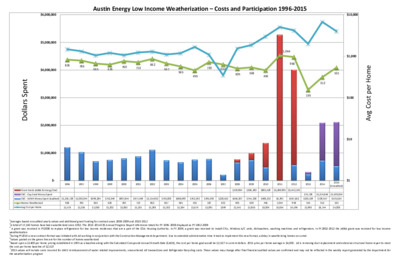
Austin Energy Low Income Weatherization – Costs and Participation 1996-2015 1Averages based on audited yearly values and additional grant funding for contract years 2008-2009 and 2010-2012 2A total of 17,160 homes have been weatherized since 1982. The 2013-2014 CES Annual Progress Report references totals for FY 1996-2008 displayed as FY 1982-2008 3 A grant was received in FY2008 to replace refrigerators for low income residences that are a part of the COA Housing Authority. In FY 2009, a grant was received to install CFLs, Window A/C units, dishwashers, washing machines and refrigerators. In FY2002-2012 the ARRA grant was received for low income weatherization 4During FY2013 a new contract format was initiated with AE working in conjunction with the Construction Management department. Due to extended administrative time it took to implement this new format, a delay in weatherizing homes occurred. 5Values posted on the green line are for the number of homes weatherized 6Based upon a $1400 per home pricing established in 1995 as a baseline along with the Calculated Compound Annual Growth Rate (CAGR), the cost per home goal would be $2,527 in current dollars. 2015 price per home average is $4,003. AE is removing duct replacement and extensive structural home repair to meet the cost per home baseline of $2,527 72015 values will include costs incurred for AWU reimbursement of water related improvements, unvouchered AP transactions and Refrigerator Recycling costs. These values may change after final financial audited values are confirmed and may not be reflected in the weekly report generated by the department for the weatherization program 19961997199819992000200120022003200420052006200720082009201020112012201320142015(Unaudited)Grant Funds (ARRA & Energy Star)$119,984$258,283$881,529$5,269,995$3,452,135CBC - Cap Fund Money Spent$75,728$1,374,646$1,593,854CBC - AEWX Money Spent (Audited)$1,216,728$1,033,044$698,284$752,359$807,844$877,559$1,114,932$735,003$668,690$762,192$785,392$220,532$658,207$744,238$488,213$6,291$567,662$233,139$729,547$531,634Homes Weatherized8267856656267607138626675654557206325055384561,044958155312531Avg Cost per Home$1,473$1,316$1,050$1,202$1,063$1,231$1,293$1,102$1,184$1,675$1,091$349$1,541$1,863$3,004$5,054$4,196$1,993$6,744$4,003 826 785 665 626 760 713 862 667 565 455 720 632 505 538 456 1,044 958 155 312 531 $1$10$100$1,000$10,000 $- $1,000,000 $2,000,000 $3,000,000 $4,000,000 $5,000,000 $6,000,000Avg Cost per Home Dollars Spent
MEMORANDUM TO: Low Income Consumer Advisory Task Force (LICATF) FROM: Denise Kuehn, Energy Efficiency Services Director DATE: August 14, 2015 SUBJECT: Response to Low Income Consumer Advisory Task Force (LICTF) Question Regarding Number of AEP Rebates paid to Multifamily Units in FY14 Question: “How many AEP central system rebates are going to multifamily properties?” Answer: A review of the FY14 data indicated that 19 AEP rebates went to multifamily properties. or roughly 0.3% of AEP rebates.
1 TO: Low Income Advisory Task Force FROM: Denise Kuehn, Energy Efficiency Services Director DATE: August 14, 2015 SUBJECT: Questions Concerning the Changes of Costs Associated with AE Weatherization Program Over the past thirty years, Austin Energy has weatherized over 17,000 homes for low income customers. Cost of providing the weatherization program has changed due to two main contributing factors: the changes in the qualification criteria associated with resources available and the need of the community defining the type and costs of the measures provided. The qualification criteria of customers receiving low income weatherization has changed over the years based on federal and local influences. The federal government subsidizes many low income programs in conjunction with the City of Austin. This criterion has been based on the federal poverty rate which has varied from 100% to the current 200% and below in order to qualify. Additional criteria have been established for ensuring potential customers have not participated in the program over the past ten years. AE further qualifies based on the value and square footage of the home. In addition, AE partners with other city departments, utilities and non-profit organizations to reduce the costs in order to align resources. AE’s partnerships to address low income needs in the Austin area range from referrals and process enhancements to implementing home improvements for other entities. AE exchanges referrals with several entities such as Austin Water Utilities, Neighborhood Housing and Community Development (NHCD), Travis County, Housing Repair Coalition (collaboration of numerous non-profit and city organizations) and various other non-profit organizations. Over the past year, AE has worked with AWU, NHCD, Purchasing, Health and Human Services and non-profit agencies to develop a standard intake form and enhance communication. In addition to referrals, AE provides administrative support for AWU-provided water savings devices at no charge to AWU. AE provides energy saving weatherization while Neighborhood Housing provides structural repairs when federal grants are available. NHCD combines different grants to provide services such as lead removal and roof repairs to an average of 200-250 unique homes per year. NHCD receives a 10% administration fee to coordinate the in work for Austin Water on these homes. AWU provides the water saving devices and pays for the installation to NHCD. Weatherization is one of the many services the City of Austin provides low income customers. Basic services such as insulation and air infiltration are utility industry standard. As more …
1 MEMORANDUM TO: Low Income Consumer Advisory Task Force FROM: Liz Jambor, Customer Energy Solutions DATE: August 21, 2015 SUBJECT: Response to Lanetta Cooper’s Questions for August 7 Meeting During the August 7 Low Income Advisory Task Force (LICATF) meeting, Lanetta Cooper submitted questions for AE staff response. The questions and related responses follow. Please note that when mapping program data, premise addresses are used. Should a mailing address be captured that is outside of the AE service territory, it is not mapped. The majority of the responses are related to data provided to the Austin American Statesman in terms of program reach by zip code. Zip code data cannot be read in isolation because there are other factors to consider such as the overall population of the zip code, housing stock, and the percent of poverty per zip code. Statistically, many of the zip codes for population, percent poverty and rebates are within the norm. It is not a universality that “wealthier residents” get more in rebates than other customers. Additional factors, such as dwelling type, age of home and home ownership, play into the eventual participation in rebate programs. For example, a zip code dense with multifamily properties may “map” into a lower participation rate because the property with multiple apartment units is counted as one rebate (for a commercial customer) when the one rebate has actually served hundreds of residential customers. Overall, the programs are meeting the needs of our customers based on their ability and need to participate. 2 3 4 Reponses 1. The time periods varied by program but covered from program inception through 2014. Data was based on residential programs only. Please note that data provided on map may not be complete program data but only data that could be mapped accurately. 2. The map captured unaudited rebate data from program inceptions through 2014 and totaled $181,189,101. Please note that data provided on the map may not be complete program data but only data that could be mapped accurately and where financial records exist (for example, for the period 1982 – 1995, there is not separate accounting for low income weatherization, or other programs). 3. No non multifamily commercial rebates were included. 4. NA 5. See table of unaudited data below. Please note that data provided on the map may not be complete program data but only data that could be mapped accurately and …
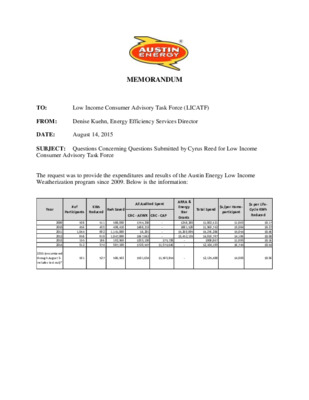
MEMORANDUM TO: Low Income Consumer Advisory Task Force (LICATF) FROM: Denise Kuehn, Energy Efficiency Services Director DATE: August 14, 2015 SUBJECT: Questions Concerning Questions Submitted by Cyrus Reed for Low Income Consumer Advisory Task Force The request was to provide the expenditures and results of the Austin Energy Low Income Weatherization program since 2009. Below is the information: CBC - AEWXCBC - CAP2009 538 511 588,030 $744,238 -$258,283$1,002,521$1,863$0.172010 456 433 498,410 $488,213 -$881,529$1,369,742$3,004$0.272011 1,044 992 1,141,090 $6,291 -$5,269,995$5,276,286$5,054$0.462012 958 910 1,047,090 $567,662 -$3,452,135$4,019,797$4,196$0.382013 155 186 192,360 $233,139$75,728 - $308,867$1,993$0.162014 312 374 387,190 $729,547$1,374,646 - $2,104,193$6,744$0.542015 (encumbered through August 3-includes test out)* 531 527 586,592 $531,634$1,593,854 -$2,125,488$4,003$0.36Total Spend$s/per Home-participant$s per Life-Cycle KWh ReducedAE Audited SpentYear# of ParticipantsKWs ReducedKwh Saved ARRA & Energy Star Grants
1 MEMORANDUM TO: Low Income Consumer Advisory Task Force FROM: Liz Jambor, Customer Energy Solutions DATE: August 21, 2015 SUBJECT: Response to Request by Lanetta Cooper to Extend Previous Data Set Lanetta Cooper requested an extension to a data set provided earlier in the LICATF process. This data set included the before and after kWh usage and payment status of customers in the weatherization program. The original data set contained 32 customers. Table 1 provides the original data set. The updated data, found in Table 2, set contains 9 customers. These are the customers that have consistently resided at the weatherized dwelling across the time line from October 2013 through July 2015. There is not consistent savings, post install, across all customers or across all months. It appears that there may be some behavioral impacts to energy savings post-weatherization. 2 Table 1. Original Data Set, Pre and Post kWh Usage StatusInstall DateActual Job CostOct-13Nov-13Dec-13Jan-14Feb-14Mar-14Apr-14May-14Jun-14Jul-14Aug-14Sep-14Current12/5/13$5,939.65927.00 625.00 Install853.00 803.00 829.00 723.00 784.00 1,025.00 1,172.00 1,284.00 1,350.00 Current12/19/13$6,237.27740.00 432.00 Install934.00 706.00 669.00 505.00 520.00 656.00 776.00 737.00 805.00 Current1/14/14$5,998.901,060.00 1,018.00 914.00 Install840.00 860.00 1,180.00 1,046.00 820.00 1,228.00 1,086.00 1,446.00 Current2/20/14$7,050.72960.00 552.00 758.00 864.00 Install544.00 524.00 690.00 836.00 1,208.00 1,184.00 1,270.00 Delinquent3/4/14$5,700.991,810.00 312.00 596.00 744.00 744.00 Install426.00 538.00 1,024.00 1,614.00 1,796.00 2,130.00 Current3/5/14$6,910.172,416.00 1,300.00 1,948.00 2,546.00 2,232.00 Install844.00 1,198.00 1,616.00 2,450.00 2,498.00 2,534.00 Delinquent3/7/14$9,195.884,670.00 3,154.00 3,868.00 4,596.00 3,810.00 Install2,372.00 2,840.00 3,408.00 4,524.00 4,972.00 5,100.00 Current3/14/14$7,945.061,350.00 756.00 634.00 674.00 600.00 Install589.00 826.00 925.00 1,241.00 1,276.00 1,303.00 Delinquent3/26/14$6,970.931,162.00 754.00 797.00 878.00 685.00 Install534.00 836.00 1,025.00 1,339.00 1,525.00 1,597.00 Current3/27/14$5,933.89749.00 410.00 401.00 388.00 345.00 Install365.00 444.00 797.00 855.00 956.00 970.00 Delinquent4/2/14$9,735.133,852.00 2,152.00 2,404.00 2,624.00 2,022.00 1,566.00 Install2,150.00 2,802.00 3,548.00 3,754.00 4,022.00 Current4/4/14$7,000.561,744.00 1,218.00 1,030.00 1,290.00 1,110.00 1,010.00 Install1,412.00 1,774.00 2,098.00 2,104.00 2,146.00 Current4/11/14$9,831.912,104.00 2,390.00 2,643.00 3,269.00 2,488.00 2,022.00 Install1,333.00 2,031.00 2,402.00 2,279.00 2,219.00 Delinquent4/16/14$11,920.871,465.00 1,185.00 2,297.00 2,584.00 2,076.00 1,743.00 Install1,478.00 1,884.00 2,349.00 2,221.00 1,533.00 Current4/17/14$8,843.714,226.00 2,602.00 3,058.00 1,874.00 1,972.00 1,406.00 Install2,594.00 3,430.00 3,736.00 3,894.00 3,832.00 Current4/17/14$5,580.693,024.00 2,286.00 1,726.00 1,120.00 1,372.00 1,668.00 Install2,480.00 2,878.00 4,084.00 3,942.00 4,114.00 Delinquent5/1/14$5,406.834,914.00 3,622.00 2,706.00 3,050.00 2,672.00 2,494.00 3,100.00 Install4,632.00 4,268.00 5,120.00 4,854.00 Current5/1/14$5,094.823,302.00 2,808.00 3,446.00 3,344.00 3,398.00 2,854.00 2,612.00 Install3,296.00 3,612.00 3,466.00 3,962.00 Current5/2/14$6,474.623,372.00 2,078.00 2,370.00 3,374.00 2,580.00 1,906.00 1,330.00 Install2,410.00 3,062.00 3,148.00 3,480.00 Current5/7/14$7,517.552,574.00 1,662.00 1,537.00 1,797.00 1,534.00 1,280.00 1,279.00 Install1,648.00 2,150.00 2,498.00 2,754.00 Delinquent5/8/14$7,161.654,480.00 3,034.00 2,996.00 3,398.00 2,758.00 2,700.00 3,078.00 Install4,814.00 6,050.00 6,266.00 5,152.00 Current5/14/14$7,643.023,182.00 2,228.00 3,628.00 3,970.00 2,634.00 1,830.00 1,562.00 Install3,050.00 2,084.00 1,892.00 2,462.00 Current5/15/14$8,574.25948.00 928.00 1,136.00 988.00 888.00 …
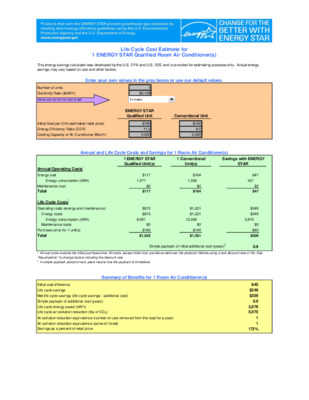
4Number of units1Electricity Rate ($/kWh)$0.109Initial Cost per Unit (estimated retail price)$180$140Energy Efficiency Ratio (EER)11.28.0Cooling Capacity of Air Conditioner (Btu/hr)5,0005,000Annual Operating Costs*Energy cost$117$164$47Energy consumption (kWh)1,0771,508431Maintenance cost$0$0$0Total$117$164$47Life Cycle Costs*Operating costs (energy and maintenance)$872$1,221$349Energy costs$872$1,221$349Energy consumption (kWh)9,69113,5683,876Maintenance costs$0$0$0Purchase price for 1 unit(s)$180$140-$40Total$1,052$1,361$309Simple payback of initial additional cost (years)† 0.9 Initial cost difference$40Life cycle savings $349Net life cycle savings (life cycle savings - additional cost)$309Simple payback of additional cost (years)0.9Life cycle energy saved (kWh)3,876Life cycle air pollution reduction (lbs of CO2)5,970Air pollution reduction equivalence (number of cars removed from the road for a year)1Air pollution reduction equivalence (acres of forest) 1Savings as a percent of retail price172%ENERGY STAR Qualified UnitConventional UnitLife Cycle Cost Estimate for1 ENERGY STAR Qualified Room Air Conditioner(s)This energy savings calculator was developed by the U.S. EPA and U.S. DOE and is provided for estimating purposes only. Actual energy savings may vary based on use and other factors.Enter your own values in the gray boxes or use our default values.Annual and Life Cycle Costs and Savings for 1 Room Air Conditioner(s)† A simple payback period of zero years means that the payback is immediate.Summary of Benefits for 1 Room Air Conditioner(s)1 ENERGY STAR Qualified Unit(s)1 Conventional Unit(s) Savings with ENERGY STAR* Annual costs exclude the initial purchase price. All costs, except initial cost, are discounted over the products' lifetime using a real discount rate of 4%. See "Assumptions" to change factors including the discount rate.Choose your city from the menu at right
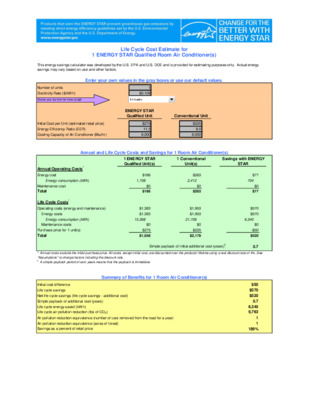
4Number of units1Electricity Rate ($/kWh)$0.109Initial Cost per Unit (estimated retail price)$275$225Energy Efficiency Ratio (EER)11.38.0Cooling Capacity of Air Conditioner (Btu/hr)8,0008,000Annual Operating Costs*Energy cost$186$263$77Energy consumption (kWh)1,7082,412704Maintenance cost$0$0$0Total$186$263$77Life Cycle Costs*Operating costs (energy and maintenance)$1,383$1,953$570Energy costs$1,383$1,953$570Energy consumption (kWh)15,36821,7086,340Maintenance costs$0$0$0Purchase price for 1 unit(s)$275$225-$50Total$1,658$2,178$520Simple payback of initial additional cost (years)† 0.7 Initial cost difference$50Life cycle savings $570Net life cycle savings (life cycle savings - additional cost)$520Simple payback of additional cost (years)0.7Life cycle energy saved (kWh)6,340Life cycle air pollution reduction (lbs of CO2)9,763Air pollution reduction equivalence (number of cars removed from the road for a year)1Air pollution reduction equivalence (acres of forest) 1Savings as a percent of retail price189%ENERGY STAR Qualified UnitConventional UnitLife Cycle Cost Estimate for1 ENERGY STAR Qualified Room Air Conditioner(s)This energy savings calculator was developed by the U.S. EPA and U.S. DOE and is provided for estimating purposes only. Actual energy savings may vary based on use and other factors.Enter your own values in the gray boxes or use our default values.Annual and Life Cycle Costs and Savings for 1 Room Air Conditioner(s)† A simple payback period of zero years means that the payback is immediate.Summary of Benefits for 1 Room Air Conditioner(s)1 ENERGY STAR Qualified Unit(s)1 Conventional Unit(s) Savings with ENERGY STAR* Annual costs exclude the initial purchase price. All costs, except initial cost, are discounted over the products' lifetime using a real discount rate of 4%. See "Assumptions" to change factors including the discount rate.Choose your city from the menu at right
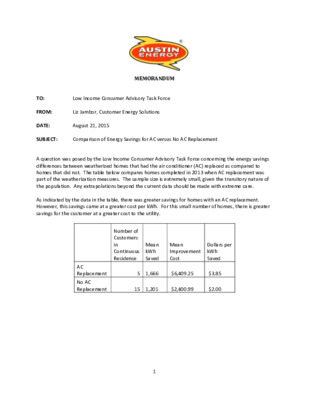
1 MEMORANDUM TO: Low Income Consumer Advisory Task Force FROM: Liz Jambor, Customer Energy Solutions DATE: August 21, 2015 SUBJECT: Comparison of Energy Savings for AC versus No AC Replacement A question was posed by the Low Income Consumer Advisory Task Force concerning the energy savings differences between weatherized homes that had the air conditioner (AC) replaced as compared to homes that did not. The table below compares homes completed in 2013 when AC replacement was part of the weatherization measures. The sample size is extremely small, given the transitory nature of the population. Any extrapolations beyond the current data should be made with extreme care. As indicated by the data in the table, there was greater savings for homes with an AC replacement. However, this savings came at a greater cost per kWh. For this small number of homes, there is greater savings for the customer at a greater cost to the utility. Number of Customers in Continuous Residence Mean kWh Saved Mean Improvement Cost Dollars per kWh Saved AC Replacement 5 1,666 $6,409.25 $3.85 No AC Replacement 15 1,201 $2,400.99 $2.00
1 MEMORANDUM TO: Low Income Consumer Advisory Task Force FROM: John Umphress, Green Building & Sustainability Consultant, Sr. DATE: August 18, 2015 SUBJECT: Factors influencing decision to retrofit existing window units with central a/c Thank you for allowing Michael Husted and I the opportunity to come speak with the task force about energy code issues, hopefully you found it helpful. During the discussions that took place as part of that meeting the subject of the efficacy of window units for air conditioning was brought up. The discussion centered upon a narrowly defined example, and didn’t lead to a broad discussion of the factors contributing to a decision as to whether a given situation would merit replacing a window unit with another a/c option. It is fair to say that a split or central system is a better solution for new construction. The decision to “upgrade” a window unit with either a split or central system in an older building is much more complex, requiring a detailed analysis of each building, and weighing a number of potential factors to determine the most effective approach for the customer. Unfortunately, it is difficult to develop a prescriptive approach that appropriately addresses all of the potential variables that may need to be considered when looking at potential a/c upgrades. In general, weatherization looks at improving the building envelope and/or the mechanical systems. Each house presents its own unique situation, and striking the appropriate balance of investments between the two areas (envelope and mechanical) for the specific premise is paramount for reaching an optimal solution. In addition, we generally reach a point of rapidly diminishing returns, where additional money spent doesn’t result in correspondingly large savings for the customer. To the contrary, they often face the unintended consequence of spending more money. Anecdotal information derived from the low-income weatherization retrofits performed by Austin Energy showed that some residences experienced significantly higher energy bills after replacing window units with central systems. This led to higher bills, and also to higher demand for the premise. This was generally attributed to the central system cooling the whole house all of the time and having a higher overall cooling capacity, as opposed to window units generally cooling a smaller space and needing less energy, particularly if only one small system was running at any given time. There are a myriad of factors that should be considered when deciding which …
Backup
Play video
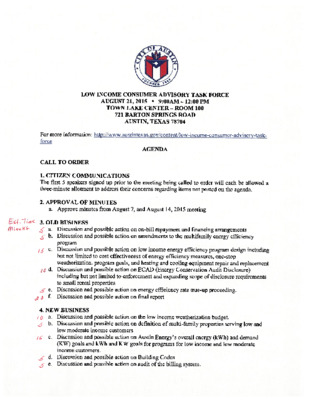
The City of Austin is committed to compliance with the American with Disabilities Act. Reasonable modifications and equal access to communications will be provided upon request. Meeting locations are planned with wheelchair access. If requiring Sign Language Interpreters or alternative formats, please give notice at least 2 days (48 hours) before the meeting date. Please call Liz Jambor at Austin Energy Department, 513-322-6353, for additional information; TTY users route through Relay Texas at 711. For more information on the Low Income Consumer Advisory Task Force, please contact Liz Jambor at 512-322-6353 LOW INCOME CONSUMER ADVISORY TASK FORCE SPECIAL CALLED MEETING AUGUST 14, 2015 11:00AM TOWN LAKE CENTER – ROOM 100 721 BARTON SPRINGS ROAD AUSTIN, TEXAS 78704 For more information: http://www.austintexas.gov/content/low-income-consumer-advisory-task- force AGENDA CALL TO ORDER 1. CITIZEN COMMUNICATIONS The first 5 speakers signed up prior to the meeting being called to order will each be allowed a three-minute allotment to address their concerns regarding items not posted on the agenda. 2. OLD BUSINESS a. Discussion of low income weatherization program, including but not limited to heating and cooling equipment repair and replacement. 3. FUTURE AGENDA ITEMS a. Discussion regarding future agenda items including a schedule of topics. ADJOURNMENT
Page 1 of 2 LOW INCOME CONSUMER ADVISORY TASK FORCE MEETING MINUTES AUGUST 14, 2015 The Low Income Consumer Advisory Task Force convened in a Special-Called meeting at Town Lake Center, 721 Barton Springs Road, Room 100, in Austin, Texas. Chairperson, Carol Biedrzycki called the meeting to order at 11:02 a.m. Task Force Members in Attendance: Carol Biedrzycki (Chair), Tim Arndt (Vice Chair), Lanetta Cooper, Richard Halpin, Dan Pruett, Cyrus Reed, and Michael Wong. Karen Hadden was not present at the call to order, but arrived later. Chris Strand was absent. Staff in Attendance: Austin Energy (AE) staff included Debbie Kimberly, Liz Jambor, Denise Kuehn, Ronnie Mendoza, and Toye Goodson. Neighborhood Housing and Community Development Department staff included Cara Welch. 1. CITIZEN COMMUNICATIONS: GENERAL No citizens signed up to speak. 2. OLD BUSINESS a. Discussion of low income weatherization program, including but not limited to heating and cooling equipment repair and replacement. Members reviewed and made changes to the draft backup document created by Ms. Biedrzycki, “Low-Income Weatherization Program Goals” (Back-up Item 2, August 14, 2015 meeting). At 11:30 a.m., the meeting was recessed. At 11:40 a.m., the meeting was reconvened. Members continued discussion regarding weatherization program goals. An amended version of the document will be distributed at the next meeting. Members reviewed and discussed additional backup documents submitted by members and staff including: “Green Building Pre-Submittal Worksheet” (Back-up Item 2, August 14, 2015 meeting) from Mr. Wong; “A Proposed Weatherization Program” (Back-up Item 2, August 14, 2015 meeting) from Mr. Reed; “8/12/2015 Draft Recommendation – Repair and Replacement of Furnaces and Air Conditioners in Low Income Weatherization Program” (Back-up Item 2, August 14, 2015 meeting) from Ms. Biedrzycki; and “AE Weatherization Program Job Status as of August 11, 2015” (Back-up Item 2, August 14, 2015 meeting) from staff. Each member was encouraged to comment on topics and issues related to the goals of the program as well as issues raised during the review of these documents. 3. FUTURE AGENDA ITEMS a. Discussion regarding future agenda items including a schedule of topics. Ms. Biedrzycki distributed a draft agenda for the August 21 meeting and requested input from members regarding the agenda items. Page 2 of 2 Members also discussed including a recommendation in the final report suggesting that a new group be formed by the 10-1 Council to continue the work of the task force past the October 1, 2015 …
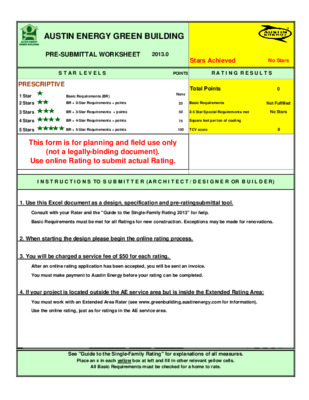
POINTS 1 StarNone 2 Stars25 3 Stars50 4 Stars75 5 Stars100TCV score 1. Use this Excel document as a design, specification and pre-ratingsubmittal tool.Consult with your Rater and the "Guide to the Single-Family Rating 2013" for help.Basic Requirements must be met for all Ratings for new construction. Exceptions may be made for renovations. 2. When starting the design please begin the online rating process. 3. You will be charged a service fee of $50 for each rating. After an online rating application has been accepted, you will be sent an invoice.You must make payment to Austin Energy before your rating can be completed. 4. If your project is located outside the AE service area but is inside the Extended Rating Area:You must work with an Extended Area Rater (see www.greenbuilding.austinenergy.com for information).Use the online rating, just as for ratings in the AE service area.Not FulfilledBR + 4-Star Requirements + pointsSquare feet per ton of coolingBasic RequirementsBR + 2-Star Requirements + points BR + 3-Star Requirements + pointsTotal Points0BR + 5-Star Requirements + pointsPRESCRIPTIVEBasic Requirements (BR) Place an x in each yellow box at left and fill in other relevant yellow cells. All Basic Requirements must be checked for a home to rate.0No Stars2-5 Star Special Requirements metPRE-SUBMITTAL WORKSHEETS T A R L E V E L S No StarsR A T I N G R E S U L T SStars Achieved 2013.0 AUSTIN ENERGY GREEN BUILDINGThis form is for planning and field use only (not a legally-binding document). Use online Rating to submit actual Rating.I N S T R U C T I O N S TO S U B M I T T E R (A R C H I T E C T / D E S I G N E R OR B U I L D E R)See "Guide to the Single-Family Rating" for explanations of all measures. Codes and testing Modeling score (applies only to new-construction, detached homes)Minimum IC3-Austin score required in 2013 is 0.0. OR minimum HERS score required in 2013 is 70 Current City of Austin IRC, IECC Codes and Amendments must be met, regardless of project location Among others, note that the following City of Austin required standards must be met:IRC with Austin amendmentsIECC with Austin amendmentsUPC with Austin amendments Including Austin Irrigation Design CriteriaHVAC efficiency and designCooling and heating equipment and duct sizing determined by correct Manual J and D …
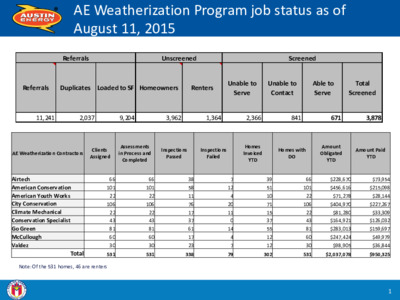
AE Weatherization Program job status as of August 11, 2015 1 ReferralsDuplicates Loaded to SFHomeownersRentersUnable to ServeUnable to Contact Able to ServeTotal Screened11,2412,0379,2043,9621,3642,3668416713,878ReferralsUnscreenedScreenedAE Weatherization Contractors Clients Assigned Assessments in Process and Completed Inspections Passed Inspections Failed Homes Invoiced YTD Homes with DO Amount Obligated YTD Amount Paid YTD Airtech 66 66 38 7 39 66 $228,670 $73,954 American Conservation 101 101 58 12 51 101 $456,616 $215,098 American Youth Works 22 22 11 4 10 22 $71,278 $28,144 City Conservation 106 106 76 20 71 106 $404,970 $227,267 Climate Mechanical 22 22 17 11 15 22 $81,280 $33,309 Conservation Specialist 43 43 37 0 37 43 $164,921 $126,032 Go Green 81 81 61 14 55 81 $283,013 $159,697 McCullough 60 60 17 4 12 60 $247,424 $49,979 Valdez 30 30 23 7 12 30 $98,905 $36,844 Total 531 531 338 79 302 531 $2,037,078 $950,325 Note: Of the 531 homes, 46 are renters
Members of the Low Income Consumer Advisory Task Force, I am writing to express strong protest for the group’s setting of a special called meeting set for Friday, August 14 while I was out of town at a time that I cannot attend and without my consultation. This meeting concerns a very controversial subject that I strongly disagree with: giving away expensive central air conditioners as part of the free weatherization program. It’s curious why this item that we have discussed several times in the past all of a sudden needed a special meeting. Whether intended or not, setting this meeting while I am out of town and without conferring with me appear deliberate and manipulative. Why the Task Force would even consider such an extremely expensive measure when there are so many other important priorities is short sighted. The payback in energy savings from installing free central air conditioning units is 60 plus years! The resolution that created us calls for finding effective measures to service low and moderate income residents. Wasting limited resources to provide free central units is a huge disservice to the tens of thousands of low and moderate income residents we are tasked to help. In contrast there are no special meetings called to create demand reduction goals as specifically called for in our Charter. In fact, we have several much more cost effective ideas left to discuss and vote on in the short time we have left. This one issue is being exaggerated at the expense of everything else. I request that this special called meeting be postponed and set for a time that I can attend, and that any future meetings be posted on our Web site at least two weeks in advance so all task members and the community can plan their schedule accordingly. Chris Strand
MEMORANDUM TO: Low Income Consumer Advisory Task Force FROM: Carol Biedrzycki, Chair DATE: August 14, 2015 SUBJECT: Special Called Meeting Thank you for agreeing to hold this extra meeting on Friday dedicated to the low income weatherization program. I look forward to seeing you on Friday at 11 a.m. in our usual meeting room at Austin Energy. Please note that the meeting agenda is posted only for discussion. No votes will be taken. To help organize our discussion on Friday I am asking you to consider starting the meeting with a discussion of the goals we would like the low income weatherization program to meet. I believe it will be helpful to have common ground for developing our recommendations. I have drafted broad goals which, when edited, will hopefully guide our discussion about the program and help us work out more specific solutions. I am suggesting that we take 15 minutes at the start of our meeting on Friday to review and discuss the Draft Low Income Weatherization Goals which follow. Please bring your suggested additions and edits to the meeting. I will open the meeting by going around the table for each member to express his or her thoughts on the goals. I am looking forward to this important discussion. DRAFT AUGUST 12, 2015 LOW-INCOME WEATHERIZATION PROGRAM GOALS To reduce the energy burden and energy costs for low‐income families, particularly for the elderly, people with disabilities and, families with children, by improving the energy efficiency of their homes. To reduce bad debt to the utility. To defer or avoid the need for capital investment in new generating facilities and to reduce the burning of fossil fuels for electricity generation and end use applications such as space and water heating and cooking. To provide the program at no out of pocket cost to eligible customers. To improve the healthfulness, safety and, affordability of housing for low and low-moderate income customers. To assure that the customers’ long term needs are met for refrigeration, lighting, cooling, and heating. To leverage utility and other available program resources to offer seamless home repair and weatherization services. To assure that an equitable level of program benefits is delivered to low-income customers. To achieve greenhouse gas reductions to support the city’s climate protection goals. To train and hire residents from disadvantaged communities and increase economic investment in those communities. To evaluate the program in consideration of …
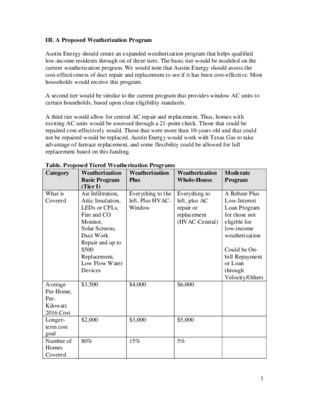
1 III. A Proposed Weatherization Program Austin Energy should create an expanded weatherization program that helps qualified low-income residents through on of three tiers. The basic tier would be modeled on the current weatherization program. We would note that Austin Energy should assess the cost-effectiveness of duct repair and replacement to see if it has been cost-effective. Most households would receive this program. A second tier would be similar to the current program that provides window AC units to certain households, based upon clear eligibility standards. A third tier would allow for central AC repair and replacement. Thus, homes with existing AC units would be assessed through a 21-point check. Those that could be repaired cost-effectively would. Those that were more than 10-years old and that could not be repaired would be replaced. Austin Energy would work with Texas Gas to take advantage of furnace replacement, and some flexibility could be allowed for full replacement based on this funding. Table. Proposed Tiered Weatherization Programs Category Weatherization Basic Program (Tier I) Weatherization Plus Weatherization Whole-House Moderate Program What is Covered Air Infiltration, Attic Insulation, LEDs or CFLs, Fire and CO Monitor, Solar Screens, Duct Work Repair and up to $500 Replacement, Low Flow Water Devices Everything to the left, Plus HVAC-Window Everything to left, plus AC repair or replacement (HVAC-Central) A Rebate Plus Low-Interest Loan Program for those not eligible for low-income weatherization Could be On-bill Repayment or Loan through Velocity/Others Average Per-Home, Per-Kilowatt 2016 Cost $3,500 $4,000 $6,000 Longer-term cost goal $2,000 $3,000 $5,000 Number of Homes Covered 80% 15% 5% 2 (example Only) Eligibility CAP customer, 200 percent of poverty Same, plus young-in or elderly, no potential for repair or replacement of AC See to left, plus Existing AC unit that is more than 10-years-old, can not be repaired through 21-point check, availability of Texas Gas could be factor MW short-term goal 0.8 0.1 0.1 MWh yearly goal 800 150 50 Who Pays for It EES Weatherization– everyone CAP Weatherization CAP Weatherization EES – separate rebate program Recommendations: Create a three-tier weatherization program. The majority of homes would be eligible only for basic weatherization services, but certain individuals and families would be eligible for window AC units or even central AC units depending upon eligibility criteria. The basic weatherization program would be paid for with the EES program, but the more expansive measures would be paid for with CAP …
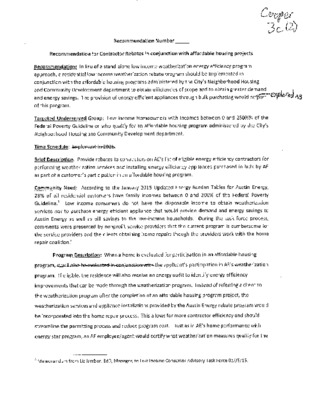
8/12/2015 Draft Recommendation Number ____ Repair and Replacement of Furnaces and Air Conditioners in Low Income Weatherization Program Targeted Underserved Group: Low income customers Brief Description: Include repair and replacement of air conditioners (central and window), furnaces and refrigerators as an energy efficiency measure in the low income weatherization program. Community need: The summer weather in Austin is extremely hot for certain periods of time. When the heat index reaches 102, Austin Energy, is prohibited from disconnecting a customer’s service1 because air conditioning is necessary to protect a resident’s health and safety especially the elderly and young children.2 While it is possible to live through an Austin summer with no air conditioning, people without air conditioning in their homes are encouraged to take shelter in public buildings with air conditioning during the hottest times of the day. Over one-fourth (118,241) of Austin Energy’s residential customers have incomes that qualify for Free Weatherization.3 Customers living with income below 50% of the Federal Poverty Guideline (FPG) spend 37.6% of household income on electricity. Those at 51 to 100% of FPG spend 11.3% and those at 101 to 200% FPG spend 5.9%. Those above 400% of the FPG spend 1.6%4. Insert data on age of housing stock housing stock As utility bills increase because of higher rates and the pass through of regulatory, community benefit charge and other per kilowatt-hour charges, low income customers are the most profoundly impacted because the energy burden becomes an even higher percentage of household income. There are large numbers of households in the Austin Energy service area with low income, high utility bills and very few energy efficiency program resources. In Texas, 26% of all home energy use is attributable to central air conditioning, 11% to the refrigerator, 9% to space heating, 7% to water heating and 2% to room air conditioning.5 Including repair and replacement of space conditioning equipment and 1 Austin City Code §15-9-109. 2 Sweating out a Texas heat wave, A guide to preventing hot weather illness. 3 Memorandum from Liz Jambor, EdD, Manager, to Low Income Consumer Advisory Task Force 01//5/15., p 5. 4 Ibid. 5 GDS Associates, Evaluation of Austin energy’s ARRA-Supported Weatherization Assistance Program, September 2012, p. 51. refrigerators allows the program to target the most energy intensive equipment in typical households. Program Description: In homes originally designed with central air conditioners and furnaces provide repair or replacement as needed based …
Play video
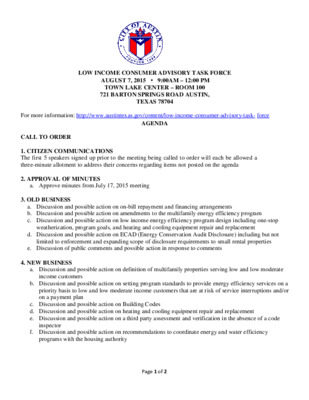
Page 1 of 2 LOW INCOME CONSUMER ADVISORY TASK FORCE AUGUST 7, 2015 9:00AM – 12:00 PM TOWN LAKE CENTER – ROOM 100 721 BARTON SPRINGS ROAD AUSTIN, TEXAS 78704 For more information: http://www.austintexas.gov/content/low-income-consumer-advisory-task- force AGENDA CALL TO ORDER 1. CITIZEN COMMUNICATIONS The first 5 speakers signed up prior to the meeting being called to order will each be allowed a three-minute allotment to address their concerns regarding items not posted on the agenda 2. APPROVAL OF MINUTES a. Approve minutes from July 17, 2015 meeting 3. OLD BUSINESS a. Discussion and possible action on on-bill repayment and financing arrangements b. Discussion and possible action on amendments to the multifamily energy efficiency program c. Discussion and possible action on low income energy efficiency program design including one-stop weatherization, program goals, and heating and cooling equipment repair and replacement d. Discussion and possible action on ECAD (Energy Conservation Audit Disclosure) including but not limited to enforcement and expanding scope of disclosure requirements to small rental properties e. Discussion of public comments and possible action in response to comments 4. NEW BUSINESS a. Discussion and possible action on definition of multifamily properties serving low and low moderate income customers b. Discussion and possible action on setting program standards to provide energy efficiency services on a priority basis to low and low moderate income customers that are at risk of service interruptions and/or on a payment plan c. Discussion and possible action on Building Codes d. Discussion and possible action on heating and cooling equipment repair and replacement e. Discussion and possible action on a third party assessment and verification in the absence of a code inspector f. Discussion and possible action on recommendations to coordinate energy and water efficiency programs with the housing authority The City of Austin is committed to compliance with the American with Disabilities Act. Reasonable modifications and equal access to communications will be provided upon request. Meeting locations are planned with wheelchair access. If requiring Sign Language Interpreters or alternative formats, please give notice at least 2 days (48 hours) before the meeting date. Please call Liz Jambor at Austin Energy Department, 513-322-6353, for additional information; TTY users route through Relay Texas at 711. For more information on the Low Income Consumer Advisory Task Force, please contact Liz Jambor at 512-322-6353 5. BRIEFINGS & REPORTS a. Austin Energy staff update on the weatherization program job status b. …
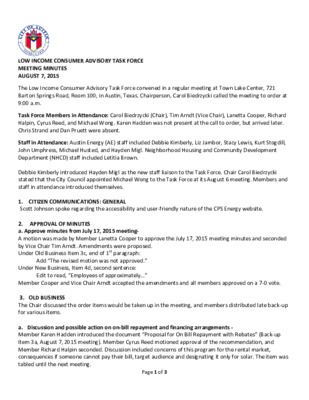
Page 1 of 3 LOW INCOME CONSUMER ADVISORY TASK FORCE MEETING MINUTES AUGUST 7, 2015 The Low Income Consumer Advisory Task Force convened in a regular meeting at Town Lake Center, 721 Barton Springs Road, Room 100, in Austin, Texas. Chairperson, Carol Biedrzycki called the meeting to order at 9:00 a.m. Task Force Members in Attendance: Carol Biedrzycki (Chair), Tim Arndt (Vice Chair), Lanetta Cooper, Richard Halpin, Cyrus Reed, and Michael Wong. Karen Hadden was not present at the call to order, but arrived later. Chris Strand and Dan Pruett were absent. Staff in Attendance: Austin Energy (AE) staff included Debbie Kimberly, Liz Jambor, Stacy Lewis, Kurt Stogdill, John Umphress, Michael Husted, and Hayden Migl. Neighborhood Housing and Community Development Department (NHCD) staff included Letitia Brown. Debbie Kimberly introduced Hayden Migl as the new staff liaison to the Task Force. Chair Carol Biedrzycki stated that the City Council appointed Michael Wong to the Task Force at its August 6 meeting. Members and staff in attendance introduced themselves. 1. CITIZEN COMMUNICATIONS: GENERAL Scott Johnson spoke regarding the accessibility and user-friendly nature of the CPS Energy website. 2. APPROVAL OF MINUTES a. Approve minutes from July 17, 2015 meeting- A motion was made by Member Lanetta Cooper to approve the July 17, 2015 meeting minutes and seconded by Vice Chair Tim Arndt. Amendments were proposed. Under Old Business Item 3c, end of 1st paragraph: Add “The revised motion was not approved.” Under New Business, Item 4d, second sentence: Edit to read, “Employees of approximately…” Member Cooper and Vice Chair Arndt accepted the amendments and all members approved on a 7-0 vote. 3. OLD BUSINESS The Chair discussed the order items would be taken up in the meeting, and members distributed late back-up for various items. a. Discussion and possible action on on-bill repayment and financing arrangements - Member Karen Hadden introduced the document “Proposal for On Bill Repayment with Rebates” (Back-up Item 3a, August 7, 2015 meeting). Member Cyrus Reed motioned approval of the recommendation, and Member Richard Halpin seconded. Discussion included concerns of this program for the rental market, consequences if someone cannot pay their bill, target audience and designating it only for solar. The item was tabled until the next meeting. Page 2 of 3 b. Discussion and possible action on amendments to the multifamily energy efficiency program - This item was not discussed. c. Discussion and possible action on …
Backup
Backup
Backup
Backup
Backup
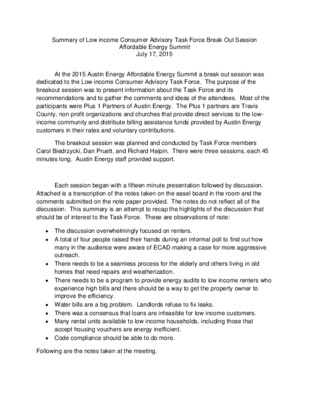
Summary of Low income Consumer Advisory Task Force Break Out Session Affordable Energy Summit July 17, 2015 At the 2015 Austin Energy Affordable Energy Summit a break out session was dedicated to the Low income Consumer Advisory Task Force. The purpose of the breakout session was to present information about the Task Force and its recommendations and to gather the comments and ideas of the attendees. Most of the participants were Plus 1 Partners of Austin Energy. The Plus 1 partners are Travis County, non profit organizations and churches that provide direct services to the low-income community and distribute billing assistance funds provided by Austin Energy customers in their rates and voluntary contributions. The breakout session was planned and conducted by Task Force members Carol Biedrzycki, Dan Pruett, and Richard Halpin. There were three sessions, each 45 minutes long. Austin Energy staff provided support. Each session began with a fifteen minute presentation followed by discussion. Attached is a transcription of the notes taken on the easel board in the room and the comments submitted on the note paper provided. The notes do not reflect all of the discussion. This summary is an attempt to recap the highlights of the discussion that should be of interest to the Task Force. These are observations of note: The discussion overwhelmingly focused on renters. A total of four people raised their hands during an informal poll to find out how many in the audience were aware of ECAD making a case for more aggressive outreach. There needs to be a seamless process for the elderly and others living in old homes that need repairs and weatherization. There needs to be a program to provide energy audits to low income renters who experience high bills and there should be a way to get the property owner to improve the efficiency. Water bills are a big problem. Landlords refuse to fix leaks. There was a consensus that loans are infeasible for low income customers. Many rental units available to low income households, including those that accept housing vouchers are energy inefficient. Code compliance should be able to do more. Following are the notes taken at the meeting. Notes from Low income Consumer Advisory Task Force Break Out Session Affordable Energy Summit July 17, 2015 Comments on the Easel Board Session 1 Task Force contact is Sady.Bartlett@austinenergy.com. More information …
Backup
Backup