JOINT SUSTAINABILITY COMMITTEE HYBRID MEETING FORMAT April 30th, 2024 at 6pm Boards and Commissions Room, Austin City Hall 301 W 2nd St, Austin TX 78702 Some members of the Committee may be participating by videoconference Public comment will be allowed in-person or remotely via telephone. Speakers may only register to speak on an item once either in-person or remotely and will be allowed up to three minutes to provide their comments. Registration no later than noon the day before the meeting is required for remote participation by telephone. To register to speak remotely, call or email Rohan Lilauwala at (rohan.lilauwala@austintexas.gov or 512-974-9394). CURRENT BOARD MEMBERS: Kaiba White, Chair (Electric Utility Commission) Diana Wheeler, Vice Chair (Urban Transportation Commission) Charlotte Davis (Resource Mgmt. Commission) Haris Qureshi (Environmental Commission) Melissa Rothrock (Zero Waste Advisory Commission) Bertha Delgado (Community Development Commission) Larry Franklin (Austin Travis County Food Policy Board) Chris Maxwell-Gaines (Water & Wastewater Commission) Amy Noel (Economic Prosperity Commission) Stephanie Bazan (Parks & Recreation Board) Jon Salinas (Design Commission) Vacant (City Council) Alice Woods (Planning Commission) Rodrigo Leal (Mayor’s Representative) Anna Scott (Mayor’s Representative) Heather Houser (Mayor’s Representative) Yureisly Suarez (Mayor’s Representative) Christopher Campbell (Mayor’s Representative) For more information, please visit: www.austintexas.gov/jsc AGENDA CALL TO ORDER PUBLIC COMMUNICATION: GENERAL The first 10 speakers signed up prior to the meeting being called to order will each be allowed a three-minute allotment to address their concerns regarding items not posted on the agenda. APPROVAL OF MINUTES 1. Approval of minutes from the April 24th, 2024 meeting of the Joint Sustainability Committee. DISCUSSION AND ACTION ITEMS 2. Joint Sustainability Committee discussion and approval of recommendations for the Environmental Investment Plan, in the areas of Buildings and Energy, Transportation, Natural Systems, and Consumption. FUTURE AGENDA ITEMS ADJOURNMENT The City of Austin is committed to compliance with the American with Disabilities Act. Reasonable modifications and equal access to communications will be provided upon request. Meeting locations are planned with wheelchair access. If requiring Sign Language Interpreters or alternative formats, please give notice at least 2 days (48 hours) before the meeting date. Please contact Rohan Lilauwala at rohan.lilauwala@austintexas.gov or 512-974-9394 for additional information; TTY users’ route through Relay Texas at 711. For more information on the Joint Sustainability Committee, please call or email Rohan Lilauwala at rohan.lilauwala@austintexas.gov or 512-974-9394.
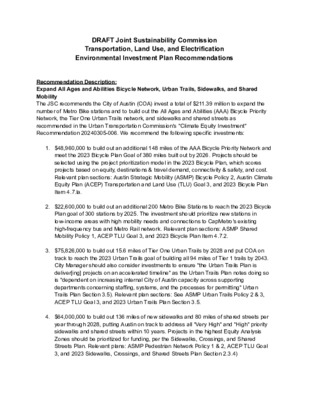
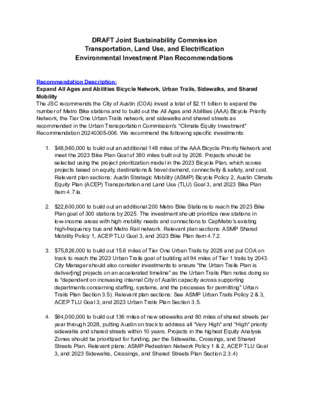
DRAFT Joint Sustainability Commission Transportation, Land Use, and Electrification Environmental Investment Plan Recommendations Recommendation Description: Expand All Ages and Abilities Bicycle Network, Urban Trails, Sidewalks, and Shared Mobility The JSC recommends the City of Austin (COA) invest a total of $211.39 million to expand the number of Metro Bike stations and to build out the All Ages and Abilities (AAA) Bicycle Priority Network, the Tier One Urban Trails network, and sidewalks and shared streets as recommended in the Urban Transportation Commission's "Climate Equity Investment" Recommendation 20240305-006. We recommend the following specific investments: 1. $48,960,000 to build out an additional 148 miles of the AAA Bicycle Priority Network and meet the 2023 Bicycle Plan Goal of 380 miles built out by 2026. Projects should be selected using the project prioritization model in the 2023 Bicycle Plan, which scores projects based on equity, destinations & travel demand, connectivity & safety, and cost. Relevant plan sections: Austin Strategic Mobility (ASMP) Bicycle Policy 2, Austin Climate Equity Plan (ACEP) Transportation and Land Use (TLU) Goal 3, and 2023 Bicycle Plan Item 4.7.la. 2. $22,600,000 to build out an additional 200 Metro Bike Stations to reach the 2023 Bicycle Plan goal of 300 stations by 2025. The investment should prioritize new stations in low-income areas with high mobility needs and connections to CapMetro's existing high-frequency bus and Metro Rail network. Relevant plan sections: ASMP Shared Mobility Policy 1, ACEP TLU Goal 3, and 2023 Bicycle Plan Item 4.7.2. 3. $75,826,000 to build out 15.6 miles of Tier One Urban Trails by 2028 and put COA on track to reach the 2023 Urban Trails goal of building all 94 miles of Tier 1 trails by 2043. City Manager should also consider investments to ensure "the Urban Trails Plan is deliver[ing] projects on an accelerated timeline" as the Urban Trails Plan notes doing so is "dependent on increasing internal City of Austin capacity across supporting departments concerning staffing, systems, and the processes for permitting" Urban Trails Plan Section 3.5). Relevant plan sections: See ASMP Urban Trails Policy 2 & 3, ACEP TLU Goal 3, and 2023 Urban Trails Plan Section 3.5. 4. $64,000,000 to build out 136 miles of new sidewalks and 80 miles of shared streets per year through 2028, putting Austin on track to address all "Very High" and "High" priority sidewalks and shared streets within 10 years. Projects in the highest Equity Analysis Zones …
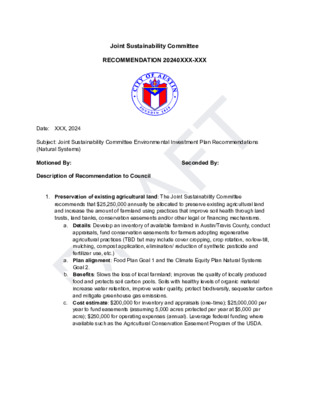
Joint Sustainability Committee RECOMMENDATION 20240XXX-XXX Motioned By: Date: XXX, 2024 Description of Recommendation to Council Subject: Joint Sustainability Committee Environmental Investment Plan Recommendations (Natural Systems) 1. Preservation of existing agricultural land: The Joint Sustainability Committee Seconded By: D R A F T recommends that $25,250,000 annually be allocated to preserve existing agricultural land and increase the amount of farmland using practices that improve soil health through land trusts, land banks, conservation easements and/or other legal or financing mechanisms. a. Details: Develop an inventory of available farmland in Austin/Travis County, conduct appraisals, fund conservation easements for farmers adopting regenerative agricultural practices (TBD but may include cover cropping, crop rotation, no/low-till, mulching, compost application, elimination/ reduction of synthetic pesticide and fertilizer use, etc.) a. Plan alignment: Food Plan Goal 1 and the Climate Equity Plan Natural Systems b. Benefits: Slows the loss of local farmland; improves the quality of locally produced food and protects soil carbon pools. Soils with healthy levels of organic material increase water retention, improve water quality, protect biodiversity, sequester carbon and mitigate greenhouse gas emissions. c. Cost estimate: $200,000 for inventory and appraisals (one-time); $25,000,000 per year to fund easements (assuming 5,000 acres protected per year at $5,000 per acre); $250,000 for operating expenses (annual). Leverage federal funding where available such as the Agricultural Conservation Easement Program of the USDA. Goal 2. Goal 2. 2. Revolving loan fund for Working Farms Fund pilot: The Joint Sustainability Committee recommends that $5,500,000 be allocated to establish a revolving loan fund to preserve agricultural land in Austin/Travis County through a pilot program that provides a path to ownership for a new generation of farmers and increases the amount of farmland acting as carbon pools. a. Details: A collaboration with the Conservation Funds Working Farms Fund and local agricultural nonprofits will acquire and permanently protect small to mid-sized farms, and provide a pathway for underrepresented farmers to own their own farms b. Plan alignment: Food Plan Goal 1 and the Climate Equity Plan Natural Systems c. Benefits: Slows the loss of local farmland, improves the quality of locally produced food, protects carbon pools, and serves as a template for program replication. d. Cost estimate: $5.25M to establish a revolving loan fund; $250K annually for operational expenses 3. Energy and water dashboard for City facilities: The Joint Sustainability Committee recommends that $350,000 be allocated to create a consolidated energy and water dashboard to …
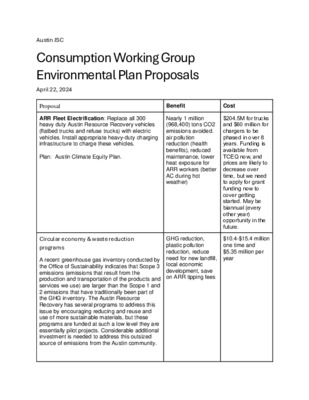
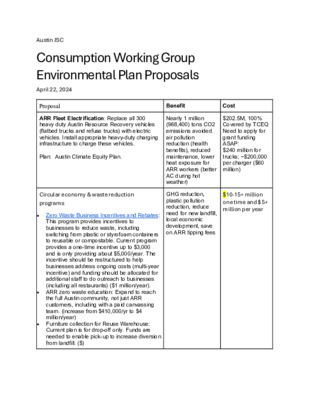
Consumption Working Group Environmental Plan Proposals Austin JSC April 22, 2024 Proposal ARR Fleet Electrification: Replace all 300 heavy duty Austin Resource Recovery vehicles (flatbed trucks and refuse trucks) with electric vehicles. Install appropriate heavy-duty charging infrastructure to charge these vehicles. Plan: Austin Climate Equity Plan. Benefit Cost Nearly 1 million (968,400) tons CO2 emissions avoided. air pollution reduction (health benefits), reduced maintenance, lower heat exposure for ARR workers (better AC during hot weather) GHG reduction, plastic pollution reduction, reduce need for new landfill, local economic development, save on ARR tipping fees Circular economy & waste reduction programs A recent greenhouse gas inventory conducted by the Office of Sustainability indicates that Scope 3 emissions (emissions that result from the production and transportation of the products and services we use) are larger than the Scope 1 and 2 emissions that have traditionally been part of the GHG inventory. The Austin Resource Recovery has several programs to address this issue by encouraging reducing and reuse and use of more sustainable materials, but these programs are funded at such a low level they are essentially pilot projects. Considerable additional investment is needed to address this outsized source of emissions from the Austin community. $204.5M for trucks and $60 million for chargers to be phased in over 8 years. Funding is available from TCEQ now, and prices are likely to decrease over time, but we need to apply for grant funding now to cover getting started. May be biannual (every other year) opportunity in the future. $10.4-$15.4 million one time and $5.35 million per year • Zero Waste Business Incentives and Rebates: This program provides incentives to businesses to reduce waste, including switching from plastic or styrofoam containers to reusable or compostable. Current program provides a one-time incentive up to $3,000 and is only providing about $5,000/year. The incentive should be restructured to help businesses address ongoing costs (multi-year incentive) and funding should be allocated for additional staff to do outreach to businesses (including all restaurants) ($1 million/year). • ARR zero waste education: Expand to reach the full Austin community, not just ARR customers, including with a paid canvassing team. (increase from $410,000/yr to $4 million/year) • Furniture collection for Reuse Warehouse: Current plan is for drop-off only. Funds are needed to enable pick-up to increase diversion from landfill. ($400,000) • Deconstruction Warehouse: To divert salvaged construction materials from the landfill. ($10-15 million) • …
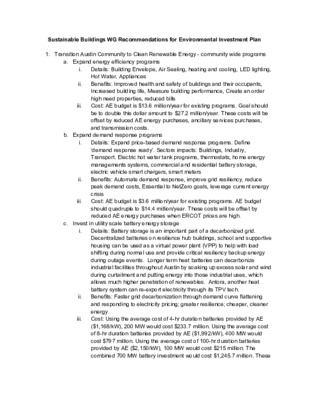
Sustainable Buildings, Electric Supply and Water Use Recommendations for Environmental Investment Plan Additional investments in energy efficiency, demand response, local solar, batteries and coal retirement are needed to meet the carbon-free by 2035 goal in the Austin Energy Resource Generation and Climate Protection Plan and the greenhouse gas emissions reduction goals in the Austin Climate Equity Plan. These are the resources that are locally available and cost effective for decarbonizing the energy sector. Decarbonizing the energy sector is doubly important because it is the lynchpin for decarbonizing transportation, buildings and other activities. Decarbonizing city buildings and improving water conservation will also yield greenhouse gas (GHG) reductions and other co-benefits. 1. Expand Austin Energy’s energy efficiency programs a. Details: More investment is needed to improve building envelopes and air sealing and install efficient heat pumps for heating and cooling and hot water production, as well as LED lighting and other energy efficiency appliances. Additional community outreach is needed to inform the community about available local, state and federal incentives. Building performance should be measured and ranked to enable focused attention on buildings with the highest need. b. Benefits: GHG reduction, air pollution reduction (and health benefits), affordability/bills reduction (for program participants and non-participants), improved health and safety of buildings and their occupants, increased building life (reduced embedded GHG emissions), greater equity in energy bills and home comfort, improved grid resilience c. Cost: AE budget is $13.6 million/year for existing programs. This amount should be doubled to $27.2 million/year ($13.6 million/year increase). An additional 14- 20 FTEs should be allocated to run energy efficiency programs, costing $1.68- 2.4 million/year. These costs will be offset by reduced AE energy purchases, ancillary services purchases, and transmission costs. a. Details: Expanded price-based demand response programs, including to the residential, commercial, industrial, and transportation sectors is needed. “Demand response ready” should be well defined and enforced. Demand response should be automated as much as possible. Electric hot water tank programs, thermostats, home energy managements systems, commercial and residential battery storage, electric vehicle smart chargers, smart meters b. Benefits: GHG reduction, affordability/reduced bills (reduce peak demand costs for AE), improve grid resilience c. Cost: AE budget is $3.6 million/year for existing programs. This amount should be quadrupled to $14.4 million/year ($10.8/year increase). An additional 11-16 FTEs should be allocated to run demand response programs, costing $1.32-1.92 2. Expand Austin Energy’s demand response programs million/year. These costs will …
JOINT SUSTAINABILITY COMMITTEE REGULAR MEETING MEETING MINUTES Mar 27, 2024 The Joint Sustainability Committee convened in a hybrid meeting via videoconferencing and City Hall. Chair Kaiba White called the Board Meeting to order at 6:06 pm. Board Members in Attendance in Person: Chris Maxwell-Gaines, Lane Becker, Larry Franklin, Charlotte Davis, Kaiba White, Haris Qureshi, Jon Salinas Board Members in Attendance Remotely: Diana Wheeler, Anna Scott, Heather Houser, Chris Campbell, Yure Suarez Board Members Absent: Bertha Delgado, Alice Woods, Melissa Rothrock, Amy Noel, Rodrigo Leal City Staff in Attendance: Rohan Lilauwala, Zach Baumer CALL TO ORDER Chair Kaiba White called the meeting to order at 6:20 pm. PUBLIC COMMUNICATION 1. Melinda Chow- River Watch, speaking in favor of Austin Civilian Conservation Corps (ACCC) success stories 2. Parc Smith – American Youth Works, speaking in favor of ACCC 3. Chase Wright – Hungry Hill Foundation, speaking in favor of ACCC 4. Jaquan Jackson – Hungry Hill Foundation, speaking in favor of ACCC 5. Paul Robbins – Environmental activist, vice chair of RMC. Speaking on the need for stronger restrictions on water use and for reclaimed water. Green choice program is obsolete, needs to be repurposed for dispatchable renewable energy 6. Adam Greenfield – Safe Streets Austin, speaking in favor of Urban Transportation Commission’s transportation package, Farm and City’s recommendations. In support of dais). converting 1 lane on every arterial to protected bike or bus lanes. 110 miles - $40 million for quick build. Savings from crash cost reduction. Example of longhorn dam 7. Scott Johnson – speaking on the importance of low-emission asphalt 1. Approval of minutes from the March 27th meeting of the Joint Sustainability Committee. Davis motions to approve, Maxwell-Gaines seconds, passes on 11-0 vote (Suarez off 3. UT City Climate Colab – Dev Niyogi, UT-Austin Presentation on the new collaborative research framework between University of Texas at Austin and the City of Austin Commissioners agree of value of Colab Suggestions of project – citywide solar potential assessment Offer to come back regularly to update JSC 2. Joint Sustainability Committee Officer Elections for the 2024-2025 Term Qureshi nominates White as chair, Maxwell-Gaines seconds, passes 12-0. Wheeler nominates Davis as vice chair, Qureshi seconds, passes 12-0. 4. Presentation on the Staff Response to Resolution 20240215-025, the “Environmental Investment Plan” – Zach Baumer, Office of Sustainability Discussions on how to maximize community benefits …
Joint Sustainability Committee Environmental Investment Plan Recommendation Outreach and Engagement for Sustainability Incentives a. Details: The City of Austin has numerous sustainability incentive programs aligned with the goals of the Climate Equity Plan. However, many of these programs are underutilized, especially among low-income households. A part of the challenge is awareness. The city should host a user-friendly website that consolidates information on all sustainability incentives offered by the City of Austin (i.e., home weatherization and repair, water conservation, rainwater collection, landscape and green infrastructure programs), as well as state and federal incentives that align with the goals of the Austin Climate Equity Plan and other city sustainability plans. Additional community outreach by the city and trusted organizations can increase the effectiveness of these programs. A new Community Engagement Specialist FTE in the Office of Sustainability is needed to coordinate community outreach and partnership activities associated with promoting sustainability incentives, with a focus on building relationships with low-income communities, communities of color, and related organizations and service providers. This employee would manage grants, contracts and stipends for community leaders and community-based organizations to do direct outreach to promote sustainability incentive programs in targeted Austin communities, in partnership with the Office of Sustainability. b. Benefits: GHG reduction, water conservation, more equitable participation in programs c. Cost: $500,000/year to the Office of Sustainability for one additional Community Engagement Specialist FTE, website construction and maintenance, and outreach grants, contracts, and stipends ($200,000)
BOARD/COMMISSION RECOMMENDATION Joint Sustainability Committee Recommendation 20240430-002: Environmental Investment Plan Funding Needs 1. 2. 3. 4. 5. 6. 7. 8. 9. List of Funding Needs Cross-Sector Funding Needs ......................................................................................................................... 2 Outreach and Engagement for Sustainability Incentives ............................................................ 2 Austin Civilian Conservation Corps .............................................................................................. 3 Energy and Water Conservation Funding Needs .......................................................................................... 4 Expand Austin Energy’s energy efficiency programs ................................................................... 4 Expand Austin Energy’s demand response programs ................................................................. 5 Invest in battery energy storage.................................................................................................. 5 Utility-owned or contracted rooftop solar .................................................................................. 6 Shut down/retire AE’s portion of Fayette coal plant .................................................................. 7 Air sealing task force and training program ................................................................................ 8 Passive House incentive program ................................................................................................ 8 10. Decarbonizing municipal buildings .............................................................................................. 9 11. Water leak detection programs................................................................................................... 9 12. Improve rebates for residential and commercial landscape conversions ................................. 10 Consumption & Waste Reduction Funding Needs...................................................................................... 11 13. Circular economy & waste reduction programs ........................................................................ 11 14. Low-carbon concrete fund ........................................................................................................ 12 15. Pro-climate, pro-health foods ................................................................................................... 12 16. Sustainable purchasing and carbon accounting ........................................................................ 13 17. City-owned composting facility ................................................................................................. 13 1 Natural Systems Funding Needs ................................................................................................................. 14 18. Preservation of existing agricultural land .................................................................................. 14 19. Revolving loan fund for Working Farms Fund pilot ................................................................... 15 20. Energy and water dashboard for city facilities .......................................................................... 15 21. Comprehensive public tree inventory for the city of Austin ..................................................... 16 Transportation and Land Use Funding Needs ............................................................................................. 17 22. Austin Resource Recovery Fleet Electrification ......................................................................... 17 23. Austin Resource Recovery Transfer Station .............................................................................. 17 24. Expand All Ages and Abilities Bicycle Network, Urban Trails, Sidewalks, and Shared Mobility 18 25. Extend Pickup Service Zones ..................................................................................................... 20 26. Downtown High-Frequency Circulator ...................................................................................... 21 27. Neighborhood E-Circulators ...................................................................................................... 22 28. Heat Resilience Infrastructure ................................................................................................... 23 29. CityLeap ATX Plan: convert travel lanes on arterial roads to protected bike or bus lanes ....... 24 30. Establish a city-owned all-electric carshare service .................................................................. 25 31. Low-cost, accessible charging stations at City of Austin owned facilities ................................. 26 32. Install charging stations at multi-family homes with priority in low and moderate income communities ....................................................................................................................................... 27 33. E-mobility solutions pilot program ............................................................................................ 28 Cross-Sector Funding Needs 1. Outreach and Engagement for Sustainability Incentives Details: The City of Austin has numerous sustainability incentive programs aligned with the goals of the Climate Equity Plan. However, many of these programs are underutilized, especially among low-income households. A part of the challenge is awareness. The city should host a user-friendly website …
JOINT SUSTAINABILITY COMMITTEE REGULAR MEETING MEETING MINUTES April 30, 2024 The Joint Sustainability Committee convened in a hybrid meeting via videoconferencing and City Hall. Chair Kaiba White called the Board Meeting to order at 6:06 pm. Board Members in Attendance in Person: Chris Maxwell-Gaines, Haris Qureshi, Kaiba White, Anna Scott Board Members in Attendance Remotely: Diana Wheeler, Jon Salinas, Melissa Rothrock, Charlotte Davis, Lane Becker, Heather Houser, Rodrigo Leal, Yure Suarez, Chris Campbell, Amy Noel Board Members Absent: Bertha Delgado, Alice Woods, Larry Franklin City Staff in Attendance: Rohan Lilauwala CALL TO ORDER Chair Kaiba White called the meeting to order at 6:06 pm. PUBLIC COMMUNICATION 1. Craig Nazor – speaking in support of LIDAR for tree inventory and support for native 2. Zenobia Joseph – speaking in favor of improved transit and shelters near low-income 1. Approval of minutes from the April 24th meeting of the Joint Sustainability Committee. Qureshi motions to approve, Maxwell-Gaines seconds, passes on 13-0 vote (Noel off nurseries communities dais) 2. Joint Sustainability Committee discussion and approval of recommendations for the Environmental Investment Plan, in the areas of Buildings and Energy, Transportation, Natural Systems, and Consumption. Discussion of details of individual recommendations at length Commissioners suggest including social cost of carbon (and air pollutants, if possible) amount for Fayette closure Tweaks suggested to sustainable buildings recommendation #10 Tweaks to ACCC recommendation – change language to purchasing a truck Suggested $400,000 budget for Sustainable Buildings Recommendation 10 Public comment - Zenobia Joseph – Speaks in favor of improved fixed-route transit, better survey methods, equity Scott motions to approve all recommendations minus five pulled items ; Qureshi second 1. Pro-climate, pro health foods 2. Downtown High-Frequency Circulator 3. Neighborhood E-Circulators 4. Establish a city-owned all-electric carshare service 5. E-mobility solutions pilot program Passes 13-0 (Suarez off dais) White motions to approve Pro-climate, pro health recommendation, Qureshi seconds, passes 12-0 (Davis recuses, Suarez off dais) Davis motions to approve neighborhood e-circulators as amended, Noel seconds, passes 13-0 Davis motions to approve downtown high frequency circulator, Qureshi seconds, passes 13-0 (Suarez off dais). (Suarez off dais). Campbell motions carshare service to approve, Becker seconds, passes 13-0 (Suarez off Leal motions to approve e-mobility solutions pilot program, Qureshi seconds, passes 10-2 (White abstains, Davis and Houser no) dais). TBD FUTURE AGENDA ITEMS White adjourns meeting …
REGULAR MEETING of the LIBRARY COMMISSION April 29, 2024 – 6 P.M. Windsor Park Branch Library 5833 Westminster Drive Austin, Texas This meeting is being held in a hybrid format, with both in-person and online virtual participation. Some members of the Commission may be participating by videoconference. Public comment will be allowed in-person or remotely via telephone. Speakers may only register to speak on an item once either in-person or remotely and will be allowed up to three minutes to provide their comments. Registration no later than noon the day before the meeting is required for remote participation by telephone. To register to speak remotely, call or email Laura Polio, 512-974-9624, laura.polio@austintexas.gov. CURRENT BOARD MEMBERS/COMMISSIONERS: Mark Smith, Chair Magen Davis Kezia Frayjo Cristina Masters Courtney Rosenthal AGENDA CALL TO ORDER PUBLIC COMMUNICATION: GENERAL Lynda Infante Huerta, Vice Chair Steve DeRosa Andrea Herrera Moreno Sheila Mehta The first five speakers signed up prior to the meeting being called to order will each be allowed a three-minute allotment to address their concerns regarding items not posted on the agenda. APPROVAL OF MINUTES Approve the minutes of the Library Commission's regular meeting on March 25, 2024. STAFF BRIEFINGS Staff briefing on the April Director’s Report covering public programming highlights, and APL facilities updates, by Roosevelt Weeks, Director of Libraries. 1. 2. DISCUSSION AND ACTION ITEMS 3. Discussion and approve a recommendation to support Austin Public Library establishing a City Poet Laureate Program and Committee 4. Discussion and conduct elections for the Chair and Vice Chair of the Library Commission. FUTURE AGENDA ITEMS ADJOURNMENT The City of Austin is committed to compliance with the American with Disabilities Act. Reasonable modifications and equal access to communications will be provided upon request. Meeting locations are planned with wheelchair access. If requiring Sign Language Interpreters or alternative formats, please give notice at least 2 days (48 hours) before the meeting date. Please call Laura Polio at the Austin Public Library Department, at 512-974-9624 for additional information; TTY users route through Relay Texas at 711. For more information on the Library Commission, please contact Laura Polio at 512-974-9624 or laura.polio@austintexas.gov.
Library Commission Meeting Minutes 25, March, 2024 REGULAR MEETING 25, March 2024 THE LIBRARY COMMISSION MINUTES The Library Commission convened in a meeting on Monday, March 25, 2024, at the Pleasant Hill Branch Library, 211 E. William Cannon Drive, in Austin, Texas. CALL TO ORDER Chair Smith called the Commission Meeting to order at 6:12 p.m. Commission Members in Attendance: Mark Smith, Chair, Lynda Infante Huerta, Vice-Chair, Christina Masters Commission Members in Attendance Remotely: Steve DeRosa, Magen Davis, Andrea Herrera Moreno Commission Members Absent: Courtney Rosenthal, Kezia Frayjo, Sheila Mehta PUBLIC COMMUNICATION: GENERAL Daniel Ronan, Austin History Center Association Interim Director, gave public comment to the commission regarding the Austin History Center Association's mission and goals. APPROVAL OF MINUTES 1. Approval of minutes from the January 29, 2023, regular meeting The minutes of the February 26, 2024, regular meeting were approved on Commission Member Master’s motion and Vice Chair Infante Huerta's second on a 6-0 vote with Commissioners Rosenthal, Frayjo, Mehta absent. STAFF BRIEFINGS 2. Discussion of the March Director’s Report covering public programming highlights, and APL facilities updates, by Roosevelt Weeks, Director of Libraries. The presentation was made by Roosevelt Weeks, Director of Libraries. Library Commission Meeting Minutes DISCUSSION AND ACTION ITEMS 25, March, 2024 3. Discussion and approval of a recommendation supporting the Austin Public Library's proposed budget for FY2025 with additional funding for unmet needs around books and materials, social workers, security and custodial positions, feasibility studies, and enhanced library cards. A motion to approve the recommendation supporting the Austin Public Library's proposed budget for FY2025 with additional funding for unmet needs around books and materials, social workers, security and custodial positions, feasibility studies, and enhanced library cards was made by Commissioner Davis and seconded by Vice Chair Infante Huerta on a 7-0 vote with Commissioners Rosenthal, Frayjo, Mehta absent. 4. Discussion and approval for Commission Members to represent the Library Commission at multiple Board and Commission Meetings to advocate for support and funding for Austin Public Library Initiatives. A motion to approve Commission Members to represent the Library Commission at multiple Board and Commission Meetings to advocate for support and funding for Austin Public Library Initiatives was made by Chair Smith and seconded by Vice Chair Infante Huerta on a 6-0 vote with Commissioners Rosenthal, Frayjo, Mehta absent. FUTURE AGENDA ITEMS Officer Elections Recommendation for Library participation in future City Homelessness Planning and Studies Kids Block …
LIBRARY COMMISSION RECOMMENDATION 20240429-3 Establish an Adult Poet Laureate Program for the City of Austin Date: April 29, 2024 Library Subject: Establishing an adult Poet Laureate program to be managed by the Austin Public Motioned By: Commissioner Mehta Seconded By: Vice Chair Infante Huerta Recommendation Establish an adult Poet Laureate program for the City of Austin to be housed and managed by the Austin Public Library Department. Description of Recommendation to Council Requesting that the Austin City Council use their authority to direct the City Manager to establish an adult Poet Laureate program to be housed in and managed by the Austin Public Library department, and add additional budget funds as needed to create and support this program. Rationale: The City of Austin is known for its love and celebration of the arts. For decades many local organizations have developed Austin’s poetry scene. Additionally, the University of Texas at Austin is a nationally recognized Masters of Fine Arts program that nurtures and produces many wonderful artists and poets. Poet Laureate positions have existed in cities, states and countries since the 1600s, and are designed to be stewards of poetry, art and storytelling. Austin is the only major city in Texas without an adult Poet Laureate program. An adult Poet Laureate can use this role to promote literacy across the city, use poetry to engage with Austin’s history, politics and culture, as well as continue to grow and support Austin’s community of artists, with the potential to amplify Austin poets of all ages. Austin Public Library is a natural home for a program like this. A Poet Laureate has the potential to encourage via performances, teaching and public speaking the importance of reading, writing and literacy. Reading and information literacy are core to the library’s mission and the library is a well known and trusted institution in the city. According to Literacy Texas, Texas ranks 46/50 for adult literacy. The adult literacy rate is 81%, with 19% of adults lacking basic prose literacy skills. Creating this program can help close the gap, and inspire Austin residents to read and write. Austin Public Library has branches strategically located across the city and is accustomed to creating programs and events across all of its branches allowing for maximum impact for this new program. They have also proven to be good stewards of city funds, and have many collection, personnel and budget needs to …
LIBRARY COMMISSION RECOMMENDATION 20240429-3 Subject: Establishing an adult Poet Laureate program to be managed by the Austin Public Library Date: 04/29/2024 Recommendation Establish an adult Poet Laureate program for the City of Austin to be housed and managed by the Austin Public Library Department. Description of Recommendation to Council Requesting that the Austin City Council use their authority to direct the City Manager to establish an adult Poet Laureate program to be housed in and managed by the Austin Public Library department, and add additional budget funds as needed to create and support this program. Rationale: The City of Austin is known for its love and celebration of the arts. For decades many local organizations have developed Austin’s poetry scene. Additionally, the University of Texas at Austin is a nationally recognized Masters of Fine Arts program that nurtures and produces many wonderful artists and poets. Poet Laureate positions have existed in cities, states and countries since the 1600s, and are designed to be stewards of poetry, art and storytelling. Austin is the only major city in Texas without an adult Poet Laureate program. An adult Poet Laureate can use this role to promote literacy across the city, use poetry to engage with Austin’s history, politics and culture, as well as continue to grow and support Austin’s community of artists, with the potential to amplify Austin poets of all ages. Austin Public Library is a natural home for a program like this. A Poet Laureate has the potential to encourage via performances, teaching and public speaking the importance of reading, writing and literacy. Reading and information literacy are core to the library’s mission and the library is a well known and trusted institution in the city. According to Literacy Texas, Texas ranks 46/50 for adult literacy. The adult literacy rate is 81%, with 19% of adults lacking basic prose literacy skills. Creating this program can help close the gap, and inspire Austin residents to read and write. Austin Public Library has branches strategically located across the city and is accustomed to creating programs and events across all of its branches allowing for maximum impact for this new program. They have also proven to be good stewards of city funds, and have many collection, personnel and budget needs to consider. We ask that you also provide financial support to create and sustain this much needed program so this does not impact the …
1 Director’s Report April 2024 TABLE OF CONTENTS Highlights _______________________________________________________________________________ 3 Facilities Update __________________________________________________________________________ 5 Capital Projects Update __________________________________________________________________5 Gallery _______________________________________________________________________________ 6 Active Project Timelines _________________________________________________________________ 7 Project Highlights _______________________________________________________________________ 8 APL by the Numbers _____________________________________________________________________ 9 Programs and Outreach__________________________________________________________________ 9 Cardholder ___________________________________________________________________________ 10 Visitors _____________________________________________________________________________ 11 Circulation and Collections ____________________________________________________________ 112 Express Checkout and Holds ___________________________________________________________113 Technologyy _________________________________________________________________________ 14 Budget, Volunteers and Meeting Rooms ____________________________________________________ 15 3 HIGHLIGHTS Expansion of Eligibility for Free Austin Public Library Cards On Monday, March 11, 2024, all Austin Public Library (APL) locations were able to provide full-access library cards to residents of the city’s Limited Purpose (LTD) and Extraterritorial Jurisdictions (ETJ). Within the first 10 days of the new expansion, 722 new accounts were renewed or created for residents living within the Austin ETJ area alone. ALW is Turning 45! Little Walnut Creek Branch Library will be celebrating its 45th Birthday on Saturday, May 4, 2024 from 11 AM - 2 PM. We guarantee it will be fun for ALL ages, with a petting zoo, face painter, balloon artist, and performers from local high schools. FREE food, games, and prizes as we invite all to come out and celebrate!" Marshalling Yard Outreach and APL tops 4,500 Enhanced Library Cards Austin Public Library, in collaboration with Austin Public Health – Homeless Strategy Division, organized an Art Program for the residents at the Marshalling Yard Temporary Emergency Shelter (MYES) on Wednesday, March 27, 2024. MYES, serves as a temporary shelter for approximately 200 residents. During the event, the outreach team distributed around 15 Enhanced Library Cards to the residents, marking a significant milestone as we surpassed the 4,000 mark! The provision of Enhanced Library Cards through outreach efforts, coupled with the addition of six (6) APL locations issuing cards, has enabled us to meet the high demand for these cards within the community. Presently, a total of nine locations across the city offer Enhanced Library Cards: Little Walnut, St. John, Southeast, Central, Cepeda, Menchaca, Millwood, Ruiz, and Terrazas. As of April 21, 2024, APL has issued over 4,500 Enhanced Library Cards – an achievement worth celebrating! 4 GABFEST Come celebrate literature with us at the first-ever Greater Austin Book Fest at the Central Library! GAB Fest is a fantastic chance for authors, illustrators, and readers from Hays, Williamson, and Travis Counties to connect and engage with their community. Meet over 80 talented local authors, have …
Library Commission Meeting Minutes 29, April, 2024 REGULAR MEETING 29, April 2024 THE LIBRARY COMMISSION MINUTES The Library Commission convened in a meeting on Monday, April 29, 2024, at the Windsor Park Branch Library, 5833 Westminster Drive, in Austin, Texas. CALL TO ORDER Chair Smith called the Commission Meeting to order at 6:00 p.m. Commission Members in Attendance: Mark Smith, Chair, Lynda Infante Huerta, Vice-Chair, Courtney Rosenthal, Kezia Frayjo, Sheila Mehta, Steve DeRosa, Magen Davis, Andrea Herrera Moreno Commission Members in Attendance Remotely: None Commission Members Absent: Christina Masters PUBLIC COMMUNICATION: GENERAL None APPROVAL OF MINUTES 1. Approval of minutes from the March 25, 2024, regular meeting The minutes of the March 25, 2024, regular meeting were approved on Vice Chair Infante Huerta's motion and Commission Member Frayjo’s second on a 8-0 vote. Commission Member Masters absent. STAFF BRIEFINGS 2. Discussion of the April Director’s Report covering public programming highlights, and APL facilities updates, by Roosevelt Weeks, Director of Libraries. The presentation was made by Roosevelt Weeks, Director of Libraries. Library Commission Meeting Minutes DISCUSSION AND ACTION ITEMS 29, April, 2024 3. Discussion and approve a recommendation to support Austin Public Library establishing a City Poet Laureate Program and Committee A motion to approve the recommendation to support Austin Public Library establishing a City Poet Laureate Program and Committee was made by Commission Member Mehta and seconded by Vice Chair Infante Huerta on a 8-0 vote with Commissioner Member. 4. Discussion and conduct elections for the Chair and Vice Chair of the Library Commission. A motion to nominate Vice Chair Infante Huerta as Chair was made by Chair Smith. Commissioner Mehta agreed to accept the nomination as Vice Chair. No other nominations were made. Lynda Infante Huerta was elected as Chair and Sheila Mehta was elected as Vice Chair on a 8 – 0 vote. Commission Member Masters absent. FUTURE AGENDA ITEMS Kids Block Party and Summer Reading Programming at May Meeting Cooling/Warming Centers at Library Facilities Adjournment: Chair Infante Huerta adjourned the meeting at 6:50 p.m. without objection. The minutes of the April 29, 2024, regular meeting were approved on May 13, 2024, with Commission Member DeRosa's motion and Commission Member Smith’s second on a 6-0 vote. Commission Member Frayjo and Herrea Moreno absent.
AUSTIN INTEGRATED WATER RESOURCE PLANNING COMMUNITY TASK FORCE April 25, 2024 --1:00pm Hybrid Special Called Meeting Austin Permitting and Development Center Room 1406 6310 Wilhelmina Delco Dr, Austin, TX 78752 Some members of the BOARD/COMMISSION may be participating by videoconference. The meeting may be viewed online after the meeting at: ATXN Video Archive | AustinTexas.gov For more information go to: Austin Integrated Water Resource Planning Community Task Force Public comment will be allowed in-person or remotely by telephone. Speakers may only register to speak on an item once either in-person or remotely and will be allowed up to three minutes to provide their comments. Registration no later than noon the day before the meeting is required for remote participation. The first 10 speakers to register will be allowed a three-minute allotment to address their concerns not on the agenda. To register, contact Emily Rafferty at emily.rafferty@austintexas.gov. The information required is the speaker’s name, item number(s) they wish to speak on if applicable, email address and telephone number (must be the same number that will be used to call into the meeting). CURRENT TASK FORCE MEMBERS: Voting Members: Bill Moriarty Sarah Faust Hani Michel Perry Lorenz Madelline Mathis Todd Bartee Robert Mace, Vice Chair Paul DiFiore Vanessa Puig-Williams Jennifer Walker, Chair Ex Officio Non-Voting Members: Austin Water: Kevin Critendon Austin Energy: Kathleen Garrett Austin Resource Recovery: Donald Hardee Housing and Planning: Tymon Khamsi Office of Innovation: Daniel Culotta Office of Sustainability: Lucia Athens Parks and Recreation: Liana Kallivoka Watershed Protection: Katie Coyne AGENDA CALL TO ORDER – PUBLIC COMMUNICATION: GENERAL APPROVAL OF MINUTES 1. Review and approve the meeting minutes from the Regular Task Force meeting on April 15, 2024 DISCUSSION ITEMS ACTION ITEMS FUTURE AGENDA ITEMS 2. Staff update on Austin’s Drought Contingency Plan and Water Conservation Plan updates 3. Approve a letter from the Water Forward Task Force to the Austin City Council regarding the Austin’s Drought Contingency Plan and Water Conservation Plan updates ADJOURN The City of Austin is committed to compliance with the American with Disabilities Act. Reasonable modifications and equal access to communications will be provided upon request. Meeting locations are planned with wheelchair access. If requiring Sign Language Interpreters or alternative formats, please give notice at least 2 days (48 hours) before the meeting date. Please call Austin Integrated Water Resource Planning Community Task Force Liaison, Emily Rafferty at 512-972-0427, for additional information; TTY users …
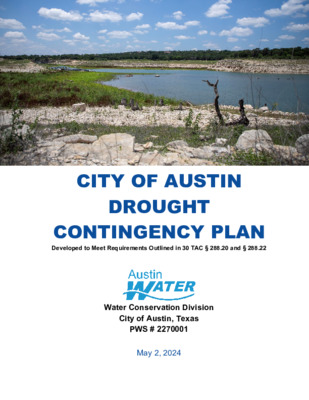
CITY OF AUSTIN DROUGHT CONTINGENCY PLAN Developed to Meet Requirements Outlined in 30 TAC § 288.20 and § 288.22 Water Conservation Division City of Austin, Texas PWS # 2270001 May 2, 2024 City of Austin Drought Contingency Plan Table of Contents SECTION I: Declaration of Policy, Purpose and Intent ................... ERROR! BOOKMARK NOT DEFINED. SECTION II: Background ........................................................................ ERROR! BOOKMARK NOT DEFINED. SECTION III: Trigger Conditions and Goals .................................................................................................... 8 SECTION IV: Drought Response Measures .................................................................................................. 11 SECTION V: Wholesale Contract Provisions ................................................................................................ 20 SECTION VI: Public Involvement ..................................................................................................................... 20 SECTION VII: Public Notification and Education ........................................................................................ 21 SECTION VIII: Coordination with Regional Planning Groups (RPG)...................................................... 21 SECTION IX: TCEQ Notification ....................................................................................................................... 21 SECTION X: Plan Review and Updates .......................................................................................................... 21 APPENDIX A: Water Conservation Code ....................................................................................................... 22 APPENDIX B: Water Conservation Penalty Code ........................................................................................ 23 APPENDIX C: Water Use Triggers for Water Use Management Ordinance .......................................... 24 APPENDIX D: Resolutions In Support of Adoption of The Drought Contingency Plan .................... 25 APPENDIX E: Resolution Adopting The 2024 Drought Contingency Plan ........................................... 26 APPENDIX F: Transmittal Letter to Regional Planning Group ................................................................. 27 APPENDIX F: Public Response to November 2023 Survey ........... ERROR! BOOKMARK NOT DEFINED. 1 City of Austin Drought Contingency Plan DROUGHT CONTINGENCY PLAN City of Austin, Texas May 2024 Section I: Declaration of Policy, Purpose and Intent The City of Austin (the City) maintains a decades-long commitment to ensuring a sustainable water supply through demand management measures. The latest update to Austin’s Drought Contingency Plan (the Plan) builds upon this legacy. This iteration of the Plan retains all measures from previous versions while incorporating new strategies to better address droughts in the future. Designed as a comprehensive strategy, the Plan focuses on addressing water shortages and emergencies, with specific attention to domestic water use, sanitation, fire protection, and public well-being. In accordance with Section 11.1272 of the Texas Water Code and Chapter 288 of Title 30 of the Texas Administrative Code, the City regularly updates this plan, underscoring the importance of adaptability to evolving water supply dynamics. This document outlines the City's strategic response to challenges posed by demand surges, infrastructure constraints, and droughts, including historical critical droughts. Through coordination with the Lower Colorado River Authority (LCRA), the Drought Contingency Plans of both the LCRA and the City are consistent in terms of targets and goals. The City’s plan is more proactive, including the implementation activities necessary …
Water Conservation Plan and Utility Profile CITY OF AUSTIN WATER CONSERVATION PLAN Developed to Meet Requirements Outlined in 30 TAC §288.2 and §288.5 May 2, 2024 Page 1 of 50 Water Conservation Plan and Utility Profile Page 2 of 50 Water Conservation Plan and Utility Profile Message from the Director Thank you for your interest in Austin’s most precious natural resource: water. The city was founded in the mid-1800s on the banks of the Colorado River to take advantage of that abundant water resource. Our water supply is just as critical today, but now we face unprecedented challenges: record high temperatures, record low flows into the Highland Lakes, water quality concerns, and continued rapid population growth. Together, we can meet these challenges. The City of Austin’s 100-year Water Forward Integrated Water Resources Plan is focused on water conservation and water use efficiency, as well as strategies to strengthen the diversity of Austin’s water supply. Austin has come a long way over the last decade – in 2023, we used essentially the same amount of water as we did in 2011, despite having 140,000 more residents. But the impacts from climate change require us to become even more water-wise and water-efficient. The update of this Water Conservation Plan is required by the State of Texas every five years to provide short-term strategies to address changing conditions. Even more importantly, the update is a necessary part of the city’s future sustainability. This document describes Austin Water’s conservation initiatives, programs, and projects to help residents and businesses increase their water use efficiency. In addition, it describes how Austin Water is maximizing our water supply from the Highland Lakes through conservation and water reuse. Learn more about what you can do to conserve our most precious resource at AustinWater.org. Shay Ralls Roalson, P.E. Austin Water Director Page 3 of 50 Water Conservation Plan and Utility Profile Table of Contents Executive Summary 5 Conservation Program History 7 Public Education and Information 9 Residential Customer Programs 11 Commercial Customer Programs 15 Regulatory Programs 17 Metering and Water Loss 20 Water Reuse 23 Water Rates 25 Goals for Water Use and Water Loss 26 Utility Profile 30 System Data 35 Appendices 42 Page 4 of 50 Water Conservation Plan and Utility Profile Executive Summary The Texas Commission on Environmental Quality and the Texas Water Development Board require an update to the City of Austin’s Water Conservation Plan …
M E M O R A N D U M TO: Mayor and Council Members THROUGH: Robert Goode, P.E., Assistant City Manager FROM: Shay Ralls Roalson, P.E., Director, Austin Water DATE: April 15, 2024 SUBJECT: Water Conservation and Drought Contingency Plan Updates We would like to share an overview of Austin Water’s upcoming Recommendations for Council Action, which update both the Water Conservation Plan (WCP) and Drought Contingency Plan (DCP), along with related amendments to the City Code to enforce the plans. The Texas Commission on Environmental Quality (TCEQ) requires the City’s WCP and DCP to be updated every five years. Staff have coordinated revisions with changes being made to the Lower Colorado River Authority’s (LCRA) DCP. RECOMMENDED COUNCIL ACTIONS On May 2, 2024, Austin Water is requesting consideration of the following: • • • Approve a resolution adopting the Water Conservation Plan, as required by the TCEQ, and repeal the resolution for the 2019 Water Conservation Plan. Approve a resolution adopting the Drought Contingency Plan, as required by the TCEQ, and repeal the resolution for the 2016 Drought Contingency Plan. Approve an ordinance amending Austin City Code Chapter 2-13, Chapter 6-4, and Chapter 15-9 to codify necessary changes to enact the updated 2024 Water Conservation Plan and Drought Contingency Plan. BACKGROUND The City of Austin’s 100-year Integrated Water Resources Plan, known as Water Forward, includes a number of strategies to provide for a sustainable water future for Austin, including water conservation and water use efficiency, reclaimed water use, like that of the recently adopted GoPurple Program, and strengthening the diversity of Austin’s water supply. While these plans have always served as an important element to water conservation and water supply planning, they are increasingly important tools as Austin continues to grow and as our region faces a prolonged drought. Current drought conditions have reduced the combined storage of the Highland Lakes to 43% of the available storage when full. The updated WCP and DCP describe current and additional activities to increase water efficiency and reduce water use. Page 1 of 3 WATER CONSERVATION PLAN The WCP provides a description of the activities by Austin Water to conserve water, both in times of plenty and in scarcity. Activities include customer education, incentives, and enforcement; water loss reduction activities; and water reuse, both centralized reclaimed and onsite. In addition to current and expanded conservation activities, the WCP includes goals for 5- …
2024 Updates to the Water Conservation and Drought Contingency Plans Water Forward Task Force – April 25, 2024 Kevin Kluge, Water Conservation Manager Agenda Going Forward • Water Conservation • Reclaimed Water • Water Loss Control Water Conservation Plan – Program Results 2019-2023 Water Conservation Plan – Goals for 2029 and 2034 • Per-Person Use (GPCD or Gallons Per Capita Daily) • Water Loss (GPCD and Infrastructure Leakage Index) Drought Contingency Plan – Overview 2 Going Forward May 2024 - Seek Council adoption of the WCP and DCP and submit to the TCEQ Summer 2024 – implement conservation activities and review WCP in conjunction with the 2024 Water Forward Plan development November 2024 - Submit a revised WCP to Council with the 2024 Water Forward Plan 3 Water Conservation Plan Program Results 2019-2023 4 Water Conservation Residential Customer Programs Household Material Distribution Residential Irrigation Audits Go Repair! and Plumbing Program Austin Energy All-Star Conservation Kits 5 Water Conservation Residential Incentive Programs 6 Water Conservation Commercial Incentive Programs Bucks for Business • Performance-based: $1 per 1,000 gallons saved over 10 years • Examples: high-efficient fixtures, cooling systems, reusing high quality rinse water • Program resurgence: In Fiscal Year 2024, 18 applications, saving 16.4 million gallons, plus up to 10 more by end of the fiscal year 7 Reclaimed Water & Onsite Water Reuse Over 160 customers using reclaimed water Recent Go Purple program • Requirements for reclaimed connections and onsite water reuse systems • Incentives for reclaimed connections and onsite water reuse systems • Funding sources Voluntary reclaimed connection incentives 8 Water Loss Control Leak detection: line annually mains • Acoustic technology inspects > 500 miles of • Smart ball technology for large transmission “Renewing Austin” program targets aging lines for replacement My ATX Water meter replacement 9 2021 Review of production meters 2023 – External review of water loss activities, final report in June 2024 Water Conservation Plan Goals for 2029 and 2034 Total Gallons Per Capita Daily (GPCD) Residential GPCD Water Loss GPCD Infrastructure Leakage Index (ILI) 10 Req. Savings (MG) 2,199 5,888 2,917 6,182 123 116 121 115 119 3,900 106 10,818 Goal GPCD 2029 Goal (0.75%) 2034 Goal (1.25%) 2029 Goal (1%) 2034 Goal (1%) 2029 Goal (WCP19 2024 Goal) 2034 Goal (WCP19 2029 Goal) Recommended Goals …
4/25/2024 Subject: Water Forward Task Force Support for Water Conservation Plan and Drought Contingency Plan Dear Austin City Council, As members of the Austin Integrated Water Resource Planning Community (Water Forward) Task Force, we would like to express our support for approval of the Water Conservation Plan and Drought Contingency Plan for the City of Austin, to be considered at the May 2nd City Council meeting. These plans are important documents, particularly given the current drought conditions in the Highland Lakes watersheds and the ongoing work needed to advance the City’s water conservation initiatives. The updated Water Conservation Plan and Drought Contingency Plan outline programs, measures, and requirements aimed at promoting efficient water use, reducing water waste, and enhancing our ability to respond effectively to drought conditions in the short term. Furthermore, these plans align with the City's broader objectives of promoting environmental stewardship, fostering economic prosperity and affordability, and safeguarding the well-being of our residents. As members of the Water Forward Task Force, we believe that intentional effort will be required by Austin Water to achieve and preferably surpass the five- and ten-year water savings goals and drought stage water use reduction targets set in these plans. We support the City placing continued strong emphasis and focus on water conservation, water-loss mitigation, and water reuse program implementation as well as water use restriction enforcement in pursuit of these goals. By approving these plans, the Austin City Council will reaffirm its commitment to proactive water management while emphasizing the need to strengthen current and future water conservation programs. Moreover, it will demonstrate leadership in addressing the pressing challenges posed by the current drought and climate change, both of which have significant implications for our region's long-term viability. With Central Texas experiencing prolonged periods of drought, it is key that we adopt comprehensive strategies to conserve our precious water resources and mitigate the impacts of water scarcity. Thank you for your attention to this matter, and we look forward to your favorable consideration. Sincerely, AUSTIN INTEGRATED WATER RESOURCE PLANNING COMMUNITY TASK FORCE Jennifer Walker, Chair
AUSTIN INTEGRATED WATER RESOURCE PLANNING COMMUNITY TASK FORCE SPECIAL CALLED MEETING MINUTES THURSDAY, April 25, 2024 The Austin Integrated Water Resource Planning Community Task Force convened in a Special Called Meeting on April 25, 2024, with Social Distancing Modifications. Chair WALKER called the meeting to order at 1:07 pm. Members in Attendance: Jennifer Walker, Chair Robert Mace, Vice Chair Paul DiFiore Madelline Mathis Ex-Officio Members in Attendance: Kevin Critendon Members in Attendance Remotely: Sarah Faust Hani Michel Bill Moriarty Perry Lorenz Vanessa Puig-Williams Austin Water Staff: Teresa Lutes Kevin Kluge Marisa Flores Gonzalez Emily Rafferty Helen Gerlach Randi Jenkins Shay Ralls Roalson Jose Emperador Charles Celauro The City of Austin is committed to compliance with the American with Disabilities Act. Reasonable modifications and equal access to communications will be provided upon request. Meeting locations are planned with wheelchair access. If requiring Sign Language Interpreters or alternative formats, please give notice at least 2 days (48 hours) before the meeting date. Please contact Austin Integrated Water Resource Planning Community Task Force liaison Emily Rafferty at 512-972-0427, for additional information; TTY users route through Relay Texas at 711. Page 1 of 2 Others in Attendance: Mose Buchele, KUT Atha Phillips, MPT Pool PUBLIC COMMUNICATION: GENERAL None APPROVAL OF MINUTES 1. Approval of the meeting minutes from the April 15, 2024, Task Force meeting. The minutes from the March 5th meeting were approved on Member DIFIORE’S motion and Member MICHEL’S second on an 9-0 vote. STAFF BRIEFINGS, PRESENTATIONS, AND/OR REPORTS 2. Staff update on Austin’s Drought Contingency Plan and Water Conservation Plan updates The presentation was made by Kevin Critendon, P.E., P.M.P., Assistant Director, Environmental Planning and Development Services, Austin Water, Kevin Kluge, Division Manager, Water Conservation, Austin Water, and Shay Ralls Roalson, Director, Austin Water. VOTING ITEMS 3. Approve a letter from the Water Forward Task Force to the Austin City Council regarding the Austin’s Drought Contingency Plan and Water Conservation Plan updates No action was taken. Chair WALKER adjourned the meeting at 3:08pm. The minutes were approved at the May 14th, 2024, meeting on Paul DiFiore’s motion, Madelline Mathis’ second on a 9-0 vote with one vacancy. Task Force Member Sarah Faust absent. The City of Austin is committed to compliance with the American with Disabilities Act. Reasonable modifications and equal access to communications will be provided upon request. Meeting locations are planned with wheelchair access. If requiring Sign Language Interpreters …
SPECIAL CALLED MEETING of the ZERO WASTE ADVISORY COMMISSION APRIL 24, 2024, 6:00 PM AE HEADQUARTERS, Assembly Room 1111a 4815 Mueller Blvd Austin, TX 78723 Some members of the BOARD/COMMISSION may be participating by videoconference. The meeting may be viewed online at: http://www.austintexas.gov/page/watch-atxn-live Public comment will be allowed in-person or remotely via telephone. Speakers may only register to speak on an item once either in-person or remotely and will be allowed up to three minutes to provide their comments. Registration no later than noon the day before the meeting is required for remote participation by telephone. To register to speak remotely, please reach out to Gustavo Valle at Gustavo.Valle@AustinTexas.gov (512.974.4350) or Claudia Quiroz at Claudia.Quiroz@AustinTexas.gov (512.974.1987). CURRENT BOARD MEMBERS/COMMISSIONERS: Amanda Masino Mayor Madeline Jasper District 1 Melissa Rothrock District 2 Katrina Scheihing District 3 Melissa Caudle District 4 Caitlin Griffith District 5 Cathy Gattuso District 6 Craig Nazor District 7 Ian Steyaert (Vice-Chair) District 8 Gerry Acuna (Chair) District 10 AGENDA CALL TO ORDER PUBLIC COMMUNICATION: GENERAL The first 3 speakers signed up no later than noon the day before the meeting will each be allowed a three-minute allotment to address their concerns regarding items not posted on the agenda. 1. 2. 3. 4. APPROVAL OF MINUTES DISCUSSION ITEMS Approve the minutes of the ZERO WASTE ADVISORY COMMISSION REGULAR MEETING on February 7, 2024. Presentation and Discussion of Austin-Travis County Food Plan – Sergio Torres-Peralta Review and Discussion of Director’s Report (FEMA Reimbursement, Refuse, Recycling, and Organic Carts (CO-OP), Brownie Follow-Up, Brandt Road Encampment Cleanup, Onion Creek Street Sweeping, Performance Reports, and Statistical Reports) – Richard McHale Presentation and Discussion FY25 Budget –Victoria Rieger DISCUSSION AND ACTION ITEMS 5. 6. 7. Approve a recommendation for Zero Waste Youth Education Program – Keri Greenwalt Approve a recommendation for Northeast Service Center Negotiations – Richard McHale Approve a recommendation for Administrative Rules City Code Revisions RCA –Richard McHale FUTURE AGENDA ITEMS Presentation of Equity-Based Preservation Plan – Cara Bertron ADJOURNMENT The City of Austin is committed to compliance with the Americans with Disabilities Act. Reasonable modifications and equal access to communications will be provided upon request. Meeting locations are planned with wheelchair access. If requiring Sign Language Interpreters or alternative formats, please give notice at least two days (48 hours) before the meeting date. Please call Gustavo Valle at Austin Resource Recovery Department (ARR), at (512.974.4350) for additional information; TTY users’ route …
A Food Plan for Austin-Travis County Find your seat at the table Some Food for Thought Developing a Food Plan What is a Food Plan & why do we need one? ● A Food Plan sets clear Goals and Strategies to move toward a more equitable, sustainable & resilient food system ● The Food Plan builds on several other initiatives made by the County, City, and Communities to tackle key food system issues. ● The Food Plan centers equity and the lived expertise of those most impacted by the current food system Good to Know ● On June 2021 Austin City Council directed the City Manager to initiate a planning process ● Travis County Commissioners Court approved formal participation in the plan in fall 2022 ● A draft was released on March 18th , and has been reviewed by hundreds of community members. Link to full resolution Project Timeline Phase 0: Planning for the Plan Phase 1: Vision Development Phase 2: Goal & Strategy Development Phase 3: Review and Ground truthing September 2021 - January 2023 March - August 2023 September 2023 - February 2024 February - Summer/Fall 2024 We are here ● ● ● ● Building Community Awareness 📰 Release of State of the Food System Report 📚 Onboarding Planning Consultant⭐ Recruitment of Community Teams🚀 ● Website launch 📶 ● World Cafe’s ☕ ● ● ● ● Listening Sessions & Tabling at events 📞 Equity Grounding Workshops 🤝 Community Circles 👐 Selecting Issue Area Groups🍽 ● ● ● ● Issue Area Group Meetings 🏘 Develop Goals and Strategies 🎯 Review Goals and Strategies Develop a draft for the Food Plan 🖊 ● ● ● ● Community Review of Plan 👀 Council and Commissioner Review ⚖ Approval 👍 Adoption 🏁 Co-creating the plan ● Planning Team: Coordinating and managing all moving parts ○ Includes: ■ ■ ■ ■ ■ ■ City of Austin staff Travis County staff Consultant Team Equity Consultants Austin Travis Food Policy Board Executive Leadership Team ● Community Advisory Committee: Advisory body overseeing the planning process ● Issue Area Groups: Developing goals and strategies for the plan ● Community Food Ambassadors: Connecting the plan to our communities ● Broader community feedback: Provide input at different stages of the plan Food Plan Structure ● Vision: Describes and articulates our shared aim - the kind of future we agree we would like to move toward together. ● Objectives: …
Zero Waste Advisory Commission February Meeting Minutes February 07, 2024 The Meeting of the Zero Waste Advisory Commission (ZWAC) convened at AE Headquarters and through Video Conference on Wednesday, February 7th, 2024. The following are the meeting highlights. For detailed information please visit: https://austintx.new.swagit.com/videos/297047 CALL TO ORDER Chair Gerry Acuna called the Commission Meeting to order at 6:00 pm Board Members in Attendance: Gerry Acuna, Melissa Caudle, Craig Nazor, Madeline Jasper, Ian Steyaert & Melissa Rothrock. Board Members not in Attendance: Amanda Masino, Caitlin Griffith, Cathy Gattuso, & Katrina Scheihing Staff in attendance: Richard McHale, Gena McKinley, Ron Romero, Amy Slagle, Donald Hardee, Jason McCombs, Victoria Rieger, Marcus Gonzalez, Samuel Gilbert, Andy Dawson, Yahel Baranovicht and Gustavo Valle. 1. Approval of the November 8th, 2023, Meeting Minutes (00:32) Chair Acuna entertained a motion for approval from Commissioner Nazor, seconded by Commissioner Caudle. Unanimous approval with a 6-0 vote. 2. Presentation and Discussion of Litter Abatement Programs – Sam Gilbert (03:06) Acting Division Manager Sam Gilbert with Austin Resource Recovery (ARR) presented ongoing Litter Abatement Programs. These include the Violet Bag Program, Violet Keepsafe Storage Program, Homeless H.E.A.L. (Housing-focused Encampment Assistant Link) Sites, Clean Creeks Program, Litter Control Program, Keep Austin Beautiful Program & Encampment Cleanups. Such initiatives are carried out in collaboration with other city departments like Transportation & Public Works and Parks and Recreations Department. I. II. Commissioners, staff, and stakeholders reviewed and discussed current Litter Abatement Programs. Commissioner Nazor inquired whether the city would implement single use plastic ordinance since they are found in great numbers at creeks. There are no current plans to implement such ordinances. Commissioner Acuna asked whether it was possible to increase the number of employees working in the Litter Abatement programs, specifically Homeless Encampment Cleanups. Director Richard McHale commented that Austin Resource Recovery is having ongoing budget discussion and would visit the matter. Commissioner Caudle asked about the status of the Zero Waste Rebate program. Division Manager Jason McCombs of Strategic Initiatives said that he would need to locate the data since he did not have concrete numbers at the time. Further, McCombs explained that while the numbers of businesses participating in the program have been steadily increasing since the pandemic, Strategic Initiatives continues to advertise the program as much as possible. 3. Presentation and Discussion of Household Hazardous Waste (HHW) Door-to-Door Pilot – Andy Dawson (27:09) Assistant Division Manager Andy Dawson with …
To: From: Date: Zero Waste Advisory Commission Richard McHale, Director, Aus�n Resource Recovery April 24, 2024 Subject: Director’s Monthly Report to the Zero Waste Advisory Commission Number of customers (under ARR service) that have four units or less that don’t have recycling and composting. Commissioner Melissa Caudle inquired the current number of ARR customers with four units or less that do not have recycling and composting. We have identified that 335 of our multifamily residents currently don’t receive recycling services and 366 residents don’t receive composting services. These customers receive dumpster services for trash disposal and are scheduled to receive carts for recycling and compost services. Follow up on Brownie The area has improved since implementa�on. Recycling on the north side of Brownie has a high compliance rate for recycling materials with litle to no contamina�on, however we are s�ll seeing some contamina�on on the south cul-de-sacs. Compos�ng in the area has had high rates of contamina�on. During collec�ons, opera�ons teams have been sor�ng materials to iden�fy contaminants. Compost employees are not sor�ng through the materials. Contaminants are easily iden�fiable (rigid plas�cs, garden hoses, bicycle �res, trash bags and aluminum are being placed in compost carts). Compost carts are periodically being collected and disposed of as garbage. Average weights are 1300-1500 pounds a�er collec�ng nearly 100% of the carts at 4- plexas on Brownie and providing tags to educate and no�fy the customer of the contamina�on. Landfill waste has also seen improvement, with no bulk set out since the most recent bulk pick up the week of January 15, 2024. There is s�ll extra landfill trash set out, however we are seeing improvement overall. AAR/APD Brandt Road Cleanup The morning of March 4th, ARR was no�fied by Aus�n Police Department’s Rapid Response that abatement would need to be performed at a homeless encampment on Brandt Road. ARR aids APD with the immediate removal of encampments that pose a risk to public safety. The encampment along Brandt Road is at-risk to floods and fires. During the Brandt Road encampment cleanup, ARR crews removed approximately 76 tons of debris from the encampment. The debris collected during the two-day cleanup on March 4th and 5th equates to nearly 5-6 semi-automated residential refuse routes. Onion Creek Street Sweeping ARR Street Cleaning programs provide cleaning of bike lanes, boulevards, downtown and residen�al streets throughout the city. In doing so, the programs rely heavily on temporary …
A Food Plan for Austin-Travis County Find your seat at the table Some Food for Thought Developing a Food Plan What is a Food Plan & why do we need one? ● A Food Plan sets clear Goals and Strategies to move toward a more equitable, sustainable & resilient food system ● The Food Plan builds on several other initiatives made by the County, City, and Communities to tackle key food system issues. ● The Food Plan centers equity and the lived expertise of those most impacted by the current food system Good to Know ● On June 2021 Austin City Council directed the City Manager to initiate a planning process ● Travis County Commissioners Court approved formal participation in the plan in fall 2022 ● A draft was released on March 18th , and has been reviewed by hundreds of community members. Link to full resolution Project Timeline Phase 0: Planning for the Plan Phase 1: Vision Development Phase 2: Goal & Strategy Development Phase 3: Review and Ground truthing September 2021 - January 2023 March - August 2023 September 2023 - February 2024 February - Summer/Fall 2024 We are here ● ● ● ● Building Community Awareness 📰 Release of State of the Food System Report 📚 Onboarding Planning Consultant⭐ Recruitment of Community Teams🚀 ● Website launch 📶 ● World Cafe’s ☕ ● ● ● ● Listening Sessions & Tabling at events 📞 Equity Grounding Workshops 🤝 Community Circles 👐 Selecting Issue Area Groups🍽 ● ● ● ● Issue Area Group Meetings 🏘 Develop Goals and Strategies 🎯 Review Goals and Strategies Develop a draft for the Food Plan 🖊 ● ● ● ● Community Review of Plan 👀 Council and Commissioner Review ⚖ Approval 👍 Adoption 🏁 Co-creating the plan ● Planning Team: Coordinating and managing all moving parts ○ Includes: ■ ■ ■ ■ ■ ■ City of Austin staff Travis County staff Consultant Team Equity Consultants Austin Travis Food Policy Board Executive Leadership Team ● Community Advisory Committee: Advisory body overseeing the planning process ● Issue Area Groups: Developing goals and strategies for the plan ● Community Food Ambassadors: Connecting the plan to our communities ● Broader community feedback: Provide input at different stages of the plan Food Plan Structure ● Vision: Describes and articulates our shared aim - the kind of future we agree we would like to move toward together. ● Objectives: …
City of Austin Recommendation for Action File #: 24-4288, Agenda Item #: 3. 5/2/2024(cid:4) Posting Language Approve an ordinance amending City Code Section 15-6-3 (Administration) relating to the process for adoption of administrative rules related to solid waste services. Lead Department Austin Resource Recovery. Fiscal Note This item has no fiscal impact. Prior Council Action: June 28, 2012 - City Council amended City Code Chapter 15-6 (Solid Waste Services) in Ordinance No. 20120628-012 to require all proposed rules from Austin Resource Recovery to be approved, modified, or disapproved by City Council. For More Information: Richard McHale, Director, 512-974-1997; Gena McKinley, Assistant Director, 512-974-2192 Additional Backup Information: BACKGROUND In 2012, City Council amended Subsection (B) of City Code Section 15-6-3 (Administration) to add the following underlined language: Before the director may adopt or amend a rule under this chapter, the director shall present the proposed rule to the Zero Waste Advisory Commission for consideration and recommendation to City Council and the City Council will approve, modify or disapprove of the proposed rule. Administrative rules are created and adopted by the City Manager in accordance with Chapter 1-2 (Adoption of Rules) to administer the policies established by the City Council. City Code Chapter 1-2 establishes the City’s administrative rule adoption process for all City departments. This process requires public posting of proposed rules, a public comment period, and an appeals process to the City Manager. Austin Resource Recovery (ARR) operates under the unique requirements of City Code Section 15-6-3, requiring administrative rules to be approved, modified, or disapproved by City Council. AMENDMENT This amendment to Subsection (B) of City Code Section 15-6-3 is intended to align ARR’s rulemaking procedures with the existing policies established by City Code and reduce the administrative burden on appointed officials, City Council, and City staff. The amendment to Subsection (C) of City Code Section 15-6-3 deletes the term “customer” to be inclusive of City of Austin Page 1 of 2 Printed on 4/19/2024 powered by Legistar™ (cid:5) (cid:6) File #: 24-4288, Agenda Item #: 3. 5/2/2024(cid:4) the public and not limit requests to those individuals receiving City services. STAFF RECOMMENDATION Staff recommends adoption of these amendments to City Code Section 15-6-3. ARR would follow the process established in City Code Chapter 1-2 for the rule adoption process. City of Austin Page 2 of 2 Printed on 4/19/2024 powered by Legistar™ (cid:5) (cid:6)
Zero Waste Advisory Commission April Meeting Minutes April 24, 2024 The Meeting of the Zero Waste Advisory Commission (ZWAC) convened at AE Headquarters and through Video Conference on Wednesday, February 7th, 2024. The following are the meeting highlights. For detailed information please visit: https://austintx.new.swagit.com/videos/303845 CALL TO ORDER Chair Gerry Acuna called the Commission Meeting to order at 6:11 pm Board Members in Attendance: Gerry Acuna, Melissa Caudle, Craig Nazor, Cathy Gattuso, Ian Steyaert, Melissa Rothrock, Caitlin Griffith, and Amanda Masino. Board Members not in Attendance: Madeline Jasper, & Katrina Scheihing Staff in Attendance: Richard McHale, Theodore Horton, Gena McKinley, Ron Romero, Amy Slagle, Jason McCombs, Victoria Rieger, Marcus Gonzalez, Keri Greenwalt, Elizabeth Nelson, Claudia Quiroz, and Gustavo Valle. 1. Approval of the April 24th, 2024, Meeting Minutes (00:38) Chair Acuna entertained a motion for approval from Commissioner Nazor, seconded by Commissioner Gattuso. The board approved the minutes in a 6-0 vote with Commissioner Masino abstaining. 2. Approve a recommendation for Zero Waste Youth Education Program – Keri Greenwalt (01:40) PIO Program Manager Keri Greenwalt with Austin Resource Recovery (ARR) requested ZWAC’s recommendation for the Zero Waste Youth Education Program contract renewal. The contract will provide students from kindergarten through 12th grade an interactive and educational outreach program that focuses on zero waste concepts and sustainability in support of Austin's Zero Waste Initiative. Keri explained that if the contract was not awarded, ARR will miss the opportunity to provide consistent engaging programs to young austinites through their schools and community groups. The current contract is set to expire on June 16th, 2024 and the recommended contractor is the current contractor (Keep Austin Beautiful). I. II. III. Commissioners, staff, and stakeholders reviewed and discussed the current Zero Waste Youth Education Program. Commissioner Nazor asked what the cost of the former contract was. Keri replied that was approximately $878,000. Commissioner Nazor also wanted clarification on who the previous contractor was. Keri explained that it was KAB (Keep Austin Beautiful) Commissioner Masino asked where the supporting documentation was. Keri noted that she was out of office and believed she had supplied the office with them. However, Keri mentioned she currently had the supporting documents and can share them with the board. While Commissioner Mansion acknowledged that the current vendor has done an excellent job, she wants time to review the supporting documents out of due diligence. Since the item is going to council on …
JOINT SUSTAINABILITY COMMITTEE HYBRID MEETING FORMAT April 24th, 2024 at 6pm Room 1406, Permitting and Development Center 6310 Wilhelmina Delco Dr, Austin, TX 78752 Some members of the Committee may be participating by videoconference Public comment will be allowed in-person or remotely via telephone. Speakers may only register to speak on an item once either in-person or remotely and will be allowed up to three minutes to provide their comments. Registration no later than noon the day before the meeting is required for remote participation by telephone. To register to speak remotely, call or email Rohan Lilauwala at (rohan.lilauwala@austintexas.gov or 512-974-9394). CURRENT BOARD MEMBERS: Kaiba White, Chair (Electric Utility Commission) Diana Wheeler, Vice Chair (Urban Transportation Commission) Charlotte Davis (Resource Mgmt. Commission) Haris Qureshi (Environmental Commission) Melissa Rothrock (Zero Waste Advisory Commission) Bertha Delgado (Community Development Commission) Larry Franklin (Austin Travis County Food Policy Board) Chris Maxwell-Gaines (Water & Wastewater Commission) Amy Noel (Economic Prosperity Commission) Stephanie Bazan (Parks & Recreation Board) Jon Salinas (Design Commission) Vacant (City Council) Alice Woods (Planning Commission) Rodrigo Leal (Mayor’s Representative) Anna Scott (Mayor’s Representative) Heather Houser (Mayor’s Representative) Yureisly Suarez (Mayor’s Representative) Christopher Campbell (Mayor’s Representative) For more information, please visit: www.austintexas.gov/jsc AGENDA CALL TO ORDER PUBLIC COMMUNICATION: GENERAL The first 10 speakers signed up prior to the meeting being called to order will each be allowed a three-minute allotment to address their concerns regarding items not posted on the agenda. APPROVAL OF MINUTES 1. Approval of minutes from the March 27, 2024 meeting of the Joint Sustainability Committee. DISCUSSION AND ACTION ITEMS 2. Conduct Joint Sustainability Committee Officer Elections for the 2023-2024 Term. DISCUSSION 3. Staff update to the Environmental Investment Plan process to create recommendations – Zach Baumer, Office of Sustainability. 4. UT-City Climate CoLab – Structure, Priorities, and Potential Research Areas - Dev Niyogi, University of Texas-Austin. 5. Joint Sustainability Committee discussion of approach and recommendations on the Environmental Investment Plan. FUTURE AGENDA ITEMS ADJOURNMENT The City of Austin is committed to compliance with the American with Disabilities Act. Reasonable modifications and equal access to communications will be provided upon request. Meeting locations are planned with wheelchair access. If requiring Sign Language Interpreters or alternative formats, please give notice at least 2 days (48 hours) before the meeting date. Please contact Rohan Lilauwala at rohan.lilauwala@austintexas.gov or 512-974-9394 for additional information; TTY users’ route through Relay Texas at 711. For more …
Benefit Cost $202.5M, 100% Covered by TCEQ Need to apply for grant funding ASAP: $240 million for trucks; ~$200,000 per charger ($60 million) $10-15+ million one time and $5+ million per year Nearly 1 million (968,400) tons CO2 emissions avoided. air pollution reduction (health benefits), reduced maintenance, lower heat exposure for ARR workers (better AC during hot weather) GHG reduction, plastic pollution reduction, reduce need for new landfill, local economic development, save on ARR tipping fees Consumption Working Group Environmental Plan Proposals Austin JSC April 22, 2024 Proposal ARR Fleet Electrification: Replace all 300 heavy duty Austin Resource Recovery vehicles (flatbed trucks and refuse trucks) with electric vehicles. Install appropriate heavy-duty charging infrastructure to charge these vehicles. Plan: Austin Climate Equity Plan. Circular economy & waste reduction programs • Zero Waste Business Incentives and Rebates: This program provides incentives to businesses to reduce waste, including switching from plastic or styrofoam containers to reusable or compostable. Current program provides a one-time incentive up to $3,000 and is only providing about $5,000/year. The incentive should be restructured to help businesses address ongoing costs (multi-year incentive) and funding should be allocated for additional staff to do outreach to businesses (including all restaurants) ($1 million/year). • ARR zero waste education: Expand to reach the full Austin community, not just ARR customers, including with a paid canvassing team. (increase from $410,000/yr to $4 million/year) • Furniture collection for Reuse Warehouse: Current plan is for drop-off only. Funds are needed to enable pick-up to increase diversion from landfill. ($) • Deconstruction Warehouse: To divert salvaged construction materials from the landfill. ($10-15 million) • Fix-it Clinics: Expand and host more ($500,000/year), • Circular Austin Accelerator and Circular Austin Showcase competition: Expand outreach and an increased number and value of awards for competition winners would increase effectiveness in building a circular economy in Austin. (increase from $ to $); • MoveOutATX: Increase number of events (increase from $/year to $/year); Plan: Austin Resource Recovery Comprehensive Plan & Austin Climate Equity Plan (Food and Product Consumption Goal 2, Strategy 4) Low-carbon concrete fund: Concrete represents the largest of Austin’s purchasing emissions, with potential surcharges for truly carbon neutral cement ranging as high as an additional $18/cubic yard, but with costs falling as new technology scales up. This fund would pay for additional testing, program fees, and surcharges to cover both city and non-city owned buildings of 1.1 M cubic …
Sustainable Buildings WG Recommendations for Environmental Investment Plan 1. Transition Austin Community to Clean Renewable Energy - community wide programs a. Expand energy efficiency programs i. Details: Building Envelope, Air Sealing, heating and cooling, LED lighting, ii. Hot Water, Appliances Benefits: Improved health and safety of buildings and their occupants, Increased building life, Measure building performance, Create an order high need properties, reduced bills iii. Cost: AE budget is $13.6 million/year for existing programs. Goal should be to double this dollar amount to $27.2 million/year. These costs will be offset by reduced AE energy purchases, ancillary services purchases, and transmission costs. b. Expand demand response programs i. Details: Expand price-based demand response programs. Define ‘demand response ready’. Sectors impacts: Buildings, Industry, Transport. Electric hot water tank programs, thermostats, home energy managements systems, commercial and residential battery storage, electric vehicle smart chargers, smart meters Benefits: Automate demand response, improve grid resiliency, reduce peak demand costs, Essential to NetZero goals, leverage current energy crisis ii. iii. Cost: AE budget is $3.6 million/year for existing programs. AE budget should quadruple to $14.4 million/year. These costs will be offset by reduced AE energy purchases when ERCOT prices are high. c. Invest in utility scale battery energy storage i. Details: Battery storage is an important part of a decarbonized grid. Decentralized batteries on resilience hub buildings, school and supportive housing can be used as a virtual power plant (VPP) to help with load shifting during normal use and provide critical resiliency backup energy during outage events. Longer term heat batteries can decarbonize industrial facilities throughout Austin by soaking up excess solar and wind during curtailment and putting energy into those industrial uses, which allows much higher penetration of renewables. Antora, another heat battery system can re-export electricity through its TPV tech. Benefits: Faster grid decarbonization through demand curve flattening and responding to electricity pricing; greater resilience; cheaper, cleaner energy. ii. iii. Cost: Using the average cost of 4-hr duration batteries provided by AE ($1,168/kW), 200 MW would cost $233.7 million. Using the average cost of 8-hr duration batteries provided by AE ($1,992/kW), 400 MW would cost $797 million. Using the average cost of 100-hr duration batteries provided by AE ($2,150/kW), 100 MW would cost $215 million. The combined 700 MW battery investment would cost $1,245.7 million. These costs would be recovered by earnings in the ERCOT energy and ancillary services markets. Heat battery pilots could …
DRAFT Joint Sustainability Commission Transportation, Land Use, and Electrification Environmental Investment Plan Recommendations Recommendation Description: Expand All Ages and Abilities Bicycle Network, Urban Trails, Sidewalks, and Shared Mobility The JSC recommends the City of Austin (COA) invest a total of $2.11 billion to expand the number of Metro Bike stations and to build out the All Ages and Abilities (AAA) Bicycle Priority Network, the Tier One Urban Trails network, and sidewalks and shared streets as recommended in the Urban Transportation Commission's "Climate Equity Investment" Recommendation 20240305-006. We recommend the following specific investments: 1. $48,960,000 to build out an additional 148 miles of the AAA Bicycle Priority Network and meet the 2023 Bike Plan Goal of 380 miles built out by 2026. Projects should be selected using the project prioritization model in the 2023 Bicycle Plan, which scores projects based on equity, destinations & travel demand, connectivity & safety, and cost. Relevant plan sections: Austin Strategic Mobility (ASMP) Bicycle Policy 2, Austin Climate Equity Plan (ACEP) Transportation and Land Use (TLU) Goal 3, and 2023 Bike Plan Item 4.7.la. 2. $22,600,000 to build out an additional 200 Metro Bike Stations to reach the 2023 Bike Plan goal of 300 stations by 2025. The investment should prioritize new stations in low-income areas with high mobility needs and connections to CapMetro's existing high-frequency bus and Metro Rail network. Relevant plan sections: ASMP Shared Mobility Policy 1, ACEP TLU Goal 3, and 2023 Bike Plan Item 4.7.2. 3. $75,826,000 to build out 15.6 miles of Tier One Urban Trails by 2028 and put COA on track to reach the 2023 Urban Trails goal of building all 94 miles of Tier 1 trails by 2043. City Manager should also consider investments to ensure "the Urban Trails Plan is deliver[ing] projects on an accelerated timeline" as the Urban Trails Plan notes doing so is "dependent on increasing internal City of Austin capacity across supporting departments concerning staffing, systems, and the processes for permitting" Urban Trails Plan Section 3.5). Relevant plan sections: See ASMP Urban Trails Policy 2 & 3, ACEP TLU Goal 3, and 2023 Urban Trails Plan Section 3.5. 4. $64,000,000 to build out 136 miles of new sidewalks and 80 miles of shared streets per year through 2028, putting Austin on track to address all "Very High" and "High" priority sidewalks and shared streets within 10 years. Projects in the highest Equity Analysis Zones …
“Environmental Investment Plan” 20240215-025 STATUS UPDATE April 24, 2024 1 Resolution 20240215-025 Reaffirm commitment to net-zero by 2040, act with urgency required to achieve this goal. Solicit community input and prepare options and associated costs of capital improvements or programs that would: 1. Reduce carbon emissions 2. Decrease water usage and improve water quality and detention 3. Advance the sustainability of City Operations, and 4. Improve Community Resilience Post a public hearing of the JSC in March (27) / April (24) to gather input from the public and the Committee is requested to submit any recommendations for investments to Council by May 1 Review whether recommendations can be funded through: - Utility rates - General Fund Expenditures - Grants - General Obligation Bonds (may include Nov 2024) 2 Resolution 20240215-025 In addition to proposals put forth by the JSC, analyze investments needed to fulfill the following adopted plans: - Climate Equity Plan - Water Forward - Watershed Protection Strategic Plan - One Austin: Climate Resilience Action Plan - Austin Strategic Mobility Plan - ARR Comprehensive Plan - AE Resource Generation Plan - PARD Land Management Plan and Long Range Plan - Austin Travis County Wildfire Preparedness Plan - Central Texas Regional Air Quality Plan - Urban Forest Plan - Austin Travis County Food Plan - Green Infrastructure Strengths and Gaps Assessment Analysis should also identify options for fulfilling either all or specific elements of these plans before their current target date. 3 Final Product A list of projects and programs that: 1. Reduce carbon emissions 2. Decrease water usage and improve water quality and detention 3. Advance the sustainability of City Operations 4. Improve Community Resilience For each project or program - General Scope / Description - Aligned with which Plan and Goal - - Approximate Cost - Potential Funding Mechanism Timeline (Short, Medium, Long term) - Utility base rates - General Fund Expenditures - Grants - General Obligation Bonds A Memo with attached Report / Spreadsheet Attachments - JSC and Community Recommendations A Presentation to Council on May 28 4 Process Scoping and Screening Initial review JSC and Public Input Finalization OOS has created a catalog of all goals / strategies in all plans called out in the Resolution Teams + Departments worked on a shared assignment spreadsheet to populate projects and information Departments reviewed their own Plans & Goals - Identified gaps Teams convened to share their findings …
Joint Sustainability Committee RECOMMENDATION 20240XXX-XXX Motioned By: Date: XXX, 2024 Description of Recommendation to Council Subject: Joint Sustainability Committee Environmental Investment Plan Recommendations (Natural Systems) Seconded By: D R A F T 1. Preservation of existing agricultural land: The Joint Sustainability Committee recommends that $XX be allocated to preserve existing agricultural land and increase the amount of farmland using practices that improve soil health through land trusts, land banks, conservation easements and/or other legal or financing mechanisms. a. Details: Develop an inventory of available farmland in Austin/Travis County, conduct appraisals, fund conservation easements and/or incentives for farmers adopting regenerative agricultural practices (TBD but may include cover cropping, crop rotation, no/low-till, mulching, compost application, elimination/ reduction of synthetic pesticide and fertilizer use, etc.) a. Plan alignment: Food Plan Goal 1 and the Climate Equity Plan Natural Systems b. Benefits: Slows the loss of local farmland; improves the quality of locally produced food and protects soil carbon pools. Soils with healthy levels of organic material increase water retention, improve water quality, protect biodiversity, sequester carbon and mitigate greenhouse gas emissions. c. Cost estimate: $TBD for inventory and appraisals (one-time); $TBD per acre for easements (one-time); $TBD for incentives (annual) Goal 2. 2. Revolving loan fund for Working Farms Fund pilot: The Joint Sustainability Committee recommends that $5.5 million be allocated to establish a revolving loan fund to preserve agricultural land in Austin/Travis County through a pilot program that provides a path to ownership for a new generation of farmers and increases the amount of farmland acting as carbon pools. a. Details: A collaboration with the Conservation Funds Working Farms Fund and local agricultural nonprofits will acquire and permanently protect small to mid-sized farms, and provide a pathway for underrepresented farmers to own their own farms b. Plan alignment: Food Plan Goal 1 and the Climate Equity Plan Natural Systems Goal 2. c. Benefits: Slows the loss of local farmland, improves the quality of locally produced food, protects carbon pools, and serves as a template for program replication. d. Cost estimate: $5.25M to establish a revolving loan fund; $250K annually for operational expenses d. Cost: $350K (TBD) real-time response to leaks, solar panel outages etc. and improving management of water and electricity usage in City parks, pools and buildings. 3. Energy and water dashboard for City facilities: The Joint Sustainability Committee recommends that $350K (TBD) be allocated to create a consolidated energy and …