Play video — original link
Play video
Play video
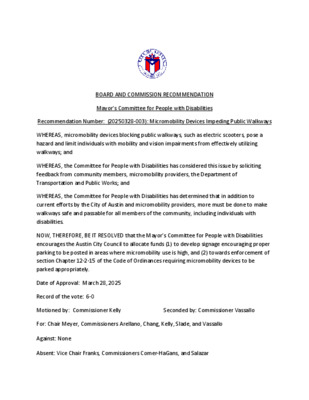
BOARD AND COMMISSION RECOMMENDATION Mayor’s Committee for People with Disabilities Recommendation Number: (20250328-003): Micromobility Devices Impeding Public Walkways WHEREAS, micromobility devices blocking public walkways, such as electric scooters, pose a hazard and limit individuals with mobility and vision impairments from effectively utilizing walkways; and WHEREAS, the Committee for People with Disabilities has considered this issue by soliciting feedback from community members, micromobility providers, the Department of Transportation and Public Works; and WHEREAS, the Committee for People with Disabilities has determined that in addition to current efforts by the City of Austin and micromobility providers, more must be done to make walkways safe and passable for all members of the community, including individuals with disabilities. NOW, THEREFORE, BE IT RESOLVED that the Mayor’s Committee for People with Disabilities encourages the Austin City Council to allocate funds (1) to develop signage encouraging proper parking to be posted in areas where micromobility use is high, and (2) towards enforcement of section Chapter 12-2-15 of the Code of Ordinances requiring micromobility devices to be parked appropriately. Date of Approval: March 28, 2025 Record of the vote: 6-0 Motioned by: Commissioner Kelly Seconded by: Commissioner Vassallo For: Chair Meyer, Commissioners Arellano, Chang, Kelly, Slade, and Vassallo Against: None Absent: Vice Chair Franks, Commissioners Comer-HaGans, and Salazar Attest: Christi Vitela Staff Liaison
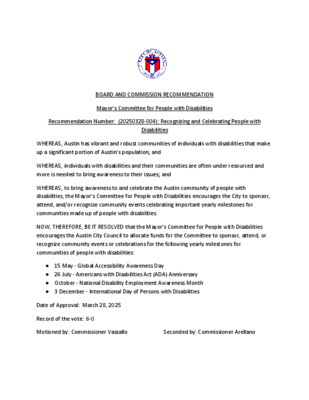
BOARD AND COMMISSION RECOMMENDATION Mayor’s Committee for People with Disabilities Recommendation Number: (20250328-004): Recognizing and Celebrating People with Disabilities WHEREAS, Austin has vibrant and robust communities of individuals with disabilities that make up a significant portion of Austin’s population; and WHEREAS, individuals with disabilities and their communities are often under resourced and more is needed to bring awareness to their issues; and WHEREAS, to bring awareness to and celebrate the Austin community of people with disabilities, the Mayor’s Committee for People with Disabilities encourages the City to sponsor, attend, and/or recognize community events celebrating important yearly milestones for communities made up of people with disabilities. NOW, THEREFORE, BE IT RESOLVED that the Mayor’s Committee for People with Disabilities encourages the Austin City Council to allocate funds for the Committee to sponsor, attend, or recognize community events or celebrations for the following yearly milestones for communities of people with disabilities: ● 15 May - Global Accessibility Awareness Day ● 26 July - Americans with Disabilities Act (ADA) Anniversary ● October - National Disability Employment Awareness Month ● 3 December - International Day of Persons with Disabilities Date of Approval: March 28, 2025 Record of the vote: 6-0 Motioned by: Commissioner Vassallo Seconded by: Commissioner Arellano For: Chair Meyer, Commissioners Arellano, Chang, Kelly, Slade, and Vassallo Against: None Absent: Vice Chair Franks, Commissioners Comer-HaGans, and Salazar Attest: Christi Vitela Staff Liaison
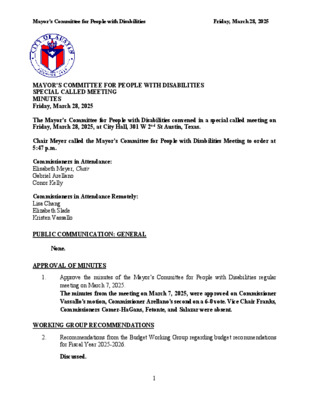
Mayor’s Committee for People with Disabilities Friday, March 28, 2025 MAYOR’S COMMITTEE FOR PEOPLE WITH DISABILITIES SPECIAL CALLED MEETING MINUTES Friday, March 28, 2025 The Mayor’s Committee for People with Disabilities convened in a special called meeting on Friday, March 28, 2025, at City Hall, 301 W 2nd St Austin, Texas. Chair Meyer called the Mayor’s Committee for People with Disabilities Meeting to order at 5:47 p.m. Commissioners in Attendance: Elisabeth Meyer, Chair Gabriel Arellano Conor Kelly Commissioners in Attendance Remotely: Lisa Chang Elizabeth Slade Kristen Vassallo PUBLIC COMMUNICATION: GENERAL None. APPROVAL OF MINUTES 1. Approve the minutes of the Mayor’s Committee for People with Disabilities regular meeting on March 7, 2025. The minutes from the meeting on March 7, 2025, were approved on Commissioner Vassallo’s motion, Commissioner Arellano’s second on a 6-0 vote. Vice Chair Franks, Commissioners Comer-HaGans, Fetonte, and Salazar were absent. WORKING GROUP RECOMMENDATIONS 2. Recommendations from the Budget Working Group regarding budget recommendations for Fiscal Year 2025-2026. Discussed. 1 Mayor’s Committee for People with Disabilities Friday, March 28, 2025 DISCUSSION AND ACTION ITEMS 3. Approve a Budget Recommendation to Council regarding Micromobility Devices Impeding Public Walkways. The motion to approve a Recommendation to Council regarding Micromobility Devices Impeding Public Walkways was approved on Commissioner Kelly’s motion, Commissioner Vassallo’s second, on a 6-0 vote. Vice Chair Franks, Commissioners Comer-HaGans, Fetonte, and Salazar were absent. 4. Approve a Budget Recommendation to Council regarding Recognizing and Celebrating People with Disabilities. The motion to approve a Budget Recommendation to Council regarding Recognizing and Celebrating People with Disabilities was approved on Commissioner Vassallo’s motion, Commissioner Arellano’s second, on a 6-0 vote. Vice Chair Franks, Commissioners Comer-HaGans, Fetonte, and Salazar were absent. FUTURE AGENDA ITEMS Deb Miller – Provisional Ridership Officer Elections Nominations for primary and secondary representatives on the JIC Working Group for COA interview panel priorities list Joint Inclusion Committee update Chair Meyer motioned to adjourn the meeting at 5:54 p.m., Commissioner Vassallo seconded, and was approved without objection, 6-0. Vice Chair Franks, Commissioners Comer-HaGans, Fetonte, and Salazar were absent. The minutes were approved at the April 11, 2025, meeting on Vice Chair Frank’s motion, Commissioner Vassallo’s second on an 8-0 vote. Commissioners Fetonte, Murphy, and Slade were absent. 2
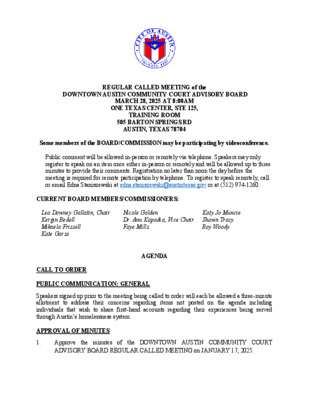
1. REGULAR CALLED MEETING of the DOWNTOWN AUSTIN COMMUNITY COURT ADVISORY BOARD MARCH 28, 2025 AT 8:00AM ONE TEXAS CENTER, STE 125, TRAINING ROOM 505 BARTON SPRINGS RD AUSTIN, TEXAS 78704 Some members of the BOARD/COMMISSION may be participating by videoconference. Public comment will be allowed in-person or remotely via telephone. Speakers may only register to speak on an item once either in-person or remotely and will be allowed up to three minutes to provide their comments. Registration no later than noon the day before the meeting is required for remote participation by telephone. To register to speak remotely, call or email Edna Staniszewski at edna.staniszewski@austintexas.gov or at (512) 974-1260. CURRENT BOARD MEMBERS/COMMISSIONERS: Lea Downey Gallatin, Chair Kergin Bedell Mikaela Frissell Kate Garza Nicole Golden Dr. Anu Kapadia, Vice Chair Faye Mills Katy Jo Muncie Shawn Tracy Roy Woody AGENDA CALL TO ORDER PUBLIC COMMUNICATION: GENERAL Speakers signed up prior to the meeting being called to order will each be allowed a three-minute allotment to address their concerns regarding items not posted on the agenda including individuals that wish to share first-hand accounts regarding their experiences being served through Austin’s homelessness system. APPROVAL OF MINUTES the minutes of Approve ADVISORY BOARD REGULAR CALLED MEETING on JANUARY 17, 2025. the DOWNTOWN AUSTIN COMMUNITY COURT DISCUSSION ITEMS Expanded Mobile Crisis Outreach Team (EMCOT) and Therapeutic Diversion Program (TDP) presentation and discussion (Downey Gallatin/Kapadia) – Marisa Malik, Integral Care Status of DACC operational areas including performance measures and services delivered through Community Services, Court Services, Homeless Services and Support Services (Downey Gallatin/Kapadia) – Robert Kingham, Court Administrator, DACC ACTION ITEMS Approve Fiscal Year 2025-26 Budget recommendations related to DACC case management services and community programs (Downey Gallatin/Kapadia) – Lea Downey Gallatin, DACC Advisory Board Chair ADJOURNMENT The City of Austin is committed to compliance with the American with Disabilities Act. Reasonable modifications and equal access to communications will be provided upon request. Meeting locations are planned with wheelchair access. If requiring Sign Language Interpreters or alternative formats, please give notice at least 2 days (48 hours) before the meeting date. Please call Edna Staniszewski at Downtown Austin Community Court, at (512) 974-1260), for additional information; TTY users route through Relay Texas at 711. For more information on the Downtown Austin Community Court Advisory Board, please contact Edna Staniszewski at (512) 974-1260 or at edna.staniszewski@austintexas.gov. 2. 3. 4.
Integral Care Programs: Expanded Mobile Crisis Outreach Team (EMCOT) and Therapeutic Diversion Program (TDP) Marisa A. Malik, LPC Director of Crisis and Justice Initiatives Expanded Mobile Crisis Outreach Team • Program Serves: Individuals experiencing a mental health crisis referred by first responders, Travis County jail personnel, and EMCOT clinicians integrated at Combined Transportation, Emergency & Communications Center • Brief Description: Focused on diverting jail bookings and emergency department admissions and providing short-term community-based interventions and crisis screening, triage and referral to stabilize a psychiatric crisis and link individuals to appropriate services. FY 2024 Performance Measures Integral Care’s EMCOT Timeline 1115 Medicaid Waiver Project (21 FTE) •Provide Telehealth Services •Integrate EMCOT clinicians into 911 Call Center (71 FTE) FY 2025: City of Austin provided one- time six-month funding City of Austin provided additional funding (28.5 FTE) 2019 2021 2013 2020 2025 Funding shifted to local entities (Travis County and City of Austin) City of Austin provided additional funding (48 FTE) •Expand EMCOT clinicians into the 911 Call Center 24/7 Therapeutic Diversion Program (TDP) Program Serves: Individuals experiencing a mental health crisis who are deflected or diverted from the criminal legal system crisis referred by first responders, the Sobering Center, emergency departments and Travis County personnel (jail counseling staff, attorneys, judges). Brief Description: A 25- bed crisis respite facility focused on providing alternatives to jail bookings and emergency department admissions and providing therapeutic interventions to stabilize a psychiatric crisis and link individuals to appropriate services. Adults may stay at the facility for up to 90 days. Services Provided • Medical and Psychiatric Care • Recovery and peer support services • Medication Support • Intensive Case management • Rehabilitative skills training • Therapeutic, trauma-informed groups • Coordinated assessments • Wellness groups and activities • Housing navigation • SOAR trained staff • Harm reduction education and counseling • Nutritional group education and counseling FY 2025 Quarter 1 Performance Measures Number of unduplicated enrolled in services: Number of coordinated assessments completed: Number of clients connected to MAP: 7 13 Average Length of Stay: 14.76 days Number of unplanned discharges: Percent connected to ongoing behavioral health services: Percent who do not have a crisis episode 30 days following discharge: Percent who do not have an arrest within 30 days following discharge: 87% 70% 75% 36 18 Percent who do not have an emergency department admission: 95% Contract Information • Funder: City of Austin (Downtown Austin Community …
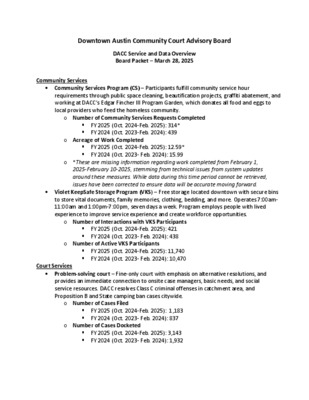
Downtown Austin Community Court Advisory Board DACC Service and Data Overview Board Packet – March 28, 2025 Community Services Community Services Program (CS) – Participants fulfill community service hour requirements through public space cleaning, beautification projects, graffiti abatement, and working at DACC’s Edgar Fincher III Program Garden, which donates all food and eggs to local providers who feed the homeless community. o Number of Community Services Requests Completed FY 2025 (Oct. 2024-Feb. 2025): 314* FY 2024 (Oct. 2023-Feb. 2024): 439 o Acreage of Work Completed FY 2025 (Oct. 2024-Feb. 2025): 12.59* FY 2024 (Oct. 2023- Feb. 2024): 15.99 o *These are missing information regarding work completed from February 1, 2025-February 10-2025, stemming from technical issues from system updates around these measures. While data during this time period cannot be retrieved, issues have been corrected to ensure data will be accurate moving forward. Violet KeepSafe Storage Program (VKS) – Free storage located downtown with secure bins to store vital documents, family memories, clothing, bedding, and more. Operates 7:00am- 11:00am and 1:00pm-7:00pm, seven days a week. Program employs people with lived experience to improve service experience and create workforce opportunities. Court Services Problem-solving court – Fine-only court with emphasis on alternative resolutions, and provides an immediate connection to onsite case managers, basic needs, and social service resources. DACC resolves Class C criminal offenses in catchment area, and Proposition B and State camping ban cases citywide. o Number of Interactions with VKS Participants FY 2025 (Oct. 2024-Feb. 2025): 421 FY 2024 (Oct. 2023- Feb. 2024): 438 o Number of Active VKS Participants FY 2025 (Oct. 2024-Feb. 2025): 11,740 FY 2024 (Oct. 2023- Feb. 2024): 10,470 o Number of Cases Filed FY 2025 (Oct. 2024-Feb. 2025): 1,183 FY 2024 (Oct. 2023- Feb. 2024): 837 o Number of Cases Docketed FY 2025 (Oct. 2024-Feb. 2025): 3,143 FY 2024 (Oct. 2023- Feb. 2024): 1,932 Clinical Diversion Program (CDP) – Dedicated case managers serve people engaging in Court Services to improve connection to case management and social services, while also improving appearance and case completion rates. o Number of CDP Clients: FY 2025 (Oct. 2024-Feb. 2025): 135 FY 2024 (Oct. 2023- Feb. 2024): 96 o Number of Cases Resolved through Participation in CDP: FY 2025 (Oct. 2024-Feb. 2025): 162 FY 2024 (Oct. 2023- Feb. 2024): 173 …
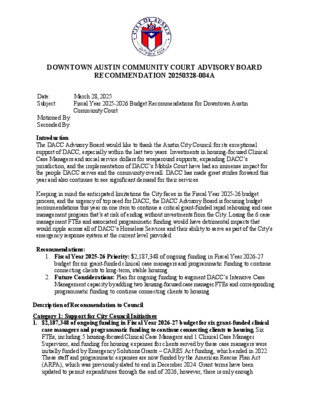
DOWNTOWN AUSTIN COMMUNITY COURT ADVISORY BOARD RECOMMENDATION 20250328-004A Date: Subject: March 28, 2025 Fiscal Year 2025-2026 Budget Recommendations for Downtown Austin Community Court Motioned By: Seconded By: Introduction The DACC Advisory Board would like to thank the Austin City Council for its exceptional support of DACC, especially within the last two years. Investments in housing-focused Clinical Case Managers and social service dollars for wraparound supports, expanding DACC’s jurisdiction, and the implementation of DACC’s Mobile Court have had an immense impact for the people DACC serves and the community overall. DACC has made great strides forward this year and also continues to see significant demand for their services. Keeping in mind the anticipated limitations the City faces in the Fiscal Year 2025-26 budget process, and the urgency of top need for DACC, the DACC Advisory Board is focusing budget recommendations this year on one item to continue a critical grant-funded rapid rehousing and case management program that’s at risk of ending without investments from the City. Losing the 6 case management FTEs and associated programmatic funding would have detrimental impacts that would ripple across all of DACC’s Homeless Services and their ability to serve as part of the City’s emergency response system at the current level provided. Recommendations: 1. Fiscal Year 2025-26 Priority: $2,187,348 of ongoing funding in Fiscal Year 2026-27 budget for six grant-funded clinical case managers and programmatic funding to continue connecting clients to long-term, stable housing. 2. Future Considerations: Plan for ongoing funding to augment DACC’s Intensive Case Management capacity by adding two housing-focused case manager FTEs and corresponding programmatic funding to continue connecting clients to housing. Description of Recommendation to Council Category 1: Support for City Council Initiatives 1. $2,187,348 of ongoing funding in Fiscal Year 2026-27 budget for six grant-funded clinical case managers and programmatic funding to continue connecting clients to housing. Six FTEs, including 5 housing-focused Clinical Case Managers and 1 Clinical Case Manager Supervisor, and funding for housing expenses for clients served by these case managers were initially funded by Emergency Solutions Grants – CARES Act funding, which ended in 2022. These staff and programmatic expenses are now funded by the American Rescue Plan Act (ARPA), which was previously slated to end in December 2024. Grant terms have been updated to permit expenditures through the end of 2026; however, there is only enough remaining ARPA funding to cover this program through the end of …
Play audio
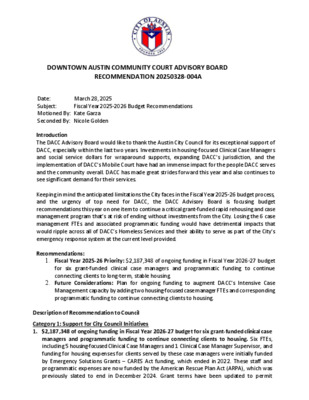
DOWNTOWN AUSTIN COMMUNITY COURT ADVISORY BOARD RECOMMENDATION 20250328-004A March 28, 2025 Fiscal Year 2025-2026 Budget Recommendations Date: Subject: Motioned By: Kate Garza Seconded By: Nicole Golden Introduction The DACC Advisory Board would like to thank the Austin City Council for its exceptional support of DACC, especially within the last two years. Investments in housing-focused Clinical Case Managers and social service dollars for wraparound supports, expanding DACC’s jurisdiction, and the implementation of DACC’s Mobile Court have had an immense impact for the people DACC serves and the community overall. DACC has made great strides forward this year and also continues to see significant demand for their services. Keeping in mind the anticipated limitations the City faces in the Fiscal Year 2025-26 budget process, and the urgency of top need for DACC, the DACC Advisory Board is focusing budget recommendations this year on one item to continue a critical grant-funded rapid rehousing and case management program that’s at risk of ending without investments from the City. Losing the 6 case management FTEs and associated programmatic funding would have detrimental impacts that would ripple across all of DACC’s Homeless Services and their ability to serve as part of the City’s emergency response system at the current level provided. Recommendations: 1. Fiscal Year 2025-26 Priority: $2,187,348 of ongoing funding in Fiscal Year 2026-27 budget for six grant-funded clinical case managers and programmatic funding to continue connecting clients to long-term, stable housing. 2. Future Considerations: Plan for ongoing funding to augment DACC’s Intensive Case Management capacity by adding two housing-focused case manager FTEs and corresponding programmatic funding to continue connecting clients to housing. Description of Recommendation to Council Category 1: Support for City Council Initiatives 1. $2,187,348 of ongoing funding in Fiscal Year 2026-27 budget for six grant-funded clinical case managers and programmatic funding to continue connecting clients to housing. Six FTEs, including 5 housing-focused Clinical Case Managers and 1 Clinical Case Manager Supervisor, and funding for housing expenses for clients served by these case managers were initially funded by Emergency Solutions Grants – CARES Act funding, which ended in 2022. These staff and programmatic expenses are now funded by the American Rescue Plan Act (ARPA), which was previously slated to end in December 2024. Grant terms have been updated to permit expenditures through the end of 2026; however, there is only enough remaining ARPA funding to cover this program through the end of 2025. …
DOWNTOWN AUSTIN COMMUNITY COURT ADVISORY BOARD RECOMMENDATION 20250328-004B March 28, 2025 Fiscal Year 2025-2026 Budget Recommendations for Community Programs Date: Subject: Motioned By: Mikaela Frissell Seconded By: Katy Jo Muncie Introduction The Downtown Austin Community Court Advisory Board’s highest priority this budget cycle is discussed in Recommendation 20250328-004A. The Board also wants to recommend continuation of two critical community initiatives whose contracts are funded and managed by DACC, both of which strengthen connection to mental health services and are key components of Austin’s diversion efforts, including those directly served by DACC. These programs include the Therapeutic Diversion Program component of the Mental Health Diversion Pilot1 and continuation of 24/7 operations for the Expanded Mobile Crisis Outreach Team. The most recent Point in Time Count results from 2023 approximated that about 31% of the total population in the Travis County Jail were likely to be experiencing homelessness. Of these individuals, 67% were people of color. Advancing these programs helps improve equitable access to services, while taking an evidence-based and person-centered approach to addressing the intersections between homelessness, criminal justice involvement, and mental health needs. Both of these programs were funded in Fiscal Year 2024-25 with one-time funding, but the community need for these programs continues. Without additional investment from the City of Austin, these critical services for the Austin community will be negatively impacted. The Board recommends Council identify funding to ensure both programs are able to continue at full capacity. Recommendations 1. $2,000,000 annually in Fiscal Years 2025-26 and 2026-27 for the Therapeutic Diversion Program component of the Mental Health Diversion Pilot 2. Ongoing funding to continue 24/7 operations for the Expanded Mobile Crisis Outreach Team (EMCOT) Description of Recommendation to Council 1. $2,000,000 funding annually Fiscal Years 2025-26 and 2026-27 for the Therapeutic Diversion Program (TDP). The Mental Health Diversion Pilot is a collaboration between Central Health, the City of Austin, Integral Care, and Travis County, which leverages existing programs and facilities to immediately address unmet deflection and diversion needs through 1 This program is now referred to as the Crisis Care Diversion Pilot; more information on the Pilot is available here. provision of critical services for individuals experiencing a mental health crisis. This Pilot, designed to be a three-year program, needs $2 million in City funding in FY 2025-26 and FY 2026-27 to continue at full capacity. The TDP component of the Mental Health Diversion Pilot, funded by …
DACC ADVISORY BOARD MEETING MINUTES (28, MARCH 2025) DOWNTOWN AUSTIN COMMUNITY COURT ADVISORY BOARD REGULAR CALLED MEETING MINUTES MARCH 28, 2025 The DOWNTOWN AUSTIN COMMUNITY COURT ADVISORY BOARD convened in a REGULAR CALLED meeting on 28, MARCH 2025, at 505 BARTON SPRINGS RD in Austin, Texas. CALL TO ORDER Vice Chair Dr. Anu Kapadia called the DOWNTOWN AUSTIN COMMUNITY COURT ADVISORY BOARD Meeting to order at 8:10 a.m. Board Members/Commissioners in Attendance: Vice Chair Dr. Anu Kapadia Board Members/Commissioners in Attendance Remotely: Mikaela Frissell, Kate Garza, Katy Jo Muncie, Nicole Golden, and Roy Woody PUBLIC COMMUNICATION: GENERAL None APPROVAL OF MINUTES 1. Approve the minutes of the DOWNTOWN AUSTIN COMMUNITY COURT ADVISORY BOARD REGULAR MEETING on JANUARY 17, 2025. Item tabled to May meeting. Due to time constraint, item #4 was presented. DISCUSSION ITEMS 2. Expanded Mobile Crisis Outreach Team (EMCOT) and Therapeutic Diversion Program (TDP) presentation and discussion (Downey Gallatin/Kapadia) – Marisa Malik, Integral Care 1 DACC ADVISORY BOARD MEETING MINUTES (28, MARCH 2025) 3. Status of DACC operational areas including performance measures and services delivered through Community Services, Court Services, Homeless Services and Support Services (Downey Gallatin/Kapadia) – Robert Kingham, Court Administrator, DACC ACTION ITEMS 4. Approve Fiscal Year 2025-26 Budget recommendations related to DACC case management services and community programs (Downey Gallatin/Kapadia) – Lea Downey Gallatin, DACC Advisory Board Chair Budget Recommendation A discussion on Kate Garza motion and Nicole Golden second. Unanimous approval with no changes to recommendation on a (6-0) vote. Budget Recommendation B discussion on Mikaela Frissell motion and Katy Jo Muncie second. Unanimous approval with no changes to recommendation on a (6-0) vote. ADJOURNMENT Meeting adjourned at 8:32 a.m. The minutes were approved at the May 16, 2025, meeting on Chair Lea Downey Gallatin’s motion, Board Member Rev. Dr. Josh Robinson’s second on a (6-0) vote 2
Emma S. Barrientos Mexican American Cultural Center Advisory Board Community Interest Announcement Phase 2 Construction Project Site Visit March 26, 2025, at 4:00 pm Emma S. Barrientos Mexican American Cultural Center, 600 River St, Austin, TX 78701 A quorum of Commission members may be present. No action will be taken, and no Commission business will occur. Michelle Rojas, Board Liaison 512-974-3771
JOINT SUSTAINABILITY COMMITTEE HYBRID MEETING FORMAT March 26, 2025 at 6 pm City Hall – Council Chambers 301 W 2nd St, Austin TX 78701 Some members of the Committee may be participating by videoconference Public comment will be allowed in-person or remotely via telephone. Speakers may only register to speak on an item once either in-person or remotely and will be allowed up to three minutes to provide their comments. Registration no later than noon the day before the meeting is required for remote participation by telephone. To register to speak remotely, email or call Rohan Lilauwala at (Rohan.lilauwala@austintexas.gov or 512-974-9394). Alternate Randall Chapman Member Kaiba White (Chair) Charlotte Davis (Vice-Chair) Genell Gary Diana Wheeler Haris Qureshi Melissa Rothrock Vacant CURRENT BOARD MEMBERS: Home Commission Electric Utility Commission Resource Management Commission Urban Transportation Commission Environmental Commission Zero Waste Advisory Commission Community Development Commission Austin Travis County Food Policy Board Marissa Bell Economic Prosperity Commission Water & Wastewater Commission Parks & Recreation Board Design Commission Planning Commission Austin/Travis County Public Health Commission City Council Mayor’s Representative Mayor’s Representative Mayor’s Representative Mayor’s Representative Mayor’s Representative Amy Noel Chris Maxwell-Gaines Lane Becker Vacant Vacant Natalie Poindexter Vacant Rodrigo Leal Anna Scott Yure Suarez Christopher Campbell Heather Houser For more information, please visit: www.austintexas.gov/jsc Vacant Richard Brimer Craig Nazor Miriam Garcia Rosamaria Murillo Luis Osta Lugo Vacant Shelby Orme Ben Luckens Alberta Phillips Vacant Vacant AGENDA CALL TO ORDER PUBLIC COMMUNICATION: GENERAL The first 10 speakers signed up prior to the meeting being called to order will each be allowed a three-minute allotment to address their concerns regarding items not posted on the agenda. APPROVAL OF MINUTES 1. Approval of minutes from the February 26th, 2025 meeting of the Joint Sustainability Committee DISCUSSION Department 2. Austin Core Transportation Plan Update – Cole Kitten, Transportation and Public Works 3. CapMetro Sustainability Updates – Rob Borowski, CapMetro 4. Internal Climate and Efficiency Revolving Fund Proposal – Rohan Lilauwala, Office of Climate Action and Resilience efforts. – Chris Maxwell-Gaines 5. Water and Wastewater Commission update on recent approvals that affect water conservations 6. Environmental Commission updates on PARD Concessions Report Presentation, Austin Energy Green Building Program overview and WPD FY25 Budget, programs, and projects. – Haris Qureshi DISCUSSION AND ACTION ITEMS 7. Recommendation on the Austin Core Transportation Plan 8. Recommendation on Internal Climate and Efficiency Revolving Fund Proposal 9. JSC Sustainable Buildings Working Group FY 25/26 …
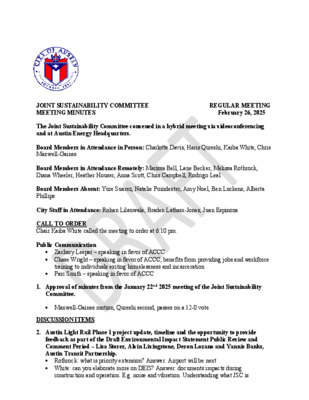
February 26, 2025 JOINT SUSTAINABILITY COMMITTEE REGULAR MEETING MEETING MINUTES The Joint Sustainability Committee convened in a hybrid meeting via videoconferencing and at Austin Energy Headquarters. Board Members in Attendance in Person: Charlotte Davis, Haris Qureshi, Kaiba White, Chris Maxwell-Gaines Board Members in Attendance Remotely: Marissa Bell, Lane Becker, Melissa Rothrock, Diana Wheeler, Heather Houser, Anna Scott, Chris Campbell, Rodrigo Leal Board Members Absent: Yure Suarez, Natalie Poindexter, Amy Noel, Ben Luckens, Alberta Phillips City Staff in Attendance: Rohan Lilauwala, Braden Latham-Jones, Juan Espinoza CALL TO ORDER Chair Kaiba White called the meeting to order at 6:10 pm. Public Communication • Zachary Leeper – speaking in favor of ACCC • Chase Wright – speaking in favor of ACCC, benefits from providing jobs and workforce training to individuals exiting homelessness and incarceration • Parc Smith – speaking in favor of ACCC 1. Approval of minutes from the January 22nd 2025 meeting of the Joint Sustainability Committee. • Maxwell-Gaines motion, Qureshi second, passes on a 12-0 vote. DISCUSSION ITEMS 2. Austin Light Rail Phase 1 project update, timeline and the opportunity to provide feedback as part of the Draft Environmental Impact Statement Public Review and Comment Period – Lisa Storer, Alvin Livingstone, Deron Lozano and Yannis Banks, Austin Transit Partnership. • Rothrock: what is priority extension? Answer: Airport will be next • White: can you elaborate more on DEIS? Answer: documents impacts during construction and operation. E.g. noise and vibration. Understanding what JSC is interested in is helpful. Federal gov’t doesn’t require level of detail being provided. E.g. working with city arborist to come up with tree preservation-first approach. • Model shows 20 million + VMT reduced. All electric vehicles. 3. Austin Civilian Conservation Corps Update on staffing, current agreements, pathways, and its future funding opportunities. – Juan Espinoza, Economic Development Department. • Davis: what happened to other pathways? Espinoza: funding shortfall meant that only natural systems pathway is active. Program has always been funded with one-time funding. • White: how much funding is needed to bring programming back? Espinoza: $2.8m at max capacity. 4. Comprehensive Climate Implementation Program Update – Braden Latham-Jones, Office of Climate Action and Resilience. • White: what about public-facing items? Latham-Jones – some items feature this. • White: will this come back to JSC? Latham-Jones: TBD, depends on timeline. 5. Recommendations and possible action on the Comprehensive Climate Implementation Program, including supportive action and/or recommendations for additions …
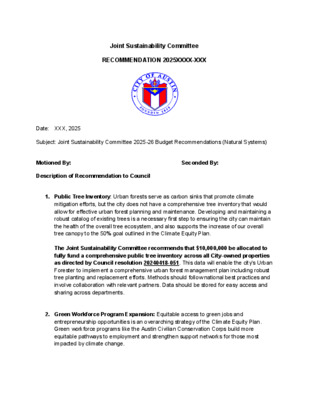
Joint Sustainability Committee RECOMMENDATION 2025XXXX-XXX Date: XXX, 2025 Subject: Joint Sustainability Committee 2025-26 Budget Recommendations (Natural Systems) Motioned By: Seconded By: Description of Recommendation to Council 1. Public Tree Inventory: Urban forests serve as carbon sinks that promote climate mitigation efforts, but the city does not have a comprehensive tree inventory that would allow for effective urban forest planning and maintenance. Developing and maintaining a robust catalog of existing trees is a necessary first step to ensuring the city can maintain the health of the overall tree ecosystem, and also supports the increase of our overall tree canopy to the 50% goal outlined in the Climate Equity Plan. The Joint Sustainability Committee recommends that $10,000,000 be allocated to fully fund a comprehensive public tree inventory across all City-owned properties as directed by Council resolution 20240418-051. This data will enable the city’s Urban Forester to implement a comprehensive urban forest management plan including robust tree planting and replacement efforts. Methods should follow national best practices and involve collaboration with relevant partners. Data should be stored for easy access and sharing across departments. 2. Green Workforce Program Expansion: Equitable access to green jobs and entrepreneurship opportunities is an overarching strategy of the Climate Equity Plan. Green workforce programs like the Austin Civilian Conservation Corps build more equitable pathways to employment and strengthen support networks for those most impacted by climate change. The Joint Sustainability Committee recommends that $4,000,000 per year be allocated to permanently fund the Austin Civilian Conservation Corps. This funding would be used to support and expand the following tracks: ○ Natural Systems (protecting critical ecosystems on City land, green infrastructure development, wildfire mitigation, enhancing the City’s trail network) ○ Clean Energy (solar for all, energy efficiency, demand response, batteries) ○ Environmental Education ○ Zero Waste (expand beyond computer refurbishment) 3. Natural Land Restoration and Wildfire Prevention: Most city parkland natural areas have not been managed for ecosystem health and are thus degraded. Threatened by heat, drought, disease, and wildfire, they present safety risks to both park users and neighbors. In 2023, City Council approved the Parks and Recreation Department’s Land Management Plan, created to guide the restoration of natural areas to improve climate resilience and reduce wildfire risk. The program currently has a budget of $828,000 and four FTEs to oversee the 10,300 acres under city management. The Joint Sustainability Committee recommends fully funding this program at an estimated …
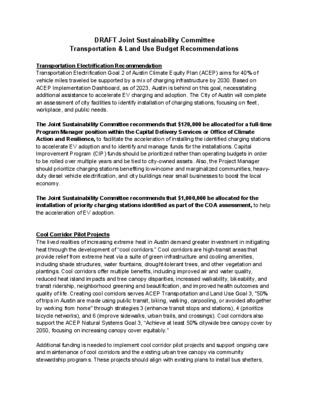
DRAFT Joint Sustainability Committee Transportation & Land Use Budget Recommendations Transportation Electrification Recommendation Transportation Electrification Goal 2 of Austin Climate Equity Plan (ACEP) aims for 40% of vehicle miles traveled be supported by a mix of charging infrastructure by 2030. Based on ACEP Implementation Dashboard, as of 2023, Austin is behind on this goal, necessitating additional assistance to accelerate EV charging and adoption. The City of Austin will complete an assessment of city facilities to identify installation of charging stations, focusing on fleet, workplace, and public needs. The Joint Sustainability Committee recommends that $120,000 be allocated for a full-time Program Manager position within the Capital Delivery Services or Office of Climate Action and Resilience, to facilitate the acceleration of installing the identified charging stations to accelerate EV adoption and to identify and manage funds for the installations. Capital Improvement Program (CIP) funds should be prioritized rather than operating budgets in order to be rolled over multiple years and be tied to city-owned assets. Also, the Project Manager should prioritize charging stations benefiting low-income and marginalized communities, heavy- duty diesel vehicle electrification, and city buildings near small businesses to boost the local economy. The Joint Sustainability Committee recommends that $1,000,000 be allocated for the installation of priority charging stations identified as part of the COA assessment, to help the acceleration of EV adoption. Cool Corridor Pilot Projects The lived realities of increasing extreme heat in Austin demand greater investment in mitigating heat through the development of “cool corridors.” Cool corridors are high-transit areas that provide relief from extreme heat via a suite of green infrastructure and cooling amenities, including shade structures, water fountains, drought-tolerant trees, and other vegetation and plantings. Cool corridors offer multiple benefits, including improved air and water quality, reduced heat island impacts and tree canopy disparities, increased walkability, bikeability, and transit ridership, neighborhood greening and beautification, and improved health outcomes and quality of life. Creating cool corridors serves ACEP Transportation and Land Use Goal 3, "50% of trips in Austin are made using public transit, biking, walking, carpooling, or avoided altogether by working from home" through strategies 3 (enhance transit stops and stations), 4 (prioritize bicycle networks), and 6 (improve sidewalks, urban trails, and crossings). Cool corridors also support the ACEP Natural Systems Goal 3, “Achieve at least 50% citywide tree canopy cover by 2050, focusing on increasing canopy cover equitably.” Additional funding is needed to implement cool …
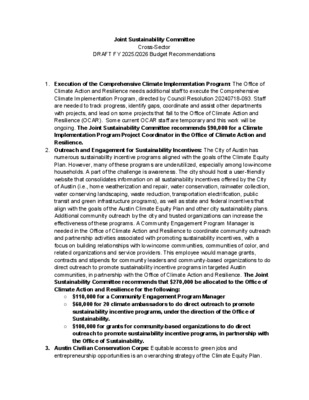
Joint Sustainability Committee Cross-Sector DRAFT FY 2025/2026 Budget Recommendations 1. Execution of the Comprehensive Climate Implementation Program: The Office of Climate Action and Resilience needs additional staff to execute the Comprehensive Climate Implementation Program, directed by Council Resolution 20240718-093. Staff are needed to track progress, identify gaps, coordinate and assist other departments with projects, and lead on some projects that fall to the Office of Climate Action and Resilience (OCAR). Some current OCAR staff are temporary and this work will be ongoing. The Joint Sustainability Committee recommends $90,000 for a Climate Implementation Program Project Coordinator in the Office of Climate Action and Resilience. 2. Outreach and Engagement for Sustainability Incentives: The City of Austin has numerous sustainability incentive programs aligned with the goals of the Climate Equity Plan. However, many of these programs are underutilized, especially among low-income households. A part of the challenge is awareness. The city should host a user-friendly website that consolidates information on all sustainability incentives offered by the City of Austin (i.e., home weatherization and repair, water conservation, rainwater collection, water conserving landscaping, waste reduction, transportation electrification, public transit and green infrastructure programs), as well as state and federal incentives that align with the goals of the Austin Climate Equity Plan and other city sustainability plans. Additional community outreach by the city and trusted organizations can increase the effectiveness of these programs. A Community Engagement Program Manager is needed in the Office of Climate Action and Resilience to coordinate community outreach and partnership activities associated with promoting sustainability incentives, with a focus on building relationships with low-income communities, communities of color, and related organizations and service providers. This employee would manage grants, contracts and stipends for community leaders and community-based organizations to do direct outreach to promote sustainability incentive programs in targeted Austin communities, in partnership with the Office of Climate Action and Resilience. The Joint Sustainability Committee recommends that $270,000 be allocated to the Office of Climate Action and Resilience for the following: ○ $110,000 for a Community Engagement Program Manager ○ $60,000 for 20 climate ambassadors to do direct outreach to promote sustainability incentive programs, under the direction of the Office of Sustainability. ○ $100,000 for grants for community-based organizations to do direct outreach to promote sustainability incentive programs, in partnership with the Office of Sustainability. 3. Austin Civilian Conservation Corps: Equitable access to green jobs and entrepreneurship opportunities is an overarching strategy …
Austin Core Transportation (ACT) Plan Small Area Mobility Plan of the ASMP: Downtown Austin Joint Sustainability Committee – March 26, 2025 Agenda • ACT Plan Purpose and Background • Planning Process • ACT Plan Project Recommendations • Implementation Plan • Next Steps 2 ACT Plan Purpose • The ACT Plan is a Small Area Mobility Plan covering Downtown Austin and will be adopted by Council as an attachment to the ASMP. • It is an update to previous transportation focused efforts Downtown – dating back to 2000 • Why are we updating the transportation plan for Downtown? • changes in transit and bicycle planning, • changes in highway improvements serving Downtown, • changes in national best practices on urban street design, and • disruptions to traditional mobility • The ACT Plan will create a unified vision for transportation Downtown and align the many projects and initiatives under one actionable plan to help accomplish the goals in the Austin Strategic Mobility Plan. 3 Background • Great Streets Master Plan, 2001 • The goal of the Great Streets program is to pursue the vision of streets for people • Downtown Access and Mobility Plan, 2002 • The emphasis of the access and mobility study was on modeling and simulating intersection traffic operations and determining existing and future levels-of- service and operational needs • Downtown Transportation Framework, 2008 • The Downtown Transportation Framework Plan builds on the Great Streets Master Plan, further developing the system of “priority streets by mode”, and developing more detailed streetscape cross sections of all of the different street types and variations • Downtown Austin Plan, 2011 • Established the vision to develop a multimodal transportation system that improves access to and mobility within Downtown 2001 2002 2008 2011 4 Background • New policy • The Austin Strategic Mobility Plan (ASMP) aspires to achieve a 50/50 mode share where 50% of commuters use means other than driving alone to get to work in 2039 • Transit planning • The Project Connect Long Term Vision Plan established a High-Capacity Transit System and was adopted as an element of the ASMP – an initial investment was funded in 2020 2019 • Managing demand • Transportation Demand Management programming, parking policy, and curb management are becoming critical strategies to manage congestion • New street design • The Congress Avenue Urban Design Initiative shows how to reimagine the allocation of space • Many …
Austin Core Transportation (ACT) Plan Phase 1 & 2 Engagement Summary August–October 2022 | November 2022–March 2023 1. "What is the ACT Plan" informational brochure 2. Phase I Feedback Summary 3. Phase I Engagement Report 4. Phase 2 Feedback Summary 5. City Council Mobility Committee May 11, 2023 Presentation WHAT IS THE AUSTIN CORE TRANSPORTATION (ACT) PLAN? The ACT Plan is studying mobility options into, out of, through and within Downtown Austin. With Project Connect transit plans and the I-35 Capital Express Central rebuild project bringing significant change to the area, it is important to reexamine the form and function of the street network to interact with those changes and meet future needs and modes of transportation. WHAT WILL ACT DO? The ACT Plan will produce a list of projects and a vision for how Downtown Austin streets should operate. These projects will work within our real-world constraints, providing safe and efficient mobility enhancements. Whether people are delivering food, commuting to work, enjoying entertainment or appreciating our public spaces, the ACT Plan seeks to make accomplishing those tasks easier. WHAT WILL ACT DO? Austin Transportation Department wants to hear from all stakeholders and travelers to downtown Austin. Comments are best provided through online surveys, emailing the team or attending community meetings. Scan here for more info AustinTexas.gov/ACTplan ACTplan@AustinTexas.gov @AustinMobility /ATXtransportation 512-974-23OO ¿QUÉ ES EL PLAN DEL CASCO CENTRAL DE AUSTIN (ACT)? El Plan ACT está estudiando opciones de movilidad hacia, desde, a través y dentro del centro de Austin. Con los planes de tránsito del Proyecto Connect y el proyecto de reconstrucción de la I-35 Capital Express Central trayendo cambios significativos al área, es importante reexaminar la forma y función de la red de calles para interactuar con esos cambios y satisfacer las necesidades futuras y los modos de transporte. ¿QUÉ HARÁ ACT? El Plan ACT producirá una lista de proyectos y una visión de cómo deberían operar las calles del Centro de Austin. Estos proyectos funcionarán dentro de nuestras limitaciones del mundo real, brindando mejoras de movilidad seguras y eficientes. Ya sea que las personas estén entregando alimentos, yendo al trabajo, disfrutando del entretenimiento o apreciando nuestros espacios públicos, el Plan ACT busca facilitar el cumplimiento de esas tareas. ¿CÓMO PUEDO PARTICIPAR EN ACT? El Departamento de Transporte de Austin quiere escuchar a todas las partes interesadas y viajeros al centro de Austin. Puede enviar comentarios a través de …
Joint Sustainability Committee Sustainable Buildings Working Group DRAFT FY 2025/2026 Budget Recommendations 1. Water Leak Detection and Repair Programs: In 2023, Austin Water loss was 8,678,000,000 gallons of water which equates to 21.68 gallons per capita per day of water loss. This waste also results in unnecessary greenhouse gas emissions from the energy needed to pump and treat the water. Austin Water’s current budget includes $2 million/year for leak detection and $6 million for repairs, but water waste would be reduced faster with an increased budget. An additional staff person would be needed to help manage the additional work. The Joint Sustainability Committee Recommends that the Austin Water water leak detection budget be increased to $3 million/year and the repair budget be increased to $7 million/year, including the addition of one full time staff position to manage the increased work. 2. Residential and Commercial Landscape Conversion Rebates for Water Conservation: During summer months, the use of water dramatically increases, mainly due to the watering of landscapes. Turf areas in particular require the most water per square foot in any landscape. While ordinances for new construction can help reduce the amount of turf areas, existing properties don’t have requirements to adapt their landscapes to conserve water. Reducing the amount of turf grass that requires a lot of water to survive will help conserve water and reduce energy use needed for pumping and treatment. Austin Water should offer more substantial and accessible rebates for landscape conversions. Currently, Austin Water offers a landscape conversion rebate of $100 per 100 square feet, up to a maximum rebate of $3000. Most conversions will be smaller areas and thus, the currently offered rebate amounts don’t incentivize many customers to implement landscape conversions. In 2023, only 19 rebate applications were submitted to Austin Water. Austin Water should implement a tiered rebate structure that offers more rebate money for smaller areas of landscape conversion for residential properties and should substantially increase the maximum rebate offered. As suggested by the Get Fertilizer Wiser campaign, there should also be incentives that are more easily accessible to individuals who may not need to fully remove turf grass in order to reduce or eliminate watering. The Joint Sustainability Committee recommends increasing Austin Water’s Landscaping Conversion budget from $40,000/year to $150,000/year. 3. Establish Sustainability Revolving Fund to Reduce GHG Emissions, Starting with Rooftop Solar and Refrigerant Leakage Mitigation: Revolving funds are an effective …
Joint Sustainability Committee RECOMMENDATION 20240228-XXX Date: February xx, 2025 Subject: Joint Sustainability Committee Budget Recommendations Motioned By: Seconded By: Recommendation Description of Recommendation to Council Sustainable Purchasing: The City of Austin Climate Equity Plan Food & Product Consumption Goal 2 says “By 2030, greenhouse gas emissions from institutional, commercial, and government purchasing are reduced by at least 50%.“ Strategy 2 to achieve that goal is “Strengthen the City’s sustainable purchasing program.” Recent analysis by the Office of Sustainability shows that over 80% of the City of Austin’s greenhouse gas emissions come from the products and services that the city purchases. It is essential that the City establish a comprehensive Sustainable Purchasing Plan that sets minimum standards for all products and services the City procures, and the City must prioritize ongoing staff support to educate all departments on sustainable purchasing and ensure that purchasing decisions comply with the Sustainable Purchasing Plan. This work is also foundational for achieving Climate Equity Plan goals for private sector sustainable purchasing in the Austin Community. Current staff in the Office of Climate Action and Resilience and the Purchasing Department have been making efforts to accomplish this goal while also doing their other work, but the volume of work needed is beyond what existing staff have capacity for. The Joint Sustainability Committee recommends that $110,000 be allocated to adding a full-time Sustainable Purchasing Program Manager position to the Purchasing Department. Pro-Climate/Pro-Health Food Implementation: The City of Austin Climate Equity Plan Food & Product Consumption Goal 1 says: “By 2030, ensure all Austinites can access a food system that is community- driven, addresses food insecurity, prioritizes regenerative agriculture, supports dietary and health agency, promotes plant-based foods, and minimizes food waste.” The Austin/Travis County Food Plan includes “Goal 8: Pro-climate, Pro-health Raise awareness of the benefits of foods that nourish our bodies and reduce the overall environmental impact of our food system while addressing barriers to access.” A key need for the plan is for community education and outreach. Partners have developed some materials but there is no budget for community outreach to share information and opportunities. The JSC recommends that $75,000 be allocated to the Office of Climate Action and Resilience for community outreach and education on benefits and opportunities to eat more pro-climate/pro-health foods. Circular economy and waste diversion programs: The City of Austin Climate Equity Plan Food & Product Consumption Goal 3 says : “Aggressively …
Joint Sustainability Committee Meeting CapMetro Updates March 26th, 2025 Antonio Martin CapMetro Project Updates • Overview • Battery Electric Buses (BEB) • 104 BEB’s • Charging Infrastructure • 9315 – 16 legacy chargers Completed 01/15/2023 • 2910 – 48 dispensers Completed 11/15/2024 • 9315 – 30 Chargers w/ 90 pantographs • 9315 – 4.35 mW solar array • Metro Rapid • PV 4 pantograph Chargers • Expo 4 pantograph Chargers • Future Technology 2 Battery Electric Buses 52 New New Flyer Buses 40 New Proterra Buses 3 BEB Charging at 2910 E. 5th Street ❖ Two Transformers 1500kVA ❖ 2 chargers (1.44MW each) ❖ 48 plug in dispenser ❖ Completed November 2024 text 4 BEB Charging Station Project - NOPS Project Overview ❖ Solar Canopy (267,000 sqft) ❖ 4.1MW/ AC 2812kW ❖ 6960 QCELL 585W modules ❖ Three Transformers 1500kVA ❖ 30 chargers (1.44MW each) ❖ 90 Pantographs Schunk SLS_301 ❖ Training Charger (mast) ❖ 1 pantograph Schunk SLS_201 ❖ Construction Schedule: ▪ Dec 2024 – Jan 2026 5 Charging / Solar Array / Microgrid Project at NOPS CONTRACTOR: HOLT RENEWABLES capmetro.org | 6 Metro Rapid EXPO Line 7 Metro Rapid Pleasant Valley Line 8 Future Technology of Choice • Hybrids • Hydrogen fuel cell • 6 mpg vs 4 mpg diesel • Lower emissions • Green zone operation (limited range zero emission) • Zero emission - H2o as exhaust • Cost of fuel prohibitive (Delay pilot until 2030) 9 Thank you.
Climate and Efficiency Revolving Funds To reduce operational costs and GHG emissions Limited dedicated funds to make city facilities more sustainable New opportunities in renewables + resilience Pressure on general fund means there is a need to reduce operational costs Context 2 Precedents Revolving funds are not a new idea, and many communities across the country have successfully implemented them to address challenges like those we face in Austin. San Antonio Philadelphia Harris County Portland Seattle 3 Case Study: San Antonio ● Energy Efficiency Fund seeded in 2009 ● Projects include lighting, HVAC with $12 million in ARRA funds ● 432 energy projects in 190 facilities completed by 2023 ● Annual avoided cost savings of $1.7m equipment and controls, solar window film, pool pump upgrades, etc. ● In 2023, $30m investment in solar, savings to be rolled into fund Case Study: Harris County ● Revolving Energy Efficiency Fund established in 2023 with one FTE ● No direct funding for projects, captures savings from already funded capital projects ● Savings (tax credits, utility rebates, energy savings) from projects flow into fund ● Fund pays for things complementary to projects (training, salaries, tools) How it Could Work Seed Funding Climate and Efficiency Revolving Fund Staff Salaries, Software, Training, Capacity Building Reinvest Savings Implement Projects Measure Energy and Other Savings 6 Energy Efficiency Renewable Energy Fleet Electrification Lighting retrofits, HVAC upgrades, weatherization Solar, batteries Electric vehicles and charging infrastructure Example Projects 7 Example Projects LED Lighting Retrofit in an Office Building Solar Array on a Library Upfront Cost: $300,000 Annual Savings: $75,000 Simple Payback Period: 4 years Lifespan: 10-15 years Upfront Cost: $95,340 (incl 30% tax credit) Annual Savings: $13,913 Simple Payback Period: 6.8 years Lifespan: 25-30 years ● As the initial investment is paid off, savings can be returned to the fund and can be ● After the investments are paid off, the projects continue to generate annual savings reinvested into other projects. for the remainder of their lifespans. 8 Thank you. Do you have any questions? www.austintexas.gov/climate /austinsustainability rohan.lilauwala@austintexas.gov
BOARD/COMMISSION RECOMMENDATION Joint Sustainability Committee Recommendation Number 20250326-007: Austin Core Transportation Plan WHEREAS, the Austin Core Transportation Plan seeks to create a cohesive and adaptable transportation framework that addresses the unique mobility challenges of downtown Austin while building on previous downtown planning efforts and integrating upcoming major infrastructure projects like I-35 Capital Express Central and Project Connect; and WHEREAS, the Downtown street network is 1% of Austin’s overall network but accounts for 12% of all pedestrian crashes and 17% of intersection-related pedestrian crashes; and WHEREAS, the Austin Strategic Mobility Plan sets a goal of 50% non-single occupancy vehicle mode share by 2039; and WHEREAS, two-way streets are safer and increase economic activity where conversions are implemented; and WHEREAS, street trees and additional shade downtown make walking more feasible and can even reduce vehicle speeds; and WHEREAS, the East side of downtown is not currently slated to have a new on-street, high- quality North-South bicycle facility in the current ACT plan; and WHEREAS, the Downtown Austin Alliance Downtown Parking Study was created to comprehensively and holistically find parking management solutions to better serve the residents, workers, and visitors of downtown Austin; and WHEREAS, the Urban Land Institute convened a Technical Assistance Panel focused on reducing the growth of parking downtown, improving management of current parking supply, improving the human experience downtown, and improving other transportation modes; and WHEREAS, City Council Resolution No. 20240201-054 and corresponding ordinances seek to reduce the overall number of new parking spaces built within downtown Austin and create a more pedestrian-oriented built environment; and WHEREAS, the future Austin Light Rail and expanded MetroRapid services are projected to carry tens of thousands additional riders into downtown; and WHEREAS, there are limited resources devoted to transportation infrastructure improvements across the City, with competing priorities, including installing transportation facilities outside of downtown where no current facilities exist; and NOW, THEREFORE, BE IT RESOLVED the Joint Sustainability Committee recommends that the City Council adopt the Austin Core Transportation plan; and BE IT FURTHER RESOLVED that the Joint Sustainability Committee recommends the Austin Core Transportation Plan prioritizes the needs of pedestrians, cyclists, and non-car modes of transportation throughout the downtown area over car volume throughput; and BE IT FURTHER RESOLVED, that the Joint Sustainability Committee recommends the ACT plan continue the protected bike lane on Red River Street from 7th Street to 12th Street, as contemplated by the 2023 Bicycle Plan and …
Play video
BOARD/COMMISSION RECOMMENDATION Joint Sustainability Committee Recommendation Number 20250326-007: Austin Core Transportation Plan WHEREAS, the Austin Core Transportation Plan seeks to create a cohesive and adaptable transportation framework that addresses the unique mobility challenges of downtown Austin while building on previous downtown planning efforts and integrating upcoming major infrastructure projects like I-35 Capital Express Central and Project Connect; and WHEREAS, the Downtown street network is 1% of Austin’s overall network but accounts for 12% of all pedestrian crashes and 17% of intersection-related pedestrian crashes; and WHEREAS, the Austin Strategic Mobility Plan sets a goal of 50% non-single occupancy vehicle mode share by 2039; and WHEREAS, two-way streets are safer and increase economic activity where conversions are implemented; and WHEREAS, street trees and additional shade downtown make walking more feasible and can even reduce vehicle speeds; and WHEREAS, the East side of downtown is not currently slated to have a new on-street, high- quality North-South bicycle facility in the current ACT plan; and WHEREAS, the Downtown Austin Alliance Downtown Parking Study was created to comprehensively and holistically find parking management solutions to better serve the residents, workers, and visitors of downtown Austin; and WHEREAS, the Urban Land Institute convened a Technical Assistance Panel focused on reducing the growth of parking downtown, improving management of current parking supply, improving the human experience downtown, and improving other transportation modes; and WHEREAS, City Council Resolution No. 20240201-054 and corresponding ordinances seek to reduce the overall number of new parking spaces built within downtown Austin and create a more pedestrian-oriented built environment; and WHEREAS, the future Austin Light Rail and expanded MetroRapid services are projected to carry tens of thousands additional riders into downtown; and WHEREAS, there are limited resources devoted to transportation infrastructure improvements across the City, with competing priorities, including installing transportation facilities outside of downtown where no current facilities exist; and NOW, THEREFORE, BE IT RESOLVED the Joint Sustainability Committee recommends that the City Council adopt the Austin Core Transportation plan; and BE IT FURTHER RESOLVED that the Joint Sustainability Committee recommends the Austin Core Transportation Plan prioritizes the needs of pedestrians, cyclists, and non-car modes of transportation throughout the downtown area over car volume throughput; and BE IT FURTHER RESOLVED, that the Joint Sustainability Committee recommends the ACT plan include protected bike lanes in both directions on all downtown streets; and BE IT FURTHER RESOLVED, that the Joint Sustainability Committee recommends the …
BOARD/COMMISSION RECOMMENDATION Joint Sustainability Committee Recommendation Number 20250326-009: Sustainable Buildings Budget Recommendations 1. Water Leak Detection and Repair Programs: In 2023, Austin Water loss was 8,678,000,000 gallons of water which equates to 21.68 gallons per capita per day of water loss. This waste also results in unnecessary greenhouse gas emissions from the energy needed to pump and treat the water. Austin Water’s current budget includes $2 million/year for leak detection and $6 million for repairs, but water waste would be reduced faster with an increased budget. An additional staff person would be needed to help manage the additional work. The Joint Sustainability Committee Recommends that the Austin Water water leak detection budget be increased to $3 million/year and the repair budget be increased to $7 million/year, including the addition of one full time staff position to manage the increased work. 2. Residential and Commercial Landscape Conversion Rebates for Water Conservation: During summer months, the use of water dramatically increases, mainly due to the watering of landscapes. Turf areas in particular require the most water per square foot in any landscape. While ordinances for new construction can help reduce the amount of turf areas, existing properties don’t have requirements to adapt their landscapes to conserve water. Reducing the amount of turf grass that requires a lot of water to survive will help conserve water and reduce energy use needed for pumping and treatment. Austin Water should offer more substantial and accessible rebates for landscape conversions. Currently, Austin Water offers a landscape conversion rebate of $100 per 100 square feet, up to a maximum rebate of $3000. Most conversions will be smaller areas and thus, the currently offered rebate amounts don’t incentivize many customers to implement landscape conversions. In 2023, only 19 rebate applications were submitted to Austin Water. Austin Water should implement a tiered rebate structure that offers more rebate money for smaller areas of landscape conversion for residential properties and should substantially increase the maximum rebate offered. As suggested by the Get Fertilizer Wiser campaign, there should also be incentives that are more easily accessible to individuals who may not need to fully remove turf grass in order to reduce or eliminate watering. The Joint Sustainability Committee recommends increasing Austin Water’s Landscaping Conversion budget from $40,000/year to $150,000/year. 3. Establish Sustainability Revolving Fund to Reduce GHG Emissions, Starting with Rooftop Solar and Refrigerant Leakage Mitigation: Revolving funds are an effective …
Joint Sustainability Committee RECOMMENDATION 20250326-010 Subject: Joint Sustainability Committee Budget Recommendations Motioned By: Charlotte Davis Seconded By: Haris Qureshi Date: March 26, 2025 Recommendation Description of Recommendation to Council 1. Sustainable Purchasing: The City of Austin Climate Equity Plan Food & Product Consumption Goal 2 says “By 2030, greenhouse gas emissions from institutional, commercial, and government purchasing are reduced by at least 50%.“ Strategy 2 to achieve that goal is “Strengthen the City’s sustainable purchasing program.” Recent analysis by the Office of Sustainability shows that over 80% of the City of Austin’s greenhouse gas emissions come from the products and services that the city purchases. It is essential that the City establish a comprehensive Sustainable Purchasing Plan that sets minimum standards for all products and services the City procures, and the City must prioritize ongoing staff support to educate all departments on sustainable purchasing and ensure that purchasing decisions comply with the Sustainable Purchasing Plan. This work is also foundational for achieving Climate Equity Plan goals for private sector sustainable purchasing in the Austin Community. Current staff in the Office of Climate Action and Resilience and the Purchasing Department have been making efforts to accomplish this goal while also doing their other work, but the focus has been limited to two products because the volume of work needed is beyond staff’s existing capacity. The Joint Sustainability Committee recommends that $110,000 per year be allocated to adding a full-time Sustainable Purchasing Program Manager position to the Financial Services Department or the Office of Climate Action and Resilience. 2. Pro-Climate/Pro-Health Food Implementation: The City of Austin Climate Equity Plan Food & Product Consumption Goal 1 says: “By 2030, ensure all Austinites can access a food system that is community- driven, addresses food insecurity, prioritizes regenerative agriculture, supports dietary and health agency, promotes plant-based foods, and minimizes food waste.” The Austin/Travis County Food Plan includes “Goal 8: Pro-climate, Pro-health Raise awareness of the benefits of foods that nourish our bodies and reduce the overall environmental impact of our food system while addressing barriers to access.” A key need for the plan is for community education and outreach. Partners have developed some materials but there is no budget for community outreach to share information and opportunities. The JSC recommends that $75,000 be allocated to the Office of Climate Action and Resilience for community outreach and education on benefits and opportunities to eat more pro-climate/pro-health …
Joint Sustainability Committee RECOMMENDATION 20250326-011 Date: March 26, 2025 Subject: Joint Sustainability Committee 2025-26 Budget Recommendations (Natural Systems) Motioned By: Charlotte Davis Seconded By: Lane Becker Description of Recommendation to Council 1. Public Tree Inventory: Urban forests serve as carbon sinks that promote climate mitigation efforts, but the city does not have a comprehensive tree inventory that would allow for effective urban forest planning and maintenance. Developing and maintaining a robust catalog of existing trees is a necessary first step to ensuring the city can maintain the health of the overall tree ecosystem, and also supports the increase of our overall tree canopy to the 50% goal outlined in the Climate Equity Plan. The Joint Sustainability Committee recommends that $10,000,000 be allocated to fully fund a comprehensive public tree inventory across all City-owned properties as directed by Council resolution 20240418-051. This data will enable the city’s Urban Forester to implement a comprehensive urban forest management plan including robust tree planting and replacement efforts. Methods should follow national best practices and involve collaboration with relevant partners. Data should be stored for easy access and sharing across departments. 2. Natural Land Restoration and Wildfire Prevention: Most city parkland natural areas have not been managed for ecosystem health and are thus degraded. Threatened by heat, drought, disease, and wildfire, they present safety risks to both park users and neighbors. In 2023, City Council approved the Parks and Recreation Department’s Land Management Plan, created to guide the restoration of natural areas to improve climate resilience and reduce wildfire risk. The program currently has a budget of $828,000 and four FTEs to oversee the 10,300 acres under city management. The Joint Sustainability Committee recommends fully funding this program at an estimated cost of $250 per acre per year for a total cost of $2,575,000, which will allow the program to expand efforts to address biodiversity loss, wildfire risk, and tree mortality. 3. Land Acquisition and Preservation: According to the Austin State of the Food System Report (2022), less than 0.6% of food consumed in Travis County is produced locally and 16.8 acres of farmland are lost daily to development. The Austin/Travis County Food Plan (Goal 1) prioritizes expanding community food production and preserving agricultural land, and the Austin Climate Equity Plan (Natural Systems Goal 2) aims to protect 500,000 acres of regional farmland by 2030. The Joint Sustainability Committee recommends that: ● $50,000 be allocated …
Joint Sustainability Committee RECOMMENDATION 20250326-012 JSC Transportation and Land-Use Budget Recommendations Date: March 26, 2025 1. Transportation Electrification Recommendation Transportation Electrification Goal 2 of Austin Climate Equity Plan (ACEP) aims for 40% of vehicle miles traveled be supported by a mix of charging infrastructure by 2030. Based on ACEP Implementation Dashboard, as of 2023, Austin is behind on this goal, necessitating additional assistance to accelerate EV charging and adoption. The City of Austin will complete an assessment of city facilities to identify installation of charging stations, focusing on fleet, workplace, and public needs. The Joint Sustainability Committee recommends that $110,000 per year be allocated for a full-time Program Manager position within the Capital Delivery Services or Office of Climate Action and Resilience, to facilitate the acceleration of installing the identified charging stations to accelerate EV adoption and to identify and manage funds for the installations. Capital Improvement Program (CIP) funds should be prioritized rather than operating budgets in order to be rolled over multiple years and be tied to city-owned assets. Also, the Program Manager should prioritize charging stations benefiting low-income and marginalized communities, heavy-duty diesel vehicle electrification, and city buildings near small businesses to boost the local economy. The Joint Sustainability Committee recommends that $1,000,000 be allocated for the installation of priority charging stations identified as part of the COA assessment, to help the acceleration of EV adoption. 2. Cool Corridor Pilot Projects The lived realities of increasing extreme heat in Austin demand greater investment in mitigating heat through the development of “cool corridors.” Cool corridors are high-transit areas that provide relief from extreme heat via a suite of green infrastructure and cooling amenities, including shade structures, water fountains, drought-tolerant trees, and other vegetation and plantings. Cool corridors offer multiple benefits, including improved air and water quality, reduced heat island impacts and tree canopy disparities, increased walkability, bikeability, and transit ridership, neighborhood greening and beautification, and improved health outcomes and quality of life. Creating cool corridors serves ACEP Transportation and Land Use Goal 3, "50% of trips in Austin are made using public transit, biking, walking, carpooling, or avoided altogether by working from home" through strategies 3 (enhance transit stops and stations), 4 (prioritize bicycle networks), and 6 (improve sidewalks, urban trails, and crossings). Cool corridors also support the ACEP Natural Systems Goal 3, “Achieve at least 50% citywide tree canopy cover by 2050, focusing on increasing canopy cover …
BOARD/COMMISSION RECOMMENDATION Joint Sustainability Committee Recommendation Number 20250326-013: Cross-Sector Budget Recommendations 1. Execution of the Comprehensive Climate Implementation Program: The Office of Climate Action and Resilience needs additional staff to execute the Comprehensive Climate Implementation Program, directed by Council Resolution 20240718-093. Staff are needed to track progress, identify gaps, coordinate and assist other departments with projects, and lead on some projects that fall to the Office of Climate Action and Resilience (OCAR). Some current OCAR staff are temporary and this work will be ongoing. The Joint Sustainability Committee recommends $90,000 per year for a Climate Implementation Program Project Coordinator in the Office of Climate Action and Resilience. 2. Outreach and Engagement for Sustainability Incentives: The City of Austin has numerous sustainability incentive programs aligned with the goals of the Climate Equity Plan. However, many of these programs are underutilized, especially among low-income households. A part of the challenge is awareness. The city should host a user-friendly website that consolidates information on all sustainability incentives offered by the City of Austin (i.e., home weatherization and repair, water conservation, rainwater collection, water conserving landscaping, waste reduction, transportation electrification, public transit and green infrastructure programs), as well as state and federal incentives that align with the goals of the Austin Climate Equity Plan and other city sustainability plans. Additional community outreach by the city and trusted organizations can increase the effectiveness of these programs. A Community Engagement Program Manager is needed in the Office of Climate Action and Resilience to coordinate community outreach and partnership activities associated with promoting sustainability incentives, with a focus on building relationships with low-income communities, communities of color, and related organizations and service providers. This employee would manage grants, contracts and stipends for community leaders and community-based organizations to do direct outreach to promote sustainability incentive programs in targeted Austin communities, in partnership with the Office of Climate Action and Resilience. The Joint Sustainability Committee recommends that $270,000 per year be allocated to the Office of Climate Action and Resilience for the following: ○ $110,000 per year for a Community Engagement Program Manager ○ $60,000 per year for 20 climate ambassadors to do direct outreach to promote sustainability incentive programs, under the direction of the Office of Sustainability. ○ $100,000 per year for grants for community-based organizations to do direct outreach to promote sustainability incentive programs, in partnership with the Office of Sustainability. 3. Austin Civilian Conservation Corps: …
JOINT SUSTAINABILITY COMMITTEE REGULAR MEETING MEETING MINUTES March 26, 2025 The Joint Sustainability Committee convened in a hybrid meeting via videoconferencing and at Austin Energy Headquarters. Board Members in Attendance in Person: Anna Scott, Haris Qureshi, Kaiba White, Charlotte Davis Board Members in Attendance Remotely: Heather Houser, Christopher Campbell, Marissa Bell, Lane Becker, Rodrigo Leal, Melissa Rothrock, Yure Suarez Board Members Absent: Chris Maxwell-Gaines, Amy Noel, Chris Crookham, Alberta Phillips, Diana Wheeler City Staff in Attendance: Rohan Lilauwala, Braden Latham-Jones, Michelle Marx CALL TO ORDER Chair Kaiba White called the meeting to order at 6:29 pm. Public Communication • Adam Greenfield on item 2, in favor of the Austin Core Transportation Plan. Suggestion to convert all remaining one-way streets to two-way streets. Also in support of protected bike lanes, bus lanes, trees. • Scott Johnson speaks in favor of low-carbon concrete and residential landscape incentive program. • Zenobia Joseph speaking in opposition to light rail plans on civil rights grounds. 1. Approval of minutes from the February 26th, 2025 meeting of the Joint Sustainability Committee. • Qureshi motion, Scott second, passes on a 10-0 vote (Suarez off dais). DISCUSSION ITEMS 2. Austin Core Transportation Plan Update – Michelle Marx, Transportation and Public Works Department. • Qureshi – does this change transit routing? Marx – CapMetro has provided info on routing that has been incorporated into the plan. • White – should JSC consider recommendation to maximize one-way to two-way conversions. Marx – not a panacea for improving safety. With tight intersection spacing in East Downtown, allows for signal coordination to reduce speeds. Context dependent – would work in places with wide streets, widely spaced intersections. 3. CapMetro Sustainability Updates – David Carr, CapMetro • Qureshi – can you comment on lack of electric buses on new rapid routes? Carr – Proterra bankruptcy has affected commissioning of new buses. New Flyer buses in service now. Charging infrastructure still being installed – especially in-route charging. • White – why is CapMetro backing away from electric bus purchases? Carr – very expensive. MetroRapid costs being covered by grants and other sources. Range performance capabilities aren’t there yet. • Carr – issues with a lack of parts and service from Proterra. New company has taken over – CapMetro pause until they catch up with servicing and parts. Nationwide issue. • Rothrock - can charging infrastructure be shared? Carr – theoretically, yes. New buses use …
Regular Meeting of the Joint Inclusion Committee (JIC) Wednesday, March 26th, 2025, at 3:00 P.M. CST Boards and Commission Room #1101, 301 W. Second Street, Austin, TX 78701 and some members may be attending via videoconference Public comment will be allowed in person or remotely via telephone. Speakers may only register to speak on an item once either in-person or remotely and will be allowed up to three minutes to provide their comments. Registration no later than noon the day before the meeting is required for remote participation by telephone. To register to speak remotely, call or email Alejandra Mireles (Equity and Inclusion Program Coordinator, Equity Division) at (512) 974-8045 or alejandra.mireles@austintexas.gov. CURRENT JIC MEMBER COMMISSIONS & REPRESENTATIVES: Member Commission: African American Resource Advisory Commission Asian American Quality-of-Life Advisory Commission Commission for Women Primary Representative: Elaina Fowler Alternate Representative: VACANT Sonny Sin Nayer Sikder Diana Melendez Richard Bondi (Vice-Chair) Teresa Ferguson Miriam Dorantes Melissa Ortega Becky Bullard Commission on Aging Commission on Immigrant Affairs Commission on Veterans Affairs Philip Reichert Alice Navarro Early Childhood Council Amanda Afifi (Chair) Hispanic/Latino Quality-of-Life Resource Advisory Commission Human Rights Commission LGBTQ+ Quality-of-Life Advisory Commission Mayor’s Committee for People with Disabilities Morgan Davis Jerry Joe Benson Jennifer Powell Curtis Wyman Andrea McIllwain Daniela Silva Muneeb "Meebs" Aslam Katie Coyne Lisa Chang 1 PURPOSE OF THE JOINT INCLUSION COMMITTEE: City Code § 2-1-204 mandates The Committee shall: 1) advise the council on issues pertaining to equity, diversity, and inclusion; and 2) promote close cooperation between the council, City management, City boards, commissions, committees, and taskforces, and individuals, institutions, and agencies to increase and sustain equity, diversity, and inclusion in the city. AGENDA CALL TO ORDER: PUBLIC COMMUNICATION The first ten speakers signed up prior to the meeting being called to order will each be allowed a three-minute allotment to address their concerns regarding items not posted on the agenda. APPROVAL OF MINUTES 1. Approve the minutes of the JOINT INCLUSION COMMITTEE’s REGULAR MEETING on FEBRUARY 26TH, 2025. DISCUSSION ITEMS 2. Discussion on the Budget Recommendation Writing Process for the Joint Inclusion Committee’s member Commissions, including submitting the form for each budget recommendations. Discussion on reappointment to the Joint Inclusion Committee, before the end of April, by emailing the Chairs of Member Commissions, and the staff liaisons, to sponsor an agenda item. Discussion on supporting Joint Inclusion Committee’s Member Commissions’ budget recommendations by following up with appointing …
BOARD/COMMISSION RECOMMENDATION Joint Inclusion Committee Recommendation Number: (20250326-0XX): Quality of Life Studies for Commissions WHEREAS, the Joint Inclusion Committee is currently made up of eleven commissions each representing a specific demographic; and WHEREAS, each of the member commissions of the Joint Inclusion Committee is tasked with representing their specific demographic and information, such as is contained in a thorough Quality of Life Study is vital to such representation; and WHEREAS, results from Quality of Life studies can have significant impact on the work of Joint Inclusion Committee member commissions, as it may take months or years to implement the issues that surface from these studies; and WHEREAS, the African American Resource Advisory Commission had a quality of life study that was completed 2006; and WHEREAS, the Hispanic/Latino Quality of Life Resource Advisory Commission had a quality of life study that was completed 2013; and WHEREAS, the Asian American Quality of Life Advisory Commission had a quality of life study that was completed 2015; and WHEREAS, the Commission on Immigrant Affairs has not had a quality of life study; and WHEREAS, the Lesbian, Gay, Bisexual Transgender, and Queer Quality of Life Advisory Commission and the Mayor's Committee for People with Disabilities each had a quality of life study that was completed 2021; and WHEREAS, there was a recent study completed at the state level on Veterans Affairs that was completed in 2024; and WHEREAS, the Human Rights Commission had funds approved for a quality of life study, initially expected to be spent in 2022 or 2023, but ended up not having the study; and Page 1 of 2 WHEREAS, the Early Childhood Council, the Commission for Women, and the Commission on Aging all have quality of life studies in progress; and NOW, THEREFORE, BE IT RESOLVED that the Joint Inclusion Committee encourages the Austin City Council to fund Quality of Life studies for the Commission on Immigrant Affairs, the African American Resource Advisory Commission, the Hispanic/Latino Quality of Life Resource Advisory Commission, the Asian American Quality of Life Advisory Commission, at an approximate cost of $800K each in the upcoming budget cycle. NOW, THEREFORE, BE IT FURTHER RESOLVED that the Joint Inclusion Committee encourages the Austin City Council to fund a quality of life study for the Commission on Veterans Affairs, the Lesbian, Gay, Bisexual Transgender, and Queer Quality of Life Advisory Commission, the Mayor's Committee for People with Disabilities, in …
BOARD/COMMISSION RECOMMENDATION Joint Inclusion Committee Recommendation Number: (20250326-010): Expansion of Homeland Security and Emergency Management Outreach WHEREAS, there is increased awareness and anxiety about the potential risk of wildfires in Austin1 2; and WHEREAS, according to FEMA National Risk Index3, the natural hazard risk for Travis County is relatively high4; and WHEREAS, four years after the deadly blackout in the Austin area due downed power lines and the power grids’ reliability remains in question5 and outages continue6 7; and WHEREAS, while power outages impact the entire population, studies confirm that children, non-English speakers, racial/ethnic minorities, and older adults are at greater risk during power outages than the general population8; and WHEREAS, most Austinites are not aware of the potential risks of different types of natural disasters in their geographic area, such as wildfires, flood, ground water contamination, and wind damage, etc.; and WHEREAS, the City of Austin Department of Homeland Security and Emergency Management already has an extensive plan involving City, County, and Police, Fire, and Sherrif departments9; and NOW, THEREFORE, BE IT RESOLVED that the Joint Inclusion Committee encourages the Austin City Council to expand the groups included in the Department of Homeland Security and Emergency Management Team to include the following: 1 As wildfire anxiety grows, Austin plans to designate half the city as at risk of fire damage - Austin MonitorAustin Monitor 2 First Warning: Extreme wildfire risk on Tuesday | KXAN Austin 3 National Risk Index | FEMA.gov 4 Community Report - Travis County, Texas | National Risk Index 5 Four years after deadly blackout, doubts remain over reliability of Texas’ power grid : NPR 6 Power outages slam Central Texas due to high winds 7 Ice storm, wild weather reveals vulnerability of Austin's power grid - CSMonitor.com 8 Understanding the social impacts of power outages in North America: a systematic review - IOPscience 9 basic_plan_update_10-24.pdf Page 1 of 2 • • Inclusion of a broad spectrum of grass roots community organizations in the notification and reporting of incidents as they are best positioned to reach out to their respective demographics, Inclusion employers in the notifications of emergencies and additional of as many people are likely to be in touch with their employers during these events. Contacting employers could be coordinated with the Secretary of State who has records of organizations doing business in the area. NOW, THEREFORE, BE IT FURTHER RESOLVED that the Joint Inclusion …
Backup
BOARD/COMMISSION RECOMMENDATION Commission on Aging Recommendation Number: (20250312-10): Increase Funding for Homeless Strategy Office WHEREAS, the City of Austin Demographer has provided information that the aging population in Austin is the fastest growing segment of our city, currently representing 10.8% of our population1; and WHEREAS, in 2024 over 27.6% of our unhomed population in Austin was 50 years of age or older2; and WHEREAS, homelessness decreases a person’s life expectancy and unhouse people over 50 tend to present as much older medically and have a greater need for social services than other unhomed populations3; and WHEREAS, while Austin leads the nation in new affordable housing construction4, in order to address the dynamic and multifaceted natures of poverty, homelessness, and housing instability as well as to accelerate access to concrete supports, dismantle systemic inequities, and mitigate barriers to healthy living, individuals and families, especially older adults and their caregivers with low incomes need access to safe, stable, and affordable housing bolstered by wraparound supportive services5; and NOW, THEREFORE, BE IT RESOLVED that the Commission on Aging encourages the Austin City Council to approve additional funds and explore all available means to provide additional social services funding for the Homeless Strategy Office to allow them to better serve homeless people over 50 years of age in Austin. Date of Approval: ____________________________ Record of the vote: 11 to 0. Motioned by Commissioner Flatau, Seconded by Commissioner Van De Putte. 1 “Age of Change, Austin’s Transforming Demographics 2010-2010”, City of Austin Planning Department, Published September 2023 and Updated August 2024. 2 “State of the HRS, A Report on the State of the Homelessness Response System in Austin/Travis County,” ECHO, August 2024, p. 11. 3 “State of the HRS, A Report on the State of the Homelessness Response System in Austin/Travis County,” ECHO, August 2024, p. 11. 4 https://www.kut.org/housing/2025-02-18/austin-tx-affordable-housing-construction-study 5 https://acf.gov/ocs/programs/ahssd March 12, 2025. Attest: _____________________________________________ (Chair)
BOARD/COMMISSION RECOMMENDATION Commission on Aging Recommendation Number: (20250312-11): Funds for Senior Transportation Programs WHEREAS, the City of Austin Demographer has provided information that the aging population in Austin is the fastest growing segment of our city, currently representing 10.8% of our population1; and WHEREAS, according to the National Aging and Disability Transportation Center, as the nation’s aging population continues to rise – with 1 in every 5 Americans expected to be 65+ by 2020 – the provision of safe and accessible transportation options remains a top concern of older adults, caregivers and the communities where they live2; and WHEREAS, older adults and those with a disability who cannot secure rides to social events can feel isolated from their communities, which puts them at risk for depression and cognitive decline3; and WHEREAS, according to City of Austin transportation data in 2022, less than 50% of our population has access to innovative public transit service or is within one quarter mile of regular fixed route transit4, lack of access is even more difficult for older adults and people with disabilities as they often need door to door services; and NOW, THEREFORE, BE IT RESOLVED that the Commission on Aging encourages the Austin City Council to fund $250,000 in Austin Public Health’s Social Services grant funds annually specifically for older adult transportation programs, to insure our older adults and those with disabilities have access to medical appointments, food and necessities as well as social interaction to prevent isolation. 1 “Age of Change, Austin’s Transforming Demographics 2010-2010”, City of Austin Planning Department, Published September 2023 and Updated August 2024. 2 https://www.nadtc.org/about/transportation-aging-disability/unique-issues-related-to-older-adults-and- transportation/ 3 “How Access to Affordable Transportation Leads to Better Health Outcomes for Older Adults”, National Council on Aging, June 17, 2024. 4 https://data.austintexas.gov/Transportation-and-Mobility/M-C-3_Percentage-of-population-that-has-access-to- /p3t8-4eip Page 1 of 2 Date of Approval: _____________________________ Record of the vote: 12 to 0. Motioned by Commissioner Anderson, Seconded by Commissioner Kareithi. Attest: _____________________________________________ (Chair Page 2 of 2 March, 12, 2025.)
BOARD/COMMISSION RECOMMENDATION Commission on Aging Recommendation Number: (20250312-12): In Home Care for Older Adults WHEREAS, 9.5% of Austin’s population are 65 years of age or over (91,033) and 19.3% of Austin’s population are 55 years or over (185,570)1; and WHEREAS, most Americans want to age in their homes. In fact, in a survey from 2024, 75 percent of U.S. adults aged over 50 years said they would like to reside in their current residence for as long as possible2; and WHEREAS, in home care for older adults is an effective upstream solution for older adults, often preventing them from being unhoused. WHEREAS, in home care is typically less expensive than assisted living if the older adult needs 40 hours or less of paid home care each week3; and WHEREAS, nationwide over 3 million people received home health care in 20204; and WHEREAS, Austinites can expect to pay an average of $4,576 per month for home health care5; and WHEREAS, compared to the other three major Texas cities, the cost of home health care in Austin is higher6; and WHEREAS, Medicaid reimbursement for in home health care in Austin is $10.60 per hour, which is not a living wage; and WHEREAS, starting salary at McDonald’s in Austin is $11.00 per hour7; and 1 Austin Demographic Data Hub | Open Data | City of Austin Texas 2 Home care in the U.S. - Statistics & Facts | Statista 3 In-Home Care vs. Assisted Living Costs | Seniors Guide 4 FastStats - Home Health Care 5 Cost of Long Term Care by State | Cost of Care Report | Carescout 6 Home Care in Austin, TX | HomeCare.org NOW, THEREFORE, BE IT RESOLVED that the Commission on Aging encourages the Austin City Council to fund and explore all available means to provide reimbursement for in home care for older adults in Austin, including but not limited to adding applicable coverage provisions on in home care to City employee assistance programs or insurance plans. _____________ Date of Approval: __ ______________ Record of the vote: 9 to 0. Motioned by Commissioner Flatau, Seconded by Commissioner Gloria Lugo. Abstaining: Commissioners Anderson, Bondi, Van de Putte. Attest: ___________________________ 7 McDonald's salaries in Austin, TX: How much does McDonald's pay? | Indeed.com March 12, 2025.(Chair)