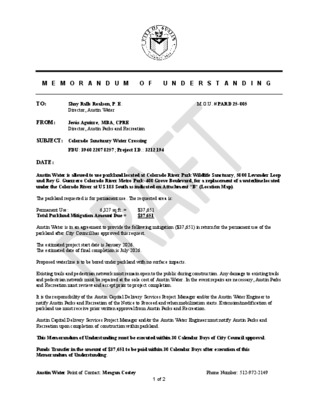
M E M O R A N D U M O F U N D E R S T A N D I N G TO: Shay Ralls Roalson, P. E. M.O.U. # PARD 25-005 Director, Austin Water FROM: Jesús Aguirre, MBA, CPRE Director, Austin Parks and Recreation SUBJECT: Colorado Sanctuary Water Crossing FDU: 3960 2207 8257; Project I.D.: 3212.194 DATE: Austin Water is allowed to use parkland located at Colorado River Park Wildlife Sanctuary, 5800 Levander Loop and Roy G. Guerrero Colorado River Metro Park-400 Grove Boulevard, for a replacement of a waterline located under the Colorado River at US 183 South as indicated on Attachment “B” (Location Map). The parkland requested is for permanent use. The requested area is: Permanent Use: 6,327 sq.ft. = $37,651 Total Parkland Mitigation Amount Due = $37,651 Austin Water is in an agreement to provide the following mitigation ($37,651) in return for the permanent use of the parkland after City Council has approved this request. The estimated project start date is January 2026. The estimated date of final completion is July 2026. Proposed waterline is to be bored under parkland with no surface impacts. Existing trails and pedestrian network must remain open to the public during construction. Any damage to existing trails and pedestrian network must be repaired at the sole cost of Austin Water. In the event repairs are necessary, Austin Parks and Recreation must review and accept prior to project completion. It is the responsibility of the Austin Capital Delivery Services Project Manager and/or the Austin Water Engineer to notify Austin Parks and Recreation of the Notice to Proceed and when mobilization starts. Extension/modification of parkland use must receive prior written approval from Austin Parks and Recreation. Austin Capital Delivery Services Project Manager and/or the Austin Water Engineer must notify Austin Parks and Recreation upon completion of construction within parkland. This Memorandum of Understanding must be executed within 30 Calendar Days of City Council approval. Funds Transfer in the amount of $37,651 to be paid within 30 Calendar Days after execution of this Memorandum of Understanding. Austin Water Point of Contact: Meagan Costey Phone Number: 512-972-2149 1 of 2 Austin Capital Delivery Services Point of Contact: Bryce Barkus Phone Number: 512-978-0830 Austin Parks and Recreation Point of Contact: Paul Books Phone Number: 512-978-1315 Parks & Recreation Board: 11/24/2025 City Council: ____________________________________________________________ Jesús Aguirre, MBA, CPRE Director, Austin Parks and Recreation Date …
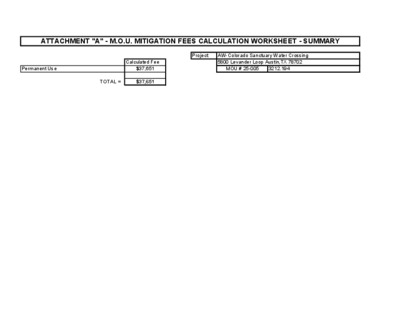
ATTACHMENT "A" - M.O.U. MITIGATION FEES CALCULATION WORKSHEET - SUMMARY Permanent Use Calculated Fee $37,651 TOTAL = $37,651 Project: AW-Colorado Sanctuary Water Crossing 5800 Levander Loop Austin,TX 78702 MOU # 25-005 3212.194 ATTACHMENT "A" - M.O.U. MITIGATION FEES CALCULATION WORKSHEET Permanent Use Agreement - Subject Tract TCAD Land Value of Subject Properties ($): $556,935,510 Project: AW-Colorado Sanctuary Water Crossing 5800 Levander Loop Austin,TX 78702 MOU # 25-005 Avg. Lot Size (sq. ft.): 9,358,899 Based on average for subject properties Value per Square Foot. ($): $60 TCAD Land Value divided by Avg. Lot Size Requested Area (sq. ft.): 6,327 Submitted by Requesting Department/Entity Preliminary Mitigation Value ($): $376,511 Requested Area multiplied by the Value per Square Foot Disturbance Value (%): 10.00% Based on limitations on future development for that portion of parkland (see table below) Final Mitigation Value ($): $37,651 Preliminary Mitigation Value multiplied by the Disturbance Value DISTURBANCE VALUES Percentage of Fee 0-10% Comments Nominal effect on use and utility 11-25% 26-49% 50% 51-74% 75-89% 90-100% Subsurface or air rights that have minimal effect on use and utility Location along a property line or non usable land area Balanced use by both owner and easement holder Some impact on surface use and conveyance of ingress/egress rights Major impact on surface use and conveyance of future uses Severe impact on surface use and conveyance of future uses Example Uses small subsurface Air rights, water or sewer line. Water or sewer line, cable lines Water or sewer line, cable lines pipelines, scenic easements pipelines, drainage easements, flowage easements Overhead electric, flowage easements, railroad ROW, irrigation canals Source: Right of Way Magazine "Easement Valuation" Sherwood, May/June 2006. Provided by City of Austin Office of Real Estate Park Name Colorado River Sanctuary Roy G Guerrero Park Prop ID Square Ft Land Value 283892 283146 1,868,833 16,848,964 9,358,899 18,688,330 1,095,182,689 Certified 2025 TCAD data Certified 2025 TCAD data 556,935,510 Average
125 E 11th St | Austin, Texas 78701 512.463.8588 txdot.gov October 8, 2025 To: City and County Transportation Officials Subject: Compliance with Pavement Marking Standards on Public Roads in Texas Dear Colleagues, The Texas Department of Transportation (TxDOT) is committed to ensuring the safety and uniformity of traffic control devices across all public roads in Texas. This letter serves to affirm both federal and state policy regarding pavement surface markings and traffic control devices, including those installed and maintained by local jurisdictions. On July 1, 2025, U.S. Transportation Secretary Sean Duffy announced the SAFE ROADS Initiative (Safe Arterials for Everyone through Reliable Operations and Distraction-Reducing Strategies). The initiative emphasizes that intersections and crosswalks should be “kept free from distractions,” including political messages, artwork, or any other non-standard markings that may compromise safety. This aligns with longstanding FHWA guidance regarding colored pavement. See FHWA Interpretation Letter 3(09)-24(I) (2013). TxDOT promulgates federal standards through the Texas Manual on Uniform Traffic Control Devices (TMUTCD), under the authority granted by Texas Transportation Code §§ 544.001, and 201.103. Local authorities are required to comply with the TMUTCD by section 544.002. These statutes require uniformity in traffic control devices and authorize TxDOT to oversee compliance on public roadways. Non-standard surface markings, signage, and signals that do not directly support traffic control or safety may cause confusion, reduce roadway uniformity, and impair the effectiveness of both human and automated vehicle navigation. Consistency in traffic control devices is essential to maintaining a safe and efficient transportation network. Pavement markings such as decorative crosswalks, murals, or markings conveying artwork or other messages are prohibited on travel lanes, shoulders, intersections, and crosswalks unless they serve a direct traffic control or safety function. This prohibition includes the use of symbols, flags, or other markings conveying any message or communications. Connecting you with Texas An Equal Opportunity Employer Compliance-Pavement Marking Standards 2 October 8, 2025 Local jurisdictions must remedy any non-compliant installations within 30 days. Exceptions may be granted only with written approval from TxDOT’s Traffic Safety Division, based on a demonstrated public safety benefit or compelling justification. Failure to comply may result in: • Withholding or denial of state or federal funding • Suspension of agreements between TxDOT and the local jurisdiction • Required removal or modification of non-compliant markings on roads that are part of the state highway system or funded through TxDOT-administered programs I have asked that your TxDOT …
MEMORANDUM To: Mayor and City Council Through: Michael Rogers, Assistant City Manager From: Date: Richard Mendoza, P.E., Director, Austin Transportation & Public Works November 5, 2025 Subject: Update on Pavement Marking Compliance and the Public Spaces Task Force The purpose of this memorandum is to provide an update on the Public Spaces Task Force and City’s efforts to comply with the Texas Department of Transportation (TxDOT) letter regarding pavement markings dated October 8, 2025. The Public Spaces Task Force will be staffed by Austin Transportation & Public Works (ATPW). This task force will be active for up to 90 days. Public Spaces Task Force Roster Six Square Cultural District - Daphne McDole • African American Resource Advisory Commission - Daryl Horton • Asian American Resource Advisory Commission – Padmini Jambulapati • Hispanic/Latino Quality of Life Commission – Amanda Afifi • Urban Transportation Commission – Susan Somers • Austin LGBTQ Chamber of Commerce – Colton Ashabranner • Greater Austin Black Chamber of Commerce – Tam Hawkins • Greater Austin Hispanic Chamber of Commerce – Monica Andry • • Mayoral – Steven Rivas • District 2 – KC Coyne • District 4 – Nikki DaVaughn • District 3 – Miriam Dorantes • District 6 – Skyler Korgel • District 7 – Chas Moore • District 8 – Garry Brown • District 10 – Devan Daniel Representatives for the following groups are pending confirmation: Arts Commission, Design Commission, Downtown Commission, LGBTQ Quality of Life Advisory Commission, Parks & Recreation Board, Tourism Commission, Greater Austin Asian Chamber of Commerce, as well as the Council Districts not listed. Date: November 5, 2025 Subject: Update on Pavement Marking Compliance and the Public Spaces Task Force The first meeting of the Public Spaces Task Force will be held on Thursday, November 6, 2025, at 5:30pm, in the Permitting and Development Center. The members will be charged with identifying and making recommendations for the City to “celebrate diversity, show our love of equality, acknowledge contributions to Austin’s culture and character, and present Austin as a unique, creative place wanting to be better by being inclusive.” The Task Force’s work shall focus on ideas that do not violate federal or state requirements and consider funding options, including seeking corporate and philanthropic giving. Potential Financial Impacts of Compliance The initial cost associated with labor and materials if the City is required to address all locations is estimated between $125,000 and …
AUSTIN PARKS AND RECREATION DIRECTOR’S UPDATE November, 2025 Park Development Beverly S. Sheffield Northwest District Park Duck Pond Why did it dry up? • Poolfill line leakage repaired • Runoff from smaller rains blocked from entering • Water leaking through bottom despite shale Why is it overflowing now? • Runoff from larger rains What can be done? • Short-term grading improvements can help water flow in and out of the pond in a more consistent, predictable way. • Working with Watershed Protection to implement. • Also investigating how to address water in parking lot. • Feasibility of long-term solutions, such as routing spring water, adding a storm drain, and a pond liner being explored. Water level low Water level high Park Development Violet Crown Mile Zero Trailhead at Zilker Metro Park • Project led by the Hill Country Conservancy. • Features new trailhead archway, meadow pavilion, observation deck, bike racks and more. • Funding provided by the Hill Country Conservancy, Austin Parks Foundation, and City of Austin Parkland Dedication funds. • Ribbon cutting ceremony was held on November 15. KXAN photo Architectural Development Gus Garcia Recreation Center Senior Wing Project • Project identified in the citywide Senior and Recreation Center Facility Gap Analysis • Scope is to expand existing rec center to create a welcoming space for seniors and senior programming. • Public engagement kicked off with a pop-up on November 10. • Survey open until December 12. Link to survey! Architectural Development Joan Means Khabele Bathhouse Rehabilitation at Barton Springs Pool • Partial opening on October 28 • Restroom and shower spaces, and most of the front parking lot now open to the public. • Rotunda and west side remain closed for construction. Recreation Services Adaptive Kayak Lake Cleanup – Modifications and Support The It’s My Parks Adaptive Kayaking event on Saturday, November 1, held in partnership with the Austin Parks Foundation and the Camacho Activity Center, included 41 volunteers and removed 268 pounds of trash from Lady Bird Lake. Free Meals for Youth Participants – Health Promotions APR partners with the Central Texas Food Bank (CTFB) to provide meals during after school programming. Despite funding shortages and on-going cuts, the CTFB will be providing weekend meals for youth through the 'backpack' program. Nine recreation centers will participate in the program, providing a projected 320 meals a week to families in need. Community Recreation Montopolis Recreation Center Staff at …
REGULAR MEETING OF THE HUMAN RIGHTS COMMISSION MONDAY, NOVEMBER 24, 2025, 6:00 P.M. AUSTIN CITY HALL, ROOM 1101 301 W. 2ND ST AUSTIN, TEXAS Some members of the Human Rights Commission may be participating by videoconference. Public comment will be allowed in-person or remotely via telephone. Speakers may only register to speak on an item once either in-person or remotely and will be allowed up to three minutes to provide their comments. Registration no later than noon the day before the meeting is required for remote participation by telephone. To register to speak remotely, call or email Ryan Sperling at ryan.sperling@austintexas.gov or 512-974-3568 CURRENT BOARD MEMBERS/COMMISSIONERS: Kolby Duhon, Chair (He/They) Muneeb “Meebs” Aslam (He/Him) Melinda Morgan Avitia Harriett Kirsh Pozen Maryam Khawar Gabriella Zeidan, Vice Chair Danielle Bryant Morgan Davis (He/Him) Mariana Krueger (She/Her) Tannya Oliva Martínez AGENDA CALL TO ORDER PUBLIC COMMUNICATION: GENERAL The first ten speakers signed up prior to the meeting being called to order will each be allowed a three-minute allotment to address their concerns regarding items not posted on the agenda. APPROVAL OF MINUTES 1. Approve the minutes of the Human Rights Commission regular meeting on October 20, 2025 STAFF BRIEFINGS 2. Briefing regarding Austin Homeless Strategies and Operations’ current homelessness response efforts and key metrics. Briefing by David Gray, Director, Austin Homeless Strategies and Operations. DISCUSSION AND ACTION ITEMS 3. Discussion and possible action to amend the 2025 Annual Schedule to remove the December 2025 meeting. WORKING GROUP UPDATES 4. Update from the Human Rights Resource Guide Working Group regarding the status of the resource guide. FUTURE AGENDA ITEMS ADJOURNMENT The City of Austin is committed to compliance with the Americans with Disabilities Act. Reasonable modifications and equal access to communications will be provided upon request. For assistance, please contact the Liaison or TTY users’ route through 711. A person may request language access accommodations no later than 48 hours before the scheduled meeting. Please call or email Ryan Sperling at Austin City Clerk’s Office, at 512-974-3568 or ryan.sperling@austintexas.gov, to request service or for additional information. For more information on the Human Rights Commission, please contact Ryan Sperling at 512-974- 3568 or ryan.sperling@austintexas.gov.
HUMAN RIGHTS COMMISSION REGULAR MEETING MINUTES Monday, October 27, 2025 The Human Rights Commission convened in a regular meeting on Monday, October 27, 2025, at 301 W. 2nd St., Boards & Commissions Room, in Austin, Texas. Chair Duhon called the Human Rights Commission meeting to order at 6:02 p.m. Commissioners in Attendance: Kolby Duhon (Chair) Gabriella Zeidan (Vice Chair) Mariana Krueger Mindy Morgan Avitia Tannya Oliva Martinez Commissioners in Attendance Remotely: Danielle Bryant Morgan Davis Maryam Khawar Harriett Kirsh Pozen PUBLIC COMMUNICATION: GENERAL None present. APPROVAL OF MINUTES 1. Approve the minutes of the Human Rights Commission regular meeting on September 22, 2025. The minutes of the September 22, 2025 meeting were approved on Commissioner Krueger’s motion, Commissioner Zeidan’s second on a 9-0 vote. Commissioner Aslam was absent. DISCUSSION ITEMS 2. Discussion regarding how the Human Rights Commission can support the Equity Division and Office of Equity and Inclusion considering the investigation by the U.S. Department of Justice. Discussion was held. 1 DISCUSSION AND ACTION ITEMS 3. 4. Approve the nomination of Human Rights Commission members as primary and alternate Joint Inclusion Committee representatives. The nomination of Commissioner Oliva Martinez as the Human Rights Commission’s Inclusion Committee was approved on primary representative on the Joint Commissioner Krueger’s motion, Vice Chair Zeidan’s second on a 9-0 vote. Commissioner Aslam was absent. The nomination of Commissioner Morgan Avitia as the Human Rights Commission’s alternate representative on the Joint Inclusion Committee was approved on Commissioner Bryant’s motion, Commissioner Krueger’s second on a 9-0 vote. Commissioner Aslam was absent. Approve the 2026 Annual Meeting Schedule of the Human Rights Commission. The motion to amend the draft 2026 annual meeting schedule to reflect that the May date will be 5/21 at 6:00 p.m. was approved on Vice Chair Zeidan’s motion, Commissioner Krueger’s second on a 9-0 vote. Commissioner Aslam was absent. The motion to amend the draft 2026 Annual Meeting Schedule to strike the December meeting date was approved on Commissioner Krueger’s motion, Vice Chair Zeidan’s second on a 9-0 vote. Commissioner Aslam was absent. The 2026 Annual Meeting Schedule was approved as amended on Vice Chair Zeidan’s motion, Commissioner Morgan Avitia’s second on a 9-0 vote. Commissioner Aslam was absent. 5. Approve changes to working group membership. Discussion was held. No action was taken. WORKING GROUP/COMMITTEE UPDATES 6. Update from the Human Rights Resource Guide Working Group regarding its proposed timeline for developing the …
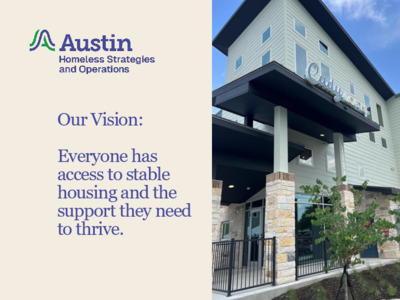
Our Vision: Everyone has access to stable housing and the support they need to thrive. HSO Strategic Pillars System Leadership We are a trusted system leader, working collaboratively to ensure an efficient, accessible, and effective homeless response. Impactful Community Investments We make investments that resolve individual experiences of homelessness and result in meaningful system change. Crisis Response System Management We ensure that people experiencing homelessness have easy access to basic needs, outreach, crisis shelter, and other services to support survival and pathways to stable housing. Communications Through public dialogue and intentional communication with stakeholders, we strengthen community trust, align efforts and drive systemwide impact. Investing in our People We pursue a culture of continuous learning, creating a collaborative, supportive, and engaging workplace that centers growth, development, and well-being. Our staff are inspired and empowered to drive meaningful change. We’re building the capacity to serve more households and reduce unsheltered homelessness. We’re getting upstream with prevention and early intervention, serving more Austinites more quickly. Example Housing Situations • People facing eviction • People with low incomes who are severely rent burdened • People experiencing partner or family violence • People who are doubled up or living in other unstable housing situations HSO Investments in Early Intervention • Digital navigation and resource hotline • Prevention programs for households/youth • Diversion resources for quick resolution of new homelessness • Leverage brick-and-mortar facilities such as shelters and navigation centers to provide rapid exit funds. Help Households Exit Homelessness & Then Promote Stability Stabilize Divert Quickly Resolve Crisis When Not Prevented Prevent Problem Solve Before Crisis Happens $34,000-$40,000 Average cost of RRH or PSH services and subsidy per client per year. $2,040 Average one-time cost per early intervention per client. Spotlight: Digital Innovations PEH Text Alert System • Launched in 2023 to enhance emergency notifications. • Reaches more than 5,000 subscribers. Navigation Hotline • Staffed 60 hours per week. • Immediate screening for early intervention eligibility. • Live referrals to appropriate resources. • 1/3 of callers are families with children. Service Pods • Deployed at high traffic social and health service locations, like navigation centers and emergency rooms. • Video conferencing and tele-health capabilities. • Clients can complete or update a housing assessment. • Reduces need to visit brick-and-mortar locations. Online Resource Finder • Launched austintexas.gov/opennow in 2025. • Provides interactive, up-to-date information on the availability and locations of resources. We’re learning from our successes …
HISTORIC LANDMARK COMMISSION COMMUNITY INTEREST ANNOUNCEMENT Preservation Plan Summit Friday, November 21, 2025, at 9 a.m. Permitting and Development Center, Room 1406/1407 6310 Wilhelmina Delco Drive AUSTIN, TEXAS A quorum of Commission members may be present. No action will be taken, and no Commission business will occur. Questions? Contact Cara Bertron (512) 974-1446
REGULAR CALLED MEETING OF THE DOWNTOWN AUSTIN COMMUNITY COURT ADVISORY BOARD FRIDAY, NOVEMBER 21, 2025 AT 8:00 A.M. ONE TEXAS CENTER, TRAINING ROOM 505 BARTON SPRINGS ROAD AUSTIN, TEXAS Some members of the Downtown Austin Community Court Advisory Board may be participating by videoconference. Public comment will be allowed in-person or remotely via telephone. Speakers may only register to speak on an item once either in-person or remotely and will be allowed up to three minutes to provide their comments. Registration no later than noon the day before the meeting is required for remote participation by telephone. To register to speak remotely, contact Edna Staniszewski at edna.staniszewski@austintexas.gov or at (512) 974-1260. CURRENT [BOARD MEMBERS OR COMMISSIONERS]: Lea Downey Gallatin, Chair Anu Kapadia, Vice Chair Kergin Bedell Karly Jo Dixon CALL TO ORDER Mikaela Frissell Faye Mills Amanda Marzullo Katy Jo Muncie Josh Robinson Roy Woody PUBLIC COMMUNICATION: GENERAL Speakers signed up prior to the meeting being called to order will each be allowed a three-minute allotment to address their concerns regarding items not posted on the agenda including individuals that wish to share first-hand accounts regarding their experiences being served through Austin’s homelessness system. APPROVAL OF MINUTES 1. 2. Approve the minutes of the Downtown Austin Community Court Advisory Board Regular meeting on September 19, 2025. Approve the minutes of the Downtown Austin Community Court Advisory Board Special Called meeting on November 14, 2025. Page 1 of 2 STAFF BRIEFINGS 2. 3. Staff briefings regarding Austin Community Court approach to service collaborations and co- located services – (Downey Gallatin/Kapadia). Presentation by Jennifer Sowinski, Clinical Operations Manager from Austin Community Court. Staff briefings regarding status of Austin Community Court operational areas including performance measures and services delivered through Community Services, Court Services, Homeless Services and Support Services – (Downey Gallatin/Kapadia). Presentation by Jennifer Sowinski, Clinical Operations Manager; Bailey Gray, Court Operations Manager, and Robert Kingham, Court Administrator from Austin Community Court. FUTURE AGENDA ITEMS ADJOURNMENT The City of Austin is committed to compliance with the Americans with Disabilities Act. Reasonable modifications and equal access to communications will be provided upon request. For assistance, please contact the Liaison or TTY users’ route through 711. A person may request language access accommodations no later than 48 hours before the scheduled meeting. Please call or email Edna Staniszewski at Austin Community Court Department, at 512) 974-1260 or at edna.staniszewski@austintexas.gov.], to request service or for …
Collocation of Social Services Austin Community Court November 21, 2025 Organizations who provide services at Austin Community Court : 2 Medical and Mental Health Support • Bimonthly, Community Care Clinic provides a full medical clinic at Austin Community Court • Black Men’s Health Clinic provides weekly support to our clients to encourage them to engage in medical care and enrollment in the Medical Assistance Program (MAP) • An Integral Care psychiatrist provides office hours weekly at Community Court • An Integral Care Intake Specialist completes enrollment assessments weekly for clients to access mental health services 3 Substance Use Services • Road to Recovery inpatient residential program screens clients for services every Tuesday and Thursday for quicker access to services • Communities for Recovery provides in-house peer recovery services in our lobby and to case managed clients. 4 Other Social Service Resources Veterans Affairs Outreach Specialist Family Eldercare SOAR Specialist Community First! Village tour and assistance with applications In-person Coordinated Assessments every Tuesday 5 Access to Austin Community Court Office Space Safe environment for clients and case managers to meet • Organizations such as Health for the Homeless, Capital Metro, Caritas, and Family Eldercare regularly meet with their clients at Austin Community Court 6 Austin Community Court is always looking for opportunities to collocate services that would benefit our clients and assist with navigating complex systems to obtain housing. For more information about potential partnerships, please contact Jennifer Sowinski, Clinical Operations Manager at Jennifer.Sowinski@austintexas.gov 7
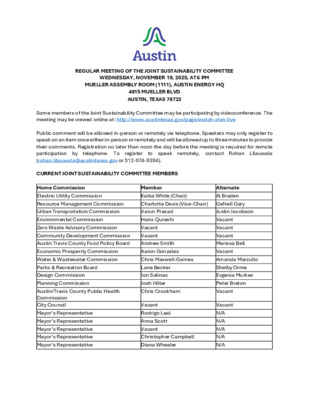
REGULAR MEETING OF THE JOINT SUSTAINABILITY COMMITTEE WEDNESDAY, NOVEMBER 19, 2025, AT 6 PM MUELLER ASSEMBLY ROOM (1111), AUSTIN ENERGY HQ 4815 MUELLER BLVD AUSTIN, TEXAS 78723 Some members of the Joint Sustainability Committee may be participating by videoconference. The meeting may be viewed online at: http://www.austintexas.gov/page/watch-atxn-live Public comment will be allowed in-person or remotely via telephone. Speakers may only register to speak on an item once either in-person or remotely and will be allowed up to three minutes to provide their comments. Registration no later than noon the day before the meeting is required for remote participation by remotely, contact Rohan Lilauwala telephone. To (rohan.lilauwala@austintexas.gov or 512-974-9394). to speak register CURRENT JOINT SUSTAINABILITY COMMITTEE MEMBERS Home Commission Electric Utility Commission Resource Management Commission Urban Transportation Commission Environmental Commission Zero Waste Advisory Commission Community Development Commission Austin Travis County Food Policy Board Economic Prosperity Commission Water & Wastewater Commission Parks & Recreation Board Design Commission Planning Commission Austin/Travis County Public Health Commission City Council Mayor’s Representative Mayor’s Representative Mayor’s Representative Mayor’s Representative Mayor’s Representative Alternate Al Braden Member Kaiba White (Chair) Charlotte Davis (Vice-Chair) GeNell Gary Varun Prasad Haris Qureshi Vacant Vacant Andrew Smith Aaron Gonzales Chris Maxwell-Gaines Lane Becker Jon Salinas Josh Hiller Chris Crookham Justin Jacobson Vacant Vacant Vacant Marissa Bell Vacant Amanda Marzullo Shelby Orme Evgenia Murkes Peter Breton Vacant Vacant Rodrigo Leal Anna Scott Vacant Christopher Campbell Diana Wheeler Vacant N/A N/A N/A N/A N/A AGENDA CALL TO ORDER PUBLIC COMMUNICATION: GENERAL The first 10 speakers signed up prior to the meeting being called to order will each be allowed a three- minute allotment to address their concerns regarding items not posted on the agenda. APPROVAL OF MINUTES 1. Approve the minutes of the Joint Sustainability Committee Regular Meeting on October 22, 2025. STAFF BRIEFINGS 2. Staff briefing regarding Solar on City Facilities. Presentation by Rohan Lilauwala, Climate Project Manager, Austin Climate Action and Resilience. DISCUSSION ITEMS 3. 4. 5. Presentation regarding Austin Resource Recovery Fleet Electrification. Presentation by Nia Nickens, Environmental Defense Fund Climate Corps Fellow. Presentation regarding Commercial Landscape Survey. Presentation by Jen Cregar, Terra Lumina Consulting. Presentation regarding Farmland Acquisition and Preservation. Presentation by Andy Smith, Marissa Bell, and Matt Simon, Austin-Travis County Food Policy Board. DISCUSSION AND ACTION ITEMS 6. 7. 8. 9. 10. Approve the creation of working groups for FY27 City of Austin Budget, funding, and priority policy recommendations. Approve …
. RECOMMENDATION TO COUNCIL Joint Sustainability Committee Recommendation Number 20251119-007: Staff for Climate Action and Resilience office in FY 2026 City of Austin Budget Date of Approval: November 19, 2025 Recommendation: The Joint Sustainability Committee recommends that the Austin City Council retain the Energy Program Manager and the Sustainability Program Manager positions for the Climate Action and Resilience office in the FY 2026 budget. Description of Recommendation to Council: The Energy Program Manager and the Sustainability Program Manager positions for the Climate Action and Resilience office were included in FY 2026 budget adopted by Council in August. The Joint Sustainability Committee believes it is important to preserve these positions in the new FY 2026 budget that Council will soon adopt. Rationale: The Energy Program Manager and the Sustainability Program Manager are vital to make progress on the city’s climate goals and will ultimately save the city money. The impact of these two positions on the budget is minimal, amounting to $124,276 from the General Fund and $104,274 from other sources. Given that these positions will help the City save money and utilize its resources more strategically, it would be more prudent to allocate space in the budget for this minor expense than to cut the positions. The Climate Action and Resilience office hasn't received new staff positions in years, despite the scope and responsibilities of the office expanding. Even with these two new positions, the office will still have unmet staffing needs; however, these two will help fill the most urgent gaps. The Energy Program Manager is needed to lead the effort to install solar energy systems and make energy efficiency improvements at City facilities. These upgrades will reduce energy consumption, thereby saving the City money and lowering greenhouse gas emissions. Capturing the financial savings in a revolving fund will enable the City to continually make informed investments that reduce energy use and emissions at its facilities. It will address a long-standing problem of deferring needed maintenance at City facilities. This position will allow the City to align its practices with the adopted goals of the Austin Climate Equity Plan and the Austin Energy Resource, . Generation and Climate Protection Plan, both of which identify local solar and energy efficiency as key strategies to reduce emissions and affordably meet local energy needs. This work is extremely time-sensitive because of the expiring federal solar energy tax credits. The Sustainable Program Manager …
. RECOMMENDATION TO COUNCIL Joint Sustainability Committee Recommendation Number 20251119-008: Funding for Solar and Energy Efficiency Investments at City Facilities Date of Approval: November 19, 2025 WHEREAS, on August 8, 2019, the Austin City Council adopted a resolution declaring a climate emergency and calling “for an immediate emergency mobilization to restore a safe climate” and directing the city manager to take steps to accelerate local greenhouse gas emissions reductions; and WHEREAS, on September 30, 2021, the Austin City Council adopted the Austin Climate Equity Plan, which established a goal of reaching net-zero greenhouse gas emissions for the Austin Community by 2040; and WHEREAS, on December 12, 2024, the Austin City Council adopted the Austin Energy Resource, Generation and Climate Protection Plan to 2035, which reaffirmed energy efficiency, local solar, demand response and customer-sited batteries as priority strategies for meeting Austin’s energy needs; and WHEREAS, Austin’s Climate Implementation Plan identifies creating a climate revolving fund to invest in energy upgrades to city facilities, capture savings, and reinvest funds for additional investment as a foundational action and identifies installing solar at city facilities one of the few actions to create cost savings for the city; and WHEREAS, other cities and counties across the country have established revolving funds and successfully implemented them to address challenges; and WHEREAS, the City of San Antonio has invested $42 million into its revolving fund for energy efficiency upgrades and solar installations at city properties and the resulting savings are available for additional investments; and WHEREAS, most City of Austin buildings that could functionally support solar energy installations do not yet have them; and WHEREAS, many City of Austin buildings are in need of energy efficiency improvements, and other upgrades that will reduce greenhouse gas emissions and cut costs; and . WHEREAS, investing in solar energy that is interconnected on the customer’s side of the meter yields the greatest financial benefit to the customer; and WHEREAS, solar installations of all capacity sizes are cost-effective and reduce greenhouse gas emissions and local air pollution; and WHEREAS, some solar energy developers and installation companies specialize on larger installations and others on smaller installations, while others work on both large- and small-scale solar installations and can balance costs and installation speed by doing some of each; and WHEREAS, the more solar energy installations the city can fund, the more money it will save; and WHEREAS, the climate crisis is worsening …
JOINT SUSTAINABILITY COMMITTEE REGULAR MEETING SPECIAL CALLED MEETING MINUTES October 22, 2025 The Joint Sustainability Committee convened in a hybrid meeting via videoconferencing and at City Hall Council Chambers. Board Members in Attendance in Person: Kaiba White, Anna Scott, Jon Salinas, Charlotte Davis Board Members in Attendance Remotely: Rodrigo Leal, Andy Smith, Christopher Campbell, Chris Crookham, Aaron Gonzales, Peter Breton, Varun Prasad Board Members Absent: Lane Becker, Haris Qureshi, Diana Wheeler, Chris Maxwell-Gaines City Staff in Attendance: Braden Latham-Jones CALL TO ORDER Chair Kaiba White called the meeting to order at 6:15pm. PUBLIC COMMUNICATION: GENERAL N/A APPROVAL OF MINUTES 1. Motion to approve minutes of the Joint Sustainability Committee Regular Meeting on August 27, 2025 Meeting. a. Adopted on a 11-0 vote on Davis motion and Salinas second. STAFF BRIEFINGS 2. Staff briefing regarding Green Infrastructure in the Right-of-Way. Presentation by Michelle Marx, Transportation Officer, Austin Transportation and Public Works. a. Marx: We are in discussion with many departments and agree that we’ll have to be at the table. The goal is to reconcile the various rules and regulations, and there’s been a willingness to collaborate from all departments. b. Marx: Focus has been on both private development and capital projects. As we update the manual, we’ll need to focus on these details. We’ll need to focus strategically on these and set up capital project review systems to catch that. c. A plan to expand existing requirements? d. Marx: Right now street trees are not rolled into residential streets, which would be an important conversation to have over time. e. Scott: Encouragement to focus on specific neighborhoods that meet an equity lens. f. Rodrigo Leal: DO you have the resources necessary in house to develop a green infrastructure plan, and how long might that take? i. Marx: We have staff capacity to develop analysis and prioritize target list. Don’t have a good inventory of street trees that are out there today and their condition. Need that to better understand where the gaps are. Inventory is a first step. g. Charlotte Davis: Question about the city-wide tree inventory, yes this is part of the conversation. h. Scott: Have y’all considered ways to expedite this process? i. Marx: Yes and we’ll continue reflecting on ways to do so. j. Andy: Encouragement for species selection, and exploring best guidance on which species would match. k. White: Ballpark funding estimate? l. Marx: Back of …
RECOMMENDATION TO COUNCIL Austin-Travis County Food Policy Board Recommendation Number: 20251020-05: Support for investing in farmland preservation and access in Austin and Travis County WHEREAS, the 2022 City of Austin State of the Food System Report indicates that less than 0.6% of the food consumed in Travis County is produced locally, and that approximately 16.8 acres of farmland are lost daily to development pressure, underscoring the critical need for agricultural land preservation e(cid:431)orts; and WHEREAS, farmland in Central Texas is continuing to increase in value and decrease in quantity, the opportunity to preserve a meaningful amount of farmland will disappear as development spreads and farmland is permanently converted to other uses; and WHEREAS, it is recognized by the Milan Urban Food Policy Pact and demonstrated by the Carbon Cycle Institute that agricultural land managed according to regenerative principles is vital to local food security, watershed protection, emergency preparedness, and climate resilience; and WHEREAS, farmland preservation supports multiple City priorities, including increasing local food production, improving water quality, wildlife habitat preservation, ecosystem biodiversity, stormwater management, carbon sequestration, and recreation; and WHEREAS, the Austin/Travis County Food Plan, approved by Austin City Council in October 2024, includes strategic, measurable, and time-bound goals and strategies to strengthen food security, promote environmental sustainability, and address climate change; and WHEREAS, Goal 1 of the Austin/Travis County Food Plan prioritizes expanding community food production, preserving agricultural lands, and increasing the amount of farmland dedicated to regenerative food production in Austin and Travis County; and WHEREAS, Strategy 1.1 of the Food Plan calls for the preservation of land for food production in Central Texas through conservation easements, fee-simple purchases, and land-banking, ensuring that farmland remains dedicated to agricultural use; and WHEREAS, Strategy 1.2 of the Food Plan directs the City of Austin to pursue capital funding sources to finance the preservation of land for agricultural use through conservation easements or direct purchases; and WHEREAS, preserving agricultural land also supports the goals of the Austin Climate Equity Plan by promoting sustainable land use and reducing carbon footprints through localized food production; and WHEREAS, Natural Systems Goal 2 of the Austin Climate Equity Plan aims to protect 500,000 acres of farmland across the five-county region through legal conservation or regenerative agriculture programs by 2030; and WHEREAS, the ATCFPB passed Recommendation Number: 20250310-06A: Support for Agricultural Land Acquisition and Preservation in March 2025 encouraging the city to increase sta(cid:431) capacity to …
Solar on City Facilities Response to Council Resolution 20250522-052 November 19, 2025 Joint Sustainability Committee Agenda • Background and Context • Approach • Site Screening • Request for Proposals • Schedule and Next Steps 2 Resolution 20250522-052 • Conduct an analysis of City property and make recommendations for the areas that would maximize the installation of solar generation, prioritizing general fund properties. • Annually calculate any energy cost savings or revenue generated and utilize an equivalent amount of funding for projects that have a beneficial environmental impact. • Evaluate opportunities for the installation of solar capacity on properties owned or operated by other local governmental entities within the Austin Energy load zone. • Analyze and make recommendations for requiring solar contractors who install City-owned solar installations to comply with the highest level of worker protections , wage rates, benefits and utilization of Department of Labor registered apprenticeship programs and/or graduates from the Austin Infrastructure Academy. 3 A Changing Federal Solar Landscape Infl ation Reduction Act (2021) • Elective pay / direct allows cities to benefit from existing tax credits 30% tax credit available (+10% for domestic content) • One Big Beautiful Bill Act (2025) • Phases out tax credits for clean energy (including solar). • Projects must “commence construction” by July 4, 2026 to get tax credits. OR • Projects must be placed into service before the end of 2027 to get tax credits. 4 Assess Collaborative team effort Engage with building owning departments upfront Inventory and assess current city facilities Determine solar potential Procure Issue RFP for multiple sites to achieve economies of scale Evaluate proposals and ownership models: • City Owned • Solar Standard Offer Decide and Build Select winning proposal(s) and identify funding (if applicable) Build Solar ASAP to leverage tax credits Build O&M into the contract for long-term performance Approach 5 There are three types of sites for municipal solar projects Rooftop Canopy Ground-mounted 6 Goal: Identify technically feasible sites to put forward, ask solar developers to propose a portfolio that maximizes scale, cost-effectiveness, and community benefits. Facilities Screening Over 250 properties ~120 sites meet basic criteria: size, roof life, electrical capacity We are here Department validation In shortlist for RFP Solar proposed by vendors 7 Schedule and Next Steps 1 2 3 4 5 CWEP Council Committ ee: Update on our approach, process, and RFP release. (Dec 2) RFP Release: Two-steps: qualifications + proposal and …
ARR Fleet Electrification Plan Nia Nickens, EDF Climate Corp | November 19, 2025 Project Overview 2 Project Overview ● Zero waste by 2040. ● Austin Resource Recovery Comprehensive Plan ● Chapter 4: Sustainability (Transportation Electrification) ● Chapter 8: Infrastructure & Facilities ● Zero Waste Commission (ZWAC) Resolution 3 Project Outline ● Fleet Assessment: Identify electric alternatives for ARR’s refuse trucks; Propose phased electrification schedule and vehicle models as ICEVs age out of service. ● Charging Infrastructure: Estimate number, type, and location of chargers; develop a buildout timeline aligned with BEV adoption. ● Financial Analysis: Compare acquisition, O&M, end-of-service, and infrastructure costs to assess life-cycle savings. ● Operational Feasibility: Evaluate route feasibility, charging locations. ● Environmental Impacts: Quantify GHG, air quality, health, and community co-benefits. 4 Fleet Assessment 5 Overview – ARR’s Fleet Composition & EV Alternatives ● 189 front-line refuse trucks targeted for electrification ● Current mix: 1 BEV pilot, 2 CNG, majority diesel ● EV alternatives available across truck classes (11–33 yd, 240–500 kWh, 80–130 mi range) 6 ARR Fleet Electrification Timeline ) % ( e v i t a l u m u C V E B 100% 90% 80% 70% 60% 50% 40% 30% 20% 10% 0% 2 0 2 6 2 0 2 7 2 0 2 8 2 0 2 9 2 0 3 0 2 0 3 1 2 0 3 2 2 0 3 3 2 0 3 4 2 0 3 5 2 0 3 6 2 0 3 7 2 0 3 8 2 0 3 9 t n u o C e v i t a l u m u C V E B 180 160 140 120 100 80 60 40 20 0 Results – ARR’s Fleet Composition & EV Alternatives ● BEV Alternatives Identified ● 11-yd Rear Loaders: 3 EV alternatives ● 25-33-yd Side Loaders: 8 EV alternatives ● 25-33-yd Rear Loaders: 3 EV alternatives 8 Charging Infrastructure 9 Overview – Estimation of New Charging Infrastructure Needed ● Assess charging needs based on the 60/40 fleet split between NESC & KGSC. Also consider possible transfer station. ● Compare technology options: all-DC fast charging vs. hybrid daisy-chain approach. ● Plan phased buildout aligned with fleet adoption and cost efficiencies. ● All infrastructure funding and associated O&M costs to be covered by Fleet Mobility Services. 10 North Austin Transfer Station: 20 DCFCs Proposed Charging 38 DCFCs 78 Daisy Chains 25 …
Commercial Landscaping Equipment Electrification Market Study Meet the Team Amanda Mortl (she / they) Austin Climate Action & Resilience Sarah Talkington (she / her) Austin Parks & Recreation Leonor Vargas (ella / her) Wisdom En Familias, LLC Jen Cregar (she / her) Terra Lumina Consulting 2 Why This Study Matters • Fossil fuel landscaping equipment = high noise + air pollution • Health risks for workers and community members In 2020, landscaping equipment in Travis County created an estimated: 154,400 tons of carbon dioxide (CO2), like driving nearly 34,000 cars for a year 361 tons of nitrogen oxides (NOx), like driving more than 161,500 cars for a year 128 tons of fine particulate matter (PM2.5), like driving more than 1.3M cars for a year 3 Background & Policy Context • Austin Climate Equity Plan: net-zero greenhouse gas emissions by 2040 • Austin-Round Rock-San Marcos MSA Regional Air Quality Plan: maintain compliance with federal air quality standards • Council resolutions: ◦ 20240229-058: Green purchasing ◦ 20240307-020: Rebates + exchange programs 4 Methodology • Online survey (53 responses) • Interviews (32 local, 7 national) • Site tours • Diverse representation: ◦ City of Austin and other govt. staff ◦ Minority / woman-owned businesses City of Austin Staff Participation by Department ◦ Small and large businesses ◦ Local and national businesses ◦ Early adopters 5 Electric Equipment Benefits Electric Equipment Challenges • Quieter • Cleaner • Easier to handle (for some) • Safer (no fuel handling, improved ergonomics for some) • Less maintenance • Potential for lower lifecycle costs • Insufficient power output • Insufficient battery life • Charging constraints • Higher upfront cost • Maintenance & disposal uncertainty • Heavier and less ergonomic (for some) • Cultural resistance 6 Market-Ready Electric Equipment Not Yet Viable Electric Equipment • Smaller (< 20 bar) chain saws • Larger (≥ 20 bar) chain saws • String and hedge trimmers for light- • String and hedge trimmers for duty applications heavy-duty applications • Leaf blowers for light-duty applications • Leaf blowers for heavy-duty applications and some operators • Push, walk behind, automated • Larger riding mowers and (robotic) mowers, and smaller riding mowers for smaller-acreage and/or single-site applications automated (robotic) mowers for larger-acreage and multi-site applications • Carts / utility terrain vehicles 7 Lead by Example Recommendations • Prioritize outcomes over technology type. • Implement a phased rollout. • Develop citywide charging infrastructure. • Use lifecycle …
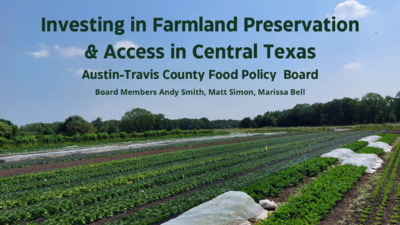
Investing in Farmland Preservation & Access in Central Texas Austin -Travis Couty Food Policy Board Commissioners Andy Smith, Matt Simon, Marissa Bell Food Access & Resilience Crisis • Less than 1% of food consumed in Travis County is produced locally. • More demand than supply - Central Texas’ production cannot realistically meet its total demand for food. ⚬ When prices rise, local food becomes inaccessible for families and small businesses • COVID-19 showed our fragile supply chain ⚬ Local producers were more resilient and quick to respond. Sources: 2022, City of Austin, State of the Food System Report; Central Texas Food Bank, Central TX Food System Dashboard Farmland Access Crisis Source: Central Texas Food Bank, Food Systems Dashboard Now is the cheapest and easiest time to break the cycle. Ripple Effects of Losing Farmland: • Food System Resilience ⚬ Less local food production capacity • Water & Flooding ⚬ Increased runoff, reduced aquifer recharge Remaining land becomes more valuable • Climate ⚬ Lost carbon sinks, more emissions from development • Biodiversity ⚬ Habitat loss and ecosystem function decline • Local Economy ⚬ Fewer viable farms, lost green jobs Farmland Preservation Supports Many City Priorities and Goals Austin-Travis County Food Plan: Food Plan Strategy 1.1: Preserve land for food production Food Plan Strategy 1.2: Pursue capital funding sources, such as general obligation bonds, to fund the conservation of agricultural land. Source: 2024, City of Austin, Austin-Travis County Food Plan Austin already protects land for water, wildlife, and open space. The same tools can be used to protect land for food production. Sources: (Austin Water, WQPL program, 2022; PARD, Our Parks, Our Future Plan, 2020; Austin Water BCP;) Case Study: Wilbarger Creek Conservation Alliance (WCCA) • 1978: Jon Beall acquires Three Creeks Farm after military retirement • 2011: Begins conservation easement discussions with Hill Country Conservancy • NRCS Funding: $1M awarded through Natural Resources Conservation Service (NRCS) Farm and Ranchlands Protection Program (predecessor to Regional Conservation Partnership Program – RCPP) ⚬ 2017 Easement Secured: with NRCS funds and matching funds from Travis County and others, the Wilbarger Creek Conservation Alliance protected 2,000+ contiguous acres of farmland. • Ongoing Stewardship: Land leased to sustainable agriculture producers aligned with conservation goals. Meet our WCCA Farmers: The Refugee Collective • Leased 20 acres since 2018 • Employs refugees in fair-wage, dignified work • Produces certified organic vegetables & eggs – 50,000+ lbs annually • Employs …
Investing in Farmland Preservation & Access in Central Texas Austin-Travis County Food Policy Board Board Members Andy Smith, Matt Simon, Marissa Bell Food Access & Resilience Crisis Less than 1% of food consumed in Travis County is produced locally. More demand than supply - Central Texas’ production cannot realistically meet its total demand for food. When prices rise, local food becomes inaccessible for families and small businesses COVID-19 showed our fragile supply chain Local producers were more resilient and quick to respond to feed our community. Sources: 2022, City of Austin, State of the Food System Report; Central Texas Food Bank, Central TX Food System Dashboard Farmland Access Crisis 2017 Total Acres 2022 Total Acres 5 year loss 2017-2022 Decrease Travis 212,782 193,523 19,259 9.10% Williamson 541,344 368,663 172,681 31.90% Hays 254,999 129,788 125,211 49.10% Bastrop 321,934 247,205 74,729 23.20% Caldwell 269,665 229,140 40,525 15.00% Region 1,600,724 1,168,319 432,405 27.00% All farmland in the 5 county region will be developed by 2035 if this rate of loss continues. Source: 2022, City of Austin, State of the Food System Report, Central Texas Food Bank, Food Systems Dashboard Now is the cheapest and easiest time to break the cycle. Ripple Effects of Losing Farmland: Food System Resilience Less local food production capacity Water & Flooding Increased runoff, reduced aquifer recharge Remaining land becomes more valuable Climate Lost carbon sinks, more emissions from development Biodiversity Habitat loss and ecosystem function decline Local Economy Fewer viable farms, lost green jobs Farmland Preservation Aligns with Many City Priorities and Goals City Goal Area Alignment / Impact Reference (Plan & Goal #) Food Security Climate Action Preserves agricultural lands and expands regenerative food production, building local food system capacity. Austin-Travis County Food Plan — Goal 1 Regenerative farmland protects carbon-rich soils and supports carbon sequestration on working lands. City Strategic Plan — CH3. Austin Climate Equity Plan — Natural Systems Goal 1 (Needs Support). Farmland Protection Advances target to protect 500,000 acres of farmland in 5-county region; currently off track. Austin Climate Equity Plan — Natural Systems Goal 2 (Off-Track) Economic Growth Supports the creation of green jobs and entrepreneurship. Austin Climate Equity Plan — Green Jobs and Entrepreneurship- Strategy 1 Watershed Protection Regenerative farmland increases infiltration, reduces runoff, and supports aquifer recharge. City Strategic Plan — CH3.2, CH3.3.2; Watershed Protection Master Plan Biodiversity Regenerative farmland maintains wildlife habitat and soil biodiversity. Resolution 20230126-054 — UN …
JOINT SUSTAINABILITY COMMITTEE RECOMMENDATION 20251119-007 Date: November 19, 2025 Subject: Staff for Climate Action and Resilience office in FY 2026 City of Austin Budget Motioned By: Seconded By: Recommendation The Joint Sustainability Committee recommends that the Austin City Council retain the Energy Program Manager and the Sustainability Program Manager positions for the Climate Action and Resilience office in the FY 2026 budget. Description of Recommendation to Council The Energy Program Manager and the Sustainability Program Manager positions for the Climate Action and Resilience office were included in FY 2026 budget adopted by Council in August. The Joint Sustainability Committee believes it is important to preserve these positions in the new FY 2026 budget that Council will soon adopt. Rationale: The Energy Program Manager and the Sustainability Program Manager are vital to make progress on the city’s climate goals and will ultimately save the city money. The impact of these two positions on the budget is minimal, amounting to $124,276 from the General Fund and $104,274 from other sources. Given that these positions will help the City save money and utilize its resources more strategically, it would be more prudent to allocate space in the budget for this minor expense than to cut the positions. The Climate Action and Resilience office hasn't received new staff positions in years, despite the scope and responsibilities of the office expanding. Even with these two new positions, the office will still have unmet staffing needs; however, these two will help fill the most urgent gaps. The Energy Program Manager is needed to lead the effort to install solar energy systems and make energy efficiency improvements at City facilities. These upgrades will reduce energy consumption, thereby saving the City money and lowering greenhouse gas emissions. Capturing the financial savings in a revolving fund will enable the City to continually make informed investments that reduce energy use and emissions at its facilities. It will address a long-standing problem of deferring needed maintenance at City facilities. This position will allow the City to align its practices with the adopted goals of the Austin Climate Equity Plan and the Austin Energy Resource, Generation and Climate Protection Plan, both of which identify local solar and energy efficiency as key strategies to reduce emissions and affordably meet local energy needs. This work is extremely time-sensitive because of the expiring federal solar energy tax credits. 1 of 2 The Sustainable Program Manager …
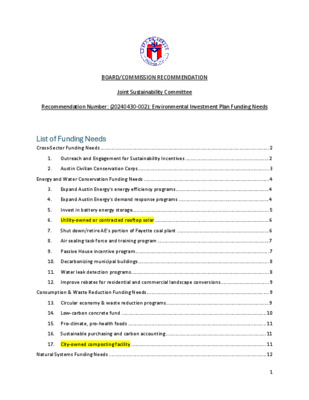
BOARD/COMMISSION RECOMMENDATION Joint Sustainability Committee Recommendation Number: (20240430-002): Environmental Investment Plan Funding Needs List of Funding Needs Cross-Sector Funding Needs ......................................................................................................................... 2 1. 2. Outreach and Engagement for Sustainability Incentives ............................................................ 2 Austin Civilian Conservation Corps .............................................................................................. 3 Energy and Water Conservation Funding Needs .......................................................................................... 4 3. 4. 5. 6. 7. 8. 9. Expand Austin Energy’s energy efficiency programs ................................................................... 4 Expand Austin Energy’s demand response programs ................................................................. 4 Invest in battery energy storage.................................................................................................. 5 Utility-owned or contracted rooftop solar .................................................................................. 6 Shut down/retire AE’s portion of Fayette coal plant .................................................................. 6 Air sealing task force and training program ................................................................................ 7 Passive House incentive program ................................................................................................ 7 10. Decarbonizing municipal buildings .............................................................................................. 8 11. Water leak detection programs ................................................................................................... 8 12. Improve rebates for residential and commercial landscape conversions ................................... 9 Consumption & Waste Reduction Funding Needs........................................................................................ 9 13. Circular economy & waste reduction programs .......................................................................... 9 14. Low-carbon concrete fund ........................................................................................................ 10 15. Pro-climate, pro-health foods ................................................................................................... 11 16. Sustainable purchasing and carbon accounting ........................................................................ 11 17. City-owned composting facility ................................................................................................. 11 Natural Systems Funding Needs ................................................................................................................. 12 1 18. Preservation of existing agricultural land .................................................................................. 12 19. Revolving loan fund for Working Farms Fund pilot ................................................................... 12 20. Energy and water dashboard for city facilities .......................................................................... 13 21. Comprehensive public tree inventory for the city of Austin ..................................................... 13 Transportation and Land Use Funding Needs ............................................................................................. 14 22. Austin Resource Recovery Fleet Electrification ......................................................................... 14 23. Austin Resource Recovery Transfer Station .............................................................................. 14 24. Expand All Ages and Abilities Bicycle Network, Urban Trails, Sidewalks, and Shared Mobility 14 25. Extend Pickup Service Zones ..................................................................................................... 16 26. Downtown High-Frequency Circulator ...................................................................................... 17 27. Neighborhood E-Circulators ...................................................................................................... 18 28. Heat Resilience Infrastructure ................................................................................................... 19 29. CityLeap ATX Plan: convert travel lanes on arterial roads to protected bike or bus lanes ....... 21 30. Establish a city-owned all-electric carshare service .................................................................. 21 31. Low-cost, accessible charging stations at City of Austin owned facilities ................................. 22 32. Install charging stations at multi-family homes with priority in low and moderate income communities ....................................................................................................................................... 23 33. E-mobility solutions pilot program ............................................................................................ 24 Cross-Sector Funding Needs 1. Outreach and Engagement for Sustainability Incentives Details: The City of Austin has numerous sustainability incentive programs aligned with the goals of the Climate Equity Plan. However, many of these programs are underutilized, especially among low-income households. A part of the challenge is awareness. The city should host a …
November 17, 2025 RE: Retain new staff positions for Climate Action and Resilience in FY26 Budget Dear Mayor Watson and City Council Members, We urge you to prioritize keeping the two new positions for the Austin Climate Action and Resilience office in the FY 2026 budget. The Energy Program Manager and the Sustainability Program Manager are vital to make progress on the city’s climate goals and will ultimately save the city money. The impact of these two positions on the budget is minimal, amounting to $124,276 from the General Fund and $104,274 from other sources. Given that these positions will help the City save money and utilize its resources more strategically, it would be more prudent to allocate space in the budget for this minor expense than to cut the positions. The Climate Action and Resilience office hasn't received new staff positions in years, despite the scope and responsibilities of the office expanding. Even with these two new positions, the office will still have unmet staffing needs; however, these two will help fill the most urgent gaps. The Energy Program Manager is needed to lead the effort to install solar energy systems and make energy efficiency improvements at City facilities. These upgrades will reduce energy consumption, thereby saving the City money and lowering greenhouse gas emissions. Capturing the financial savings in a revolving fund will enable the City to continually make informed investments that reduce energy use and emissions at its facilities. It will address a long-standing problem of deferring needed maintenance at City facilities. This position will allow the City to align its practices with the adopted goals of the Austin Climate Equity Plan and the Austin Energy Resource, Generation and Climate Protection Plan, both of which identify local solar and energy efficiency as key strategies to reduce emissions and affordably meet local energy needs. This work is extremely time-sensitive because of the expiring federal solar energy tax credits. The Sustainable Program Manager is needed to develop and implement environmentally sustainable purchasing policies, procedures and programs at the City. The City of Austin’s largest source of greenhouse gas emissions is in the products and materials it purchases. A significant section of the Austin Climate Equity Plan, which focuses on reducing emissions by adjusting purchasing policies and practices, has languished due to a lack of staff to complete the work. The City has considerable purchasing power and should utilize procurement …
BOARD/COMMISSION RECOMMENDATION Joint Sustainability Committee Recommendation Number 20251119-008: Resolution on Funding for Solar and Energy Efficiency Investments at City Facilities WHEREAS, on August 8, 2019, the Austin City Council adopted a resolution declaring a climate emergency and calling “for an immediate emergency mobilization to restore a safe climate” and directing the city manager to take steps to accelerate local greenhouse gas emissions reductions; and WHEREAS, on September 30, 2021, the Austin City Council adopted the Austin Climate Equity Plan, which established a goal of reaching net-zero greenhouse gas emissions for the Austin Community by 2040; and WHEREAS, on December 12, 2024, the Austin City Council adopted the Austin Energy Resource, Generation and Climate Protection Plan to 2035, which reaffirmed energy efficiency, local solar, demand response and customer-sited batteries as priority strategies for meeting Austin’s energy needs; and WHEREAS, Austin’s Climate Implementation Plan identifies creating a climate revolving fund to invest in energy upgrades to city facilities, capture savings, and reinvest funds for additional investment as a foundational action and identifies installing solar at city facilities one of the few actions to create cost savings for the city; and WHEREAS, other cities and counties across the country have established revolving funds and successfully implemented them to address challenges; and WHEREAS, the City of San Antonio has invested $42 million into its revolving fund for energy efficiency upgrades and solar installations at city properties and the resulting savings are available for additional investments; and WHEREAS, most City of Austin buildings that could functionally support solar energy installations do not yet have them; and WHEREAS, many City of Austin buildings are in need of energy efficiency improvements, and other upgrades that will reduce greenhouse gas emissions and cut costs; and WHEREAS, investing in solar energy that is interconnected on the customer’s side of the meter yields the greatest financial benefit to the customer; and WHEREAS, solar installations of all capacity sizes are cost-effective and reduce greenhouse gas emissions and local air pollution; and WHEREAS, some solar energy developers and installation companies specialize on larger installations and others on smaller installations, while others work on both large- and small- scale solar installations and can balance costs and installation speed by doing some of each; and WHEREAS, the more solar energy installations the city can fund, the more money it will save; and WHEREAS, the climate crisis is worsening and the opportunity to avoid catastrophic …
BOARD/COMMISSION RECOMMENDATION Joint Sustainability Committee Recommendation Number: (20240430-002): Environmental Investment Plan Funding Needs List of Funding Needs Cross-Sector Funding Needs ......................................................................................................................... 2 1. 2. Outreach and Engagement for Sustainability Incentives ............................................................ 2 Austin Civilian Conservation Corps .............................................................................................. 3 Energy and Water Conservation Funding Needs .......................................................................................... 4 3. 4. 5. 6. 7. 8. 9. Expand Austin Energy’s energy efficiency programs ................................................................... 4 Expand Austin Energy’s demand response programs ................................................................. 4 Invest in battery energy storage.................................................................................................. 5 Utility-owned or contracted rooftop solar .................................................................................. 6 Shut down/retire AE’s portion of Fayette coal plant .................................................................. 6 Air sealing task force and training program ................................................................................ 7 Passive House incentive program ................................................................................................ 7 10. Decarbonizing municipal buildings .............................................................................................. 8 11. Water leak detection programs ................................................................................................... 8 12. Improve rebates for residential and commercial landscape conversions ................................... 9 Consumption & Waste Reduction Funding Needs........................................................................................ 9 13. Circular economy & waste reduction programs .......................................................................... 9 14. Low-carbon concrete fund ........................................................................................................ 10 15. Pro-climate, pro-health foods ................................................................................................... 11 16. Sustainable purchasing and carbon accounting ........................................................................ 11 17. City-owned composting facility ................................................................................................. 11 Natural Systems Funding Needs ................................................................................................................. 12 1 18. Preservation of existing agricultural land .................................................................................. 12 19. Revolving loan fund for Working Farms Fund pilot ................................................................... 12 20. Energy and water dashboard for city facilities .......................................................................... 13 21. Comprehensive public tree inventory for the city of Austin ..................................................... 13 Transportation and Land Use Funding Needs ............................................................................................. 14 22. Austin Resource Recovery Fleet Electrification ......................................................................... 14 23. Austin Resource Recovery Transfer Station .............................................................................. 14 24. Expand All Ages and Abilities Bicycle Network, Urban Trails, Sidewalks, and Shared Mobility 14 25. Extend Pickup Service Zones ..................................................................................................... 16 26. Downtown High-Frequency Circulator ...................................................................................... 17 27. Neighborhood E-Circulators ...................................................................................................... 18 28. Heat Resilience Infrastructure ................................................................................................... 19 29. CityLeap ATX Plan: convert travel lanes on arterial roads to protected bike or bus lanes ....... 21 30. Establish a city-owned all-electric carshare service .................................................................. 21 31. Low-cost, accessible charging stations at City of Austin owned facilities ................................. 22 32. Install charging stations at multi-family homes with priority in low and moderate income communities ....................................................................................................................................... 23 33. E-mobility solutions pilot program ............................................................................................ 24 Cross-Sector Funding Needs 1. Outreach and Engagement for Sustainability Incentives Details: The City of Austin has numerous sustainability incentive programs aligned with the goals of the Climate Equity Plan. However, many of these programs are underutilized, especially among low-income households. A part of the challenge is awareness. The city should host a …
RECOMMENDATION TO COUNCIL Joint Sustainability Committee Recommendation 20251119-010: Support for investing in farmland preservation and access in Austin and Travis County Date of Approval: November 19, 2025 WHEREAS, the 2022 City of Austin State of the Food System Report indicates that less than 0.6% of the food consumed in Travis County is produced locally, and that approximately 16.8 acres of farmland are lost daily to development pressure, underscoring the critical need for agricultural land preservation efforts; and WHEREAS, farmland in Central Texas is continuing to increase in value and decrease in quantity, the opportunity to preserve a meaningful amount of farmland will disappear as development spreads and farmland is permanently converted to other uses; and WHEREAS, it is recognized by the Milan Urban Food Policy Pact and demonstrated by the Carbon Cycle Institute that agricultural land managed according to regenerative principles is vital to local food security, watershed protection, emergency preparedness, and climate resilience; and WHEREAS, farmland preservation supports multiple City priorities, including increasing local food production, improving water quality, wildlife habitat preservation, ecosystem biodiversity, stormwater management, carbon sequestration, and recreation; and WHEREAS, the Austin/Travis County Food Plan, approved by Austin City Council in October 2024, includes strategic, measurable, and time-bound goals and strategies to strengthen food security, promote environmental sustainability, and address climate change; and WHEREAS, Goal 1 of the Austin/Travis County Food Plan prioritizes expanding community food production, preserving agricultural lands, and increasing the amount of farmland dedicated to regenerative food production in Austin and Travis County; and WHEREAS, Strategy 1.1 of the Food Plan calls for the preservation of land for food production in Central Texas through conservation easements, fee-simple purchases, and land-banking, ensuring that farmland remains dedicated to agricultural use; and WHEREAS, Strategy 1.2 of the Food Plan directs the City of Austin to pursue capital funding sources to finance the preservation of land for agricultural use through conservation easements or direct purchases; and WHEREAS, preserving agricultural land also supports the goals of the Austin Climate Equity Plan by promoting sustainable land use and reducing carbon footprints through localized food production; and WHEREAS, Natural Systems Goal 2 of the Austin Climate Equity Plan aims to protect 500,000 acres of farmland across the five-county region through legal conservation or regenerative agriculture programs by 2030; and WHEREAS, the ATCFPB passed Recommendation Number: 20250310-06A: Support for Agricultural Land Acquisition and Preservation in March 2025 encouraging the city to increase …
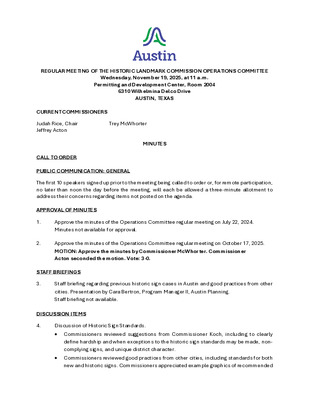
REGULAR MEETING OF THE HISTORIC LANDMARK COMMISSION OPERATIONS COMMITTEE Wednesday, November 19, 2025, at 11 a.m. Permitting and Development Center, Room 2004 6310 Wilhelmina Delco Drive AUSTIN, TEXAS Some members of the committee may be participating by videoconference. Public comment will be allowed in-person or remotely via telephone. Speakers may only register to speak on an item once either in person or remotely and will be allowed up to three minutes to provide their comments. Registration no later than noon the day before the meeting is required for remote participation by telephone. To register to speak remotely, contact Cara Bertron at (512) 974-1446 or cara.bertron@austintexas.gov. CURRENT COMMISSIONERS Judah Rice, Chair Jeffrey Acton Trey McWhorter AGENDA CALL TO ORDER PUBLIC COMMUNICATION: GENERAL The first 10 speakers signed up prior to the meeting being called to order or, for remote participation, no later than noon the day before the meeting, will each be allowed a three-minute allotment to address their concerns regarding items not posted on the agenda. APPROVAL OF MINUTES 1. 2. Approve the minutes of the Operations Committee regular meeting on July 22, 2024. Approve the minutes of the Operations Committee regular meeting on October 17, 2025. STAFF BRIEFINGS 3. Staff briefing regarding previous historic sign cases in Austin and good practices from other cities. Presentation by Cara Bertron, Program Manager II, Austin Planning. DISCUSSION ITEMS 4. 5. Discussion of Historic Sign Standards. Discussion of ways to approach concerns about structural issues in older buildings. FUTURE AGENDA ITEMS ADJOURNMENT The City of Austin is committed to compliance with the Americans with Disabilities Act. Reasonable modifications and equal access to communications will be provided upon request. For assistance, please contact the Liaison or TTY users’ route through 711. A person may request language access accommodations no later than 48 hours before the scheduled meeting. Please call or email Cara Bertron at Austin Planning at (512) 974-1446 or cara.bertron@austintexas.gov to request service or for additional information. For more information on the Operations Committee, please contact Cara Bertron at (512) 974-1446 or cara.bertron@austintexas.gov.
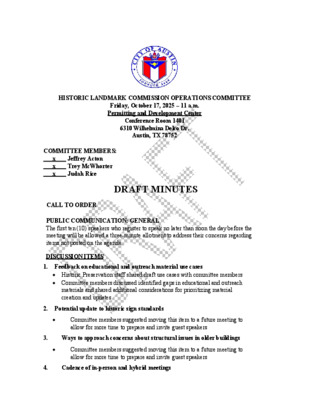
HISTORIC LANDMARK COMMISSION OPERATIONS COMMITTEE Friday, October 17, 2025 – 11 a.m. Permitting and Development Center Conference Room 1401 6310 Wilhelmina Delco Dr. Austin, TX 78752 COMMITTEE MEMBERS: x x x Jeffrey Acton Trey McWhorter Judah Rice DRAFT MINUTES CALL TO ORDER PUBLIC COMMUNICATION: GENERAL The first ten (10) speakers who register to speak no later than noon the day before the meeting will be allowed a three-minute allotment to address their concerns regarding items not posted on the agenda. DISCUSSION ITEMS 1. Feedback on educational and outreach material use cases • Historic Preservation staff shared draft use cases with committee members • Committee members discussed identified gaps in educational and outreach materials and shared additional considerations for prioritizing material creation and updates 2. Potential update to historic sign standards • Committee members suggested moving this item to a future meeting to allow for more time to prepare and invite guest speakers 3. Ways to approach concerns about structural issues in older buildings • Committee members suggested moving this item to a future meeting to allow for more time to prepare and invite guest speakers 4. Cadence of in-person and hybrid meetings • • • Committee meetings occur once a month Only the Chair must be present in person for meetings, other committee members may join remotely Chair can appoint someone to chair for them if they are unable to attend the meeting in person 5. Discussion of items for future Committee agendas • • November Committee meeting to address historic sign standards and Historic Landmark Commission bylaws Future Committee meeting to discuss ways to approach concerns about structural issues in older buildings ADJOURNMENT The City of Austin is committed to compliance with the American with Disabilities Act. Reasonable modifications and equal access to communications will be provided upon request. Meeting locations are planned with wheelchair access. If requiring Sign Language Interpreters or alternative formats, please give notice at least 2 days (48 hours) before the meeting date. Please call the Historic Preservation Office at 512-974- 3393 for additional information; TTY users route through Relay Texas at 711. For more information on the Operations Committee, please contact Cara Bertron at 512- 974-1446.
REGULAR MEETING OF THE HISTORIC LANDMARK COMMISSION OPERATIONS COMMITTEE Wednesday, November 19, 2025, at 11 a.m. Permitting and Development Center, Room 2004 6310 Wilhelmina Delco Drive AUSTIN, TEXAS CURRENT COMMISSIONERS Judah Rice, Chair Jeffrey Acton Trey McWhorter MINUTES CALL TO ORDER PUBLIC COMMUNICATION: GENERAL The first 10 speakers signed up prior to the meeting being called to order or, for remote participation, no later than noon the day before the meeting, will each be allowed a three-minute allotment to address their concerns regarding items not posted on the agenda. APPROVAL OF MINUTES 1. 2. Approve the minutes of the Operations Committee regular meeting on July 22, 2024. Minutes not available for approval. Approve the minutes of the Operations Committee regular meeting on October 17, 2025. MOTION: Approve the minutes by Commissioner McWhorter. Commissioner Acton seconded the motion. Vote: 3-0. STAFF BRIEFINGS 3. Staff briefing regarding previous historic sign cases in Austin and good practices from other cities. Presentation by Cara Bertron, Program Manager II, Austin Planning. Staff briefing not available. DISCUSSION ITEMS 4. Discussion of Historic Sign Standards. • Commissioners reviewed suggestions from Commissioner Koch, including to clearly define hardship and when exceptions to the historic sign standards may be made, non- complying signs, and unique district character. • Commissioners reviewed good practices from other cities, including standards for both new and historic signs. Commissioners appreciated example graphics of recommended and not recommended work, as well as tables outlining sign requirements by neighborhood. • Commissioners discussed the issue of outdated standards and other documents being available online without context that they are obsolete. • Make the process for historic sign review clear, including 5-day administrative approval. • Discuss neon signs and the percentage of window coverage: are these priorities? Should they be changed? • Commissioners will do field research to identify effective and iconic signs for comparison against the historic sign standards, including on both older/historic and new large-scale buildings. • Discuss historic signs with Preservation Austin, sign fabricators, and historic sign restoration companies. Integrate historic sign standards into Historic Design Standards in the future. • • Consider significant murals on buildings that themselves may not be eligible for landmark designation. • Mary Marrero, Austin Law, responded to commissioner questions. 5. Discussion of ways to approach concerns about structural issues in older buildings. • Item will be discussed at a future meeting. FUTURE AGENDA ITEMS ADJOURNMENT Meeting minutes approved at …
REGULAR CALLED MEETING ELECTRIC BOARD Wednesday November 19, 2025 @ 10:00 AM- In Person/Web Ex PERMITTING DEVELOPMENT CENTER/ 1st FLOOR, CONF RM 1401- 1402 6310 WILHELMINA DELCO DR AUSTIN, TEXAS Public comment will be allowed in-person or remotely by telephone. Speakers may only register to speak on an item once either in-person or remotely and will be allowed up to three minutes to provide their comments. Registration no later than noon the day before the meeting is required for remote participation. To register, contact rick.arzola@austintexas.gov. CURRENT BOARD MEMBERS: David Johnson- Chair; Gabe Flores- Vice Chair; Cochren, Joel; Deschaine, David; Grant, Michael; Goss, Delwin; Hernandez, Joseph; King, Kenny; Shope, Victoria; Wallace, Rogelio CALL TO ORDER PUBLIC COMUNICATION: GENERAL The first 10 speakers signed up prior to the meeting being called to order will each be allowed a three-minute allotment to address their concerns regarding items not posted on the agenda. APPROVAL OF MINUTES- 1. Approve the minutes of the Electrical Board Regular Called Meeting from October 15, 2025 DISCUSSION 2. Discussion with Austin Energy on any Austin Energy Criteria manual update or changes. 3. Discussion on Commercial Plan Review update; Submittals, on time ratio and staffing. 4. Discussion on Building and Trade Contractor Service update; permit application process, turnaround times and staffing. 5. Discussion on Commercial and Residential Inspection update on staff vacancies and timely inspections. 6. Final report from the workgroup on the National Electrical Code ordinance update FUTURE AGENDA ITEMS ADJOURNMENT The City of Austin is committed to compliance with the Americans with Disabilities Act. Reasonable modifications and equal access to communications will be provided upon request. For assistance, please contact the Liaison or TTY users’ route through 711. A person may request language access accommodations no later than 48 hours before the scheduled meeting. Please call or email Rick Arola at Austin Development Services Department, at 512-974-2417 or rick.arzola@austintexas.gov, to request service or for additional information. For more information on the Electrical Board please contact Rick Arzola at 512-974-2417 and rick.arzola@austintexas.gov
REGULAR CALLED MEETING OF THE ECONOMIC PROSPERITY COMMISSION WEDNESDAY, NOVEMBER 19, 2025, 6:30PM CITY OF AUSTIN PERMITTING AND DEVELOPMENT CENTER, ROOM 1401/1402 6310 WILHELMINA DELCO DR AUSTIN, TEXAS Some members of the Economic Prosperity Commission may be participating by videoconference. Public comment will be allowed in-person or remotely via telephone. Speakers may only register to speak on an item once either in-person or remotely and will be allowed up to three minutes to provide their comments. Registration no later than noon the day before the meeting is required for remote participation by telephone. To register to speak remotely, call or email Ryan Sperling, 512-974-3568, ryan.sperling@austintexas.gov. CURRENT BOARD MEMBERS/COMMISSIONERS: Commissioner Appointment Nicole Tomaszewski Ofelia Zapata Raquel Valdez Sanchez (Vice Chair) Michael Nahas Rodrigo Cantu Shakeel Rashed District 1 District 2 District 3 District 4 District 5 District 6 Commissioner Zain Pleuthner Appointment District 7 VACANT District 8 Aaron Gonzales (Chair) District 9 Aditi Joshi Jake Randall District 10 Mayor AGENDA CALL TO ORDER PUBLIC COMMUNICATION: GENERAL The first 10 speakers signed up prior to the meeting being called to order will each be allowed a three- minute allotment to address their concerns regarding items not posted on the agenda. APPROVAL OF MINUTES 1. Approve the minutes of the Economic Prosperity Commission Regular Meeting on October 15, 2025. DISCUSSION ITEMS 2. 3. 4. 5. 6. Presentation regarding long-term funding of City employee pensions. Presentation by Josh Rauh, Professor of Finance, Stanford Business School, and Trammell Cooper, Certified Financial Planner. Discussion regarding utilization of the Boards & Commissions Recommendations Archive webpage. Discussion regarding expectations for commissioner conduct and decorum. Discussion regarding the Boards & Commissions Review Framework discussed at the October 15, 2025 Audit & Finance Committee meeting, and possible response by the Economic Prosperity Commission. Discussion presenting a framework for policy development and research for future commission recommendations. DISCUSSION AND ACTION ITEMS 7. 8. 9. 10. Approve the nomination of an Economic Prosperity Commission member as the commission’s alternate representative on the Joint Sustainability Committee. Approve the 2026 Annual Schedule of the Economic Prosperity Commission. Approve a recommendation regarding improved delivery of City summer youth employment programs. Approve a recommendation regarding policy recommendations for long-term funding of City employee pensions. FUTURE AGENDA ITEMS ADJOURNMENT The City of Austin is committed to compliance with the Americans with Disabilities Act. Reasonable modifications and equal access to communications will be provided upon request. For assistance, …
RECOMMENDATION TO COUNCIL Economic Prosperity Commission Recommendation Number: 20251119-009: Summer Youth Employment & Workforce Development Date of Approval: November 19, 2025 Recommendation: The Economic Prosperity Commission recommends several key actions to strengthen Travis County’s Summer Youth Employment Program (SYEP) and City of Austin’s Summer Internship Program (SIP) to better prepare Austin’s future workforce. These policy recommendations outline how the City of Austin can make strategic investments that expand career pathways and long-term income opportunities for high school students. Description of Recommendation to Council: The Economic Prosperity Commission encourages the Austin City Council to undertake the following low- or no-cost actions: 1. Centralize the application process for both students and employers across City and County programs. 2. Improve coordination and resource sharing among all youth employment partners, including Travis County, the City of Austin, and AISD. 3. Connect AISD P-TECH internships with SYEP & SIP apprenticeship opportunities. 4. Establish requirements for Chapter 380 businesses to hire high school students for summer positions and contribute financially to SYEP & SIP, given their vested interest in developing a skilled local workforce. 5. Develop an outreach and awareness strategy targeting Infrastructure Academy partners, Capital IDEA, AFL-CIO, AFSCME, Skillpoint Alliance, the startup community, Chambers of Commerce, and other workforce industry groups. 6. Obtain employer-funded internships, with payment determined to employers’ tax status to unlock additional external funding opportunities. 7. Coordinate job-shadowing opportunities through SYEP & SIP so AISD students can visit internship sites before summer begins. These visits should be open to both SYEP & SIP participants and nonparticipants and can especially support students who lack required documentation 8. Increase public access to program data, including student outcomes and overall program performance on the 1-3 years following programs conclusion 9. Create employer-friendly guides explaining the benefits of hosting high school interns. 10. 10. SYEP & SIP will be provided for 14-15 year olds. The Economic Prosperity Commission encourages the Austin City Council to pursue the following investment-based actions: • Embed AI literacy certifications into the curriculum of SYEP & SIP career tracks. Rationale: Operations and Student Demand To inform these recommendations, the Commission met with the Travis County SYEP, the City of Austin SIP, and founding members of the City’s program, and reviewed peer-city models. We learned that of the 717 students who applied to the City’s program, only 190 were offered jobs. The County’s program reflected similar trends. The primary barrier is limited private-sector …
. RECOMMENDATION TO COUNCIL Economic Prosperity Commission Recommendation Number: 20251119-010: Pensions and OPEB Benefits WHEREAS, City Council created the Economic Prosperity Commission to advise the council on matters related to job creation and the City of Austin is one of the largest employers in Austin and retirement benefits make up a large percentage of the compensation of City of Austin employees. WHEREAS, City Council created the Economic Prosperity Commission to advise the council on matters related to job creation and the financial health of the City of Austin’s government is a signal used by employers to decide where to create jobs. WHEREAS, the City of Austin’s Annual Comprehensive Financial Report says “The deficit in governmental unrestricted net position is largely due to the net pension liability of $2.3 billion and other postemployment benefits (OPEB) liability of $1.9 billion.”. WHEREAS, the Legacy Liability of all 3 pensions is expected to increase. The police pension’s increases until 2030, COAERS until 2031, and the firefighter’s until 2032. WHEREAS, the payments to reduce the Legacity Liability will exceed $190 million in 2028. And those payments will continue until 2051 for the police pension, until 2053 for COAERS, and until 2055 for the firefighters’. WHEREAS, the City of Austin has not saved any money to pay for “other post-employment benefits” (OPEB), such as medical care. WHEREAS, the City of Austin is not legally required to provide OPEB and employees have no guarantee that OPEB will continue. NOW, THEREFORE, BE IT RESOLVED that the Economic Prosperity Commission makes the following recommendations: • • The City should establish a defined-contribution plan to pay for OPEB for all employees hired after the plan was created. This is a legal trust where a fixed percentage of wages should be put into the fund to pay for OPEB benefits during each employees’ retirement. The City should continue to explore the cheapest way to provide medical care to existing retirees. This includes studying Chicago’s plan to use the Affordable Care Act, known as ObamaCare, as a way to get medical coverage for retirees. . • • • • The City Budget’s “Taxpayer Impact Statement” page should include the per-ratepayer change in the City’s “total governmental activities net position” for the previous year. The pensions’ rules should be simulated under random expected conditions (for example, shuffled historical data) and varying assumptions. The output of those simulations should include the range of values …