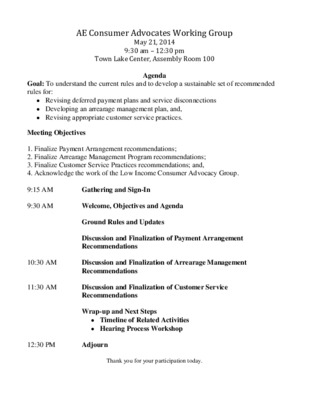
AE Consumer Advocates Working Group May 21, 2014 9:30 am – 12:30 pm Town Lake Center, Assembly Room 100 Agenda Goal: To understand the current rules and to develop a sustainable set of recommended rules for: • Revising deferred payment plans and service disconnections • Developing an arrearage management plan, and, • Revising appropriate customer service practices. Meeting Objectives 1. Finalize Payment Arrangement recommendations; 2. Finalize Arrearage Management Program recommendations; 3. Finalize Customer Service Practices recommendations; and, 4. Acknowledge the work of the Low Income Consumer Advocacy Group. 9:15 AM Gathering and Sign-In 9:30 AM Welcome, Objectives and Agenda Ground Rules and Updates Discussion and Finalization of Payment Arrangement Recommendations 10:30 AM Discussion and Finalization of Arrearage Management Recommendations 11:30 AM Discussion and Finalization of Customer Service Recommendations Wrap-up and Next Steps • Timeline of Related Activities • Hearing Process Workshop 12:30 PM Adjourn Thank you for your participation today.
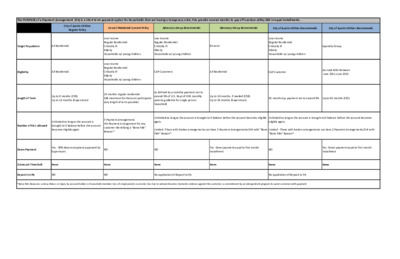
City of Austin Utilities RecommendsCity of Austin Utilities RecommendsTarget PopulationLow IncomeRegular ResidentialCritically IllElderlyHouseholds w/ young childrenSpecialty GroupEligibilityCAP CustomerAccrued debt between June 2011-June 2013Length of Term36 month cap; payment not to exceed 5%Up to 60 months (CSC)Number of PA's AllowedDown PaymentNOYes -Down payment equal to first month installment$ Amount ThresholdNoneNoneDeposit on PANo application of deposit to PANo application of deposit to PA*Bona Fide Reasons= serious illness or injury by account holder or household member; loss of employment; economic loss due to natural disaster; domestic violence against the customer; a commitment by an independent program to assist customer with paymentNoneNoneNoneNoneNONOUnlimited-as long as the account is brought to 0 balance before the account becomes eligible again.Limited - Those with broken arrangements can have 2 Payment Arrangements/3rd with "Bona Fide" Reason*Unlimited-as long as the account is brought to 0 balance before the account becomes eligible again. Limited -Those with broken arrangements can have 3 Payment Arrangements/4th with "Bona Fide" Reason*Yes - 50% down exceptions approved by SupervisorsNONOYes -Down payment equal to first month installmentUnlimited-as long as the account is brought to 0 balance before the account becomes eligible again3 Payment Arrangements4th Payment Arrangement for any customer identifying a "Bona Fide" Reason *The PURPOSE of a Payment Arrangement (PA) is a short term payment option for households that are having a temporary crisis; PAs provide several months to pay off overdue utility bills in equal installments. All ResidentialLow IncomeRegular ResidentialCritically IllElderlyHouseholds w/ young childrenCAP CustomersAll ResidentialUp to 8 months (CSR) Up to 12 months (Supervisors)24 months regular residential$48 maximum for discount participants (any length of term possible)As defined by a monthly payment not to exceed 5% of U.S. Dept of HHS monthly poverty guideline for single person householdUp to 24 months, if needed (CSR) Up to 36 months (Supervisors) City of Austin UtilitiesRegular PolicyCouncil Mandated Current PolicyAdvocacy Group RecommendsAdvocacy Group RecommendsAll ResidentialLow IncomeRegular ResidentialCritically IllElderlyHouseholds w/ young childrenLow IncomeRegular ResidentialCritically IllElderlyHouseholds w/ young childrenGeneral
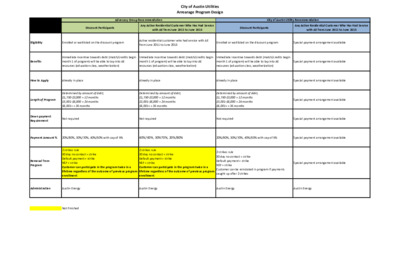
City of Austin UtilitiesArrearage Program DesignDiscount ParticipantsAny Active Residential Customer Who Has Had Service with AE from June 2011 to June 2013Discount ParticipantsAny Active Residential Customer Who Has Had Service with AE from June 2011 to June 2013EligibilityEnrolled or waitlisted on the discount programActive residential customer who had service with AE from June 2011 to June 2013Enrolled or waitlisted on the discount programSpecial payment arrangement availableBenefitsImmediate incentive towards debt (match/credits begin month 1 of program) will be able to tap into AE resources (education class, weatherization) Immediate incentive towards debt (match/credits begin month 1 of program) will be able to tap into AE resources (education class, weatherization) Immediate incentive towards debt (match/credits begin month 1 of program) will be able to tap into AE resources (education class, weatherization) Special payment arrangement availableHow to ApplyAlready in place Already in place Already in place Special payment arrangement availableLength of ProgramDetermined by amount of debt; $1,750-$3,000 = 12 months $3,001-$6,000 = 24 months $6,001+ = 36 months Determined by amount of debt; $1,750-$3,000 = 12 months $3,001-$6,000 = 24 months $6,001+ = 36 months Determined by amount of debt; $1,750-$3,000 = 12 months $3,001-$6,000 = 24 months $6,001+ = 36 months Special payment arrangement availableDown payment RequirementNot requiredNot requiredNot requiredSpecial payment arrangement availablePayment Amount %20%/80%, 30%/70%, 40%/60% with cap of 5% 40%/60%, 30%70%, 20%/80%20%/80%, 30%/70%, 40%/60% with cap of 5% Special payment arrangement availableRemoval from Program2 strikes rule 30 day no contact = strike Default payment = strike NSF = strike Customer can participate in the program twice in a lifetime regardless of the outcome of previous program enrollment2 strikes rule 30 day no contact = strike Default payment = strike NSF = strike Customer can participate in the program twice in a lifetime regardless of the outcome of previous program enrollment2 strikes rule 30 day no contact = strike Default payment = strike NSF = strike Customer can be reinstated in program if payments caught up after 2 strikes Special payment arrangement availableAdministrationAustin EnergyAustin EnergyAustin EnergyAustin EnergyNot FinishedAdvocacy Group RecommendationCity of Austin Utility Recommendation
1 Employee Training May 2014 Overview of Training Program New Hire Training •Five weeks of instructor lead training totaling 200 hours of training –125 hours of classroom instruction –75 hours of trainer supported phone time •New hire graduates transition to a nesting environment in the call center for 4 to 6 weeks directly after New Hire Training •12 hours of Customer Relationship Building training is provided by our Quality Assurance team during the first 3 days of nesting Overview of Training Program Training for Existing Agents •Refresher training is provided as needed •Training is provided anytime there is a policy or process change •Weekly huddles are scheduled twice a week to address any issues or changes from the previous week •Supervisors are on-site with the CSR’s and are able to coach through challenging situations •Supervisors are available to take over any situation that requires upper management approval •Supervisors have an escalated team available to them to assist as needed Customer Advocacy Recommendations & Current Training Program Components Current Program Components •New Hire Training includes 15 hours of training on these topics •Training focus –Determining that a customer needs help when it hasn’t been explicitly stated –Determining the difference between a high bill due to an AE error versus a high bill due to usage patterns –Analyzing usage patterns to help customers conserve through changing habits –Identifying conservation programs that may benefit the customer –Connecting the customer with assistance agencies •Refresher training is provided to all agents as needed Recommendation: Inquiries and referrals to assistance and conservation and efficiency programs would be part of the conference between the customer and the AE Customer Care employee. Current Program Components: •If and when an arrearage program is created and funded, the training curriculum will be updated to include all of the above mentioned items. Customer Advocacy Recommendations & Current Training Program Components Recommendation: As part of the referral process, there should be an explanation of any arrearage programs including providing the customer application forms and instructions. Current Program Components: •All newly hired call center employees complete a 12 hour Customer Relationship Building class that focuses on improving the customer experience through the way we communicate with our customers. •The goal of the class is to highlight the importance of communicating in a way that shows we value our customers and we will work to the best of our ability to address the reason …
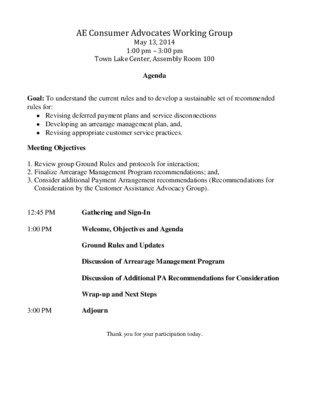
AE Consumer Advocates Working Group May 13, 2014 1:00 pm – 3:00 pm Town Lake Center, Assembly Room 100 Agenda Goal: To understand the current rules and to develop a sustainable set of recommended rules for: • Revising deferred payment plans and service disconnections • Developing an arrearage management plan, and, • Revising appropriate customer service practices. Meeting Objectives 1. Review group Ground Rules and protocols for interaction; 2. Finalize Arrearage Management Program recommendations; and, 3. Consider additional Payment Arrangement recommendations (Recommendations for Consideration by the Customer Assistance Advocacy Group). 12:45 PM Gathering and Sign-In 1:00 PM Welcome, Objectives and Agenda Ground Rules and Updates Discussion of Arrearage Management Program Discussion of Additional PA Recommendations for Consideration Wrap-up and Next Steps 3:00 PM Adjourn Thank you for your participation today.
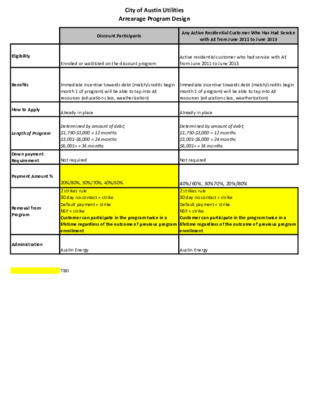
City of Austin UtilitiesArrearage Program DesignDiscount ParticipantsAny Active Residential Customer Who Has Had Service with AE from June 2011 to June 2013EligibilityEnrolled or waitlisted on the discount programActive residential customer who had service with AE from June 2011 to June 2013BenefitsImmediate incentive towards debt (match/credits begin month 1 of program) will be able to tap into AE resources (education class, weatherization) Immediate incentive towards debt (match/credits begin month 1 of program) will be able to tap into AE resources (education class, weatherization) How to ApplyAlready in place Already in place Length of ProgramDetermined by amount of debt; $1,750-$3,000 = 12 months $3,001-$6,000 = 24 months $6,001+ = 36 months Determined by amount of debt; $1,750-$3,000 = 12 months $3,001-$6,000 = 24 months $6,001+ = 36 months Down payment RequirementNot requiredNot requiredPayment Amount %20%/80%, 30%/70%, 40%/60% 40%/60%, 30%70%, 20%/80%Removal from Program2 strikes rule 30 day no contact = strike Default payment = strike NSF = strike Customer can participate in the program twice in a lifetime regardless of the outcome of previous program enrollment2 strikes rule 30 day no contact = strike Default payment = strike NSF = strike Customer can participate in the program twice in a lifetime regardless of the outcome of previous program enrollmentAdministrationAustin EnergyAustin EnergyTBD
Austin Energy Consumer Advocates Working Group April 16, 2014 9:30 am – 12:30 pm 721 Barton Springs Road Town Lake Center, Assembly Room 100 Agenda Goal: To understand the current rules and to develop a sustainable set of recommended rules for: • Revising deferred payment plans and service disconnections • Developing an arrearage management plan, and, • Revising appropriate customer service practices. Meeting Objectives 1. Review subcommittee’s recommendation for an Arrearage Management Program 2. Discuss arrearage management program components 3. Develop draft of Working Committee’s Arrearage Management Program 9:15 AM Gathering and Sign-In 9:30 AM Welcome, Objectives and Agenda Ground Rules and Updates Presentation of Arrearage Management Program by subcommittee • Program design process • Program recommendations Discussion on Arrearage Management Program components 12:00 PM Discussion on Remaining Work and Meeting Schedule Wrap-up and Next Steps 12:30 PM Adjourn Thank you for your participation today.
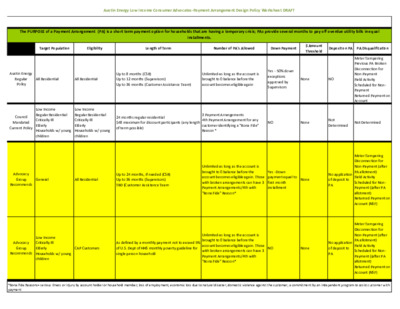
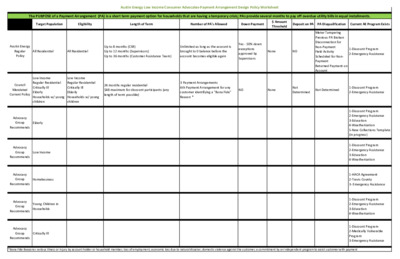
Austin Energy Low Income Consumer Advocates-Payment Arrangement Design Policy Worksheet DRAFTTarget PopulationEligibilityLength of TermNumber of PA's AllowedDown Payment$ Amount ThresholdDeposit on PAPA DisqualificationAll ResidentialAll ResidentialUp to 8 months (CSR)Up to 12 months (Supervisors)Up to 36 months (Customer Assistance Team)Unlimited-as long as the account is brought to 0 balance before the account becomes eligible againYes - 50% down exceptions approved by SupervisorsNoneNOMeter TamperingPrevious PA BrokenDisconnection for Non-PaymentField Activity Scheduled for Non-PaymentReturned Payment on AccountLow IncomeRegular ResidentialCritically IllElderlyHouseholds w/ young childrenLow IncomeRegular ResidentialCritically IllElderlyHouseholds w/ young children24 months regular residential$48 maximum for discount participants (any length of term possible)3 Payment Arrangements4th Payment Arrangement for any customer identifying a "Bona Fide" Reason *NONoneNot DeterminedNot DeterminedGeneralAll ResidentialUp to 24 months, if needed (CSR)Up to 36 months (Supervisors)TBD (Customer Assistance TeamUnlimited-as long as the account is brought to 0 balance before the account becomes eligible again. Those with broken arrangements can have 3 Payment Arrangements/4th with "Bona Fide" Reason*Yes -Down payment equal to first month installmentNoneNo application of deposit to PAMeter TamperingDisconnection for Non-Payment (after PA allotment)Field Activity Scheduled for Non-Payment ((after PA allotment)Returned Payment on Account (NSF)Low IncomeCritically IllElderlyHouseholds w/ young childrenCAP CustomersAs defined by a monthly payment not to exceed 5% of U.S. Dept of HHS monthly poverty guideline for single person householdUnlimited-as long as the account is brought to 0 balance before the account becomes eligible again. Those with broken arrangements can have 3 Payment Arrangements/4th with "Bona Fide" Reason*NONoneNo application of deposit to PAMeter TamperingDisconnection for Non-Payment (after PA allotment)Field Activity Scheduled for Non-Payment ((after PA allotment)Returned Payment on Account (NSF)*Bona Fide Reasons= serious illness or injury by account holder or household member; loss of employment; economic loss due to natural disaster; domestic violence against the customer; a commitment by an independent program to assist customer with paymentThe PURPOSE of a Payment Arrangement (PA) is a short term payment option for households that are having a temporary crisis; PAs provide several months to pay off overdue utility bills in equal installments. Austin Energy Regular PolicyCouncil Mandated Current PolicyAdvocacy Group RecommendsAdvocacy Group Recommends
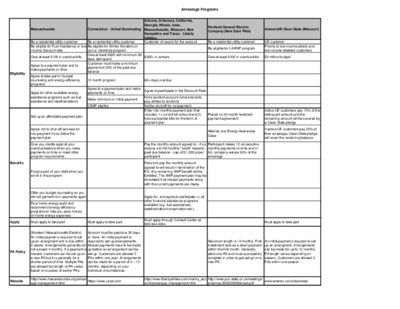
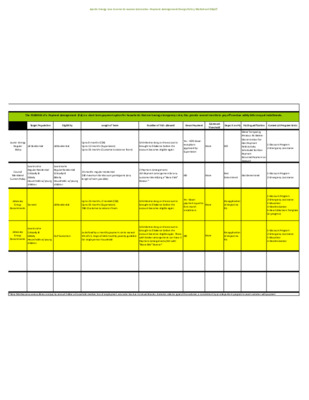
Arrearage ProgramsMassachusettsConnecticut - United IlluminatingArizona, Arkansas, California, Georgia, Illinois, Iowa, Massachusetts, Missouri, New Hampshire and Texas - Liberty UtilitiesPortland General Electric Company (New Start Pilot)AmerenUE-Clean Slate (Missouri)Be a residential utility customerBe a residential utility customerCustomer of record for the accountBe a residential utility customerUE customerBe eligible for Fuel Assistance or low-income discount rateBe eligible for Winter Moratorium (a.k.a. hardship) programBe eligible for LIHEAP programPriority to low-income elderly and low-income disabled customersOwe at least $100 in overdue billsOwe at least $500 with minimum 90 days delinquent$300+ in arrearsOwe at least $100 in overdue bills$3 million budgetAgree to a payment plan and to make payments on timeCustomer must make a minimum payment of 20% of the past due balanceAgree to take part in budget counseling and energy efficiency programs12 month program 60+ days overdueAgree to a payment plan and make payments on timeAgree to participate in the Discount RateMake minimum or initial paymentNot a landlord account (where tenants pay utilities to landlord)CEAP eligibleNot be shut off for nonpaymentSet up an affordable payment planEnter into monthly payment plan that includes: 1) current bill amount and 2) future projected bills for the term of payment planPlaced on 24-month levelized payment agreementActive UE customers pay 10% of the delinquent amount and the remaining amount will be covered by a Clean Slate pledgeAgree not to shut off services for non-payment if you follow the payment plan Attends one Energy Awareness ClassInactive UE customers pay 20% of their arrearage, Clean Slate pledge will cover the remaining balance.Give you credits against your overdue balance when you make payments on time or meet other program requirementsPay the monthly amount agreed to - if so, receive a $100 monthly "credit" towards past due balance - cap of $1,200/yr/per participantParticipant makes 12 consecutive monthly payments on time and in full, company waives 50% of the arrearage Forgive part of your debt when you enroll in the programFailure to pay the monthly amount agreed to will result in termination of the PA. Any remaining AMP benefit will be forfeited. The AMP payment plan may be reinstated if all missed payments along with the current payments are made.Offer you budget counseling so you will not get behind in payments againDo a home energy audit and recommend energy efficiency programs to help you save money on home energy expensesApplyMust apply to take partMust apply to take partMust apply through Contact Center at 800-544-4944.Must apply …
Discount Steering Committee Meeting Minutes February 24, 2014 In attendance: Michelle Akers (HACA) Kathleen Hopkins (Any Baby Can) Pat Macy (St. Austin Catholic Church) Tondalier Owens (Travis County HHS & VS) Linda Perez (Meals on Wheels & More) Angel Ramirez (Texas VFW Foundation) Ronnie Mendoza (AE) Sandra Castillo (AE) Melissa Davis (AE) Jessica Twining (AE) Irene Nemitsas (AE) Review of meeting minutes – February 15th, 2014 Approved as is. Discount Program Qualifier Numbers/Percentages • Mass Mailing o Austin Energy recently conducted mass letter mailing to 120,000 MAP recipients in targeted zipcodes, promoting open spots in Discount Program for MAP beneficiaries o Mailed about 2 weeks ago o Solix has noticed increase in volume of calls for applications – hopefully will help fill some of those open MAP spots o Linda from MoW requested a copy of the letter to be distributed to DSC so they can give to their clients • Community Benefit Charge Fund Forecasting o Current 33,000 spots will still not utilize funding overage from FY2013 o As such, spots have increased to 45,000 o Initiated Friday, 2/21 o Pending 11,000 enrollment into program o Even though understood that this number will have to be reduced back to 25,000 (though there will be some carryover into FY15) o Will just not re-enroll customers when their enrollment expires o But hoping City Council will see the need for the program and provide additional funding to keep at/close to 45,000 • Re-Evaluation of Current Formula o Currently 4,000-5,000 MAP openings – how do we equitably use these? o Is it ok to absorb into other programs? Committee agreed yes. o Using formula already created, if a program is not utilizing all allocated spots, after a period of 4 months (after beginning of fiscal year), use formula to disperse between top-three demanded programs. Then with new fiscal year, go back to original allocation o Right now top three programs are Medicaid, CHIP and SNAP Weatherization • Reporting o Ronnie reviewed current numbers of CAP weatherization program o Goal is to weatherize 200 homes during FY14 (this includes carryover funds from FY2013 plus FY14 funding) o Numbers include: Eligible customers (includes two priority 1 lists and one priority 2 list pulled since October 2013) = 967 Completed home visits = 123 Customers completing education class = 73 Customers pending education class = 20 Completed audits = 60 …
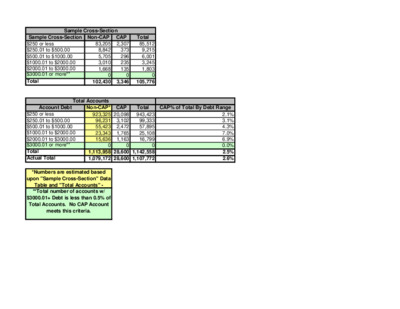
Discount Steering Committee Working Session Minutes March 5, 2014 In attendance: Michelle Akers (HACA) Gloria Cueva (Caritas of Austin) Kathleen Hopkins (Any Baby Can) Pat Macy (St. Austin Catholic Church) Tondalier Owens (Travis County HHS & VS) Linda Perez (Meals on Wheels & More) Angel Ramirez (Texas VFW Foundation) Ronnie Mendoza (AE) Sandra Castillo (AE) Irene Nemitsas (AE) Sample Section of AE Customers - Chart o AE pulled a representative sample of its customer base – approximately 100,000 accounts, split out between CAP and non-CAP o Included active and inactive accounts o Provided so DSC can get an idea of the number of customers in debt and the amount/level of debt, starting from $250 up to $3,000+ o Also pulled so AE can estimate the possible budget needed to fund the arrearage program o Showed a large gap between those in debt who are CAP (smaller percentage) versus non-CAP (much larger percentage) Debt over $3,000 – Reference Chart o Smaller sample size presented above didn’t fully represent those with $3,000+ in debt o Second chart provided (for reference only) that showed customers $3,000+ in debt Stratified by dates – starting when collections process was re-instated (July 2013) to present Non-disconnect period (July 2011-July 2013) definitely contributed towards these larger debts Collections was enacted in phases – starting with the larger outstanding balances ($10,000+) and working down from there o Payment arrangements don’t work for these large amounts Research shows that 78% of these arrangements are broken Only after utilities disconnect for non-pay do customers begin to pay towards their debts AE Executive Expectations o What are collection expectations of AE executives for the arrearage management program? (AMP) o 100% debt collection because AE cannot forgive debt o What this program will offer though, is pledge “matches” or “credits” applied towards account, an incentive program that works with the customer to pay down their debt Case Studies Showing Success? o AE will be one of the first for a public utility o Difficult to find similar scenarios- most utilities are de-regulated and can write off the debt as an expense Then they recoup expense the following year by raising rates AE cannot do that 2015 AMP Budgeting o Already proposed by AE - Ronnie had to forecast as he needed to ensure once the program is created that there is sufficient funding for it …
Discount Steering Committee Meeting Monday, March 24, 2014 Meeting Notes Attendees: Pat Macy St Austin Catholic Church Michelle Akers HACA Linda Perez Meals on Wheels and More Kathleen Hopkins Any Baby Can Tonda Owens Travis County Gloria Cuevas Caritas Ronnie Mendoza AE Sandra Castillo AE Lori Kirchgatter AE Jessica Twining AE Melissa Davis AE Irene Nemitsas AE I. Welcome II. Minutes Review Reviewed minutes from 3-5-14 meeting Focus of last meeting was designing arrearage program (matrix) and decision points Clarification was given regarding referral for regular residential customers – regular residential customers will be referred to arrearage program via an agency they are working with, not referred to an agency (by AE) in order to get a referral to arrearage program Ronnie explained that he has to send a monthly DSC report to Council Minutes approved III. DSC Decision Points Handout outlines everything the DSC has decided on over the last two years A suggestion was made to add “why” statements to the decision points and their relation to which AE program o For example: How the DSC came up with $8,700 balance maximum for weatherization program participants – and then reduced the maximum to $5,700 IV. Weatherization Program Structure Narrative Outlines CAP Weatherization process from start to finish Can we specify a timeframe for each piece of the process? o Ronnie suggested adding the CAP Weatherization Program timeline (already created) to accompany the narrative V. Weatherization Follow-Up Updated numbers for customers participating in CAP + Education program (excludes CAP control group numbers) For future updates on numbers, AE will provide DSC members with info on why and at what point customers are falling out of the program o Customer didn’t complete education class within allotted timeframe; landlord didn’t sign agreement form, etc. CAP team met with CES - Customer Energy Solutions (formerly Energy Efficiency Services) and contractors two weeks ago o CAP homes need to be #1 priority o Budgeting error by CES caused delay in CAP work orders going out for bidding process – increased spending authority needed – hoping to be remedied next week Impact to CAP Weatherization customers reflected in updated numbers handout: “Audit Completed & Not Out for Bid” Lori discussed incentives for CAP Weatherization customers to encourage response to follow-up surveys (18-month period) – asked for DSC feedback o CAP team suggested items such as CFL’s, air filters, and possibly $25 pledge, want …
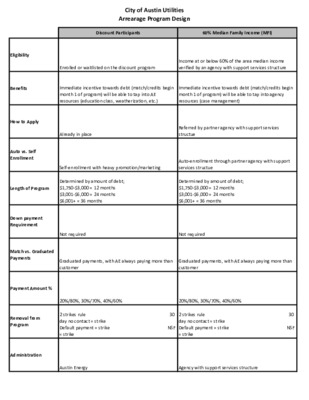
City of Austin UtilitiesArrearage Program DesignDiscount Participants60% Median Family Income (MFI)EligibilityEnrolled or waitlisted on the discount programIncome at or below 60% of the area median income verified by an agency with support services structureBenefitsImmediate incentive towards debt (match/credits begin month 1 of program) will be able to tap into AE resources (education class, weatherization, etc.)Immediate incentive towards debt (match/credits begin month 1 of program) will be able to tap into agency resources (case management)How to ApplyAlready in placeReferred by partner agency with support services structueAuto vs. Self EnrollmentSelf-enrollment with heavy promotion/marketing Auto-enrollment through partner agency with support services structueLength of ProgramDetermined by amount of debt; $1,750-$3,000 = 12 months $3,001-$6,000 = 24 months $6,001+ = 36 monthsDetermined by amount of debt; $1,750-$3,000 = 12 months $3,001-$6,000 = 24 months $6,001+ = 36 monthsDown payment RequirementNot requiredNot requiredMatch vs. Graduated PaymentsGraduated payments, with AE always paying more than customer Graduated payments, with AE always paying more than customer Payment Amount %20%/80%, 30%/70%, 40%/60%20%/80%, 30%/70%, 40%/60%Removal from Program2 strikes rule 30 day no contact = strike Default payment = strike NSF = strike2 strikes rule 30 day no contact = strike Default payment = strike NSF = strikeAdministrationAustin EnergyAgency with support services structure City of Austin UtilitiesArrearage Program DesignEligibilityBenefitsHow to ApplyAuto vs. Self EnrollmentLength of ProgramDown payment RequirementMatch vs. Graduated PaymentsPayment Amount %Removal from ProgramAdministrationRegular ResidentialReferred to AE by agency that does not have support services structureImmediate incentive towards debt, will be able to tap into AE resources (education class, weatherization, etc.)Referred by partner agency that does not have a support services structureAuto-enrollment through partner agency that does not have a support services structureDetermined by amount of debt; $1,750-$3,000 = 12 months $3,001-$6,000 = 24 months $6,001+ = 36 monthsNot requiredMatched payments50%/50%2 strikes rule 30 day no contact = strike Default payment = strike NSF = strikeAgency without support services structure
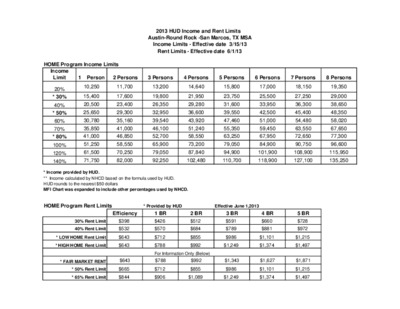
Income Limit1 Person 2 Persons3 Persons4 Persons5 Persons6 Persons7 Persons8 Persons20%10,25011,70013,20014,64015,80017,00018,15019,350* 30%15,40017,60019,80021,95023,75025,50027,25029,00040%20,50023,40026,35029,28031,60033,95036,30038,650* 50%25,65029,30032,95036,60039,55042,50045,40048,35060%30,78035,16039,54043,92047,46051,00054,48058,02070%35,85041,00046,10051,24055,35059,45063,55067,650* 80%41,00046,85052,70058,55063,25067,95072,65077,300100%51,25058,55065,90073,20079,05084,90090,75096,600120%61,50070,25079,05087,84094,900101,900108,900115,950140%71,75082,00092,250102,480110,700118,900127,100135,250* Income provided by HUD.** Income calculated by NHCD based on the formula used by HUD.HUD rounds to the nearest $50 dollarsMFI Chart was expanded to include other percentages used by NHCD.Effective June 1,2013Efficiency1 BR2 BR3 BR4 BR5 BR$398$426$512$591$660$728$532$570$684$789$881$972$643$712$855$986$1,101$1,215$643$788$992$1,249$1,374$1,497$643 $788 $992 $1,343 $1,627 $1,871 $665$712$855$986$1,101$1,215$844$906$1,089$1,249$1,374$1,497* FAIR MARKET RENT* 50% Rent Limit* 65% Rent Limit2013 HUD Income and Rent Limits Austin-Round Rock -San Marcos, TX MSAIncome Limits - Effective date 3/15/13HOME Program Income LimitsHOME Program Rent Limits* LOW HOME Rent Limit30% Rent Limit40% Rent LimitFor Information Only (Below)* Provided by HUD* HIGH HOME Rent LimitRent Limits - Effective date 6/1/13
Sample Cross-SectionNon-CAPCAPTotal$250 or less83,2052,30785,512$250.01 to $500.008,8423739,215$500.01 to $1000.005,7052966,001$1000.01 to $2000.003,0102353,245$2000.01 to $3000.001,6681351,803$3000.01 or more**000Total102,4303,346105,776Account DebtNon-CAP*CAPTotalCAP% of Total By Debt Range$250 or less923,32520,098943,4232.1%$250.01 to $500.0096,2313,10299,3333.1%$500.01 to $1000.0055,4232,47257,8954.3%$1000.01 to $2000.0023,3431,76525,1087.0%$2000.01 to $3000.0015,6361,16316,7996.9%$3000.01 or more**0000.0%Total1,113,95828,6001,142,5582.5%Actual Total1,079,17228,6001,107,7722.6%Sample Cross-SectionTotal Accounts*Numbers are estimated based upon "Sample Cross-Section" Data Table and "Total Accounts" - **Total number of accounts w/ $3000.01+ Debt is less than 0.5% of Total Accounts. No CAP Account meets this criteria.
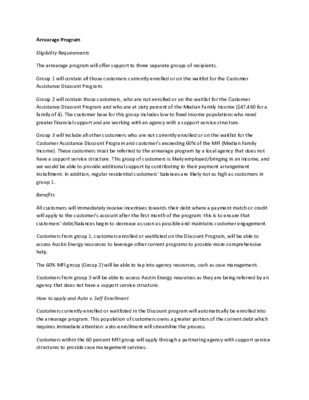
Arrearage Program Eligibility Requirements The arrearage program will offer support to three separate groups of recipients. Group 1 will contain all those customers currently enrolled or on the waitlist for the Customer Assistance Discount Program. Group 2 will contain those customers, who are not enrolled or on the waitlist for the Customer Assistance Discount Program and who are at sixty percent of the Median Family Income ($47,460 for a family of 4). The customer base for this group includes low to fixed income populations who need greater financial support and are working with an agency with a support service structure. Group 3 will include all other customers who are not currently enrolled or on the waitlist for the Customer Assistance Discount Program and customer’s exceeding 60% of the MFI (Median Family Income). These customers must be referred to the arrearage program by a local agency that does not have a support service structure. This group of customers is likely employed/bringing in an income, and we would be able to provide additional support by contributing to their payment arrangement installment. In addition, regular residential customers’ balances are likely not as high as customers in group 1. Benefits All customers will immediately receive incentives towards their debt where a payment match or credit will apply to the customer’s account after the first month of the program: this is to ensure that customers’ debt/balances begin to decrease as soon as possible and maintains customer engagement. Customers from group 1, customers enrolled or waitlisted on the Discount Program, will be able to access Austin Energy resources to leverage other current programs to provide more comprehensive help. The 60% MFI group (Group 2) will be able to tap into agency resources, such as case management. Customers from group 3 will be able to access Austin Energy resources as they are being referred by an agency that does not have a support service structure. How to apply and Auto v. Self Enrollment Customers currently enrolled or waitlisted in the Discount program will automatically be enrolled into the arrearage program. This population of customers owns a greater portion of the current debt which requires immediate attention: auto-enrollment will streamline the process. Customers within the 60 percent MFI group will apply through a partnering agency with support service structures to provide case management services. Customers within the regular residential group will apply through an agency without support service …
Austin Energy Low Income Consumer Advocates-Payment Arrangement Design Policy Worksheet DRAFTTarget PopulationEligibilityLength of TermNumber of PA's AllowedDown Payment$ Amount ThresholdDeposit on PAPA DisqualificationCurrent AE Program ExistsAll ResidentialAll ResidentialUp to 8 months (CSR)Up to 12 months (Supervisors)Up to 36 months (Customer Assistance Team)Unlimited-as long as the account is brought to 0 balance before the account becomes eligible againYes - 50% down exceptions approved by SupervisorsNoneNOMeter TamperingPrevious PA BrokenDisconnection for Non-PaymentField Activity Scheduled for Non-PaymentReturned Payment on Account1-Discount Program2-Emergency AssistanceLow IncomeRegular ResidentialCritically IllElderlyHouseholds w/ young childrenLow IncomeRegular ResidentialCritically IllElderlyHouseholds w/ young children24 months regular residential$48 maximum for discount participants (any length of term possible)3 Payment Arrangements4th Payment Arrangement for any customer identifying a "Bona Fide" Reason *NONoneNot DeterminedNot Determined1-Discount Program2-Emergency AssistanceGeneralAll ResidentialUp to 24 months, if needed (CSR)Up to 36 months (Supervisors)TBD (Customer Assistance TeamUnlimited-as long as the account is brought to 0 balance before the account becomes eligible againYes -Down payment equal to first month installmentNoneNo application of deposit to PA1-Discount Program2-Emergency Assistance3-Education4-Weatherization5-New Collections Template (in progress)Low IncomeCritically IllElderlyHouseholds w/ young childrenCAP CustomersAs defined by a monthly payment not to exceed 5% of U.S. Dept of HHS monthly poverty guideline for single person householdUnlimited-as long as the account is brought to 0 balance before the account becomes eligible again. Those with broken arrangements can have 3 Payment Arrangements/4th with "Bona Fide" Reason*NONoneNo application of deposit to PA1-Discount Program2-Emergency Assistance3-Education4-Weatherization*Bona Fide Reasons= serious illness or injury by account holder or household member; loss of employment; economic loss due to natural disaster; domestic violence against the customer; a commitment by an independent program to assist customer with paymentThe PURPOSE of a Payment Arrangement (PA) is a short term payment option for households that are having a temporary crisis; PAs provide several months to pay off overdue utility bills in equal installments. Austin Energy Regular PolicyCouncil Mandated Current PolicyAdvocacy Group RecommendsAdvocacy Group Recommends
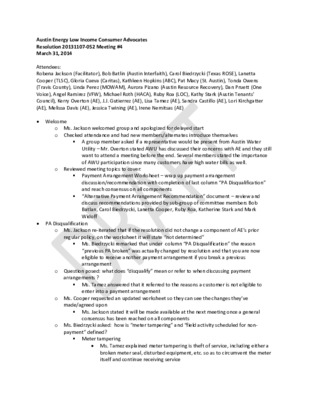
Austin Energy Low Income Consumer Advocates Resolution 20131107-052 Meeting #4 March 31, 2014 Attendees: Robena Jackson (Facilitator), Bob Batlin (Austin Interfaith), Carol Biedrzycki (Texas ROSE), Lanetta Cooper (TLSC), Gloria Cueva (Caritas), Kathleen Hopkins (ABC), Pat Macy (St. Austin), Tonda Owens (Travis County), Linda Perez (MOWAM), Aurora Pizano (Austin Resource Recovery), Dan Pruett (One Voice), Angel Ramirez (VFW), Michael Roth (HACA), Ruby Roa (LOC), Kathy Stark (Austin Tenants’ Council), Kerry Overton (AE), J.J. Gutierrez (AE), Lisa Tamez (AE), Sandra Castillo (AE), Lori Kirchgatter (AE), Melissa Davis (AE), Jessica Twining (AE), Irene Nemitsas (AE) • Welcome o Ms. Jackson welcomed group and apologized for delayed start o Checked attendance and had new members/alternates introduce themselves A group member asked if a representative would be present from Austin Water Utility – Mr. Overton stated AWU has discussed their concerns with AE and they still want to attend a meeting before the end. Several members stated the importance of AWU participation since many customers have high water bills as well. o Reviewed meeting topics to cover: Payment Arrangement Worksheet – wrap up payment arrangement discussion/recommendation with completion of last column “PA Disqualification” and reach consensus on all components “Alternative Payment Arrangement Recommendation” document – review and discuss recommendations provided by sub-group of committee members Bob Batlan, Carol Biedrzycki, Lanetta Cooper, Ruby Roa, Katherine Stark and Mark Widoff • PA Disqualification o Ms. Jackson re-iterated that if the resolution did not change a component of AE’s prior regular policy, on the worksheet it will state “not determined” Ms. Biedrzycki remarked that under column “PA Disqualification” the reason “previous PA broken” was actually changed by resolution and that you are now eligible to receive another payment arrangement if you break a previous arrangement o Question posed: what does “disqualify” mean or refer to when discussing payment arrangements ? Ms. Tamez answered that it referred to the reasons a customer is not eligible to enter into a payment arrangement o Ms. Cooper requested an updated worksheet so they can see the changes they’ve made/agreed upon Ms. Jackson stated it will be made available at the next meeting once a general consensus has been reached on all components o Ms. Biedrzycki asked: how is “meter tampering” and “field activity scheduled for non-payment” defined? Meter tampering • Ms. Tamez explained meter tampering is theft of service, including either a broken meter seal, …
Austin Energy Low Income Consumer Advocate Working Group March 19, 2014 9:30 am – 12:30 pm Town Lake Center, Assembly Room 100 Agenda Goal: To understand the current rules and to develop a sustainable set of recommended rules for: • Revising deferred payment plans and service disconnections, • Developing an arrearage management plan, and, • Revising appropriate customer service practices. Meeting Objectives 1. Review existing Payment Arrangement (PA) policies and targeted groups 2. Review Austin Energy’s programs that assist low-income and special needs groups 3. Develop recommended revised PA policies for low-income and targeted groups 9:15 AM Gathering and Sign-In 9:30 AM Welcome, Objectives and Agenda Ground Rules and Updates March 28th, 9:30 a.m. – 12:30 p.m. Updated PA Data Set Deferred Payment Arrangement Matrix • Purpose of Payment Arrangements • Existing Programs to Assist Targeted Groups 10:00 AM Draft Revised Policies – Deferred Payment Plans Wrap-up and Next Steps 12:30 PM Adjourn Thank you for your participation today.
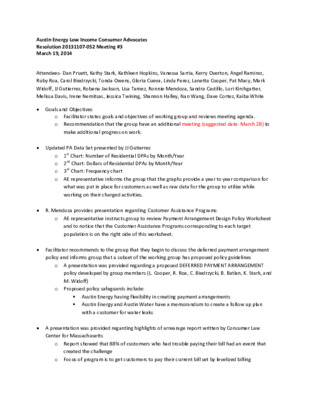
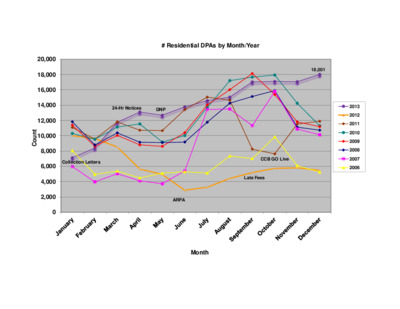
Austin Energy Low Income Consumer Advocates Resolution 20131107-052 Meeting #3 March 19, 2014 Attendees- Dan Pruett, Kathy Stark, Kathleen Hopkins, Vanessa Sarria, Kerry Overton, Angel Ramirez, Ruby Roa, Carol Biedrzycki, Tonda Owens, Gloria Cueva, Linda Perez, Lanetta Cooper, Pat Macy, Mark Widoff, JJ Gutierrez, Robena Jackson, Lisa Tamez, Ronnie Mendoza, Sandra Castillo, Lori Kirchgatter, Melissa Davis, Irene Nemitsas, Jessica Twining, Shannon Halley, Nan Wang, Dave Cortez, Kaiba White • Goals and Objectives o Facilitator states goals and objectives of working group and reviews meeting agenda. o Recommendation that the group have an additional meeting (suggested date: March 28) to make additional progress on work. • Updated PA Data Set presented by JJ Gutierrez o 1st Chart: Number of Residential DPAs by Month/Year o 2nd Chart: Dollars of Residential DPAs by Month/Year o 3rd Chart: Frequency chart o AE representative informs the group that the graphs provide a year to year comparison for what was put in place for customers as well as raw data for the group to utilize while working on their charged activities. • R. Mendoza provides presentation regarding Customer Assistance Programs o AE representative instructs group to review Payment Arrangement Design Policy Worksheet and to notice that the Customer Assistance Programs corresponding to each target population is on the right side of this worksheet. • Facilitator recommends to the group that they begin to discuss the deferred payment arrangement policy and informs group that a subset of the working group has proposed policy guidelines o A presentation was provided regarding a proposed DEFERRED PAYMENT ARRANGEMENT policy developed by group members (L. Cooper, R. Roa, C. Biedrzycki, B. Batlan, K. Stark, and M. Widoff) o Proposed policy safeguards include: Austin Energy having flexibility in creating payment arrangements Austin Energy and Austin Water have a memorandum to create a follow up plan with a customer for water leaks • A presentation was provided regarding highlights of arrearage report written by Consumer Law Center for Massachusetts o Report showed that 88% of customers who had trouble paying their bill had an event that created the challenge o Focus of program is to get customers to pay their current bill set by levelized billing If the customer receives financial utility assistance, this is taken into consideration when creating their levelized amount The utility company for this program writes off the customers debt o Clarification on the utility …
Customer Assistance Program March 19, 2014 Customer Assistance Programs Who are we? The Customer Assistance Program (CAP) encompasses all of the City of Austin sponsored programs designed to assist moderate to low-income customers in regards to their utility bill. What do we do? The goal of the Customer Assistance Program is to maximize the participation of eligible City of Austin utility customers by better promoting and presenting these programs to utility customers, civic, public, and private organizations. Why? Austin Energy promotes programs designed to provide assistance to customers in the areas of financial support, case management, dispute resolution, energy efficiency improvements and water conservation. 2 Program Components • Discounts • Financial Support Plus 1 • Medically Vulnerable Registry • Education Classes • Weatherization • Community Connections Resource Fair • Case Management Project • Affordable Energy Policy Summit • Pilot Projects 3 Discount Program-The Beginning •Established 1985 •COA Utilities’ first program to assist low income customers •Original Partner Utilities: •Austin Energy •Public Works •Watershed Protection •Austin Water joined in 2009 4 Discount Program-Description Provides significant monthly discounts to City of Austin utility customers for a continuous 12 month period. The average customer is provided about $64 in monthly discounts 5 Discount Program – The Present 6 •Case Management & Evaluation Case Management & Evaluation Case Management & Evaluation Weatherization Discounts Education Discount Program-Description Discounts available •Electric Service Customer Charge waiver •Discount (10%) on total electrical usage •Discount on Community Benefit Charge (CAP) •Water Service Customer Charge waiver •Water Tiered Fixed Charge Waiver •Water Volume Charge discount •Wastewater Service Customer Charge waiver •Drainage Fee 50% discount 7 Discount Program-The Present Discount Program •50% growth – enrollment •75% growth – funding •New qualifiers •All Medicaid types •Supplemental Nutrition Assistance Program (SNAP) •Children’s Health Insurance Program (CHIP) •Telephone Lifeline Program •Travis County Comprehensive Energy Assistance Program (CEAP) •Medical Access Program (MAP) •Automatic enrollment 8 Discount Program-The Present Education component •Required pre-requisite for all weatherization program participants •One interactive 4 hour class for the whole family •Flexible class schedules •Spanish classes available Weatherization component •Targets high usage customers •(4mth ≥2,500 kWh or 6mth ≥1,500 kWh) •Home energy audit •Appliance replacement 9 Discount Program-The Present Utility Discount Program (electric only) Customers Served 43,029 Average Household Savings Per Month $23.00 Customer Savings $11,921,603 10 *Numbers from FY06-12 Plus 1-Description The Financial Support Plus 1 program helps customers who are having financial difficulties and are unable to pay …
Austin Energy Low Income Consumer Advocates-Payment Arrangement Design Policy WorksheetTarget PopulationEligibilityLength of TermNumber of PA's AllowedDown Payment$ Amount ThresholdDeposit on PAPA DisqualificationCurrent AE Program ExistsAll ResidentialAll ResidentialUp to 8 months (CSR)Up to 12 months (Supervisors)Up to 36 months (Customer Assistance Team)Unlimited-as long as the account is brought to 0 balance before the account becomes eligible againYes - 50% down exceptions approved by SupervisorsNoneNOMeter TamperingPrevious PA BrokenDisconnection for Non-PaymentField Activity Scheduled for Non-PaymentReturned Payment on Account1-Discount Program2-Emergency AssistanceLow IncomeRegular ResidentialCritically IllElderlyHouseholds w/ young childrenLow IncomeRegular ResidentialCritically IllElderlyHouseholds w/ young children24 months regular residential$48 maximum for discount participants (any length of term possible)3 Payment Arrangements4th Payment Arrangement for any customer identifying a "Bona Fide" Reason *NONoneNot DeterminedNot Determined1-Discount Program2-Emergency AssistanceElderly1-Discount Program2-Emergency Assistance3-Education4-Weatherization5-New Collections Template (in progress)Low Income1-Discount Program2-Emergency Assistance3-Education4-WeatherizationHomelessness1-HACA Agreement2-Travis County 3- Emergency Assistance Young Children in Households1-Discount Program2-Emergency Assistance3-Education4-WeatherizationCritically Ill1-Discount Program2-Medically Vulnerable Program3-Emergency Assistance*Bona Fide Reasons= serious illness or injury by account holder or household member; loss of employment; economic loss due to natural disaster; domestic violence against the customer; a commitment by an independent program to assist customer with paymentAdvocacy Group RecommendsAdvocacy Group RecommendsAustin Energy Regular PolicyCouncil Mandated Current PolicyAdvocacy Group RecommendsAdvocacy Group RecommendsAdvocacy Group RecommendsThe PURPOSE of a Payment Arrangement (PA) is a short term payment option for households that are having a temporary crisis; PAs provide several months to pay off overdue utility bills in equal installments.
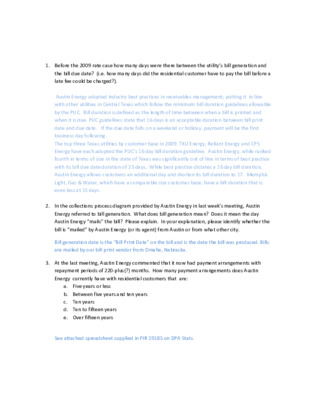
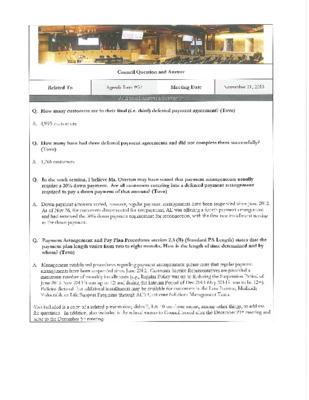
1. Before the 2009 rate case how many days were there between the utility’s bill generation and the bill due date? (i.e. how many days did the residential customer have to pay the bill before a late fee could be charged?). Austin Energy adopted industry best practices in receivables management; putting it in line with other utilities in Central Texas which follow the minimum bill duration guidelines allowable by the PUC. Bill duration is defined as the length of time between when a bill is printed and when it is due. PUC guidelines state that 16 days is an acceptable duration between bill print date and due date. If the due date falls on a weekend or holiday, payment will be the first business day following. The top three Texas utilities by customer base in 2009: TXU Energy, Reliant Energy and CPS Energy have each adopted the PUC’s 16 day bill duration guideline. Austin Energy, while ranked fourth in terms of size in the state of Texas was significantly out of line in terms of best practice with its bill due date duration of 23 days. While best practice dictates a 16 day bill duration, Austin Energy allows customers an additional day and shorten its bill duration to 17. Memphis Light, Gas & Water, which have a comparable size customer base, have a bill duration that is even less at 15 days. 2. In the collections process diagram provided by Austin Energy in last week’s meeting, Austin Energy referred to bill generation. What does bill generation mean? Does it mean the day Austin Energy “mails” the bill? Please explain. In your explanation, please identify whether the bill is “mailed” by Austin Energy (or its agent) from Austin or from what other city. Bill generation date is the “Bill Print Date” on the bill and is the date the bill was produced. Bills are mailed by our bill print vendor from Omaha, Nebraska. 3. At the last meeting, Austin Energy commented that it now had payment arrangements with repayment periods of 220-plus(?) months. How many payment arrangements does Austin Energy currently have with residential customers that are: a. Five years or less b. Between five years and ten years c. Ten years d. Ten to fifteen years e. Over fifteen years See attached spreadsheet supplied in PIR 19185 on DPA Stats. 4. Please provide the following information for the group of …
Austin Energy Low Income Consumer Advocate Group February 19, 2014 9:30 am – 12:30 pm Town Lake Center, Assembly Room 100 Agenda Meeting Objectives 1. Review group structure and protocols 2. Complete constituting the Working Group 3. Gain a common understanding of Austin Energy’s deferred payment program and policies and mandates guiding those policies 4. Begin discussing Austin Energy’s deferred payment policies and identifying areas of agreement for revised rules 9:15 AM Gathering and Sign-In 9:30 AM Welcome, Objectives and Agenda Group Structure and Protocols Additions to Working Group Presentation: Deferred Payment Arrangement Questions and Answers Dialogue and Seeking Agreement: Deferred Payment Plans and Service Disconnections Wrap-up and Next Steps 12:30 PM Adjourn Thank you for your participation today.
Larry Weis, Austin Energy General Manager Mission: Deliver clean, affordable, reliable energy and excellent customer service. Collections Overview Disconnection and Reconnection Process Special Council Committee on Austin Energy Meeting December 5, 2013 2 •Follow City Code Chapter15-9 and state laws regarding utility debt •Assist the customer in reducing outstanding balances by offering flexible payment arrangements •Offer the customer opportunities to successfully manage their utility account and prevent perpetual debt accumulation •Offer special provisions for CAP and low income customers •Minimize utility rate increases •Optimize support services funding Objectives 3 Collections Process Steps Overview •The collections process begins with the generation of the customer’s bill •The process is highly automated, events trigger each process step •The customer can stop the next event at any point in the process by either making payment in full or requesting a Payment Arrangement. 4 Definitions Payment Arrangement •A Payment Arrangement (PA) is a short term payment option for households that are having a temporary crisis; PAs provide several months to pay off overdue utility bills in equal installments. These installments are in addition to the regular monthly current charges. The City of Austin does not disconnect services of customers with approved payment arrangements and on-time payments. Payment Arrangement Success •Successful PAs occur when payments for each PA installment plus the current billed charges are received in full, on or before the due date for each applicable month. Payment Arrangement Default •PAs are in default when the full PA installment and current billed charges due are not paid by the due date. If default occurs the account will proceed through the collections process. Arrearage Management Program •Arrearage Management Programs are long-term financial assistance programs and provide relief for low-income customers who have significant past due amounts (arrears) on their utility bills. •Bill is not paid by due date •No response to delinquent payment reminder •No response to 24-hour notice •Customer does not request a payment arrangement 5 How Does a Disconnect Occur? •On average 14% of the total residential customers enter into the collections process each month 422, 27% 358, 23% 289, 18% 514, 32% August 2013 Customer Behavior – 24-Hour Notice 10,644 , 20% 2,242 , 4% 866 , 2% 39,390 , 74% August 2013 Customer Behavior - FTNs Paid account Set up Payment Arrangement Set up Payment Plan Took no action * There was no collection activity between August 2011 – May 2013. In …
PUBLIC UTILITY REGULATORY ACT Title II, Texas Utilities Code (As Amended) Effective as of September 1, 2011 PUBLIC UTILITY COMMISSION OF TEXAS [BLANK PAGE] PUBLIC UTILITY REGULATORY ACT Title II, Texas Utilities Code (As Amended) Effective as of September 1, 2011 PUBLIC UTILITY COMMISSION OF TEXAS 1701 N. Congress Avenue • P.O. Box 13326 • Austin, Texas 78711-3326 • 512/936-7000 [BLANK PAGE] i FOREWORD The Public Utility Code was enacted by Acts 1997, 75th Leg., R.S., ch. 166, § 1 as a new and separate code effective September 1, 2007. Title 2 of the code is properly cited as the Public Utility Regulatory Act. This edition of the Public Utility Regulatory Act contains amendments adopted through the 82nd Legislature, First Called Session. In general, the effect of amendments have been clear and the resulting text changes were straightforward and did not require any editorial discretion. Except as explained below, editorial discretion was exercised in reconciling multiple amendments to the same section. In the majority of these cases, there was no irreconcilable conflict and all of the amendments could be given effect. In some cases, an act expressly amended a provision as added or amended by another act. In the few cases where an irreconcilable conflict was found, the act with the later date of enactment was given effect, with the other provisions italicized below. In addition, a note explaining the conflict is provided following the section annotation. The annotations following each section have two components. The first annotation shows the derivation of the section, either citing to the Public Utility Regulatory Act of 1995 (V.A.C.S. Art. 1446c-0), Acts 1997, ch. 166, or showing the section as added to the code and citing the relevant act. The second component identifies subsequent amendments, cites the amending act (and originating bill), provides a brief summary of each of the amendments, and, where appropriate, provides a reference to related provisions or material. This publication is maintained by the Commission Advising and Docket Management Division of the Public Utility Commission of Texas. Suggestions or corrections may be submitted to that division. ii [BLANK PAGE] iii TABLE OF CONTENTS TITLE I. GENERAL PROVISIONS ..........................................................................................1 CHAPTER 1. GENERAL PROVISIONS ................................................................................................ 1 Sec. 1.001. PURPOSE OF CODE. ..................................................................................................................... 1 Sec. 1.002. CONSTRUCTION OF CODE. ........................................................................................................ 1 Sec. 1.003. REFERENCE IN LAW TO STATUTE REVISED BY CODE. ...................................................... 1 TITLE II. PUBLIC UTILITY REGULATORY ACT ..............................................................3 SUBTITLE A. PROVISIONS …
Collections Overview Disconnection and Reconnection Process September 2013 Mission: Deliver clean, affordable, reliable energy and excellent customer service. www.austinenergy.com Collections Process Steps August 2013 2 Bill Generation 24 Hour Notice Bill Due Late Fees / Letters Mailed Delinquency Due Disconnect for Non-Payment Collections Process 17 days 17 days 4 days 6 days Overview The collections process begins with the generation of the customer’s bill The process is highly automated, events trigger each process step The customer can stop the next event at any point in the process www.austinenergy.com Overview Allow a minimum of 17 Days from Bill Generation to Bill Due Date May vary due to holiday or weekend COA Regs 15-9-131 DETERMINATION OF BILLING CYCLES Bill Generation: Due Date How We Compare Number of Days from Bill to Due Date August 2013 3 Austin Energy 17 CPS Energy 16 Pedernales Electric Cooperative 16 PUC (TXU, Reliant) 16 MLGW 16 Colorado Springs Utilities 14 www.austinenergy.com Overview Assess 5% Late Fee On Metered Services only On Current Amount Due only Listed on the Payment Stub COA Regs 15-9-137 PAYMENT REQUIREMENTS AND LATE PAYMENT PENALTY Past Due: Late Fee Assessed August 2013 4 www.austinenergy.com Delinquent Letters Mailed August 2013 5 Austin Energy $0 CPS Energy $0 Pedernales Electric Cooperative $0 Reliant $0 TXU $10 per notice Gexa Energy $15 per notice Amigo Energy $22 per notice Bounce Energy $20 per notice How We Compare Disconnect Notice Fee Overview Mail letter stating that Account is subject to Disconnection for Non-Payment if no action is taken Letter type based on account activity Friendly Firm COA Regs 15-9-106 NOTICE OF SERVICE DISCONNECTION www.austinenergy.com No Response from Customer: 24 Hour Notice August 2013 6 Overview Leave Courtesy Door Hanger Cost of $1.5M annually COA Regs Requirement for notice of service disconnection per 15-9-106 NOTICE OF SERVICE DISCONNECTION is met through Delinquent Letter. NOTICE OF SERVICE TERMINATION Previous attempts to collect on you utility account have been unsuccessful. Payment of your past due balance must be made immediately or utility services will be disconnected. In order to prevent disconnection, payment must be made at an authorized pay station and you must contact the utility service center to provide receipt information. If you are experiencing difficulty paying your bill, you may qualify for a Payment Arrangement or financial assistance. Please contact us for more information. Austin Energy Yes CPS Energy Yes Pedernales Electric Cooperative No Reliant No TXU …
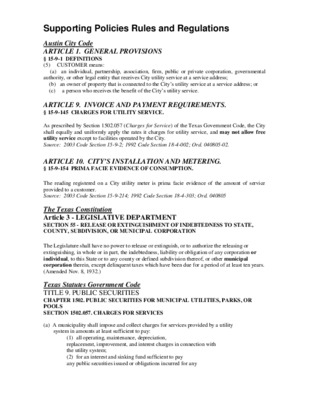
Supporting Policies Rules and Regulations Austin City Code ARTICLE 1. GENERAL PROVISIONS § 15-9-1 DEFINITIONS (5) CUSTOMER means: (a) an individual, partnership, association, firm, public or private corporation, governmental authority, or other legal entity that receives City utility service at a service address; (b) an owner of property that is connected to the City’s utility service at a service address; or (c) a person who receives the benefit of the City’s utility service. ARTICLE 9. INVOICE AND PAYMENT REQUIREMENTS. § 15-9-145 CHARGES FOR UTILITY SERVICE. As prescribed by Section 1502.057 (Charges for Service) of the Texas Government Code, the City shall equally and uniformly apply the rates it charges for utility service, and may not allow free utility service except to facilities operated by the City. Source: 2003 Code Section 15-9-2; 1992 Code Section 18-4-002; Ord. 040805-02. ARTICLE 10. CITY’S INSTALLATION AND METERING. § 15-9-154 PRIMA FACIE EVIDENCE OF CONSUMPTION. The reading registered on a City utility meter is prima facie evidence of the amount of service provided to a customer. Source: 2003 Code Section 15-9-214; 1992 Code Section 18-4-303; Ord. 040805 The Texas Constitution Article 3 - LEGISLATIVE DEPARTMENT SECTION 55 - RELEASE OR EXTINGUISHMENT OF INDEBTEDNESS TO STATE, COUNTY, SUBDIVISION, OR MUNICIPAL CORPORATION The Legislature shall have no power to release or extinguish, or to authorize the releasing or extinguishing, in whole or in part, the indebtedness, liability or obligation of any corporation or individual, to this State or to any county or defined subdivision thereof, or other municipal corporation therein, except delinquent taxes which have been due for a period of at least ten years. (Amended Nov. 8, 1932.) Texas Statutes Government Code TITLE 9. PUBLIC SECURITIES CHAPTER 1502. PUBLIC SECURITIES FOR MUNICIPAL UTILITIES, PARKS, OR POOLS SECTION 1502.057. CHARGES FOR SERVICES (a) A municipality shall impose and collect charges for services provided by a utility system in amounts at least sufficient to pay: (1) all operating, maintenance, depreciation, replacement, improvement, and interest charges in connection with the utility system; (2) for an interest and sinking fund sufficient to pay any public securities issued or obligations incurred for any purpose described by Section 1502.002 relating to the utility system; and (3) any outstanding debt against the system. (b) The rates charged for services provided by a utility system must be equal and uniform. A municipality may not allow any free service except for: (1) municipal public schools; …
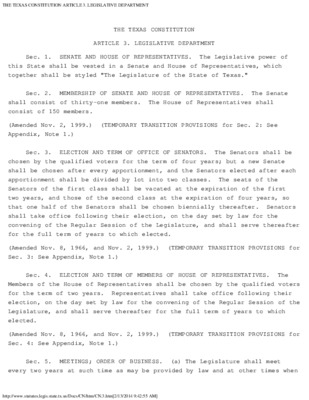
THE TEXAS CONSTITUTION ARTICLE 3. LEGISLATIVE DEPARTMENThttp://www.statutes.legis.state.tx.us/Docs/CN/htm/CN.3.htm[2/13/2014 9:42:55 AM] THE TEXAS CONSTITUTIONARTICLE 3. LEGISLATIVE DEPARTMENTSec. 1. SENATE AND HOUSE OF REPRESENTATIVES. The Legislative power of this State shall be vested in a Senate and House of Representatives, which together shall be styled "The Legislature of the State of Texas." Sec. 2. MEMBERSHIP OF SENATE AND HOUSE OF REPRESENTATIVES. The Senate shall consist of thirty-one members. The House of Representatives shall consist of 150 members. (Amended Nov. 2, 1999.) (TEMPORARY TRANSITION PROVISIONS for Sec. 2: See Appendix, Note 1.)Sec. 3. ELECTION AND TERM OF OFFICE OF SENATORS. The Senators shall be chosen by the qualified voters for the term of four years; but a new Senate shall be chosen after every apportionment, and the Senators elected after each apportionment shall be divided by lot into two classes. The seats of the Senators of the first class shall be vacated at the expiration of the first two years, and those of the second class at the expiration of four years, so that one half of the Senators shall be chosen biennially thereafter. Senators shall take office following their election, on the day set by law for the convening of the Regular Session of the Legislature, and shall serve thereafter for the full term of years to which elected. (Amended Nov. 8, 1966, and Nov. 2, 1999.) (TEMPORARY TRANSITION PROVISIONS for Sec. 3: See Appendix, Note 1.)Sec. 4. ELECTION AND TERM OF MEMBERS OF HOUSE OF REPRESENTATIVES. The Members of the House of Representatives shall be chosen by the qualified voters for the term of two years. Representatives shall take office following their election, on the day set by law for the convening of the Regular Session of the Legislature, and shall serve thereafter for the full term of years to which elected. (Amended Nov. 8, 1966, and Nov. 2, 1999.) (TEMPORARY TRANSITION PROVISIONS for Sec. 4: See Appendix, Note 1.)Sec. 5. MEETINGS; ORDER OF BUSINESS. (a) The Legislature shall meet every two years at such time as may be provided by law and at other times when THE TEXAS CONSTITUTION ARTICLE 3. LEGISLATIVE DEPARTMENThttp://www.statutes.legis.state.tx.us/Docs/CN/htm/CN.3.htm[2/13/2014 9:42:55 AM]convened by the Governor.(b) When convened in regular Session, the first thirty days thereof shall be devoted to the introduction of bills and resolutions, acting upon emergency appropriations, passing upon the confirmation of the recess appointees of the Governor and such emergency matters as may be submitted …
Austin Energy Low Income Customer Advocates January 15, 2014 11:00 am – 12:30 pm Meeting Objectives 1. Introduce Austin Council Resolution No. 20131107-052 and meeting process 2. Discuss group structure and protocols 3. Brainstorm best ideas relative to the resolution 4. Confirm meeting dates and next steps Agenda 11:00 AM Gathering and Sign-In 11:10 AM Welcome and Opening Comments Kerry Overton 11:20 AM Introductions, Objectives, Agenda, Ground Rules, Group Structure Robena Jackson 11:55 AM Best Ideas Stakeholder Group 12:25 PM Wrap-Up and Next Steps 12:30 PM Adjourn Thank you for your participation today.
1 Austin Energy Low Income Consumer Advocates Resolution 20131107-052 Meeting #1 January 15, 2014 Attendees: Kathy Stark (Austin Tenants’ Council), Mark Widoff (Gray Panthers), Gloria Cueva (Caritas), Michelle Akers (HACA), Angel Ramirez (VFW), Ruby Roa (COC), Kathleen Hopkins (ABC), Vanessa Sarria (CAN), Randy Chapman (TLSC), Barbara Grove (Austin Interfaith), Carol Biedrzycki (Texas ROSE), Bob Batlan (Austin Interfaith), Linda Perez (MOWAM), Tonda Owens (Travis County), Pat Macy (St. Austin), Lanetta Cooper (TLSC), Barbara Rush (Morrison), Shannon Halley (Tovo), Kerry Overton (AE), J.J. Gutierrez (AE), Ronnie Mendoza (AE), Robena Jackson (Facilitator) , Elaine Kelly-Diaz (AE), Lisa Tamez (AE), Melissa Davis (AE), Lori Kirchgatter (AE), Sandra Castillo (AE), Jessica Twining (AE), Irene Nemitsas (AE) • Welcome/Opening Remarks o Kerry Overton, Deputy General Manager, Austin Energy, welcomed all attendees and introduced Robena Jackson, meeting facilitator o Mr. Overton reviewed Resolution 20131107-052 and stated that the group has been ordered to develop a comprehensive program to address the resolution o Ms. Jackson verified all groups represented: Austin Interfaith, Texas Rose, Meals on Wheels and More, Travis County, St. Austin Catholic Church, Texas Legal Services, Austin Tenants Council, Caritas, Housing Authority of the City of Austin (HACA), Veterans of Foreign Wars (VFW), Ladies of Charity, Any Baby Can, Community Advancement Network (CAN), Gray Panthers o Question raised: Ms. Biedrzycki inquired about Resolution 20131212-081 – concerning administrative hearing process and customer information communication procedures Ms. Jackson responded for purposes of these meetings attendees are to concentrate on discussing/providing recommendations for resolution 20131107-52 Resolution 20131212-081 was put on hold/parking lot for group to review at the close of the meeting o Ms. Jackson reviewed her role as facilitator: Acts as neutral moderator Not content expert Helps move meetings forward and stay on task Ensure lines of communication remain open o Ms. Jackson established ground rules for meetings: Listen Speak one at a time Stay concise and to the point • Any items that may be out of scope will be tabled/put on the parking lot Stay focused at task on hand Silence phones All attendees agreed to rules • Meeting Structure o Ms. Jackson proposed meeting structure moving forward, Recommending establishment of two groups: Stakeholders and Working Group Stakeholders • Will meet along with Working Group 2 or 3 times during total 5 meeting process, though they can choose to come to all 5 …
RESOLUTION NO. 20131107-052 WHEREAS, Austin Energy has residential customers with high past-due balances, many of whom are low-income customers; and WHEREAS, a large number of residential customers are at risk of having their utilities disconnected or have already received service disconnections; and WHEREAS, the loss of critical utilities threatens health and safety, and once utilities are disconnected a family may be unable to maintain housing; and WHEREAS, the City should ensure that, at a minimum, low-income households are provided the resources to maintain critical utility services; and WHEREAS, such resources should include strategies and protections against termination for the most vulnerable populations, such as the elderly, critically ill, or households with young children; and WHEREAS, one strategy some utilities use to prevent terminations is an arrearage management plan; and WHEREAS, evidence suggests that arrearage management plans have a positive impact on utility revenues; and WHEREAS, the City has a fiscal and legal obligation to ensure that the utility collects payment for utility service; and WHEREAS, deferred payment arrangements that are reasonable, realistic, and tailored to each customer's financial circumstances would also provide protection against disconnection; and WHEREAS, customers experiencing high utility bills, including excessive water usage, should be provided information about usage reduction strategies including options for participation in energy efficiency rebate and low-income weatherization programs, as well as water conservation rebates and education; NOW, THEREFORE, BE IT RESOLVED BY THE CITY COUNCIL OF THE CITY OF AUSTIN: That the City Manager is directed to work with the Discount Steering Committee and other consumer advocates to develop revised rules for deferred payment plans and service disconnections; BE IT FURTHER RESOLVED That the City Manager work with the Discount Steering Committee and consumer advocates to develop an arrearage management plan, taking into consideration best practices from other cities, and including strategies for incentivizing customers for honoring payment agreements; BE IT FURTHER RESOLVED That the City Manager work with this group to develop appropriate customer service practices for providing information to customers entering into deferred payment plans about resources available to customers through Austin Energy or the Austin Water Utility, including eligibility for customer assistance programs, participation in energy efficiency rebate and/or low income weatherization, and education on usage management strategies; BE IT FURTHER RESOLVED: That the City Manager provide the recommendations of the Discount Steering Committee and consumer advocates to the Electric Utility Commission, the Resource Management Commission, and the Water …