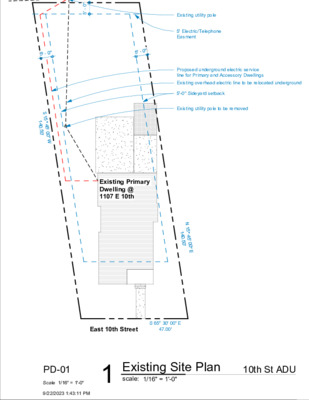
1107 E 10th Street ADU Design Review Architecture Review Committee Meeting Wednesday May 15, 2024 East 10th Steet 45-foot electrical pole 35-foot electrical pole 45-foot electrical pole 35.5-foot electrical pole 45-foot electrical pole 35-foot structure 35-foot electrical pole 10th Street Streetview ADUs - Robertson Stuart District 1004 E 9th Street 1105 E 9th Street 1104 E 8th Street 1105 E 9th Street 1104 E 8th Street Robertson Stuart District – Recent Construction East North
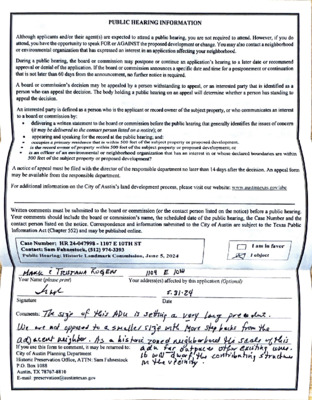
From: To: Cc: Subject: Date: Attachments: Sue Gall Contreras, Kalan Corona, Nicole; Rivera, Andrew Case Number HR-2024-047998; PR 2024-043549 - Comments for Planning Commission public hearing July 9, 2024 Wednesday, July 3, 2024 3:52:01 PM HR-2024-047998 Gall Appeal Comments.pdf External Email - Exercise Caution Attached are my comments objecting to the proposed ADU in case HR-2024-047998, which is scheduled to be discussed at the July 9 Planning Commission public hearing. I'm also pasting them below for convenience. Will you please sign me up to speak at the July 9 public hearing? Thank you all for your time and help. Kalan, Nicole and Andrew, Sue Gall 1109 East 10th Street ------------------- Sue Gall 1109 E 10th Street Austin, TX 78702 July 3, 2024 City of Austin Planning Department ATTN: Kalan Contreras P.O. Box 1088 Austin, TX 78767 SENT VIA EMAIL TO: kalan.contreras@austintexas.gov CC: Nicole.corona@austintexas.gov; Andrew.rivera@austintexas.gov RE Case Number HR-2024-047998; PR 2024-043549 – 1107 E 10TH ST Dear Ms. Contreras, Planning Commission Public Hearing: July 9, 2024 Case Number: HR-2024-047998; PR 2024-043549 – 1107 E 10TH ST Contact: Kalan Contreras, 512-974-2727 I strongly object to this proposed Accessory Dwelling Unit (ADU), which is scheduled to be discussed at the next Planning Commission meeting: This property is within the Robertson/Stuart & Mair Historic District, one of eight local historic districts recognized by the city. Historic district designation involves adding an HD to the base zoning and requires the support of a majority of property owners or land area owners, as well as high architectural integrity. The city’s own website states that historic districts “offer the strongest protection and greatest benefit for Austin’s older neighborhoods”. (1) Our neighborhood spent years and tens of thousands of dollars to achieve Historic District designation in 2019. A majority of both property owners and land area owners in the neighborhood supported it. The Planning Commission at the time unanimously recommended it for approval to City Council. The HD zoning overlay allows the Historic Landmark Commission to approve a Certificate of Appropriateness for only those proposals which comply with the District Design Standards contained in the District Preservation Plan.(2) At the June 5, 2024 Historic Landmark Commission hearing, it was clear that neither the applicant nor the Commission correctly applied our District Design Standards. The Robertson/Stuart & Mair District Design Standards, viewable on the city’s website,(3) are clear that new construction must be “compatible with the design patterns of …
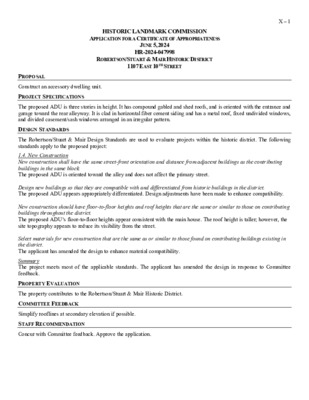
HISTORIC LANDMARK COMMISSION APPLICATION FOR A CERTIFICATE OF APPROPRIATENESS JUNE 5, 2024 HR-2024-047998 ROBERTSON/STUART & MAIR HISTORIC DISTRICT 1107 EAST 10TH STREET X – 1 PROPOSAL Construct an accessory dwelling unit. PROJECT SPECIFICATIONS The proposed ADU is three stories in height. It has compound gabled and shed roofs, and is oriented with the entrance and garage toward the rear alleyway. It is clad in horizontal fiber cement siding and has a metal roof, fixed undivided windows, and divided casement/sash windows arranged in an irregular pattern. DESIGN STANDARDS The Robertson/Stuart & Mair Design Standards are used to evaluate projects within the historic district. The following standards apply to the proposed project: 1.4. New Construction New construction shall have the same street-front orientation and distance from adjacent buildings as the contributing buildings in the same block. The proposed ADU is oriented toward the alley and does not affect the primary street. Design new buildings so that they are compatible with and differentiated from historic buildings in the district. The proposed ADU appears appropriately differentiated. Design adjustments have been made to enhance compatibility. New construction should have floor-to-floor heights and roof heights that are the same or similar to those on contributing buildings throughout the district. The proposed ADU’s floor-to-floor heights appear consistent with the main house. The roof height is taller; however, the site topography appears to reduce its visibility from the street. Select materials for new construction that are the same as or similar to those found on contributing buildings existing in the district. The applicant has amended the design to enhance material compatibility. Summary The project meets most of the applicable standards. The applicant has amended the design in response to Committee feedback. PROPERTY EVALUATION The property contributes to the Robertson/Stuart & Mair Historic District. COMMITTEE FEEDBACK Simplify rooflines at secondary elevation if possible. STAFF RECOMMENDATION Concur with Committee feedback. Approve the application. LOCATION MAP X – 2
1107 E 10th Street Design Review Planning Commission Meeting Tuesday July 9, 2024 East 10th Steet 45-foot electrical pole 35-foot electrical pole 45-foot electrical pole 35.5-foot electrical pole 45-foot electrical pole 35-foot structure 35-foot electrical pole 10th Street Streetview ADUs - Robertson Stuart District 1004 E 9th Street 1105 E 9th Street 1104 E 8th Street 1105 E 9th Street 1104 E 8th Street Robertson Stuart District – Recent Construction East North 3 Story Properties within Robertson Stuart 13 Properties Total = 3 Story Properties 45 Foot Electrical Pole Contributing Structure Located adjacent to subject property 35’ 1004 E 9th St, Unit A 3 Stories Built 2016 1004 E 9th St, Unit B 3 Stories 1004 E 9th St, Unit A 1004 E 9th St, Unit B 1013 E 9th St Contributing Structure 30’ 1110 E 8th St 3 Stories Built 2016 1110 E 8th St 3 Stories 39’ 800, 802, 804, 806, 808 E Lydia St 3 Stories Built 2018 800, 802, 804, 806, 808 Lydia St 3 Stories Built 2018 705 Lydia St 3 Stories Built 2017 1105 E 9th St 3 Stories Built 2018 1104 E 8th St 3 Stories Built 2014
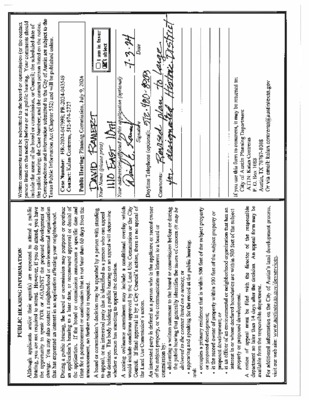
From: To: Cc: Subject: Date: e Contreras, Kalan; Corona, Nicole; Rivera, Andrew "Mark Rogers"; "Bri Miriani"; "Mark Biechler"; "Jerry Garcia"; Emily Little; "David West"; 1107 E. 10th Street - AGAINST Thursday, July 4, 2024 9:40:43 AM External Email - Exercise Caution Greetings Kalan – I strongly oppose the proposed development at 1107 East 10th Street in the Robertson, Stuart & Mair Historic District. Planning Commission Public Hearing: July 9, 2024 Case Number: HR-2024-047998; PR 2024-043549 – 1107 E 10TH ST This proposed development flies in the face of Local Historic District Design Guidelines and if approved, will set such a precedent that the “Local Historic District” concept will rapidly lose its integrity. This will open the door for similar inappropriate projects. Precedent must not be set at this important time, right after the HOME Code Amendments have just been adopted. This case will determine how HOME relates to Historic Districts in the future. It is a test case for our neighborhood and there will be many more to follow in every other historic district. Please protect the founding principles and Historic District Design Guidelines first, followed by new allowances for increased density allowed in HOME. We are in favor of increased density, but not at the expense of our protected “Local Historic District.” Developers and designers must increase density in forms that are historically compatible to the context. We must rely on the Historic Landmark Commission and the Historic Preservation Office to uphold the governing Local Historic Guidelines. HOME does not, and must not, supersede Historic Guidelines. The proposed project at 1107 East 10th does not comply in terms of scale, massing, height and is no way compatible with the design patterns of the Robinson, Stuart & Mair Historic District. Please register my strong opposition and sign me up to speak at the July 9 hearing. Thank you very much, --- together in the love of history, Emily Emily Little ARCHITECT FAIA 1001 East 8th St. Austin TX 78702 512-470-8058 CAUTION: This is an EXTERNAL email. Please use caution when clicking links or opening attachments. If you believe this to be a malicious or phishing email, please report it using the "Report Message" button in Outlook. For any additional questions or concerns, contact CSIRT at "cybersecurity@austintexas.gov". From: To: Subject: Date: Dominic Welhouse Contreras, Kalan 1107 East 10th Street Saturday, July 6, 2024 2:31:51 PM You don't often get email from …
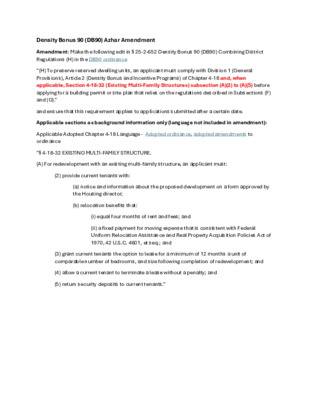
Density Bonus 90 (DB90) Azhar Amendment Amendment: Make the following edit in § 25-2-652 Density Bonus 90 (DB90) Combining District Regulations (H) in the DB90 ordinance “(H) To preserve reserved dwelling units, an applicant must comply with Division 1 (General Provisions), Article 2 (Density Bonus and Incentive Programs) of Chapter 4-18 and, when applicable, Section 4-18-32 (Existing Multi-Family Structures) subsection (A)(2) to (A)(5) before applying for a building permit or site plan that relies on the regulations described in Subsections (F) and (G).” and ensure that this requirement applies to applications submitted after a certain date. Applicable sections as background information only (language not included in amendment): Applicable Adopted Chapter 4-18 Language - Adopted ordinance, adopted amendments to ordinance “§ 4-18-32 EXISTING MULTI-FAMILY STRUCTURE. (A) For redevelopment with an existing multi-family structure, an applicant must: (2) provide current tenants with: (a) notice and information about the proposed development on a form approved by the Housing director; (b) relocation benefits that: (i) equal four months of rent and fees; and (ii) a fixed payment for moving expense that is consistent with Federal Uniform Relocation Assistance and Real Property Acquisition Policies Act of 1970, 42 U.S.C. 4601, et seq.; and (3) grant current tenants the option to lease for a minimum of 12 months a unit of comparable number of bedrooms, and size following completion of redevelopment; and (4) allow a current tenant to terminate a lease without a penalty; and (5) return security deposits to current tenants.”
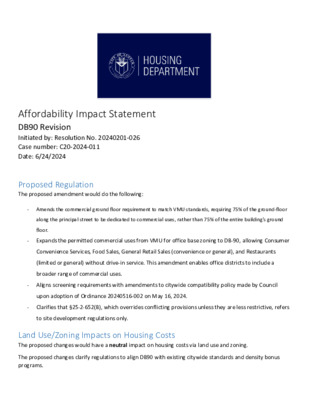
Affordability Impact Statement DB90 Revision Initiated by: Resolution No. 20240201-026 Case number: C20-2024-011 Date: 6/24/2024 Proposed Regulation The proposed amendment would do the following: - Amends the commercial ground floor requirement to match VMU standards, requiring 75% of the ground-floor along the principal street to be dedicated to commercial uses, rather than 75% of the entire building's ground floor. - Expands the permitted commercial uses from VMU for office base zoning to DB-90, allowing Consumer Convenience Services, Food Sales, General Retail Sales (convenience or general), and Restaurants (limited or general) without drive-in service. This amendment enables office districts to include a broader range of commercial uses. - Aligns screening requirements with amendments to citywide compatibility policy made by Council upon adoption of Ordinance 20240516-002 on May 16, 2024. - Clarifies that §25-2-652(B), which overrides conflicting provisions unless they are less restrictive, refers to site development regulations only. Land Use/Zoning Impacts on Housing Costs The proposed changes would have a neutral impact on housing costs via land use and zoning. The proposed changes clarify regulations to align DB90 with existing citywide standards and density bonus programs. Impact on Development Cost The proposed changes would have a neutral impact on development costs. The proposed changes clarify regulations to align DB90 with existing citywide standards and density bonus programs. Impact on Affordable Housing The proposed changes would have a positive impact on affordable housing. Requiring ground floor commercial uses only along the principal street, rather than the entire building’s ground floor, matches VMU standards. This change is intended to increase participation in the DB90 density bonus program, as it can be difficult to lease up ground floor commercial, especially when the commercial use is not facing onto the principal street. Increased participation in this program will eventually lead to a rise in the number of affordable housing units citywide. City Policies Implemented Other Housing Policy Considerations None. Manager’s Signature __________ ____________________
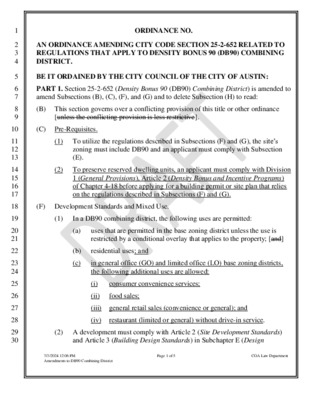
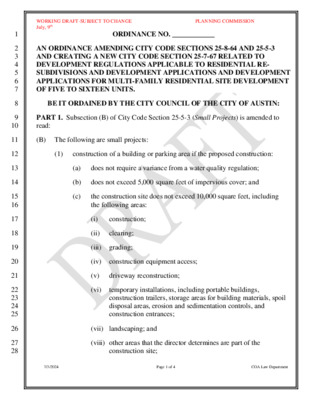
1 2 3 4 5 6 7 8 9 10 11 12 13 14 15 16 17 18 19 20 21 22 23 24 25 26 27 28 29 30 ORDINANCE NO. AN ORDINANCE AMENDING CITY CODE SECTION 25-2-652 RELATED TO REGULATIONS THAT APPLY TO DENSITY BONUS 90 (DB90) COMBINING DISTRICT. BE IT ORDAINED BY THE CITY COUNCIL OF THE CITY OF AUSTIN: PART 1. Section 25-2-652 (Density Bonus 90 (DB90) Combining District) is amended to amend Subsections (B), (C), (F), and (G) and to delete Subsection (H) to read: (B) This section governs over a conflicting provision of this title or other ordinance [unless the conflicting provision is less restrictive]. (C) Pre-Requisites. (1) To utilize the regulations described in Subsections (F) and (G), the site’s zoning must include DB90 and an applicant must comply with Subsection (E). (2) To preserve reserved dwelling units, an applicant must comply with Division 1 (General Provisions), Article 2 (Density Bonus and Incentive Programs) of Chapter 4-18 before applying for a building permit or site plan that relies on the regulations described in Subsections (F) and (G). (F) Development Standards and Mixed Use. (1) In a DB90 combining district, the following uses are permitted: (a) (b) (c) uses that are permitted in the base zoning district unless the use is restricted by a conditional overlay that applies to the property; [and] residential uses; and in general office (GO) and limited office (LO) base zoning districts, the following additional uses are allowed: (i) consumer convenience services; (ii) food sales; (iii) general retail sales (convenience or general); and (iv) restaurant (limited or general) without drive-in service. (2) A development must comply with Article 2 (Site Development Standards) and Article 3 (Building Design Standards) in Subchapter E (Design 7/3/2024 12:06 PM Amendments to DB90 Combining District Page 1 of 5 COA Law Department 31 32 33 34 35 36 37 38 39 40 41 42 43 44 45 46 47 48 49 50 51 52 53 54 55 56 57 58 59 60 61 62 Standards and Mixed Use) of this chapter except when those provisions conflict with this section. (3) Mix of Uses. (a) (b) In this subdivision, PRINCIPAL STREET has the same meaning as principal street in and is applied consistent with Article 5 (Definitions) of Subchapter E (Design Standards and Mixed Use). Pedestrian-Oriented Commercial and Civic Spaces. At least [When a site abuts a …
C20-2024-011: DB90 Revisions Paul Ray Books, Senior Planner Background 2023 2024 2022 City Council adopted Ordinance No. 20220609-080, creating a second tier of the VMU program, referred to as VMU2, which allowed for increased height in exchange for increased community benefits. City Council adopted Ordinance No. 20221201-055, creating an incentive program that allows residential uses in commercial zoning districts, referred to as Residential in Commercial, which allowed for the construction of residential uses in exchange for increased community benefits. Ordinance No. 20220609-080, Ordinance No. 20221201-055, and Ordinance No. 20221201-056 were invalidated. City Council adopted Ordinance No. 20240229-073, which created the Density Bonus 90 (DB-90) combining district and density bonus program with requirements and incentives mirroring VMU 2 provisions. 2 DB90 Requirements and Incentives Affordability – Rental: – 10% of units set-aside affordable to 50% Median Family Income (MFI); OR – 12% of units set-aside affordable to 60% MFI – Ownership: – 12% of units set-aside affordable to 80% MFI • Requirements for ownership units may be satisfied by a fee-in-lieu of on-site units setback Site Development Standards – Exemptions from standards include the following: – Minimum site area requirements – Maximum floor area ratio – Maximum building coverage – Minimum street side yard setback and interior yard – Minimum front yard setback – Article 10 Compatibility Standards Subchapter C Height – 30 ft in additional height from the base zone up to a maximum of 90 ft Mix of Uses – Requirements for pedestrian-oriented commercial uses – Floors beyond the second must be residential Subchapter E Design Standards – Streetscape, building placement, and design standards 3 DB90 Combining District Example Zoning String: CS-MU-CO-DB90-NP Eligible Districts: Base Zoning Districts Base Zones Description CS (CS-1) Commercial Services Base Max Height 60ft Max Height with Bonus 90ft Impervious Cover 95% GR LO LR GO Community Commercial Limited Office Neighborhood Commercial General Office 60ft 40ft 40ft 60ft 90ft 70ft 70ft 90ft 90% 70% 80% 80% 4 DB90 Process Owners of eligible properties must request a rezoning to add DB90 Requires a Commission recommendation and Council action – – Notice of the rezoning will be provided pursuant to 25-1-132, which includes utility account holders and property owners located within 500 feet of the subject property Property owners within 200 feet can protest the rezoning – Housing Certification – – Prior to site plan submittal, an applicant is required …
ORDINANCE AMENDMENT REVIEW SHEET Amendment: C20-2024-011 Density Bonus 90 Revisions Amend City Code Title 25 (Land Development) to revise uses, site development regulations, density bonus requirements, and compatibility standards applicable in density bonus 90 (DB90) combining district. Description: Background: In 2021, amendments to the City’s Vertical Mixed Use (VMU) Overlay, including the creation of a second-tier bonus program known as VMU2, were initiated through City Council Resolution No. 20211118-052. The resolution directed staff to process code amendments to allow for an additional 30’ in height beyond the base zone standards for developments participating in the new tier of the density bonus program and proposed affordability requirements for such developments. In June of 2022, City Council adopted Ordinance No. 20220609-080, implementing the code amendments initiated through the 2021 Council resolution. However, in December 2023, Ordinance No. 20220609-080, Ordinance No. 20221201-056, and Ordinance No. 20221201-055 were invalidated. In February 2024, City Council adopted Ordinance No. 20240229-073, which created the Density Bonus 90 (DB90) combining district. This new district is similar to the provisions in VMU2 and is available citywide through the rezoning process. Summary of Proposed Code Amendment: The proposed amendment to §25-2-652 would do the following: - Amend the commercial ground floor requirement to match VMU standards, requiring 75% of the ground floor frontage along the principal street to be designed for commercial use with an additional clarification regarding civic uses - Add the allowed commercial uses from VMU to office base zoning districts - Align compatibility screening requirements with amendments to citywide policy made by Council through Ordinance 20240516-004 - Clarify that provisions of the DB90 program govern over a conflicting provision of the Land Development Code or other ordinance Proposed Text Amendment(s): See draft ordinance. Staff Recommendation: Recommended Staff supports the proposed amendments, which aim to increase participation in the density bonus program and align its regulations with citywide standards. The modification to commercial ground floor requirements will ensure that developments under the DB90 program resemble existing VMU developments, enabling staff to review these applications consistently, and facilitating a streamlined approval process. Further, an analysis of recent VMU developments revealed that the program's requirements result in only 8% to 15% of the ground floor square footage being allocated to commercial use, which is significantly below the 75% required under DB90. Allowing for additional commercial uses within office base zoning districts will enable true mixed-use developments that provide a variety …
Affordability Impact Statement Live Music Venue and Creative Space Bonus Phase 2 Case number: C20-2023-026 Initiated by: Resolution No.(s) 20220728-094 and 20220901-089 Date: 6/27/2024 Proposed Regulation The proposed amendment would create a new combining district for an affordable creative space bonus program available upon request through a zoning application. It would include the following components: - Requires the designation to be applied to more than one parcel to meet the definition of a creative district. - Requires 30% of building frontage and 25% of ground floor to be for affordable creative spaces. - Requires protections for existing creative spaces, including replacement, notice, rent assistance, and leasing - Requires residential and hotel developments near music and performance venues to conduct a sound - Requires leases to be affordable for 10 years, with rent at 50% of average city retail space rent or a sustainable options. assessment and disclose to future residents. ratio and limited annual increases. - Allows for an extra 30 feet in height and exemptions from site development standards for developments providing affordable creative spaces or a fee in lieu of the affordable space. - Provides for exemptions from certain compatibility standards, replaced with a compatibility buffer and screening requirements. Land Use/Zoning Impacts on Housing Costs The proposed changes would have a neutral impact on land use/zoning related housing costs. This would establish an optional density bonus program available upon request that would require review by city staff, the planning commission, and City Council. As part of the staff review, the Housing Department will evaluate the request in accordance with the goals of the Austin Strategic Housing Blueprint and assess any negative impact to existing affordable housing. Impact on Development Cost The proposed changes would have a neutral impact on development costs. Each proposal will be evaluated individually, with the Housing Department ensuring that the creative district designation does not negatively affect existing and future multi-family developments. Sound Assessment requirements may add costs for multi-family developments within 600 feet of the creative district. Impact on Affordable Housing The proposed changes would have a neutral impact on affordable housing. This creative district density bonus program could compete with other density bonus programs specifically designed for affordable housing, like DB-90. However, the case-by-case evaluation may deem it appropriate in historically commercial districts where housing is less suitable. The Housing Department will review each case and provide recommendations to the Planning Commission …
Live Music Venue and Creative Space Regulatory Incentives Phase II July 2024 Council Actions Resolution No. 20220728-094: Establish the criteria to be a Live Music Venue Create live music venue bonus and incentive program for new and existing venues Initiate changes to Land Development Code Section 25 Resolution No. 20220901-089: Develop and adopt clear creative space land use definitions Create creative space bonus and incentive program for new and existing venues Create new code elements to "Diversify, sustain, and cultivate the city's culture, music, and arts communities and industries“ Criteria for designation of Arts Districts Initiate changes to Land Development Code Section 25 Resolution No. 20230921-102: Develop LDC amendments with incentives for cultural space preservation and creation by Spring 2024 Bring an ordinance establishing a Cultural District Overlay initiated in Resolution No. 20220728-094 and Resolution No. 20220901-089 by Spring 2024 Guidance from Resolutions Resolution No. 20220728-094: Expanded facilitation of affordable commercial space... in new construction Prioritization of music venue or creative space as a community benefit for density bonuses or other overlays within the Red River Cultural District, East 6th Street Entertainment District, and Warehouse Entertainment District Fee Waivers Modified Parking requirements Resolution No. 20220901-089: “Increase in floor to area ratio (FAR) in square footage or other appropriate development incentive related to what is provided for the dedicated creative space" "Prioritization of creative space as a city-wide community benefit as it relates to density bonus programs, Planned Unit Development (PUD) zoning, or within other regulatory plans Increased flexibility in development regulations and opportunities for modification of policies, rules, codes, or design standards Permit accessory use as a theater, art gallery, or art workshop in all commercial and industrial/warehousing zoning districts Fee waivers Modified parking requirements Expedited permitting process Goals and Timeline Cultural District Milestones Arts Commission: March 18 Goals Develop a citywide paper district that is not mapped; no change to a property’s zoning will be made through initial district adoption Focus on a “district” approach similar to Historic Districts, with minimum size requirements After adoption, owners of eligible properties may then request a rezoning to incorporate Creative District code string Initiate a subdistrict of the Downtown Density Bonus for Red River Codes and Ordinances Joint Committee (COJC): March 20 Recommended unanimously …
C20-2023-026 ORDINANCE AMENDMENT REVIEW SHEET Amendment: C20-2023-026 Live Music Venue and Creative Space Bonus Phase 2 Description: Amendments to Title 25 of the City Code to create a new Creative District combining district with provisions for creative space and music venue preservation, modified site requirements, and density bonuses for affordable creative space. Background: Initiated by City Council Resolutions 20220728-094 and 20220901-089, and reaffirmed by City Council Resolutions On July 28, 2022, the City Council adopted Resolution No. 20220728-094 initiating changes to establish the criteria to be a Live Music Venue to and support the creation of a live music venue bonus and incentive program for new and existing venues. On September 1, 2022, the City Council adopted Resolution No. 20220901-089 initiating changes to develop and adopt clear land use definitions and to create a bonus and incentive program for broadly defined creative spaces. These Resolutions are being addressed concurrently. Revised definitions were approved on September 14, 2023, in Ordinance 20230914-097. Ordinance No. 20230921-103 and Resolution 20240229-060 reaffirmed City Council’s commitment to the creation of a density bonus and district program to support live music and creative space districts and the preservation and incentivization of affordable creative space. Summary of Proposed Code Amendment: The proposed code amendments will create a new combining district for an affordable creative space bonus program and: 1. Is available city-wide on parcels in majority commercial districts that have been rezoned to add the new combining district designation as areas that include existing or planned clusters of creative space use structures and sites, through a process including minimum size requirements and review from the Housing Department and Economic Development Department. 2. Defines the following land uses as creative space uses: 1. Art Gallery; 2. Art Workshop; 3. Cocktail Lounge; 4. Performance Venue; 5. Personal Improvement Services; and, 6. Theater 3. Requires the following use requirements for developments in creative district combining districts: 1. Along at least 30 percent of building frontage along the principal street, the building must be reserved for affordable creative space uses in ground-floor spaces; 2. At least 25 percent of ground floor gross leasable area in the building must be dedicated to affordable creative space; and, 1 3. Development must comply with protections consistent with Existing Non- Residential Space provisions of 4-18-31 for existing creative space uses in existence on the site for at least 12 months; the developer must: 1. Redevelop the …
Affordability Impact Statement Infill Plats & Site Plan Lite, Phase 2 Initiated by: Resolution No. 20221201-048, 20230504-023 Case number: C20-2023-045 Date: July 5, 2024 Proposed Regulation The proposed amendments would do the following: Infill Plats • Provides small-scale residential developments with a streamlined subdivision review process to facilitate fee-simple ownership of lots as an alternative to condominium regimes. • Aligns impervious cover assumptions used in the streamlined subdivision review with impervious cover limits imposed by zoning regulations, which will provide more flexible subdivision options, allowing landowners to create smaller lots without triggering full subdivision review. • The modified drainage standards are limited to applications that meet the following criteria: • Less than one acre in site area; o Not located within the Wildland Urban Interface; o o Does not require a plat vacation. Is within a previously platted residential subdivision; and • Projects under a quarter-acre are not required to provide a drainage study or onsite detention. • Projects between a quarter-acre and one acre must provide a drainage plan demonstrating that, without altering natural topography, stormwater will discharge to an existing storm drainage system or right-of-way. Site Plan Lite, Phase 2 • The modified drainage standards are limited to applications that meet the following criteria: o Less than a half-acre in site area; and o 5 to 16 units on a single lot. • Qualifying projects must provide a drainage plan demonstrating that, without altering natural topography, stormwater will discharge to an existing storm drainage system or right-of-way. • Establishes a new “small-project” category for developments of 5 to 16 units that qualify for the modified drainage standards, streamlining the review process with shorter review times and reduced fees. Land Use/Zoning Impacts on Housing Costs The proposed changes would have a positive impact on housing costs by facilitating the delivery of missing middle projects through a less onerous permitting process and by expanding options for “fee simple” ownership of units on separate lots rather than condominium regimes. Like Home I and Home II, this housing strategy is aimed at increasing attainable housing options for middle-income Austinites, which is supported by many of the Strategic Housing Blueprint and Imagine Austin Goals to encourage diverse housing types throughout Austin. The modified drainage standards apply only to areas outside the Wildland Urban Interface (WUI). However, further analysis and discussion are necessary to determine if these standards are entirely unavailable in all proximity …
1 2 3 4 5 6 7 8 9 10 11 12 13 14 15 16 17 18 19 20 21 22 23 24 25 26 27 28 WORKING DRAFT-SUBJECT TO CHANGE July, 9th PLANNING COMMISSION ORDINANCE NO. ____________ AN ORDINANCE AMENDING CITY CODE SECTIONS 25-8-64 AND 25-5-3 AND CREATING A NEW CITY CODE SECTION 25-7-67 RELATED TO DEVELOPMENT REGULATIONS APPLICABLE TO RESIDENTIAL RE- SUBDIVISIONS AND DEVELOPMENT APPLICATIONS AND DEVELOPMENT APPLICATIONS FOR MULTI-FAMILY RESIDENTIAL SITE DEVELOPMENT OF FIVE TO SIXTEEN UNITS. BE IT ORDAINED BY THE CITY COUNCIL OF THE CITY OF AUSTIN: PART 1. Subsection (B) of City Code Section 25-5-3 (Small Projects) is amended to read: (B) The following are small projects: (1) construction of a building or parking area if the proposed construction: (a) does not require a variance from a water quality regulation; (b) does not exceed 5,000 square feet of impervious cover; and (c) the construction site does not exceed 10,000 square feet, including the following areas: (i) construction; (ii) clearing; (iii) grading; (iv) construction equipment access; (v) driveway reconstruction; (vi) temporary installations, including portable buildings, construction trailers, storage areas for building materials, spoil disposal areas, erosion and sedimentation controls, and construction entrances; (vii) landscaping; and (viii) other areas that the director determines are part of the construction site; 7/3/2024 Page 1 of 4 COA Law Department 29 30 31 32 33 34 35 36 37 38 39 40 41 42 43 44 45 46 47 48 49 50 51 52 53 54 55 56 57 58 WORKING DRAFT-SUBJECT TO CHANGE July, 9th PLANNING COMMISSION construction of a storm sewer not more than 30 inches in diameter that is entirely in a public right-of-way or an easement; construction of a utility line not more than eight inches in diameter that is entirely in a public right-of-way; (2) (3) (4) construction of a left turn lane on a divided arterial street; (5) construction of street intersection improvements; (6) widening a public street to provide a deceleration lane if additional right- of-way is not required; (7) construction of five to 16 dwelling units that meet all applicable requirements for review under Section 25-7-67 (Modified Drainage Standards for Residential Infill); (8[7]) depositing less than two feet of earth fill, if the site is not in a 100-year floodplain and the fill is not to be deposited within the dripline of a protected tree; (9[8]) construction of a boat …
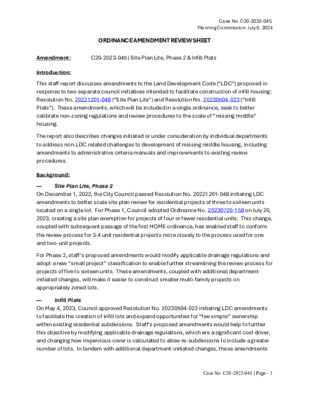
ORDINANCE AMENDMENT REVIEW SHEET Case No. C20-2023-045 Planning Commission: July 9, 2024 Amendment: C20-2023-045 | Site Plan Lite, Phase 2 & Infill Plats Introduction: This staff report discusses amendments to the Land Development Code (“LDC”) proposed in response to two separate council initiatives intended to facilitate construction of infill housing: Resolution No. 20221201-048 (“Site Plan Lite”) and Resolution No. 20230504-023 (“Infill Plats”). These amendments, which will be included in a single ordinance, seek to better calibrate non-zoning regulations and review procedures to the scale of “missing middle” housing. The report also describes changes initiated or under consideration by individual departments to address non-LDC related challenges to development of missing middle housing, including amendments to administrative criteria manuals and improvements to existing review procedures. Background: Site Plan Lite, Phase 2 — On December 1, 2022, the City Council passed Resolution No. 20221201-048 initiating LDC amendments to better scale site plan review for residential projects of three to sixteen units located on a single lot. For Phase 1, Council adopted Ordinance No. 20230720-158 on July 20, 2023, creating a site plan exemption for projects of four or fewer residential units. This change, coupled with subsequent passage of the first HOME ordinance, has enabled staff to conform the review process for 3-4 unit residential projects more closely to the process used for one and two-unit projects. For Phase 2, staff’s proposed amendments would modify applicable drainage regulations and adopt a new “small project” classification to enable further streamlining the review process for projects of five to sixteen units. These amendments, coupled with additional department- initiated changes, will make it easier to construct smaller multi-family projects on appropriately zoned lots. Infill Plats — On May 4, 2023, Council approved Resolution No. 20230504-023 initiating LDC amendments to facilitate the creation of infill lots and expand opportunities for “fee simple” ownership within existing residential subdivisions. Staff’s proposed amendments would help to further this objective by modifying applicable drainage regulations, which are a significant cost driver, and changing how impervious cover is calculated to allow re-subdivisions to include a greater number of lots. In tandem with additional department-initiated changes, these amendments Case No. C20-2023-045 | Page - 1 Case No. C20-2023-045 Planning Commission: July 9, 2024 will better calibrate regulations applicable to small-lot single-family uses as authorized by the second HOME ordinance. Department-level Improvements — Aside from drainage regulations codified in LDC Chapter 25-7 (Drainage), most of …
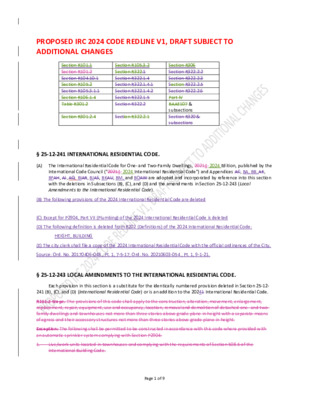
1. PROPOSED IRC 2024 CODE REDLINE V1, DRAFT SUBJECT TO ADDITIONAL CHANGES Section R101.1 Section R101.2 Section R104.10.1 Section R105.2 Section R105.3.1.1 Section R106.1.4 Table R301.2 Section R105.3.2 Section R322.1 Section R322.1.4 Section R322.1.4.1 Section R322.1.4.2 Section R322.1.5 Section R322.2 Section R301.2.4 Section R322.2.1 Section R306 Section R322.2.2 Section R322.2.3 Section R322.2.5 Section R322.2.6 Part IV BAAE107 & subsections Section R320 & subsections § 25-12-241 INTERNATIONAL RESIDENTIAL CODE. (A) The International Residential Code for One- and Two-Family Dwellings, 20214 2024 Edition, published by the International Code Council ("20214 2024 International Residential Code") and Appendices AC, BA, BB, AE, BFAH, AJ, AQ, BIAR, BJAS, BKAU, BM, and BOAW are adopted and incorporated by reference into this section with the deletions in Subsections (B), (C), and (D) and the amendments in Section 25-12-243 (Local Amendments to the International Residential Code). (B) The following provisions of the 2024 International Residential Code are deleted (C) Except for P2904, Part VII (Plumbing) of the 2024 International Residential Code is deleted (D) The following definition is deleted from R202 (Definitions) of the 2024 International Residential Code: HEIGHT, BUILDING (E) The city clerk shall file a copy of the 2024 International Residential Code with the official ordinances of the City. Source: Ord. No. 20170406-048 , Pt. 1, 7-5-17; Ord. No. 20210603-054 , Pt. 1, 9-1-21. § 25-12-243 LOCAL AMENDMENTS TO THE INTERNATIONAL RESIDENTIAL CODE. Each provision in this section is a substitute for the identically numbered provision deleted in Section 25-12- 241 (B), (C), and (D) (International Residential Code) or is an addition to the 20241 International Residential Code. R101.2 Scope. The provisions of this code shall apply to the construction, alteration, movement, enlargement, replacement, repair, equipment, use and occupancy, location, removal and demolition of detached one- and two- family dwellings and townhouses not more than three stories above grade plane in height with a separate means of egress and their accessory structures not more than three stories above grade plane in height. Exception: The following shall be permitted to be constructed in accordance with this code where provided with an automatic sprinkler system complying with Section P2904: Live/work units located in townhouses and complying with the requirements of Section 508.5 of the International Building Code. Page 1 of 9 2. 3. 4. 5. 1. 2. 3. 4. 5. 6. 7. Owner-occupied lodging houses with five or fewer guestrooms. A care facility with six or fewer persons …
Affordability Impact Statement 2024 International Residential Code & Local Amendments Date: 7/1/2024 Proposed Regulation The proposed adoption of the 2024 International Residential Code (IRC) and associated local amendments. These codes would replace the current 2021 IRC and corresponding local amendments. The IRC is a model code published by International Code Council (ICC), a non-profit entity with a robust democratic process for weighing the costs and benefits of code changes. The Development Services Department has the stated goal of minimizing the number of 2024 local amendments to the IRC and deferring to the model codes whenever possible. When amendments are made it is generally because they are mandated by council, responding to business needs, clarifying language, and improving the City’s Insurance Services Office (ISO) rating. Land Use/Zoning Impacts on Housing Costs The proposed changes would likely have a neutral impact on housing costs via land use and zoning. Impact on Development Cost The proposed changes would likely have a neutral impact on development costs. 2024 Model Code Update: The University of Florida researched the cost impact of updating from the 2023 Florida Building Codes to the 2024 International Codes (Issa et al. 2024).1 The 2023 Florida Building Code adopts the 2021 IRC as one of its model codes, so it may be a helpful baseline to understand the overall cost impact of the changes from the 2021 IRC to the 2024 IBC. The State of Florida does adopt amendments to the model codes, but they have the closest available comparison to understand the cost impacts of adopting the 2024 IBC. The University of Florida study models the adoption of the 2024 International Codes on seven different building types, including small office, retail, primary school, small hotel, mid-rise apartment, 1-story residence, and 2-story residence. The average net change in cost estimate between all the building types is +0.45% according to their report. The IRC applies to “detached one- and two- family dwellings and townhouses not more than three stories above grade plane in height” (see Section R101.2 of the IRC), so the 1-story and 2-story residences from the Issa et al. report are the most informative cost impact models.2 The Issa et al. report estimates 1-story residences will be +10% more expensive to build and 2-story residences will be +16% more expensive to build, with both increases due to National Electrical Code (NEC) changes rather than IRC changes. Local Amendments: The most …
M E M O R A N D U M TO: Mayor and Council Members THROUGH: Veronica Briseño, Assistant City Manager FROM: José G. Roig, Development Services Director Chief Joel Baker, Aus�n Fire Chief Chief Robert Luckritz, EMS Chief, Aus�n Travis County EMS DATE: June 26, 2024 SUBJECT: Resolu�on No. 20240502-094 Staff Update - Single Stairway Provisions for Mul�family Developments Up to Five-Stories We want to provide all of you with a mul�-departmental recommenda�on on Resolu�on No. 20240502-094 which proposes an amendment to the 2024 Interna�onal Building Code (IBC) allowing a single stairway for mul�family developments up to five stories. Technical code and first responder experts from the Development Services Department (DSD), Aus�n Fire Department (AFD), and Aus�n/Travis County Emergency Medical Services (ATCEMS) reviewed Aus�n’s single stairway amendment and found significant poten�al safety risks to occupants and first responders were we to amend the Code. As a result, staff recommends that the City of Aus�n con�nue to allow the model na�onal codes to set minimum standards for construc�on in Aus�n, thereby maintaining two means of egress for mul�family developments. Safety Concerns Construc�ng a single stairway --as opposed to two separate stairways-- for a five-story building poses escape hazards for occupants during fire, ac�ve shooter, severe weather, or large-scale emergencies. The following points highlight primary safety concerns: • Occupant Risk Considera�ons – Fire-loss data, some�mes cited by proponents of single stairway design, suggests that such an approach poses a low risk to occupants. While the probability of a fire is low, the consequences of a fire with a single stairway design make this an inherent risk. The na�onal standard set in the model code manda�ng two staircases reflects the increased likelihood of significant injury and mass casual�es in limi�ng occupants to a single exit in the event of a fire or other emergency. • Subject Mater Expert Findings – A na�onal proposal to permit mid-rise buildings to be served by a single exit stairway was reviewed and overwhelmingly rejected by the Interna�onal Code Page 1 of 4 Council (ICC) Technical Commitee, ci�ng tes�mony from many na�onal safety experts about the dangers it would pose to occupants and first responders. • Hindered Evacua�on Tac�cs – AFD employs evacua�on tac�cs by designa�ng one stairwell for evacua�on and the second stairwell for firefigh�ng opera�ons. Elimina�ng a stairwell may lead to unsafe exposure of fire condi�ons to occupants and cause counterflow and conges�on with occupants …
PROPOSED IBC 2024 CODE REDLINE V1, DRAFT SUBJECT TO ADDITIONAL CHANGES AN ORDINANCE REPEALING AND REPLACING DIVISION 1 OF ARTICLE 1 OF CITY CODE CHAPTER 25‐12 RELATING TO THE INTERNATIONAL BUILDING CODE; REPEALING AND REPLACING ARTICLE 10 OF CITY CODE CHAPTER 25‐12 RELATING TO THE INTERNATIONAL EXISTING BUILDING CODE; AND CREATING OFFENSES. BE IT ORDAINED BY THE CITY COUNCIL OF THE CITY OF AUSTIN: PART 1. City Code Chapter 25‐12 (Technical Codes) is amended to repeal and replace Division 1 of Article 1 (Building Code) to read: DIVISION 1. INTERNATIONAL BUILDING CODE AND LOCAL AMENDMENTS § 25‐12‐1 INTERNATIONAL BUILDING CODE. (A) The International Building Code, 2021 2024 Edition, published by the International Code Council ("2021 2024 International Building Code") is adopted and incorporated by reference into this section with the deletions in Subsection (B) and the amendments in Section 25‐12‐3 (Local Amendments to the International Building Code). (B) The following provisions of the 20241 International Building Code are deleted. 414.1.3305.2.3 503.1.4 plus subsections 308.2.3 Chapter 9 308.2.4 1612 plus subsections 427.6 2901.1503.1.4 1108.6.4.2 1301.1 3102.5Chapter 9 103 plus subsections Table 1004.5308.3 3201.11008.2.1 1507.8 plus subsections 1507.9 plus subsections 1607.8.2 1612 plus subsections 2901.1 2902.2 2902.6 3102.5 3201.1 3202.1 Table 2901.1 Footnote (e) 1010.1.2308.3.1.1 1010.3.3 308.3.2 3202.1 1009.3 3202.3.41010.1.2 1102.1308.5 1204 plus subsections 308.5.1 1301.1 308.5.3 1507.8 plus subsections 308.5.4 1507.9 plus subsections 310.2 1607.8.2310.4.1 406.4.3 1010.2.7 1010.3.3 1101.2 1102.1 1108.6.1.2 1108.6.2.2.2 1108.6.2.3.2 1108.6.3 Page 1 of 19 101.4.1 101.4.2 101.4.3 104.32.1 105.1.1 105.2 105.5 107.2.6 110.3 112.3 113 plus subsections 305.2 305.2.2 Table 1004.5 414.1.3 (C) The following definition is deleted from Section 202.2.1 (General Definitions) of the 2021 International Building Code: (C) The city clerk shall file a copy of the 20241 International Building Code with the official ordinances of FOSTER CARE FACILITIES. (B) the City. § 25‐12‐2 CITATIONS TO THE BUILDING CODE. In the City Code, "Building Code" means the 20241 International Building Code adopted in Section 25‐12‐1 (International Building Code) as amended by Section 25‐12‐3 (Local Amendments to the International Building Code). In this article, "this code" means the Building Code. § 25‐12‐3 LOCAL AMENDMENTS TO THE INTERNATIONAL BUILDING CODE. Each provision in this section is a substitute for the identically numbered provision deleted in Section 25‐12‐ 1(B) (International Building Code) or is an addition to the 20241 International Building Code. [A] 101.4.1 Gas. The provisions of the International Fuel Gas Code and the Plumbing Code shall …
2024 International Building Code & International Residential Code Adoption Amendment: 2024 Technical Code Adoption- International Building Code & International Residential Code Planning Commission Date: July 9, 2024 Description: The purpose of this report is for recommendation of the 2024 technical code adoption of the 2024 International Building and International Residential Code. Development Services is purposing the adoption of the 2024 International Residential Code (IRC) and International Building Code (IBC). DSD Engagement team has conducted public engagement for both the IRC and IBC, which are currently open for public input from June 25 through July 24. This engagement pertains to the adoption of the 2024 editions of the technical codes, including proposed local amendments. The 2024 editions of the technical codes are scheduled for adoption by the City Council on September 12, 2024, with implementation slated for January 1, 2025. On May 3, 2024, resolution # 20240502-094 was approved by the council. Summary of Proposed Code Adoption: Adopting the most recent codes helps protect the health, safety and welfare of Austin residents by, • Responding to new findings from building science research, field experience, or changes in community expectations • Responding to building performance assessments following catastrophic events to • increase resilience in new structures Introducing new and innovative technologies and construction methods Aligning with other current accepted codes and standards Staff Recommendation: Staff recommend approval of the 2024 IBC and IRC. Board and Commission Actions On July 24, 2024, There is a scheduled meeting with the Building and Fire Board of Appeals to present the International Building Code (IBC) and International Residential Code (IRC). Additionally, the Planning Commission is set to convene on July 9th, 2024. City Council Action May 3RD, Council approved resolution # 20240502-094 Single Stair Resolution Attached: 2024 IRC Redline 7/1/2024 2024 IBC Redline Single Stair Memo IBC Affordability Impact Statement Ordinance Number: N/A City Staff: Todd Wilcox- Building Official, Jessica Lopez Phone: Jessica Lopez 512-978-4661 Todd Wilcox 512-974-1681 Email: Jessica.lopez@austintexas.gov / Todd.Wilcox@austintexas.gov 7/1/2024
Sr. No. Proposed by Topic Proposed Amendment Justification Notes WG Vote Tally 1 2 3 4 5 Maxwell City Staff Maxwell City Staff Woods City Staff Maxwell City Staff Add one full time employee to Zoning team. Woods Training Optional Planning Commission 101 training for PC members, possibly through Texas Municipal League or APA Texas Chapter. Rehearings for VMU cases, DB-90 and numerous additional paper districts being created all leading to increase in zoning cases. Allow for new and existing commissioners to gain valuable knowledge about planning processes, state law, and best practices to inform discussions and improve efficiency. Ensures the ongoing sovereignty of Planning Commission and similar independent commissions and ensures clear separation of oversight/influence for assigned City Staff. Brings more clarity to decision-making related to legal questions that arise at Planning Commission, and improves efficiency at meetings. Explore the establishment of the Office of the Land Use Commissions (OLUC), which will involve the transfer of existing commission liaisons and the recruitment of supplementary staff as needed. OLUC will encompass the Board of Adjustment, Planning Commission, and Zoning and Platting Commission. Additionally, the office will incorporate a specialized legal representative tasked with attending commission meetings in person, exclusively representing the best interests of the commissions. Allocate funds for a singular budgetary expense aimed at engaging a consultant. The purpose of this engagement is to conduct a comprehensive evaluation and review of all operations and methodologies within the Planning Department. The consultant will offer insights and recommendations geared towards enhancing workflow efficiency and improving work outcomes, with a focus on meeting the established timelines mandated by city regulations. Request additional funding for Planning Department outreach, specifically related to Citywide LDC changes. Improve transparency and access to Planning Commission processes. Improve efficiency in communications between Planning Commission and Planning Dept. staff and help Planning Commmission meet established timelines set by City Council. 2 2 2 2 2 Maxwell Vote Woods Vote Yes Yes Yes Yes Yes Yes Yes Yes Yes Yes
July 9th, 2024 Planning Commission: Re: Opposing Item 25, Infill Plat & Site Plan Lite Ordinance The Austin Infill Coalition strives to unite urban infill development professionals and promote broad cooperation in order to affect positive change in Ausin’s built environment, with particular regard to housing. The Austin Infill Coalition does not support Infill Plat and Site Plan Lite draft ordinance proposed by staff, as it does not align with the objectives outlined in the resolutions and HOME ordinances, and does not achieve significant progress in addressing Austin’s Housing needs. AIC remains committed to supporting housing policies that increase housing availability and affordability, and we do not believe this ordinance accomplishes that goal. Sincerely, ________________ Ki Gray President _______________ Elle Allen Vice President Docusign Envelope ID: 9CAE30E7-754D-4B63-BE7B-9C64A499ED66 Docusign Envelope ID: 9CAE30E7-754D-4B63-BE7B-9C64A499ED66
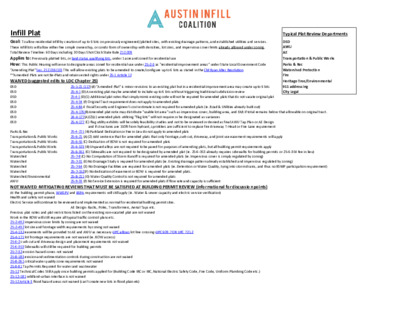
Infill Plat Goal: To allow residential infill by creation of up to 6 lots on previously engineered/platted sites, with existing drainage patterns, and established utilities and services. These infill lots will allow either fee simple ownership, or condo form of ownership with densities, lot sizes, and impervious cover limits already allowed under zoning. Total Review Timeline: 60 Days including 30 Days Shot Clock State Rule 212.009 Applies to: Previously platted lots, or land status qualifying lots, under 1 acre and zoned for residential use How: This Public Hearing will serve to designate areas zoned for residential use under 25-2-3 as "residential improvement areas" under State Local Government Code "Amending Plat" Sec. 212.016(10) This will allow existing plats to be amended to create/configure up to 6 lots as stated in the CM Ryan Alter Resolution **Amended Plats are not Re-Plats and retain vested rights under 25-1 Article 12 WAIVED (suggested edits to LDC Chapter 25) DSD DSD DSD DSD DSD DSD DSD DSD 25-1-21 (117)(d) "Amended Plat" is minor revisions to an existing plat but in a residential improvement area may create up to 6 lots 25-4-1 (D) An existing plat may be amended to include up to 6 lots without triggering traditional subdivision review 25-4-1 (D)(1) Additional plat notes that simply mimic existing code will not be required for amended plats that do not vacate original plat 25-4-34 (F) Original Tract requirement does not apply to amended plats 25-4-84-E Fiscal Security and Engineer's cost estimate is not required for amended plats (ie. Road & Utilities already built out) 25-4-176(B)Amended plat note may distribute "usable lot area" such as impervious cover, building area, and FAR if total remains below that allowable on original tract. 24-4-177(A)(2)(c) amended plats utilizing "flag lots" will not require or be designated as variances 25-4-177 (C) flag utility exhibits will be solely feasibility studies and not to be reviewed or denied as final AWU Tap Plan or AE Design Parks & Rec Watershed Protection Fire Heritage Tree/Environmental 911 addressing City Legal DSD AWU AE Transportation & Public Works Typical Plat Review Departments and if structures are 150ft from hydrant, sprinklers are sufficient to replace fire driveway T-Head or Fire Lane requirement 25-4-211 (B) Parkland Dedication or Fee in Lieu do not apply to amended plats 25-6-21 (A)(2) Add sentence that for amended plats that only frontage,curb cut, driveway, and joint use easement requirements will apply 25-6-55 (C) …
ORDINANCE AMENDMENT REVIEW SHEET Case No. C20-2023-045 Planning Commission: July 9, 2024 Amendment: C20-2023-045 | Site Plan Lite, Phase 2 & Infill Plats Introduction: This staff report discusses amendments to the Land Development Code (“LDC”) proposed in response to two separate council initiatives intended to facilitate construction of infill housing: Resolution No. 20221201-048 (“Site Plan Lite”) and Resolution No. 20230504-023 (“Infill Plats”). These amendments, which will be included in a single ordinance, seek to better calibrate non-zoning regulations and review procedures to the scale of “missing middle” housing. The report also describes changes initiated or under consideration by individual departments to address non-LDC related challenges to development of missing middle housing, including amendments to administrative criteria manuals and improvements to existing review procedures. Background: Site Plan Lite, Phase 2 — On December 1, 2022, the City Council passed Resolution No. 20221201-048 initiating LDC amendments to better scale site plan review for residential projects of three to sixteen units located on a single lot. For Phase 1, Council adopted Ordinance No. 20230720-158 on July 20, 2023, creating a site plan exemption for projects of four or fewer residential units. This change, coupled with subsequent passage of the first HOME ordinance, has enabled staff to conform the review process for 3-4 unit residential projects more closely to the process used for one and two-unit projects. For Phase 2, staff’s proposed amendments would modify applicable drainage regulations and adopt a new “small project” classification to enable further streamlining the review process for projects of five to sixteen units. These amendments, coupled with additional department- initiated changes, will make it easier to construct smaller multi-family projects on appropriately zoned lots. Infill Plats — On May 4, 2023, Council approved Resolution No. 20230504-023 initiating LDC amendments to facilitate the creation of infill lots and expand opportunities for “fee simple” ownership within existing residential subdivisions. Staff’s proposed amendments would help to further this objective by modifying applicable drainage regulations, which are a significant cost driver, and changing how impervious cover is calculated to allow re-subdivisions to include a greater number of lots. In tandem with additional department-initiated changes, these amendments Case No. C20-2023-045 | Page - 1 Case No. C20-2023-045 Planning Commission: July 9, 2024 will better calibrate regulations applicable to small-lot single-family uses as authorized by the second HOME ordinance. Department-level Improvements — Aside from drainage regulations codified in LDC Chapter 25-7 (Drainage), most of …
PLANNING COMMISSION REGULAR MEETING MINUTES TUESDAY, JULY 9, 2024 The Planning Commission convened in a regular meeting on Tuesday, July 9, 2024, at Austin City Hall, Boards and Commission Room, 1101, 301 West Second Street, Austin, TX. Commissioner Anderson called the Commission Meeting to order at 6:11 p.m. Commissioners in Attendance: Greg Anderson Nadia Barrera-Ramirez Adam Haynes Commissioners in Attendance Remotely: Awais Azhar Grayson Cox Ryan Johnson Felicity Maxwell Jennifer Mushtaler Danielle Skidmore Alice Woods Commissioners absent: Claire Hempel Patrick Howard Alberta Phillips Ex-Officio Members in Attendance: Jessica Cohen Candace Hunter PUBLIC COMMUNICATION None. APPROVAL OF MINUTES 1. Approve the minutes of the Planning Commission regular meeting on June 11, 2024, and June 25, 2024. The minutes from the meeting of 06/11/2024 were approved and the minutes from the meeting on 06/25/2024 were postponed to the meeting on 07/23/2024 on the consent agenda on Vice Chair Azhar’s motion, Commissioner Maxwell’s second, on a 7-3 vote. Those voting aye were Vice Chair Azhar and Commissioners Anderson, Haynes, Johnson, Maxwell, Skidmore, and Woods. Those voting nay were Commissioners Cox, Barrera- Ramirez, and Mushtaler. Chair Hempel, Commissioners Howard and Phillips were absent. PUBLIC HEARINGS Agent: Request: Staff Rec.: Staff: 2. Plan Amendment: NPA-2023-0010.02 - East 2nd Street - 2300 Block; District 3 Location: 109, 111, 113 Mildred Street and 2305, 2307 E. 2nd Street (Unit A), 2307 E. 2nd Street (Unit B), 2311 E. 2nd Street, Lady Bird Lake Watershed Owner/Applicant: Patrica Ann Pope; LaFayette 2109, LLC; and Isdale Investments, LLC; and Emily Kolb Isdale Armbrust & Brown, PLLC (Michael Whellan) Single Family to Mixed Use land use Recommended Maureen Meredith, 512-974-2695, maureen.meredith@austintexas.gov Planning Department The motion to approve Staff’s postponement request to July 23, 2024, was approved on the consent agenda on Vice Chair Azhar’s motion, Commissioner Maxwell’s second, on a 7-3 vote. Those voting aye were Vice Chair Azhar and Commissioners Anderson, Haynes, Johnson, Maxwell, Skidmore, and Woods. Those voting nay were Commissioners Cox, Barrera-Ramirez, and Mushtaler. Chair Hempel and Commissioners Howard and Phillips were absent. 3. Rezoning: Location: C14-2024-0027 - East Cesar Chavez-2300 Block; District 3 2300-2328 East Cesar Chavez Street; 2305-2317 East 2nd Street; 109-113 Mildred Street, Lady Bird Lake Watershed Owner/Applicant: Patricia Ann Pope; LaFayette 2109, LLC; Isdale Investments, LLC; Agent: Request: Isdale Emily Kolb; 2324-ECC ARC LLC; 2400 ECC ARC LLC; 2317 E 2nd-ARC LLC Armbrust & Brown, PLLC (Michael Whellan) SF-3-NP, CS-CO-MU-NP, CS-CO-MU-NP, LO-NP, and LO-CO- …
REGULAR MEETING of the MBE/WBE and Small Business Enterprise Procurement Program Advisory Committee Tuesday, July 9, 2024 at 5:30 pm City of Austin Permit and Development Center 6310 Wilhelmina Delco Drive - Room 1215 Austin, Texas 78752 Some members of this MBE/WBE Advisory Committee may be participating by videoconference. PUBLIC PARTICIPATION GUIDELINES The public will be allowed to speak at the Advisory Committee meeting remotely by phone or in-person at the address listed above. To participate remotely, speakers must register in advance with the board liaison before the registration deadline. Public Communication: General The first 10 speakers will be allowed to speak on any topic that is not posted on the agenda. The Committee Chair will call upon speakers at the beginning of the meeting. A person may not speak at general communication more often than once out of every three regularly scheduled committee meetings. Public Comment on Agenda Items Members of the public may speak on any item posted to the agenda. Speakers will be called upon when this agenda item is taken up by the Committee Chair. How to Register to Speak Remotely All speakers are required to register for remote participation. Registered speakers will be allowed 3 minutes to speak by telephone only. The deadline to register is at 12:00pm on the day before the meeting. To register to speak, email the board liaison, Nakia James at nakia.james@austintexas.gov before the deadline. Once registration closes, the board liaison will send all speakers an email to confirm registration, provide instructions on speaking at the meeting, and the number to call in on the day of the meeting. How to Sign-Up to Speak In-Person Speakers that would like to address the committee in person will be allowed to sign up until 15 minutes before the start of the meeting. Speakers will be allowed 3 minutes to speak. The City of Austin is committed to compliance with the American with Disabilities Act. Reasonable modifications and equal access to communications will be provided upon request. Meeting locations are planned with wheelchair access. If requiring Sign Language Interpreters or alternative formats, please give notice at least 2 days (48 hours) before the meeting date. Please contact Nakia James at (512) 974-9108 or nakia.james@austintexas.gov for additional information; TTY users route through Relay Texas at 711. For more information on the MBE/WBE and Small Business Procurement Program Advisory Committee, contact Nakia James at (512) 974-9108 …
Regular Meeting of the Construction Advisory Committee Tuesday, July 9, 2024 10:00 AM – 11:30 AM One Texas Center – Directors Conference Room 505 Barton Springs Road, 13th Floor Austin, Texas If view online televised, you may the meeting the Construction Advisory Committee may be participating by at: Some members of videoconference. http://www.austintexas.gov/page/watch-atxn-live Public comment will be allowed in-person or remotely via telephone. Speakers may only register to speak on an item once either in-person or remotely and will be allowed up to three minutes to provide their comments. Registration no later than noon the day before the meeting is required for remote participation by telephone. To register to speak remotely, call or email Vanessa Ibanez at 512-974-1058 or vanessa.ibanez@austintexas.gov. CURRENT BOARD COMMISSIONERS: Lyn Nance-Hendricks, Chair Michelle Dahlstrom Benjamin Marchiony Jeffrey Musgrove Calvin Williams Riley Drake, Vice Chair Ron Lord Bianca Medina-Leal Candelario Vazquez AGENDA CALL TO ORDER PUBLIC COMMUNICATION: GENERAL The first five speakers signed up prior to the meeting being called to order will each be allowed a three-minute allotment to address their concerns regarding items not posted on the agenda. APPROVAL OF MINUTES 1. Approve the minutes of the Construction Advisory Committee Regular Meeting on June 11, 2024. STAFF BRIEFINGS 2. DISCUSSION ITEMS Director’s Report on Capital Delivery Services Updates – Thuan Nguyen 3. 4. 5. Presentation regarding Prevailing Wage Performance – Judith Gonzalez Presentation regarding Wage Theft Ordinance – Sean Forkner Presentation regarding Place Based Enhancement 380 Program Presentation – Donald Jackson FUTURE AGENDA ITEMS ADJOURNMENT The City of Austin is committed to compliance with the American with Disabilities Act. Reasonable modifications and equal access to communications will be provided upon request. Meeting locations are planned with wheelchair access. If requiring Sign Language Interpreters or alternative formats, please give notice at least 2 days (48 hours) before the meeting date. Please call Vanessa Ibanez with Capital Delivery Services Department, at 512-974-1058, for additional information; TTY users’ route through Relay Texas at 711. For more information on the Construction Advisory Committee, please contact Vanessa Ibanez at 512-974-1058
Construction Advisory Committee Meeting Minutes Tuesday, July 9, 2024 CONSTRUCTION ADVISORY COMMITTEE REGULAR MEETING MINUTES TUESDAY, July 9, 2024 The Construction Advisory Committee convened in a Regular meeting on Tuesday, July 9, 2024, at 505 Barton Springs Road, 13th Floor – Directors Conference Room in Austin, Texas. Chair Lyn Nance-Hendricks called the Construction Advisory Committee Meeting to order at 10:14 a.m. Board Members/Commissioners in Attendance: Chair, Lyn Nance-Hendricks, Vice Chair Riley Drake Board Members/Commissioners in Attendance Remotely: Michelle Dahlstrom, Bianca Medina- Leal, Jeffrey Musgrove, Candelario Vazquez, Calvin Williams PUBLIC COMMUNICATION: GENERAL None APPROVAL OF MINUTES Approve the minutes of the Construction Advisory Committee Regular Meeting on June 11, 2024. The minutes from the meeting of 6/11/2024 were approved on Vice Chair Riley Drake’s motion, Calvin Williams second on a 6-0 vote. Benjamin Marchiony and Ron Lord were absent. Candelario Vazquez was off the dais. STAFF BRIEFINGS Director’s Report on Capital Delivery Services Project Updates The presentation was made by Thuan Nguyen, Capital Delivery Services DISCUSSION AND ACTION ITEMS Presentation by Judith Gonzalez regarding Prevailing Wage Performance Presentation by Sean Forkner regarding Wage Theft Ordinance Presentation by Donald Jackson regarding Place-Based Enhancement 380 Program 1. 2. 3. 4. 5. 1 Construction Advisory Committee Meeting Minutes Tuesday, July 9, 2024 FUTURE AGENDA ITEMS Approve letter of recommendation for council presented by working group at the August 13th Construction Advisory Committee meeting. Chair Lyn Nance-Hendricks adjourned the meeting at 11:30 a.m. without objection. The minutes were approved at the 8/13/2024 meeting on Jeff Musgrove’s motion, Ron Lord second on an 8-0 vote. Benjamin Marchiony absent. 2
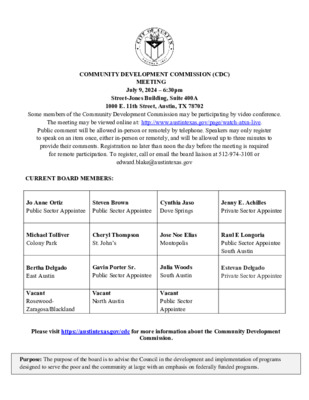
COMMUNITY DEVELOPMENT COMMISSION (CDC) MEETING July 9, 2024 – 6:30pm Street-Jones Building, Suite 400A 1000 E. 11th Street, Austin, TX 78702 Some members of the Community Development Commission may be participating by video conference. The meeting may be viewed online at: http://www.austintexas.gov/page/watch-atxn-live. Public comment will be allowed in-person or remotely by telephone. Speakers may only register to speak on an item once, either in-person or remotely, and will be allowed up to three minutes to provide their comments. Registration no later than noon the day before the meeting is required for remote participation. To register, call or email the board liaison at 512-974-3108 or edward.blake@austintexas.gov CURRENT BOARD MEMBERS: Jo Anne Ortiz Public Sector Appointee Steven Brown Public Sector Appointee Cheryl Thompson St. John’s Gavin Porter Sr. Public Sector Appointee Vacant North Austin Cynthia Jaso Dove Springs Jose Noe Elias Montopolis Julia Woods South Austin Vacant Public Sector Appointee Jenny E. Achilles Private Sector Appointee Raul E Longoria Public Sector Appointee South Austin Estevan Delgado Private Sector Appointee Michael Tolliver Colony Park Bertha Delgado East Austin Vacant Rosewood- Zaragosa/Blackland Please visit https://austintexas.gov/cdc for more information about the Community Development Commission. Purpose: The purpose of the board is to advise the Council in the development and implementation of programs designed to serve the poor and the community at large with an emphasis on federally funded programs. AGENDA CALL TO ORDER PUBLIC COMMUNICATION: GENERAL The first 10 speakers signed up prior to the meeting being called to order will each be allowed a three- minute allotment to address their concerns regarding items not posted on the agenda. 1. Approve the June 11, 2024, Community Development Commission meeting minutes. APPROVAL OF MINUTES BRIEFINGS DISCUSSION ITEMS 2. Briefing on the Heat Resilience Playbook (Marc Coudert, Program Manager, Environmental Conservation, Office of Resilience). 3. Presentation and discussion regarding Project Connect Anti-Displacement Land Acquisition and Preservation investments (Nicole Joslin, Real Estate Division Manager, Housing Department). 4. Presentation and discussion regarding outcomes for Community Services Block Grant (CSBG) for May 2024 (Angel Zambrano, Manager, Neighborhood Services Unit, Austin Public Health). DISCUSSION AND ACTION ITEMS Interim Director, Housing Department). 5. Discussion and possible action regarding the FY 25-29 Consolidated Plan (Mandy DeMayo, 6. Discussion and possible action regarding the revised Citizen Participation Plan (CPP) (Mandy DeMayo, Interim Director, Housing Department). FUTURE AGENDA ITEMS ADJOURNMENT The City of Austin is committed to compliance with the American with Disabilities Act. Reasonable …
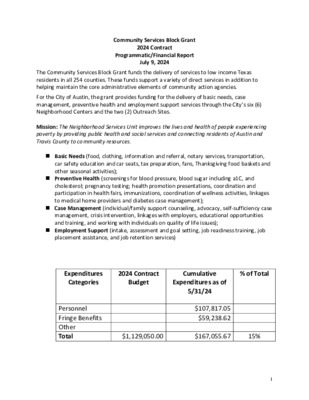
Community Services Block Grant 2024 Contract Programmatic/Financial Report July 9, 2024 The Community Services Block Grant funds the delivery of services to low income Texas residents in all 254 counties. These funds support a variety of direct services in addition to helping maintain the core administrative elements of community action agencies. For the City of Austin, the grant provides funding for the delivery of basic needs, case management, preventive health and employment support services through the City’s six (6) Neighborhood Centers and the two (2) Outreach Sites. Mission: The Neighborhood Services Unit improves the lives and health of people experiencing poverty by providing public health and social services and connecting residents of Austin and Travis County to community resources. ◼ Basic Needs (food, clothing, information and referral, notary services, transportation, car safety education and car seats, tax preparation, fans, Thanksgiving food baskets and other seasonal activities); ◼ Preventive Health (screenings for blood pressure, blood sugar including a1C, and cholesterol; pregnancy testing; health promotion presentations, coordination and participation in health fairs, immunizations, coordination of wellness activities, linkages to medical home providers and diabetes case management); ◼ Case Management (individual/family support counseling, advocacy, self-sufficiency case management, crisis intervention, linkages with employers, educational opportunities and training, and working with individuals on quality of life issues); ◼ Employment Support (intake, assessment and goal setting, job readiness training, job placement assistance, and job retention services) Expenditures Categories 2024 Contract Budget % of Total Cumulative Expenditures as of 5/31/24 Personnel Fringe Benefits Other Total $1,129,050.00 $107,817.05 $59,238.62 $167,055.67 15% 1 4 4E 5 5B 5D 4C 4I 5A 5JJ 7A 7B 7D 7N Transition Out of Poverty Goal Goal Achieved TOP Individuals who transitioned out of poverty 43 7 Success Rate% 16% Austin Public Health Report on PY24 Community Action Plan MISSION: To prevent disease, promote health, and protect the well-being of our community. TOP 5 NEEDS: Housing; Health; Employment; Basic Needs; Education Report Date May 2024 FNPI Outcome Description Target #Enrolled #Achieved Success Rate % Housing Households who avoided eviction Health and Social/Behavioral Development Individuals who demonstrated improved physical health and well being Individuals who improved skills related to the adult role of parents/caregivers 800 10 50 776 46 41 #Enrolled #Achieved Success Rate % 190% SRV 3O Service Description Tax Preparation Programs Number Served 356 A Year Ago Rent Payments Utility Payments Immunizations Food Distribution Case Management Eligibility Determinations Transportation Emergency Clothing 3A.1 Total …
CITY OF AUSTIN Heat Resilience Playbook 7/9/24 Outline 01 Background 02 Components of the playbook 0403 Climate Projections 04 Next Steps Heat Resilience Playbook Why have it? What is it? Temperatures are rising Council is asking for it The Community wants to know The City and local agencies are doing a lot! Heat Resilience Playbook identifies neighborhood-based and citywide projects, programs, and policies that combat extreme heat. This Playbook seeks to uplift existing City & agency-led heat resilience efforts Let’s communicate the strategies currently underway It’s not a plan No budget or timeline Heat Resilience Playbook Timeline Partners include Go Austin/Vamos Austin (GAVA), University of Texas at Austin, City of Austin (COA) Departments. Who We Worked With ● Austin Bergstrom International Airport ● Austin Energy ● Homeland Security & Emergency Management ● Homeless Strategy Office ● Austin Energy Green Building ● Housing ● Austin Public Health ● Human Resource ● Austin Public Libraries ● Parks and Recreation ● Development Services - ● Watershed Protection ● Planning ● Travis County ● Austin Water ● Cap Metro Forestry Steps 01 02 03 04 Reviewed national & internal best practices Assessed how city, and agencies, compare to best practices. Id’d 70+ strategies COA+ currently pursuing Reviewed findings with staff & drafted/ refined strategies Assembled strategies into report Extreme Heat Impacts Our: AUSTIN’S HEAT EQUITY When there are major heat events, our residents who are most vulnerable feel it the worst. While all of Austin is expected to experience increases in extreme heat, not all residents face the same impacts. People with the least amount of resources or who spend time outdoors are most at risk — including outdoor workers, infants, elderly, incarcerated people, individuals experiencing homelessness, low-income communities, and people with chronic or mental illness. Spotlight on Neighborhood Cooling Cool Connections Built shade Outdoor Cool Oases Cool Homes Connected trails with access to creeks Tree-lined sidewalks Built shade Shaded bus stops Green infrastructure Park with cooling features, like sprinklers & water fountains Cool Community Spaces Austin’s Heat Resilience Playbook is Composed of 3 Pillars, Divided into 13 Strategies and 56 Actions 1.1 Heat Risk and Mitigation Communications 1.2 Enhanced Outreach During Extreme Heat 2.1 Cool Homes 3.1 Cool Buildings 2.2 Cool Community Spaces 3.2 Tree Planting and Maintenance 2.3 Outdoor Cool Oases 3.3 Parks and Green Space 1.3 Safety Measures and Policies 2.4 Cool Connections 3.4 Resilient Energy System 1.4 Data and Evaluation …
CITY OF AUSTIN CITIZEN PARTICIPATION PLAN A. PURPOSE Participating Jurisdictions (PJs) that receive U.S. Department of Housing and Urban Development (HUD) entitlement grant funds must develop a Citizen Participation Plan (CPP). The CPP describes efforts that will be undertaken to encourage community members to participate in the development of the City’s federal reports: Assessment of Fair Housing (AFH), Consolidated Plan, Annual Action Plan, and the Consolidated Annual Performance and Evaluation Report (CAPER). The CPP is designed to encourage the participation of city residents in the development of the federal reports listed above, particularly those residents who are predominantly low- and moderate-income. For purposes of CDBG funding, a resident is considered to be low-income if their family income equals 50% or less of median family income (MFI), as estimated by HUD. A person is considered to be moderate-income if their family income is between 50% and 80% of MFI. Predominately low-to moderate-income neighborhoods are defined as any neighborhood where at least 51% of the residents have incomes equal to or below 80% of the MFI for any given year. The determination of whether a neighborhood meets the low-to moderate income definition is made by the City at the time a project of area-wide benefit is funded based on current data provided by HUD. The CPP also encourages local and regional institutions and other organizations (including businesses, developers, and community and faith-based organizations) to participate in the process of developing and implementing the Consolidated Plan and related reports. The City takes appropriate actions to encourage the participation of persons of minority backgrounds, persons with limited-English proficiency, and persons with disabilities. It is important to note that HUD’s use of the statutory term “citizen participation” does not in any way limit engagement and consultation with community members based on legal status or country of origin. Any person that resides in the Austin metro area is encouraged to provide input about the federal reporting process as outlined in this CPP. The City of Austin is committed to compliance with the Americans with Disabilities Act (ADA) and Section 504 of the Rehabilitation Act of 1973, as amended. Reasonable modifications and equal access to communications will be provided upon request. The City of Austin does not discriminate on the basis of disability in the admission or access to, or treatment or employment in its programs and activities. The City of Austin considers it the right of …
PLAN DE PARTICIPACIÓN CIUDADANA DE LA CIUDAD DE AUSTIN A. PROPÓSITO Las Jurisdicciones Participantes (PJ, por sus siglas en inglés) que reciben fondos de subvención garantizada por ley del Departamento de Vivienda y Desarrollo Urbano (HUD) de los Estados Unidos deben desarrollar un Plan de Participación Ciudadana (CPP, por sus siglas en inglés). El CPP describe las iniciativas que se llevarán a cabo para fomentar la participación de los miembros de la comunidad en el desarrollo de los informes federales de la Ciudad: Evaluación de Vivienda Justa (AFH), Plan Consolidado, Plan de Acción Anual y el Informe Consolidado Anual de Rendimiento y Evaluación (CAPER). los El CPP está diseñado para fomentar la participación de los residentes de la ciudad en el desarrollo de informes federales mencionados anteriormente, en especial aquellos residentes que perciben predominantemente ingresos bajos y moderados. Para los fines de asignación de fondos de Subvención en Bloque para Desarrollo Comunitario (CDBG), se considera que un residente tiene ingresos bajos cuando el ingreso familiar es igual al 50% o menos del ingreso familiar mediano (MFI), según lo estimado por el HUD. Una persona se considera de ingresos moderados cuando su ingreso familiar está entre el 50% y el 80% del MFI. Los vecindarios de ingresos predominantemente bajos a moderados se definen como cualquier vecindario donde al menos el 51% de los residentes tienen ingresos iguales o inferiores al 80% del MFI para un año determinado. La Ciudad determina si un vecindario cumple con la definición de ingresos bajos a moderados al momento de financiar un proyecto de beneficio en toda el área, utilizando datos actuales proporcionados por el HUD. El CPP también fomenta la participación de instituciones locales y regionales y otras organizaciones (incluidas empresas, desarrolladores y organizaciones comunitarias y religiosas) en el proceso de desarrollo e implementación del Plan Consolidado y los informes relacionados. La Ciudad lleva a cabo medidas adecuadas para promover la participación de personas de grupos minoritarios, personas con dominio limitado del inglés y personas con discapacidades. Es importante destacar que el uso por parte del HUD del término estatutario "participación ciudadana" de ninguna manera limita la participación y consulta con los miembros de la comunidad según su condición legal o país de origen. Se alienta a cualquier persona que resida en el área metropolitana de Austin a proporcionar información sobre el proceso de presentación de informes federales, tal como se describe en este CPP. …
COMMUNITY DEVELOPMENT COMMISSION REGULAR MEETING DRAFT MINUTES JUNE 11, 2024 The COMMUNITY DEVELOPMENT COMMISSION convened in a REGULAR MEETING on JUNE 11, 2024, at The Street-Jones Building, Room 400A, 1000 E. 11th St., in Austin, Texas. Some members of the commission participated by video conference. CALL TO ORDER Chair Thompson called the meeting to order at 6:53pm with 11 members present. Commissioner Brown was absent. Board Members/Commissioners in Attendance: Cheryl Thompson (Chair) Jose Noe Elias (Vice Chair) Jenny Achilles Bertha Delgado Estevan Delgado Raul Longoria Gavin Porter Michael Tolliver Board Members/Commissioners in Attendance Remotely: Jo Anne Ortiz Julia Woods Board Members/Commissioners Absent: Steven Brown Staff Members in Attendance Letitia Brown Ed Blake Lisa Rodriguez Julie Smith Angel Zambrano CALL TO ORDER Chair Thompson called the meeting to order at 6:53pm with 11 commissioners present. Commissioner Brown was absent. PUBLIC COMMUNICATION: GENERAL The first 10 speakers signed up prior to the meeting being called to order will each be allowed a three- minute allotment to address their concerns regarding items not posted on the agenda. Elisa Rendon (East Town Lake Neighborhood Association), Monica Hale (CAPCDG) and Zenobia Joseph addressed the board. APPROVAL OF MINUTES 1. Approve the May 14, 2024, Community Development Commission meeting minutes. On Commissioner Tolliver’s motion, Vice Chair Elias’s second, the May 14, 2024, minutes were approved unanimously on an 11-0-0 vote. BRIEFINGS 2. Briefing on the CDC Annual Internal Review (Housing Staff) Ed Brown gave the briefing regarding the CDC Annual Internal Review that is due in August. DISCUSSION ITEMS 3. Presentation and discussion of input heard during the 2024 Community Needs Assessment (Julie Smith, Community Engagement Specialist, Housing Department). Julie Smith gave the presentation regarding the results of the 2024 Community Needs Assessment. PUBLIC HEARING 4. Conduct a public hearing to receive comment on community needs for the City's Fiscal Year 2025-2029 Consolidated Plan that will be submitted to the U.S. Department of Housing and Urban Development as part of the City's application for federal funding. Zenobia Joseph and Elisa Rendon (East Town Lake Neighborhood Association) spoke to the board regarding their concerns about the 2025-2029 Consolidated Plan. The City of Austin is committed to compliance with the American with Disabilities Act. Reasonable modifications and equal access to communications will be provided upon request. Meeting locations are planned with wheelchair access. If requiring Sign Language Interpreters or alternative formats, please give notice by calling 512-974-1606 at …