INDEX OF DRAWINGS NOTE: All drawings are drawn for compliasnce with the 2015 IRC and City of Austin Amendments Architectural Drawings: Cover Sheet Site Survey McMansion Site Plan Existing Demo Floor Plan Renovated First Floor Plan & General Notes New Second Floor Plan & Door and Window Schedules North and South Exterior Elevations East and West Exterior Elevations Electrical Floor Plans 1st and 2nd Floors and Roof Plan Interior Elevations Interior Elevations & Wall Section Structural Drawings: Structural General Notes Foundation Plan 2nd Floor & Lower Roof Framing Plans Roof Framing Plan Structural Details Structural Details Wind Brace Plan First Floor Wind Brace Plan Second Floor A0 A1 A2 A3 A4 A5 A6 A7 A8 A9 A10 S1 S2 S3 S4 S5 S6 S7 S8 3/22/21 n o i t i d d A & n o i t a v o n e R 2 0 7 8 7 s a x e T n i t s u A t e e r t S e c n e p S 2 0 9 A0 Average Point of Mid Highest Sloped Roof " 8 / 3 9 - ' 3 2 " 0 - ' 5 1 " 2 / 1 7 - ' 8 i t h g e H e t a P g n i t s x E l i Tent Setback Lines Typical 30 Year Roof Shingles 4 in 12 Pitch Plate Height Vertical Metal Siding Panels - Second Floor Addition Beyond Second Floor Line e s u o H g n i t s x E i " 0 - ' 9 " 4 / 3 4 - ' 0 1 " 0 - ' 2 3 " 0 - ' 5 1 102.66' FFE 100.9' High Point Tent 1 100.9' High Point Tent 1 100.85' Average Natural Grade Existing Single Story House South Front Elevation Scale: 1/8" = 1'-0" Tent Setback Lines Composition Roof Shingles - Typ. 4 in 12 Pitch Plate Height 4 5 . 0 0 ° " 0 - ' 9 Second Floor Line 3'-6" WI Railing " 6 - ' 3 " 4 / 3 4 - ' 1 Plate Height " 0 - ' 9 " 0 - ' 5 1 101.3' High Point Tent 2 102.66' FFE 100.85' Average Natural Grade North Rear Elevation Scale: 1/8" = 1-0" Average Point of Mid-Highest Sloped Roof 117 …
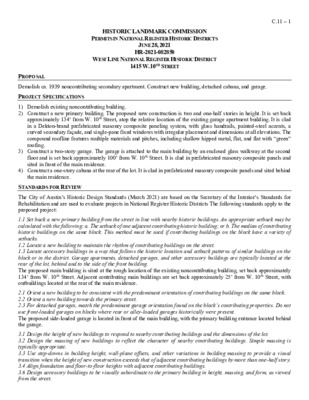
HISTORIC LANDMARK COMMISSION PERMITS IN NATIONAL REGISTER HISTORIC DISTRICTS JUNE 28, 2021 HR-2021-082850 WEST LINE NATIONAL REGISTER HISTORIC DISTRICT 1415 W. 10TH STREET C.11 – 1 PROPOSAL PROJECT SPECIFICATIONS Demolish ca. 1939 noncontributing secondary apartment. Construct new building, detached cabana, and garage. 1) Demolish existing noncontributing building. 2) Construct a new primary building. The proposed new construction is two and one-half stories in height. It is set back approximately 134’ from W. 10th Street, atop the relative location of the existing garage apartment building. It is clad in a Dekton-brand prefabricated masonry composite paneling system, with glass handrails, painted-steel accents, a curved secondary façade, and single-pane fixed windows with irregular placement and dimensions at all elevations. The compound roofline features multiple materials and pitches, including shallow hipped metal, flat, and flat with “green” roofing. 3) Construct a two-story garage. The garage is attached to the main building by an enclosed glass walkway at the second floor and is set back approximately 100’ from W. 10th Street. It is clad in prefabricated masonry composite panels and sited in front of the main residence. 4) Construct a one-story cabana at the rear of the lot. It is clad in prefabricated masonry composite panels and sited behind the main residence. STANDARDS FOR REVIEW The City of Austin’s Historic Design Standards (March 2021) are based on the Secretary of the Interior’s Standards for Rehabilitation and are used to evaluate projects in National Register Historic Districts The following standards apply to the proposed project: 1.1 Set back a new primary building from the street in line with nearby historic buildings. An appropriate setback may be calculated with the following: a. The setback of one adjacent contributing historic building; or b. The median of contributing historic buildings on the same block. This method must be used if contributing buildings on the block have a variety of setbacks. 1.2 Locate a new building to maintain the rhythm of contributing buildings on the street. 1.3 Locate accessory buildings in a way that follows the historic location and setback patterns of similar buildings on the block or in the district. Garage apartments, detached garages, and other accessory buildings are typically located at the rear of the lot, behind and to the side of the front building. The proposed main building is sited at the rough location of the existing noncontributing building, set back approximately 134’ from W. 10th Street. …
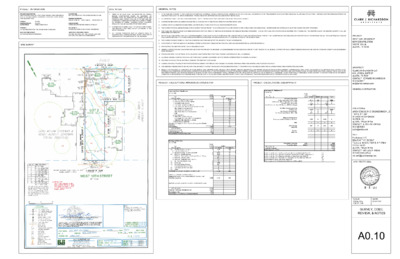
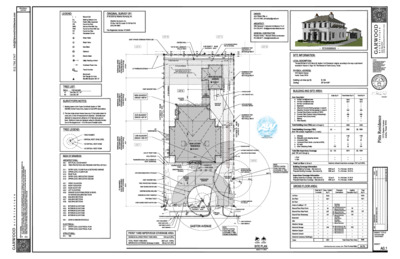
PROJECT INFORMATION SITE NOTES GENERAL NOTES PROJECT DESCRIPTION: NEW CONSTRUCTION OF A TWO-STORY SINGLE FAMILY RESIDENCE WITH ATTACHED GARAGE, BASEMENT, DETACHED GUEST HOUSE, AND ADJACENT POOL. ZONING: NEIGHBORHOOD: SUBDIVISION: SF-3NP W.A.N.G. WEED SUBDIVISION FLOODPLAIN: NOT LOCATED IN 100 YR FLOODPLAIN PER COA GIS 1. MINIMUM SETBACKS: FRONT YARD: 25'; SIDE YARD: 5'; REAR YARD: 10' LANDSCAPING: THERE ARE PROTECTED TREES ON THE LOT. PARKING: (2) TWO REQUIRED FOR THE SINGLE FAMILY DWELLING OCCUPANCY: OWNER OCCUPIED SINGLE FAMILY RESIDENCE MAX BUILDING HEIGHT: 32' PER MCMANSION ORDINANCE APPLICABLE BUILDING CODES: 2015 IRC, 2015 IECC, 2011 NEC, 2012 IFC, 2012 UMC, 2012 UPC, TAS, AND LOCAL AMENDMENTS TREES TO BE SAVED SHALL BE PROTECTED BY FENCING BEFORE CONSTRUCTION BEGINS. NO EQUIPMENT OR MATERIAL SHALL BE OPERATED OR STORED WITHIN THE FENCED-IN AREA. FENCES SHALL BE AT THE DRIP LINE AND COMPLETELY SURROUND THE TREE OR CLUSTER OF TREES. NO BURNING OF DEBRIS, CLEANING FLUIDS, CONCRETE SPILLS, ETC. WILL BE ALLOWED WITHIN THESE AREAS. 2. CONTRACTOR TO VERIFY EXACT LOCATION OF STRUCTURES, AND RELATED STRUCTURES ON LOT ACCORDING TO THE SET OF DRAWINGS. 3. ALL EXISTING CONDITIONS MUST BE VERIFIED PRIOR TO CONSTRUCTION, CONTRACTOR MUST NOTIFY ARCHITECT IN WRITING OF ANY DISCREPANCIES TO THE DRAWINGS. 1. AT NO TIME ARE CHANGES TO THE CONSTRUCTION METHODS, MATERIALS, DETAILS, SPECIFICATIONS, GENERAL NOTES OR SCHEDULES, OR DELETION OF ANY REQUIREMENT SHOWN ON THESE DRAWINGS ACCEPTABLE WITHOUT FIRST OBTAINING WRITTEN PERMISSION FROM THE ARCHITECT AND CLIENT. TO OBTAIN PERMISSION - PRICING, RELEVANT DRAWINGS AND DOCUMENTS MUST BE PROVIDED. 2. ALL PROPOSALS SHALL TAKE INTO CONSIDERATION ALL SITE & CONSTRUCTION CONDITIONS AFFECTING WORK UNDER THIS CONTRACT. 3. COORDINATE MECHANICAL PLUMBING AND ELECTRICAL DIVISIONS WITH OTHER TRADES AFFECTING OR AFFECTED BY SAME. 4. CONTRACTOR TO COORDINATE STAGING AREAS, SEE PROPOSED STAGING PLAN FOR COA MANDATED RESTRICTIONS. THE CONTRACTOR SHALL BE RESPONSIBLE FOR CONSTRUCTING THE PROJECT IN ACCORDANCE WITH ALL PROVISIONS OF APPLICABLE CODES AND ORDINANCES. WORKMANSHIP AND MATERIALS TO BE OF THE HIGHEST INDUSTRY STANDARDS. THE PLANS AND SPECIFICATIONS HAVE BEEN DEVELOPED WITH THE INTENT OF MEETING OR EXCEEDING THE MINIMUM REQUIRED STANDARDS. SHOULD THE PLANS AND SPECIFICATIONS DISAGREE WITH THEMSELVES, THE GREATER QUALITY OR GREATER QUANTITY SHALL BE PERFORMED OR FURNISHED. 7. NOTICE TO ALL SUBCONTRACTORS: IT IS YOUR RESPONSIBILITY TO BID YOUR SCOPE OF WORK USING THE COMPLETE SET OF PLANS AND SPECIFICATIONS. THE FACT THAT SOMETHING WAS NOT INDICATED ON YOUR PORTION OF THE DRAWINGS WILL NOT …
Ed Richardson Contreras, Kalan Allen, Amber 1415 W 10th St | OWANA and Neighborhood Meeting Dates Summary Monday, June 21, 2021 12:49:02 PM From: To: Cc: Subject: Date: H Folks, Below is a summary of our outreach to both OWANA’s Zoning Committee and through that process to the adjacent neighbors to the project. We will also meet with them (OWANA) Thursday the 24th to give them an update. For context, our client’s father became sick after the second round of meetings (and eventually passed away early 2021) so the project was somewhat delayed as a result – hence the gap between the fall meetings and permitting in 2021. We will send the updated presentation on Thursday for distribution to HLC members. -9.24.2020: OWANA Zoning Committee Meeting: Ed Richardson | CRA presents existing site conditions and proposed design to OWANA Zoning Committee. - 10.13.2020: Meeting with Adjacent Neighbors: Ed Richardson | CRA meets all directly adjacent neighbors at 1415 W 10th to review proposed design. Topics included: - Reviewed Existing and Proposed Drainage on site with east neighbor. - Reviewed Height and Location of proposed structures. Reviewed what each neighbor with views into the lot could expect to see from their homes. - Discussed Fence Heights and Location. We will revisit the Fence and Fence Heights when project is closer to construction. We are open to a lower fence along 10thstreet. - Reviewed Second Floor Window Alignments: between the proposed structure and the existing home to the east. Clark Richardson field surveyed the window locations and mapped them on the survey and reviewed with property owner. There are no direct window alignments. - 10.22.2020: OWANA Zoning Committee Meeting II: Ed Richardson | CRA presented our responses to the comments / concerns from the previous meeting Shoring: The noise and disruption from potential shoring for the construction of the basement was a primary concern for neighbors. CRA recommends no driven piles be used for shoring and instead drilled piers be used in any temporary shoring required. The structural work for the shoring will be part of the means and methods for construction of the basement by the contractor and therefore while it will be engineered. The precise drawings will not be included in the architectural drawings. Street Façade: We’re proposing a specimen tree be added in front of the street façade complimenting the window located towards the west side of the façade …
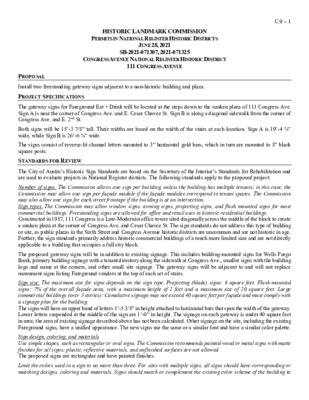
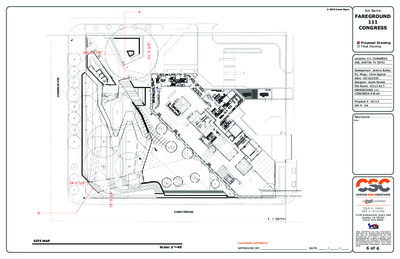
HISTORIC LANDMARK COMMISSION PERMITS IN NATIONAL REGISTER HISTORIC DISTRICTS JUNE 28, 2021 SB-2021-071307, 2021-071325 CONGRESS AVENUE NATIONAL REGISTER HISTORIC DISTRICT 111 CONGRESS AVENUE C.9 – 1 PROPOSAL PROJECT SPECIFICATIONS Install two freestanding gateway signs adjacent to a non-historic building and plaza. The gateway signs for Fareground Eat + Drink will be located at the steps down to the sunken plaza of 111 Congress Ave. Sign A is near the corner of Congress Ave. and E. Cesar Chavez St. Sign B is along a diagonal sidewalk from the corner of Congress Ave. and E. 2nd St. Both signs will be 15’-3 7/8” tall. Their widths are based on the width of the stairs at each location. Sign A is 19’-4 ¾” wide, while Sign B is 26’-6 ¾” wide. The signs consist of reverse-lit channel letters mounted to 3” horizontal gold bars, which in turn are mounted to 8” black square posts. STANDARDS FOR REVIEW The City of Austin’s Historic Sign Standards are based on the Secretary of the Interior’s Standards for Rehabilitation and are used to evaluate projects in National Register districts. The following standards apply to the proposed project: Number of signs. The Commission allows one sign per building, unless the building has multiple tenants; in this case, the Commission may allow one sign per façade module if the façade modules correspond to tenant spaces. The Commission may also allow one sign for each street frontage if the building is at an intersection. Sign types. The Commission may allow window signs, awning signs, projecting signs, and flush mounted signs for most commercial buildings. Freestanding signs are allowed for office and retail uses in historic residential buildings. Constructed in 1987, 111 Congress is a Late-Modernist office tower sited diagonally across the middle of the block to create a sunken plaza at the corner of Congress Ave. and Cesar Chavez St. The sign standards do not address this type of building or site, as public plazas in the Sixth Street and Congress Avenue historic districts are uncommon and are not historic in age. Further, the sign standards primarily address historic commercial buildings of a much more limited size and are not directly applicable to a building that occupies a full city block. The proposed gateway signs will be in addition to existing signage. This includes building-mounted signs for Wells Fargo Bank, primary building signage with a tenant directory along the sidewalk …
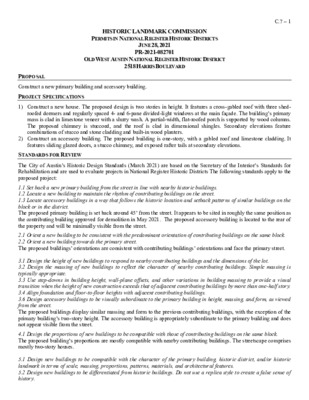
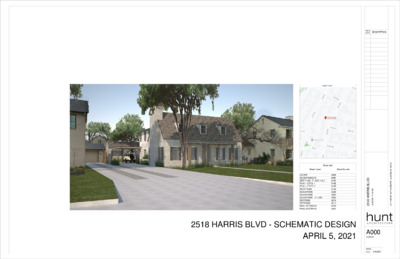
HISTORIC LANDMARK COMMISSION PERMITS IN NATIONAL REGISTER HISTORIC DISTRICTS JUNE 28, 2021 PR-2021-082701 OLD WEST AUSTIN NATIONAL REGISTER HISTORIC DISTRICT 2518 HARRIS BOULEVARD C.7 – 1 PROPOSAL Construct a new primary building and accessory building. PROJECT SPECIFICATIONS 1) Construct a new house. The proposed design is two stories in height. It features a cross-gabled roof with three shed- roofed dormers and regularly spaced 4- and 6-pane divided-light windows at the main façade. The building’s primary mass is clad in limestone veneer with a slurry wash. A partial-width, flat-roofed porch is supported by wood columns. The proposed chimney is stuccoed, and the roof is clad in dimensional shingles. Secondary elevations feature combinations of stucco and stone cladding and built-in wood planters. 2) Construct an accessory building. The proposed building is one-story, with a gabled roof and limestone cladding. It features sliding glazed doors, a stucco chimney, and exposed rafter tails at secondary elevations. STANDARDS FOR REVIEW The City of Austin’s Historic Design Standards (March 2021) are based on the Secretary of the Interior’s Standards for Rehabilitation and are used to evaluate projects in National Register Historic Districts The following standards apply to the proposed project: 1.1 Set back a new primary building from the street in line with nearby historic buildings. 1.2 Locate a new building to maintain the rhythm of contributing buildings on the street. 1.3 Locate accessory buildings in a way that follows the historic location and setback patterns of similar buildings on the block or in the district. The proposed primary building is set back around 45’ from the street. It appears to be sited in roughly the same position as the contributing building approved for demolition in May 2021. The proposed accessory building is located to the rear of the property and will be minimally visible from the street. 2.1 Orient a new building to be consistent with the predominant orientation of contributing buildings on the same block. 2.2 Orient a new building towards the primary street. The proposed buildings’ orientations are consistent with contributing buildings’ orientations and face the primary street. 3.1 Design the height of new buildings to respond to nearby contributing buildings and the dimensions of the lot. 3.2 Design the massing of new buildings to reflect the character of nearby contributing buildings. Simple massing is typically appropriate. 3.3 Use step-downs in building height, wall-plane offsets, and other variations in building massing to provide …
VICINITY MAP Sheet List Sheet Name Sheet Number COVER DESIGN IMAGES SITE PLAN - PHASE 1 & 2 PLAN - LEVEL 1 PLAN - LEVEL 2 ROOF PLAN ELEVATIONS ELEVATIONS ELEVATIONS - STUDIO SECTIONS SECTIONS WALL SECTIONS WALL SECTIONS A000 A001 A101 A102 A103 A104 A200 A201 A202 A210 A211 A220 A221 REV # DATE DESCRIPTION 3 0 7 8 7 X T N T S U A I , T E E R T S H T 0 3 T S E W 7 1 7 1 I D V L B S R R A H 8 1 5 2 3 0 7 8 7 X T N T S U A I A000 COVER SCALE: DATE: 4/5/2021 2518 HARRIS BLVD - SCHEMATIC DESIGN APRIL 5, 2021 PHASE 2 MAIN HOUSE PHASE 1 REAR ADU WITH TRELLIS AND SITE WALL PHASE 2 CARPORT PHASE 2 DRIVEWAY REWORK PHASE 2 COMPLETE - MAIN HOUSE AND ADU PHASE 1 COMPLETE - ADU ONLY PHASE 2 COMPLETE - MAIN HOUSE AND ADU REV # DATE DESCRIPTION 3 0 7 8 7 X T N T S U A I , T E E R T S H T 0 3 T S E W 7 1 7 1 I D V L B S R R A H 8 1 5 2 3 0 7 8 7 X T N T S U A I A001 DESIGN IMAGES SCALE: DATE: 4/5/2021 06.17 31' - 0" COURTYARD PROPERTY LINE / FENCE " 0 - ' 0 1 REAR SETBACK AC T R R C VISITABLE ENTRY ADU 06.18 06.02 04.03 " 7 - ' 2 1 1 A102 EXISTING COVERED REAR DECK K C A B T E S E D S I 5' - 0" E C N E F / E N I L Y T R E P O R P PROPERTY LINE / FENCE " 0 - ' 0 1 REAR SETBACK COURTYARD 31' - 0" ADU " 7 - ' 2 1 GRAVEL 06.02 16' - 2 1/2" 7' - 11 1/2" BACK DECK VISITABLE ENTRY AC T R R C VISITABLE ENTRY CARPORT 3' - 0" 3' - 0" 2' - 0" " 4 - ' 7 2 " 3 - ' 1 2 I E N L Y T R E P O R P K C A B T E S E D S …
HISTORIC LANDMARK COMMISSION PERMITS IN NATIONAL REGISTER HISTORIC DISTRICTS JUNE 28, 2021 HR-2021-084436 OLD WEST AUSTIN NATIONAL REGISTER HISTORIC DISTRICT 1512 GASTON AVENUE C.8 – 1 PROPOSAL Construct a new two-story building and one-story garage. PROJECT SPECIFICATIONS 1) Construct a two-story residence. The proposed building is set back approximately 40’ from the street. It is clad in brick, with a compound hipped roof clad in shingles, three stucco chimneys, and a covered entryway. Fenestration includes 4:4 aluminum-clad wood windows of different dimensions at the main elevation and a paneled door flanked by decorative wood paneling beneath a shallow portico. 2) Construct a rear one-story garage, attached to the main building by a breezeway. The proposed garage features a hipped shingled roof, fixed aluminum-clad wood windows, and cladding to match the primary building. STANDARDS FOR REVIEW The City of Austin’s Historic Design Standards (March 2021) are based on the Secretary of the Interior’s Standards for Rehabilitation and are used to evaluate projects in National Register Historic Districts The following standards apply to the proposed project: 1.1 Set back a new primary building from the street in line with nearby historic buildings. 1.2 Locate a new building to maintain the rhythm of contributing buildings on the street. 1.3 Locate accessory buildings in a way that follows the historic location and setback patterns of similar buildings on the block or in the district. The proposed building is set back approximately 40’, in line with contributing buildings on the block and consistent with the rhythm of the streetscape. The proposed garage is located at the rear of the lot and will be minimally visible from the street. 2.1 Orient a new building to be consistent with the predominant orientation of contributing buildings on the same block. 2.2 Orient a new building towards the primary street. 2.3 For detached garages, match the predominant garage orientation found on the block’s contributing properties. Do not use front-loaded garages on blocks where rear or alley-loaded garages historically were present. The proposed buildings match the predominant street-facing orientation of nearby contributing buildings. 3.1 Design the height of new buildings to respond to nearby contributing buildings and the dimensions of the lot. 3.2 Design the massing of new buildings to reflect the character of nearby contributing buildings. 3.4 Align foundation and floor-to-floor heights with adjacent contributing buildings. 3.6 Design accessory buildings to be visually subordinate to the primary building in …
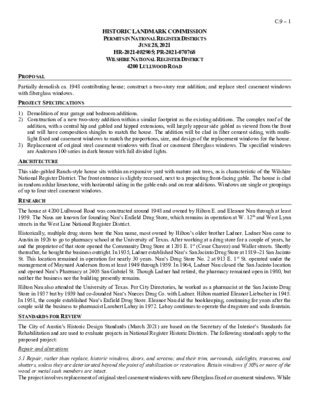
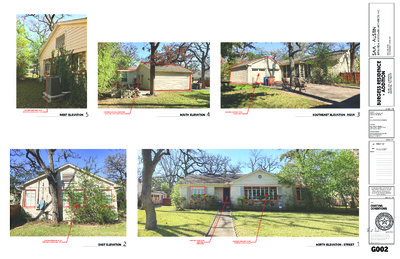
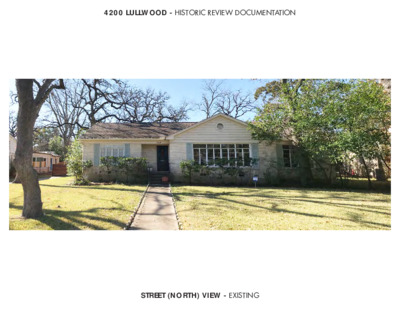
HISTORIC LANDMARK COMMISSION PERMITS IN NATIONAL REGISTER DISTRICTS JUNE 28, 2021 HR-2021-082905; PR-2021-070768 WILSHIRE NATIONAL REGISTER DISTRICT 4200 LULLWOOD ROAD C.9 – 1 PROPOSAL PROJECT SPECIFICATIONS Partially demolish ca. 1948 contributing house; construct a two-story rear addition; and replace steel casement windows with fiberglass windows. 1) Demolition of rear garage and bedroom additions. 2) Construction of a new two-story addition within a similar footprint as the existing additions. The complex roof of the addition, with a central hip and gabled and hipped extensions, will largely appear side gabled as viewed from the front and will have composition shingles to match the house. The addition will be clad in fiber cement siding, with multi- light fixed and casement windows to match the proportions, size, and design of the replacement windows for the house. 3) Replacement of original steel casement windows with fixed or casement fiberglass windows. The specified windows are Andersen 100 series in dark bronze with full divided lights. ARCHITECTURE RESEARCH This side-gabled Ranch-style house sits within an expansive yard with mature oak trees, as is characteristic of the Wilshire National Register District. The front entrance is slightly recessed, next to a projecting front-facing gable. The house is clad in random ashlar limestone, with horizontal siding in the gable ends and on rear additions. Windows are single or groupings of up to four steel casement windows. The house at 4200 Lullwood Road was constructed around 1948 and owned by Hilton E. and Eleanor Nau through at least 1959. The Naus are known for founding Nau’s Enfield Drug Store, which remains in operation at W. 12th and West Lynn streets in the West Line National Register District. Historically, multiple drug stores bore the Nau name, most owned by Hilton’s older brother Ladner. Ladner Nau came to Austin in 1926 to go to pharmacy school at the University of Texas. After working at a drug store for a couple of years, he and the proprietor of that store opened the Community Drug Store at 1201 E. 1st (Cesar Chavez) and Waller streets. Shortly thereafter, he bought the business outright. In 1935, Ladner established Nau’s San Jacinto Drug Store at 1819–21 San Jacinto St. This location remained in operation for nearly 30 years. Nau’s Drug Store No. 2 at 913 E. 1st St. operated under the management of Maynard Anderson from at least 1949 through 1959. In 1964, Ladner Nau closed the San …
EXISTING WINDOWS TO BE REMOVED & REPLACED, TYP. WEST ELEVATION 5 EXISTING GARAGE & BEDROOM ADDITION TO BE DEMOLISHED SOUTH ELEVATION 4 EXISTING GARAGE TO BE DEMOLISHED SOUTHEAST ELEVATION - REAR 3 EXISTING WINDOWS TO BE REMOVED & REPLACED, TYP. EAST ELEVATION 2 EXISTING DOORTO BE REMOVED & REPLACED; EXISTING WINDOWS TO BE REMOVED & REPLACED; NORTH ELEVATION - STREET 1 . C N I I S T C E T I H C R A S E T A C O S S A A D E V L U P E S N I T S U A - A A S t e n . s t c e t i h c r a a s @ o d r a c i r 2 3 7 3 - 5 3 2 - 6 5 9 E C N E D I S E R S S E G R U B N O I T I D D A - , D O O W L L U L 0 0 2 4 2 2 7 8 7 X T , N I T S U A project info: physical: 4200 L U L L W O O D R D , A U S T I N , T X 7 8 7 5 6 owner: JT & C H R I S T I N A B U R G E S S contractor: B I L L T A U T E H O M E S 2152 S A G E C R E E K L O O P A U S T I N , T X 7 8 7 0 4 structural engineer: P C W C O N S T R U C T I O N I N C . 101 P R E C I S I O N D R . B U D A, T X 7 8 6 1 0 PERMIT SET 4/29/2021 set: set: date: date: revisions: revisions: phase info: IF THIS DOCUMENT IS PRINTED ON 11X17 PAPER, ASSUME ALL SCALES TO BE HALF OF STATED SCALE - SCALE TO BE VERIFIED THROUGH MEASUREMENT. drawing info: sheet: EXISTING CONDITIONS 4/29/2021 IF THIS DOCUMENT IS NOT SIGNED, SEALED AND DATED, IT MAY NOT BE USED FOR REGULATORY APPROVAL, PERMIT OR CONSTRUCTION. C copyright 2016 G002 By diazj at 1:59 pm, May 03, …
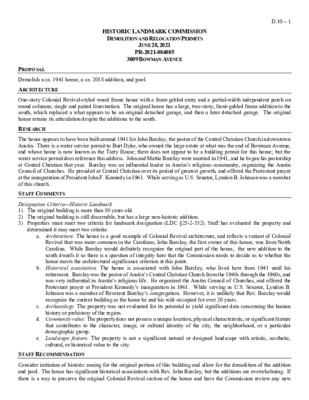
HISTORIC LANDMARK COMMISSION DEMOLITION AND RELOCATION PERMITS JUNE 28, 2021 PR-2021-084005 3009 BOWMAN AVENUE D.10 – 1 PROPOSAL ARCHITECTURE RESEARCH Demolish a ca. 1941 house, a ca. 2018 addition, and pool. One-story Colonial Revival-styled wood frame house with a front-gabled entry and a partial-width independent porch on round columns; single and paired fenestration. The original house has a large, two-story, front-gabled frame addition to the south, which replaced a what appears to be an original detached garage, and then a later detached garage. The original house retains its articulation despite the additions to the south. The house appears to have been built around 1941 for John Barclay, the pastor of the Central Christian Church in downtown Austin. There is a water service permit to Burt Dyke, who owned the large estate at what was the end of Bowman Avenue, and whose home is now known as the Tarry House; there does not appear to be a building permit for this house; but the water service permit does reference this address. John and Mattie Barclay were married in 1941, and he began his pastorship at Central Christian that year. Barclay was an influential leader in Austin’s religious community, organizing the Austin Council of Churches. He presided at Central Christian over its period of greatest growth, and offered the Protestant prayer at the inauguration of President John F. Kennedy in 1961. While serving as U.S. Senator, Lyndon B. Johnson was a member of this church. STAFF COMMENTS Designation Criteria—Historic Landmark 1) The original building is more than 50 years old. 2) The original building is still discernible, but has a large non-historic addition. 3) Properties must meet two criteria for landmark designation (LDC §25-2-352). Staff has evaluated the property and determined it may meet two criteria: a. Architecture. The house is a good example of Colonial Revival architecture, and reflects a variant of Colonial Revival that was more common in the Carolinas; John Barclay, the first owner of this house, was from North Carolina. While Barclay would definitely recognize the original part of the house, the new addition to the south dwarfs it so there is a question of integrity here that the Commission needs to decide as to whether the house meets the architectural significance criterion at this point. b. Historical association. The house is associated with John Barclay, who lived here from 1941 until his retirement. Barclay was the pastor …
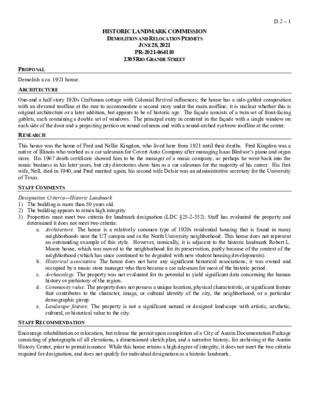
HISTORIC LANDMARK COMMISSION DEMOLITION AND RELOCATION PERMITS JUNE 28, 2021 PR-2021-064110 2305 RIO GRANDE STREET D.2 – 1 PROPOSAL Demolish a ca. 1921 house. ARCHITECTURE One-and a half story 1920s Craftsman cottage with Colonial Revival influences; the house has a side-gabled composition with an elevated roofline at the rear to accommodate a second story under the main roofline; it is unclear whether this is original architecture or a later addition, but appears to be of historic age. The façade consists of a twin set of front-facing gablets, each containing a double set of windows. The principal entry in centered in the façade with a single window on each side of the door and a projecting portico on round columns and with a round-arched eyebrow roofline at the center. RESEARCH STAFF COMMENTS This house was the home of Fred and Nellie Kingdon, who lived here from 1921 until their deaths. Fred Kingdon was a native of Illinois who worked as a car salesman for Covert Auto Company after managing Isaac Bledsoe’s piano and organ store. His 1967 death certificate showed him to be the manager of a music company, so perhaps he went back into the music business in his later years, but city directories show him as a car salesman for the majority of his career. His first wife, Nell, died in 1940, and Fred married again; his second wife Delsie was an administrative secretary for the University of Texas. Designation Criteria—Historic Landmark 1) The building is more than 50 years old. 2) The building appears to retain high integrity. 3) Properties must meet two criteria for landmark designation (LDC §25-2-352). Staff has evaluated the property and determined it does not meet two criteria: a. Architecture. The house is a relatively common type of 1920s residential housing that is found in many neighborhoods near the UT campus and in the North University neighborhood. This house does not represent an outstanding example of this style. However, ironically, it is adjacent to the historic landmark Robert L. Moore house, which was moved to the neighborhood for its preservation, partly because of the context of the neighborhood (which has since continued to be degraded with new student housing developments). b. Historical association. The house does not have any significant historical associations; it was owned and occupied by a music store manager who then became a car salesman for most of the historic period. …
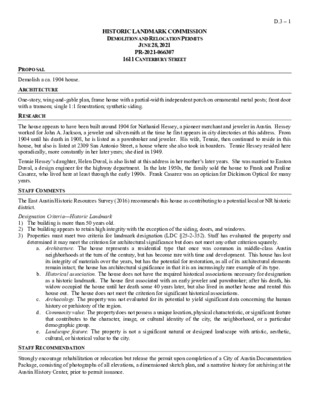
HISTORIC LANDMARK COMMISSION DEMOLITION AND RELOCATION PERMITS JUNE 28, 2021 PR-2021-066307 1611 CANTERBURY STREET D.3 – 1 PROPOSAL Demolish a ca. 1904 house. ARCHITECTURE RESEARCH One-story, wing-and-gable plan, frame house with a partial-width independent porch on ornamental metal posts; front door with a transom; single 1:1 fenestration; synthetic siding. The house appears to have been built around 1904 for Nathaniel Hessey, a pioneer merchant and jeweler in Austin. Hessey worked for John A. Jackson, a jeweler and silversmith at the time he first appears in city directories at this address. From 1904 until his death in 1908, he is listed as a pawnbroker and jeweler. His wife, Tennie, then continued to reside in this house, but also is listed at 2309 San Antonio Street, a house where she also took in boarders. Tennie Hessey resided here sporadically, more constantly in her later years; she died in 1949. Tennie Hessey’s daughter, Helen Duval, is also listed at this address in her mother’s later years. She was married to Easton Duval, a design engineer for the highway department. In the late 1950s, the family sold the house to Frank and Pauline Casarez, who lived here at least through the early 1990s. Frank Casarez was an optician for Dickinson Optical for many years. STAFF COMMENTS The East Austin Historic Resources Survey (2016) recommends this house as contributing to a potential local or NR historic district. Designation Criteria—Historic Landmark 1) The building is more than 50 years old. 2) The building appears to retain high integrity with the exception of the siding, doors, and windows. 3) Properties must meet two criteria for landmark designation (LDC §25-2-352). Staff has evaluated the property and determined it may meet the criterion for architectural significance but does not meet any other criterion squarely. a. Architecture. The house represents a residential type that once was common in middle-class Austin neighborhoods at the turn of the century, but has become rare with time and development. This house has lost its integrity of materials over the years, but has the potential for restoration, as all of its architectural elements remain intact; the house has architectural significance in that it is an increasingly rare example of its type. b. Historical association. The house does not have the required historical associations necessary for designation as a historic landmark. The house first associated with an early jeweler and pawnbroker; after his death, his widow …
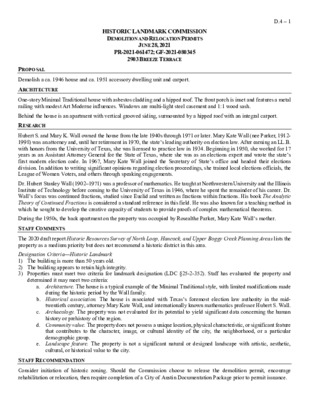
HISTORIC LANDMARK COMMISSION DEMOLITION AND RELOCATION PERMITS JUNE 28, 2021 PR-2021-061472; GF-2021-080345 2903 BREEZE TERRACE D.4 – 1 PROPOSAL ARCHITECTURE RESEARCH Demolish a ca. 1946 house and ca. 1951 accessory dwelling unit and carport. One-story Minimal Traditional house with asbestos cladding and a hipped roof. The front porch is inset and features a metal railing with modest Art Moderne influences. Windows are multi-light steel casement and 1:1 wood sash. Behind the house is an apartment with vertical grooved siding, surmounted by a hipped roof with an integral carport. Hubert S. and Mary K. Wall owned the house from the late 1940s through 1971 or later. Mary Kate Wall (nee Parker, 1912- 1998) was an attorney and, until her retirement in 1970, the state’s leading authority on election law. After earning an LL.B. with honors from the University of Texas, she was licensed to practice law in 1934. Beginning in 1950, she worked for 17 years as an Assistant Attorney General for the State of Texas, where she was as an elections expert and wrote the state’s first modern election code. In 1967, Mary Kate Wall joined the Secretary of State’s office and headed their elections division. In addition to writing significant opinions regarding election proceedings, she trained local elections officials, the League of Women Voters, and others through speaking engagements. Dr. Hubert Stanley Wall (1902–1971) was a professor of mathematics. He taught at Northwestern University and the Illinois Institute of Technology before coming to the University of Texas in 1946, where he spent the remainder of his career. Dr. Wall’s focus was continued fractions, studied since Euclid and written as fractions within fractions. His book The Analytic Theory of Continued Fractions is considered a standard reference in this field. He was also known for a teaching method in which he sought to develop the creative capacity of students to provide proofs of complex mathematical theorems. During the 1950s, the back apartment on the property was occupied by Rosealthe Parker, Mary Kate Wall’s mother. STAFF COMMENTS The 2020 draft report Historic Resources Survey of North Loop, Hancock, and Upper Boggy Creek Planning Areas lists the property as a medium priority but does not recommend a historic district in this area. Designation Criteria—Historic Landmark 1) The building is more than 50 years old. 2) The building appears to retain high integrity. 3) Properties must meet two criteria for landmark designation (LDC §25-2-352). …
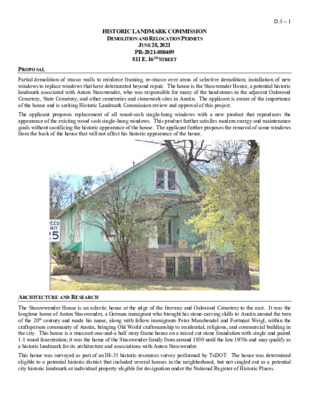
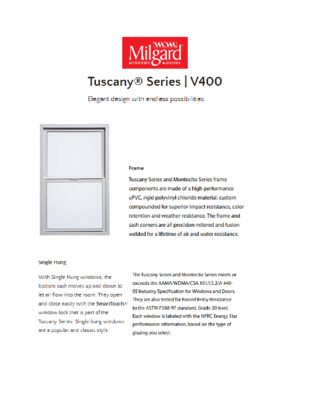
HISTORIC LANDMARK COMMISSION DEMOLITION AND RELOCATION PERMITS JUNE 28, 2021 PR-2021-080409 811 E. 16TH STREET D.5 – 1 PROPOSAL Partial demolition of stucco walls to reinforce framing, re-stucco over areas of selective demolition; installation of new windows to replace windows that have deteriorated beyond repair. The house is the Stasswender House, a potential historic landmark associated with Anton Stasswender, who was responsible for many of the headstones in the adjacent Oakwood Cemetery, State Cemetery, and other cemeteries and stonework sites in Austin. The applicant is aware of the importance of the house and is seeking Historic Landmark Commission review and approval of this project. The applicant proposes replacement of all wood-sash single-hung windows with a new product that reproduces the appearance of the existing wood sash single-hung windows. This product further satisfies modern energy and maintenance goals without sacrificing the historic appearance of the house. The applicant further proposes the removal of some windows from the back of the house that will not affect his historic appearance of the house. ARCHITECTURE AND RESEARCH The Stasswwender House is an eclectic house at the edge of the freeway and Oakwood Cemetery to the east. It was the longtime home of Anton Stasswender, a German immigrant who brought his stone-carving skills to Austin around the turn of the 20th century and made his name, along with fellow immigrants Peter Mansbendel and Fortunat Weigl, within the craftsperson community of Austin, bringing Old World craftsmanship to residential, religious, and commercial building in the city. This house is a stuccoed one-and-a half story frame house on a raised cut stone foundation with single and paired 1:1 wood fenestration; it was the home of the Stasswender family from around 1930 until the late 1970s and may qualify as a historic landmark for its architecture and associations with Anton Stasswender. This house was surveyed as part of an IH-35 historic resources survey performed by TxDOT. The house was determined eligible to a potential historic district that included several houses in the neighborhood, but not singled out as a potential city historic landmark or individual property eligible for designation under the National Register of Historic Places. D.5 – 2 STAFF COMMENTS The house has long been identified as a potential historic landmark due to its distinctive architecture and historical associations. Designation Criteria—Historic Landmark 1) The building is more than 50 years old. 2) The building appears to retain high …
Millgard Tuscany Single Hung Windows (cid:52)(cid:85)(cid:86)(cid:68)(cid:68)(cid:80)(cid:1)(cid:51)(cid:70)(cid:81)(cid:77)(cid:66)(cid:68)(cid:70)(cid:78)(cid:70)(cid:79)(cid:85) (cid:52)(cid:85)(cid:86)(cid:68)(cid:68)(cid:80)(cid:1)(cid:51)(cid:70)(cid:81)(cid:77)(cid:66)(cid:68)(cid:70)(cid:78)(cid:70)(cid:79)(cid:85) Proposed Stucco Finish to match current finish (cid:38)(cid:89)(cid:74)(cid:84)(cid:85)(cid:74)(cid:79)(cid:72)(cid:1)(cid:84)(cid:85)(cid:80)(cid:79)(cid:70)(cid:1)(cid:80)(cid:79)(cid:1)(cid:70)(cid:89)(cid:85)(cid:70)(cid:83)(cid:74)(cid:80)(cid:83)(cid:1)(cid:83)(cid:70)(cid:78)(cid:66)(cid:74)(cid:79)(cid:84) (cid:52)(cid:85)(cid:86)(cid:68)(cid:68)(cid:80)(cid:1)(cid:51)(cid:70)(cid:81)(cid:77)(cid:66)(cid:68)(cid:70)(cid:78)(cid:70)(cid:79)(cid:85)(cid:1) (cid:52)(cid:85)(cid:86)(cid:68)(cid:68)(cid:80)(cid:1)(cid:51)(cid:70)(cid:81)(cid:77)(cid:66)(cid:68)(cid:70)(cid:78)(cid:70)(cid:79)(cid:85) (cid:52)(cid:85)(cid:86)(cid:68)(cid:68)(cid:80)(cid:1)(cid:51)(cid:70)(cid:81)(cid:77)(cid:66)(cid:68)(cid:70)(cid:78)(cid:70)(cid:79)(cid:85) (cid:52)(cid:85)(cid:86)(cid:68)(cid:68)(cid:80)(cid:1)(cid:51)(cid:70)(cid:81)(cid:77)(cid:66)(cid:68)(cid:70)(cid:78)(cid:70)(cid:79)(cid:85) (cid:52)(cid:85)(cid:86)(cid:68)(cid:68)(cid:80)(cid:1)(cid:51)(cid:70)(cid:81)(cid:77)(cid:66)(cid:68)(cid:70)(cid:78)(cid:70)(cid:79)(cid:85) (cid:38)(cid:89)(cid:74)(cid:84)(cid:85)(cid:74)(cid:79)(cid:72)(cid:1)(cid:84)(cid:85)(cid:80)(cid:79)(cid:70)(cid:1)(cid:83)(cid:70)(cid:78)(cid:66)(cid:74)(cid:79)(cid:84)
HISTORIC LANDMARK COMMISSION DEMOLITION AND RELOCATION PERMITS JUNE 28, 2021 PR-2021-076165; GF-2021-080450 2007 WILLOW ST. D.6 – 1 PROPOSAL Demolish a ca. 1912 house. ARCHITECTURE RESEARCH One-story National Folk house with a hipped roof and full-width integral porch supported by Doric columns. The front door has a transom and sidelights. Windows are 1:1, with the exception of a picture window on the façade. The house at 2007 Willow St. was constructed around 1912. Lamar Q. Cato, a draftsman for architect George A. Endress, occupied the house between 1912 and 1914, followed by a succession of renters, including a boilermaker and a lineman. Beginning in 1922, the occupants were Edward B. and Emma Harris and their daughter and son-in-law, Ola and Charles A. Childress. Through the 1920s, Edward and Emma both worked as clerks at various establishments, and Charles was a firefighter. By 1932, Edward founded a grocery store on E. 6th Street, and Ola worked there as a clerk. In 1935, Charles is listed as a business partner in the grocery. The venture was short-lived, however, due to Edward’s death shortly thereafter. Emma continued to live in the house until her death in 1939. Charles and Ola owned the house through 1952. Charles worked in a variety of ventures. Ola was active in the Metz Elementary PTA and taught piano in the home. The house was subsequently occupied by a series of renters. STAFF COMMENTS The property is listed as non-contributing to the recommended South East Austin Historic District in the 2016 East Austin Historic Resource Survey. Staff disagrees that modifications are significant enough to render the house non-contributing. Designation Criteria—Historic Landmark 1) The building is more than 50 years old. 2) The building appears to retain moderate integrity. 3) Properties must meet two criteria for landmark designation (LDC §25-2-352). Staff has evaluated the property and determined that it does not appear to meet two criteria: a. Architecture. The house is a good example of a National Folk house with modest Classical Revival detailing but has alterations, including a picture window on the façade. b. Historical association. The house does not appear to have significant historical associations. While the Harris and Childress families lived in the home for around 30 years, they do not appear to have made significant contributions to Austin’s history. c. Community value. The property does not possess a unique location, physical characteristic, or significant feature that …
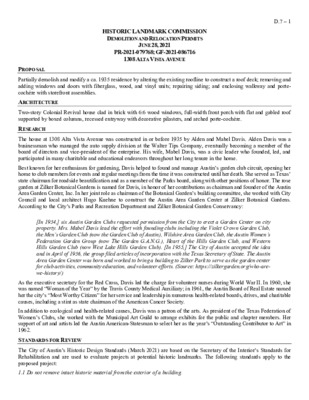
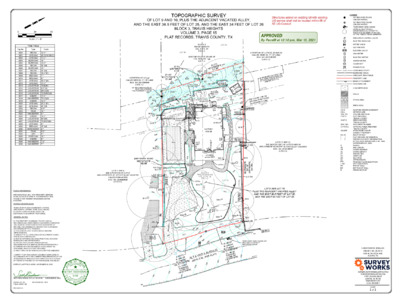
HISTORIC LANDMARK COMMISSION DEMOLITION AND RELOCATION PERMITS JUNE 28, 2021 PR-2021-079768; GF-2021-086716 1308 ALTA VISTA AVENUE D.7 – 1 PROPOSAL ARCHITECTURE RESEARCH Partially demolish and modify a ca. 1935 residence by altering the existing roofline to construct a roof deck; removing and adding windows and doors with fiberglass, wood, and vinyl units; repairing siding; and enclosing walkway and porte- cochère with storefront assemblies. Two-story Colonial Revival house clad in brick with 6:6 wood windows, full-width front porch with flat and gabled roof supported by boxed columns, recessed entryway with decorative pilasters, and arched porte-cochère. The house at 1308 Alta Vista Avenue was constructed in or before 1935 by Alden and Mabel Davis. Alden Davis was a businessman who managed the auto supply division at the Walter Tips Company, eventually becoming a member of the board of directors and vice-president of the enterprise. His wife, Mabel Davis, was a civic leader who founded, led, and participated in many charitable and educational endeavors throughout her long tenure in the home. Best known for her enthusiasm for gardening, Davis helped to found and manage Austin’s garden club circuit, opening her home to club members for events and regular meetings from the time it was constructed until her death. She served as Texas’ state chairman for roadside beautification and as a member of the Parks board, along with other positions of honor. The rose garden at Zilker Botanical Gardens is named for Davis, in honor of her contributions as chairman and founder of the Austin Area Garden Center, Inc. In her joint role as chairman of the Botanical Garden’s building committee, she worked with City Council and local architect Hugo Kuehne to construct the Austin Area Garden Center at Zilker Botanical Gardens. According to the City’s Parks and Recreation Department and Zilker Botanical Garden Conservancy: [In 1954,] six Austin Garden Clubs requested permission from the City to erect a Garden Center on city property. Mrs. Mabel Davis lead the effort with founding clubs including the Violet Crown Garden Club, the Men’s Garden Club (now the Garden Club of Austin), Wilshire Area Garden Club, the Austin Women’s Federation Garden Group (now The Garden G.A.N.G.), Heart of the Hills Garden Club, and Western Hills Garden Club (now West Lake Hills Garden Club). [In 1955,] The City of Austin accepted the idea and in April of 1956, the group filed articles of incorporation with the Texas Secretary …
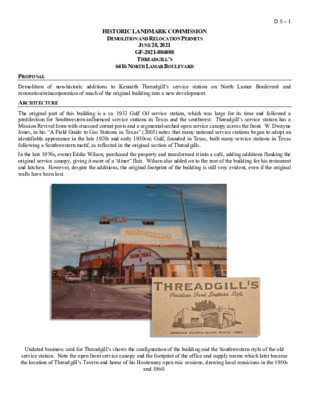
HISTORIC LANDMARK COMMISSION DEMOLITION AND RELOCATION PERMITS JUNE 28, 2021 GF-2021-086008 THREADGILL’S 6416 NORTH LAMAR BOULEVARD D.8 – 1 PROPOSAL ARCHITECTURE Demolition of non-historic additions to Kenneth Threadgill’s service station on North Lamar Boulevard and restoration/reincorporation of much of the original building into a new development. The original part of this building is a ca. 1933 Gulf Oil service station, which was large for its time and followed a predilection for Southwestern-influenced service stations in Texas and the southwest. Threadgill’s service station has a Mission Revival form with stuccoed corner posts and a segmental-arched open service canopy across the front. W. Dwayne Jones, in his “A Field Guide to Gas Stations in Texas” (2003) notes that many national service stations began to adopt an identifiable appearance in the late 1920s and early 1930sw; Gulf, founded in Texas, built many service stations in Texas following a Southwestern motif, as reflected in the original section of Threadgills. In the late 1970s, owner Eddie Wilson, purchased the property and transformed it into a café, adding additions flanking the original service canopy, giving it more of a “diner” flair. Wilson also added on to the rear of the building for his restaurant and kitchen. However, despite the additions, the original footprint of the building is still very evident, even if the original walls have been lost. Undated business card for Threadgill’s shows the configuration of the building and the Southwestern style of the old service station. Note the open front service canopy and the footprint of the office and supply rooms which later became the location of Threadgill’s Tavern and home of his Hootenany open mic sessions, drawing local musicians in the 1950s and 1960. D.8 – 2 RESEARCH Kenneth Threadgill, who had operated the Gulf station at 6416 N. Lamar for a short time, obtained the first beer license issued in Travis County after the end of Prohibition in 1933. He opened a tavern and beer hall at his service station, and the place became renowned in Austin for hosting musicians, who would plan for beer money and food, as well as some of the biggest acts in country music. Threadgill, a renowned blues yodeler and musician in his own right, began hosting open- mic nights at his service station, which after World War II, began attracting UT students, including the young Janis Joplin, who began her career of performing in public here. …
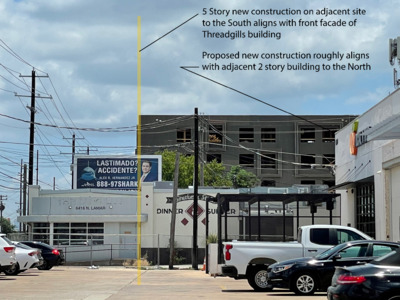
5 Story new construction on adjacent site to the South aligns with front facade of Threadgills building Proposed new construction roughly aligns with adjacent 2 story building to the North New Multifamily Units New Outdoor Lawn and Park Space “Glass” Transition to New Building Existing Building and Canopy New Sculputural Element rd a v le u o r B a m a . L N New Parking Area With Multi-Family Above
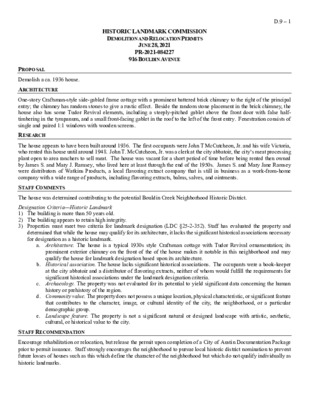
HISTORIC LANDMARK COMMISSION DEMOLITION AND RELOCATION PERMITS JUNE 28, 2021 PR-2021-084227 916 BOULDIN AVENUE D.9 – 1 PROPOSAL Demolish a ca. 1936 house. ARCHITECTURE One-story Craftsman-style side-gabled frame cottage with a prominent battered brick chimney to the right of the principal entry; the chimney has random stones to give a rustic effect. Beside the random stone placement in the brick chimney, the house also has some Tudor Revival elements, including a steeply-pitched gablet above the front door with false half- timbering in the tympanum, and a small front-facing gablet in the roof to the left of the front entry. Fenestration consists of single and paired 1:1 windows with wooden screens. RESEARCH STAFF COMMENTS The house appears to have been built around 1936. The first occupants were John T McCutcheon, Jr. and his wife Victoria, who rented this house until around 1948. John T. McCutcheon, Jr. was a clerk at the city abbatoir, the city’s meat processing plant open to area ranchers to sell meat. The house was vacant for a short period of time before being rented then owned by James S. and Mary J. Ramsey, who lived here at least through the end of the 1950s. James S. and Mary Jane Ramsey were distributors of Watkins Products, a local flavoring extract company that is still in business as a work-from-home company with a wide range of products, including flavoring extracts, balms, salves, and ointments. The house was determined contributing to the potential Bouldin Creek Neighborhood Historic District. Designation Criteria—Historic Landmark 1) The building is more than 50 years old. 2) The building appears to retain high integrity. 3) Properties must meet two criteria for landmark designation (LDC §25-2-352). Staff has evaluated the property and determined that while the house may qualify for its architecture, it lacks the significant historical associations necessary for designation as a historic landmark. a. Architecture. The house is a typical 1930s style Craftsman cottage with Tudor Revival ornamentation; its prominent exterior chimney on the front of the of the house makes it notable in this neighborhood and may qualify the house for landmark designation based upon its architecture. b. Historical association. The house lacks significant historical associations. The occupants were a book-keeper at the city abbatoir and a distributor of flavoring extracts, neither of whom would fulfill the requirements for significant historical associations under the landmark designation criteria. c. Archaeology. The property was not evaluated …
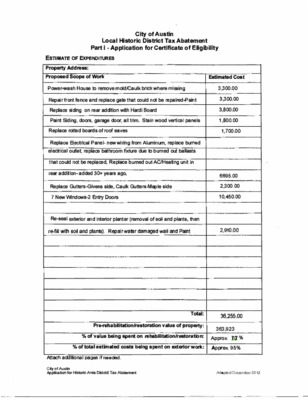
Local Historic Part I -Application City of Austin District for Certificate Tax Abatement of Eligibility ESTIMATE OF EXPENDITURES Property Address: Proposed Scope of Work Estimated Cost Power-wash House to remove mold/Caulk brick where missing 3,300.00 Repair front fence and replace gate that could not be repaired-Paint 3,300.00 Replace siding on rear addition with Hardi Board 3,800.00 Paint Siding, doors, garage door, all trim. Stain wood vertical panels 1,800.00 Replace rotted boards of roof eaves 1,700.00 Replace Electrical electrical outlet, replace Panel-new wiring from Aluminum, replace burned bathroom fixture due to burned out ballasts that could not be replaced, Replace burned out AC/Heating unit in rear addition- added 30+ years ago, 6695.00 Replace Gutters-Givens side, Caulk Gutters-Maple side 2,300.00 7 New Windows-2 Entry Doors 10,450.00 Re-seal exterior and interior planter (removal of soil and plants, then re-fill with soil and plants). Repair water damaged wall and Paint 2,910.00 Pre-rehabilitation/restoration value of property: 363,923 % of value being spent on rehabilitation/restoration: Approx. 7.710 % Total: 36,255.00 % of total estimated .. Attach addIt1onal pages ,f needed. costs being spent on exterior work: Approx. 95% City of Austin Application for Historic Area District Tax Abatement Adopted December 2012 Nathaniel Bennett -�. General Contractor 11 00 Blackjack TX 78664 Lockhart, Bill To: Pat Calhoun 2401 Givens Ave Austin Tx DATE: INVOICE# FOR: May 20, 2021 1553 DESCRIPTION AMOUNT power wash house , caulk where brick is missing repair front fence and replace gate that couldn't be repaired -paint replace siding on rear addition with hardi-board paint siding, doors, garage.all trim. Stain wood vertical panels replace rotting boards of roof eaves -� out AC/Heating unit in rear addition- added 30+ years ago replace gutters-Givens side, caulk gutters Maple side 7 new windows - 2 entry doors 3,300.00 3,300.00 3,800.00 1,800.00 1,700.00 2,300.00 10,450.00 replace electrical panel -new wiring from aluminum, replace outlet burned electrical 6,695.00 replace bathroom fixture due to burned ballast that couldn't be replaced, replace burned reseal exterior and interior planter( removal of soil and plants, refill with soil and plants 2,910.00 1 TOT AL $ 36,255.00 Make all checks payable concerning If you have any questions to: Nathaniel contact: this invoice, Bennett Nathaniel Bennett, THANK YOU FOR YOUR BUSINESS!
Versión en español a continuación. Historic Landmark Commission Meeting Monday, May 24th, 2021, 6:00 PM Historic Landmark Meeting to be held May 24th, 2021 with Social Distancing Modifications Public comment will be allowed via telephone; no in-person input will be allowed. All speakers must register in advance (Sunday, May 23rd by noon). All public comment will occur at the beginning of the meeting. To speak remotely at the May 24th Historic Landmark Commission Meeting, members of the public must: Call or email the board liaison at (512) 974-3393 or preservation@austintexas.gov no later than noon, Sunday, May 23 (the day before the meeting). The following information is required: speaker name, item number(s) they wish to speak on, whether they are for/against/neutral, email address and telephone number (must be the same number that will be used to call into the meeting). Once a request to speak has been made to the board liaison, the information to call on the day of the scheduled meeting will be provided either by email or phone call. Speakers must call in at least 15 minutes prior to meeting start time in order to speak, late callers will not be accepted and will not be able to speak. Speakers will be placed in a queue until their time to speak. Handouts or other information may be emailed to preservation@austintexas.gov by noon the day before the scheduled meeting. This information will be provided to Board and Commission members in advance of the meeting. If the meeting is broadcast live, it may be viewed here: http://www.austintexas.gov/page/watch-atxn-live Reunión del Historic Landmark Commission FECHA de la reunion (24 de mayo, 2021) La junta se llevará con modificaciones de distanciamiento social Se permitirán comentarios públicos por teléfono; no se permitirá ninguna entrada en persona. Todos los oradores deben registrarse con anticipación (23 de mayo, 2021 antes del mediodía). Todos los comentarios públicos se producirán al comienzo de la reunión. Para hablar de forma remota en la reunión, los miembros del público deben: Llame o envíe un correo electrónico al enlace de la junta en (512) 974-3393 or preservation@austintexas.gov a más tardar al mediodía (el día antes de la reunión). Se requiere la siguiente información: nombre del orador, número (s) de artículo sobre el que desean hablar, si están a favor / en contra / neutral, dirección de correo electrónico (opcional) y un número de teléfono …
M E M O R A N D U M TO: FROM: DATE: Historic Landmark Commission Historic Preservation Office staff January 8, 2021; updated June 25, 2021 SUBJECT: Demolition or relocation permit applications for property owned by religious organizations Texas Local Government Code § 211.0165 provides municipal authority for historic landmark designation. In 2019, the Texas Legislature amended that authority through House Bill 2496, 86 (R). In addition to introducing a supermajority requirement for landmark designation over owner objection, the bill provided that property owned by a religious organization may not be designated without owner consent. Subsection (b) states: If the property is owned by an organization that qualifies as a religious organization under Section 11.20, Tax Code, the municipality may designate the property as a local historic landmark only if the organization consents to the designation [emphasis added]. A religious organization under Section 11.20 of the Tax Code is defined as one that is organized and operated primarily for the purpose of engaging in religious worship or promoting the spiritual development or well-being of individuals; is operated in a way that does not result in accrual of distributable profits, realization of private gain resulting from payment of compensation in excess of a reasonable allowance for salary or other compensation for services rendered, or realization of any other form of private gain; and must use its assets in performing the organization’s religious functions or the religious functions of another religious organization; and by charter, bylaw, or other regulation adopted by the organization to govern its affairs direct that on discontinuance of the organization by dissolution or otherwise the assets are to be transferred to this state, the United States, or a charitable, educational, religious, or other similar organization that is qualified as a charitable organization under the IRS Code of 1954. Most active churches qualify as religious organizations under the Texas Tax Code and are therefore subject to the provisions of § 211.0165 of the Local Government Code. Demolition and relocation permits for properties without historic designation Under Land Development Code § 25-11-213, Historic Preservation Office staff reviews all applications for demolition or relocation permits for properties that are at least fifty years of age. The purpose of this review is to determine if a property may meet the criteria for designation as a historic landmark and thus should be referred to the Historic Landmark Commission for a public hearing. …
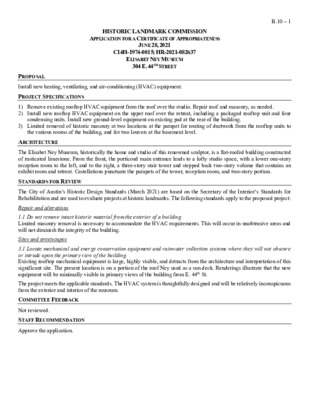
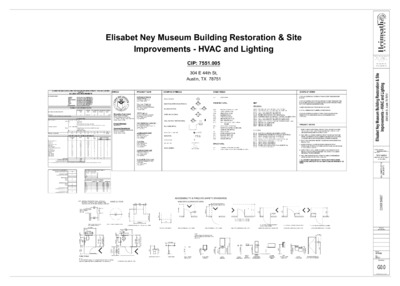
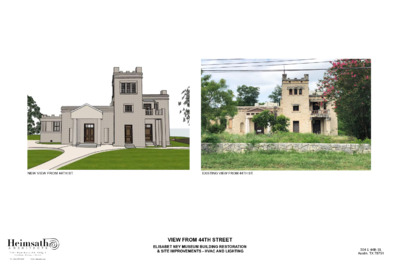
HISTORIC LANDMARK COMMISSION APPLICATION FOR A CERTIFICATE OF APPROPRIATENESS JUNE 28, 2021 C14H-1974-0015; HR-2021-082637 ELISABET NEY MUSEUM 304 E. 44TH STREET B.10 – 1 PROPOSAL PROJECT SPECIFICATIONS Install new heating, ventilating, and air-conditioning (HVAC) equipment. 1) Remove existing rooftop HVAC equipment from the roof over the studio. Repair roof and masonry, as needed. 2) Install new rooftop HVAC equipment on the upper roof over the retreat, including a packaged rooftop unit and four condensing units. Install new ground-level equipment on existing pad at the rear of the building. 3) Limited removal of historic masonry at two locations at the parapet for routing of ductwork from the rooftop units to the various rooms of the building, and for two louvers at the basement level. ARCHITECTURE STANDARDS FOR REVIEW Repair and alterations Sites and streetscapes The Elisabet Ney Museum, historically the home and studio of this renowned sculptor, is a flat-roofed building constructed of rusticated limestone. From the front, the porticoed main entrance leads to a lofty studio space, with a lower one-story reception room to the left, and to the right, a three-story stair tower and stepped back two-story volume that contains an exhibit room and retreat. Castellations punctuate the parapets of the tower, reception room, and two-story portion. The City of Austin’s Historic Design Standards (March 2021) are based on the Secretary of the Interior’s Standards for Rehabilitation and are used to evaluate projects at historic landmarks. The following standards apply to the proposed project: 1.1 Do not remove intact historic material from the exterior of a building. Limited masonry removal is necessary to accommodate the HVAC requirements. This will occur in unobtrusive areas and will not diminish the integrity of the building. 3.1 Locate mechanical and energy conservation equipment and rainwater collection systems where they will not obscure or intrude upon the primary view of the building. Existing rooftop mechanical equipment is large, highly visible, and detracts from the architecture and interpretation of this significant site. The present location is on a portion of the roof Ney used as a sun deck. Renderings illustrate that the new equipment will be minimally visible in primary views of the building from E. 44th St. The project meets the applicable standards. The HVAC system is thoughtfully designed and will be relatively inconspicuous from the exterior and interior of the museum. COMMITTEE FEEDBACK Not reviewed. STAFF RECOMMENDATION Approve the application. LOCATION MAP B.10 …
NEW VIEW FROM 44TH ST. EXISTING VIEW FROM 44TH ST. Heimsath A R C H I T E C T S 7 5 0 9 M a n c h a c a R d . B l d g 4 A u s t i n , T e x a s 7 8 7 4 5 Tel. (512) 478-1621 www.heimsath.com VIEW FROM 44TH STREET ELISABET NEY MUSEUM BUILDING RESTORATION & SITE IMPROVEMENTS - HVAC AND LIGHTING 304 E 44th St. Austin, TX 78751 NEW VIEW FROM SW EXISTING VIEW FROM SW Heimsath A R C H I T E C T S 7 5 0 9 M a n c h a c a R d . B l d g 4 A u s t i n , T e x a s 7 8 7 4 5 Tel. (512) 478-1621 www.heimsath.com VIEW FROM SW ON 44TH ST ELISABET NEY MUSEUM BUILDING RESTORATION & SITE IMPROVEMENTS - HVAC AND LIGHTING 304 E 44th St. Austin, TX 78751
B.4 – 1 HISTORIC LANDMARK COMMISSION APPLICATION FOR A CERTIFICATE OF APPROPRIATENESS MAY 24, 2021 C14H-1986-0015 GRANDBERRY BUILDING 907 CONGRESS AVENUE PROPOSAL PROJECT SPECIFICATIONS Review of a plan to deconstruct, store, and re-erect historic building façade. Catalog and store, then re-erect the historic building façades of the Grandberry Building, Mitchell-Robertson Building, and the building at 911 Congress Ave. as part of a redevelopment project at a later date. In conjunction with proposed additions, deconstruction and reconstruction of these façades has received approval from the Historic Landmark Commission on three separate occasions: September 25, 2006 (for 907 and 909 Congress Ave. only), January 26, 2015 (pending development of more detailed plans for treatment of the three façades), and June 25, 2018. See Prior Commission Action below. On March 24, 2021, the Building Standards Commission (BSC) issued an order requiring that conditions be remedied within 90 days or imposing fines on the property owner. The BSC orders are uploaded as backup to this meeting for reference. In discussion at the April 24, 2021 meeting, Commissioners suggested that the applicant determine if scaffolding erected for purposes of documenting and dismantling the façades would suffice for compliance with the BSC orders. The orders do not mention stabilization or bracing as options, and Code Department staff have confirmed that scaffolding would be insufficient to meet the requirements. Instead, the orders require repairs to fully remedy the violations, which include cracks and openings in exterior walls, roof and drainage issues, and missing windows, among other concerns. Per the applicant, stabilization and repair of the buildings in place is not technically feasible due to the extent of deterioration, including mortar loss, shear failures and racking, and the inability to adequately shore the façades following demolition of masonry party walls that provide lateral support. In particular, the wall abutting the Mutual Building, an adjacent historic landmark, requires demolition to allow that property owner to perform needed repairs. The proposed scope of work entails developing a detailed plan for deconstruction and reconstruction of the historic façades, including as an initial phase: review of existing documentation, visual and non-destructive analysis of building materials and assemblies, structural evaluation, and development of a finalized scope of work and sequence of implementation. Laser scanning has been performed, and analysis of the resulting point cloud is underway. Deconstruction will be done by hand and treated much like an archeological investigation, with specific conditions and …
June 4, 2021 Elizabeth Brummett Development Services Manager City of Austin - Historic Preservation Office Via Electronic Delivery Re: 907, 909, and 911 Congress Avenue – Historic Review Applications for three 0.845 acre pieces of property located at 907, 909, and 911 Austin, TX 78724 (the “Properties”) Dear Ms. Brummett: As representatives of the owner of the Properties and the buildings thereon (the “Buildings”), we respectfully submit the enclosed historic review application packages (the “Applications”). The Applications reflect our months-long effort to comply with directives from both the City of Austin Building and Standards (“BSC) Commission and Historic Landmark Commission (“HLC”). In the Fall of 2020, complaints were made to BSC regarding the condition of the Buildings, which led BSC to issue a secure façade order in February 2021. On February 12 and March 8, 2021, we made presentations to HLC’s Architectural Review Committee requesting that HLC provide direction as to how we could forward with the safe deconstruction of the Buildings, as any demolition permit requires HLC approval. After the façades were secured, BSC issued follow-up orders on March 24, 2021 requiring that all cited violations be corrected at the Buildings by June 22, 2021 (the “Orders”). The Orders include a requirement that we receive all necessary approvals from HLC. For your convenience, we have attached the Orders hereto as Exhibit A. At the March, April, and May HLC monthly meetings (the February meeting was cancelled due to weather), we presented our findings that we could not safely hold the Building façades in place while complying with the Orders. We have attached two letters from structural engineers stating as much hereto as Exhibits C and D. It is our restated position that compliance with the Orders while leaving any portion of the façades in place is impracticable. We bring these applications reflecting this position and plan to deconstruct and reconstruct the Buildings in a manner that respects and protects their historic nature as much as is reasonably possible. The applications packet includes a scope of work provided by Architect Donna Carter, which explains the extent of work contemplated to retain as much historic material as possible for all three buildings. 200 Lee Barton Drive, Suite 100 | Austin, Texas 78704 | 512-807-2900 | www.drennergroup.com Please let me know if you or your team members require additional information or have any questions. Thank you for your time and attention to …
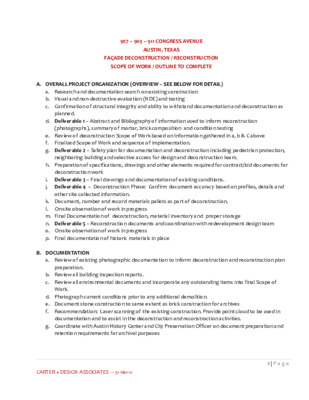
907 – 909 – 911 CONGRESS AVENUE AUSTIN, TEXAS FAÇADE DECONSTRUCTION / RECONSTRUCTION SCOPE OF WORK / OUTLINE TO COMPLETE A. OVERALL PROJECT ORGANIZATION (OVERVIEW – SEE BELOW FOR DETAIL) a. Research and documentation search on existing construction b. Visual and non‐destructive evaluation (NDE) and testing c. Confirmation of structural integrity and ability to withstand documentation and deconstruction as planned. d. Deliverable 1 – Abstract and Bibliography of information used to inform reconstruction (photographs), summary of mortar, brick composition and condition testing e. Review of deconstruction Scope of Work based on Information gathered in a, b & C above f. Finalized Scope of Work and sequence of implementation. g. Deliverable 2 – Safety plan for documentation and deconstruction including pedestrian protection, neighboring building and selective access for design and deconstruction team. h. Preparation of specifications, drawings and other elements required for contract/bid documents for deconstruction work i. Deliverable 3 – Final drawings and documentation of existing conditions. j. Deliverable 4 – Deconstruction Phase: Confirm document accuracy based on profiles, details and other site collected information. k. Document, number and record materials pallets as part of deconstruction. l. On‐site observation of work in progress m. Final Documentation of deconstruction, material inventory and proper storage n. Deliverable 5 – Reconstruction documents and coordination with redevelopment design team o. On‐site observation of work in progress p. Final documentation of historic materials in place B. DOCUMENTATION preparation. Work. a. Review of existing photographic documentation to inform deconstruction and reconstruction plan b. Review all building inspection reports. c. Review all environmental documents and incorporate any outstanding items into final Scope of d. Photograph current conditions prior to any additional demolition. e. Document stone construction to same extent as brick construction for archives f. Recommendation: Laser scanning of the existing construction. Provide point cloud to be used in documentation and to assist in the deconstruction and reconstruction activities. g. Coordinate with Austin History Center and City Preservation Officer on document preparation and retention requirements for archival purposes CARTER ● DESIGN ASSOCIATES ‐‐ 31‐Mar‐21 1 | P a g e C, D & E ARE DONE SIMULTANEOUSLY C. THE NON – DESTRUCTIVE EVALUATION (NDE) PROGRAM a. Determine logistics, fieldwork and site requirements. Work with contractor to determine scaffolding plan, safety procedures and building exposure strategies b. Confirm areas that are stable and can support further investigation c. Prior to deconstruction, expose representative areas of the structures for …
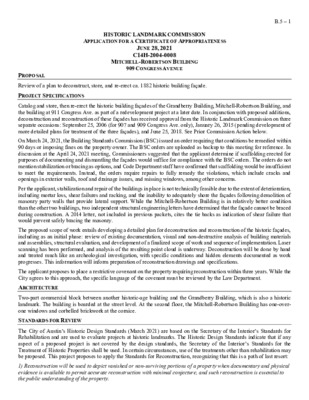
B.5 – 1 HISTORIC LANDMARK COMMISSION APPLICATION FOR A CERTIFICATE OF APPROPRIATENESS JUNE 28, 2021 C14H-2004-0008 MITCHELL-ROBERTSON BUILDING 909 CONGRESS AVENUE PROPOSAL PROJECT SPECIFICATIONS Review of a plan to deconstruct, store, and re-erect ca. 1882 historic building façade. Catalog and store, then re-erect the historic building façades of the Grandberry Building, Mitchell-Robertson Building, and the building at 911 Congress Ave. as part of a redevelopment project at a later date. In conjunction with proposed additions, deconstruction and reconstruction of these façades has received approval from the Historic Landmark Commission on three separate occasions: September 25, 2006 (for 907 and 909 Congress Ave. only), January 26, 2015 (pending development of more detailed plans for treatment of the three façades), and June 25, 2018. See Prior Commission Action below. On March 24, 2021, the Building Standards Commission (BSC) issued an order requiring that conditions be remedied within 90 days or imposing fines on the property owner. The BSC orders are uploaded as backup to this meeting for reference. In discussion at the April 24, 2021 meeting, Commissioners suggested that the applicant determine if scaffolding erected for purposes of documenting and dismantling the façades would suffice for compliance with the BSC orders. The orders do not mention stabilization or bracing as options, and Code Department staff have confirmed that scaffolding would be insufficient to meet the requirements. Instead, the orders require repairs to fully remedy the violations, which include cracks and openings in exterior walls, roof and drainage issues, and missing windows, among other concerns. Per the applicant, stabilization and repair of the buildings in place is not technically feasible due to the extent of deterioration, including mortar loss, shear failures and racking, and the inability to adequately shore the façades following demolition of masonry party walls that provide lateral support. While the Mitchell-Robertson Building is in relatively better condition than the other two buildings, two independent structural engineering letters have determined that the façade cannot be braced during construction. A 2014 letter, not included in previous packets, cites the tie backs as indication of shear failure that would prevent safely bracing the masonry. The proposed scope of work entails developing a detailed plan for deconstruction and reconstruction of the historic façades, including as an initial phase: review of existing documentation, visual and non-destructive analysis of building materials and assemblies, structural evaluation, and development of a finalized scope of work and sequence of …