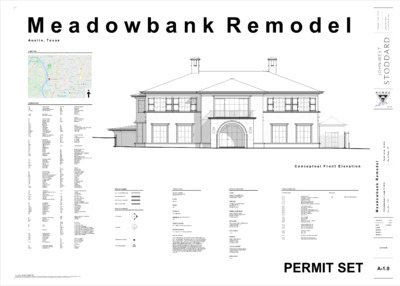
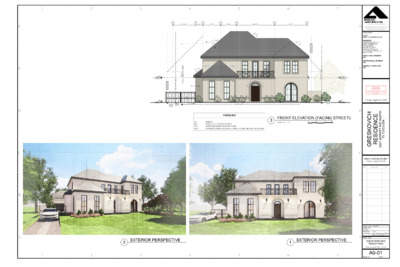
A u s t i n , T e x a s VICINITY MAP ABBREVIATIONS AD ADJ AFF APPROX BLDG BOB CB CJ CL CAB CLG CLKG CLO CNTR COL CONC CONSTR CONT CRPT CTR CTSK D DF DO DS DEPT DET DIA DIM DN DR DTL DW DWG DWR EG EXG EJ ELEV EQ EQUIP EXP EXT FA FD FF FFE FOC FOF FOS FDN FIN FLR FRZ FT FTG FURR GB GC GA GALV GL GND GR GWB HB HC HM HDW HDWD HDWR HNDCP HORIZ HR HT ID IN INSUL INT JST JT KIT LIN LB LAB LAM LAV LKR LT LTWT MC MO MECH AREA DRAIN ADJUSTABLE ABOVE FINISH FLOOR APPROXIMATE BUILDING BOTTOM OF BEAM CATCH BASIN CEILING JOIST CENTERLINE CABINET CEILING CAULKING CLOSET COUNTER COLUMN CONCRETE CONSTRUCTION CONTINUOUS CARPET CENTER OR COUNTER COUNTERSUNK DIAMETER DOUGLASS FIR DOOR OPENING DOWNSPOUT DEPARTMENT DETAIL DIAMETER DIMENSION DOWN DOOR DETAIL DISHWASHER DRAWING DRAWER EXISTING GRADE EXISTING EXPANSION ELEVATION EQUAL EQUIPMENT EXPOSED EXTERIOR FIRE ALARM FLOOR DRAIN FINISH FACE FINISH FLOOR ELEVATION FACE OF CONCRETE FACE OF FINISH FACE OF STUCCO FOUNDATION FINISH FLOOR FREEZER FOOT OR FEET FOOTING FURRING GRAB BAR GENERAL CONTRACTOR GAUGE GALVANIZED GLASS OR GLAZING GROUND GRADE GYPSUM WALL BOARD HOSE BIBB HANDICAP HOLLOW METAL HARDWARE HARDWOOD HARDWARE HANDICAP HORIZONTAL HOUR HEIGHT INTERIOR DESIGNER INCHES INSULATION INTERIOR JOIST JOINT KITCHEN LINEN CLOSET LEADER BOX LABORATORY LAMINATED LAVATORY LOCKER LIGHT LIGHTWEIGHT MEDICINE CABINET MASONRY OPENING MECHANICAL MFCTR MIN MIR MISC MTD MTL MUL N NIC NTS NOM O OC OD O/M OBS OPNG P TILE PL PLAM PW PLAS PW PRCST QB R RD RO R/F RR RAD REC REF REINF REQ'D REV RGTR RM S S TILE SC SD SS S.SK SCHED SEC SH SHWR SIM SPEC STD STL STOR STRUCT SYM T&G T TB TC TO TOB TOC TOD TOW TP TPD TRS TV TOW TEL TEMP TER THK TYP UNO UNF UR VERT VEST VIF VWB VWBD VWE VWID VWLA VWLD VWME VWO W WC WI WP W/ or W W/O WD WSCT WT N MANUFACTURER MINIMUM MIRROR MISCELLANEOUS MOUNTED METAL MULLION NORTH NOT IN CONTRACT NOT TO SCALE NOMINAL OVEN ON CENTER OUTSIDE DIAMETER/DIMENSION OVEN & MICROWAVE OBSCURE OPENING PORCELAIN TILE PLATE PLASTIC LAMINATE PLYWOOD PLASTER PLYWOOD PRE-CAST QUARRY BLOCK RISER OR RADIUS ROOF DRAIN ROUGH OPENING REFRIGERATOR - FREEZER ROOF RAFTER RADIUS RECOMMENDATION REFERENCE OR REFRIGERATOR REINFORCED REQUIRED REVISION REGISTER ROOM SOUTH …
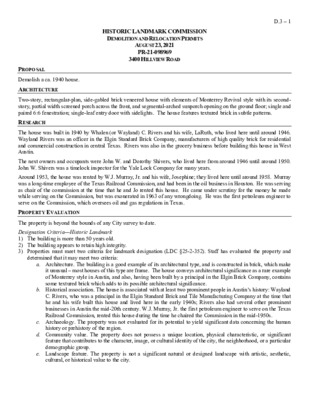
HISTORIC LANDMARK COMMISSION DEMOLITION AND RELOCATION PERMITS AUGUST 23, 2021 PR-21-098969 3400 HILLVIEW ROAD D.3 – 1 PROPOSAL Demolish a ca. 1940 house. ARCHITECTURE RESEARCH Two-story, rectangular-plan, side-gabled brick veneered house with elements of Monterrey Revival style with its second- story, partial width screened porch across the front, and segmental-arched sunporch opening on the ground floor; single and paired 6:6 fenestration; single-leaf entry door with sidelights. The house features textured brick in subtle patterns. The house was built in 1940 by Whalen (or Wayland) C. Rivers and his wife, LaRuth, who lived here until around 1946. Wayland Rivers was an officer in the Elgin Standard Brick Company, manufacturers of high quality brick for residential and commercial construction in central Texas. Rivers was also in the grocery business before building this house in West Austin. The next owners and occupants were John W. and Dorothy Shivers, who lived here from around 1946 until around 1950. John W. Shivers was a timelock inspector for the Yale Lock Company for many years. Around 1953, the house was rented by W.J. Murray, Jr. and his wife, Josephine; they lived here until around 1958. Murray was a long-time employee of the Texas Railroad Commission, and had been in the oil business in Houston. He was serving as chair of the commission at the time that he and Jo rented this house. He came under scrutiny for the money he made while serving on the Commission, but was exonerated in 1963 of any wrongdoing. He was the first petroleum engineer to serve on the Commission, which oversees oil and gas regulations in Texas. PROPERTY EVALUATION The property is beyond the bounds of any City survey to date. Designation Criteria—Historic Landmark 1) The building is more than 50 years old. 2) The building appears to retain high integrity. 3) Properties must meet two criteria for landmark designation (LDC §25-2-352). Staff has evaluated the property and determined that it may meet two criteria: a. Architecture. The building is a good example of its architectural type, and is constructed in brick, which make it unusual – most houses of this type are frame. The house conveys architectural significance as a rare example of Monterrey style in Austin, and also, having been built by a principal in the Elgin Brick Company, contains some textured brick which adds to its possible architectural significance. b. Historical association. The house is associated with …
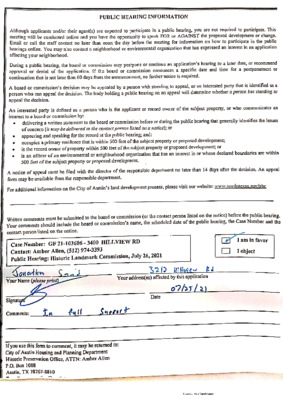
Allen, Amber From: Sent: To: Subject: Paul E. Stubbs, D.D.S. Sunday, July 25, 2021 11:53 AM PAZ Preservation Case Number: GF21-103606 - 3400 Hillview Rd *** External Email - Exercise Caution *** Amber Allen: I am IN FAVOR of demolition of the house at 3400 Hillview Road, 78703. Paul E. Stubbs, DDS Paul E. Stubbs, D.D.S. 3410 Hillview Rd. Austin Texas 78703 CAUTION: This email was received at the City of Austin, from an EXTERNAL source. Please use caution when clicking links or opening attachments. If you believe this to be a malicious and/or phishing email, please forward this email to cybersecurity@austintexas.gov. 1
Allen, Amber From: Sent: To: Subject: Paul and/or Virginia Stubbs Sunday, July 25, 2021 12:01 PM PAZ Preservation Case Number: GF 21-103606-34100 Hillview RD *** External Email - Exercise Caution *** Attn: Amber Allen, Public Hearing Historic Landmark Commission, July 26, 2021 I am in favor of the demolition of the house at 3400 Rd., Austin, TX 78703 Virginia Stubbs 3410 Hillview Road, Austin, TX 78703 CAUTION: This email was received at the City of Austin, from an EXTERNAL source. Please use caution when clicking links or opening attachments. If you believe this to be a malicious and/or phishing email, please forward this email to cybersecurity@austintexas.gov. 1
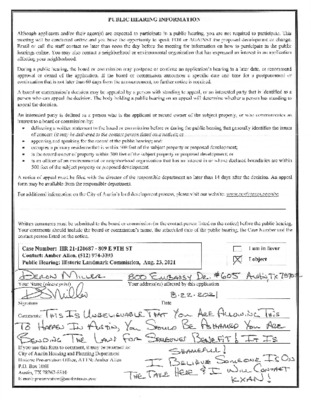
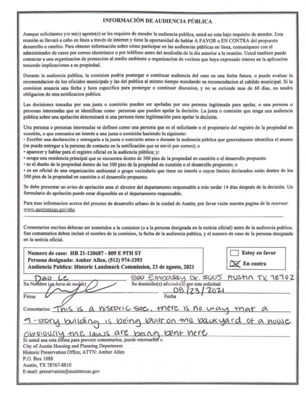
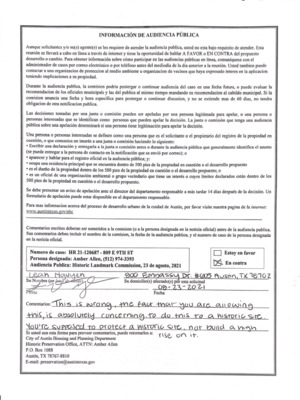
HISTORIC LANDMARK COMMISSION DEMOLITION AND RELOCATION PERMITS AUGUST 23, 2021 PR-2021-104341 800 W. 12TH STREET D.4 – 1 PROPOSAL Demolish a 1940 building. ARCHITECTURE Mid-century Modern Humble Oil & Refining Company service station. The flat-roofed building’s form consists of a central volume flanked by two angled wings. Horizontal banding extends along the top of the walls. The canopy over the gas pumps has been removed, leaving a gap in the banding and an angled brace supporting the remaining roof overhang at the central portion of the building. The walls are roughly textured stucco. The central door is flanked by partial height storefront windows, which are boarded over. On the front of each wing, three narrow windows are high on the walls. The end walls of the wings are infilled overhead door openings, with diagonal wood siding and stone added around the east opening. The back of the building is a solid wall without fenestration. RESEARCH This Humble Oil & Refining Company service station was constructed in 1940, simultaneous with the construction of Lamar Blvd. to the west and redevelopment of this portion of W. 12th St. from residences to neighborhood-scale commercial buildings. The Texas Department of Transportation’s (TxDOT) A Field Guide to Gas Stations in Texas, 2016 update, shows a smaller footprint as representative of Humble service stations built from 1940–1950. The typical design, with or without a canopy over the gas pumps, lacks the angled service bay wings of this building. Stucco or porcelain enamel metal panels as cladding and a red and blue band just below the roofline are common characteristics. PROPERTY EVALUATION The Historic Resources Survey for Old Austin Neighborhood Association (HHM, Inc., 2020) lists the property as contributing to a potential West Downtown Historic District, recommended as eligible for listing in the National Register of Historic Places and as a local historic district. This building is noted as lacking integrity for local landmark designation. Designation Criteria—Historic Landmark 1) The building is more than 50 years old. 2) The building retains a moderate degree of integrity. Alternations outside of the period of significance include removal of the canopy and infill of the overhead service doors. 3) Properties must meet two criteria for landmark designation (Land Development Code §25-2-352). Staff has evaluated the property and determined that it does not meet two criteria: a. Architecture. The building is a midcentury gas station more elaborate design than typical Humble …
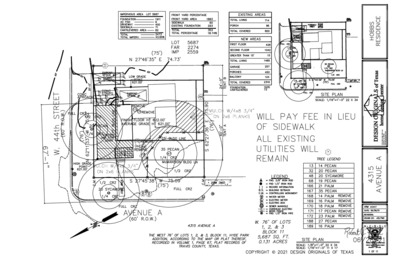
HISTORIC LANDMARK COMMISSION DEMOLITION AND RELOCATION PERMITS AUGUST 23, 2021 PR-21-103869 4315 AVENUE A D.5 – 1 Construct a two-story addition to a one-story house. PROPOSAL ARCHITECTURE RESEARCH The existing house is a small, one-story, rectangular-plan, board- and-batten frame house with a pyramidal roof and a partial- width inset porch; single and paired 4:4 fenestration.. The applicant has noted that the house is not structurally sound and that the board and batten siding appears to date from the 1980s. This very modest house was built around 1921 for a cabinet maker, later turned furniture salesman, and his wife, who worked as a drapery seamstress for a furniture store. Charles and Ethel Peck lived here from the date of construction of this house until around 1943, when they moved away. The next owners and occupants, Paul and Clara Krizov, lived here from around 1943 at least through the end of the 1950s. Paul Krizof was a machinist. PROPERTY EVALUATION The house is not within either the Hyde Park National Register Historic district nor the Hyde Park Local Historic District, so the Commission’s evaluation of this project is limited to whether the existing house qualifies as a historic landmark. Designation Criteria—Historic Landmark 1) The building is more than 50 years old. 2) The building appears to retain moderate integrity. 3) Properties must meet two criteria for landmark designation (LDC §25-2-352). Staff has evaluated the property and determined that it [does / may / does not] meet two criteria: a. Architecture. The building reflects vernacular working class housing in Austin in its small size, and board and batten siding. This house form was once very common in Austin, and even in Hyde Park, but remaining examples are in East and South Austin. b. Historical association. The property does not appear to have significant historical associations. During the historic period, the house was the home of two families: the Pecks and the Krizovs. Charles Peck was a salesman in a furniture store; his wife was a drapery seamstress for a furniture store. Paul Krizov was a machinist. c. Archaeology. The property was not evaluated for its potential to yield significant data concerning the human history or prehistory of the region. d. Community value. The property does not possess a unique location, physical characteristic, or significant feature that contributes to the character, image, or cultural identity of the city, the neighborhood, or a particular demographic …
HISTORIC LANDMARK COMMISSION DEMOLITION AND RELOCATION PERMITS AUGUST 23, 2021 PR-21-105009 2501 INWOOD PLACE D.6 – 1 PROPOSAL Demolish a ca/ 1948 house. ARCHITECTURE RESEARCH One-story, irregular plan, flat-roofed house with elements of International Style and mid-century Modern design; wood and stone veneer siding; large expanses of glass. The house was built in 1948-49 by Plan Con, a local building construction firm operated by Carl B. Morris, president of Materials Distributing Company (with Maurice W. Cole as vice-president, Russell Horn as secretary, and Ned Cole as treasurer (4601 E. 5th Street), Maurice W. Cole, the proprietor of Fabricon, which is listed as cabinet makers in the Austin city directories of the late 1940s, but which really manufactured pre-fabricated wall storage units, roof trusses and windows, and was a pioneer in home design and the efficiency of interior storage (4601 E. 5th Street); Carl Morris’ obituary noted that he was a real estate developer and home builder; Russell J. Horn, proprietor of Metal Equipment Company, welders (4607 E. 5th Street), and Ned A. Cole, a student in the School of Architecture at the University of Texas. Plan Con was listed in the 1949 city directory as building contractors, with offices at 4601 E. 5th Street. The firm was a collaboration of several GIs returning from World War II, and planned houses with prefabricated units and increased interior storage. Ned Cole, who presumably served as architect for the Plan Con houses in Austin, was also the architect of seven houses in the later Air Conditioned Village experiment in Austin (1954) and built homes throughout Central Texas. He moved to Baton Rouge, Louisiana in 1961, where he continued his long career, including serving as a consultant on the construction of the Louisiana Superdome in New Orleans. The house was owned and occupied by Hugh and Frances McMath from the time of its construction at least through the late 1950s. Hugh McMath was a renowned professor of architecture at the University of Texas, with a specialization in Mexican architecture. He was instrumental in introducing his students to the principles of Mexican architecture and worked to include Mexican architectural programs into the greater sphere of American architectural studies. PROPERTY EVALUATION The property is beyond the bounds of any City survey to date. Designation Criteria—Historic Landmark 1) The building is more than 50 years old. 2) The building appears to retain high integrity, although the applicant …
Allen, Amber From: Sent: To: Cc: Subject: Attachments: Importance: High Vincent Huebinger Wednesday, August 18, 2021 3:17 PM Sadowsky, Steve; Allen, Amber Dane Wilkins RE: Item D-6 2501 Inwood Demo Hugh McMath 1.JPG Steve, just left you and Amber a VM. It is indeed a very interesting house but we are not finding the Mid‐century modern aspects on 2501 Inwood based on the industry (architectural) standards. Yes there are some pronounced windows but no lines and angles established in this front elevation or roof. Most mid‐century modern houses built in 1950‐60’s had had lines with open spaces and pronounced split level roofs. The exterior wood is an odd combination and is not repairable. We are preparing some backup material for Landmark commissioners to try to emphasize the lack of element for this agenda. I have another hearing on Monday evening in Grand Prairie, therefore Dane Wilkins out of our office will be on the live line of the meeting. I am assuming that the postponement policy by staff will be granted (since it always is) and this is the last item on the agenda. Knowing the process, I believe you will be requesting postponements at the beginning of the hearing? We did find 2502 Inwood went to your landmark commission in 2018 and was allowed to be demo’d and rebuilt as a combination of mid‐century and eclectic. Others on that block were also demo’d. Regarding Hugh McMath, he was a very impressive tenured professor and acting director for a few years. The most we have found on him are his international trips to Monterrey, his thesis at MIT and some other articles. We can agree to postpone in light of your mention of Ned Cole and Plan con, which we did not discover in our research. The only thing we know about Ned Cole is that he may have been a student of Professor McMath. We also need to finish the structural walk Monday morning for the interior. From the exterior, Mike McIntyre has already found very disturbing damage & conditions, to be documented by the next hearing. We can include his preliminary exterior findings sometime tomorrow morning in the backup. According to his daughter, Hugh did not design the house. Let us know the best way we should proceed and your thoughts on if Laura Burkhart would benefit on having some architectural renderings available next month? She may be …
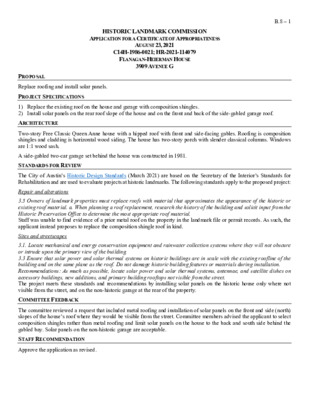
HISTORIC LANDMARK COMMISSION APPLICATION FOR A CERTIFICATE OF APPROPRIATENESS AUGUST 23, 2021 C14H-1986-0021; HR-2021-114079 FLANAGAN-HEIERMAN HOUSE 3909 AVENUE G B.8 – 1 PROPOSAL Replace roofing and install solar panels. PROJECT SPECIFICATIONS ARCHITECTURE 1) Replace the existing roof on the house and garage with composition shingles. 2) Install solar panels on the rear roof slope of the house and on the front and back of the side-gabled garage roof. Two-story Free Classic Queen Anne house with a hipped roof with front and side-facing gables. Roofing is composition shingles and cladding is horizontal wood siding. The house has two-story porch with slender classical columns. Windows are 1:1 wood sash. A side-gabled two-car garage set behind the house was constructed in 1981. STANDARDS FOR REVIEW The City of Austin’s Historic Design Standards (March 2021) are based on the Secretary of the Interior’s Standards for Rehabilitation and are used to evaluate projects at historic landmarks. The following standards apply to the proposed project: Repair and alterations Sites and streetscapes 3.5 Owners of landmark properties must replace roofs with material that approximates the appearance of the historic or existing roof material. a. When planning a roof replacement, research the history of the building and solicit input from the Historic Preservation Office to determine the most appropriate roof material. Staff was unable to find evidence of a prior metal roof on the property in the landmark file or permit records. As such, the applicant instead proposes to replace the composition shingle roof in kind. 3.1. Locate mechanical and energy conservation equipment and rainwater collection systems where they will not obscure or intrude upon the primary view of the building. 3.3 Ensure that solar power and solar thermal systems on historic buildings are in scale with the existing roofline of the building and on the same plane as the roof. Do not damage historic building features or materials during installation. Recommendations: As much as possible, locate solar power and solar thermal systems, antennae, and satellite dishes on accessory buildings, new additions, and primary building rooftops not visible from the street. The project meets these standards and recommendations by installing solar panels on the historic house only where not visible from the street, and on the non-historic garage at the rear of the property. COMMITTEE FEEDBACK The committee reviewed a request that included metal roofing and installation of solar panels on the front and side (north) slopes of …
Vincent Gerard & associates, inc. McMath House Property Evaluation 1) Age: Building permits put the construction of the house and the addition in the year 1948 and 1952 respectively, making this a 74-year-old home. 2) The buildings structural integrity has degraded quickly since McMath’s death in 1992. There are Trees that lean on the structure, patio support beams that have rotted and water damage on the garage I beam as seen in photos. (See structural engineer John McIntyre report exhibit B) 3) In our opinion this property meets one of the four proposed criteria for it to be determined for landmark designation. a. The architecture is a mix of three or more architectures and does not conform to the styles of International or Mid-century Modern as shown below. b. McMath and his wife Frances Marian, were a beloved member of the local University community hosting student study abroad trips to Monterey where the majority of Hugh’s study and design took place. Hugh makes note that the majority of his work was on documenting the influence of American Architecture on Mexico, not the other way around. Hugh was the interim director of the school of architecture during its transition from the school of engineering but was not the author of the movement merely the acting director and then the official director for 1 and for 5 years respectively. During McMath’s LAND PLANNING, DEVELOPMENT & ZONING CONSULTANTS 1715 SOUTH CAPITAL OF TEXAS HIGHWAY • SUITE 207 • AUSTIN, TEXAS 78746 VINCENTGERARD.COM • (512) 328-2693 tenure there were no news articles we discovered exhibiting his architectural prowess like what are seen by other Deans of the school of architecture, Deans who became Titians of the local Austin community. An example of a peer would be the following; c. There are no known prehistoric features on this .4-acre site located at the city’s core. d. The building does not possess a unique location, physical characteristic, or significant feature that contributes to the character image or cultural identity of the city, the neighborhood, or a particular demographic group. This building is barely visible to those off site. e. The landscape is very natural and has a great deal of erosion due to poor drainage of the property. Features of Mid-century Modern Architecture* • Glass and Large Windows • Straight and Flat Lines • Open and Split-Level Spaces • Minimal Ornamentation and Furniture with Many Built-Ins …
M E M O R A N D U M TO: FROM: DATE: Historic Landmark Commission Historic Preservation Office staff August 19, 2021 SUBJECT: Senate Bill 1585, 87th Legislature (Regular Session) Texas Local Government Code § 211.0165 provides authority for local historic designations, including landmarks and historic districts. In 2019, the Texas Legislature amended that authority through House Bill 2496, 86 (R), which introduced a supermajority requirement for landmark designation over owner objection. During the 2021 regular session, the Legislature passed Senate Bill 1585, 87 (R), which introduces two clarifying amendments to the supermajority requirement. This legislation goes into effect on September 1, 2021. Specification of a single commission to approve designations The 2019 legislation added a requirement that, unless a property owner consents, historic designation must be approved by a ¾ vote of the zoning, planning, or historical commission and a ¾ vote of the governing body of the municipality. The City of Austin interpreted this as requiring an affirmative vote of ¾ of the members of either the Historic Landmark Commission or land use commission (Planning Commission or Zoning and Platting Commission, as applicable), followed by an affirmative vote of ¾ of City Council to designate a property over the owner’s objection. For bodies with 11 members, this ¾ supermajority requires an affirmative vote of 9 members. The number of affirmative votes required may be reduced if there is a vacancy or recusal, but not in the case of an absence. The 2021 legislation clarifies that a municipality must specify a single commission as the entity with exclusive authority to approve historic designations. In Austin, this is the mission of the Historic Landmark Commission. As such, if a supermajority of Historic Landmark Commissioners do not vote to recommend historic zoning, the case will no longer advance to the land use commission for consideration. Conversely, if a supermajority does vote to recommend historic zoning, the case will follow the current process: it will be heard by the land use commission and, regardless of that commission’s recommendation, will advance to City Council for consideration. It is worth noting that no properties have received historic zoning over the owner’s objection during the two years these requirements have been in effect. Further, no cases that failed to reach a supermajority at the Historic Landmark Commission subsequently received a supermajority at the land use commission to advance the case to City Council. In …
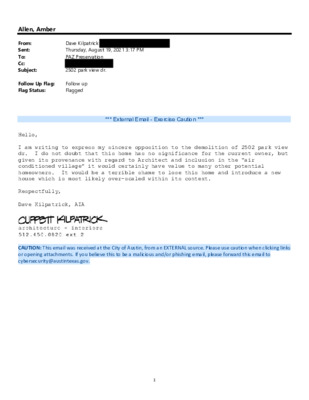
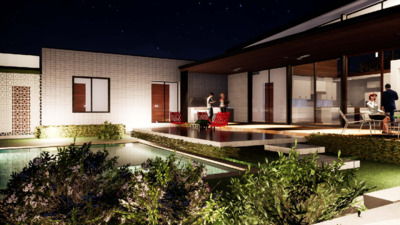
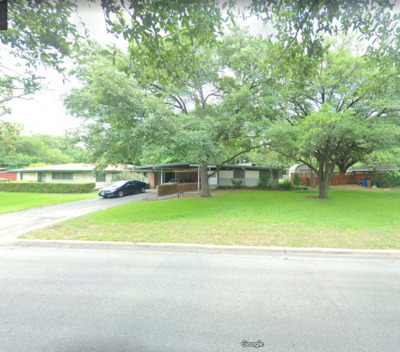
Allen, Amber From: Sent: To: Cc: Subject: Dave Kilpatrick Thursday, August 19, 2021 3:17 PM PAZ Preservation 2502 park view dr. Follow Up Flag: Flag Status: Follow up Flagged *** External Email - Exercise Caution *** Hello, I am writing to express my sincere opposition to the demolition of 2502 park view dr. I do not doubt that this home has no significance for the current owner, but given its provenance with regard to Architect and inclusion in the “air conditioned village” it would certainly have value to many other potential homeowners. It would be a terrible shame to lose this home and introduce a new house which is most likely over-scaled within its context. Respectfully, Dave Kilpatrick, AIA CAUTION: This email was received at the City of Austin, from an EXTERNAL source. Please use caution when clicking links or opening attachments. If you believe this to be a malicious and/or phishing email, please forward this email to cybersecurity@austintexas.gov. 1
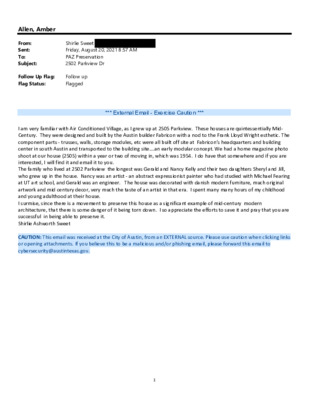
Allen, Amber From: Sent: To: Subject: Shirlie Sweet Friday, August 20, 2021 8:57 AM PAZ Preservation 2502 Parkview Dr Follow Up Flag: Flag Status: Follow up Flagged *** External Email - Exercise Caution *** I am very familiar with Air Conditioned Village, as I grew up at 2505 Parkview. These houses are quintessentially Mid‐ Century. They were designed and built by the Austin builder Fabricon with a nod to the Frank Lloyd Wright esthetic. The component parts ‐ trusses, walls, storage modules, etc were all built off site at Fabricon’s headquarters and building center in south Austin and transported to the building site….an early modular concept. We had a home magazine photo shoot at our house (2505) within a year or two of moving in, which was 1954. I do have that somewhere and if you are interested, I will find it and email it to you. The family who lived at 2502 Parkview the longest was Gerald and Nancy Kelly and their two daughters Sheryl and Jill, who grew up in the house. Nancy was an artist ‐ an abstract expressionist painter who had studied with Michael Fearing at UT art school, and Gerald was an engineer. The house was decorated with danish modern furniture, much original artwork and mid century decor, very much the taste of an artist in that era. I spent many many hours of my childhood and young adulthood at their house. I surmise, since there is a movement to preserve this house as a significant example of mid‐century modern architecture, that there is some danger of it being torn down. I so appreciate the efforts to save it and pray that you are successful in being able to preserve it. Shirlie Ashworth Sweet CAUTION: This email was received at the City of Austin, from an EXTERNAL source. Please use caution when clicking links or opening attachments. If you believe this to be a malicious and/or phishing email, please forward this email to cybersecurity@austintexas.gov. 1
3009 Bowman West Austin Case 1 Overview Request: Recommend against historic zoning. Code Criteria (Must Meet Two) 3009 Bowman Architecture Historic Association Archaeology Community Value Landscape Feature ? ? ✖ ✖ ✖ Staff Report: “[I]t is unlikely that Rev. Barclay would recognize the current building.” 2 A Question of Integrity: Architecture Staff Report: “[T]he new addition to the south dwarfs [the original part of the house] so there is a question of integrity here that the Commission needs to decide as to whether the house meets the architectural significance criterion at this point. 3 A Question of Integrity: Architecture Staff Report: “[I]t is unlikely that Rev. Barclay would recognize the current building as the home he and his wife occupied for over 20 years.” 4 Site Footprint 5 Original Significantly Altered Not Original Most of the façade is not original or is significantly altered. 6 Original Most of the façade is not original or is significantly altered. 7 Staff Report: “It is unlikely that Rev. Barclay would recognize the current building as the home he and his wife occupied for over 20 years.” 8 Staff Report: “It is unlikely that Rev. Barclay would recognize the current building as the home he and his wife occupied for over 20 years.” 9 Staff Report: “It is unlikely that Rev. Barclay would recognize the current building as the home he and his wife occupied for over 20 years.” 10 Staff Report: “It is unlikely that Rev. Barclay would recognize the current building as the home he and his wife occupied for over 20 years.” 11 Staff Report: “It is unlikely that Rev. Barclay would recognize the current building as the home he and his wife occupied for over 20 years.” 12 Staff Report: “It is unlikely that Rev. Barclay would recognize the current building as the home he and his wife occupied for over 20 years.” 13 Historic Association Historic Association: Rev. John Barclay • Pastor at Central Christian Church when LBJ was in the congregation. • Offered a prayer at the inauguration of LBJ/JFK (1961). Policy Questions for Consideration: • While Rev. Barclay, like many local leaders, knew LBJ, does this connection warrant historic designation? • If connection to LBJ is sufficient for historic designation, such a decision – when applied consistently – would likely result in designation (and tax exemption) for various other West Austin homes. 14 Condition: Lead Paint The …
Allen, Amber From: Sent: To: Subject: Carla Penny Saturday, August 21, 2021 3:04 PM PAZ Preservation GF-21-103669 *** External Email - Exercise Caution *** I support protecting this historic house in Allandale from demolition. It's a lovely example of mid‐century modernism in home design use of newly deployed technologies. This home deserves preservation. It is also reflective of the mid‐century vibe of this particular part of Allandale. It would be a terrible loss to our community if it were not preserved. I live in a 1954 house a few blocks to the north of this property and have managed to update the interior without destroying the original design and aesthetic of the house. I believe this is possible at 2502 Park View as well. I would hope a commercially viable solution could be found that preserves the character and design of this important structure. Carla Penny 2500 Albata Ave, Austin, TX 78757 CAUTION: This email was received at the City of Austin, from an EXTERNAL source. Please use caution when clicking links or opening attachments. If you believe this to be a malicious and/or phishing email, please forward this email to cybersecurity@austintexas.gov. 1
Historical Commission Case: A.2 • PR-2021-064188 Aug.23rd 2502 Park View Dr Joseph Reynolds 2611 West 49th Member Allandale Zoning Committee Commissioners, I support full historic recognition and designation for 2502 Park View. 2502 Park View was one of the experimental houses used to determine how residences could/should be air-conditioned. The experiment was to try various ways to install air conditioning, to determine what life effects it would have, to measure the electricity used to cool the houses - A/C was a change that resulted in housing booms in hot climate. Let me share my perspective. First, I have experience with experimental housing. During the mid-1960s I was leading a software effort at Tracor [Austin’s first ‘technology’ star and first ‘native’ Fortune-500 company] to use computer graphics to show what a future house would look like when inside/outside. At the time architects drew sketches of a building, and made detail ‘mechanical drawings’ of the structural elements. The computer graphics would be a big improvement over just showing a client plan-view drawings, and much cheaper than the sketches, or cardboard models in use. Computer graphics could be interactive. Tracor had professors from UT Architecture School consulting. That work got me involved in a 1969-1970 project called Ice City. Life-size experimental buildings were more useful than cardboard models, and could have ‘organic’ shapes. But, they needed to be discarded, and that was expensive disposal. So, Ice City would build the life-size models during freezing winter from ice-foam, which would just melt when the weather warmed. In 1970 we were doing what is now called 3-D Printing, but on a life-size scale. We also worked on ‘responsive rooms’ which was an attempt to have the building support activity occurring inside. We built instrumented rooms at what is now part of the Pickle Research center. My second perspective is that I’m old enough to have lived ‘before’ and ‘after’ air- conditioning. I was born December 1941. Our milkman in Dallas drove a horse-cart to deliver. By 1945 mom had a Servel brand ‘gas’ refrigerator; a little ‘pilot flame’ heated a bubble pump that compressed the refrigerant. To cool the house [best at night] there was a big fan in the ceiling of the hallway that sucked air in through the windows, and blew it out through the attic. The only cool buildings were department stores and movie theatres. Some still blew air across blocks of …
Allen, Amber From: Sent: To: Subject: Sheryl Kelly Ginsburgh Saturday, August 21, 2021 9:42 PM PAZ Preservation 2502 Park View Drive *** External Email ‐ Exercise Caution *** This was my home for 60 years. It has a gorgeous backyard. I was told that the new owners were not going to raze the house, and that was why it was sold to them. Maybe they re‐sold it and the new owners decided to raze it. The people who bought it from the builder got it for a good price because they said they were not going to tear it down. Again, maybe they re‐sold it. The home was old and did have issues. Please check City Council meeting records for details. One minute it was a Historical building, the next it wasn’t. PLEASE check Council Council meetings for the full story. Enter: 2502 Park View Drive, Austin Tx 78757 Austin City Council or some variation. It worked for me. It was a hotly debated topic. My vote is to try to keep the house and do necessary renovation. But I’m not the one paying for that!! Lots of good memories. The development was called Edge Wood because it truly was the outer limit of Austin! Please do not contact me. Sent from my iPhone CAUTION: This email was received at the City of Austin, from an EXTERNAL source. Please use caution when clicking links or opening attachments. If you believe this to be a malicious and/or phishing email, please forward this email to cybersecurity@austintexas.gov. 1
Allen, Amber From: Sent: To: Subject: Carolyn Croom Saturday, August 21, 2021 11:09 PM PAZ Preservation; Little, Kelly - BC; Koch, Kevin - BC; Tollett, Blake - BC; Featherston, Witt; Heimsath, Ben - BC; Wright, Caroline - BC; Valenzuela, Sarah - BC; McWhorter, Trey - BC; Castillo, Anissa - BC; Larosche, Carl - BC; Myers, Terri - BC Concerning 2502 PARK VIEW DRIVE (GF-21-10366) *** External Email - Exercise Caution *** Dear Members of the Historic Landmark Commission, I support preservation of the Mid‐Century Modern home at 2502 Park View Drive. As an excellent Modern residence, designed by a well‐known Austin architect, this house has significant historic and architectural value. In addition, it’s the best‐preserved home in the proposed Austin Air Conditioned Village Historic District and is also representative of the entire proposed District. The Austin Air Conditioned Village experiment was the first large‐scale and also largest project of test houses built in the 1950s to test the feasibility and affordability of air‐conditioning in homes affordable to middle‐class buyers. According to Preservation Austin, in comments to the Historical Landmark Commission, the Air Conditioned Village was not only a nationally‐significant study but also "an internationally‐renowned experiment in building innovation and social science." The residence is definitely the most modern in its design of the Air Conditioned Village houses, closest to the International Style of architecture and Arts & Architecture magazine’s Case Study houses, with a nearly flat roof and a very simple, clean execution. Other elements of mid‐century design in the house include site‐specific passive cooling strategies, clerestory windows, exposed roof beams, an asymmetrical, paneled facade, and distinctive patterned‐brick screening walls. The house is an early, outstanding example of architect Fred Day, who made a substantial contribution to Austin’s development. According to Preservation Austin, his "involvement in this high‐profile, and much celebrated project was an early victory in his 40‐year career.” A graduate of the UT School of Architecture, his contributions include the award‐winning Faulk Central Library, the Teachers Retirement System of Texas building, the Austin Doctors Building, the pro‐bono master plan and drawings for Laguna Gloria, and renovations to the UT Law School and Student Union. Notable buildings he designed outside Austin include the Visitors Center at the McDonald Observatory and the Hooper‐Schaeffer Fine Arts Center at Baylor University. He was president of AIA Austin and awarded an honorary Life Membership on the UT School of Architecture Advisory Council. He …
Allen, Amber From: Sent: To: Subject: Kevin Smith Sunday, August 22, 2021 12:01 PM PAZ Preservation 2502 Park View Dr Demo Permit *** External Email - Exercise Caution *** Commissioners and City Staff, I am writing today to express my support in preserving 2502 Park View Dr. This is a unique home, not only for its excellent architecture (which was designed by local architect Fred Day); or it exceeding the requirement to meet two of the five criteria for local landmark status. It is unique in that this proposed local landmark has National significance through its association with the Austin Air Condition Village experiment which was sponsored in part by the American Association of Homebuilders and the results of the Village help guide Federal lending practices to provide mortgages to homes with air conditioning. In addition to help preserve this home; it will also help preserve an affordable home. The last redevelopment that occurred on Park View Dr, sold for almost 5 times its original purchase price. I believe doing a partial rehabilitation of the home’s historic features coupled with the using entitlements offered through the code, to build a substantial addition (sympathetic to the design of the home) is a win‐win scenario and would offer a buyer a truly unique one of a kind property. Respectfully, Kevin Smith 2500 Park View Dr CAUTION: This email was received at the City of Austin, from an EXTERNAL source. Please use caution when clicking links or opening attachments. If you believe this to be a malicious and/or phishing email, please forward this email to cybersecurity@austintexas.gov. 1
Allen, Amber From: Sent: To: Kevin Smith Sunday, August 22, 2021 12:03 PM PAZ Preservation *** External Email - Exercise Caution *** Commissioners and City Staff, As we are back in COVID‐19 Stage 5 restrictions, the volunteers and I did not feel it was prudent to potentially risk exposure by collecting signatures opposing the demolition of 2502 Park View Dr in person. Instead, like a lot of other things during the pandemic we turned to digital solution. We created a change.org petition, to help safely gather signatures. We also asked for the signatures of the petition to include their zip code so we have an idea of where the support for saving this potential local landmark with national significance. An added benefit of collecting signatures in this manner is it dove‐tails nicely with one of Local Landmark Criteria‐ Community Value. From the over 450 signatures of the petition, Thank you for your time and consideration. Kevin Attachments (2) CAUTION: This email was received at the City of Austin, from an EXTERNAL source. Please use caution when clicking links or opening attachments. If you believe this to be a malicious and/or phishing email, please forward this email to cybersecurity@austintexas.gov. 1 Name Carolyn Croom City Austin Megan Jones-Smith Austin 78756 US 78757-2103 US TX TX State Postal Code Country Commented Date 8/18/2021 8/18/2021 Comment "I live a few blocks away, at the same zip code as this wonderful home, 78757!" "We are already losing too much of Austin’s history in the push to develop and grow." Joe Reynolds Austin TX 78731 US 8/18/2021 "The houses of Air Conditioned Village are iconic artifacts of an important study, how to effectively include air-conditioning in single family homes. At the time of the study, air conditioning was limited to large places, like department stores, or movie theaters. Freon? Ammonia was the fluid used. Water cooling towers were needed to condense and recycle the refrigerant. How best to dispense the cool air around the house? How to insulate? There were many architecture and engineering issues. After the experiment more modern systems were designed, no more water towers; costs fell, soon A/C could fit into a window. The southern climate was conquered and life there changed.The houses are the equivalent of 1800s steam locomotives, or early 1900s airplanes, or 1958 transistors. They deserve national recognition and publicity." "This was a time in our country when hope and …
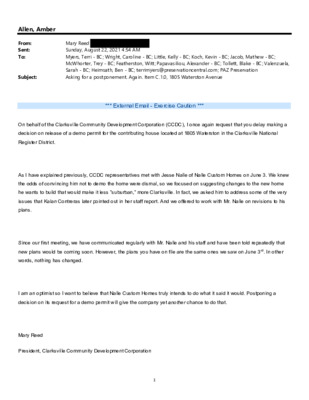
Allen, Amber From: Sent: To: Subject: Mary Reed Sunday, August 22, 2021 4:54 AM Myers, Terri - BC; Wright, Caroline - BC; Little, Kelly - BC; Koch, Kevin - BC; Jacob, Mathew - BC; McWhorter, Trey - BC; Featherston, Witt; Papavasiliou, Alexander - BC; Tollett, Blake - BC; Valenzuela, Sarah - BC; Heimsath, Ben - BC; terrimyers@preservationcentral.com; PAZ Preservation Asking for a postponement. Again. Item C.1.0, 1805 Waterston Avenue *** External Email - Exercise Caution *** On behalf of the Clarksville Community Development Corporation (CCDC), I once again request that you delay making a decision on release of a demo permit for the contributing house located at 1805 Waterston in the Clarksville National Register District. As I have explained previously, CCDC representatives met with Jesse Nalle of Nalle Custom Homes on June 3. We knew the odds of convincing him not to demo the home were dismal, so we focused on suggesting changes to the new home he wants to build that would make it less ”suburban,” more Clarksville. In fact, we asked him to address some of the very issues that Kalan Contreras later pointed out in her staff report. And we offered to work with Mr. Nalle on revisions to his plans. Since our first meeting, we have communicated regularly with Mr. Nalle and his staff and have been told repeatedly that new plans would be coming soon. However, the plans you have on file are the same ones we saw on June 3rd. In other words, nothing has changed. I am an optimist so I want to believe that Nalle Custom Homes truly intends to do what it said it would. Postponing a decision on its request for a demo permit will give the company yet another chance to do that. Mary Reed President, Clarksville Community Development Corporation 1 MR•PR Austin, TX 78703 Be Kind "I have decided to stick with love. Hate is too great a burden to bear." MLK CAUTION: This email was received at the City of Austin, from an EXTERNAL source. Please use caution when clicking links or opening attachments. If you believe this to be a malicious and/or phishing email, please forward this email to cybersecurity@austintexas.gov. 2