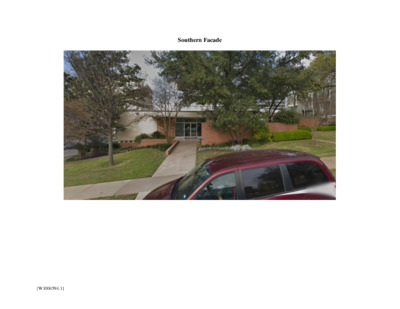
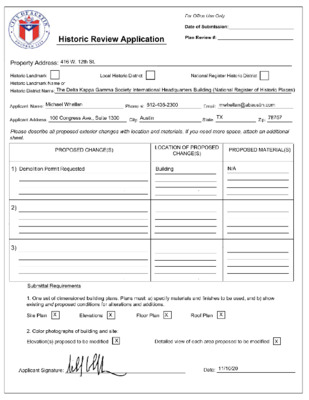
November 14, 2020 City of Austin Historic Landmark Commission Austin, Texas Dear Landmark Commission Members: Mid Tex Mod is the regional chapter of the nonprofit DOCOMOMO US, the American chapter of DOCOMOMO International advocating for modern design worldwide. We are committed to raising awareness of mid-century modern architecture in Central Texas. Our Mid Tex Mod Board of Directors opposes the demolition of the Delta Kappa Gamma building at 416 West 12th Street. The property is listed in the National Register of Historic Places under Criteria A and C, in the areas of education and architecture. The International-style Delta Kappa Gamma Building was designed in 1956 by noted Austin architectural firm, Kuehne Brooks & Barr, and its design respects and compliments the residential scale of the surrounding neighborhood. The building serves as the international headquarters of the Delta Kappa Gamma Society, founded in 1929 to support women in education. The property is recognized as a historically significant resource in the recently completed Old Austin Neighborhood Association Historic Resource Survey of Downtown Austin. The survey was grant funded through the Certified Local Government (CLG) Grant Program of the Texas Historical Commission and a Preservation Austin grant, and supported through the City of Austin’s Historic Preservation Office. The survey received a prestigious 2020 Preservation Merit Award from Preservation Austin. Mid Tex Mod strongly urges you to oppose the demolition of the architecturally and historically significant Delta Kappa Gamma Society International Headquarters Building at 416 West 12th Street. Sincerely, Elizabeth Porterfield, Board President Mid Tex Mod Post Office Box 1282 13 November 2020 Austin, TX 78767 www.originalaustin.org RE: 416 West 12th Street – demolition permit request City of Austin Historic Landmark Commission Austin, Texas Dear Historic Landmark Commission Members: The Old Austin Neighborhood Association (OANA) Board of Directors opposes the demolition of the property at 416 West 12th Street. Within OANA’s boundaries (Lamar to Lavaca; Ladybird Lake to 15th Street), there is a unique neighborhood of old and new buildings. We advocate for the restoration of significant historic properties and support compatible development that helps maintain the historic and residential character of our neighborhood. 416 West 12th Street is included in the West-Downtown-Historic-Survey also known as the Historic Survey of the Old Austin Neighborhood. This survey was funded OANA funded with the support of the Texas Historic Commission and the City of Austin through for a Certified Local Government Grant. 416 West 12th Street …
December 10, 2020 Dear Commissioners, As the president and executive director of The Delta Kappa Gamma Society International, we ask you to support our application for Downtown Mixed-Use (DMU) zoning for our property and to oppose historic zoning. Doing so would honor Delta Kappa Gamma’s work and legacy by empowering us to revitalize the organization and better position us to deliver on our mission and vision. Delta Kappa Gamma is a professional honor society whose grants and programs support women educators and students across the world. Our founder, Dr. Annie Webb Blanton, was a trailblazer for women’s rights in Texas. At a time when women faced extraordinarily high professional barriers, Dr. Blanton earned her doctorate, became the third woman ever promoted to the rank of professor at the University of Texas, and became the first woman ever elected to statewide office in Texas, as the State Superintendent of Public Instruction. Dr. Blanton founded Delta Kappa Gamma in 1929 as a way to organize women to fight gender discrimination, advocate for pro-education legislation, and assist women educators in their professional development. She initially founded our organization at the University of Texas at Austin’s campus, the first of five different locations from which we have operated. The office building in question for this case (at 416 W. 12th St.) is our fifth location. Dr. Blanton never saw this building; Delta Kappa Gamma moved into it over a decade after she passed away. While we have enjoyed working from this office space, the structure has become a major barrier to Delta Kappa Gamma’s continued health and stability. The building’s age and layout have made it nearly impossible to retrofit for modern technology, hampering our ability to improve the efficiency and effectiveness of our work, while the increasing cost of building maintenance is forcing us to divert critical resources. Historic zoning would lock in these barriers and escalating costs forever and deprive Delta Kappa Gamma of the ability to deploy one of our most important assets, the 416 W. 12th St. site. This is particularly important now, as Delta Kappa Gamma is at a critical juncture. Delta Kappa Gamma membership has declined since its peak in the 1990s and – as the organization’s leadership – we are actively working on strategies to revitalize Delta Kappa Gamma and ensure we can continue to deliver on Dr. Blanton’s vision of empowering women educators and students around …
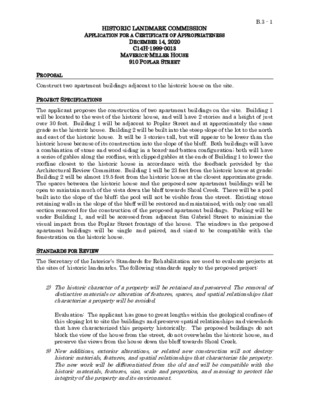
HISTORIC LANDMARK COMMISSION APPLICATION FOR A CERTIFICATE OF APPROPRIATENESS B.3 - 1 DECEMBER 14, 2020 C14H-1999-0013 MAVERICK-MILLER HOUSE 910 POPLAR STREET Construct two apartment buildings adjacent to the historic house on the site. PROPOSAL PROJECT SPECIFICATIONS The applicant proposes the construction of two apartment buildings on the site. Building 1 will be located to the west of the historic house, and will have 2 stories and a height of just over 30 feet. Building 1 will be adjacent to Poplar Street and at approximately the same grade as the historic house. Building 2 will be built into the steep slope of the lot to the north and east of the historic house. It will be 3 stories tall, but will appear to be lower than the historic house because of its construction into the slope of the bluff. Both buildings will have a combination of stone and wood siding in a board-and-batten configuration; both will have a series of gables along the roofline, with clipped gables at the ends of Building 1 to lower the roofline closest to the historic house in accordance with the feedback provided by the Architectural Review Committee. Building 1 will be 23 feet from the historic house at grade; Building 2 will be almost 19.5 feet from the historic house at the closest approximate grade. The spaces between the historic house and the proposed new apartment buildings will be open to maintain much of the vista down the bluff towards Shoal Creek. There will be a pool built into the slope of the bluff; the pool will not be visible from the street. Existing stone retaining walls in the slope of the bluff will be restored and maintained, with only one small section removed for the construction of the proposed apartment buildings. Parking will be under Building 1, and will be accessed from adjacent San Gabriel Street to minimize the visual impact from the Poplar Street frontage of the house. The windows in the proposed apartment buildings will be single and paired, and sized to be compatible with the fenestration on the historic house. STANDARDS FOR REVIEW The Secretary of the Interior’s Standards for Rehabilitation are used to evaluate projects at the sites of historic landmarks. The following standards apply to the proposed project: 2) The historic character of a property will be retained and preserved. The removal of distinctive materials or alteration of features, …
Maverick Miller House 910 Poplar Austin, 78705 City Council District: 9 H; LO; CO; NP : 211.5X158.5 APPROC OLT 59 DIVISION D Owner: Cater Joseph DC+CJ Poplar Street LLC 2402 MARLTON DR AUSTIN, TX 78703-3821 Legal Description Zoning: Request: Construct two apartment buildings adjacent to the Maverick Miller house, a locally designated landmark. The buildings are designed to be subordinate to the Maverick Miller house. Preservation Austin: Preservation Austin holds the restrictive covenant for the building (2006, amended 2020). The plans for the new buildings were developed with extensive consultation and input from Preservation Austin over a three year period. Preservation Austin established a committee of preservation professionals to work with the property owner on developing a rehabilitation plan and schedule for the Maverick Miller house and the plans for the new development. Over the three year period, numerous meetings were held to discuss and develop a suitable plan for the house and the new construction. Preservation Austin is providing a letter of support for the project. New construction is essential to maintain the viability of the Maverick Miller house. Preservation Austin understands that by negotiating a plan for new construction on the lot and amending the restrictive covenant, the Maverick Miller house will remain viable for the years to come. By not subdividing portions of the lot to be sold for development and working to develop an innovative solution, Preservation Austin and Cater Joseph have ensured the long term sustainability of the Maverick Miller house. Background: The Maverick Miller house, designated a City of Austin Historic Landmark in 1999, is a two story limestone house with a cross gable, hipped roof. Noted economist and University of Texas professor Edmund T. Miller (1878-1952) and his wife, Emily (1884-1979), an artist and member of the pioneer Maverick family of San Antonio, acquired this property in 1922. The design for their home was the work of Emily Miller, her nephew Edward Sammons Maverick, and architecture professor Raymond Everett. Built to complement the hillside setting and completed in 1923, the house features the work of metal craftsman Fortunat Weigl and retains many of its original landscaping features. The building is also a Recorded Texas Historic Landmark (2001) and it has been deemed eligible for the National Register. Preservation Austin holds a restrictive covenant on the property (2006; amended 2020). Project Development: The project was developed with extensive negotiations and input from Preservation Austin …
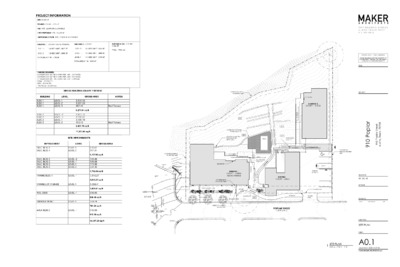
PROJECT INFORMATION SITE: 32,684 SF ZONING: LO-MU-H-CO-NP FAR: 70% - 22,878 SF ALLOWABLE FAR PROPOSED: 47% - 15,210 SF IMPERVIOUS COVER: 70% - 22,878 SF ALLOWABLE BUILDING 1 - 2 STORY ABOVE PARKING BUILDING 2 - 3 STORY LEVEL 1 - 1) 8 BED UNIT - 3827 SF LEVEL -2 - 1) 4 BED UNIT - 2474 SF LEVEL 2 - 1) 8 BED UNIT - 3958 SF LEVEL -1 - 1) 6 BED UNIT - 2998 SF TOTAL BEDS = 16 - 7785 SF LEVEL 1 - 1) 6 BED UNIT - 3179 SF TOTAL BEDS = 16 - 8651 SF EXISTING BLDG - 2 STORY 2,330 SF TOTAL BEDS = 6 PARKING REQUIRED: 3-6 BEDROOM UNITS@ 4 CARS PER UNIT = 12 SPACES 2-8 BEDROOM UNITS@ 5 CARS PER UNIT = 10 SPACES 1-4 BEDROOM UNIT @ 3 CARS PER UNIT = 3 SPACES TOTAL - 25 SPACES 80% = 20 SPACES PROVIDED - 22 SPACES GROSS BUILDING SQUARE FOOTAGE BUILDING LEVEL GROSS AREA NOTES BLDG 1 BLDG 1 BLDG 1 BLDG 2 BLDG 2 BLDG 2 BLDG 2 LEVEL 1 LEVEL 2 LEVEL 3 LEVEL -2 LEVEL -1 LEVEL 1 LEVEL 2 8,271.91 sq ft 3,826.65 3,957.83 487.43 2,473.35 2,997.81 3,180.49 430.13 9,081.78 sq ft 17,353.69 sq ft Roof Terrace Roof Terrace SITE IMPROVEMENTS IMPROVEMENT LEVEL GROSS AREA BALC. BLDG 1 BALC. BLDG 1 BALC. BLDG 2 BALC. BLDG 2 BALC. BLDG 2 BALC. BLDG 2 LEVEL 1 LEVEL 2 LEVEL -2 LEVEL -1 LEVEL 1 LEVEL 2 PARKING BLDG 1 LEVEL -1 5,810.27 PARKING LOT @ GRADE LEVEL 1 3,058.41 POOL DECK LEVEL -1 836.95 SIDEWALK BLDG 1 LEVEL 1 784.24 WALK BLDG 2 LEVEL -1 910.00 1,187.92 sq ft 820.61 367.31 543.46 389.68 575.96 260.36 1,769.46 sq ft 5,810.27 sq ft 3,058.41 sq ft 836.95 sq ft 784.24 sq ft 910.00 sq ft 14,357.25 sq ft CONTINUOUS FENCE @ PROPERTY LINE PROJECT ENTRY BUILDING 2 3 STORY - 18 BEDS 575' ALL EXISTING SITE WALLS TO REMAIN U.N.O. 580' PORTION OF EXISTING SITE WALL TO BE RELOCATED 585' 590' POOL RAMP DOWN MAX 1:12 ACCESSIBLE ROUTE 23'-0" RAMP DOWN MAX 1:12 W ALK W AY Y A W K L A W REAR ENTRY COVERED ENTRY @ POPLAR STREET BUILDING 1 2 STORY - 16 BEDS ABOVE PARKING EXISTING 2 STORY - 5 BEDS " 5 - ' 9 1 WALKWAY ACCESSIBLE ROUTE . 5 …
HISTORIC LANDMARK COMMISSION APPLICATION FOR A CERTIFICATE OF APPROPRIATENESS B.5 - 1 DECEMBER 14, 2020 C14H-2009-0026 BYRNE-REED HOUSE 1410 RIO GRANDE STREET Repair and stabilize the first floor porch at both corners pursuant to a Heritage Grant application. PROPOSAL PROJECT SPECIFICATIONS The applicant proposes to repair and stabilize the northeast and southwest corners of the first floor porch where there has been some deterioration of existing foundation structural members. At the northeast corner, the applicant proposes to remove the original lime- based slab, remove and clean historic encaustic tile, and install new steel anchors in the porch slabs and concrete steps. After pouring a new slab, the original encaustic tiles will be reinstalled; any that are missing or broken will be replaced with custom tiles to match the historic tiles. On the southwest corner, trapped moisture has caused decay in the wooden joists, causing them to collapse. Those joists will be replaced with a steel and pressure-treated wood floor support system. Historic skirting brick will be removed, cleaned, and re-installed. New cast iron foundation vents that match those existing on the house. A bronze floor drain with a scupper will be added to allow better drainage from the patio above. Historic encaustic tiles that are missing or broken will be replaced with custom-made tiles that match the original. STANDARDS FOR REVIEW The Secretary of the Interior’s Standards for Rehabilitation are used to evaluate projects on historic landmarks. The following standards apply to the proposed project: 5) Distinctive materials, features, finishes, and construction techniques or examples of craftsmanship that characterize a property will be preserved. Evaluation: Historic tiles and brick will be preserved; if any are missing or damaged, they will be replaced with custom-made materials to match the original. 6) Deteriorated historic features will be repaired rather than replaced. Where the severity of deterioration requires replacement of a distinctive feature, the new feature will match the old in design, color, texture, and, where possible, materials. Replacement of missing features will be substantiated by documentary and physical evidence. Evaluation: Only those materials damaged beyond repair will be replaced; all replacement materials will match historic fabric. The project meets the applicable standards. COMMITTEE FEEDBACK Not reviewed. STAFF RECOMMENDATION Approve as proposed. B.5 - 2
SUMMARY OF PROPOSED EXTERIOR WORK Humanities Texas completed a full restoration of the Byrne-Reed House in 2010. Over the past year, we observed changes at the northeast and southeast corners of the first floor porch, indicating loss of structural continuity—water retention, uneven surfaces, and displaced tiles. Humanities Texas engaged a structural engineer and historic preservation contractor to inspect the areas and assess underlying issues. The proposed exterior work described here will repair and stabilize the first floor porch at both corners and mitigate any future movement. Humanities Texas received a City of Austin Heritage Grant to undertake these repairs and has engaged James Nolan Construction as general contractor. NORTHEAST CORNER OF FIRST FLOOR PORCH Visual inspection confirmed that the northeast corner of the porch was originally constructed by pouring a lime-based slab over rock, sand, and dirt. The dirt and gravel base has destabilized over time due to the constant percussive ground disturbances from nearby traffic. To repair this issue, the contractor will remove the original lime-based slab and compact existing soil. Historic encaustic tiles will be carefully removed and cleaned, preserving as many as possible. New steel anchors will be installed into the adjacent porch slabs and concrete steps, and a new slab will be poured. Encaustic tiles will then be reinstalled. Tiles that are missing or broken will be replaced with new tiles custom made to match the original in fit, finish, and form. SOUTHWEST CORNER OF FIRST FLOOR PORCH Lack of venting under the southwest corner of the porch caused moisture trapped in the cavity below to decay the wooden floor joists installed during the 2010 restoration. These joists have collapsed into the cavity below, leaving this section of porch supported only by the surface tension of the historic concrete slab and encaustic tiles. These compromised joists will be removed and replaced with a steel and pressure-treated wood support system. In order to access the cavity under this section of porch, some historic brick will need to be removed. The bricks that must be removed from the skirting area will be carefully cleaned and reinstalled. New cast iron foundation vents will be added to allow for cross ventilation, which will discourage moisture accumulation and prevent any further compromise to wooden structural members. These cast iron vents will match in-kind with other cast iron vents on the house. The contractor will also add a bronze floor drain with …
HISTORIC LANDMARK COMMISSION APPLICATION FOR A CERTIFICATE OF APPROPRIATENESS B.8 - 1 DECEMBER 14, 2020 C14H-1982-0015 CLARK-EMMERT HOUSE 4300 AVENUE D PROPOSAL Remove a door and rooflet on the north side of the house and install siding over the opening; remove a door on the west side of the house and replace it with a window. The applicant also has proposed removing an asphalt shingle roof and replacing it with a standing seam roof, although that is not specified on this application. PROJECT SPECIFICATIONS The applicant proposes to remove a door and rooflet on the north side of the house (facing a fence) and install siding to match existing over the opening. On the west elevation of the house (facing the alley), the applicant proposes to remove a door and rooflet and install a double-hung wood window in its place that will match existing windows in size, configuration, materials, and dimensions. STANDARDS FOR REVIEW The Secretary of the Interior’s Standards for Rehabilitation are used to evaluate projects on historic landmarks. The following standards apply to the proposed project: 1) The historic character of a property will be retained and preserved. The removal of distinctive materials or alteration of features, spaces, and spatial relationships that characterize a property will be avoided. Evaluation: The doors proposed for removal may not have been original to the design of the house; removal of these doors do not constitute a distinctive material that characterize the house. 4) Changes to a property that have acquired historic significance in their own right will be retained and preserved. Evaluation: Neither of the doors proposed for removal are on the principal or visible elevations of the house 5) New additions, exterior alterations, or related new construction will not destroy historic materials, features, and spatial relationships that characterize the property. The new work will be differentiated from the old and will be compatible with the historic materials, features, size, scale and proportion, and massing to protect the integrity of the property and its environment. Evaluation: The applicant proposes siding to match existing to cover one door opening and a window to match existing to replace the other. The project meets the applicable standards. COMMITTEE FEEDBACK The Committee initially expressed concerns about the proposal to install a window in the door opening if there was no evidence of a window there, but then advised that the door-to- window replacement would be …
HISTORIC LANDMARK COMMISSION DECEMBER 14, 2020 PERMITS IN A NATIONAL REGISTER HISTORIC DISTRICT GF-20-180133 1510 PALMA PLAZA OLD WEST AUSTIN NATIONAL REGISTER HISTORIC DISTRICT C.11 - 1 PROPOSAL RESEARCH Demolish a ca. 1923 house that is contributing to the Old West Austin National Register Historic District. ARCHITECTURE One-and-a-half story, L-plan stuccoed cottage with clipped gables; single, paired, and triple 1:1 fenestration; shed-roofed cover over entry. The house was built in 1923 by A. Howard and Augusta Osburn, who lived here until around 1943. A. Howard Osburn was a proprietor with Murray and Niles Graham in the Enfield Insurance Agency, a branch of the Enfield Realty Company, which developed the Enfield subdivisions carved out of the old Pease Estate, and including this house. In the early 1930s, he joined the insurance firm of Millican and Hamby as a solicitor in the real estate department. In the mid-1930s, Augusta Osburn became the manager of the Austin Country Club after managing the downtown Austin Club for a number of years. The Osburns moved to the country club and rented this house for a short period of time, then moved back in, staying here until around 1943. Augusta Osburn, besides being the manager of two prestigious clubs in the city, also ran a lending library in the Renfro Drug Company store on W. 12th Street; the Renfro Drug Company was owned and operated by her family, and was one of the largest drug stores in the city with several locations downtown, on the west side, and near the university. Their main store was at 600 Congress Avenue, the site of the current CVS Drug Store at 6th Street and Congress Avenue. Howard Osburn was also involved in real estate development, including the Upland addition centering on Concordia Avenue just east of what is now IH-35 between Manor Road and E. 38th Street north of French Place. Howard and Augusta Osburn moved from this house to Tarrytown, where they spent the rest of their lives on Hopi Trail. From the early 1940s until the early 1960s, the house was rented as a single family residence to including an insurance agent, an employee of a women’s and children’s clothing store, and an owner of a car dealership. The house was converted to a duplex in 1962, and an additional housing unit was added in 1963 to make the property a tri-plex; city directories from the mid- …
1510 PALMA PLAZA OLD WEST AUSTIN NATIONAL REGISTER DISTRICT Austin, TX 78703 Date: December 10, 2020 PROPOSAL Demolish a triplex at 1510 Palma Plaza TABLE OF CONTENTS § Historic Designation Criteria § Previous Demolition Permits § Structural Engineering Report § Preliminary Report of Required Repairs § Proposed New Construction Sketches § Photos of Existing Structure (separate file) Historic Designation Criteria - LDC 25-2-352 1. The property is at least 50 years old as it was built in 1925 (per TCAD). 2. The property does not retain a high degree of integrity as it was altered from a single family home to a duplex in 1962 and then to a triplex in 1963 which included an extra driveway and two additional entrances. 3. Property must meet two historic designation criteria for landmark designation (LDC 25-2- 352). This property does not demonstrate significance according to City Code: a. ARCHITECTURE: The building contains a small degree of Spanish influences but it does not appear to be architecturally significant. b. HISTORICAL ASSOCIATION: A. Howard Osburn and Augusta Osburn occupied the property for approximately 20 years in the 1920s to 1940s. A. Howard Osburn worked in real estate and insurance but was not responsible for any notable innovation or significant civic service while living at the property. There does not appear to be significant historical associations. c. ARCHAEOLOGY: The property was not evaluated for its potential to yield significant data concerning the human history or prehistory of the region. d. COMMUNITY VALUE: The property does not appear to possess a unique location, physical characteristic, or significant feature that contributes to the character, image, or cultural identity of the community, Austin, or Texas as a whole. e. LANDSCAPE FEATURES: The property is not a significant natural or designed landscape with artistic, aesthetic, cultural, or historical value to the city. Previous Demolition Permits The meeting minutes from a 2006 Historic Landmark Commission meeting show that the Commission initiated the landmarking process but the motion failed. Subsequently, in 2006 and again in 2007, the City of Austin issued a demolition permit for 1510 Palma Plaza as illustrated below:
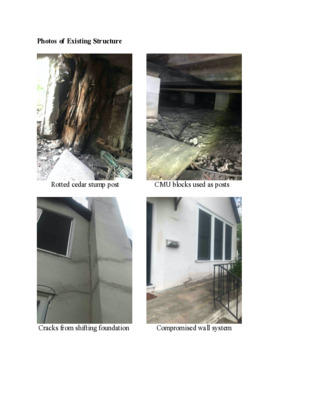
Photos of Existing Structure Rotted cedar stump post CMU blocks used as posts Cracks from shifting foundation Compromised wall system Front Facade West Facade East Facade Back
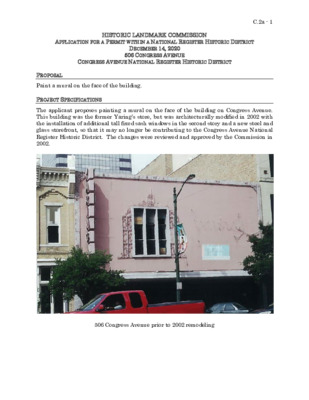
APPLICATION FOR A PERMIT WITHIN A NATIONAL REGISTER HISTORIC DISTRICT HISTORIC LANDMARK COMMISSION CONGRESS AVENUE NATIONAL REGISTER HISTORIC DISTRICT DECEMBER 14, 2020 506 CONGRESS AVENUE C.2a - 1 PROPOSAL Paint a mural on the face of the building. PROJECT SPECIFICATIONS The applicant proposes painting a mural on the face of the building on Congress Avenue. This building was the former Yaring’s store, but was architecturally modified in 2002 with the installation of additional tall fixed sash windows in the second story and a new steel and glass storefront, so that it may no longer be contributing to the Congress Avenue National Register Historic District. The changes were reviewed and approved by the Commission in 2002. 506 Congress Avenue prior to 2002 remodeling C.2a - 2 506 Congress Avenue after renovations Current photograph, December, 2020 (by staff) The proposed mural is large and colorful with a soccer motif. It was designed by renowned Spanish artist Ruben Sanchez; Here is his website https://www.iamrubensanchez.com C.2a - 3 STANDARDS FOR REVIEW The Secretary of the Interior’s Standards for Rehabilitation do not apply to artwork applied to buildings in historic districts, and the Commission has no specific guidelines or standards for proposed artwork. The mural could be removed in the future without damage to the structure. In her paper, “Historic Preservation Considerations for Murals,” Leigh Burns, the director of the Fox Theater Institute recommends that historic buildings should convey the historic message of the building and to take into consideration that murals affect the historic feel of the city and all the architecture within the district. The City of Milwaukee, Wisconsin’s Historic Preservation Commission in 2019 reviewed the following draft guidelines for murals on historic buildings: DRAFT – NOT AN APPROVED DOCUMENT Mural Guidelines for Historic Properties in the City of Milwaukee For the purposes of these guidelines, a “mural” shall be defined as an artistic work applied to an exterior surface of a pre-existing structure and that does not constitute a sign under 200-08-84 of the Milwaukee Code of Ordinances. I. APPLICATION REQUIREMENTS In addition to those materials usually required for Certificates of Appropriateness (CoA), applicants seeking a CoA for a mural on an historic property shall submit: a. Written approval from the property owner for the mural, provided the applicant is not the owner of the property. b. A record of ownership of the mural. c. A maintenance plan specifying care and the …
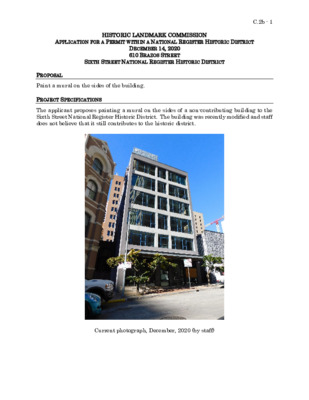
APPLICATION FOR A PERMIT WITHIN A NATIONAL REGISTER HISTORIC DISTRICT HISTORIC LANDMARK COMMISSION DECEMBER 14, 2020 610 BRAZOS STREET SIXTH STREET NATIONAL REGISTER HISTORIC DISTRICT C.2b - 1 PROPOSAL Paint a mural on the sides of the building. PROJECT SPECIFICATIONS The applicant proposes painting a mural on the sides of a non-contributing building to the Sixth Street National Register Historic District. The building was recently modified and staff does not believe that it still contributes to the historic district. Current photograph, December, 2020 (by staff) C.2b - 2 The proposed mural will be painted on the north wall of the building and the mechanical structure on the roof; it will slightly wrap around the sides of the front wall of the building. Like the proposed mural at 506 Congress Avenue, this mural was designed by renowned Spanish artist Ruben Sanchez; Here is his website https://www.iamrubensanchez.com STANDARDS FOR REVIEW The Secretary of the Interior’s Standards for Rehabilitation do not apply to artwork applied to buildings in historic districts, and the Commission has no specific guidelines or standards for proposed artwork. The mural could be removed in the future without damage to the structure. In her paper, “Historic Preservation Considerations for Murals,” Leigh Burns, the director of the Fox Theater Institute recommends that historic buildings should convey the historic message of the building and to take into consideration that murals affect the historic feel of the city and all the architecture within the district. C.2b - 3 The City of Milwaukee, Wisconsin’s Historic Preservation Commission in 2019 reviewed the following draft guidelines for murals on historic buildings: DRAFT – NOT AN APPROVED DOCUMENT Mural Guidelines for Historic Properties in the City of Milwaukee For the purposes of these guidelines, a “mural” shall be defined as an artistic work applied to an exterior surface of a pre-existing structure and that does not constitute a sign under 200-08-84 of the Milwaukee Code of Ordinances. I. APPLICATION REQUIREMENTS In addition to those materials usually required for Certificates of Appropriateness (CoA), applicants seeking a CoA for a mural on an historic property shall submit: II. DESIGN STANDARDS a. Written approval from the property owner for the mural, provided the applicant is not the owner of the property. b. A record of ownership of the mural. c. A maintenance plan specifying care and the parties responsible for the maintenance of the mural. Maintenance includes, but is not …
PERMITS WITHIN NATIONAL REGISTER HISTORIC DISTRICTS HISTORIC LANDMARK COMMISSION DECEMBER 14, 2020 GF-20-171451 1601 WOODLAWN BOULEVARD OLD WEST AUSTIN NATIONAL REGISTER HISTORIC DISTRICT C.4 - 1 PROPOSAL RESEARCH Demolish a ca. 1934 house and construct a single family residence in its stead. ARCHITECTURE The existing house is a one-story, roughly rectangular-plan, side-gabled frame cottage with a slightly projecting front-gabled bay to the left of the entry block; single 1:1 fenestration with a larger 1:1 window in the projecting front-gabled bay, which also features cornice ornamentation; hipped-roofed over-door hood; synthetic siding. The house was built around 1934 for Einer and Henrietta Juul, who lived here until around 1948. Einer Juul was a native of Denmark. At the time that he and Henrietta moved into this house from another house on Woodlawn Boulevard on the south side of Enfield Road, he was a teller at the American National Bank. In 1939, he resigned from the bank and opened his own real estate development firm with offices in the Littlefield Building. Einer Juul was the developer of Theodor Low Heights in South Austin, which was originally designed to be an upper-middle class residential neighborhood on the hills overlooking downtown far to the north. Theodor Low Heights was later subdivided into smaller lots and was fully developed in the 1940s and 1950s. Einer Juul was also renowned as a local bowler; many newspaper articles in the 1940s and 1950s noted his skills on the alley. The Juul family was related to the family of Dewitt C. Greer, long-time and prominent head of the Texas Highway Department. From this house, Einer and Henrietta Juul moved to a house on Spring Lane in Tarrytown. This house was then rented out, to a school teacher, and later to a professor who had previously worked as an engineering consultant to the Portland Cement Association. STAFF COMMENTS The house was listed with no priority for research in the Comprehensive Cultural Resources Survey (1984) and is listed as non-contributing to the Old West Austin National Register Historic District, although staff does not agree with that determination as this house retains its essential form and materials. Staff has evaluated this house for designation as a historic landmark and has determined that the house does not meet the criteria for landmark designation as set forth in City Code: a. Architecture. The house is a 1930s cottage that exhibits what appears to be …
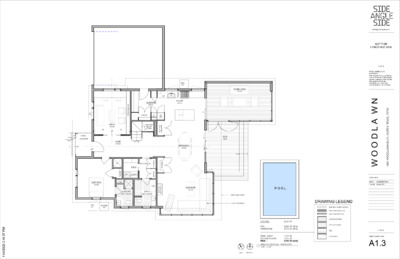
I G N V L E H S N E P O AE LIBRARY WOOD EQ EQ DW MUD/PANTRY WOOD PANTRY 24" FREEZE 30" REF. DRAWERS BELOW STAIRS T U O L L U P S R E W A R D 7 3/4" PORCH CONCRETE 7 3/4" 7 3/4" DN FOYER WOOD UP 17R DINING ROOM WOOD NEW A/C H S A R T KITCHEN WOOD SCREEN PORCH WOOD . . . PATIO DECK DN A/C BATH HALL UTILITY DRY WASH T E S O L C CAB. GUEST BATH NOT IN SCOPE BATH 1 NOT IN SCOPE E G A R O T S E G A R O T S M O O R B CAB. S A G W E N E C A L P E R F I GUEST ROOM WOOD NEW A/C EXISTING A/C : M P 7 3 : 4 4 2 0 2 0 2 4 / 1 1 / LIVING ROOM WOOD P O O L ROOF LINE ABOVE LINE OF ADDITION DRAWING LEGEND EXISTING CONSTRUCTION NEW CONSTRUCTION NEW CONCRETE WALL WOOD FLOORING WOOD DECKING TILE CONCRETE LOT SIZE: 8,257 SF FAR - IMPERVIOUS - ____________________________________________________ 3,302 SF (40%) 3,715 SF (45%) FIRST FLOOR - SECOND FLOOR - FINAL - 1,727 SF 1,540 SF 3,267 SF (40%) 1 FIRST FLOOR PLAN - PROPOSED 1/4" = 1'-0" TRUE PROJECT arthur@sideangleside.co NOT FOR CONSTRUCTION 11.04.18 FIELD INSPECTION REQUIRED Prior to performing any bidding, new construction, and/or repairs, general contractor shall visit the site, inspect all existing conditions, and report any discrepancies to the architect. N W A L D O O W 3 0 7 8 7 , S A X E T , I N T S U A , D V L B N W A L D O O W 1 0 6 1 ISSUE SETS DATE DESCRIPTION 11.04.18 BANK SET 11.04.18 FIRST FLOOR PLAN A1.3 STANDING SEAM, FLAT PAN METAL, 12" O.C. LINE OFROOF ABOVE " 0 - ' 2 H C N E B N I T L U B I BEDROOM 1 WOOD H C N E B BATH 2 TILE T E S O L C T E S O L C LINEN HALL WOOD OPEN TO BELOW 36" PONY WALL MEDICINE CABINETS T E S O L C T E S O L C 2 BEDROOM 2 WOOD J MED. CABINET IN 54" PONY …
HISTORIC LANDMARK COMMISSION DECEMBER 14, 2020 PERMITS IN NATIONAL REGISTER HISTORIC DISTRICT HR-20-179655 3219 FUNSTON STREET C.6 - 1 PROPOSAL RESEARCH Demolish a ca. 1947 house and construct a new two-story house in its place. ARCHITECTURE The existing house is a one-story, rectangular-plan, hipped-roof, frame house with a central, partial-width, hipped-roof, independent porch on paired plain wood posts; single and double fenestration. According to city building and utility permits, the house was built in 1947. The first owners ad occupants were Floyd E. and Arlene D. Wilder, who lived here at least through the end of the 1950s. Floyd E. Wilder was a plant operator for the Lower Colorado River Authority, but more importantly, was the “exalted ruler” of the Elks Lodge in Austin and was very active in Elks organization activities throughout the state in the 1950s and 1960s. Arlene D. Wilder was very active in the Benevolent Patriotic Order of Does, the women’s auxiliary of the Elks. She worked as a clerk in the State Employment Commission for many years. The Wilders eventually retired to Toledo Bend Reservoir, and spent the rest of their lives there in Sabine County. STAFF COMMENTS The house is outside the bounds of any city survey to date, but was listed as non-contributing to the Old West Austin National Register Historic District, although staff disagrees with that determination as the house exhibits its basic form and materials to a large degree. Staff has evaluated this house for designation as a historic landmark and has determined that the house does not meet the criteria for landmark designation as set forth in City Code: a. Architecture. The house is a post-World War II minimal traditional cottage with no architectural distinction. It does not qualify for landmark designation under the criterion for architecture. b. Historical association. The house was the long-time home of a couple who were very active in the Elks Lodge and its women’s auxiliary, but there do not appear to be significant historical associations that would qualify this house under the criterion for significant historical associations. c. Archaeology. The house was not evaluated for its potential to yield significant data concerning the human history or prehistory of the region. d. Community value. The house does not possess a unique location, physical characteristic, or significant feature that contributes to the character, image, or cultural identity of the city, the neighborhood, or a particular demographic …
HISTORIC LANDMARK COMMISSION DECEMBER 14, 2020 DEMOLITION AND RELOCATION PERMITS HDP-2020-0474 1402 DRAKE AVENUE D.10 - 1 PROPOSAL Demolish a ca. 1937 house. ARCHITECTURE RESEARCH One-story, rectangular-plan, side-gabled frame house with a front-gabled independent porch on battered posts and square piers; single and paired 1:1 fenestration. The house was built in 1937 by Paul Kirschner, a local contractor and financier, who also built the house next door at 1400 Drake Avenue. The first owners were Michael R. and Gladys E. Mason, who lived here in the late 1930s and again in the early 1940s, when they are listed as renters; they lived at other addresses in between their two tenancies in this house. Michael R. Mason is listed variously as an assistant attorney and stenographer for the State Board of Insurance Commissioners. Gladys Mason worked as a telephone operator for a dry cleaning establishment. She went on to work as a clerk in the State Board of Insurance Commissioners after moving to a house on W. 30th Street. Verner and Doris Magnuson purchased the house around 1943 and lived here until around 1955. Verner Magnuson was a railroad man, working as the city freight agent for the Southern Pacific Lines. He and Doris had lived in Houston before moving to Austin for his work, and after leaving this house, moved back to Houston. From the early 1960s through the mid-1970s, the house was owned and occupied by Cleo and Beulah Beshears; he ran a Texaco service station on South Congress Avenue before his retirement. STAFF COMMENTS The house was listed with no priority for research in the Comprehensive Cultural Resources Survey (1984), but is contributing to the pending Travis Heights National Register Historic District. Staff has evaluated this house for designation as a historic landmark and has determined that the house does not meet the criteria for landmark designation as set forth in City Code: a. Architecture. The house is represents a very intact example of 1930s residential design, which typifies many neighborhoods in greater Travis Heights. The house has been noted as contributing to the pending Travis Heights National Register Historic District, but by itself, reflects a common style with no architectural distinction. b. Historical association. The house was the home of several families, including that of a city railroad freight agent and the operator of a service station; apart from representing a style and size of residential architecture …
Gaudette, Angela From: Sent: To: Subject: Paula Kothmann < Friday, December 11, 2020 12:03 PM Paula Kothmann; PAZ Preservation D 10 1402 Drake Avenue request to postpone *** External Email - Exercise Caution *** Dear Commissioners: We have no info on this project This property is a contributing structure to our Travis Heights-Fairview Park National Register Historic District, of which I am a resident We respectfully request a postponement so that we can gather information Thank you for your consideration, Paula Kothmann ‐‐ Member, Board of Directors Texas Energy Council CAUTION: This email was received at the City of Austin, from an EXTERNAL source. Please use caution when clicking links or opening attachments. If you believe this to be a malicious and/or phishing email, please forward this email to cybersecurity@austintexas.gov. 1
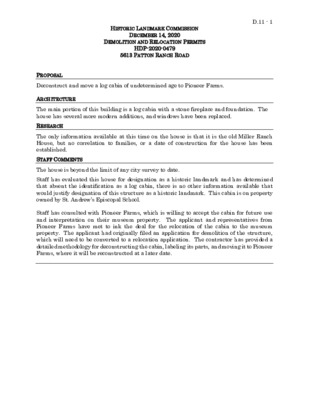
HISTORIC LANDMARK COMMISSION DECEMBER 14, 2020 DEMOLITION AND RELOCATION PERMITS HDP-2020-0479 5613 PATTON RANCH ROAD D.11 - 1 PROPOSAL RESEARCH Deconstruct and move a log cabin of undetermined age to Pioneer Farms. ARCHITECTURE The main portion of this building is a log cabin with a stone fireplace and foundation. The house has several more modern additions, and windows have been replaced. The only information available at this time on the house is that it is the old Miller Ranch House, but no correlation to families, or a date of construction for the house has been established. STAFF COMMENTS The house is beyond the limit of any city survey to date. Staff has evaluated this house for designation as a historic landmark and has determined that absent the identification as a log cabin, there is no other information available that would justify designation of this structure as a historic landmark. This cabin is on property owned by St. Andrew’s Episcopal School. Staff has consulted with Pioneer Farms, which is willing to accept the cabin for future use and interpretation on their museum property. The applicant and representatives from Pioneer Farms have met to ink the deal for the relocation of the cabin to the museum property. The applicant had originally filed an application for demolition of the structure, which will need to be converted to a relocation application. The contractor has provided a detailed methodology for deconstructing the cabin, labeling its parts, and moving it to Pioneer Farms, where it will be reconstructed at a later date. D.11 - 2 E-mail from contractor for relocation: Hi Tom and Brandon, After careful analysis of best methods to relocate the cedar log structure at 5613 Patton Ranch Rd, we have determined that the best method will be to disassemble and transport to Pioneer Farms for reassembly by Pioneer Farms staff. We have determined this best method due to the fragile nature of the structure built on a rock and mortar footing without a modern foundation that could be transported with the log structure. Disassembly will also give Pioneer Farms an opportunity to make necessary repairs which would likely require disassembly to achieve. D.11 - 3 DAR will remove the portion of the house and roof added and built around the cabin. All modern framing will be removed to isolate and expose the original walls of the cabin. The footprint and walls will be …
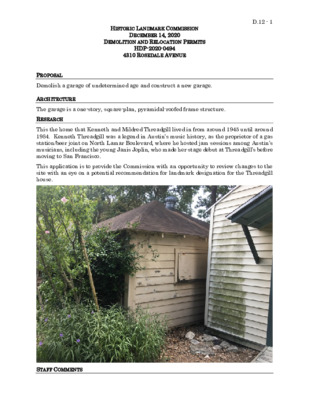
D.12 - 1 HISTORIC LANDMARK COMMISSION DECEMBER 14, 2020 DEMOLITION AND RELOCATION PERMITS HDP-2020-0494 4310 ROSEDALE AVENUE PROPOSAL RESEARCH Demolish a garage of undetermined age and construct a new garage. ARCHITECTURE The garage is a one-story, square-plan, pyramidal-roofed frame structure. This the home that Kenneth and Mildred Threadgill lived in from around 1945 until around 1984. Kenneth Threadgill was a legend in Austin’s music history, as the proprietor of a gas station/beer joint on North Lamar Boulevard, where he hosted jam sessions among Austin’s musicians, including the young Janis Joplin, who made her stage debut at Threadgill’s before moving to San Francisco. This application is to provide the Commission with an opportunity to review changes to the site with an eye on a potential recommendation for landmark designation for the Threadgill house. STAFF COMMENTS The house is beyond the limit of any city survey to date. Staff has evaluated this house for designation as a historic landmark and has determined that the house meets the criteria for landmark designation as set forth in City Code: D.12 - 2 a. Architecture. The house is a 1930s stone-veneered cottage that embodies a vernacular style and material that is increasingly rare in Austin. The original part of the house is intact, but it does have a dormer addition to the front roof that is compatible with the design of the house, as well as a two-story addition to the rear which is not visible from the street and does not affect the historic appearance of the house. Despite the modifications, the house satisfies the criterion for architectural significance. b. Historical association. The house was the long-time home of Kenneth and Mildred Threadgill, who lived here from the mid-1940s until the mid-1980s. Kenneth Threadgill is an icon in Austin music history as the proprietor of a service station and beer joint that offered music and provided an opportunity for young singers, such as Janis Joplin, to perform. The house qualifies for landmark designation for its associations with Kenneth Threadgill. c. Archaeology. The house was not evaluated for its potential to yield significant data concerning the human history or prehistory of the region. d. Community value. The house does not possess a unique location, physical characteristic, or significant feature that contributes to the character, image, or cultural identity of the city, the neighborhood, or a particular demographic group. e. Landscape feature. The property is not …
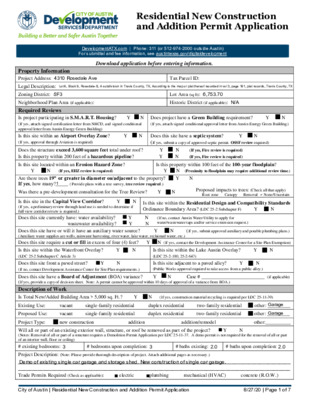
Residential New Construction and Addition Permit Application DevelopmentATX.com | Phone: 311 (or 512-974-2000 outside Austin) For submittal and fee information, see austintexas.gov/digitaldevelopment Download application before entering information. Property Information Project Address: Legal Description: Zoning District: Tax Parcel ID: Lot Area (sq ft): Historic District (if applicable): Neighborhood Plan Area (if applicable): Required Reviews Is project participating in S.M.A.R.T. Housing? Y N (If yes, attach signed certification letter from NHCD, and signed conditional approval letter from Austin Energy Green Building) Is this site within an Airport Overlay Zone? Y N (If yes, approval through Aviation is required) Does project have a Green Building requirement? Y N (If yes, attach signed conditional approval letter from Austin Energy Green Building) Does this site have a septic system? Y N (If yes, submit a copy of approved septic permit. OSSF review required) Does the structure exceed 3,600 square feet total under roof? Y N (If yes, Fire review is required) Is this property within 200 feet of a hazardous pipeline? Y N (If yes, Fire review is required) Is this site located within an Erosion Hazard Zone? Y N (If yes, EHZ review is required) Is this property within 100 feet of the 100-year floodplain? Y N (Proximity to floodplain may require additional review time.) Are there trees 19” or greater in diameter on/adjacent to the property? Y N If yes, how many?_____ ( Provide plans with a tree survey, tree review required.) Was there a pre-development consultation for the Tree Review? Y N Proposed impacts to trees: (Check all that apply) Root zone Canopy Removal None/Uncertain Is this site in the Capital View Corridor? Y N (If yes, a preliminary review through land use is needed to determine if full view corridor review is required.) Does this site currently have: water availability? Y N wastewater availability? Y N Does this site have or will it have an auxiliary water source? Y N (If yes, submit approved auxiliary and potable plumbing plans.) (Auxiliary water supplies are wells, rainwater harvesting, river water, lake water, reclaimed water, etc.) Does this site require a cut or fill in excess of four (4) feet? Y N (If yes, contact the Development Assistance Center for a Site Plan Exemption) Is this site within the Residential Design and Compatibility Standards Ordinance Boundary Area? (LDC 25-2 Subchapter F) Y N (If no, contact Austin Water Utility to apply for water/wastewater taps …
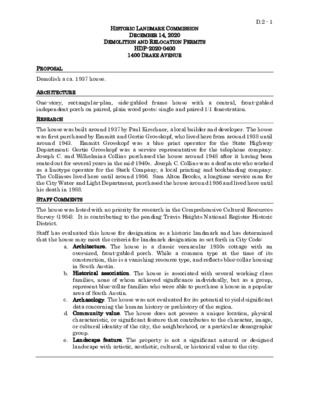
HISTORIC LANDMARK COMMISSION DECEMBER 14, 2020 DEMOLITION AND RELOCATION PERMITS HDP-2020-0400 1400 DRAKE AVENUE D.2 - 1 PROPOSAL Demolish a ca. 1937 house. ARCHITECTURE RESEARCH One-story, rectangular-plan, side-gabled frame house with a central, front-gabled independent porch on paired, plain wood posts; single and paired 1:1 fenestration. The house was built around 1937 by Paul Kirschner, a local builder and developer. The house was first purchased by Emmitt and Gertie Grosskopf, who lived here from around 1938 until around 1943. Emmitt Grosskopf was a blue print operator for the State Highway Department; Gertie Grosskopf was a service representative for the telephone company. Joseph C. and Wilhelmina Collins purchased the house around 1948 after it having been rented out for several years in the mid-1940s. Joseph C. Collins was a deaf mute who worked as a linotype operator for the Steck Company, a local printing and bookbinding company. The Collinses lived here until around 1956. Sam Alton Brooks, a longtime service man for the City Water and Light Department, purchased the house around 1956 and lived here until his death in 1988. STAFF COMMENTS The house was listed with no priority for research in the Comprehensive Cultural Resources Survey (1984). It is contributing to the pending Travis Heights National Register Historic District. Staff has evaluated this house for designation as a historic landmark and has determined that the house may meet the criteria for landmark designation as set forth in City Code: a. Architecture. The house is a classic vernacular 1930s cottage with an oversized, front-gabled porch. While a common type at the time of its construction, this is a vanishing resource type, and reflects blue-collar housing in South Austin. b. Historical association. The house is associated with several working class families, none of whom achieved significance individually, but as a group, represent blue-collar families who were able to purchase a house in a popular area of South Austin. c. Archaeology. The house was not evaluated for its potential to yield significant data concerning the human history or prehistory of the region. d. Community value. The house does not possess a unique location, physical characteristic, or significant feature that contributes to the character, image, or cultural identity of the city, the neighborhood, or a particular demographic group. e. Landscape feature. The property is not a significant natural or designed landscape with artistic, aesthetic, cultural, or historical value to the city. STAFF RECOMMENDATION …
Gaudette, Angela From: Sent: To: Cc: Subject: Paula Kothmann < Sunday, November 15, 2020 9:56 AM PAZ Preservation Gaudette, Angela; Angela Reed; Mary Janecek-Friedman; Clif Ladd; Melanie Martinez; Michele Webre; bob gee; Paula Kothmann; Megan Spencer D.7 1400 Drake Avenue (HDP-2020-0400) > *** External Email - Exercise Caution *** Dear Commissioners: I'm a resident of the Travis Heights-Fairview Park National Register District. I respectfully request that you consider postponing the case for D.7 1400 Drake Avenue (HDP‐2020‐ 0400). This property is a contributing property to our District. The applicant has not set an appointment with our committee to discuss options to total demolition. On Tuesday, Nov 17, 2020, we will be presenting this property to our entire SRCC Neighborhood Association , which represents ~5,000 households per my understanding. Should the SRCC vote to oppose demolition of this property, we will forward that statement to your Commission. I plan to speak at the meeting on Monday and will be happy to answer any questions at that time. Thank you for your efforts to preserve our historic properties! Kind regards, Paula Kothmann Preservation Committee, SRCC ‐‐ Paula Kothmann, CMM Investment Real Estate Consultant Certified Minerals Manager Associate 1317 Kenwood Ave/Austin, TX 78704 512.470.2405 Texas Real Estate Commission License #664403 Brigham Real Estate (Austin) 1 Mayfair International Realty (London) Director, Texas Chapter, District One National Association of Royalty Owners Member, Board of Directors Texas Energy Council CAUTION: This email was received at the City of Austin, from an EXTERNAL source. Please use caution when clicking links or opening attachments. If you believe this to be a malicious and/or phishing email, please forward this email to cybersecurity@austintexas.gov. 2 Gaudette, Angela From: Sent: To: Subject: Melanie Martinez Sunday, November 15, 2020 10:51 AM PAZ Preservation; Myers, Terri - BC; Gaudette, Angela; Little, Kelly - BC; Jacob, Mathew - BC; McWhorter, Trey - BC; Papavasiliou, Alexander - BC; Heimsath, Ben - BC; Tollett, Blake - BC; Valenzuela, Sarah - BC; Koch, Kevin - BC; Featherston, Witt; Sadowsky, Steve; Bertron, Cara; bc- Caroline.Wright@austin.texas.gov Item D7, 1400 Drake Ave., HDP2020-0400 *** External Email - Exercise Caution *** Dear Commissioners and Staff, I am writing again to express my opposition to the demolition of 1400 Drake Avenue. I'm a resident of the Travis Height‐ Fairview Park National Register district and, as this house is contributing to our district, believe it should remain. I also serve as …
From: Sent: To: Cc: Gaudette, Angela Paula Kothmann Friday, December 11, 2020 11:37 AM PAZ Preservation > Subject: D.2 1400 Drake Avenue (HDP-2020-0400) *** External Email - Exercise Caution *** Dear Commissioners: I write on behalf of the South River City Citizens Neighborhood Association, representing ~5,000 households to the best of my knowledge, which voted to oppose demolition of this property at our November 17, 2020, per this statement: SRCC formally oppose the demolition of 1400 Drake Ave We respectfully request that you consider opposing the case for D.2 1400 Drake Avenue (HDP‐2020‐0400). This property is a contributing property to our Travis Heights-Fairview Park The owner has not provided our committee with its plans for a replacement National Register District. property. I'll forward our official letter from our SRCC Neighborhood Association (Acting) President once I have it; I expect to get it before Sunday. I plan to speak at the meeting on Monday and will be happy to answer any questions at that time. Thank you for your consideration! Kind regards, Paula Kothmann Preservation Committee, SRCC 1 ‐‐ CAUTION: This email was received at the City of Austin, from an EXTERNAL source. Please use caution when clicking links or opening attachments. If you believe this to be a malicious and/or phishing email, please forward this email to cybersecurity@austintexas.gov. 2
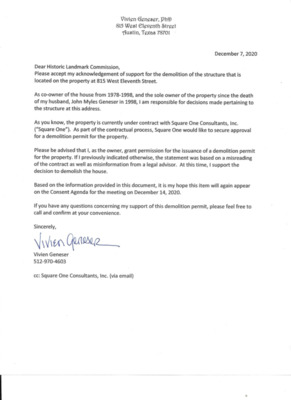
HISTORIC LANDMARK COMMISSION DECEMBER 14, 2020 DEMOLITION AND RELOCATION PERMITS HDP-2020-0410 815 WEST 11TH STREET D.3 - 1 PROPOSAL Demolish a ca. 1911 house. ARCHITECTURE One-story, rectangular-plan, hipped roof frame house with permastone siding, a central, hipped-roof front-facing dormer containing two windows; partial-width inset porch on non- historic wood posts; . RESEARCH The house was built around 1911; the first occupants were Jasper J. and Blanche Coulter, who lived here until around 1917. Jasper Coulter was a book keeper for McKean-Eilers, a large wholesale dry goods company on Congress Avenue (their building is a historic landmark). The house was rented by Lucy Scott, a teacher at Pease School, in the late 1910s and early 1920s. Patrick J. Moran, an oil driller, and his wife, Imogene, are listed as the owners of the house in the 1927 city directory; only Imogene Moran is shown in the 1929 directory. Following the Morans’ ownership of the house, it was a rental property again, with a meat cutter, the superintendent for the Austin Coca-Cola bottling plant, and a projectionist at the Varsity Theater among the tenants. Around 1946, Mrs. Gretta Catterall, a widow, purchased the property; she lived here until around 1970. STAFF COMMENTS The house was listed as a Priority 2 for research in the Comprehensive Cultural Resources Survey (1984). Staff has evaluated this house for designation as a historic landmark and has determined that the house may meet the criteria for landmark designation as set forth in City Code: a. Architecture. The house is a good example of a transitional house, between the older Victorian styles and the later bungalows. This house has a traditional form, but without the architectural ornamentation of earlier tastes, and without the simple floorplan and prominent front porch of the later bungalows. This neighborhood has a number of transitional houses; this one would be contributing to a potential historic district in the west end of downtown. b. Historical association. The house was the home of several middle class families, and represents the lifestyle of the middle class during the early 20th century. The house also has a history of both home ownership and rentals that typified residential patterns in this section of the city. While none of the inhabitants appear to have figured significantly in the history of Austin, the character of the house reflects middle class values. c. Archaeology. The house was not evaluated for its …
Statement from Ted Siff, president of the Old Austin Neighborhood Association 11-12-2020 The OANA board voted to take no action regarding the request for a demolition permit on 815 West 11th Street. Best, Ted Ted Siff, President Old Austin Neighborhood Association
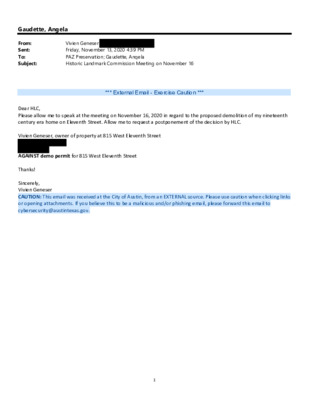
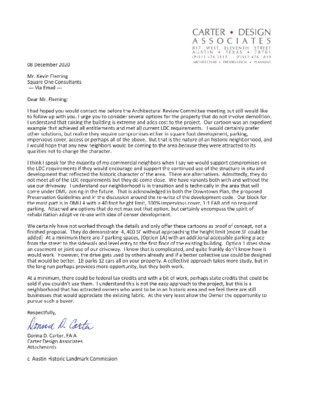
Gaudette, Angela From: Sent: To: Subject: Vivien Geneser Friday, November 13, 2020 4:39 PM PAZ Preservation; Gaudette, Angela Historic Landmark Commission Meeting on November 16 *** External Email - Exercise Caution *** Dear HLC, Please allow me to speak at the meeting on November 16, 2020 in regard to the proposed demolition of my nineteenth century era home on Eleventh Street. Allow me to request a postponement of the decision by HLC. Vivien Geneser, owner of property at 815 West Eleventh Street AGAINST demo permit for 815 West Eleventh Street Thanks! Sincerely, Vivien Geneser CAUTION: This email was received at the City of Austin, from an EXTERNAL source. Please use caution when clicking links or opening attachments. If you believe this to be a malicious and/or phishing email, please forward this email to cybersecurity@austintexas.gov. 1 Memo To: From: CC: Date: Re: Historic Landmark Commission Donna D. Carter, FAIA Square One Consultants 15 November 2020 Item D.9 HDP‐2020‐0410 Demolition of 815 W. 11th St. I am one of the owners of the property to the west of this house (817 W. 11th St) where I have had my architectural office since 1985. I am opposed to the demolition of the approximately 100 year old home at 815 W. 11th St. The immediate block is mostly businesses that have successfully adapted the sites to accommodate their office use, while retaining the historic structures and feel of the neighborhood. The sole exception on our block, even at three stories, is an unwelcome intrusion on the rhythm, scale, articulations that make up the feel of the street. Unlike 815, at least the 1980s building is towards the end of the block and allows the historic vista to remain looking south or east. I sympathize with the potential buyers, however, I would ask for a postponement to allow us to work with the applicant to come up with compromise that is acceptable to the applicant, the city and the immediate neighbors on the alley. The current development code requirements provide no leeway or incentives to keep the existing structure when compared to other requirements of the code. Our design firm has looked at several development options that provide for the +/‐ 4500 sf development that a vacant lot would allow under the current entitlements. However, options would require some accommodation for parking, impervious cover or protected trees. The current code prioritizes these issues over the …