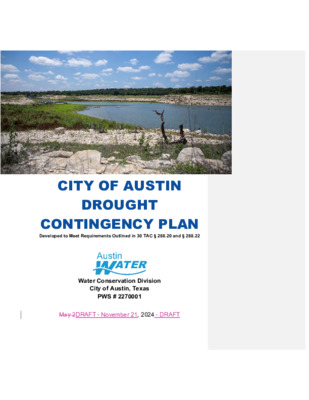
CITY OF AUSTIN DROUGHT CONTINGENCY PLAN Developed to Meet Requirements Outlined in 30 TAC § 288.20 and § 288.22 Water Conservation Division City of Austin, Texas PWS # 2270001 May 2DRAFT - November 21, 2024 - DRAFT City of Austin Drought Contingency Plan Table of Contents SECTION I: DECLARATION OF POLICY, PURPOSE AND INTENT ...................................................................... 2 SECTION II: BACKGROUND .................................................................................................................................... 2 SECTION III: TRIGGER CONDITIONS AND GOALS ............................................................................................... 8 SECTION IV: DROUGHT RESPONSE MEASURES .............................................................................................. 11 SECTION V: WHOLESALE CONTRACT PROVISIONS ........................................................................................ 20 SECTION VI: PUBLIC INVOLVEMENT................................................................................................................... 20 SECTION VII: PUBLIC NOTIFICATION AND EDUCATION................................................................................... 21 SECTION VIII: COORDINATION WITH REGIONAL PLANNING GROUPS (RPG)............................................... 21 SECTION IX: TCEQ NOTIFICATION ...................................................................................................................... 21 SECTION X: PLAN REVIEW AND UPDATES ........................................................................................................ 21 APPENDIX A: WATER CONSERVATION CODE ................................................................................................... 22 APPENDIX B: WATER CONSERVATION PENALTY CODE ................................................................................. 59 APPENDIX C: WATER USE TRIGGERS FOR WATER USE MANAGEMENT ORDINANCE .............................. 86 APPENDIX D: RESOLUTIONS IN SUPPORT OF ADOPTION OF THE DROUGHT CONTINGENCY PLAN ...... 87 APPENDIX E: RESOLUTION ADOPTING THE 2024 DROUGHT CONTINGENCY PLAN ................................... 94 APPENDIX F: TRANSMITTAL LETTER TO REGIONAL PLANNING GROUP ..................................................... 95 APPENDIX G: PUBLIC RESPONSE TO NOVEMBER 2023 SURVEY .................................................................. 96 1 Page 1 of 136 City of Austin Drought Contingency Plan DROUGHT CONTINGENCY PLAN City of Austin, Texas May 2024 SECTION I: DECLARATION OF POLICY, PURPOSE, AND INTENT ..................................................................... 3 SECTION II: BACKGROUND .................................................................................................................................... 3 SECTION IV: DROUGHT RESPONSE MEASURES .............................................................................................. 15 SECTION V: WHOLESALE CONTRACT PROVISIONS ........................................................................................ 29 SECTION VI: PUBLIC INVOLVEMENT................................................................................................................... 29 SECTION VII: PUBLIC NOTIFICATION AND EDUCATION................................................................................... 30 SECTION VIII: COORDINATION WITH REGIONAL PLANNING GROUPS (RPG)............................................... 30 SECTION IX: TCEQ NOTIFICATION ...................................................................................................................... 31 SECTION X: PLAN REVIEW AND UPDATES ........................................................................................................ 32 APPENDIX A: WATER CONSERVATION CODE ................................................................................................... 33 APPENDIX B: WATER CONSERVATION PENALTY CODE ................................................................................. 71 APPENDIX C: RESOLUTIONS IN SUPPORT OF ADOPTION OF THE DROUGHT CONTINGENCY PLAN .... 110 APPENDIX D: RESOLUTION ADOPTING THE 2024 DROUGHT CONTINGENCY PLAN ................................ 111 APPENDIX E: TRANSMITTAL LETTER TO REGIONAL PLANNING GROUP ................................................... 120 APPENDIX F: PUBLIC RESPONSE TO NOVEMBER 2023 SURVEY ................................................................ 124 2 Page 2 of 136 City of Austin Drought Contingency Plan Section I: Declaration of Policy, Purpose, and Intent The City of Austin (the City) maintains a decades-long commitment to ensuring a sustainable water supply through demand management measures. The latest update to Austin’s Drought Contingency Plan (the Plan) builds upon this legacy. This iteration of the Plan retains all measures from previous versions while incorporating …
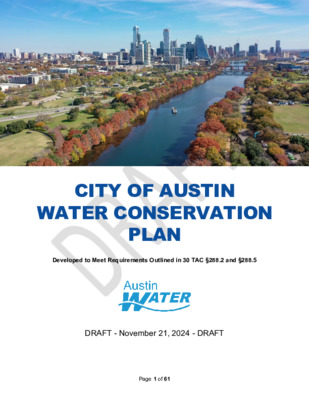
Water Conservation Plan and Utility Profile CITY OF AUSTIN WATER CONSERVATION PLAN Developed to Meet Requirements Outlined in 30 TAC §288.2 and §288.5 DRAFT - November 21, 2024 - DRAFT Page 1 of 61 Water Conservation Plan and Utility Profile Message from the Director Thank you for your interest in Austin’s most precious natural resource: water. The city was founded in the mid-1800s on the banks of the Colorado River to take advantage of that abundant water resource. Our water supply is just as critical today, but now we face unprecedented challenges: record high temperatures, record low flows into the Highland Lakes, water quality concerns, and continued rapid population growth. Together, we can meet these challenges. The City of Austin’s 100-year Water Forward Integrated Water Resources Plan is focused on water conservation and water use efficiency, as well as strategies to strengthen the diversity of Austin’s water supply. Austin has come a long way over the last decade – in 2023, we used essentially the same amount of water as we did in 2011, despite having 140,000 more residents. But the impacts from climate change require us to become even more water-wise and water-efficient. The update of this Water Conservation Plan is required by the State of Texas every five years to provide short-term strategies to address changing conditions. While Austin Water completed the required plan update in May 2024, we are now providing this November 2024 update to incorporate additional water conservation strategies. Even more importantly, the update is a necessary part of the city’s future sustainability. This document describes Austin Water’s conservation initiatives, programs, and projects to help residents and businesses increase their water use efficiency. In addition, it describes how Austin Water is maximizing our water supply from the Highland Lakes through conservation and water reuse. Learn more about what you can do to conserve our most precious resource at AustinWater.org. Shay Ralls Roalson, P.E. Austin Water Director Page 2 of 61 Water Conservation Plan and Utility Profile Table of Contents Message from the Director ...................................................................................................... 2 Executive Summary ................................................................................................................. 4 Conservation Program History ................................................................................................ 7 Public Education and Information ........................................................................................... 9 Residential Customer Programs ........................................................................................... 11 Regulatory Programs ............................................................................................................. 18 Metering and Water Loss ....................................................................................................... 21 Water Reuse............................................................................................................................ 24 Water Rates ............................................................................................................................ 27 Goals for Water Use and Water Loss .................................................................................... 29 Future Water Use and Loss Activities ............................................................................... 32 Utility Profile ........................................................................................................................... 42 System Data …
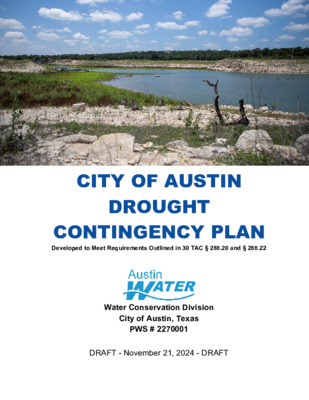
CITY OF AUSTIN DROUGHT CONTINGENCY PLAN Developed to Meet Requirements Outlined in 30 TAC § 288.20 and § 288.22 Water Conservation Division City of Austin, Texas PWS # 2270001 DRAFT - November 21, 2024 - DRAFT City of Austin Drought Contingency Plan Table of Contents SECTION I: DECLARATION OF POLICY, PURPOSE, AND INTENT ..................................................................... 2 SECTION II: BACKGROUND .................................................................................................................................... 2 SECTION IV: DROUGHT RESPONSE MEASURES .............................................................................................. 10 SECTION V: WHOLESALE CONTRACT PROVISIONS ........................................................................................ 21 SECTION VI: PUBLIC INVOLVEMENT................................................................................................................... 21 SECTION VII: PUBLIC NOTIFICATION AND EDUCATION................................................................................... 22 SECTION VIII: COORDINATION WITH REGIONAL PLANNING GROUPS (RPG)............................................... 22 SECTION IX: TCEQ NOTIFICATION ...................................................................................................................... 22 SECTION X: PLAN REVIEW AND UPDATES ........................................................................................................ 23 APPENDIX A: WATER CONSERVATION CODE ................................................................................................... 24 APPENDIX B: WATER CONSERVATION PENALTY CODE ................................................................................. 25 APPENDIX C: RESOLUTIONS IN SUPPORT OF ADOPTION OF THE DROUGHT CONTINGENCY PLAN ...... 36 APPENDIX D: RESOLUTION ADOPTING THE 2024 DROUGHT CONTINGENCY PLAN .................................. 37 APPENDIX E: TRANSMITTAL LETTER TO REGIONAL PLANNING GROUP ..................................................... 38 APPENDIX F: PUBLIC RESPONSE TO NOVEMBER 2023 SURVEY .................................................................. 39 Page 1 of 44 City of Austin Drought Contingency Plan Section I: Declaration of Policy, Purpose, and Intent The City of Austin (the City) maintains a decades-long commitment to ensuring a sustainable water supply through demand management measures. The latest update to Austin’s Drought Contingency Plan (the Plan) builds upon this legacy. This iteration of the Plan retains all measures from previous versions while incorporating new strategies to better address droughts in the future. Designed as a comprehensive strategy, the Plan focuses on addressing water shortages and emergencies, with specific attention to domestic water use, sanitation, fire protection, and public well- being. In accordance with Section 11.1272 of the Texas Water Code and Chapter 288 of Title 30 of the Texas Administrative Code, the City regularly updates this plan, underscoring the importance of adaptability to evolving water supply dynamics. This document outlines the City's strategic response to challenges posed by demand surges, infrastructure constraints, and droughts, including historical critical droughts. Through coordination with the Lower Colorado River Authority (LCRA), the Drought Contingency Plans of both the LCRA and the City are consistent in terms of targets and goals. The City’s plan is more proactive, including the implementation activities necessary to conserve water. Detailed within the regulatory framework of the City of Austin’s Municipal Code, the Water Conservation Code (updated in conjunction with this plan in May and November 2024) forms an …
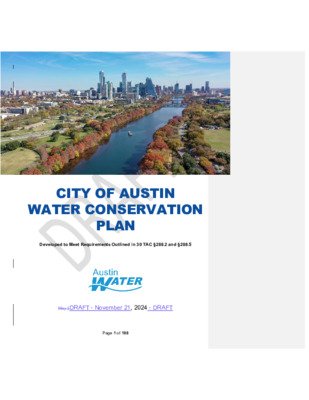
Water Conservation Plan and Utility Profile CITY OF AUSTIN WATER CONSERVATION PLAN Developed to Meet Requirements Outlined in 30 TAC §288.2 and §288.5 Page 1 of 188 May 2DRAFT - November 21, 2024 - DRAFT Water Conservation Plan and Utility Profile Page 2 of 188 Water Conservation Plan and Utility Profile Message from the Director Thank you for your interest in Austin’s most precious natural resource: water. The city was founded in the mid-1800s on the banks of the Colorado River to take advantage of that abundant water resource. Our water supply is just as critical today, but now we face unprecedented challenges: record high temperatures, record low flows into the Highland Lakes, water quality concerns, and continued rapid population growth. Together, we can meet these challenges. The City of Austin’s 100-year Water Forward Integrated Water Resources Plan is focused on water conservation and water use efficiency, as well as strategies to strengthen the diversity of Austin’s water supply. Austin has come a long way over the last decade – in 2023, we used essentially the same amount of water as we did in 2011, despite having 140,000 more residents. But the impacts from climate change require us to become even more water-wise and water-efficient. The update of this Water Conservation Plan is required by the State of Texas every five years to provide short-term strategies to address changing conditions. While Austin Water completed the required plan update in May 2024, we are now providing this November 2024 update to incorporate additional water conservation strategies. Even more importantly, the update is a necessary part of the city’s future sustainability. This document describes Austin Water’s conservation initiatives, programs, and projects to help residents and businesses increase their water use efficiency. In addition, it describes how Austin Water is maximizing our water supply from the Highland Lakes through conservation and water reuse. Learn more about what you can do to conserve our most precious resource at AustinWater.org. Shay Ralls Roalson, P.E. Austin Water Director Page 3 of 188 Water Conservation Plan and Utility Profile Table of Contents Message from the Director ...................................................................................................... 3 Executive Summary ................................................................................................................. 5 Conservation Program History ................................................................................................ 7 Public Education and Information ........................................................................................... 9 Residential Customer Programs ........................................................................................... 11 Regulatory Programs ............................................................................................................. 18 Metering and Water Loss ....................................................................................................... 21 Water Reuse............................................................................................................................ 24 Water Rates ............................................................................................................................ 26 Goals for Water Use and Water Loss .................................................................................... 27 Utility Profile ........................................................................................................................... …
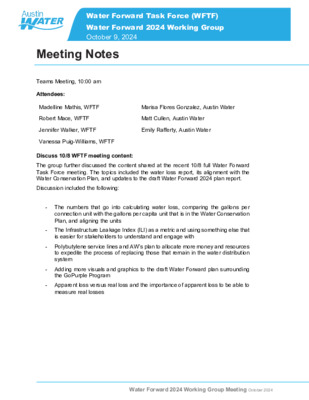
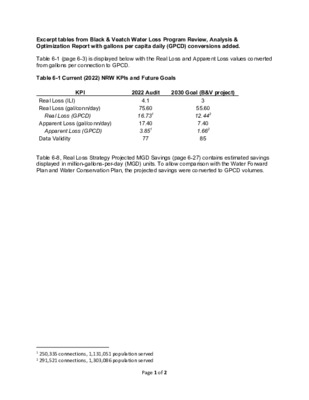
Water Forward Task Force (WFTF) Water Forward 2024 Working Group October 9, 2024 Meeting Notes Teams Meeting, 10:00 am Attendees: Madelline Mathis, WFTF Marisa Flores Gonzalez, Austin Water Robert Mace, WFTF Matt Cullen, Austin Water Jennifer Walker, WFTF Emily Rafferty, Austin Water Vanessa Puig-Williams, WFTF Discuss 10/8 WFTF meeting content: The group further discussed the content shared at the recent 10/8 full Water Forward Task Force meeting. The topics included the water loss report, its alignment with the Water Conservation Plan, and updates to the draft Water Forward 2024 plan report. Discussion included the following: - The numbers that go into calculating water loss, comparing the gallons per connection unit with the gallons per capita unit that is in the Water Conservation Plan, and aligning the units - The Infrastructure Leakage Index (ILI) as a metric and using something else that is easier for stakeholders to understand and engage with - Polybutylene service lines and AW’s plan to allocate more money and resources to expedite the process of replacing those that remain in the water distribution system - Adding more visuals and graphics to the draft Water Forward plan surrounding - Apparent loss versus real loss and the importance of apparent loss to be able to the GoPurple Program measure real losses Water Forward 2024 Working Group Meeting October 2024
APPENDIX A: COMMUNITY ENGAGEMENT SUMMARY A-1 Date May-2023 Activity Survey Survey Nov-2023 Total Survey Engagement: 06/14/22 06/22/22 01/23/24 01/24/24 Total Workshop Engagement: 11/29/22 Webinar Webinar 03/29/23 Workshop Workshop Workshop Workshop 04/25/24 Webinar 06/27/24 Webinar Water Forward 2024 Community Engagement Topic Community Values Water Forward 2024 Update and Water Management Strategies Engagement Water Forward 2024 Update Water Forward 2024 Update Water Management Strategies Water Management Strategies Water Forward University Water Forward University - Equity and Affordability Water Forward 2024 Update and Water Management Strategies Water Forward 2024 Update and Water Management Strategies Water Forward 2024 Update - Preferred 50-year Portfolio, Water Conservation Plan, and Drought Contingency Plan 50-Year Portfolio 120 574 694 19 43 12 32 106 21 18 8 14 25 36 122 45,052 Open House Open House 08/27/24 08/28/24 Total Webinar/Open House Engagement: Total Number of Impressions of Water Forward Related Social Media: 02/01/24 Colorado River Land Analysis + Water Forward 2024 1:1 Meeting w/ Austin Parks Foundation 1:1 Meeting w/ Austin Sierra Club, Save Barton Creek Association and Save our Springs Alliance Colorado River Land Analysis + Water Forward 2024 Colorado River Land Analysis + Water Forward 2024 1:1 Meeting w/ Clean Water Action Colorado River Land Analysis + Water Forward 2024 1:1 Meeting w/ Earth Day Austin Colorado River Land Analysis + Water Forward 2024 1:1 Meeting w/ Environment Texas Colorado River Land Analysis + Water Forward 2024 1:1 Meeting w/ Texas Water Foundation Water Forward 2024 + Equity and Affordability 1:1 Meeting w/ St. David's Foundation Water Forward 2024 + Equity and Affordability 1:1 Meeting w/ Austin Justice Coalition 1:1 Meeting w/ Capital Area Metropolitan Planning Organization (CAMPO) 1:1 Meeting w/ DAWA (Diversity Awareness and Wellness in Action) 1:1 Meeting w/ DAWA (Diversity Awareness and Wellness in Action) 1:1 Meeting w/ Colorado River Land Trust Water Forward 2024 + Equity and Affordability Colorado River Land Analysis Water Forward 2024 + Equity and Affordability Water Forward 2024 + Equity and Affordability 05/31/24 02/29/24 05/30/24 12/20/23 02/07/24 11/29/23 12/06/23 01/04/24 01/11/24 02/14/24 12/14/23 12/11/23 03/20/24 03/15/24 07/11/24 09/12/24 10/10/24 12/15/23 1:1 Meeting w/ Hill Country Alliance, Hill Country Conservancy, Texas Hill Country Conservation Network, and National Wildlife Federation 1:1 Meeting w/ Hill Country Alliance, Hill Country Conservancy, Texas Hill Country Conservation Network, and National Wildlife Federation 1:1 Meeting w/ Hill Country Alliance, Hill Country Conservancy, Texas Hill Country Conservation Network, and National Wildlife Federation 1:1 Meeting w/ Hill …
DRAFT – Water Forward 2024 Appendix B APPENDIX B: WATER FORWARD 2024 EQUITY AND AFFORDABILITY ROADMAP Summary This goal of this document is to provide context about equity and affordability considerations related to water resource management in Austin and to discuss how these considerations will be included in Water Forward 2024 (WF24), the first update to Austin’s 100-year Integrated Water Resource Plan. This appendix provides key definitions, describes how WF24 evaluated the distribution of benefits and burdens of plan implementation outcomes, summarizes procedural equity best practices, and also provides historical context related to race, the environment, governmental policies, and water resources in Austin. Water Forward Overview Austin Water is committed to providing safe, reliable, high-quality and affordable water services to all water users in our community. The purpose of the Water Forward plan is to develop and implement diverse and environmentally conscious water management strategies to adapt to growth, drought, and climate change and ensure a sustainable, resilient, equitable, and affordable water future for our community for the next 100 years. As part of the 2024 plan update, Austin Water seeks to be intentional in considering equity and affordability impacts in the plan development process and in implementation of plan strategies. Austin Water recognizes the importance of an equity framework rooted in an understanding of historic discriminatory and exclusionary practices that may have contributed to certain present day inequities in qualityof life outcomes for communities of color and low-income communities. Staff have compiled key definitions, historical information, and stakeholder feedback to guide and support the creation of an Equity and Affordability framework for the Water Forward 2024 plan update. Definitions Equity The City of Austin Equity Statement is as follows: “Racial equity is the condition when race no longer predicts a person’s quality of life outcomes in our community. The City recognizes that race is the primary determinant of social equity and therefore we begin the journey toward social equity with this definition. The City of Austin recognizes historical and structural disparities and a need for alleviation of the wrongs by critically transforming its institutions and creating a culture of equity.” B-1 DRAFT – Water Forward 2024 Appendix B Affordability Regarding affordability, Austin Water seeks to align with the City of Austin Strategic Direction 2023, which states: "Austinites deserve to experience the necessities of life as affordable and accessible. Simply put, this means a household can afford rent or mortgage, …
DRAFT - Water Forward 2024 Appendix C APPENDIX C: POPULATION, EMPLOYMENT, AND DEMAND PROJECTIONS Integrated water resource planning provides a blueprint that ensures residents and businesses in Austin have sustainable access to clean water now and into the future. To properly plan and manage Austin’s water resources, it is critical to have a reasonable understanding and characterization of how and where water is currently used in the city as well as quantifiable estimates of how much water will be needed in the future. Appendix C.1 describes the primary tool used to characterize and explore water demands, referred to as the Disaggregated Demand Model (DDM). Using the tool, current water use is defined, as described in Appendix C.2, and future demand is projected, as described in Appendix C.3. These sections describe the City’s water demand at the water source (diversions), at the water treatment plant (pumpage), and at the Austin Water customers’ meters (consumption). C.1 Disaggregated Demand Model The foundation of the Water Forward 2024 water demand estimates is the underlying DDM, which evaluates historical demand, population, housing units, and employment and uses projections of future population, housing units, and employment to project future demands. The DDM was used to develop a range of demands based on high, medium, and low population and employment projections. The DDM provides the analytical environment for assessing potential water savings from conservation and reuse measures being evaluated during plan development. The DDM also includes functionality to assess water demands under future climatic scenarios and tracks water consumption by end uses, which informs the assessment of yield potential for decentralized supply options. The following sections describe the model’s attributes, primary data sources, and development. C.1.1 Demand Model Attributes The DDM is a data-driven Python tool that models water use by sector, subsector, and end use at geographic planning units for current demands as well as high, medium, and low demand projections for the key planning horizons of 2040, 2080, and 2120. Austin Water staff conducted this analysis using geographic units known as the Delphi, Trends, and Imagine Austin (DTI) polygons, which refers to Austin’s comprehensive plan, Imagine Austin. The DTI polygons divide the city into 235 geographic units. The area covered by the DTI polygons includes the City of Austin’s full and limited purpose jurisdictions, as well as the city’s extra-territorial jurisdiction, as shown in Figure C-1. The DDM provides an estimate of existing and future …
DRAFT – Water Forward 2024 Appendix D APPENDIX D: CLIMATE AND HYDROLOGY ANALYSIS The Water Forward 2024 (WF24) Climate and Hydrology Analysis is a set of collaborative tasks between Austin Water, researchers at the University of Texas at Austin (UT Austin), and consultant Richard Hoffpauir, Phd, PE (Hoffpauir Consulting). The tasks within the Climate and Hydrology Analysis were developed with input from the Water Forward Climate Technical Advisory Group (CTAG). The goal of the Climate and Hydrology Analysis was to provide Austin Water with projections of temperature, precipitation, and streamflow based on various future warming pathways from General Circulation Models (GCMs), also known as global climate models. The projection data was used to develop hydrologic scenarios for modeling future water supply needs and water management strategy portfolio performance across a range of possible future conditions. The Climate and Hydrology Analysis tasks and results are documented in a series of technical memoranda which are included in this Appendix. The tasks numbers and titles are as follows: Task 2: GCM Selection Task 3: Downscaling Task 4: Hydrologic Modeling Task 5: Climate Scenario Inputs for WAM Task 6: Stochastic Drought Sequences Note that Task 1 of the Climate and Hydrology Analysis addressed project management and did not produce a technical memorandum. D-1 DRAFT – Water Forward 2024 Appendix D Summary Task 2: Selection of General Circulation Models April 2022 Prepared by: The University of Texas at Austin This report summarizes the efforts as part of the UT-CoA project for evaluation of 35 General Circulations Models (GCMs) from the Coupled Model Intercomparison Project Phase 6 (CMIP6) in the Colorado River Basin. The goal is to find the most appropriate models by comparing the model results with observational datasets. Statistical analysis of three variables, including precipitation, temperature, and the number of dry days, provides quantitative assessment against the observational datasets. A methodology for scoring model performance is presented. Taylor diagrams are also used for visual comparison across multiple models. Finally, best- performing GCMs are suggested for use in the future tasks. D-2 DRAFT – Water Forward 2024 Appendix D List of Acronyms CMIP Coupled Model Intercomparison Project CPC Climate Predictions Center GCM General Circulation Model (or Global Climate Model) NDD Number of Dry Days P Precipitation R Correlation coefficient T Temperature UDEL University of Delaware WAM Water Availability Model WRCP World Climate Research Program D-3 DRAFT – Water Forward 2024 Appendix D Introduction GCMs are …
DRAFT - Water Forward 2024 Appendix E APPENDIX E: PRELIMINARY NEEDS ANALYSIS Estimating Water Supply Needs Selecting water management strategies and their targeted yields first requires an estimate of the future water supply needs. For the purposes of this analysis, water supply needs are defined as water supply shortages in each decade of the Water Forward 2024 (WF24) 100-year planning period when no additional conservation, reuse, or supply are implemented. The needs in each decade are estimated using modeling and vary based on scenarios, which reflect plausible future conditions. Only existing water management strategies are included in the estimate of future water supply needs. The modeling effort used to estimate needs is known as the Preliminary Needs Analysis. Model The Texas Commission on Environmental Quality (TCEQ) Water Availability Model (WAM) is the modeling tool used to estimate future water supply needs. The WAM is a collection of model input files covering all state-granted water rights across all river basins in Texas and a generalized computer modeling platform called the Water Rights Analysis Package (WRAP). The WAM is used by state agencies, water right holders, and stakeholders to simulate water availability for a specified water management scenario through a given hydrologic sequence. Typically the WAM is used to simulate water availability during a repeat of historical hydrology which is comprised of monthly naturalized stream flows and net evaporation, generally covering the past 60 to 80 years for the state’s river basins. The following section describes the modified WAM inputs that are used to assess water availability and needs under a range of future conditions. Scenarios The Colorado River Basin WAM is modified for the Preliminary Needs Analysis. First, the WAM is modified to reflect basin-wide demands, including Austin’s demands, in future decades of the 100-year planning period. Secondly, future water supply strategies for non-Austin entities are added in the decade within which the strategy is expected to be operational. Lastly, the WAM’s hydrological inputs are also modified to include projections of future drought and climate conditions in addition to the standard historical hydrology. The pairings of future demands, regional supplies, and hydrological conditions are known as Scenarios. The scenario approach to modeling is intended to explore the range of uncertainty in each of the scenario components across the planning period. E - 1 DRAFT - Water Forward 2024 Appendix E Demands Future demand estimates by decade for Austin and customers of …
APPENDIX F: WATER MANAGEMENT STRATEGY COST AND YIELD CHARACTERIZATION Strategy characterization and costs were developed by Plummer Associates. The Unified Cost Model, a tool developed by the Texas Water Development Board for use in the state water planning process, was used to create standardized capital, operations and maintenance, and annual costs for each strategy. F-1 DRAFT ‐ Water Forward Modeling Characterization of Water Management Strategies Name: Aquifer Storage and Recovery (ASR) Strategy description & assumptions: ASR is characterized as storage of drinking water from AW's water distribution system in an underground aquifer for recovery and use when supplies are scarce. ASR costs and operational assumptions are based on project parameters that have been developed through ASR implementation planning. The yield and storage ranges are used to test the project size against future scenarios. ASR is included in every candidate portfolio for modeling since implementation of the project has started. Modeling assumptions: Yield and storage ranges Year 2030 2040 2050 2060 2070 2080 2120 Min model test annual yield (AFY) 0 6,000 6,000 6,000 6,000 6,000 6,000 Max model test annual yield (AFY) 0 60,000 83,000 83,000 83,000 83,000 83,000 Min model test total storage (AF) 0 20,000 20,000 20,000 20,000 20,000 20,000 Max model test total storage (AF) 0 60,000 120,000 180,000 240,000 300,000 360,000 Scalability assumptions Max start volume (AF) 60,000 Max decadal yield increase (AFY) 30,000 Storage assumptions Does this strategy have a modeled storage element? Other assumptions Yes Can this strategy meet needs above existing COA run‐of‐river water rights and LCRA backup contract? No DRAFT ‐ Water Forward Modeling Characterization of Water Management Strategies DRAFTF-2 DRAFT ‐ Water Forward Modeling Characterization of Water Management Strategies Cost Estimate Summary City of Austin ‐ S‐1 Aquifer Storage and Recovery (ASR) CAPITAL COST Item Estimated Cost For Facilities Primary Pump Station (74 MGD) Transmission Pipeline (66 in dia., approx. 50 miles) Well Fields (72 Wells, Pumps, and approx. 13 miles Well Field Piping) Storage Tanks (Other Than at Booster Pump Stations) Water Treatment Plant ‐ wellfield (37 MGD) Integration Point Infrastructure (10 MG GST, 74 MGD Pump Station, Yard Piping, etc) TOTAL COST OF FACILITIES Engineering and Feasibility Studies, Legal Assistance, Financing, Bond Counsel, and Contingencies (30% for pipes & 35% for all other facilities) Environmental & Archaeology Studies and Mitigation Land Acquisition/Leasing and Surveying Interest During Construction (3% for 5 years with a 0.5% ROI) x TOTAL COST OF …
APPENDIX G: WATER MANAGEMENT STRATEGY EQUITY EVALUATION G-1 Equity and Affordability Framework Draft note sheets with scores for each strategy - attached Themes: • Water Supply Reliability: o Access to water o Infrastructure Resiliency • Public Health o Regulatory requirements o Water Quality o Environment • Accountability o Transparency o Accessibility o Community outreach and education • Affordability and Economic Impacts o Rate impacts o Growth and development o Workforce development Score summary – Potential Impacts/Benefits: • Green highlight: 5 points • Yellow highlight: 3 points • Red highlight: 1 point G-2 Draft Equity and Affordability Notes Centralized Reclaimed Themes Questions Potential Strategy Impacts/Benefits Potential Mitigation Strategies Page 1/3 Score Water Supply Reliability 1.1 Given that marginalized communities can be the most impacted by emergency situations, how does the strategy impact/benefit Austin Water’s access to water supply, especially during drought or other emergency situations? Water Supply Reliability 1.2 How does the strategy benefit Austin Water’s water, reclaimed water, and/or wastewater infrastructure resilience? Water Supply Reliability 1.3 Does this strategy create an inequitable maintenance burden for Austin Water customers who are a part of marginalized communities? Potential for improved resiliency in emergencies by providing access to non-potable water from a second system source. Potential to increase access to water during drought situations if reclaimed water can be used for onsite purposes and to maintain outdoor irrigation to support community spaces. Outdoor irrigation from reclaimed in drought may provide benefit from mitigation of heat island effects. N/A Investing in centralized reclaimed system projects would expand AW's system and provide additional resilience to reclaimed water customers. N/A Possibly-- dual-plumbing for water distribution in residential buildings could result in increased maintenance requirements for owners due to additional pipe, some of which may be located in marginalized communities. However, development projects with a qualified affordable housing component are excluded from the reclaimed connection requirements. Programs to provide maintenance support, training for building management, etc. for dual plumbed systems. Water Supply Reliability 1.4 Does this strategy include energy resilience components? No significant energy resilience components. Water Supply Reliability 1.5 Can this strategy be tailored to help improve water, reclaimed water, and/or wastewater service to marginalized communities? Implementation of this strategy could include a focus on bringing additional benefit to marginalized communities by providing an additional source of water (non-potable) during drought. The GoPurple program provides incentives to help projects offset costs to connect to the centralized …
DRAFT - Water Forward 2024 Appendix H APPENDIX H: COLORADO RIVER LAND ANALYSIS EVALUATION Austin Water’s Wildlands Austin Water currently protects over 48,000 acres of land through its Balcones Canyonlands Preserve (BCP) and Water Quality Protection Lands (WQPL) programs. Managed by the Wildland Conservation Division, these lands protect portions of the Lake Austin and Lake Travis watersheds for endangered species habitat, and areas over the Edwards Aquifer recharge and contributing zones for the long-term resilience of the Barton Springs segment of the Edwards Aquifer. Since its inception in 1998, the Water Quality Protection Lands program has been bolstered by five voter-approved bonds, totaling around $230 million, with an additional $24 million from partnerships. As part of this initiative to protect its source water, the City of Austin set a goal to keep overall impervious cover below 10% within the Source Water Protection Area, which includes the Barton Springs Edwards Aquifer Recharge and Contributing Zones. To help achieve this goal, it is estimated that the City of Austin would need to permanently protect approximately 100,000 acres of land. As of 2024, the City of Austin has been able to acquire permanent protections on over 45,000 acres in this area, the majority of which are managed by Austin Water’s Wildland Conservation Division. Austin Water will continue to protect current and future water supplies through the active management of these Wildlands. Austin Water will also continue to pursue further additions to the Water Quality Protection Lands and Balcones Canyonlands Preserve that meet those programs’ land protection priorities. Colorado River Land Analysis Austin’s drinking water supply has benefited from a landscape of rural, largely working lands throughout the Highland Lakes’ watershed. However, land use in Texas is changing rapidly as the state’s population grows. According to Texas A&M Natural Resources Institute, the 20 counties in the lower Colorado basin have seen an 87% increase in population and the loss of over 108,000 acres of working lands since 1997. The working lands that remain are increasingly being subdivided into smaller and smaller parcels. These trends are likely to continue, emphasizing the need to plan for upstream water quality protection. Source Water Protection refers to the management of areas through which water travels and the regulation of activities on these lands to prevent pollution and contaminants from entering public drinking water sources. The quality and quantity of a city’s drinking water supply, as well as other …
DRAFT - Water Forward 2024 Appendix I APPENDIX I: WATER MANAGEMENT STRATEGY ASSESSMENT AND VULNERABILITY EVALUATION Selecting Water Management Strategy Portfolios The goal of the water management strategy assessment and vulnerability evaluation and selection process is to identify portfolios of water management strategies that, when combined with Austin's core water supplies from the Colorado River and Highland Lakes, will provide a robust and reliable source of water to meet Austin’s demands over the 100-year planning horizon, from 2030-2120. Austin Water has many potential water management strategies that could extend and supplement its core water supplies sourced from the Colorado River. These strategies, compiled from the list of candidates considered in Water Forward 2018 (WF18), include conservation, potable and non-potable reuse, water supply storage, and the development of new water sources. These Water Management strategies are organized into groupings, referred to as portfolios. The evaluation and selection process seeks to identify the best portfolios for Austin Water to address reliability across a wide range of future scenarios while also considering costs and other planning objectives outlined in the Guiding Principles of Water Forward 2024 (WF24). The entire process is referred to as the Water Management Strategy Analysis and Vulnerability Evaluation, or WAVE. A reliable portfolio meets Austin’s water needs over the 100-year planning horizon. These needs are modeled estimates of water supply shortages in each decade if Austin Water implemented no new water management strategies. The needs in each decade vary based on the modeling scenarios, which reflect the wide range of possible future conditions. The WAVE considers varying levels of Austin demand, of basin-wide or regional water supply development, and of climate change impacts over the 100-year planning horizon. The Texas Commission on Environmental Quality (TCEQ) Water Availability Model (WAM), the state’s surface water rights model, is used to evaluate Austin water needs. Water Management Strategy Evaluation The WAVE proceeds in two components, 1) a Water Management Strategy Evaluation and 2) a Vulnerability Analysis and Adaptive Management Plan. The first component addresses the water supply needs of the first 50 years of the WF24 planning horizon, from 2030 to 2080. The water management strategy evaluation begins by considering a large number of possible portfolios for 2080. Since there are many types of water management strategies that can be combined in various ways, the number of portfolios is very large. Each potential portfolio is evaluated using a simulation modeling tool (described …
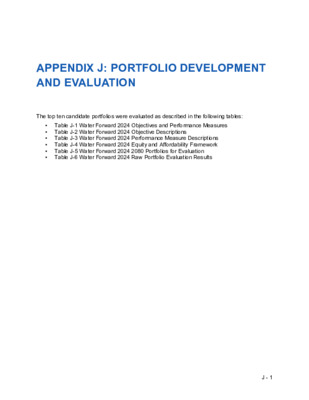
APPENDIX J: PORTFOLIO DEVELOPMENT AND EVALUATION The top ten candidate portfolios were evaluated as described in the following tables: • Table J-1 Water Forward 2024 Objectives and Performance Measures • Table J-2 Water Forward 2024 Objective Descriptions • Table J-3 Water Forward 2024 Performance Measure Descriptions • Table J-4 Water Forward 2024 Equity and Affordability Framework • Table J-5 Water Forward 2024 2080 Portfolios for Evaluation • Table J-6 Water Forward 2024 Raw Portfolio Evaluation Results J - 1 Table J-1 Water Forward 2024 Objectives and Performance Measures Objective Sub-Objective Performance Measure Data Source Objective Weight Sub- Objective Weight Water Supply Benefits Maximize reliability and resiliency, minimize vulnerability Water Availability Modeling results Maximize portfolio diversity Portfolio diversity score Economic Benefits Maximize cost-effectiveness Cost (lifecycle, capital, operations and maintenance) Strategy Characterization 20% 20% Equity Benefits Equity and affordability score Maximize positive benefits and minimize negative impacts for marginalized communities Equity & Affordability Tool 8% 8% Water Availability Modeling Portfolio Characterization Water Availability Modeling Strategy Characterization Portfolio Characterization 40% 20% Minimize ecosystem impacts Net return flows Minimize net energy use Operational energy use Environmental Benefits Maximize water use efficiency Potable GPCD Minimize water quality impacts Water quality impact score Qualitative Minimize implementation and operational risk Implementation and operational risk score Qualitative Implementation Benefits Maximize water distribution and wastewater collection system resiliency System resiliency benefits Qualitative 12% 3.5% Maximize local control/local resource Volume of local and AW-controlled water resources Portfolio Characterization 35% 5% 4% 6% 6% 4% 3.5% 5% J - 2 Table J-2 Water Forward 2024 Objective Descriptions Objective Objective Description Sub-Objective Water Supply Benefits Avoid severe water shortages during drought and a variety of climate change scenarios Include diverse water management strategies that make use of all water sources Maximize portfolio diversity Maximize reliability and resiliency, minimize vulnerability Economic Benefits Evaluate affordability impacts in a holistic manner that balances near-term and long-term costs Maximize cost-effectiveness Equity Benefits Maximize positive benefits and minimize negative impacts for marginalized communities Maximize positive benefits and minimize negative impacts for marginalized communities Environmental Benefits Develop strategies that continue to protect the natural environment, including source and downstream water quality Minimize ecosystem impacts Minimize net energy use Maximize water use efficiency Minimize water quality impacts Implementation Benefits Develop strategies that are technically, socially, and economically feasible and can be implemented and operated with a manageable level of risk Develop strategies that make use of locally available and …
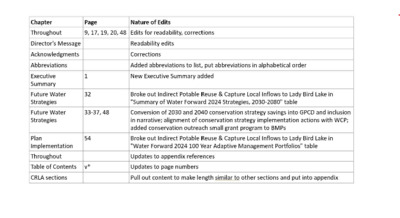
Water Forward 2024 Plan Report DRAFT – September 3October 21, 2024 Report Cover Page This page intentionally left blank. WATER FORWARD 2024 - DRAFT | ii Director’s Message Austin Water is doing important work to make sure Austin has a strong and reliable water supply, even as our city faces the challenges of growth, drought, and a changing climate. Over the past few years, Austin Water has put smart strategies in place that have already made a big difference. We've focused on conservation, encouraging our customers to use water wisely through recent hot and dry years. We've also launched GoPurple, a program that will expand our reclaimed water system and includes requirements and incentives for new and existing developments to reuse water onsite. We are pursuing water storage strategies to stretch our existing supplies. And working closely with our regional partners, we've strengthened Austin's ability to bridge droughts and provide a sustainable water supply to meet all our community’s water needs. Our work doesn't stop here. Climate science tells us that we must do even more to protect our future. The challenges we face are real, and we need to stay ahead of them. That's why we're committed to learning from our past efforts and adjusting as we go. We've been using an adaptive management approach, which means we to closely monitor how our plans are working and make changes as needed. This is a key part of Water Forward 2024, which provides a roadmap for Austin's water future. We've been working hand in hand with the Water Forward Task Force, a group of dedicated community members who help inform our efforts. Together, we've updated the 2018 plan, adjusted our strategies, and responded to the needs we've identified along the way. This collaborative approach has resulted in updates that not only means we're not only thinking about address today's needs but also prepareing us for tomorrow's challenges. At Austin Water, work is already underway to carry out this updated plan. We're focused on staying transparent and accountable to you, our community, as we move forward. We know that water is essential to our quality of life, and we're determined to protect this precious resource. As we look to the future, we at Austin Water hold a hopeful vision. Austin is a leader in water conservation and sustainability and we see a future where our city continues to thrive, and where …
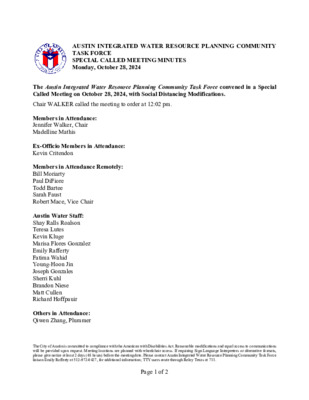
AUSTIN INTEGRATED WATER RESOURCE PLANNING COMMUNITY TASK FORCE SPECIAL CALLED MEETING MINUTES Monday, October 28, 2024 The Austin Integrated Water Resource Planning Community Task Force convened in a Special Called Meeting on October 28, 2024, with Social Distancing Modifications. Chair WALKER called the meeting to order at 12:02 pm. Members in Attendance: Jennifer Walker, Chair Madelline Mathis Ex-Officio Members in Attendance: Kevin Critendon Members in Attendance Remotely: Bill Moriarty Paul DiFiore Todd Bartee Sarah Faust Robert Mace, Vice Chair Austin Water Staff: Shay Ralls Roalson Teresa Lutes Kevin Kluge Marisa Flores Gonzalez Emily Rafferty Fatima Wahid Young-Hoon Jin Joseph Gonzales Sherri Kuhl Brandon Niese Matt Cullen Richard Hoffpauir Others in Attendance: Qiwen Zhang, Plummer The City of Austin is committed to compliance with the American with Disabilities Act. Reasonable modifications and equal access to communications will be provided upon request. Meeting locations are planned with wheelchair access. If requiring Sign Language Interpreters or alternative formats, please give notice at least 2 days (48 hours) before the meeting date. Please contact Austin Integrated Water Resource Planning Community Task Force liaison Emily Rafferty at 512-972-0427, for additional information; TTY users route through Relay Texas at 711. Page 1 of 2 PUBLIC COMMUNICATION: GENERAL None. APPROVAL OF MINUTES 1. Approval of the meeting minutes from the regular called October 8, 2024, Task Force meeting. The minutes from the October 8th, meeting were approved on Member DIFIORE’ motion and Member FAUST’s second on an 7-0 vote. STAFF BRIEFINGS, PRESENTATIONS, AND/OR REPORTS 2. Presentation on revisions to the draft Water Forward 2024 Plan, Water Conservation Plan, and Drought Contingency Plan reports The presentation was made by Marisa Flores Gonzalez, Program Manager III, and Kevin Kluge, Division Manager, Water Conservation, Austin Water. VOTING ITEMS None Chair WALKER adjourned the meeting at 2:00pm. The minutes were approved at the November 4th, 2024, meeting on Robert Mace’s motion, Hani Michel’s second on an 8-0 vote with one vacancy. Task Force Members Perry Lorenz and Madelline Mathis absent. The City of Austin is committed to compliance with the American with Disabilities Act. Reasonable modifications and equal access to communications will be provided upon request. Meeting locations are planned with wheelchair access. If requiring Sign Language Interpreters or alternative formats, please give notice at least 2 days (48 hours) before the meeting date. Please contact Austin Integrated Water Resource Planning Community Task Force liaison Emily Rafferty at 512-972-0427, for additional …
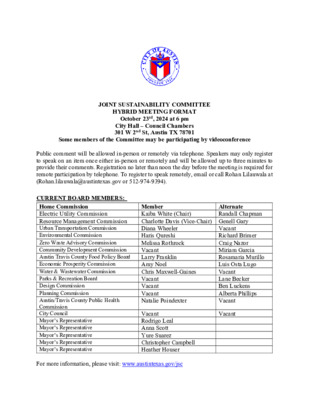
JOINT SUSTAINABILITY COMMITTEE HYBRID MEETING FORMAT October 23rd, 2024 at 6 pm City Hall – Council Chambers 301 W 2nd St, Austin TX 78701 Some members of the Committee may be participating by videoconference Public comment will be allowed in-person or remotely via telephone. Speakers may only register to speak on an item once either in-person or remotely and will be allowed up to three minutes to provide their comments. Registration no later than noon the day before the meeting is required for remote participation by telephone. To register to speak remotely, email or call Rohan Lilauwala at (Rohan.lilauwala@austintexas.gov or 512-974-9394). CURRENT BOARD MEMBERS: Home Commission Electric Utility Commission Resource Management Commission Urban Transportation Commission Environmental Commission Zero Waste Advisory Commission Community Development Commission Austin Travis County Food Policy Board Economic Prosperity Commission Water & Wastewater Commission Parks & Recreation Board Design Commission Planning Commission Austin/Travis County Public Health Commission City Council Mayor’s Representative Mayor’s Representative Mayor’s Representative Mayor’s Representative Mayor’s Representative Alternate Randall Chapman Member Kaiba White (Chair) Charlotte Davis (Vice-Chair) Genell Gary Diana Wheeler Haris Qureshi Melissa Rothrock Vacant Larry Franklin Amy Noel Chris Maxwell-Gaines Vacant Vacant Vacant Natalie Poindexter Vacant Richard Brimer Craig Nazor Miriam Garcia Rosamaria Murillo Luis Osta Lugo Vacant Lane Becker Ben Luckens Alberta Phillips Vacant Vacant Rodrigo Leal Anna Scott Yure Suarez Christopher Campbell Heather Houser Vacant For more information, please visit: www.austintexas.gov/jsc Committee. DISCUSSION AGENDA CALL TO ORDER PUBLIC COMMUNICATION: GENERAL The first 10 speakers signed up prior to the meeting being called to order will each be allowed a three-minute allotment to address their concerns regarding items not posted on the agenda. APPROVAL OF MINUTES 1. Approval of minutes from the September 25th, 2024 meeting of the Joint Sustainability 2. Presentation on low-carbon concrete – Johanna Anderson, EPA. 3. Presentation on Austin Core Transportation Plan – Cole Kitten, Transportation and Public Works Department. 4. Presentation on Tree Regulations and Protections – Naomi Rotramel and Daniel Priest, Development Services Department. 5. Discussion of agricultural land acquisition and potential Working Farms Fund pilot. DISCUSSION AND ACTION ITEMS FUTURE AGENDA ITEMS 6. Approval of Proposed 2025 Joint Sustainability Committee Annual Meeting Schedule ADJOURNMENT The City of Austin is committed to compliance with the American with Disabilities Act. Reasonable modifications and equal access to communications will be provided upon request. Meeting locations are planned with wheelchair access. If requiring Sign Language Interpreters or alternative formats, …
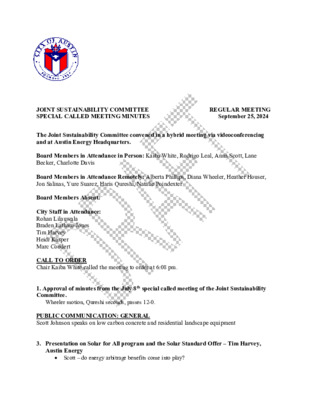
JOINT SUSTAINABILITY COMMITTEE REGULAR MEETING September 25, 2024 SPECIAL CALLED MEETING MINUTES The Joint Sustainability Committee convened in a hybrid meeting via videoconferencing and at Austin Energy Headquarters. Board Members in Attendance in Person: Kaiba White, Rodrigo Leal, Anna Scott, Lane Becker, Charlotte Davis Board Members in Attendance Remotely: Alberta Phillips, Diana Wheeler, Heather Houser, Jon Salinas, Yure Suarez, Haris Qureshi, Natalie Poindexter Board Members Absent: City Staff in Attendance: Rohan Lilauwala Braden Latham-Jones Tim Harvey Heidi Kasper Marc Coudert CALL TO ORDER Chair Kaiba White called the meeting to order at 6:08 pm. 1. Approval of minutes from the July 8th special called meeting of the Joint Sustainability Committee. Wheeler motion, Qureshi seconds, passes 12-0. PUBLIC COMMUNICATION: GENERAL Scott Johnson speaks on low carbon concrete and residential landscape equipment 3. Presentation on Solar for All program and the Solar Standard Offer – Tim Harvey, Austin Energy • Scott – do energy arbitrage benefits come into play? • Harvey – one of the considered benefits. Utility will control battery to a certain depth of discharge (to support resilience). On edge of event, batteries not used. On blue sky days, AE will use batteries for price chasing, 4CP avoidance, peak usage, to get max value out of battery • PPA will be used for solar purchases, performance contract for battery will • Grant will be used to buy down PPA and performance contract to AE’s avoided allow AE to benefit from them. cost of solar and make it feasible. • Phillips – questions around how program works, if benefits flow to wealthier folks • Harvey – provides clarification • Opportunity to provide feedback in community engagement process to shape program/ • Leal – why is program designed this way • Harvey – difficult to find 2500 low-income homes that are viable • If model is successful, potential to receive unused funds later • Leal – would roof repairs/rebuilding be part of it? • Harvey – there are existing programs, this grant can’t be for that as per EPA agreement. Homes will receive free weatherization if customer qualify • Opportunity for community engagement to help define what homes to target • Leal – what does governance look like? • Harvey – plans to set this up during community engagement. Work in progress, no money yet. Need to staff up in the early years. • Leal – who was engaged? • Harvey – …
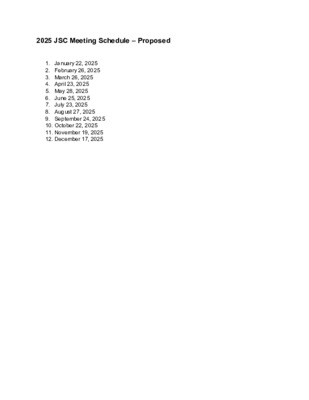
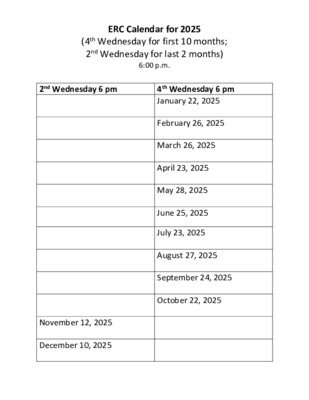
2025 JSC Meeting Schedule – Proposed 1. January 22, 2025 2. February 26, 2025 3. March 26, 2025 4. April 23, 2025 5. May 28, 2025 6. June 25, 2025 7. July 23, 2025 8. August 27, 2025 9. September 24, 2025 10. October 22, 2025 11. November 19, 2025 12. December 17, 2025
US EPA's Low Embodied Carbon Construction Materials Program for City of Austin's Joint Sustainability Committee October 23, 2024 The U.S. Federal Government www.epa.gov/greenerproducts | 2 2022 Inflation Reduction Act directed EPA to: Develop a determination for “Substantially Lower Embodied Carbon Construction Materials” for GSA & FHWA Provide grant funding and technical assistance to increase and improve environmental product declarations (EPDs) Create a label to help purchasers identify and procure lower embodied carbon construction materials www.epa.gov/greenerproducts | 3 Why embodied carbon? Embodied carbon of construction materials accounts for 15% of global greenhouse gas emissions. www.epa.gov/greenerproducts | 4 Why embodied carbon? Embodied carbon of construction materials accounts for 15% of global greenhouse gas emissions. www.epa.gov/greenerproducts | 5 Range of Strategies to Reduce Embodied Carbon in the Market Energy Efficient Manufacturing (e.g., ENERGY STAR Industrial) Salvage & Reuse US & Locally Made Materials Material Efficiency Lower Carbon Input Materials Durable Materials (vs. High Replacement Rate) Recycled Content Bio-Based Materials Renewable & Lower Carbon Intensive Fuels Most strategies to reduce embodied carbon of construction materials take place long before they arrive at a construction site. www.epa.gov/greenerproducts | 6 Quantifying & Reporting Embodied Carbon Environmental Product Declarations (EPDs) www.epa.gov/greenerproducts | 7 Key LEC Program Elements www.epa.gov/greenerproducts | 8 www.epa.gov/greenerproducts | 9 Grant Selections – Texas NEW SLIDE •University of Texas – Austin (salvaged materials) •Knauf Insulation (insulation) •Heidelberg (cement/concrete) •Holcim (cement/concrete, asphalt) Read more about the above projects: Selected projects summaries www.epa.gov/greenerproducts | 10 Interim Determination Overview “Substantially lower embodied carbon construction materials” as determined by EPA • Enables GSA & FHWA to implement their portions of the IRA • Defines “substantially lower embodied carbon construction materials” • Best performing 20% GHG emissions in CO2e (GWP per ISO 21930:2017)* • If not available in project location, best performing 40% • If not available in project location, better than estimated industry average *Because GWP is used in EPDs for construction products as an impact category (per ISO 21930), it was used in the Interim Determination as a proxy for embodied carbon. However, GWP is defined differently in other GHG accounting efforts. For clarity and consistency, EPA is exploring ways to better align terminology. Top 40% Top 20% Better than Industry Average www.epa.gov/greenerproducts | 11 Initial Focus Materials The label program does not address what type of material should be used in a project -- it is limited to “like to like” comparisons. Additional materials may be …
An Introduction to Austin’s Tree Regulations Joint Sustainability Committee October 23, 2024 Naomi Rotramel, City Arborist Daniel Priest, Environmental Compliance Specialist, Sr. History of Austin’s Tree Ordinance Margret Hofmann, 1925-2012 Hofmann Oaks Park History of Austin’s Tree Ordinance 1983 - Tree Preservation Ordinance 2010 - Heritage Tree Ordinance Why Do We Protect Trees? Austin’s urban forest currently has over 33 million trees, all of which support the following benefits: • • • • • • • • Trees improve air quality by filtering out particles, absorbing carbon dioxide and releasing oxygen. Trees help reduce flood impacts by slowing and filtering rainwater. Trees contribute to connections with nature that improve people’s health outcomes and contribute to an environment where people feel connected to their community. Trees are good for business: Shoppers spend more time and money in shopping areas with businesses that have good tree coverage. Tree roots hold soil in place, reducing erosion. Shade from urban trees can cool the air up to 8 degrees Celsius. Their shade and wind protection reduce energy use. Trees provide food, shelter, and nesting for diverse wildlife. Trees provide a sense of place and soften the sharp outlines of concrete, metal, and glass of urban and suburban cityscapes Source: Texas A&M Forest Service To maintain the health and integrity of our urban forest, the City of Austin strives to plant trees, preserve trees during land development, and care for existing trees. Why Do We Protect Trees? Land Development Code 25-8.B.1 • Prohibits removal of Protected or Heritage trees without a permit • 8"+ trees – preserve "to extent feasible" on site plan applications • Defines removal - physical removal, over pruning, or excessive root disturbance • Creates position of City Arborist to implement LDC 25-8.B.1 • Approval criteria for removal: • Reasonable use • Reasonable access • Dead, Diseased, or Imminent Hazard • Administrative rules – preservation criteria, protection requirements, mitigation • Variances and appeals Rules implementing LDC 25-8.B.1 are found in Section 3 of the Environmental Criteria Manual What are the Tree Regulations? Land Development Code 25-8, Subchapter B, Article 1 Division 1 – General Provisions Definitions Authorizes Rules Application Requirements Division 2 – Protected Trees Approval Criteria for Removal Division 3 – Heritage Trees Approval Criteria for Removal Variances Environmental Criteria Manual Section 3 3.3 - Survey Requirements Survey and Plan Depictions Hill Country Roadway Ordinance 3.5 - Design Criteria Protection (3.5.2) …
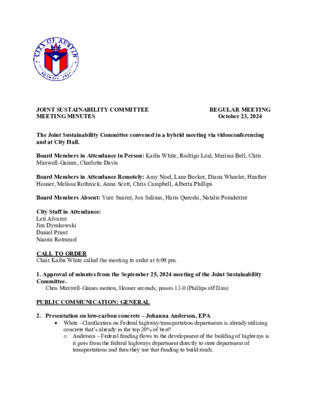
JOINT SUSTAINABILITY COMMITTEE REGULAR MEETING MEETING MINUTES October 23, 2024 The Joint Sustainability Committee convened in a hybrid meeting via videoconferencing and at City Hall. Board Members in Attendance in Person: Kaiba White, Rodrigo Leal, Marissa Bell, Chris Maxwell-Gaines, Charlotte Davis Board Members in Attendance Remotely: Amy Noel, Lane Becker, Diana Wheeler, Heather Houser, Melissa Rothrock, Anna Scott, Chris Campbell, Alberta Phillips Board Members Absent: Yure Suarez, Jon Salinas, Haris Qureshi, Natalie Poindexter City Staff in Attendance: Leti Alvarez Jim Dymkowski Daniel Priest Naomi Rotramel CALL TO ORDER Chair Kaiba White called the meeting to order at 6:09 pm. 1. Approval of minutes from the September 25, 2024 meeting of the Joint Sustainability Committee. Chris Maxwell-Gaines motion, Houser seconds, passes 12-0 (Phillips off Dais) PUBLIC COMMUNICATION: GENERAL 2. Presentation on low-carbon concrete – Johanna Anderson, EPA • White –Clarification on Federal highway/transportation departments is already utilizing concrete that’s already in the top 20% of best? o Anderson – Federal funding flows to the development of the building of highways is it goes from the federal highways department directly to state department of transportations and then they use that funding to build roads. • Bell – Procurement, curious do you imagine people utilizing these labels without limiting fair and open competition and meeting any procurement regulations that are required o Anderson – Initially you might give extra points for a product that has a label. Like any new sustainable product on the marketplace, one might set up a separate agreement for the sustainable products versus the lesser. Market availability, purchasers will have to do their due diligence and provide situation-by-situation basis. • White – Looks like this grant closes 11/25, will they be able to get something together in a month? o Anderson – In general grant programs there’s a real interest in reaching folks that are not professional grant writers so I would assume that the federal highways grant is going that way also. • Scott – How to we implement this? And how to we implement faster? o Anderson – There are tools already. I would say see how the federal government is doing it. Looking at how to take the approach, prioritizing, finding partners most willing, testing out carbon concrete, see what work is being done. • White – You talked about standards for the environmental product declarations, should we expect that they’re automatically adhering to those standards? …
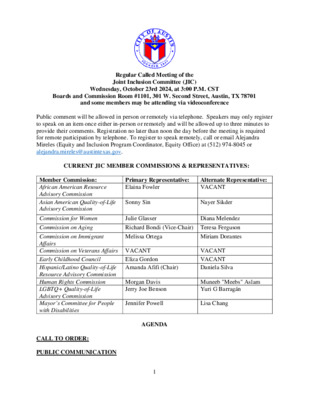
Regular Called Meeting of the Joint Inclusion Committee (JIC) Wednesday, October 23rd 2024, at 3:00 P.M. CST Boards and Commission Room #1101, 301 W. Second Street, Austin, TX 78701 and some members may be attending via videoconference Public comment will be allowed in person or remotely via telephone. Speakers may only register to speak on an item once either in-person or remotely and will be allowed up to three minutes to provide their comments. Registration no later than noon the day before the meeting is required for remote participation by telephone. To register to speak remotely, call or email Alejandra Mireles (Equity and Inclusion Program Coordinator, Equity Office) at (512) 974-8045 or alejandra.mireles@austintexas.gov. CURRENT JIC MEMBER COMMISSIONS & REPRESENTATIVES: Primary Representative: Elaina Fowler Alternate Representative: VACANT Member Commission: African American Resource Advisory Commission Asian American Quality-of-Life Advisory Commission Commission for Women Commission on Aging Commission on Immigrant Affairs Commission on Veterans Affairs VACANT Early Childhood Council Hispanic/Latino Quality-of-Life Resource Advisory Commission Human Rights Commission LGBTQ+ Quality-of-Life Advisory Commission Mayor’s Committee for People with Disabilities Sonny Sin Nayer Sikder Julie Glasser Richard Bondi (Vice-Chair) Teresa Ferguson Miriam Dorantes Melissa Ortega Diana Melendez Eliza Gordon Amanda Afifi (Chair) VACANT VACANT Daniela Silva Morgan Davis Jerry Joe Benson Muneeb "Meebs" Aslam Yuri G Barragán Jennifer Powell Lisa Chang CALL TO ORDER: PUBLIC COMMUNICATION AGENDA 1 The first ten speakers signed up prior to the meeting being called to order will each be allowed a three-minute allotment to address their concerns regarding items not posted on the agenda. APPROVAL OF MINUTES 1. Approve the minutes of the COMMITTEE’s REGULAR MEETING on SEPTEMBER 25TH, 2024. DISCUSSION ITEMS 2. Discussion on community input collected at the Joint Inclusion Committee’s Community Voices and Choices session on October 2nd, 2024. Discussion on the next steps from Commission on Aging requesting a City of Austin Implicit Bias Day. Discussion on meeting with the College Student Commission. Discussion on LGBTQ+ Quality of Life Advisory Commission’s Feasibility Study for a Cultural Center. Discussion on making quorum and using the hold over provision for the JIC Representatives from Districts 2, 4, 6, 7, 10 and Mayoral Appointees. Discussion on including Joint Inclusion Committee updates on home Commission monthly agendas. Discussion on promoting the Joint Inclusion Committee’s Community Voices and Choices sessions with Commissioners from home Commissions. DISCUSSION AND ACTION ITEMS 9. Approve a Recommendation to support Sunday Sessions ATX. Approve Commissioners attending, …
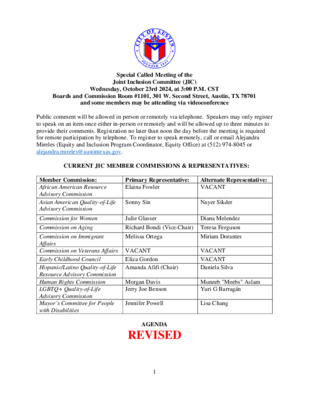
Special Called Meeting of the Joint Inclusion Committee (JIC) Wednesday, October 23rd 2024, at 3:00 P.M. CST Boards and Commission Room #1101, 301 W. Second Street, Austin, TX 78701 and some members may be attending via videoconference Public comment will be allowed in person or remotely via telephone. Speakers may only register to speak on an item once either in-person or remotely and will be allowed up to three minutes to provide their comments. Registration no later than noon the day before the meeting is required for remote participation by telephone. To register to speak remotely, call or email Alejandra Mireles (Equity and Inclusion Program Coordinator, Equity Office) at (512) 974-8045 or alejandra.mireles@austintexas.gov. CURRENT JIC MEMBER COMMISSIONS & REPRESENTATIVES: Primary Representative: Elaina Fowler Alternate Representative: VACANT Member Commission: African American Resource Advisory Commission Asian American Quality-of-Life Advisory Commission Commission for Women Commission on Aging Commission on Immigrant Affairs Commission on Veterans Affairs VACANT Early Childhood Council Hispanic/Latino Quality-of-Life Resource Advisory Commission Human Rights Commission LGBTQ+ Quality-of-Life Advisory Commission Mayor’s Committee for People with Disabilities Sonny Sin Nayer Sikder Julie Glasser Richard Bondi (Vice-Chair) Teresa Ferguson Miriam Dorantes Melissa Ortega Diana Melendez Eliza Gordon Amanda Afifi (Chair) VACANT VACANT Daniela Silva Morgan Davis Jerry Joe Benson Muneeb "Meebs" Aslam Yuri G Barragán Jennifer Powell Lisa Chang AGENDA REVISED 1 CALL TO ORDER: PUBLIC COMMUNICATION The first ten speakers signed up prior to the meeting being called to order will each be allowed a three-minute allotment to address their concerns regarding items not posted on the agenda. APPROVAL OF MINUTES 1. Approve the minutes of the COMMITTEE’s REGULAR MEETING on SEPTEMBER 25TH, 2024. DISCUSSION ITEMS 2. Discussion on community input collected at the Joint Inclusion Committee’s Community Voices and Choices session on October 2nd, 2024. Discussion on the next steps from Commission on Aging requesting a City of Austin Implicit Bias Day. Discussion on meeting with the College Student Commission. Discussion on LGBTQ+ Quality of Life Advisory Commission’s Feasibility Study for a Cultural Center. Discussion on making quorum and using the hold over provision for the JIC Representatives from Districts 2, 4, 6, 7, 10 and Mayoral Appointees. Discussion on including Joint Inclusion Committee updates on home Commission monthly agendas. Discussion on promoting the Joint Inclusion Committee’s Community Voices and Choices sessions with Commissioners from home Commissions. DISCUSSION AND ACTION ITEMS 9. Approve a Recommendation to support Sunday Sessions ATX. Approve Commissioners …
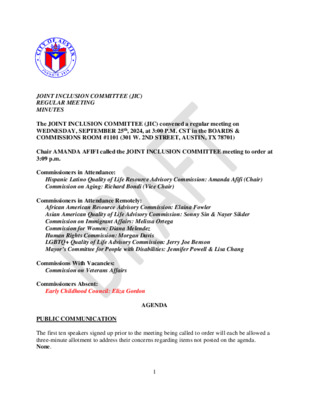
JOINT INCLUSION COMMITTEE (JIC) REGULAR MEETING MINUTES The JOINT INCLUSION COMMITTEE (JIC) convened a regular meeting on WEDNESDAY, SEPTEMBER 25th, 2024, at 3:00 P.M. CST in the BOARDS & COMMISSIONS ROOM #1101 (301 W. 2ND STREET, AUSTIN, TX 78701) Chair AMANDA AFIFI called the JOINT INCLUSION COMMITTEE meeting to order at 3:09 p.m. Commissioners in Attendance: Hispanic Latino Quality of Life Resource Advisory Commission: Amanda Afifi (Chair) Commission on Aging: Richard Bondi (Vice Chair) Commissioners in Attendance Remotely: African American Resource Advisory Commission: Elaina Fowler Asian American Quality of Life Advisory Commission: Sonny Sin & Nayer Sikder Commission on Immigrant Affairs: Melissa Ortega Commission for Women: Diana Melendez Human Rights Commission: Morgan Davis Mayor’s Committee for People with Disabilities: Jennifer Powell & Lisa Chang Commissions With Vacancies: Commission on Veterans Affairs Commissioners Absent: Early Childhood Council: Eliza Gordon LGBTQ+ Quality of Life Advisory Commission: Jerry Joe Benson PUBLIC COMMUNICATION The first ten speakers signed up prior to the meeting being called to order will each be allowed a three-minute allotment to address their concerns regarding items not posted on the agenda. None. AGENDA 1 APPROVAL OF MINUTES 1. DISCUSSION ITEMS 2. Approve the minutes of the COMMITTEE’s SPECIAL CALLED MEETING on SEPTEMBER 4TH, 2024. The minutes were approved on COMMISSIONER JENNIFER POWELL’s motion, COMMISSIONER JERRY JOE BENSON’s second, on a 6-0 vote. (Off the dais: African American Resource Advisory Commission’s Commission Fowler, Commission for Women’s Commissioner Diana Melendez, and Human Rights Commission’s Commissioner Morgan Davis. Absent: Early Childhood Council’s Commissioner Eliza Gordon.) Presentation by Sunday Sessions ATX with an overview of the organization, upcoming opportunities for Community engagement, and needs for FY25. (Cierra Madison, Founder of Sunday Sessions ATX) Cierra begins presentation by providing context for Resolution 20240215-023. Shares that Austin’s Black and Brown communities do not have green spaces available to them. Shares that Sunday Sessions ATX has been rejected for permits, that the impacts of this has shown a bias when serving Austin’s Black and Brown owned businesses and communities. Cierra shares that because People of Color continue to be displaced from central Austin, it is important to provide a central local for Black and Brown people to socialize in green spaces. Sunday Sessions ATX asks for structural support and money in support of the organization’s work and the impact of the work. COMMISSIONER SONNY SIN thanks Cierra for presenting and asks if Sunday Sessions ATX has connected …
RESOLUTION FOR SUPPORT OF SUNDAY SESSIONS ATX WHEREAS, Sunday Sessions ATX is a community-focused organization dedicated to fostering inclusivity, well-being, and engagement through free, open-to-the-public music events hosted in outdoor greenspaces that reflect the City of Austin’s cultural identity and enhance its reputation as the "Live Music Capital of the World"; and WHEREAS, the City of Austin recognizes the significant social and economic benefits of supporting free community events, which attract visitors, support local businesses, and provide meaningful opportunities for community engagement; and WHEREAS, the City Council, in Resolution No. 20240215-023, acknowledged the challenges faced by event organizers due to rising costs, emphasizing the need for support to sustain free, accessible community events like "Blues on the Green," which contribute to Austin’s cultural vibrancy; and directed the City Manager to solicit input from the Arts, Music, and Quality of Life commissions in developing recommendations to support and sustain these events by utilizing partnerships across all areas of expertise involved in the live music and arts event space, with the goal of expanding opportunities for the City to co-sponsor community events that are centered around locality, diversity, and inclusivity; and further established an ordinance for associated fee waivers, co-sponsorships, or related budget authorizations needed to effectuate these goals; and WHEREAS, Sunday Sessions ATX is an ongoing, monthly event that aligns with the goals outlined in Resolution No. 20240215-023 by providing free access to local music, arts, and wellness activities, while creating inclusive and diverse spaces for Austinites; and WHEREAS, the ACE permitting fee presents a financial barrier for small, grassroots organizations like Sunday Sessions ATX, and waiving this fee on an ongoing basis would directly support the City’s goal of fostering open, accessible, and culturally enriching events; and WHEREAS, the City of Austin is committed to preserving and promoting accessible community events that reflect Austin’s diversity and vibrancy, including supporting organizations like Sunday Sessions ATX through fee waivers and other resources to ensure their long-term sustainability; NOW, THEREFORE, BE IT RESOLVED, that the Joint Inclusion Committee (JIC) requests that the Austin City Council direct the City Manager’s Office to waive the ACE permitting fees for Sunday Sessions ATX on a recurring, monthly basis in recognition of its valuable contributions to Austin’s cultural and community life, as part of the City's broader efforts to support free, public, and inclusive events; and BE IT FURTHER RESOLVED, that the Joint Inclusion Committee (JIC) supports …
RECOMMENDATION Joint Inclusion Committee Recommendation Number 20241023-009: Support of Sunday Sessions ATX RECOMMENDATION FOR SUPPORT OF SUNDAY SESSIONS ATX WHEREAS, Sunday Sessions ATX is a community-focused organization dedicated to fostering inclusivity, well-being, and engagement through free, open-to-the-public music events hosted in outdoor greenspaces that reflect the City of Austin’s cultural identity and enhance its reputation as the "Live Music Capital of the World"; and WHEREAS, the City of Austin recognizes the significant social and economic benefits of supporting free community events, which attract visitors, support local businesses, and provide meaningful opportunities for community engagement; and WHEREAS, the City Council, in Resolution No. 20240215-023, acknowledged the challenges faced by event organizers due to rising costs, emphasizing the need for support to sustain free, accessible community events like "Blues on the Green," which contribute to Austin’s cultural vibrancy; and directed the City Manager to solicit input from the Arts, Music, and Quality of Life commissions in developing recommendations to support and sustain these events by utilizing partnerships across all areas of expertise involved in the live music and arts event space, with the goal of expanding opportunities for the City to co-sponsor community events that are centered around locality, diversity, and inclusivity; and further established an ordinance for associated fee waivers, co-sponsorships, or related budget authorizations needed to effectuate these goals; and WHEREAS, Sunday Sessions ATX is an ongoing, monthly event that aligns with the goals outlined in Resolution No. 20240215-023 by providing free access to local music, arts, and wellness activities, while creating inclusive and diverse spaces for Austinites; and WHEREAS, the ACE permitting fee presents a financial barrier for small, grassroots organizations like Sunday Sessions ATX, and waiving this fee on an ongoing basis would directly support the City’s goal of fostering open, accessible, and culturally enriching events; and WHEREAS, the City of Austin is committed to preserving and promoting accessible community events that reflect Austin’s diversity and vibrancy, including supporting organizations like Sunday Sessions ATX through fee waivers and other resources to ensure their long-term sustainability; NOW, THEREFORE, BE IT RESOLVED, that the Joint Inclusion Committee (JIC) requests that the Austin City Council direct the City Manager’s Office to waive the ACE permitting fees for Sunday Sessions ATX on a recurring, monthly basis in recognition of its valuable contributions to Austin’s cultural and community life, as part of the City's broader efforts to support free, public, and inclusive events; …
JOINT INCLUSION COMMITTEE (JIC) SPECIAL MEETING MINUTES The JOINT INCLUSION COMMITTEE (JIC) convened a special meeting on WEDNESDAY, October 23rd, 2024, at 3:00 P.M. CST in the BOARDS & COMMISSIONS ROOM #1101 (301 W. 2ND STREET, AUSTIN, TX 78701) Vice-Chair RICHARD BONDI called the JOINT INCLUSION COMMITTEE meeting to order at 3:09 p.m. Commissioners in Attendance: Commissioners in Attendance Remotely: Commission on Immigrant Affairs: Melissa Ortega Commission for Women: Diana Melendez Commission on Aging: Richard Bondi (Vice Chair) Early Childhood Council: Eliza Gordon Mayor’s Committee for People with Disabilities: Lisa Chang Hispanic Latino Quality of Life Resource Advisory Commission: Amanda Afifi (Chair) LGBTQ+ Quality of Life Advisory Commission: Jerry Joe Benson Asian American Quality of Life Advisory Commission: Sonny Sin & Nayer Sikder Commissions With Vacancies: Commissioners Absent: Commission on Veterans Affairs African American Resource Advisory Commission: Commissioners Elaina Fowler or Antonio Ross Human Rights Commission: Commissioners Morgan Davis or Muneeb “Meebs”Aslam 1 PUBLIC COMMUNICATION The first ten speakers signed up prior to the meeting being called to order will each be allowed a three-minute allotment to address their concerns regarding items not posted on the agenda. Cierra Maddison expresses gratitude for the Joint Inclusion Committee’s agenda item approving a Recommendation in support of Sunday Sessions ATX and that she will share the upcoming JIC’s community input meetings for the City’s FY26 budget. APPROVAL OF MINUTES 1. Approve the minutes of the COMMITTEE’s REGULAR MEETING on SEPTEMBER 25TH, 2024. The minutes are approved at the October 23rd, 2024 Special Called meeting on COMMISSIONER LISA CHANG’s motion, COMMISSIONER JERRY JOE BENSON’S second, on a 6-0 vote. (Off the dais: Asian American Quality of Life Advisory Commission’s Commissioner Sonny Si, and Hispanic Latino Quality of Life Resource Advisory Commission’s Amanda Afifi. Absent: African American Resource Advisory Commissions’ Elaina Fowler and Human Rights Commission’s Commissioner Morgan Davis.) DISCUSSION ITEMS 2. Discussion on community input collected at the Joint Inclusion Committee’s Community Voices and Choices session on October 2nd, 2024. Discussion on what was shared during sessions. Discussion on the next steps from Commission on Aging requesting a City of Austin Implicit Bias Day. COMMISSIONER RICHARD BONDI shares about connecting with Marion Sanchez through the Commission on Aging because the We All the Belong campaign is like the purpose of the event and there could be funding for it; shares that a public proclamation may be made; shares possibilities that the event could be …
1. REGULAR CALLED MEETING of the ETHICS REVIEW COMMISSION OCTOBER 23, 2024 at 6:00 P.M. AUSTIN CITY HALL, BOARDS & COMMISSIONS ROOM, #1101 301 W 2ND STREET AUSTIN, TEXAS 78701 Some members of the Ethics Review Commission may be participating by videoconference. The meeting may be viewed online at: http://www.austintexas.gov/page/watch-atxn-live Public Speakers: Public comment will be allowed in-person or remotely via telephone. Speakers may only register to speak once, either in-person or remotely, and will be allowed up to three minutes to provide their comments. If participating remotely by telephone, a speaker must register no later than noon the day before the meeting. To register to speak remotely, contact Lizette Benitez at (512) 974-2915 or lizette.benitez@austintexas.gov. Adam Materne Luis Figueroa Secretary Nguyen Stanton-Adams William Ross Pumfrey District 2 – Vacancy Amy Casto CURRENT COMMISSIONERS: Edward Espinoza Brian Mcgiverin Chair Michael Lovins Vice-Chair Haksoon Andrea Low Mary Kahle CALL TO ORDER PUBLIC COMMUNICATION: GENERAL AGENDA There is no limit on the number of speakers who may speak on agenda items. There is a limit on the number of speakers who may speak on items not posted on the agenda—only the first ten speakers who register prior to the meeting being called to order will be allowed a three-minute allotment to address non-agenda items. For more information on public communication, please see the “Notice Regarding Public Communication” at the end of this agenda. APPROVAL OF MINUTES Approve the minutes of the Ethics Review Commission Regular meeting on September 25, 2024. 1 2. 3. 4. 5. 6. DISCUSSION AND ACTION ITEMS Consideration, discussion, and potential action regarding: Adopt the Ethics Review Commission regular meeting calendar for 2025. Update from the Working Group to Review ERC Complaints Process. Discussion regarding the scheduling of the Greenberg-Greco complaint and the Greenberg- Watson complaint. Discussion regarding the scheduling of the Duchen-Ganguly complaint. Discussion regarding the scheduling of the Kelly-Laine complaint. FUTURE AGENDA ITEMS ADJOURNMENT The City of Austin is committed to compliance with the American with Disabilities Act. Reasonable modifications and equal access to communications will be provided upon request. Meeting locations are planned with wheelchair access. If you are requiring Sign Language Interpreters or alternative formats, please give notice at least 2 days (48 hours) before the meeting date. Please call Lizette Benitez, Caroline Webster at the Law Department, at (512) 974-2268 for additional information; TTY users’ route through Relay Texas at 711. For more information …
ERC Calendar for 2025 (4th Wednesday for first 10 months; 2nd Wednesday for last 2 months) 6:00 p.m. 2nd Wednesday 6 pm 4th Wednesday 6 pm January 22, 2025 February 26, 2025 March 26, 2025 April 23, 2025 May 28, 2025 June 25, 2025 July 23, 2025 August 27, 2025 September 24, 2025 October 22, 2025 November 12, 2025 December 10, 2025
REGULAR MEETING of the PLANNING COMMISSION TUESDAY, OCTOBER 22, 2024, 6:00 PM AUSTIN CITY HALL, COUNCIL CHAMBERS, ROOM 1001 301 WEST 2ND STREET AUSTIN, TEXAS Some members of the Planning Commission may be participating by videoconference. The meeting may be viewed online at: http://www.austintexas.gov/page/watch-atxn-live. Public comment will be allowed in-person or remotely via telephone. Speakers may only register to speak on an item once either in-person or remotely. Registration no later than 2 PM the day of the meeting is required for remote participation by telephone. For more information on public comment, please see the agenda section “Speaker Registration”. Please contact Ella Garcia, Staff Liaison, for questions regarding speaker registration at LandUseLiaison@austintexas.gov or by phone at 512-978-0821. CURRENT BOARD MEMBERS/COMMISSIONERS: Claire Hempe1, Chair (District 8) Awais Azhar, Vice Chair (Mayor’s Representative) Greg Anderson, Secretary (District 4) Alice Woods, Parliamentarian (District 2) Patrick Howard (District 1) Nadia Barrera-Ramirez (District 3) Felicity Maxwell (District 5) EX-OFFICIO MEMBERS: Casey Haney (District 6) Ryan Johnson (District 7) Danielle Skidmore (District 9) Grayson Cox (District 10) Alberta Phillips (Mayor’s Representative) Adam Haynes (Mayor’s Representative) Jessica Cohen, Chair of Board of Adjustment Candace Hunter, AISD Board of Trustees TC Broadnax, City Manager Richard Mendoza – Director of Transportation and Public Works EXECUTIVE SESSION (No public discussion) The Planning Commission will announce it will go into Executive Session, if necessary, according to Chapter 551 of the Texas Government Code, to receive advice from Legal Counsel on matters Executive Liaison: Joi Harden, 512-974-1617 Staff Liaison: Ella Garcia, 512-978-0821 Attorney: AJ Urteaga, 512-974-2386 specifically listed on the agenda. The Commission may not conduct a closed meeting without the approval of the city attorney. Private Consultation with Attorney – Section 551.071. CALL TO ORDER PUBLIC COMMUNICATION: GENERAL AGENDA The first four speakers signed up prior to the meeting being called to order will each be allowed a three-minute allotment to address their concerns regarding items not posted on the agenda. APPROVAL OF MINUTES 1. Approve the minutes of the Planning Commission regular meeting on October 8, 2024. PUBLIC HEARINGS Location: 2. Plan Amendment: NPA-2024-0027.01 - Rawson Saunders - Tarrytown Christian Church Improvements; District 10 2614 and 2614 ½ Exposition Boulevard, 2702 McCoullugh Street, 2615 ½ and 2611 Hillview Road, Taylor Slough South Watershed; Central West Austin Combined (West Austin) Neighborhood Planning Area Owner/Applicant: Austin Area School For Dyslexics Inc./Tarrytown Baptist Church Agent: Request: Staff Rec.: Staff: Thrower Design, LLC (Ron …
PLANNING COMMISSION REGULAR MEETING MINUTES TUESDAY, OCTOBER 8, 2024 The Planning Commission convened in a regular meeting on Tuesday, October 8, 2024, at Austin City Hall, Council Chambers, Room 1001, 301 W. Second Street, Austin, TX. Chair Hempel called the Commission Meeting to order at 6:10 p.m. Commissioners in Attendance: Claire Hempel Awais Azhar Greg Anderson Nadia Barrera-Ramirez Casey Haney Adam Haynes Ryan Johnson Felicity Maxwell Alberta Phillips Danielle Skidmore Alice Woods Commissioners in Attendance Remotely: Grayson Cox Patrick Howard Ex-Officio Members in Attendance: Jessica Cohen Ex-Officio Members in Attendance Remotely: Candace Hunter PUBLIC COMMUNICATION Paul Stables, Initiate a rezoning for a conditional use permit. Carol Philipson, Cell towers in endangered habitats. APPROVAL OF MINUTES 1. Approve the minutes of the regular meeting of the Planning Commission on September 24, 2024 The minutes from the meeting of September 24, 2024, were approved on the consent agenda on Vice Chair Azhar’s motion, Commissioner Maxwell’s second, on a 12-0 vote. Commissioner Phillips was off the dais. PUBLIC HEARINGS 2. Plan Amendment: NPA-2023-0018.06 - 6725 Shirley Avenue; District 4 Location: 6719, 6725 Shirley Avenue, and 605 William Street, Waller Creek Watershed; Brentwood/Highland Combined (Highland) Neighborhood Planning Area Owner/Applicant: 6725 Shirley Avenue, LLC Agent: Request: Drenner Group, PC (Leah M. Bojo) To change the base maximum building height from 60 feet to 120 feet with participation in the density bonus program and to change the Live/Work Flex subdistrict to TOD Mixed Use subdistrict. The land use on the future land use map is Specific Regulating District. There is no proposed change to the future land use map. Recommended Maureen Meredith, 512-974-2695, maureen.meredith@austintexas.gov Planning Department Staff Rec.: Staff: The motion to approve Staff’s recommendation to change the base maximum building height from 60 feet to 120 feet with participation in the density bonus program and to change the Live/Work Flex subdistrict to TOD Mixed Use subdistrict. The land use on the future land use map is Specific Regulating District. There is no proposed change to the future land use map, for NPA-2023-0018.06 - 6725 Shirley Avenue, located at 6719, 6725 Shirley Avenue and 605 Williams Street, was approved on the consent agenda on Vice Chair Azhar’s motion, Commissioner Maxwell’s second, on a 12-0 vote. Commissioner Phillips was off the dais. 3. Rezoning: Location: C14-2023-0132 - 6725 Shirley Avenue; District 4 6719, 6725 Shirley Avenue, and 605 William Street, Waller Creek Watershed; Brentwood/Highland Combined (Highland) Neighborhood …
City of Austin Planning Department 6310 Wilhelmina Delco Drive, Austin, TX 78752 P.O. Box 1088, Austin, TX 78767 -1088 (512) 974-2000 ♦ h ttp s:/ / w w w.a u st in tex a s .g ov / d epa r tm e n t/ plan n in g - de part men t MEMORANDUM TO: FROM: DATE: RE: Claire Hempel, Chair & Planning Commission Members Maureen Meredith, Senior Planner, Long-Range Planning Division Cynthia Hadri, Senior Planner, Current Planning Division Planning Department October 15, 2024 NPA-2023-0027.01 and C14-2024-0051_Rawson Saunders/Tarrytown Christian Church Improvement 2614, 2614 ½ Exposition Blvd, 2702 McCullough St, 2611 and 2615 ½ Hillview Road Central West Austin Combined Neighborhood Planning Area (WANG) The Applicant requests a postponement of the above-referenced cases from the October 22, 2024 Planning Commission date to the December 17, 2024 hearing date to allow time for action by the Board of Adjustment. See attached letter from Victoria Haase, Thrower Design, LLP. The postponement request was made in a timely manner and meets the Planning Commission’s policy. Attachments: Letter from Victoria Haase, Thrower Design, LLP Plan Amendment Map Zoning Map The City of Austin is committed to compliance with the Americans with Disabilities Act and will provide reasonable modifications and equal access to communications upon request. The City of Austin is committed to compliance with the Americans with Disabilities Act and will provide reasonable modifications and equal access to communications upon request. The City of Austin is committed to compliance with the Americans with Disabilities Act and will provide reasonable modifications and equal access to communications upon request. The City of Austin is committed to compliance with the Americans with Disabilities Act and will provide reasonable modifications and equal access to communications upon request.