3/1/2024 – updated 4:48pm Summary of Water Forward Reclaimed and Reuse Ordinance Items to Be Considered by Council on March 7, 2024 and Links to Backup Item 2: Authorize nego�a�on and execu�on of an interlocal agreement with Travis County for the County to reimburse the City for the County’s propor�onate share of costs to design and construct oversized reclaimed water mains and appurtenances within the Central Business District that will provide service to the County’s Civil and Family Court Building and Probate Court Building. Item 3: Approve an ordinance amending City Code Chapter 15-13 (Regula�on of Onsite Water Reuse Systems) to establish development project requirements and clarify onsite water reuse regula�ons. o Link to backup material o Link to backup material Item 4: Approve a resolu�on authorizing Aus�n Water to con�nue a pilot program and issue incen�ves on a pilot basis during Fiscal Year 2023-2024 for alterna�ve onsite water reuse systems and reclaimed water connec�ons for new commercial, mixed use and mul�-family developments in the total amount of $5,600,000, not to exceed $500,000 for each project. o Link to backup material Item 30: Conduct a public hearing and approve an ordinance amending Exhibit A to the Fiscal Year 2023- 2024 City Fee and Fine Ordinance (Ordinance No. 20230816-007) to add a dedicated GoPurple component of $0.15 cents per thousand gallons to Aus�n Water’s water u�lity and wastewater u�lity community benefit charges to support reuse strategies in the Water Forward plan; and amending the Fiscal Year 2023-2024 Aus�n Water Community Benefit Charge Special Revenue Fund (Ordinance No. 20230816-008) to increase revenue and appropria�ons by $4,100,000 and the Fiscal Year 2023-2024 Aus�n Water Opera�ng Funds (Ordinance No.20230816-008) to increase transfers in and appropria�ons by $4,100,000 for reuse strategies in the Water Forward plan. o Link to backup material Item 37: Conduct a public hearing and consider an ordinance amending City Code Chapter 25-9 (Water and Wastewater) rela�ng to clarifying requirements for water conserva�on in the implementa�on of the Water Forward Plan, including distances for the Reclaimed Water Connec�on requirement, clarifying defini�ons, and modifying variances including adding certain affordable housing exemp�ons for Reclaimed Water Connec�ons and Onsite Water Reuse requirements; and waiving the requirement in City Code Sec�on 25-1-502 (Amendment Review) for Planning Commission review of Land Development Code amendments. o Link to backup material
AUSTIN INTEGRATED WATER RESOURCE PLANNING COMMUNITY TASK FORCE SPECIAL CALLED MEETING MINUTES TUESDAY, March 5, 2024 The Austin Integrated Water Resource Planning Community Task Force convened in a Regular Meeting on March 5, 2024, with Social Distancing Modifications. Chair WALKER called the meeting to order at 12:05 pm. Members in Attendance: Jennifer Walker, Chair Robert Mace, Vice Chair Paul DiFiore Madelline Mathis Ex-Officio Members in Attendance: Kevin Critendon Members in Attendance Remotely: Sarah Faust Hani Michel Todd Bartee Bill Moriarty Vanessa Puig Williams Austin Water Staff: Shay Ralls Roalson Anna Bryan-Borja Joseph Gonzales Teresa Lutes Kevin Kluge Heather Cooke Katherine Jashinski Marisa Flores Gonzalez Sara Eatman Emily Rafferty The City of Austin is committed to compliance with the American with Disabilities Act. Reasonable modifications and equal access to communications will be provided upon request. Meeting locations are planned with wheelchair access. If requiring Sign Language Interpreters or alternative formats, please give notice at least 2 days (48 hours) before the meeting date. Please contact Austin Integrated Water Resource Planning Community Task Force liaison Emily Rafferty at 512-972-0427, for additional information; TTY users route through Relay Texas at 711. Page 1 of 2 Others in Attendance: Robert Lempert (RAND) Michelle Miro (RAND) Richard Hoffpauir (Hoffpauir Consulting, PLLC) PUBLIC COMMUNICATION: GENERAL None APPROVAL OF MINUTES 1. Approval of the meeting minutes from the January 9, 2024, Task Force meeting. The minutes from the January 9th meeting were approved on Vice Chair MACE’S motion and Member MICHEL’s second on an 9-0 vote. STAFF BRIEFINGS, PRESENTATIONS, AND/OR REPORTS 2. Update on Lower Colorado River and Highland Lakes water supply conditions The presentation was made by Marisa Flores Gonzalez, Program Manager III, Austin Water. 3. Update on Reuse Ordinances related to clarifying requirements and modifying variances for Reclaimed Water Connections and Onsite Water Reuse requirements, reauthorizing the Onsite Water Reuse Systems pilot incentive, creating a GoPurple Community Benefit Charge, and approving negotiation and execution of an interlocal agreement related to reclaimed connections for the Travis County Courthouse The presentation was made by Shay Ralls Roalson, Director, Austin Water. 4. Update on Indirect Potable Reuse Emergency Implementation Project The presentation was made by Sara Eatman, Engineer A, Austin Water. VOTING ITEMS 5. Approve a letter from the Water Forward Task Force to the Austin City Council regarding voting items on the March 7, 2024, Austin City Council agenda related to implementing Water Forward reuse and reclaimed …
AFRICAN AMERICAN RESOURCE ADVISORY COMMISSION MARCH 5, 2024 Austin History Center (C05767, PICA 24201, PICA 29995); Chen Chen Wu; City of Austin Why Does This Matter? 16% PLAN VISION Historic preservation in Austin actively engages communities in protecting and sharing important places and stories. Preservation uses the past to create a shared sense of belonging and to shape an equitable, inclusive, sustainable, and economically vital future for all. Photos (L-R): Preservation Austin; Marilyn Poole; City of Austin; HUD PD&R Edge Community-Based Process 12 months 22 working group and drafting committee meetings 1,100 working group hours 38 focus group hours 2,200+ staff hours Icons from the Noun Project: Community by Gan Khoon Lay, focus group by mikicon, committee by Adrien Coquet Community-Based Process “Being part of the working group was a great experience mainly because the members had diverse backgrounds, but the same goal. It was a rare learning experience.” Michelle Benavides Ursula A. Carter Linda Y. Jackson Brenda Malik Emily Payne Gilbert Rivera 1 Brita Wallace* 1 Justin Bragiel 2 Mary Jo Galindo* Meghan King* Alyson McGee 1 Rocio Peña-Martinez* JuanRaymon Rubio 2 Bob Ward 1 Noel Bridges Jerry Garcia 1 Jolene Kiolbassa 1 Debra Murphy 2 Misael Ramos* Maria Solis* 1 Caroline Wright 1 *Drafting Committee member 1 Phase 1 only 2 Phase 2 only Julia Brookins* Ben Goudy 2 Kevin Koch Robin Orlowski 2 Mary Reed* 1 Erin Waelder Amalia Carmona 2 Hanna Huang* 1 Kelechi Madubuko Leslie Ornelas 1 Lori Renteria 1 Equity-Based Preservation Plan REVIEWING THE DRAFT Neal Douglass, Oct. 1949, ND-49-346-02, Austin History Center, Austin Public Library. Draft Plan Goals 1. Tell Austin’s full history 9. Proactively identify important places 2. Recognize cultural heritage 10. Follow good designation practices 3. Preserve archaeological resources 11. Support stewardship of community 4. Stabilize communities assets 5. Support environmental sustainability 12. Be strategic with review 6. Engage communities equitably 13. Protect historic resources 7. Support people doing the work 14. Implement the plan collaboratively 8. Engage new partners What We Preserve Parade and mural unveiling (The Austin Chronicle), San Antonio Office of Historic Preservation Think broadly. • Recognize Austin’s rich and complex history through active listening, inclusive research, and interpretation • Better recognize and protect legacy businesses, murals, and archaeological resources • Use preservation tools to support community stabilization and environmental sustainability Who Preserves Invite and support. • Help people access knowledge, resources, and decision-making power • Streamline and …
Discussion on community needs and spending priorities for the FY 24-29 Consolidated Plan for federal grants. Agenda Where Does Our Funding Come From? Planning and Reporting for Federal Funding How We Make Decisions Fair Housing Programs and Activities Overview What We've Heard From the Community Group and Community Input How do we fund our programs? HUD Annual Entitlement Grants Housing Trust Fund Approved City Bonds City Operating Budget Project Connect Anti-Displacement Funds CARES Act Federal Grants: Planning & Reporting Programs & Activites The U.S. Department of Housing and Urban Development (HUD) allocates entitlement funding to municipalities and state governments. The City of Austin applies for what in recent years has been approximately $14 million in annual grant entitlements across four grants for affordable housing, community development, economic development, and public services. Each year, we plan and evaluate the programs funded by the HUD grants. 5 U.S. Department of Housing and Urban Development (HUD) Consolidated Plan (5-Year) Allocates federal resources to housing and community development Action Plan (1-Year) Summarizes actions, activities and federal/non- federal resources in the Consolidated Plan Consolidated Annual Performance and Evaluation Report (CAPER) (1-Year) End-of-year report on progress toward consolidated plan 6 How are funding decisions made? We are here Community Participation: Community Needs Assessment Available Use of Funding Sources Consolidated Plan Housing Needs & Market Analysis Other Planning Efforts Austin Strategic Housing Blueprint Analysis of Impediments to Fair Housing Choice 7 Consolidated Plan Funding Sources Community Development Block Grant (CDBG) Goal: Provide decent housing and a suitable living environment; expand economic opportunities for low-income people Housing Opportunities for Persons with AIDS (HOPWA) Goal: Benefit low-income persons living with HIV/AIDS and their families by providing supportive services and housing Consolidated Plan (5-Year) HOME Investment Partnerships (HOME) Goal: create affordable housing for low- income households Emergency Solutions Grant (ESG) Goal: Assist people to quickly regain stability in permanent housing after experiencing a housing crisis and/or homelessness 8 Fair Housing • 2019 Analysis of Impediments to Fair Housing Choice (AI) • Potential upcoming "Equity Plan" related to fair housing • Seeking input and surveying on fair housing issues, experiences 9 Programs & Activities 10 Who Do We Serve? Fiscal Year 22-23 Snapshot 64.4% 3,017 # households served FY 22-23 70.0% 60.0% 50.0% 40.0% 30.0% 20.0% 10.0% 0.0% 17.5% 16.7% Extremely Low Income (<30% MFI) Very Low Income (31%- 50% MFI) Low Income (51%-80% MFI) 1.4% 81%+ MFI *Income data does …
Regular CALLED MEETING of the AFRICAN AMERICAN RESOURCE ADVISORY COMMISSION March 5, 2024, at 5:30 pm. City of Austin Permitting and Development Center 6310 Wilhelmina Delco Dr. Room 1401/1402 Austin, Texas 78752 Some African American Resource Advisory Commission members may be participating by videoconference. Public comment will be allowed in-person or remotely via telephone. Speakers may only register to speak on an item once, in-person or remotely, and will be allowed up to three minutes to provide their comments. Registration by telephone for remote participation is required by noon the day before the meeting. Call or email Florinda Bryant at 512.974.2715 florinda.bryant@austintexas.gov to register to speak remotely. CURRENT BOARD MEMBERS/COMMISSIONERS: Elaina Fowler, Chair (District 10) Daryl Horton, (Appointee) Mueni Rudd (District 2) Dr. Chiquita Eugene (District 5) Serita Fontanesi (District 7) Joi Harden (District 9) Greg Smith (ARA Appointee) Cherelle Vanbrakle, Vice Chair (District 4) Dewi Smith (District 1) Anthony Jackson (District 3) Vacant (District 6) Antonio Ross (District 8) Vacant (AAUL Appointee) Nelson Linder (NAACP Appointee) Roger Davis (GABC Appointee) MEETING AGENDA CALL TO ORDER PUBLIC COMMUNICATION The first ten speakers signed up before the meeting being called to order will each be allowed a three-minute allotment to address their concerns regarding items not posted on the agenda. APPROVAL OF MINUTES 1. Approve the minutes of the African American Resource Advisory Commission Special Call Meeting on November 28th, 2023. 2. Approve the minutes of the Committee’s Regular Called Meeting on February 6, 2024. DISCUSSION ITEMS update on Block 16 + 18. 3. Anne Gatlin Hayes, CTO with Austin Economic Development Corporation, will share an 4. Florinda Bryant, Program Coordinator of the African American Cultural & Heritage Facility, with a 2023-2024 program update and 2024-2025 budget request. 5. Cara Berton, Equity-Based Preservation Plan draft sharing. 6. Chris Duran, Sr Research Analyst; Julie Smith, Community Engagement Specialist with the Housing Department; and Leslie Boyd, Interim Public Health Manager II with Austin Public Health, will share Federal funding priorities for a five-year strategic plan. 7. Amanda Johnston, Executive Director of Torch Literary Arts, will share information on 8. Kim Wright, Manager of Millennium Youth Entertainment Complex, update on the the organization and the 2024-2025 budget request. complex including impact and budget needs. 9. Review and discuss budget recommendations for the Joint Inclusion Commission. (JIC member: Serita Fontanesi) 10. Review and discuss the scope of all current working groups and possible action to …
1. 2. REGULAR CALLED MEETING of the PUBLIC SAFETY COMMISSION March 4, 2024 at 4:00 PM AUSTIN CITY HALL BOARDS AND COMMISSIONS ROOM #1101 301 WEST 2ND STREET AUSTIN, TEXAS Some members of the Public Safety Commission may be participating by videoconference. The meeting may be viewed online at: http://www.austintexas.gov/page/watch-atxn-live Public comment will be allowed in-person or remotely via telephone. Speakers may only register to speak on an item once either in-person or remotely and will be allowed up to three minutes to provide their comments. Registration no later than noon the day before the meeting is required for remote participation by telephone. To register to speak remotely, call or email Christi Vitela, 512- 974-2792, christi.vitela@austintexas.gov. Pierre Nguyễn Kristy Orr Angelica Reyes Timothy Ruttan Yasmine Smith CURRENT COMMISSIONERS: Nelly Paulina Ramírez, Chair Rebecca Bernhardt, Vice Chair Cory Hall-Martin Paul Hermesmeyer David Holmes CALL TO ORDER PUBLIC COMMUNICATION: GENERAL AGENDA The first three speakers signed up prior to the meeting being called to order will each be allowed a three-minute allotment to address their concerns regarding items not posted on the agenda. APPROVAL OF MINUTES Approve the minutes of the Public Safety Commission regular meeting on February 5, 2024. DISCUSSION ITEMS Presentation by Teresa Gardner, Austin Travis County Emergency Medical Services (ATCEMS) Chief of Staff regarding the Austin Travis County EMS Quarterly Report. 3. 4. 5. 6. 7. Presentations by Chief of Staff Jeff Greenwalt, Austin Police Department; Chief of Staff Teresa Gardner, Austin Travis County Emergency Medical Services; and Chief of Staff Rob Vire, Austin Fire Department; Texas Harm Reduction Alliance and Vocal Texas on opioid use hot spots, prevention, and education efforts. Presentations by Chief of Staff Jeff Greenwalt, Austin Police Department; Chief of Staff Teresa Gardner, Austin Travis County Emergency Medical Services; and Chief of Staff Rob Vire, Austin Fire Department regarding electronic payroll system rollout. DISCUSSION AND ACTION ITEMS Approve a Recommendation for the Fiscal Year 2024-2025 Budget. WORKING GROUP UPDATES Collective Sex Crimes Response Model (CSCRM) Working Group update on project status and Fiscal Year 2024-2025 Unmet Needs budget requests. Public Safety Wellness Center Working Group update on a tour of the facility. FUTURE AGENDA ITEMS ADJOURNMENT The City of Austin is committed to compliance with the American with Disabilities Act. Reasonable modifications and equal access to communications will be provided upon request. Meeting locations are planned with wheelchair access. If requiring Sign Language Interpreters or …
1. 3. PUBLIC SAFETY COMMISSION REGULAR CALLED MEETING MINUTES Monday, February 5, 2024 The Public Safety Commission convened in a regular called meeting on Monday, February 5, 2024, at City Hall Building, Boards and Commissions Room, 301 W 2nd Street in Austin, Texas. Chair Ramírez called the Public Safety Commission Meeting to order at 4:02 p.m. Commissioners in Attendance: Nelly Paulina Ramírez, Chair Cory Hall-Martin Bernard Hermesmeyer David Holmes Lauren Peña Timothy Ruttan Commissioners in Attendance Remotely: Pierre Nguyễn Yasmine Smith PUBLIC COMMUNICATION: GENERAL No speakers. APPROVAL OF MINUTES Approve the minutes of the PUBLIC SAFETY COMMISSION REGULAR MEETING on January 8, 2024. The minutes from the meeting of 01/08/2024, were approved on Commissioner Peña’s motion, Commissioner Hermesmeyer’s second on a 7-0 vote. Commissioner Nguyễn was off the dais. Commissioners Bernhardt and Orr were absent. DISCUSSION ITEMS 2. 2024 meeting. Discussion on edit to APD’s Virtual Magistration Pilot Program presented at January 8, Chair Ramírez explained that Chief Greenwalt updated the APD Virtual Magistration Pilot Program slide deck on page 3 to reflect a correction on Travis County’s proposal for the new annual Interlocal Agreement to read $10.9 million. Public Safety Quarterly Report, Austin Fire Department 1 6. Presentation was made by Chief Rob Vires, Austin Fire Department. Commissioner Ruttan asked for clarification on AFD Recruiting’s demographic numbers on slide 19. Discussion of policing and disabilities with the Office of Police Oversight, Austin Police 4. Department. Presentation was made by Lindsay Southard, Community Engagement Specialist and Sara Peralta, Public Information and Marketing Manager, Office of Police Oversight, and Brienz Edwards, Training Specialist, APD Training Academy. Chair Ramírez requested data on police encounters. Commissioner Holmes seconded request for data specifically around the percentage of individuals experiencing force who were perceived to be mentally impaired. DISCUSSION AND ACTION ITEMS 5. Discussion of Public Safety Wellness Center and potential formation of working group. (Sponsors: Commissioners Nguyễn & Peña) Presentation was made by Heather Arispe, Public Safety Wellness Administrator, Department. The motion to approve the formation of a working group to establish the needs of the Public Safety Wellness Center and potentially form recommendations was approved on Commissioner Nguyễn’s motion, Commissioner Peña’s second on an 8-0 vote. Commissioners Bernhardt and Orr were absent. Commissioners Nguyễn, Peña, Holmes and Ruttan volunteered to join the working group with Chair Ramírez’s approval. Discussion and potential formation of Budget Recommendations Working Group. (Sponsors: Commissioners Ruttan and Peña) The …
RESOLUTION NO. 20220616-053 WHEREAS, the use of opioids, such as hydrocodone, oxycodone, Fentanyl, carfentanil, tramadol, methadone, and heroin can be fatal or cause severe side effects; and WHEREAS, from April 2020 to April 2021 the U.S. Centers for Disease Control and Prevention reported 100,000 Americans have died from drug overdoses, resulting in a 28 percent increase from the year before; and WHEREAS, Travis County has experienced an upward trend of drug overdose deaths, particularly those resulting from opioids and in March of this year overdoses in Austin doubled from 60, the base average, to 120; and WHEREAS, Travis County ranked fourth among Texas counties for accidental opioid fatalities in 2019 and a report from the Texas Harm Reduction Alliance revealed 262 people died of a drug overdose in Travis County the following year, a 36 percent increase; and WHEREAS, this year the Travis County Medical Examiner released the "Travis County Medical Examiner Annual Report 2021," which shows that drug toxicity is now the number one cause of accidental deaths in Travis County, ahead ofboth falls and motor vehicle fatalities; and WHEREAS, the 2021 Report shows that overdose deaths in which Fentanyl was detected rose by 237 percent -from 35 in 2020 to 118 in 2021; and WHEREAS, drugs, including but not limited to, heroin, cocaine, opioids, and Xanax are being laced with Fentanyl, and while pharmaceutical Fentanyl is 50- 100 times more potent than morphine, illicitly manufactured Fentanyl can contain even higher concentrations, increasing the danger of overdose, with two out of every five pills laced with Fentanyl containing a potentially lethal dose; and Page 1 of 9 WHEREAS, since 2019, the increase of counterfeit pills containing Fentanyl seized by the DEA has increased by 430 percent; and WHEREAS, in 2018, Texas paid $20 billion for non-fatal overdose care in emergency rooms and intensive care units; and WHEREAS, previous studies indicate that it is possible to effectively reduce the impact of opioid use disorder through various approaches, including improved syndromic and disease surveillance, community-based outreach and linguistically accessible public education, expanded access to medically assisted treatment, prescription drug take-back and disposal, use of Fentanyl testing strips, and the increased availability and training on the use of Naloxone; and WHEREAS, harm reduction is a proactive and evidence-based approach to reduce overdoses and overdose deaths, and the harms associated with drug use at both the individual and community levels; and WHEREAS, lack …
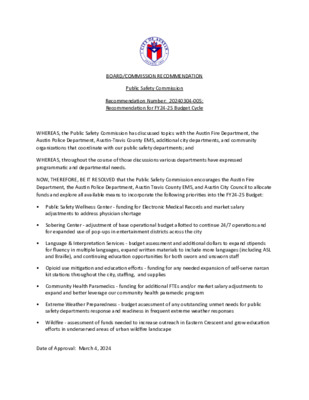
BOARD/COMMISSION RECOMMENDATION Public Safety Commission Recommenda>on Number: 20240304-005: Recommenda>on for FY24-25 Budget Cycle WHEREAS, the Public Safety Commission has discussed topics with the Aus>n Fire Department, the Aus>n Police Department, Aus>n-Travis County EMS, addi>onal city departments, and community organiza>ons that coordinate with our public safety departments; and WHEREAS, throughout the course of those discussions various departments have expressed programma>c and departmental needs. NOW, THEREFORE, BE IT RESOLVED that the Public Safety Commission encourages the Aus>n Fire Department, the Aus>n Police Department, Aus>n Travis County EMS, and Aus>n City Council to allocate funds and explore all available means to incorporate the following priori>es into the FY24-25 Budget: • • • • • Public Safety Wellness Center - funding for Electronic Medical Records and market salary adjustments to address physician shortage Sobering Center - adjustment of base opera>onal budget alloZed to con>nue 24/7 opera>ons and for expanded use of pop-ups in entertainment districts across the city Language & Interpreta>on Services - budget assessment and addi>onal dollars to expand s>pends for fluency in mul>ple languages, expand wriZen materials to include more languages (including ASL and Braille), and con>nuing educa>on opportuni>es for both sworn and unsworn staff • Opioid use mi>ga>on and educa>on efforts - funding for any needed expansion of self-serve narcan kit sta>ons throughout the city, staffing, and supplies Community Health Paramedics - funding for addi>onal FTEs and/or market salary adjustments to expand and beZer leverage our community health paramedic program Extreme Weather Preparedness - budget assessment of any outstanding unmet needs for public safety departments response and readiness in frequent extreme weather responses • Wildfire - assessment of funds needed to increase outreach in Eastern Crescent and grow educa>on efforts in underserved areas of urban wildfire landscape Date of Approval: _____________________________ Record of the vote: (Unanimous on a 7-0 vote, 4-3 vote with names of those vo>ng no listed) AZest: _____________________________________________ (Staff or board member can sign)
Collective Sex Crimes Response Model (CSCRM) Project Austin Police Department CSCRM Status Update Q1 2024 2 Dashboard Status – Feb 2024 Summary: • Complete = 10% (12 Items) • In Progress = 75% (89 Items) • Not Started = 15% (18 Items) *Note: • Q1 2024 Items listed as “Not Started” have not yet been assessed by the multi-disciplinary Workgroup, however improvements may have already been initiated and/or implemented by APD independently. See Slide 4 for a detailed break-down of “In Progress” status toward “Complete”. • 3 In Progress Break-Down Below is a break-down of where the ‘In Progress’ work resides in its progression toward ‘Complete’... Workgroup 1. Solution Recommendation 2. Documentation 3. Training 4. Communications 5. Metrics 6. Ownership Policy Training Response & Investigations Data & Metrics Outreach & Partnerships Total 15 22 23 5 9 74 12* - 1 - 1 14* - - - - - - *6 Items are pending SOP approval. 4 Items are pending General Orders approval. 1 - - - - 1 - - - - - - - - - - - - Q1 2024 Total 27 22 25 5 10 89 7. Steering Committee Approval - - - - - - 4 CSCRM Funding Requests Q1 2024 5 FY2025 Unmet Needs Funding Requests Q1 2024 6 FY2025 Unmet Needs Funding Requests Q1 2024 7 Issues, Risks, and Additional Funding Considerations Q1 2024 8 APD Academy & Recruitment • Law enforcement staffing shortages and hiring challenges are being felt nation-wide. APD is not immune to this reality, and significant financial support and innovative approaches need to be considered to survive and overcome it. • CSCRM is requesting/recommending 56 hours of Academy/Cadet level training for Sexual Assault (40 hr. classroom, 16 hr. simulations). This request/recommendation is unlikely to be met without additional investment and innovation: • Cadet training classes need to be extended to incorporate Kroll recommendations and CSCRM requests. • Financial incentives and wages need to be drastically increased to recruit and retain new Cadets. New approaches such as housing stipends need to be considered given the current housing market in Austin. Investments in the Academy do not make sense if we cannot recruit and keep quality Cadets. • An increase in Civilian roles need to be considered whenever and wherever possible keeping Sworn personnel fulfilling their vital positions. Q1 2024 9 SAFE’s Forensic Nursing Program • SAFE’s forensic nursing program is …
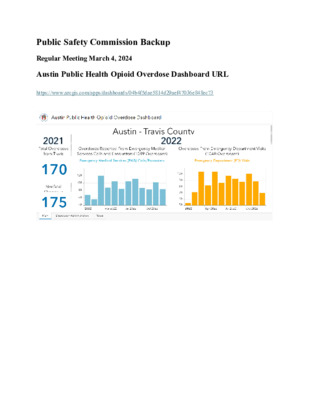
Public Safety Commission Backup Regular Meeting March 4, 2024 Austin Public Health Opioid Overdose Dashboard URL https://www.arcgis.com/apps/dashboards/04b4f5dae5814d29aef47036e848ec73
ATCEMS Community Health Paramedic O P I O I D U S E D I S O R D E R S U P P O R T A N D B U P R E N O R P H I N E B R I D G E P R O G R A M S N A R C A N R E S C U E K I T D I S T R I B U T I O N B R E AT H N O W N A R C A N T R A I N I N G Responding to the Opioid Crisis What has Changed? 2 Opiate Overdose Deaths per 100,000 State of Texas 3 At the Port of Laredo Texas, over 300M fatal doses of Fentanyl are seized per month 30% of Opioid users who die of an overdose, interact with EMS in the 12 months prior to their death Opiates kill more people nationwide than gun violence and car crashes1 • Annual mortality rate for untreated Opioid User is more than twice that of the frontline soldier in Vietnam Why Emergency Medical Services? Identifying a Gap in Available Care Few patients receive anything more than comfort care in the ER or after discharge • ERs only treat opioid withdrawal symptoms superficially – Tylenol, fluids, Zofran for vomiting • As few as 16.6% of opioid overdose patients receive any treatment within 90 days of hospitalization for overdose5 Once a patient was ready to enter treatment, they had to wait as much as a week or more to start a MAT (Medication-Assisted Treatment) program • 7-14 more chances to overdose and potentially die Austin Travis County EMS was seeing patients' overdose, and in some cases die, while waiting for their intake at a MAT clinic Addressing Opioid Use in The City of Austin/Travis County The Opioid Use Disorder Support Program and its sub- program, the Buprenorphine Bridge Program were created by and are components of the Community Health Paramedic Team at ATCEMS Mission – to reduce morbidity and mortality associated with opioid use disorder and help bring support and recovery resources to people with opioid use disorder Acknowledgements • Withdrawal from opioids, while not potentially lethal as with alcohol, is a wretched condition that few people can tolerate • Successful treatments for Opioid Use Disorder exist, but many patients are …
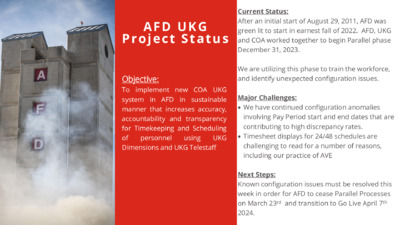
A F D U K G P r o j e c t S t a t u s Objective: To implement new COA UKG system in AFD in sustainable manner that increases accuracy, accountability and transparency for Timekeeping and Scheduling of UKG Dimensions and UKG Telestaff personnel using Current Status: After an initial start of August 29, 2011, AFD was green lit to start in earnest fall of 2022. AFD, UKG and COA worked together to begin Parallel phase December 31, 2023. We are utilizing this phase to train the workforce, and identify unexpected configuration issues. Major Challenges: • We have continued configuration anomalies involving Pay Period start and end dates that are contributing to high discrepancy rates. • Timesheet displays for 24/48 schedules are challenging to read for a number of reasons, including our practice of AVE Next Steps: Known configuration issues must be resolved this week in order for AFD to cease Parallel Processes on March 23rd and transition to Go Live April 7th 2024. 1
Austin Police Department UKG Update • Dedicated APD Lt on project • Ongoing train the trainer, resulting in 100+ trainers department wide • Parallel testing late March, results will dictate go live date • Go live on target for June
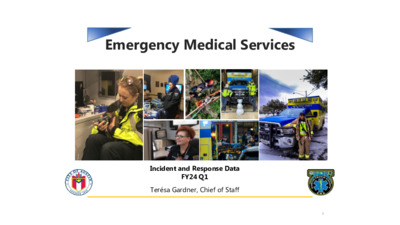
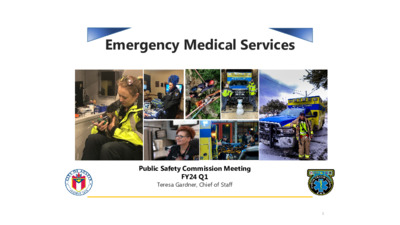
Emergency Medical Services Incident and Response Data FY24 Q1 Terésa Gardner, Chief of Staff 1 Incidents, Patient Contacts, Transports January 2021– January 2024 Incidents | Patient Contacts | Patient Transports January 2021 - January 2024 14000 12000 10000 8000 6000 4000 2000 0 1 2 - n a J 1 2 - b e F 1 2 - r a M 1 2 - r p A 1 2 - y a M 1 2 - n u J 1 2 - l u J 1 2 - g u A 1 2 - p e S 1 2 - t c O 1 2 - v o N 1 2 - c e D 2 2 - n a J 2 2 - b e F 2 2 - r a M 2 2 - r p A 2 2 - y a M 2 2 - n u J 2 2 - l u J 2 2 - g u A 2 2 - p e S 2 2 - t c O 2 2 - v o N 2 2 - c e D 3 2 - n a J 3 2 - b e F 3 2 - r a M 3 2 - r p A 3 2 - y a M 3 2 - n u J 3 2 - l u J 3 2 - g u A 3 2 - p e S 3 2 - t c O 3 2 - v o N 3 2 - c e D 4 2 - n a J Incidents Patient Contacts Patient Transports 2 P1 Compliance by District FY24 Q1 Priority 1 Compliance by District FY24 Q1 71.92% 72.60% 72.26% 72.57% 68.81% 72.41% 69.33% 69.14% 85.96% 56.70% 1 2 3 4 5 6 7 8 9 10 % Goal Met 100% 90% 80% 70% 60% 50% 40% 30% 20% 10% 0% 3 P1 Response Interval by District FY24 Q1 Priority 1 Response Interval by District FY24 Q1 12.30 13.03 12.47 12.90 13.03 12.25 13.78 11.92 11.97 10.88 7.46% 7.44% 9.24% 8.35% 7.94% 8.68% 8.37% 6.52% 8.33% 6.15% 1 2 3 4 5 6 7 8 9 10 90th Percentile (Minutes) % of Total for District 16 14 12 10 8 6 4 2 0 100% 90% 80% 70% 60% 50% 40% 30% 20% 10% 0% 4 Priority Percentage By District FY24 Q1 Priority …
POP UP RESOURCE CLINICS A U S T I N - T R AV I S C O U N T Y E M S I N T E G R AT E D S E R V I C E S S E R V I N G T H E U N D E R S E R V E D 1 Innovative Service, Care & Navigation Connect clients with resources Complete interventions on site Reduce costs and overlap in services On Site Resources Overcoming Barriers to Care Healthcare Funding • Can be approved within 10 minutes—Receive physical card • Approved for services at Seton Hospitals, Community Care Clinics and prescription services at HEB with no co-pay Substance Use Harm Reduction • All necessary agencies on site to connect to treatment • Assist with placement, funding, transportation and support Medical Care and Testing • Physicians and medical teams on site to provide care • Medical Testing—HIV, Hep B & C, All STDs • If positive – Client will be connected to ongoing resources/care teams Pink PURC • Resources and care specifically focused for females • Provides safe environment for females who have experienced trauma • All staff and volunteers are female PURC Data FY2023 FY2023 vs Q1 FY2024 Q1 FY2024 1000 West Rundberg Lane, 78758 1030 Norwood Park Boulevard, 78753 1300 Lavaca Street, 78701 1807 Ferguson Lane, 78754 6900 East Ben White Boulevard, 78741 710 West Cesar Chavez Street, 78701 889 Wilks Avenue, 78752 PURC Locations Q1 FY2024 Questions? 7
BOARD/COMMISSION RECOMMENDATION Public Safety Commission Recommenda>on Number: 20240304-005: Recommenda>on for FY24-25 Budget Cycle WHEREAS, the Public Safety Commission has discussed topics with the Aus>n Fire Department, the Aus>n Police Department, Aus>n-Travis County EMS, addi>onal city departments, and community organiza>ons that coordinate with our public safety departments; and WHEREAS, throughout the course of those discussions various departments have expressed programma>c and departmental needs. NOW, THEREFORE, BE IT RESOLVED that the Public Safety Commission encourages the Aus>n Fire Department, the Aus>n Police Department, Aus>n Travis County EMS, and Aus>n City Council to allocate funds and explore all available means to incorporate the following priori>es into the FY24-25 Budget: • • • • • Public Safety Wellness Center - funding for Electronic Medical Records and market salary adjustments to address physician shortage Sobering Center - adjustment of base opera>onal budget alloZed to con>nue 24/7 opera>ons and for expanded use of pop-ups in entertainment districts across the city Language & Interpreta>on Services - budget assessment and addi>onal dollars to expand s>pends for fluency in mul>ple languages, expand wriZen materials to include more languages (including ASL and Braille), and con>nuing educa>on opportuni>es for both sworn and unsworn staff • Opioid use mi>ga>on and educa>on efforts - funding for any needed expansion of self-serve narcan kit sta>ons throughout the city, staffing, and supplies Community Health Paramedics - funding for addi>onal FTEs and/or market salary adjustments to expand and beZer leverage our community health paramedic program Extreme Weather Preparedness - budget assessment of any outstanding unmet needs for public safety departments response and readiness in frequent extreme weather responses • Wildfire - assessment of funds needed to increase outreach in Eastern Crescent and grow educa>on efforts in underserved areas of urban wildfire landscape Date of Approval: March 4, 2024 Record of the vote: Unanimous on an 8-0 vote, Commissioners Hall-Martin and Hermesmeyer were absent. AZest: _____________________________________________ Christi Vitela (Staff or board member can sign)
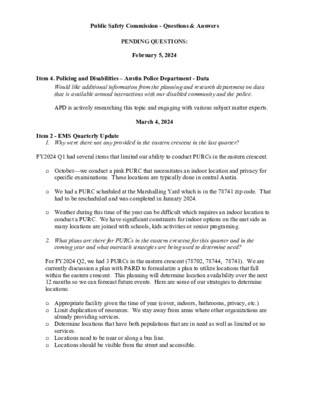
Public Safety Commission - Questions & Answers PENDING QUESTIONS: February 5, 2024 Item 4. Policing and Disabilities – Austin Police Department - Data Would like additional information from the planning and research department on data that is available around interactions with our disabled community and the police. APD is actively researching this topic and engaging with various subject matter experts. March 4, 2024 Item 2 - EMS Quarterly Update 1. Why were there not any provided in the eastern crescent in the last quarter? FY2024 Q1 had several items that limited our ability to conduct PURCs in the eastern crescent. o October—we conduct a pink PURC that necessitates an indoor location and privacy for specific examinations. These locations are typically done in central Austin. o We had a PURC scheduled at the Marshalling Yard which is in the 78741 zip code. That had to be rescheduled and was completed in January 2024. o Weather during this time of the year can be difficult which requires an indoor location to conduct a PURC. We have significant constraints for indoor options on the east side as many locations are joined with schools, kids activities or senior programing. 2. What plans are there for PURCs in the eastern crescent for this quarter and in the coming year and what outreach strategies are being used to determine need? For FY2024 Q2, we had 3 PURCs in the eastern crescent (78702, 78744, 78741). We are currently discussion a plan with PARD to formularize a plan to utilize locations that fall within the eastern crescent. This planning will determine location availability over the next 12 months so we can forecast future events. Here are some of our strategies to determine locations: o Appropriate facility given the time of year (cover, indoors, bathrooms, privacy, etc.) o Limit duplication of resources. We stay away from areas where other organizations are already providing services. o Determine locations that have both populations that are in need as well as limited or no services. o Locations need to be near or along a bus line. o Locations should be visible from the street and accessible. Public Safety Commission - Questions & Answers Our process for determining locations has been fluid. Initiatives like camping bans and area clean outs result in movement of vulnerable populations. We trend these movements and try to adjust our approach to ensure we are serving our intended …
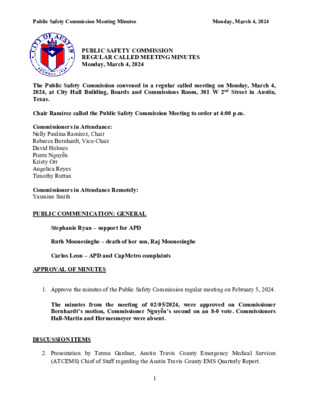
Public Safety Commission Meeting Minutes Monday, March 4, 2024 PUBLIC SAFETY COMMISSION REGULAR CALLED MEETING MINUTES Monday, March 4, 2024 The Public Safety Commission convened in a regular called meeting on Monday, March 4, 2024, at City Hall Building, Boards and Commissions Room, 301 W 2nd Street in Austin, Texas. Chair Ramírez called the Public Safety Commission Meeting to order at 4:00 p.m. Commissioners in Attendance: Nelly Paulina Ramírez, Chair Rebecca Bernhardt, Vice-Chair David Holmes Pierre Nguyễn Kristy Orr Angelica Reyes Timothy Ruttan Commissioners in Attendance Remotely: Yasmine Smith PUBLIC COMMUNICATION: GENERAL Stephanie Ryan – support for APD Ruth Moonesinghe – death of her son, Raj Moonesinghe Carlos Leon – APD and CapMetro complaints APPROVAL OF MINUTES 1. Approve the minutes of the Public Safety Commission regular meeting on February 5, 2024. The minutes from the meeting of 02/05/2024, were approved on Commissioner Bernhardt’s motion, Commissioner Nguyễn’s second on an 8-0 vote. Commissioners Hall-Martin and Hermesmeyer were absent. DISCUSSION ITEMS 2. Presentation by Teresa Gardner, Austin Travis County Emergency Medical Services (ATCEMS) Chief of Staff regarding the Austin Travis County EMS Quarterly Report. 1 Public Safety Commission Meeting Minutes Monday, March 4, 2024 Presentation was given by Stephen White, Acting Assistant Chief of Integrated Services. 3. Presentations by Chief of Staff Jeff Greenwalt, Austin Police Department; Chief of Staff Teresa Gardner, Austin Travis County Emergency Medical Services; and Chief of Staff Rob Vire, Austin Fire Department; Texas Harm Reduction Alliance and Vocal Texas on opioid use hot spots, prevention, and education efforts. Presentations were given by Stephen White, EMS Acting Assistant Chief of Integrated Services; Angela Carr, EMS Division Chief; Mike Sasser, EMS Captain; Cate Graziani, Vocal Texas; and Gaby Libretti, Texas Harm Reduction Alliance. Commissioner Smith requested EMS follow up to include: -geographical locations of the Pop Up Resource Clinics (PURC) and their outreach strategies -a map of the interventions administered through the Buprenorphine Bridge Program (BBP) -zip code data for where the rescue kits are distributed and where Narcan is administered prior to EMS arrival -data included on the Austin Public Health Opioid Overdose Dashboard for overdose calls that result in an arrest 4. Presentations by Chief of Staff Jeff Greenwalt, Austin Police Department; Chief of Staff Teresa Gardner, Austin Travis County Emergency Medical Services; and Chief of Staff Rob Vire, Austin Fire Department regarding electronic payroll system rollout. Presentations were given by Jeff Greenwalt, Chief of Staff, …
Health Alliance for Austin Musicians Presentation to City of Austin Music Commission March 4, 2024 OUR MISSION HAAM provides access to affordable healthcare to Austin's low-income, working musicians, with a focus on prevention and wellness. The Live Music Capital of the World LIVE MUSIC’S IMPACT ON AUSTIN $2 billion Economic activity each year $38 million Local tax revenue each year Austin is home to 9,000+ musicians Live music is an economic engine Cultural identity 3 Health Alliance for Austin Musicians KEEPING MUSIC IN AUSTIN ALIVE & WELL HAAM Member Julian Acosta BY ANDREW BENNETT PHOTOGRAPHY MUSICIAN LIFE EXPECTANCY IS 25 YEARS LESS THAN THE AVERAGE POPULATION HAAM’S VALUE SINCE 2005 HAAM HAS PROVIDED OVER 7500 MUSICIANS WITH OVER $144 MILLION IN AFFORDABLE HEALTH CARE HAAM Member Vanessa Lively BY CHARLIE SCHWAN PHOTOGRAPHY Leveraging Community Partnerships 6 Health Alliance for Austin Musicians KEEPING MUSIC IN AUSTIN ALIVE & WELL City of Austin and HAAM Economic Development Department Music & Entertainment Division Arts Commission Austin Public Health Mayor’s Office 7 Health Alliance for Austin Musicians KEEPING MUSIC IN AUSTIN ALIVE & WELL When I got that first vaccine, it was such a relief. I almost cried. - Mama Duke “ HAAM’s Model Access to Care Partner organizations providing preventative and proactive healthcare Affordability Community enrollment and eligibility resources leveraged Success in the Healthcare System Healthcare navigation and proactive education Cultural Competence Dedicated outreach to underserved musicians Deep understanding of iconic subpopulation with genuine relationships 9 Health Alliance for Austin Musicians KEEPING MUSIC IN AUSTIN ALIVE & WELL Service Delivery Model GUIDANCE • Navigation • Health & Insurance Literacy PREVENTION • Screenings & Vaccinations • Hearing • Voice Education • Fitness & Mind + Body ACCESS TO CARE • Insurance Linkage • Premium Assistance • Primary & Specialty Care • Urgent & Emergency Care • Hospitalization • Dental • Vision • Behavioral Health 10 Health Alliance for Austin Musicians KEEPING MUSIC IN AUSTIN ALIVE & WELL Comprehensive Coverage Saves Austin Millions HAAM’s Premium Assistance Programs provide nearly $17 million of healthcare coverage every year to musicians who would otherwise be unfunded. Funneling federal funds into local health systems Full fee payment to local providers Increasing all around access to care Partnerships, philanthropy, & local and federal dollars save our healthcare system Annual musician premiums cost $1,600/yr, leveraged into $8,900/yr of coverage Insurance Coverage Rates & Membership Growth 12 Health Alliance for Austin Musicians …
REGULAR MEETING of the MUSIC COMMISSION March 4, 2024, 6:30PM CITY HALL COUNCIL CHAMBERS ROOM 1001, 301 W 2ND STREET, Austin, Texas 78701 Some members of the Music Commission may be participating by videoconference. The meeting may be viewed online at: http://www.austintexas.gov/page/watch-atxn-live Public comment will be allowed in-person or remotely via telephone. Speakers may only register to speak on an item once either in-person or remotely and will be allowed up to three minutes to provide their comments. Registration no later than noon the day before the meeting is required for remote participation by telephone. To register to speak remotely, call or email She lbi Mitchell, 512-974-6318, Shelbi.Mitchell@austintexas.gov. CURRENT BOARD MEMBERS/COMMISSIONERS: Nagavalli Medicharla - Chair, Anne-Charlotte Patterson – Vice Chair, Oren Rosenthal – Parliamentarian, Nelson Aguilar, Tami Blevins, Leonard Davila, Lauryn Gould, Jonathan “Chaka” Mahone, Celeste Quesada, Scott Strickland AGENDA CALL TO ORDER PUBLIC COMMUNICATION: GENERAL APPROVAL OF MINUTES DISCUSSION ITEMS 1. 2. 3. Approve the minutes of the Music Commission Meeting on January 8, 2024, and February 5, 2024. Presentation on Black Artists and Professional Creatives Registry by Harold McMillan, Founder/President, East Austin Creative Coalition. Presentation on music journalism and access to media coverage in Austin by Raoul Hernandez, Assistant Professor, School of Journalism and Media, University of Texas, Austin. 4. 5. 6. 7. 8. 10. 11. 12. Update on FY24 Austin Live Music Fund guidelines by Chair Medicharla. Presentation on Health Alliance for Austin Musicians (HAAM) by Paul Scott, Chief Executive Officer, HAAM. Update on musical performances for Music Commission meetings by Shelbi Mitchell, Program Coordinator, Music & Entertainment, Economic Development Department. Presentation by Austin Federation of Musicians Local representative. Discussion regarding all ages shows and how the City of Austin supports youth in Austin. STAFF BRIEFINGS 9. Live Music Fund collections update by Kim McCarson, Program Manager, Music & Entertainment Division, Economic Development Department. Update on consultant evaluation of the FY23 Live Music Fund Event Program by Erica Shamaly, Division Manager, Music & Entertainment Division. Update on calendar for Live Music Fund awardee events. Update on City Commission guidelines by Shelbi Mitchell, Program Coordinator, Music & Entertainment, Economic Development Department. DISCUSSION AND ACTION ITEMS 13. FUTURE AGENDA ITEMS Approve Music Commission Budget recommendations to Council for FY25. ADJOURNMENT The City of Austin is committed to compliance with the American with Disabilities Act. Reasonable modifications and equal access to communications will be provided upon request. Meeting locations are …
MUSIC COMMISSION MEETING 3/04/2024 H O T E L O C C U P A N C Y T A X C O L L E C T I O N S L I V E M U S I C F U N D Kim McCarson Program Manager UPDATED 3.04.2024 FY 24 Year-to-Date Hotel Occupancy Tax Collections – Live Music Fund FY24 Amended Budget $5,575,000 January 2024 w/ Encumbrances $857,431 FY24 Year-to-Date w/ Encumbrances $1,789,374 FY24 Year-End Estimate $17,874 $312,748 $827,586 $19,399 $338,773 $854,923 $12,938 $323,076 $798,287 $5,509 $217,400 $744,461 $857,431 $4,903 $171,733 $755,308 FY 23 October February FY 24 November March December April January May FY 23 Year-to-Date Hotel Occupancy Tax Collections – Live Music Fund FY23 Amended Budget $4,100,000 September 2023 w/ Encumbrances $17,874 FY23 Year-to-Date w/ Encumbrances $4,472,973 FY23 Year-End Estimate $4,043,166 $17,874 $312,748 $827,586 $19,399 $338,773 $854,923 $12,938 $323,076 $798,287 $5,509 $217,400 $744,461 FY 23 October April November May December June January July February August March September
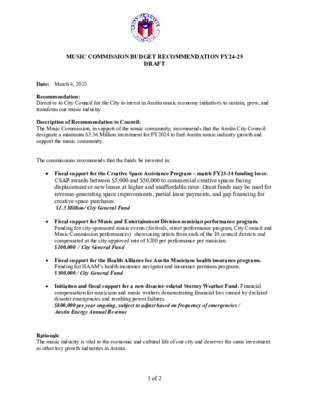
MUSIC COMMISSION BUDGET RECOMMENDATION FY24-25 DRAFT Date: March 4, 2023 Recommendation: Directive to City Council for the City to invest in Austin music economy initiatives to sustain, grow, and transform our music industry. Description of Recommendation to Council: The Music Commission, in support of the music community, recommends that the Austin City Council designate a minimum $3.36 Million investment for FY2024 to fuel Austin music industry growth and support the music community. The commissions recommends that the funds be invested in: Fiscal support for the Creative Space Assistance Program – match FY23-34 funding lever. CSAP awards between $5,000 and $50,000 to commercial creative spaces facing displacement or new leases at higher and unaffordable rates. Grant funds may be used for revenue-generating space improvements, partial lease payments, and gap financing for creative space purchases. $1.5 Million/ City General Fund Fiscal support for Music and Entertainment Division musician performance program. Funding for city-sponsored music events (festivals, street performance program, City Council and Music Commission performances) showcasing artists from each of the 10 council districts and compensated at the city-approved rate of $200 per performance per musician. $100,000 / City General Fund Fiscal support for the Health Alliance for Austin Musicians health insurance programs. Funding for HAAM’s health insurance navigator and insurance premium programs. $500,000 / City General Fund Initiation and fiscal support for a new disaster-related Stormy Weather Fund. Financial compensation for musicians and music workers demonstrating financial loss caused by declared disaster emergencies and resulting power failures. $800,000 per year ongoing, subject to adjust based on frequency of emergencies / Austin Energy Annual Revenue Rationale The music industry is vital to the economic and cultural life of our city and deserves the same investment as other key growth industries in Austin. 1 of 2 Music and musicians contribute significantly to Austin's economy, including our robust tourism economy. The cost of living in Austin has risen to nearly unsustainable levels. From 2011 to 2021, the median home price in Austin increased from $193,000 to $517,000, and the median rent increased from $815 to $1,387. Many musicians struggle to make a living in Austin due to affordability issues. According to a survey by the Austin Music Census, nearly three-quarters of musicians in Austin reported making less than $18,000 per year from music-related income. Funding activities that provide more paid work to Austin musicians can help …
MUSIC COMMISSION BUDGET RECOMMENDATION FY24-25 20240304-13 Date: March 4, 2024 Subject: Music Commission budget recommendations for FY24-25 Motioned By: Parliamentarian Oren Rosenthal Seconded By: Commissioner Lauryn Gould Recommendation: Directive to City Council for the City to invest in Austin music economy initiatives to sustain, grow, and transform our music industry. Description of Recommendation to Council: The Music Commission recommends that the Austin City Council adopt the following budget recommendations: • Fiscal support for the Creative Space Assistance Program – match FY23-34 funding lever. CSAP awards between $5,000 and $50,000 to commercial creative spaces facing displacement or new leases at higher and unaffordable rates. Grant funds may be used for revenue-generating space improvements, partial lease payments, and gap financing for creative space purchases. $1.5 Million/ Source: General Fund • Fiscal support for Music and Entertainment Division musician performance program. Funding for city-sponsored music events (festivals, street performance program, City Council and Music Commission performances) showcasing artists from each of the 10 council districts and compensated at the city-approved rate of $200 per performance per musician. $100,000 / Source: General Fund • Fiscal support for the Health Alliance for Austin Musicians health insurance programs. Funding for HAAM’s health insurance navigator and insurance premium programs. $500,000 / Source: General Fund In addition, Music Commission recommends consideration of the following: • Initiation and fiscal support for a new disaster-related Stormy Weather Fund. Financial compensation for musicians and music workers demonstrating financial loss caused by declared disaster emergencies and resulting power failures. $800,000 per year ongoing, subject to adjust based on frequency of emergencies / Source: Austin Energy Annual Revenue • Fiscal support for Austin music marketing campaign. Develop and fund regional marketing campaign to increase attendance at local live music events and increase album sales for local artists. $400,000 / Source: Hotel Occupancy Tax 1 of 2 Rationale The music industry is vital to the economic and cultural life of our city and deserves the same investment as other key growth industries in Austin. • Music and musicians contribute significantly to Austin's economy, including our robust tourism economy. • The cost of living in Austin has risen to nearly unsustainable levels. From 2011 to 2021, the median home price in Austin increased from $193,000 to $517,000, and the median rent increased from $815 to $1,387. • Many musicians struggle to make a living in Austin due to affordability issues. According to a survey by …
MUSIC COMMISSION REGULAR MEETING MINUTES 4 March 2024 The Music Commission convened in a regular meeting on 4 March 2024, at City Hall Council Chambers 301 W 2nd St, Austin, TX 78701. Chair Medicharla called the Music Commission Meeting to order at 6:44 p.m. Commissioners in Attendance: Chair Nagavalli Medicharla, Vice-Chair Anne-Charlotte Patterson Parliamentarian Oren Rosenthal, Leonard Davila, Lauryn Gould, Celeste Quesada Commissioners in Attendance: Nelson Aguilar, Tami Blevins, Jonathan Mahone, Scott Strickland CURRENT BOARD MEMBERS/COMMISSIONERS: Nagavalli Medicharla - Chair, Anne-Charlotte Patterson – Vice Chair, Oren Rosenthal – Parliamentarian, Nelson Aguilar, Tami Blevins, Leonard Davila, Lauryn Gould, Jonathan “Chaka” Mahone, Celeste Quesada, Scott Strickland CALL TO ORDER PUBLIC COMMUNICATION: GENERAL AGENDA Jeanie Ramirez called in to speak for public communication. APPROVAL OF MINUTES 1. The minutes from the meeting on January 8, 2024, and February 5, 2024 were approved on Vice Chair Patterson’s motion, Commissioner Quesada’s second with a 9-2 vote. Commissioners Aguilar and Rosenthal abstained. DISCUSSION ITEMS 2. Presentation on Black Artists and Professional Creatives Registry by Harold McMillan, Founder/President, East Austin Creative Coalition. Font Size: 12; Font: Times New Roman; Font Style: Regular 3. 4. 5. 6. 7. 8. 10. 11. 12. Presentation on music journalism and access to media coverage in Austin by Raoul Hernandez, Assistant Professor, School of Journalism and Media, University of Texas, Austin. Update on FY24 Austin Live Music Fund guidelines by Chair Medicharla. Commission candidate Pedro Carvalho owner of the Far Out, Erica Shamaly, Music & Entertainment Division Manager, and Sylnovia Holt-Rabb, Director of Economic Development Department, commented. Presentation on Health Alliance for Austin Musicians (HAAM) by Paul Scott, Chief Executive Officer, HAAM. Update on musical performances for Music Commission meetings by Shelbi Mitchell, Program Coordinator, Music & Entertainment, Economic Development Department. Presentation by Austin Federation of Musicians Local representative. Representative was not present. Discussion regarding all ages shows and how the City of Austin supports youth in Austin. Erica Shamaly, Music & Entertainment Division Manager, and Sylnovia Holt- Rabb, Director of Economic Development Department, commented. STAFF BRIEFINGS 9. Live Music Fund collections update by Kim McCarson, Program Manager, Music & Entertainment Division, Economic Development Department. Chair Medicharla motions to move item 13 before item 9, Patterson seconds with a unanimous vote. Update on consultant evaluation of the FY23 Live Music Fund Event Program by Erica Shamaly, Division Manager, Music & Entertainment Division. Update on calendar for Live Music Fund awardee events. Update …
1. REGULAR MEETING of the COMMISSION ON IMMIGRANT AFFAIRS MARCH 4, 2024 AT 6:30PM AUSTIN CITY HALL 301 WEST 2ND STREET ROOM 1101 AUSTIN, TEXAS Some members of the COMMISSION ON IMMIGRANT AFFAIRS may be participating by videoconference. The meeting may be viewed online at: http://www.austintexas.gov/page/watch- atxn-live Public comment will be allowed in-person or remotely via telephone. Speakers may only register to speak on an item once either in-person or remotely and will be allowed up to three minutes to provide their comments. Registration no later than noon the day before the meeting is required for remote participation by telephone. To register to speak remotely, call or email Gunjen Mittal, 512- 972-6104, gunjen.mittal@austintexas.gov. CURRENT BOARD MEMBERS/COMMISSIONERS: Melissa Ortega, Chair Victor Martinez, Vice Chair Virginia Badillo Jose Caceres Adrian De La Rosa Rennison Lalgee Fang Fang Aditi Joshi Adnan Suleiman CALL TO ORDER PUBLIC COMMUNICATION: GENERAL AGENDA The first 10 speakers signed up to the meeting being called to order will each be allowed a three- minute allotment to address their concerns regarding items not posted on the agenda. APPROVAL OF MINUTES Approve the minutes of the COMMISSION ON IMMIGRANT AFFAIRS REGULAR MEETING on 2/5/2024. Font Size: 12; Font: Times New Roman; Font Style: Regular 3. 4. 5. 6. 7. 8. STAFF BRIEFINGS 2. Staff briefing by Rocio Villalobos, Program Manager with the Equity Office regarding updates on her work with Austin immigrant communities. DISCUSSION ITEMS Presentation by Christian Duran from the Housing Department regarding the FY 24-29 Consolidated Plan Community Needs Assessment. Discussion on recruiting new members to this Commission to fill remaining seats. DISCUSSION AND ACTION Review, discuss and approve calling a special-called meeting to work on budget recommendations. Discuss and approve the March 23rd retreat based on current number of Commissioners. Review and discuss the scope of all current working groups and possible action to update membership. Current members of the budget workgroup are: Commissioners Melissa Ortega and Adnan Suleiman. Current members of QOL Study workgroup are: Commissioners Aditi Joshi, Rennison Lalgee, Melissa Ortega, Victor Martinez and Adrian De La Rosa. WORKING GROUP/COMMITTEE UPDATES Update from BUDGET WORKING GROUP regarding budget recommendations for FY25. FUTURE AGENDA ITEMS ADJOURNMENT The City of Austin is committed to compliance with the American with Disabilities Act. Reasonable modifications and equal access to communications will be provided upon request. Meeting locations are planned with wheelchair access. If requiring Sign Language Interpreters or alternative …
REGULAR MEETING of the ART IN PUBLIC PLACES PANEL Monday, March 4, 2024, at 6:00 PM Virtual Meeting Members of the ART IN PUBLIC PLACES PANEL may be participating by video conference. Public comment will be allowed remotely via video conference or telephone. Speakers may only register to speak on an item remotely and will be allowed up to three minutes to provide their comments. Registration no later than noon the day before the meeting is required for participation. To register to speak, call or email frederico.geib@austintexas.gov or 512-974 - 3779. CURRENT BOARD MEMBERS/COMMISSIONERS: Chair – Stephanie Lemmo, Vice Chair – J Muzacz, Sarah Carr, Taylor Davis, Kristi-Anne Shaer, Lisa Woods, Monica Maldonado – Arts Commission Liaison CALL TO ORDER PUBLIC COMMUNICATION: GENERAL AGENDA The first 10 speakers signed up prior to the meeting being called to order will each be allowed a three-minute allotment to address their concerns regarding items not posted on the agenda. APPROVAL OF MINUTES Approve the minutes of the Art in Public Places Panel Regular Meeting on February 5, 2024. DISCUSSION ITEMS 1. 2. 3. 4. DISCUSSION AND ACTION ITEMS 5. Discussion of Chair’s Report on AIPP Panel Roster by Stephanie Lemmo Discussion of Arts Commission Liaison Report on Action Items from February 2024, Arts Commissions Meeting by Arts Commission Liaison Maldonado TEMPO Design Presentation by the Trail Conservancy Presentation of Downtown Austin Alliance Writing on the Walls Artwork Loan application by Raasin McIntosh, Downtown Austin Alliance Urban Activation Vice President and Designate AIPP Panel Member to join the Departmental Review Committee STAFF BRIEFINGS 6. 7. AIPP Staff Updates on Progression of Current Projects and Milestones Georgian Acres Neighborhood Park Artwork Dedication by Frederico Geib, AIPP Coordinator FUTURE AGENDA ITEMS ADJOURNMENT The City of Austin is committed to compliance with the American with Disabilities Act. Reasonable modifications and equal access to communications will be provided upon request. Meeting locations are planned with wheelchair access. If requiring Sign Language Interpreters or alternative formats, please give notice at least 2 days (48 hours) before the meeting date. Please contact Frederico Geib at the Economic Development Department at frederico.geib@austintexas.gov or 512-974 -3779 for additional information; TTY users' route through Relay Texas at 711.
ART IN PUBLIC PLACES PANEL Regular Meeting Minutes The Art in Public Places Panel convened a regular meeting on Monday, March 4, 2024, via Zoom. Chair Stephanie Lemmo called the Meeting to order at 6:03 PM. Panel Members in Attendance: Chair Stephanie Lemmo, Vice Chair J Muzacz, and Panel Members Sarah Carr, Kristi-Anne Shaer, and Lisa Woods. Staff in Attendance: EDD staff: Cultural Arts Division Manager Meghan Wells. AIPP staff: Project Coordinators Alex Irrera, Ryan Runcie, Frederico Geib, Sean Harrison, and Lindsay Hutchens. Guests in Attendance: Caitlin Young and Mandi Thomas from The Trail Conservancy, Raasin McIntosh and Emily Risinger from the Downtown Austin Alliance. PUBLIC COMMUNICATION: GENERAL None. APPROVAL OF MINUTES The minutes from the Art in Public Places Panel Regular Meeting on Monday, February 5, 2024, were approved on the motion of Vice Chair Muzacz and Panel Member Shaer seconded. Passed 3-0-1, with Panel Member Carr abstaining. Panel Members Davis and Woods, and Arts Commission Liaison Maldonado absent. DISCUSSION ITEMS Discussion of Chair’s Report on AIPP Panel terms by Chair Lemmo. Discussion ensued; Panel Member Carr’s final term ends in May and Vice Chair Muzacz’s final term will begin in July. EDD Staff Wells is administering the nominating committee to fill the upcoming vacancy. Discussion of Arts Commission Liaison Report on Action items from February 2024, Arts Commissions Meeting by Arts Commission Liaison Maldonado. Commissioner Maldonado absent. AIPP Staff Hutchens reported on action items from February Arts Commission meeting. TEMPO Design Presentation by the Trail Conservancy. No action was taken. DISCUSSION AND ACTION ITEMS ACTION: Presentation of Downtown Austin Alliance Writing on the Walls Artwork Loan application by Raasin McIntosh, Downtown Austin Alliance Urban Activation Vice President, and Designate AIPP Panel Member to join the Departmental Review 1. 2. 3. 4. 5. Committee. Chair Lemmo moved to nominate Vice Chair Muzacz to join the Department Review Committee. Panel Member Carr seconded. Passed 5-0-0, with Panel Member Davis and Arts Commission Liaison Maldonado absent. STAFF BRIEFINGS 6. AIPP Staff updated AIPP Panel on collections care and repairs, as well as recent attendance to the Texas Public Art Administrators conference in San Antonio. AIPP Staff Geib also invited AIPP Panelists to attend the upcoming Georgian Acres Neighborhood Park AIPP Artwork Dedication. FUTURE AGENDA ITEMS None. ADJOURNMENT Chair Lemmo adjourned the meeting at 7:24 PM without objection. The minutes were approved at the April 1, 2024, Art in Public Places Panel …
Airport Advisory Commission COMMUNITY INTEREST ANNOUNCEMENT British Airways 10-year Anniversary with Austin-Bergstrom International Airport (AUS) March 3, 2024, 5PM – 7PM 3600 Presidential Blvd Austin, TX 78719 A quorum of the Commission may be present. No action will be taken. For further information contact: Jason Alexander, Board Liaison 512-530-6619 or jason.alexander@flyaustin.com
REGULAR MEETING OF THE 2024 CHARTER REVIEW COMMISSION Thursday February 29, 2024, at 5:30 P.M. Austin City Hall, Boards & Commissions Rm 301 W 2nd St AUSTIN, TEXAS Public comment will be allowed in-person or remotely via telephone. Speakers may only register to speak on an item once either in-person or remotely and will be allowed up to three minutes to provide their comments. Registration no later than noon the day before the meeting is required for remote participation by telephone. To register to speak remotely, please call Myrna Rios, (512) 974-2210, 2024 or email your request to myrna.rios@austintexas.gov. CURRENT COMMISSIONERS: Jessica Palvino, Chair Ryan Botkin Cynthia Van Maanen Julio Altamirano Randy Ortega Betsy Greenberg Alejandro Garcia, Vice Chair JC Dwyer Brian McGiverin Michael O Cowles Megan Lasch AGENDA CALL TO ORDER PUBLIC COMMUNICATION: GENERAL The first 10 speakers signed up prior to the meeting being called to order will each be allowed a three-minute allotment to address their concerns regarding items not posted on the agenda. APPROVAL OF MINUTES 1. Approve the minutes of the 2024 Charter Review Commission regular meeting of February 15, 2024. STAFF BRIEFINGS 2. Law Department briefing regarding staff proposed charter revisions. DISCUSSION AND ACTION ITEMS 3. Discussion and possible action on the City Attorney Working Group initial recommendation report. (Chair Palvino, Commissioners Garcia and McGiverin) 4. Discussion and possible action on the Initiative/Charter/Referendum Mechanics Work Groups initial recommendation on proposition lettering. (Commissioners Altamirano, Botkin, and Ortega) 5. Discussion and possible action on the Petition Process Working Groups initial recommendation report on revisions to the petition process. (Commissioners Cowles, Dwyer, and McGiverin) 6. Discussion and possible action on Recall Petitions Work Group recommendations. (Commissioner Van Maanen) 7. Discussion and possible action regarding community engagement of the Charter Review process from the Outreach Work Group. 8. Discussion and possible action on the review and finalization of the draft report to Council. 9. Discussion and possible action of future meetings and meeting location. FUTURE AGENDA ITEMS 10. The Commission may discuss and identify future agenda items, topics, or presentations. ADJOURNMENT The City of Austin is committed to compliance with the American with Disabilities Act. Reasonable modifications and equal access to communications will be provided upon request. Meeting locations are planned with wheelchair access. If requiring Sign Language Interpreters or alternative formats, please give notice at least 2 days (48 hours) before the meeting date. Please call Myrna …
2024 CHARTER REVIEW COMMISSION MINUTES REGULAR MEETING February 29, 2024 The 2024 Charter Review Commission convened in a regular meeting on Thursday, February 29, 2024, Austin City Hall, 301 W. Second Street, Room 1029, Austin, Texas. Chair Palvino called the Commission Meeting to order at 5:32 p.m. Commissioner Botkin absent. Commissioner Cowles Commissioner Lasch Commissioner Van Maanen Commissioner Ortega Commissioner Greenberg Commission Members in Attendance: Chair Palvino Vice Chair Garcia Commissioner Botkin (absent) Commissioner Dwyer Commissioner McGivern Commission Altamirano Staff in Attendance: Myrna Rios, City Clerk’s Office Neal Falgoust, Law Department Wajiha Rizvi, Law Department (virtual) PUBLIC COMMUNICATION: GENERAL Miriam Schoenfield Joe Riddell APPROVAL OF MINUTES 1. Approve the minutes of the 2024 Charter Review Commission regular meeting of February 15, 2024. Withdrawn STAFF BRIEFINGS 2. Law Department briefing regarding staff proposed charter revisions. The presentation was made by Neal Falgoust, Law Department. DISCUSSION AND ACTION ITEMS 3. Discussion and possible action on the City Attorney Working Group initial recommendation report. (Chair Palvino, Commissioners Garcia and McGiverin) 1 The presentation on the City Attorney Working Group “Recommendation #2 Council is assigned a designated attorney with the city attorney’s office” was made by Vice Chair Garcia. The motion to approve recommendation #2 was made by Chair Palvino, seconded by Commissioner Altamirano on an 8-2 vote. Commissioners Ortega and Greenberg voted no. Commissioner Botkin absent. 4. Discussion and possible action on the Initiative/Charter/Referendum Mechanics Work Groups initial recommendation on proposition lettering. (Commissioners Altamirano, Botkin, and Ortega) No further action required. 5. Discussion and possible action on the Petition Process Working Groups initial recommendation report on revisions to the petition process. (Commissioners Cowles, Dwyer, and McGiverin) The presentation on the Petition Process Working Group “Letter of Intent” recommendation was presented by Commissioner Van Maanen. The motion to approve the recommendation was made by Commissioner Cowles, seconded by Commissioner Dwyer on a 10-0 vote. Commissioner Botkin absent. The presentation on the Petition Process Working Group “3.5 % Signature Threshold” was presented by Commissioner Dwyer. The motion to approve the “5% signature threshold” was made by Commissioner Dwyer, seconded by Commissioner Cowles on a 1-9 vote. Commissioner Dwyer voted yes. Those voting no: Chair Palvino, Vice Chair Garcia, Commissioner’s Altamirano, Greenberg, McGiverin, Van Maanen, Lasch, Cowles, and Ortega. Commissioner Botkin absent. The motion failed. The motion to approve the “3.5% signature threshold” was made by Commissioner Dwyer, seconded by Commissioner Altamirano on a 5-5 vote. …

City of Austin Staff Proposed Charter Amendments On March 9, 2023, the City Council directed the City Manager to establish a Charter Review Commission under Resolution 20230309-25. The commission was tasked with issuing a report on topics including, but not limited to, initiative, referendum, and Charter amendment petition and election requirements. Through a parallel process, City staff performed an exhaustive review of the charter and recommend the following revisions for Council consideration. Many of these revisions are a non- substantive, routine harmonizations of language such as: 1) deletion of legacy and transitional text that addresses interim matters solely relevant to the timing of the charter provision’s original adoption; 2) updates to legal citations; 3) updates for compliance with changes in the law; 4) references to controlling state law; and 5) recommendations based on current practices due to advances in technology and practice since the charter’s adoption. Substantive changes have been summarized by topic below. Disposition of City Property (Article I, § 3) The city currently holds possession of goods that may be damaged or have no value for the purposes for which the goods were originally intended, known as salvage property. The city also obtains property that is not necessary or valuable for the city’s needs, or surplus property. 1 Under the city’s current practice, these items are indefinitely kept in storage without a procedure for disposition. This recommendation adds language to the charter to allow the city to implement procedures for the disposition of the city’s salvage or surplus property. If adopted, the specific procedure for disposition would be developed and set out in an ordinance subject to council review and approval at a later date. Annexation (Article I, § 6 and § 7) References to landowner consent have been removed to remain consistent with HB 347, which revised the municipal annexation process. HB 347 became effective in May 2019 at the conclusion of the 86th Legislature. Notice and hearing requirements for limited purpose annexations are also recommended to be removed given the controlling state law, addressing notice and hearing requirements for both limited and full purpose annexations.2 The city will continue to follow such requirements to ensure interested members of the public have the opportunity to be heard. Redistricting (Article II, § 3) Independence & Timing (Article II, § 3(B) & (G)) A new definition is recommended to clarify what is meant by the word “independent” in the …
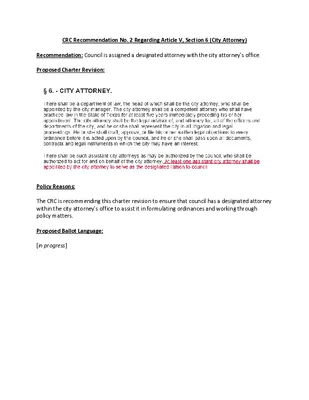
CRC Recommendation No. 2 Regarding Article V, Section 6 (City Attorney) Recommendation: Council is assigned a designated attorney with the city attorney’s office. Proposed Charter Revision: Policy Reasons: The CRC is recommending this charter revision to ensure that council has a designated attorney within the city attorney’s office to assist it in formulating ordinances and working through policy matters. Proposed Ballot Language: [in progress]

Item 5 2024 Charter Review Commission, 2/29/24 Background City Council Resolution 20230309-025 establishing the 2024 Charter Review Commission to make recommendations to the Council to, in part, “improve and enhance transparency and the general functions of city government….” The City Charter does not currently require public disclosure of the intent to collect signatures for a petition, the identity of the person(s) initiating the petition and responsible for collecting petition signatures, or contact information for the petitioners, among other disclosures commonly required in citizen-initiated petition policies in other cities, nor does the Charter require that the parties responsible for collecting and submitting petition signatures be residents of Austin. As such, the current petition process does not encourage or require the level of transparency that Austin residents deserve. Draft Recommendation Amended language for City Charter Article IV, Section 3: Subsection 1: Notice of Intent. A signature presented as part of a petition for a ballot initiative, referendum, recall, or for a Charter amendment to the extent allowable under state law, is considered valid only if: a) The signer is a qualified voter in the jurisdiction impacted by the petition; b) The signature includes the signer’s printed name, residence address, date of birth or Voter Unique Identifier (VUID), the date of signing, and the signer’s live signature, as described in Texas Election Code Sec. 277.002 (a); and c) The signature was collected during the effective period of a Notice of Intent filed with and accepted by the City Clerk. i) Notices of Intent are considered to be in effect once they are reviewed and accepted by the City Clerk, until the date the collected petition signatures are submitted to the City Clerk, for a period not exceeding 180 days. d) The signature was submitted as part of the petition before the 90th day before the date by which an election must be ordered for the next general municipal election date for petitions for initiative, referendum, and to the extent allowable under state law, Charter amendments. e) The signature was collected on a standardized petition form prescribed by the City Clerk, which at a minimum: i) ii) iii) Contact information for the Clerk’s office; The URL of the page on the City’s website where Notices of Intent are posted, as well as a QR code directing to that URL; The following information provided on the Notice of Intent: 1) The type of petition; 2) …

Recommendation: Background Item 5 City Council Resolution 20230309-025 establishing the 2024 Charter Review Commission indicated City Council’s intent to hold an election in November 2024 to allow voters to decide on several important changes to the charter including “changes to petition requirements for initiative and referendum or City Charter amendments including (…) Use of a durable signature threshold that utilizes a percentage of the total number of registered voters in the City.” Among the reasons cited for this change, the Resolution stated: “WHEREAS, in November 2012, voters approved a Charter amendment to change the number of required signatures for initiative and referendum petitions to be equal to the number of signatures required by state law to initiate a Charter amendment: 5% of qualified voters or 20,000, whichever number is smaller, and this change resulted in petitioners needing fewer than half the number of signatures than before;” and “WHEREAS, in 2012, when the change was made, 20,000 signatures was 4% of qualified voters,but this fixed number represents a steadily decreasing percentage of Austin voters as the City's population continues to grow;” and “WHEREAS, an October 2019 report by the City Auditor regarding citizen initiatives to amend the City Code noted that most peer cities require more signatures for citizen initiatives than Austin and that only Austin provides for a set number of signatures required or a percentage requirement, whichever is smaller”. The Charter Review Commission established the Petition Process Working Group on October 2nd, 2023. Its membership consisted of Commissioners Cowles, Dwyer, Greenberg, McGivern and Van Maanen. This recommendation was presented to the full Commission on XX/XX/XXXX. It was adopted/rejected by a X-X vote. Substance of the Proposed Amendments, Revisions or Repeals to the Charter This recommendation sets a durable signature threshold for the approval of citizen initiative and referendum petitions at 3.5% of qualified Austin voters. The Charter Review Commission recommends amending Article IV, § 1 by replacing the current language: “Any initiated ordinance may be submitted to the council by a petition signed by qualified voters of the city equal in number to the number of signatures required by state law to initiate an amendment to this Charter.” with the following amended language: “Any initiated ordinance may be submitted to the council by a petition signed by three and a half percent of qualified voters of the city.” and amending Article IV, § 2 by replacing the current language: …