Play video — original link
Play video
Play video

C I T Y O F A U S T I N | J a n u a r y 2 0 , 2 0 2 1 Bond Oversight Commission Bond Oversight Commission C I T Y O F A U S T I N | J a n u a r y 2 0 , 2 0 2 1 Bond Oversight Commission Our Vision Ensure efficiency, equity, timeliness, and Bond Oversight Commission Our Mission The commission shall monitor the city manager's Our Goals The mayor and council shall work with the commission to set priorities and goals for each accountability in the implementation of existing and future City bond programs. plans relating to the issuance of bonds and the implementation of projects approved in bond elections, including the review of future potential bonds, the annual appropriation of bond funds, and any changes in the amount of bond funds issues or cash commitments made. new bond issue to be submitted to the voters. The commission shall advise the council on proposed bonds and the implementation of projects approved in bond elections. C I T Y O F A U S T I N | J a n u a r y 2 0 , 2 0 2 1 Bond Oversight Commission I T E M 2 A . 2020 Active Mobility Bond: Proposition B Bond Oversight Commission E r i c B a i l e y , P u b l i c Wo r k s D e p a r t m e n t P r e s e n t e r s : A n n a M a r t i n , A u s t i n T r a n s p o r t a t i o n D e p a r t m e n t C I T Y O F A U S T I N | J a n u a r y 2 0 , 2 0 2 1 B o n d O v e r s i g h t C o m m i s s i o n | p g . 4 2020 ACTIVE MOBILITY BOND PROPOSITION B Bond Oversight Commission The issuance of $460,000,000 in tax supported general obligation bonds and notes for planning, constructing, reconstructing, and improving sidewalks, urban trails, bikeways, bridges, roads, streets, intersections, …
ENVIRONMENTAL COMMISSION MOTION 20210120 002c Subject: City of Austin’s 87th State Legislative Agenda Motion by: Kevin Ramberg Seconded by: Linda Guerrero Date: January 20, 2021 RATIONALE: WHEREAS, the City of Austin’s greatest asset is its people who are passionate about their city, committed to its improvement, and determined to see its vision become a reality; and WHEREAS, the percent of registered voters who voted in the past 4 years of city elections exceeded 60 percent; WHEREAS, a majority of voters who live in Austin voted for the current Austin City Council representation; WHEREAS, over 700 Austinites participate and serve on over 60 Boards and Commissions to help shape, and continually improve upon the policies of the City and the lives of its residents; WHEREAS, the input provided to the Austin City Council through the City’s Boards and Commissions reflects the will of the community; WHEREAS, it is the intent of the City of Austin that the legislative agenda guide City staff, in coordination with the City’s strategic partners, in their efforts to advocate on behalf of the City of Austin and its residents; WHEREAS, in recent years, the Texas Legislature has attempted to pass legislation that negatively impacts the City through preemption or limiting the ability to advocate; WHEREAS, the 2019 Legislature strongly considered and almost passed S.B. 29 which would have limited the ability of the City to utilize community advocates to effectively advocate on behalf of the policies created and supported by its residents; WHEREAS, taxpayers and City residents benefit from and need community advocates as a tool that amplifies their voices before the Legislature, Congress, and regulatory bodies; and WHEREAS, a prohibition on community advocacy is detrimental to a representative democracy where all Austinites and Texans have equal opportunities to voice their opinions. 1 THEREFORE, BE IT RESOLVED THAT THE Environmental Commission OF THE CITY OF AUSTIN HEREBY ADOPTS THE FOLLOWING RESOLUTION THAT: 1. The Environmental Commission endorses the City of Austin’s 2020 Legislative Agenda adopted by the Austin City Council on September 17th, 2020. 2. The Environmental Commission believes the general principals of the policy and position statements contained in the City of Austin’s state legislative agenda capture the positions of its membership and the community it represents. 3. The Environmental Commission urges all Austin delegation members of the Texas Legislature to protect the City’s right to effectively represent the taxpayers and continue to amplify their …
1 ENVIRONMENTAL COMMISSION MOTION 20210120 003a Date: January 20, 2021 Subject: Allegro Parmer, SP-2019-0170C Motion by: Kevin Ramberg RATIONALE: Seconded by: Andrew Creel WHEREAS, the Environmental Commission recognizes the applicant is requesting variances from LDC 25-8- 261 to allow construction in a critical water quality zone code, and WHEREAS, the Environmental Commission recognizes the majority of the site is within the critical water quality zone and has been extensively disturbed through previously permitted development to construct a parking lot and a water quality and detention pond, and WHEREAS, the Environmental Commission recognizes that staff recommends this variance (with conditions) having determined the required Findings of Fact have been met. Therefore, the Environmental Commission recommends the variance request with the following Staff Conditions: 1) The applicant will fully dismantle the existing water quality and detention pond, including pond appurtenances and underdrains, and provide restoration in accordance with City’s 609.S standards and specifications; 2) The applicant will clean up debris and trash along the portion of Yett Branch creek located at the southern property boundary of the commercial subdivision; and 3) The applicant will design the fire lane turnaround within the CWQZ in accordance with ECM 1.6.7 to reduce pollutant load and impervious cover. VOTE 9-0 For: Thompson, Coyne, Maceo, Ramberg, Guerrero, Gordon, Bedford, Barrett Bixler, Creel Against: None Abstain: None Recuse: None Absent: None Approved By: Linda Guerrero, Environmental Commission Chair 2
1 ENVIRONMENTAL COMMISSION MOTION 20210120 003b Date: January 20, 2021 Subject: 3336 Mount Bonnell Road, SP-2020-0274D Motion by: Kevin Ramberg Seconded by: Perry Bedford RATIONALE: WHEREAS, the Environmental Commission recognizes the applicant is requesting variance from LDC 25-8- 281(C)(2)(b) to allow the construction within 150 feet of a spring Critical Environmental Feature (CEF), and WHEREAS, the Environmental Commission recognizes the Limits of Construction will not encroach into the spring CEF, but only the CEF buffer, and WHEREAS, the Environmental Commission recognizes that staff recommends this variance (with conditions) having determined the required Findings of Fact have been met. Therefore, the Environmental Commission recommends the variance request with the following Staff Conditions: 1) 2) Remove existing boat dock and access path as specified on plans; Restore disturbed areas per City Standard Specification 609S. VOTE 8-0 For: Thompson, Coyne, Maceo, Ramberg, Guerrero, Gordon, Bedford, Creel Against: None Abstain: Barrett Bixler Recuse: None Absent: None Approved By: Linda Guerrero, Environmental Commission Chair
1 ENVIRONMENTAL COMMISSION MOTION 20210120 003c Date: January 20, 2021 Subject: Goodnight Ranch Planned Unit Development (PUD) – 2nd Amendment, C814-04-0187.02.SH Motion by: Kevin Ramberg Seconded by: Katie Coyne RATIONALE: WHEREAS, the Environmental Commission recognizes the applicant is requesting to amend an existing PUD. WHEREAS, the Environmental Commission recognizes the amendment includes environmental code modification to: 1) LDC 25-8-92: critical water quality zones, 2) LDC 25-8-281: Critical Environmental Features and 3) LDC 25-8-392: Impervious cover in uplands; and, WHEREAS, the Environmental Commission recognizes that staff recommends the PUD amendment (with conditions). Therefore, the Environmental Commission recommends the requested PUD amendment with the following Staff Conditions: 1. The PUD will provide a minimum of 129 acres of Open Space; 2. Impervious cover on the portion of the PUD south of Slaughter Lane will be capped at 67% gross 3. The critical water quality zone will be reconstructed per Exhibit D and D-1; and 4. The project will restore the creek and wetland buffers per Exhibit D and D-1. site area; and the following Environmental Commission Conditions: 1. The Environmental Commission directs staff to work with the applicant to consider additional dark skies standards above Subchapter E. VOTE 9-0 For: Thompson, Coyne, Maceo, Guerrero, Gordon, Bedford, Creel, Barrett Bixler Against: None Abstain: None Recuse: None Absent: None Approved By: Linda Guerrero, Environmental Commission Chair 2
ENVIRONMENTAL COMMISSION MOTION 20210120 003d Date: January 20, 2021 Subject: Blue Bluff at Wildhorse Ranch, C8-2020-0033 Motion by: Katie Coyne Seconded by: Wendy Gordon RATIONALE: WHEREAS, the Environmental Commission recognizes the applicant is requesting variances from LDC 25-8- 341 to allow cut over 4 feet to 15 feet and LDC 25-8-342 to allow fill over 4 feet to 15 feet, and WHEREAS, the Environmental Commission recognizes the site is located in the Gilleland Creek Watershed and in the Desired Development Zone, and WHEREAS, the Environmental Commission recognizes that staff recommends these variances (with one condition) having determined the required Findings of Fact have been met. Therefore, the Environmental Commission recommends the requested variances with the following Staff Condition: 1) The Applicant will protect three natural, unclassified drainages. These small waterways with less than 64 acres of drainage will be preserved in a natural state with foot-path trails for pedestrian access to the Critical Water Quality Zone buffers for an unnamed tributary of Gilleland Creek and for Gilleland Creek. Development within these drainage areas will be limited to park amenities such as trails and trail appurtenances (buildings and parking will not be allowed). VOTE 8-0 For: Thompson, Coyne, Maceo, Guerrero, Gordon, Bedford, Creel, Barrett Bixler Against: None Abstain: None Recuse: Ramberg Absent: None Approved By: Linda Guerrero, Environmental Commission Chair 1
ENVIRONMENTAL COMMISSION MEETING MINUTES Wednesday, January 20, 2021 The Environmental Commission convened in a public meeting on Wednesday, January 20, 2020 with Social Distancing Modifications via remote video conferencing. Commissioners in Attendance: Andrew Creel Pam Thompson Kevin Ramberg Linda Guerrero Perry Bedford Katie Coyne Wendy Gordon Peggy Maceo Audrey Barrett Bixler Commissioners Absent: None Staff in Attendance: Pamela Abee-Taulli Kaela Champlin Chris Herrington Liz Johnston Jorge Morales Mike McDougal Kristy Nguyen Radmon Rice CALL TO ORDER Chair Guerrero called the meeting to order at 6:05 P.M. CITIZEN COMMUNICATION: GENERAL The first ten speakers who register to speak no later than noon the day before the meeting will be allowed a three-minute allotment to address their concerns regarding items not posted on the agenda. Speakers Katie Lee 1. APPROVAL OF MINUTES AND ACTION a. Approval of the December 2, 2020 Environmental Commission Meeting Minutes A motion to approve the December 2, 2020 Environmental Commission Meeting Minutes were approved on Commissioner Ramberg’s motion, Commissioner Coyne’s second on an 8-0 vote. Commissioner Creel was off the dais. 1 2. 3. ITEMS FOR CONSIDERATION AND POSSIBLE ACTION a. Commissioner Audrey Barret Bixler welcome and introduction Item conducted as posted. No action taken. b. Recognize Mary Ann Neely for over 13 years of service on the Environmental Commission Item conducted as posted. No action taken. c. Consider a recommendation to support the City of Austin’s 87th State Legislative Agenda A resolution to support the City of Austin’s 87th State Legislative Agenda was approved on Commissioner Ramberg’s motion, Chair Guerrero’s second on a 7-1 vote. Those voting aye were Commissioners Thompson, Barret Bixler, Coyne, Maceo, Ramberg, Guerrero, and Bedford. Commission Creel voted nay. Commissioner Gordon abstained. PUBLIC HEARINGS a. Name: Allegro Parmer, SP-2019-0170C Applicant: Michele Rogerson Lynch Location: 4001 W. Parmer Ln, Austin, TX, 78727 (District 7) Staff: Kristy Nguyen, Environmental Review Specialist Sr., Development Services Department Watershed: Walnut Creek, Suburban, Desired Development Zone Request: Request to vary from LDC 25-8-261 to allow construction in a critical water quality zone Staff Recommendation: Staff recommends this variance with conditions Speakers Michele Rogerson Lynch A motion to close the public hearing was approved on Commissioner Ramberg’s motion, Commissioner Creel’s second on a 9-0 vote. A motion to recommend the variance with conditions was approved on Commissioner Ramberg’s motion, Commissioner Creel’s second on a 9-0 vote. b. Name: 3336 Mount Bonnell Road, SP-2020-0274D Applicant: Caitlin Kuglen Location: 3336 Mount …

Versión en español a continuación. Resource Management Commission Meeting January 19, 2021 The Resource Management Commission to be held January 19, 2021 with Social Distancing Modifications Public comment will be allowed via telephone; no in-person input will be allowed. All speakers must register in advance of Monday, January 18, 2021 by noon. All public comment will occur at the beginning of the meeting. To speak remotely at the Resource Management Commission Meeting, members of the public must: •Call or email the board liaison at Natasha Goodwin at 512-322-6505 or Natasha.Goodwin@austinenergy.com no later than noon, Monday, January 18, 2021. The following information is required: speaker name, item number(s) they wish to speak on, whether they are for/against/neutral, email address and telephone number (must be the same number that will be used to call into the meeting). •Once a request to speak has been made to the board liaison, the information to call on the day of the scheduled meeting will be provided either by email or phone call. •Speakers must call in at least 15 minutes prior to meeting start time in order to speak, late callers will not be accepted and will not be able to speak. •Speakers will be placed in a queue until their time to speak. •Handouts or other information may be emailed to Natasha.Goodwin@austinenergy.com by noon the day before the scheduled meeting. This information will be provided to Board and Commission members in advance of the meeting. •If the meeting is broadcast live, it may be viewed here: http://www.austintexas.gov/page/watch-atxn-live The City of Austin is committed to compliance with the American with Disabilities Act. Reasonable modifications and equal access to communications will be provided upon request. M eeting locations are planned with wheelchair access. If requiring Sign Language Interpreters or alternative formats, please call (512) 322-6450 at least 48 hours before the meeting date. TTY users route through Relay Texas at 711. For more information on the Resource M anagement Commission , please call Natasha Goodwin (512) 322-6505. Reunión del Resource Management Commission FECHA de la reunion (January 19, 2021) La junta se llevará con modificaciones de distanciamiento social Se permitirán comentarios públicos por teléfono; no se permitirá ninguna entrada en persona. Todos los oradores deben registrarse con anticipación (January 18, 2021). Todos los comentarios públicos se producirán al comienzo de la reunión. Para hablar de forma remota en la reunión, los miembros del público deben: • …
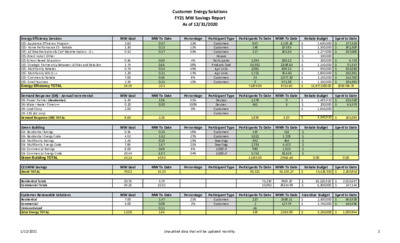
Customer Energy Solutions FY21 MW Savings Report As of 12/31/2020 22% 11% 33% 4% 38% 45% 17% 8% 10% 31% 150% 0% 18% 27% 13% 21% 8% 34% Customers Customers Customers Houses Participants Products Sold Apt Units Apt Units Customers Customers Devices Devices Customers Customers Customers Customers Dwellings Dwellings 1,000 sf 1,000 sf MW Goal MW To Date Percentage Participant Type Participants To Date MWh To Date Rebate Budget Energy Efficiency Services EES- Appliance Efficiency Program EES- Home Performance ES - Rebate EES- AE Weatherization & CAP Weatherization - D.I. EES-Direct Install -Other EES-School Based Education EES- Strategic Partnership Between Utilities and Retailers EES- Multifamily Rebates EES- Multifamily WX-D.I.+ EES- Commercial Rebate EES- Small Business Energy Efficiency TOTAL Demand Response (DR) - Annual Incremental DR- Power Partner (Residential) DR- Water Heater Timers++ DR- Load Coop DR- ERS (AE only) Demand Response (DR) TOTAL Green Building GB- Residential Ratings GB- Residential Energy Code GB- Multifamily Ratings GB- Multifamily Energy Code GB- Commercial Ratings GB- Commercial Energy Code Green Building TOTAL CES MW Savings Grand TOTAL Residential Totals Commercial Totals Customer Renewable Solutions Residential Commercial Unincentivized Solar Energy TOTAL 2.60 1.30 0.52 0.56 1.75 0.75 1.20 7.00 2.50 18.18 6.40 0.20 2.00 8.60 0.56 4.92 1.45 7.86 8.00 20.45 43.24 20.76 49.26 7.00 5.00 12.00 0.57 0.15 0.17 0.03 0.66 0.34 0.21 0.56 0.24 2.92 1.96 0.30 2.26 0.10 1.32 0.19 1.67 0.68 6.97 10.93 16.10 5.79 10.31 1.47 0.08 0.11 1.66 1,119.26 197.83 264.55 180.22 2,848.64 609.13 764.40 2,077.20 671.38 8732.60 $ 1,600,000 $ 1,500,000 $ 1,277,000 $ 100,000 $ 200,000 $ 1,150,000 $ 900,000 $ 1,800,000 $ 2,250,000 $ 1,100,000 $ 11,877,000.00 0 5 $ 1,499,910 $ 200,000 $ 1,850,000 Spent to Date $ 277,525 $ 392,509 357,068 $ $ $ $ $ $ $ 6,723 91,357 334,030 353,391 142,760 104,385 2059748.79 Spent to Date $ 135,520 $ 65,573 5.07 $ 3,549,910 $ 201,093 152 1,728 464 4,472 1,925 18,625 $ - $ - $ - $ - $ - $ - 11189.00 27366.60 0.00 0.00 847 148 117 1,394 65,952 2,081 1,721 24 9 72293.00 1,378 461 1,839 119 1,021 592 2,735 980 5,742 227 2 46 229 MW Goal MW To Date Percentage Participant Type Participants To Date MWh To Date Rebate Budget MW Goal MW To Date Percentage Participant Type Participants To Date MWh To Date Rebate Budget Spent to Date MW Goal 70.02 MW To Date …
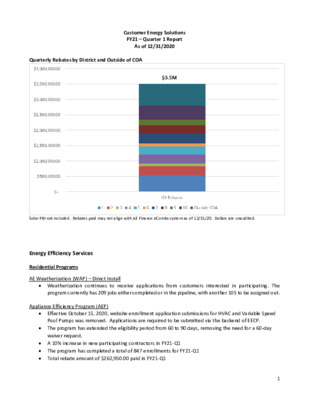
Customer Energy Solutions FY21 – Quarter 1 Report As of 12/31/2020 Quarterly Rebates by District and Outside of COA Solar PBI not included. Rebates paid may not align with AE Finance eCombs system as of 12/31/20. Dollars are unaudited. Energy Efficiency Services Residential Programs AE Weatherization (WAP) – Direct Install • Weatherization continues to receive applications from customers interested in participating. The program currently has 209 jobs either completed or in the pipeline, with another 105 to be assigned out. Appliance Efficiency Program (AEP) • Effective October 15, 2020, website enrollment application submissions for HVAC and Variable Speed Pool Pumps was removed. Applications are required to be submitted via the backend of EECP. • The program has extended the eligibility period from 60 to 90 days, removing the need for a 60-day waiver request. • A 10% increase in new participating contractors in FY21-Q1 • The program has completed a total of 847 enrollments for FY21-Q1 • Total rebate amount of $262,950.00 paid in FY21-Q1 1 Home Performance w/Energy Star (HPwES) • We launched the Limited Time Offer for FY21 that will run from 10/15/20 through 4/15/21. The Limited Time Offer includes a $600 rebate for qualifying Rebate projects and 0% financing for qualifying Rebate & Loan projects. • We permanently increased the Velocity Credit Union loan cap from $15,000 to $20,000 on10/15/2020. • From 10/1/2020 to 12/31/2020 the program achieved 148 projects. SPUR – Instant Savings • During the holidays, we highlighted Energy Star air purifiers to support customers during the allergy/flu season and LED lighting due to the shorter days of sunlight. • Our SPUR field representative visited over 250 sites this quarter to verify signage was up and prices were correct during the holiday season. To promote Power Partner Thermostats, he also updated all instore signage related to the Seasonal Savings offer. Instant Savings was included in Marketing Communication’s Energy Conservation Campaign and was advertised through web, print, digital, radio and direct emails to the customer. All-Stars • • Many schools in Austin Energy’s territory were not sure what to expect with students toggling between in-building and remote learning for Fall 2020 and therefor were hesitant to commit to any “extracurricular” programs during this time. • Despite the challenges due to Covid-19, All-Stars was able to achieve almost 25% of the goal this quarter with 1,209 participants. • We are in the process of creating videos to …
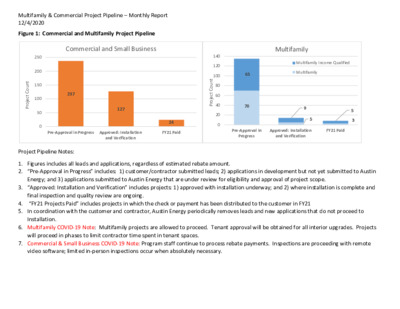
Multifamily & Commercial Project Pipeline – Monthly Report 12/4/2020 Figure 1: Commercial and Multifamily Project Pipeline Commercial and Small Business Multifamily 127 24 Pre-Approval in Progress Approved: Installation FY21 Paid and Verification Pre-Approval in Approved: Installation FY21 Paid Progress and Verification 140 120 100 80 60 40 20 0 t n u o C t c e o r P j 65 70 Multifamily Income Qualified Multifamily 9 5 5 3 250 200 150 100 50 0 t n u o C t c e o r P j 237 Project Pipeline Notes: 1. Figures includes all leads and applications, regardless of estimated rebate amount. 2. “Pre-Approval in Progress” includes: 1) customer/contractor submitted leads; 2) applications in development but not yet submitted to Austin Energy; and 3) applications submitted to Austin Energy that are under review for eligibility and approval of project scope. 3. “Approved: Installation and Verification” includes projects: 1) approved with installation underway; and 2) where installation is complete and final inspection and quality review are ongoing. 4. “FY21 Projects Paid” includes projects in which the check or payment has been distributed to the customer in FY21 5. In coordination with the customer and contractor, Austin Energy periodically removes leads and new applications that do not proceed to Installation. 6. Multifamily COVID-19 Note: Multifamily projects are allowed to proceed. Tenant approval will be obtained for all interior upgrades. Projects will proceed in phases to limit contractor time spent in tenant spaces. 7. Commercial & Small Business COVID-19 Note: Program staff continue to process rebate payments. Inspections are proceeding with remote video software; limited in-person inspections occur when absolutely necessary. Multifamily & Commercial Project Pipeline – Monthly Report 12/4/2020 Table 1: Multifamily and Multifamily Income Qualified – Estimated RCA Project Pipeline (for estimated rebates >$62k) Program Multifamily Income Qualified Multifamily Income Qualified Multifamily Income Qualified Latest Enrollment Workflow # Location Name Installation Address Council District Estimated kW savings Estimated kWh savings Estimated $ Incentive Measures Planned Paid 1183402 Lupine Terrace* 1 34.8 131,144 $62,724 Installation 1203275 Bent Tree Apartments* 10 98.3 231,788 $82,263 Installation 1203807 Huntington Meadows* 1 56.3 206,305 $97,860 Multifamily Installation Nalle Woods* 10 57.0 263,247 $98,886 1137 GUNTER ST 8405 BENT TREE RD 7000 DECKER LN 4700 N CAPITAL OF TEXAS HWY SB 4701 STAGGERBRUSH RD 14233 The Lakes Blvd 8 7 1190747, 1205154 1201740, 1201741, 1190308 1205826, 1207373, 1207491 Multifamily Installation Monterrey Ranch* 194.4 33,247 …
Impact Fee Advisory Committee January 19, 2021 4:30 PM Virtual Meeting held via WebEx Members of the public who would like to join the virtual meeting may do so by selecting this link https://austintexas.webex.com/austintexas/j.php?MTID=m3a615932d1e801d80bb09ea60f03bdde or by dialing 1-408-418-9388 (Toll) or 1-844-992-4726 (Toll Free). CURRENT BOARD MEMBERS: Kris Bailey Lance Parisher Susan Turrieta Donny Hamilton, Jr. Channy Soeur Dick Kallerman Bobak Tehrany, Chair CALL TO ORDER – January 19, 2021 4:30 p.m. AGENDA CITIZEN COMMUNICATION: GENERAL Members of the public wishing to speak during citizen communication must register in advance by emailing their name, email address and/or phone number to liane.conte@austintexas.gov no later than Monday, January 18, 2021 at 5 p.m. If you experience technical difficulties logging in or calling in, please call Liane Conte at (512) 289-3053. Please indicate in your email if you’d like to speak on a specific item. The first 10 speakers signed up will each be allowed three-minutes to address their concerns regarding items NOT posted on the agenda. Speakers who would like to address items ON the agenda will be called on by the Chair to speak for up to three-minutes when that item is taken up. 1. APPROVAL OF MINUTES a. Approval of minutes from the September 15, 2020 Impact Fee Advisory Committee meeting. 2. NEW BUSINESS a. Discussion and action on the water and wastewater Semi-Annual Impact Fee Report for April 1, 2020 through September 30, 2020 as set forth in the functions of the advisory committee, Austin City Code and Chapter 395.058 of the Texas Local Government Code. b. Staff briefing on adopted street impact fee ordinances and program implementation. c. Discussion and possible action on future Impact Fee Advisory Committee meeting dates for 2021. FUTURE AGENDA ITEMS ADJOURNMENT The City of Austin is committed to compliance with the American with Disabilities Act. Reasonable modifications and equal access to communications will be provided upon request. Meeting locations are planned with wheelchair access. If requiring Sign Language Interpreters or alternative formats, please give notice at least 2 days (48 hours) before the meeting date. Please call Liane Miller at the Austin Transportation Department at 512-974-7922, for additional information; TTY users route through Relay Texas at 711. For more information on the Impact Fee Advisory Committee, please contact Liane Conte at liane.conte@austintexas.gov, (512) 974-7922 or visit www.austintexas.gov/ifac.
CITY OF AUSTIN, TEXAS AUSTIN WATER SEMI-ANNUAL IMPACT FEE COLLECTIONS REPORT April 1, 2020 through September 30, 2020 City of Austin | Austin Water P.O. Box 1088 Austin, TX 78767 AustinWater.org Martin Tower, P.E., Managing Engineer, Austin Water Aurora Pizano, Financial Manager II, Austin Water January 11, 2021 Semi-Annual Impact Fee Collections Report for April 1, 2020 to September 30, 2020 MEMORANDUM To: From: Date: Subject: The Semi-Annual Impact Fee Collections Report as of September 30, 2020 is attached for your reference. The report is based on financial information reported in the City’s accounting system, ADV3, and in AMANDA, one of the City’s accounts receivable systems. Water fees collected during this six-month reporting period were $1,698,723 lower than the amount collected during the April through September reporting period a year prior; wastewater fees collected were $126,918 higher than those collected during the same period one year ago. Interest earnings for the six-month period equaled $90,159. The combined utility impact fees collected, plus interest, during the six-month period totaled $18,810,834. Of this total, $13,223,252 was for water and $5,587,582 was for wastewater. Total combined utility impact fees collected, plus interest, since the adoption of the current ordinance on June 20, 1990, through September 30, 2020, equal $364,289,239. Of this total, $244,965,939 was collected for water and $119,323,300 was collected for wastewater. Overall, combined collections were nearly $2 million more in FY2020 when compared to FY2019. As of September 30, 2020, the cash balances in the water and wastewater impact fee funds were $23,797,958 and $9,019,534 respectively, for a combined total of $32,817,492. Please let me know if you have any questions or need additional information. I can be reached at 512-972-0331. Cc: Greg Meszaros, Director Joseph Gonzales, Assistant Director, Financial Services Jonathan Orenstein, Financial Manager III, Consumer Services Division Teresa Lutes, P.E., Managing Engineer, Systems Planning Division Attachment: Semi-Annual Impact Fee Collections Report Semi-Annual Impact Fee Collections October 1, 2016 through September 31, 2017 Texas Local Government Code, Chapter 395, Section 395.058, requires that the Impact Fee Advisory Committee “file semiannual reports with respect to the progress of the capital improvements plan and report to the political subdivision any perceived inequities in implementing the plan or imposing the impact fee.” This report supports the committee by providing financial information about the collection of impact fees, and the value of fee waivers and exemptions. Waivers are granted for policy reasons or are …
ORDINANCE NO. 20201210-062 AN ORDINANCE AMENDING CITY CODE CHAPTER 25- 6 ESTABLISHING A STREET IMPACT FEE PROGRAM. BE IT ORDAINED BY THE CITY COUNCIL OF THE CITY OF AUSTIN: PART 1. FINDINGS. The City Council makes the following findings in support o f this ordinance: (1) (2) (3) (4) (5) (6) (7) (8) Texas Local Government Code Chapter 395 ("Chapter 395") authorizes the City to offset the impacts of new development on the City's roadway network by imposing street impact fees by service area within city limits. The City has adopted land use assumptions by service area that project anticipated residential and employment growth from new development within each delineated service area over a ten-year period, in accordance with the methodology prescribed by Chapter 395. The City has prepared and adopted a roadway capacity plan that identifies improvements necessary to serve new development within each capital service area over a ten-year period, in accordance with the methodology prescribed by Chapter 395. The City has prepared and adopted a Transportation Plan that addresses all transportation needs within the City and that contains strategies for reducing the need for new capital improvements for the roadway system in the future by shifting demand to other modes of transportation. The Transportation Plan contains strategies for funding transportation needs. Street impact fees for a new development are calculated according to the trip generation rate and trip length for the new development. Street impact fees for a new development are calculated according to the standardized trip generation rate and trip length within the service area for the new development. Overall vehicular demand for roadway improvements generated by a new development can be reduced from that projected in the roadway capacity plan Page 1 of 14 by employing transportation demand management strategies recognized by the professional transportation engineering and planning fields. (9) It is appropriate to reduce street impact fees for applied measures that result in reduction in overall vehicular demand for a new development. (10) The strategies for reduction in overall vehicular demand from a new development include the following: (a) (b) (c) internal development; trip capture resulting from mixed land uses within a new proximity ofa development to existing and planned transit facilities that facilitate use of transit as an alternative to vehicular transportation; and reduction in the number of parking spaces and other parking management techniques within a new development that discourage demand for …
RMC Monthly Report December 2020 FY21 Mark Jordan Water Conservation Division City of Austin | Austin Water s t i n U f o r e b m u N 700 600 500 400 300 200 100 0 Residential Program Participation, FY21 YTD FY18 FY19 FY20 FY21 249 253 200 114 91 63 69 353 121 122 35 23 28 54 31 20 3 19 8 1 6 0 2 2 5 2 Home Water Use Monitoring Device Irrigation Upgrade Irrigation Audits Drought Survival Tools WaterWise Landscape WaterWise Rainscape Rainwater Harvesting RMC Monthly Report –December 2020, FY21 02 60 50 40 s t i n U f o r e b m u N 30 20 10 0 Commercial & Multifamily Program Participation, FY21 YTD FY18 FY19 FY20 FY21 54 17 8 11 1 0 3 2 0 0 0 2 Commercial Audit Commercial Process Rebates Commercial Kitchen Rebates RMC Monthly Report – December 2020, FY21 03 $450,000 $400,000 $350,000 $300,000 $ e v i t n e c n I $250,000 $200,000 $150,000 $100,000 $50,000 $0 Rebates and Incentives Budget, FY21 YTD FY21 Total Budget Q1 Q2 Q3 Q4 $420,000 $245,000 $- $65,000 $- $14,804.40 Commercial Commercial Multi-Family Multi-Family Residential Residential RMC Monthly Report – December 2020, FY21 04 Helping Hands Outreach (H2O) Programs • G.O. REPAIR! – Austin Water (AW) partners with Housing & Planning Department’s (Formerly Neighborhood Housing and Community Development Department) G.O. Repair! Program to provide grants of up to $20,000 per year to qualifying homeowners for plumbing repairs, accessibility improvements, and to make other repairs to address substandard housing conditions that pose health and safety risks. • FREE HOME WATER USE REPORT – AW provides customers with access to a water use mobile app and internet reports to help homeowners achieve greater water savings. Customers can receive customized leak alerts, conservation tips, and information about rebate programs • FREE WATER CONSERVATION TOOLS – AW Conservation provides free water saving materials such as: high efficiency aerators and showerheads; micro-fiber towels; and soil moisture meters to residential and multi-family customers. • PRIVATE WASTEWATER LATERAL REPAIR/REPLACEMENT – AW can provide financial assistance to eligible customers for the replacement or repair of private wastewater laterals at single-family homes or duplexes whose household income is 100% or less than the area Median Family Income. RMC Monthly Report – December 2020, FY21 05 Water Waste Enforcement Activity, FY21 YTD Warnings and …
Versión en español a continuación. Urban Renewal Board Special Called Meeting January 19, 2021, 1:00-5:00pm Urban Renewal Board to be held January 19, 2021 with Social Distancing Modifications Public comment will be allowed via telephone; no in-person input will be allowed. All speakers must register in advance (January 18, 2021 by noon). All public comment will occur at the beginning of the meeting. To speak remotely at the January 19, 2021 Urban Renewal Board Meeting, members of the public must: •Call or email the board liaison at 512-974-3458 or laura.keating@austintexas.gov no later than noon, (the day before the meeting). The following information is required: speaker name, item number(s) they wish to speak on, whether they are for/against/neutral, email address and telephone number (must be the same number that will be used to call into the meeting). •Once a request to speak has been made to the board liaison, the information to call on the day of the scheduled meeting will be provided either by email or phone call. •Speakers must call in at least 15 minutes prior to meeting start time in order to speak, late callers will not be accepted and will not be able to speak. •Speakers will be placed in a queue until their time to speak. •Handouts or other information may be emailed to laura.keating@austintexas.gov by noon the day before the scheduled meeting. This information will be provided to Board and Commission members in advance of the meeting. •If the meeting is broadcast live, it may be viewed here: http://www.austintexas.gov/page/watch-atxn-live Reunión del Urban Renewal Board FECHA de la reunion (19 Enero, 2021, 1:00 – 5:00pm) La junta se llevará con modificaciones de distanciamiento social Se permitirán comentarios públicos por teléfono; no se permitirá ninguna entrada en persona. Todos los oradores deben registrarse con anticipación (18 Enero, 2021 antes del mediodía). Todos los comentarios públicos se producirán al comienzo de la reunión. Para hablar de forma remota en la reunión, los miembros del público deben: junta en 512-974-3458 or • Llame o envíe un correo electrónico al enlace de laura.keating@austintexas.gov a más tardar al mediodía (el día antes de la reunión). Se requiere la siguiente información: nombre del orador, número (s) de artículo sobre el que desean hablar, si están a favor / en contra / neutral, dirección de correo electrónico (opcional) y un número de teléfono (debe ser el número que se utilizará para llamar ). …
Draft Vision Statements Based on discussions during 12/21/20 URB meeting. Manuel Escobar Darrell Pierce Amit Motwani Danielle Skidmore Jaqueline Watson Nathaniel Bradford Kobla Tetey Achieve sustainable, lasting revitalization that results in diverse equity for all stakeholders and serves as a model for development throughout the City. Create and sustain model revitalization that drives diversity for stakeholders impacted by 11th and 12th street corridors. Promote diversity, and facilitate revitalization for modeling historic preservation of 11th and 12th street corridors. The URB has, by means of its implementation of the URP, inculcated a lasting development model whose sustainable resilience is the cohesive result of shared incentive and equitable benefit for all community stakeholders. Achieve a sustainable resident-informed revitalization that respects the history and diversity of the East 11th and 12th Street corridors and serves as an inspiration for other locations in the city. Accomplish a diverse historically respectful revitalization of the East 11th and 12th Street corridors that inspires future development throughout Austin. Seconded Commissioner Watson’s visions statement. Ensuring that all stakeholders benefit from investments into the City, driving diverse equity and sustainability in a manner that is respectful to all parties, leaving a legacy of inspirational community development and becoming a model for other cities to follow.
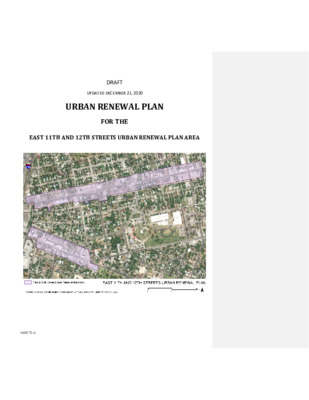
UPDATED DECEMBER 21, 2020 DRAFT URBAN RENEWAL PLAN FOR THE EAST 11TH AND 12TH STREETS URBAN RENEWAL PLAN AREA 1484775.v1 TABLE OF CONTENTS 1. Boundary Description 2. History 2.1 Accomplishments 3. Vision, Purpose, Authority and Scope 4. Redevelopment Strategy 5. Applicability of NCCD Controls 6. Land Use 7. Relocation of Persons, Businesses (including individuals and families, business concerns, and others displaced by the project) 8. Duration and Modification Procedures of URP Appendices: Appendix A: East 11th and 12th Street Urban Renewal Plan; Amendments Appendix B: East 11th Street and East 12th Street Neighborhood Conservation Combining District (NCCDs); Amendments Abbreviations commonly used in the document: URP – Urban Renewal Plan URA-Urban Renewal Agency ARA – Austin Revitalization Authority Note: Some of the tables and figures from the original 1999 Urban Renewal Plan have been deleted or modified, as they were no longer accurate or relevant. The original plan is available at this website: http://www.austintexas.gov/department/urban-renewal-plan 1484775.v1 EAST 11 TH & 12TH STREETS URBAN RENEWAL PLAN (URP) 1. BOUNDARY DESCRIPTION The formal boundaries of the East 11th and 12th Streets Urban Renewal Area are set forth in the documents listed in Appendix A and the ordinance approving this URP. In general, the boundaries are: The East 11th Street Corridor, including properties within one-half block of the north frontage of East 11th Street and south frontage of Juniper Street, from Branch Street on the west to Navasota Street on the east; and properties within one-half block of the south frontage of East 11th, from San Marcos Street on the west to Navasota Street on the east. The East 12th Street Corridor, including properties within one-half block of the north frontage of East 12th and between the IH-35 Northbound Frontage Road on the west to Poquito Street to the east; and properties within one-half block of the south frontage of East 12th Street, from Branch Street on the west to Poquito Street on the east. 2. HISTORY This East 11th and 12th Streets Urban Renewal Plan (“URP" also referred to as the East 11th and 12th Streets Community Redevelopment Plan or “CRP”), is a comprehensive document defining the official public policy guidelines of the City of Austin (City) for driving public and private redevelopment actions within the East 11th and 12th Streets Urban Renewal Area in compliance with Texas Local Government Code, Chapter 374. The URP’s original conceptual approaches and strategies for the entire Central …
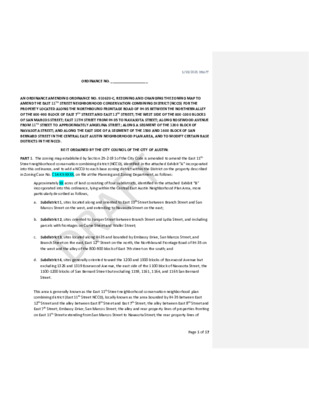
ORDINANCE NO. __________________ 1/19/2021 DRAFT AN ORDINANCE AMENDING ORDINANCE NO. 910620-C, REZONING AND CHANGING THE ZONING MAP TO AMEND THE EAST 11TH STREET NEIGHBORHOOD CONSERVATION COMBINING DISTRICT (NCCD) FOR THE PROPERTY LOCATED ALONG THE NORTHBOUND FRONTAGE ROAD OF IH-35 BETWEEN THE NORTHERN ALLEY OF THE 800-900 BLOCK OF EAST 7TH STREET AND EAST 12TH STREET; THE WEST SIDE OF THE 800-1000 BLOCKS OF SAN MARCOS STREET; EAST 11TH STREET FROM IH-35 TO NAVASOTA STREET; ALONG ROSEWOOD AVENUE FROM 11TH STREET TO APPROXIMATELY ANGELINA STREET; ALONG A SEGMENT OF THE 1200 BLOCK OF NAVASOTA STREET; AND ALONG THE EAST SIDE OF A SEGMENT OF THE 1500 AND 1600 BLOCK OF SAN BERNARD STREET IN THE CENTRAL EAST AUSTIN NEIGHBORHOOD PLAN AREA, AND TO MODIFY CERTAIN BASE DISTRICTS IN THE NCCD. BE IT ORDAINED BY THE CITY COUNCIL OF THE CITY OF AUSTIN: PART 1. The zoning map established by Section 25-2-191 of the City Code is amended to amend the East 11th Street neighborhood conservation combining district (NCCD), identified in the attached Exhibit "A" incorporated into this ordinance, and to add a NCCD to each base zoning district within the District on the property described in Zoning Case No. C14-XX-XXXX, on file at the Planning and Zoning Department, as follows: Approximately XX acres of land consisting of four subdistricts, identified in the attached Exhibit “B” incorporated into this ordinance, lying within the Central East Austin Neighborhood Plan Area, more particularly described as follows, a. Subdistrict 1, sites located along and oriented to East 11th Street between Branch Street and San Marcos Street on the west, and extending to Navasota Street on the east; b. Subdistrict 2, sites oriented to Juniper Street between Branch Street and Lydia Street, and including parcels with frontages on Curve Street and Waller Street; c. Subdistrict 3, sites located along IH-35 and bounded by Embassy Drive, San Marcos Street, and Branch Street on the east, East 12th Street on the north, the Northbound Frontage Road of IH-35 on the west and the alley of the 800-900 block of East 7th street on the south; and d. Subdistrict 4, sites generally oriented toward the 1200 and 1300 blocks of Rosewood Avenue but excluding 1326 and 1319 Rosewood Avenue, the east side of the 1100 block of Navasota Street, the 1100-1200 blocks of San Bernard Street but excluding 1159, 1161, 1164, and 1165 San Bernard Street. This area is …