Austin Energy's Resource Generation Plan 2035 Workshops Presented by Lynda Rife City of Austin District 2 Residential Customers Tri-City Region Solar and Storage Coalition CCARE Homeowners United for Rate Fairness (HURF) Overview: Workshop #4 • Austin Energy hosted their fourth in a series of workshops on Thurs. Oct. 3, 2024, from 11:30 a.m. to 1:30 p.m. • The goals of Workshop #4 were to provide workshop participants with the results from the surveys taken from Workshop #3, give insight into how Austin Energy will incorporate an equity lens to the Resource Generation Plan 2035, and gather feedback on drafted value and objective statements. Report Out of Workshop #3 Key Takeaways Reliability is the community’s top priority across the board. Equity continues to be a major theme and discussion point throughout the workshops. The impacts of outages can be detrimental to vulnerable communities. Austin Energy’s environmental sustainability leadership should be applauded. Equity – Generally Moving in the Right Direction The three dimensions of energy equity: Procedural equity focuses on ensuring fair, inclusive participation in the decision-making process. • Recognition equity aims to understand and address past and present energy equities. • Distributional equity focuses on just and equitable distribution of benefits and impacts in Austin’s clean energy transition. What we heard: Concerns about the medically vulnerable and encouraging Austin Energy to expand their CAP programs. • • Values Statements* – Generally Moving in the Right Direction Reliability Providing consistent and predictable electric service that will power our community as it continues to grow. Affordability Assessing the fairness and impacts of costs for customers while continuing to provide the public-power benefits that enhance our community’s quality of life. Environmental Sustainability Maintaining flexibility in support of clean and innovative technologies and programs while taking a holistic assessment of the community and environmental impacts. Energy Equity Evaluating and expanding access to the services Austin Energy provides so they can reach those who need them most while understanding the impact of our operations on the community. *Developed based workshop discussions Value Statements – What We Heard • Strengthen words like “understanding” and “assessing” to make the statements more actionable. • Predictability with both reliability and affordability – improve communications to the community. • Include more references to climate change issues. Updated Value Statements* Reliability Providing consistent and predictable electric service that will power our community as it continues to grow. Affordability Assessing the impacts and …
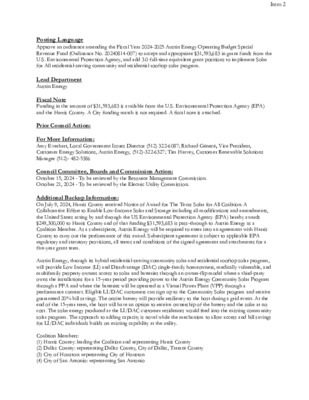
Item 2 Posting Language ..Title Approve an ordinance amending the Fiscal Year 2024-2025 Austin Energy Operating Budget Special Revenue Fund (Ordinance No. 20240814-007) to accept and appropriate $31,593,683 in grant funds from the U.S. Environmental Protection Agency, and add 3.0 full-time equivalent grant positions to implement Solar for All residential-serving community and residential rooftop solar program. ..De Lead Department Austin Energy Prior Council Action: Fiscal Note Funding in the amount of $31,593,683 is available from the U.S. Environmental Protection Agency (EPA) and the Harris County. A City funding match is not required. A fiscal note is attached. For More Information: Amy Everhart, Local Government Issues Director (512) 322-6087; Richard Génecé, Vice President, Customer Energy Solutions, Austin Energy, (512)-322-6327; Tim Harvey, Customer Renewable Solutions Manager (512)- 482-5386 Council Committee, Boards and Commission Action: October 15, 2024 - To be reviewed by the Resource Management Commission. October 21, 2024 - To be reviewed by the Electric Utility Commission. Additional Backup Information: On July 9, 2024, Harris County received Notice of Award for The Texas Solar for All Coalition: A Collaborative Effort to Enable Low-Income Solar and Storage including all modifications and amendments, the United States acting by and through the US Environmental Protection Agency (EPA) hereby awards $249,300,000 to Harris County and of that funding $31,593,683 is pass-through to Austin Energy as a Coalition Member. As a subrecipient, Austin Energy will be required to enter into an agreement with Harris County to carry out the performance of this award. Subrecipient agreement is subject to applicable EPA regulatory and statutory provisions, all terms and conditions of the signed agreement and attachments for a five-year grant term. Austin Energy, through its hybrid residential-serving community solar and residential rooftop solar program, will provide Low Income (LI) and Disadvantage (DAC) single-family homeowners, medically vulnerable, and multifamily property owners access to solar and batteries through an owner-flip model where a third-party owns the installations for a 15-year period providing power to the Austin Energy Community Solar Program through a PPA and where the batteries will be operated as a Virtual Power Plant (VPP) through a performance contract. Eligible LI/DAC customers can sign up to the Community Solar program and receive guaranteed 20% bill savings. The onsite battery will provide resiliency to the host during a grid event. At the end of the 15-year term, the host will have an option to receive ownership of the battery and …
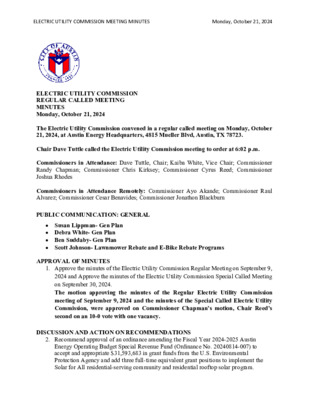
ELECTRIC UTILITY COMMISSION MEETING MINUTES Monday, October 21, 2024 ELECTRIC UTILITY COMMISSION REGULAR CALLED MEETING MINUTES Monday, October 21, 2024 The Electric Utility Commission convened in a regular called meeting on Monday, October 21, 2024, at Austin Energy Headquarters, 4815 Mueller Blvd, Austin, TX 78723. Chair Dave Tuttle called the Electric Utility Commission meeting to order at 6:02 p.m. Commissioners in Attendance: Dave Tuttle, Chair; Kaiba White, Vice Chair; Commissioner Randy Chapman; Commissioner Chris Kirksey; Commissioner Cyrus Reed; Commissioner Joshua Rhodes Commissioners in Attendance Remotely: Commissioner Ayo Akande; Commissioner Raul Alvarez; Commissioner Cesar Benavides; Commissioner Jonathon Blackburn PUBLIC COMMUNICATION: GENERAL • Susan Lippman- Gen Plan • Debra White- Gen Plan • Ben Suddaby- Gen Plan • Scott Johnson- Lawnmower Rebate and E-Bike Rebate Programs APPROVAL OF MINUTES 1. Approve the minutes of the Electric Utility Commission Regular Meeting on September 9, 2024 and Approve the minutes of the Electric Utility Commission Special Called Meeting on September 30, 2024. The motion approving the minutes of the Regular Electric Utility Commission meeting of September 9, 2024 and the minutes of the Special Called Electric Utility Commission, were approved on Commissioner Chapman’s motion, Chair Reed’s second on an 10-0 vote with one vacancy. DISCUSSION AND ACTION ON RECOMMENDATIONS 2. Recommend approval of an ordinance amending the Fiscal Year 2024-2025 Austin Energy Operating Budget Special Revenue Fund (Ordinance No. 20240814-007) to accept and appropriate $31,593,683 in grant funds from the U.S. Environmental Protection Agency and add three full-time equivalent grant positions to implement the Solar for All residential-serving community and residential rooftop solar program. ELECTRIC UTILITY COMMISSION MEETING MINUTES Monday, October 21, 2024 The motion to recommend approval of an ordinance amending the Fiscal Year 2024-2025 Austin Energy Operating Budget Special Revenue Fund, was recommended on Chair Tuttle’s motion, Commissioner Reed’s second on an 10-0 vote with one vacancy. 3. Recommend approval of a resolution authorizing the filing of eminent domain proceedings and payment to acquire the property interests needed for the Cap Ex South, CKT987 & 1031 Structure Relocation 2021 Project for the public use of relocating various structures along existing circuits 926/927, 987, and 988 to accommodate the Texas Department of Transportation expansion of Interstate Highway 35 (IH 35), requiring the acquisition of 0.168 acres (7,319 square feet) of a permanent electric transmission and distribution easement, being a portion of Lot 23, Block “A”, Circle “S” Ridge Section 1, a Subdivision recorded …
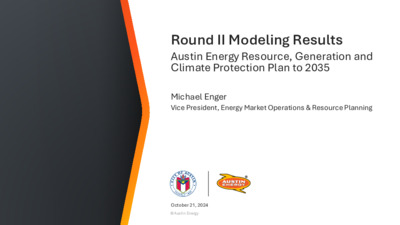
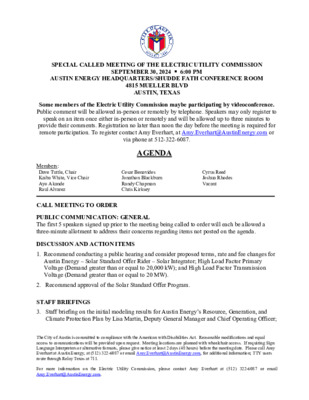
SPECIAL CALLED MEETING OF THE ELECTRIC UTILITY COMMISSION SEPTEMBER 30, 2024 6:00 PM AUSTIN ENERGY HEADQUARTERS/SHUDDE FATH CONFERENCE ROOM 4815 MUELLER BLVD AUSTIN, TEXAS Some members of the Electric Utility Commission maybe participating by videoconference. Public comment will be allowed in-person or remotely by telephone. Speakers may only register to speak on an item once either in-person or remotely and will be allowed up to three minutes to provide their comments. Registration no later than noon the day before the meeting is required for remote participation. To register contact Amy Everhart, at Amy.Everhart@AustinEnergy.com or via phone at 512-322-6087. AGENDA Members: Dave Tuttle, Chair Kaiba White, Vice Chair Ayo Akande Raul Alvarez Cesar Benavides Jonathon Blackburn Randy Chapman Chris Kirksey Cyrus Reed Joshua Rhodes Vacant CALL MEETING TO ORDER PUBLIC COMMUNICATION: GENERAL The first 5 speakers signed up prior to the meeting being called to order will each be allowed a three-minute allotment to address their concerns regarding items not posted on the agenda. DISCUSSION AND ACTION ITEMS 1. Recommend conducting a public hearing and consider proposed terms, rate and fee changes for Austin Energy – Solar Standard Offer Rider – Solar Integrator; High Load Factor Primary Voltage (Demand greater than or equal to 20,000 kW); and High Load Factor Transmission Voltage (Demand greater than or equal to 20 MW). 2. Recommend approval of the Solar Standard Offer Program. STAFF BRIEFINGS 3. Staff briefing on the initial modeling results for Austin Energy’s Resource, Generation, and Climate Protection Plan by Lisa Martin, Deputy General Manager and Chief Operating Officer; The City of Austin is committed to compliance with the American with Disabilities Act. Reasonable modifications and equal access to communications will be provided upon request. Meeting locations are planned with wheelchair access. If requiring Sign Language Interpreters or alternative formats, please give notice at least 2 days (48 hours) before the meeting date. Please call Amy Everhart at Austin Energy, at (512) 322-6087 or email Amy.Everhart@AustinEnergy.com, for additional information; TTY users route through Relay Texas at 711. For more information on the Electric Utility Commission, please contact Amy Everhart at (512) 322-6087 or email Amy.Everhart@AustinEnergy.com. Michael Enger, Vice President of Energy Market Operations and Resource Planning; and Ben Anderson, Resource Planning Manager at Ascend Analytics. FUTURE AGENDA ITEMS ADJOURNMENT The City of Austin is committed to compliance with the American with Disabilities Act. Reasonable modifications and equal access to communications will …
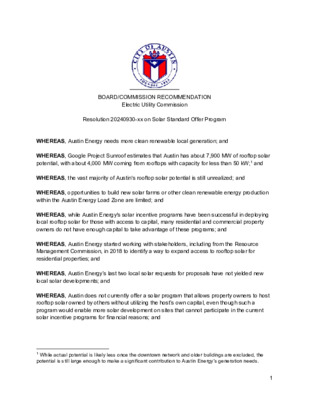
BOARD/COMMISSION RECOMMENDATION Electric Utility Commission Resolution 20240930-xx on Solar Standard Offer Program WHEREAS, Austin Energy needs more clean renewable local generation; and WHEREAS, Google Project Sunroof estimates that Austin has about 7,900 MW of rooftop solar potential, with about 4,000 MW coming from rooftops with capacity for less than 50 kW;1 and WHEREAS, the vast majority of Austin's rooftop solar potential is still unrealized; and WHEREAS, opportunities to build new solar farms or other clean renewable energy production within the Austin Energy Load Zone are limited; and WHEREAS, while Austin Energy's solar incentive programs have been successful in deploying local rooftop solar for those with access to capital, many residential and commercial property owners do not have enough capital to take advantage of these programs; and WHEREAS, Austin Energy started working with stakeholders, including from the Resource Management Commission, in 2018 to identify a way to expand access to rooftop solar for residential properties; and WHEREAS, Austin Energy’s last two local solar requests for proposals have not yielded new local solar developments; and WHEREAS, Austin does not currently offer a solar program that allows property owners to host rooftop solar owned by others without utilizing the host’s own capital, even though such a program would enable more solar development on sites that cannot participate in the current solar incentive programs for financial reasons; and 1 While actual potential is likely less once the downtown network and older buildings are excluded, the potential is still large enough to make a significant contribution to Austin Energy’s generation needs. 1 WHEREAS, Austin Energy could significantly increase the amount of solar development within the Austin Energy Load Zone by facilitating solar development on more rooftops in Austin, where solar developers lease the rooftop from the property owner; and WHEREAS, Austin Energy supports new behind-the-meter solar projects under 10 MW with photovoltaic incentives, treating the Value of Solar payment for all PV generation as a bill credit (which renders it non-taxable income), and including the 2.3 cent/kWh societal benefits portion of the Value of Solar tariff; and behind-the-meter rooftop PV projects are exempt from property tax; and WHEREAS, Austin Energy’s proposed Solar Standard Offer program will apply to new solar projects under 10 MW connected to Austin Energy’s distribution system on the grid side of the customer meter, but will not offer any solar incentive, the solar project will be subject to property tax, the …
Item 17 Posting Language ..Title Conduct a public hearing and consider proposed terms, rate and fee changes for Austin Energy – Solar Standard Offer Rider – Solar Integrator; High Load Factor Primary Voltage (Demand greater than or equal to 20,000 kW); and High Load Factor Transmission Voltage (Demand greater than or equal to 20 MW). ..De Lead Department Austin Energy Prior Council Action: Fiscal Note The Solar Standard Offer Rider is funded through the Power Supply Adjustment. For More Information: Amy Everhart, Director, Local Government Relations (512) 322-6087; Russell Maenius, Sr. VP and Chief Financial Officer, (512)-322-6133. Council Committee, Boards and Commission Action: Sept 9, 2024 - To be reviewed by the Electric Utility Commission. Sept 17, 2024 - To be reviewed by the Resource Management Commission. Additional Backup Information: If the Solar Standard Offer Rider is approved, the Standard Offer Program will allow Austin Energy to procure locally sited solar generation at market-based rates and increase the Community Solar generation portfolio through a standardized and streamlined approach with pre-established project criteria and published energy value. This method allows developers of solar installations to have price transparency which enables them to obtain financing, engage potential host customers, identify viable projects, and meet project criteria set by Austin Energy. Through the Standard Offer Program, Austin Energy will purchase the production at a value equal to the avoided costs of energy and transmission expenses. Through the Standard Offer Program customers who may not have normally moved forward with solar projects due to split incentives between a building owner and a customer paying for utilities will now have a new opportunity through direct compensation for ahead of the meter interconnections. The Community Solar program increases solar access while helping Austin Energy achieve our local solar goals. The Standard Offer Program is designed to facilitate the expansion of the Community Solar Portfolio. In addition, in support of customer-sited, third-party owned renewable energy, Austin Energy is proposing the removal of the maximum capacity limits for on-site renewable generation associated with High Load Factor Primary Voltage (Demand greater than or equal to 20,000 kW) and High Load Factor Transmission Voltage (Demand greater than or equal to 20,000 kW) rate schedules. This change to the tariff language means that customers in these rate categories can build larger on-site renewable generation, if desired.
BOARD/COMMISSION RECOMMENDATION Electric Utility Commission Resolution 20240930-xx on Solar Standard Offer Program WHEREAS, Austin Energy needs more clean renewable local generation; and WHEREAS, Google Project Sunroof estimates that Austin has about 7,900 MW of rooftop solar potential, with about 4,000 MW coming from rooftops with capacity for less than 50 kW;1 and WHEREAS, the vast majority of Austin's rooftop solar potential is still unrealized; and WHEREAS, opportunities to build new solar farms or other clean renewable energy production within the Austin Energy Load Zone are limited; and WHEREAS, while Austin Energy's solar incentive programs have been successful in deploying local rooftop solar for those with access to capital, many residential and commercial property owners do not have enough capital to take advantage of these programs; and WHEREAS, Austin Energy started working with stakeholders, including from the Resource Management Commission, in 2018 to identify a way to expand access to rooftop solar for residential properties; and WHEREAS, Austin Energy’s last two local solar requests for proposals have not yielded new local solar developments; and WHEREAS, Austin does not currently offer a solar program that allows property owners to host rooftop solar owned by others without utilizing the host’s own capital, even though such a program would enable more solar development on sites that cannot participate in the current solar incentive programs for financial reasons; and 1 While actual potential is less once older buildings are excluded, and the hosting capacity of the distribution grid accounted for, the potential is still large enough to make a significant contribution to Austin Energy’s generation needs. 1 WHEREAS, Austin Energy could significantly increase the amount of solar development within the Austin Energy Load Zone by facilitating solar development on more rooftops in Austin, where solar developers lease the rooftop from the property owner; and WHEREAS, Austin Energy supports new behind-the-meter solar projects under 10 MW with photovoltaic incentives, treating the Value of Solar payment for all PV generation as a bill credit (which renders it non-taxable income), and including the 2.3 cent/kWh societal benefits portion of the Value of Solar tariff; and behind-the-meter rooftop PV projects are exempt from property tax; and WHEREAS, Austin Energy’s proposed Solar Standard Offer program will apply to new solar projects under 10 MW connected to Austin Energy’s distribution system on the grid side of the customer meter, but will not offer any solar incentive, the solar project will be …
BOARD/COMMISSION RECOMMENDATION Electric Utility Commission Recommendation No. 20240930-002 Recommendation on Solar Standard Offer Program WHEREAS, Austin Energy needs more clean renewable local generation; and WHEREAS, Google Project Sunroof estimates that Austin has about 7,900 MW of rooftop solar potential, with about 4,000 MW coming from rooftops with capacity for less than 50 kW;1 and WHEREAS, the vast majority of Austin's rooftop solar potential is still unrealized; and WHEREAS, opportunities to build new solar farms or other clean renewable energy production within the Austin Energy Load Zone are limited; and WHEREAS, while Austin Energy's solar incentive programs have been successful in deploying local rooftop solar for those with access to capital, many residential and commercial property owners do not have enough capital to take advantage of these programs; and WHEREAS, Austin Energy started working with stakeholders, including from the Resource Management Commission, in 2018 to identify a way to expand access to rooftop solar for residential properties; and WHEREAS, Austin Energy’s last two local solar requests for proposals have not yielded new local solar developments; and WHEREAS, Austin does not currently offer a solar program that allows property owners to host rooftop solar owned by others without utilizing the host’s own capital, even though such a program would enable more solar development on sites that cannot participate in the current solar incentive programs for financial reasons; and WHEREAS, Austin Energy could significantly increase the amount of solar development within the Austin Energy Load Zone by facilitating solar development on more rooftops in Austin, where solar developers lease the rooftop from the property owner; and WHEREAS, Austin Energy supports new behind-the-meter solar projects under 10 MW with photovoltaic incentives, treating the Value of Solar payment for all PV generation as a bill credit (which renders it non-taxable income), and including the 2.3 cent/kWh societal benefits portion of the Value of Solar tariff; and behind-the-meter rooftop PV projects are exempt from property tax; and WHEREAS, Austin Energy’s proposed Solar Standard Offer program will apply to new solar projects under 10 MW connected to Austin Energy’s distribution system on the grid side of the customer meter, but will not offer any solar incentive, the solar project will be subject to property tax, the compensation for solar production will be a stand-alone payment that counts as taxable income, and the proposed compensation will not include a the societal benefits portion of the Value of Solar; …
ELECTRIC UTILITY COMMISSION MEETING MINUTES Monday, September 30, 2024 ELECTRIC UTILITY COMMISSION SPECIAL CALLED MEETING MINUTES Monday, September 30, 2024 The Electric Utility Commission convened in a special called meeting on Monday, September 30, 2024, at Austin Energy Headquarters, 4815 Mueller Blvd, Austin, TX 78723. Chair Dave Tuttle called the Electric Utility Commission meeting to order at 6:02 p.m. Commissioners in Attendance: Commissioner Dave Tuttle, Chair; Commissioner Kaiba White, Vice Chair; Commissioner Cyrus Reed; Commissioner Joshua Rhodes Commissioners in Attendance Remotely: Commissioner Ayo Akande; Commissioner Raul Alvarez; Commissioner Cesar Benavides; Commissioner Jonathon Blackburn; Commissioner Randy Chapman; Commissioner Chris Kirksey PUBLIC COMMUNICATION: GENERAL • Jen Cregar- Gen Plan • Al Braden- Gen Plan • Susan Lippman- Gen Plan • Ben Suddaby- Gen Plan DISCUSSION AND ACTION ON RECOMMENDATIONS 1. Recommend conducting a public hearing and consider proposed terms, rate and fee changes for Austin Energy – Solar Standard Offer Rider – Solar Integrator; High Load Factor Primary Voltage (Demand greater than or equal to 20,000 kW); and High Load Factor Transmission Voltage (Demand greater than or equal to 20 MW). The motion to approve a recommendation conducting a public hearing and consider proposed terms, rate and fee changes for Austin Energy – Solar Standard Offer Rider – Solar Integrator; High Load Factor Primary Voltage; and High Load Factor Transmission Voltage was approved on Vice Chair White’s motion, Commissioner Rhodes’s second on a 10-0 vote with one vacancy. 2. Recommend approval of the Solar Standard Offer Program. The motion to approve a recommendation on the Solar Standard Offer Program was approved on Commissioner Reed’s motion, Chair Tuttle’s second on a 10-0 vote with one vacancy. STAFF BRIEFINGS 3. Staff briefing on the initial modeling results for Austin Energy’s Resource, Generation, ELECTRIC UTILITY COMMISSION MEETING MINUTES Monday, September 30, 2024 and Climate Protection Plan by Lisa Martin, Deputy General Manager and Chief Operating Officer; Michael Enger, Vice President of Energy Market Operations and Resource Planning; and Ben Anderson, Resource Planning Manager at Ascend Analytics. The briefing was presented by Lisa Martin, Deputy General Manager and Chief Operating Officer, Michael Enger, Vice President of Energy Market Operations and Resource Planning, and Ben Anderson, Resource Planning Manager. FUTURE AGENDA ITEMS ADJOURNMENT Chair Tuttle adjourned the meeting at 9:02 p.m. without objection. The meeting minutes were approved at the October 21, 2024 meeting on Commissioner Chapman’s motion, Commissioner Reed’s second on an 10-0 vote with one …
REGULAR MEETING OF THE ELECTRIC UTILITY COMMISSION SEPTEMBER 9, 2024 6:00 PM AUSTIN ENERGY HEADQUARTERS/SHUDDE FATH CONFERENCE ROOM 4815 MUELLER BLVD AUSTIN, TEXAS Some members of the Electric Utility Commission maybe participating by videoconference. Public comment will be allowed in-person or remotely by telephone. Speakers may only register to speak on an item once either in-person or remotely and will be allowed up to three minutes to provide their comments. Registration no later than noon the day before the meeting is required for remote participation. To register contact Amy Everhart, at Amy.Everhart@AustinEnergy.com or via phone at 512-322-6087. AGENDA Members: Dave Tuttle, Chair Kaiba White, Vice Chair Ayo Akande Raul Alvarez Cesar Benavides Jonathon Blackburn Randy Chapman Cyrus Reed Joshua Rhodes Vacant Vacant CALL MEETING TO ORDER PUBLIC COMMUNICATION: GENERAL The first 5 speakers signed up prior to the meeting being called to order will each be allowed a three-minute allotment to address their concerns regarding items not posted on the agenda. APPROVAL OF MINUTES 1. Approve the minutes of the Electric Utility Commission Regular Meeting on August 12, 2024. DISCUSSION AND ACTION ITEMS 2. Recommend approval of a resolution authorizing the filing of eminent domain proceedings and payment to acquire the property interests needed for a Permanent Electric Transmission and Distribution Easement, consisting of approximately 0.153 acres (6,668 square feet) of land in two parts (3,709 square feet and 2,959 square feet) generally located at 6900 South Interstate Highway 35, Austin, Texas 78745 and being a portion of Lots 1A and 2A, Forrest C. Walker Subdivision, a Subdivision recorded in Book 75, Page 219; and a Temporary Construction Easement, consisting of approximately 0.0734 acres (3,196 square feet) of land generally located at 6940 South Interstate Highway 35, Austin, Texas 78745 and being a portion of Lot 2A Forrest C. Walker Subdivision, a Subdivision recorded in Book 75, Page 219 Official Public Records of Travis County, Texas, from Long Real Estate Holdings, LLC. The property is currently appraised at $556,853, subject to an increase in value based on updated appraisals or a Special Commissioner’s award. 3. Recommend approval of a resolution authorizing the filing of eminent domain proceedings and payment to acquire the property interests needed for a Temporary Construction Easement, consisting of approximately 0.0703 acres (3,062 square feet) of land generally located at 8309 South Interstate Highway 35, Austin, Texas 78744 (PID 430743) and being out of the Santiago …
Affordability Impact Statement 2024 International Energy Conservation Code Commercial Provisions Date: 8/14/2024 Proposed Regulation The proposed adoption of the 2024 International Energy Conservation Code Commercial Provisions and local amendments would replace the 2024 International Energy Conservation Code Commercial Provisions and corresponding local amendments. The proposed local amendments have been reduced, clarified, and amended to support Austin’s climate and energy efficiency goals. Land Use/Zoning Impacts on Housing Costs The proposed changes would have a neutral impact on housing costs via land use and zoning. There are no direct impacts anticipated on land use or zoning due to these amendments. Impact on Development Cost The proposed changes would have a negative impact on construction costs for mid-rise and high-rise multifamily buildings. The U.S. Department of Energy (DOE) Pacific Northwest National Lab (PNNL) is responsible for developing final cost-effectiveness reports on the energy codes at both national and state levels. As of August 2nd, this report is unavailable for the 2024 IECC Commercial Provisions. In the meantime, Austin Energy conducted local modeling using the same set of building prototypes developed by the DOE to standardize the analysis of energy savings and costs related to the energy code. The table and information below provide details on potential cost impacts amendments to the model code and appendices, per Austin Energy’s local modeling. Measure Incremental First Cost per Dwelling Unit Incremental First Cost per Apartment Building 2024 IECC Model Code Overall Model code item – Renewable Energy Unavailable $490 Unavailable $39,000 Appendix CG – Electric Vehicle Charging Infrastructure Appendix CH – Space Hea�ng Electric-Ready Provisions Appendix CH – Water Hea�ng Electric-Ready Provisions Appendix CH – Cooking Electric-Ready Provisions Appendix CH – Clothes Drying Electric-Ready Provisions Appendix CI – Demand Responsive Controls Appendix CJ – Electrical Energy Storage System Total $360* $200 $200* $100 $0 $0 $385 $28,440* *If parking is provided $15,500 $15,800* *for individual water heating $7,900 $0 $0 $30,400 Over $1,735 Over $137,040 Source: Austin Energy • Model Code Item: Renewable Energy Systems: The 2024 IECC model code mandates that buildings include renewable energy systems, such as solar panels. However, exceptions exist for smaller projects or areas where installing solar panels isn’t feasible, like downtown Austin. For a typical 10-story, 79-unit apartment building, the required solar system would cost approximately $39,000, or $490 per unit. The payback period for this investment, considering current energy rates, would be around 22 years. • Model Code: Additional …
Affordability Impact Statement 2024 International Energy Conservation Code Residential Provisions Date: 8/14/2024 Proposed Regulation The proposed adoption of the 2024 International Energy Conservation Code Residential Provisions and local amendments would replace the 2021 International Energy Conservation Code Residential Provisions and corresponding local amendments. The proposed local amendments have been reduced, clarified, and amended to support Austin’s climate and energy efficiency goals. Land Use/Zoning Impacts on Housing Costs The proposed changes would have a neutral impact on housing costs. No direct impacts to land use or zoning are anticipated as a result of these amendments. The cost impact varies across different housing types, with some experiencing increases and others decreases. The changes support energy efficiency improvements which can lead to long-term cost savings. Impact on Development Cost The proposed updates to the energy conservation code have a mixed impact on development costs in the short-term, with potential long-term benefits for household affordability. Local modeling estimates a decrease in construction costs of $396 per affordable single-family home, $244 per standard single-family home, and an increase of $427 per low-rise multifamily unit. • Affordable single-family homes would see an overall decrease of $396 per house. Major cost savers include the decrease in attic insulation ($905 savings). Major cost drivers include the requirement updates to interior lighting controls ($123 cost) and adoption of Appendix RE for EV readiness ($124 cost). The savings are anticipated to increase after occupancy with energy efficiency savings of up to $52 per year; roughly 3.6% energy savings. Peak demand will be decreased by 0.029 kW, which will help to keep rates lower in the future. • Higher-cost single-family homes would experience an estimated decrease of $244 per house. Major cost savings include the reduction in attic insulation ($844 savings). Cost increases include interior lighting controls with sensors ($176 cost) and adoption of Appendix RE for EV readiness ($124 cost). The savings will further increase after occupancy with the increased energy efficiency and savings of up to $52 per year; roughly 4.5% energy savings. Peak demand will be decreased by 0.113 kW, which will help to keep rates lower in the future. • Low-rise multifamily developments (4 stories or less) would see an overall increase of $427 per unit. Major cost increases include adopting Appendix RE for EV readiness ($325 costs) and interior lighting controls ($105 costs), though due to Austin’s recent elimination of parking requirements, EV readiness would only …
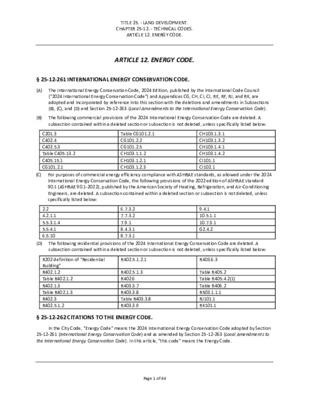
TITLE 25. - LAND DEVELOPMENT. CHAPTER 25-12. - TECHNICAL CODES. ARTICLE 12. ENERGY CODE. ARTICLE 12. ENERGY CODE. § 25-12-261 INTERNATIONAL ENERGY CONSERVATION CODE. (A) The International Energy Conservation Code, 2024 Edition, published by the International Code Council ("2024 International Energy Conservation Code") and Appendices CG, CH, CI, CJ, RE, RF, RJ, and RK, are adopted and incorporated by reference into this section with the deletions and amendments in Subsections (B), (C), and (D) and Section 25-12-263 (Local Amendments to the International Energy Conservation Code). (B) The following commercial provisions of the 2024 International Energy Conservation Code are deleted. A subsection contained within a deleted section or subsection is not deleted, unless specifically listed below: (C) For purposes of commercial energy efficiency compliance with ASHRAE standards, as allowed under the 2024 International Energy Conservation Code, the following provisions of the 2022 edition of ASHRAE standard 90.1 (ASHRAE 90.1-2022), published by the American Society of Heating, Refrigeration, and Air-Conditioning Engineers, are deleted. A subsection contained within a deleted section or subsection is not deleted, unless specifically listed below: C201.3 C402.4 C402.5.3 Table C405.13.2 C405.15.1 CG101.2.1 Table CG101.2.1 CG101.2.2 CG101.2.5 CH103.1.1.2 CH103.1.2.1 CH103.1.2.3 2.2 4.2.1.1 5.5.3.1.4 5.5.4.1 6.5.10 6.7.3.2 7.7.3.2 7.9.1 8.4.3.1 8.7.3.1 R202 definition of "Residential Building" R402.1.2 Table R402.1.2 R402.1.3 Table R402.1.3 R402.3 R402.5.1.2 R402.5.1.3 R402.6 R403.3.7 R403.3.8 Table R403.3.8 R403.3.9 § 25-12-262 CITATIONS TO THE ENERGY CODE. CH103.1.3.1 CH103.1.3.2 CH103.1.4.1 CH103.1.4.2 CI101.1 CI102.1 9.4.1 10.5.1.1 10.7.3.1 G2.4.2 Table R405.2 Table R405.4.2(1) Table R406.2 R503.1.1.1 RJ101.1 RK101.1 (D) The following residential provisions of the 2024 International Energy Conservation Code are deleted. A subsection contained within a deleted section or subsection is not deleted, unless specifically listed below: R402.5.1.2.1 R403.6.3 In the City Code, "Energy Code" means the 2024 International Energy Conservation Code adopted by Section 25-12-261 (International Energy Conservation Code) and as amended by Section 25-12-263 (Local Amendments to the International Energy Conservation Code). In this article, "this code" means the Energy Code. Page 1 of 44 § 25-12-263 LOCAL AMENDMENTS TO THE INTERNATIONAL ENERGY CONSERVATION CODE. (A) The following provisions are local amendments to the commercial provisions of the 2024 International Conservation Code. Each provision in this subsection is a substitute for an identically numbered provision deleted by Section 25-12-261(B) or an addition to the 2024 International Energy Conservation Code. C201.3 Terms defined in other codes. Terms not defined in this code that are defined in the Building Code, …
International Energy Conservation Code (IECC) Commercial - IECC [2024] Project Engagement VIEWS 223 PARTICIPANTS RESPONSES COMMENTS SUBSCRIBERS 20 0 26 2 Please provide a comment or question about the proposed Commercial provisions of the International Energy Conservation Code (IECC) 2024 Technical Code Amendments in the space below. Please respond by July 9, 2024. July 8, 2024 Attention: Public Comments Dear Austin Energy Green Building Staff, Vehicle Readiness proposals of the 2024 International Energy Conversation Code (IECC) The Alliance for Transportation Electrification appreciates the opportunity to comment on Austin Energy’s Residential and Commercial Electric Vehicle Readiness proposals of the 2024 International Energy Conversation Code (IECC). We applaud the City’s leadership in pushing forward the energy code in a timely manner. Although many cities and states have adopted energy codes, only a handful have been proactive in adopting, updating, and enforcing the most up-to-date codes. Energy codes ensure that a building's energy use is included as a fundamental part of the design and construction process of new buildings; making an early investment in building energy improvements will pay dividends to Austin residents for years into the future. We offer the following comments on the 2024 IECC Electric Vehicle Readiness proposals for both commercial and 1. We support the residential electric vehicle readiness proposal for one-and two- family dwellings, townhomes, and residential buildings. R-2 occupancies. The residential proposal derived from Appendix RE of the 2024 IECC Residential code requires that new one- and two-family dwellings and townhouses with designated parking provide one EV capable, EV ready, or EVSE space per dwelling unit. Multifamily buildings with four stories or less must provide an EV capable space, EV ready space, or EVSE space for 40 percent of dwelling units or automobile parking spaces, whichever is less. These requirements give building owners flexibility in establishing the level of EV readiness that will fit their current and future needs, while still providing the necessary minimum EV charging load that the distribution system needs to be sized for. Moreover, the language in Appendix RE was developed as a consensus proposal during the IECC code development process with input from a diverse group of stakeholders including representatives from the home builders, electrical manufacturers, EV charging providers, and utilities. It went through several rounds of public comment and editorial changes to ensure clarity, consistency, enforceability, and technical soundness. Adopting Appendix RE outright would help staff streamline and quicken the public …