Meeting of the Codes and Ordinances Joint Committee December 21, 2022 at 6:00 p.m. Permitting and Development Center (PDC) – Room #1406 6310 Wilhelmina Delco Drive Austin, TX 78752 Some members of the Codes and Ordinances Joint Committee may be participating by video conference. Public comment will be allowed in-person or remotely by telephone. Speakers may only register to speak on an item once, either in-person or remotely, and will be allowed up to three minutes to provide their comments. Registration no later than noon the day before the meeting is required for remote participation. To register, call or email the board liaison at 512-974-3509 or greg.dutton@austintexas.gov CURRENT COMMITTEE MEMBERS Nadia Barrera-Ramirez (Chair) Claire Hempel (Vice-Chair) Awais Azhar Todd Shaw Ann Denkler Jolene Kiolbassa Greg Anderson CALL TO ORDER PUBLIC COMMUNICATION: GENERAL Speakers signed up prior to commencement of the meeting will be allowed to address their concerns regarding items not posted on the agenda. APPROVAL OF MINUTES 1. Approval of the October 19, 2022, meeting minutes. DISCUSSION AND ACTION ITEMS 2. North Burnet/Gateway TOD Subdistrict. Discuss and consider a recommendation for adoption of an ordinance amending City Code Title 25 relating to the North Burnet/Gateway Regulating Plan, to modify the Gateway and Midway Zones, within the Transit Oriented Development Subdistrict, to increase the maximum floor-to-area ratio and building height when using a development bonus. City Staff: Jorge Rousselin, Housing and Planning and Department, (512) 974-2975, jorge.rousselin@austintexas.gov. Facilitator: Chair Barrera-Ramirez City Attorney: None 1 DISCUSSION ITEMS 3. Update on Potential Upcoming and Current Code Amendments – City Staff: Greg Dutton, Housing and Planning and Department, (512) 974-3509, Greg.Dutton@austintexas.gov. FUTURE AGENDA ITEMS Future agenda items will NOT be discussed at the current meeting, but will be offered for initiation, discussion, and/or possible recommendation to the full Planning Commission at a FUTURE meeting. ADJOURNMENT The City of Austin is committed to compliance with the American with Disabilities Act. Reasonable modifications and equal access to communications will be provided upon request. Meeting locations are planned with wheelchair access. If requiring Sign Language Interpreters or alternative formats, please give notice at least 2 days before the meeting date. Please call Greg Dutton at Planning and Development Review Department, at (512) 974-3509, for additional information; the City receives and accepts Video Relay Service (VRS) calls from people who are Deaf or hard-of-hearing. For more information on the Codes and Ordinances Joint Committee, please contact Greg …
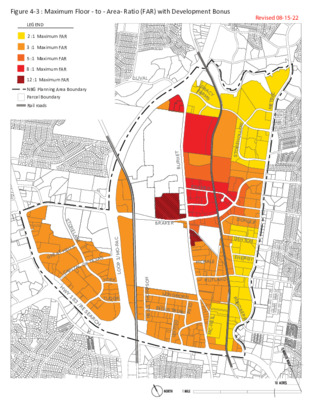
C20-2022-015 ORDINANCE AMENDMENT REVIEW SHEET Amendment: C20-2022-015 - Consider an ordinance amending City Code Title 25 to amend the North Burnet/Gateway Regulating Plan to modify the Gateway and Midway Zones, within the Transit Oriented Development Subdistrict, to increase the maximum floor-to-area ratio and building height when using a development bonus. Summary of proposed code amendment TOD-Gateway Zone and TOD-Midway Zone will increase the maximum FAR and building height when using a development bonus as follows: 1. For the TOD-Gateway Zone, modify the maximum FAR from 8:1 to 12:1. 2. For the TOD-Gateway Zone, modify the maximum building height from 360 feet to 491 feet. 3. For the TOD-Midway Zone, modify the maximum FAR from 5:1 to 7.5:1. 4. For the TOD-Midway Zone, modify the maximum building height from 240 feet to 327 feet. 5. Revise Figure 4-3: Maximum FAR with Development Bonus, of the North Burnet/Gateway Regulating Plan as described above. (See Attachment “A”). 6. Revise Figure 4-5: Maximum Height with Development Bonus, of the North Burnet/Gateway Regulating Plan as described above. (See Attachment “B”). Background: Initiated by the Planning Commission on September 27, 2022. Co-Sponsors: Commissioner Azhar and Commissioner Anderson. On May 19, 2022, via Resolution No. 20220519-040, City Council initiated amendments to the Commercial Mixed-Use (CMU) Gateway Zone of the North Burnet/Gateway Regulating Plan to increase FAR and building height when using a development bonus via Ordinance No. 20221027-044. With this action, the maximum FAR increased from 8:1 to 12:1 (a 50% increase) and the maximum building height increased from 308ft to 420 ft. (a 36% increase). As the CMU-Gateway entitlements increased, the development entitlements became more intense than the TOD-Gateway Subdistrict. The North Burnet Gateway Regulating Plan designated the TOD district as the highest density subdistrict in the North Burnet/Gateway area with the greatest focus on providing active pedestrian-oriented uses at the ground level of buildings. Density is enabled to the highest degree in the TOD-Gateway Zone area closest to the rail stations and to a lesser degree elsewhere. To preserve the goals of the Regulating Plan, the City Council and Planning Commission asked Staff to analyze possible increases to the entitlements of the TOD-Gateway and TOD-Midway Zones to accurately calibrate development entitlements. Given the TOD-Gateway and TOD-Midway Zone entitlement modifications were impacted by the CMU- Gateway Zone increases, Staff analyzed proportional increases to the CMU-Gateway and how those modifications affected other subdistricts. With the CMU-Gateway modifications, …
Meeting of the Codes and Ordinances Joint Committee October 19, 2022 at 6:00 p.m. Permitting and Development Center (PDC) – Room #1406 6310 Wilhelmina Delco Drive Austin, TX 78752 Some members of the Codes and Ordinances Joint Committee may be participating by video conference. Public comment will be allowed in-person or remotely by telephone. Speakers may only register to speak on an item once, either in-person or remotely, and will be allowed up to three minutes to provide their comments. Registration no later than noon the day before the meeting is required for remote participation. To register, call or email the board liaison at 512-974-3509 or greg.dutton@austintexas.gov CURRENT COMMITTEE MEMBERS Nadia Barrera-Ramirez (Chair) Claire Hempel (Vice-Chair) Awais Azhar Todd Shaw Ann Denkler Jolene Kiolbassa Greg Anderson CALL TO ORDER PUBLIC COMMUNICATION: GENERAL Speakers signed up prior to commencement of the meeting will be allowed to address their concerns regarding items not posted on the agenda. APPROVAL OF MINUTES 1. Approval of the June 15, 2022, meeting minutes. 2. Approval of the September 21, 2022 meeting minutes. DISCUSSION AND ACTION ITEMS 3. Historic Design Standards Amendments. Discuss and consider a recommendation for adoption of an ordinance amending Title 25 of the City Code to codify the Historic Design Standards as a tool for interpreting the Secretary of the Interior’s Standards. (No changes to the historic review process are proposed.) City Staff: Andrew Rice, Housing and Planning and Department, (512) 974-1686, Andrew.Rice@austintexas.gov Facilitator: Chair Barrera-Ramirez City Attorney: None 1 4. Great Streets Fee-in-Lieu. Discuss and consider a recommendation for adoption of an ordinance amending Title 25-2-586 (Downtown Density Bonus Program) to provide an alternative option for properties located along TxDOT frontages that cannot comply with Great Street Standards. City Staff: Jorge Rousselin, Housing and Planning Department, (512) 974-2975, Jorge.Rousselin@austintexas.gov 5. Site-Specific Save Our Springs (SOS) Amendment. Discuss and consider a recommendation for adoption of site-specific amendments to City Code Chapter 25-8, Subchapter A, Article 13 (Save Our Springs Initiative), as minimally required to address development related to the proposed Brodie Oaks PUD, C814-2021-0099, and located within the Barton Springs Zone. City Staff: Leslie Lilly, Watershed Protection Department, (512) 535-8914, Leslie.Lilly@austintexas.gov 6. Residential in Commercial. Discuss and consider a recommendation for adoption of an ordinance amending Title 25 of the City Code to create an affordable housing bonus program and allow residential development on commercially-zoned properties. City Staff: Greg Dutton, Housing and Planning …
TITLE 25. - LAND DEVELOPMENT. CHAPTER 25-2. - ZONING. COMPATIBILITY ON CORRIDORS WORKING DRAFT – SUBJECT TO CHANGE 10/14/2022 § 25-2-32 ZONING DISTRICTS AND MAP CODES. (A) This section provides the City's zoning districts and the corresponding zoning map codes. A zoning district may be referred to by its map code. (F) Combining districts and map codes are as follows: (20) university neighborhood overlay…. UNO (21) corridor overlay …. COR Division 6. Combining and Overlay Districts. § 25-2-181 CORRIDOR OVERLAY (COR) DISTRICT PURPOSE AND BOUNDARIES. (A) The purpose of the corridor overlay is to increase housing capacity and support transit investments on certain roadways by relaxing compatibility regulations and reducing parking minimums. (B) The boundaries of the COR district are identified in Section 25-2-769.03 (Corridor Roadways). (Supp. No. 158) Created: 2022-09-28 16:13:09 [EST] Page 1 of 14 TITLE 25. - LAND DEVELOPMENT. CHAPTER 25-2. - ZONING. COMPATIBILITY ON CORRIDORS WORKING DRAFT – SUBJECT TO CHANGE 10/14/2022 ARTICLE 3. ADDITIONAL REQUIREMENTS FOR CERTAIN DISTRICTS. Division 13. Corridor Overlay. § 25-2-769.01 APPLICABILITY. (A) This division applies to a site within the zoning jurisdiction that is: (1) developed, zoned, or used as residential; and (2) front-facing or side-facing a roadway that qualifies as light rail line, medium corridor, or larger corridor. (B) This division governs over a conflicting provision of this title or other ordinance unless the conflicting provision is less restrictive. § 25-2-769.02 DEFINITIONS. In this division, the following definitions apply: (1) CORRIDOR means a roadway that qualifies as a larger corridor, light rail line, or medium corridor. (2) CORRIDOR SITE means a site that is front-facing or side-facing a corridor. (3) LARGER CORRIDOR means a roadway described in Section 25-2- (4) LIGHT RAIL LINE means the light rail depicted on Exhibit A attached to Resolution No. 20200807-003 (Project Connect Contract with the Voters). (5) MEDIUM CORRIDOR means a roadway described in Section 25-2- 769.03(C). 769.03(B). (6) TRIGGERING PROPERTY means a property zoned SF-5 or more restrictive Austin, Texas, Land Development Code (Supp. No. 158) Created: 2022-09-28 16:13:22 [EST] Page 2 of 14 TITLE 25. - LAND DEVELOPMENT. CHAPTER 25-2. - ZONING. COMPATIBILITY ON CORRIDORS WORKING DRAFT – SUBJECT TO CHANGE 10/14/2022 § 25-2-769.03 CORRIDOR ROADWAYS. (A) A site is located along a light rail line when the site front-faces or side- faces one of the following streets: (1) Center Ridge Drive between North I.H.-35 Frontage Road and Center Line Pass; Boulevard; …
ORDINANCE AMENDMENT REVIEW SHEET C20-2022-013 Amendment: C20-2022-013 Alternative Option for Great Streets Description Consider an ordinance amending Title 25-2-586 (Downtown Density Bonus Program) to provide an alternative option for properties located along TxDOT frontages that cannot comply with Great Street Standards. Summary of proposed code amendment The proposed amendment to Title 25-2-586 (Downtown Density Bonus Program) will provide an alternative option for compliance with Great Streets Standards when there is extra jurisdictional control of the right-of- way. Background: Initiated by City Council Resolution No. 20220728-093 On July 28, 2022, the City Council initiated a Code amendment to Title 25-2-586 (Downtown Density Bonus Program) based on Staff recommendations from a Fee-in-Lieu Memorandum to Council dated July 7, 2022. Specifically, the Code amendment will: 1. Allow a fee-in-lieu for properties located along TxDOT frontages that cannot comply with Great Streets standards in the range of $55-$60 per square foot pf frontage along TxDOT right of way. 2. Require a fee-in-lieu and one-time fee in the amount of 10% of the cost for construction at $5.50- $6.00 per square foot to cover maintenance of any Great Streets improvements, including landscape elements, trash receptacles, benches, bike infrastructure, and streetlights. 3. Create a specific fund within the Public Works Department for the design, construction, and maintenance of Great Street capital improvement projects within the Downtown area. Certain properties in Downtown are eligible to participate in the Downtown Density Bonus Program (the Program) as outlined in 25-2-586. In accordance with Program requirements, the applicant is required to execute a restrictive covenant committing to provide streetscape improvements along all public street frontages, consistent with the Great Streets Standards (the Standards). Properties in the Rainey Street Subdistrict of the Waterfront Overlay (WO) are eligible to participate in the Program per 25-2-739. Certain properties in the WO subdistrict have frontage on Texas Department of Transportation (TxDOT) right-of-way (ROW). Where these properties have frontage along TxDOT ROW, the City of Austin has no jurisdiction to require streetscape improvements. Any proposed improvements outside private property on said frontage are to be coordinated with TxDOT. On March 12, 2020, the City Council executed Resolution No. 20200312-040 directing the City Manager to “bring forward a recommendation for creating a fee-in-lieu option for the Great Streets requirement of the Downtown Density Bonus Program for projects unable to provide such streetscapes due to other jurisdictional opposition to their construction.” Staff Recommendation Staff recommends APPROVAL of …
TITLE 25. - LAND DEVELOPMENT. CHAPTER 25-1. - GENERAL REQUIREMENTS AND PROCEDURES. ARTICLE 15. HOUSING. RESIDENTIAL IN COMMERCIAL DISTRICTS INCENTIVE PROGRAM WORKING DRAFT – SUBJECT TO CHANGE 10/14/2022 ARTICLE 15. HOUSING. Division 5. Residential Uses in Commercial Districts Incentive Program. § 25-1-751 PURPOSE, APPLICABILITY, SHORT TITLE, AUTHORITY, AND CONFLICT. (A) The purpose of this division is to establish a voluntary incentive program that allows residential uses in commercial districts. (B) This division applies within the zoning jurisdiction. (C) This division may be cited as "Residential in Commercial Development (D) The director may adopt, implement, and enforce: (1) program guidelines; and (2) administrative rules in accordance with Chapter 1-2 (Administrative Program". Rules). (E) A provision of this title that is specifically applicable to a residential- commercial development governs over a conflicting provision of this title. § 25-1-752 DEFINITIONS. In this division, (1) CREATIVE SPACES means XXXX. (2) CREATIVE SPACE OPERATOR means a person who owns or manages a (3) MARKET RATE UNITS means a rental or ownership dwelling unit that is creative space. not an affordable unit. Austin, Texas, Land Development Code (Supp. No. 158) Created: 2022-09-28 16:13:09 [EST] Page 1 of 8 TITLE 25. - LAND DEVELOPMENT. CHAPTER 25-1. - GENERAL REQUIREMENTS AND PROCEDURES. ARTICLE 15. HOUSING. RESIDENTIAL IN COMMERCIAL DISTRICTS INCENTIVE PROGRAM WORKING DRAFT – SUBJECT TO CHANGE 10/14/2022 (4) MFI means median family income as defined in Section 25-1-701 (Definitions) for the Austin-Round Rock metropolitan statistical area. § 25-1-753 ELIGIBILITY. (A) A proposed development is eligible for this program if the development: (1) meets the requirements in this division; and (2) is new construction; or (3) will redevelop a site without existing creative spaces or multi-family structures; or (4) complies with the requirements in Subsection (C). (B) A creative space is existing if the space has operated for at least 10 years. (C) Redevelopment of a Site with Existing Spaces and Structures. (1) A proposed development that will require the applicant to redevelop existing creative spaces is eligible for this program if: (a) the proposed development: (i) meets the standards imposed in this subsection; (ii) will replace all existing creative spaces that were operating the previous year with comparable-sized creative spaces; and (b) the applicant provides creative space operators with: (i) (ii) notice and information about the proposed development on a form approved by the director; relocation benefits that are consistent with the Federal Uniform Relocation Assistance and …
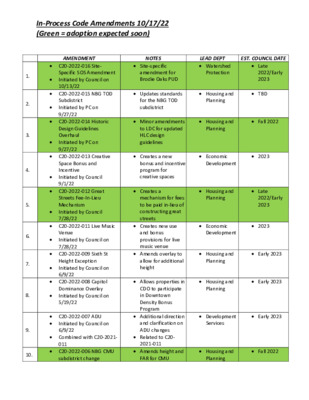
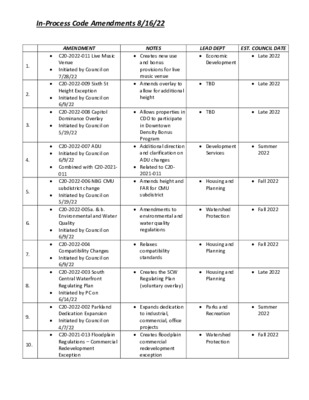
In-Process Code Amendments 10/17/22 (Green = adoption expected soon) • • AMENDMENT • C20-2022-016 Site- Specific SOS Amendment Initiated by Council on 10/13/22 • C20-2022-015 NBG TOD Subdistrict Initiated by PC on 9/27/22 • C20-2022-014 Historic Design Guidelines Overhaul Initiated by PC on 9/27/22 • • C20-2022-013 Creative Space Bonus and Incentive Initiated by Council 9/1/22 • • C20-2022-012 Great Streets Fee-In-Lieu Mechanism Initiated by Council 7/28/22 • • C20-2022-011 Live Music • Venue Initiated by Council on 7/28/22 • C20-2022-009 Sixth St Height Exception Initiated by Council on 6/9/22 • • C20-2022-008 Capitol Dominance Overlay Initiated by Council on 5/19/22 • • C20-2022-007 ADU • Initiated by Council on 6/9/22 • Combined with C20-2021- 011 • C20-2022-006 NBG CMU subdistrict change 1. 2. 3. 4. 5. 6. 7. 8. 9. 10. NOTES • Site-specific amendment for Brodie Oaks PUD LEAD DEPT • Watershed Protection EST. COUNCIL DATE • Late 2022/Early 2023 • Updates standards for the NBG TOD subdistrict • Minor amendments to LDC for updated HLC design guidelines • Creates a new bonus and incentive program for creative spaces • Creates a mechanism for fees to be paid in-lieu of constructing great streets • Creates new use and bonus provisions for live music venue • Amends overlay to allow for additional height • Allows properties in CDO to participate in Downtown Density Bonus Program • Additional direction and clarification on ADU changes • Related to C20- 2021-011 • Amends height and FAR for CMU • Housing and Planning • TBD • Housing and Planning • Fall 2022 • Economic Development • 2023 • Housing and Planning • Late 2022/Early 2023 • Economic Development • 2023 • Housing and Planning • Early 2023 • Housing and Planning • Early 2023 • Development Services • Early 2023 • Housing and Planning • Fall 2022 In-Process Code Amendments 10/17/22 (Green = adoption expected soon) • • • AMENDMENT • Initiated by Council on 5/19/22 • C20-2022-005a Environmental and Water Quality Initiated by Council on 6/9/22 • C20-2022-005b Environmental and Water Quality Initiated by Council on 6/9/22 • C20-2022-004 Compatibility Changes Initiated by Council on 6/9/22 • C20-2022-003 South Central Waterfront Regulating Plan Initiated by PC on 6/14/22 • • C20-2022-002 Parkland Dedication Expansion Initiated by Council on 4/7/22 • • C20-2021-013 Floodplain Regulations – Commercial Redevelopment Exception Initiated by PC on 12/14/21 • • C20-2021-012 Residential in Commercial Initiated by Council …
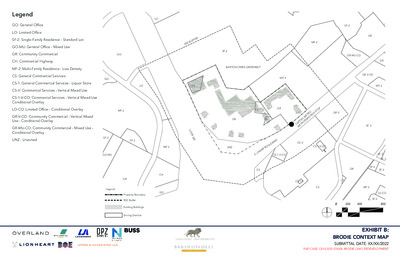
Legend GO: General Office LO: Limited Office SF-2: Single-Family Residence - Standard Lot GO-MU: General Office - Mixed Use GR: Community Commercial CH: Commercial Highway GO MF-2: Multi-Family Residence - Low Density CS: General Commercial Services CS-1: General Commercial Services - Liquor Store CS-V: Commercial Services - Vertical Mixed Use GO CS-1-V-CO: Commercial Services - Vertical Mixed Use Conditional Overlay LO-CO: Limited Office - Conditional Overlay MF-2 GR-V-CO: Community Commercial - Vertical Mixed Use - Conditional Overlay GR-MU-CO: Community Commercial - Mixed Use - Conditional Overlay UNZ - Unzoned SF-2 SF-2 GO-MU LO R E F F U 0 ’ B 0 5 SF-2 LO CS BARTON CREEK GREENBELT MF-4 L O O P 3 6 0 MF-2 UNZ CS-1-V-CO CS-1 GR GR CS U S S T O P O E T R R A PID B GR-V A PIT A L M E T R O M C CS-V D R A V E L U O R B A CS-1-V-CO M A S . L CS CH GO GR Legend: Property Boundary 500’ Buffer Existing Buildings Zoning Districts MF-2 SF-2 GR GR-MU-CO GR-V-CO GR MF-2 SF-3 SF-5 SF-3 GR SF-6 SF-3 CS-1-V CS CS MF-2 LO-CO SF-6 0 200 400 800 EXHIBIT B: BRODIE CONTEXT MAP SUBMITTAL DATE: XX/XX/2022 PUD CASE: C814-2021-076006 BRODIE OAKS REDEVELOPMENT SITE METRICS 37.6 Acres / 1,637,856 Sq. Ft. 56% NSA; 54% GSA 5,750 Sq. Ft. 50 feet Total Site Area Proposed Impervious Cover Minimum Lot Size Minimum Lot Width Minimum Setbacks Front Street Side Yard Interior Side Yard Rear Yard 0 feet 0 feet 0 feet 0 feet LAND USE AREA METRICS Acres Building Cover Impervious Cover* Non- Residential Maximum Hotel Maximum Residential Max. % Max. Sq. Ft. Keys Sq. Ft. Units Sq. Ft. 1,400,000 200 200,000 1,700 1,500,000 11.7 .5% 5,000 -- -- -- -- Max. 95% 25.9 Land Use Area 1 Land Use Area 2 Site Total 37.6 95% 7.5% 56% *Maximum impervious cover is based on Net Site Area (NSA) and will be tracked by site plan in compliance with Exhibit H - Brodie Oaks Redevelopment Phasing Plan. Impervious Cover will be higher on a site-by-site basis. Maximum floor-to-area ratio is not applicable to the Brodie Oaks Redevelopment. L O O P 3 6 0 BARTON CREEK GREENBELT Legend: Property Boundary Private Streets with Public Access Easements Land Use Area 1 Land Use Area 2 U S S T …
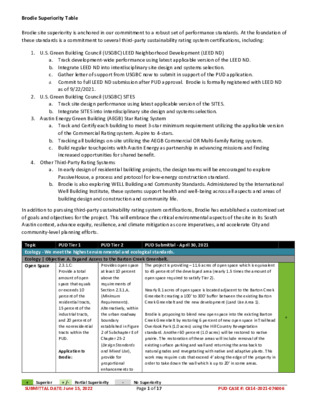
Brodie Superiority Table Brodie site superiority is anchored in our commitment to a robust set of performance standards. At the foundation of these standards is a commitment to several third-party sustainability rating system certifications, including: 1. U.S. Green Building Council (USGBC) LEED Neighborhood Development (LEED ND) Integrate LEED ND into interdisciplinary site design and systems selection. a. Track development-wide performance using latest applicable version of the LEED ND. b. c. Gather letter of support from USGBC now to submit in support of the PUD application. d. Commit to full LEED ND submission after PUD approval. Brodie is formally registered with LEED ND as of 9/22/2021. 2. U.S. Green Building Council (USGBC) SITES a. Track site design performance using latest applicable version of the SITES. Integrate SITES into interdisciplinary site design and systems selection. b. 3. Austin Energy Green Building (AEGB) Star Rating System a. Track and Certify each building to meet 3-star minimum requirement utilizing the applicable version of the Commercial Rating system. Aspire to 4-stars. b. Tracking all buildings on-site utilizing the AEGB Commercial OR Multi-family Rating system. c. Build regular touchpoints with Austin Energy as partnership in advancing missions and finding increased opportunities for shared benefit. 4. Other Third-Party Rating Systems a. In early design of residential building projects, the design teams will be encouraged to explore PassiveHouse, a process and protocol for low-energy construction standard. b. Brodie is also exploring WELL Building and Community Standards. Administered by the International Well Building Institute, these systems support health and well-being across all aspects and areas of building design and construction and community life. In addition to pursuing third-party sustainability rating system certifications, Brodie has established a customized set of goals and objectives for the project. This will embrace the critical environmental aspects of the site in its South Austin context, advance equity, resilience, and climate mitigation as core imperatives, and accelerate City and community-level planning efforts. PUD Tier 1 Topic Ecology - We meet the highest environmental and ecological standards. Ecology | Objective A. Expand Access to the Barton Creek Greenbelt. Open Space PUD Tier 2 PUD Submittal - April 30, 2021 2.3.1.C: Provide a total amount of open space that equals or exceeds 10 percent of the residential tracts, 15 percent of the industrial tracts, and 20 percent of the nonresidential tracts within the PUD. Application to Brodie: Provides open space at least 10 percent above the requirements …
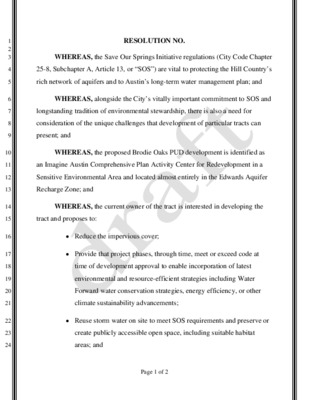
1 2 3 4 5 6 7 8 9 10 11 12 13 14 15 16 17 18 19 20 21 22 23 24 RESOLUTION NO. WHEREAS, the Save Our Springs Initiative regulations (City Code Chapter 25-8, Subchapter A, Article 13, or “SOS”) are vital to protecting the Hill Country’s rich network of aquifers and to Austin’s long-term water management plan; and WHEREAS, alongside the City’s vitally important commitment to SOS and longstanding tradition of environmental stewardship, there is also a need for consideration of the unique challenges that development of particular tracts can present; and WHEREAS, the proposed Brodie Oaks PUD development is identified as an Imagine Austin Comprehensive Plan Activity Center for Redevelopment in a Sensitive Environmental Area and located almost entirely in the Edwards Aquifer Recharge Zone; and tract and proposes to: WHEREAS, the current owner of the tract is interested in developing the • Reduce the impervious cover; • Provide that project phases, through time, meet or exceed code at time of development approval to enable incorporation of latest environmental and resource-efficient strategies including Water Forward water conservation strategies, energy efficiency, or other climate sustainability advancements; • Reuse storm water on site to meet SOS requirements and preserve or create publicly accessible open space, including suitable habitat areas; and Page 1 of 2 25 26 27 28 29 30 31 32 33 34 35 36 37 38 39 40 41 42 43 44 45 46 • Preserve and protect one hundred percent of heritage trees. WHEREAS, an application for the Brodie Oaks PUD development (C814- 2021-0099) has been submitted to the City, and, as proposed by the applicant, would require site-specific amendments to SOS; and WHEREAS, Council desires that all reasonable options be considered in the continuing discussion of the Brodie Oaks PUD development with applicant, staff, and the community to ensure the project achieves environmental superiority; and WHEREAS, this action preserves Council’s normal legislative ability to approve, deny, or condition the site-specific amendment, as well as the proposed PUD, at the time these cases are heard by Council; NOW, THEREFORE, BE IT RESOLVED BY THE CITY COUNCIL OF THE CITY OF AUSTIN: Council initiates site-specific amendments to City Code Chapter 25-8, Subchapter A, Article 13 (Save Our Springs Initiative), as minimally required to allow for limits to impervious cover as proposed in application C814-2021-0099 for the Brodie Oaks PUD development. These proposed site-specific amendments should …
Brodie Oaks Redevelopment SOS Amendment 4107 S Capital of Texas Highway C814-2021-0099 Leslie Lilly Environmental Program Coordinator Watershed Protection What is an SOS Amendment • 1992 Save Our Springs ordinance adopted by citizen initiative • Per 25-8-515, variances to SOS are not allowed • Supermajority of Council must approve amendments to SOS • Council Resolution 20221011-076 on October 13, 2022: • “ The City Manager is directed to initiate site specific variances ….. Brodie Oaks Planned Unit Development • A Planned Unit Development (PUD) is a type of site development and regulatory process established by city ordinance for a tract of land. • The SOS amendment is being considered concurrent with the Brodie Oaks PUD ordinance • SOS Initiative prohibits the ability of a PUD Ordinance to modify SOS Full Purpose Jurisdiction Barton Springs Watershed Barton Springs Zone Edwards Aquifer Recharge Zone 37.6 Acres 84% Impervious Cover Edwards Aquifer Recharge Zone SOS Requirements • Impervious cover in the Edwards Aquifer Recharge Zone is 15% NSA, 20% NSA in the Contributing Zone undeveloped conditions. • Water Quality Controls required for runoff from all impervious cover to meet Land Use Plan for Brodie Oaks PUD Water Quality for Brodie Oaks PUD SOS Amendment • Section A of 25-8-514 (Pollution Prevention Required) shall be modified to allow a maximum impervious cover for the site of 54% net site area. PUD Ordinance • • • • 25-8-341 shall be modified to allow cut not to exceed a maximum of fourteen (14) feet as indicated on Exhibit G. 25-8-342 shall be modified to allow fill not to exceed a maximum of fourteen (14) feet as indicated on Exhibit G. 25-8-281 shall be modified to allow encroachment into CEFs as indicated on Exhibit F. ECM 1.6.7.5 (D) shall be modified to allow captured runoff for beneficial reuse Critical Environmental Features Grading Plan Staff Recommendation Recommended with the following conditions provided in Brodie Oaks PUD Ordinance: • Reduction in impervious cover from 86% NSA to 54% NSA • Bring the site into compliance with SOS water quality treatment requirements • Clustering impervious cover 100-300’ away from Barton Creek • Provides rainwater harvesting for landscape irrigation of not less than 50% of the landscaped • Restoring 2 acres of the tract to native vegetation • Provide 100% GSI for water quality controls. area. • Provides superior tree protections. • Complies with Austin Green Building 3-star rating • Provide …
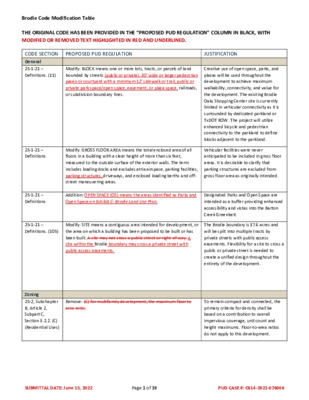
Brodie Code Modification Table THE ORIGINAL CODE HAS BEEN PROVIDED IN THE “PROPOSED PUD REGULATION” COLUMN IN BLACK, WITH MODIFIED OR REMOVED TEXT HIGHLIGHTED IN RED AND UNDERLINED. PROPOSED PUD REGULATION CODE SECTION General 25-1-21 – Definitions. (11) Modify: BLOCK means one or more lots, tracts, or parcels of land bounded by streets (public or private), 30’ wide or larger pedestrian paseo or courtyard with a minimum 12’ sidewalk or trail, public or private park space/open space, easement, or plaza space, railroads, or subdivision boundary lines. JUSTIFICATION Creative use of open space, parks, and plazas will be used throughout the development to achieve maximum walkability, connectivity, and value for the development. The existing Brodie Oaks Shopping Center site is currently limited in vehicular connectivity as it is surrounded by dedicated parkland or TxDOT ROW. The project will utilize enhanced bicycle and pedestrian connectivity to the parkland to define blocks adjacent to the parkland. Vehicular facilities were never anticipated to be included in gross floor areas. It is desirable to clarify that parking structures are excluded from gross floor area as originally intended. Designated Parks and Open Space are intended as a buffer providing enhanced accessibility and vistas into the Barton Creek Greenbelt. To remain compact and connected, the primary criteria for density shall be based on a contribution to overall impervious coverage, unit count and height maximums. Floor-to-area ratios do not apply to this development. Modify: GROSS FLOOR AREA means the total enclosed area of all floors in a building with a clear height of more than six feet, measured to the outside surface of the exterior walls. The term includes loading docks and excludes atria airspace, parking facilities, parking structures, driveways, and enclosed loading berths and off- street maneuvering areas. Addition: OPEN SPACE (OS) means the areas identified as Parks and Open Space on Exhibit C- Brodie Land Use Plan. Modify: SITE means a contiguous area intended for development, or the area on which a building has been proposed to be built or has been built. A site may not cross a public street or right-of-way. A site within the Brodie boundary may cross a private street with public access easements. The Brodie boundary is 37.6 acres and will be split into multiple tracts by private streets with public access easements. Flexibility for a site to cross a public or private street is needed to create a unified design …
RESOLUTION NO. 20220609-066 WHEREAS, Austin is facing an affordability crisis as the housing market reaches record rents and home prices; and WHEREAS, City Council has recently passed a number of resolutions to address affordability and housing supply, including reforms for accessory dwelling units, Vertical Mixed Use, Equitable Transit Oriented Development, and affordable housing bonus programs for commercial zones; and WHEREAS, Austin voters approved substantial investments in corridor improvements, active transportation, and Project Connect in 2016,2018, and 2020; and WHEREAS, current compatibility regulations, established in the 1980s, limit housing capacity on corridors by limiting the height of developments of properties within 540 feet of single-family properties, which is significantly more restrictive compared to cities with similar regulations; and WHEREAS, current parking minimums may require more parking than currently needed and conflict with the City's goal of reaching a 50/50 transportation mode share; and WHEREAS, moderate changes to compatibility and parking regulations on corridors would increase affordable and market-rate housing supply and support the City's transit investments; and Page 1 of 7 WHEREAS, Planning Commission, Zoning and Platting Commission, City Council, and community members have provided substantial feedback in the last 10 years on potential changes to the compatibility regulations and parking minimums; and WHEREAS, the Austin City Council is committed to enacting policy changes to increase housing capacity and support transit investments on corridors; NOW, THEREFORE, BE IT RESOLVED BY THE CITY COUNCIL OF THE CITY OF AUSTIN: The City Council initiates the following amendments to City Code Title 25 (Land Development Code) to increase housing capacity and support transit investments on corridors by relaxing compatibility regulations and reducing parking minimums. It is Council's intent that these amendments apply to a property that is front-facing or side-facing a corridor. It is Council's intent that these amendments apply when the property's existing compatibility or parking regulations are more restrictive. BE IT FURTHER RESOLVED: The City Council directs the City Manager to prepare a code amendment that accomplishes the following for a property located on a Light Rail, Larger, or Medium Corridor: 1. Defines Light Rail Corridors to include Project Connect Light Rail Lines and their Future Extensions (i.e. Orange and Blue Lines); Page 2 of 7 2. Defines Larger Corridors to include: a. b. a. b. Austin Strategic Mobility Plan (ASMP) Level 5 Streets (i.e., major highways); and Project Connect MetroRapid Routes (i.e., Expo Center, Pleasant Valley, Burnet to Menchaca & Oak …
C20-2022-004 ORDINANCE AMENDMENT REVIEW SHEET Amendment: C20-2022-004 Compatibility on Corridors Description: Consider an amendment to Title 25 of the City Code to modify compatibility standards as applied to certain projects on certain corridors. Proposed Language: See attached draft code language and background information. Summary of proposed code amendment • The proposed amendment will generally reduce compatibility for a residential or mixed-use project on a defined set of corridors: Medium, Large, or Light Rail Line. For all eligible projects on a corridor: o Compatibility will extend 300’in distance (vs 540’ today) o Compatibility will be triggered by zoning only (not use) o An additional 5’ of height will be allowed vs current standards • Projects providing affordable housing may be granted a further reduction in compatibility: light rail line o Maximum height at a distance of 100’ from a triggering property for projects on a o 65’ of height at a distance of 100’ from a triggering property and 90’ of height at 200’ from a triggering property on a large corridor o 65’ of height at a distance of 150’ from a triggering property and 90’ of height at 250’ from a triggering property on a medium corridor • Minimum parking requirements are reduced for residential or mixed-use corridor properties: o 25% of what would otherwise be required for a light rail line or large corridor o 50% of what would otherwise be required for a medium corridor Background: Initiated by City Council Resolution 20220609-066. The City of Austin’s current compatibility standards apply to sites that are within 540 feet (or nearly two downtown blocks) of the property line of an urban family residence (SF-5) or more restrictive zoning district. Compatibility standards also apply when a site is adjacent to a lot on which a use permitted in an SF-5 or more restrictive zoning district is located. Current compatibility standards include: • Height and Setback Limitations • Scale and Clustering Requirements • Screening Requirements 10/18/2022 1 C20-2022-004 The dimensional characteristics of the City’s current compatibility standards are shown in the image below, with annotations in pink text showing the proposed compatibility standards along light rail lines, large corridors, and medium corridors as defined in the ordinance: Existing Compatibility Standards and Proposed Compatibility Standards Along Specified Corridors In June 2022, City Council adopted a resolution that directed staff to modify the application of compatibility to projects on certain corridors (see Corridor …
RESOLUTION NO. 20211209-056 WHEREAS, under the Land Development Code, residential development is not currently allowed in many of the commercial zoning districts in Austin; and WHEREAS, City Council adopted the Austin Housing Strategic Blueprint (the Blueprint) in 2017 which called for 135,000 housing units by 2028, with 60,000 of those units at or below 80 percent of the median family income (MFI); and WHEREAS, in the proposed Land Development Code Revision, residential uses were allowed in more zoning districts than in current city code; and WHEREAS, allowing housing in more places provides the opportunity for increased housing supply in Austin; and WHEREAS, in its 2018 report, the Planning Commission Mapping Working Group indicated that allowing mixed use in commercial zoning could lead to about 46,324 housing units in new capacity; NOW, THEREFORE, BE IT RESOLVED BY THE CITY COUNCIL OF THE CITY OF AUSTIN: The City Council initiates amendments to the Land Development Code, codified in City Code Title 25, to allow residential uses in General Commercial Services (CS), Commercial Liquor Sales (CS-1), Community Commercial (GR), Neighborhood Commercial (LR), General Office (GO), and Limited Office (LO) zoning districts, subject to participation in a voluntary affordable housing incentive program. BE IT FURTHER RESOLVED: In developing the proposed amendments, the City Manager is directed to: Page 1 of 3 1. Require at least 10 percent of the rental units be affordable to households at 60 percent MFI for at least 40 years; 2. Require at least 10 percent of the homeownership units be affordable to households at 80 percent MFI for at least 99 years; 3. Authorize residential uses in all parcels located in the listed zoning districts except when subject to a regulating plan which prohibits residential uses on the particular parcel, subject to compliance with affordability requirements, site development regulations, parking requirements, and design standards similar to those design standards currently applicable to Vertical Mixed Use Buildings; 4. To the extent feasible, provide an incentive for ground floor retail by increasing height by 5-10 feet to accommodate the higher ceiling on the first floor when the project contains commercial uses on the ground floor and provides residential dwelling units on all upper floors; 5. Identify options for a "right to return" policy for art workshops and galleries, theater, and other creative spaces that have operated for more than 10 years on a particular site. The policy would give preference to …
C20-2021-012 • • ORDINANCE AMENDMENT REVIEW SHEET Amendment: C20-2021-012 Residential in Commercial Description: Consider an amendment to Title 25 of the City Code to create an affordable housing bonus program and allow residential development on commercially-zoned properties. Proposed Language: See attached draft ordinance and background information. Summary of proposed code amendment The proposed amendment will create an affordable housing bonus program to allow commercially-zoned properties with no existing residential entitlements to develop projects with residential units in return for on-site affordable units. Eligible projects: o Must provide on-site affordable units o Cannot exceed base zoning height or impervious cover o Must generally comply with the standards of a mixed-use (MU) combining district Background: Initiated by City Council Resolution 20211209-056. In December 2021, City Council issued a resolution that directed staff to create a bonus program that would allow commercially zoned properties with no existing residential entitlement to develop residential units in return for providing on-site affordable units. Staff Recommendation: Recommend with modifications As drafted, the proposed amendments to the Land Development Code would apply to 7,474 commercially zoned properties, including all properties zoned Commercial Liquor Sales (CS- 1), General Commercial Services (CS), Community Commercial (GR), Neighborhood Commercial (LR), General Office (GO), and Limited Office (LO). A significant majority of these properties are located along existing transit corridors and Project Connect transit corridors, and approximately 37% of these properties are located within displacement risk areas. (See charts below for more detailed analysis.) The draft code amendments include provisions for the preservation of existing residential development as well as creative spaces. The draft code amendments would support implementation of multiple City policy goals, including goals related to transit-supportive land uses, housing production goals of the Austin Strategic Housing Blueprint, and goals related to preservation of existing affordable housing. Based on the geographic analysis, the recommended code amendments do not appear to have a disproportionate impact on racial equity or displacement risk areas. 10/14/20221 C20-2021-012 Property owners currently have other options for developing residential units on commercially-zoned properties, including providing affordable housing that meets the deep affordability targets of the Affordability Unlocked Program and requesting a zone change through the conventional zone change request process. HPD staff generally supports providing additional flexibility to develop residential projects in commercial zones as described in the draft code language, but has identified several potential areas of concern: • Compatibility of Uses. The current proposal includes General …
From: To: Subject: Date: Fwd: Item 76 SOS site specific amendment for Brodie Oaks PUD Thursday, October 13, 2022 11:30:56 AM Begin forwarded message: From: Bill Bunch Date: October 13, 2022 at 11:06:39 AM CDT To: Subject: Item 76 SOS site specific amendment for Brodie Oaks PUD Dear Councilmembers, SOS Alliance does support the resolution to initiate a site specific amendment to the SOS ordinance that would be consistent in general with the current proposal by the owner/developer to reduce impervious cover on the site by a substantial amount. We appreciate that the terms of the resolution were adjusted to clearly reserve council's discretion to judge both the proposed site specific amendment and the PUD on their merits when they come to council. There may be details that still emerge in the amendment public process. Our goal is to reach full agreement with the developer on the proposed development, however there are some challenging issues remaining that mostly involve issues other than water quality issues. We do appreciate the applicant engaging with stakeholders from very early in the process. Thank you for your consideration, Bill Bunch -- Bill Bunch Save Our Springs Alliance P.O. Box 684881 Austin, Texas 78768 512-784-3749
REGULAR MEETING CODES AND ORDINANCES JOINT COMMITTEE MINUTES Wednesday, September 21, 2022 The Codes and Ordinances Joint Committee convened in a regular meeting on Wednesday, September 21, 2022 at 6:00 p.m. Permitting and Development Center (PDC) – Room #1406 6310 Wilhelmina Delco Drive Austin, TX 78752 Chair Barrera-Ramirez called the meeting to order at 6:03 pm. Committee Members in Attendance: Greg Anderson Claire Hempel (Vice-Chair) Ann Denkler Nadia Barrera-Ramirez (Chair) City Staff in Attendance: Andrew Rice, Housing and Planning Department Donna Galati, Project Connect Office Alyssa Hedge, Project Connect Office CALL TO ORDER APPROVAL OF MINUTES 1. Approval of the June 15, 2022, meeting minutes. 2. Approval of the August 17, 2022, meeting minutes. A motion was made to approve the minutes by Commissioner Hempel, seconded by Commission Barrera-Ramirez. Vote: 4-0. The June 15 minutes were not available but will be available for approval at a future meeting. DISCUSSION AND ACTION ITEMS 3. 2023 Meeting Schedule. Discuss and approve the 2023 meeting schedule. Commissioners discussed various options for meeting location, date, and time. Staff will make inquiries and let the Commissioners know what options exist for the 2023 meeting schedule. 4. Historic Design Standards Amendments. Discuss and consider a recommendation for initiation of amendments to Title 25 of the City Code to codify the Historic Design Standards as a tool for interpreting the Secretary of the Interior’s Standards. (No changes to the historic review process are proposed.) City Staff: Andrew Rice, Housing and Planning and Department, (512) 974-1686, andrew.rice@austintexas.gov Facilitator: Commissioner Barrera-Ramirez, Chair of COJC City Attorney: None 1 Andrew Rice gave an overview of changes to historic design standards that would require minor changes to the land development code (LDC), noting that there would be no change to the review process. A motion was made to recommend initiation of the item to Planning Commission by Commissioner Denkler, seconded by Commissioner Hempel, with additional direction that staff meet with homebuilders to go over changes. Vote: 3-0-1. Item failed to garner an affirmative vote but will move to PC for initiation without a recommendation. 5. Project Connect. Discuss and consider a recommendation for adoption of an ordinance amending Title 25 of City Code to create a foundational ordinance for Transit System Projects to facilitate the construction of critical transportation infrastructure. City Staff: Donna Galati, Project Connect Office, (512) 974-2733, Donna.Galati@austintexas.gov A recusal by Commissioner Barrera-Ramirez meant that quorum was lost, and …
Great Streets Code Amendment to 25-2-586 (Downtown Density Bonus Program) Applicability of Great Streets Standards Certain properties in Downtown are eligible to participate in the Downtown Density Bonus Program (the Program) as outlined in 25-2-586. In accordance with Program requirements, the applicant is required to execute a restrictive covenant committing to provide streetscape improvements along all public street frontages, consistent with the Great Street Standards (the Standards). General Boundary of Great Streets with locations of improvements highlighted 2 Conflict with extra-jurisdictional control • Properties in the Rainey St. Subdistrict of the Waterfront Overlay are eligible to participate in the Program per 25-2-739. • Certain properties in the subdistrict front on Texas Department of Transportation (TxDOT) right-of-way (ROW). • On such portion where properties front said ROW, the City of Austin has no jurisdiction to require streetscape improvements. Any proposed improvements outside private property on said frontage are to be coordinated with TxDOT. Downtown Austin with Capitol View Corridors TxDOT ROW and jurisdiction: 5,584 linear feet outside of CVC 3 Council Direction Resolution No. 20220728-093 initiates a Code Amendment to 25-2-586 1. Bring forward a recommendation for establishing a fund into which such fees-in-lieu can be deposited and creating an administrative process for allocating these funds only for the provision of Great Streets within the areas of Downtown included in the Great Streets and Downtown Density Bonus Program boundaries. 2. Create a fee-in-lieu for properties located along TxDOT frontages that cannot comply with Great Streets standards in the range of $55-$60 per square foot of frontage along the TxDOT right of way. (currently approx. 234 linear feet ̴ ̴ 4,206 sq. ft.). 3. Adjust the fee for construction periodically, but not more than once per fiscal year, to account for increases in the cost of construction. 4 Council Direction Resolution No. 20220728-093 initiates a Code Amendment to 25-2-586 4. Create an additional up-front, one-time cost in the amount of 10% of the cost for construction ($5.50-$6 per square foot) to cover maintenance of any Great Streets improvements, including landscape elements, trash receptacles, benches, bike infrastructure, and streetlights. 5. Create a specific fund within the Public Works Department for the design, construction, and maintenance of Great Street CIP projects within the downtown area. 6. A deposit of the fee-in-lieu would be required to be posted to the fund prior to the issuance of a Certificate of Occupancy (CO) for the building; 5 …
Historic Design Standards City of Austin October 2022 Welcome In Austin, historic preservation encourages the preservation of historic buildings, structures, sites, and districts; promotes awareness of cultural and architectural heritage; and helps shape a more sustainable, equitable, and livable place. As the city grows, these Historic Design Standards will help property owners, designers, builders, and historic preservation professionals make consistent decisions about how to meet present-day needs while stewarding local built heritage and achieving larger goals. Clear standards and graphics show good practices, as well as changes to avoid. The Historic Design Standards were created by a working group representing property owners, designers, developers, advocates, and the Historic Landmark Commission. The working group sought to develop locally relevant standards grounded in national preservation principles. Many members are laypeople, and readability was a key concern: the standards needed to be understandable by property owners and neighbors considering whether to apply for historic district designation, as well as by architects. A Maintenance and Preservation chapter and illustrated glossary support those who want to learn more about architectural elements and materials. The Historic Design Standards promote long-term sustainability by supporting the retention and repair of existing buildings, which keep tons of old-growth wood and other material in use and out of the landfill. They also support sustainable solutions for making buildings more energy efficient now, from high-impact improvements like attic insulation and duct sealing to DIY changes such as weather-stripping around windows and doors. Historic Preservation Office staff are available to answer questions and provide feedback on proposed projects. Reach out to preservation@austintexas.gov or call (512) 974-3393. Left cover image: People looking out over Austin, ca. 1940s Acknowledgments Design Standards Working Group The Historic Landmark Commission created the Design Standards Working Group on September 24, 2018 to create a new set of historic design standards, with the goals of providing clear, user-friendly standards and guidelines for all historic property owners and of simplifying the historic district application process. This document is the product of the working group’s efforts and is modeled on the Preservation Austin design standards template produced through a community initiative in April 2011. David Carroll, AIA Urban Design Commission, preservation architect Janet Beinke Historic district property owner Cara Bertron Historic Preservation Office staff Madeline Clites Preservation consultant Angela Gaudette Historic Preservation Office staff Laura Keating Urban Design staff Marie Oehlerking-Read Texas Historical Commission staff (prev.) Misael Ramos Representative from potential …
Frequently Asked Questions This FAQ sheet is intended to provide a brief orientation to the Historic Design Standards. Please contact preservation@austintexas.gov if you have further questions. 1 Why were the Historic Design Standards I own a property in a locally designated historic developed? Don’t we already have standards for district. How will the Historic Design Standards 3 historic properties? affect me? The Historic Design Standards were developed to clarify existing standards for historic landmarks and National Register districts. They will also make the historic district application process easier and more equitable for new districts. The Historic Design Standards will not affect previously agreed-upon design standards for existing historic districts. They do align with existing district design standards and may be adopted by property owners within each district if desired. The Secretary of the Interior’s Standards for Rehabilitation form the foundation of preservation practice in the United States and are used in Austin to evaluate proposed changes to historic landmarks and in National Register districts. However, these very general standards can be hard to interpret when planning and evaluating specific projects. The Historic Design Standards clarify them with more specific good practices and illustrations. Right now, community members compiling a historic district application must hire a consultant or learn how to develop their own design standards. Then multiple rounds of review are required with other property owners and City staff. This adds time and cost to the application process—and results in design standards that are nearly identical to those for other districts. The Historic Design Standards will provide a consistent, predictable set of standards for all areas considering historic district designation. I own a historic landmark. How will the Historic 2 Design Standards affect me? If adopted by City Council, the Historic Design Standards will clarify existing standards for exterior changes to historic landmarks, as well as new construction on landmarked properties. The Historic Design Standards are based on the standards that City staff and the Historic Landmark Commission already use to evaluate projects. However, they are clearer, more specific, and easier to use. No process changes are proposed. 4 I own a property in a National Register district. How will the Historic Design Standards affect me? If adopted by City Council, the Historic Design Standards will clarify existing guidelines for National Register district properties. The Historic Design Standards are based on the standards that City staff and the Historic Landmark …
Brodie Oaks Redevelopment SOS Amendment 4107 S Capital of Texas Highway C814-2021-0099 Leslie Lilly Environmental Program Coordinator Watershed Protection What is an SOS Amendment • 1992 Save Our Springs ordinance adopted by citizen initiative • Per 25-8-515, variances to SOS are not allowed • Supermajority of Council must approve amendments to SOS • Council Resolution 20221011-076 on October 13, 2022: • “ The City Manager is directed to initiate site specific variances ….. Brodie Oaks Planned Unit Development • A Planned Unit Development (PUD) is a type of site development and regulatory process established by city ordinance for a tract of land. • The SOS amendment is being considered concurrent with the Brodie Oaks PUD ordinance • SOS Initiative prohibits the ability of a PUD Ordinance to modify SOS Full Purpose Jurisdiction Barton Springs Watershed Barton Springs Zone Edwards Aquifer Recharge Zone 37.6 Acres 84% Impervious Cover Edwards Aquifer Recharge Zone SOS Requirements • Impervious cover in the Edwards Aquifer Recharge Zone is 15% NSA, 20% NSA in the Contributing Zone undeveloped conditions. • Water Quality Controls required for runoff from all impervious cover to meet Land Use Plan for Brodie Oaks PUD Water Quality for Brodie Oaks PUD SOS Amendment • Section A of 25-8-514 (Pollution Prevention Required) shall be modified to allow a maximum impervious cover for the site of 56% net site area. PUD Ordinance • • • • 25-8-341 shall be modified to allow cut not to exceed a maximum of fourteen (14) feet as indicated on Exhibit G. 25-8-342 shall be modified to allow fill not to exceed a maximum of fourteen (14) feet as indicated on Exhibit G. 25-8-281 shall be modified to allow encroachment into CEFs as indicated on Exhibit F. ECM 1.6.7.5 (D) shall be modified to allow captured runoff for beneficial reuse Critical Environmental Features Grading Plan Staff Recommendation Recommended with the following conditions provided in Brodie Oaks PUD Ordinance: • Reduction in impervious cover from 86% NSA to 54% NSA • Bring the site into compliance with SOS water quality treatment requirements • Clustering impervious cover 100-300’ away from Barton Creek • Provides rainwater harvesting for landscape irrigation of not less than 50% of the landscaped • Restoring 2 acres of the tract to native vegetation • Provide 100% GSI for water quality controls. area. • Provides superior tree protections. • Complies with Austin Green Building 3-star rating • Provide …
Code Amendment: Compatibility on Corridors Codes and Ordinances Joint Committee October 19, 2022 Greg Dutton – Housing and Planning Content Background Council resolution Proposed draft changes Staff’s recommendation Timeline Background Draft LDC is suspended (March 2020) VMU2 is passed on 6/9/22: Allows 30’ additional feet for deeper affordability Parking reduction to 25% of standard for properties on light rail lines Compatibility reduced to 100’ for properties on light rail lines 3 Council Resolution 6/9/22 WHEREAS, Austin is facing an affordability crisis as the housing market reaches record rents and home prices; and WHEREAS, City Council has recently passed a number of resolutions to address affordability and housing supply, including reforms for accessory dwelling units, Vertical Mixed Use, Equitable Transit Oriented Development, and affordable housing bonus programs for commercial zones; and WHEREAS, Austin voters approved substantial investments in corridor improvements, active transportation, and Project Connect in 2016,2018, and 2020; 4 Council Resolution 6/9/22 WHEREAS, current compatibility regulations, established in the 1980s, limit housing capacity on corridors by limiting the height of developments of properties within 540 feet of single-family properties, which is significantly more restrictive compared to cities with similar regulations; and WHEREAS, current parking minimums may require more parking than currently needed and conflict with the City's goal of reaching a 50/50 transportation mode share; and 5 Council Resolution 6/9/22 WHEREAS, moderate changes to compatibility and parking regulations on corridors would increase affordable and market-rate housing supply and support the City's transit investments; and WHEREAS, Planning Commission, Zoning and Platting Commission, City Council, and community members have provided substantial feedback in the last 10 years on potential changes to the compatibility regulations and parking minimums; and WHEREAS, the Austin City Council is committed to enacting policy changes to increase housing capacity and support transit investments on corridors; 6 Council Resolution 6/9/22 For a residential or mixed-use project on light rail, large corridors, medium corridors: Compatibility ends at 300’ from triggering property (zoning only) Additional 5’ in height Parking reduced to 25% (light rail and large corridor) or 50% (medium corridor) 7 Council Resolution 6/9/22 For a residential or mixed-use project on specified corridors providing affordable housing: Maximum height at a distance of 100’ from a triggering property for projects on a light rail line 65’ of height at a distance …
Code Amendment: Residential in Commercial Codes and Ordinances Joint Committee October 19, 2022 Greg Dutton – Housing and Planning Content Background Council resolution Proposed draft changes Staff’s recommendation Timeline Background Residential in commercial is a new concept for the draft LDC Basic concept is to allow residential in commercially-zoned property to add housing capacity Draft LDC is suspended (March 2020) 3 Council Resolution 12/9/21 WHEREAS, under the Land Development Code, residential development is not currently allowed in many of the commercial zoning districts in Austin; and WHEREAS, City Council adopted the Austin Housing Strategic Blueprint (the Blueprint) in 2017 which called for 135,000 housing units by 2028, with 60,000 of those units at or below 80 percent of the median family income (MFI); 4 Council Resolution 12/9/21 WHEREAS, in the proposed Land Development Code Revision, residential uses were allowed in more zoning districts than in current city code; and WHEREAS, allowing housing in more places provides the opportunity for increased housing supply in Austin; and WHEREAS, in its 2018 report, the Planning Commission Mapping Working Group indicated that allowing mixed use in commercial zoning could lead to about 46,324 housing units in new capacity; 5 Council Resolution 12/9/21 Allow residential development in: CS, CS-1, GR, LR, GO, LO Affordable housing required Right to return for creative spaces* *Definition still being determined 6 Proposed draft changes: Applicability 7 Proposed draft changes Affordable housing required for residential entitlement: Rental: 10% @ 60% MFI, 40 years Owner: 10% @ 80% MFI, 99 years Fee-in-lieu not allowed 8 Proposed draft changes Effectively grants –MU zoning administratively No other changes to site development standards: height, impervious cover, floor area ratio, parking 9 Eligible Commercial Parcels by Displacement Risk Area & High Opportunity Area 0 1000 2000 3000 4000 5000 6000 7000 8000 Total 7474 Eligible Commercial Parcels 0 1000 2000 3000 4000 5000 6000 7000 8000 Total 7474 Within All Displacement Risk Areas 2802 Within 1/2 mile of Project Connect routes 4615 Within High Opportunity Areas 3111 Within 1/2 Mile of Current Transit Service 6874 Eligible Commercial Parcels Along Compatibility Ordinance Corridor 0 1000 2000 3000 4000 5000 6000 7000 8000 Total 7474 Along Compatibility Ordinance Corridor 3476 1 0 Staff’s recommendation Recommended with changes: Modify to exclude properties within 500’ of a level 5 …
Meeting of the Codes and Ordinances Joint Committee September 21, 2022 at 6:00 p.m. Permitting and Development Center (PDC) – Room #1406 6310 Wilhelmina Delco Drive Austin, TX 78752 Some members of the Codes and Ordinances Joint Committee may be participating by video conference. Public comment will be allowed in-person or remotely by telephone. Speakers may only register to speak on an item once, either in-person or remotely, and will be allowed up to three minutes to provide their comments. Registration no later than noon the day before the meeting is required for remote participation. To register, call or email the board liaison at 512-974-3509 or greg.dutton@austintexas.gov CURRENT COMMITTEE MEMBERS Nadia Barrera-Ramirez (Chair) Claire Hempel (Vice-Chair) Awais Azhar Todd Shaw Ann Denkler Jolene Kiolbassa Greg Anderson CALL TO ORDER PUBLIC COMMUNICATION: GENERAL Speakers signed up prior to commencement of the meeting will be allowed to address their concerns regarding items not posted on the agenda. APPROVAL OF MINUTES 1. Approval of the June 15, 2022, meeting minutes. 2. Approval of the August 17, 2022, meeting minutes. DISCUSSION AND ACTION ITEMS 3. 2023 Meeting Schedule. Discuss and approve the 2023 meeting schedule. 4. Historic Design Standards Amendments. Discuss and consider a recommendation for initiation of amendments to Title 25 of the City Code to codify the Historic Design Standards as a tool for interpreting the Secretary of the Interior’s Standards. (No changes to the historic review process are Facilitator: Chair Barrera-Ramirez City Attorney: None 1 proposed.) City Staff: Andrew Rice, Housing and Planning and Department, (512) 974-1686, andrew.rice@austintexas.gov 5. Project Connect. Discuss and consider a recommendation for adoption of an ordinance amending Title 25 of City Code to create a foundational ordinance for Transit System Projects to facilitate the construction of critical transportation infrastructure. City Staff: Donna Galati, Project Connect Office, (512) 974-2733, Donna.Galati@austintexas.gov DISCUSSION ITEMS 6. Update on Potential Upcoming and Current Code Amendments – City Staff: Greg Dutton, Housing and Planning and Department, (512) 974-3509, Greg.Dutton@austintexas.gov. FUTURE AGENDA ITEMS Future agenda items will NOT be discussed at the current meeting, but will be offered for initiation, discussion, and/or possible recommendation to the full Planning Commission at a FUTURE meeting. ADJOURNMENT The City of Austin is committed to compliance with the American with Disabilities Act. Reasonable modifications and equal access to communications will be provided upon request. Meeting locations are planned with wheelchair access. If requiring Sign Language Interpreters or …
In-Process Code Amendments 9/16/22 AMENDMENT • C20-2022-013 Creative Space Bonus and Incentive Initiated by Council 9/1/22 • • C20-2022-012 Great Streets Fee-In-Lieu Mechanism Initiated by Council 7/28/22 • • C20-2022-011 Live Music • Venue Initiated by Council on 7/28/22 • C20-2022-009 Sixth St Height Exception Initiated by Council on 6/9/22 • • C20-2022-008 Capitol Dominance Overlay Initiated by Council on 5/19/22 • • C20-2022-007 ADU • Initiated by Council on 6/9/22 • Combined with C20-2021- 011 • • C20-2022-006 NBG CMU subdistrict change Initiated by Council on 5/19/22 • C20-2022-005a Environmental and Water Quality Initiated by Council on 6/9/22 • C20-2022-005b Environmental and Water Quality Initiated by Council on 6/9/22 • • 1. 2. 3. 4. 5. 6. 7. 8. 9. 10. NOTES • Creates a new bonus and incentive program for creative spaces • Creates a mechanism for fees to be paid in-lieu of constructing great streets • Creates new use and bonus provisions for live music venue • Amends overlay to allow for additional height • Allows properties in CDO to participate in Downtown Density Bonus Program • Additional direction and clarification on ADU changes • Related to C20- 2021-011 • Amends height and FAR for CMU subdistrict • Amendments to environmental and water quality regulations • Amendments to environmental and water quality regulations LEAD DEPT • Economic Development EST. COUNCIL DATE • TBD • Housing and Planning • Economic Development • Housing and Planning • Late 2022/Early 2023 • Late 2022/Early 2023 • Late 2022 • Housing and Planning • Late 2022 • Development Services • Late 2022 • Housing and Planning • Fall 2022 • Watershed Protection • Fall 2022 • Watershed Protection • Early-Mid 2023 • C20-2022-004 • Relaxes Compatibility Changes compatibility • Housing and Planning • Fall 2022 In-Process Code Amendments 9/16/22 AMENDMENT • Initiated by Council on 6/9/22 • C20-2022-003 South Central Waterfront Regulating Plan Initiated by PC on 6/14/22 • • C20-2022-002 Parkland Dedication Expansion Initiated by Council on 4/7/22 • • C20-2021-013 Floodplain Regulations – Commercial Redevelopment Exception Initiated by PC on 12/14/21 • • C20-2021-012 Residential in Commercial Initiated by Council on 12/9/21 • C20-2021-011 ADU Expansion Initiated by Council on 12/9/21 • C20-2021-014 Project Connect Initiated by Council on 10/29/22 • • C20-2021-006 Vertical Mixed Use Affordable Housing Initiated by PC on 7/27/21 Initiated by Council on 11/18/21 • • C20-2021-003 Downtown Density Bonus Updates Initiated by Council on …
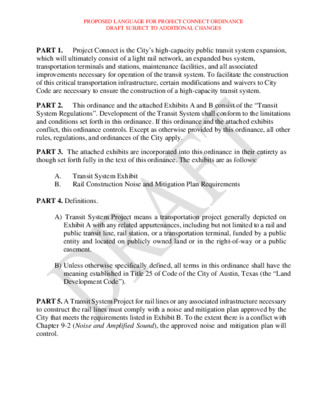
PROPOSED LANGUAGE FOR PROJECT CONNECT ORDINANCE DRAFT SUBJECT TO ADDITIONAL CHANGES Project Connect is the City’s high-capacity public transit system expansion, PART 1. which will ultimately consist of a light rail network, an expanded bus system, transportation terminals and stations, maintenance facilities, and all associated improvements necessary for operation of the transit system. To facilitate the construction of this critical transportation infrastructure, certain modifications and waivers to City Code are necessary to ensure the construction of a high-capacity transit system. PART 2. This ordinance and the attached Exhibits A and B consist of the “Transit System Regulations”. Development of the Transit System shall conform to the limitations and conditions set forth in this ordinance. If this ordinance and the attached exhibits conflict, this ordinance controls. Except as otherwise provided by this ordinance, all other rules, regulations, and ordinances of the City apply. PART 3. The attached exhibits are incorporated into this ordinance in their entirety as though set forth fully in the text of this ordinance. The exhibits are as follows: A. B. Transit System Exhibit Rail Construction Noise and Mitigation Plan Requirements PART 4. Definitions. A) Transit System Project means a transportation project generally depicted on Exhibit A with any related appurtenances, including but not limited to a rail and public transit line, rail station, or a transportation terminal, funded by a public entity and located on publicly owned land or in the right-of-way or a public easement. B) Unless otherwise specifically defined, all terms in this ordinance shall have the meaning established in Title 25 of Code of the City of Austin, Texas (the “Land Development Code”). PART 5. A Transit System Project for rail lines or any associated infrastructure necessary to construct the rail lines must comply with a noise and mitigation plan approved by the City that meets the requirements listed in Exhibit B. To the extent there is a conflict with Chapter 9-2 (Noise and Amplified Sound), the approved noise and mitigation plan will control. PROPOSED LANGUAGE FOR PROJECT CONNECT ORDINANCE DRAFT SUBJECT TO ADDITIONAL CHANGES PART 6. Transit System Uses as described in 25-2-6(28). A) The use of a site for a traction powered substation is a Local Utility Service use B) The use of a site for the provision of maintenance, repair, vehicular or equipment servicing, material storage, or similar activities for rail lines is a Maintenance and Facilities use as described in …
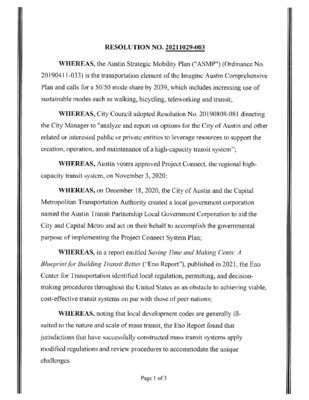
RESOLUTION NO. 20211029-003 WHEREAS, the Austin Strategic Mobility Plan ("ASMP") (Ordinance No. 20190411-033) is the transportation element of the Imagine Austin Comprehensive Plan and calls for a 50/50 mode share by 2039, which includes increasing use of sustainable modes such as walking, bicycling, teleworking and transit; WHEREAS, City Council adopted Resolution No. 20190808-081 directing the City Manager to "analyze and report on options for the City of Austin and other related or interested public or private entities to leverage resources to support the creation, operation, and maintenance of a high-capacity transit system"; WHEREAS, Austin voters approved Project Connect, the regional high- capacity transit system, on November 3,2020; WHEREAS, on December 18,2020, the City of Austin and the Capital Metropolitan Transportation Authority created a local government corporation named the Austin Transit Partnership Local Government Corporation to aid the City and Capital Metro and act on their behalf to accomplish the governmental purpose of implementing the Project Connect System Plan; WHEREAS, in a report entitled Saving Time and Making Cents: A Blueprintfor Building Transit Better ("Eno Report"), published in 2021, the Eno Center for Transportation identified local regulation, permitting, and decision- making procedures throughout the United States as an obstacle to achieving viable, cost-effective transit systems on par with those of peer nations; WHEREAS, noting that local development codes are generally ill- suited to the nature and scale of mass transit, the Eno Report found that jurisdictions that have successfully constructed mass transit systems apply modified regulations and review procedures to accommodate the unique challenges Page 1 0f 3 transit construction presents and the ways it differs from private development or conventional transportation and public works projects; WHEREAS, the City ofAustin's Land Development Code does not provide for the design and permitting of linear construction required for mobility and transit facilities that encompass large areas, include subsurface and above-ground elements, and span multiple zoning districts and watersheds; WHEREAS, greater flexibility and more carefully tailored regulations are required to facilitate construction of Project Connect; WHEREAS, City staff routinely interprets and applies City Code to development and capital improvement applications; WHEREAS, the Land Development Code, existing regulations, criteria, and procedures should be flexibly applied to facilitate construction of Project Connect to the greatest extent possible until existing requirements can be amended; WHEREAS, there are Project Connect MetroRapid and MetroRail projects currently moving forward in advance of the Orange and Blue Line light rail projects; …
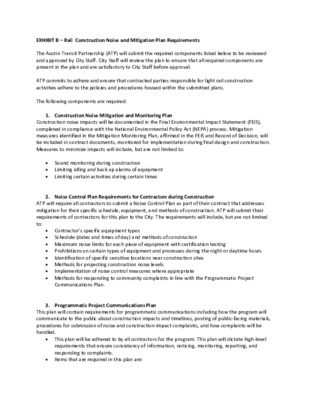
EXHIBIT B – Rail Construction Noise and Mitigation Plan Requirements The Austin Transit Partnership (ATP) will submit the required components listed below to be reviewed and approved by City Staff. City Staff will review the plan to ensure that all required components are present in the plan and are satisfactory to City Staff before approval. ATP commits to adhere and ensure that contracted parties responsible for light rail construction activities adhere to the policies and procedures housed within the submitted plans. The following components are required: 1. Construction Noise Mitigation and Monitoring Plan Construction noise impacts will be documented in the Final Environmental Impact Statement (FEIS), completed in compliance with the National Environmental Policy Act (NEPA) process. Mitigation measures identified in the Mitigation Monitoring Plan, affirmed in the FEIS and Record of Decision, will be included in contract documents, monitored for implementation during final design and construction. Measures to minimize impacts will include, but are not limited to: • • • Sound monitoring during construction Limiting idling and back up alarms of equipment Limiting certain activities during certain times 2. Noise Control Plan Requirements for Contractors during Construction ATP will require all contractors to submit a Noise Control Plan as part of their contract that addresses mitigation for their specific schedule, equipment, and methods of construction. ATP will submit their requirements of contractors for this plan to the City. The requirements will include, but are not limited to: Schedule (dates and times of day) and methods of construction • Contractor’s specific equipment types • • Maximum noise limits for each piece of equipment with certification testing • Prohibitions on certain types of equipment and processes during the night or daytime hours • • Methods for projecting construction noise levels • • Methods for responding to community complaints in line with the Programmatic Project Identification of specific sensitive locations near construction sites Implementation of noise control measures where appropriate Communications Plan. 3. Programmatic Project Communications Plan This plan will contain requirements for programmatic communications including how the program will communicate to the public about construction impacts and timelines, posting of public-facing materials, procedures for submission of noise and construction impact complaints, and how complaints will be handled. • This plan will be adhered to by all contractors for the program. This plan will dictate high-level requirements that ensure consistency of information, noticing, monitoring, reporting, and responding to complaints. Items that are …
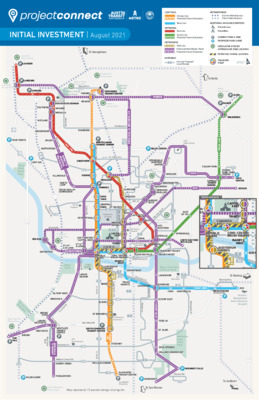
INITIAL INVESTMENT | August 2021 SOUTHEND Lago Vista Pickup Zone FOUR POINTS OHLEN B u r n e t R d NORTHCROSS R R E E D D L L I I N N E E LBJ High School E E N N I I L L N N E E E E R R G G To Hutto 130 TOLL ELGIN ELGIN MANOR MANOR WILDHORSE WILDHORSE WILDHORSE LEANDER LEANDER LAKELINE LAKELINE LAKELINE HOWARD HOWARD To Georgetown Pflugerville Pickup Zone Stoney Creek Park TECH RIDGE TECH RIDGE TECH RIDGE TRANSIT CENTER TRANSIT CENTER TRANSIT CENTER 45 TOLL PARMER PARMER Howard Ln 325 Walnut Creek Metro Park PARMER ACC Northridge BROADMOOR/DOMAIN BROADMOOR/DOMAIN BRAKER LN BRAKER KRAMER MCKALLA MCKALLA M e t r i c B l RUTLAND CROSSROADS LOOP 360 CRESTVIEW CRESTVIEW CRESTVIEW A A B B M M N N U U E E D D R R N N N N O O C C E E A A H H T T K K A A T T C C H H O O A A I I L L L L ALLANDALE KOENIG KOENIG NORTH LOOP TEXAS HEALTH COMMISSION A A C C C C H H I I G G H H L L A A N N D D T T O O T T E E C C H H R R I I D D G G E E RUNDBERG 325 Rundberg Ln NORTH LAMAR NORTH LAMAR NORTH LAMAR TRANSIT CENTER TRANSIT CENTER TRANSIT CENTER 325 10 N L a m a r B l St Johns Ave 300 E x p o s i t i o n B l 335 Seton Hospital L a m a r B l UT/WEST MALL UT/WEST MALL Enfield Rd DOWNTOWN AREA DELCO CENTER DELCO CENTER d r R o n a M SPRINGDALE SHOPPING CENTER PHILOMENA BERKMAN/ MUELLER M LK Bl Oak Springs Dr ACC EASTVIEW GOVALLE GOVALLE HIGHLAND HIGHLAND HIGHLAND HIGHLAND TRIANGLE TRIANGLE TRIANGLE TRIANGLE 7 HYDE HYDE PARK PARK HEMPHILL HEMPHILL PARK PARK ST. DAVID’S 20 University of Texas S a n J a c i n t o B MEDICAL MEDICAL SCHOOL SCHOOL l 7 10 CAPITOL CAPITOL EAST EAST CLARKSON HANCOCK 38½ St AIRPORT BLVD MLK Dell Seton Hospital MLK 2 COMAL Emma Long Metro Park LOOP 360 WHELESS EXPO EXPO COLONY PARK COLONY PARK TOWN CENTER 51st St 300 WESTMINSTER …
Historic Design Standards City of Austin September 2022 Welcome In Austin, historic preservation encourages the preservation of historic buildings, structures, sites, and districts; promotes awareness of cultural and architectural heritage; and helps shape a more sustainable, equitable, and livable place. As the city grows, these Historic Design Standards will help property owners, designers, builders, and historic preservation professionals make consistent decisions about how to meet present-day needs while stewarding local built heritage and achieving larger goals. Clear standards and graphics show good practices, as well as changes to avoid. The Historic Design Standards were created by a working group representing property owners, designers, developers, advocates, and the Historic Landmark Commission. The working group sought to develop locally relevant standards grounded in national preservation principles. Many members are laypeople, and readability was a key concern: the standards needed to be understandable by property owners and neighbors considering whether to apply for historic district designation, as well as by architects. A Maintenance and Preservation chapter and illustrated glossary support those who want to learn more about architectural elements and materials. The Historic Design Standards promote long-term sustainability by supporting the retention and repair of existing buildings, which keep tons of old-growth wood and other material in use and out of the landfill. They also support sustainable solutions for making buildings more energy efficient now, from high-impact improvements like attic insulation and duct sealing to DIY changes such as weather-stripping around windows and doors. Historic Preservation Office staff are available to answer questions and provide feedback on proposed projects. Reach out to preservation@austintexas.gov or call (512) 974-3393. Left cover image: People looking out over Austin, ca. 1940s Acknowledgments Design Standards Working Group The Historic Landmark Commission created the Design Standards Working Group on September 24, 2018 to create a new set of historic design standards, with the goals of providing clear, user-friendly standards and guidelines for all historic property owners and of simplifying the historic district application process. This document is the product of the working group’s efforts and is modeled on the Preservation Austin design standards template produced through a community initiative in April 2011. David Carroll, AIA Urban Design Commission, preservation architect Janet Beinke Historic district property owner Cara Bertron Historic Preservation Office staff Madeline Clites Preservation consultant Angela Gaudette Historic Preservation Office staff Laura Keating Urban Design staff Marie Oehlerking-Read Texas Historical Commission staff (prev.) Misael Ramos Representative from potential …
Frequently Asked Questions This FAQ sheet is intended to provide a brief orientation to the Historic Design Standards. Please contact preservation@austintexas.gov if you have further questions. 1 Why were the Historic Design Standards I own a property in a locally designated historic developed? Don’t we already have standards for district. How will the Historic Design Standards 3 historic properties? affect me? The Historic Design Standards were developed to clarify existing standards for historic landmarks and National Register districts. They will also make the historic district application process easier and more equitable for new districts. The Historic Design Standards will not affect previously agreed-upon design standards for existing historic districts. They do align with existing district design standards and may be adopted by property owners within each district if desired. The Secretary of the Interior’s Standards for Rehabilitation form the foundation of preservation practice in the United States and are used in Austin to evaluate proposed changes to historic landmarks and in National Register districts. However, these very general standards can be hard to interpret when planning and evaluating specific projects. The Historic Design Standards clarify them with more specific good practices and illustrations. Right now, community members compiling a historic district application must hire a consultant or learn how to develop their own design standards. Then multiple rounds of review are required with other property owners and City staff. This adds time and cost to the application process—and results in design standards that are nearly identical to those for other districts. The Historic Design Standards will provide a consistent, predictable set of standards for all areas considering historic district designation. I own a historic landmark. How will the Historic 2 Design Standards affect me? If adopted by City Council, the Historic Design Standards will clarify existing standards for exterior changes to historic landmarks, as well as new construction on landmarked properties. The Historic Design Standards are based on the standards that City staff and the Historic Landmark Commission already use to evaluate projects. However, they are clearer, more specific, and easier to use. No process changes are proposed. 4 I own a property in a National Register district. How will the Historic Design Standards affect me? If adopted by City Council, the Historic Design Standards will clarify existing guidelines for National Register district properties. The Historic Design Standards are based on the standards that City staff and the Historic Landmark …
REGULAR MEETING CODES AND ORDINANCES JOINT COMMITTEE MINUTES Wednesday, August 17, 2022 The Codes and Ordinances Joint Committee convened in a regular meeting on Wednesday, August 17, at 1000 E. 11th St, Street Jones Building, Room 400A, Austin, TX 78702. Chair Barrera-Ramirez called the meeting to order at 6:10 pm. Committee Members in Attendance: Jolene Kiolbassa Awais Azhar Claire Hempel (Vice-Chair) City Staff in Attendance: Jorge Rousselin, Housing and Planning Department Andrea Bates, Watershed Protection Department Liz Johnston, Watershed Protection Department Pamela Abee-Taulli, Watershed Protection Department Katie Coyne, Watershed Protection Department Ann Denkler Nadia Barrera-Ramirez (Chair) CALL TO ORDER APPROVAL OF MINUTES 1. Approval of the June 15, 2022, meeting minutes. The June 15 minutes will be available for approval at a future meeting. No action taken. DISCUSSION AND ACTION ITEMS 2. Election of Officers. Elect a chair and vice-chair of the Codes and Ordinances Joint Committee. A motion was made to re-elect Commissioner Barrera-Ramirez as Chair and Commissioner Hempel as Vice Chair by Commissioner Azhar, seconded by Commissioner Kiolbassa. Vote: 5-0 (Commissioners Shaw and Anderson absent). 3. Environmental, Drainage, and Landscape Amendments. Discuss and consider a recommendation for adoption of an ordinance amending Title 25 of the City Code relating to environmental, drainage, and landscape requirements. City Staff: Liz Johnston, Watershed Protection Department, (512) 974-2619, Liz.Johnston@austintexas.gov Katie Coyne and Liz Johnston gave a presentation on a suite of amendments to the LDC Facilitator: Commissioner Barrera-Ramirez, Chair of COJC City Attorney: None 1 that would require green stormwater infrastructure as well as functional green elements. There was some concern from commissioners about the cost of these new requirements and how they might apply to sites that already have high impervious cover, such as in the downtown area. There was also discussion about whether the requirements would encourage or deter missing middle housing. A request was made to forward the backup to the ZAP Commission. No action taken. 4. North Burnet/Gateway Regulating Plan Subdistrict. Discuss and consider a recommendation for adoption of an ordinance amending Title 25 of the City Code to modify the Commercial Mixed Use – Gateway Zone Subdistrict of the North Burnet/Gateway Regulating Plan, to increase the maximum floor-area ratio (FAR) and building height when using a development bonus. City Staff: Jorge Rousselin, Housing and Planning Department, (512) 974-2975, Jorge.Rousselin@austintexas.gov Jorge Rousselin gave a presentation on a chance to a NBG subdistrict that would allow additional height and …
1 JOINT COMMITTEE ON CODES & ORDINANCES SEPTEMBER 21, 2022 DESIGN STANDARDS WORKING GROUP 3 PROCESS SEPT 2018 2019 JUNE 2020 Standards revised; graphics added NOV DEC HLC forms Design Standards Working Group Draft released for community review Working group does deep dive, creates draft UT graduate class surveys national best practices 2 SEPT -OCT DEC 2022 Initiation and recommend. (JSOC, Planning Commission) Review and possible approval by City Council Working group recommends Historic Design Standards; HLC adopts resolution in support Review by: -Planning Commission 12/8/20 -Zoning and Platting Commission 12/1/20 -Downtown Commission 12/16/20 -Design Commission 12/21/20 DESIGN STANDARDS Historic districts 5 Secretary of the Interior’s Standards for Rehabilitation 1. A property will be used as it was historically or be given a new use that requires minimal change to its distinctive materials, features, spaces, and spatial relationships. 2. The historic character of a property will be retained and preserved. The removal of distinctive materials or alteration of features, spaces, and spatial relationships that characterize a property will be avoided. 3. Each property will be recognized as a physical record of its time, place, and use. Changes that create a false sense of historical development, such as adding conjectural features or elements from other historic properties, will not be undertaken. 4. Changes to a property that have acquired historic significance in their own right will be retained and preserved. 5. Distinctive materials, features, finishes, and construction techniques or examples of craftsmanship that characterize a property will be preserved. 6. Deteriorated historic features will be repaired rather than replaced. Where the severity of deterioration requires replacement of a distinctive feature, the new feature will match the old in design, color, texture, and, where possible, materials. Replacement of missing features will be substantiated by documentary and physical evidence. 7. Chemical or physical treatments, if appropriate, will be undertaken using the gentlest means possible. Treatments that cause damage to historic materials will not be used. 8. Archeological resources will be protected and preserved in place. If such resources must be disturbed, mitigation measures will be undertaken. 9. New additions, exterior alterations, or related new construction will not destroy historic materials, features, and spatial relationships that characterize the property. The new work will be differentiated from the old and will be compatible with the historic materials, features, size, scale and proportion, and massing to protect the integrity of the property and its environment. 10. …
Meeting of the Codes and Ordinances Joint Committee August 17, 2022 at 6:00 p.m. Street Jones Building – Room #400A 1000 E. 11th St, Austin, TX 78702 Some members of the Codes and Ordinances Joint Committee may be participating by video conference. Public comment will be allowed in-person or remotely by telephone. Speakers may only register to speak on an item once, either in-person or remotely, and will be allowed up to three minutes to provide their comments. Registration no later than noon the day before the meeting is required for remote participation. To register, call or email the board liaison at 512-974-3509 or greg.dutton@austintexas.gov CURRENT COMMITTEE MEMBERS Nadia Barrera-Ramirez (Chair) Claire Hempel (Vice-Chair) Awais Azhar Todd Shaw Ann Denkler Jolene Kiolbassa Greg Anderson CALL TO ORDER PUBLIC COMMUNICATION: GENERAL Speakers signed up prior to commencement of the meeting will be allowed to address their concerns regarding items not posted on the agenda. APPROVAL OF MINUTES 1. Approval of the June 15, 2022, meeting minutes. DISCUSSION AND ACTION ITEMS 2. Election of Officers. Elect a chair and vice-chair of the Codes and Ordinances Joint Committee. 3. Environmental, Drainage, and Landscape Amendments. Discuss and consider a recommendation for adoption of an ordinance amending Title 25 of the City Code relating to environmental, drainage, and landscape requirements. City Staff: Liz Johnston, Watershed Protection Department, (512) 974-2619, Liz.Johnston@austintexas.gov Facilitator: Chair Barrera-Ramirez City Attorney: None 1 4. North Burnet/Gateway Regulating Plan Subdistrict. Discuss and consider a recommendation for adoption of an ordinance amending Title 25 of the City Code to modify the Commercial Mixed Use – Gateway Zone Subdistrict of the North Burnet/Gateway Regulating Plan, to increase the maximum floor-area ratio (FAR) and building height when using a development bonus. City Staff: Jorge Rousselin, Housing and Planning Department, (512) 974-2975, Jorge.Rousselin@austintexas.gov DISCUSSION ITEMS 5. Update on Potential Upcoming and Current Code Amendments – City Staff: Greg Dutton, Housing and Planning and Department, (512) 974-3509, Greg.Dutton@austintexas.gov. FUTURE AGENDA ITEMS Future agenda items will NOT be discussed at the current meeting, but will be offered for initiation, discussion, and/or possible recommendation to the full Planning Commission at a FUTURE meeting. ADJOURNMENT The City of Austin is committed to compliance with the American with Disabilities Act. Reasonable modifications and equal access to communications will be provided upon request. Meeting locations are planned with wheelchair access. If requiring Sign Language Interpreters or alternative formats, please give notice at …
C20-2022-006 ORDINANCE AMENDMENT REVIEW SHEET Amendment: C20-2022-006 Regulating Plan for the North Burnet/Gateway Zoning District Description: Consider an ordinance amending Title 25 of the City Code to modify the Commercial Mixed Use - Gateway Zone Subdistrict of the Regulating Plan to increase the maximum floor-to-area ratio (FAR) and building height when using a development bonus. Proposed Language: See attached draft ordinance and background information. Summary of proposed code amendment • The proposed modification to the CMU-Gateway Zone Subdistrict will increase the maximum FAR and height: o Modify the Maximum FAR with Development Bonus from 8:1 to 12:1. o Modify the Maximum Building Height with Development Bonus from 308 feet to 420 feet. o Revise Figure 4-3: Maximum FAR with Development Bonus, of the North Burnet/Gateway Regulating Plan as described above. o Revise Figure 4-5: Maximum Height with Development Bonus, of the North Burnet/Gateway Regulating Plan as described above. Background: Initiated by City Council Resolution 20220519-040. Council Sponsors: Council Member Leslie Pool, Mayor Pro Tem Alison Alter, Council Member Mackenzie Kelly, Council Member José 'Chito' Vela, Mayor Steve Adler. On June 16, 2022, City Council issued a resolution that directed staff to modify the Commercial Mixed Use - Gateway Zone Subdistrict of the Regulating Plan to increase the maximum floor-to-area ratio (FAR) and building height when using a development bonus. Staff Recommendation: Staff recommends the proposed code amendment. Board and Commission Actions August 17, 2022: To be reviewed by the Codes and Ordinances Subcommittee. September 13, 2022: To be reviewed by the Planning Commission. Council Action September 29, 2022: A public hearing will be scheduled. Ordinance Number: NA City Staff: Jorge E. Rousselin Phone: (512) 974-2975 Email: Jorge.rousselin@austintexas.gov Figure 4-3 : Maximum Floor - to - Area- Ra�o (FAR) with Development Bonus Revised 08-08-19 LEGEND 2 :1 Maximum FAR 3 :1 Maximum FAR 5 :1 Maximum FAR 8 :1 Maximum FAR Parcel Boundary Rail roads NBG Planning Area Boundary DUVAL G R A F A R C Y M S C I R T E M W O L L O H E N O T S DONLEY DENTON ENERGY R U N D B E R G T E N R U B KRAMER BRAKER MCHALE RUTLAND N O S P M O H T S L I E N LONGHORN INDUSTRIAL D I E R D E T I N U L I E N - C M G …
In‐Process Code Amendments 8/16/22 1. 2. 3. 4. 5. 6. 7. 8. 9. 10. AMENDMENT C20‐2022‐011 Live Music Venue Initiated by Council on 7/28/22 C20‐2022‐009 Sixth St Height Exception Initiated by Council on 6/9/22 C20‐2022‐008 Capitol Dominance Overlay Initiated by Council on 5/19/22 C20‐2022‐007 ADU Initiated by Council on 6/9/22 Combined with C20‐2021‐ 011 C20‐2022‐006 NBG CMU subdistrict change Initiated by Council on 5/19/22 Environmental and Water Quality Initiated by Council on 6/9/22 C20‐2022‐004 Compatibility Changes Initiated by Council on 6/9/22 C20‐2022‐003 South Central Waterfront Regulating Plan Initiated by PC on 6/14/22 C20‐2022‐002 Parkland Dedication Expansion Initiated by Council on 4/7/22 C20‐2021‐013 Floodplain Regulations – Commercial Redevelopment Exception NOTES Creates new use and bonus provisions for live music venue Amends overlay to allow for additional height Allows properties in CDO to participate in Downtown Density Bonus Program Additional direction and clarification on ADU changes Related to C20‐ 2021‐011 Amends height and FAR for CMU subdistrict environmental and water quality regulations Relaxes compatibility standards Creates the SCW Regulating Plan (voluntary overlay) Expands dedication to industrial, commercial, office projects Creates floodplain commercial redevelopment exception LEAD DEPT Economic EST. COUNCIL DATE Late 2022 Development TBD Late 2022 TBD Late 2022 Development Services Summer 2022 Housing and Planning Fall 2022 Housing and Planning Fall 2022 Housing and Planning Late 2022 Parks and Recreation Summer 2022 Watershed Protection Fall 2022 C20‐2022‐005a. & b. Amendments to Fall 2022 Watershed Protection In‐Process Code Amendments 8/16/22 NOTES LEAD DEPT EST. COUNCIL DATE C20‐2021‐012 Residential Allows residential Late 2022 Housing and Planning C20‐2021‐011 ADU Expands Development Services Summer 2022 AMENDMENT Initiated by PC on 12/14/21 in Commercial Initiated by Council on 12/9/21 Expansion Initiated by Council on 12/9/21 C20‐2021‐014 Project Connect Initiated by Council on 10/29/22 C20‐2021‐006 Vertical Mixed Use Affordable Housing Initiated by PC on 7/27/21 Initiated by Council on 11/18/21 C20‐2021‐004 Great Streets Fee‐In‐Lieu Mechanism Initiated by Council 8/22/19 C20‐2021‐003 Downtown Density Bonus Updates Initiated by Council on 4/22/21 C20‐2021‐002 Affordability Unlocked Site Plan Changes …
2022 Environmental Code Amendments Phase 1 Codes and Ordinances Joint Committee A u g u s t 1 7 , 2 0 2 2 C I T Y O F A U S T I N W A T E R S H E D P R O T E C T I O N D E P A R T M E N T Objective • Respond to por tion of Resolution 20220609- 061 that requires staff to bring for th an ordinance related to environmental protection in September amending Title 25 • Key subject areas Stormwater Landscape • • • Water Resource Protection Colorado River Protections • Previously identified minor code amendments and other amendments that meet the • objectives of the resolution Incentivize Missing Middle • C I T Y O F A U S T I N W A T E R S H E D P R O T E C T I O N D E P A R T M E N T 2 Progress So Far • Internal Water shed Protection Dept (WPD) technical staff • Input from other depar tments inc luding • Development Services Department • Austin Water • Austin Transportation • CoA Project Connect Office • Housing and Planning • Law • Environmental Commission Workgroup 7/25/2022 • Environmental Commission Update 8/3/2022 C I T Y O F A U S T I N W A T E R S H E D P R O T E C T I O N D E P A R T M E N T 3 Next Steps • 9/6/2022 - Environmental Commission • 9/13/2022 - Planning Commission • 9/29/2022 - City Council Phase 2: Greenfield Detention Requirements and Urban Slope Protection September & October Commissions • • November City Council C I T Y O F A U S T I N W A T E R S H E D P R O T E C T I O N D E P A R T M E N T 4 Stormwater “ 1 . E s t a b l i s h c r i t e r i a t h a t p r i o r i t i z e w h e n g r e e n s t o r m w a t e r m e t h o …
CHAPTER 25-2. ZONING. ARTICLE 9. LANDSCAPING § 25-2-981 - APPLICABILITY; EXCEPTIONS. (A) Except as provided in Subsection (B), this article applies in the city's zoning jurisdiction. (B) Division 2 (Requirements for a Site Plan) and Division 3 (Additional Site Plan Requirements in Hill Country Roadway Corridors) do not apply to: (1) property zoned central business district or downtown mixed use district, except for (Functional Green); a lot containing one single-family residence; a lot containing one duplex residence, unless the residence exceeds 4,000 square feet of gross floor (2) (3) area or has more than six bedrooms; (4) (5) (6) (7) (8) a two-family residential use; a secondary apartment special use; substantial restoration of a building within one year after the building is damaged; restoration of a building designated as a historic landmark; or interior or facade remodeling, if the front and side exterior walls of the building remain in the same location. (C) Developed property, or property with an approved site plan, that is affected by right-of-way condemnation may be developed without compliance with this article, as provided by this subsection. (1) After condemnation, improvements shown on the remainder of an approved site plan may be constructed, and only the landscaping on the remainder of the approved site plan is required. Improvements on developed properties that are lost through condemnation may be replaced. Only the area within the limits of construction for the replaced improvements must comply with this article, except an owner is not required to provide more landscaping than was in existence before the condemnation. (2) Division 2. Requirements for a Site Plan. § 25-2-1007 PARKING LOTS. (A) For each 12 parking spaces in a parking lot that is in a landscape yard, a minimum of 90 square feet of landscaped area are required within the parking lot. For each 12 parking spaces in a parking lot that is not in a landscape yard, a minimum of 60 square feet of landscaped area are required within the parking lot. (C) A parking lot must have end islands landscaped with trees in accordance with the Environmental Criteria Manual. (D) Except as provided in Subsection (E), a parking space may not be located more than 50 feet from a landscaped area, or more than 50 feet from a tree. In a parking lot that has more than three distinct modules for the parking of vehicles: (1) a landscaped median at …
Figure 4-3 : Maximum Floor - to - Area- Ratio (FAR) with Development Bonus Revised 08-15-22 LEGEND 2 :1 Maximum FAR 3 :1 Maximum FAR 5 :1 Maximum FAR 8 :1 Maximum FAR 12 :1 Maximum FAR NBG Planning Area Boundary Parcel Boundary Rail roads DUVAL G R A F A R C Y M S C I R T E M W O L L O H E N O T S DONLEY DENTON ENERGY R U N D B E R G T E N R U B KRAMER BRAKER MCHALE RUTLAND N O S P M O H T S L I E N LONGHORN INDUSTRIAL D I E R D E T I N U L I E N - C M G R E A T H I T E X A S O F S T O N E L A K E L S L C A P I T A L H W Y 1 8 C A P - O M / 1 P O O L YORK TUDOR 3 / R E S E A R C H