Council Questions and Answers — original pdf
Backup
Backup
Larry Weis, Austin Energy General Manager Mission: Deliver clean, affordable, reliable energy and excellent customer service. Collections Overview Disconnection and Reconnection Process Special Council Committee on Austin Energy Meeting December 5, 2013 2 •Follow City Code Chapter15-9 and state laws regarding utility debt •Assist the customer in reducing outstanding balances by offering flexible payment arrangements •Offer the customer opportunities to successfully manage their utility account and prevent perpetual debt accumulation •Offer special provisions for CAP and low income customers •Minimize utility rate increases •Optimize support services funding Objectives 3 Collections Process Steps Overview •The collections process begins with the generation of the customer’s bill •The process is highly automated, events trigger each process step •The customer can stop the next event at any point in the process by either making payment in full or requesting a Payment Arrangement. 4 Definitions Payment Arrangement •A Payment Arrangement (PA) is a short term payment option for households that are having a temporary crisis; PAs provide several months to pay off overdue utility bills in equal installments. These installments are in addition to the regular monthly current charges. The City of Austin does not disconnect services of customers with approved payment arrangements and on-time payments. Payment Arrangement Success •Successful PAs occur when payments for each PA installment plus the current billed charges are received in full, on or before the due date for each applicable month. Payment Arrangement Default •PAs are in default when the full PA installment and current billed charges due are not paid by the due date. If default occurs the account will proceed through the collections process. Arrearage Management Program •Arrearage Management Programs are long-term financial assistance programs and provide relief for low-income customers who have significant past due amounts (arrears) on their utility bills. •Bill is not paid by due date •No response to delinquent payment reminder •No response to 24-hour notice •Customer does not request a payment arrangement 5 How Does a Disconnect Occur? •On average 14% of the total residential customers enter into the collections process each month 422, 27% 358, 23% 289, 18% 514, 32% August 2013 Customer Behavior – 24-Hour Notice 10,644 , 20% 2,242 , 4% 866 , 2% 39,390 , 74% August 2013 Customer Behavior - FTNs Paid account Set up Payment Arrangement Set up Payment Plan Took no action * There was no collection activity between August 2011 – May 2013. In …
Backup
Backup
PUBLIC UTILITY REGULATORY ACT Title II, Texas Utilities Code (As Amended) Effective as of September 1, 2011 PUBLIC UTILITY COMMISSION OF TEXAS [BLANK PAGE] PUBLIC UTILITY REGULATORY ACT Title II, Texas Utilities Code (As Amended) Effective as of September 1, 2011 PUBLIC UTILITY COMMISSION OF TEXAS 1701 N. Congress Avenue • P.O. Box 13326 • Austin, Texas 78711-3326 • 512/936-7000 [BLANK PAGE] i FOREWORD The Public Utility Code was enacted by Acts 1997, 75th Leg., R.S., ch. 166, § 1 as a new and separate code effective September 1, 2007. Title 2 of the code is properly cited as the Public Utility Regulatory Act. This edition of the Public Utility Regulatory Act contains amendments adopted through the 82nd Legislature, First Called Session. In general, the effect of amendments have been clear and the resulting text changes were straightforward and did not require any editorial discretion. Except as explained below, editorial discretion was exercised in reconciling multiple amendments to the same section. In the majority of these cases, there was no irreconcilable conflict and all of the amendments could be given effect. In some cases, an act expressly amended a provision as added or amended by another act. In the few cases where an irreconcilable conflict was found, the act with the later date of enactment was given effect, with the other provisions italicized below. In addition, a note explaining the conflict is provided following the section annotation. The annotations following each section have two components. The first annotation shows the derivation of the section, either citing to the Public Utility Regulatory Act of 1995 (V.A.C.S. Art. 1446c-0), Acts 1997, ch. 166, or showing the section as added to the code and citing the relevant act. The second component identifies subsequent amendments, cites the amending act (and originating bill), provides a brief summary of each of the amendments, and, where appropriate, provides a reference to related provisions or material. This publication is maintained by the Commission Advising and Docket Management Division of the Public Utility Commission of Texas. Suggestions or corrections may be submitted to that division. ii [BLANK PAGE] iii TABLE OF CONTENTS TITLE I. GENERAL PROVISIONS ..........................................................................................1 CHAPTER 1. GENERAL PROVISIONS ................................................................................................ 1 Sec. 1.001. PURPOSE OF CODE. ..................................................................................................................... 1 Sec. 1.002. CONSTRUCTION OF CODE. ........................................................................................................ 1 Sec. 1.003. REFERENCE IN LAW TO STATUTE REVISED BY CODE. ...................................................... 1 TITLE II. PUBLIC UTILITY REGULATORY ACT ..............................................................3 SUBTITLE A. PROVISIONS …

Collections Overview Disconnection and Reconnection Process September 2013 Mission: Deliver clean, affordable, reliable energy and excellent customer service. www.austinenergy.com Collections Process Steps August 2013 2 Bill Generation 24 Hour Notice Bill Due Late Fees / Letters Mailed Delinquency Due Disconnect for Non-Payment Collections Process 17 days 17 days 4 days 6 days Overview The collections process begins with the generation of the customer’s bill The process is highly automated, events trigger each process step The customer can stop the next event at any point in the process www.austinenergy.com Overview Allow a minimum of 17 Days from Bill Generation to Bill Due Date May vary due to holiday or weekend COA Regs 15-9-131 DETERMINATION OF BILLING CYCLES Bill Generation: Due Date How We Compare Number of Days from Bill to Due Date August 2013 3 Austin Energy 17 CPS Energy 16 Pedernales Electric Cooperative 16 PUC (TXU, Reliant) 16 MLGW 16 Colorado Springs Utilities 14 www.austinenergy.com Overview Assess 5% Late Fee On Metered Services only On Current Amount Due only Listed on the Payment Stub COA Regs 15-9-137 PAYMENT REQUIREMENTS AND LATE PAYMENT PENALTY Past Due: Late Fee Assessed August 2013 4 www.austinenergy.com Delinquent Letters Mailed August 2013 5 Austin Energy $0 CPS Energy $0 Pedernales Electric Cooperative $0 Reliant $0 TXU $10 per notice Gexa Energy $15 per notice Amigo Energy $22 per notice Bounce Energy $20 per notice How We Compare Disconnect Notice Fee Overview Mail letter stating that Account is subject to Disconnection for Non-Payment if no action is taken Letter type based on account activity Friendly Firm COA Regs 15-9-106 NOTICE OF SERVICE DISCONNECTION www.austinenergy.com No Response from Customer: 24 Hour Notice August 2013 6 Overview Leave Courtesy Door Hanger Cost of $1.5M annually COA Regs Requirement for notice of service disconnection per 15-9-106 NOTICE OF SERVICE DISCONNECTION is met through Delinquent Letter. NOTICE OF SERVICE TERMINATION Previous attempts to collect on you utility account have been unsuccessful. Payment of your past due balance must be made immediately or utility services will be disconnected. In order to prevent disconnection, payment must be made at an authorized pay station and you must contact the utility service center to provide receipt information. If you are experiencing difficulty paying your bill, you may qualify for a Payment Arrangement or financial assistance. Please contact us for more information. Austin Energy Yes CPS Energy Yes Pedernales Electric Cooperative No Reliant No TXU …
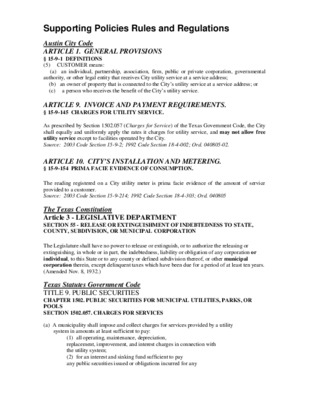
Supporting Policies Rules and Regulations Austin City Code ARTICLE 1. GENERAL PROVISIONS § 15-9-1 DEFINITIONS (5) CUSTOMER means: (a) an individual, partnership, association, firm, public or private corporation, governmental authority, or other legal entity that receives City utility service at a service address; (b) an owner of property that is connected to the City’s utility service at a service address; or (c) a person who receives the benefit of the City’s utility service. ARTICLE 9. INVOICE AND PAYMENT REQUIREMENTS. § 15-9-145 CHARGES FOR UTILITY SERVICE. As prescribed by Section 1502.057 (Charges for Service) of the Texas Government Code, the City shall equally and uniformly apply the rates it charges for utility service, and may not allow free utility service except to facilities operated by the City. Source: 2003 Code Section 15-9-2; 1992 Code Section 18-4-002; Ord. 040805-02. ARTICLE 10. CITY’S INSTALLATION AND METERING. § 15-9-154 PRIMA FACIE EVIDENCE OF CONSUMPTION. The reading registered on a City utility meter is prima facie evidence of the amount of service provided to a customer. Source: 2003 Code Section 15-9-214; 1992 Code Section 18-4-303; Ord. 040805 The Texas Constitution Article 3 - LEGISLATIVE DEPARTMENT SECTION 55 - RELEASE OR EXTINGUISHMENT OF INDEBTEDNESS TO STATE, COUNTY, SUBDIVISION, OR MUNICIPAL CORPORATION The Legislature shall have no power to release or extinguish, or to authorize the releasing or extinguishing, in whole or in part, the indebtedness, liability or obligation of any corporation or individual, to this State or to any county or defined subdivision thereof, or other municipal corporation therein, except delinquent taxes which have been due for a period of at least ten years. (Amended Nov. 8, 1932.) Texas Statutes Government Code TITLE 9. PUBLIC SECURITIES CHAPTER 1502. PUBLIC SECURITIES FOR MUNICIPAL UTILITIES, PARKS, OR POOLS SECTION 1502.057. CHARGES FOR SERVICES (a) A municipality shall impose and collect charges for services provided by a utility system in amounts at least sufficient to pay: (1) all operating, maintenance, depreciation, replacement, improvement, and interest charges in connection with the utility system; (2) for an interest and sinking fund sufficient to pay any public securities issued or obligations incurred for any purpose described by Section 1502.002 relating to the utility system; and (3) any outstanding debt against the system. (b) The rates charged for services provided by a utility system must be equal and uniform. A municipality may not allow any free service except for: (1) municipal public schools; …
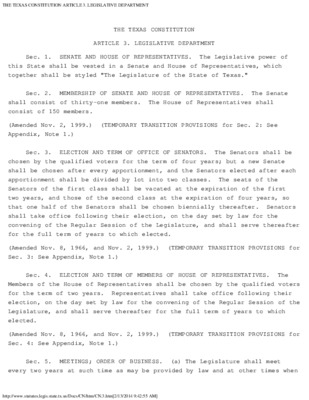
THE TEXAS CONSTITUTION ARTICLE 3. LEGISLATIVE DEPARTMENThttp://www.statutes.legis.state.tx.us/Docs/CN/htm/CN.3.htm[2/13/2014 9:42:55 AM] THE TEXAS CONSTITUTIONARTICLE 3. LEGISLATIVE DEPARTMENTSec. 1. SENATE AND HOUSE OF REPRESENTATIVES. The Legislative power of this State shall be vested in a Senate and House of Representatives, which together shall be styled "The Legislature of the State of Texas." Sec. 2. MEMBERSHIP OF SENATE AND HOUSE OF REPRESENTATIVES. The Senate shall consist of thirty-one members. The House of Representatives shall consist of 150 members. (Amended Nov. 2, 1999.) (TEMPORARY TRANSITION PROVISIONS for Sec. 2: See Appendix, Note 1.)Sec. 3. ELECTION AND TERM OF OFFICE OF SENATORS. The Senators shall be chosen by the qualified voters for the term of four years; but a new Senate shall be chosen after every apportionment, and the Senators elected after each apportionment shall be divided by lot into two classes. The seats of the Senators of the first class shall be vacated at the expiration of the first two years, and those of the second class at the expiration of four years, so that one half of the Senators shall be chosen biennially thereafter. Senators shall take office following their election, on the day set by law for the convening of the Regular Session of the Legislature, and shall serve thereafter for the full term of years to which elected. (Amended Nov. 8, 1966, and Nov. 2, 1999.) (TEMPORARY TRANSITION PROVISIONS for Sec. 3: See Appendix, Note 1.)Sec. 4. ELECTION AND TERM OF MEMBERS OF HOUSE OF REPRESENTATIVES. The Members of the House of Representatives shall be chosen by the qualified voters for the term of two years. Representatives shall take office following their election, on the day set by law for the convening of the Regular Session of the Legislature, and shall serve thereafter for the full term of years to which elected. (Amended Nov. 8, 1966, and Nov. 2, 1999.) (TEMPORARY TRANSITION PROVISIONS for Sec. 4: See Appendix, Note 1.)Sec. 5. MEETINGS; ORDER OF BUSINESS. (a) The Legislature shall meet every two years at such time as may be provided by law and at other times when THE TEXAS CONSTITUTION ARTICLE 3. LEGISLATIVE DEPARTMENThttp://www.statutes.legis.state.tx.us/Docs/CN/htm/CN.3.htm[2/13/2014 9:42:55 AM]convened by the Governor.(b) When convened in regular Session, the first thirty days thereof shall be devoted to the introduction of bills and resolutions, acting upon emergency appropriations, passing upon the confirmation of the recess appointees of the Governor and such emergency matters as may be submitted …
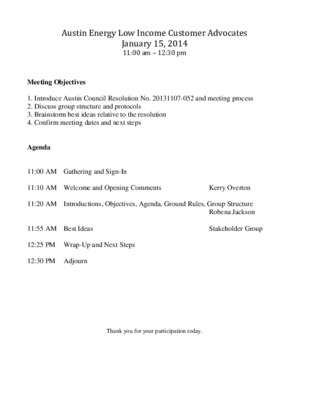
Austin Energy Low Income Customer Advocates January 15, 2014 11:00 am – 12:30 pm Meeting Objectives 1. Introduce Austin Council Resolution No. 20131107-052 and meeting process 2. Discuss group structure and protocols 3. Brainstorm best ideas relative to the resolution 4. Confirm meeting dates and next steps Agenda 11:00 AM Gathering and Sign-In 11:10 AM Welcome and Opening Comments Kerry Overton 11:20 AM Introductions, Objectives, Agenda, Ground Rules, Group Structure Robena Jackson 11:55 AM Best Ideas Stakeholder Group 12:25 PM Wrap-Up and Next Steps 12:30 PM Adjourn Thank you for your participation today.
1 Austin Energy Low Income Consumer Advocates Resolution 20131107-052 Meeting #1 January 15, 2014 Attendees: Kathy Stark (Austin Tenants’ Council), Mark Widoff (Gray Panthers), Gloria Cueva (Caritas), Michelle Akers (HACA), Angel Ramirez (VFW), Ruby Roa (COC), Kathleen Hopkins (ABC), Vanessa Sarria (CAN), Randy Chapman (TLSC), Barbara Grove (Austin Interfaith), Carol Biedrzycki (Texas ROSE), Bob Batlan (Austin Interfaith), Linda Perez (MOWAM), Tonda Owens (Travis County), Pat Macy (St. Austin), Lanetta Cooper (TLSC), Barbara Rush (Morrison), Shannon Halley (Tovo), Kerry Overton (AE), J.J. Gutierrez (AE), Ronnie Mendoza (AE), Robena Jackson (Facilitator) , Elaine Kelly-Diaz (AE), Lisa Tamez (AE), Melissa Davis (AE), Lori Kirchgatter (AE), Sandra Castillo (AE), Jessica Twining (AE), Irene Nemitsas (AE) • Welcome/Opening Remarks o Kerry Overton, Deputy General Manager, Austin Energy, welcomed all attendees and introduced Robena Jackson, meeting facilitator o Mr. Overton reviewed Resolution 20131107-052 and stated that the group has been ordered to develop a comprehensive program to address the resolution o Ms. Jackson verified all groups represented: Austin Interfaith, Texas Rose, Meals on Wheels and More, Travis County, St. Austin Catholic Church, Texas Legal Services, Austin Tenants Council, Caritas, Housing Authority of the City of Austin (HACA), Veterans of Foreign Wars (VFW), Ladies of Charity, Any Baby Can, Community Advancement Network (CAN), Gray Panthers o Question raised: Ms. Biedrzycki inquired about Resolution 20131212-081 – concerning administrative hearing process and customer information communication procedures Ms. Jackson responded for purposes of these meetings attendees are to concentrate on discussing/providing recommendations for resolution 20131107-52 Resolution 20131212-081 was put on hold/parking lot for group to review at the close of the meeting o Ms. Jackson reviewed her role as facilitator: Acts as neutral moderator Not content expert Helps move meetings forward and stay on task Ensure lines of communication remain open o Ms. Jackson established ground rules for meetings: Listen Speak one at a time Stay concise and to the point • Any items that may be out of scope will be tabled/put on the parking lot Stay focused at task on hand Silence phones All attendees agreed to rules • Meeting Structure o Ms. Jackson proposed meeting structure moving forward, Recommending establishment of two groups: Stakeholders and Working Group Stakeholders • Will meet along with Working Group 2 or 3 times during total 5 meeting process, though they can choose to come to all 5 …
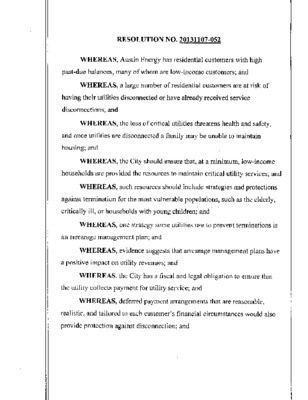
RESOLUTION NO. 20131107-052 WHEREAS, Austin Energy has residential customers with high past-due balances, many of whom are low-income customers; and WHEREAS, a large number of residential customers are at risk of having their utilities disconnected or have already received service disconnections; and WHEREAS, the loss of critical utilities threatens health and safety, and once utilities are disconnected a family may be unable to maintain housing; and WHEREAS, the City should ensure that, at a minimum, low-income households are provided the resources to maintain critical utility services; and WHEREAS, such resources should include strategies and protections against termination for the most vulnerable populations, such as the elderly, critically ill, or households with young children; and WHEREAS, one strategy some utilities use to prevent terminations is an arrearage management plan; and WHEREAS, evidence suggests that arrearage management plans have a positive impact on utility revenues; and WHEREAS, the City has a fiscal and legal obligation to ensure that the utility collects payment for utility service; and WHEREAS, deferred payment arrangements that are reasonable, realistic, and tailored to each customer's financial circumstances would also provide protection against disconnection; and WHEREAS, customers experiencing high utility bills, including excessive water usage, should be provided information about usage reduction strategies including options for participation in energy efficiency rebate and low-income weatherization programs, as well as water conservation rebates and education; NOW, THEREFORE, BE IT RESOLVED BY THE CITY COUNCIL OF THE CITY OF AUSTIN: That the City Manager is directed to work with the Discount Steering Committee and other consumer advocates to develop revised rules for deferred payment plans and service disconnections; BE IT FURTHER RESOLVED That the City Manager work with the Discount Steering Committee and consumer advocates to develop an arrearage management plan, taking into consideration best practices from other cities, and including strategies for incentivizing customers for honoring payment agreements; BE IT FURTHER RESOLVED That the City Manager work with this group to develop appropriate customer service practices for providing information to customers entering into deferred payment plans about resources available to customers through Austin Energy or the Austin Water Utility, including eligibility for customer assistance programs, participation in energy efficiency rebate and/or low income weatherization, and education on usage management strategies; BE IT FURTHER RESOLVED: That the City Manager provide the recommendations of the Discount Steering Committee and consumer advocates to the Electric Utility Commission, the Resource Management Commission, and the Water …