LOW INCOME CONSUMER ADVISORY TASK FORCE SEPTEMBER 4, 2015 9:00AM – 12:00 PM TOWN LAKE CENTER – ROOM 100 721 BARTON SPRINGS ROAD AUSTIN, TEXAS 78704 For more information: http://www.austintexas.gov/content/low-income-consumer-advisory-task- force AGENDA CALL TO ORDER 1. CITIZEN COMMUNICATIONS The first 5 speakers signed up prior to the meeting being called to order will each be allowed a three-minute allotment to address their concerns regarding items not posted on the agenda. 2. APPROVAL OF MINUTES a. Approve minutes from the August 21, 2015 meeting 3. OLD BUSINESS a. Discussion and possible action on the low income weatherization budget. (25 min.) b. Discussion and possible action on Austin Energy’s overall energy (kWh) and demand (KW) goals and kWh and KW goals for programs for low income and low moderate income customers. (25 min.) c. Discussion and possible action on ECAD (Energy Conservation Audit Disclosure) online audit and disclosure postings and expanding the scope of disclosure requirements. (10 min.) d. Discussion and possible action on energy efficiency rate true-up proceeding. (10 min.) e. Discussion and possible action on Building Codes. (10 min.) f. Discussion and possible action on audit of the billing system. (5 min.) g. Discussion and possible action on final report. (90 min.) 4. BRIEFINGS & REPORTS a. Austin Energy staff update on the weatherization program job status b. Status of data requests c. Committee Reports – possible reports from the Low Income Energy Efficiency Program Committee, Low-Moderate Income Energy Efficiency Program Committee, and/or Affordable Rental Property Committee 5. FUTURE AGENDA ITEMS a. Discussion regarding future agenda items including a schedule of topics and issues and topics raised during briefings and citizen communications The City of Austin is committed to compliance with the American with Disabilities Act. Reasonable modifications and equal access to communications will be provided upon request. Meeting locations are planned with wheelchair access. If requiring Sign Language Interpreters or alternative formats, please give notice at least 2 days (48 hours) before the meeting date. Please call Liz Jambor at Austin Energy Department, 513-322-6353, for additional information; TTY users route through Relay Texas at 711. For more information on the Low Income Consumer Advisory Task Force, please contact Liz Jambor at 512-322-6353 ADJOURNMENT Page 2 of 2
Page 1 of 4 LOW INCOME CONSUMER ADVISORY TASK FORCE MEETING MINUTES AUGUST 21, 2015 The Low Income Consumer Advisory Task Force convened in a regular meeting at Town Lake Center, 721 Barton Springs Road, Room 100, in Austin, Texas. Chairperson, Carol Biedrzycki called the meeting to order at 9:05 a.m. Task Force Members in Attendance: Carol Biedrzycki (Chair), Lanetta Cooper, Richard Halpin, Dan Pruett, Cyrus Reed, Chris Strand, and Michael Wong. Tim Arndt (Vice Chair) and Karen Hadden were not present at the call to order, but arrived later. Staff in Attendance: Austin Energy (AE) staff included Debbie Kimberly, Mark Dreyfus, Liz Jambor, Denise Kuehn, Ronnie Mendoza, and Hayden Migl. Neighborhood Housing and Community Development Department (NHCD) staff included Cara Welch. 1. CITIZEN COMMUNICATIONS: GENERAL There were no citizens signed up for Citizen Communications. 2. APPROVAL OF MINUTES a. Approve minutes from August 7, and August 14, 2015 meeting- A motion was made by Member Dan Pruett to approve the August 7, 2015 meeting minutes and seconded by Member Richard Halpin. All members approved on a 7-0 vote. A motion was made by Member Michael Wong to approve the August 14, 2015 meeting minutes and seconded by Member Richard Halpin. One amendment was proposed. Under Future Agenda Items, second sentence: Edit to read, “…suggesting that a new group be formed by the 10-1 Council to continue the work…” Member Wong and Member Halpin accepted the amendment and all members approved on a 7-0 vote. 3. OLD BUSINESS a. Discussion and possible action on on-bill repayment and financing arrangements - Member Cyrus Reed introduced the document “On-Bill Repayment Recommendation” (Back-up Item 3a, August 21, 2015 meeting) and highlighted changes since the previous meeting. Member Lanetta Cooper distributed the document “Customer Protections” (Back-up Item 3a, August 21, 2015 meeting) to be associated with this recommendation. Member Richard Halpin motioned approval of the recommendation, and Member Chris Strand seconded. Discussion included concerns regarding the target market and customer protections. An amendment was proposed and accepted to include “as the program is developed, the following customer protections are to be considered,” in the recommendation. The motion passed 6-2 with Chair Biedrzycki and Member Cooper voting against and Vice Chair Arndt not yet in attendance. b. Discussion and possible action on amendments to the multifamily energy efficiency program - This item was not discussed. Page 2 of 4 c. Discussion and possible action on …
RECOMMENDATION Recommendation: The City Council should set a goal that a minimum of 20% of the Energy Efficiency Services budget should be spent on programs that help low and low-moderate income residential customers, with roughly half of this dedicated to a free weatherization program serving those at 200 percent or less of the federal poverty level. Reasoning: The current low and low to moderate income energy efficiency programs consist of a free weatherization program as well as a Multifamily program that is believed to serve many low and low-to-moderate customers. In addition, a relatively small amount of AE energy efficiency expenditures have been made to provide solar incentives on multi-family properties. The residential program is the low income weatherization program. AE’s energy efficiency funding for this program is transparent; that is, the monies did actually get spent for the direct benefit of low-income customers with a small amount paid for administration of the program. The multi-family weatherization program is not so transparent. While it appears that AE invested energy efficiency dollars for the most part in multi-family properties located in zip codes where incomes show low and low to moderate households reside, there is not a direct accountability that a significant number of low and low-moderate income tenants reside in the multi-family properties where AE spent the EE dollars. Nonetheless, the Task Force reasonably assumes that some low and low to moderate income customers were tenants of multi-family properties in which AE invested energy efficiency dollars. Lastly, the Task Force did not receive any energy efficiency dollar amount that AE invested in solar programs for low and low to moderate income customers during any of the fiscal years; although we were made aware of solar projects such as those run by Foundation Communities. We are also aware of individual “Green Building” projects that benefit low-income and low-moderate income individuals such as the Guadalupe-Saldaña net-zero home project. Still, the Task Force finds that funding for designated low-income and low-moderate income residents has made up a relatively small part of the energy efficiency budget. An energy efficiency budget goal of twenty per cent to be spent on low and low-moderate income energy efficiency programs is reasonable for a number of reasons. The first is that the amount of energy efficiency revenues AE receives from its low and low-moderate income customers is higher. For fiscal year 2014, assuming an average monthly use of …
RECOMMENDATION Recommendation: The City Council should direct the City Manager to investigate operating practices that could potentially reduce the costs of the low income weatherization program and report back to the council in six months with a strategy for implementation. Reasoning: Several of our recommendations have included changes in current program costs that should reduce the costs of the low income weatherization program. While the current contract is averaging roughly $4,000 per home, we believe that long-term this cost could be reduced substantially. One of our recommendations is having AE obtain price discounts through commitments to purchase a minimum number of window air conditioning and/or heating units from retailer/manufacturers. The Task Force has assumed a twenty percent discount. This would provide 100 units for the costs it currently incurs for eighty. Another recommendation the Task Force has made is to leverage the low income weatherization program with the various affordable housing programs the City of Austin offers thereby providing some efficiencies in scope. An additional advantage of the leverage program is that AE will realize the additional energy and demand savings attributable to the affordable housing services such as home repair and will thereby drive down the dollar per KW savings investment attributable to the low income weatherization program. The Task Force believes that there are several avenues of cost reduction that should be explored. These avenues include: Obtaining price discounts by offering to do sole business with a solar screen manufacturer (local to ensure quick delivery) or from a few solar screen manufacturers. This is the same concept with the window units. Obtaining price discounts for any product that is being purchased for the low income weatherization program; Using a local geographic approach such as neighborhood by neighborhood approach to minimize the travel between jobs; Consider whether some or all of the current contract work for the low income weatherization program could be takin internally. Consider whether AE leveraging its low income weatherization services with nonprofits and other entities engaged in providing funding or services involving affordable housing projects achieve economies of scope as well as provide additional demand and energy savings. Using a “voucher” or “rebate” system with a wider universe of contractors at least for a portion of the weatherization program rather than relying on set contracts with a relatively small number of contractors. Considering a more limited pilot project …
Overall Demand and Energy Savings Goals for Austin Energy Recommendation: The Low-Income Consumer Task Force reaffirms the goal adopted by City Council that Austin Energy continue to meet its 800 MW peak reduction goal by 2020, and recommends that Austin Energy pursue achieving at least another 200 MWs of peak reduction by the beginning of 2025, subject to availability of technology, programs and budgets. Thus, the Task Force believes assuming adequate support from council this goal of achieving 1,000 MWs by the beginning of 2025 is readily achievable. In addition, Austin Energy should continue to study achieving an even greater level of peak reduction, such as 1200 MWs by the beginning of 2025. Expanded loan programs and the availability of PACE may allow the utility to achieve this ambitious goal or at least get nearer to this ambitious goal. Background. On December 11th, 2014, the City Council established a new demand reduction goal for Austin Energy, reaffirming the goal of reaching 800 MWs of peak demand between 2007 and the end of 2020, and requiring at least an additional 100 MWs of peak demand reduction by 2025. As part of this new overall 900 MW goal, Council required that at least an additional 100 MWs out of the 900 MWs be acquired from demand response. Although the Council set the new 900 MWs of demand reduction goal, Council was careful to direct Austin Energy to view this goal as a minimum, and therefore established two additional “targets.” First, City Council told Austin Energy to seek to achieve a greater amount of demand reduction, by stating that subject to further study, technological development, progress toward goals and rate and budget considerations, Austin Energy should consider the potential to reduce an additional 100 MWs of demand reduction through additional energy efficiency and demand response programs by the end of 2024. Secondly, City Council directed Austin Energy to study whether an even more ambitious goal of 1,200 MWs by the end of 2024 was economically and technically achievable. The Low Income Task Force believes that assuming improved technologies, programs and a budget commitment roughly consistent with current budgets in the $40 million range, achieving 1,000 MWs by the end of 2024 is readily achievable. Further study and analysis of course is needed. In addition, with the development of new programs like PACE, improved loan opportunities, and potentially other financial mechanisms like On-Bill Repayment, …
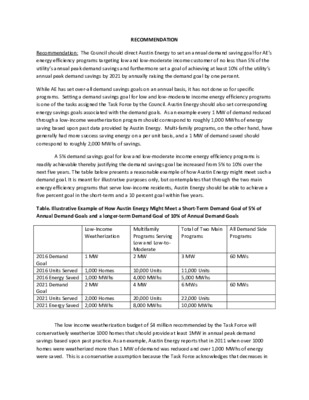
RECOMMENDATION Recommendation: The Council should direct Austin Energy to set an annual demand saving goal for AE’s energy efficiency programs targeting low and low-moderate income customer of no less than 5% of the utility’s annual peak demand savings and furthermore set a goal of achieving at least 10% of the utility’s annual peak demand savings by 2021 by annually raising the demand goal by one percent. While AE has set over-all demand savings goals on an annual basis, it has not done so for specific programs. Setting a demand savings goal for low and low-moderate income energy efficiency programs is one of the tasks assigned the Task Force by the Council. Austin Energy should also set corresponding energy savings goals associated with the demand goals. As an example every 1 MW of demand reduced through a low-income weatherization program should correspond to roughly 1,000 MWhs of energy saving based upon past data provided by Austin Energy. Multi-family programs, on the other hand, have generally had more success saving energy on a per unit basis, and a 1 MW of demand saved should correspond to roughly 2,000 MWhs of savings. A 5% demand savings goal for low and low-moderate income energy efficiency programs is readily achievable thereby justifying the demand savings goal be increased from 5% to 10% over the next five years. The table below presents a reasonable example of how Austin Energy might meet such a demand goal. It is meant for illustrative purposes only, but contemplates that through the two main energy efficiency programs that serve low-income residents, Austin Energy should be able to achieve a five percent goal in the short-term and a 10 percent goal within five years. Table. Illustrative Example of How Austin Energy Might Meet a Short-Term Demand Goal of 5% of Annual Demand Goals and a longer-term Demand Goal of 10% of Annual Demand Goals Low-Income Weatherization Multifamily Programs Serving Low and Low-to-Moderate Total of Two Main Programs All Demand Side Programs 2016 Demand Goal 1 MW 2 MW 3 MW 60 MWs 2016 Units Served 1,000 Homes 10,000 Units 11,000 Units 2016 Energy Saved 1,000 MWhs 4,000 MWhs 5,000 MWhs 2021 Demand Goal 2 MW 4 MW 6 MWs 60 MWs 2021 Units Served 2,000 Homes 20,000 Units 22,000 Units 2021 Energy Saved 2,000 MWhs 8,000 MWhs 10,000 MWhs The low income weatherization budget of $4 million recommended by the Task Force …
Recommendation Number _____1 Online Access of ECAD Results Targeted Underserved Group: All Renters Recommendation: Make the results of ECAD audits and disclosure forms for multi-family properties available on the city’s website. Time Schedule: Implementation in 2016 Budget Impact: The budget impact is unknown at this time. It is anticipated that the posting of documents on a website should be achievable at a reasonable cost and may therefore be possible within the current ECAD budget allocation. Community Need: The ECAD ordinance was adopted in 2008 and amended in 2011. In 2013, 54.9%2 of all households in Austin were renters. The survey further shows that 32.8% of renter households have annual income under $25,000 and another 31.1% have income between $25,000 and $49,999. Thus, 63.9% of renter households have income under $50,000 per year.3 Median household income for renters is $37,538 compared to $85,246 for homeowners. As utilities become a more significant part of the affordable housing equation ECAD can provide important guidance to consumers choosing a different apartment to rent. The problem is that the average consumer is unaware of ECAD and the information it provides. At the July 17, 2015 Austin Energy Affordable Energy Summit, and informal poll taken by hand indicated that 4 attendees knew about the program. Program Description: Under the city’s Energy Conservation Audit Disclosure (ECAD) ordinance, apartments with 5 or more units were required to have an energy audit conducted by June 1, 2011. The results are to be made available in three ways. 1) the results must be prominently displayed in facility common areas where public and legal notices are regularly posted, 2) copies of the audit must be available for review at the leasing or manager’s office, and 3) the standardized audit disclosure form must be provided to a prospective tenant prior to the tenant’s signing of a lease application or if no application is required prior to the signing of a lease. Searching the Internet for information about rental properties is a common practice. Having the ECAD documents posted on the city’s website would give consumers the ability to access and compare the documents early in the process of searching for housing. 1 Number will be assigned in final report. 2 U.S. Census Bureau, American Fact Finder , S2503 FINANCIAL CHARACTERISTICS, 2009-2013 American Community Survey 5-Year Estimates. 3 Ibid.
Recommendation Number ____ Amend the ECAD ordinance to include small rental properties Recommendation: Amend Austin City Code Chapter 6-7 and Austin Energy Rule R161-11.32 to provide the Energy Conservation Audit Disclosure to renters of single family homes, duplexes, triplexes and fourplexes. Targeted Underserved Group: All renters Time Schedule: Enact the expanded scope in 2015 and begin enforcement in 2016. Budget Impact: Accomplish within current budget for 2015 and proposed budget for 2016 Brief Description: Amend the ECAD ordinance to add a category for rental properties not exceeding four dwelling units. Moreover amend the ECAD rules to require landlords to provide energy audit disclosure information to prospective tenants in the same or similar manner as the energy audit information is disclosed tor renters in large apartment complexes.. Community Need: Consumers should be provided the information they need to make an educated decision about where to live. The ECAD ordinance was adopted with provisions to better inform families entering into leases in apartments of how the utility bills of current residents compare with the bills of other renters in the city. The status quo is that renters are often blindsided by high electric bills after signing a lease. After an exhaustive search for an affordable unit or a unit that accepts housing vouchers what appears to be affordable is not because of unexpectedly high utility bills. In some cases, a rental property with higher rent, but lower electric bills would be more affordable overall. In 2013, 54.9%1 of all households in Austin were renters. According to U.S. census data, 44% of renter-occupied housing units are in complexes that contain between 5 and 50 units. The remaining 37% of housing units are single-family, attached, duplex, triplex and four-plex structures.2 Data further show that 32.8% of renter households have annual income under $25,000 and another 31.1% have income between $25,000 and $49,999. Thus, 63.9% of renter households have income under $50,000 per year.3 Median household income for renters is $37,538 compared to $85,246 for homeowners.4 Program Description: The proposed amendment to the ECAD ordinance would provide the energy audit information to all renters, not just those in large apartment complexes. Landlords of single-family homes, duplexes, triplexes, fourplexes, and units designated as condominiums won’t be required to make energy efficiency upgrades, but will have to get energy audits done on 1 U.S. Census Bureau, American Fact Finder , S2503 FINANCIAL CHARACTERISTICS, 2009-2013 American Community Survey …
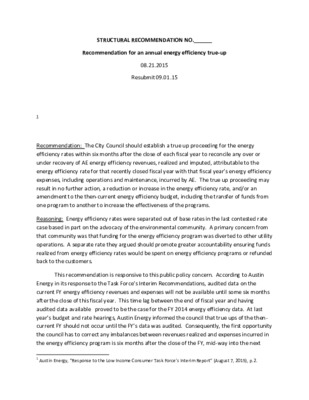
STRUCTURAL RECOMMENDATION NO.______ Recommendation for an annual energy efficiency true-up 08.21.2015 Resubmit 09.01.15 1 Recommendation: The City Council should establish a true up proceeding for the energy efficiency rates within six months after the close of each fiscal year to reconcile any over or under recovery of AE energy efficiency revenues, realized and imputed, attributable to the energy efficiency rate for that recently closed fiscal year with that fiscal year’s energy efficiency expenses, including operations and maintenance, incurred by AE. The true up proceeding may result in no further action, a reduction or increase in the energy efficiency rate, and/or an amendment to the then-current energy efficiency budget, including the transfer of funds from one program to another to increase the effectiveness of the programs. Reasoning: Energy efficiency rates were separated out of base rates in the last contested rate case based in part on the advocacy of the environmental community. A primary concern from that community was that funding for the energy efficiency program was diverted to other utility operations. A separate rate they argued should promote greater accountability ensuring funds realized from energy efficiency rates would be spent on energy efficiency programs or refunded back to the customers. This recommendation is responsive to this public policy concern. According to Austin Energy in its response to the Task Force’s Interim Recommendations, audited data on the current FY energy efficiency revenues and expenses will not be available until some six months after the close of this fiscal year. This time lag between the end of fiscal year and having audited data available proved to be the case for the FY 2014 energy efficiency data. At last year’s budget and rate hearings, Austin Energy informed the council that true ups of the then-current FY should not occur until the FY’s data was audited. Consequently, the first opportunity the council has to correct any imbalances between revenues realized and expenses incurred in the energy efficiency program is six months after the close of the FY, mid-way into the next 1 Austin Energy, “Response to the Low Income Consumer Task Force’s Interim Report” (August 7, 2015), p.2. year’s FY’s operations. A true up proceeding at this time would provide up to date adjustments to the then current FY EE programs and/or rates in a timely manner. Without this true-up the regulatory risk increases that funds collected with EE rates are spent elsewhere in …
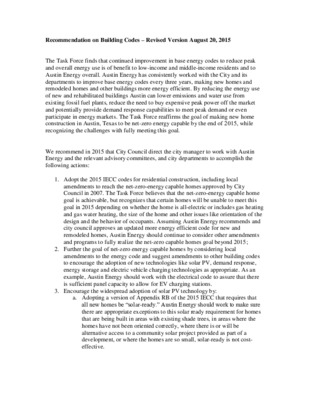
Recommendation on Building Codes – Revised Version August 20, 2015 The Task Force finds that continued improvement in base energy codes to reduce peak and overall energy use is of benefit to low-income and middle-income residents and to Austin Energy overall. Austin Energy has consistently worked with the City and its departments to improve base energy codes every three years, making new homes and remodeled homes and other buildings more energy efficient. By reducing the energy use of new and rehabilitated buildings Austin can lower emissions and water use from existing fossil fuel plants, reduce the need to buy expensive peak power off the market and potentially provide demand response capabilities to meet peak demand or even participate in energy markets. The Task Force reaffirms the goal of making new home construction in Austin, Texas to be net-zero energy capable by the end of 2015, while recognizing the challenges with fully meeting this goal. We recommend in 2015 that City Council direct the city manager to work with Austin Energy and the relevant advisory committees, and city departments to accomplish the following actions: 1. Adopt the 2015 IECC codes for residential construction, including local amendments to reach the net-zero-energy capable homes approved by City Council in 2007. The Task Force believes that the net-zero-energy capable home goal is achievable, but recognizes that certain homes will be unable to meet this goal in 2015 depending on whether the home is all-electric or includes gas heating and gas water heating, the size of the home and other issues like orientation of the design and the behavior of occupants. Assuming Austin Energy recommends and city council approves an updated more energy efficient code for new and remodeled homes, Austin Energy should continue to consider other amendments and programs to fully realize the net-zero capable homes goal beyond 2015; 2. Further the goal of net-zero energy capable homes by considering local amendments to the energy code and suggest amendments to other building codes to encourage the adoption of new technologies like solar PV, demand response, energy storage and electric vehicle charging technologies as appropriate. As an example, Austin Energy should work with the electrical code to assure that there is sufficient panel capacity to allow for EV charging stations. 3. Encourage the widespread adoption of solar PV technology by: a. Adopting a version of Appendix RB of the 2015 IECC that requires that all …
CLARIFICATION OF PROPOSED (d) TO THE Task Force’s RECOMMENDATION ON TRANSPARENCY, REPORTING AND ACCOUNTING Request for Clarification:.. Paragraph (d) to the Task Force’s Recommendation on Transparency, Reporting and Accounting should read as follows: Austin Energy should develop better tracking data by energy efficiency program and by city council district to: . . . . .
1 LOW INCOME CONSUMER ADVISORY TASK FORCE FINAL REPORT DRAFT FOR DISCUSSION September 4, 2015 This draft report is the product of a working group consisting of Task Force Members Lanetta Cooper, Cyrus Reed, Chris Strand and Carol Biedrzycki. You will see in reviewing the draft that there are placeholders for agenda items that are posted for discussion at the on September 4, 2015 task force meeting. At Friday’s meeting please make your comments specific to this draft. For example, if you believe something needs to be added please have copies of a draft of the material available for the group and have a specific suggestion as to where you would like it to fit into the draft. At the meeting there has been discussion about listing appropriate topics and areas of discussion for the future. This section of the report still needs to be drafted. The report working group plans to have the next draft on September 11th that will incorporate all the recommendations made to date and comments submitted to the task force on September 4th. 2 Executive Summary 3 I. Table of Contents I. INTRODUCTION 5 II. BACKGROUND 5 A. Summary of Task Force Activities 6 1. Mission 6 2. Membership 6 3. Activities 7 4. Briefings and Reports 8 B. Demographics 9 C. History of Low and Low Moderate Income Programs 12 D. Equity 13 III. RECOMMENDATIONS 14 A. Global Recommendations 14 1. Program Evaluation Policies 15 2. Transparency, Reporting, and Accounting 16 3. Energy Efficiency True-Up Correction for Energy Efficiency Services Budget Implementation 21 4. Better Building Codes and Planning Review Process 21 5. Establishing goals for demand and energy savings for all programs 21 6. Establishing goals for demand and energy savings for low and low moderate income energy efficiency programs including the weatherization program. 22 7. Establishing budget goals for low and low moderate income energy efficiency programs including the weatherization program. 22 B. Program Goals 23 C. Residential 24 1. Rollover of Unspent Weatherization Funds 25 2. Universal Application with Automatic Referral Process 26 3. Provision of Air Conditioners in Low Income Weatherization Program 27 4. On-Bill Repayment 29 5. Contractor Rebate Pilot program in conjunction with Affordable Housing projects 31 6. Energy Star Window Heating and Cooling Units for Vulnerable Populations 33 7. Low Interest Loans for Installation of Energy Star Window Units 34 8. Low Interest Loans for Comprehensive Energy …
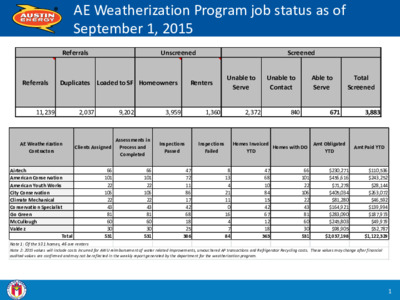
AE Weatherization Program job status as of September 1, 2015 1 ReferralsDuplicates Loaded to SFHomeownersRentersUnable to ServeUnable to Contact Able to ServeTotal Screened11,2392,0379,2023,9591,3602,3728406713,883ReferralsUnscreenedScreenedAE Weatherization ContractorsClients AssignedAssessments in Process and CompletedInspections PassedInspections FailedHomes Invoiced YTDHomes with DOAmt Obligated YTDAmt Paid YTDAirtech66664784766$230,271$110,536American Conservation101101721368101$456,616$243,252American Youth Works22221141022$71,278$28,144City Conservation 106106862184106$405,034$263,072Climate Mechanical222217111522$81,280$46,592Conservation Specialist43434204243$164,921$139,994Go Green818168166781$283,090$187,973McCullough60601841260$245,803$49,979Valdez30302571830$98,905$52,787Total53153138684363531$2,037,198$1,122,329Note 1: Of the 531 homes, 46 are rentersNote 2: 2015 values will include costs incurred for AWU reimbursement of water related improvements, unvouchered AP transactions and Refrigerator Recycling costs. These values may change after financial audited values are confirmed and may not be reflected in the weekly report generated by the department for the weatherization program.
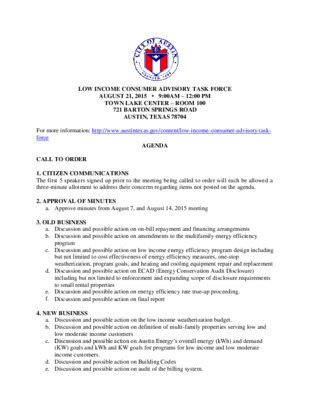
LOW INCOME CONSUMER ADVISORY TASK FORCE AUGUST 21, 2015 9:00AM – 12:00 PM TOWN LAKE CENTER – ROOM 100 721 BARTON SPRINGS ROAD AUSTIN, TEXAS 78704 For more information: http://www.austintexas.gov/content/low-income-consumer-advisory-task- force AGENDA CALL TO ORDER 1. CITIZEN COMMUNICATIONS The first 5 speakers signed up prior to the meeting being called to order will each be allowed a three-minute allotment to address their concerns regarding items not posted on the agenda. 2. APPROVAL OF MINUTES a. Approve minutes from August 7, and August 14, 2015 meeting 3. OLD BUSINESS a. Discussion and possible action on on-bill repayment and financing arrangements b. Discussion and possible action on amendments to the multifamily energy efficiency program c. Discussion and possible action on low income energy efficiency program design including but not limited to cost effectiveness of energy efficiency measures, one-stop weatherization, program goals, and heating and cooling equipment repair and replacement d. Discussion and possible action on ECAD (Energy Conservation Audit Disclosure) including but not limited to enforcement and expanding scope of disclosure requirements to small rental properties e. Discussion and possible action on energy efficiency rate true-up proceeding. f. Discussion and possible action on final report 4. NEW BUSINESS a. Discussion and possible action on the low income weatherization budget. b. Discussion and possible action on definition of multi-family properties serving low and low moderate income customers c. Discussion and possible action on Austin Energy’s overall energy (kWh) and demand (KW) goals and kWh and KW goals for programs for low income and low moderate income customers. d. Discussion and possible action on Building Codes e. Discussion and possible action on audit of the billing system. The City of Austin is committed to compliance with the American with Disabilities Act. Reasonable modifications and equal access to communications will be provided upon request. Meeting locations are planned with wheelchair access. If requiring Sign Language Interpreters or alternative formats, please give notice at least 2 days (48 hours) before the meeting date. Please call Liz Jambor at Austin Energy Department, 513-322-6353, for additional information; TTY users route through Relay Texas at 711. For more information on the Low Income Consumer Advisory Task Force, please contact Liz Jambor at 512-322-6353 f. Discussion and possible action on the need for a task force after October 1, 2015. 5. BRIEFINGS & REPORTS a. Austin Energy staff update on the weatherization program job status b. Status of data …
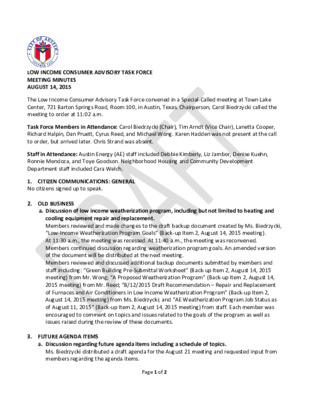
Page 1 of 2 LOW INCOME CONSUMER ADVISORY TASK FORCE MEETING MINUTES AUGUST 14, 2015 The Low Income Consumer Advisory Task Force convened in a Special-Called meeting at Town Lake Center, 721 Barton Springs Road, Room 100, in Austin, Texas. Chairperson, Carol Biedrzycki called the meeting to order at 11:02 a.m. Task Force Members in Attendance: Carol Biedrzycki (Chair), Tim Arndt (Vice Chair), Lanetta Cooper, Richard Halpin, Dan Pruett, Cyrus Reed, and Michael Wong. Karen Hadden was not present at the call to order, but arrived later. Chris Strand was absent. Staff in Attendance: Austin Energy (AE) staff included Debbie Kimberly, Liz Jambor, Denise Kuehn, Ronnie Mendoza, and Toye Goodson. Neighborhood Housing and Community Development Department staff included Cara Welch. 1. CITIZEN COMMUNICATIONS: GENERAL No citizens signed up to speak. 2. OLD BUSINESS a. Discussion of low income weatherization program, including but not limited to heating and cooling equipment repair and replacement. Members reviewed and made changes to the draft backup document created by Ms. Biedrzycki, “Low-Income Weatherization Program Goals” (Back-up Item 2, August 14, 2015 meeting). At 11:30 a.m., the meeting was recessed. At 11:40 a.m., the meeting was reconvened. Members continued discussion regarding weatherization program goals. An amended version of the document will be distributed at the next meeting. Members reviewed and discussed additional backup documents submitted by members and staff including: “Green Building Pre-Submittal Worksheet” (Back-up Item 2, August 14, 2015 meeting) from Mr. Wong; “A Proposed Weatherization Program” (Back-up Item 2, August 14, 2015 meeting) from Mr. Reed; “8/12/2015 Draft Recommendation – Repair and Replacement of Furnaces and Air Conditioners in Low Income Weatherization Program” (Back-up Item 2, August 14, 2015 meeting) from Ms. Biedrzycki; and “AE Weatherization Program Job Status as of August 11, 2015” (Back-up Item 2, August 14, 2015 meeting) from staff. Each member was encouraged to comment on topics and issues related to the goals of the program as well as issues raised during the review of these documents. 3. FUTURE AGENDA ITEMS a. Discussion regarding future agenda items including a schedule of topics. Ms. Biedrzycki distributed a draft agenda for the August 21 meeting and requested input from members regarding the agenda items. Page 2 of 2 Members also discussed including a recommendation in the final report suggesting the work of the task force continue past the October 1, 2015 date included in the Council resolution. ADJOURNMENT The Chair adjourned the …
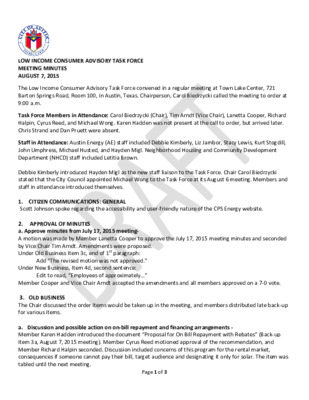
Page 1 of 3 LOW INCOME CONSUMER ADVISORY TASK FORCE MEETING MINUTES AUGUST 7, 2015 The Low Income Consumer Advisory Task Force convened in a regular meeting at Town Lake Center, 721 Barton Springs Road, Room 100, in Austin, Texas. Chairperson, Carol Biedrzycki called the meeting to order at 9:00 a.m. Task Force Members in Attendance: Carol Biedrzycki (Chair), Tim Arndt (Vice Chair), Lanetta Cooper, Richard Halpin, Cyrus Reed, and Michael Wong. Karen Hadden was not present at the call to order, but arrived later. Chris Strand and Dan Pruett were absent. Staff in Attendance: Austin Energy (AE) staff included Debbie Kimberly, Liz Jambor, Stacy Lewis, Kurt Stogdill, John Umphress, Michael Husted, and Hayden Migl. Neighborhood Housing and Community Development Department (NHCD) staff included Letitia Brown. Debbie Kimberly introduced Hayden Migl as the new staff liaison to the Task Force. Chair Carol Biedrzycki stated that the City Council appointed Michael Wong to the Task Force at its August 6 meeting. Members and staff in attendance introduced themselves. 1. CITIZEN COMMUNICATIONS: GENERAL Scott Johnson spoke regarding the accessibility and user-friendly nature of the CPS Energy website. 2. APPROVAL OF MINUTES a. Approve minutes from July 17, 2015 meeting- A motion was made by Member Lanetta Cooper to approve the July 17, 2015 meeting minutes and seconded by Vice Chair Tim Arndt. Amendments were proposed. Under Old Business Item 3c, end of 1st paragraph: Add “The revised motion was not approved.” Under New Business, Item 4d, second sentence: Edit to read, “Employees of approximately…” Member Cooper and Vice Chair Arndt accepted the amendments and all members approved on a 7-0 vote. 3. OLD BUSINESS The Chair discussed the order items would be taken up in the meeting, and members distributed late back-up for various items. a. Discussion and possible action on on-bill repayment and financing arrangements - Member Karen Hadden introduced the document “Proposal for On Bill Repayment with Rebates” (Back-up Item 3a, August 7, 2015 meeting). Member Cyrus Reed motioned approval of the recommendation, and Member Richard Halpin seconded. Discussion included concerns of this program for the rental market, consequences if someone cannot pay their bill, target audience and designating it only for solar. The item was tabled until the next meeting. Page 2 of 3 b. Discussion and possible action on amendments to the multifamily energy efficiency program - This item was not discussed. c. Discussion and possible action on …
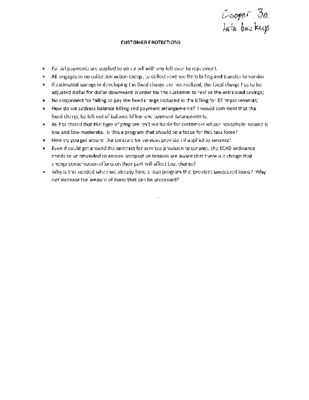
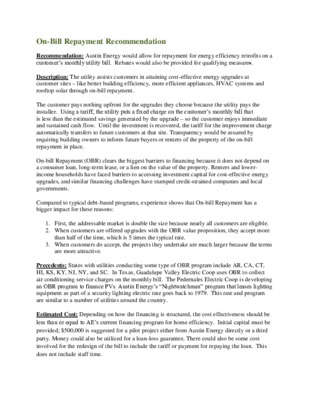
On-Bill Repayment Recommendation Recommendation: Austin Energy would allow for repayment for energy efficiency retrofits on a customer’s monthly utility bill. Rebates would also be provided for qualifying measures. Description: The utility assists customers in attaining cost-effective energy upgrades at customer sites – like better building efficiency, more efficient appliances, HVAC systems and rooftop solar through on-bill repayment. The customer pays nothing upfront for the upgrades they choose because the utility pays the installer. Using a tariff, the utility puts a fixed charge on the customer’s monthly bill that is less than the estimated savings generated by the upgrade – so the customer enjoys immediate and sustained cash flow. Until the investment is recovered, the tariff for the improvement charge automatically transfers to future customers at that site. Transparency would be assured by requiring building owners to inform future buyers or renters of the property of the on-bill repayment in place. On-bill Repayment (OBR) clears the biggest barriers to financing because it does not depend on a consumer loan, long-term lease, or a lien on the value of the property. Renters and lower-income households have faced barriers to accessing investment capital for cost-effective energy upgrades, and similar financing challenges have stumped credit-strained companies and local governments. Compared to typical debt-based programs, experience shows that On-bill Repayment has a bigger impact for these reasons: 1. First, the addressable market is double the size because nearly all customers are eligible. 2. When customers are offered upgrades with the OBR value proposition, they accept more than half of the time, which is 5 times the typical rate. 3. When customers do accept, the projects they undertake are much larger because the terms are more attractive. Precedents: States with utilities conducting some type of OBR program include AR, CA, CT, HI, KS, KY, NJ, NY, and SC. In Texas, Guadalupe Valley Electric Coop uses OBR to collect air conditioning service charges on the monthly bill. The Pedernales Electric Coop is developing an OBR program to finance PVs. Austin Energy’s “Nightwatchman” program that leases lighting equipment as part of a security lighting electric rate goes back to 1979. This rate and program are similar to a number of utilities around the country. Estimated Cost: Depending on how the financing is structured, the cost effectiveness should be less than or equal to AE’s current financing program for home efficiency. Initial capital must be provided; $500,000 is suggested …
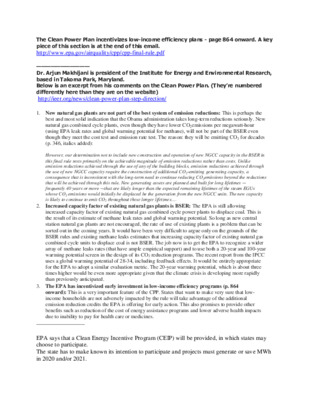
The Clean Power Plan incentivizes low-income efficiency plans - page 864 onward. A key piece of this section is at the end of this email. http://www.epa.gov/airquality/cpp/cpp-final-rule.pdf ——————————— Dr. Arjun Makhijani is president of the Institute for Energy and Environmental Research, based in Takoma Park, Maryland. Below is an excerpt from his comments on the Clean Power Plan. (They’re numbered differently here than they are on the website) http://ieer.org/news/clean-power-plan-step-direction/ 1. New natural gas plants are not part of the best system of emission reductions: This is perhaps the best and most solid indication that the Obama administration takes long-term reductions seriously. New natural gas combined cycle plants, even though they have lower CO2emissions per megawatt-hour (using EPA leak rates and global warming potential for methane), will not be part of the BSER even though they meet the cost test and emission rate test. The reason: they will be emitting CO2 for decades (p. 346, italics added): However, our determination not to include new construction and operation of new NGCC capacity in the BSER in this final rule rests primarily on the achievable magnitude of emission reductions rather than costs. Unlike emission reductions achieved through the use of any of the building blocks, emission reductions achieved through the use of new NGCC capacity require the construction of additional CO2-emitting generating capacity, a consequence that is inconsistent with the long-term need to continue reducing CO2emissions beyond the reductions that will be achieved through this rule. New generating assets are planned and built for long lifetimes –- frequently 40 years or more –-that are likely longer than the expected remaining lifetimes of the steam EGUs whose CO2 emissions would initially be displaced be the generation from the new NGCC units. The new capacity is likely to continue to emit CO2 throughout these longer lifetimes…. 2. Increased capacity factor of existing natural gas plants is BSER: The EPA is still allowing increased capacity factor of existing natural gas combined cycle power plants to displace coal. This is the result of its estimate of methane leak rates and global warming potential. So long as new central station natural gas plants are not encouraged, the rate of use of existing plants is a problem that can be sorted out in the coming years. It would have been very difficult to argue only on the grounds of the BSER rules and existing methane leaks estimates that increasing capacity …
Recommendation Number _____ Recommendation for Contractor Rebates in conjunction with affordable housing projects August 21, 2015 Recommendation: In addition to a stand-alone low income weatherization energy efficiency program approach, a residential low income weatherization rebate program should be implemented in conjunction with the affordable housing programs administered by the City’s Neighborhood Housing and Community Development department to obtain efficiencies of scope. Because of the leveraging of the weatherization program into the affordable housing programs, AE will be able to capture the additional demand and energy savings arising from the affordable housing programs. The provision of energy efficient appliances through bulk purchasing would be part of this program. The department would serve as a case manager to ensure AE is brought into the process. Targeted Underserved Group: Low income Homeowners with Incomes between 0 and 250%% of the Federal Poverty Guideline. Time Schedule: Begin plan to implement in 2016 and implement by 2017. Brief Description: Provide rebates to contractors on AE’s list of eligible energy efficiency contractors for performing weatherization services and installing energy efficiency appliances purchased in bulk by AE as part of a customer’s participation in an affordable housing program. Community Need: According to the January 2015 Updated Energy Burden Tables for Austin Energy, 28% of all residential customers have family incomes between 0 and 200% of the Federal Poverty Guideline.1 Low income consumers do not have the disposable income to obtain weatherization services nor to purchase energy efficient appliance that would provide demand and energy savings to Austin Energy as well as bill savings to the low-income households. During the task force process, comments were presented by nonprofit service providers that the current program is cumbersome for the service providers and the clients obtaining home repairs though the providers work with the home repair coalition.i Program Description: When a home is evaluated for participation in an affordable housing program, as part of that process, AE would be contacted to evaluate for the applicant’s participation in AE’s weatherization program. If eligible, the residence will also receive an energy audit to identify energy efficiency improvements that can be made through the weatherization program. Instead of referring a client to the weatherization program after the completion of an affordable housing program project, the weatherization services and appliance installations provided by the Austin Energy rebate program would be incorporated into the home repair process. This allows for more contractor efficiency and should …
1 Proposed Recommendation Number _____ Recommendation for Vulnerable Populations August 21, 2015 Recommendation: A residential low income energy efficiency program should be created to provide window heating and/or cooling units including installation to low income families served by Austin Energy with at least one member: aged 62 or older, disabled, or a child who is six years of age or younger. This program would be implemented through the use of contractor rebates and the provision of energy efficient window cooling and/or heating units purchased by AE achieving discounts through the use of commitments to purchase a minimum number of appliances from one to three retailers in the Austin area. Targeted Underserved Group: Homeowners and tenants whose household income qualifies for the emergency home repair program provided by the City of Austin Neighborhood Housing & Community Development and who meet the qualifications stated above. Time Schedule: Implement in 2016. Brief Description: Provide emergency heating and/or cooling relief to vulnerable populations through the provision of energy efficiency cooling and/or heating window units. Program Description: This program would be provided in conjunction with the City of Austin’s emergency Home Repair Program which is part of the City of Austin’s Neighborhood Housing & Community Development Client Service’s Programs. Contractors certified by Austin Energy would perform the work. Austin Energy would certify that the window unit(s) is (are) needed before the window unit is installed. Once that determination is made, Austin Energy would provide the window unit(s). After installation, Austin Energy would review the household to ensure the window unit was installed and installed properly. A rebate check issued to the contractor to cover the cost of installation would be provided after the final Austin Energy review. As part of implementing this program, AE should consider providing the air conditioner units through a loan program taking into consideration storage and refurbishing issues involved in a loan program and the experience of other jurisdictions in the loaning of air conditioner units. Budget: There are two funding components to this proposed program: 2 1. One-time funding to establish a contingency reserve to provide payment to the manufacturer-retailer if the guaranteed minimum level of cooling and/or heating appliances are not purchased; and 2. Funding for rebates.
Recommendation No. ___ Recommend AE leverage with Austin Housing Authority Recommendation: AE should leverage its EE programs with Austin Housing Authority rehab and building programs. The council may need to enter into a memorandum of understanding to establish the relationship with Austin Housing Authority. Reasoning One of the problems AE faces with providing EE to low income tenants involving multi-family units is determining income eligibility. For the most part, AE utilizes third sources for eligibility determinations in its residential low income program. This recommendation would allow AE to utilize third party determination for income eligibility for tenants. Public housing’s tenants are all low income. Consequently, AE will be assured that it is using EE funds to low income tenants through the provision of EE services to public housing multi-family housing stock .
RECOMMENDATION NO.___ Recommend Austin Housing Finance Corporation to condition financing on applicant request for EE services Recommendation: Austin Housing Finance Corporation should condition financing approval to applicants involved with affordable housing with a condition that applicant seek energy efficiency services from AE, including solar for new construction financing. Higher rebates should be offered to these applicants. Reasoning: Austin Housing Finance Corporation provides low cost financing to builders and developers who construct affordable housing. For many applicants, the housing corporation requires them to apply for tax credits, which further ensures low and low-moderate income households will have access to the housing being constructed. Adding a requirement that the applicant seek energy efficiency services from AE, particularly solar will provide greater housing affordability to the tenants. AE funding of energy efficiency programs to these applicants will greater assure that EE funding to going to low and low-moderate income AE customers.
8/19/2015 Draft Recommendation Number ____ Provision of Air Conditioners in Low Income Weatherization Program Recommendation: To make window unit air conditioners the standard air conditioning application in the low income weatherization program and to include under limited circumstances, repair and replacement of central air conditioners. Targeted Underserved Group: Low income customers Time Schedule: Implementation in 2016 Budget Impact: Accomplish within current budget. Brief Description: To make window unit air conditioners the standard air conditioning application in the low income weatherization program and to include under limited circumstances, repair and replacement of central air conditioners Community need: The summer weather in Austin is extremely hot for certain periods of time. When the heat index reaches 102, Austin Energy, is prohibited from disconnecting a customer’s service1 because air conditioning is necessary to protect a resident’s health and safety especially the elderly and young children.2 While it is possible to live through an Austin summer with no air conditioning, people without air conditioning in their homes are encouraged to take shelter in public buildings with air conditioning during the hottest times of the day. Over one-fourth (118,241) of Austin Energy’s residential customers have incomes that qualify for Free Weatherization.3 Customers living with income below 50% of the Federal Poverty Guideline (FPG) spend 37.6% of household income on electricity. Those at 51 to 100% of FPG spend 11.3% and those at 101 to 200% FPG spend 5.9%. Those above 400% of the FPG spend 1.6%4. As utility bills increase because of higher rates and the pass through surcharges for regulatory costs, community benefit charge and other charges, low income customers are the most profoundly impacted by increases. As utility bills rise, the energy burden becomes an even higher percentage of those households on fixed and low incomes. There are large numbers of households in the Austin Energy service area with low income, high utility bills and very few energy efficiency program resources. 1 Austin City Code §15-9-109. 2 Sweating out a Texas heat wave, A guide to preventing hot weather illness. 3 Memorandum from Liz Jambor, EdD, Manager, to Low Income Consumer Advisory Task Force 01//5/15., p 5. 4 Ibid. In Texas, 26% of all home energy use is attributable to central air conditioning, 11% to the refrigerator, 9% to space heating, 7% to water heating and 2% to room air conditioning.5 Under the current program, a customer can participate in the low income …
DRAFT AUGUST 19, 2015 PROGRAM GOALS The City of Austin Sustainability Office uses a matrix of energy and non-energy benefits for evaluating its purchasing recommendations. The Low Income Consumer Advisory Task Force adopted this matrix for evaluating energy efficiency programs for customer households with low and low-moderate incomes. The Task Force included the additional consideration of program impacts to Austin Energy’s bad debt and collection costs. As a further refinement the Task Force adopted the goals listed below. The order in which the goals are listed does not indicate their order of importance. To evaluate the program in consideration of the triple bottom line of sustainability equity (people), economy (prosperity) and environment (planet). To achieve greenhouse gas reductions to support the city’s climate protection goals. To assure that the programs contribute to Austin Energy’s overall peak demand reduction goals of 800 MWs by 2020 and at least 900 MWs by the end of 2024, as well as to contributing to associated energy saving targets. To utilize the low-income energy efficiency programs in a way that helps contribute to compliance with the Clean Power Plan rule, and specifically, take advantage of the opportunities present under the Clean Energy Incentive Program, which gives enhanced credits to utilities and states to implement low-income efficiency and renewable energy programs. To fully utilize incentives and opportunities presented by federal and state programs and policies, including the Environmental Protection Agency’s Clean Energy Incentive Program. To defer or avoid the need for capital investment in new generating facilities and to reduce the burning of fossil fuels for electricity generation and end use applications such as space and water heating and cooking. To assure that an equitable level of program benefits is delivered to low-income customers. To reduce bad debt and collection costs to the utility. To provide for a continuing dialogue within a new task force with a focus on low-income energy efficiency issues and solutions. LOW-INCOME WEATHERIZATION PROGRAM GOALS In light of the public disagreement over the value of the now completed ARRA program the Task Force recommends that the utility move forward with a program designed to meet specific goals and to evaluate the program in accordance with those goals. In addition to and in accordance with the program goals presented earlier the Task Force adopted the following goals for the low-income weatherization program. To …
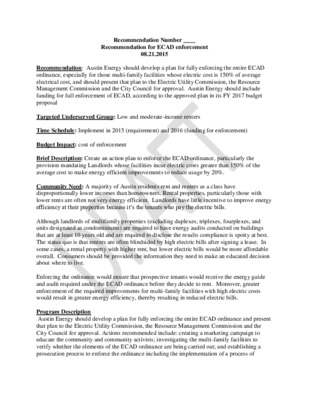
Recommendation Number ____ Recommendation for ECAD enforcement 08.21.2015 Recommendation: Austin Energy should develop a plan for fully enforcing the entire ECAD ordinance, especially for those multi-family facilities whose electric cost is 150% of average electrical cost, and should present that plan to the Electric Utility Commission, the Resource Management Commission and the City Council for approval. Austin Energy should include funding for full enforcement of ECAD, according to the approved plan in its FY 2017 budget proposal Targeted Underserved Group: Low and moderate-income renters Time Schedule: Implement in 2015 (requirement) and 2016 (funding for enforcement) Budget Impact: cost of enforcement Brief Description: Create an action plan to enforce the ECAD ordinance, particularly the provision mandating Landlords whose facilities incur electric costs greater than 150% of the average cost to make energy efficient improvements to reduce usage by 20%. Community Need: A majority of Austin residents rent and renters as a class have disproportionally lower incomes than homeowners. Rental properties, particularly those with lower rents are often not very energy efficient. Landlords have little incentive to improve energy efficiency at their properties because it’s the tenants who pay the electric bills. Although landlords of multifamily properties (excluding duplexes, triplexes, fourplexes, and units designated as condominiums) are required to have energy audits conducted on buildings that are at least 10 years old and are required to disclose the results compliance is spotty at best. The status quo is that renters are often blindsided by high electric bills after signing a lease. In some cases, a rental property with higher rent, but lower electric bills would be more affordable overall. Consumers should be provided the information they need to make an educated decision about where to live. Enforcing the ordinance would ensure that prospective tenants would receive the energy guide and audit required under the ECAD ordinance before they decide to rent. Moreover, greater enforcement of the required improvements for multi-family facilities with high electric costs would result in greater energy efficiency, thereby resulting in reduced electric bills. Program Description Austin Energy should develop a plan for fully enforcing the entire ECAD ordinance and present that plan to the Electric Utility Commission, the Resource Management Commission and the City Council for approval. Actions recommended include: creating a marketing campaign to educate the community and community activists; investigating the multi-family facilities to verify whether the elements of the ECAD ordinance are being carried out; …
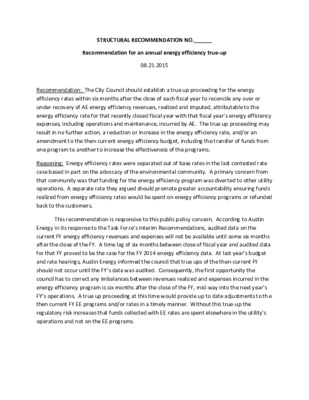
STRUCTURAL RECOMMENDATION NO.______ Recommendation for an annual energy efficiency true-up 08.21.2015 Recommendation: The City Council should establish a true up proceeding for the energy efficiency rates within six months after the close of each fiscal year to reconcile any over or under recovery of AE energy efficiency revenues, realized and imputed, attributable to the energy efficiency rate for that recently closed fiscal year with that fiscal year’s energy efficiency expenses, including operations and maintenance, incurred by AE. The true up proceeding may result in no further action, a reduction or increase in the energy efficiency rate, and/or an amendment to the then-current energy efficiency budget, including the transfer of funds from one program to another to increase the effectiveness of the programs. Reasoning: Energy efficiency rates were separated out of base rates in the last contested rate case based in part on the advocacy of the environmental community. A primary concern from that community was that funding for the energy efficiency program was diverted to other utility operations. A separate rate they argued should promote greater accountability ensuring funds realized from energy efficiency rates would be spent on energy efficiency programs or refunded back to the customers. This recommendation is responsive to this public policy concern. According to Austin Energy in its response to the Task Force’s Interim Recommendations, audited data on the current FY energy efficiency revenues and expenses will not be available until some six months after the close of the FY. A time lag of six months between close of fiscal year and audited data for that FY proved to be the case for the FY 2014 energy efficiency data. At last year’s budget and rate hearings, Austin Energy informed the council that true ups of the then-current FY should not occur until the FY’s data was audited. Consequently, the first opportunity the council has to correct any imbalances between revenues realized and expenses incurred in the energy efficiency program is six months after the close of the FY, mid-way into the next year’s FY’s operations. A true up proceeding at this time would provide up to date adjustments to the then current FY EE programs and/or rates in a timely manner. Without this true-up the regulatory risk increases that funds collected with EE rates are spent elsewhere in the utility’s operations and not on the EE programs.
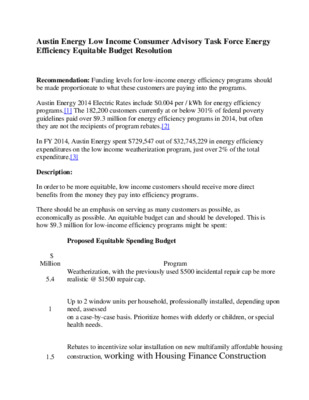
Austin Energy Low Income Consumer Advisory Task Force Energy Efficiency Equitable Budget Resolution Recommendation: Funding levels for low-income energy efficiency programs should be made proportionate to what these customers are paying into the programs. Austin Energy 2014 Electric Rates include $0.004 per / kWh for energy efficiency programs.[1] The 182,200 customers currently at or below 301% of federal poverty guidelines paid over $9.3 million for energy efficiency programs in 2014, but often they are not the recipients of program rebates.[2] In FY 2014, Austin Energy spent $729,547 out of $32,745,229 in energy efficiency expenditures on the low income weatherization program, just over 2% of the total expenditure.[3] Description: In order to be more equitable, low income customers should receive more direct benefits from the money they pay into efficiency programs. There should be an emphasis on serving as many customers as possible, as economically as possible. An equitable budget can and should be developed. This is how $9.3 million for low-income efficiency programs might be spent: Proposed Equitable Spending Budget $ Million Program 5.4 Weatherization, with the previously used $500 incidental repair cap be more realistic @ $1500 repair cap. 1 Up to 2 window units per household, professionally installed, depending upon need, assessed on a case-by-case basis. Prioritize homes with elderly or children, or special health needs. 1.5 Rebates to incentivize solar installation on new multifamily affordable housing construction, working with Housing Finance Construction 1.4 Multifamily affordable housing efficiency / weatherization 9.3 Equitable funding total - balances out money paid into programs by 182,200 low-income customers - up to 301% of federal poverty guidelines [1] Austin Energy Residential Electric Rates, Effective November 2014, Austin Energy website [2] Calculated by Lanetta Cooper, using data provided by Austin Energy in response to a public information request (June 4, 2015 and May 22, 2015) [3] Based on data provided by Austin Energy in response to a public in response to a public information request (June 4, 2015 and May 22, 2015)
RECOMMENDATION NO.____ Recommend that the CAP program no longer fund weatherization Recommendation: The CAP program should no longer fund a weatherization program. Reasoning: The CAP program provides billing assistance through the use of a waiver of certain utility charges and a 10% discount on the remainder of the electric utility bill. There is a waiting list of AE customers whose household incomes are at 200% or below federal poverty guidelines for that program. Removing the economic burden of the weatherization program from the CAP program would free up monies to provide bill assistance to more AE’s low and low-moderate income customers in need. Further, the weatherization program has consistently been characterized by AE as an energy efficiency program. As such, it should be in the energy efficiency program funded with EE rates.