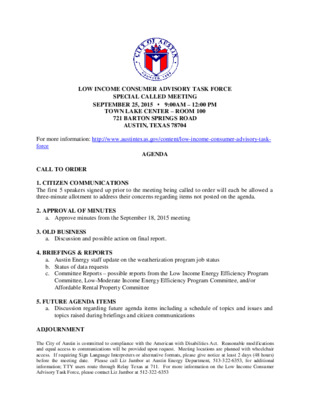
The City of Austin is committed to compliance with the American with Disabilities Act. Reasonable modifications and equal access to communications will be provided upon request. Meeting locations are planned with wheelchair access. If requiring Sign Language Interpreters or alternative formats, please give notice at least 2 days (48 hours) before the meeting date. Please call Liz Jambor at Austin Energy Department, 513-322-6353, for additional information; TTY users route through Relay Texas at 711. For more information on the Low Income Consumer Advisory Task Force, please contact Liz Jambor at 512-322-6353 LOW INCOME CONSUMER ADVISORY TASK FORCE SPECIAL CALLED MEETING SEPTEMBER 25, 2015 9:00AM – 12:00 PM TOWN LAKE CENTER – ROOM 100 721 BARTON SPRINGS ROAD AUSTIN, TEXAS 78704 For more information: http://www.austintexas.gov/content/low-income-consumer-advisory-task- force AGENDA CALL TO ORDER 1. CITIZEN COMMUNICATIONS The first 5 speakers signed up prior to the meeting being called to order will each be allowed a three-minute allotment to address their concerns regarding items not posted on the agenda. 2. APPROVAL OF MINUTES a. Approve minutes from the September 18, 2015 meeting 3. OLD BUSINESS a. Discussion and possible action on final report. 4. BRIEFINGS & REPORTS a. Austin Energy staff update on the weatherization program job status b. Status of data requests c. Committee Reports – possible reports from the Low Income Energy Efficiency Program Committee, Low-Moderate Income Energy Efficiency Program Committee, and/or Affordable Rental Property Committee 5. FUTURE AGENDA ITEMS a. Discussion regarding future agenda items including a schedule of topics and issues and topics raised during briefings and citizen communications ADJOURNMENT The City of Austin is committed to compliance with the American with Disabilities Act. Reasonable modifications and equal access to communications will be provided upon request. Meeting locations are planned with wheelchair access. If requiring Sign Language Interpreters or alternative formats, please give notice at least 2 days (48 hours) before the meeting date. Please call Liz Jambor at Austin Energy Department, 513-322-6353, for additional information; TTY users route through Relay Texas at 711. For more information on the Low Income Consumer Advisory Task Force, please contact Liz Jambor at 512-322-6353
LOW INCOME CONSUMER ADVISORY TASK FORCE FINAL REPORT Council Resolution No. 20140828-158 Submitted to the City Council by: Carol Biedrzycki, Chair Timothy Arndt, Vice Chair Lanetta Cooper Karen Hadden Richard Halpin Dan Pruett Cyrus Reed Chris Strand Michael WongSeptember 30, 2015 i Executive Summary This is the final report of The Low Income Consumer Advisory Task Force, created in November 2014 by the seven member at-large Austin City Council. The focus of the Task Force was directed at making recommendations to improve energy efficiency programs for low and low moderate income households served by Austin Energy. Over half of Austin households have low and low moderate incomes. Over a majority of Austin households live in rental property and census data show that renters have lower incomes than homeowners. Therefore, programs for multifamily properties are essential to serving the low and low moderate income community. In our many meetings we never failed to hear comments about the prevalence of high unaffordable utility bills renters struggle to pay. Low and low moderate income customers contribute to the support and financial stability of our utility to a greater degree than they are credited. At the request of the Task Force Austin Energy estimated the amount paid by Customer Assistance Program (CAP) customers in Fiscal Year 2014 to be $52.2 million. CAP customers, a small portion of the low and low moderate income customers and renters served by Austin Energy, paid nearly $1.6 million toward the total costs of energy efficiency and solar programs. The Task Force estimates that together CAP and non-CAP low and low moderate income customers contribute about $10 million a year toward the programs. Thus, equity is an issue that has inspired our recommendations to City Council. In the eleven months the Task Force was convened we did our best to focus on needs and solutions to better serve the broad base of customers we were assigned. Austin Energy has worked diligently with us embracing some of our ideas that are already moving forward while others are still being studied. Overall, while Austin Energy is making efforts to reach low and low moderate income customers, the information and data reviewed by the Task Force shows that more can be done to deliver energy efficiency benefits to these customer groups. We believe our recommendations would improve the delivery of services and hope the City Council finds merit in them. The following …
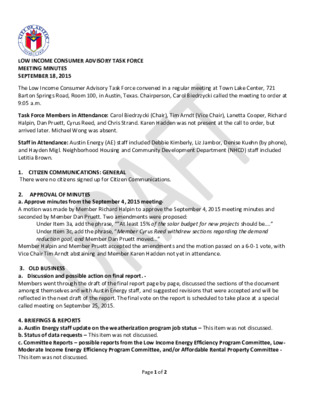
Page 1 of 2 LOW INCOME CONSUMER ADVISORY TASK FORCE MEETING MINUTES SEPTEMBER 18, 2015 The Low Income Consumer Advisory Task Force convened in a regular meeting at Town Lake Center, 721 Barton Springs Road, Room 100, in Austin, Texas. Chairperson, Carol Biedrzycki called the meeting to order at 9:05 a.m. Task Force Members in Attendance: Carol Biedrzycki (Chair), Tim Arndt (Vice Chair), Lanetta Cooper, Richard Halpin, Dan Pruett, Cyrus Reed, and Chris Strand. Karen Hadden was not present at the call to order, but arrived later. Michael Wong was absent. Staff in Attendance: Austin Energy (AE) staff included Debbie Kimberly, Liz Jambor, Denise Kuehn (by phone), and Hayden Migl. Neighborhood Housing and Community Development Department (NHCD) staff included Letitia Brown. 1. CITIZEN COMMUNICATIONS: GENERAL There were no citizens signed up for Citizen Communications. 2. APPROVAL OF MINUTES a. Approve minutes from the September 4, 2015 meeting- A motion was made by Member Richard Halpin to approve the September 4, 2015 meeting minutes and seconded by Member Dan Pruett. Two amendments were proposed: Under Item 3a, add the phrase, “”At least 15% of the solar budget for new projects should be….” Under Item 3c, add the phrase, “Member Cyrus Reed withdrew sections regarding the demand reduction goal, and Member Dan Pruett moved…” Member Halpin and Member Pruett accepted the amendments and the motion passed on a 6-0-1 vote, with Vice Chair Tim Arndt abstaining and Member Karen Hadden not yet in attendance. 3. OLD BUSINESS a. Discussion and possible action on final report. - Members went through the draft of the final report page by page, discussed the sections of the document amongst themselves and with Austin Energy staff, and suggested revisions that were accepted and will be reflected in the next draft of the report. The final vote on the report is scheduled to take place at a special called meeting on September 25, 2015. 4. BRIEFINGS & REPORTS a. Austin Energy staff update on the weatherization program job status – This item was not discussed. b. Status of data requests – This item was not discussed. c. Committee Reports – possible reports from the Low Income Energy Efficiency Program Committee, Low-Moderate Income Energy Efficiency Program Committee, and/or Affordable Rental Property Committee - This item was not discussed. Page 2 of 2 5. FUTURE AGENDA ITEMS a. Discussion regarding future agenda items including a schedule of topics and issues …
ENERGY EFFICIENCY EQUALS ECONOMICDEVELOPMENTThe Economics of Public Utility System Benefit Funds:Jerrold OppenheimTheo MacGregorJune 2008ABOUT THE AUTHORSJerrold Oppenheim and Theo MacGregor are the co-authors of a comprehensiveexamination of the benefits of early childhood education, published in 2002. Thatdocument has been used extensively to inform policy makers about the needs and valuesof investments made in Pre-K and other early childhood programs. In 2006, Entergyagain turned to Oppenheim and MacGregor for the answer to another critical question—that of “What is the business case for investing in low-income programs?”For 2008, Entergy asked Oppenheim and MacGregor to examine more deeply theeconomics of investing in low-income programs that focus on energy use.A graduate of Harvard College and Boston College Law School (Juris Doctor), JerroldOppenheim directed energy and utility litigation for the Attorneys General of New Yorkand Massachusetts. In his 35+-year career, he has played a key role in the development ofregulatory policy in US states as legal counsel and advisor for state governments,consumer organizations, low-income advocates, labor unions, environmental interests,industrial customers, and utilities.Theo MacGregor founded MacGregor Energy Consultancy in 1998, specializing inelectric industry consumer, low-income, and energy efficiency issues. Prior to foundingher own firm, Ms. MacGregor spent more than ten years with the Electric Power Divisionof the Massachusetts Department of Public Utilities (DPU), most recently as actingdirector. Ms. MacGregor holds an MBA from Simmons School of Management inBoston, Massachusetts.Together, they are co-authors, with Greg Palast, ofDemocracy And Regulation(PlutoPress, 2002), winner of the American Civil Liberties Union Upton Sinclair Freedom ofExpression Award. Much of their recent work is posted onwww.DemocracyAndRegulation.com. ENERGY EFFICIENCY EQUALS ECONOMIC DEVELOPMENTFOREWORDPublic investments in low-income energy efficiency are an extraordinarily potent sourceof economic development, including jobs. To make this point we used conventionalUnited States Commerce Department multiplier data to determine the effect of low-income energy efficiency in a manner not done before: we analyzed the multiplier effectof the investment, as many others have done, but we also analyzed the multiplier effect ofa comprehensive menu of economic benefits of thus directing resources to reducepoverty. To make the point in an unmistakable way, we compared our results with themultiplier effect of a public investment that is widely agreed (including by us) to besocially and economically productive – public incentives for manufacturing. Ifinvestments in low-income energy efficiency were as economically productive asinvestments to attract manufacturing, then such investments would be very productiveindeed.We favor the development of domestic manufacturing because it provides well-payingjobs and increases economic activity in …
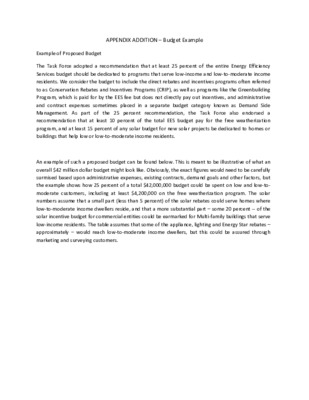
APPENDIX ADDITION – Budget Example Example of Proposed Budget The Task Force adopted a recommendation that at least 25 percent of the entire Energy Efficiency Services budget should be dedicated to programs that serve low-income and low-to-moderate income residents. We consider the budget to include the direct rebates and incentives programs often referred to as Conservation Rebates and Incentives Programs (CRIP), as well as programs like the Greenbuilding Program, which is paid for by the EES fee but does not directly pay out incentives, and administrative and contract expenses sometimes placed in a separate budget category known as Demand Side Management. As part of the 25 percent recommendation, the Task Force also endorsed a recommendation that at least 10 percent of the total EES budget pay for the free weatherization program, and at least 15 percent of any solar budget for new solar projects be dedicated to homes or buildings that help low or low-to-moderate income residents. An example of such a proposed budget can be found below. This is meant to be illustrative of what an overall $42 million dollar budget might look like. Obviously, the exact figures would need to be carefully surmised based upon administrative expenses, existing contracts, demand goals and other factors, but the example shows how 25 percent of a total $42,000,000 budget could be spent on low and low-to-moderate customers, including at least $4,200,000 on the free weatherization program. The solar numbers assume that a small part (less than 5 percent) of the solar rebates could serve homes where low-to-moderate income dwellers reside, and that a more substantial part – some 20 percent -- of the solar incentive budget for commercial entities could be earmarked for Multi-family buildings that serve low-income residents. The table assumes that some of the appliance, lighting and Energy Star rebates – approximately – would reach low-to-moderate income dwellers, but this could be assured through marketing and surveying customers. Category Amount Serving Low-Income Customers Amount Serving Low to Low-Moderate Income Customers Other Customers Total Weatherization $4,200,000 $0 $0 $4,200,000 Multi-Family EES $2,100,000 $2,100,000 $4,200,000 Loan Program Expenses $500,000 $500,000 $1,000,000 Solar Home Rebates $200,000 $5,000,000 $5,200,000 Solar Commercial Rebates $400,000 $1,200,000 $1,600,000 Green-Building Ratings and Codes $500,000 $2,500,000 $3,000,000 Emergency Air-Conditioning Program $200,000 $200,000 $400,000 Commercial Rebates and Incentives (not including Multi-Family) $4,500,000 $4,500,000 Demand Response $300,000 $1,600,000 $1,900,000 Thermal Storage $800,000 $800,000 Category Amount Serving Low-Income Customers Amount Serving …
LOW INCOME CONSUMER ADVISORY TASK FORCE FINAL REPORT DRAFT 10 FOR ACTION ON SEPTEMBER 25, 2015 Submitted to the City Council by: Carol Biedrzycki, Chair Timothy Arndt, Vice Chair Lanetta Cooper Karen Hadden Richard Halpin Dan Pruett Cyrus Reed Chris Strand Michael Wong September 30, 2015 i Executive Summary This is the final report of The Low Income Consumer Advisory Task Force, created in November 2014 by the seven member at-large Austin City Council. The focus of the Task Force was directed at making recommendations to improve energy efficiency programs for low and low moderate income households served by Austin Energy. Over half of Austin Energy’s residential customers have low and low moderate incomes. Over a majority of Austin households live in rental property and census data show that renters have lower incomes than homeowners. Therefore, programs for multifamily properties are essential to serving the low and low moderate income community. In our many meetings we never failed to hear comments about the prevalence of high unaffordable utility bills renters struggle to pay. Low and low moderate income customers contribute to the support and financial stability of our utility to a greater degree than they are credited. At the request of the Task Force Austin Energy estimated the amount paid by Customer Assistance Program (CAP) customers in 2014 to be $52.2 million. CAP customers, a small portion of the low and low moderate income customers and renters served by Austin Energy, paid nearly $1.6 million toward the total costs of energy efficiency and solar programs. The Task Force estimates that together CAP and non-CAP low and low moderate income customers contribute about $11 million a year toward the programs. In the eleven months the Task Force was convened we did our best to focus on needs and solutions to better serve the broad base of customers we were assigned. Austin Energy has worked diligently with us embracing some of our ideas that are already moving forward while others are still being studied. Overall, while Austin Energy is making efforts to reach low and low moderate income customers, the information and data reviewed by the Task Force shows that more can be done to deliver energy efficiency benefits to these customer groups. We believe our recommendations would improve the delivery of services and hope the City Council finds merit in them. The following lists the six directives given in the resolution …
1 LOW INCOME CONSUMER ADVISORY TASK FORCE FINAL REPORT DRAFT 9 DRAFT 9 FOR ACTION ON SEPTEMBER 25, 2015 September 21, 2015 This Draft 9 is the final draft report with changes agreed to by the full task force on September 18. The purpose of this draft is to have all the task force members check the changes to make sure they are made as you anticipated. Therefore, this is a redlined document. The next version will be cleaned up and ready for a final review and a vote on September 25th. this will be posted on Wednesday September 25th. Formatted: SuperscriptFormatted: Font: CalibriFormatted: List Paragraph i Executive Summary This is the final report of The Low Income Consumer Advisory Task Force, created in November 2014 by the seven member at-large Austin City Council. The focus of the Task Force was directed at making recommendations to improve energy efficiency programs for low and low moderate income households served by Austin Energy. Over half of Austin Energy’s residential customers have low and low moderate incomes. Over a majority of Austin households live in rental property and census data show that renters have lower incomes than homeowners. Therefore, programs for multifamily properties are essential to serving the low and low moderate income community. In our many meetings we never failed to hear comments about the prevalence of high unaffordable utility bills renters struggle to pay. Low and low moderate income customers contribute to the support and financial stability of or utility to a greater degree than they are credited. At the request of the Task Force Austin Energy estimated the amount paid by Customer Assistance Program (CAP) customers in 2014 to be $52.2 million. CAP customers, a small portion of the low and low moderate income customers and renters served by Austin Energy, paid nearly $1.6 million toward the total costs of energy efficiency and solar programs. The Task Force estimates that together CAP and non CAP low and low moderate income customers contribute about $11 million a year toward the programs. . In the eleven months the Task Force was convened we did our best to focus on needs and solutions to better serve the broad base of customers we were assigned. Austin Energy has worked diligently with us embracing some of our ideas that are already moving forward while others are still being studied. Overall, while Austin Energy is making …
ORNL/CON-484NONENERGY BENEFITS FROM THE WEATHERIZATION ASSISTANCEPROGRAM: A SUMMARY OF FINDINGS FROM THE RECENTLITERATUREMartin SchweitzerBruce TonnOAK RIDGE NATIONAL LABORATORY DOCUMENT AVAILABILITYReports produced after January 1, 1996, are generally available free via the U.S. Departmentof Energy (DOE) Information Bridge.Web site http://www.osti.gov/bridge Reports produced before January 1, 1996, may be purchased by members of the public fromthe following source.National Technical Information Service5285 Port Royal RoadSpringfield, VA 22161Telephone 703-605-6000 (1-800-553-6847)TDD 703-487-4639Fax 703-605-6900E-mail info@ntis.fedworld.govWeb site http://www.ntis.gov/support/ordernowabout.htmReports are available to DOE employees, DOE contractors, Energy Technology DataExchange (ETDE) representatives, and International Nuclear Information System (INIS)representatives from the following source.Office of Scientific and Technical InformationP.O. Box 62Oak Ridge, TN 37831Telephone 865-576-8401Fax 865-576-5728E-mail reports@adonis.osti.govWeb site http://www.osti.gov/contact.htmlThis report was prepared as an account of work sponsoredby an agency of the United States Government. Neither theUnited States Government nor any agency thereof, nor any oftheir employees, makes any warranty, express or implied, orassumes any legal liability or responsibility for the accuracy,completeness, or usefulness of any information, apparatus,product, or process disclosed, or represents that its usewould not infringe privately owned rights. Reference herein toany specific commercial product, process, or service by tradename, trademark, manufacturer, or otherwise, does notnecessarily constitute or imply its endorsement,recommendation, or favoring by the United StatesGovernment or any agency thereof. The views and opinionsof authors expressed herein do not necessarily state orreflect those of the United States Government or any agencythereof. ORNL/CON-484NONENERGY BENEFITS FROM THE WEATHERIZATION ASSISTANCEPROGRAM: A SUMMARY OF FINDINGS FROM THE RECENT LITERATUREMartin Schweitzer, Bruce TonnOAK RIDGE NATIONAL LABORATORYDate Published: April 2002Prepared forU. S. Department of EnergyOffice of Building Technology AssistanceBudget Activity Number EC 17 01 00 0Prepared byOAK RIDGE NATIONAL LABORATORYOak Ridge, Tennessee 37831managed byUT-BATTELLE, LLCfor theU.S. DEPARTMENT OF ENERGYunder contract DE-AC05-00OR22725 ivTABLE OF CONTENTSEXECUTIVE SUMMARY....................................................vii1. INTRODUCTION..........................................................11.1 BACKGROUND....................................................11.2 METHODS.........................................................11.3 SCOPE OF REPORT.................................................32. RATEPAYER BENEFITS....................................................52.1 PAYMENT-RELATED BENEFITS.....................................62.2 SERVICE PROVISION BENEFITS......................................93. BENEFITS TO HOUSEHOLDS..............................................113.1 AFFORDABLE HOUSING BENEFITS.................................123.2 SAFETY, HEALTH, AND COMFORT BENEFITS........................154. SOCIETAL BENEFITS.....................................................174.1 ENVIRONMENTAL BENEFITS......................................174.2 SOCIAL BENEFITS................................................204.3 ECONOMIC BENEFITS..............................................215. SUMMARY AND CONCLUSIONS...........................................236. ACKNOWLEDGMENTS...................................................277. REFERENCES............................................................29 v vi1200110010009008007006005004003002001000Ratepayer Benefits: Payment-RelatedPoint Estimate (2001 $ per participating household: Net Present Value)Ratepayer Benefits: Service ProvisionHousehold Benefits: Affordable HousingHousehold Benefits: Safety,Health, and ComfortSocietal Benefits: EnvironmentalSocietal Benefits: SocialSocietal Benefits: Economic1811507831238691171123EXECUTIVE SUMMARYThe purpose of this project is to summarize findings reported in the recent literature onnonenergy benefits attributable to the weatherizing of low income homes. This study is a follow-up to the seminal research conducted on the nonenergy benefits attributable to theDepartment of Energy’s national Weatherization Assistance Program by Brown et al. (1993). For …
and .The Economic Development Impacts of Home Energy Assistance:The Entergy StatesDeveloped for Entergy by:Roger D. ColtonFisher, Sheehan & ColtonAugust 2003 The Economic Development of Home Eneergy Assistance | The Energy States and .The Economic Development Impacts of Home Energy Assistance The Entergy States ContentsEXECUTIVE SUMMARY ES - i CHAPTER ONE- Introduction 1 Energy and Weatherization in the Entergy States 1 Defining the Economic Impacts of Energy Assistance 3 CHAPTER TWO - The Economic Development Impacts of Cash Energy Assistance 5 The Benefit Impacts of Cash Energy Assistance 5 The Payment Impacts of Cash Energy Assistance 6 Changes in Payment Patterns 7 Household Level Impacts of Improved Payment Patterns 9 Statewide Impacts of Improved Payment Patterns 11 Summary of Payment Impacts 12 The Behavior Impacts of Cash Energy Assistance 13 Changes in Behavior Patterns 13 Household Level Impacts of Changed Behavior Patterns 15 Statewide Impacts of Changed Behavior Patterns 15 Summary of Behavior Impacts 16 Summary of Cash Assistance Economic Development Impacts 17 CHAPTER THREE - The Economic Development Impacts of Weatherization Assistance 18 The Benefit Impacts of Weatherization Assistance 18 The Payment Impacts of Weatherization Assistance 20 Process Issues with Quantifying Payment and Behavior Impacts 21 Quantifying the Weatherization Impacts 22 Summary of Payment Impacts 23 The Behavior Impacts of Weatherization Assistance 24 Summary of Behavior Impacts 25 Summary of Weatherization Assistance Economic Development Impacts 27 CHAPTER FOUR - The Particular Economic Development Benefits to the Low-Income Community 28On the Cover: Entergy employees volunteer their weekends to help senior citizens with safety and energy efficiency improvements. The Economic Development of Home Eneergy Assistance | The Energy States and .Executive Summary The delivery of low-income home energy assistance in the states served by Entergy operating companies provides a wide range of economic benefits to those states. Frequently thought of exclusively as a way to prevent unpaid utility bills, and to preserve service against termination for nonpayment, in fact, low-income energy assistance can also be viewed as a strategy to promote economic development and employment (particularly in low-income communities). The economic impacts that low-income energy assistance provides to the Entergy states are quantified below. For purposes of this analysis, the Entergy states include Arkansas, Louisiana, Mississippi and Texas. The Entergy jurisdictions within these states …
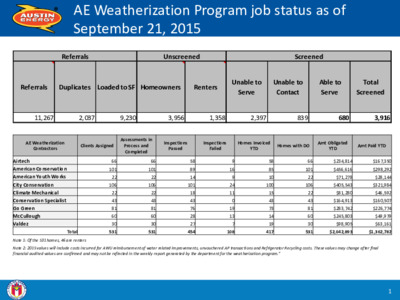
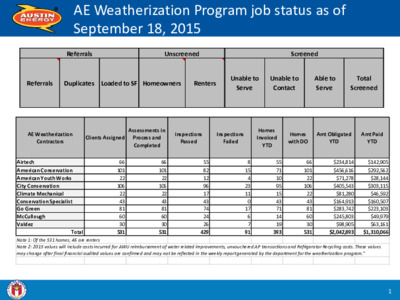
AE Weatherization Program job status as of September 21, 2015 1 ReferralsDuplicates Loaded to SFHomeownersRentersUnable to ServeUnable to Contact Able to ServeTotal Screened11,2672,0379,2303,9561,3582,3978396803,916ReferralsUnscreenedScreenedAE Weatherization Contractors Clients Assigned Assessments in Process and Completed Inspections Passed Inspections Failed Homes Invoiced YTD Homes with DO Amt Obligated YTD Amt Paid YTD Airtech 66 66 58 9 58 66 $234,814 $167,350 American Conservation 101 101 89 16 85 101 $456,616 $298,292 American Youth Works 22 22 14 9 10 22 $71,278 $28,144 City Conservation 106 106 101 24 100 106 $405,543 $321,984 Climate Mechanical 22 22 18 11 15 22 $81,280 $46,592 Conservation Specialist 43 43 43 0 43 43 $164,913 $160,507 Go Green 81 81 76 19 73 81 $283,742 $226,774 McCullough 60 60 28 13 14 60 $245,803 $49,979 Valdez 30 30 27 7 19 30 $98,905 $63,161 Total 531 531 454 108 417 531 $2,042,893 $1,362,782 Note 1: Of the 531 homes, 46 are renters Note 2: 2015 values will include costs incurred for AWU reimbursement of water related improvements, unvouchered AP transactions and Refrigerator Recycling costs. These values may change after final financial audited values are confirmed and may not be reflected in the weekly report generated by the department for the weatherization program.”
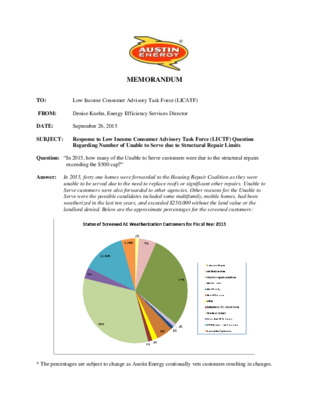
MEMORANDUM TO: Low Income Consumer Advisory Task Force (LICATF) FROM: Denise Kuehn, Energy Efficiency Services Director DATE: September 26, 2015 SUBJECT: Response to Low Income Consumer Advisory Task Force (LICTF) Question Regarding Number of Unable to Serve due to Structural Repair Limits Question: “In 2015, how many of the Unable to Serve customers were due to the structural repairs exceeding the $500 cap?” Answer: In 2015, forty one homes were forwarded to the Housing Repair Coalition as they were unable to be served due to the need to replace roofs or significant other repairs. Unable to Serve customers were also forwarded to other agencies. Other reasons for the Unable to Serve were the possible candidates included some multifamily, mobile homes, had been weatherized in the last ten years, and exceeded $250,000 without the land value or the landlord denied. Below are the approximate percentages for the screened customers: * The percentages are subject to change as Austin Energy continually vets customers resulting in changes.
1 MEMORANDUM TO: Low Income Consumer Advisory Task Force FROM: Denise Kuehn and Liz Jambor, Customer Energy Solutions DATE: September 23, 2015 SUBJECT: Response to Task Force Information Requests The following data and information requests were made during the September 18 Low Income Consumer Advisory Task Force meeting. Staff responses follow each specific request. 1. Question: Provide number of customers in 2014, not population, broken out by residential, commercial, and industrial. AE Response: FY14 – 391,410 residential 45,436 commercial 151 industrial 2. Question: Review p. 3 of Lanetta’s handout – numbers should be based on burden study. Please provide updates if necessary. AE Response: The numbers should be: 0-200% = $4,516.186 201-300% = $2,445,312 301-400% = $2,059,411 Total = $9,020,909 Based on percentages form the burden study and the current energy efficiency portion of the CBC (0.4 cents) and the quoted average kwh of 955.2 kwh annually. 3. Question: Ask Ronnie how many payment arrangements are in apartments AE Response: Request has been made for updated data. 4. Question: Reviews numbers for Carol on p. 13 re: survey 2 AE Response: Annual household income for the weatherization survey participants ranged from under $10,000 to over $100,000 with 20% of the 86 survey respondents refusing to answer. Based on the answers provided, the average income was shown to be $31,100, under the median income for Austin. The average number of people in the home was 3.79. If we compared the two averages, we would find that the average reported income for a family of 3-4 was below 200% of poverty. Annual household income for the residential rebate survey participants ranged from under $10,000 to over $100,000 with 23% of the 465 survey respondents refusing to answer. Based on the answers provided, the average income was shown to be $94,000. The average number of people in the home was not collected for this survey but only 25% had children less than 18 years of age living in the home. This income is appropriate for these programs as the residential programs do not use income as a qualification for participation. 5. Question: Chris and Richard asked for the status on any bill analysis we have panned. AE Response: Bill analysis requires at a minimum 18 months of data to cover 2 summers, pre and post. Bill analysis also requires consistency in residency due to the behavioral impacts on energy savings. It is a …
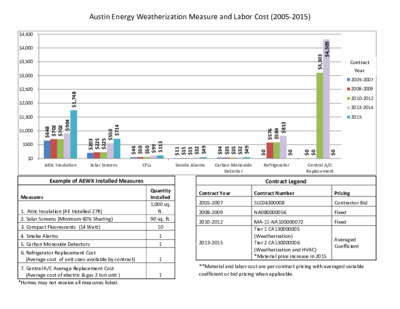
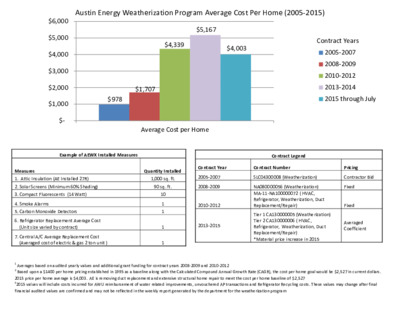
Austin Energy Weatherization Program Average Cost Per Home (2005-2015) 1 Averages based on audited yearly values and additional grant funding for contract years 2008-2009 and 2010-2012 2 Based upon a $1400 per home pricing established in 1995 as a baseline along with the Calculated Compound Annual Growth Rate (CAGR), the cost per home goal would be $2,527 in current dollars. 2015 price per home average is $4,003. AE is removing duct replacement and extensive structural home repair to meet the cost per home baseline of $2,527 32015 values will include costs incurred for AWU reimbursement of water related improvements, unvouchered AP transactions and Refrigerator Recycling costs. These values may change after final financial audited values are confirmed and may not be reflected in the weekly report generated by the department for the weatherization program $978 $1,707 $4,339 $5,167 $4,003 $- $1,000 $2,000 $3,000 $4,000 $5,000 $6,000Average Cost per Home2005-20072008-20092010-20122013-20142015 through JulyExample of AEWX Installed Measures Measures Quantity Installed 1. Attic Insulation (AE Installed 27R) 1,000 sq. ft. 2. Solar Screens (Minimum 60% Shading) 90 sq. ft. 3. Compact Fluorescents (14 Watt) 10 4. Smoke Alarms 1 5. Carbon Monoxide Detectors 1 6. Refrigerator Replacement Average Cost (Unit size varied by contract) 1 7. Central A/C Average Replacement Cost (Averaged cost of electric & gas 2 ton unit ) 1 Contract Legend Contract Year Contract Number Pricing 2005-2007 SLC04300008 (Weatherization) Contractor Bid 2008-2009 NA080000056 (Weatherization) Fixed 2010-2012 MA-11-NA100000072 ( HVAC, Refrigerator, Weatherization, Duct Replacement/Repair) Fixed 2013-2015 Tier 1 CA130000005 (Weatherization) Tier 2 CA130000006 ( HVAC, Refrigerator, Weatherization, Duct Replacement/Repair) *Material price increase in 2015 Averaged Coefficient Contract Years
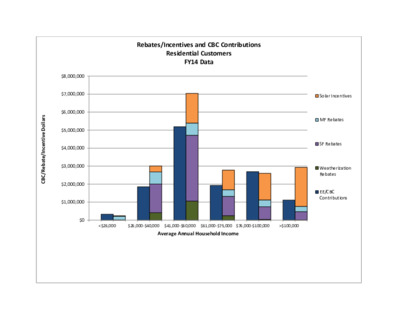
$0$1,000,000$2,000,000$3,000,000$4,000,000$5,000,000$6,000,000$7,000,000$8,000,000<$26,000$26,000-$40,000$41,000-$60,000$61,000-$75,000$76,000-$100,000>$100,000CBC/Rebate/Incentive Dollars Average Annual Household Income Rebates/Incentives and CBC Contributions Residential Customers FY14 Data Solar IncentivesMF RebatesSF RebatesWeatherizationRebatesEE/CBCContributions
Minority Report of The Low Income Consumer Advisory Task Force Version 2 November 4, 2015 2 Dear Mayor and Council: The authors of this minority report would like to express our sincere appreciation for being allowed to be a part of a special group that has spent considerable time discussing ways to improve the plight of those that have shared less in the prosperity that Austin has experienced recently. While we supported many of the recommendations of the Low Income Consumer Advisory Task Force (LICA) that we served on, there are fundamental differences we have with the final report that compel us to write this minority opinion. We have organized our report with 12 succinct recommendations in an Executive Summary, followed by more detail on each of the recommendations. To introduce our perspective, we would like to begin with a few general observations. • The largest flaw with LICA was that the recommendations were not made in a holistic manner. We were only tasked to look at electricity cost for Austin Energy, which is typically a small portion of the budget for low- and moderate-income households. As such, the total impact of LICA’s work will have limited impact on a household’s budget. In fact, some of the recommendations, such as including air conditioners in the free weatherization program, could actually increase the amount spent on an electric bill, adversely affecting a low-income household. Why pay for someone’s free air conditioner if they cannot afford to run it? A better strategy would have been to create a task force that considers all of the challenges faced by low- and moderate-income customers: housing; food; medical care; child care; transportation; and all utilities (not just electricity). Creating a Low Income Committee in the format of Austin’s newly created Sustainability Committee would have been a more balanced approach. • There was very little acknowledgement of the goals of Austin Energy’s Demand Side programs, and how those goals contribute positively by lowering the energy expenditure of a low- and moderate-income household and create a better environment for all. These programs lower the cost of electricity to Austin Energy, making the utility more profitable, lowering rates for customers in all income brackets. • Very little time was spent looking at ways to broaden the effect of the limited resources of the program. In fact, some of the recommendations do the opposite by recommending that additional funding …
Minority Report of The Low Income Consumer Advisory Task Force 2 Dear Mayor and Council: The authors of this minority report would like to express our sincere appreciation for being allowed to be a part of a special group that has spent considerable time discussing ways to improve the plight of those that have shared less in the prosperity that Austin has experienced recently. While we supported many of the recommendations of the Low Income Consumer Advisory Task Force (LICA) that we served on, there are fundamental differences we have with the final report that compel us to write this minority opinion. We have organized our report with 12 succinct recommendations in an Executive Summary, followed by more detail on each of the recommendations. To introduce our perspective, we would like to begin with a few general observations. • The largest flaw with LICA was that the recommendations were not made in a holistic manner. We were only tasked to look at electricity cost for Austin Energy, which is typically a small portion of the budget for low- and moderate-income households. As such, the total impact of LICA’s work will have limited impact on a household’s budget. In fact, some of the recommendations, such as including air conditioners in the free weatherization program, could actually increase the amount spent on an electric bill, adversely affecting a low-income household. Why pay for someone’s free air conditioner if they cannot afford to run it? A better strategy would have been to create a task force that considers all of the challenges faced by low- and moderate-income customers: housing; food; medical care; child care; transportation; and all utilities (not just electricity). Creating a Low Income Committee in the format of Austin’s newly created Sustainability Committee would have been a more balanced approach. • There was very little acknowledgement of the goals of Austin Energy’s Demand Side programs, and how those goals contribute positively by lowering the energy expenditure of a low- and moderate-income household and create a better environment for all. These programs lower the cost of electricity to Austin Energy, making the utility more profitable, lowering rates for customers in all income brackets. • Very little time was spent looking at ways to broaden the effect of the limited resources of the program. In fact, some of the recommendations do the opposite by recommending that additional funding should be given to the …
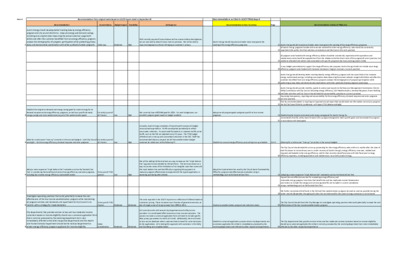
Item #Recommendations as Cited in LICATF FINALReportRecommendationCurrent StatusBudget ImpactFeasibilityAE ResponseRecommendation in Exec SummaryPageRecommendation in Body of FINAL doc1Austin Energy should develop better tracking data by energy efficiency program and city council district to: measure energy and demand savings, including consumption data measuring the actual customer usage both before and after the customer benefited from an energy efficiency program; analyze the demographics of program participation while protecting privacy data; and demonstrate coordination with other publically funded programsUnderwayModerateHighWith recently acquired Census data as well as a nascent data clearinghouse, we are now able to attach Census tract to premises. We will be able to report demographics without infringing on customers' privacy.Austin Energy should improve and make more transparent the tracking of its energy efficiency programs.21Austin Energy should improve and make more transparent the tracking of its energy efficiency programs.22All Austin Energy programs funded with revenues realized from the energy efficiency rate should be consistently reported to the public, the City’s advisory commissions and the Council. (Current practice)22All program costs funded with energy efficiency dollars should be consistently reported and the operations and maintenance costs should be separated out from the rebates and other direct costs of the program (Current practice; but unable to allocate/track admin costs associated with specific programs due to accounting system limits)23In any budget presentation to support its energy efficiency rate proposal, Austin Energy should not include any energy efficiency program costs funded with Customer Assistance Program revenues. (current practice)23Austin Energy should develop better tracking data by energy efficiency program and city council district to: measure energy and demand savings, including consumption data measuring the actual customer usage both before and after the customer benefited from an energy efficiency program; analyze the demographics of program participation while protecting privacy data; and demonstrate coordination with other publically funded programs (underway)24Austin Energy should provide monthly, quarterly and annual reports to the Resource Management Commission, Electric Utility Commission and City Council indicating energy efficiency, CAP Weatherization, Demand Response, Green Building and Solar activities and City Council should establish accountability procedures. (current practice)14Improving transparency, reporting and accountability for the energy efficiency, demand response and solar programs (current practice)21One key recommendation is requiring an improved annual report that would break out information not only by program but by City Council District. (underway - will report FY15 data accordingly)2Establish the long-term demand and energy saving goals for Austin Energy for its demand response and energy …
The City of Austin is committed to compliance with the American with Disabilities Act. Reasonable modifications and equal access to communications will be provided upon request. Meeting locations are planned with wheelchair access. If requiring Sign Language Interpreters or alternative formats, please give notice at least 2 days (48 hours) before the meeting date. Please call Liz Jambor at Austin Energy Department, 513-322-6353, for additional information; TTY users route through Relay Texas at 711. For more information on the Low Income Consumer Advisory Task Force, please contact Liz Jambor at 512-322-6353 LOW INCOME CONSUMER ADVISORY TASK FORCE SEPTEMBER 18, 2015 9:00AM – 12:00 PM TOWN LAKE CENTER – ROOM 100 721 BARTON SPRINGS ROAD AUSTIN, TEXAS 78704 For more information: http://www.austintexas.gov/content/low-income-consumer-advisory-task- force AGENDA CALL TO ORDER 1. CITIZEN COMMUNICATIONS The first 5 speakers signed up prior to the meeting being called to order will each be allowed a three-minute allotment to address their concerns regarding items not posted on the agenda. 2. APPROVAL OF MINUTES a. Approve minutes from the September 4, 2015 meeting 3. OLD BUSINESS a. Discussion and possible action on final report. 4. BRIEFINGS & REPORTS a. Austin Energy staff update on the weatherization program job status b. Status of data requests c. Committee Reports – possible reports from the Low Income Energy Efficiency Program Committee, Low-Moderate Income Energy Efficiency Program Committee, and/or Affordable Rental Property Committee 5. FUTURE AGENDA ITEMS a. Discussion regarding future agenda items including a schedule of topics and issues and topics raised during briefings and citizen communications ADJOURNMENT
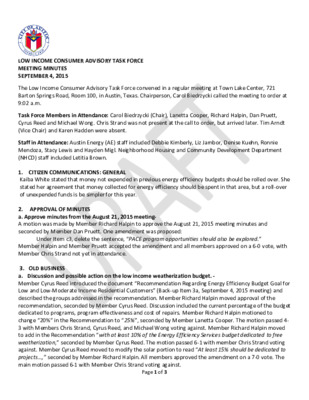
Page 1 of 3 LOW INCOME CONSUMER ADVISORY TASK FORCE MEETING MINUTES SEPTEMBER 4, 2015 The Low Income Consumer Advisory Task Force convened in a regular meeting at Town Lake Center, 721 Barton Springs Road, Room 100, in Austin, Texas. Chairperson, Carol Biedrzycki called the meeting to order at 9:02 a.m. Task Force Members in Attendance: Carol Biedrzycki (Chair), Lanetta Cooper, Richard Halpin, Dan Pruett, Cyrus Reed and Michael Wong. Chris Strand was not present at the call to order, but arrived later. Tim Arndt (Vice Chair) and Karen Hadden were absent. Staff in Attendance: Austin Energy (AE) staff included Debbie Kimberly, Liz Jambor, Denise Kuehn, Ronnie Mendoza, Stacy Lewis and Hayden Migl. Neighborhood Housing and Community Development Department (NHCD) staff included Letitia Brown. 1. CITIZEN COMMUNICATIONS: GENERAL Kaiba White stated that money not expended in previous energy efficiency budgets should be rolled over. She stated her agreement that money collected for energy efficiency should be spent in that area, but a roll-over of unexpended funds is be simpler for this year. 2. APPROVAL OF MINUTES a. Approve minutes from the August 21, 2015 meeting- A motion was made by Member Richard Halpin to approve the August 21, 2015 meeting minutes and seconded by Member Dan Pruett. One amendment was proposed: Under Item c3, delete the sentence, “PACE program opportunities should also be explored.” Member Halpin and Member Pruett accepted the amendment and all members approved on a 6-0 vote, with Member Chris Strand not yet in attendance. 3. OLD BUSINESS a. Discussion and possible action on the low income weatherization budget. - Member Cyrus Reed introduced the document “Recommendation Regarding Energy Efficiency Budget Goal for Low and Low-Moderate Income Residential Customers” (Back-up Item 3a, September 4, 2015 meeting) and described the groups addressed in the recommendation. Member Richard Halpin moved approval of the recommendation, seconded by Member Cyrus Reed. Discussion included the current percentage of the budget dedicated to programs, program effectiveness and cost of repairs. Member Richard Halpin motioned to change “20%” in the Recommendation to “25%”, seconded by Member Lanetta Cooper. The motion passed 4-3 with Members Chris Strand, Cyrus Reed, and Michael Wong voting against. Member Richard Halpin moved to add in the Recommendation “with at least 10% of the Energy Efficiency Services budget dedicated to free weatherization,” seconded by Member Cyrus Reed. The motion passed 6-1 with member Chris Strand voting against. Member Cyrus Reed …
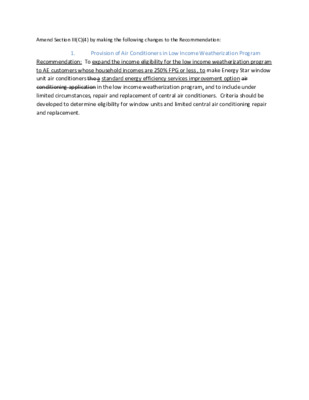
Amend Section III(C)(4) by making the following changes to the Recommendation: 1. Provision of Air Conditioners in Low Income Weatherization Program Recommendation: To expand the income eligibility for the low income weatherization program to AE customers whose household incomes are 250% FPG or less , to make Energy Star window unit air conditioners the a standard energy efficiency services improvement option air conditioning application in the low income weatherization program, and to include under limited circumstances, repair and replacement of central air conditioners. Criteria should be developed to determine eligibility for window units and limited central air conditioning repair and replacement.
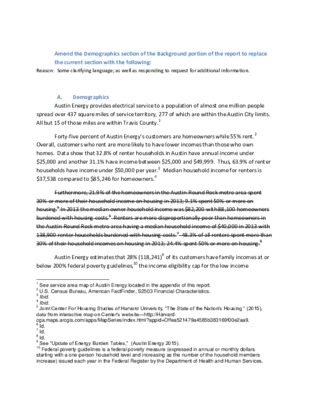
Amend the Demographics section of the Background portion of the report to replace the current section with the following: Reason: Some clarifying language; as well as responding to request for additional information. A. Demographics Austin Energy provides electrical service to a population of almost one million people spread over 437 square miles of service territory, 277 of which are within the Austin City limits. All but 15 of those miles are within Travis County.1 Forty-five percent of Austin Energy’s customers are homeowners while 55% rent.2 Overall, customers who rent are more likely to have lower incomes than those who own homes. Data show that 32.8% of renter households in Austin have annual income under $25,000 and another 31.1% have income between $25,000 and $49,999. Thus, 63.9% of renter households have income under $50,000 per year.3 Median household income for renters is $37,538 compared to $85,246 for homeowners.4 Furthermore, 21.9% of the homeowners in the Austin-Round Rock metro area spent 30% or more of their household income on housing in 2013; 9.1% spent 50% or more on housing.5 In 2013 the median owner household income was $82,200 with 88,100 homeowners burdened with housing costs.6 Renters are more disproportionally poor than homeowners in the Austin-Round Rock metro area having a median household income of $40,000 in 2013 with 138,900 renter households burdened with housing costs.7 48.3% of all renters spent more than 30% of their household incomes on housing in 2013; 24.4% spent 50% or more on housing.8 Austin Energy estimates that 28% (118,241)9 of its customers have family incomes at or below 200% federal poverty guidelines,10 the income eligibility cap for the low income 1 See service area map of Austin Energy located in the appendix of this report. 2 U.S. Census Bureau, American FactFinder, S2503 Financial Characteristics. 3 Ibid. 4 Ibid. 5 Joint Center For Housing Studies of Harvard University, “The State of the Nation’s Housing “ (2015), data from interactive map on Center’s website—http://Harvard-cga.maps.arcgis.com/apps/MapSeries/index.html?appid=Offea521479a4585b383169f00e2aa9. 6 Id. 7 Id. 8 Id. 9 See “Update of Energy Burden Tables,” (Austin Energy 2015). 10 Federal poverty guidelines is a federal poverty measure (expressed in annual or monthly dollars starting with a one-person household level and increasing as the number of the household members increase) issued each year in the Federal Register by the Department of Health and Human Services. weatherization program. Of this amount, up to 43,000 averaging 35,306 households in FY …
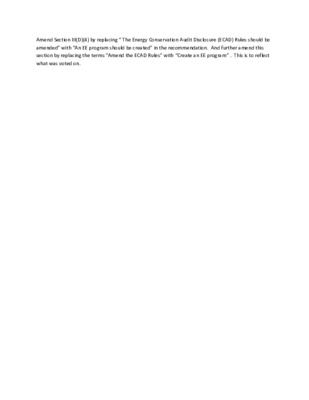
Amend Section III(D)(4) by replacing “ The Energy Conservation Audit Disclosure (ECAD) Rules should be amended” with “An EE program should be created” in the recommendation. And further amend this section by replacing the terms “Amend the ECAD Rules” with “Create an EE program” . This is to reflect what was voted on.
Amend Section , Paragraph II(E) of the Background of the history of the multi-family EE programs at p. 12 of the 8th draft report the last paragraph of this section to read as follows: In the course of the Task Force meetings, a continual message delivered by members of the public is that Austin Energy needs to do more to make rental properties more efficient. Many residents of older apartment complexes are plagued by air conditioners that are 30 years old. They still work and therefore property owners are under no obligation to replace them but they use high amounts of electricity producing utility bills that many households cannot afford to pay. One of the intents of the ECAD ordinance was to increase the energy efficiency of multi-family properties. Lack of effective enforcement of ECAD has negated the ordinance’s effectiveness.
1 LOW INCOME CONSUMER ADVISORY TASK FORCE FINAL REPORT DRAFT 8 DRAFT 7 FOR DISCUSSION ON SEPTEMBER 18, 2015 September 14, 2015 THIS DRAFT 8 IS THE FINAL DRAFT REPORT BEING SUBMITTED BY THE WORKING GROUP (LANETTA COOPER, CYRUS REED, CHRIS STRAND AND CAROL BIEDRZYCKI) FOR REVIEW BY AUSTIN ENERGY AND THE FULL TASK FORCE. THIS DRAFT IS NOT A CONSENSUS DOCUMENT OF THE REPORT WRITING WORKING GROUP. DIFFERENCES OF OPINION WILL BE DISCUSSED AND HOPEFULLY RESOLVED AT THE MEETING OF THE FULL TASK FORCE. THE WORKING GROUP ALSO MAKES A SPECIAL REQUEST FOR TASK FORCE MEMBERS TO BRING ITEMS FOR FUTURE CONSIDERATION. THIS IS AN ISSUE BROUGHT UP TO THE TASK FORCE THAT WAS NOT VETTED THAT DESERVES FURTHER ATTENTION. SEE SECTION IV FOR EXAMPLES. PLEASE BRING A HARD COPY OF THE REPORT WITH YOU TO THE SEPTEMBER 18TH MEETING AND BE PREPARED TO OFFER YOUR CORRECTIONS AND SUGGESTED CHANGES TO THE FULL TASK FORCE. THE MEETING ON THE 18TH IS ESSENTIALLY DEVOTED TO THE REPORT. A VOTE WILL BE TAKEN ON THE FINAL REPORT ON SEPTEMBER 25TH. THE FINAL REPORT WILL BE SUBMITTED TO THE CITY MANAGER AND CITY COUNCIL ON OR BEFORE OCTOBER 1ST. i Executive Summary This is the final report of The Low Income Consumer Advisory Task Force, created in November 2014 by the seven member at-large Austin City Council. The focus of the Task Force was directed at making recommendations to improve energy efficiency programs for low and low moderate income households served by Austin Energy. The following lists the six directives given in the resolution creating the Task Force and a summary of applicable recommendations adopted by the Task Force. The recommendations are followed by a list of items for further consideration as the Task Force ran out of time before all the ideas could be considered. Directive 1. Make recommendations regarding the development, design, and implementation of energy efficiency and renewable energy programs to meet the demand reduction goals of low income and low-moderate income residential customer programs. Recommendations: Austin Energy should improve and make more transparent the tracking of its energy efficiency programs. Adopt overall program goals and goals specific to low income programs. Establish an annual energy efficiency accounting true-up schedule. Adopt the triple bottom line used by the City of Austin Sustainability Office for program cost-effectiveness evaluation. Conduct a weatherization program cost reduction study. …
ITEM FOR FUTURE CONSIDERATION One-Stop Weatherization Implementing the universal application and contractor rebate recommendations should make the delivery of program services more seamless but falls short of providing what some task force embers refer to as “one stop” weatherization where other city programs could be reimbursed for providing Weatherization to their housing repair program eligible clients. At the January 16, 2015 Task force meeting, Letitia Brown, Neighborhood Housing and Community Development and Austin Housing Finance Corporation provided a description of 9 housing repair programs1 that could also provide weatherization directly instead of referring the client to Austin Energy. Also note that newly constructed affordable housing must meet city’s energy efficiency code but there is no such standard for the housing repair programs. A panel discussion of non-profit organizations was asked to share insight on ways to improve weatherization and utility based programs. A number of organizations participated including Austin Tenants’ Council, Home Repair Coalition, Austin Habitat for Humanity, Foundation Communities and The United Way for Greater Austin. Charles Cloutman from The Home Repair Coalition and Jesse Porter, Habitat for Humanity, expressed frustration for clients who receive home repairs and weatherization through two separate programs. Representatives for both organizations recommended that the weatherization funds be made available to the housing programs so that weatherization measures can be installed at the same time other repairs are being made on the client’s home.2 Susan Peterson, Foundation Communities pointed out that weatherization is often piecemeal in an apartment building because of differing housing income eligibility and weatherization income eligibility requirements.3 She suggested that all subsidized housing units should qualify for the weatherization program. Further streamlining of program delivery and cost reduction may be possible with a seamless operation that uses all the city’s programs o reach low and low moderate income households that would benefit from energy efficiency services. 1 Architectural Barrier Removal, LeadSmart, Lead Healthy Homes, Private lateral Pipeline Grant, Home Repair Loan Program, Holly Good neighbor, Emergency Home Repair, GO Repair. Distributed to Task Force members January 16, 2015. 2 Low-Income Consumer Advisory Task Force Meeting Minutes January 16, 2015, p. 2. 3 Ibid. ITEM FOR FUTURE CONSIDERATION Increasing the cap on incidental repairs for the weatherization program. The Austin Energy weatherization program places a cap of $500 on incidental repairs. As of September 1, 2015 Austin Energy reported to the Task Force that it was unable to serve 2,372 of 3,883 …
Amend Section III(C)(5) as follows: 1. On-Bill Repayment Recommendation: Austin Energy would allow for repayment for energy efficiency retrofits on a customer’s monthly utility bill. Rebates would also be provided for qualifying measures. Targeted Group: Middle and Moderate Income Residential Customers Time Schedule: Not Determined Estimated Cost: Depending on how the financing is structured, the cost effectiveness should be less than or equal to Austin Energy’s current financing program for home efficiency. Initial capital must be provided; $500,000 is suggested for a pilot project either from Austin Energy directly or a third party. Money could also to be be utilized for a loan-loss guarantee or as a guarantor on a vendor note. There could also be some cost involved for the redesign of the bill to include the tariff or payment arrangement for repaying the loan. This does not include staff time. Description: Through on bill repayment, Tthe utility assists customers in attaining cost-effective energy upgrades at customer sites – like better building efficiency, more efficient appliances, HVAC (heating, ventilating and air conditioning) systems and rooftop solar through on-bill repayment. The customer pays nothing upfront for the upgrades they choose because the third party lender or vendor pays the installer. Using a tariff payment arrangement, the utility puts a fixed charge on the customer’s monthly bill that is less than the estimated savings generated by the upgrade – so the customer enjoys immediate and sustained cash flow. Until the investment is recovered, the tariff payment arrangement for the improvement charge automatically transfers to future customers at that site. Transparency would be assured by requiring building owners to inform future buyers or renters of the property of the on-bill repayment in place. On-Bill Repayment (OBR) clears the biggest barriers to financing because it does not necessarily depend on a consumer loan,. Nor is it characterized as a long-term lease, or a lien on the value of the property. Renters and lower-income households have faced barriers to accessing investment capital for cost-effective energy upgrades, and similar financing challenges have stumped credit-strained companies and local governments. Compared to typical debt-based programs, experience shows that OBR has a bigger impact for these reasons: 1. First, the addressable market is double the size because nearly all customers are eligible. 2. When customers are offered upgrades with the OBR value proposition, they accept more than half of the time, which is 5 times the typical rate. …
1. On-Bill Repayment Recommendation: Austin Energy would allow for repayment for energy efficiency retrofits on a customer’s monthly utility bill. Financing Would Come from a third-party not from the utility itself. Rebates would also be provided for qualifying measures. Targeted Group: Middle and Moderate Income Residential Customers Time Schedule: Not Determined Estimated Cost: Depending on how the financing is structured, the cost effectiveness should be less than or equal to Austin Energy’s current financing program for home efficiency. Initial capital must be provided; $500,000 is suggested for a pilot project either from Austin Energy directly or a third party. Money could also to be be utilized for a loan-loss guarantee or as a guarantor on a vendor note. There could also be some cost involved for the redesign of the bill to include the tariff or payment arrangement for repaying the loan. This does not include staff time. Description: Through on bill repayment, Tthe utility assists customers in attaining cost-effective energy upgrades at customer sites – like better building efficiency, more efficient appliances, HVAC (heating, ventilating and air conditioning) systems and rooftop solar through on-bill repayment. The customer pays nothing upfront for the upgrades they choose because the third party lender or vendor pays the installer. Using a tariff payment arrangement, the utility puts a fixed charge on the customer’s monthly bill that is less than the estimated savings generated by the upgrade – so the customer enjoys immediate and sustained cash flow. Until the investment is recovered, the tariff payment arrangement for the improvement charge automatically transfers to future customers at that site. Transparency would be assured by requiring building owners to inform future buyers or renters of the property of the on-bill repayment in place. On-Bill Repayment (OBR) clears the biggest barriers to financing because it does not necessarily depend on a traditional consumer loan,. Nor is it characterized as a long-term lease, or a lien on the value of the property. Renters and lower-income households have faced barriers to accessing investment capital for cost-effective energy upgrades, and similar financing challenges have stumped credit-strained companies and local governments. Compared to typical debt-based programs, experience shows that OBR has a bigger impact for these reasons: 1. First, the addressable market is double the size because nearly all customers are eligible. 2. When customers are offered upgrades with the OBR value proposition, they accept more than half of the time, …
MEMORANDUM TO: Low Income Consumer Advisory Task Force FROM: Debbie Kimberly, V.P. Customer Energy Solutions DATE: September 16, 2015 SUBJECT: Response to Low Income Consumer Advisory Task Force (LICATF) Final Report On September 14, 2015, the LICATF submitted the updated final draft (version 8) of its report to task force members and staff for review in preparation for task force votes on September 18. Austin Energy deeply appreciates the work of this group, and also acknowledges the support of many Austin Energy staff over the past 11 months, which entailed 25 meetings, numerous information requests and thousands of hours of work. With the final report totaling 60 pages, and in an effort to facilitate task force dialogue, this document is prepared in summary fashion, with further staff input on specific recommendations to be provided by September 25. In reviewing the task force report, we are encouraged by areas of agreement and would note that many of these initiatives have already been implemented and/or agreed to by staff. Examples include: 1) Increased detail and transparency in data reporting via monthly and annual reports. Monthly reports are posted online, and staff will continue to add detail (including monthly weatherization reporting shared with the task force). Requests for Council Approval (RCAs) have added significant explanatory detail. Staff prepared detail on the CES budget that expanded the high level information assembled by the City. Staff also agreed prospectively to prepare year-end reports that depict participation by Councilmember district (as well as for customers living outside the City of Austin). 2) Enhanced efficiencies in program administration. Reflective of program process improvements made this year, roughly 530 customer residences will be weatherized this year, a number that would have been higher were it not for issues beyond staff’s control associated with finalizing the new contract. Multifamily performance has exceeded budget and steps have been taken to ensure that the program is cost-effective in reaching this large, growing and hard-to-reach market. 3) Staff commissioned and distributed a report by GDS Associates to assess best practices and is continuing to explore ways to enhance and streamline program administration. 4) AE is coordinating with other City departments on focused outreach to select neighborhoods in 2016 – in particular, the Holly and Rundberg Lane communities. 5) Multifamily ECAD audits and disclosures are already available on the COA data mart. Staff is committed to further enhance outreach efforts that were expanded …
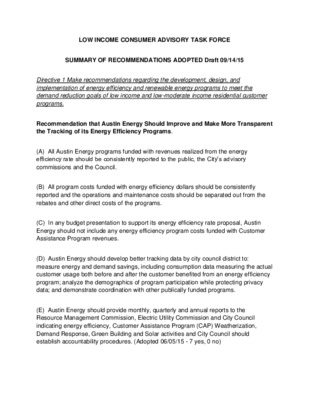
LOW INCOME CONSUMER ADVISORY TASK FORCE SUMMARY OF RECOMMENDATIONS ADOPTED Draft 09/14/15 Directive 1 Make recommendations regarding the development, design, and implementation of energy efficiency and renewable energy programs to meet the demand reduction goals of low income and low-moderate income residential customer programs. Recommendation that Austin Energy Should Improve and Make More Transparent the Tracking of its Energy Efficiency Programs. (A) All Austin Energy programs funded with revenues realized from the energy efficiency rate should be consistently reported to the public, the City’s advisory commissions and the Council. (B) All program costs funded with energy efficiency dollars should be consistently reported and the operations and maintenance costs should be separated out from the rebates and other direct costs of the programs. (C) In any budget presentation to support its energy efficiency rate proposal, Austin Energy should not include any energy efficiency program costs funded with Customer Assistance Program revenues. (D) Austin Energy should develop better tracking data by city council district to: measure energy and demand savings, including consumption data measuring the actual customer usage both before and after the customer benefited from an energy efficiency program; analyze the demographics of program participation while protecting privacy data; and demonstrate coordination with other publically funded programs. (E) Austin Energy should provide monthly, quarterly and annual reports to the Resource Management Commission, Electric Utility Commission and City Council indicating energy efficiency, Customer Assistance Program (CAP) Weatherization, Demand Response, Green Building and Solar activities and City Council should establish accountability procedures. (Adopted 06/05/15 - 7 yes, 0 no) LOW INCOME CONSUMER ADVISORY TASK FORCE Page 2 SUMMARY OF RECOMMENDATIONS ADOPTED Draft 09/14/15 Recommendation for Weatherization Program Cost Reduction Study. The City Council should direct the City Manager to investigate operating practices that could potentially increase the cost effectiveness of the low income weatherization program while maintaining all program services and standards and report back to city council in six months with a strategy for implementation. (Adopted 09/04/15 - 7 yes, 0 no) Recommendation for an Annual Energy Efficiency True-up. The City Council should establish a true up proceeding for the energy efficiency rates within six months after the close of each fiscal year to reconcile any over or under recovery of the utility’s energy efficiency revenues, realized and imputed, attributable to the energy efficiency rate for that recently closed fiscal year with that fiscal year’s energy efficiency expenses, including operations and maintenance, …
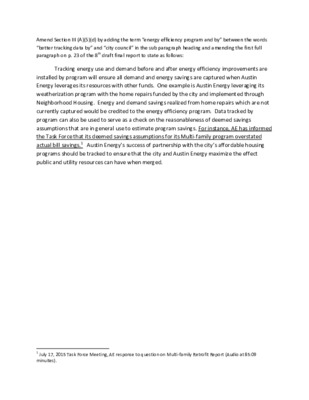
Amend Section III (A)(5)(d) by adding the term “energy efficiency program and by” between the words “better tracking data by” and “city council” in the sub paragraph heading and amending the first full paragraph on p. 23 of the 8th draft final report to state as follows: Tracking energy use and demand before and after energy efficiency improvements are installed by program will ensure all demand and energy savings are captured when Austin Energy leverages its resources with other funds. One example is Austin Energy leveraging its weatherization program with the home repairs funded by the city and implemented through Neighborhood Housing. Energy and demand savings realized from home repairs which are not currently captured would be credited to the energy efficiency program. Data tracked by program can also be used to serve as a check on the reasonableness of deemed savings assumptions that are in general use to estimate program savings. For instance, AE has informed the Task Force that its deemed savings assumptions for its Multi-family program overstated actual bill savings.1 Austin Energy’s success of partnership with the city’s affordable housing programs should be tracked to ensure that the city and Austin Energy maximize the effect public and utility resources can have when merged. 1 July 17, 2015 Task Force Meeting, AE response to question on Multi-family Retrofit Report (Audio at 85:09 minuites).
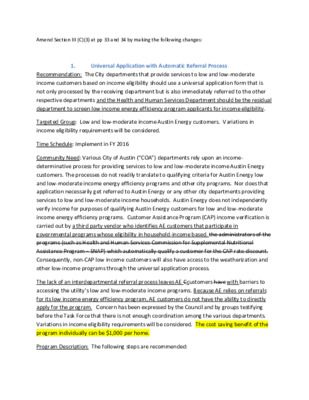
Amend Section III (C)(3) at pp 33 and 34 by making the following changes: 1. Universal Application with Automatic Referral Process Recommendation: The City departments that provide services to low and low-moderate income customers based on income eligibility should use a universal application form that is not only processed by the receiving department but is also immediately referred to the other respective departments and the Health and Human Services Department should be the residual department to screen low income energy efficiency program applicants for income eligibility. Targeted Group: Low and low-moderate income Austin Energy customers. Variations in income eligibility requirements will be considered. Time Schedule: Implement in FY 2016 Community Need: Various City of Austin (“COA”) departments rely upon an income-determinative process for providing services to low and low-moderate income Austin Energy customers. The processes do not readily translate to qualifying criteria for Austin Energy low and low-moderate income energy efficiency programs and other city programs. Nor does that application necessarily get referred to Austin Energy or any other city departments providing services to low and low-moderate income households. Austin Energy does not independently verify income for purposes of qualifying Austin Energy customers for low and low-moderate income energy efficiency programs. Customer Assistance Program (CAP) income verification is carried out by a third party vendor who identifies AE customers that participate in governmental programs whose eligibility in household-income based. the administrators of the programs (such as Health and Human Services Commission for Supplemental Nutritional Assistance Program – SNAP) which automatically qualify a customer for the CAP rate discount. Consequently, non-CAP low income customers will also have access to the weatherization and other low-income programs through the universal application process. The lack of an interdepartmental referral process leaves AE Ccustomers have with barriers to accessing the utility’s low and low-moderate income programs. Because AE relies on referrals for its low income energy efficiency program, AE customers do not have the ability to directly apply for the program. Concern has been expressed by the Council and by groups testifying before the Task Force that there is not enough coordination among the various departments. Variations in income eligibility requirements will be considered. The cost saving benefit of the program individually can be $1,000 per home. Program Description: The following steps are recommended: A universal application should be created, consistent with confidentiality and privacy concerns, and used by all City of Austin departments …
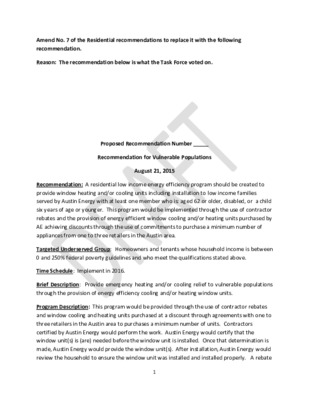
1 Amend No. 7 of the Residential recommendations to replace it with the following recommendation. Reason: The recommendation below is what the Task Force voted on. Proposed Recommendation Number _____ Recommendation for Vulnerable Populations August 21, 2015 Recommendation: A residential low income energy efficiency program should be created to provide window heating and/or cooling units including installation to low income families served by Austin Energy with at least one member who is: aged 62 or older, disabled, or a child six years of age or younger. This program would be implemented through the use of contractor rebates and the provision of energy efficient window cooling and/or heating units purchased by AE achieving discounts through the use of commitments to purchase a minimum number of appliances from one to three retailers in the Austin area. Targeted Underserved Group: Homeowners and tenants whose household income is between 0 and 250% federal poverty guidelines and who meet the qualifications stated above. Time Schedule: Implement in 2016. Brief Description: Provide emergency heating and/or cooling relief to vulnerable populations through the provision of energy efficiency cooling and/or heating window units. Program Description: This program would be provided through the use of contractor rebates and window cooling and heating units purchased at a discount through agreements with one to three retailers in the Austin area to purchases a minimum number of units. Contractors certified by Austin Energy would perform the work. Austin Energy would certify that the window unit(s) is (are) needed before the window unit is installed. Once that determination is made, Austin Energy would provide the window unit(s). After installation, Austin Energy would review the household to ensure the window unit was installed and installed properly. A rebate 2 check issued to the contractor to cover the cost of installation would be provided after the final Austin Energy review. As part of implementing this program, AE should consider providing the air conditioner units through a lending program taking into consideration storage and refurbishing issues involved in a lending program and the experience of other jurisdictions in the lending of air conditioner units. Budget: There are three funding components to this proposed program: 1. One-time funding to establish a contingency reserve to provide payment to the manufacturer-retailer if the guaranteed minimum level of cooling and/or heating appliances are not purchased; 2. Funding for rebates; and 3. The cost of the cooling and/or heating window units
AE Weatherization Program job status as of September 18, 2015 1 ReferralsDuplicates Loaded to SFHomeownersRentersUnable to ServeUnable to Contact Able to ServeTotal ScreenedReferralsUnscreenedScreenedAE Weatherization ContractorsClients AssignedAssessments in Process and CompletedInspections PassedInspections FailedHomes Invoiced YTDHomes with DOAmt Obligated YTDAmt Paid YTDAirtech66665585566$234,814$142,905American Conservation101101821571101$456,616$292,562American Youth Works22221241022$71,278$28,144City Conservation 106106962395106$405,543$303,115Climate Mechanical222217111522$81,280$46,592Conservation Specialist43434304343$164,913$160,507Go Green818174177181$283,742$223,103McCullough60602461460$245,803$49,979Valdez30302671930$98,905$63,161Total53153142991393531$2,042,893$1,310,066Note 1: Of the 531 homes, 46 are rentersNote 2: 2015 values will include costs incurred for AWU reimbursement of water related improvements, unvouchered AP transactions and Refrigerator Recycling costs. These values may change after final financial audited values are confirmed and may not be reflected in the weekly report generated by the department for the weatherization program.”
1 MEMORANDUM TO: Low Income Consumer Advisory Task Force FROM: Liz Jambor, Customer Energy Solutions DATE: September 14, 2015 SUBJECT: Response to Task Force Question During the September 4th Low Income Consumer Advisory Task Force meeting, a question was asked regarding the load factors across all programs. This memo serves as the response. The discussion during the meeting centered on energy savings and load factor as measured by the rebate programs. While we capture the kW and kWh per program, the number of hours, specific to the energy and demand savings, is a bit more a challenge. Based on the method by which meter data is collected, there are very few programs from which we have a load factor or a load shape. Interval meters are needed to capture the fluctuations in use over the hours of the day, typically read in 15-minute increments. The vast majority of our residential meters are read daily as well as most of our commercial meters. Additionally, formulas that do use the interval meter data, thus producing a load factor and load shape, are based on the “average” customer and would not represent all customers across all energy efficiency programs. Savings for our residential energy efficiency programs were originally based on the DOE-2 model (Department of Energy) and have been modified with subsequent bill analysis. We focus on the kW savings by measure and by program as an indication of the savings generated by the energy efficiency measures. We report this as part of our monthly and annual reports of savings by program. Typically, the benefit of the savings over the expenditure is viewed in terms of the benefit/cost ratio of the Total Resource Cost test, the Utility test or the Participant test. Each test is deemed as a positive benefit to cost ratio if the result is 1.0 or greater. Table 1 below provides the results of the FY14 programs and the corresponding Benefit/Cost Ratio tests. As the table indicates, a majority of the residential programs exceed 1.0 across all three tests. Another way we measure the impact of the programs (in the absence of load factors) is assessing the dollars per kW, or the rebate plus 65% O&M dollars spent to gain a kW of savings. The residential programs range from $542/kW to $5,003/kW for FY14. The low income weatherization program had the highest rebate dollars spent per kW realized. Table 1 …
From: Jambor, Liz (Elizabeth) [mailto:Elizabeth.Jambor@austinenergy.com] Sent: Monday, September 14, 2015 5:19 PM To: Lanetta Cooper; Kuehn, Denise; Kimberly, Deborah (Debbie) Subject: RE: history of multi-family ee program Lanetta: Given that Debbie and Denise are both away on work-related business, please let me provide you some information. The Austin Energy Multi-Family Program had its beginnings in 1986 with an energy audit of 145 properties that were considered for a pilot program that was yet to be defined. After several years of trials and tribulations, the Multi-Family Incentive Pilot Program launched October 1, 1989. The pilot was successful and the Multi-Family Program soon became a standard rebate offering, helping residents of multi-family communities in Austin save on their energy bills while enjoying more comfortable apartment homes. With little exception, the bulk of the program as it was originally designed has remained unchanged. More details of the FY14 and FY15 programs can be found in our annual report at https://austinenergy.com/wps/wcm/connect/3c27e063-b577-4a6f-835a-4338db2c1401/5-7-15+CES+Spreads+ReportReduced.pdf?MOD=AJPERES . The multifamily program is found on pages 12-13 (page 7 in the downloaded version), with detailed tables on pages 26-30 (pages 14-16 on the downloaded version). You can also find details about the current program at https://powersaver.austinenergy.com/wps/portal/psp/multifamily/ . Thanks. Liz Liz Jambor, Ed.D. | Manager, Data Analytics & Business Intelligence | Austin Energy 811 Barton Springs Rd. | 512-322-6353 (ofc) 512-663-1103 (cell) From: Lanetta Cooper [mailto:lcooper@tlsc.org] Sent: Monday, September 14, 2015 2:24 PM To: Kuehn, Denise; Jambor, Liz (Elizabeth); Kimberly, Deborah (Debbie) Subject: history of multi-family ee program Hey guys. I called Ms. Kuehn’s number and a message said that she was out of town. I am reviewing the report and we do not have a history of the multi-family ee program: when did it start; what did it first offer; how and when did it change; have costs of the program increased. How was program eligibility established to ensure funding was going to low and low-moderate income customers? In other words, something along what we discuss involving the history of the low income weatherization program. Lanetta M. Cooper