JOINT SUSTAINABILITY COMMITTEE HYBRID MEETING FORMAT December 13th, 2023 at 6pm Room 1401, Permitting and Development Center 6310 Wilhelmina Delco Dr, Austin, TX 78752 Some members of the Committee may be participating by videoconference Public comment will be allowed in-person or remotely via telephone. Speakers may only register to speak on an item once either in-person or remotely and will be allowed up to three minutes to provide their comments. Registration no later than noon the day before the meeting is required for remote participation by telephone. To register to speak remotely, call or email Rohan Lilauwala at (rohan.lilauwala@austintexas.gov or 512-974-9394). CURRENT BOARD MEMBERS: Kaiba White, Chair (Electric Utility Commission) Diana Wheeler, Vice Chair (Urban Transportation Commission) Charlotte Davis (Resource Mgmt. Commission) Haris Qureshi (Environmental Commission) Melissa Rothrock (Zero Waste Advisory Commission) Bertha Delgado (Community Development Commission) Larry Franklin (Austin Travis County Food Policy Board) Chris Maxwell-Gaines (Water & Wastewater Commission) Amy Noel (Economic Prosperity Commission) Stephanie Bazan (Parks & Recreation Board) Jon Salinas (Design Commission) Vacant (City Council) Alice Woods (Planning Commission) Rodrigo Leal (Mayor’s Representative) Anna Scott (Mayor’s Representative) Heather Houser (Mayor’s Representative) Yureisly Suarez (Mayor’s Representative) Christopher Campbell (Mayor’s Representative) For more information, please visit: www.austintexas.gov/jsc AGENDA CALL TO ORDER PUBLIC COMMUNICATION: GENERAL The first 10 speakers signed up prior to the meeting being called to order will each be allowed a three-minute allotment to address their concerns regarding items not posted on the agenda. DISCUSSION 1. Sustainable Procurement Update – Amanda Mortl (Office of Sustainability) 2. Regional Air Quality – Anton Cox (Capital Area Council of Governments) 3. Air Quality in Austin – Scott Johnson 4. Updates from the Electric Utility Commission on Austin Energy Generation Plan Updates – Kaiba White, Electric Utility Commission. 5. Discussion of amendments to the Austin Climate Equity Plan spurred by council action. 6. Approval of minutes from the October 25th meeting of the Joint Sustainability Committee. DISCUSSION AND ACTION ITEMS 7. Resolution on Austin Energy Resource Planning. 8. 2024 JSC Meeting Schedule. FUTURE AGENDA ITEMS ADJOURNMENT The City of Austin is committed to compliance with the American with Disabilities Act. Reasonable modifications and equal access to communications will be provided upon request. Meeting locations are planned with wheelchair access. If requiring Sign Language Interpreters or alternative formats, please give notice at least 2 days (48 hours) before the meeting date. Please contact Rohan Lilauwala at rohan.lilauwala@austintexas.gov or 512-974-9394 for additional …
Joint Sustainability Committee RECOMMENDATION 20231213-007 Date: December 13, 2023 Subject: Austin Energy Resource Planning Motioned By: Haris Qureshi Seconded By: Anna Scott WHEREAS, it is the Joint Sustainability Committee’s responsibility to advise “on matters related to conservation and sustainability and review City policies and procedures relevant to the Austin Community Climate Plan and the Austin Climate Equity Plan, including planning, implementation, community engagement, goal setting, and progress monitoring”, and WHEREAS, the greenhouse gas emissions reduction goal established by the Austin City Council in the Climate Equity Plan is to achieve “net-zero community-wide greenhouse gas emissions by 2040, utilizing a steep decline path followed by negative emissions” that translates to approximately 75% reduction in emission by 2030; and WHEREAS, meeting the greenhouse gas reduction goals adopted by the Austin City Council in the Climate Equity Plan isn’t possible without significant emissions reductions by Austin Energy in the near, medium and long-term; and WHEREAS, if the Austin Energy Resource, Generation and Climate Protection Plan emissions reductions are only or primarily focused on 2035, Austin will not meet the established greenhouse gas emissions reduction goal; and WHEREAS, any near or medium-term increase in greenhouse gas emissions does not align with the Climate Equity Plan or the greenhouse gas reduction goals adopted by the Austin City Council; and WHEREAS, reducing and eliminating local air pollution, especially in and near historically and currently marginalized and lower-income parts of the community, is an important equity and community health priority reflected in the Climate Equity Plan; and WHEREAS, water conservation and reducing water use are goals established by the Austin City Council; and WHEREAS, methane - the primary component of natural gas - has 86 times the global warming potential as carbon dioxide when emitted directly into the atmosphere, which is a well- documented problem and natural gas also releases carbon dioxide emissions when combusted; and WHEREAS, green hydrogen currently only accounts for 0.2 percent of all hydrogen production and no hydrogen pipeline or other distribution infrastructure currently serves central Texas and no green hydrogen production exists in Texas; and WHEREAS, strict standards on the production of green hydrogen are necessary to ensure that it reduces, instead of increases, greenhouse gas emissions and those standards are not yet in place; and WHEREAS, hydrogen has 37 times the global warming potential as carbon dioxide and leakage rates from hydrogen infrastructure vary widely, making any climate benefit from using …
December JSC Sustainable Procurement Program and Procurement Emissions Inventory update December 13, 2023 Sustainable Procurement Program ○ Past- Timeline ○ Present- Program development supported by SPLC ○ Future- Next Steps Sustainable Procurement Initiatives 2004 Air Quality Improvement Through contracting preference 2005 United Nations Urban Environmental Accords Zero Waste by 2040 2007 Carbon Neutrality Plan, Sustainability Standards in Municipal Projects 2008 Responsible (Green) Purchasing Program initiated ; Resolution to Eliminate Purchasing of Plastic Bottles 2014-2017 Internal training materials developed 2018 Sustainable Procurement Program policy vision text developed 2020 Climate Equity Plan goals adopted 2022 Baseline Procurement Emission Inventory Year w/ Parametrix 2023 SPLC Sustainable Procurement Program support Sustainable Procurement Leadership Council Coaching SP Program Components 🗸 - Vision 𐄂 - Program Charter 𐄂 - Establishing Goals and Metrics 𐄂 - Strategy Development 𐄂 - Staff Engagement and Accountability Vision We envision a future where every purchase we make is a statement of our commitment to sustainability, fostering a balance between people, planet, and prosperity. By choosing climate-friendly, environmentally preferred and ethically-sourced products, and investing in small businesses, we strive to create a positive impact on the environment, communities, and future generations. Strengthening the City’s sustainable procurement program A program charter defines the ways in which our program will work toward the vision and includes: 𐄂 Program objectives 𐄂 Program and Resource Commitments 𐄂 Program Structure 𐄂 Prioritization 𐄂 Focus Areas 𐄂 Metrics for Success 𐄂 Continuous Improvements Next Steps: Continue sustainable procurement program coaching with SPLC Plan to spend 2023-2024 budgeted $100K on sustainable procurement program development and climate plan implementation Goal 2 Strategies #1-2 Sustainable Procurement Program Focus Area Update: Procurement Emissions and Impacts ○ Procurement Inventory Intro ○ Preliminary Results ○ Next Steps Climate plan and Procurement Food and Product Consumption Goals Goal 2: By 2030, reduce greenhouse gas emissions from institutional, commercial, and government purchasing by at least 50%. 1. Measure institutional lifecycle emissions • Develop a methodology to measure lifecycle greenhouse gas emissions and other environmental and social impacts from non-residential purchasing and identify a baseline for progress 2. Strengthen the City’s sustainable purchasing program programs 3. Strengthen non-City institutional purchasing 4. Expand the City’s Circular Economy Program Climate plan and Procurement Food and Product Consumption Goals Goal 2: By 2030, reduce greenhouse gas emissions from institutional, commercial, and government purchasing by at least 50%. 1. Measure institutional lifecycle emissions • Develop a methodology to measure lifecycle …
Overview of Regional Air Quality Planning Efforts in the Austin MSA Clean Air Coalition Meeting December 13, 2023 CAPCOG – Regional Planning Commission in Statute; more often called a COG. • Emergency Communications 9-1-1 • Area Agency on Aging/Aging & Disability Resource Center • Homeland Security Planning & Training • Regional Law Enforcement Academy • Air Quality Planning • Solid Waste Planning • Economic Development Analysis & Technical Assistance • Transportation Planning 12/13/2023 Capital Area Council of Governments 2 Ten – county service area; State of Texas planning region 12 12/13/2023 Capital Area Council of Governments 3 CAPCOG’S AIR QUALITY PROGRAM 12/13/2023 Capital Area Council of Governments 4 Local Government Voluntary Action Central Texas Clean Air Coalition (CAC) is a national leader in pro-active, voluntary efforts to improve air quality and stay in attainment of the standards Goal: Maintaining compliance with the NAAQS, improve air quality, provide guidance • Inspection and maintenance program, vehicle replacement programs, point source controls • CAPCOG’s air quality program conducts air quality monitoring, technical work, planning, and outreach Pollutants of Concerns are Ozone (O3) and fine particulate matter (PM2.5) 12/13/2023 Capital Area Council of Governments 5 Supporting Members • Austin White Lime • Capital Area Metropolitan Planning Organization • Capital Metro • City of Lago Vista • City of Sunset Valley • City of Taylor • Clean Air Force of Central Texas • Huston-Tillotson University • Lower Colorado River Authority • Lonestar Clean Fuels Alliance • Public Citizen • Sierra Club – Lonestar Chapter • South-central Partnership for Energy Efficiency as a Resource • St. Edward's University • Texas Commission on Environmental Quality • Texas Department of Transportation • Texas Lehigh Cement Company • Texas Parks & Wildlife Department • US Environmental Protection Agency 12/13/2023 Capital Area Council of Governments 6 CAPCOG’s AQ program • Provide technical assistance to CAC members – Monitor Pollution levels in the region – Technical reports (Annual Report, Annual Data • Preform Studies and Planning Activities – Emissions and Control Strategies (In partnership with Analysis) EPA and TCEQ) – Modeling Analysis (2015-2020 Ozone conceptual Moder, PM 2.5 Conceptual Model, Cost of Non- Attainment) 12/13/2023 Capital Area Council of Governments 7 Outreach and Education The CAC wants to educate everyone on the dangers of air pollution! Air Central Texas (ACT) is an initiative to reduce exposure to air pollution in Central Texas through voluntary actions. Our partners include local governments, regional …
JOINT SUSTAINABILITY COMMITTEE REGULAR MEETING MEETING MINUTES Oct 25, 2023 The Joint Sustainability Committee convened in a hybrid meeting via videoconferencing and at Austin Energy HQ. Acting Chair Diana Wheeler called the Board Meeting to order at 6:07 pm. Board Members in Attendance in Person: Diana Wheeler, Charlotte Davis, Chris Maxwell- Gaines, Jon Salinas, Rodrigo Leal, Haris Qureshi Board Members in Attendance Remotely: Heather Houser, Melissa Rothrock, Kaiba White, Stephanie Bazan, Yure Suarez, Chris Campbell, Alice Woods Board Members Absent: Haris Qureshi, Larry Franklin, Bertha Delgado City Staff in Attendance: Angela Baucom, Rohan Lilauwala, Jason McCombs, Richard McHale CALL TO ORDER PUBLIC COMMUNICATION Diana Prechter encouraged JSC to recommend closure of Zilker Park Polo Field to parking. off Dais) Chris Flores encouraged JSC to support audit of the use of fertilizer on Zilker Great Lawn because of its effects on water quality in Barton Creek. 9. Approval of minutes from the September 27th meeting of the Joint Sustainability Committee. Motion to approve by Qureshi, seconded by Davis. Approved unanimously (12-0, Woods 2. Austin Resource Recovery Zero Waste Comprehensive Plan Update. – Jason McCombs, Austin Resource Recovery, Scott Pasternak, Burns & McDonnell. Qureshi asks about multifamily composting. McCombs – thinking about this for a while, coming in Oct 2024. White has several questions around goals, timelines, rollout plans. Discussions at length around workforce development, community engagement, litter control, textile recycling, fees for diversion, etc. 1. Sustainable Purchasing Best Practices – Johanna Anderson, Sustainable Purchasing Leadership Council. Discussions around potential staffing needs, resources available, engagement with institutions and businesses 3. Updates from the Planning Commission – Alice Woods PC submitted recommendations in support of changes to city telework policy Joint meeting with council on 10/26 in favor of homes initiative. 4. Updates from Urban Transportation Commission – Diana Wheeler Recent topics discussed safe routes to schools, ETOD program, parking requirements 5. Updates from Zero Waste Advisory Commission – Melissa Rothrock ZWAC made recommendation of support of ARR zero waste plan Working on multifamily composting initiative 6. Updates from Design Commission – Jon Salinas Looking at building/site design guidelines 7. Updates from Electric Utility Commission – Kaiba White AE to present on modeling at Nov meeting. Resource planning WG continued meeting AE part of EPA Solar for All grant application 10. Resolution in support of proposed Land Development …
Joint Sustainability Committee Resolution on Austin Energy Resource Planning December 13, 2023 WHEREAS, it is the Joint Sustainability Committee’s responsibility to advise “on matters related to conservation and sustainability and review City policies and procedures relevant to the Austin Community Climate Plan and the Austin Climate Equity Plan, including planning, implementation, community engagement, goal setting, and progress monitoring”, and WHEREAS, the greenhouse gas emissions reduction goal established by the Austin City Council in the Climate Equity Plan is to achieve “net-zero community-wide greenhouse gas emissions by 2040, utilizing a steep decline path followed by negative emissions” that translates to approximately 75% reduction in emission by 2030; and WHEREAS, meeting the greenhouse gas reduction goals adopted by the Austin City Council in the Climate Equity Plan isn’t possible without significant emissions reductions by Austin Energy in the near, medium and long-term; and WHEREAS, if the Austin Energy Resource, Generation and Climate Protection Plan emissions reductions are only or primarily focused on 2035, Austin will not meet the established greenhouse gas emissions reduction goal; and WHEREAS, any near or medium-term increase in greenhouse gas emissions does not align with the Climate Equity Plan or the greenhouse gas reduction goals adopted by the Austin City Council; and WHEREAS, reducing and eliminating local air pollution, especially in and near historically and currently marginalized and lower-income parts of the community, is an important equity and community health priority reflected in the Climate Equity Plan; and WHEREAS, water conservation and reducing water use are goals established by the Austin City Council; and WHEREAS, methane - the primary component of natural gas - has 86 times the global warming potential as carbon dioxide when emitted directly into the atmosphere, which is a well- documented problem and natural gas also releases carbon dioxide emissions when combusted; and WHEREAS, green hydrogen currently only accounts for 0.2 percent of all hydrogen production and no hydrogen pipeline or other distribution infrastructure currently serves central Texas and no green hydrogen production exists in Texas; and WHEREAS, strict standards on the production of green hydrogen are necessary to ensure that it reduces, instead of increases, greenhouse gas emissions and those standards are not yet in place; and WHEREAS, hydrogen has 37 times the global warming potential as carbon dioxide and leakage rates from hydrogen infrastructure vary widely, making any climate benefit from using hydrogen uncertain and worsening climate change a possibility; NOW THEREFORE, …
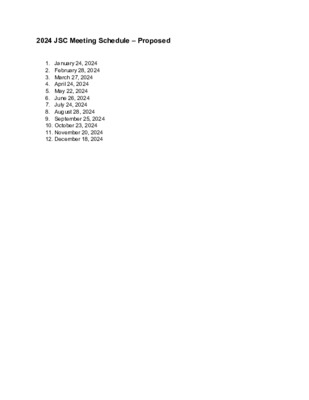
2024 JSC Meeting Schedule – Proposed 1. January 24, 2024 2. February 28, 2024 3. March 27, 2024 4. April 24, 2024 5. May 22, 2024 6. June 26, 2024 7. July 24, 2024 8. August 28, 2024 9. September 25, 2024 10. October 23, 2024 11. November 20, 2024 12. December 18, 2024
JOINT SUSTAINABILITY COMMITTEE HYBRID MEETING FORMAT October 25th, 2023 at 6pm Austin Energy HQ, Shudde Fath Conference Room 4815 Mueller Blvd Austin, TX 78723 Some members of the Committee may be participating by videoconference Public comment will be allowed in-person or remotely via telephone. Speakers may only register to speak on an item once either in-person or remotely and will be allowed up to three minutes to provide their comments. Registration no later than noon the day before the meeting is required for remote participation by telephone. To register to speak remotely, call or email Rohan Lilauwala at (rohan.lilauwala@austintexas.gov or 512-974-9394). CURRENT BOARD MEMBERS: Kaiba White, Chair (Electric Utility Commission) Diana Wheeler, Vice Chair (Urban Transportation Commission) Charlotte Davis (Resource Mgmt. Commission) Haris Qureshi (Environmental Commission) Melissa Rothrock (Zero Waste Advisory Commission) Bertha Delgado (Community Development Commission) Larry Franklin (Austin Travis County Food Policy Board) Chris Maxwell-Gaines (Water & Wastewater Commission) Amy Noel (Economic Prosperity Commission) Stephanie Bazan (Parks & Recreation Board) Jon Salinas (Design Commission) Vacant (City Council) Alice Woods (Planning Commission) Rodrigo Leal (Mayor’s Representative) Anna Scott (Mayor’s Representative) Heather Houser (Mayor’s Representative) Yureisly Suarez (Mayor’s Representative) Christopher Campbell (Mayor’s Representative) For more information, please visit: www.austintexas.gov/jsc AGENDA CALL TO ORDER PUBLIC COMMUNICATION: GENERAL The first 10 speakers signed up prior to the meeting being called to order will each be allowed a three-minute allotment to address their concerns regarding items not posted on the agenda. DISCUSSION 1. Sustainable Purchasing Best Practices – Johanna Anderson, Sustainable Purchasing Leadership Council. 2. Austin Resource Recovery Zero Waste Comprehensive Plan Update. 3. Updates from the Planning Commission. 4. Updates from the Urban Transportation Commission. 5. Updates from the Zero Waste Advisory Commission. 6. Updates from the Design Commission 7. Updates from the Electric Utility Commission. 8. Updates from the Planning Commission. DISCUSSION AND ACTION ITEMS 9. Approval of minutes from the September 27th meeting of the Joint Sustainability Committee. 10. Resolution in support of proposed Land Development Code amendments. FUTURE AGENDA ITEMS ADJOURNMENT The City of Austin is committed to compliance with the American with Disabilities Act. Reasonable modifications and equal access to communications will be provided upon request. Meeting locations are planned with wheelchair access. If requiring Sign Language Interpreters or alternative formats, please give notice at least 2 days (48 hours) before the meeting date. Please contact Rohan Lilauwala at rohan.lilauwala@austintexas.gov or 512-974-9394 for additional information; TTY users’ route …
Introduction to Sustainable Procurement Opportunities for local government action SPLC leads a global community of public and private purchasers, suppliers, advocates, and experts dedicated to driving positive impact through the power of procurement. Powering Procurement for Good (c)2023 Sustainable Purchasing Council SPLC’s Broad Membership Coalition A membership of 180+ Distinguished Organizations Leveraging $800B in annual purchasing power Multi-stakeholder membership including Fortune 500s, government, higher education, and specialized non-profits Working together to align and aggregate procurement demand for environmentally, socially, economically sustainable products, services and supply chains (c)2023 Sustainable Purchasing Council Today’s agenda Baseline definitions Importance of taking a program approach Local government examples Baseline definitions HEALTHY COMMUNITY ECONOMY ENVIRONMENT FOR EVERYONE FOREVER Procurement that… achieves value for money. strengthens the organization. CONVENTIONAL PROCUREMENT Procurement that… achieves value for money. strengthens the organization. strengthens the economy. strengthens society. strengthens the environment. CONVENTIONAL PROCUREMENT SUSTAINABLE PROCUREMENT Sustainable Procurement Sustainable Purchasing Sustainable Purchasing Procurement that… achieves value for money. strengthens the organization. strengthens the environment. strengthens society. strengthens the economy. CONVENTIONAL PROCUREMENT SUSTAINABLE PROCUREMENT Responsible Sourcing Responsible Supply Chain Supply Chain Sustainability Sustainable Procurement Purchasing in ways that intentionally strengthen our… (c)2023 Sustainable Purchasing Council Environment Society Economy • Climate protection • Pollution prevention • Waste reduction • Resource efficiency • Habitat preservation • Air and water quality • Health + Safety • Equal opportunity • Fair wages • Employee training • Workers rights • No forced labor • Supplier diversity • Small business • Local jobs • Fair competition • Transparency • Innovation • Corruption-free Benefits to the organization Tangible Intangible + Process efficiency + Innovation + Performance tracking - Regulatory burden - Costs + Supplier relationships + Brand value + Customer satisfaction + Employee satisfaction + Investor visibility - Business risk (c)2023 Sustainable Purchasing Council Taking a program approach Opportunistic Activity vs. Prioritized Strategic Program More work, less impact IMPACT Lack of prioritized focus Prioritization Prioritization Pilot: Environmental Impacts of Higher Education Spend Electricity Food, & Dining Construction & Maintenance Fuels Sanitary & Waste 5 purchasing categories 64% of total spending 83% of estimated impacts 14 Insight: Analysis and prioritization sharpens focus and reduces complexity Strategic Program Approach Vision Prioritized Impacts Focus Areas Goals and Metrics Solution Strategies Benefits of a program approach Individual activities With a strategic program Silos Cross-functional collaboration Efforts are less impactful …
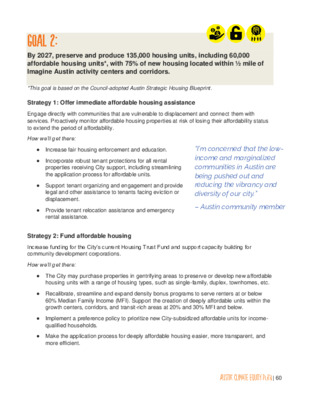
By 2027, preserve and produce 135,000 housing units, including 60,000 affordable housing units*, with 75% of new housing located within ½ mile of Imagine Austin activity centers and corridors. *This goal is based on the Council-adopted Austin Strategic Housing Blueprint. Strategy 1: Offer immediate affordable housing assistance Engage directly with communities that are vulnerable to displacement and connect them with services. Proactively monitor affordable housing properties at risk of losing their affordability status to extend the period of affordability. How we’ll get there: ● Increase fair housing enforcement and education. ● Incorporate robust tenant protections for all rental properties receiving City support, including streamlining the application process for affordable units. ● Support tenant organizing and engagement and provide legal and other assistance to tenants facing eviction or displacement. ● Provide tenant relocation assistance and emergency rental assistance. “I’m concerned that the low- income and marginalized communities in Austin are being pushed out and reducing the vibrancy and diversity of our city.” – Austin community member Strategy 2: Fund affordable housing Increase funding for the City’s current Housing Trust Fund and support capacity building for community development corporations. How we’ll get there: ● The City may purchase properties in gentrifying areas to preserve or develop new affordable housing units with a range of housing types, such as single-family, duplex, townhomes, etc. ● Recalibrate, streamline and expand density bonus programs to serve renters at or below 60% Median Family Income (MFI). Support the creation of deeply affordable units within the growth centers, corridors, and transit-rich areas at 20% and 30% MFI and below. ● Implement a preference policy to prioritize new City-subsidized affordable units for income- qualified households. ● Make the application process for deeply affordable housing easier, more transparent, and more efficient. | 60 Strategy 3: Enhance community engagement for affordable housing and anti- displacement programs Include low-income communities, communities of color, and people with disabilities directly affected by systemic inequalities in the City’s Housing Investment Review Committee activities and when creating anti-displacement programs. Enhance direct outreach of Housing and Planning Department-subsidized affordable units in gentrifying areas with culturally relevant communication strategies. By 2030, 50% of trips in Austin are made using public transit, biking, walking, carpooling, or avoided altogether by working from home*. *Based on City of Austin and Capital Metro data, includes all trips, and was approximately 20% in 2019. Strategy 1: Expand and improve public transportation Work with …
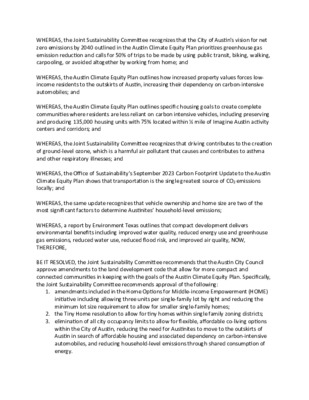
WHEREAS, the Joint Sustainability Commi(cid:425)ee recognizes that the City of Aus(cid:415)n’s vision for net zero emissions by 2040 outlined in the Aus(cid:415)n Climate Equity Plan priori(cid:415)zes greenhouse gas emission reduc(cid:415)on and calls for 50% of trips to be made by using public transit, biking, walking, carpooling, or avoided altogether by working from home; and WHEREAS, the Aus(cid:415)n Climate Equity Plan outlines how increased property values forces low‐ income residents to the outskirts of Aus(cid:415)n, increasing their dependency on carbon‐intensive automobiles; and WHEREAS, the Aus(cid:415)n Climate Equity Plan outlines specific housing goals to create complete communi(cid:415)es where residents are less reliant on carbon intensive vehicles, including preserving and producing 135,000 housing units with 75% located within ½ mile of Imagine Aus(cid:415)n ac(cid:415)vity centers and corridors; and WHEREAS, the Joint Sustainability Commi(cid:425)ee recognizes that driving contributes to the crea(cid:415)on of ground‐level ozone, which is a harmful air pollutant that causes and contributes to asthma and other respiratory illnesses; and WHEREAS, the Office of Sustainability’s September 2023 Carbon Footprint Update to the Aus(cid:415)n Climate Equity Plan shows that transporta(cid:415)on is the single greatest source of CO2 emissions locally; and WHEREAS, the same update recognizes that vehicle ownership and home size are two of the most significant factors to determine Aus(cid:415)nites’ household‐level emissions; WHEREAS, a report by Environment Texas outlines that compact development delivers environmental benefits including improved water quality, reduced energy use and greenhouse gas emissions, reduced water use, reduced flood risk, and improved air quality, NOW, THEREFORE, BE IT RESOLVED, the Joint Sustainability Commi(cid:425)ee recommends that the Aus(cid:415)n City Council approve amendments to the land development code that allow for more compact and connected communi(cid:415)es in keeping with the goals of the Aus(cid:415)n Climate Equity Plan. Specifically, the Joint Sustainability Commi(cid:425)ee recommends approval of the following: 1. amendments included in the Home Op(cid:415)ons for Middle‐income Empowerment (HOME) ini(cid:415)a(cid:415)ve including allowing three units per single‐family lot by right and reducing the minimum lot size requirement to allow for smaller single‐family homes; 2. the Tiny Home resolu(cid:415)on to allow for (cid:415)ny homes within single family zoning districts; 3. elimina(cid:415)on of all city occupancy limits to allow for flexible, affordable co‐living op(cid:415)ons within the City of Aus(cid:415)n, reducing the need for Aus(cid:415)nites to move to the outskirts of Aus(cid:415)n in search of affordable housing and associated dependency on carbon‐intensive automobiles, and reducing household‐level emissions through shared consump(cid:415)on of energy.
ARR Comprehensive Plan Update for JSC October 25, 2023 Meeting Agenda Introductions Planning Process Benchmarking Research & Analysis Stakeholder Engagement ARR Comprehensive Plan Overview Questions and Next Steps 2 Introductions 3 Update to 2011 Zero Waste Master Plan • The existing 2011 Zero Waste Master Plan has been renamed to the 2023 Zero Waste Comprehensive Plan • 2011 Plan had a goal to reach 90% diversion by the year 2040 • The 2011 plan focused on introduction to zero waste and access to services • This is a roadmap for the next 10 years 4 Key Accomplishments Since 2011 • Curbside Composting at Single Family Homes • Universal Recycling – recycling, food donation, or composting access for employees at all businesses and food permitted businesses • Construction Debris Recycling 5 Planning Process 6 Planning Process Early Improvement Recommendations Feasibility Matrix Preferred Strategies Benchmarking Research Key Definitions, Data/Technology & Policy Issues Analyze Multiple ARR Topics Establish Plan Goals & Objectives Identify Alternatives Evaluate Options Research, Analysis & Recommendations Develop Strategies & Options Multiple Strategy Workshops ARR Comprehensive Plan City/Stakeholder Engagement & Public Outreach Develop Outline & Write Multiple Drafts Based on Workshop and Stakeholder Engagement Feedback 7 Benchmarking 8 Benchmarking Overview Benchmarked 13 Zero Waste cities Zero Waste definitions Technology solutions Policy issues Key findings & recommendations to inform Comprehensive Plan 9 Benchmarking Results Year when City Adopted Zero Waste Vision 2008 2008 2013 1998 2005 2015 2012 2010 N/A N/A 2014 2013 2009 City Los Angeles Portland San Diego Seattle Austin Minneapolis Phoenix San Antonio Fort Worth Denver Boston Dallas San Francisco Published Diversion Rate* Waste Generators Considered Percent Year Commercial Single- Family Multi- Family Construction & Demolition (C&D) 76% 70% 65% 57% 42% 37% 36% 36% 30% 23% 21% 21% City does not use diversion rate 2011 2015 2018 2018 2015 2016 2019 2019 2018 2019 2019 2016 N/A ✓ ✓ ✓ ✓ ✓ ✓ ✓ ✓ ✓ ✓ ✓ ✓ ✓ ✓ ✓ ✓ ✓ ✓ ✓ ✓ ✓ ✓ ✓ ✓ ✓ ✓ ✓ *Metrics are based on data published at the time of benchmarking analysis (2020). More recent diversion rates may have been published by cities but were not updated within the table in order to maintain a baseline benchmarking comparison. ✓ ✓ ✓ ✓ ✓ ✓ 1 0 Benchmarking Results ► Of 13 benchmark cities, Austin’s diversion rate only trails west coast cities (LA, Portland, …
JOINT SUSTAINABILITY COMMITTEE REGULAR MEETING MEETING MINUTES Sep 27, 2023 The Joint Sustainability Committee convened in a hybrid meeting via videoconferencing and at AE Headquarters. Acting Chair Diana Wheeler called the Board Meeting to order at 6:05 pm. Board Members in Attendance in Person: Diana Wheeler, Alice Woods, Jon Salinas, Yure Suarez, Rodrigo Leal, Chris Maxwell-Gaines, Chris Campbell Board Members in Attendance Remotely: Lane Becker, Heather Houser, Melissa Rothrock, Kaiba White, Charlotte Davis Board Members Absent: Kelsey Hitchingham, Haris Qureshi, Larry Franklin, Bertha Delgado City Staff in Attendance: Zach Baumer CALL TO ORDER 9. Approval of minutes from the July 26th meeting of the Joint Sustainability Committee. Motion by White, seconded by Suarez. Approved unanimously (10-0, Maxwell-Gaines and Campbell off dais) PUBLIC COMMUNICATION Scott Johnson (air quality advocate) spoke on the importance of sustainable purchasing to encourage improved air quality Monica Guzman (Go Austin/Vamos Austin) spoke on the need for neighborhood circulators/shuttles in the Rundberg area of North Austin. 1. City of Austin Carbon Footprints, Phillip Duran, Office of Sustainability White: Great news that we got more funding for this department that needs even more Discussions of pros and cons of using 100-year Global Warming Potential measures vs funding for the large job it does. 20-year GWP Discussion on how to communicate consumption-based emissions 2. Climate Pollution Reduction Grants – Rohan Lilauwala, Office of Sustainability Unclear about whether GHG reductions include Scope 1-3 emissions 4. Updates from the Planning Commission – Alice Woods PC joint meeting with Council on Oct 26 to discuss changes to Land Development Code, voted by PC on Nov 14, Council on Dec 14. Impacts have positive sustainability impacts. Encourages JSC to pass resolution in support of the item. Wants to explore sustainability guide – can help provide objective source of environmental information. 5. Updates from Urban Transportation Commission – Diana Wheeler Encourages defending Project Connect, uses examples of other cities. Congress Ave urban design plan update 6. Updates from Water/Wastewater Commission – Chris Maxwell-Gaines Austin Water external review to improve organization effectiveness and resilience Water supply – Austin at stage 2 water restrictions since Aug 15 7. Updates from Resource Management Commission – Charlotte Davis RMC considering resolution around AE Green Choice – repurpose program towards dispatchable renewable energy and storage 8. Updates from Electric Utility Commission – Kaiba White …
JOINT SUSTAINABILITY COMMITTEE REGULAR MEETING MEETING MINUTES Oct 25, 2023 The Joint Sustainability Committee convened in a hybrid meeting via videoconferencing and at Austin Energy HQ. Acting Chair Diana Wheeler called the Board Meeting to order at 6:07 pm. Board Members in Attendance in Person: Diana Wheeler, Charlotte Davis, Chris Maxwell- Gaines, Jon Salinas, Rodrigo Leal, Haris Qureshi Board Members in Attendance Remotely: Heather Houser, Melissa Rothrock, Kaiba White, Stephanie Bazan, Yure Suarez, Chris Campbell, Alice Woods Board Members Absent: Haris Qureshi, Larry Franklin, Bertha Delgado City Staff in Attendance: Angela Baucom, Rohan Lilauwala, Jason McCombs, Richard McHale CALL TO ORDER PUBLIC COMMUNICATION Diana Prechter encouraged JSC to recommend closure of Zilker Park Polo Field to parking. off Dais) Chris Flores encouraged JSC to support audit of the use of fertilizer on Zilker Great Lawn because of its effects on water quality in Barton Creek. 9. Approval of minutes from the September 27th meeting of the Joint Sustainability Committee. Motion to approve by Qureshi, seconded by Davis. Approved unanimously (12-0, Woods 2. Austin Resource Recovery Zero Waste Comprehensive Plan Update. – Jason McCombs, Austin Resource Recovery, Scott Pasternak, Burns & McDonnell. Qureshi asks about multifamily composting. McCombs – thinking about this for a while, coming in Oct 2024. White has several questions around goals, timelines, rollout plans. Discussions at length around workforce development, community engagement, litter control, textile recycling, fees for diversion, etc. 1. Sustainable Purchasing Best Practices – Johanna Anderson, Sustainable Purchasing Leadership Council. Discussions around potential staffing needs, resources available, engagement with institutions and businesses 3. Updates from the Planning Commission – Alice Woods PC submitted recommendations in support of changes to city telework policy Joint meeting with council on 10/26 in favor of homes initiative. 4. Updates from Urban Transportation Commission – Diana Wheeler Recent topics discussed safe routes to schools, ETOD program, parking requirements 5. Updates from Zero Waste Advisory Commission – Melissa Rothrock ZWAC made recommendation of support of ARR zero waste plan Working on multifamily composting initiative 6. Updates from Design Commission – Jon Salinas Looking at building/site design guidelines 7. Updates from Electric Utility Commission – Kaiba White AE to present on modeling at Nov meeting. Resource planning WG continued meeting AE part of EPA Solar for All grant application 10. Resolution in support of proposed Land Development …
JOINT SUSTAINABILITY COMMITTEE HYBRID MEETING FORMAT September 27th, 2023 at 6pm Permitting and Development Center, Room 1401/1402 6310 Wilhelmina Delco Dr, Austin, TX 78752 Some members of the Committee may be participating by videoconference Public comment will be allowed in-person or remotely via telephone. Speakers may only register to speak on an item once either in-person or remotely and will be allowed up to three minutes to provide their comments. Registration no later than noon the day before the meeting is required for remote participation by telephone. To register to speak remotely, call or email Zach Baumer at (zach.baumer@austintexas.gov or 415-694-3111). CURRENT BOARD MEMBERS: Kaiba White, Chair (Electric Utility Commission) Diana Wheeler, Vice Chair (Urban Transportation Commission) Charlotte Davis (Resource Mgmt. Commission) Haris Qureshi (Environmental Commission) Melissa Rothrock (Zero Waste Advisory Commission) Bertha Delgado (Community Development Commission) Larry Franklin (Austin Travis County Food Policy Board) Chris Maxwell-Gaines (Water & Wastewater Commission) Kelsey Hitchingham (Economic Prosperity Commission) Stephanie Bazan (Parks & Recreation Board) Jon Salinas (Design Commission) Vacant (City Council) Alice Woods (Planning Commission) Rodrigo Leal (Mayor’s Representative) Anna Scott (Mayor’s Representative) Heather Houser (Mayor’s Representative) Yureisly Suarez (Mayor’s Representative) Christopher Campbell (Mayor’s Representative) For more information, please visit: www.austintexas.gov/jsc AGENDA CALL TO ORDER PUBLIC COMMUNICATION: GENERAL The first 10 speakers signed up prior to the meeting being called to order will each be allowed a three-minute allotment to address their concerns regarding items not posted on the agenda. DISCUSSION 1. Austin Carbon Footprints – Phillip Duran, Office of Sustainability. 2. EPA Climate Pollution Reduction Grants opportunity – Rohan Lilauwala, Office of Sustainability. 3. 2024 JSC Meeting Schedule. 4. Updates from the Planning Commission. 5. Updates from the Urban Transportation Commission. 6. Updates from the Water and Wastewater Commission. 7. Updates from the Resource Management Commission. 8. Updates from the Electric Utility Commission. DISCUSSION AND ACTION ITEMS 9. Approval of minutes from the August 23rd meeting of the Joint Sustainability Committee. 10. Discussion and Possible Recommendation to Council on Priority policy and program recommendations from JSC working groups on Austin Climate Equity Plan Implementation. FUTURE AGENDA ITEMS ADJOURNMENT The City of Austin is committed to compliance with the American with Disabilities Act. Reasonable modifications and equal access to communications will be provided upon request. Meeting locations are planned with wheelchair access. If requiring Sign Language Interpreters or alternative formats, please give notice at least 2 days (48 hours) before the meeting …
JOINT SUSTAINABILITY COMMITTEE REGULAR MEETING MEETING MINUTES Sep 27, 2023 The Joint Sustainability Committee convened in a hybrid meeting via videoconferencing and at AE Headquarters. Acting Chair Diana Wheeler called the Board Meeting to order at 6:05 pm. Board Members in Attendance in Person: Diana Wheeler, Alice Woods, Jon Salinas, Yure Suarez, Rodrigo Leal, Chris Maxwell-Gaines, Chris Campbell Board Members in Attendance Remotely: Lane Becker, Heather Houser, Melissa Rothrock, Kaiba White, Charlotte Davis Board Members Absent: Kelsey Hitchingham, Haris Qureshi, Larry Franklin, Bertha Delgado City Staff in Attendance: Zach Baumer CALL TO ORDER 9. Approval of minutes from the July 26th meeting of the Joint Sustainability Committee. Motion by White, seconded by Suarez. Approved unanimously (10-0, Maxwell-Gaines and Campbell off dais) PUBLIC COMMUNICATION Scott Johnson (air quality advocate) spoke on the importance of sustainable purchasing to encourage improved air quality Monica Guzman (Go Austin/Vamos Austin) spoke on the need for neighborhood circulators/shuttles in the Rundberg area of North Austin. 1. City of Austin Carbon Footprints, Phillip Duran, Office of Sustainability White: Great news that we got more funding for this department that needs even more Discussions of pros and cons of using 100-year Global Warming Potential measures vs funding for the large job it does. 20-year GWP Discussion on how to communicate consumption-based emissions 2. Climate Pollution Reduction Grants – Rohan Lilauwala, Office of Sustainability Unclear about whether GHG reductions include Scope 1-3 emissions 4. Updates from the Planning Commission – Alice Woods PC joint meeting with Council on Oct 26 to discuss changes to Land Development Code, voted by PC on Nov 14, Council on Dec 14. Impacts have positive sustainability impacts. Encourages JSC to pass resolution in support of the item. Wants to explore sustainability guide – can help provide objective source of environmental information. 5. Updates from Urban Transportation Commission – Diana Wheeler Encourages defending Project Connect, uses examples of other cities. Congress Ave urban design plan update 6. Updates from Water/Wastewater Commission – Chris Maxwell-Gaines Austin Water external review to improve organization effectiveness and resilience Water supply – Austin at stage 2 water restrictions since Aug 15 7. Updates from Resource Management Commission – Charlotte Davis RMC considering resolution around AE Green Choice – repurpose program towards dispatchable renewable energy and storage 8. Updates from Electric Utility Commission – Kaiba White …
Joint Sustainability Committee RECOMMENDATION 20230927-010 Date: September 27, 2023 Subject: Priorities for accelerating implementation of the Austin Climate Equity Plan Motioned By: Rodrigo Leal Seconded By: Christopher Campbell Recommendation The Joint Sustainability Committee recommends that additional emphasis be placed on implementing the goals and strategies in the Austin Climate Equity Pan (ACEP), to give our community a chance to meet the goals of the plan. The committee recommends that the City Council, city management, and appropriate city departments start work immediately to implement the following list of strategies identified as priorities. Tracking and Reporting Recommendation: 1. The Office of Sustainability should publish a schedule of official updates to the Climate Equity Plan implementation dashboard, including metrics on the specific sub-strategies within the plan and more formalized equity accounting, to enable the public to see progress toward Austin’s climate equity goals. Recommend biannual or quarterly updates. All city departments should be instructed to provide timely updates with sufficient detail to enable these updates. [ACEP] Sustainable Buildings Recommendations: 2. City Council should (after appropriate stakeholder engagement by Austin Energy and Development Services) adopt the 2024 International Energy Conservation Code (IECC), with a local amendment to require space for a heat pump hot water heater, as quickly as possible. [Sustainable Buildings Goal 1, Strategies 1 and 3] 3. City Council should update the Energy Conservation Audit and Disclosure Ordinance (ECAD) to require energy efficiency upgrades to multifamily and commercial buildings that perform poorly on energy audits. [Sustainable Buildings Goal 1, Strategies 1 and 3] 4. City Council should consider incorporating the use of the Passive House standard and/or Living Building Challenge standard into a density bonus program when the existing density bonus programs are consolidated. [Sustainable Buildings Goal 1, Strategies 1 and 3] 5. City Council should establish a policy to explicitly promote or incentivize the Passive House and/or Living Building Challenge standards throughout the City of Austin RFP and building funding scoring metrics (stating preference for and/or adding points to scoring for meeting these standards). [Sustainable Buildings Goal 1, Strategies 1 and 3] 6. Austin Energy should create a pilot program, possibly utilizing funds from Austin Energy’s Energy Efficiency Services fee or grants, to demonstrate the efficacy of certified Passive House and/or Living Building Challenge multifamily projects. Recommend funding $3,000 per unit for first 1000 Low Income Housing Tax Credit (LIHTC) units to certify and create a report detailing construction cost increases …
Carbon Footprint Update September 2023 1 Austin’s Carbon Emissions 2 Carbon Accounting Protocols International leader on climate science For communities, like the Austin area For organizations like COA, CapMetro 3 Carbon Emission “Scopes” “BURN” “BUY” “BEYOND” Fuels you burn directly Transportation fuel Water and space heating fuel Electricity District Energy Indirect offsite emissions Everything else Production and delivery of goods and services Can occur anywhere in the world Hard to measure Traditional Carbon Footprint 4 Carbon Footprint Boundaries City of Austin Daily Operations Austin Extra-territorial Jurisdiction Municipal Carbon Footprint Community-wide Carbon Footprint 5 Austin’s Carbon Emissions 6 City of Austin Municipal Footprint Boundary Sources Electricity Natural Gas District Energy City Vehicles Refrigerants Carbon Offsets City of Austin Daily Operations GreenChoice Energy since 2012 Space and water heating City Hall, Central Library, Austin Convention Center Fleet, emergency aircraft, mileage reimbursements Estimate based on fleet and facility purchase orders Local tree plantings, Airport and Convention Center 7 City of Austin Municipal Footprint CITY OF AUSTIN Municipal Carbon Footprint Net emissions in 2022 44K Metric Tons CO₂e Electricity Natural Gas District Energy City Vehicles Refrigerants Offsets Link: COA Municipal Carbon Footprint Dashboard 8 City of Austin Municipal Footprint 2022 Net Emissions: 44k metric tons CO₂e 9 Local Community-wide Footprint Boundary Sources Electricity Natural Gas Transportation Refrigerants Industrial Waste Austin Energy Texas Gas Service, Atmos Energy, UT Power Plant Google EIE, Red Line and freight, in- boundary aviation Community-wide estimate based on population Semi-conductor manufacturing, other processes Austin Water wastewater, local landfills, flaring Austin Extra-territorial Jurisdiction If the emissions occur here, we try to capture them 10 Local Community-wide Footprint COMMUNITY-WIDE FOOTPRINT Carbon emission trends by source COVID-19 Link: Local Community-wide Carbon Footprint Dashboard 11 Local Community-wide Footprint Emissions Peaked in 2011 COMMUNITY-WIDE FOOTPRINT Progress towards net-zero by 2040 11.8 MT CO₂e in 2021 Natural Gas Electricity Transportation Industrial Refrigerants Waste 12 Local Community-wide Footprint 2021: 11.8 million metric tons CO₂e 13 Consumption-based Footprint “BURN” “BUY” “BEYOND” Fuels you burn directly Transportation fuel Water and space heating fuel Electricity District Energy Indirect offsite emissions Everything else Production and delivery of goods and services Can occur anywhere in the world Hard to measure Consumption-Based Footprint 14 Consumption-based Footprint What is a consumption-based emissions inventory? Our consumption-based emissions inventory (CBEI) is an estimate of the greenhouse gas emissions from the production and delivery of the goods and services used by the entire community. Sources like utilities …
Joint Sustainability Committee RECOMMENDATION 20230726-XXX Date: September 27, 2023 Subject: Priorities for accelerating implementation of the Austin Climate Equity Plan Motioned By: Seconded By: Recommendation The Joint Sustainability Committee recommends that additional emphasis be placed on implementing the strategies in the Austin Climate Equity Pan, to give our community a chance to meet the goals of the plan. The committee recommends that the City Council, city management, and appropriate city departments start work immediately to implement the following list of strategies identified as priorities. Sustainable Buildings Recommendations: 1. City Council should (after appropriate stakeholder engagement by Austin Energy and Development Services) adopt the 2024 International Energy Conservation Code (IECC), with a local amendment to require space for a heat pump hot water heater, as quickly as possible. [Sustainable Buildings Goal 1, Strategies 1 and 3] 2. City Council should update the Energy Conservation Audit and Disclosure Ordinance (ECAD) to require energy efficiency upgrades to multifamily and commercial buildings that perform poorly on energy audits. [Sustainable Buildings Goal 1, Strategies 1 & 3] 3. City Council should create a density bonus (that stacks on top of Affordability Unlocked bonus and other bonus programs) to incentivize the use of the Passive House standard and/or Living Building Challenge standard. [Sustainable Buildings Goal 1, Strategies 1 and 3] 4. City Council should establish a policy to explicitly promote or incentivize the Passive House and/or Living Building Challenge standards throughout the City of Austin RFP and building funding scoring metrics (stating preference for and/or adding points to scoring for meeting these standards). [Sustainable Buildings Goal 1, Strategies 1 and 3] 5. Austin Energy should create a pilot program, possibly utilizing funds from Austin Energy’s Energy Efficiency Services fee or grants, to demonstrate the efficacy of certified Passive House and/or Living Building Challenge multifamily projects. Recommend funding $3,000 per unit for first 1000 Low Income Housing Tax Credit (LIHTC) units to certify and create a report detailing construction cost increases vis a vis utility savings and other benefits. [Sustainable Buildings Goal 1, Strategies 1 and 3] 6. Austin Energy should split the Austin Energy Green Building (AEGB) program into one track that applies to Smart Housing and a “standard” track for all other development. Allocate funding and staff to administer these programs. Create incentives and/or provide a density bonus for Smart Housing to meet the requirements of the “standard” AEGB program. [Sustainable Buildings Goal 1, Strategies …
Joint Sustainability Committee RECOMMENDATION 20230726-XXX Date: September 26, 2023September 25, 2023September 6, 2023 Subject: Priorities for implementation of the Austin Climate Equity Plan Motioned By: Seconded By: Description of Recommendations to Council Transportation Electrification Recommendations: 1. The Joint Sustainability Commission recommends that Austin Energy, in collaboration with CapMetro and City of Austin Department of Transportation and Public Works, define and then conduct an Electric Vehicles (EV) Community Needs Assessment with a focus on the Eastern Crescent, Rundberg (North Austin, North Lamar, Georgian Acres), and Dove Springs. Assessment should build on community engagement and feedback (such as leveraging an Ambassadors program and partnering with entities such as TxETRA) to address mobility challenges in these regions and consider other electric mobility options such as buses, shuttles, and carsharing. 2. The Joint Sustainability Commission recommends that Austin Energy will provide develop city-wide incentives for buying and leasing new and used EVs targeted only to those who qualify for the Austin Energy Customer Assistance Program (CAP). 3. The Joint Sustainability Commission recommends that Austin Energy will facilitate the createion of a coalition of organizations and a paid ambassadors program (e.g., Climate Ambassadors), to provide stipends to individuals and organizations that already have trust in the community to provide EV education. Education shouldwill encompass: clarifying the EV charging process, raising awareness about available incentives, and increasing community involvement by connecting systematically excluded groups with job and training/education opportunities in the EV field. 2 Transportation Electrification Rationales: 1. Austin Energy identified this as a high equity impact strategy. The Austin Climate Equity Plan notes that conducting a community EV Community Needs Assessment will assist in identifying the intersections of mobility challenges, transportation electrification, and racial and economic justice. The assessment will inform an EV adoption growth plan that will be supported by enhanced communications efforts and incentives. [Transportation Electrification Goal 1, Strategy 1] 2. Even though there are federal and state-wide incentives that have made EVs more affordable and comparable to internal combustion engine vehicles, current incentives are not targeted to low-income communities. Also, EV adopters tend to belong to higher income population groups. Therefore, a city-wide incentive toward low-income communities can level the playing field, promote a just and equitable transition to EVs and accelerate EV adoption city-wide. This would be considered a high equity and high emission reduction impact recommendation. [Transportation Electrification Goal 1, Strategy 2] 3. A lack of education around available tax …
Joint Sustainability Committee RECOMMENDATION 20230726-XXX Date: September 27, 2023 Subject: Priorities for implementation of the Austin Climate Equity Plan Motioned By: Seconded By: Recommendation Description of Recommendation to Council Natural Systems and Food & Product Consumption Recommendations: 1. The Office of Sustainability should publish a schedule of official updates to the Climate Equity Plan implementation dashboard, including metrics on the specific sub-strategies within the plan and more formalized equity accounting, to enable the public to see progress toward Austin’s climate equity goals. Recommend biannual or quarterly updates. All city departments should be instructed to provide timely updates with sufficient detail to enable these updates. 2. The disposal rate goal in the Austin Resource Recovery Zero Waste Plan should decline over time, rather than remain steady as indicated in the draft plan. 3. The near-term goals of The Austin Resource Recovery Zero Waste Plan should be redefined as a timeframe of 0-2 years to better align with the goals of the ACEP, instead of near-term being defined as 0-5 years as indicated in the draft plan. 4. Office of Sustainability should work with relevant City departments, potentially including Austin Public Health, to begin a stakeholder process to develop educational campaigns and incentives to promote healthy, low-carbon, protein-rich food choices within the retail space and non-retail programs (Mobile Markets, Healthy Food Pantries and pop-ups, etc.). This may include a local program similar to Double Up Food Bucks for protein-rich plant foods (such as beans, lentils and soy). Direct incentives to grocery stores and affordable restaurants (which could be in the form of coupons available to customers) should also be considered. The Office of Sustainability should pursue any available options for outside funding, including an EPA Climate Pollution Reduction Grant, in addition to city funding. Rationale: Natural Systems and Food & Product Consumption Recommendations 1. More data and information and more frequent updates to the dashboard is needed to better gauge Austin’s stated progress on climate goals. Data gaps, in particular on the Climate Equity Plan implementation dashboard, exist. Status of progress is only shown down to the “strategy” level, but each “strategy” in the plan actually includes multiple strategies. Reporting on the status of each sub-strategy is needed. Status of the actual implementation is sometimes out of date, and often doesn’t include any information about who is leading an initiative or who to contact to get more information or get involved. Additionally, …
Climate Pollution Reduction Grants Office of Sustainability Approach - Sep 2023 Partners • Part of Inflation Reduction Act, passed in 2021 • Funds targeted at states, MSAs, and tribal governments • Two phases • Planning • Implementation CPRG Planning Grants ● $1 million in non-competitive funding to the Austin-Round Rock Metropolitan Statistical Area (MSA) for regional climate planning ● City of Austin (Sustainability) leading process ● AECOM supported grant application ● Outputs ○ Priority Climate Action Plan (PCAP) (due Mar 1, 2024) ○ Comprehensive Climate Action Plan (CCAP) (due mid-2025) ○ Status Report (due mid-2027) 3 City of Austin Travis County CAPCOG City of Kyle Hays County CAMPO City of Buda Bastrop County Clean Air Force Partners City of San Marcos City of Lakeway City of Round Rock City of Pflugerville SPEER Movability Alliance Sierra Club Lone Star Clean Fuels 4 Planning Grant Application Timeline ● May: Applied for grant ● Jun-Aug: Worked with EPA ● Oct: Project kicks off ● Sep: Received notice of award, council approval, job postings up 5 PCAP Timeline 6 CPRG Implementation Funds - Opportunity ● $4.3 billion for general competition ● Expectation of 30 to 115 grants ranging between $2 million and $500 million ● Measures proposed must be in PCAP and focused on GHG reductions ● We can submit two applications: one individual, and one as lead of a coalition ● We can also participate in other coalitions ● Deadline is April 1, 2024 7 CPRG Implementation Funds - Goals 1. Implement ambitious measures that will achieve significant cumulative GHG reductions by 2030 and beyond 2. Pursue measures that will achieve substantial community benefits (such as reduction of criteria air pollutants (CAPs) and hazardous air pollutants (HAPs)), particularly in low-income and disadvantaged communities; 3. Complement other funding sources to maximize these GHG reductions and community benefits 4. Pursue innovative policies and programs that are replicable and can be “scaled up” across multiple jurisdictions. 8 CPRG Implementation Funds - Evaluation Criteria Overall Project Summary and Approach Impact of GHG Reduction Measures Environmental Results – Outputs, Outcomes, and Performance Measures Low-Income and Disadvantaged Communities Job Quality Total Programmatic Capability and Past Performance Budget and Timely Expenditure of Grant Funds 45 60 30 35 5 30 45 250 9 Prep Work for Grants - Interdepartmental Meetings ● We’ve been having monthly conversations with 20+ departments ● Tracking opportunities ● Identifying projects and looking for opportunities for …
JOINT SUSTAINABILITY COMMITTEE REGULAR MEETING MEETING MINUTES August 23, 2023 The Joint Sustainability Committee convened in a hybrid meeting via videoconferencing and at AE Headquarters. Acting Chair Kaiba White called the Board Meeting to order at 6:10 pm. Board Members in Attendance in Person: Charlotte Davis, Rodrigo Leal, Yure Suarez, Kaiba White, Haris Qureshi Board Members in Attendance Remotely: Stephanie Bazan, Jon Salinas, Diana Wheeler, Melissa, Rothrock, Heather Houser, Christopher Campbell, Anna Scott Board Members Absent: Larry Franklin, Alice Woods, Kelsey Hitchingham, Chris Maxwell- Gaines, Bertha Delgado Observing: None City Staff in Attendance: Zach Baumer CALL TO ORDER PUBLIC COMMUNICATION The speakers who registered in advance for public comment have three minutes each to address items on the agenda at this time. 5. Approval of minutes from the July 26th meeting of the Joint Sustainability Committee. Motion by Qureshi, seconded by Davis. Approved unanimously (12-0) 1. Office of Sustainability Budget - Zach Baumer, Office of Sustainability Qureshi: Will you continue to fund Climate Ambassadors? Baumer: Yes with additional staff will find a way to continue to support ambassadors. White: Met with Rodney Gonzales and made the recommendations clear / simple / easily fundable. Question looming about Temp to Perm Admin or Engagement staff? Baumer: Will follow up. Scott: Do we know exactly why this additional funding was received? White: Great news that we got more funding for this department that needs even more funding for the large job it does. 2. EV charging infrastructure education and workforce development – Larry Franklin, Black Lives Veggies – Item Skipped 6. Discussion and Possible Recommendation to Council on composting and recycling services at multifamily residential properties. – Kaiba White - Kaiba White summary of presentation - Discussed Recommendation to Council - Davis: What about enforcement? - White: Code enforcement officers. - Rothrock: Will be a slow rollout, no enforcement for a year. - Davis: Education, are there additional requirements above and beyond signage / information to educate folks how to use it? - White: Signage and also materials given to residents - Suarez: Who ends up paying for this, and trash valet, will they compost? - Discussion: unsure, recommendation doesn’t address. - Going to council next month. Houser motion – Scott – 2nd. Vote = 12-0 adopted. 7. Discussion and Possible Recommendation to Council on Priority policy and program recommendations from JSC working groups on Austin …
JOINT SUSTAINABILITY COMMITTEE HYBRID MEETING FORMAT August 23rd, 2023 at 6pm Austin Energy HQ, Shudde Fath Conference Room 4815 Mueller Blvd Austin, TX 78723 Some members of the Committee may be participating by videoconference Public comment will be allowed in-person or remotely via telephone. Speakers may only register to speak on an item once either in-person or remotely and will be allowed up to three minutes to provide their comments. Registration no later than noon the day before the meeting is required for remote participation by telephone. To register to speak remotely, call or email Zach Baumer at (zach.baumer@austintexas.gov or 415-694-3111). CURRENT BOARD MEMBERS: Kaiba White, Chair (Electric Utility Commission) Diana Wheeler, Vice Chair (Urban Transportation Commission) Charlotte Davis (Resource Mgmt. Commission) Haris Qureshi (Environmental Commission) Melissa Rothrock (Zero Waste Advisory Commission) Bertha Delgado (Community Development Commission) Larry Franklin (Austin Travis County Food Policy Board) Chris Maxwell-Gaines (Water & Wastewater Commission) Kelsey Hitchingham (Economic Prosperity Commission) Lane Becker (Parks & Recreation Board) Jon Salinas (Design Commission) Vacant (City Council) Alice Woods (Planning Commission) Rodrigo Leal (Mayor’s Representative) Anna Scott (Mayor’s Representative) Heather Houser (Mayor’s Representative) Yureisly Suarez (Mayor’s Representative) Christopher Campbell (Mayor’s Representative) For more information, please visit: www.austintexas.gov/jsc AGENDA CALL TO ORDER PUBLIC COMMUNICATION: GENERAL The first 10 speakers signed up prior to the meeting being called to order will each be allowed a three-minute allotment to address their concerns regarding items not posted on the agenda. DISCUSSION 1. Office of Sustainability 2023-2024 Budget – Zach Baumer, Office of Sustainability. 2. EV charging infrastructure education and workforce development – Larry Franklin, Black Lives Veggies. 3. JSC Annual Report. 4. N/A (Item removed) DISCUSSION AND ACTION ITEMS 5. Approval of minutes from the July 26th meeting of the Joint Sustainability Committee. 6. Discussion and Possible Recommendation to Council on composting and recycling services at multifamily residential properties. 7. Discussion and Possible Recommendation to Council on Priority policy and program recommendations from JSC working groups on Austin Climate Equity Plan Implementation. FUTURE AGENDA ITEMS ADJOURNMENT The City of Austin is committed to compliance with the American with Disabilities Act. Reasonable modifications and equal access to communications will be provided upon request. Meeting locations are planned with wheelchair access. If requiring Sign Language Interpreters or alternative formats, please give notice at least 2 days (48 hours) before the meeting date. Please call Zach Baumer at the Office of Sustainability at 415-694-3111, for …
JOINT SUSTAINABILITY COMMITTEE REGULAR MEETING MEETING MINUTES August 23, 2023 The Joint Sustainability Committee convened in a hybrid meeting via videoconferencing and at AE Headquarters. Acting Chair Kaiba White called the Board Meeting to order at 6:10 pm. Board Members in Attendance in Person: Charlotte Davis, Rodrigo Leal, Yure Suarez, Kaiba White, Haris Qureshi Board Members in Attendance Remotely: Stephanie Bazan, Jon Salinas, Diana Wheeler, Melissa, Rothrock, Heather Houser, Christopher Campbell, Anna Scott Board Members Absent: Larry Franklin, Alice Woods, Kelsey Hitchingham, Chris Maxwell- Gaines, Bertha Delgado Observing: None City Staff in Attendance: Zach Baumer CALL TO ORDER PUBLIC COMMUNICATION The speakers who registered in advance for public comment have three minutes each to address items on the agenda at this time. 5. Approval of minutes from the July 26th meeting of the Joint Sustainability Committee. Motion by Qureshi, seconded by Davis. Approved unanimously (12-0) 1. Office of Sustainability Budget - Zach Baumer, Office of Sustainability Qureshi: Will you continue to fund Climate Ambassadors? Baumer: Yes with additional staff will find a way to continue to support ambassadors. White: Met with Rodney Gonzales and made the recommendations clear / simple / easily fundable. Question looming about Temp to Perm Admin or Engagement staff? Baumer: Will follow up. Scott: Do we know exactly why this additional funding was received? White: Great news that we got more funding for this department that needs even more funding for the large job it does. 2. EV charging infrastructure education and workforce development – Larry Franklin, Black Lives Veggies – Item Skipped 6. Discussion and Possible Recommendation to Council on composting and recycling services at multifamily residential properties. – Kaiba White - Kaiba White summary of presentation - Discussed Recommendation to Council - Davis: What about enforcement? - White: Code enforcement officers. - Rothrock: Will be a slow rollout, no enforcement for a year. - Davis: Education, are there additional requirements above and beyond signage / information to educate folks how to use it? - White: Signage and also materials given to residents - Suarez: Who ends up paying for this, and trash valet, will they compost? - Discussion: unsure, recommendation doesn’t address. - Going to council next month. Houser motion – Scott – 2nd. Vote = 12-0 adopted. 7. Discussion and Possible Recommendation to Council on Priority policy and program recommendations from JSC working groups on Austin …
JOINT SUSTAINABILITY COMMITTEE RECOMMENDATION 20230823-6 Date: August 23, 2023 Subject: Multifamily Composting Ordinance Recommendation Recommendation Multifamily Composting Ordinance Recommendation Description of Recommendation to Council The Joint Sustainability recommends that the Austin City Council approve the proposed update to the Universal Recycling Ordinance to require composting collection at multifamily properties, as proposed by staff in the Attachment A. Rationale: Providing composting services to all residents aligns with the goals of the Austin Climate Equity plan. Keeping organic materials out of the landfill reduces methane production, which is an important step for mitigating climate change. Motioned By: Heather Houser Seconded By: Anna Scott Vote: 12-0 Against: none Abstain: none For: Stephanie Bazan, Jon Salinas, Diana Wheeler, Melissa Rothrock, Heather Houser, Christopher Campbell, Anna Scott, Charlotte Davis, Rodrigo Leal, Yure Suarez, Kaiba White, Haris Qureshi Absent: Larry Franklin, Alice Woods, Kelsey Hitchingham, Chris Maxwell-Gaines, Bertha Delgado Attest: Zach Baumer, Interim Chief Sustainability Officer 1 of 2 Attachment A: Multi-Family Compost – Universal Recycling Ordinance Code and Rules Amendment 2 of 2 1 2 3 4 5 6 7 8 9 10 11 12 13 14 15 16 17 18 19 20 21 22 23 24 25 26 27 28 29 PART 1. City Code Section 15-6-91 (Affected Premises) is amended to read: § 15-6-91 AFFECTED PREMISES. (A) The responsible party for a premises of which all or part is used for multi- family residential use shall: (1) (2) ensure that tenants and employees have access to on-site recycling services described under this article, for that portion of the premises that is multi-family residential; and after October 1, 2024, and for premises with five or more dwelling units, ensure that tenants and employees have access to composting services described under this article, for that portion of the premises that is multi-family residential. [, effective: (1) immediately for premises with 75 or more dwelling units; (2) October 1, 2013 for premises with 50 or more but less than 75 (3) October 1, 2014 for premises with 25 or more but less than 50 (4) October 1, 2015 for premises with 10 or more but less than 25 (5) October 1, 2016 for premises with 5 or more but less than 10 dwelling units; dwelling units; dwelling units; and dwelling units.] (B) The responsible party for a premises of which all or part is used for office, medical office, medical facilities, religious assembly, or private educational …
JOINT SUSTAINABILITY COMMITTEE HYBRID MEETING FORMAT August 23rd, 2023 at 6pm Austin Energy HQ, Shudde Fath Conference Room 4815 Mueller Blvd Austin, TX 78723 Some members of the Committee may be participating by videoconference Public comment will be allowed in-person or remotely via telephone. Speakers may only register to speak on an item once either in-person or remotely and will be allowed up to three minutes to provide their comments. Registration no later than noon the day before the meeting is required for remote participation by telephone. To register to speak remotely, call or email Zach Baumer at (zach.baumer@austintexas.gov or 415-694-3111). CURRENT BOARD MEMBERS: Kaiba White, Chair (Electric Utility Commission) Diana Wheeler, Vice Chair (Urban Transportation Commission) Charlotte Davis (Resource Mgmt. Commission) Haris Qureshi (Environmental Commission) Melissa Rothrock (Zero Waste Advisory Commission) Bertha Delgado (Community Development Commission) Larry Franklin (Austin Travis County Food Policy Board) Chris Maxwell-Gaines (Water & Wastewater Commission) Kelsey Hitchingham (Economic Prosperity Commission) Lane Becker (Parks & Recreation Board) Jon Salinas (Design Commission) Vacant (City Council) Alice Woods (Planning Commission) Rodrigo Leal (Mayor’s Representative) Anna Scott (Mayor’s Representative) Heather Houser (Mayor’s Representative) Yureisly Suarez (Mayor’s Representative) Christopher Campbell (Mayor’s Representative) For more information, please visit: www.austintexas.gov/jsc AGENDA CALL TO ORDER PUBLIC COMMUNICATION: GENERAL The first 10 speakers signed up prior to the meeting being called to order will each be allowed a three-minute allotment to address their concerns regarding items not posted on the agenda. DISCUSSION 1. Office of Sustainability 2023-2024 Budget – Zach Baumer, Office of Sustainability. 2. EV charging infrastructure education and workforce development – Larry Franklin, Black Lives Veggies. 3. JSC Annual Report. 4. N/A (Item removed) DISCUSSION AND ACTION ITEMS 5. Approval of minutes from the July 26th meeting of the Joint Sustainability Committee. 6. Discussion and Possible Recommendation to Council on composting and recycling services at multifamily residential properties. 7. Discussion and Possible Recommendation to Council on Priority policy and program recommendations from JSC working groups on Austin Climate Equity Plan Implementation. FUTURE AGENDA ITEMS ADJOURNMENT The City of Austin is committed to compliance with the American with Disabilities Act. Reasonable modifications and equal access to communications will be provided upon request. Meeting locations are planned with wheelchair access. If requiring Sign Language Interpreters or alternative formats, please give notice at least 2 days (48 hours) before the meeting date. Please call Zach Baumer at the Office of Sustainability at 415-694-3111, for …
Office of Sustainability Budget Summary August 2023 1 Budget ● FY23 Budget - $2,116,101 ○ $80% = 14 Staff - $1.7 million ○ $125k in office costs (rent) ○ $50k for memberships / conferences / sponsorships ○ $230k for Projects (materials, consultants, advertising, etc.) 2 Staffing 14 Total - - - - 12 FTEs 1 on Loan 1 vacant 2 Temps 3 New Resources for FY2023-24 ● $350k (from FY23) to fund UT Climate Co-lab with Dr. Dev Nyogi ● $200k – Ongoing Consultant support for Grant Pursuits ● $100k – Sustainable Purchasing Plan ● $50k – Refrigerant Study ● 1 - Temp to Permanent Conversion for our team ● 1 - Replacement FTE for Marc Coudert to transition to Resilience 4 Climate Pollution Reduction Grant ● $1 million from EPA over 4 years (FY 24-27) to conduct regional ● Work is largely front-loaded and will take place mostly in FY 24 climate planning and FY 25 ● 4 Temps being hired ○ Project Coordinator (FY 24-27) ○ Engagement Coordinator (FY 24-25) ○ Junior Analyst (FY 24-25) ○ Project Administrator (FY 24-25) ● Expected kickoff Oct 1, 2024 – more to come 5 Thank you! zach.baumer@austintexas.gov 6
JOINT SUSTAINABILITY COMMITTEE REGULAR MEETING July 26, 2023 MEETING MINUTES The Joint Sustainability Committee convened in a hybrid meeting via videoconferencing and at PDC. Acting Chair Kaiba White called the Board Meeting to order at 6:13 pm. Board Members in Attendance in Person: Kaiba White, Haris Qureshi, Charlotte Davis, Jon Salinas, Larry Franklin, Rodrigo Leal Board Members in Attendance Remotely: Melissa Rothrock, Heather Houser, Anna Scott, Diana Wheeler, Christopher Campbell Board Members Absent: Kelsey Hitchingham, Chris Maxwell-Gaines, Yure Suarez Observing: Amy Noel (not yet completed oath) City Staff in Attendance: Zach Baumer, Rohan Lilauwala, Matt McCaw, Amanda Ross, Jodi, Juan Espinoza, Kerstin Johannson, Cameron Freberg, Christa McCarthy CALL TO ORDER PUBLIC COMMUNICATION The speakers who registered in advance for public comment have three minutes each to address items on the agenda at this time. 6. Approval of minutes from the June 28th meeting of the Joint Sustainability Committee. Motion by Qureshi, seconded by Davis. Approved unanimously (11-0) 1. Parks and Recreation Department Land Management Plan Overview – Matt McCaw, Parks and Recreation Department Leal: does $200/acre cost represent new costs? Where did this come from? McCaw: study of comparable plans. Yes, new costs. Current 2 FTEs + 1 homelessness response coordinator, 75k operating budget. In the early phases of long-term project. Qureshi: is there an ideal budgetary mount that should go to this? McCaw: to fully fund this plan, $2 million Qureshi: are there particular areas of vulnerability to wildfire? McCaw: Generally well distributed, wildland-urban interface is everywhere. Fire behavior changes between woodland (in west) and grassland (in east). Woodland might be slower but more intense, grassland faster but less intense. Soil water availability – shallow soils in west contributes to vulnerability. White: how much restoration is being done now vs 1000 acres a year target McCaw: based on many treatments needed over time. Areas will need to be treated multiple times. 400 acres of restoration done in 2.5-3 years. White: Are volunteers being used? McCaw: Not as much as we can, beginning conversations with Parks foundation to collaborate on training and engagement with volunteers White: Do Creekside lands fall into this plan? McCaw: Riparian/aquatic areas are 5% of total. When streambank stabilization and engineering are involved, Watershed get involved. E.g. replaced a failing earthen dam in Onion Creek. Lots of collaboration with WPD. Wheeler: What …
CITY OF AUSTIN RECOMMENDATION FOR COUNCIL ACTION AMENDMENT TO AUSTIN CITY CODE CHAPTER 15-6 AND ADMINISTRATIVE RULES COUNCIL DATE: XX/XX/2023 SUBJECT: Approve an ordinance amending City Code Chapter 15-6 and administrative rules relating to composting and recycling services at multifamily residential properties. MBE/WBE: N/A LEAD DEPARTMENT: Austin Resource Recovery FISCAL NOTE: PURCHASING/LEGAL: N/A PRIOR COUNCIL ACTION: On October 17, 2019, Council approved a resolution directing the City Manager to make recommendations to the City Council on possible amendments to the Universal Recycling Ordinance to include organic waste collection at all commercial and multifamily properties. FOR MORE INFORMATION CONTACT: ADDITIONAL BACKUP INFORMATION (RCA BODY) BOARD AND COMMISSION ACTION: August 9, 2023 – To be reviewed by the Zero Waste Advisory Commission BACKGROUND: Austin City Council adopted the Universal Recycling Ordinance (URO) in 2010 as part of Austin Resource Recovery’s Master Plan and the City’s Zero Waste goal to divert 90% of solid waste from landfills and incinerators by the year 2040. The URO requires that commercial and multifamily properties provide access to recycling service to employees and tenants and methods of organics diversion to commercial food-permitted business employees. A 2015 Community Diversion Study found that 85 % of discarded material generated in Austin comes from the commercial and multifamily sector and that 37% is compostable. PROCESS Austin Resource Recovery staff conducted a pilot to test composting at seven multifamily properties between March 2021 and February 2022. Staff published a report summarizing the findings of the pilot and initiated stakeholder meetings to discuss potential policy changes. Staff led five stakeholder meetings between October 2022 and May 2023 and opened three online surveys to collect feedback on priorities and draft policy language. The Zero Waste Advisory Commission (ZWAC)’s URO Committee met on October 20, 2022 and December 1, 2022 to discuss the proposed changes. Stakeholders included apartment managers, multifamily residents, private haulers, and non-profits. ZWAC URO committee members, stakeholders, and staff discussed concerns about composting at multifamily properties, which included site placement constraints for containers, compostable material contamination, costs of service impacts, and access to composting for multifamily residents. Based on stakeholder feedback, ARR staff developed recommended language for the amended Code and Administrative Rules and presented that to the Zero Waste Advisory Commission. The Commission voted to xx on a x-x vote. REVISIONS Revisions to Austin City Chapter 15-6, Article 5 include: a) Adding language to require the “responsible party for a …
MULTIFAMILY COMPOSTING Proposed URO Amendments ZWAC 8/9/2023 Agenda • URO Overview • Policy Development Process • Existing Policy • Proposed Amendments - Code • Proposed Amendments – Admin Rules Universal Recycling Ordinance • In effect since 2012 • Requires recycling at multifamily & commercial • Requires organics diversion at food permitted properties businesses • Convenient access • Education and signs • Report annually • Enforcement: Class C Misdemeanor Why Compost? Community Engagement Process PILOT • Spring ‘21 – Winter ‘22 PHASE 1 • Fall 2022 • Tested composting at 8 • 5 Meetings properties • Findings published in report • Online Survey • URO Committee Recommendations • ZWAC Recommendations PHASE 2 • March – Draft 1 Speak Up Austin Survey • April – Draft 2 Speak Up Austin Survey • 2 Meetings Phase 1 Feedback • Convenient access • Education • Contamination a concern • Costs a concern, how they are passed on • Flexible requirements • Residents overall in favor, with some concerns • Contamination, education, cleanliness Phase 2 Feedback • Draft 1 Survey – Open 3/1 -3/31 • 191 Comments (62 participants) • Draft 2 Survey – Open 4/10 – 5/7 • 202 Comments (54 participants) • Speak Up Austin – draft documents and FAQ • https://publicinput.com/w0633 Composting service required at all multifamily properties Minimum 1 gallon per unit per week and no overflowing containers Annual education, signs and labels on containers* Convenient access required Annual reporting* Enforcement: Class C misdemeanor* • Effective Oct. 1, 2024 * Indicates existing code/rules language Proposed Policy Overview Existing Policy • Education • Annual Reporting • Convenience • Signs • Waivers • Enforcement Existing Policy References • § 15-6-93 - EDUCATION. • § 15-6-101 - ANNUAL DIVERSION PLAN. • Rules 8.8 – Exterior Collection Areas, Points, and Containers common areas • Rules 8.9 – Interior collection & containers in • Rules 8.10 – Promotion and Education • Rules 8.11 – Waiver Process • Rules 8.12 - Compliance and Enforcement Proposed Amendments § 15-6-91 AFFECTED PREMISES. (A)(2) After October 1, 2024, and for premises with five or more dwelling units, ensure that tenants and employees have access to composting services described under this article, for that portion of the premises that is multi-family residential § 15-6-92 DIVERSION REQUIREMENTS FOR AFFECTED PREMISES. On-site recycling and organic material diversion (A) services required under this article shall: … (3) … collect at least the following materials, …
Joint Sustainability Committee RECOMMENDATION 20230726-XXX Date: August 23, 2023 Subject: Priorities for implementation of the Austin Climate Equity Plan Motioned By: Seconded By: Recommendation Description of Recommendation to Council Natural Systems and Food & Product Consumption Recommendations: 1. More data and information and more frequent updates to the dashboard is needed to better gauge Austin’s state progress on climate goals. Publish a schedule of official updates to the Climate Equity Plan implementation dashboard, including metrics and more formalized equity accounting, to enable the public to see progress toward Austin’s climate equity goals. Recommend biannual or quarterly updates. 2. Seek out and incorporate indigenous knowledge into the PARD Recommended Land Management Strategy recommendation, with appropriate compensation to contributors for their time and expertise. 3. Make permitting paperwork for community gardens available in Spanish and develop a plan to reach the Spanish-speaking community Commented [1]: Do we know they haven't incorporated indigenous knowledge? Commented [2R1]: Good point. I did not see it addressed in the PARD land management presentation, but have asked Staff to clarify. Commented [3]: Who is this recommended to? Does the city run these gardens? Commented [4R3]: The city approves permitting for community gardens on city-owned lands, with four unrelated volunteers and a sponsoring nonprofit. Details here: https://www.austintexas.gov/parks-and- recreation/community-garden-permit-guide 4. Explore the idea of piloting a sales-tax holiday for thrift store shopping and repair services, similar to the Back to School sales tax holiday weekends, to encourage residents to participate in the circular economy. 5. Set a disposal rate goal for ARR that declines over time 6. Accelerate goals in the ARR plan: near-term goals should be defined as 0-2 years. 3-5 years is medium-term. 7. Promote climate-friendly food choices within the retail and non-retail programs (Mobile Markets, Healthy Food Pantries and Pop-ups, etc.) by developing incentives for plant- based protein. 8. Circular economy- pilot re-usable/refillable develop incentives/programs for retail that provide refillable services using lower impact containers Rationale: Natural Systems and Food & Product Consumption Recommendations 1. Data gaps, in particular on the climate equity plan implementation dashboard, exist. Status of the actual implementation is sometimes out of date, and the individual carbon impact of any individual strategy is unknown, making recommendations sometimes difficult to assess. Additionally, equity accounting needs to be formalized. 2. Austin’s livable future depends on our ability to create and successfully implement sustainable environmental solutions. Sustainability is at the foundation of traditional ecological knowledge, …
Joint Sustainability Committee RECOMMENDATION 2023XXXX-XXX Date: XXXX XX, 2023 Subject: Priorities for continuing implementation of the Austin Climate Equity Plan Motioned By: Seconded By: Recommendation Description of Recommendation to Council Sustainable Buildings Recommendations: 1. Adopt the 2024 International Energy Conservation Code (IECC), with a local amendment to require space for a heat pump hot water heater, as quickly as possible. 2. Update the Energy Conservation Audit and Disclosure Ordinance (ECAD) to require energy efficiency upgrades to multifamily and commercial buildings that perform poorly on energy audits. 3. Create a density bonus (that stacks on top of Affordability Unlocked bonus and other bonus programs) to incentivize the use of the Passive House standard and/or Living Building Challenge standard. 4. Explicitly promote or incentivize the Passive House and/or Living Building Challenge standards throughout the City of Austin RFP and building funding scoring metrics (stating preference for and/or adding points to scoring for meeting these standards). 5. Split the Austin Energy Green Building (AEGB) program into one track that applies to Smart Housing and a “standard” track for all other development. Allocate funding and staff to administer these programs. Allocate funding for incentives for Smart Housing to meet the requirements of the “standard” AEGB program. 6. Update Austin Energy’s Green Choice program to address current energy needs, such as load-matching renewable energy and improving grid resilience through energy storage. 7. Create a pilot program, possibly utilizing Austin Energy’s Energy Efficiency Services fee and/or Development Service Department funds, to explore the efficacy and cost of certified Passive House and/or Living Building Challenge multifamily projects. Recommend funding $3,000 per unit for first 1000 Low Income Housing Tax Credit (LIHTC) units to certify and create a report detailing construction cost increases vis a vis utility savings and other benefits. Rationale: Sustainable Building Recommendations 1. The 2024 International Energy Conservation Code (IECC) will result in more efficient residential and commercial building and will establish initial standards for electric-ready and EV-ready construction. These are important improvements that are called for in the Austin Climate Equity Plan and will reduce greenhouse gas emissions. Constructing buildings that are efficient and allow for electrification is more cost effective than retrofitting them later. This is a low-cost option for the city because builders would make the investments. It will also ultimately reduce costs for building owners and occupants. 2. The Energy Conservation Audit and Disclosure Ordinance (ECAD) was a good first step …
Joint Sustainability Committee RECOMMENDATION 20230726-XXX Date: August 23, 2023 Subject: Priorities for implementation of the Austin Climate Equity Plan Motioned By: Seconded By: Recommendation Description of Recommendation to Council Transportation Electrification Recommendations: 1. Allocate funding for staff/consultant to define and conduct an EV Community Needs Assessment . communities. 2. Provide city-wide incentives for buying and leasing EVs targeted only to low-income 3. Create a coalition (including organizations that already have trust in the community) to provide education on clarifying the EV charging process, raise awareness about available incentives and increase community involvement by providing systematically excluded groups career/education opportunities focusing on EVs and EV charging infrastructure. Transportation and Land Use Recommendations: 1. The Joint Sustainability Committee recommends allocating [$500,000] to pilot a Universal Basic Mobility Program (UBMP) that would advance strategy #2 above all and would forward these other strategies toward Goal 3 as well. These funds would go toward 1. Allocating or hiring [.5 FTE] in [OOS? Transpo? Capmetro?] to manage the one-year pilot, to educate UBMP participants on how to use public transit and shared mobility safely, and to assess UBMP pilot's efficacy; and 2. Providing [300] low-income residents of Austin with [$100] debit cards per month for one year to pay for public transit, shared bikes and e-bikes, and shared e-scooters. 2. The Joint Sustainability Committee recommends the City of Austin take a comprehensive approach to extreme heat mitigation, response, and resiliency, with a focus on the following priority actions a. Cool Corridor Program. Identify key mobility corridors that could serve as “cool corridors” with natural and engineered shade/cooling solutions to provide safe, climate-resilient connectivity on key pedestrian and transit routes. These corridors should (1) prioritize benefits in low-income neighborhoods facing high heat vulnerability, (2) address gaps based on the City’s existing heat vulnerability analyses, and (3) be developed in consultation with community-based organizations. Initial locations to prioritize for cool corridors should include the Rundberg community and the St. Johns, Montopolis, Franklin Park, and Dove Springs neighborhoods, due to high heat vulnerability as measured by various socioeconomic and heat exposure indicators. Key investments in cool corridors should include the following: Drought-tolerant tree plantings; i. ii. In partnership with CapMetro, Art in Public Places, and other key institutions and stakeholders, joint funding for research, design, and installation of resilient transit stops (including upgrades to existing transit stops) at sites facing high heat vulnerability (see existing example). These sites …
JOINT SUSTAINABILITY COMMITTEE HYBRID MEETING FORMAT July 26th, 2023 at 6pm Permitting and Development Center, Room 1401/1402 6310 Wilhelmina Delco Dr, Austin, TX 78752 Some members of the Committee may be participating by videoconference Public comment will be allowed in-person or remotely via telephone. Speakers may only register to speak on an item once either in-person or remotely and will be allowed up to three minutes to provide their comments. Registration no later than noon the day before the meeting is required for remote participation by telephone. To register to speak remotely, call or email Zach Baumer at (zach.baumer@austintexas.gov or 415-694-3111). CURRENT BOARD MEMBERS: Kaiba White, Chair (Electric Utility Commission) Diana Wheeler, Vice Chair (Urban Transportation Commission) Charlotte Davis (Resource Mgmt. Commission) Haris Qureshi (Environmental Commission) Melissa Rothrock (Zero Waste Advisory Commission) Vacant (Community Development Commission) Vacant (Austin Travis County Food Policy Board) Chris Maxwell-Gaines (Water & Wastewater Commission) Kelsey Hitchingham (Economic Prosperity Commission) Lane Becker (Parks & Recreation Board) Jon Salinas (Design Commission) Vacant (City Council) Alice Woods (Planning Commission) Rodrigo Leal (Mayor’s Representative) Anna Scott (Mayor’s Representative) Heather Houser (Mayor’s Representative) Yureisly Suarez (Mayor’s Representative) Christopher Campbell (Mayor’s Representative) For more information, please visit: www.austintexas.gov/jsc AGENDA CALL TO ORDER PUBLIC COMMUNICATION: GENERAL The first 10 speakers signed up prior to the meeting being called to order will each be allowed a three-minute allotment to address their concerns regarding items not posted on the agenda. DISCUSSION 1. Parks and Recreation Department Land Management Plan Overview – Matt McCaw, Parks and Recreation Department. 2. Austin Civilian Conservation Corps Overview – Juan Espinoza, Parks and Recreation Department. 3. Austin Energy Support of Austin Climate Equity Plan Transportation Electrification Implementation Overview – Cameron Freberg, Austin Energy. 4. JSC Annual Report. 5. Updates from home commissions. DISCUSSION AND ACTION ITEMS 6. Approval of minutes from the June 28th meeting of the Joint Sustainability Committee. 7. Discussion and Possible Recommendation to Council on Proposal to demote the Office of Sustainability, Office of Resilience, Equity Office and Office of Civil Rights, as described in the draft FY 2023/2024 City of Austin Budget. 8. Discussion and Possible Recommendation to Council on Priority policy and program recommendations from JSC working groups on Austin Climate Equity Plan Implementation. FUTURE AGENDA ITEMS ADJOURNMENT The City of Austin is committed to compliance with the American with Disabilities Act. Reasonable modifications and equal access to communications will be provided upon request. …