JOINT SUSTAINABILITY COMMITTEE HYBRID MEETING FORMAT December 18th, 2024 at 6 pm Austin Energy – Mueller Assembly Room 1111 4815 Mueller Blvd, Austin, TX 78723 Some members of the Committee may be participating by videoconference Public comment will be allowed in-person or remotely via telephone. Speakers may only register to speak on an item once either in-person or remotely and will be allowed up to three minutes to provide their comments. Registration no later than noon the day before the meeting is required for remote participation by telephone. To register to speak remotely, email or call Rohan Lilauwala at (Rohan.lilauwala@austintexas.gov or 512-974-9394). Alternate Randall Chapman Member Kaiba White (Chair) Charlotte Davis (Vice-Chair) Genell Gary Diana Wheeler Haris Qureshi Melissa Rothrock Vacant CURRENT BOARD MEMBERS: Home Commission Electric Utility Commission Resource Management Commission Urban Transportation Commission Environmental Commission Zero Waste Advisory Commission Community Development Commission Austin Travis County Food Policy Board Marissa Bell Economic Prosperity Commission Water & Wastewater Commission Parks & Recreation Board Design Commission Planning Commission Austin/Travis County Public Health Commission City Council Mayor’s Representative Mayor’s Representative Mayor’s Representative Mayor’s Representative Mayor’s Representative Amy Noel Chris Maxwell-Gaines Lane Becker Vacant Vacant Natalie Poindexter Vacant Rodrigo Leal Anna Scott Yure Suarez Christopher Campbell Heather Houser For more information, please visit: www.austintexas.gov/jsc Vacant Richard Brimer Craig Nazor Miriam Garcia Rosamaria Murillo Luis Osta Lugo Vacant Ben Luckens Alberta Phillips Vacant Vacant Committee. DISCUSSION AGENDA CALL TO ORDER PUBLIC COMMUNICATION: GENERAL The first 10 speakers signed up prior to the meeting being called to order will each be allowed a three-minute allotment to address their concerns regarding items not posted on the agenda. APPROVAL OF MINUTES 1. Approval of minutes from the November 20th, 2024 meeting of the Joint Sustainability 2. Low Carbon Concrete in Portland, OR – Cary Watters, City of Portland 3. Austin’s Urban Forest – Emily King, Development Services Department 4. Discussion of Joint Sustainability Committee preparation to make recommendations for the FY 25-26 budget 5. Discussion of updated JSC priorities for the Land Acquisition Fund 6. Update on the Austin Energy Resource, Generation and Climate Protection Plan – Kaiba White, Electric Utility Commission 7. Update on the Congress Avenue Urban Design plans – Diana Wheeler, Urban Transportation Commission 8. Update on PFAS water testing and the approval of the Water Forward 2024 plan, Water Conservation Plan, and the Drought Contingency Plan – Chris Maxwell-Gaines, Water and Wastewater Commission …
JOINT SUSTAINABILITY COMMITTEE REGULAR MEETING November 20, 2024 MEETING MINUTES The Joint Sustainability Committee convened in a hybrid meeting via videoconferencing and at Austin Energy Headquarters. Board Members in Attendance in Person: Kaiba White, Chris Maxwell-Gaines, Charlotte Davis, Anna Scott, Marissa Bell, Haris Qureshi Board Members in Attendance Remotely: Diana Wheeler, Amy Noel, Lane Becker, Rodrigo Leal, Christopher Campbell, Heather House Board Members Absent: Yure Suarez, Natalie Poindexter, Melissa Rothrock City Staff in Attendance: Zach Baumer, Braden Latham-Jones, Angela Baucom, Sara Norris, Amy Everhart, Lisa Martin CALL TO ORDER Chair Kaiba White called the meeting to order at 6:07 pm. 1. Approval of minutes from the October 23rd, 2024 meeting of the Joint Sustainability Committee. • Commissioners request edits: o Notation standardization o Discussion item #5 of land acquisition has no content underneath it. Please revise to say “the committee discussed the item” in lieu of leaving it blank o Clean up the consistency of how the commissioners are referred to (first initial and last name, or other). Please standardize throughout. • Approved 12-0 on Qureshi motion, Maxwell-Gaines second. DISCUSSION AND ACTION ITEMS 2. Recommendation in support of the city pursuing a Low Carbon Transportation Materials Grant (moved up from 7) a. City is pursuing this. Discussion of letter in support. Vote would be to add the JSC to the letter with the intention of having other local organizations sign on as well. Due date is Monday. b. Diana Wheeler moves to approve JSC signing onto letter and Anna seconds c. Unanimous approval 3. Recommendation on Austin Energy Generation Plan (moved up from 6) a. Lisa Martin with AE presented: Resource Generation Plan last one was adopted in 2020 and a lot of new risks have been identified, including growth in population, data centers and AI, changes in weather and climate impacts, and changes in the ERCOT market. Council in 2022 directed AE to update the plan, and since then AE has been working on the process to update it along with a 40 member stakeholder group representing a diverse group of Austinites to move towards meeting the full range of needs in a reliable and affordable way. The plan will be published and shared next week in draft form and will be voted on by council in December. The plan itself focused on addressing risks by starting with prioritizing customer energy solutions. Once those are maximized, looking at how …
CITY OF PORTLAND LOW CARBON CONCRETE INITIATIVE City of Austin Joint Sustainability Commission December 18th, 2024 Cary Watters Sustainable Procurement Program Manager Agenda • Origin of the initiative • Initiative development • Pilot projects • Embodied carbon threshold • Exemptions • Misconceptions • Lessons learned • Open discussion 2 Origin of the initiative 2016 Sustainable Supply Chain Analysis 3 Timeline of City and State Partnership to Advancement of Low Carbon Concrete City of Portland Concrete EPD Requirements for City Projects City of Portland Buy Clean policy developed Advisory committee Data collection Pilot projects Concrete Embodied Carbon (GWP) Threshold Requirements 2016 2017 2018 2019 2020 2021 2022 2023 State of Oregon Concrete EPD Incentive Program Buy Clean legislation introduced, did not pass Buy Clean legislation introduced again, did not pass Buy Clean Oregon Passes (DOT only) State of Oregon 4 Steps in the initiative: Convened a committee of stakeholders. 1. 2. 3. 4. 5. Established a product-specific EPD requirement for concrete mixes used on City projects Established a baseline average EPD for Portland area for Portland cement concrete Conducted pilot tests of lower-embodied carbon concrete mixes Established requirements for GWP thresholds for concrete mixes 5 Step 1: Low Carbon Concrete Committee Representing Stakeholder Type City of Portland – Sustainable Procurement Program City Bureau/Committee Convener City of Portland – Water Bureau City of Portland – Bureau of Transportation City of Portland – Bureau of Environmental Services - Materials Testing Lab Oregon Department of Environmental Quality 4 Portland area ready-mix suppliers 3 structural and materials engineers 3 contractors – residential, commercial, infrastructure Architect City Bureau City Bureau City Bureau Engineers Contractor Designer Subject Matter Expert – Low Carbon Concrete Concrete Producers 6 Step 2: City of Portland Low Carbon Concrete Procurement Policy for EPDs 7 Step 2: City of Portland Low Carbon Concrete Procurement Policy for EPDs • EPDs are submitted as part of the specifications submittal for a concrete mix • Our staff reviews EPD for: • Is the EPD current (not expired) • Is the EPD 3rd-party verified • Rare issues concrete EPD • One Bureau submitted the EPD for the cement, but not the ready-mix 8 Step 3: Determine a baseline • GWP range of the 1100 published EPDs in Portland region (2019) • 17 plants, 4 producers • Portland skewed higher than PNW average 9 EPD Mobile Mix Concrete in Portland • Link to EPD for Mobile Mix Concrete …
Austin's Tree Canopy Presentation for the Joint Sustainability Committee D e c e m b e r 2 0 2 4 Presentation Overview • Austin's urban forest stats • How equity fits in • Additional tools Significant Benefits https://texasforestinfo.tamu.edu/urbanforeststats/assets/standard/AustinTX2022.pdf 2022 Tree Canopy & Plantable Space Heading 41% Canopy Cover 39K Acres of new canopy needed to meet 50% canopy cover goal. https://storymaps.arcgis.com/stories/d9ba0b99c60b4b8395414a09c4533949 The City of Austin measures tree canopy every 4 years using the calculation: tree canopy area divided by land area. The canopy cover number uses the City of Austin's boundary, inclusive of full purpose, limited purpose, and extraterritorial jurisdictions in May 2023. Analysis provided by Alan Halter, IT Geospatial Analyst Senior, Development Services Department, Urban Forest Program Growing our canopy, equitably Community Tree Priority Map • Organized into 2 categories: • High • Low • Includes 9 data inputs in these categories: • Environment • Social Vulnerability • Community Investment • Health & Well-Being https://www.austintexas.gov/blog/explore-austins-community-tree-priority-map Additional tools My City's Trees • Urban Forest Inventory and Analysis data • • Inventory statistics Summary Reports https://mct.tfs.tamu.edu/app Additional tools Tree Canopy • National tree canopy database • View tree canopy cover and land cover classes • Planning tool built-in https://hub.treesatwork.org/ Emily King Urban Forester Emily.King@AustinTexas.gov Follow Nature in the City for events, updates, job postings, and more! facebook.com/NatureCityATX instagram.com/NatureCityATX
MY CITY’S TREES Bringing the Nation’s Forest Census to Urban Areas Austin, Texas www.mycitystrees.com Created: December 13, 2024 INTRODUCTION Information presented in this report comes from the USDA Forest Service’s Urban Forest Inventory & Analysis (FIA) program. The Austin publication, Austin's Urban Forest, 2014, contains detailed information about the inventory. Readers are encouraged to view the publication to learn more about the Urban FIA program, inventory methods, assessment, and management implications. My City’s Trees is a web application enabling access and exploration of a city’s urban forest using Urban FIA data, U.S. Census data, and thematic spatial data. This report was generated from My City’s Trees on December 13, 2024. Austin, TX was selected for city, land cover was selected for theme, and Developed - Open, Developed - Low, Developed - Medium, Developed - High, Deciduous / Mixed Forest, Evergreen Forest, Shrub / Herbaceous, and Water / Barren were selected for classes (described below). Land cover classes are based on the 2019 National Land Cover Database (MRLC). CLASS Developed - Open Developed - Low Developed - Medium Developed - High Deciduous / Mixed Forest Evergreen Forest Shrub / Herbaceous Water / Barren DESCRIPTION Open space on developed land Low intensity developed land Medium intensity developed land High intensity developed land Deciduous forest, mixed forest, and woody wetland lands Evergreen forest land Shrub/scrub, grassland/herbaceous, pasture/hay, and cultivated crop lands Open water, barren land, and emergent herbaceous wetlands The city boundary is from the 2010 U.S. Census. The sample data used in this report were collected from 2014 to 2021. Population data is from the 2020 U.S. Census. Questions and comments about this application may be directed to Rebekah Zehnder, Texas A&M Forest Service, at (979) 458-6630 or mct@tfs.tamu.edu. Links My City’s Trees: www.mycitystrees.com Austin's Urban Forest, 2014: http://www.nrs.fs.fed.us/pubs/50393 Urban FIA Program: https://www.fs.usda.gov/research/programs/urbanfia A Note about Sampling Error Estimates are based on a sample and are therefore subject to sampling error. Urban FIA is designed to provide reliable estimates at the population level (e.g., the city boundary). In general, with more specific My City’s Trees • Austin, TX 2 www.mycitystrees.com estimates (e.g., publicly owned versus all ownerships, specific species, single class of theme, etc.) sampling errors will increase and the reliability of the estimate will decrease. Sampling errors should be considered in any application of the estimates presented here. While sampling errors are not included per se, the number of plots used …
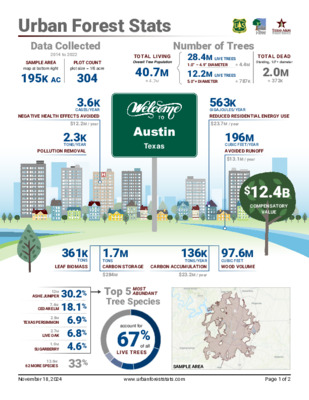
TOTAL LIVING Overall Tree Population 40.7M ± 4.7M Number of Trees 28.4M LIVE TREES 1.0” – 4.9” DIAMETER ± 4.4M 12.2M LIVE TREES 5.0”+ DIAMETER ± 787K TOTAL DEAD Standing, 1.0”+ diameter 2.0M ± 372K Urban Forest Stats Data Collected 2014 to 2022 SAMPLE AREA map at bottom right PLOT COUNT plot size = 1/6 acre 195K AC 304 CASES/YEAR NEGATIVE HEALTH EFFECTS AVOIDED 3.6K $12.2M / year 2.3K TONS/YEAR POLLUTION REMOVAL Austin Texas 563K $23.7M / year GIGAJOULES/YEAR REDUCED RESIDENTIAL ENERGY USE 196M CUBIC FEET/YEAR AVOIDED RUNOFF $13.1M / year $12.4B COMPENSATORY VALUE 361K TONS LEAF BIOMASS 1.7M TONS CARBON STORAGE TONS/YEAR CARBON ACCUMULATION $284M $23.2M / year 136K 97.6M CUBIC FEET WOOD VOLUME ASHE JUNIPER CEDAR ELM TEXAS PERSIMMON LIVE OAK SUGARBERRY 12M 30.2% 7.4M 18.1% 2.8M 6.9% 2.7M 6.8% 1.9M 4.6% 13.6M 33% 62 MORE SPECIES Top 5 MOST ABUNDANT Tree Species account for 67% of all LIVE TREES November 18, 2024 www.urbanforeststats.com Page 1 of 2 SAMPLE AREA Urban Forest Stats CONTINUED Austin’s Top 3 Tree Species LAND USE OWNERSHIP RESIDENTIAL OTHER DEVELOPED FOREST OTHER PUBLIC PRIVATE account for 14% of OTP account for 6% of OTP account for 80% of OTP account for <1% of OTP account for 55% of OTP account for 45% of OTP Cedar elm 775K Ashe juniper 630K Sugarberry 553K 5.75M TREES on 51.9K RESIDENTIAL AC Ashe juniper 410K Texas persimmon 287K Live oak 236K 2.46M TREES on 82.6K DEVELOPED AC Ashe juniper 11.2M Cedar elm 6.5M Texas persimmon 2.2M 32.4M TREES on 48.2K FOREST AC Ashe juniper 57K Honey mesquite 9.2K None — 66.5K TREES on 12.5K OTHER AC OVERALL TREE POPULATION DIAMETER (INCHES) Ashe juniper 6.3M Cedar elm 6.3M Texas persimmon 2.8M 28.4M Ashe juniper 4.2M Live oak 866K Cedar elm Ashe juniper 1.8M Live oak 687K Cedar elm Live oak 108K Ashe juniper 72K Pecan 743K 8.16M 348K 3.74M 19K 323K TREES with diameters 1.0” to 4.9” TREES with diameters 5.0” to 9.9” TREES with diameters 10.0” to 19.9” TREES with diameters 20.0” or greater Ashe juniper 7.3M Cedar elm 4.8M Chinese tallowtree 1.8M 22.3M TREES on 68.8K PUBLIC AC Ashe juniper 5.0M Cedar elm 2.5M Live oak 1.7M 18.3M TREES on 122.3K PRIVATE AC OVERALL TREE POPULATION MAINTAINED AREA Live oak 639K Sugarberry 603K Cedar elm 431K 4.59M TREES in areas MAINTAINED Ashe juniper 12.1M Cedar elm 6.9M Texas persimmon 2.6M 36.1M TREES in areas NOT MAINTAINED …
JOINT SUSTAINABILITY COMMITTEE HYBRID MEETING FORMAT November 20th, 2024 at 6 pm Austin Energy – Mueller Assembly Room 1111 4815 Mueller Blvd, Austin, TX 78723 Some members of the Committee may be participating by videoconference Public comment will be allowed in-person or remotely via telephone. Speakers may only register to speak on an item once either in-person or remotely and will be allowed up to three minutes to provide their comments. Registration no later than noon the day before the meeting is required for remote participation by telephone. To register to speak remotely, email or call Rohan Lilauwala at (Rohan.lilauwala@austintexas.gov or 512-974-9394). Alternate Randall Chapman Member Kaiba White (Chair) Charlotte Davis (Vice-Chair) Genell Gary Diana Wheeler Haris Qureshi Melissa Rothrock Vacant CURRENT BOARD MEMBERS: Home Commission Electric Utility Commission Resource Management Commission Urban Transportation Commission Environmental Commission Zero Waste Advisory Commission Community Development Commission Austin Travis County Food Policy Board Marissa Bell Economic Prosperity Commission Water & Wastewater Commission Parks & Recreation Board Design Commission Planning Commission Austin/Travis County Public Health Commission City Council Mayor’s Representative Mayor’s Representative Mayor’s Representative Mayor’s Representative Mayor’s Representative Amy Noel Chris Maxwell-Gaines Lane Becker Vacant Vacant Natalie Poindexter Vacant Rodrigo Leal Anna Scott Yure Suarez Christopher Campbell Heather Houser For more information, please visit: www.austintexas.gov/jsc Vacant Richard Brimer Craig Nazor Miriam Garcia Rosamaria Murillo Luis Osta Lugo Vacant Ben Luckens Alberta Phillips Vacant Vacant AGENDA CALL TO ORDER PUBLIC COMMUNICATION: GENERAL The first 10 speakers signed up prior to the meeting being called to order will each be allowed a three-minute allotment to address their concerns regarding items not posted on the agenda. APPROVAL OF MINUTES 1. Approval of minutes from the October 23rd, 2024 meeting of the Joint Sustainability Committee. DISCUSSION Sustainability Norris, Austin Energy Marissa Bell 2. Austin Climate Equity Plan Implementation Update – Braden Latham-Jones, Office of 3. Heat Pump Survey Response and Strategy – Zach Baumer, Office of Sustainability, and Sara 4. Update from Austin-Travis County Food Plan on Food Plan Implementation Resolution - 5. Update from Austin-Travis County Public Health Commission regarding draft recommendations for Community Health Workers, goals and priorities for 2025, and public health weather-related issues and flu season – Natalie Poindexter DISCUSSION AND ACTION ITEMS 6. Recommendation on Austin Energy Generation Plan Grant 7. Recommendation in support of the City pursuing a Low Carbon Transportation Materials FUTURE AGENDA ITEMS ADJOURNMENT The City of Austin is committed …
JOINT SUSTAINABILITY COMMITTEE HYBRID MEETING FORMAT November 20th, 2024 at 6 pm Austin Energy – Mueller Assembly Room 1111 4815 Mueller Blvd, Austin, TX 78723 Some members of the Committee may be participating by videoconference Public comment will be allowed in-person or remotely via telephone. Speakers may only register to speak on an item once either in-person or remotely and will be allowed up to three minutes to provide their comments. Registration no later than noon the day before the meeting is required for remote participation by telephone. To register to speak remotely, email or call Rohan Lilauwala at (Rohan.lilauwala@austintexas.gov or 512-974-9394). Alternate Randall Chapman Member Kaiba White (Chair) Charlotte Davis (Vice-Chair) Genell Gary Diana Wheeler Haris Qureshi Melissa Rothrock Vacant CURRENT BOARD MEMBERS: Home Commission Electric Utility Commission Resource Management Commission Urban Transportation Commission Environmental Commission Zero Waste Advisory Commission Community Development Commission Austin Travis County Food Policy Board Marissa Bell Economic Prosperity Commission Water & Wastewater Commission Parks & Recreation Board Design Commission Planning Commission Austin/Travis County Public Health Commission City Council Mayor’s Representative Mayor’s Representative Mayor’s Representative Mayor’s Representative Mayor’s Representative Amy Noel Chris Maxwell-Gaines Lane Becker Vacant Vacant Natalie Poindexter Vacant Rodrigo Leal Anna Scott Yure Suarez Christopher Campbell Heather Houser For more information, please visit: www.austintexas.gov/jsc Vacant Richard Brimer Craig Nazor Miriam Garcia Rosamaria Murillo Luis Osta Lugo Vacant Ben Luckens Alberta Phillips Vacant Vacant AGENDA ADDENDUM CALL TO ORDER PUBLIC COMMUNICATION: GENERAL APPROVAL OF MINUTES DISCUSSION 8. Discussion of process of identifying and acquiring land in accordance of City of Austin Resolution No. 20240814-024 on Creating a Dedicated Land Acquisition Fund – Charlotte Davis 9. Update from Resource Management Commission on Austin Energy's Solar for All grant from the U.S. Environmental Protection Agency – Charlotte Davis DISCUSSION AND ACTION ITEMS FUTURE AGENDA ITEMS ADJOURNMENT The City of Austin is committed to compliance with the American with Disabilities Act. Reasonable modifications and equal access to communications will be provided upon request. Meeting locations are planned with wheelchair access. If requiring Sign Language Interpreters or alternative formats, please give notice at least 2 days (48 hours) before the meeting date. Please contact Rohan Lilauwala at rohan.lilauwala@austintexas.gov or 512-974-9394 for additional information; TTY users’ route through Relay Texas at 711. For more information on the Joint Sustainability Committee, please email or call Rohan Lilauwala at rohan.lilauwala@austintexas.gov or 512-974-9394.
JOINT SUSTAINABILITY COMMITTEE REGULAR MEETING MEETING MINUTES October 23, 2024 The Joint Sustainability Committee convened in a hybrid meeting via videoconferencing and at City Hall. Board Members in Attendance in Person: Kaiba White, Rodrigo Leal, Marissa Bell, Chris Maxwell-Gaines, Charlotte Davis Board Members in Attendance Remotely: Amy Noel, Lane Becker, Diana Wheeler, Heather Houser, Melissa Rothrock, Anna Scott, Chris Campbell Board Members Absent: Yure Suarez, Jon Salinas, Haris Qureshi, Natalie Poindexter City Staff in Attendance: Leti Alvarez Jim Dymkowski Daniel Priest Naomi Rotramel CALL TO ORDER Chair Kaiba White called the meeting to order at 6:09 pm. 1. Approval of minutes from the September 25, 2024 meeting of the Joint Sustainability Committee. Chris Maxwell-Gaines motion, Houser seconds, passes 12-0. PUBLIC COMMUNICATION: GENERAL 2. Presentation on low-carbon concrete – Johanna Anderson, EPA • K. White –Clarification on Federal highway/transportation departments is already utilizing concrete that’s already in the top 20% of best? o Johanna – Federal funding flows to the development of the building of highways is it goes from the federal highways department directly to state department of transportations and then they use that funding to build roads. • Bell – Procurement, curious do you imagine people utilizing these labels without limiting fair and open competition and meeting any procurement regulations that are required o Johanna – Initially you might give extra points for a product that has a label. Like any new sustainable product on the marketplace, one might set up a separate agreement for the sustainable products versus the lesser. Market availability, purchasers will have to do their due diligence and provide situation-by-situation basis. • Kaiba – Looks like this grant closes 11/25, will they be able to get something together in a month? o Johanna – In general grant programs there’s a real interest in reaching folks that are not professional grant writers so I would assume that the federal highways grant is going that way also. • Anna Scott – How to we implement this? And how to we implement faster? o Johanna – There are tools already. I would say see how the federal government is doing it. Looking at how to take the approach, prioritizing, finding partners most willing, testing out carbon concrete, see what work is being done. • K. White – You talked about standards for the environmental product declarations, should we expect that they’re automatically adhering to those standards? Are they …
Joint Sustainability Committee Resolution 20241120-XXX on Austin Energy Resource Plan WHEREAS, on August 8, 2019, the Austin City Council adopted a resolution declaring a climate emergency and calling “for an immediate emergency mobilization to restore a safe climate” and directing the city manager to take a number of steps to accelerate local greenhouse gas emissions reductions, including from Austin Energy; and WHEREAS, in 2020, the Austin City Council adopted the Austin Energy Resource, Generation and Climate Protection Plan to 2030, which states that “Austin Energy will maintain an energy supply portfolio sufficient to offset customer demand while eliminating carbon and other pollutant emissions from its electric generation facilities as rapidly as feasible within the limitations set by the Austin City Council.” and states that “and all generation resources will be carbon-free by 2035;” and WHEREAS, the Austin Energy Resource, Generation and Climate Protection Plan to 2030 also states that “Austin Energy will no longer purchase, contract for or build long-term generation or storage resources that emit new carbon”; and WHEREAS, in 2021, the Austin City Council adopted the Austin Climate Equity Plan, which includes community-wide greenhouse gas reduction goals to achieve net-zero emissions by 2040, with about 75% reduction by 2030; and WHEREAS, electrification is a key strategy for reducing and eliminating greenhouse gas emissions in many sectors and Carbon-Free electricity is needed to achieve those goals; and WHEREAS, on June 8, 2023, the Austin City Council adopted a resolution endorsing the Fossil Fuel Non-Proliferation Treaty and a plan for “transitioning to a 100 percent clean energy economy, phase out fossil fuel production, and invest in communities on the frontlines of environmental injustice;” and WHEREAS, ground level ozone and particulate matter air pollution in the Austin region already exceed the health-based standards set by the U.S. Environmental Protection Agency and CAPCOG has identified that increased NOx emissions from electric generating units, including Austin Energy's power plants, as highly correlated with high local ozone measurements; and WHEREAS, the Austin Energy Resource, Generation and Climate Protection Plan to 2030 references an affordability goal and affordability remains important to many customers, but the workshops that Austin Energy hosted as part of this process to update the Austin Energy Resource, Generation and Climate Protection Plan revealed that a large majority of participants are supportive of allowing rate increases beyond the current goal of two percent per year, so long as low-income customers are shielded …
Joint Sustainability Committee Resolution 20241120-XXX on Austin Energy Resource Plan WHEREAS, on August 8, 2019, the Austin City Council adopted a resolution declaring a climate emergency and calling “for an immediate emergency mobilization to restore a safe climate” and directing the city manager to take a number of steps to accelerate local greenhouse gas emissions reductions, including from Austin Energy; and WHEREAS, in 2020, the Austin City Council adopted the Austin Energy Resource, Generation and Climate Protection Plan to 2030, which states that “Austin Energy will maintain an energy supply portfolio sufficient to offset customer demand while eliminating carbon and other pollutant emissions from its electric generation facilities as rapidly as feasible within the limitations set by the Austin City Council.” and states that “and all generation resources will be carbon-free by 2035;” and WHEREAS, the Austin Energy Resource, Generation and Climate Protection Plan to 2030 also states that “Austin Energy will no longer purchase, contract for or build long-term generation or storage resources that emit new carbon”; and WHEREAS, in 2021, the Austin City Council adopted the Austin Climate Equity Plan, which includes community-wide greenhouse gas reduction goals to achieve net-zero emissions by 2040, with about 75% reduction by 2030; and WHEREAS, electrification is a key strategy for reducing and eliminating greenhouse gas emissions in many sectors and Carbon-Free electricity is needed to achieve those goals; and WHEREAS, on June 8, 2023, the Austin City Council adopted a resolution endorsing the Fossil Fuel Non-Proliferation Treaty and a plan for “transitioning to a 100 percent clean energy economy, phase out fossil fuel production, and invest in communities on the frontlines of environmental injustice;” and WHEREAS, ground level ozone and particulate matter air pollution in the Austin region already exceed the health-based standards set by the U.S. Environmental Protection Agency and CAPCOG has identified that increased NOx emissions from electric generating units, including Austin Energy's power plants, as highly correlated with high local ozone measurements; and WHEREAS, the Austin Energy Resource, Generation and Climate Protection Plan to 2030 references an affordability goal and affordability remains important to many customers, but the workshops that Austin Energy hosted as part of this process to update the Austin Energy Resource, Generation and Climate Protection Plan revealed that a large majority of participants are supportive of allowing rate increases beyond the current goal of two percent per year, so long as low-income customers are shielded …
November X, 2024 Federal Highway Administration – Low Carbon Transportation Materials Program Dear Federal Highway Administration, We are pleased to send this Letter of Commitment in support of the City of Austin’s application to the Federal Highway Administration’s Low Carbon Transportation Materials Program (LCTM) to seek reimbursement funds for eligible costs associated with activities required to develop and implement a city-wide Low Carbon Transportation Materials Procurement Program. This application supports Austin City Council Resolution No. 20230420-024, which directs the City Manager to create a plan and implement a schedule to transition the City to sustainable low-embodied carbon concrete. It also supports the Council adopted Austin Climate Equity Plan, which established a net-zero community wide greenhouse gas emission goal by 2040, and a goal of reducing embodied carbon footprint of materials used in local construction by 40% by 2030. The City of Austin’s LCTM grant application is a multi-departmental effort with stakeholders from Transportation and Public Works (TPW), Office of Sustainability (OOS), Capital Delivery Services (CDS), and Financial Services Division (FSD). The city-wide Low Carbon Transportation Materials Procurement Program will include processes for: - Collecting and verifying Environmental Product Declarations (EPD) from Texas concrete, cement, and asphalt suppliers - Developing a central database to store EPDs - Using collected EPDs and working with industry to establish a regional benchmark to determine reasonable greenhouse gas emissions thresholds for material procurement - Setting a timeline for reevaluating regional thresholds and for suppliers to resubmit EPDs - Establishing a central, city-wide transportation materials data collection system for both concrete and asphalt to track mix designs, material quantity use, and the carbon footprint related to construction material use - Establishing training for city-wide transportation materials data collection system for project - coordinators, in-house crews, and inspectors Implement performance-based concrete specifications in which concrete mixes are designed based on intended use/performance instead of prescriptive-based concrete specifications which are over designed in strength, and often involve excessive use of cement - Procuring and implementing the use of low carbon concrete, cement, and asphalt in the annual street and bridge maintenance program and in applicable capital delivery projects. We are committed to the project’s overarching mission, and supportive of all initiatives that further regional collaboration on climate. Thank you for your time and consideration. Sincerely,
Presentation to Joint Sustainability Committee NOVEMBER 20, 2024 Agenda 01 Background & Context 02 Implementation Plan 03 Prioritization Process 04 Next Steps 05 Questions 2 Resolution 20240718-093 Resolution 20240718-093 was approved in July 2024. Staff was directed to bring two items to Council. 1. A comprehensive bond package that funds and addresses climate, infrastructure, and any other public improvements for the purpose of conducting an election no later than November 2026, and 2. A comprehensive climate implementation program of which one component is a climate bond proposition contained in the comprehensive bond package. The comprehensive climate implementation program, shall provide a detailed and thorough means for investing in our climate. Funding for this implementation program shall not be limited to general obligation bonds but should include grants, fees, utilities, general fund, cost sharing, etc. 3 Implementation Status Update 3 7 4 3 ON TRACK NEED SUPPORT OFF TRACK DATA UNAVAILABLE SUSTAINABLE BUILDINGS NATURAL SYSTEMS FOOD & PRODUCT CONSUMPTION TRANSPORTATION & LAND USE TRANSPORTATION ELECTRIFICATION Net Zero Carbon for New Buildings and 25% reduction for existing buildings Protect an additional 20,000 acres of land Ensure a more sustainable local Food System 80% of new non-residential development is in activity centers and corridors 40% of VMT is electrified Reduce Refrigerant leakage by 25% Protect 500,000 acres of farmland from development Reduce emissions from institutional purchasing by 50% By 2027, meet strategic housing blueprint goals Sufficient EV charging infrastructure to meet 40% of VMT Reduce embodied carbon of building materials by 40% By 2050, achieve 50% tree canopy cover Pursue waste reduction and meet the ARR diversion goals 50% of trips in Austin are made in a non-single occupancy vehicle Austin area is a leader in EV adoption and the industry Achieve 152,000 acre feet per year of water usage Manage City land to capture carbon 4 Comprehensive Climate Implementation Program 2-year Implementation Plan Programmatic Adjustments ● Public document with climate projects achievable between ‘25 - ‘27 ● Organizational restructure aimed at successful implementation 5 Environmental Investment Plan Joint Sustainability Committee Recommendations Projects Identified from Other Departmental Plans Project Identification Departmental Workshops to Review and Finalize 6 Building a Prioritization Tool ● Consulted with peer cities, colleagues within Urban Sustainability Directors’ Network ● Identified the C40 Action Selection and Prioritisation (ASAP) Tool ● Added criteria from Climate Equity Plan: ○ Equity Tool ○ Overarching strategies ○ Health and Housing Priorities 7 Prioritization Process …
HVAC-R CONTRACTOR STUDY Advancing high-efficiency, climate-smart heating, ventilation, air conditioning, and refrigeration (HVAC-R) technologies and practices in support of the Austin Climate Equity Plan. April 2024 Prepared by City of Austin HVAC Contractor Study: Contractor Engagement Plan iii Acknowledgements This report was prepared by Jen Cregar and Marisa Hanson-Lopez for the City of Austin Office of Sustainability. We are grateful to the following individuals and organizations for sharing their time and insights that informed this study. ● Jason Baker, Acme A/C & Heating ● Amanda Mortl, City of Austin Office of ● Alpha Tounkara, American Conservation & Sustainability Air Institute ● Harvey Giblin + faculty, Austin Career ● Greg Arcangeli, Austin Energy ● Aiden Cohen, Austin Energy ● Heidi Kasper, Austin Energy ● Sara Norris, Austin Energy ● Sally Phipps, Austin Energy ● Holly Prosser, Austin Energy ● Joe Teng, Austin Energy ● Tom Turner, Austin Energy Joni Zacharisen, Austin Energy Jordan Garcia, Better Service Co. Inc. Coalition ● Ted Tiffany, Building Decarbonization ● Zach Baumer, City of Austin Office of Sustainability ● ● ● Sarah Talkington, City of Austin Parks & Recreation Department ● Trey Farmer, Forge Craft Architecture + Design ● Katelynn Essig, Foundation Communities ● John Chavez, hvacMENSCH ● Al D’Andrea, McCullough Heating & Air ● Kevin DeMaster, Mitsubishi Electric Trane ● Garrett Smith, Mitsubishi Electric Trane ● Ben Lipscomb, National Comfort Institute ● Dominick Guarino, National Comfort Conditioning HVAC US LLC HVAC US LLC Institute Plumbing ● Paul Wieboldt, Tradewinds Appropriate Technologies ● Shawn Hoover, Vertex Mechanical ● Victoria Kramer, Bluebonnet AC Services, ● Roland Arrisola, Stan’s Heating, Air & City of Austin HVAC-R Contractor Study i Table of Contents Acknowledgements ....................................................................................................................................... ii Executive Summary ....................................................................................................................................... 1 Background & Purpose ................................................................................................................................. 5 Contractor Engagement Approach ............................................................................................................... 6 Findings & Recommendations ...................................................................................................................... 8 Residential Heat Pump Barriers .............................................................................................................. 10 Multifamily Heat Pump Barriers ............................................................................................................. 25 Low-GWP Refrigerant Barriers ................................................................................................................ 31 Conclusion ................................................................................................................................................... 37 Appendix A. Survey Results ....................................................................................................................... A-1 Appendix B. Peer Municipally Owned Utility Heat Pump and Heat Pump Water Heater Incentives ........ B-1 City of Austin HVAC-R Contractor Study ii Tables Table 1. Summary of Recommendations ...................................................................................................... 2 Table 2. Contractor Engagement Approach.................................................................................................. 7 Table 3. Contractor Engagement Representation ........................................................................................ 7 Table 4. Summary of Residential Heat Pump Barriers and Solutions ......................................................... 10 Table 5. Recommended Solutions to HP Upfront Cost Barrier ................................................................... 12 Table 6. Summary of Single-Family Heat Pump and Heat Pump Water …
Joint Sustainability Committee Recommendation 20241120-006 on Austin Energy Resource, Generation and Climate Protection Plan WHEREAS, on August 8, 2019, the Austin City Council adopted a resolution declaring a climate emergency and calling “for an immediate emergency mobilization to restore a safe climate” and directing the city manager to take a number of steps to accelerate local greenhouse gas emissions reductions, including from Austin Energy; and WHEREAS, in 2020, the Austin City Council adopted the Austin Energy Resource, Generation and Climate Protection Plan to 2030, which states that “Austin Energy will maintain an energy supply portfolio sufficient to offset customer demand while eliminating carbon and other pollutant emissions from its electric generation facilities as rapidly as feasible within the limitations set by the Austin City Council.” and states that “and all generation resources will be carbon-free by 2035;” and WHEREAS, the Austin Energy Resource, Generation and Climate Protection Plan to 2030 also states that “Austin Energy will no longer purchase, contract for or build long-term generation or storage resources that emit new carbon”; and WHEREAS, in 2021, the Austin City Council adopted the Austin Climate Equity Plan, which includes community-wide greenhouse gas reduction goals to achieve net-zero emissions by 2040, with about 75% reduction by 2030; and WHEREAS, electrification is a key strategy for reducing and eliminating greenhouse gas emissions in many sectors and Carbon-Free electricity is needed to achieve those goals; and WHEREAS, on June 8, 2023, the Austin City Council adopted a resolution endorsing the Fossil Fuel Non-Proliferation Treaty and a plan for “transitioning to a 100 percent clean energy economy, phase out fossil fuel production, and invest in communities on the frontlines of environmental injustice;” and WHEREAS, ground level ozone and particulate matter air pollution in the Austin region already exceed the health-based standards set by the U.S. Environmental Protection Agency and CAPCOG has identified that increased NOx emissions from electric generating units, including Austin Energy's power plants, as highly correlated with high local ozone measurements; and WHEREAS, the Austin Energy Resource, Generation and Climate Protection Plan to 2030 references an affordability goal and affordability remains important to many customers, but the workshops that Austin Energy hosted as part of this process to update the Austin Energy Resource, Generation and Climate Protection Plan revealed that a large majority of participants are supportive of allowing rate increases beyond the current goal of two percent per year, so long as …
JOINT SUSTAINABILITY COMMITTEE REGULAR MEETING MEETING MINUTES November 20, 2024 The Joint Sustainability Committee convened in a hybrid meeting via videoconferencing and at Austin Energy Headquarters. Board Members in Attendance in Person: Kaiba White, Chris Maxwell-Gaines, Charlotte Davis, Anna Scott, Marissa Bell, Haris Qureshi Board Members in Attendance Remotely: Diana Wheeler, Amy Noel, Lane Becker, Rodrigo Leal, Christopher Campbell, Heather Houser Board Members Absent: Yure Suarez, Natalie Poindexter, Melissa Rothrock City Staff in Attendance: Zach Baumer, Braden Latham-Jones, Angela Baucom, Sara Norris, Amy Everhart, Lisa Martin CALL TO ORDER Chair Kaiba White called the meeting to order at 6:07 pm. 1. Approval of minutes from the October 23rd, 2024 meeting of the Joint Sustainability Committee. • Commissioners request edits: o Notation standardization o Discussion item #5 of land acquisition has no content underneath it. Please revise to say “the committee discussed the item” in lieu of leaving it blank o Clean up the consistency of how the commissioners are referred to (first initial and last name, or other). Please standardize throughout. • Approved 12-0 on Qureshi motion, Maxwell-Gaines second. DISCUSSION AND ACTION ITEMS 2. Recommendation in support of the city pursuing a Low Carbon Transportation Materials Grant (moved up from 7) a. City is pursuing this. Discussion of letter in support. Vote would be to add the JSC to the letter with the intention of having other local organizations sign on as well. Due date is Monday. b. Diana Wheeler moves to approve JSC signing onto letter and Anna seconds c. Unanimous approval 3. Recommendation on Austin Energy Generation Plan (moved up from 6) a. Lisa Martin with AE presented: Resource Generation Plan last one was adopted in 2020 and a lot of new risks have been identified, including growth in population, data centers and AI, changes in weather and climate impacts, and changes in the ERCOT market. Council in 2022 directed AE to update the plan, and since then AE has been working on the process to update it along with a 40 member stakeholder group representing a diverse group of Austinites to move towards meeting the full range of needs in a reliable and affordable way. The plan will be published and shared next week in draft form and will be voted on by council in December. The plan itself focused on addressing risks by starting with prioritizing customer energy solutions. Once those are maximized, looking at how …
JOINT SUSTAINABILITY COMMITTEE HYBRID MEETING FORMAT October 23rd, 2024 at 6 pm City Hall – Council Chambers 301 W 2nd St, Austin TX 78701 Some members of the Committee may be participating by videoconference Public comment will be allowed in-person or remotely via telephone. Speakers may only register to speak on an item once either in-person or remotely and will be allowed up to three minutes to provide their comments. Registration no later than noon the day before the meeting is required for remote participation by telephone. To register to speak remotely, email or call Rohan Lilauwala at (Rohan.lilauwala@austintexas.gov or 512-974-9394). CURRENT BOARD MEMBERS: Home Commission Electric Utility Commission Resource Management Commission Urban Transportation Commission Environmental Commission Zero Waste Advisory Commission Community Development Commission Austin Travis County Food Policy Board Economic Prosperity Commission Water & Wastewater Commission Parks & Recreation Board Design Commission Planning Commission Austin/Travis County Public Health Commission City Council Mayor’s Representative Mayor’s Representative Mayor’s Representative Mayor’s Representative Mayor’s Representative Alternate Randall Chapman Member Kaiba White (Chair) Charlotte Davis (Vice-Chair) Genell Gary Diana Wheeler Haris Qureshi Melissa Rothrock Vacant Larry Franklin Amy Noel Chris Maxwell-Gaines Vacant Vacant Vacant Natalie Poindexter Vacant Richard Brimer Craig Nazor Miriam Garcia Rosamaria Murillo Luis Osta Lugo Vacant Lane Becker Ben Luckens Alberta Phillips Vacant Vacant Rodrigo Leal Anna Scott Yure Suarez Christopher Campbell Heather Houser Vacant For more information, please visit: www.austintexas.gov/jsc Committee. DISCUSSION AGENDA CALL TO ORDER PUBLIC COMMUNICATION: GENERAL The first 10 speakers signed up prior to the meeting being called to order will each be allowed a three-minute allotment to address their concerns regarding items not posted on the agenda. APPROVAL OF MINUTES 1. Approval of minutes from the September 25th, 2024 meeting of the Joint Sustainability 2. Presentation on low-carbon concrete – Johanna Anderson, EPA. 3. Presentation on Austin Core Transportation Plan – Cole Kitten, Transportation and Public Works Department. 4. Presentation on Tree Regulations and Protections – Naomi Rotramel and Daniel Priest, Development Services Department. 5. Discussion of agricultural land acquisition and potential Working Farms Fund pilot. DISCUSSION AND ACTION ITEMS FUTURE AGENDA ITEMS 6. Approval of Proposed 2025 Joint Sustainability Committee Annual Meeting Schedule ADJOURNMENT The City of Austin is committed to compliance with the American with Disabilities Act. Reasonable modifications and equal access to communications will be provided upon request. Meeting locations are planned with wheelchair access. If requiring Sign Language Interpreters or alternative formats, …
JOINT SUSTAINABILITY COMMITTEE REGULAR MEETING September 25, 2024 SPECIAL CALLED MEETING MINUTES The Joint Sustainability Committee convened in a hybrid meeting via videoconferencing and at Austin Energy Headquarters. Board Members in Attendance in Person: Kaiba White, Rodrigo Leal, Anna Scott, Lane Becker, Charlotte Davis Board Members in Attendance Remotely: Alberta Phillips, Diana Wheeler, Heather Houser, Jon Salinas, Yure Suarez, Haris Qureshi, Natalie Poindexter Board Members Absent: City Staff in Attendance: Rohan Lilauwala Braden Latham-Jones Tim Harvey Heidi Kasper Marc Coudert CALL TO ORDER Chair Kaiba White called the meeting to order at 6:08 pm. 1. Approval of minutes from the July 8th special called meeting of the Joint Sustainability Committee. Wheeler motion, Qureshi seconds, passes 12-0. PUBLIC COMMUNICATION: GENERAL Scott Johnson speaks on low carbon concrete and residential landscape equipment 3. Presentation on Solar for All program and the Solar Standard Offer – Tim Harvey, Austin Energy • Scott – do energy arbitrage benefits come into play? • Harvey – one of the considered benefits. Utility will control battery to a certain depth of discharge (to support resilience). On edge of event, batteries not used. On blue sky days, AE will use batteries for price chasing, 4CP avoidance, peak usage, to get max value out of battery • PPA will be used for solar purchases, performance contract for battery will • Grant will be used to buy down PPA and performance contract to AE’s avoided allow AE to benefit from them. cost of solar and make it feasible. • Phillips – questions around how program works, if benefits flow to wealthier folks • Harvey – provides clarification • Opportunity to provide feedback in community engagement process to shape program/ • Leal – why is program designed this way • Harvey – difficult to find 2500 low-income homes that are viable • If model is successful, potential to receive unused funds later • Leal – would roof repairs/rebuilding be part of it? • Harvey – there are existing programs, this grant can’t be for that as per EPA agreement. Homes will receive free weatherization if customer qualify • Opportunity for community engagement to help define what homes to target • Leal – what does governance look like? • Harvey – plans to set this up during community engagement. Work in progress, no money yet. Need to staff up in the early years. • Leal – who was engaged? • Harvey – …
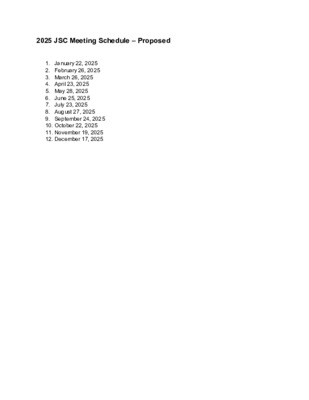
2025 JSC Meeting Schedule – Proposed 1. January 22, 2025 2. February 26, 2025 3. March 26, 2025 4. April 23, 2025 5. May 28, 2025 6. June 25, 2025 7. July 23, 2025 8. August 27, 2025 9. September 24, 2025 10. October 22, 2025 11. November 19, 2025 12. December 17, 2025
US EPA's Low Embodied Carbon Construction Materials Program for City of Austin's Joint Sustainability Committee October 23, 2024 The U.S. Federal Government www.epa.gov/greenerproducts | 2 2022 Inflation Reduction Act directed EPA to: Develop a determination for “Substantially Lower Embodied Carbon Construction Materials” for GSA & FHWA Provide grant funding and technical assistance to increase and improve environmental product declarations (EPDs) Create a label to help purchasers identify and procure lower embodied carbon construction materials www.epa.gov/greenerproducts | 3 Why embodied carbon? Embodied carbon of construction materials accounts for 15% of global greenhouse gas emissions. www.epa.gov/greenerproducts | 4 Why embodied carbon? Embodied carbon of construction materials accounts for 15% of global greenhouse gas emissions. www.epa.gov/greenerproducts | 5 Range of Strategies to Reduce Embodied Carbon in the Market Energy Efficient Manufacturing (e.g., ENERGY STAR Industrial) Salvage & Reuse US & Locally Made Materials Material Efficiency Lower Carbon Input Materials Durable Materials (vs. High Replacement Rate) Recycled Content Bio-Based Materials Renewable & Lower Carbon Intensive Fuels Most strategies to reduce embodied carbon of construction materials take place long before they arrive at a construction site. www.epa.gov/greenerproducts | 6 Quantifying & Reporting Embodied Carbon Environmental Product Declarations (EPDs) www.epa.gov/greenerproducts | 7 Key LEC Program Elements www.epa.gov/greenerproducts | 8 www.epa.gov/greenerproducts | 9 Grant Selections – Texas NEW SLIDE •University of Texas – Austin (salvaged materials) •Knauf Insulation (insulation) •Heidelberg (cement/concrete) •Holcim (cement/concrete, asphalt) Read more about the above projects: Selected projects summaries www.epa.gov/greenerproducts | 10 Interim Determination Overview “Substantially lower embodied carbon construction materials” as determined by EPA • Enables GSA & FHWA to implement their portions of the IRA • Defines “substantially lower embodied carbon construction materials” • Best performing 20% GHG emissions in CO2e (GWP per ISO 21930:2017)* • If not available in project location, best performing 40% • If not available in project location, better than estimated industry average *Because GWP is used in EPDs for construction products as an impact category (per ISO 21930), it was used in the Interim Determination as a proxy for embodied carbon. However, GWP is defined differently in other GHG accounting efforts. For clarity and consistency, EPA is exploring ways to better align terminology. Top 40% Top 20% Better than Industry Average www.epa.gov/greenerproducts | 11 Initial Focus Materials The label program does not address what type of material should be used in a project -- it is limited to “like to like” comparisons. Additional materials may be …
An Introduction to Austin’s Tree Regulations Joint Sustainability Committee October 23, 2024 Naomi Rotramel, City Arborist Daniel Priest, Environmental Compliance Specialist, Sr. History of Austin’s Tree Ordinance Margret Hofmann, 1925-2012 Hofmann Oaks Park History of Austin’s Tree Ordinance 1983 - Tree Preservation Ordinance 2010 - Heritage Tree Ordinance Why Do We Protect Trees? Austin’s urban forest currently has over 33 million trees, all of which support the following benefits: • • • • • • • • Trees improve air quality by filtering out particles, absorbing carbon dioxide and releasing oxygen. Trees help reduce flood impacts by slowing and filtering rainwater. Trees contribute to connections with nature that improve people’s health outcomes and contribute to an environment where people feel connected to their community. Trees are good for business: Shoppers spend more time and money in shopping areas with businesses that have good tree coverage. Tree roots hold soil in place, reducing erosion. Shade from urban trees can cool the air up to 8 degrees Celsius. Their shade and wind protection reduce energy use. Trees provide food, shelter, and nesting for diverse wildlife. Trees provide a sense of place and soften the sharp outlines of concrete, metal, and glass of urban and suburban cityscapes Source: Texas A&M Forest Service To maintain the health and integrity of our urban forest, the City of Austin strives to plant trees, preserve trees during land development, and care for existing trees. Why Do We Protect Trees? Land Development Code 25-8.B.1 • Prohibits removal of Protected or Heritage trees without a permit • 8"+ trees – preserve "to extent feasible" on site plan applications • Defines removal - physical removal, over pruning, or excessive root disturbance • Creates position of City Arborist to implement LDC 25-8.B.1 • Approval criteria for removal: • Reasonable use • Reasonable access • Dead, Diseased, or Imminent Hazard • Administrative rules – preservation criteria, protection requirements, mitigation • Variances and appeals Rules implementing LDC 25-8.B.1 are found in Section 3 of the Environmental Criteria Manual What are the Tree Regulations? Land Development Code 25-8, Subchapter B, Article 1 Division 1 – General Provisions Definitions Authorizes Rules Application Requirements Division 2 – Protected Trees Approval Criteria for Removal Division 3 – Heritage Trees Approval Criteria for Removal Variances Environmental Criteria Manual Section 3 3.3 - Survey Requirements Survey and Plan Depictions Hill Country Roadway Ordinance 3.5 - Design Criteria Protection (3.5.2) …
JOINT SUSTAINABILITY COMMITTEE REGULAR MEETING MEETING MINUTES October 23, 2024 The Joint Sustainability Committee convened in a hybrid meeting via videoconferencing and at City Hall. Board Members in Attendance in Person: Kaiba White, Rodrigo Leal, Marissa Bell, Chris Maxwell-Gaines, Charlotte Davis Board Members in Attendance Remotely: Amy Noel, Lane Becker, Diana Wheeler, Heather Houser, Melissa Rothrock, Anna Scott, Chris Campbell, Alberta Phillips Board Members Absent: Yure Suarez, Jon Salinas, Haris Qureshi, Natalie Poindexter City Staff in Attendance: Leti Alvarez Jim Dymkowski Daniel Priest Naomi Rotramel CALL TO ORDER Chair Kaiba White called the meeting to order at 6:09 pm. 1. Approval of minutes from the September 25, 2024 meeting of the Joint Sustainability Committee. Chris Maxwell-Gaines motion, Houser seconds, passes 12-0 (Phillips off Dais) PUBLIC COMMUNICATION: GENERAL 2. Presentation on low-carbon concrete – Johanna Anderson, EPA • White –Clarification on Federal highway/transportation departments is already utilizing concrete that’s already in the top 20% of best? o Anderson – Federal funding flows to the development of the building of highways is it goes from the federal highways department directly to state department of transportations and then they use that funding to build roads. • Bell – Procurement, curious do you imagine people utilizing these labels without limiting fair and open competition and meeting any procurement regulations that are required o Anderson – Initially you might give extra points for a product that has a label. Like any new sustainable product on the marketplace, one might set up a separate agreement for the sustainable products versus the lesser. Market availability, purchasers will have to do their due diligence and provide situation-by-situation basis. • White – Looks like this grant closes 11/25, will they be able to get something together in a month? o Anderson – In general grant programs there’s a real interest in reaching folks that are not professional grant writers so I would assume that the federal highways grant is going that way also. • Scott – How to we implement this? And how to we implement faster? o Anderson – There are tools already. I would say see how the federal government is doing it. Looking at how to take the approach, prioritizing, finding partners most willing, testing out carbon concrete, see what work is being done. • White – You talked about standards for the environmental product declarations, should we expect that they’re automatically adhering to those standards? …
JOINT SUSTAINABILITY COMMITTEE HYBRID MEETING FORMAT September 25th, 2024 at 6 pm City Hall – Council Chambers 301 W 2nd St, Austin TX 78701 Some members of the Committee may be participating by videoconference Public comment will be allowed in-person or remotely via telephone. Speakers may only register to speak on an item once either in-person or remotely and will be allowed up to three minutes to provide their comments. Registration no later than noon the day before the meeting is required for remote participation by telephone. To register to speak remotely, email or call Rohan Lilauwala at (Rohan.lilauwala@austintexas.gov or 512-974-9394). CURRENT BOARD MEMBERS: Home Commission Electric Utility Commission Resource Management Commission Urban Transportation Commission Environmental Commission Zero Waste Advisory Commission Community Development Commission Austin Travis County Food Policy Board Economic Prosperity Commission Water & Wastewater Commission Parks & Recreation Board Design Commission Planning Commission Austin/Travis County Public Health Commission City Council Mayor’s Representative Mayor’s Representative Mayor’s Representative Mayor’s Representative Mayor’s Representative Alternate Randall Chapman Member Kaiba White (Chair) Charlotte Davis (Vice-Chair) Genell Gary Diana Wheeler Haris Qureshi Melissa Rothrock Vacant Larry Franklin Amy Noel Chris Maxwell-Gaines Vacant Jon Salinas Vacant Natalie Poindexter Vacant Richard Brimer Craig Nazor Miriam Garcia Rosamaria Murillo Luis Osta Lugo Vacant Lane Becker Ben Luckens Alberta Phillips Vacant Vacant Rodrigo Leal Anna Scott Yure Suarez Christopher Campbell Heather Houser Vacant For more information, please visit: www.austintexas.gov/jsc Committee. DISCUSSION Energy Wheeler AGENDA CALL TO ORDER PUBLIC COMMUNICATION: GENERAL The first 10 speakers signed up prior to the meeting being called to order will each be allowed a three-minute allotment to address their concerns regarding items not posted on the agenda. APPROVAL OF MINUTES 1. Approval of minutes from the August 28th, 2024 meeting of the Joint Sustainability 2. Presentation on heat resilience planning efforts – Marc Coudert, Office of Resilience 3. Presentation on Solar for All program and the Solar Standard Offer – Tim Harvey, Austin 4. Presentation on the International Energy Conservation Code (IECC) 2024 Update – Heidi Kasper, Austin Energy 5. Updates from the Urban Transportation Commission on the Living Streets Program – Diana DISCUSSION AND ACTION ITEMS 6. Consider approval of a Recommendation on the Austin Energy Solar Standard Offer Program 7. Consider approval of a Recommendation on the adoption of the 2024 International Energy Conservation Code 8. Create working groups to support Joint Sustainability Committee oversight of Comprehensive Climate Implementation Process FUTURE …
JOINT SUSTAINABILITY COMMITTEE REGULAR MEETING SPECIAL CALLED MEETING MINUTES August 28, 2024 The Joint Sustainability Committee convened in a hybrid meeting via videoconferencing and at Austin Energy Headquarters. Board Members in Attendance in Person: Heather Houser, Kaiba White, Rodrigo Leal, Haris Qureshi, Natalie Poindexter, Charlotte Davis Board Members in Attendance Remotely: Jon Salinas, Anna Scott, Melissa Rothrock, Chris Campbell, Diana Wheeler, Yure Suarez, Amy Noel Board Members Absent: Larry Franklin, Alberta Philipps, Chris Maxwell-Gaines, Lane Becker City Staff in Attendance: Zach Baumer Braden Latham-Jones CALL TO ORDER Chair Kaiba White called the meeting to order at 6:10pm. PUBLIC COMMUNICATION: GENERAL N/A 1. Approval of minutes from the July 8th special called meeting of the Joint Sustainability Committee. Qureshi motion, Houser second, passes 12-0 with Suarez off dais. 1. Sustainable Purchasing Update – Amanda Mortl, Office of Sustainability a. Scott – When will we see the first purchase from this work? i. Mortl – Landscaping example, have a list of upcoming contracts and are monitoring when they expire/up for renewal, looking ahead to mid-2025 as the next opportunity. Current contracts have updated preference language. b. White – Can you share preference language? i. Mortl – Can do so, yes. c. White – Can you speak to the upcoming concrete contract opportunities? i. Mortl – Can direct you to that plan. d. White – No progress to changes to that plan? i. Mortl – Not able to speak to that fully, but that’s the latest that I’m aware of. e. Yure – Those first few slides, those are based on spending model? i. Mortl – Industry-wide averages f. White – Any other product areas you’ll be moving on to next? i. Mortl – These two pilots are based on Council priorities, are currently doing those. 2. Updates from Environmental Investment Plan effort and City Budget; JSC next steps. a. White – What will quarterly briefings look like? i. Baumer – Still in the process of creating that, I expect that we’ll present on the Environmental Investment Plan as the first quarterly briefing b. Qureshi – Since the resolution directs City Manager to update Council on Climate Bond and Environmental Investment Plan. Is there a timeline for that? i. Baumer – We’ll be playing a role because we’re coordinating the comprehensive Climate Equity Plan implementation. My hope is that we have multiple departments participating in these briefings moving forward. c. Poindexter – With …
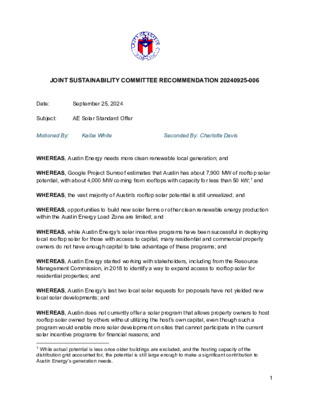
BOARD/COMMISSION RECOMMENDATION Joint Sustainability Committee Resolution 20240925-xx on Solar Standard Offer Program WHEREAS, Austin Energy needs more clean renewable local generation; and WHEREAS, Google Project Sunroof estimates that Austin has about 7,900 MW of rooftop solar potential, with about 4,000 MW coming from rooftops with capacity for less than 50 kW;1 and WHEREAS, the vast majority of Austin's rooftop solar potential is still unrealized; and WHEREAS, opportunities to build new solar farms or other clean renewable energy production within the Austin Energy Load Zone are limited; and WHEREAS, while Austin Energy's solar incentive programs have been successful in deploying local rooftop solar for those with access to capital, many residential and commercial property owners do not have enough capital to take advantage of these programs; and WHEREAS, Austin Energy started working with stakeholders, including from the Resource Management Commission, in 2018 to identify a way to expand access to rooftop solar for residential properties; and WHEREAS, Austin Energy’s last two local solar requests for proposals have not yielded new local solar developments; and WHEREAS, Austin does not currently offer a solar program that allows property owners to host rooftop solar owned by others without utilizing the host’s own capital, even though such a program would enable more solar development on sites that cannot participate in the current solar incentive programs for financial reasons; and 1 While actual potential is likely less once the downtown network and older buildings are excluded, the potential is still large enough to make a significant contribution to Austin Energy’s generation needs. 1 WHEREAS, Austin Energy could significantly increase the amount of solar development within the Austin Energy Load Zone by facilitating solar development on more rooftops in Austin, where solar developers lease the rooftop from the property owner; and WHEREAS, Austin Energy supports new behind-the-meter solar projects under 10 MW with photovoltaic incentives, treating the Value of Solar payment for all PV generation as a bill credit (which renders it non-taxable income), and including the 2.3 cent/kWh societal benefits portion of the Value of Solar tariff; and behind-the-meter rooftop PV projects are exempt from property tax; and WHEREAS, Austin Energy’s proposed Solar Standard Offer program will apply to new solar projects under 10 MW connected to Austin Energy’s distribution system on the grid side of the customer meter, but will not offer any solar incentive, the solar project will be subject to property tax, the …
CITY OF AUSTIN Heat Resilience Playbook 9/25/24 Outline 01 Background 02 Components of the playbook 0403 Climate Projections 04 Next Steps Heat Resilience Playbook Why have it? What is it? Temperatures are rising Council is asking for it The Community wants to know The City and local agencies are doing a lot! Heat Resilience Playbook identifies neighborhood-based and citywide projects, programs, and policies that combat extreme heat. This Playbook seeks to uplift existing City & agency-led heat resilience efforts Let’s communicate the strategies currently underway It’s not a plan No budget or timeline Heat Resilience Playbook Timeline Partners include Go Austin/Vamos Austin (GAVA), University of Texas at Austin, City of Austin (COA) Departments. Who We Worked With ● Austin Bergstrom International Airport ● Austin Energy ● Homeland Security & Emergency Management ● Homeless Strategy Office ● Austin Energy Green Building ● Housing ● Austin Public Health ● Human Resource ● Austin Public Libraries ● Parks and Recreation ● Development Services - ● Watershed Protection ● Planning ● Travis County ● Austin Water ● Cap Metro Forestry Steps 01 02 03 04 Reviewed national & internal best practices Assessed how city, and agencies, compare to best practices. Id’d 70+ strategies COA+ currently pursuing Reviewed findings with staff & drafted/ refined strategies Assembled strategies into report Extreme Heat Impacts Our: AUSTIN’S HEAT EQUITY When there are major heat events, our residents who are most vulnerable feel it the worst. While all of Austin is expected to experience increases in extreme heat, not all residents face the same impacts. People with the least amount of resources or who spend time outdoors are most at risk — including outdoor workers, infants, elderly, incarcerated people, individuals experiencing homelessness, low-income communities, and people with chronic or mental illness. Spotlight on Neighborhood Cooling Cool Connections Built shade Outdoor Cool Oases Cool Homes Connected trails with access to creeks Tree-lined sidewalks Built shade Shaded bus stops Green infrastructure Park with cooling features, like sprinklers & water fountains Cool Community Spaces Austin’s Heat Resilience Playbook is Composed of 3 Pillars, Divided into 13 Strategies and 56 Actions 1.1 Heat Risk and Mitigation Communications 1.2 Enhanced Outreach During Extreme Heat 2.1 Cool Homes 3.1 Cool Buildings 2.2 Cool Community Spaces 3.2 Tree Planting and Maintenance 2.3 Outdoor Cool Oases 3.3 Parks and Green Space 1.3 Safety Measures and Policies 2.4 Cool Connections 3.4 Resilient Energy System 1.4 Data and Evaluation …
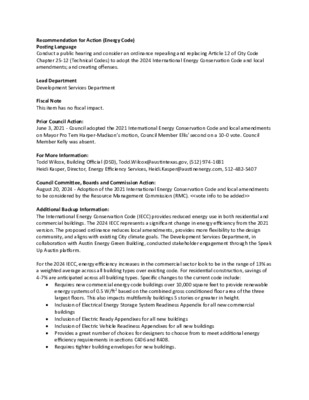
Recommendation for Action (Energy Code) Posting Language Conduct a public hearing and consider an ordinance repealing and replacing Article 12 of City Code Chapter 25-12 (Technical Codes) to adopt the 2024 International Energy Conservation Code and local amendments; and creating offenses. Lead Department Development Services Department Fiscal Note This item has no fiscal impact. Prior Council Action: June 3, 2021 - Council adopted the 2021 International Energy Conservation Code and local amendments on Mayor Pro Tem Harper-Madison’s motion, Council Member Ellis' second on a 10-0 vote. Council Member Kelly was absent. For More Information: Todd Wilcox, Building Official (DSD), Todd.Wilcox@austintexas.gov, (512) 974-1681 Heidi Kasper, Director, Energy Efficiency Services, Heidi.Kasper@austinenergy.com, 512-482-5407 Council Committee, Boards and Commission Action: August 20, 2024 - Adoption of the 2021 International Energy Conservation Code and local amendments to be considered by the Resource Management Commission (RMC). <<vote info to be added>> Additional Backup Information: The International Energy Conservation Code (IECC) provides reduced energy use in both residential and commercial buildings. The 2024 IECC represents a significant change in energy efficiency from the 2021 version. The proposed ordinance reduces local amendments, provides more flexibility to the design community, and aligns with existing City climate goals. The Development Services Department, in collaboration with Austin Energy Green Building, conducted stakeholder engagement through the Speak Up Austin platform. For the 2024 IECC, energy efficiency increases in the commercial sector look to be in the range of 13% as a weighted average across all building types over existing code. For residential construction, savings of 4-7% are anticipated across all building types. Specific changes to the current code include: • • Requires new commercial energy code buildings over 10,000 square feet to provide renewable energy systems of 0.5 W/ft2 based on the combined gross conditioned floor area of the three largest floors. This also impacts multifamily buildings 5 stories or greater in height. Inclusion of Electrical Energy Storage System Readiness Appendix for all new commercial buildings Inclusion of Electric Ready Appendixes for all new buildings Inclusion of Electric Vehicle Readiness Appendixes for all new buildings • • • Provides a great number of choices for designers to choose from to meet additional energy efficiency requirements in sections C406 and R408. • Requires tighter building envelopes for new buildings. • Requires residential bathrooms with intermittent exhaust fans to include controls to help remove excess moisture. • Reduces prescriptive requirement of attic insulation in …
Date: Subject: JOINT SUSTAINABILITY COMMITTEE RECOMMENDATION 20240925-006 September 25, 2024 AE Solar Standard Offer Motioned By: Kaiba White Seconded By: Charlotte Davis WHEREAS, Austin Energy needs more clean renewable local generation; and WHEREAS, Google Project Sunroof estimates that Austin has about 7,900 MW of rooftop solar potential, with about 4,000 MW coming from rooftops with capacity for less than 50 kW;1 and WHEREAS, the vast majority of Austin's rooftop solar potential is still unrealized; and WHEREAS, opportunities to build new solar farms or other clean renewable energy production within the Austin Energy Load Zone are limited; and WHEREAS, while Austin Energy's solar incentive programs have been successful in deploying local rooftop solar for those with access to capital, many residential and commercial property owners do not have enough capital to take advantage of these programs; and WHEREAS, Austin Energy started working with stakeholders, including from the Resource Management Commission, in 2018 to identify a way to expand access to rooftop solar for residential properties; and WHEREAS, Austin Energy’s last two local solar requests for proposals have not yielded new local solar developments; and WHEREAS, Austin does not currently offer a solar program that allows property owners to host rooftop solar owned by others without utilizing the host’s own capital, even though such a program would enable more solar development on sites that cannot participate in the current solar incentive programs for financial reasons; and 1 While actual potential is less once older buildings are excluded, and the hosting capacity of the distribution grid accounted for, the potential is still large enough to make a significant contribution to Austin Energy’s generation needs. 1 WHEREAS, Austin Energy could significantly increase the amount of solar development within the Austin Energy Load Zone by facilitating solar development on more rooftops in Austin, where solar developers lease the rooftop from the property owner; and WHEREAS, Austin Energy supports new behind-the-meter solar projects under 10 MW with photovoltaic incentives, treating the Value of Solar payment for all PV generation as a bill credit (which renders it non-taxable income), and including the 2.3 cent/kWh societal benefits portion of the Value of Solar tariff; and behind-the-meter rooftop PV projects are exempt from property tax; and WHEREAS, Austin Energy’s proposed Solar Standard Offer program will apply to new solar projects under 10 MW connected to Austin Energy’s distribution system on the grid side of the customer meter, but will …
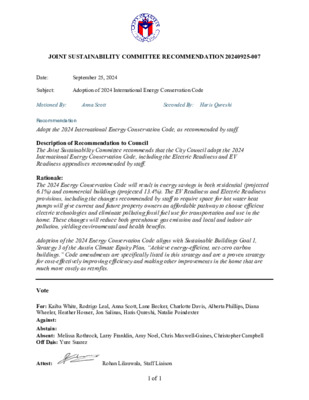
Date: Subject: JOINT SUSTAINABILITY COMMITTEE RECOMMENDATION 20240925-007 September 25, 2024 Adoption of 2024 International Energy Conservation Code Motioned By: Anna Scott Seconded By: Haris Qureshi Recommendation Adopt the 2024 International Energy Conservation Code, as recommended by staff. Description of Recommendation to Council The Joint Sustainability Committee recommends that the City Council adopt the 2024 International Energy Conservation Code, including the Electric Readiness and EV Readiness appendixes recommended by staff. Rationale: The 2024 Energy Conservation Code will result in energy savings in both residential (projected 6.1%) and commercial buildings (projected 13.4%). The EV Readiness and Electric Readiness provisions, including the changes recommended by staff to require space for hot water heat pumps will give current and future property owners an affordable pathway to choose efficient electric technologies and eliminate polluting fossil fuel use for transportation and use in the home. These changes will reduce both greenhouse gas emission and local and indoor air pollution, yielding environmental and health benefits. Adoption of the 2024 Energy Conservation Code aligns with Sustainable Buildings Goal 1, Strategy 3 of the Austin Climate Equity Plan, “Achieve energy-efficient, net-zero carbon buildings.” Code amendments are specifically listed in this strategy and are a proven strategy for cost-effectively improving efficiency and making other improvements in the home that are much more costly as retrofits. Vote For: Kaiba White, Rodrigo Leal, Anna Scott, Lane Becker, Charlotte Davis, Alberta Phillips, Diana Wheeler, Heather Houser, Jon Salinas, Haris Qureshi, Natalie Poindexter Against: Abstain: Absent: Melissa Rothrock, Larry Franklin, Amy Noel, Chris Maxwell-Gaines, Christopher Campbell Off Dais: Yure Suarez Attest: Rohan Lilauwala, Staff Liaison 1 of 1
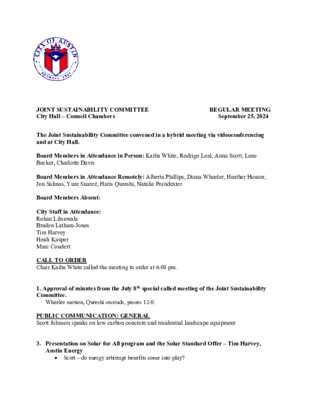
JOINT SUSTAINABILITY COMMITTEE REGULAR MEETING September 25, 2024 City Hall – Council Chambers The Joint Sustainability Committee convened in a hybrid meeting via videoconferencing and at City Hall. Board Members in Attendance in Person: Kaiba White, Rodrigo Leal, Anna Scott, Lane Becker, Charlotte Davis Board Members in Attendance Remotely: Alberta Phillips, Diana Wheeler, Heather Houser, Jon Salinas, Yure Suarez, Haris Qureshi, Natalie Poindexter Board Members Absent: City Staff in Attendance: Rohan Lilauwala Braden Latham-Jones Tim Harvey Heidi Kasper Marc Coudert CALL TO ORDER Chair Kaiba White called the meeting to order at 6:08 pm. 1. Approval of minutes from the July 8th special called meeting of the Joint Sustainability Committee. Wheeler motion, Qureshi seconds, passes 12-0. PUBLIC COMMUNICATION: GENERAL Scott Johnson speaks on low carbon concrete and residential landscape equipment 3. Presentation on Solar for All program and the Solar Standard Offer – Tim Harvey, Austin Energy • Scott – do energy arbitrage benefits come into play? • Harvey – one of the considered benefits. Utility will control battery to a certain depth of discharge to benefit the utility (leaving enough charge to support resilience). On edge of event, batteries not used. On blue sky days, AE will use batteries for price chasing, 4CP avoidance, peak usage, to get max value out of battery • PPA will be used for solar purchases, performance contract for battery will • Grant will be used to buy down PPA and performance contract to AE’s avoided allow AE to benefit from them. cost of solar and make it feasible. • Phillips – questions around how program works, if benefits flow to wealthier folks • Harvey – AE starting proposal is to allow any residents in EPA designated Disadvantaged Community (DAC) zones, but this could be changed/refined.provides clarification • Opportunity to provide feedback in community engagement process to shape program/ • Leal – why is program designed this way • Harvey – difficult to find 2500 low-income homes that are viable • If model is successful, potential to receive unused funds later • Leal – would roof repairs/rebuilding be part of it? • Harvey – there are existing programs, this grant can’t be for that as per EPA agreement. Homes will receive free weatherization if customer qualify. Homeowners will be informed about home repair program. • Opportunity for community engagement to help define what homes to target • Leal – what does governance look like? …
JOINT SUSTAINABILITY COMMITTEE HYBRID MEETING FORMAT August 28th, 2024 at 6 pm City Hall – Council Chambers 301 W 2nd St, Austin TX 78701 Some members of the Committee may be participating by videoconference Public comment will be allowed in-person or remotely via telephone. Speakers may only register to speak on an item once either in-person or remotely and will be allowed up to three minutes to provide their comments. Registration no later than noon the day before the meeting is required for remote participation by telephone. To register to speak remotely, email or call Rohan Lilauwala at (Rohan.lilauwala@austintexas.gov or 512-974-9394). CURRENT BOARD MEMBERS: Home Commission Electric Utility Commission Resource Management Commission Urban Transportation Commission Environmental Commission Zero Waste Advisory Commission Community Development Commission Austin Travis County Food Policy Board Economic Prosperity Commission Water & Wastewater Commission Parks & Recreation Board Design Commission Planning Commission Austin/Travis County Public Health Commission City Council Mayor’s Representative Mayor’s Representative Mayor’s Representative Mayor’s Representative Mayor’s Representative Alternate Randall Chapman Member Kaiba White (Chair) Charlotte Davis (Vice-Chair) Genell Gary Diana Wheeler Haris Qureshi Melissa Rothrock Vacant Larry Franklin Amy Noel Chris Maxwell-Gaines Vacant Jon Salinas Vacant Natalie Poindexter Vacant Richard Brimer Craig Nazor Miriam Garcia Rosamaria Murillo Luis Osta Lugo Vacant Lane Becker Ben Luckens Alberta Phillips Vacant Vacant Rodrigo Leal Anna Scott Yure Suarez Christopher Campbell Heather Houser Vacant For more information, please visit: www.austintexas.gov/jsc AGENDA CALL TO ORDER PUBLIC COMMUNICATION: GENERAL The first 10 speakers signed up prior to the meeting being called to order will each be allowed a three-minute allotment to address their concerns regarding items not posted on the agenda. APPROVAL OF MINUTES 1. Approval of minutes from the July 8, 2024 special called meeting of the Joint Sustainability Committee. DISCUSSION 2. Sustainable Purchasing Update – Amanda Mortl, Office of Sustainability 3. Updates from Environmental Investment Plan effort and City Budget; JSC next steps. 4. Update from the Resource Management Commission on recommendations regarding advising on gas utility matters and support of progressive natural gas rates. – Charlotte Davis 5. Update from Urban Transportation Commission on recent recommendation to update the Urban Trails Plan map – Diana Wheeler 6. Update from the Electric Utility Commission on Austin Energy Resource Planning, solar program development, and Austin Internation Energy Conservation Code update – Kaiba White 7. Update from the Environmental Commission on the ATX / Travis County Food Plan, Cities Connecting Children …
JOINT SUSTAINABILITY COMMITTEE REGULAR MEETING SPECIAL CALLED MEETING MINUTES July 8, 2024 The Joint Sustainability Committee convened in a hybrid meeting via videoconferencing and at Austin Energy Headquarters. Board Members in Attendance in Person: Diana Wheeler Board Members in Attendance Remotely: Lane Becker, Kaiba White, Heather Houser, Jon Salinas, Alberta Philipps, Anna Scott, Rodrigo Leal, Melissa Rothrock, Chris Campbell, Haris Qureshi Board Members Absent: Larry Franklin, Chris Maxwell-Gaines, Yure Suarez, Amy Noel, Charlotte Davis City Staff in Attendance: Rohan Lilauwala CALL TO ORDER Acting Chair Diana Wheeler called the meeting to order at 7:07 pm. 1. Approval of minutes from the Jun 24th meeting of the Joint Sustainability Committee. • Salinas motions to approve with amendment to include all members absent, Scott seconds, passes 10-0 with Qureshi off dais. 2. Recommendation of investments the City should fund as part of council resolution 20240215-025 ‘Environmental Investment Plan’. • Leal – where did the $250-300 million number come from? o White – number discussed by council subquorum. Should be $250-350 million range. • Qureshi provides minor copy edits • Qureshi amendment to increase number to $250-300 million • Leal - What about water conservation? o White – city-owned solar can offset Austin Water’s energy costs to allow for reinvestments into water conservation. Conserving land improves source water quality. • Scott motions to approve as amended, Campbell seconds, passes 11-0. 3. Recommendation in support of a ‘Climate Fee’ as outlined in the staff response to council resolution 20240215-025 ‘Environmental Investment Plan’. • Discussion of progressive vs regressive nature of tax. Intention to steer options to reduce impact on low-income earners. • White amends last paragraph to “This new fee should be structured to be equitable and responsive to Austin’s wealth gaps and the fee should provide predictable revenue. A legal analysis of options that could be paid by residents, businesses, corporations and/or visitors should be conducted and presented to the City Council for consideration as soon as possible.” • Scott motions to approve as amended, Phillips seconds, passes 11-0. Meeting adjourned at 7:43 pm. ADJOURNMENT The City of Austin is committed to compliance with the American with Disabilities Act. Reasonable modifications and equal access to communications will be provided upon request. Meeting locations are planned with wheelchair access. If requiring Sign Language Interpreters or alternative formats, please give notice at least 2 days (48 hours) before the meeting date. Please call Zach Baumer …
Sustainable Procurement Program update to the JSC August, 2024 Agenda ○ Summary from last JSC update in December 2023 ○ February 2024 Resolution & August 2024 response ■ Sustainable Purchasing program development ■ Prioritized purchasing categories ○ Next Steps ■ Internal Share Platform pilot Summary from last JSC update in December 2023 ● 2022 Procurement Emissions inventory complete in Dec 2023 ○ 2022 Procurement emissions: 206,000 MT CO2e ○ Construction-related purchasing category represents highest spend and largest climate impact Resolution 20240229-058 Be it resolved that we… the City ● Develop a systemic approach for the procurement processes of ● Commence an initial pilot program: ○ concrete construction and ○ greenspace maintenance services and equipment. ● Include environmental impact information used for evaluation or tracking, such as Environmental Product Declarations, as a part of any request for Council action on a Council agenda related to these pilot areas. Program development systemic approach Sustainable Procurement Leadership Council Coaching ● Sustainable procurement program development action team meetings to develop: ○ Organizational inventory, ○ Strategy cycles/pilots for prioritized purchasing categories ● Includes quarterly check-ins with SPLC staff ● Outputs: ○ Program vision and charter, ○ Strategic program plan Landscape pilot: ● Preference policy to be added to greenspace solicitation documents, and a zero-emission requirement will be used on a case-by-case basis as the market expands ● Staff will identify active contracts and update solicitation documents to add environmental preferences and requirements as appropriate Concrete pilot The process of developing contracting contracting preferences requires: ● Collecting data on and understanding the life-cycle emissions from different concrete mixes; ● Testing new concrete mixes to ensure they meet performance ● Defining “lower carbon” concrete and establishing a regional baseline; requirements; and ● Adding a preference policy for concrete with emissions below a baseline carbon intensity (kg of CO2 per cubic meter of concrete). EPDs ● Environmental preferences and requirements for concrete are being developed in accordance with the Plan to Transition to Low-Embodied Carbon Concrete in pursuit of a Carbon Neutral Austin. ● This document, authored by the Transportation and Public Works Department’s (TPW) Office of the City Engineer, is meant to be a living document and lays out a plan and timeline for updates to low carbon concrete preferences and requirements. Next Steps: ● This resolution further directs additional data tracking, monitoring, data analysis and reporting as well as procedure development and regular contract review and …