REGULAR MEETING OF THE ENVIRONMENTAL COMMISSION WEDNESDAY, OCTOBER 7, 2026, AT 6:00 P.M. PERMITTING AND DEVELOPMENT CENTER, ROOM 1405 6310 WILHELMINA DELCO DRIVE AUSTIN, TEXAS Some members of the Environmental Commission may be participating by videoconference. The meeting may be viewed online at: http://www.austintexas.gov/page/watch-atxn-live Public comment will be allowed in-person or remotely via telephone. Speakers may only register to speak on an item once either in-person or remotely and will be allowed up to three minutes to provide their comments. Registration no later than noon the day before the meeting is required for remote participation by telephone. To register to speak remotely, contact Nicole Corona, 737-291-3084, Nicole.Corona@austintexas.gov. CURRENT COMMISSIONERS: Mariana Krueger, Chair Jennifer Bristol, Vice Chair Haris Qureshi, Secretary Sean Atkins Richard Brimer Isabella Changsut AGENDA CALL TO ORDER PUBLIC COMMUNICATION: GENERAL Annie Fierro Justin Fleury Martin Luecke Allison Morrison David Sullivan The first ten speakers signed up prior to the meeting being called to order will each be allowed a three-minute allotment to address their concerns regarding items not posted on the agenda. APPROVAL OF MINUTES 1. Approve the minutes of the Environmental Commission Regular Meeting on September 16, 2026. PUBLIC HEARINGS 2. Conduct a public hearing and approve a recommendation to Council regarding approval or denial of a wastewater service extension request for 1107 Castle Ridge Road, Austin, Texas, 78746. Presentation by Kaela Champlin, Environmental Program Coordinator, Austin Watershed Protection. WORKING GROUP RECOMMENDATIONS 3. Report of recommendations by the Dog’s Head Working Group. DISCUSSION AND ACTION ITEMS 4. 5. 6. Approve a recommendation to Council from the Dog’s Head Working Group regarding the regulating plan for the area commonly known as Dog's Head, bounded by the Colorado River, US Highway 183, and State Highway 130. Approve a recommendation to Council regarding development agreement amendments for the area commonly known as Dog's Head, bounded by the Colorado River, US Highway 183, and State Highway 130. Approve the 2027 annual schedule of the Environmental Commission. FUTURE AGENDA ITEMS City Code requires at least two board members sponsor an item to be included on an agenda. This section of the agenda provides members an opportunity to request items for future agendas. Staff should assume that if there is no objection from other members expressed at the meeting, the members’ silence indicates approval for staff to include on the next agenda. ADJOURNMENT The City of Austin is committed to compliance with the …

REGULAR MEETING ENVIRONMENTAL COMMISSION MINUTES WEDNESDAY, SEPTEMBER 16, 2026 The Environmental Commission convened in a regular meeting on Wednesday, September 16, 2026, at the Permitting and Development Center, Room 1405, located at 6310 Wilhelmina Delco Drive in Austin, Texas. Chair Krueger called the Environmental Commission Meeting to order at 6:04 p.m. Commissioners in Attendance: Mariana Krueger, Chair Jennifer Bristol, Vice Chair Richard Brimer Justin Fleury Martin Luecke David Sullivan Commissioners in Attendance Remotely: Annie Fierro Allison Morrison PUBLIC COMMUNICATION: GENERAL Chris Flores, Request for Ethics Review Commission review of City Manger’s Office involvement with Dog’s Head. APPROVAL OF MINUTES 1. Approve the minutes of the Environmental Commission Regular Meeting on August 19, 2026. The minutes from the Environmental Commission Regular Meeting on August 19, 2026, were approved on Commissioner Sullivan’s motion, Commissioner Fleury’s second, on a 6-0 vote. Commissioners Luecke and Morrison were off the dais. Secretary Qureshi and Commissioner Changsut were absent. STAFF BRIEFINGS 2. Staff briefing regarding the City of Austin's Municipal Separate Storm Sewer System permit. Presentation by Jacob Johnson, Environmental Program Coordinator, Austin Watershed Protection. Sponsored by Secretary Qureshi and Commissioner Sullivan. The presentation was made by Jacob Johnson, Environmental Program Coordinator, Austin Watershed Protection. 1 3. Staff briefing to provide an update on Austin City Council action taken at the May 21, 2026, and July 23, 2026, meetings and to discuss next steps regarding the area commonly known as Dog's Head, bounded by the Colorado River, US Highway 183, and State Highway 130. Presentation by Liz Johnston, Environmental Officer, Austin Watershed Protection. Sponsored by Commissioners Brimer and Sullivan. The presentation was made by Liz Johnston, Environmental Officer, Austin Watershed Protection. WORKING GROUP UPDATES 4. Update from the Dog’s Head Working Group regarding the meeting on September 10, 2026. The update was given by Vice Chair Bristol. COMMITTEE UPDATES 5. Update from the Urban Forestry Committee regarding the meeting on September 14, 2026. The update was given by Commissioner Brimer. FUTURE AGENDA ITEMS None. ADJOURNMENT Chair Krueger adjourned the meeting at 8:54 p.m. without objection. 2
MEMORANDUM To: From: Mayor and City Council Michael Rogers, Assistant City Manager Susana Carbajal, Assistant City Manager Date: October 5, 2026 Subject: 1107 Castle Ridge Road Wastewater Service Extension Request No. 6451 Service Extension Requests (SERs) located outside of the City of Austin’s full purpose jurisdiction and not within the Desired Development Zone require City Council approval and review by the Environmental and Water and Wastewater Commissions. Austin Water and Austin Watershed Protection staff have completed the review for 1107 Castle Ridge Road Wastewater Service Extension Request (SER) No. 6451, and both departments recommend approval of the request. Summary of Proposed Development The 1107 Castle Ridge Road project consists of approximately 2.85 acres (Property). The Property is located entirely within the City’s 2-mile Extra-Territorial Jurisdiction (ETJ), Impact Fee Boundary, Austin Water’s service area for wastewater, the Drinking Water Protection Zone, the Barton Creek Watershed, the Barton Springs Zone, and the Edwards Aquifer Contributing Zone. The Property is generally located west of Loop 360 and north of Lost Creek Boulevard, near City Council district 8 in zip code 78746. There is an existing single-family home on this lot that receives water service from Travis County Water Control and Improvement District (WCID) No. 10 and has a privately owned and operated onsite sewage facility (OSSF) for its wastewater service. Parkside Homes, LLC (Owner) is proposing to demolish the existing home, abandon the OSSF, and redevelop the tract with three single-family homes. The Owner requested that the City provide centralized wastewater service to the Property. In response to the request, Austin Water determined that the Owner must construct infrastructure to receive wastewater services from Austin Water. These requirements are reflected in SER No. 6451. Travis County WCID No. 10 will continue to provide retail water service to the Property. The Owner previously submitted SER No. 5845 and SER No. 6290. The initial application for SER No. 5845 was approved on consent by City Council on October 10, 2024, but subsequently expired. The Owner later submitted SER No. 6290 but it was denied by City Council on April 23, 2026, over concerns related to the ability for the property to remove itself from the ETJ, thereby no longer being held to the high standards of environmental protections required by the Save Our Springs Ordinance Date: Subject: October 5, 2026 1107 Castle Ridge Road Wastewater Service Extension Request No. 6451 Nearby SER Activity There are …
Dog’s Head Working Group Recommendation Presented to the Environmental Commission on October 7, 2026 WHEREAS, the Environmental Commission formed “the Dog’s Head Working Group to organize and engage community stakeholders; advise the applicant, City of Austin (CoA), and City Council on the regulatory plan; and to make recommendations regarding the regulating plan of the Dog's Head development agreement.”; and WHEREAS, the working group consists of members of the Environmental Commission, the existing communities, and residents living on the Dog’s Head Property and environmental community, which met 10 times between June and September; and WHEREAS, the working group formed a smaller sub-committee to engage with Dog’s Head Land JV, Ltd.; City of Austin (CoA) staff; and Council members. That group met three times at City Hall; WHEREAS, the sub-committee reached agreement with Dog’s Head Land JV, Ltd. and CoA staff to delay the Regulating Plan until March 2027; and NOW THEREFORE BE IT RESOLVED, that the Dog’s Head Working Group recommends the following: 1. Reinstate Environmental Commission involvement in all phases of the Dog’s Head Development, as defined by CoA Code. 2. Dog’s Head Land JV, Ltd. shall share any and all hydrological studies with the Environmental Commission and Austin Watershed Protection annually, with the first study to be released no later than January 1, 2027. 3. Dog’s Head Land JV, Ltd., in partnership with the CoA, shall conduct an Environmental Resource Inventory on the property and in the river within two years of the Effective Date of the Development Agreement. The results of this inventory shall be publicly released, and a briefing shall be given to the Environmental Commission. 4. Austin Watershed Protection shall conduct a hydrological study of the groundwater and aquifers beneath the Dog’s Head Property, inclusive of flood management strategies. These shall be made public via the CoA website, with subsequent updates annually. 5. Projects not related to mining operations or the remediation of the former mines shall obtain approval for Cut Requirements (Section 25-8-341) and Fill Requirements (Section 25-8-342) that exceed four feet, in a manner consistent with 2026 CoA Code. Variance requests shall come before the Environmental Commission according to CoA code. 6. CoA, in partnership with Dog’s Head Land JV, Ltd., shall conduct a full Environmental Assessment Study that includes: water quality, soil quality (including presence of pollutants in the area), baseline assessment of the state of the existing ecology on the site with …

RECOMMENDATION TO COUNCIL Environmental Commission Recommendation 20261007-005: Dog’s Head Development Agreement Amendments WHEREAS, the Environmental Commission was presented with a staff briefing regarding the Dog’s Head on September 16, 2026; and WHEREAS, the Environmental Commission finds multiple areas within the Development Agreement that should be amended to align with current city code that protects the environment; and WHEREAS, the Austin City Council voted on several amendments to the development agreement at the July 23, 2026, City Council meeting, but to date, City Legal and the City Manager’s Office have not finalized or publicized the incorporation of those amendments into the document; NOW THEREFORE BE IT RESOLVED that the Environmental Commission recommends the following amendments be made to the Dog’s Head Development Agreement (DA) prior to City Council approval of the Regulating Plan: 1. Updates from July 23, 2026, City Council Meeting a. Amend the DA to incorporate all amended language approved by City Council at the July 23, 2026, City Council Meeting. 2. Development Agreement Control/Conflicts a. Section 3.06 (d) (at present, the development agreement controls if there is any conflict with either the Regulating Plan or the interim zoning in city code) Amend the DA so that Regulating Plan Controls as soon as it is in place, with the DA, only as amended, controlling in the interim. i. 3. Land Use a. Section 3.03 (at present, the Director of Development Services can authorize any variance to Land Development Code administratively without public process) i. Strike this section and reinstate board and commission approval for all variances. b. Section 3.04 (at present, existing land uses are allowed to continue) i. Phase out autonomous boat testing and prohibit any military or military-adjacent operations. c. Section 3.05 (a-b) (currently, all permitted uses within the Dog’s Head Property will be classified as either Mixed Use Development or Open Space) i. ii. iii. Amend this section to preclude all polluting industrial uses, as described in the Land Development Code (LDC), 25-2-5. In particular, disallow data centers, chip manufacturing, and weapons/ defense-related manufacturing. Prioritize residential, civic, and agricultural uses as described in the Land Development Code (25-2-3, 25-2-6, and 25-2-7). d. Section 3.05 (c) (at present, all new land uses are automatically permitted) Remove this entire sub-section to allow for standard public process. i. e. Section 3.09 (currently, there are no height restrictions for the property) i. Limit building height to 90 feet. f. Section …
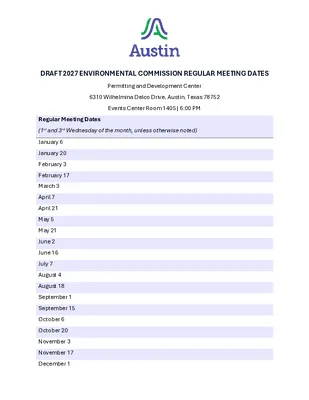
DRAFT 2027 ENVIRONMENTAL COMMISSION REGULAR MEETING DATES Permitting and Development Center 6310 Wilhelmina Delco Drive, Austin, Texas 78752 Events Center Room 1405 | 6:00 PM Regular Meeting Dates (1st and 3rd Wednesday of the month, unless otherwise noted) January 6 January 20 February 3 February 17 March 3 April 7 April 21 May 5 May 21 June 2 June 16 July 7 August 4 August 18 September 1 September 15 October 6 October 20 November 3 November 17 December 1
1107 Castle Ridge Road Wastewater Service Extension Request #6451 Austin Watershed Protection | October 7, 2026 What is a Service Extension Request? ▪ A service extension request is an application for City water or wastewater service from a property owner or developer. ▪ Required when: ▪ a property is more than 100 feet from accessible water/wastewater system or ▪ existing infrastructure isn't adequate for the proposed project demands ▪ May involve the construction of a new line/associated facility or upgrades to existing lines/facilities. ▪ Applicant pays for the associated infrastructure, as outlined in the service extension request. 2 Service Extension Request Policy ▪ A Service Extension Request requires Council approval if property: ▪ is in Drinking Water Protection Zone and ▪ is outside of the City's full purpose jurisdiction ▪ AW & WPD staff review plans and present staff findings ▪ Environmental Commission and Water & Wastewater Commission make recommendations for support or denial ▪ No conditions may be placed on Service Extension Requests per State law 3 Request Summary ▪ Wastewater Service Request ▪ 1107 Castle Ridge Road ▪ 2.85 acres ▪ 2-mile extraterritorial jurisdiction ▪ Barton Creek Watershed (Barton Springs Zone) ▪ Edwards Aquifer Contributing Zone ▪ Drinking Water Protection Zone ▪ Subject to Save Our Springs Ordinance 4 Request Summary ▪ Subdivide 2.85-acre lot ▪ Existing single-family home will be demolished ▪ Redevelop the tract with three single-family homes with driveways and a firetruck turnaround entrance ▪ Requesting centralized wastewater service ▪ Travis County WCID No. 10 will continue to provide retail water service to property. 5 Background ▪ Owner previously submitted SERs for this property ▪ The initial SER application (SER No. 5845) was approved by City Council on October 10, 2024, but subsequently expired. ▪ Owner later submitted SER No. 6290 but it was denied by City Council on April 23, 2026, over concerns related to the ability for the property to remove itself from the extraterritorial jurisdiction (ETJ). ▪ Owner requested removal from 2-mile ETJ but was denied due to proximity to the Bee Caves Armory. 6 Service Extension Request #6451 Site Location Austin City Limits Austin extraterritorial jurisdiction Edwards Aquifer Recharge Zone Edwards Aquifer Contributing Zone 7 Austin City LimitsETJRechargeContributingAustin City LimitsETJRechargeContributing Imagine Austin Growth Concept Map 8 Proposed Wastewater Extension ▪ Construct 760 ft of gravity wastewater main from existing 8” gravity wastewater main in Whitemarch Valley Walk ▪ Extend north to …

REGULAR MEETING OF THE ENVIRONMENTAL COMMISSION WEDNESDAY, SEPTEMBER 16, 2026, AT 6:00 P.M. PERMITTING AND DEVELOPMENT CENTER, ROOM 1405 6310 WILHELMINA DELCO DRIVE AUSTIN, TEXAS Some members of the Environmental Commission may be participating by videoconference. The meeting may be viewed online at: http://www.austintexas.gov/page/watch-atxn-live Public comment will be allowed in-person or remotely via telephone. Speakers may only register to speak on an item once either in-person or remotely and will be allowed up to three minutes to provide their comments. Registration no later than noon the day before the meeting is required for remote participation by telephone. To register to speak remotely, contact Nicole Corona, 737-291-3084, Nicole.Corona@austintexas.gov. CURRENT COMMISSIONERS: Mariana Krueger, Chair Jennifer Bristol, Vice Chair Haris Qureshi, Secretary Richard Brimer Isabella Changsut Annie Fierro AGENDA CALL TO ORDER PUBLIC COMMUNICATION: GENERAL Justin Fleury Martin Luecke Allison Morrison David Sullivan The first ten speakers signed up prior to the meeting being called to order will each be allowed a three-minute allotment to address their concerns regarding items not posted on the agenda. APPROVAL OF MINUTES 1. Approve the minutes of the Environmental Commission Regular Meeting on August 19, 2026. STAFF BRIEFINGS 2. Staff briefing regarding the City of Austin's Municipal Separate Storm Sewer System permit. Presentation by Jacob Johnson, Environmental Program Coordinator, Austin Watershed Protection. Sponsored by Secretary Qureshi and Commissioner Sullivan. 3. Staff briefing to provide an update on Austin City Council action taken at the May 21, 2026, and July 23, 2026, meetings and to discuss next steps regarding the area commonly known as Dog's Head, bounded by the Colorado River, US Highway 183, and State Highway 130. Presentation by Liz Johnston, Environmental Officer, Austin Watershed Protection. Sponsored by Commissioners Brimer and Sullivan. WORKING GROUP UPDATE 4. Update from the Dog’s Head Working Group regarding the meetings on September 10, 2026. COMMITTEE UPDATES 5. Update from the Urban Forestry Committee regarding the meeting on September 14, 2026. FUTURE AGENDA ITEMS City Code requires at least two board members sponsor an item to be included on an agenda. This section of the agenda provides members an opportunity to request items for future agendas. Staff should assume that if there is no objection from other members expressed at the meeting, the members’ silence indicates approval for staff to include on the next agenda. ADJOURNMENT The City of Austin is committed to compliance with the Americans with Disabilities Act. Reasonable modifications …

ENVIRONMENTAL COMMISSION MINUTES REGULAR MEETING WEDNESDAY, AUGUST 19, 2026 The Environmental Commission convened in a regular meeting on Wednesday, August 19, 2026, at the Permitting and Development Center, Room 1405, located at 6310 Wilhelmina Delco Drive in Austin, Texas. Chair Krueger called the Environmental Commission Meeting to order at 6:01 p.m. Commissioners in Attendance: Mariana Krueger, Chair Jennifer Bristol, Vice Chair Richard Brimer Justin Fleury Martin Luecke Allison Morrison David Sullivan Commissioners in Attendance Remotely: Isabella Changsut PUBLIC COMMUNICATION: GENERAL None present. APPROVAL OF MINUTES 1. Approve the minutes of the Environmental Commission Regular Meeting on August 5, 2026. The minutes from the Environmental Commission Regular Meeting on August 5, 2026, were approved on Commissioner Sullivan’s motion, Commissioner Brimer’s second, on a 6-0 vote. Commissioners Luecke and Morrison were off the dais. Secretary Qureshi and Commissioner Fierro were absent. PUBLIC HEARINGS 2. Name: 5811 Southwest Parkway Site-Specific SOS Amendment, C20-2026-008 Applicant: Thompson Land Engineering Location: 5811 Southwest Parkway, Austin, Texas, 78735 Council District: 8 1 Staff: Leslie Lilly, Environmental Conservation Program Manager, Austin Watershed Protection, 512-535-8914, leslie.lilly@austintexas.gov; Sean Watson, Environmental Program Coordinator, Austin Watershed Protection, 512-963-2167, sean.watson@austintexas.gov Applicant Request: In response to Council Resolution No. 20190131-040, consider a site- specific amendment to City Code Chapter 25-8, Subchapter A, Article 13 (Save Our Springs Initiative), as minimally required to address development at the site located at 5811 Southwest Parkway. Staff Recommendation: Recommended with conditions The public hearing was conducted and a motion to close the public hearing was approved on Commissioner Sullivan’s motion, Commissioner Brimer’s second, on an 8-0 vote. Secretary Qureshi and Commissioner Fierro were absent. The motion to recommend the project 5811 Southwest Parkway Site-Specific SOS Amendment, C20-2026-008, located at 5811 Southwest Parkway, to Council was approved on Chair Krueger’s motion, Commissioner Sullivan’s second, on an 8-0 vote. Secretary Qureshi and Commissioner Fierro were absent. The following amendment was made by Commissioner Brimer, seconded by Commissioner Sullivan, and approved on an 8-0 vote. Secretary Qureshi and Commissioner Fierro were absent. The amendment was to add the inclusion of dark sky building practices into the recommendation. WORKING GROUP UPDATE 3. 4. Update from the Artificial Turf Working Group regarding future meeting dates. The update was given by Commissioner Sullivan. Update from the Dog’s Head Working Group regarding the meeting on August 6, 2026, and future meeting dates. The update was given by Vice Chair Bristol. FUTURE AGENDA ITEMS Staff briefing …
MS4 Permit Update Environmental Commission | September 16, 2026 From The Top ▪ MS4 = Municipal Separate Storm Sewer System ▪ Texas Pollutant Discharge Elimination System (TPDES) permit that allows Austin to convey stormwater and discharge to waterways ▪ Prohibit non-stormwater discharges ▪ Reduce pollutants to the Maximum Extent Practicable ▪ Originates from the National Pollutant Discharge Elimination System (NPDES) Permit Program as part of the Clean Water Act ▪ 1990 – Environmental Protection Agency (EPA) issues NPDES Stormwater Phase I rule ▪ 1992 - City of Austin applies for EPA MS4 permit ▪ 1998 - EPA authorizes Texas Commission on Environmental Quality (TCEQ) to develop and implement TPDES program ▪ 2006 - TCEQ issues Phase I MS4 permit to COA 2 MS4 Permit ▪ Tells the City what needs to be done ▪ Broken up into 8 Minimum Control Measures ▪ Total Maximum Daily Load (TMDL) requirements are now included in MS4 permits ▪ Five-year permit cycle ▪ Annual reporting ▪ Periodic TCEQ audits 3 Stormwater Management Program (SWMP) ▪ SWMP informs TCEQ how COA will fulfill permit requirements ▪ Collection of best management practices and quantified targets ▪ Over 100 targets across various City of Austin departments ▪ Targets include activities staff has control over 4 Who’s Involved? Section of the SWMP MS4 Maintenance Activities Post Construction Stormwater Control Measures Illicit Discharge Detection and Elimination Good Housekeeping for Municipal Operations Industrial and High Risk Runoff Construction Site Stormwater Runoff Core Contributing Departments WPD, ARR, TPW WPD, DSD, PLAN WPD, AW, ARR, AFD WPD, ARR, TPW, AFD, AUS, FMS, APR, AW WPD, AW, DSD, AFD DSD Public Education, Outreach, Involvement and Participation WPD, ARR, AW Monitoring, Evaluating and Reporting WPD Total Maximum Daily Loads WPD- Austin Watershed Protection, ARR – Austin Resource Recovery, TPW – Transportation and Public Works, DSD – Austin Development Services, PLAN – Austin Planning, AW – Austin Water, AFD – Austin Fire, AUS – Austin Bergstrom International Airport, FMS – Fleet Mobility Services, APR – Austin Parks, HSO – Homeless Strategies Office WPD, AW, HSO 5 Current Status ▪ TCEQ audit in July 2026 resulted in General Compliance (no violations) ▪ TCEQ issued a draft permit June 2026 as part of Austin’s permit renewal process ▪ Potential to have new permit by end of the fiscal year ▪ Minimal TCEQ edits/additions compared to the current permit ▪ Once the permit is issued,180 days to submit …
Dog’s Head Update to Environmental Commission Liz Johnston, Environmental Officer Watershed Protection Department | September 16, 2026 Dog’s Head Update This presentation is focused on items primarily related to Austin Watershed Protection and will provide an overview on the following topics: ▪ Site Context ▪ May Council action ▪ July Council action ▪ Regulatory Comparison Table ▪ Floodplain Update ▪ Next Steps, including brief explanation of a regulatory plan ▪ Q&A 2 Property Information ▪ Annexed into Full Purpose May 2026 ▪ District 3 & 2-mile ETJ ▪ Colorado River & Carson Creek ▪ Bounded by Colorado River to north & east ▪ Previously used as sand/gravel mining operations Colorado River Watershed Carson Creek Watershed Watershed boundaries and creek centerlines Council District 3 boundaries. Information from Property Profile 3 US 183 Longhorn Dam Colorado River SH 71 Aerial imagery courtesy of NearMaps Dog’s Head Current and Historic Aerial Images 1940 2017 2026 Current Aerial Aerial imagery courtesy of Nearmap – May 2026 May 21, 2026 Council Action ▪ Development Agreement – 45-year contract (Item 38) ▪ Interlocal Agreement with Travis County granting City of Austin regulatory authority over the Dog’s Head (Item 39) ▪ Annexation Ordinance (Item 60) 7 July 23, 2026 Council Action ▪ Tax Increment Reinvestment Zone agreement with Travis County (Item 14) ▪ Tax Increment Reinvestment Zone preliminary project and financing plan (Item 15) ▪ Right-of-way vacation of portions of Hergotz Lane and Dalton Lane (Items 75 & 76) ▪ Annexation of 37 acres of right-of-way land (Item 106) ▪ Creation of TIRZ Zone, approval of boundaries, City participation rate, and appointment of the board of directors (Item 111) ▪ Development Agreement Amendment (Item 142) 8 Drainage & Environmental Regulatory Comparison Table (1 of 3) City of Austin Mining Reclamation May Development Agreement July Development Agreement Cut and Fill · Up to 4' allowed · 4'-8' administrative variance (with conditions) · 8+ Land Use Commission variance · Allowed to restore pits back to previous grade · Not applicable except in the CWQZ unless associated with necessary bank stabilization · No Change Critical Environmental Features (wetlands and springs/seeps) · Standard setback 150', may be administratively reduced to 50' · Wetlands protected per definition defined in 1987 US Army Corps of Engineers delination manual · Wetlands may be mitigation · Mining pits not exempt · Staff generally would allow mitigation for wetlands · Wetland protections do not apply if …
Dog’s Head Update to Environmental Commission Liz Johnston, Environmental Officer Austin Watershed Protection | September 16, 2026 Dog’s Head Update This presentation is focused on items primarily related to Austin Watershed Protection and will provide an overview on the following topics: ▪ Site Context ▪ May Council action ▪ July Council action ▪ Regulatory Comparison Table ▪ Floodplain Update ▪ Next Steps, including brief explanation of a regulatory plan ▪ Q&A 2 Property Information ▪ Annexed into Full Purpose May 2026 ▪ District 3 & 2-mile ETJ ▪ Colorado River & Carson Creek ▪ Bounded by Colorado River to north & east ▪ Previously used as sand/gravel mining operations Colorado River Watershed Carson Creek Watershed Watershed boundaries and creek centerlines Council District 3 boundaries. Information from Property Profile 3 US 183 Longhorn Dam Colorado River SH 71 Aerial imagery courtesy of NearMaps Dog’s Head Current and Historic Aerial Images 1940 2017 2026 Current Aerial Aerial imagery courtesy of Nearmap – May 2026 May 21, 2026 Council Action ▪ Development Agreement – 45-year contract (Item 38) ▪ Interlocal Agreement with Travis County granting City of Austin regulatory authority over the Dog’s Head (Item 39) ▪ Annexation Ordinance (Item 60) 7 July 23, 2026 Council Action ▪ Tax Increment Reinvestment Zone agreement with Travis County (Item 14) ▪ Tax Increment Reinvestment Zone preliminary project and financing plan (Item 15) ▪ Right-of-way vacation of portions of Hergotz Lane and Dalton Lane (Items 75 & 76) ▪ Annexation of 37 acres of right-of-way land (Item 106) ▪ Creation of TIRZ Zone, approval of boundaries, City participation rate, and appointment of the board of directors (Item 111) ▪ Development Agreement Amendment (Item 142) 8 Drainage & Environmental Regulatory Comparison Table (1 of 3) City of Austin Mining Reclamation May Development Agreement July Development Agreement Cut and Fill · Up to 4' allowed · 4'-8' administrative variance (with conditions) · 8+ Land Use Commission variance · Allowed to restore pits back to previous grade · Not applicable except in the CWQZ unless associated with necessary bank stabilization · No Change Critical Environmental Features (wetlands and springs/seeps) · Standard setback 150', may be administratively reduced to 50' · Wetlands protected per definition defined in 1987 US Army Corps of Engineers delination manual · Wetlands may be mitigation · Mining pits not exempt · Staff generally would allow mitigation for wetlands · Wetland protections do not apply if …

Environmental Commission – Dog’s Head Development Working Group Update: September 16, 2026 Prepared by Jennifer Bristol, Chair – Working Group June 17 – The Environmental Commission approved the formation of a working group to “organize and engage community stakeholders; advise the applicant, City of Austin (CoA), and City Council on the regulatory plan; and to make recommendations regarding the regulating plan.” Between June 20–29, the working group met for three meetings, two hours each, to make a recommendation to City Council on the TIRZ for the Dog’s Head Development. These first meetings had between 12 and 20 members of the working group in attendance. July 1 – The working group made a recommendation to the Environmental Commission, and it was unanimously passed. August 17 – The working group decided to form a subcommittee to meet with Endeavor and City staff. The committee consisted of two representatives of the existing neighborhoods on the Dog’s Head, PODER, and three commissioners. August 25 – The subcommittee met at City Hall with Council Member Duchen and his staff, staff from Council Member Valesquez’s office, Watershed staff, three commissioners, Endeavor, and its legal counsel. The goal of this group was to reach agreement on: 1. Pushing back the date for the Regulating Plan (achieved). 2. Reinstating the Environmental Commission (not yet achieved). 3. Establishing a working relationship with all parties. August 27 – Larger working group meeting. September 2 – Subcommittee meeting. 1. Agreed to look at the Regulating Plan recommendations together with Endeavor. 2. Agreed to tour the property. 3. Made requests to see some of the Phase One environmental studies. 4. Agreed that a letter would be sent from Endeavor to the CoA to formally request pushing back the Regulating Plan to March 2027 (task completed on September 10). September 8 – Subcommittee tour of the property with Endeavor. September 10 – Larger working group three-hour meeting to work on the draft of the Regulating Plan. 1. Commissioners Brimer and Bristol created and submitted recommendations as a framework for the others to contribute to and shape as a group. 2. Chair Kruger submitted recommendations for amendments to the Development Agreement that would enable some of the Regulating Plan recommendations and offer better protections for the environment moving forward. September 15 – Subcommittee met again. 1. Chair Kruger will give an update to the Environmental Commission. In total, 10 meetings totaling approximately 32 hours …
REGULAR MEETING ENVIRONMENTAL COMMISSION MINUTES WEDNESDAY, SEPTEMBER 16, 2026 The Environmental Commission convened in a regular meeting on Wednesday, September 16, 2026, at the Permitting and Development Center, Room 1405, located at 6310 Wilhelmina Delco Drive in Austin, Texas. Chair Krueger called the Environmental Commission Meeting to order at 6:04 p.m. Commissioners in Attendance: Mariana Krueger, Chair Jennifer Bristol, Vice Chair Richard Brimer Justin Fleury Martin Luecke David Sullivan Commissioners in Attendance Remotely: Annie Fierro Allison Morrison PUBLIC COMMUNICATION: GENERAL Chris Flores, Request for Ethics Review Commission review of City Manger’s Office involvement with Dog’s Head. APPROVAL OF MINUTES 1. Approve the minutes of the Environmental Commission Regular Meeting on August 19, 2026. The minutes from the Environmental Commission Regular Meeting on August 19, 2026, were approved on Commissioner Sullivan’s motion, Commissioner Fleury’s second, on a 6-0 vote. Commissioners Luecke and Morrison were off the dais. Secretary Qureshi and Commissioner Changsut were absent. STAFF BRIEFINGS 2. Staff briefing regarding the City of Austin's Municipal Separate Storm Sewer System permit. Presentation by Jacob Johnson, Environmental Program Coordinator, Austin Watershed Protection. Sponsored by Secretary Qureshi and Commissioner Sullivan. The presentation was made by Jacob Johnson, Environmental Program Coordinator, Austin Watershed Protection. 1 3. Staff briefing to provide an update on Austin City Council action taken at the May 21, 2026, and July 23, 2026, meetings and to discuss next steps regarding the area commonly known as Dog's Head, bounded by the Colorado River, US Highway 183, and State Highway 130. Presentation by Liz Johnston, Environmental Officer, Austin Watershed Protection. Sponsored by Commissioners Brimer and Sullivan. The presentation was made by Liz Johnston, Environmental Officer, Austin Watershed Protection. WORKING GROUP UPDATES 4. Update from the Dog’s Head Working Group regarding the meeting on September 10, 2026. The update was given by Vice Chair Bristol. COMMITTEE UPDATES 5. Update from the Urban Forestry Committee regarding the meeting on September 14, 2026. The update was given by Commissioner Brimer. FUTURE AGENDA ITEMS None. ADJOURNMENT Chair Krueger adjourned the meeting at 8:54 p.m. without objection. The minutes were approved at the October 7, 2026 meeting on Commissioner Sullivan’s motion, Commissioner Brimer’s second, on a 9-0 vote. Secretary Qureshi and Commissioner Morrison were off the dais. 2

REGULAR MEETING OF THE URBAN FORESTRY COMMITTEE MONDAY, SEPTEMBER 14, 2026, AT 10:30 A.M. PERMITTING AND DEVELOPMENT CENTER, ROOM 1401 6310 WILHELMINA DELCO DRIVE AUSTIN, TEXAS Some members of the Urban Forestry Committee may be participating by videoconference. The meeting may be viewed online at: http://www.austintexas.gov/page/watch-atxn-live Public comment will be allowed in-person or remotely via telephone. Speakers may only register to speak on an item once either in-person or remotely and will be allowed up to three minutes to provide their comments. Registration no later than noon the day before the meeting is required for remote participation by telephone. To register to speak remotely, contact Nicole Corona, 737-291-3084, Nicole.Corona@austintexas.gov. CURRENT COMMISSIONERS: Richard Brimer, Chair Martin Luecke, Vice Chair Annie Fierro Justin Fleury AGENDA CALL TO ORDER PUBLIC COMMUNICATION: GENERAL The first ten speakers signed up prior to the meeting being called to order will each be allowed a three-minute allotment to address their concerns regarding items not posted on the agenda. APPROVAL OF MINUTES 1. Approve the minutes of the Urban Forestry Committee Regular Meeting on May 13, 2026. DISCUSSION ITEMS 2. Presentation regarding the Wildfire Symposium Summary. Presentation by Nico Hauwert, Ph.D., Adjunct Professor, Austin Community College. 3. Discussion of the East Austin tree planting project. FUTURE AGENDA ITEMS City Code requires at least two board members sponsor an item to be included on an agenda. This section of the agenda provides members an opportunity to request items for future agendas. Staff should assume that if there is no objection from other members expressed at the meeting, the members’ silence indicates approval for staff to include on the next agenda. ADJOURNMENT The City of Austin is committed to compliance with the Americans with Disabilities Act. Reasonable modifications and equal access to communications will be provided upon request. For assistance, please contact the Liaison or TTY users’ route through 711. A person may request language access accommodations no later than 48 hours before the scheduled meeting. Please call or email Nicole Corona at Austin Watershed Protection at 737-291-3084, Nicole.Corona@austintexas.gov to request service or for additional information. For more information on the Urban Forestry Committee, please contact Nicole Corona at 737-291- 3084, Nicole.Corona@austintexas.gov.
URBAN FORESTRY COMMITTEE MINUTES REGULAR MEETING WEDNESDAY, MAY 13, 2026 The Urban Forestry Committee convened in a regular meeting on Wednesday, May 13, 2026, at the Permitting and Development Center, Room 1405, located at 6310 Wilhelmina Delco Drive in Austin, Texas. Vice Chair Luecke called the Urban Forestry Committee Meeting to order at 12:04 p.m. Commissioners in Attendance: Martin Luecke, Vice Chair Justin Fleury Commissioners in Attendance Remotely: Richard Brimer, Chair Annie Fierro PUBLIC COMMUNICATION: GENERAL None present. APPROVAL OF MINUTES 1. Approve the minutes of the Urban Forestry Committee Regular Meeting on December 1, 2025. The minutes from the Urban Forestry Committee Regular Meeting on December 1, 2025, were approved on Commissioner Fleury’s motion, Chair Brimer’s second, on a 3-0 vote. Commissioner Fierro was off the dais. STAFF BRIEFINGS 2. 3. Staff briefing regarding an update on the Urban Forest Replenishment Fund. Presentation by Emily King, Urban Forester, Austin Climate Action and Resilience. The presentation was made by Emily King, Urban Forester, Austin Climate Action and Resilience. Staff briefing regarding the Youth Forestry Council. Presented by Britney Huynh, Program Development Coordinator, and Zane Williams, Austin Climate Action and Resilience. The presentation was made by Britney Huynh, Program Development Coordinator, and Zane Williams, Austin Climate Action and Resilience. 1 DISCUSSION ITEMS 4. Discussion of Windsor Park Neighborhood Association's Shade the Streets initiative. Presented by Commissioner Luecke. Discussed. FUTURE AGENDA ITEMS None. ADJOURNMENT Vice Chair Luecke adjourned the meeting at 1:21 p.m. without objection. 2


March 2023 Aerial Photo Barton Creek Greenbelt west of Mopac Wildfire remains October 2025 by Nico Hauwert Justice Jones Austin Fire Dept 2024 talk (https://youtu.be/aRCwN_fdFWM?list=PLLf4G2eXDF-5Rke2Ixjdo3DC7tcxdaIKo) Sept 15, 2023 Message from Nico Hauwert to Mayor Kirk Watson regarding City plan to expand tree clearing, prescribed burning and pesticides on parkland, including unacknowledged Balcones Canyonlands Conservation Plan endangered species permit. https://drive.google.com/file/d/1DADSz42NhCD3Eoe0AGlpJKEITivvFm99/view?usp=sharing Jan. 26, 2025 Nico Hauwert Wildfire Comments to Mayor and City Council https://drive.google.com/file/d/1vPBQ9ROr0Pd-jb6Dq6UWxkvk6jZ72MAR/view?usp=sharing 2023 Wildfire Assessment report on Bright Leaf Preserve with Austin Fire Dept. https://drive.google.com/file/d/1-TgjTQFdllJSqXUoEvngbvpc9Mwi9PIV/view?usp=sharing Redman, C.1999. Human Impact on Ancient Environments. University of Arizona Press.240 p. Aronson, James L. Hailemichael, Million, Savin, Samuel M.. 2008. Hominid environments at Hadar from paleosol studies in a framework of Ethiopian climate change: Journal of Human Evolution V 55 p 532–550. Levin, N. E., Brown, F. H., Behrensmeyer, A. K., Bobe, R. & Cerling, T. E. 2011. Paleosol carbonates from the Omo Group: Isotopic records of local and regional environmental change in East Africa. Palaeogeogr. Palaeoclimatol. Palaeoecol. doi:10.1016/j.palaeo.2011.04.026. Wright DK (2017) Humans as Agents in the Termination of the African Humid Period. Front. Earth Sci. 5:4. doi: 10.3389/feart.2017.00004 Hughes, Donald J. 1975. Ecology in Ancient Civilizations. The University of New Mexico Press. 181 p. Ehrlich, Ann and Erhich Paul. 1980. Ecoscience: The Greeks and Romans did it too! Mother Earth News. https://www.motherearthnews.com/nature-and-environment/greeks-and-romans-zmaz80mjzraw The land was the best in the world…Many great deluges have taken place during the nine thousand years, .. there has never been any considerable accumulation of the soil coming down from the mountains, as in other places, but the earth has fallen away all round and sunk out of sight. The consequence is, that in comparison of what then was, there are remaining only the bones of the wasted body..all the richer and softer parts of the soil having fallen away, and the mere skeleton of the land being left. But in the primitive state of the country, its mountains were high hills covered with soil, and the plains, as they are termed by us, of Phelleus were full of rich earth, and there was abundance of wood in the mountains. Of this last the traces still remain, for although some of the mountains now only afford sustenance to bees, not so very long ago there were still to be seen roofs of timber cut from trees growing there, which were of a size sufficient to cover the largest houses; …

Buckley, S.B. 1874. First Annual Report of the Geological and Agricultural Survey of Texas. State Geologist 142 p. From Bray 1904 O’Donnell. 2019. Historical ecology of the Texas Hill Country, Historical Accounts of Vegetation Communities from 1700-1900, with an Emphasis on the Eastern Edge of the Edwards Plateau: Austin Water Balcones Canyonland Technical Report. 35 p. https://www.researchgate.net/publication/331582514_HISTORICAL_ECOLOGY_OF_THE_TEXAS_HILL_COUNTRY • Findell and Eltahir (1997) tested the hypothesis suggested by Shukla and Mintz (1982) that soil moisture increases local precipitation by comparing a 14-year soil moisture record in Illinois with precipitation. It found that summer initial soil moisture conditions were a strong predictor of drought or flood years. • Englehart and Douglas (2002) examined patterns of drought and flooding from 1910 to 2000 in central United States with large-scale climate modes, including El Niño Southern Oscillation (ENSO), La Niña, and Pacific Decadal Oscillation, and found that antecedent soil moisture and vegetation growth were better predictors of extended dry conditions. • Pal et al (2000, 2001, 2002) used regional modeling to show that local soil moisture conditions affected drought and flood conditions in the Midwest United States by creating anticyclones similar to Namias (1960) hypothesis. • Koster et al (2004) used multiple models to show Central Texas into the high plains to the north have a strong coupling between soil moisture and local climate, including temperature and precipitation. Findell, Kirsten L. and Eltahir, Elfatih A.B. 1997. An analysis of the soil moisture-rainfall feedback, based on direct observations from Illinois: Water Resources Research, vol. 33, no. 4, pages 725–735, April 1997 Englehart, Phil J. and Douglas, Arthur V. 2002. On some characteristic variations in warm season precipitation over the central United States (1910–2000): Journal of Geophysical Research, vol. 107, no. D16, 4286, 10.1029/2001JD000972 Pal, J. S., E. E. Small, and E. A. B. Eltahir. 2000. Simulation of regional scale water and energy budgets: Influence of a new moist physics scheme within Reg CM, J. Geophys. Res., 105, 29,579 – 29, 594. 2000 -Pal et al, JGR Simulation regional-scale.pdf Pal, J. S., and E. A. B. Eltahir. 2001. Pathways relating soil moisture conditions to future summer rainfall within a model of the land-atmosphere system., J. Climate, 14, 1227 – 1242. Pal, J. S., and E. A. B. Eltahir. 2002. Teleconnections of soil moisture and rainfall during the 1993 midwest summer flood: Geophysical Research Letters, Vol. 29, No. 18, 1865, doi:10.1029/2002gl014815. 2002GL014815 (mit.edu) Temperature measurements collected over …
Namias, Jerome. 1960. Factors in the initiation, perpetuation, and termination of drought: International Association of Scientific Hydrology Commission on Surface Waters Publication 51, p. 81-94. Makarieva AM, Gorshkov VG, Li B-L (2009) Precipitation on land versus distance from the ocean: evidence for a forest pump of atmospheric moisture. Ecol Complex 6:302–307. Sheil, Douglas. 2018. Forests, atmospheric water and an uncertain future: the new biology of the global water cycle: Forest Ecosystems (2018) 5:19. https://doi.org/10.1186/s40663-018-0138-y
Wilcox, B. P., and Y. Huang (2010), Woody plant encroachment paradox: Rivers rebound as degraded grasslands convert to woodlands, Geophys. Res. Lett., 37, L07402, doi:10.1029/2009GL041929. Nowak et al 2014 calculated that across the United States 17 million tons of NO2, O3, PM2.5, SO2 were removed by trees in 2010. In Travis and Hays Counties a range of 1.87-3.37 tons/km2 of NO2, O3, PM2.5, SO2 were removed by trees in 2010. “96.3 percent of pollution removal from trees occurred on rural land” Brabec et al. 2002 concluded that impervious cover needed to be refined with forest versus open cover to accurately predict pollution attenuation and surface runoff for land planning. ” In addition to the focus on impervious thresholds, there is preliminary evidence in the scientific literature that the new model for watershed-based water quality planning requires an equal focus on threshold amounts of forest cover in the watershed that can act to mitigate the impervious areas within the system.” Nowak, David J.; Hirabayashi, Satoshi; Bodine, Allison; Greenfield, Eric. 2014. Tree and forest effects on air quality and human health in the United States. Environmental Pollution. 193: 119-129. https://doi.org/10.1016/j.envpol.2014.05.028 Available from: https://research.fs.usda.gov/treesearch/46102 Brabec, Elizabeth; Schulte, Stacey; and Richards, Paul L. 2002. Planning Impervious Surfaces and Water Quality: A Review of Current Literature and Its Implications for Watershed: Journal of Planning Literature 2002 16: 499. DOI: 10.1177/088541202400903563. Available at: http://jpl.sagepub.com/content/16/4/499 • Wildfire/prescribed burning in general result in increasing runoff, soil erosion, loss of sequestered carbon, release of downstream nutrients such as phosphorus and nitrogen, algal blooms with potential for toxic cyanobacteria, and release of mercury (Planas et al 2000; Lucotte et al., 2016). • Worldwide release of stored carbon, phosphorus and nitrates (Pellegrini et al., 2018) • Wildfires are calculated to contribute 800 tons per year of airborne mercury which constitutes 25% of all anthropogenic sources of mercury (Cyberwest, 2001). • Particulate matter >2.5 microrons “air pollution called PM2.5 – responsible for an estimated 4.2 million premature deaths every year globally. This includes over a million deaths in China, over half a million in India, almost 200,000 in Europe, and over 50,000 in the United States.” Cyberwest. 2001. Mercury emissions found in wildfire smoke: Cyberwest Magazine August 24, 2001. Available from: Mercury emissions found in wildfire smoke (cyberwest.com) Feiger Erin. 2023. Research uncovers stunning factor behind nearly 200,000 cases of dementia each year: ‘Toxins for the brain’ :Cool Down 9/14/2023 https://www.msn.com/en-us/health/other/research-uncovers- stunning-factor-behind-nearly-200-000-cases-of-dementia-each-year-toxins-for-the- …
“Considering all the interests dependent upon the water supply of this region, there would seem to be little ground for opposing the policy of maintaining (and where necessary establishing) a forest cover upon these arid hills.” Bray 1904.
REGULAR MEETING OF THE ENVIRONMENTAL COMMISSION WEDNESDAY, AUGUST 19, 2026, AT 6:00 P.M. PERMITTING AND DEVELOPMENT CENTER, ROOM 1405 6310 WILHELMINA DELCO DRIVE AUSTIN, TEXAS Some members of the Environmental Commission may be participating by videoconference. The meeting may be viewed online at: http://www.austintexas.gov/page/watch-atxn-live Public comment will be allowed in-person or remotely via telephone. Speakers may only register to speak on an item once either in-person or remotely and will be allowed up to three minutes to provide their comments. Registration no later than noon the day before the meeting is required for remote participation by telephone. To register to speak remotely, contact Nicole Corona, 737-291-3084, Nicole.Corona@austintexas.gov. CURRENT COMMISSIONERS: Mariana Krueger, Chair Jennifer Bristol, Vice Chair Haris Qureshi, Secretary Richard Brimer Isabella Changsut Annie Fierro AGENDA CALL TO ORDER PUBLIC COMMUNICATION: GENERAL Justin Fleury Martin Luecke Allison Morrison David Sullivan The first ten speakers signed up prior to the meeting being called to order will each be allowed a three-minute allotment to address their concerns regarding items not posted on the agenda. APPROVAL OF MINUTES 1. Approve the minutes of the Environmental Commission Regular Meeting on August 5, 2026. PUBLIC HEARINGS 2. Name: 5811 Southwest Parkway Site-Specific SOS Amendment, C20-2026-008 Applicant: Thompson Land Engineering Location: 5811 Southwest Parkway, Austin, Texas, 78735 Council District: 8 Staff: Leslie Lilly, Environmental Conservation Program Manager, Austin Watershed leslie.lilly@austintexas.gov; Sean Watson, Environmental Protection, 512-535-8914, Austin Watershed Coordinator, Program sean.watson@austintexas.gov Applicant Request: In response to Council Resolution No. 20190131-040, consider a site- specific amendment to City Code Chapter 25-8, Subchapter A, Article 13 (Save Our Springs Initiative), as minimally required to address development at the site located at 5811 Southwest Parkway. Staff Recommendation: Recommended with conditions 512-963-2167, Protection, WORKING GROUP UPDATE 3. 4. Update from the Artificial Turf Working Group regarding future meeting dates. Update from the Dog’s Head Working Group regarding the meeting on August 6, 2026, and future meeting dates. FUTURE AGENDA ITEMS City Code requires at least two board members sponsor an item to be included on an agenda. This section of the agenda provides members an opportunity to request items for future agendas. Staff should assume that if there is no objection from other members expressed at the meeting, the members’ silence indicates approval for staff to include on the next agenda. ADJOURNMENT The City of Austin is committed to compliance with the Americans with Disabilities Act. Reasonable modifications and equal access …
ENVIRONMENTAL COMMISSION MINUTES REGULAR MEETING WEDNESDAY, AUGUST 5, 2026 The Environmental Commission convened in a regular meeting on Wednesday, August 5, 2026, at the Permitting and Development Center, Room 1405, located at 6310 Wilhelmina Delco Drive in Austin, Texas. Chair Krueger called the Environmental Commission Meeting to order at 6:00 p.m. Commissioners in Attendance: Mariana Krueger, Chair Jennifer Bristol, Vice Chair Haris Qureshi, Secretary Justin Fleury Martin Luecke Allision Morrison David Sullivan Commissioners in Attendance Remotely: Richard Brimer Annie Fierro PUBLIC COMMUNICATION: GENERAL Kimery Duda, The Expedition School. Adam Shedlosky, The Expedition School. APPROVAL OF MINUTES 1. Approve the minutes of the Environmental Commission Regular Meeting on July 15, 2026. The minutes from the Environmental Commission Regular Meeting on July 15, 2026, were approved on Commissioner Sullivan’s motion, Commissioner Luecke’s second, on a 9-0. Commissioner Changsut was absent. STAFF BRIEFINGS 2. Staff briefing regarding an update to the Bird-Friendly Design Resolution. Presentation by Leslie Lilly, Lily Rerecich, and Hannelore Sederholm, Austin Watershed Protection. Sponsored by Chair Krueger and Vice Chair Bristol. The presentation was made by Leslie Lilly, Lily Rerecich, and Hannelore Sederholm, Austin Watershed Protection. 1 PUBLIC HEARINGS 3. Name: Great Wave - D Permit, SP-2026-0221D Applicant: John Dailey, Gray AES, PSC Location: 3900 West Howard Lane, Austin, Texas, 78728 Council District: 7 Staff: Brad Jackson, Environmental Compliance Specialist Senior, Austin Development Services, 512-974-2128, Brad.Jackson@austintexas.gov Applicant Request: Request to vary from LDC 25-8-341 to allow cut up to 20 feet; request to vary from LDC 25-8-342 to allow fill up to 20 feet. Staff Recommendation: Recommended with conditions The public hearing was conducted and a motion to close the public hearing was approved on Commissioner Sullivan’s motion, Commissioner Luecke’s second, on a 9-0 vote. Commissioner Changsut was absent. The motion to recommend the project Great Wave - D Permit, SP-2026-0221D, located at 3900 West Howard Lane, to Council with conditions was approved on Secretary Qureshi’s motion, Commissioner Sullivan’s second, on an 8-0 vote. Commissioner Brimer abstained. Commissioner Changsut was absent. COMMITTEE UPDATES 4. Update from the Urban Forestry Committee regarding upcoming meeting dates. Sponsored by Chair Krueger and Commissioner Brimer. The update was given by Commissioner Brimer. FUTURE AGENDA ITEMS Update from the Artificial Turf Working Group regarding future meeting dates. Sponsored by Chair Krueger and Commissioner Sullivan. ADJOURNMENT Chair Krueger adjourned the meeting at 8:20 p.m. without objection. 2
ITEM FOR ENVIRONMENTAL COMMISSION AGENDA COMMISSION MEETING DATE: NAME & NUMBER OF PROJECT: NAME OF APPLICANT OR ORGANIZATION: August 19, 2026 5811 Southwest Parkway Site-Specific SOS Amendment C20-2026-008 Thompson Land Engineering LOCATION: 5811 Southwest Parkway COUNCIL DISTRICT: 8 ENVIRONMENTAL REVIEW STAFF: Leslie Lilly, Environmental Conservation Program Manager, Austin Watershed Protection, 512-535-8914, leslie.lilly@austintexas.gov WATERSHED: REQUEST: Sean Watson, Environmental Program Coordinator, Austin Watershed Protection, 512-963-2167, sean.watson@austintexas.gov Barton Creek Watershed/Barton Springs Zone In response to Council Resolution No. 20190131-040, consider a site- specific amendment to City Code Chapter 25-8, Subchapter A, Article 13 (Save Our Springs Initiative), as minimally required to address development at the site located at 5811 Southwest Parkway. Page 2 of 2 STAFF RECOMMENDATION: Recommended with conditions STAFF CONDITIONS: 1. Development proposed for 5811 Southwest Parkway shall comply with 25-8, Subchapter A, Article 13 (Save Our Springs Initiative) at the time of permit application, except as modified below. a. Section A of 25-8-514 (Pollution Prevention Required) shall be modified to allow a maximum impervious cover for the site of 33.5% gross site area. 2. Additionally, development proposed for 5811 Southwest Parkway, shall comply with the following requirements: a. Small reduction in impervious cover from 33.9% to 33.5% b. SOS non-degradation water quality treatment for entire site c. Austin Energy Green Building rating of 2 star d. Bird friendly building design e. Integrated Pest Management f. No artificial turf g. h. Complies with the Hill Country Roadway regulations i. Two electric charging stations j. Caliper inches of trees for mitigation has increased by Interpretive signage 1 inch (3-inch to 4-inch) k. All disturbed areas are shown to be revegetated with 609S l. Landscape plants will be Texas native plantings
MEMORANDUM To: From: Date: Subject: Mariana Kreuger, Chair, and Commissioners of the Environmental Commission Liz Johnston, Environmental Officer Austin Watershed Protection August 12, 2026 Site-Specific SOS Amendment for 5811 Southwest Parkway SPC-2025-0066C The purpose of this memorandum is to inform you that on the August 19, 2026, Environmental Commission agenda is a proposed amendment to the City’s Save Our Springs ordinance and related variances to Chapter 25-8 of the Land Development Code. The ordinance is being brought forward to enable development at the site located at 5811 Southwest Parkway (SPC-2025-0066C). This action concerns land located in the Barton Springs Zone. Project Description and Background On January 31, 2019, City Council approved Resolution No. 20190131-040 to initiate variances and amendments to the Land Development Code, including site-specific amendments to Chapter 25-8, Subchapter A, Article 13 (Save Our Springs Initiative) as minimally required to address development related to the proposed development at 5811 Southwest Parkway. The 3.206-acre site is an abandoned mobile home park with outdated septic systems and failing drain fields that were constructed several years before the property was annexed by the City of Austin. The septic fields are to be removed, and the new development will be utilizing public wastewater. The applicant is proposing a site-specific SOS amendment to allow for the proposed development of the site while providing on site water quality treatment, a small reduction in impervious cover, and native plantings. The site is in the Edwards Aquifer Recharge Zone and Barton Springs Zone within the Barton Creek Watershed. The entire 3.206-acre site is located in uplands with no Critical Water Quality Zone (CWQZ) or Water Quality Transition Zone (WQTZ). There are also no Critical Environmental Features (CEFs) on the site. The existing impervious cover is 1.0258 acres or 44,683.848 square feet. Summary of Code Amendment The amendment under consideration is related to proposed development at 5811 Southwest Parkway that was submitted for review in February 2025. The property is located in the Barton Creek Page 1 of 3 Date: Subject: August 12, 2026 Site-Specific SOS Amendment for 5811 Southwest Parkway SPC-2025-0066C Watershed, in the Barton Springs Zone, and within the recharge zone of the Edwards Aquifer, which pursuant to current city code and the Save Our Springs (SOS) ordinance, requires non-degradation water quality treatment for all development and impervious cover limited to 15% Net Site Area (NSA). The 3.026-acre site located at 5811 Southwest Parkway is …
5811 Southwest Parkway Site-Specific SOS Amendment SPC-2025-0066C Austin Watershed Protection | August 19, 2026 SOS Amendment ▪ 1992 Save Our Springs (SOS) ordinance adopted by citizen initiative ▪ Per 25-8-515, variances to SOS are not allowed ▪ Supermajority of Council must approve amendments to SOS ▪ Council Resolution #20190131-040 on January 31st, 2019 “The City Council initiates site specific amendments to the Land Development Code, including Chapter 25-8, Subchapter A, Article 13 (Save Our Springs Initiative), as minimally required to address proposed redevelopment of the 3.026- acre site located at 5811 Southwest Parkway.” 2 The Site SPC-2025-0066C 3 Site Features ▪ Barton Creek Watershed ▪ Barton Springs Zone Classification ▪ Edwards Aquifer Recharge Zone ▪ Full Purpose Jurisdiction ▪ Council District 8 ▪ All uplands (no Critical Water Quality Zone (CWQZ); no Water Quality Transition Zone (WQTZ) ▪ No Critical Environmental Features (CEFs) ▪ 3.206 Acres ▪ Existing Impervious Cover 33.9% (1.0258 acres or 44,683.848 sqft) ▪ Septic fields will be removed and the new development will utilize public wastewater 4 The Site 5 The Site 6 SOS Initiating Resolution ▪ January 31, 2019: City Council initiates a site-specific amendment to the Land Development Code, including Chapter 25-8, Subchapter A, Article 13 (Save Our Springs Initiative), as minimally required to address proposed redevelopment of 5811 Southwest Parkway. ▪ Once a complete application for development has been filed by representatives of 5811 Southwest Parkway (submitted February 2025), the City Manager is directed to work with the applicant to minimize departure from code requirements while maximizing environmental protection and return to Council with an ordinance that: a) allows for no increase in existing impervious cover on the site; if feasible, identifies ways to decrease the amount of impervious cover; b) c) provides water quality treatment consistent with City Code Section 25-8-26 (Redevelopment Exception in the Barton Springs Zone) for all redevelopment areas and to the extent feasible for the entire site; incorporates additional environmental and resource-efficient strategies; and d) e) preserves the requirements of the Hill Country Roadway regulations. 7 SOS Amendment ▪ SOS requirement for impervious cover limited to 15% Net Site Area (NSA) (0.4539 acres or 19,771.88 sqft) ▪ Proposed impervious cover reduced from 33.9% to 33.5% Gross Site Area (GSA) (1.01 acres or 43,995.60 sqft) 8 SOS Amendment ▪ SOS requirement for non-degradation water quality treatment ▪ The initiating resolution only requires Barton Springs Zone Redevelopment level water quality …

ORDINANCE AMENDMENT REVIEW SHEET C20-2026-008 Amendment: C20-2026-008 Site-Specific SOS Amendment. Description: Amends Land Development Code (LDC) 25-8 Article 13 Save Our Springs Initiative of the Land Development Code for proposed development at 5811 Southwest Parkway. Proposed Language: Consider an ordinance granting a site-specific amendment to City Code Chapter 25-8, Subchapter A, Article 13 (Save Our Springs Initiative), as minimally required to address development at the site located at 5811 Southwest Parkway. This action concerns land located in the Barton Springs Zone. Summary of proposed code amendment The amendment under consideration is related to proposed development at 5811 Southwest Parkway that was submitted for review in February 2025. The property is located in the Barton Creek Watershed, in the Barton Springs Zone, and within the recharge zone of the Edwards Aquifer, which pursuant to current city code and the Save Our Springs (SOS) ordinance, requires non-degradation water quality treatment for all development and impervious cover limited to 15% Net Site Area (NSA). The 3.026-acre site located at 5811 Southwest Parkway is an abandoned mobile home park. To redevelop the site as a childcare facility (commercial), the owner is committed to no expansion of impervious cover and standards that meet and exceed all the requirements of the Barton Springs Zone redevelopment ordinance. The owner is also committed to incorporating additional environmental and resource-efficient strategies such as rainwater harvesting systems and green roofs, design of swales and appropriate setbacks integrated into a healthy landscape, clustered development and hardscapes to preserve undisturbed space and trees, use of native plant species, and no use of toxic pesticides and herbicides. The SOS ordinance would limit the total impervious cover for the site to 15% Net Site Area (NSA) (0.4539 acres or 19,771.88 sqft). The proposed SOS amendment requests an impervious cover limit of 33.5% Gross Site Area (GSA) (1.01 acres or 43,995.60 sqft). The site currently has existing impervious cover of 33.9% (1.0258 acres or 44,683.848 sqft ). Lastly, because LDC 25-8-515 prohibits variances from the SOS Ordinance, a site-specific amendment to the SOS Ordinance approved by a supermajority of the City Council is necessary to allow the proposed development of 5811 Southwest Parkway. The proposed site-specific SOS amendments are being requested to allow the following improvements: • Removal of an abandoned mobile home park with outdated septic systems and failing drain fields • Construction of a childcare facility with a covered play area, sport court, …
ITEM FOR ENVIRONMENTAL COMMISSION AGENDA COMMISSION MEETING DATE: NAME & NUMBER OF PROJECT: NAME OF APPLICANT OR ORGANIZATION: August 19, 2026 5811 Southwest Parkway Site-Specific SOS Amendment C20-2026-008 Thompson Land Engineering LOCATION: 5811 Southwest Parkway COUNCIL DISTRICT: 8 ENVIRONMENTAL REVIEW STAFF: Leslie Lilly, Environmental Conservation Program Manager, Austin Watershed Protection, 512-535-8914, leslie.lilly@austintexas.gov WATERSHED: REQUEST: Sean Watson, Environmental Program Coordinator, Austin Watershed Protection, 512-963-2167, sean.watson@austintexas.gov Barton Creek Watershed/Barton Springs Zone In response to Council Resolution No. 20190131-040, consider a site- specific amendment to City Code Chapter 25-8, Subchapter A, Article 13 (Save Our Springs Initiative), as minimally required to address development at the site located at 5811 Southwest Parkway. Page 2 of 2 STAFF RECOMMENDATION: Recommended with conditions STAFF CONDITIONS: 1. Development proposed for 5811 Southwest Parkway shall comply with 25-8, Subchapter A, Article 13 (Save Our Springs Initiative) at the time of permit application, except as modified below. a. Section A of 25-8-514 (Pollution Prevention Required) shall be modified to allow a maximum impervious cover for the site of 33.5% gross site area. 2. Additionally, development proposed for 5811 Southwest Parkway, shall comply with the following requirements: a. Small reduction in impervious cover from 33.9% to 33.5% b. SOS non-degradation water quality treatment for entire site c. Austin Energy Green Building rating of 2 star d. Bird friendly building design e. Integrated Pest Management f. No artificial turf g. h. Complies with the Hill Country Roadway regulations i. Two electric charging stations j. Caliper inches of trees for mitigation has increased by Interpretive signage 1 inch (3-inch to 4-inch) k. All disturbed areas are shown to be revegetated with 609S l. Landscape plants will be Texas native plantings
MEMORANDUM To: From: Date: Subject: Mariana Kreuger, Chair, and Commissioners of the Environmental Commission Liz Johnston, Environmental Officer Austin Watershed Protection August 12, 2026 Site-Specific SOS Amendment for 5811 Southwest Parkway SPC-2025-0066C The purpose of this memorandum is to inform you that on the August 19, 2026, Environmental Commission agenda is a proposed amendment to the City’s Save Our Springs ordinance and related variances to Chapter 25-8 of the Land Development Code. The ordinance is being brought forward to enable development at the site located at 5811 Southwest Parkway (SPC-2025-0066C). This action concerns land located in the Barton Springs Zone. Project Description and Background On January 31, 2019, City Council approved Resolution No. 20190131-040 to initiate variances and amendments to the Land Development Code, including site-specific amendments to Chapter 25-8, Subchapter A, Article 13 (Save Our Springs Initiative) as minimally required to address development related to the proposed development at 5811 Southwest Parkway. The 3.026-acre site is an abandoned mobile home park with outdated septic systems and failing drain fields that were constructed several years before the property was annexed by the City of Austin. The septic fields are to be removed, and the new development will be utilizing public wastewater. The applicant is proposing a site-specific SOS amendment to allow for the proposed development of the site while providing on site water quality treatment, a small reduction in impervious cover, and native plantings. The site is in the Edwards Aquifer Recharge Zone and Barton Springs Zone within the Barton Creek Watershed. The entire 3.026-acre site is located in uplands with no Critical Water Quality Zone (CWQZ) or Water Quality Transition Zone (WQTZ). There are also no Critical Environmental Features (CEFs) on the site. The existing impervious cover is 1.0258 acres or 44,683.848 square feet. Exhibit 1. Existing Conditions for 5811 Southwest Parkway Page 1 of 5 Date: Subject: August 12, 2026 Site-Specific SOS Amendment for 5811 Southwest Parkway SPC-2025-0066C Exhibit 2. Proposed Development Page 2 of 5 Date: Subject: August 12, 2026 Site-Specific SOS Amendment for 5811 Southwest Parkway SPC-2025-0066C Summary of Code Amendment Page 3 of 5 Date: Subject: August 12, 2026 Site-Specific SOS Amendment for 5811 Southwest Parkway SPC-2025-0066C The amendment under consideration is related to proposed development at 5811 Southwest Parkway that was submitted for review in February 2025. The property is located in the Barton Creek Watershed, in the Barton Springs Zone, and within the …
5811 Southwest Parkway Site-Specific SOS Amendment SPC-2025-0066C Austin Watershed Protection | August 19, 2026 SOS Amendment ▪ 1992 Save Our Springs (SOS) ordinance adopted by citizen initiative ▪ Per 25-8-515, variances to SOS are not allowed ▪ Supermajority of Council must approve amendments to SOS ▪ Council Resolution #20190131-040 on January 31st, 2019 “The City Council initiates site specific amendments to the Land Development Code, including Chapter 25-8, Subchapter A, Article 13 (Save Our Springs Initiative), as minimally required to address proposed redevelopment of the 3.026- acre site located at 5811 Southwest Parkway.” 2 The Site SPC-2025-0066C 3 Site Features ▪ Barton Creek Watershed ▪ Barton Springs Zone Classification ▪ Edwards Aquifer Recharge Zone ▪ Full Purpose Jurisdiction ▪ Council District 8 ▪ All uplands (no Critical Water Quality Zone (CWQZ); no Water Quality Transition Zone (WQTZ) ▪ No Critical Environmental Features (CEFs) ▪ 3.026 Acres ▪ Existing Impervious Cover 33.9% (1.0258 acres or 44,683.848 sqft) ▪ Septic fields will be removed and the new development will utilize public wastewater 4 The Site 5 The Site 6 SOS Initiating Resolution ▪ January 31, 2019: City Council initiates a site-specific amendment to the Land Development Code, including Chapter 25-8, Subchapter A, Article 13 (Save Our Springs Initiative), as minimally required to address proposed redevelopment of 5811 Southwest Parkway. ▪ Once a complete application for development has been filed by representatives of 5811 Southwest Parkway (submitted February 2025), the City Manager is directed to work with the applicant to minimize departure from code requirements while maximizing environmental protection and return to Council with an ordinance that: a) allows for no increase in existing impervious cover on the site; if feasible, identifies ways to decrease the amount of impervious cover; b) c) provides water quality treatment consistent with City Code Section 25-8-26 (Redevelopment Exception in the Barton Springs Zone) for all redevelopment areas and to the extent feasible for the entire site; incorporates additional environmental and resource-efficient strategies; and d) e) preserves the requirements of the Hill Country Roadway regulations. 7 SOS Amendment ▪ SOS requirement for impervious cover limited to 15% Net Site Area (NSA) (0.4539 acres or 19,771.88 sqft) ▪ Proposed impervious cover reduced from 33.9% to 33.5% Gross Site Area (GSA) (1.01 acres or 43,995.60 sqft) 8 SOS Amendment ▪ SOS requirement for non-degradation water quality treatment ▪ The initiating resolution only requires Barton Springs Zone Redevelopment level water quality …
C20-2026-008 ORDINANCE AMENDMENT REVIEW SHEET Amendment: C20-2026-008 Site-Specific SOS Amendment. Description: Amends Land Development Code (LDC) 25-8 Article 13 Save Our Springs Initiative of the Land Development Code for proposed development at 5811 Southwest Parkway. Proposed Language: Consider an ordinance granting a site-specific amendment to City Code Chapter 25-8, Subchapter A, Article 13 (Save Our Springs Initiative), as minimally required to address development at the site located at 5811 Southwest Parkway. This action concerns land located in the Barton Springs Zone. Summary of proposed code amendment The amendment under consideration is related to proposed development at 5811 Southwest Parkway that was submitted for review in February 2025. The property is located in the Barton Creek Watershed, in the Barton Springs Zone, and within the recharge zone of the Edwards Aquifer, which pursuant to current city code and the Save Our Springs (SOS) ordinance, requires non-degradation water quality treatment for all development and impervious cover limited to 15% Net Site Area (NSA). The 3.026-acre site located at 5811 Southwest Parkway is an abandoned mobile home park. To redevelop the site as a childcare facility (commercial), the owner is committed to no expansion of impervious cover and standards that meet and exceed all the requirements of the Barton Springs Zone redevelopment ordinance. The owner is also committed to incorporating additional environmental and resource-efficient strategies such as rainwater harvesting systems and green roofs, design of swales and appropriate setbacks integrated into a healthy landscape, clustered development and hardscapes to preserve undisturbed space and trees, use of native plant species, and no use of toxic pesticides and herbicides. The SOS ordinance would limit the total impervious cover for the site to 15% Net Site Area (NSA) (0.4539 acres or 19,771.88 sqft). The proposed SOS amendment requests an impervious cover limit of 33.5% Gross Site Area (GSA) (1.01 acres or 43,995.60 sqft). The site currently has existing impervious cover of 33.9% (1.0258 acres or 44,683.848 sqft ). Lastly, because LDC 25-8-515 prohibits variances from the SOS Ordinance, a site-specific amendment to the SOS Ordinance approved by a supermajority of the City Council is necessary to allow the proposed development of 5811 Southwest Parkway. The proposed site-specific SOS amendments are being requested to allow the following improvements: • Removal of an abandoned mobile home park with outdated septic systems and failing drain fields 1 • Construction of a childcare facility with a covered play area, sport …
5811 Southwest Parkway Site-Specific SOS Amendment SPC-2025-0066C Austin Watershed Protection | August 19, 2026 SOS Amendment ▪ 1992 Save Our Springs (SOS) ordinance adopted by citizen initiative ▪ Per 25-8-515, variances to SOS are not allowed ▪ Supermajority of Council must approve amendments to SOS ▪ Council Resolution #20190131-040 on January 31st, 2019 “The City Council initiates site specific amendments to the Land Development Code, including Chapter 25-8, Subchapter A, Article 13 (Save Our Springs Initiative), as minimally required to address proposed redevelopment of the 3.026- acre site located at 5811 Southwest Parkway.” 2 The Site SPC-2025-0066C 3 Site Features ▪ Barton Creek Watershed ▪ Barton Springs Zone Classification ▪ Edwards Aquifer Recharge Zone ▪ Full Purpose Jurisdiction ▪ Council District 8 ▪ All uplands (no Critical Water Quality Zone (CWQZ); no Water Quality Transition Zone (WQTZ) ▪ No Critical Environmental Features (CEFs) ▪ 3.026 Acres ▪ Existing Impervious Cover 33.9% (1.0258 acres or 44,683.848 sqft) 4 The Site 5 Background ▪ Originally developed as a mobile home park in the 70’s before the passage of the SOS Ordinance ▪ No water quality treatment provided and wastewater treatment was provided with septic system ▪ Site struggled with outdated septic systems and failing drain fields ▪ Redevelopment of the site was not possible using the 25-8-26 (Redevelopment Exception in the Barton Springs Zone) due to residential use ▪ SOS Amendment initiated by City Council in 2019 6 The Site 7 The Site 8 SOS Initiating Resolution ▪ January 31, 2019: City Council initiates a site-specific amendment to the Land Development Code, including Chapter 25-8, Subchapter A, Article 13 (Save Our Springs Initiative), as minimally required to address proposed redevelopment of 5811 Southwest Parkway. ▪ Once a complete application for development has been filed by representatives of 5811 Southwest Parkway (submitted February 2025), the City Manager is directed to work with the applicant to minimize departure from code requirements while maximizing environmental protection and return to Council with an ordinance that: a) allows for no increase in existing impervious cover on the site; if feasible, identifies ways to decrease the amount of impervious cover; b) c) provides water quality treatment consistent with City Code Section 25-8-26 (Redevelopment Exception in the Barton Springs Zone) for all redevelopment areas and to the extent feasible for the entire site; incorporates additional environmental and resource-efficient strategies; and d) e) preserves the requirements of the Hill Country …

. RECOMMENDATION TO COUNCIL Environmental Commission Recommendation 20260819-002: 5811 Southwest Parkway Site-Specific SOS Amendment, C20- 2026-008 WHEREAS, the Environmental Commission recognizes that the applicant, Thompson Land Engineering, has submitted a site-specific amendment to City Code Chapter 25-8, Subchapter A, Article 13 (Save Our Springs Initiative), as minimally required to address development at the site located at 5811 Southwest Parkway; and WHEREAS, the Environmental Commission recognizes the site is located in Barton Creek Watershed, the Edwards Aquifer Recharge Zone, and Council District 8; and WHEREAS, the Environmental Commission recognizes that staff recommends this site-specific amendment. NOW, THEREFORE, BE IT RESOLVED, the Environmental Commission recommends the request for a site-specific amendment to City Code Chapter 25-8, Subchapter A, Article 13 with the following conditions: Staff Conditions: • Small reduction in impervious cover from 33.9% to 33.5% • SOS non-degradation water quality treatment for entire site • Austin Energy Green Building rating of 2 stars • Bird-friendly building design • Integrated Pest Management • No artificial turf • • Complies with the Hill Country Roadway regulations • Two electric charging stations • Caliper inches of trees for mitigation have increased by 1 inch (3-inch to 4-inch) • All disturbed areas are shown to be revegetated with 609S • Landscape plants 100% native Interpretive signage Environmental Commission Conditions: • Work with the Texas Children in Nature Network to incorporate best practices for outdoor learning environments, including the use of playscapes made exclusively of natural materials . • As part of the bird-friendly building design package, use native plants that feed or attract birds, such as Texas Red Mallow, Texas Persimmon, and American Beauty Berry • Reduce the number of parking spaces to 18 • Overall reduction of on-site impervious cover to 25% • Narrowing of the driveway to 20ft • Increase of on-site tree planting to 40 or more trees, with the rest of the mitigation as indicated per staff conditions Inclusion of dark sky building practices • Date of Approval: August 19, 2026 Motioned By: Chair Krueger Seconded By: Commissioner Sullivan Vote: For: 8-0 Chair Krueger, Vice Chair Bristol, Commissioner Brimer, Commissioner Changsut, Commissioner Fleury, Commissioner Luecke, Commissioner Morrison, Commissioner Sullivan Against: None Abstain: None Off the dais: None Absent: Secretary Qureshi, Commissioner Fierro Attest: _____________________________________________ Mariana Krueger, Chair
ENVIRONMENTAL COMMISSION MINUTES REGULAR MEETING WEDNESDAY, AUGUST 19, 2026 The Environmental Commission convened in a regular meeting on Wednesday, August 19, 2026, at the Permitting and Development Center, Room 1405, located at 6310 Wilhelmina Delco Drive in Austin, Texas. Chair Krueger called the Environmental Commission Meeting to order at 6:01 p.m. Commissioners in Attendance: Mariana Krueger, Chair Jennifer Bristol, Vice Chair Richard Brimer Justin Fleury Martin Luecke Allison Morrison David Sullivan Commissioners in Attendance Remotely: Isabella Changsut PUBLIC COMMUNICATION: GENERAL None present. APPROVAL OF MINUTES 1. Approve the minutes of the Environmental Commission Regular Meeting on August 5, 2026. The minutes from the Environmental Commission Regular Meeting on August 5, 2026, were approved on Commissioner Sullivan’s motion, Commissioner Brimer’s second, on a 6-0 vote. Commissioners Luecke and Morrison were off the dais. Secretary Qureshi and Commissioner Fierro were absent. PUBLIC HEARINGS 2. Name: 5811 Southwest Parkway Site-Specific SOS Amendment, C20-2026-008 Applicant: Thompson Land Engineering Location: 5811 Southwest Parkway, Austin, Texas, 78735 Council District: 8 1 Staff: Leslie Lilly, Environmental Conservation Program Manager, Austin Watershed Protection, 512-535-8914, leslie.lilly@austintexas.gov; Sean Watson, Environmental Program Coordinator, Austin Watershed Protection, 512-963-2167, sean.watson@austintexas.gov Applicant Request: In response to Council Resolution No. 20190131-040, consider a site- specific amendment to City Code Chapter 25-8, Subchapter A, Article 13 (Save Our Springs Initiative), as minimally required to address development at the site located at 5811 Southwest Parkway. Staff Recommendation: Recommended with conditions The public hearing was conducted and a motion to close the public hearing was approved on Commissioner Sullivan’s motion, Commissioner Brimer’s second, on an 8-0 vote. Secretary Qureshi and Commissioner Fierro were absent. The motion to recommend the project 5811 Southwest Parkway Site-Specific SOS Amendment, C20-2026-008, located at 5811 Southwest Parkway, to Council was approved on Chair Krueger’s motion, Commissioner Sullivan’s second, on an 8-0 vote. Secretary Qureshi and Commissioner Fierro were absent. The following amendment was made by Commissioner Brimer, seconded by Commissioner Sullivan, and approved on an 8-0 vote. Secretary Qureshi and Commissioner Fierro were absent. The amendment was to add the inclusion of dark sky building practices into the recommendation. WORKING GROUP UPDATE 3. 4. Update from the Artificial Turf Working Group regarding future meeting dates. The update was given by Commissioner Sullivan. Update from the Dog’s Head Working Group regarding the meeting on August 6, 2026, and future meeting dates. The update was given by Vice Chair Bristol. FUTURE AGENDA ITEMS Staff briefing …
REGULAR MEETING OF THE ENVIRONMENTAL COMMISSION WEDNESDAY, AUGUST 5, 2026, AT 6:00 P.M. PERMITTING AND DEVELOPMENT CENTER, ROOM 1405 6310 WILHELMINA DELCO DRIVE AUSTIN, TEXAS Some members of the Environmental Commission may be participating by videoconference. The meeting may be viewed online at: http://www.austintexas.gov/page/watch-atxn-live Public comment will be allowed in-person or remotely via telephone. Speakers may only register to speak on an item once either in-person or remotely and will be allowed up to three minutes to provide their comments. Registration no later than noon the day before the meeting is required for remote participation by telephone. To register to speak remotely, contact Nicole Corona, 737-291-3084, Nicole.Corona@austintexas.gov. CURRENT COMMISSIONERS: Mariana Krueger, Chair Jennifer Bristol, Vice Chair Haris Qureshi, Secretary Richard Brimer Isabella Changsut Annie Fierro AGENDA CALL TO ORDER PUBLIC COMMUNICATION: GENERAL Justin Fleury Martin Luecke Allison Morrison David Sullivan The first ten speakers signed up prior to the meeting being called to order will each be allowed a three-minute allotment to address their concerns regarding items not posted on the agenda. APPROVAL OF MINUTES 1. Approve the minutes of the Environmental Commission Regular Meeting on July 15, 2026. STAFF BRIEFINGS 2. Staff briefing regarding an update to the Bird-Friendly Design Resolution. Presentation by Leslie Lilly, Lily Rerecich, and Hannelore Sederholm, Austin Watershed Protection. Sponsored by Chair Krueger and Vice Chair Bristol. PUBLIC HEARINGS 3. Name: Great Wave - D Permit, SP-2026-0221D Applicant: John Dailey, Gray AES, PSC Location: 3900 West Howard Lane, Austin, Texas, 78728 Council District: 7 Staff: Brad Jackson, Environmental Compliance Specialist Senior, Austin Development Services, 512-974-2128, Brad.Jackson@austintexas.gov Applicant Request: Request to vary from LDC 25-8-341 to allow cut up to 20 feet; request to vary from LDC 25-8-342 to allow fill up to 20 feet. Staff Recommendation: Recommended with conditions COMMITTEE UPDATES 4. Update from the Urban Forestry Committee regarding upcoming meeting dates. Sponsored by Chair Krueger and Commissioner Brimer. FUTURE AGENDA ITEMS City Code requires at least two board members sponsor an item to be included on an agenda. This section of the agenda provides members an opportunity to request items for future agendas. Staff should assume that if there is no objection from other members expressed at the meeting, the members’ silence indicates approval for staff to include on the next agenda. ADJOURNMENT The City of Austin is committed to compliance with the Americans with Disabilities Act. Reasonable modifications and equal access to communications …
ENVIRONMENTAL COMMISSION MINUTES REGULAR MEETING WEDNESDAY, JULY 15, 2026 The Environmental Commission convened in a regular meeting on Wednesday, July 15, 2026, at the Permitting and Development Center, Room 1405, located at 6310 Wilhelmina Delco Drive in Austin, Texas. Chair Kruger called the Environmental Commission Meeting to order at 6:04 p.m. Commissioners in Attendance: Mariana Krueger, Chair Jennifer Bristol, Vice Chair Isabella Changsut Justin Fleury Martin Luecke Allison Morrison David Sullivan Commissioners in Attendance Remotely: Richard Brimer PUBLIC COMMUNICATION: GENERAL None present. APPROVAL OF MINUTES 1. Approve the minutes of the Environmental Commission Regular Meeting on July 15, 2026. The minutes from the Environmental Commission Regular Meeting on July 15, 2026, were approved on Commissioner Sullivan’s motion, Commissioner Brimer’s second, on a 6-0 vote. Commissioners Changsut and Luecke were off the dais. Secretary Qureshi and Commissioner Fierro were absent. STAFF BRIEFINGS 2. Staff briefing regarding the history of Austin Watershed Protection ordinances. Presentation by Matt Hollon, Regulatory Policy Analyst, Austin Watershed Protection. The presentation was made by Matt Hollon, Regulatory Policy Analyst, Austin Watershed Protection. 1 DISCUSSION ITEMS 3. 4. 5. 6. Discussion of Environmental Commission Bylaws. Discussed. Discussion of Robert’s Rules of Order, the Texas Open Meetings Act, and general commission procedures. Presentation by Commissioner Sullivan. The presentation was made by Commissioner Sullivan. Discussion of public comment process. Discussed. Discussion of the 2025-2026 goals and objectives of the Environmental Commission. Discussed. FUTURE AGENDA ITEMS Update from the Urban Forestry Committee regarding upcoming meeting dates. Sponsored by Chair Krueger and Commissioner Brimer. ADJOURNMENT Chair Krueger adjourned the meeting at 9:46 p.m. without objection. 2
Bird Friendly Design Update to Council Resolution No. 20241121-073 Austin Watershed Protection | August 5, 2026 Context ▪ Investigating Bird Window Collisions following City Council Resolution No. 20241121-073 ▪ Objectives from January 2026 Memorandum ▪ Residential Outreach Program ▪ Data Collection ▪ Green Building Policy Green Heron (credit: Jupiterimages/ Getty Images) 2 Intern Data ▪ Process ▪ Consulted Lights Out Texas Volunteer and Data Collection Protocol Coordination ▪ Systematically searched for dead or stunned birds, then photographing evidence ▪ Interns collected data during and after the close of migration season ▪ Walks occurred midday (after many bird strikes were already picked up) Poster of "Lights Out Texas Data Collection & Volunteer Protocol" (credit: Audubon Texas) Dead sparrow with ruler (credit: H. Sederholm) 3 Intern Data ▪ Results ▪ Found evidence of over 30 bird strikes in the span of six weeks ▪ Timing of data collection underscores greater number and distribution of bird strikes Spreadsheet recording the conditions, images, and locations of dead birds (credit: L. Rerecich and H. Sederholm) 4 Intern Data ▪ Process ▪ Route located in the South Central Waterfront ▪ Includes all faces of the building with windows and accessible to surveyors Map of survey route throughout the South Central Waterfront (credit: H. Sederholm) 5 Intern Data ▪ Cooperating with Building Services ▪ Meeting with building managers ▪ Creating data collection methods Digital form for collecting data on bird strikes, in Spanish Digital form for collecting data on bird strikes, in English 6 Downtown Austin Alliance Data ▪ Downtown Austin Alliance is a local nonprofit with a mission to "create, preserve and enhance the vibe, vitality and value of Downtown Austin for everyone." ▪ Conducts myriad projects, direct services, and research ▪ Regularly encounters and records bird fatalities in downtown Image of downtown Austin's skyline (credit: Wirestock/ Getty Images) 7 Downtown Austin Alliance Data ▪ They have recorded 446 collisions this year alone ▪ Indicates large impact of collisions Map of bird strike fatalities in July (credit: Downtown Austin Alliance) Dead white-winged dove (credit: H. Sederholm) 8 Downtown Austin Alliance Data Map of bird strike fatalities in January (credit: Downtown Austin Alliance) Map of bird strike fatalities in February (credit: Downtown Austin Alliance) Map of bird strike fatalities in March (credit: Downtown Austin Alliance) Map of bird strike fatalities in April (credit: Downtown Austin Alliance) Map of bird strike fatalities in May (credit: Downtown Austin Alliance) …