
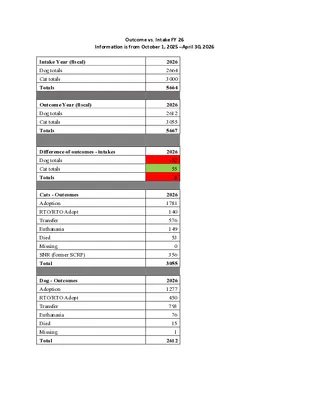

REGULAR MEETING OF THE ANIMAL ADVISORY COMMISSION MONDAY, MAY 11, 2026, AT 6:00 P.M. AUSTIN CITY HALL, ROOM 1101 301 WEST 2ND STREET AUSTIN, TEXAS Some members of the Animal Advisory Commission may be participating by videoconference. The meeting may be viewed online at: http://www.austintexas.gov/page/watch-atxn-live Public comment will be allowed in-person or remotely via telephone. Speakers may only register to speak on an item once either in-person or remotely and will be allowed up to three minutes to provide their comments. Registration no later than noon the day before the meeting is required for remote participation by telephone. To register to speak remotely, contact Nekaybaw Watson at nekaybaw.watson@austintexas.gov or 512-974-2562. CURRENT COMMISSIONERS: Dr. Paige Nilson, Chair, D4 Jo Anne Norton, Vice Chair, D7 Jennifer Daniel, Parliamentarian, D6 Koby Ahmed, Mayor Beatriz Dulzaides, D2 Erin Ferguson, D8 Whitney Holt, D5 Sarah Huddelston, D9 David Loignon, D10 Nancy Nemer, Travis County Jules Maron, D3 Erin Van Landingham, D1 CALL TO ORDER PUBLIC COMMUNICATION: GENERAL AGENDA The first 10 speakers signed up prior to the meeting being called to order will each be allowed a three- minute allotment to address their concerns regarding items not posted on the agenda. APPROVAL OF MINUTES 1. Approve the minutes of the Animal Advisory Commission Regular meeting on April 13, 2026. STAFF BRIEFINGS 2. 3. Staff briefing regarding monthly reports. Presentation by Monica Dangler, Director, Austin Animal Services and Jason Garza, Assistant Director, Austin Animal Services. Staff briefing regarding Austin Animal Service’s Strategic Plan One Year Update. Presentation by Monica Dangler, Director, Austin Animal Services. WORKING GROUP UPDATES 4. Update from Pet Friendly Housing Working Group regarding future recommendations. DICUSSION AND ACTION ITEMS 5. 6. 7. 8. 9. 10. 11. 12. Approve the election of Chair. Approve the creation of a working group regarding policies related to off-leash dogs and the addition of members. Approve the creation of a Working group that creates incentives for city and county employees who foster an animal for Ausin Animal Shelter and the addition of members. Approve a Recommendation to Council regarding breed labeling policies in shelters. Approve a Recommendation to Council regarding Satellite Adoption. Approve an update to the membership of the Pet Friendly Housing Working Group. Approve an amendment to the Rules and Procedures regarding the order of public comment. Approve the appointment of a chair and committee members OR the dissolution of the No Kill subcommittee. FUTURE AGENDA …

ANIMAL ADVISORY COMMISSION REGULAR MEETING MINUTES APRIL 13, 2026 The Animal Advisory Commission convened in a regular meeting on Monday, April 13, 2026, at Austin City Hall, Boards and Commissions Room 301 W 2nd Street in Austin, Texas. Chair Nilson called the Animal Advisory Commission Meeting to order at 6:00 pm. Commissioners in Attendance: Dr. Paige Nilson, Chair, D4 Jennifer Daniel, D6 Beatriz Dulzaides, D2 Whitney Holt, D5 David Loignon, D10 Jules Maron, D3 Jo Anne Norton, Parliamentarian, D7 Commissioners in Attendance Remotely: Erin Ferguson, D8 Nancy Nemer, Travis County Erin Van Landingham, D1 Commissioners Absent: Koby Ahmed, Mayor Ryan Clinton, Travis County Sarah Huddleston, D9 PUBLIC COMMUNICATION: GENERAL Rochelle Vickery – Requesting assistance for TNR volunteers via gas cards or gift cards to incentivize and reduce cost for volunteers Shelly Leibham – Dog overpopulation Julie Oliver – Data inconsistencies Lynette Cox – TNR process for community cats 1 Pat Valls-Trelles - Requesting assistance for TNR volunteers via gas cards or gift cards to incentivize and reduce cost for volunteers APPROVAL OF MINUTES 1. Approve the minutes of the Animal Advisory Commission Regular Meeting on February 9, 2026. The minutes of March 9, 2026, regular meeting of the Animal Advisory Commission was approved during April 13, 2026, regular meeting on Commissioner Holt’s motion, Commissioner Dulzaides’ second on a 10-0 vote. Commissioners Ahmed, Clinton, and Huddleston were absent. STAFF BRIEFINGS 2. 3. Staff briefing regarding monthly reports. Presentation by Monica Dangler, Director, Austin Animal Services and Jason Garza, Assistant Director, Austin Animal Services. Presentation given by Monica Dangler, Director, Austin Animal Services and Jason Garza, Assistant Director, Austin Animal Services. Staff briefing regarding deceased animal recovery services. Presentation by Amy Slagle, Assistant Director, Austin Resource Recovery. Presentation given by Amy Slagle, Assistant Director, Austin Resource Recovery. DISCUSSION ITEMS 4. Quarterly report from Animal Pets Alive! Presentation given by Mara Hartsell, Quality of Care Director, Austin Pets Alive! Presentation given by Mara Hartsell, Quality of Care Director, Austin Pets Alive! DISCUSSION AND ACTION ITEMS 5. 6. 7. Approve the reprioritization of the legislative priority list sent to the Austin Government Relations Office in February. Discussed. Approve a Recommendation to Council regarding pet friendly housing policies in public funded housing developments. The motion to approve a Recommendation to Council regarding pet friendly housing policies in public funded housing developments was approved on Commissioner Dulzaides’ motion, Commissioner Daniel’s second on a 10-0 vote. Commissioners …

RECOMMENDATION TO COUNCIL ANIMAL ADVISORY COMMISSION 20260511-009 EXPANDING ACCESS TO PET ADOPTION THROUGH SATELLITE ADOPTION CENTERS WHEREAS, the City of Austin is committed to promoting animal welfare, supporting no-kill practices at Austin Animal Center, and achieving open intake; and WHEREAS, the Austin Animal Services Strategic Plan published in 2025 cites “Research, analyze, and explore additional locations to offer ASO services throughout the community (i.e., new satellite locations, secondary locations)” as Humane Care Goal 2C as well as “Expand ASO’s community presence, including increasing participation in local events, hosting new activities, and building partnerships” as Live Release Goal 3C; and WHEREAS, overcrowding in our shelter strains our resources, greatly hinders intake capacity, and creates barriers to timely adoption; and WHEREAS, increasing the visibility and accessibility of adoptable pets has been shown to significantly improve adoption rates and community engagement; and WHEREAS, the City of Austin owns and operates various public facilities and properties that may be suitable for temporary or permanent use as satellite adoption centers; and WHEREAS, Travis County contracts the City of Austin as part of their Animal Services Interlocal Agreement and also owns and operates various public facilities and properties that may be suitable for temporary or permanent use as satellite adoption centers; and WHEREAS, partnerships with local nonprofit organizations, as well as private businesses and community groups, could provide additional locations, volunteer staffing, and resources for off-site adoption efforts; and WHEREAS, establishing satellite adoption centers in high-traffic, community-centered locations throughout Austin and Travis County would reduce barriers to adoption, increase foot traffic exposure for animals, and enhance community participation in animal welfare initiatives; SO BE IT RESOLVED, that City staff across the appropriate departments shall research, and when appropriate, pilot satellite adoption center locations in Austin and Travis County; and SO BE IT FURTHER RESOLVED, that Austin City Council shall offer full support in finding ways to reimagine the utilization of City owned or rented facilities so as to minimize the cost burden on residents and the Austin Animal Services Department in pursuit of these goals; and SO BE IT FURTHER RESOLVED, that Travis County Commissioners Court shall take equal ownership and innovative steps in re-imagining the utilization of County owned and rented facilities in pursuit of these goals. Date of Approval: Motioned by: Seconded by: Vote: For: Against: Abstain: Recuse: Off Dais: Absent: Attest:

Reports and Updates Austin Animal Services | May 11, 2026 30-60-90 Day Horizon Plan Monica Dangler, Director Accomplishments on the Horizon! Completed action items in the past 30 days Clear the Crates! We sent out (adoptive, foster, or transfer) 103 animals in late April/early May with 60 being cats and 41 dogs, of which 29 were large breed adults! That is 29 more animals than last month during the same period which included 17 more large breed adult dogs! Process Improvement Continued work on pathways and transfer protocols Added extra day of surgery for animals who need extra support Programs and Socials Implemented Doggie Day Out Graduation for inaugural Enduring Service program dogs Improvements to shelter presence Added event calendar to the website Enhance Staffing Including VS positions in citywide market study to improve recruitment and retention 3 What does the horizon plan look like for May? 30 Community Engagement • Implement Marketing plan Enhance Staffing • Relaunch kennel cleaning study with adjusted Animal Care schedules • Continue recruiting for one lead and two technicians for Vet Services Process Improvement • Finalize dates for Maddie’s Fund Clinic Consultation for efficiency and S/N • Develop communication strategy for kennel space protocol on Socials • Procure Doobert a foster management tool • Procure Petzel a pet adoption follow up tool 4 What does the horizon plan look like for May? 30 Foster Program • Weekly foster posts • Identify 3 dogs for foster every day • Daily foster emails • Launch Dog Day Out to 4-5 days a week • Develop accountability plan Develop plan for reopening intake • Ongoing process • Work with APA on community-based solutions Social Presence • Update social messaging • Implement plan for socials 5 60 What does the horizon plan look like for May and June? Foster Program • Weekly foster posts • Identify 5 dogs for foster every day • Daily foster emails • Implement foster management tools • Offer Dog Day Out program 5 days a week Shelter and Process Improvements • Develop communication strategy for kennel space protocol on Socials • Implement Doobert foster management tool • Implement post-adoption tool Social Presence • Update engagement efforts • Implement Newsletter Develop plan for reopening intake • Reduce wait-time for intake 6 What does the horizon plan look like for May, June, and July? 90 Open Intake Planning • Open intake for all stray animals …

Recommendation to Council Animal Advisory Commission Recommendation 20260511-008 Regarding Breed Labeling Practices WHEREAS, accurate identification of a dog’s breed based solely on visual assessment has been widely shown to be unreliable without genetic testing even among animal welfare professionals and veterinary staff; and WHEREAS, labeling dogs as specific breeds—particularly “pit bull” or “pit bull mix”—based on appearance alone can misrepresent their true genetic makeup; and WHEREAS, many housing providers enforce breed restrictions that disproportionately impact dogs labeled as “pit bull” types, creating significant barriers for adopters seeking rental housing; and WHEREAS, such labeling practices can unintentionally reduce adoption rates and increase length of stay for affected dogs; and WHEREAS, a growing number of animal welfare organizations are adopting best practices that prioritize temperament, and individual characteristics over speculative breed identification including: 1. Orange County Animal Services (OCAS), an open intake municipal shelter in Florida, stopped using breed labels in 2014, and an independent peer-reviewed study of OCAS’s outcomes data found that removing breed labels improved adoption rates and decreased lengths of stay for all dog types, with the greatest impact for pit-bull-type dogs (https://www.ocnetpets.com/); 2. Williamson County Animal Services, an open intake municipal shelter in Texas, stopped using breed labels in 2017; most dogs are currently listed on their website as “mixed breed” (https://www.wilcotx.gov/163/Animal-Shelter); 3. Memphis Animal Services, an open intake municipal shelter in Tennessee, stopped using breed labels in 2016; dogs are currently listed on their website as “mixed breed” (https://memphisanimalservices.com/); 4. DeKalb County Animal Services and Fulton County Animal Services, two open intake municipal shelters in Georgia managed by LifeLine Animal Project, stopped using breed labels in 2017 (https://dekalbanimalservices.com/; https://fultonanimalservices.com/); 5. Fairfax County Animal Shelter, an open intake municipal shelter in Virginia, stopped using breed labels in 2015; dogs are currently listed on their website as “mixed breed” (https://www.fairfaxcounty.gov/animalservices/); 6. Rochester Animal Services, a managed intake municipal shelter in New York, stopped using breed labels in 2017; dogs are currently listed on their website as “mixed breed” (https://www.cityofrochester.gov/departments/department-recreation-and-human-serv ices-drhs/rochester-animal-services-ras); and WHEREAS, studies show that shifting to a “mixed breed” designation where lineage is unknown and distinct and undeniable breed traits are absent promotes fairness, reduces bias, and improves adoption outcomes for all dogs; and WHEREAS, the previous interim Director for Austin Animal Services had started the process of updating breed labeling practices to align with these goals; NOW, THEREFORE, BE IT RESOLVED, that the Austin Animal Advisory Commission …
Resolution Regarding Breed Labeling Practices WHEREAS, accurate identification of a dog’s breed based solely on visual assessment has been widely shown to be unreliable without genetic testing even among animal welfare professionals and veterinary staff; and WHEREAS, labeling dogs as specific breeds—particularly “pit bull” or “pit bull mix”—based on appearance alone can misrepresent their true genetic makeup; and WHEREAS, many housing providers enforce breed restrictions that disproportionately impact dogs labeled as “pit bull” types, creating significant barriers for adopters seeking rental housing; and WHEREAS, such labeling practices can unintentionally reduce adoption rates and increase length of stay for affected dogs; and WHEREAS, a growing number of animal welfare organizations are adopting best practices that prioritize temperament, and individual characteristics over speculative breed identification including: 1. Orange County Animal Services (OCAS), an open intake municipal shelter in Florida, stopped using breed labels in 2014, and an independent peer-reviewed study of OCAS’s outcomes data found that removing breed labels improved adoption rates and decreased lengths of stay for all dog types, with the greatest impact for pit-bull-type dogs (https://www.ocnetpets.com/); 2. Williamson County Animal Services, an open intake municipal shelter in Texas, stopped using breed labels in 2017; most dogs are currently listed on their website as “mixed breed” (https://www.wilcotx.gov/163/Animal-Shelter); 3. Memphis Animal Services, an open intake municipal shelter in Tennessee, stopped using breed labels in 2016; dogs are currently listed on their website as “mixed breed” (https://memphisanimalservices.com/); 4. DeKalb County Animal Services and Fulton County Animal Services, two open intake municipal shelters in Georgia managed by LifeLine Animal Project, stopped using breed labels in 2017 (https://dekalbanimalservices.com/; https://fultonanimalservices.com/); 5. Fairfax County Animal Shelter, an open intake municipal shelter in Virginia, stopped using breed labels in 2015; dogs are currently listed on their website as “mixed breed” (https://www.fairfaxcounty.gov/animalservices/); 6. Rochester Animal Services, a managed intake municipal shelter in New York, stopped using breed labels in 2017; dogs are currently listed on their website as “mixed breed” (https://www.cityofrochester.gov/departments/department-recreation-and-human-serv ices-drhs/rochester-animal-services-ras); and WHEREAS, studies show that shifting to a “mixed breed” designation where lineage is unknown and distinct and undeniable breed traits are absent promotes fairness, reduces bias, and improves adoption outcomes for all dogs; and WHEREAS, the previous interim Director for Austin Animal Services had started the process of updating breed labeling practices to align with these goals; NOW, THEREFORE, BE IT RESOLVED, that the Austin Animal Advisory Commission respectfully recommends City Council and the City …
A RESOLUTION OF THE AUSTIN CITY COUNCIL EXPANDING ACCESS TO PET ADOPTION THROUGH SATELLITE ADOPTION CENTERS WHEREAS, the City of Austin is committed to promoting animal welfare, supporting no-kill practices at Austin Animal Center, and achieving open intake; and WHEREAS, the Austin Animal Services Strategic Plan published in 2025 cites “Research, analyze, and explore additional locations to offer ASO services throughout the community (i.e., new satellite locations, secondary locations)” as Humane Care Goal 2C as well as “Expand ASO’s community presence, including increasing participation in local events, hosting new activities, and building partnerships” as Live Release Goal 3C; and WHEREAS, overcrowding in our shelter strains our resources, greatly hinders intake capacity, and creates barriers to timely adoption; and WHEREAS, increasing the visibility and accessibility of adoptable pets has been shown to significantly improve adoption rates and community engagement; and WHEREAS, the City of Austin owns and operates various public facilities and properties that may be suitable for temporary or permanent use as satellite adoption centers; and WHEREAS, Travis County contracts the City of Austin as part of their Animal Services Interlocal Agreement and also owns and operates various public facilities and properties that may be suitable for temporary or permanent use as satellite adoption centers; and WHEREAS, partnerships with local nonprofit organizations, as well as private businesses and community groups, could provide additional locations, volunteer staffing, and resources for off-site adoption efforts; and WHEREAS, establishing satellite adoption centers in high-traffic, community-centered locations throughout Austin and Travis County would reduce barriers to adoption, increase foot traffic exposure for animals, and enhance community participation in animal welfare initiatives; SO BE IT RESOLVED, that City Council and the City Manager request City staff across the appropriate departments research, and when appropriate, pilot satellite adoption center locations in Austin and Travis County; and SO BE IT FURTHER RESOLVED, that Austin City Council shall offer full support in finding ways to reimagine the utilization of City owned or rented facilities so as to minimize the cost burden on residents and the Austin Animal Services Department in pursuit of these goals; and SO BE IT FURTHER RESOLVED, that Travis County Commissioners Court shall take equal ownership and innovative steps in reimagining the utilization of County owned and rented facilities in pursuit of these goals.
. RECOMMENDATION TO COUNCIL Animal Advisory Commission Recommendation Number: 20260511-009: Expanding Access to Pet Adoption Through Satellite Adoption Centers WHEREAS, the City of Austin is committed to promoting animal welfare, supporting no-kill practices at Austin Animal Center, and achieving open intake; and WHEREAS, the Austin Animal Services Strategic Plan published in 2025 cites “Research, analyze, and explore additional locations to offer ASO services throughout the community (i.e., new satellite locations, secondary locations)” as Humane Care Goal 2C as well as “Expand ASO’s community presence, including increasing participation in local events, hosting new activities, and building partnerships” as Live Release Goal 3C; and WHEREAS, overcrowding in our shelter strains our resources, greatly hinders intake capacity, and creates barriers to timely adoption; and WHEREAS, increasing the visibility and accessibility of adoptable pets has been shown to significantly improve adoption rates and community engagement; and WHEREAS, the City of Austin owns and operates various public facilities and properties that may be suitable for temporary or permanent use as satellite adoption centers; and WHEREAS, Travis County contracts the City of Austin as part of their Animal Services Interlocal Agreement and also owns and operates various public facilities and properties that may be suitable for temporary or permanent use as satellite adoption centers; and WHEREAS, partnerships with local nonprofit organizations, as well as private businesses and community groups, could provide additional locations, volunteer staffing, and resources for off- site adoption efforts; and WHEREAS, establishing satellite adoption centers in high-traffic, community-centered locations throughout Austin and Travis County would reduce barriers to adoption, increase foot traffic exposure for animals, and enhance community participation in animal welfare initiatives; SO BE IT RESOLVED, that City Council and the City Manager request City staff across the appropriate departments research, and when appropriate, pilot satellite adoption center locations in Austin and Travis County; and SO BE IT FURTHER RESOLVED, that Austin City Council shall offer full support in finding ways to reimagine the utilization of City owned or rented facilities so as to minimize the cost burden on residents and the Austin Animal Services Department in pursuit of these goals; and . SO BE IT FURTHER RESOLVED, that Travis County Commissioners Court shall take equal ownership and innovative steps in reimagining the utilization of County owned and rented facilities in pursuit of these goals. Date of Approval: May 11, 2026 Motioned By: Commissioner Holt Seconded By: Vice Chair Norton Vote: 11-0 …
Austin Animal Services 5-Year Strategic Plan One Year Update Presented May 11, 2026 Agenda Introduction & Background Strategic Plan Summary Priorities & Progress Highlights Summary & Next Steps Questions? What’s the purpose of the new Strategic Plan? The plan is a roadmap for future initiatives and decisions. It guides resource allocation, performance targets, and future collaboration with stakeholders. How was it developed? The strategic plan was developed over an 8-month period with input from diverse stakeholders, including staff, volunteers, partners, and the community. The Working Group used feedback/information gathered from stakeholders, along with their own expertise in animal welfare, to develop the strategic plan during a series of workshops facilitated by an external consultant. How’s it going? Well! Since March 2025, many initiatives have begun to meet the priorities and goals established by the plan. 3 The strategic plan established six priorities: Humane Care Open Intake Public Health and Safety Spay Neuter Live Release Staff and Volunteers Each has goals and strategies to help achieve the priority. In total, there are eighteen (18) goals and sixty-four (64) strategies. 4 4Goals 11Strategies Humane Care “Meet animals’ physical and emotional needs and ensure a high quality of life for animals in shelter and foster care by providing enrichment, behavioral support, and well-maintained facilities.” INCREASE ENRICHMENT, SOCIALIZATION, AND BEHAVIORAL SERVICES • Expanded dog play group activities • Implemented population rounds • Added Outcomes Consultant role OFFER TRAINING AND EDUCATIONAL OPPORTUNITIES IN ANIMAL BEHAVIOR • Provided animal handling training for staff and volunteers 5 4Goals 11Strategies Humane Care “Meet animals’ physical and emotional needs and ensure a high quality of life for animals in shelter and foster care by providing enrichment, behavioral support, and well-maintained facilities.” Continued ENHANCE SHELTER CLEANLINESS AND SANITATION • Revised the Cleaning and Disinfecting Standard Operating Procedure (SOP) • Implemented inspections following SOP implementation IMPROVE CAMPUS FACILITIES AND PHYSICAL SPACES • Facilities enhancement was included in the proposed bond that is pending voter approval • Secured a third-party architect to develop construction plans for a small dog kennel with dedicated outdoor space 6 2 Goals 5 Strategies Spay Neuter “Reduce the number of stray, unowned, and unwanted animals by improving and increasing spay/neuter services.” INCREASE FREE & SUBSIDIZED SPAY/NEUTER SURGERIES FOR OWNED ANIMALS • Increased free spay/neuter surgeries by 34.9% from FY2024 to FY2025 • 11,112 owned animals were spayed through clinics provided by contracted vendors in fiscal year 2025 …

ANIMAL ADVISORY COMMISSION REGULAR MEETING MINUTES MAY 11, 2026 The Animal Advisory Commission convened in a regular meeting on Monday, May 11, 2026, at Austin City Hall, Boards and Commissions Room 301 W 2nd Street in Austin, Texas. Vice Chair Norton called the Animal Advisory Commission Meeting to order at 6:00 pm. Commissioners in Attendance: Jo Anne Norton, Vice Chair, D7 Jennifer Daniel, Parliamentarian, D6 Beatriz Dulzaides, D2 Erin Ferguson, D8 Whitney Holt, D5 David Loignon, D10 Jules Maron, D3 Erin Van Landingham, D1 Commissioners in Attendance Remotely: Koby Ahmed, Mayor Sarah Huddleston, D9 Nancy Nemer, Travis County Commissioners Absent: Dr. Paige Nilson, Chair, D4 PUBLIC COMMUNICATION: GENERAL Robyn Katz – State of Animals in Texas Sandra Muller – Transparency in Reporting Pat Valls Trelles – Donations Fund Rochelle Vickery – No food to people who have no record of spay or neuter 1 APPROVAL OF MINUTES 1. Approve the minutes of the Animal Advisory Commission Regular Meeting on April 13, 2026. The minutes of the April 13, 2026 regular meeting of the Animal Advisory Commission was approved during the May 11, 2026 regular meeting of the Animal Advisory Commission on Commissioner Holt’s motion, Commissioner Ferguson’s second on an 11-0 vote. Chair Nilson was absent. STAFF BRIEFINGS 2. 3. Staff briefing regarding monthly reports. Presentation by Monica Dangler, Director, Austin Animal Services and Jason Garza, Assistant Director, Austin Animal Services. Presentation given by Monica Dangler, Director, Austin Animal Services and Jason Garza, Assistant Director, Austin Animal Services. Staff briefing regarding Austin Animal Service’s Strategic Plan One Year Update. Presentation by Monica Dangler, Director, Austin Animal Services. Presentation given by Monica Dangler, Director, Austin Animal Services; Jason Garza, Assistant Director, Austin Animal Services; and Melissa Pool, Chief Administrative Officer, Austin Animal Services. WORKING GROUP UPDATES 4. Update from Pet Friendly Housing Working Group regarding future recommendations. Update provided by Commissioner Holt. DISCUSSION AND ACTION ITEMS 5. 6. 7. Approve the election of Chair. The motion to approve Commissioner Nilson as Chair of the Animal Advisory Commission failed on Vice Chair Norton’s motion, Commissioner Holt’s second on a 6-2 vote. Vice Chair Norton, Parliamentarian Daniel, and Commissioners Ferguson, Holt, Huddleston, and Maron were for. Commissioners Ahmed and Nemer were against. Commissioners Dulzaides, Loignon, and Van Landingham abstained. Chair Nilson was absent. Approve the creation of a working group regarding policies related to off-leash dogs and the addition of members. The motion to …