Austin Climate Equity Plan “Environmental Investment Plan” Update August 29, 2024 1 Timeline of Events February 2024 - Resolution Directing staff to create the Environmental Investment Plan March - May - Staff creates 70 project proposals April - JSC Passes 33 EIP recommendations May 24 - Sub-quorum releases letter stating their priority projects May 28 - Presentation to Council Work Session on the Staff Response May 30 - “Public Hearing” on the EIP July 18 - Item 93 - IFC Directing the Creation of a Comprehensive Climate Implementation Program Aug 14 - Item 24 - Budget IFC Directing the Creation of a Land Acquisition Fund 2 Environmental Investment Plan - Resolution 20240215-025 Reaffirm commitment to net-zero by 2040 Prepare capital improvements or programs that would: 1. Reduce carbon emissions 2. Decrease water usage and improve water quality and detention 3. Advance the sustainability of City Operations 4. Improve Community Resilience Review funding sources: ● Utility rates and fees ● General Fund Expenditures ● Grants ● General Obligation Bonds Joint Sustainability Committee (JSC) public hearing and submit recommendations to Council 3 May 24 - Letter to City Manager from Fuentes, Alter, Alter, Ellis, Velasquez We have identified key priorities in the attached table that are far enough in their development to be considered for action this year, including a focused 2024 General Obligation Bond package. While some items within the comprehensive list will require additional development for the 2026 bond package... We are not proposing that every item attached ultimately be in a bond, but by focusing our efforts now, we will be in a better position to make a final decision on what items simply cannot wait for the future and need our attention now. A number of identified proposals are within the purview of our utilities, which can fund these programs through rates. Lastly, we would like to focus on a few priority general fund supported programs also identified below. However, given the limited general fund dollars currently available, we intend to explore how and to what magnitude the proposed climate fee could fund these priorities. 4 Resolution 20240718-093 The City Manager is directed to schedule and conduct public briefings as needed to be presented to Council to provide information regarding the City's current bonded indebtedness and bond ratings for the purpose of planning future bond proposals. The City Manager is directed to bring to Council two items: 1) …
JOINT SUSTAINABILITY COMMITTEE REGULAR MEETING MEETING MINUTES August 28, 2024 The Joint Sustainability Committee convened in a hybrid meeting via videoconferencing and at City Hall – Council Chambers. Board Members in Attendance in Person: Heather Houser, Kaiba White, Rodrigo Leal, Haris Qureshi, Natalie Poindexter, Charlotte Davis Board Members in Attendance Remotely: Jon Salinas, Anna Scott, Melissa Rothrock, Chris Campbell, Diana Wheeler, Yure Suarez, Amy Noel Board Members Absent: Larry Franklin, Alberta Philipps, Chris Maxwell-Gaines, Lane Becker City Staff in Attendance: Zach Baumer Braden Latham-Jones CALL TO ORDER Chair Kaiba White called the meeting to order at 6:10pm. PUBLIC COMMUNICATION: GENERAL N/A 1. Approval of minutes from the July 8th special called meeting of the Joint Sustainability Committee. Qureshi motion, Houser second, passes 12-0 with Suarez off dais. 1. Sustainable Purchasing Update – Amanda Mortl, Office of Sustainability a. Scott – When will we see the first purchase from this work? i. Mortl – Landscaping example, have a list of upcoming contracts and are monitoring when they expire/up for renewal, looking ahead to mid-2025 as the next opportunity. Current contracts have updated preference language. b. White – Can you share preference language? i. Mortl – Can do so, yes. c. White – Can you speak to the upcoming concrete contract opportunities? i. Mortl – Can direct you to that plan. d. White – No progress to changes to that plan? i. Mortl – Not able to speak to that fully, but that’s the latest that I’m aware of. e. Yure – Those first few slides, those are based on spending model? i. Mortl – Industry-wide averages f. White – Any other product areas you’ll be moving on to next? i. Mortl – These two pilots are based on Council priorities, are currently doing those. 2. Updates from Environmental Investment Plan effort and City Budget; JSC next steps. a. White – What will quarterly briefings look like? i. Baumer – Still in the process of creating that, I expect that we’ll present on the Environmental Investment Plan as the first quarterly briefing b. Qureshi – Since the resolution directs City Manager to update Council on Climate Bond and Environmental Investment Plan. Is there a timeline for that? i. Baumer – We’ll be playing a role because we’re coordinating the comprehensive Climate Equity Plan implementation. My hope is that we have multiple departments participating in these briefings moving forward. c. Poindexter – With …
JOINT SUSTAINABILITY COMMITTEE HYBRID MEETING FORMAT SPECIAL CALED MEETING July 8th, 2024 at 7 pm Shudde Fath Conference Room, Austin Energy Headquarters 4815 Mueller Blvd, Austin, TX 78723 Some members of the Committee may be participating by videoconference Public comment will be allowed in-person or remotely via telephone. Speakers may only register to speak on an item once either in-person or remotely and will be allowed up to three minutes to provide their comments. Registration no later than noon the day before the meeting is required for remote participation by telephone. To register to speak remotely, email or call Rohan Lilauwala at (Rohan.lilauwala@austintexas.gov or 512-974-9394). CURRENT BOARD MEMBERS: Home Commission Electric Utility Commission Resource Management Commission Urban Transportation Commission Environmental Commission Zero Waste Advisory Commission Community Development Commission Austin Travis County Food Policy Board Economic Prosperity Commission Water & Wastewater Commission Parks & Recreation Board Design Commission Planning Commission Austin/Travis County Public Health Commission City Council Mayor’s Representative Mayor’s Representative Mayor’s Representative Mayor’s Representative Mayor’s Representative Alternate Randall Chapman Member Kaiba White (Chair) Charlotte Davis (Vice-Chair) Genell Gary Diana Wheeler Haris Qureshi Melissa Rothrock Vacant Larry Franklin Amy Noel Chris Maxwell-Gaines Stephanie Bazan Jon Salinas Vacant Vacant Vacant Richard Brimer Craig Nazor Miriam Garcia Vacant Luis Osta Lugo Vacant Lane Becker Ben Luckens Alberta Phillips Vacant Vacant Rodrigo Leal Anna Scott Yure Suarez Christopher Campbell Heather Houser Vacant For more information, please visit: www.austintexas.gov/jsc AGENDA CALL TO ORDER PUBLIC COMMUNICATION: GENERAL The first 10 speakers signed up prior to the meeting being called to order will each be allowed a three-minute allotment to address their concerns regarding items not posted on the agenda. APPROVAL OF MINUTES 1. Approval of minutes from the June 26, 2024 meeting of the Joint Sustainability Committee. DISCUSSION AND ACTION ITEMS 2. Recommendation of investments the City should fund as part of council resolution 20240215-025 ‘Environmental Investment Plan’. 3. Recommendation in support of a ‘Climate Fee’ as outlined in the staff response to council resolution 20240215-025 ‘Environmental Investment Plan’. FUTURE AGENDA ITEMS ADJOURNMENT The City of Austin is committed to compliance with the American with Disabilities Act. Reasonable modifications and equal access to communications will be provided upon request. Meeting locations are planned with wheelchair access. If requiring Sign Language Interpreters or alternative formats, please give notice at least 2 days (48 hours) before the meeting date. Please contact Rohan Lilauwala at rohan.lilauwala@austintexas.gov or 512-974-9394 for …
JOINT SUSTAINABILITY COMMITTEE REGULAR MEETING MEETING MINUTES June 26, 2024 The Joint Sustainability Committee convened in a hybrid meeting via videoconferencing and the Permitting and Development Center. Board Members in Attendance in Person: Charlotte Davis, Haris Qureshi, Jon Salinas, Chris Maxwell-Gaines Board Members in Attendance Remotely: Heather Houser, Anna Scott, Alice Woods, Rodrigo Leal, Diana Wheeler, Yure Suarez Board Members Absent: City Staff in Attendance: Rohan Lilauwala and Zach Baumer CALL TO ORDER Vice-Chair Charlotte Davis called the meeting to order at 6:16 pm. PUBLIC COMMUNICATION • Kathy Mitchell – On behalf Community Investment Budget. Includes support for Climate Equity Plan + Food Plan. Looking for JSC endorsement before August. 1. Approval of minutes from the May 22nd meeting of the Joint Sustainability Committee. • Davis correction – on item 2, reflect that no action was taken. • Maxwell-Gaines motions to approve, Qureshi second, passes 10-0. 2. Recommendation of investments the City should fund as part of council resolution 20240215-025 ‘Environmental Investment Plan’. • Item struck from agenda 4. Update on regional climate planning efforts as part of the EPA’s Climate Pollution Reduction Grant Program – Mali Calvo, Office of Sustainability • Qureshi - will we be doing county-specific workshops? Do we have ideas on how o We’re doing outreach to different municipal/county governments. • How are we pursuing funding for four measures not applied for a grant? o We’re opportunistic, looking for funding where available. Supporting EPA Community change grant for trees + AE Solar for all. 5. Climate Fee Best Practices – Rohan Lilauwala, Office of Sustainability • Qureshi – in support of progressive rather than regressive taxation • Salinas – what is the large retailer fee in Portland? o 1% surcharge on companies with more than $1 billion in annual revenue and more than $500,000 in revenue in Portland • Leal - Is Legal department looking into more comprehensive fee approaches? o Unclear at the moment • Woods – are these on utility bills? o Yes • Scott – could projects with revenue/savings be compatible with a climate fee? o Yes, but there could be other revenue streams (green bank, revolving funds) that those projects could fund • Maxwell-Gaines – could hotel tax fund this? Or other tourist taxes fund this? o Potential pushback from hospitality industry • Salinas – is there revenue from micromobility? Could energy/water rates be tiered further? o Fee could be put on …
Joint Sustainability Committee Resolution 20240708-02: Supporting the Environmental Investment Plan WHEREAS, the purpose of the Joint Sustainability Committee is “to advise the council on matters related to conservation and sustainability; and review City policies and procedures relevant to the Austin Community Climate Plan and the Austin Climate Equity Plan, including planning, implementation, community engagement, goal setting, and progress monitoring”; and WHEREAS, it is the duty of the Joint Sustainability Committee to “promote close cooperation between the council, City management, City boards, commissions, committees, and taskforces, and individuals, institutions, and agencies concerned with the politics, procedures, and implementation of the Austin Community Climate Plan and the Austin Climate Equity Plan with the goal of coordinating all similar activities within the City and the community in order to secure the greatest public benefit”; and WHEREAS, the Joint Sustainability Committee has had working groups for the past two and a half years that have gathered information from city staff, the Austin community and experts and advocates in other cities to identify funding needs to implement the Austin Climate Equity Plan; and WHEREAS, the Joint Sustainability Committee solicited and received public input on what needs funding through the Environmental Investment Plan to meet existing environmental goals through a written form, at a public hearing on March 27, 2024, and at the April 30, 2024 Joint Sustainability Committee meeting; and WHEREAS, the public comments received by the Joint Sustainability Committee on the Environmental Investment Plan emphasized the need for action, including more funding to meet a variety of environmental and climate goals established by the City of Austin; and WHEREAS, on August 8, 2019, the Council unanimously approved Resolution No. 20190808- 078 declaring a climate emergency in the City and calling to accelerate the timeline for achieving the City's climate goals; and WHEREAS, the climate crisis continues to worse each year and the window of opportunity to preserve a livable climate is rapidly closing due climate tipping points are likely already being reached; and WHEREAS, it is a scientific fact that greenhouse gas emissions reductions made sooner will yield climate benefits sooner and are therefore more valuable in avoiding tipping points that could make preserving a livable climate impossible; and WHEREAS, land acquisition, increasing the use of solar energy and battery storage, and tree planting are strategies that are adopted within multiple City of Austin plans (including the Climate Equity Plan, Water Forward, Austin/Travis County …
Joint Sustainability Committee Resolution 20240708-03: Resolution on Climate Fee WHEREAS, it is the Joint Sustainability Committee’s responsibility to advise “on matters related to conservation and sustainability and review City policies and procedures relevant to the Austin Community Climate Plan and the Austin Climate Equity Plan, including planning, implementation, community engagement, goal setting, and progress monitoring”, and WHEREAS, the greenhouse gas emissions reduction goal established by the Austin City Council in the Climate Equity Plan is to achieve “net-zero community-wide greenhouse gas emissions by 2040, utilizing a steep decline path followed by negative emissions” that translates to approximately 75% reduction in emissions by 2030; and WHEREAS the Joint Sustainability Committee identified over $2.24 billion in one time costs and $96.14 million in ongoing expenses for implementing the Austin Climate Equity Plan and associated city plans; and WHEREAS increasing pressures on the city budget and utility rates will make funding the identified sustainability needs very difficult without a new source of revenue; and WHEREAS other cities have implemented dedicated fees to fund sustainability needs; and WHEREAS the City of Austin already utilizes dedicated fees to fund certain sustainability needs, including at Austin Energy, Austin Water and Austin Resource Recovery; and WHEREAS funding from existing fees is insufficient in magnitude to fund all existing needs and existing fees can only be used to fund certain programs; NOW THEREFORE BE IT RESOLVED that the Joint Sustainability Committee recommends that the Austin City Council and the City Manager actively pursue establishing a new Green Fee to help fill the funding gap for implementing the Austin Climate Equity Plan and associated city plans, including: ● Austin Energy Resource, Generation and Climate Protection Plan ● Austin Strategic Mobility Plan ● Austin Resource Recovery Master Plan ● Water Forward ● Watershed Protection Strategic Plan ● Austin/Travis County Food Plan ● One Austin: Climate Resilience Action Plan ● Central Texas Regional Air Quality Plan ● Urban Forest Plan This new fee should be structured to be progressive, not regressive, should provide predictable revenue and should be paid by residents, businesses, corporations and/or visitors.
Joint Sustainability Committee Resolution 20240708-02: Supporting the Environmental Investment Plan WHEREAS, the purpose of the Joint Sustainability Committee is “to advise the council on matters related to conservation and sustainability; and review City policies and procedures relevant to the Austin Community Climate Plan and the Austin Climate Equity Plan, including planning, implementation, community engagement, goal setting, and progress monitoring”; and WHEREAS, it is the duty of the Joint Sustainability Committee to “promote close cooperation between the council, City management, City boards, commissions, committees, and taskforces, and individuals, institutions, and agencies concerned with the politics, procedures, and implementation of the Austin Community Climate Plan and the Austin Climate Equity Plan with the goal of coordinating all similar activities within the City and the community in order to secure the greatest public benefit”; and WHEREAS, the Joint Sustainability Committee has had working groups for the past two and a half years that have gathered information from city staff, the Austin community and experts and advocates in other cities to identify funding needs to implement the Austin Climate Equity Plan; and WHEREAS, the Joint Sustainability Committee solicited and received public input on what needs funding through the Environmental Investment Plan to meet existing environmental goals through a written form, at a public hearing on March 27, 2024, and at the April 30, 2024 Joint Sustainability Committee meeting; and WHEREAS, the public comments received by the Joint Sustainability Committee on the Environmental Investment Plan emphasized the need for action, including more funding to meet a variety of environmental and climate goals established by the City of Austin; and WHEREAS, on August 8, 2019, the Council unanimously approved Resolution No. 20190808- 078 declaring a climate emergency in the City and calling to accelerate the timeline for achieving the City's climate goals; and WHEREAS, the climate crisis continues to worsen each year and the window of opportunity to preserve a livable climate is rapidly closing due to climate tipping points are likely already being reached; and WHEREAS, it is a scientific fact that greenhouse gas emissions reductions made sooner will yield climate benefits sooner and are therefore more valuable in avoiding tipping points that could make preserving a livable climate impossible; and WHEREAS, land acquisition, increasing the use of solar energy and battery storage, and tree planting are strategies that are adopted within multiple City of Austin plans (including the Climate Equity Plan, Water Forward, Austin/Travis …
Joint Sustainability Committee Resolution 20240708-03: Resolution on Climate Fee WHEREAS, it is the Joint Sustainability Committee’s responsibility to advise “on matters related to conservation and sustainability and review City policies and procedures relevant to the Austin Community Climate Plan and the Austin Climate Equity Plan, including planning, implementation, community engagement, goal setting, and progress monitoring”, and WHEREAS, the greenhouse gas emissions reduction goal established by the Austin City Council in the Climate Equity Plan is to achieve “net-zero community-wide greenhouse gas emissions by 2040, utilizing a steep decline path followed by negative emissions” that translates to approximately 75% reduction in emissions by 2030; and WHEREAS the Joint Sustainability Committee identified over $2.24 billion in one time costs and $96.14 million in ongoing expenses for implementing the Austin Climate Equity Plan and associated city plans; and WHEREAS increasing pressures on the city budget and utility rates will make funding the identified sustainability needs very difficult without a new source of revenue; and WHEREAS other cities have implemented dedicated fees to fund sustainability needs; and WHEREAS the City of Austin already utilizes dedicated fees to fund certain sustainability needs, including at Austin Energy, Austin Water and Austin Resource Recovery; and WHEREAS funding from existing fees is insufficient in magnitude to fund all existing needs and existing fees can only be used to fund certain programs; NOW THEREFORE BE IT RESOLVED that the Joint Sustainability Committee recommends that the Austin City Council and the City Manager actively pursue establishing a new Green Fee to help fill the funding gap for implementing the Austin Climate Equity Plan and associated city plans, including: ● Austin Energy Resource, Generation and Climate Protection Plan ● Austin Strategic Mobility Plan ● Austin Resource Recovery Master Plan ● Water Forward ● Watershed Protection Strategic Plan ● Austin/Travis County Food Plan ● One Austin: Climate Resilience Action Plan ● Central Texas Regional Air Quality Plan ● Urban Forest Plan This new fee should be structured to be equitable and responsive to Austin’s wealth gaps and the fee should provide predictable revenue. A legal analysis of options that could be paid by residents, businesses, corporations and/or visitors should be conducted and presented to the City Council for consideration as soon as possible. Motion: Anna Scott Second: Alberta Phillips Vote: 11-0 Yes: Diana Wheeler, Lane Becker, Kaiba White, Heather Houser, Jon Salinas, Alberta Philipps, Anna Scott, Rodrigo Leal, Melissa Rothrock, Chris Campbell, …
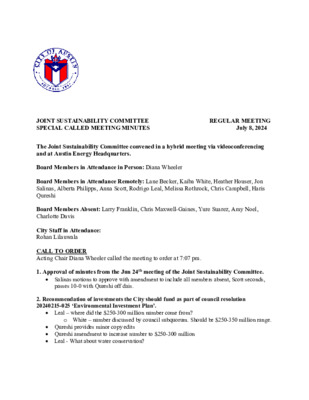
JOINT SUSTAINABILITY COMMITTEE REGULAR MEETING SPECIAL CALLED MEETING MINUTES July 8, 2024 The Joint Sustainability Committee convened in a hybrid meeting via videoconferencing and at Austin Energy Headquarters. Board Members in Attendance in Person: Diana Wheeler Board Members in Attendance Remotely: Lane Becker, Kaiba White, Heather Houser, Jon Salinas, Alberta Philipps, Anna Scott, Rodrigo Leal, Melissa Rothrock, Chris Campbell, Haris Qureshi Board Members Absent: Larry Franklin, Chris Maxwell-Gaines, Yure Suarez, Amy Noel, Charlotte Davis City Staff in Attendance: Rohan Lilauwala CALL TO ORDER Acting Chair Diana Wheeler called the meeting to order at 7:07 pm. 1. Approval of minutes from the Jun 24th meeting of the Joint Sustainability Committee. • Salinas motions to approve with amendment to include all members absent, Scott seconds, passes 10-0 with Qureshi off dais. 2. Recommendation of investments the City should fund as part of council resolution 20240215-025 ‘Environmental Investment Plan’. • Leal – where did the $250-300 million number come from? o White – number discussed by council subquorum. Should be $250-350 million range. • Qureshi provides minor copy edits • Qureshi amendment to increase number to $250-300 million • Leal - What about water conservation? o White – city-owned solar can offset Austin Water’s energy costs to allow for reinvestments into water conservation. Conserving land improves source water quality. • Scott motions to approve as amended, Campbell seconds, passes 11-0. 3. Recommendation in support of a ‘Climate Fee’ as outlined in the staff response to council resolution 20240215-025 ‘Environmental Investment Plan’. • Discussion of progressive vs regressive nature of tax. Intention to steer options to reduce impact on low-income earners. • White amends last paragraph to “This new fee should be structured to be equitable and responsive to Austin’s wealth gaps and the fee should provide predictable revenue. A legal analysis of options that could be paid by residents, businesses, corporations and/or visitors should be conducted and presented to the City Council for consideration as soon as possible.” • Scott motions to approve as amended, Phillips seconds, passes 11-0. Meeting adjourned at 7:43 pm. ADJOURNMENT The City of Austin is committed to compliance with the American with Disabilities Act. Reasonable modifications and equal access to communications will be provided upon request. Meeting locations are planned with wheelchair access. If requiring Sign Language Interpreters or alternative formats, please give notice at least 2 days (48 hours) before the meeting date. Please call Zach Baumer …
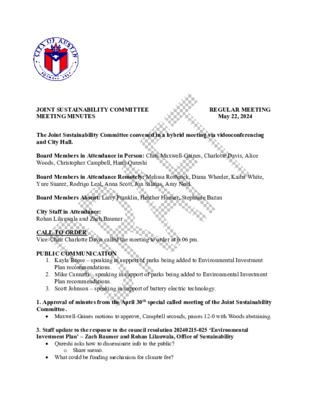
JOINT SUSTAINABILITY COMMITTEE REGULAR MEETING MEETING MINUTES May 22, 2024 The Joint Sustainability Committee convened in a hybrid meeting via videoconferencing and City Hall. Board Members in Attendance in Person: Chris Maxwell-Gaines, Charlotte Davis, Alice Woods, Christopher Campbell, Haris Qureshi Board Members in Attendance Remotely: Melissa Rothrock, Diana Wheeler, Kaiba White, Yure Suarez, Rodrigo Leal, Anna Scott, Jon Salinas, Amy Noel Board Members Absent: Larry Franklin, Heather Houser, Stephanie Bazan City Staff in Attendance: Rohan Lilauwala and Zach Baumer CALL TO ORDER Vice-Chair Charlotte Davis called the meeting to order at 6:06 pm. PUBLIC COMMUNICATION 1. Kayla Reese – speaking in support of parks being added to Environmental Investment 2. Mike Cannatti – speaking in support of parks being added to Environmental Investment Plan recommendations. Plan recommendations. 3. Scott Johnson – speaking in support of battery electric technology. 1. Approval of minutes from the April 30th special called meeting of the Joint Sustainability Committee. • Maxwell-Gaines motions to approve, Campbell seconds, passes 12-0 with Woods abstaining. 3. Staff update to the response to the council resolution 20240215-025 ‘Environmental Investment Plan’ – Zach Baumer and Rohan Lilauwala, Office of Sustainability • Qureshi asks how to disseminate info to the public? o Share memo. • What could be funding mechanism for climate fee? o Need council support to even have direction, then come up with options • White: Questioning Decker infrastructure as setting stage for new thermal generation • Leal: Question around why “other” category o A gap now, but TPW will seek funding in the future. • Campbell: Is there going to be discussion around priorities? o Next steps from council • Noel: What did we learn? o Hard to compare projects that meet different goals. i.e. water vs carbon o Most funding comes down in silos. In this case – we did things a different way. E.g. land acquisition, city facilities; would require departmental collaborations + thinking beyond budget cycles. • White: Where is ARR fleet electrification. Should take advantage of if funding is available. o Charging network needed first, not enough time to assess fleet cost. • Davis: Estimates – did they line up with JSC? o Not really. Very rough estimates. More work needed to be refined. 2. Recommendation in support of staff response to council resolution 20240215-025 ‘Environmental Investment Plan’. • No 4. Update from the Electric Utility Commission on the Austin Energy Resource Planning Process – …
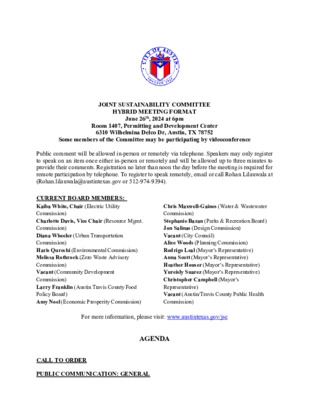
JOINT SUSTAINABILITY COMMITTEE HYBRID MEETING FORMAT June 26th, 2024 at 6pm Room 1407, Permitting and Development Center 6310 Wilhelmina Delco Dr, Austin, TX 78752 Some members of the Committee may be participating by videoconference Public comment will be allowed in-person or remotely via telephone. Speakers may only register to speak on an item once either in-person or remotely and will be allowed up to three minutes to provide their comments. Registration no later than noon the day before the meeting is required for remote participation by telephone. To register to speak remotely, email or call Rohan Lilauwala at (Rohan.lilauwala@austintexas.gov or 512-974-9394). CURRENT BOARD MEMBERS: Kaiba White, Chair (Electric Utility Commission) Charlotte Davis, Vice Chair (Resource Mgmt. Commission) Diana Wheeler (Urban Transportation Commission) Haris Qureshi (Environmental Commission) Melissa Rothrock (Zero Waste Advisory Commission) Vacant (Community Development Commission) Larry Franklin (Austin Travis County Food Policy Board) Amy Noel (Economic Prosperity Commission) Chris Maxwell-Gaines (Water & Wastewater Commission) Stephanie Bazan (Parks & Recreation Board) Jon Salinas (Design Commission) Vacant (City Council) Alice Woods (Planning Commission) Rodrigo Leal (Mayor’s Representative) Anna Scott (Mayor’s Representative) Heather Houser (Mayor’s Representative) Yureisly Suarez (Mayor’s Representative) Christopher Campbell (Mayor’s Representative) Vacant (Austin/Travis County Public Health Commission) For more information, please visit: www.austintexas.gov/jsc AGENDA CALL TO ORDER PUBLIC COMMUNICATION: GENERAL The first 10 speakers signed up prior to the meeting being called to order will each be allowed a three-minute allotment to address their concerns regarding items not posted on the agenda. APPROVAL OF MINUTES 1. Approval of minutes from the May 22, 2024 meeting of the Joint Sustainability Committee. DISCUSSION AND ACTION ITEMS 2. Recommendation of investments the City should fund as part of council resolution 20240215-025 ‘Environmental Investment Plan’. 3. Recommendation in support of a ‘Climate Fee’ as outlined in the staff response to council resolution 20240215-025 ‘Environmental Investment Plan’. DISCUSSION 4. Update on regional climate planning efforts as part of the EPA’s Climate Pollution Reduction Grant Program – Mali Calvo and Rohan Lilauwala, Office of Sustainability 5. Climate Fee Best Practices and Case Studies – Rohan Lilauwala, Office of Sustainability 6. Joint Sustainability Committee Annual Report – Kaiba White 7. Update from the Resource Management Commission on amendments to bylaws to include advising Council on natural gas utility matters – Charlotte Davis FUTURE AGENDA ITEMS ADJOURNMENT The City of Austin is committed to compliance with the American with Disabilities Act. Reasonable modifications and equal access to …
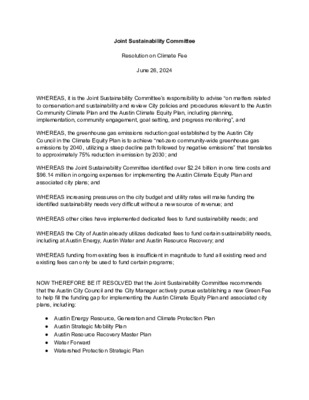
Joint Sustainability Committee Resolution on Climate Fee June 26, 2024 WHEREAS, it is the Joint Sustainability Committee’s responsibility to advise “on matters related to conservation and sustainability and review City policies and procedures relevant to the Austin Community Climate Plan and the Austin Climate Equity Plan, including planning, implementation, community engagement, goal setting, and progress monitoring”, and WHEREAS, the greenhouse gas emissions reduction goal established by the Austin City Council in the Climate Equity Plan is to achieve “net-zero community-wide greenhouse gas emissions by 2040, utilizing a steep decline path followed by negative emissions” that translates to approximately 75% reduction in emission by 2030; and WHEREAS the Joint Sustainability Committee identified over $2.24 billion in one time costs and $96.14 million in ongoing expenses for implementing the Austin Climate Equity Plan and associated city plans; and WHEREAS increasing pressures on the city budget and utility rates will make funding the identified sustainability needs very difficult without a new source of revenue; and WHEREAS other cities have implemented dedicated fees to fund sustainability needs; and WHEREAS the City of Austin already utilizes dedicated fees to fund certain sustainability needs, including at Austin Energy, Austin Water and Austin Resource Recovery; and WHEREAS funding from existing fees is insufficient in magnitude to fund all existing need and existing fees can only be used to fund certain programs; NOW THEREFORE BE IT RESOLVED that the Joint Sustainability Committee recommends that the Austin City Council and the City Manager actively pursue establishing a new Green Fee to help fill the funding gap for implementing the Austin Climate Equity Plan and associated city plans, including: ● Austin Energy Resource, Generation and Climate Protection Plan ● Austin Strategic Mobility Plan ● Austin Resource Recovery Master Plan ● Water Forward ● Watershed Protection Strategic Plan ● Austin/Travis County Food Plan ● One Austin: Climate Resilience Action Plan ● Central Texas Regional Air Quality Plan ● Urban Forest Plan This new fee should be structured to provide predictable revenue and should be paid by both residents and businesses.
Climate Pollution Reduction Grant Joint Sustainability Committee Austin-Round Rock-Georgetown MSA June 26, 2024 Agenda Program Information Priority Climate Action Plan ● Emissions Inventory ● Implementation Grant Comprehensive Climate Action Plan ● Process ● Timeline ● How to Get Involved Climate Pollution Reduction Grant ● Funding across the US for regional and state climate planning our region’s efforts ● City of Austin Office of Sustainability leading ● Several deliverables due over four years ● Planning covers the 5 county region: Travis, Williamson, Hays, Bastrop, Caldwell 3 Climate Pollution Reduction Grant March 2024 ● Deliverable 1: Priority Climate Action Plan ○ Completed March 1, a quick sprint ○ Focused list of near-term, high-priority, implementation-ready measures to reduce GHGs August 2025 Priority Climate Action Plan ● Submitted Mar 1 ● Regional GHG inventory ● GHG reduction measures ○ GHG analysis ○ Benefit/co-pollutant analysis ○ LIDAC benefits analysis ○ Workforce analysis ○ Funding analysis ○ Review of authority 2022 GHG Emissions in the Region Comprehensive methodology, results are representative of real emissions in the region Relatively low compared to others in Texas and even nationally ● Houston-Galveston - 31.5 MT CO2e ● Dallas-Fort Worth - 12.9 MT CO2e ● San Francisco Bay Area - 10.9 MT CO2e 2022 GHG Emissions in the Region GHG Emissions by County Legend Per Capita Emissions Greenhouse Gas Reduction Measures ● Key part of deliverable - identification of near-term, implementation-ready greenhouse gas reduction measures + analyses on each ● Input from staff in the region every two weeks ● Workshop, staff intake form, public survey ● Input from Community and Stakeholder Advisory group (30+ members) monthly Project Ideas Scoped Projects Community & Stakeholder Input Analysis ‘Long List’ of Measures GHG Reduction Impact Regional Scope LIDAC benefits Quick to Implement Not covered by other govts In PCAP Implementation Grant Application Advance to ‘Short List’ Priority GHG Reduction Measures Emission Reduction (MT CO2e) 2025-2030 2031-2050 TRANSPOR- TATION BUILDINGS AND ENERGY WATER AND LAND Implement Transportation Demand Management programs 860,806 725,426 Encourage and subsidize Renewable Diesel fuel (R99) availability 705,137 1,127,532 Install community solar and battery storage 50,357 132,429 Implement holistic building-wide upgrades to municipal buildings 27,214 47,236 Implement water conservation programs 34,224 99,379 Implement community-driven tree planting and forest restoration program 41,068 115,854 Cumulative Emissions Avoided by GHG Reduction Measure CPRG Implementation Grants Transportation Demand Management ● COA Transportation and Public Works + TxDOT, CapMetro, CARTS ● $47.85 million ● Mobility …
Climate Fee Joint Sustainability Committee Rohan Lilauwala, Climate Project Manager Office of Sustainability June 26, 2024 1 What are we really trying to achieve? ● Austin is a leader in climate action, one of only four major US Cities with the most aggressive climate goal (net-zero by 2040), and one only five that centers equity. ● Community members, organizations, activists, stakeholders, and City Council are pushing to make progress on climate and environmental goals. ● Creating and passing plans (like the Austin Climate Equity Plan) with no budget and funding plan sets us up for failure. ● Council Resolution No. 20240215-025 forced us to have a conversation around what projects should be priorities and how could pay for them. 2 What are we really trying to achieve? Status Quo: Identify Projects, then Find Money ● Too many projects, hard to prioritize, hard to categorize ● Maybe we find money, maybe we don’t ● No matter how much money is found, stakeholders are unhappy because everything won’t be funded and the process is unclear 3 What are we really trying to achieve? Status Quo: Identify Projects, then Find Money Climate Fee: Have Money, then Identify and Spend on Projects ● Too many projects, hard to prioritize, hard to categorize ● Maybe we find money, maybe we don’t ● No matter how much money is found, stakeholders are unhappy because everything won’t be funded and the process is unclear ● We have a set $ amount to spend and that’s clear to everyone ● Generate project ideas, analyze them, ● prioritize and fit into the budget allowed Some don’t get what they want, but stakeholders feel heard, spending and process is transparent 4 Portland Clean Energy Fund ● Funded by a 1% gross receipts tax on large retailers, approved by voters in 2018 with 65% in support, with support of community-based organizations. ● Portland Clean Energy Fund supports clean energy projects and job training, rooted in climate and environmental justice. ● Guided by the PCEF committee,charged with evaluating the effectiveness of the program in achieving the goals laid out in the Climate Investment Plan. 5 Portland Clean Energy Fund ● Expects to raise $750 million by 2028, spending plan passed in 2023, and features: ○ Planting 25,000 trees in heat-vulnerable neighborhoods to increase tree canopy. ○ Adding energy-efficient and renewable energy technologies in new and redeveloped affordable multifamily housing. ○ Making schools …
Annual Internal Review This report covers the time period of 7/1/2023 to 6/30/2024 __________Joint Sustainability Committee_____________ (Official Name of Board or Commission) The Board/Commission mission statement (per the City Code) is: 1. Describe the board’s actions supporting their mission during the previous calendar year. Address all elements of the board’s mission statement as provided in the relevant sections of the City Code. The JSC passed the following recommendations over the last year: - July 26, 2023 o 20230726-7 Recommendation of Proposal to Preserve the Independence of the Offices of Sustainability, Resilience, Equity, and Civil Rights o 20230823-6 Recommendation on Multifamily Composting Ordinance o 20230927-010 Recommendation for accelerating implementation of the Austin - August 23, 2023 - September 27, 2023 Climate Equity Plan - December 13, 2023 - January 24, 2024 o 20231213-007 Recommendation for support of Austin Energy Resource Planning o 20240124-002 Recommendations on amendments to the Ausitn Climate Equity Plan on telework and disposal rate goals - February 28, 2024 o 20240228-013 Recommendation on supporting Pro-Climate Food Choices in the Austin Food Plan o Approved amendment to bylaws to add a member from the Austin Travis County Public Health Commission to the Joint Sustainability Committee. o 20240228-015 Recommendation for Support of the goals of the Great Streets Initiative that contribute to the Green Infrastructure Resolution. o 20240228-017 Recommendation for Environmental Impact Study for Parking in Austin - March 27, 2024 - April 30, 2024 o 20240228-014 Recommendations for City of Austin FY25 Budget o 20240327-006 Recommendations on the FY 24-25 Budget o 20240430-002 Recommendation for Environmental Investment Plan Funding 2. Determine if the board’s actions throughout the year comply with the mission statement. (If any of the board’s actions were outside the scope of the mission statement, the report should explain the non-compliance issues.) All of the Joint Sustainability Committees actions complied with its mission statement. 3. List the board’s goals and objectives for the new calendar year. (Make sure the goals and objectives fall within the mission statement of the board/commission.) 1. Oversee and contribute to the implementation of the Austin Climate Equity Plan by working with all city departments, city management and the Austin City Council to evaluate and expand efforts to reduce emissions within City operations and in the community 2. Monitor and advise on effective communication of progress to implement the Austin Climate Equity Plan via the Dashboard, with an emphasis on increasing the level …
JOINT SUSTAINABILITY COMMITTEE REGULAR MEETING MEETING MINUTES June 26, 2024 The Joint Sustainability Committee convened in a hybrid meeting via videoconferencing and the Permitting and Development Center. Board Members in Attendance in Person: Charlotte Davis, Haris Qureshi, Jon Salinas, Chris Maxwell-Gaines Board Members in Attendance Remotely: Heather Houser, Anna Scott, Alice Woods, Rodrigo Leal, Diana Wheeler, Yure Suarez Board Members Absent: Larry Franklin, Amy Noel, Christopher Campbell, Kaiba White, Melissa Rothrock, Stephanie Bazan City Staff in Attendance: Rohan Lilauwala and Zach Baumer CALL TO ORDER Vice-Chair Charlotte Davis called the meeting to order at 6:16 pm. PUBLIC COMMUNICATION • Kathy Mitchell – On behalf Community Investment Budget. Includes support for Climate Equity Plan + Food Plan. Looking for JSC endorsement before August. 1. Approval of minutes from the May 22nd meeting of the Joint Sustainability Committee. • Davis correction – on item 2, reflect that no action was taken. • Maxwell-Gaines motions to approve, Qureshi second, passes 10-0. 2. Recommendation of investments the City should fund as part of council resolution 20240215-025 ‘Environmental Investment Plan’. • Item struck from agenda 4. Update on regional climate planning efforts as part of the EPA’s Climate Pollution Reduction Grant Program – Mali Calvo, Office of Sustainability • Qureshi - will we be doing county-specific workshops? Do we have ideas on how o We’re doing outreach to different municipal/county governments. • How are we pursuing funding for four measures not applied for a grant? o We’re opportunistic, looking for funding where available. Supporting EPA Community change grant for trees + AE Solar for all. 5. Climate Fee Best Practices – Rohan Lilauwala, Office of Sustainability • Qureshi – in support of progressive rather than regressive taxation • Salinas – what is the large retailer fee in Portland? o 1% surcharge on companies with more than $1 billion in annual revenue and more than $500,000 in revenue in Portland • Leal - Is Legal department looking into more comprehensive fee approaches? o Unclear at the moment • Woods – are these on utility bills? o Yes • Scott – could projects with revenue/savings be compatible with a climate fee? o Yes, but there could be other revenue streams (green bank, revolving funds) that those projects could fund • Maxwell-Gaines – could hotel tax fund this? Or other tourist taxes fund this? o Potential pushback from hospitality industry • Salinas – is there revenue from micromobility? …
JOINT SUSTAINABILITY COMMITTEE HYBRID MEETING FORMAT May 22nd, 2024 at 6pm Council Chambers, Austin City Hall 301 W 2nd St, Austin, TX 78701 Some members of the Committee may be participating by videoconference Public comment will be allowed in-person or remotely via telephone. Speakers may only register to speak on an item once either in-person or remotely and will be allowed up to three minutes to provide their comments. Registration no later than noon the day before the meeting is required for remote participation by telephone. To register to speak remotely, call or email Rohan Lilauwala at (Rohan.lilauwala@austintexas.gov or 512-974-9394). CURRENT BOARD MEMBERS: Kaiba White, Chair (Electric Utility Commission) Diana Wheeler, Vice Chair (Urban Transportation Commission) Charlotte Davis (Resource Mgmt. Commission) Haris Qureshi (Environmental Commission) Melissa Rothrock (Zero Waste Advisory Commission) Bertha Delgado (Community Development Commission) Larry Franklin (Austin Travis County Food Policy Board) Chris Maxwell-Gaines (Water & Wastewater Commission) Amy Noel (Economic Prosperity Commission) Stephanie Bazan (Parks & Recreation Board) Jon Salinas (Design Commission) Vacant (City Council) Alice Woods (Planning Commission) Rodrigo Leal (Mayor’s Representative) Anna Scott (Mayor’s Representative) Heather Houser (Mayor’s Representative) Yureisly Suarez (Mayor’s Representative) Christopher Campbell (Mayor’s Representative) For more information, please visit: www.austintexas.gov/jsc AGENDA CALL TO ORDER PUBLIC COMMUNICATION: GENERAL The first 10 speakers signed up prior to the meeting being called to order will each be allowed a three-minute allotment to address their concerns regarding items not posted on the agenda. APPROVAL OF MINUTES 1. Approval of minutes from the April 30, 2024 special called meeting of the Joint Sustainability Committee. DISCUSSION AND ACTION ITEMS 2. Recommendation in support of staff response to council resolution 20240215-025 ‘Environmental Investment Plan’. DISCUSSION 3. Staff update to the response to the council resolution 20240215-025 ‘Environmental Investment Plan’ – Rohan Lilauwala, Office of Sustainability 4. Update from the Electric Utility Commission on the Austin Energy Resource Planning Process – Kaiba White timelines – Jon Salinas 5. Update from the Design Commission on the status of updated design guidelines and 6. Update from the Water and Wastewater Commission on the Walnut Creek Wastewater Treatment Plant Expansion contracts – Chris Maxwell-Gaines 7. Update from Planning Commission on recent Land Development Code changes including HOME and ETOD – Alice Woods FUTURE AGENDA ITEMS ADJOURNMENT The City of Austin is committed to compliance with the American with Disabilities Act. Reasonable modifications and equal access to communications will be provided upon request. Meeting …
JOINT SUSTAINABILITY COMMITTEE REGULAR MEETING MEETING MINUTES April 30, 2024 The Joint Sustainability Committee convened in a hybrid meeting via videoconferencing and City Hall. Chair Kaiba White called the Board Meeting to order at 6:06 pm. Board Members in Attendance in Person: Chris Maxwell-Gaines, Haris Qureshi, Kaiba White, Anna Scott Board Members in Attendance Remotely: Diana Wheeler, Jon Salinas, Melissa Rothrock, Charlotte Davis, Lane Becker, Heather Houser, Rodrigo Leal, Yure Suarez, Chris Campbell, Amy Noel Board Members Absent: Bertha Delgado, Alice Woods, Larry Franklin City Staff in Attendance: Rohan Lilauwala CALL TO ORDER Chair Kaiba White called the meeting to order at 6:06 pm. PUBLIC COMMUNICATION 1. Craig Nazor – speaking in support of LIDAR for tree inventory and support for native 2. Zenobia Joseph – speaking in favor of improved transit and shelters near low-income 1. Approval of minutes from the April 24th meeting of the Joint Sustainability Committee. Qureshi motions to approve, Maxwell-Gaines seconds, passes on 13-0 vote (Noel off nurseries communities dais) 2. Joint Sustainability Committee discussion and approval of recommendations for the Environmental Investment Plan, in the areas of Buildings and Energy, Transportation, Natural Systems, and Consumption. Discussion of details of individual recommendations at length Commissioners suggest including social cost of carbon (and air pollutants, if possible) amount for Fayette closure Tweaks suggested to sustainable buildings recommendation #10 Tweaks to ACCC recommendation – change language to purchasing a truck Suggested $400,000 budget for Sustainable Buildings Recommendation 10 Public comment - Zenobia Joseph – Speaks in favor of improved fixed-route transit, better survey methods, equity Scott motions to approve all recommendations minus five pulled items ; Qureshi second 1. Pro-climate, pro health foods 2. Downtown High-Frequency Circulator 3. Neighborhood E-Circulators 4. Establish a city-owned all-electric carshare service 5. E-mobility solutions pilot program Passes 13-0 (Suarez off dais) White motions to approve Pro-climate, pro health recommendation, Qureshi seconds, passes 12-0 (Davis recuses, Suarez off dais) Davis motions to approve neighborhood e-circulators as amended, Noel seconds, passes 13-0 Davis motions to approve downtown high frequency circulator, Qureshi seconds, passes 13-0 (Suarez off dais). (Suarez off dais). Campbell motions carshare service to approve, Becker seconds, passes 13-0 (Suarez off Leal motions to approve e-mobility solutions pilot program, Qureshi seconds, passes 10-2 (White abstains, Davis and Houser no) dais). TBD FUTURE AGENDA ITEMS White adjourns meeting …
M E M O R A N D U M TO: Mayor and Council Members THROUGH: Susana Carbajal, Chief of Staff FROM: Zach Baumer, Chief Sustainability Officer DATE: May 21, 2024 SUBJECT: Response to Environmental Investment Plan (Resolution No. 20240215-025) On February 15, 2024, the Austin City Council passed Resolution No. 20240215-025, directing the City Manager to “solicit community input and prepare options and associated costs of capital improvements or programs that would reduce carbon emissions, decrease water usage, improve water quality and water detention, advance the sustainability of City operations, and improve community resilience.” The resolution also called for a public hearing of the Joint Sustainability Committee to gather public input and recommendations. Over the past three months, staff from the Office of Sustainability convened numerous City departments and facilitated meetings and discussions across the organization on this response. Staff began by analyzing 13 existing City of Austin plans across multiple departments to catalog all the goals and strategies within each plan. Department representatives reviewed their plans and goals to identify gaps and potential new projects. The Office of Sustainability then convened the departments to discuss their findings and facilitated workshops to consolidate and refine all department proposals. Summary Attachment A includes the full list of potential new projects and investments and is summarized below. The list is a result of cross-departmental collaboration, deepening connections and alignment across City-wide work areas, and offers a snapshot of major initiatives that would fill gaps and advance areas in climate sustainability and community resilience. A comprehensive cost-benefit analysis of these potential environmental investments in comparison with other City priorities has not yet been completed and is necessary. Staff has also not yet evaluated the long-term approach to addressing funding gaps and implementation. The potential new projects have been categorized into 4 topic areas Page 1 of 4 summarized below. Items marked “JSC” indicate alignment with Joint Sustainability Committee recommendations. Carbon Emissions Potential projects would reduce emissions from energy and transportation and reduce waste. Total summarized needs: $455 million Project Department ARR Transfer Station + EV Charging Network CE12 CE13 CE14 Recycling and Reuse Drop Off Facility (could be combined with Transfer Station) Weatherization and EV Charging Programs for Low and Moderate-income Customers Facilities to Process Compost, Reuse Materials, and Recycle Construction Debris CE6 CE10 CE15 CE16 CE17 CE7 Matching Funds for Federal Clean Energy/Resiliency Grants ARR ARR AE ARR Transportation Demand Management …
JOINT SUSTAINABILITY COMMITTEE REGULAR MEETING MEETING MINUTES May 22, 2024 The Joint Sustainability Committee convened in a hybrid meeting via videoconferencing and City Hall. Board Members in Attendance in Person: Chris Maxwell-Gaines, Charlotte Davis, Alice Woods, Christopher Campbell, Haris Qureshi Board Members in Attendance Remotely: Melissa Rothrock, Diana Wheeler, Kaiba White, Yure Suarez, Rodrigo Leal, Anna Scott, Jon Salinas, Amy Noel Board Members Absent: Larry Franklin, Heather Houser, Stephanie Bazan City Staff in Attendance: Rohan Lilauwala and Zach Baumer CALL TO ORDER Vice-Chair Charlotte Davis called the meeting to order at 6:06 pm. PUBLIC COMMUNICATION 1. Kayla Reese – speaking in support of parks being added to Environmental Investment 2. Mike Cannatti – speaking in support of parks being added to Environmental Investment Plan recommendations. Plan recommendations. 3. Scott Johnson – speaking in support of battery electric technology. 1. Approval of minutes from the April 30th special called meeting of the Joint Sustainability Committee. • Maxwell-Gaines motions to approve, Campbell seconds, passes 12-0 with Woods abstaining. 3. Staff update to the response to the council resolution 20240215-025 ‘Environmental Investment Plan’ – Zach Baumer and Rohan Lilauwala, Office of Sustainability • Qureshi asks how to disseminate info to the public? o Share memo. • What could be funding mechanism for climate fee? o Need council support to even have direction, then come up with options • White: Questioning Decker infrastructure as setting stage for new thermal generation • Leal: Question around why “other” category o A gap now, but TPW will seek funding in the future. • Campbell: Is there going to be discussion around priorities? o Next steps from council • Noel: What did we learn? o Hard to compare projects that meet different goals. i.e. water vs carbon o Most funding comes down in silos. In this case – we did things a different way. E.g. land acquisition, city facilities; would require departmental collaborations + thinking beyond budget cycles. • White: Where is ARR fleet electrification. Should take advantage of if funding is available. o Charging network needed first, not enough time to assess fleet cost. • Davis: Estimates – did they line up with JSC? o Not really. Very rough estimates. More work needed to be refined. 2. Recommendation in support of staff response to council resolution 20240215-025 ‘Environmental Investment Plan’. • No action was taken. 4. Update from the Electric Utility Commission on the Austin Energy Resource …
JOINT SUSTAINABILITY COMMITTEE HYBRID MEETING FORMAT April 30th, 2024 at 6pm Boards and Commissions Room, Austin City Hall 301 W 2nd St, Austin TX 78702 Some members of the Committee may be participating by videoconference Public comment will be allowed in-person or remotely via telephone. Speakers may only register to speak on an item once either in-person or remotely and will be allowed up to three minutes to provide their comments. Registration no later than noon the day before the meeting is required for remote participation by telephone. To register to speak remotely, call or email Rohan Lilauwala at (rohan.lilauwala@austintexas.gov or 512-974-9394). CURRENT BOARD MEMBERS: Kaiba White, Chair (Electric Utility Commission) Diana Wheeler, Vice Chair (Urban Transportation Commission) Charlotte Davis (Resource Mgmt. Commission) Haris Qureshi (Environmental Commission) Melissa Rothrock (Zero Waste Advisory Commission) Bertha Delgado (Community Development Commission) Larry Franklin (Austin Travis County Food Policy Board) Chris Maxwell-Gaines (Water & Wastewater Commission) Amy Noel (Economic Prosperity Commission) Stephanie Bazan (Parks & Recreation Board) Jon Salinas (Design Commission) Vacant (City Council) Alice Woods (Planning Commission) Rodrigo Leal (Mayor’s Representative) Anna Scott (Mayor’s Representative) Heather Houser (Mayor’s Representative) Yureisly Suarez (Mayor’s Representative) Christopher Campbell (Mayor’s Representative) For more information, please visit: www.austintexas.gov/jsc AGENDA CALL TO ORDER PUBLIC COMMUNICATION: GENERAL The first 10 speakers signed up prior to the meeting being called to order will each be allowed a three-minute allotment to address their concerns regarding items not posted on the agenda. APPROVAL OF MINUTES 1. Approval of minutes from the April 24th, 2024 meeting of the Joint Sustainability Committee. DISCUSSION AND ACTION ITEMS 2. Joint Sustainability Committee discussion and approval of recommendations for the Environmental Investment Plan, in the areas of Buildings and Energy, Transportation, Natural Systems, and Consumption. FUTURE AGENDA ITEMS ADJOURNMENT The City of Austin is committed to compliance with the American with Disabilities Act. Reasonable modifications and equal access to communications will be provided upon request. Meeting locations are planned with wheelchair access. If requiring Sign Language Interpreters or alternative formats, please give notice at least 2 days (48 hours) before the meeting date. Please contact Rohan Lilauwala at rohan.lilauwala@austintexas.gov or 512-974-9394 for additional information; TTY users’ route through Relay Texas at 711. For more information on the Joint Sustainability Committee, please call or email Rohan Lilauwala at rohan.lilauwala@austintexas.gov or 512-974-9394.
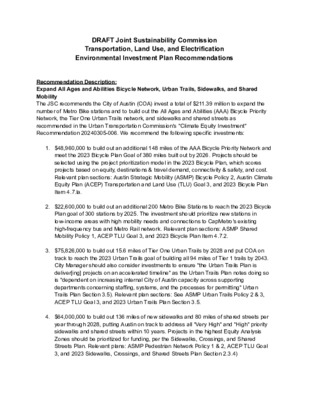
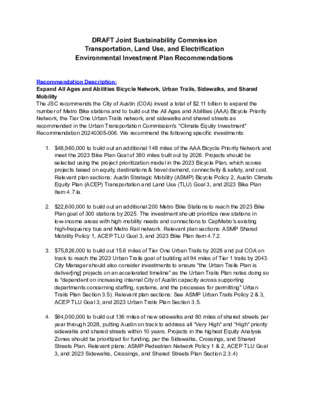
DRAFT Joint Sustainability Commission Transportation, Land Use, and Electrification Environmental Investment Plan Recommendations Recommendation Description: Expand All Ages and Abilities Bicycle Network, Urban Trails, Sidewalks, and Shared Mobility The JSC recommends the City of Austin (COA) invest a total of $211.39 million to expand the number of Metro Bike stations and to build out the All Ages and Abilities (AAA) Bicycle Priority Network, the Tier One Urban Trails network, and sidewalks and shared streets as recommended in the Urban Transportation Commission's "Climate Equity Investment" Recommendation 20240305-006. We recommend the following specific investments: 1. $48,960,000 to build out an additional 148 miles of the AAA Bicycle Priority Network and meet the 2023 Bicycle Plan Goal of 380 miles built out by 2026. Projects should be selected using the project prioritization model in the 2023 Bicycle Plan, which scores projects based on equity, destinations & travel demand, connectivity & safety, and cost. Relevant plan sections: Austin Strategic Mobility (ASMP) Bicycle Policy 2, Austin Climate Equity Plan (ACEP) Transportation and Land Use (TLU) Goal 3, and 2023 Bicycle Plan Item 4.7.la. 2. $22,600,000 to build out an additional 200 Metro Bike Stations to reach the 2023 Bicycle Plan goal of 300 stations by 2025. The investment should prioritize new stations in low-income areas with high mobility needs and connections to CapMetro's existing high-frequency bus and Metro Rail network. Relevant plan sections: ASMP Shared Mobility Policy 1, ACEP TLU Goal 3, and 2023 Bicycle Plan Item 4.7.2. 3. $75,826,000 to build out 15.6 miles of Tier One Urban Trails by 2028 and put COA on track to reach the 2023 Urban Trails goal of building all 94 miles of Tier 1 trails by 2043. City Manager should also consider investments to ensure "the Urban Trails Plan is deliver[ing] projects on an accelerated timeline" as the Urban Trails Plan notes doing so is "dependent on increasing internal City of Austin capacity across supporting departments concerning staffing, systems, and the processes for permitting" Urban Trails Plan Section 3.5). Relevant plan sections: See ASMP Urban Trails Policy 2 & 3, ACEP TLU Goal 3, and 2023 Urban Trails Plan Section 3.5. 4. $64,000,000 to build out 136 miles of new sidewalks and 80 miles of shared streets per year through 2028, putting Austin on track to address all "Very High" and "High" priority sidewalks and shared streets within 10 years. Projects in the highest Equity Analysis Zones …
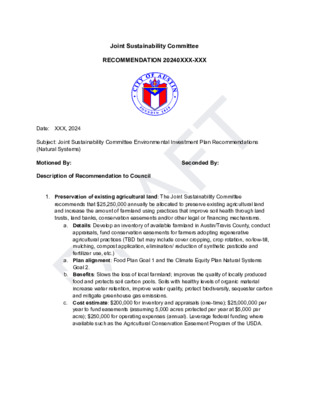
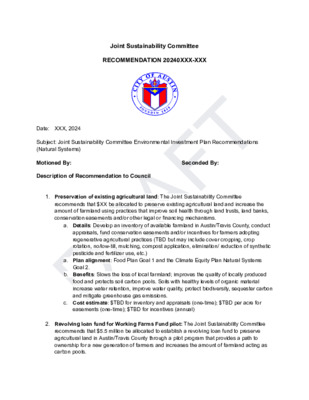
Joint Sustainability Committee RECOMMENDATION 20240XXX-XXX Motioned By: Date: XXX, 2024 Description of Recommendation to Council Subject: Joint Sustainability Committee Environmental Investment Plan Recommendations (Natural Systems) 1. Preservation of existing agricultural land: The Joint Sustainability Committee Seconded By: D R A F T recommends that $25,250,000 annually be allocated to preserve existing agricultural land and increase the amount of farmland using practices that improve soil health through land trusts, land banks, conservation easements and/or other legal or financing mechanisms. a. Details: Develop an inventory of available farmland in Austin/Travis County, conduct appraisals, fund conservation easements for farmers adopting regenerative agricultural practices (TBD but may include cover cropping, crop rotation, no/low-till, mulching, compost application, elimination/ reduction of synthetic pesticide and fertilizer use, etc.) a. Plan alignment: Food Plan Goal 1 and the Climate Equity Plan Natural Systems b. Benefits: Slows the loss of local farmland; improves the quality of locally produced food and protects soil carbon pools. Soils with healthy levels of organic material increase water retention, improve water quality, protect biodiversity, sequester carbon and mitigate greenhouse gas emissions. c. Cost estimate: $200,000 for inventory and appraisals (one-time); $25,000,000 per year to fund easements (assuming 5,000 acres protected per year at $5,000 per acre); $250,000 for operating expenses (annual). Leverage federal funding where available such as the Agricultural Conservation Easement Program of the USDA. Goal 2. Goal 2. 2. Revolving loan fund for Working Farms Fund pilot: The Joint Sustainability Committee recommends that $5,500,000 be allocated to establish a revolving loan fund to preserve agricultural land in Austin/Travis County through a pilot program that provides a path to ownership for a new generation of farmers and increases the amount of farmland acting as carbon pools. a. Details: A collaboration with the Conservation Funds Working Farms Fund and local agricultural nonprofits will acquire and permanently protect small to mid-sized farms, and provide a pathway for underrepresented farmers to own their own farms b. Plan alignment: Food Plan Goal 1 and the Climate Equity Plan Natural Systems c. Benefits: Slows the loss of local farmland, improves the quality of locally produced food, protects carbon pools, and serves as a template for program replication. d. Cost estimate: $5.25M to establish a revolving loan fund; $250K annually for operational expenses 3. Energy and water dashboard for City facilities: The Joint Sustainability Committee recommends that $350,000 be allocated to create a consolidated energy and water dashboard to …
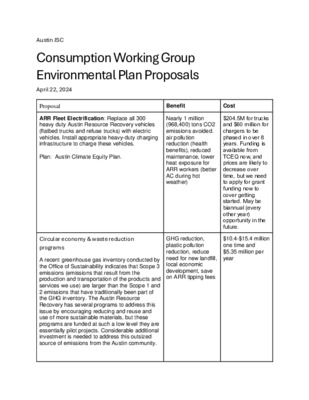
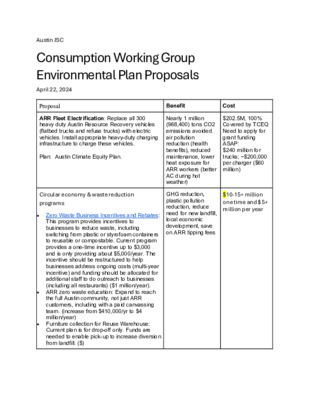
Consumption Working Group Environmental Plan Proposals Austin JSC April 22, 2024 Proposal ARR Fleet Electrification: Replace all 300 heavy duty Austin Resource Recovery vehicles (flatbed trucks and refuse trucks) with electric vehicles. Install appropriate heavy-duty charging infrastructure to charge these vehicles. Plan: Austin Climate Equity Plan. Benefit Cost Nearly 1 million (968,400) tons CO2 emissions avoided. air pollution reduction (health benefits), reduced maintenance, lower heat exposure for ARR workers (better AC during hot weather) GHG reduction, plastic pollution reduction, reduce need for new landfill, local economic development, save on ARR tipping fees Circular economy & waste reduction programs A recent greenhouse gas inventory conducted by the Office of Sustainability indicates that Scope 3 emissions (emissions that result from the production and transportation of the products and services we use) are larger than the Scope 1 and 2 emissions that have traditionally been part of the GHG inventory. The Austin Resource Recovery has several programs to address this issue by encouraging reducing and reuse and use of more sustainable materials, but these programs are funded at such a low level they are essentially pilot projects. Considerable additional investment is needed to address this outsized source of emissions from the Austin community. $204.5M for trucks and $60 million for chargers to be phased in over 8 years. Funding is available from TCEQ now, and prices are likely to decrease over time, but we need to apply for grant funding now to cover getting started. May be biannual (every other year) opportunity in the future. $10.4-$15.4 million one time and $5.35 million per year • Zero Waste Business Incentives and Rebates: This program provides incentives to businesses to reduce waste, including switching from plastic or styrofoam containers to reusable or compostable. Current program provides a one-time incentive up to $3,000 and is only providing about $5,000/year. The incentive should be restructured to help businesses address ongoing costs (multi-year incentive) and funding should be allocated for additional staff to do outreach to businesses (including all restaurants) ($1 million/year). • ARR zero waste education: Expand to reach the full Austin community, not just ARR customers, including with a paid canvassing team. (increase from $410,000/yr to $4 million/year) • Furniture collection for Reuse Warehouse: Current plan is for drop-off only. Funds are needed to enable pick-up to increase diversion from landfill. ($400,000) • Deconstruction Warehouse: To divert salvaged construction materials from the landfill. ($10-15 million) • …
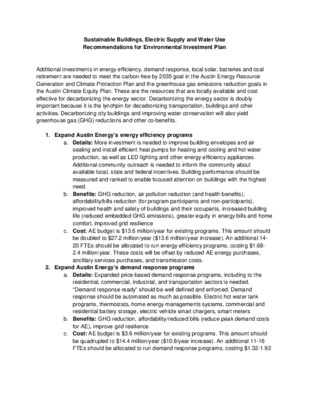
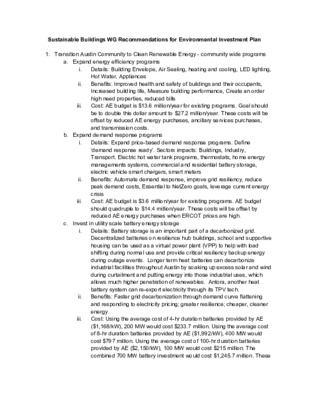
Sustainable Buildings, Electric Supply and Water Use Recommendations for Environmental Investment Plan Additional investments in energy efficiency, demand response, local solar, batteries and coal retirement are needed to meet the carbon-free by 2035 goal in the Austin Energy Resource Generation and Climate Protection Plan and the greenhouse gas emissions reduction goals in the Austin Climate Equity Plan. These are the resources that are locally available and cost effective for decarbonizing the energy sector. Decarbonizing the energy sector is doubly important because it is the lynchpin for decarbonizing transportation, buildings and other activities. Decarbonizing city buildings and improving water conservation will also yield greenhouse gas (GHG) reductions and other co-benefits. 1. Expand Austin Energy’s energy efficiency programs a. Details: More investment is needed to improve building envelopes and air sealing and install efficient heat pumps for heating and cooling and hot water production, as well as LED lighting and other energy efficiency appliances. Additional community outreach is needed to inform the community about available local, state and federal incentives. Building performance should be measured and ranked to enable focused attention on buildings with the highest need. b. Benefits: GHG reduction, air pollution reduction (and health benefits), affordability/bills reduction (for program participants and non-participants), improved health and safety of buildings and their occupants, increased building life (reduced embedded GHG emissions), greater equity in energy bills and home comfort, improved grid resilience c. Cost: AE budget is $13.6 million/year for existing programs. This amount should be doubled to $27.2 million/year ($13.6 million/year increase). An additional 14- 20 FTEs should be allocated to run energy efficiency programs, costing $1.68- 2.4 million/year. These costs will be offset by reduced AE energy purchases, ancillary services purchases, and transmission costs. a. Details: Expanded price-based demand response programs, including to the residential, commercial, industrial, and transportation sectors is needed. “Demand response ready” should be well defined and enforced. Demand response should be automated as much as possible. Electric hot water tank programs, thermostats, home energy managements systems, commercial and residential battery storage, electric vehicle smart chargers, smart meters b. Benefits: GHG reduction, affordability/reduced bills (reduce peak demand costs for AE), improve grid resilience c. Cost: AE budget is $3.6 million/year for existing programs. This amount should be quadrupled to $14.4 million/year ($10.8/year increase). An additional 11-16 FTEs should be allocated to run demand response programs, costing $1.32-1.92 2. Expand Austin Energy’s demand response programs million/year. These costs will …
JOINT SUSTAINABILITY COMMITTEE REGULAR MEETING MEETING MINUTES Mar 27, 2024 The Joint Sustainability Committee convened in a hybrid meeting via videoconferencing and City Hall. Chair Kaiba White called the Board Meeting to order at 6:06 pm. Board Members in Attendance in Person: Chris Maxwell-Gaines, Lane Becker, Larry Franklin, Charlotte Davis, Kaiba White, Haris Qureshi, Jon Salinas Board Members in Attendance Remotely: Diana Wheeler, Anna Scott, Heather Houser, Chris Campbell, Yure Suarez Board Members Absent: Bertha Delgado, Alice Woods, Melissa Rothrock, Amy Noel, Rodrigo Leal City Staff in Attendance: Rohan Lilauwala, Zach Baumer CALL TO ORDER Chair Kaiba White called the meeting to order at 6:20 pm. PUBLIC COMMUNICATION 1. Melinda Chow- River Watch, speaking in favor of Austin Civilian Conservation Corps (ACCC) success stories 2. Parc Smith – American Youth Works, speaking in favor of ACCC 3. Chase Wright – Hungry Hill Foundation, speaking in favor of ACCC 4. Jaquan Jackson – Hungry Hill Foundation, speaking in favor of ACCC 5. Paul Robbins – Environmental activist, vice chair of RMC. Speaking on the need for stronger restrictions on water use and for reclaimed water. Green choice program is obsolete, needs to be repurposed for dispatchable renewable energy 6. Adam Greenfield – Safe Streets Austin, speaking in favor of Urban Transportation Commission’s transportation package, Farm and City’s recommendations. In support of dais). converting 1 lane on every arterial to protected bike or bus lanes. 110 miles - $40 million for quick build. Savings from crash cost reduction. Example of longhorn dam 7. Scott Johnson – speaking on the importance of low-emission asphalt 1. Approval of minutes from the March 27th meeting of the Joint Sustainability Committee. Davis motions to approve, Maxwell-Gaines seconds, passes on 11-0 vote (Suarez off 3. UT City Climate Colab – Dev Niyogi, UT-Austin Presentation on the new collaborative research framework between University of Texas at Austin and the City of Austin Commissioners agree of value of Colab Suggestions of project – citywide solar potential assessment Offer to come back regularly to update JSC 2. Joint Sustainability Committee Officer Elections for the 2024-2025 Term Qureshi nominates White as chair, Maxwell-Gaines seconds, passes 12-0. Wheeler nominates Davis as vice chair, Qureshi seconds, passes 12-0. 4. Presentation on the Staff Response to Resolution 20240215-025, the “Environmental Investment Plan” – Zach Baumer, Office of Sustainability Discussions on how to maximize community benefits …
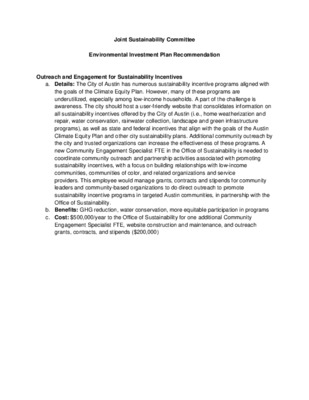
Joint Sustainability Committee Environmental Investment Plan Recommendation Outreach and Engagement for Sustainability Incentives a. Details: The City of Austin has numerous sustainability incentive programs aligned with the goals of the Climate Equity Plan. However, many of these programs are underutilized, especially among low-income households. A part of the challenge is awareness. The city should host a user-friendly website that consolidates information on all sustainability incentives offered by the City of Austin (i.e., home weatherization and repair, water conservation, rainwater collection, landscape and green infrastructure programs), as well as state and federal incentives that align with the goals of the Austin Climate Equity Plan and other city sustainability plans. Additional community outreach by the city and trusted organizations can increase the effectiveness of these programs. A new Community Engagement Specialist FTE in the Office of Sustainability is needed to coordinate community outreach and partnership activities associated with promoting sustainability incentives, with a focus on building relationships with low-income communities, communities of color, and related organizations and service providers. This employee would manage grants, contracts and stipends for community leaders and community-based organizations to do direct outreach to promote sustainability incentive programs in targeted Austin communities, in partnership with the Office of Sustainability. b. Benefits: GHG reduction, water conservation, more equitable participation in programs c. Cost: $500,000/year to the Office of Sustainability for one additional Community Engagement Specialist FTE, website construction and maintenance, and outreach grants, contracts, and stipends ($200,000)
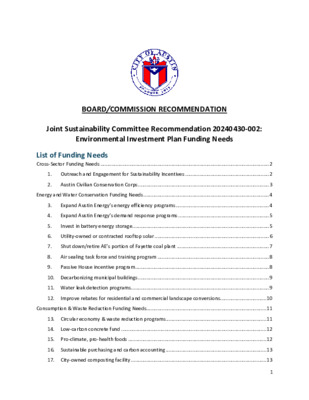
BOARD/COMMISSION RECOMMENDATION Joint Sustainability Committee Recommendation 20240430-002: Environmental Investment Plan Funding Needs 1. 2. 3. 4. 5. 6. 7. 8. 9. List of Funding Needs Cross-Sector Funding Needs ......................................................................................................................... 2 Outreach and Engagement for Sustainability Incentives ............................................................ 2 Austin Civilian Conservation Corps .............................................................................................. 3 Energy and Water Conservation Funding Needs .......................................................................................... 4 Expand Austin Energy’s energy efficiency programs ................................................................... 4 Expand Austin Energy’s demand response programs ................................................................. 5 Invest in battery energy storage.................................................................................................. 5 Utility-owned or contracted rooftop solar .................................................................................. 6 Shut down/retire AE’s portion of Fayette coal plant .................................................................. 7 Air sealing task force and training program ................................................................................ 8 Passive House incentive program ................................................................................................ 8 10. Decarbonizing municipal buildings .............................................................................................. 9 11. Water leak detection programs................................................................................................... 9 12. Improve rebates for residential and commercial landscape conversions ................................. 10 Consumption & Waste Reduction Funding Needs...................................................................................... 11 13. Circular economy & waste reduction programs ........................................................................ 11 14. Low-carbon concrete fund ........................................................................................................ 12 15. Pro-climate, pro-health foods ................................................................................................... 12 16. Sustainable purchasing and carbon accounting ........................................................................ 13 17. City-owned composting facility ................................................................................................. 13 1 Natural Systems Funding Needs ................................................................................................................. 14 18. Preservation of existing agricultural land .................................................................................. 14 19. Revolving loan fund for Working Farms Fund pilot ................................................................... 15 20. Energy and water dashboard for city facilities .......................................................................... 15 21. Comprehensive public tree inventory for the city of Austin ..................................................... 16 Transportation and Land Use Funding Needs ............................................................................................. 17 22. Austin Resource Recovery Fleet Electrification ......................................................................... 17 23. Austin Resource Recovery Transfer Station .............................................................................. 17 24. Expand All Ages and Abilities Bicycle Network, Urban Trails, Sidewalks, and Shared Mobility 18 25. Extend Pickup Service Zones ..................................................................................................... 20 26. Downtown High-Frequency Circulator ...................................................................................... 21 27. Neighborhood E-Circulators ...................................................................................................... 22 28. Heat Resilience Infrastructure ................................................................................................... 23 29. CityLeap ATX Plan: convert travel lanes on arterial roads to protected bike or bus lanes ....... 24 30. Establish a city-owned all-electric carshare service .................................................................. 25 31. Low-cost, accessible charging stations at City of Austin owned facilities ................................. 26 32. Install charging stations at multi-family homes with priority in low and moderate income communities ....................................................................................................................................... 27 33. E-mobility solutions pilot program ............................................................................................ 28 Cross-Sector Funding Needs 1. Outreach and Engagement for Sustainability Incentives Details: The City of Austin has numerous sustainability incentive programs aligned with the goals of the Climate Equity Plan. However, many of these programs are underutilized, especially among low-income households. A part of the challenge is awareness. The city should host a user-friendly website …
JOINT SUSTAINABILITY COMMITTEE REGULAR MEETING MEETING MINUTES April 30, 2024 The Joint Sustainability Committee convened in a hybrid meeting via videoconferencing and City Hall. Chair Kaiba White called the Board Meeting to order at 6:06 pm. Board Members in Attendance in Person: Chris Maxwell-Gaines, Haris Qureshi, Kaiba White, Anna Scott Board Members in Attendance Remotely: Diana Wheeler, Jon Salinas, Melissa Rothrock, Charlotte Davis, Lane Becker, Heather Houser, Rodrigo Leal, Yure Suarez, Chris Campbell, Amy Noel Board Members Absent: Bertha Delgado, Alice Woods, Larry Franklin City Staff in Attendance: Rohan Lilauwala CALL TO ORDER Chair Kaiba White called the meeting to order at 6:06 pm. PUBLIC COMMUNICATION 1. Craig Nazor – speaking in support of LIDAR for tree inventory and support for native 2. Zenobia Joseph – speaking in favor of improved transit and shelters near low-income 1. Approval of minutes from the April 24th meeting of the Joint Sustainability Committee. Qureshi motions to approve, Maxwell-Gaines seconds, passes on 13-0 vote (Noel off nurseries communities dais) 2. Joint Sustainability Committee discussion and approval of recommendations for the Environmental Investment Plan, in the areas of Buildings and Energy, Transportation, Natural Systems, and Consumption. Discussion of details of individual recommendations at length Commissioners suggest including social cost of carbon (and air pollutants, if possible) amount for Fayette closure Tweaks suggested to sustainable buildings recommendation #10 Tweaks to ACCC recommendation – change language to purchasing a truck Suggested $400,000 budget for Sustainable Buildings Recommendation 10 Public comment - Zenobia Joseph – Speaks in favor of improved fixed-route transit, better survey methods, equity Scott motions to approve all recommendations minus five pulled items ; Qureshi second 1. Pro-climate, pro health foods 2. Downtown High-Frequency Circulator 3. Neighborhood E-Circulators 4. Establish a city-owned all-electric carshare service 5. E-mobility solutions pilot program Passes 13-0 (Suarez off dais) White motions to approve Pro-climate, pro health recommendation, Qureshi seconds, passes 12-0 (Davis recuses, Suarez off dais) Davis motions to approve neighborhood e-circulators as amended, Noel seconds, passes 13-0 Davis motions to approve downtown high frequency circulator, Qureshi seconds, passes 13-0 (Suarez off dais). (Suarez off dais). Campbell motions carshare service to approve, Becker seconds, passes 13-0 (Suarez off Leal motions to approve e-mobility solutions pilot program, Qureshi seconds, passes 10-2 (White abstains, Davis and Houser no) dais). TBD FUTURE AGENDA ITEMS White adjourns meeting …
JOINT SUSTAINABILITY COMMITTEE HYBRID MEETING FORMAT April 24th, 2024 at 6pm Room 1406, Permitting and Development Center 6310 Wilhelmina Delco Dr, Austin, TX 78752 Some members of the Committee may be participating by videoconference Public comment will be allowed in-person or remotely via telephone. Speakers may only register to speak on an item once either in-person or remotely and will be allowed up to three minutes to provide their comments. Registration no later than noon the day before the meeting is required for remote participation by telephone. To register to speak remotely, call or email Rohan Lilauwala at (rohan.lilauwala@austintexas.gov or 512-974-9394). CURRENT BOARD MEMBERS: Kaiba White, Chair (Electric Utility Commission) Diana Wheeler, Vice Chair (Urban Transportation Commission) Charlotte Davis (Resource Mgmt. Commission) Haris Qureshi (Environmental Commission) Melissa Rothrock (Zero Waste Advisory Commission) Bertha Delgado (Community Development Commission) Larry Franklin (Austin Travis County Food Policy Board) Chris Maxwell-Gaines (Water & Wastewater Commission) Amy Noel (Economic Prosperity Commission) Stephanie Bazan (Parks & Recreation Board) Jon Salinas (Design Commission) Vacant (City Council) Alice Woods (Planning Commission) Rodrigo Leal (Mayor’s Representative) Anna Scott (Mayor’s Representative) Heather Houser (Mayor’s Representative) Yureisly Suarez (Mayor’s Representative) Christopher Campbell (Mayor’s Representative) For more information, please visit: www.austintexas.gov/jsc AGENDA CALL TO ORDER PUBLIC COMMUNICATION: GENERAL The first 10 speakers signed up prior to the meeting being called to order will each be allowed a three-minute allotment to address their concerns regarding items not posted on the agenda. APPROVAL OF MINUTES 1. Approval of minutes from the March 27, 2024 meeting of the Joint Sustainability Committee. DISCUSSION AND ACTION ITEMS 2. Conduct Joint Sustainability Committee Officer Elections for the 2023-2024 Term. DISCUSSION 3. Staff update to the Environmental Investment Plan process to create recommendations – Zach Baumer, Office of Sustainability. 4. UT-City Climate CoLab – Structure, Priorities, and Potential Research Areas - Dev Niyogi, University of Texas-Austin. 5. Joint Sustainability Committee discussion of approach and recommendations on the Environmental Investment Plan. FUTURE AGENDA ITEMS ADJOURNMENT The City of Austin is committed to compliance with the American with Disabilities Act. Reasonable modifications and equal access to communications will be provided upon request. Meeting locations are planned with wheelchair access. If requiring Sign Language Interpreters or alternative formats, please give notice at least 2 days (48 hours) before the meeting date. Please contact Rohan Lilauwala at rohan.lilauwala@austintexas.gov or 512-974-9394 for additional information; TTY users’ route through Relay Texas at 711. For more …
Benefit Cost $202.5M, 100% Covered by TCEQ Need to apply for grant funding ASAP: $240 million for trucks; ~$200,000 per charger ($60 million) $10-15+ million one time and $5+ million per year Nearly 1 million (968,400) tons CO2 emissions avoided. air pollution reduction (health benefits), reduced maintenance, lower heat exposure for ARR workers (better AC during hot weather) GHG reduction, plastic pollution reduction, reduce need for new landfill, local economic development, save on ARR tipping fees Consumption Working Group Environmental Plan Proposals Austin JSC April 22, 2024 Proposal ARR Fleet Electrification: Replace all 300 heavy duty Austin Resource Recovery vehicles (flatbed trucks and refuse trucks) with electric vehicles. Install appropriate heavy-duty charging infrastructure to charge these vehicles. Plan: Austin Climate Equity Plan. Circular economy & waste reduction programs • Zero Waste Business Incentives and Rebates: This program provides incentives to businesses to reduce waste, including switching from plastic or styrofoam containers to reusable or compostable. Current program provides a one-time incentive up to $3,000 and is only providing about $5,000/year. The incentive should be restructured to help businesses address ongoing costs (multi-year incentive) and funding should be allocated for additional staff to do outreach to businesses (including all restaurants) ($1 million/year). • ARR zero waste education: Expand to reach the full Austin community, not just ARR customers, including with a paid canvassing team. (increase from $410,000/yr to $4 million/year) • Furniture collection for Reuse Warehouse: Current plan is for drop-off only. Funds are needed to enable pick-up to increase diversion from landfill. ($) • Deconstruction Warehouse: To divert salvaged construction materials from the landfill. ($10-15 million) • Fix-it Clinics: Expand and host more ($500,000/year), • Circular Austin Accelerator and Circular Austin Showcase competition: Expand outreach and an increased number and value of awards for competition winners would increase effectiveness in building a circular economy in Austin. (increase from $ to $); • MoveOutATX: Increase number of events (increase from $/year to $/year); Plan: Austin Resource Recovery Comprehensive Plan & Austin Climate Equity Plan (Food and Product Consumption Goal 2, Strategy 4) Low-carbon concrete fund: Concrete represents the largest of Austin’s purchasing emissions, with potential surcharges for truly carbon neutral cement ranging as high as an additional $18/cubic yard, but with costs falling as new technology scales up. This fund would pay for additional testing, program fees, and surcharges to cover both city and non-city owned buildings of 1.1 M cubic …
Sustainable Buildings WG Recommendations for Environmental Investment Plan 1. Transition Austin Community to Clean Renewable Energy - community wide programs a. Expand energy efficiency programs i. Details: Building Envelope, Air Sealing, heating and cooling, LED lighting, ii. Hot Water, Appliances Benefits: Improved health and safety of buildings and their occupants, Increased building life, Measure building performance, Create an order high need properties, reduced bills iii. Cost: AE budget is $13.6 million/year for existing programs. Goal should be to double this dollar amount to $27.2 million/year. These costs will be offset by reduced AE energy purchases, ancillary services purchases, and transmission costs. b. Expand demand response programs i. Details: Expand price-based demand response programs. Define ‘demand response ready’. Sectors impacts: Buildings, Industry, Transport. Electric hot water tank programs, thermostats, home energy managements systems, commercial and residential battery storage, electric vehicle smart chargers, smart meters Benefits: Automate demand response, improve grid resiliency, reduce peak demand costs, Essential to NetZero goals, leverage current energy crisis ii. iii. Cost: AE budget is $3.6 million/year for existing programs. AE budget should quadruple to $14.4 million/year. These costs will be offset by reduced AE energy purchases when ERCOT prices are high. c. Invest in utility scale battery energy storage i. Details: Battery storage is an important part of a decarbonized grid. Decentralized batteries on resilience hub buildings, school and supportive housing can be used as a virtual power plant (VPP) to help with load shifting during normal use and provide critical resiliency backup energy during outage events. Longer term heat batteries can decarbonize industrial facilities throughout Austin by soaking up excess solar and wind during curtailment and putting energy into those industrial uses, which allows much higher penetration of renewables. Antora, another heat battery system can re-export electricity through its TPV tech. Benefits: Faster grid decarbonization through demand curve flattening and responding to electricity pricing; greater resilience; cheaper, cleaner energy. ii. iii. Cost: Using the average cost of 4-hr duration batteries provided by AE ($1,168/kW), 200 MW would cost $233.7 million. Using the average cost of 8-hr duration batteries provided by AE ($1,992/kW), 400 MW would cost $797 million. Using the average cost of 100-hr duration batteries provided by AE ($2,150/kW), 100 MW would cost $215 million. The combined 700 MW battery investment would cost $1,245.7 million. These costs would be recovered by earnings in the ERCOT energy and ancillary services markets. Heat battery pilots could …
DRAFT Joint Sustainability Commission Transportation, Land Use, and Electrification Environmental Investment Plan Recommendations Recommendation Description: Expand All Ages and Abilities Bicycle Network, Urban Trails, Sidewalks, and Shared Mobility The JSC recommends the City of Austin (COA) invest a total of $2.11 billion to expand the number of Metro Bike stations and to build out the All Ages and Abilities (AAA) Bicycle Priority Network, the Tier One Urban Trails network, and sidewalks and shared streets as recommended in the Urban Transportation Commission's "Climate Equity Investment" Recommendation 20240305-006. We recommend the following specific investments: 1. $48,960,000 to build out an additional 148 miles of the AAA Bicycle Priority Network and meet the 2023 Bike Plan Goal of 380 miles built out by 2026. Projects should be selected using the project prioritization model in the 2023 Bicycle Plan, which scores projects based on equity, destinations & travel demand, connectivity & safety, and cost. Relevant plan sections: Austin Strategic Mobility (ASMP) Bicycle Policy 2, Austin Climate Equity Plan (ACEP) Transportation and Land Use (TLU) Goal 3, and 2023 Bike Plan Item 4.7.la. 2. $22,600,000 to build out an additional 200 Metro Bike Stations to reach the 2023 Bike Plan goal of 300 stations by 2025. The investment should prioritize new stations in low-income areas with high mobility needs and connections to CapMetro's existing high-frequency bus and Metro Rail network. Relevant plan sections: ASMP Shared Mobility Policy 1, ACEP TLU Goal 3, and 2023 Bike Plan Item 4.7.2. 3. $75,826,000 to build out 15.6 miles of Tier One Urban Trails by 2028 and put COA on track to reach the 2023 Urban Trails goal of building all 94 miles of Tier 1 trails by 2043. City Manager should also consider investments to ensure "the Urban Trails Plan is deliver[ing] projects on an accelerated timeline" as the Urban Trails Plan notes doing so is "dependent on increasing internal City of Austin capacity across supporting departments concerning staffing, systems, and the processes for permitting" Urban Trails Plan Section 3.5). Relevant plan sections: See ASMP Urban Trails Policy 2 & 3, ACEP TLU Goal 3, and 2023 Urban Trails Plan Section 3.5. 4. $64,000,000 to build out 136 miles of new sidewalks and 80 miles of shared streets per year through 2028, putting Austin on track to address all "Very High" and "High" priority sidewalks and shared streets within 10 years. Projects in the highest Equity Analysis Zones …
“Environmental Investment Plan” 20240215-025 STATUS UPDATE April 24, 2024 1 Resolution 20240215-025 Reaffirm commitment to net-zero by 2040, act with urgency required to achieve this goal. Solicit community input and prepare options and associated costs of capital improvements or programs that would: 1. Reduce carbon emissions 2. Decrease water usage and improve water quality and detention 3. Advance the sustainability of City Operations, and 4. Improve Community Resilience Post a public hearing of the JSC in March (27) / April (24) to gather input from the public and the Committee is requested to submit any recommendations for investments to Council by May 1 Review whether recommendations can be funded through: - Utility rates - General Fund Expenditures - Grants - General Obligation Bonds (may include Nov 2024) 2 Resolution 20240215-025 In addition to proposals put forth by the JSC, analyze investments needed to fulfill the following adopted plans: - Climate Equity Plan - Water Forward - Watershed Protection Strategic Plan - One Austin: Climate Resilience Action Plan - Austin Strategic Mobility Plan - ARR Comprehensive Plan - AE Resource Generation Plan - PARD Land Management Plan and Long Range Plan - Austin Travis County Wildfire Preparedness Plan - Central Texas Regional Air Quality Plan - Urban Forest Plan - Austin Travis County Food Plan - Green Infrastructure Strengths and Gaps Assessment Analysis should also identify options for fulfilling either all or specific elements of these plans before their current target date. 3 Final Product A list of projects and programs that: 1. Reduce carbon emissions 2. Decrease water usage and improve water quality and detention 3. Advance the sustainability of City Operations 4. Improve Community Resilience For each project or program - General Scope / Description - Aligned with which Plan and Goal - - Approximate Cost - Potential Funding Mechanism Timeline (Short, Medium, Long term) - Utility base rates - General Fund Expenditures - Grants - General Obligation Bonds A Memo with attached Report / Spreadsheet Attachments - JSC and Community Recommendations A Presentation to Council on May 28 4 Process Scoping and Screening Initial review JSC and Public Input Finalization OOS has created a catalog of all goals / strategies in all plans called out in the Resolution Teams + Departments worked on a shared assignment spreadsheet to populate projects and information Departments reviewed their own Plans & Goals - Identified gaps Teams convened to share their findings …
Joint Sustainability Committee RECOMMENDATION 20240XXX-XXX Motioned By: Date: XXX, 2024 Description of Recommendation to Council Subject: Joint Sustainability Committee Environmental Investment Plan Recommendations (Natural Systems) Seconded By: D R A F T 1. Preservation of existing agricultural land: The Joint Sustainability Committee recommends that $XX be allocated to preserve existing agricultural land and increase the amount of farmland using practices that improve soil health through land trusts, land banks, conservation easements and/or other legal or financing mechanisms. a. Details: Develop an inventory of available farmland in Austin/Travis County, conduct appraisals, fund conservation easements and/or incentives for farmers adopting regenerative agricultural practices (TBD but may include cover cropping, crop rotation, no/low-till, mulching, compost application, elimination/ reduction of synthetic pesticide and fertilizer use, etc.) a. Plan alignment: Food Plan Goal 1 and the Climate Equity Plan Natural Systems b. Benefits: Slows the loss of local farmland; improves the quality of locally produced food and protects soil carbon pools. Soils with healthy levels of organic material increase water retention, improve water quality, protect biodiversity, sequester carbon and mitigate greenhouse gas emissions. c. Cost estimate: $TBD for inventory and appraisals (one-time); $TBD per acre for easements (one-time); $TBD for incentives (annual) Goal 2. 2. Revolving loan fund for Working Farms Fund pilot: The Joint Sustainability Committee recommends that $5.5 million be allocated to establish a revolving loan fund to preserve agricultural land in Austin/Travis County through a pilot program that provides a path to ownership for a new generation of farmers and increases the amount of farmland acting as carbon pools. a. Details: A collaboration with the Conservation Funds Working Farms Fund and local agricultural nonprofits will acquire and permanently protect small to mid-sized farms, and provide a pathway for underrepresented farmers to own their own farms b. Plan alignment: Food Plan Goal 1 and the Climate Equity Plan Natural Systems Goal 2. c. Benefits: Slows the loss of local farmland, improves the quality of locally produced food, protects carbon pools, and serves as a template for program replication. d. Cost estimate: $5.25M to establish a revolving loan fund; $250K annually for operational expenses d. Cost: $350K (TBD) real-time response to leaks, solar panel outages etc. and improving management of water and electricity usage in City parks, pools and buildings. 3. Energy and water dashboard for City facilities: The Joint Sustainability Committee recommends that $350K (TBD) be allocated to create a consolidated energy and …