COMMUNITY DEVELOPMENT COMMISSION REGULAR MEETING MINUTES TUESDAY, September 8TH, 2026 The COMMUNITY DEVELOPMENT COMMISSION convened in a REGULAR MEETING on TUESDAY, September 8TH, 2026, at CITY HALL, BOARDS AND COMMISSION ROOM in Austin, Texas. Some members of the commission participated by video conference. Board Members/Commissioners in Attendance: Lyric Wardlow, Vice Chair Jenny E. Achilles Omar Gamboa Cynthia Jaso Valeria Menard Board Members/Commissioners in Attendance Remotely: Taniquewa Brewster Raul Longoria Sonia Martinez Staff Members in Attendance: Nefertitti Jackmon Miguel Lopez Angel Zambrano CALL TO ORDER Vice Chair Lyric Wardlow called the meeting to order at 6:48 PM. PUBLIC COMMUNICATION: GENERAL The first 10 speakers signed up prior to the meeting being called to order will each be allowed a three-minute allotment to address their concerns regarding items not posted on the agenda. Marian Sanchez, speaking on behalf of PODER, provided public comment. APPROVAL OF MINUTES 1. Approve the minutes of the CDC Regular meeting on August 11, 2026. The minutes from the Community Development Commission Regular Meeting on August 11th, 2026, were approved on Commissioner Menard’s motion, Commissioner Gamboa’s second, on a 8-0 vote. STAFF BRIEFINGS 2. Staff briefing regarding Community Services Block Grant (CSBG) activities and outcomes. Presentation by Angel Zambrano, Program Manager III, Austin Public Health. The presentation was made by Angel Zambrano, Program Manager III, Austin Public Health. DISCUSSION ITEMS 3. Discussion on the recent meeting of the Housing Investment Review Committee (HIRC). Discussion led by Commissioner Valeria Menard. This item was tabled for the October meeting. 4. Update and discussion of the CDC Election process. Discussion led by Chair Noe Elias. This item was tabled for the October meeting. DISCUSSION AND ACTION ITEMS 5. Discussion and action on the election and nomination process for APH concerning Public Sector and Private Sector Appointees. Presentation by Angel Zambrano, Program Manager III, Austin Public Health. This item was tabled for the October meeting. 6. Discussion and possible approval of a recommendation regarding the Dog’s Head Development. Discussion led by Commissioner Valeria Menard. The motion to approve the recommendation regarding the Dog’s Head Development was approved with the listed amendments on Commissioner Jenny E. Achilles’s motion, Commission Raul Longoria’s second, on 8-0 vote. • Addition of the number 20 item as “Allow and prioritize affordable housing ranging from 30%-80% Median Family Income (MFI) throughout the area.” • Replacement of the Environmental Commission with the Community Development Commission on the second WHEREAS. …
COMMUNITY DEVELOPMENT COMMISSION (CDC) MEETING October 13, 2026 – 6:30 PM AUSTIN CITY HALL, BOARDS AND COMMISSIONS - ROOM 1101 301 W 2ND STREET, 78701 AUSTIN, TEXAS Some members of the CDC may be participating by videoconference. The meeting may be viewed online at: http://www.austintexas.gov/page/watch-atxn-live Public comment will be allowed in-person or remotely via telephone. Speakers may only register to speak on an item once either in-person or remotely and will be allowed up to three minutes to provide their comments. Registration no later than noon the day before the meeting is required for remote participation by telephone. To register to speak remotely, contact Miguel Lopez, (512) 975-1575, Miguel.lopez@austintexas.gov. CURRENT COMMISSIONERS: Noe Elias, Chair, Montopolis Jenny E. Achilles, Private Sector Omar Gamboa, Public Sector Cynthia Jaso, Dove Springs Sonia Martinez, East Austin Jo Anne Ortiz, Public Sector CALL TO ORDER PUBLIC COMMUNICATION: GENERAL Lyric E. Wardlow, Vice Chair, Public Sector Taniquewa S. Brewster, Rosewood-Zaragosa Tisha-Vonique Hood, Public Sector Raul E. Longoria, South Austin Valerie Menard, St. John’s AGENDA The first 10 speakers signed up prior to the meeting being called to order will each be allowed a three- minute allotment to address their concerns regarding items not posted on the agenda. APPROVAL OF MINUTES 1. Approve the minutes of the CDC Regular meeting on September 8, 2026. STAFF BRIEFINGS 2. Staff briefing regarding Community Services Block Grant (CSBG) activities and outcomes. Presentation by Angel Zambrano, Program Manager III, Austin Public Health (APH). DISCUSSION ITEMS 3. Discussion and presentation of federal regulations regarding Community Development Block Grant (CDBG) funding and the annual HUD Funding Cycle including the Annual Action Plan, Needs Assessment, and the Consolidated Annual Performance and Evaluation Report (CAPER). Presentation led by KateLynn Dean, Grants Program Manager, and Julie Smith, Community Engagement Specialist, Austin Housing. DISCUSSION AND ACTION ITEMS 4. 5. 6. 7. Discussion and action on the Austin Public Health election and nomination process. Presentation by Angel Zambrano, Program Manager III, Austin Public Health. Discussion and action to approve the recommendation provided by the Election Working Group regarding the Community Development Commission (CDC) election process. Discussion led by Chair Noe Elias. Discussion and action on providing a recommendation for existing multifamily rezoning cases that have not received final action from City Council. Discussion led by Chair Noe Elias. Approve the 2027 Annual Meeting Calendar of the Community Development Commission (CDC). Discussion led by Miguel Lopez, Planner I, Austin …
Austin Public Health Report on PY26 Community Action Plan MISSION: To prevent disease, promote health, and protect the well-being of our community. TOP 5 NEEDS: Housing; Basic Needs; Employment; Health; Income Community Services Block Grant 2026 Contract Programmatic/Financial Report October 13th, 2026 The Community Services Block Grant funds the delivery of services to low-income Texas residents in all 254 counties. These funds support a variety of direct services in addition to helping maintain the core administrative elements of community action agencies. For the City of Austin, the grant provides funding for the delivery of basic needs, case management, preventive health and employment support services through the City’s seven (7) Neighborhood Centers. Mission: The Neighborhood Services Unit aims to improve the lives and health of people experiencing poverty by providing public health and social services and connecting residents of Austin and Travis County to community resources. ◼ Basic Needs (food, clothing, information and referral, notary services, transportation, car safety education and car seats, tax preparation, fans, Thanksgiving food baskets and other seasonal activities); ◼ Preventive Health (screenings for blood pressure, blood sugar including a1C, and cholesterol; pregnancy testing; health promotion presentations, coordination and participation in health fairs, immunizations, coordination of wellness activities, linkages to medical home providers and diabetes case management); ◼ Case Management (individual/family support counseling, advocacy, self-sufficiency case management, crisis intervention, linkages with employers, educational opportunities and training, and working with individuals on quality-of-life issues); ◼ Employment Support (intake, assessment and goal setting, job readiness training, job placement assistance, and job retention services) Expenditures Categories Personnel Fringe Benefits Other Total 2026 Contract Budget $ $ $ $1,148,214 Cumulative Expenditures through 8/31/26 $508,179.71 $281,873.10 $ $790,052.81 Percent of Total 69% 1 Neighborhood Services Unit Success Stories From the nurse’s own words: I have a client whom I see at Austin Reconciliation Church for Health Screenings. They were unaware that their sugar was elevated until I screened them. Their A1C was elevated, and they were having symptoms of elevated blood sugar. The client did not have health insurance but MAP staff were at the outreach event. They signed them up and I called CommUnityCare to get them seen the same week. I also assisted the client with an appointment to get bus passes at the St. John Neighborhood Center. The client was given educational materials on prediabetes and nutrition. Client did see the doctor and was reluctant to start the medication. …
CITY OF AUSTIN CITIZEN PARTICIPATION PLAN A. PURPOSE Participating Jurisdictions (PJs) that receive U.S. Department of Housing and Urban Development (HUD) entitlement grant funds must develop a Citizen Participation Plan (CPP). The CPP describes efforts that will be undertaken to encourage community members to participate in the development of the City’s federal reports: Assessment of Fair Housing (AFH), Consolidated Plan, Annual Action Plan, and the Consolidated Annual Performance and Evaluation Report (CAPER). The CPP is designed to encourage the participation of city residents in the development of the federal reports listed above, particularly those residents who are predominantly low- and moderate-income. For purposes of CDBG funding, a resident is considered to be low-income if their family income equals 50% or less of median family income (MFI), as estimated by HUD. A person is considered to be moderate-income if their family income is between 50% and 80% of MFI. Predominately low-to moderate-income neighborhoods are defined as any neighborhood where at least 51% of the residents have incomes equal to or below 80% of the MFI for any given year. The determination of whether a neighborhood meets the low-to moderate income definition is made by the City at the time a project of area-wide benefit is funded based on current data provided by HUD. The CPP also encourages local and regional institutions and other organizations (including businesses, developers, and community and faith-based organizations) to participate in the process of developing and implementing the Consolidated Plan and related reports. The City takes appropriate actions to encourage the participation of persons of minority backgrounds, persons with limited-English proficiency, and persons with disabilities. It is important to note that HUD’s use of the statutory term “citizen participation” does not in any way limit engagement and consultation with community members based on legal status or country of origin. Any person that resides in the Austin metro area is encouraged to provide input about the federal reporting process as outlined in this CPP. The City of Austin is committed to compliance with the Americans with Disabilities Act (ADA) and Section 504 of the Rehabilitation Act of 1973, as amended. Reasonable modifications and equal access to communications will be provided upon request. The City of Austin does not discriminate on the basis of disability in the admission or access to, or treatment or employment in its programs and activities. The City of Austin considers it the right of …
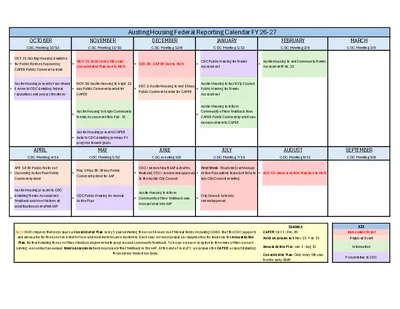
Federal Funding Engagement Cycle Austin Housing | October 13, 2026 Federal Funding Overview The U.S. Department of Housing and Urban Development (HUD) allocates entitlement funding to municipalities and state governments. The City of Austin applies for approximately $14 million in annual grant entitlements across four grants for affordable housing, community development, economic development, and public services. These grants are part of a 5-year cycle. 2 3 HUD Funding Sources 3 4 5-year Cycle Consolidated Plan (5-Year) Allocates federal resources to housing and community development Action Plan (1-Year) Summarizes actions, activities and federal/non- federal resources in the Consolidated Plan Consolidated Annual Performance and Evaluation Report (CAPER) (1-Year) End-of-year report on progress toward consolidated plan 4 Austin Housing's Role Grant application Grant management (coordination with other departments, reporting) Community Engagement Program management 5 CDC's Role Advise Council Host Public Hearings U.S. Code states public organizations administer CSBG funds with support of a tripartite board (42 USCA 9910) Code of Federal Regulations states jurisdiction must have Citizen Participation Plan & host public hearings (24 CFR 91.105) Austin Municipal Code requires the operation of a Community Development Commission for the representation of low-income populations (2-1-128) Citizen Participation Plan outlines when public hearings shall be held during preparation of the Annual Action Plan and 5-Year Consolidated Plan 6 Needed Shifts for Engagement Check-box engagement with limited impact Misaligned calendar with too little time to use feedback Unclear roles and responsibilities between staff and commissioners 7 Needed Shifts for Engagement Check-box engagement with limited Thoughtful engagement connected to impact decision-makers Misaligned calendar with too little time Engagement calendar aligned with to use feedback decision-making processes Unclear roles and responsibilities between staff and commissioners Clear expectations and ongoing communication 8 New Calendar October (FY start) November December January February March CAPER Season CAPER 15-day Public Comment Period CAPER due to HUD Begin Community Needs Assessment Community Needs Assessment Community Needs Assessment Community Needs Assessment April May June July August Drafting of Action Plan 30-day Public Comment Period for Action Plan CDC Review of Action Plan; recommendation to Council Council review & approval of Action Plan Action Plan submission to HUD Begin Action Plan Draft September (FY end) 9 What you can expected from us Monthly updates on where we are in the process Opportunities for meaningful dialogue and input 10 How you can …
◦ ◦ ◦ ◦ OCTOBER CDC Meeting 10/13 NOVEMBER CDC Meeting 11/10 DECEMBER CDC Meeting 12/8 JANUARY CDC Meeting 1/12 FEBRUARY CDC Meeting 2/9 MARCH CDC Meeting 3/9 Austing Housing Federal Reporting Calendar FY 26-27 OCT 31: Austing Housing deadline for Public Notice of upcoming CAPER Public Comment period ◦ NOV 15, 2029 (every 5th year) - Consolidated Plan due to HUD ◦ DEC 29 - CAPER due to HUD ◦ CDC Public Hearing for Needs Assessment ◦ Austin Housing to end Community Needs Assessment Feb. 15 Austin Housing presents Year Ahead Review to CDC detailing federal regulations and project timelines ◦ NOV 16: Austin Housing to begin 15 day Public Comment period for CAPER ◦ DEC 2: Austin Housing to end 15 day Public Comment period for CAPER ◦ Austin Housing to host City Council Public Hearing for Needs Assessment ◦ ◦ Austin Housing to begin Community Needs Assessment thru Feb. 15 Austin Housing presents CAPER data to CDC detailing previous FY progress toward goals ◦ Austin Housing to inform Community of how feedback from CAPER Public Comment period was incorporated into CAPER APRIL CDC Meeting 4/14 MAY CDC Meeting 5/12 JUNE CDC meeting 6/9 JULY CDC Meeting 7/14 AUGUST CDC Meeting 8/11 SEPTEMBER CDC Meeting 9/8 APR 14-30: Public Notice of Upcoming Action Plan Public Comment period Austin Housing present to CDC detailing Needs Assessment feedback and how it informed modifications in drafted AAP ◦ May 1-May 30: 30 day Public Comment period for AAP ◦ CDC Public Hearing for Annual Action Plan ◦ ◦ CDC review of draft AAP & draft is finalized; CDC recommend approval to the Austin City Council ◦ First Week - Finalized Draft Annual Action Plan added to docket for late July City Council meeting ◦ AUG 15 - Annual Action Plan due to HUD Austin Housing to inform Community of how feedback was incorporated into AAP ◦ City Council late July review/approval Note: HUD requires that we prepare a Consolidated Plan every 5 years detailing the use of 4 sources of federal funds, including CDBG, that the CDC supports and advocates for the use of on behalf of low- and moderate-income Austinites. Each year, we must prepare a reapplication for funds via the Annual Action Plan, further detailing the use of those funds in alignment with progress and community feedback. To be sure we are receptive to the needs of those we …
COMMUNITY DEVELOPMENT COMMISSION RECOMMENDATION 20261013-04 Recommendation on the CDC Election Process RECOMMENDATION Whereas, the Austin Community Development Commission (CDC) consists of eight members democratically selected to represent residents from each of the eight geographic areas of Travis County, in order to represent low-income populations eligible to be served under the Community Services Block Grant (CSBG); Whereas, Board members serve for a term of four years beginning March 1 of the year of appointment; Whereas, the eight democratically selected members shall serve an initial two-year term, with an additional maximum of two consecutive four-year terms; Whereas, a transparent, accessible, and well-communicated election process is essential to ensuring meaningful participation by low-income residents and individuals with lived experience; Whereas, community members have expressed that current election notifications do not provide adequate time for outreach, planning, or participation; Whereas, community members have also noted confusion regarding the steps required to vote or to become a candidate, indicating a need for clearer instructions and educational materials; Whereas, greater engagement between current CDC members, candidates, and community organizations would increase trust, strengthen relationships, and improve civic participation; Now, therefore, be it resolved that the Austin Community Development Commission advises Austin Public Health to widely advertise the CDC election and election process at least one month in advance, using multiple reminders and multiple communication platforms to reach as many community members as possible. Be it further resolved that the Commission advises Austin Public Health to provide training and educational materials on the election process, the history and purpose of the Commission, roles and responsibilities of commissioners, and how community members can participate. Be it further resolved that the Commission advises Austin Public Health to strengthen communication and outreach regarding deadlines, eligibility requirements, and step-by-step voting instructions to prevent confusion and increase accessibility. Be it further resolved that the Commission advises Austin Public Health to provide opportunities for prospective candidates to learn about CDC roles and responsibilities prior to the election cycle. Be it further resolved that the Commission advises increasing community-facing information that highlights the CDC’s focus on low-income populations and people with lived experience, ensuring these communities know the election is intended for them. Be it further resolved that the Commission advises providing clear, accessible instructions—both in writing and through optional training—on how to cast a vote, how to submit candidate information, and how community organizations can properly conduct their elections. Be it further resolved …
COMMUNITY DEVELOPMENT COMMISSION (CDC) MEETING September 8, 2026 – 6:30 PM AUSTIN CITY HALL, BOARDS AND COMMISSIONS - ROOM 1101 301 W 2ND STREET, 78701 AUSTIN, TEXAS Some members of the CDC may be participating by videoconference. The meeting may be viewed online at: http://www.austintexas.gov/page/watch-atxn-live Public comment will be allowed in-person or remotely via telephone. Speakers may only register to speak on an item once either in-person or remotely and will be allowed up to three minutes to provide their comments. Registration no later than noon the day before the meeting is required for remote participation by telephone. To register to speak remotely, contact Miguel Lopez, (512) 975-1575, Miguel.lopez@austintexas.gov. CURRENT COMMISSIONERS: Noe Elias, Chair, Montopolis Jenny E. Achilles, Private Sector Omar Gamboa, Public Sector Cynthia Jaso, Dove Springs Sonia Martinez, East Austin Valerie Menard, St. John’s CALL TO ORDER PUBLIC COMMUNICATION: GENERAL Lyric E. Wardlow, Vice Chair, Public Sector Taniquewa S. Brewster, Rosewood-Zaragosa Tisha-Vonique Hood, Public Sector Raul E. Longoria, South Austin Cassandra Medrano, South Austin Jo Anne Ortiz, Public Sector AGENDA The first 10 speakers signed up prior to the meeting being called to order will each be allowed a three- minute allotment to address their concerns regarding items not posted on the agenda. APPROVAL OF MINUTES 1. Approve the minutes of the CDC Regular meeting on August 14, 2026. STAFF BRIEFINGS 2. Staff briefing regarding Community Services Block Grant (CSBG) activities and outcomes. Presentation by Angel Zambrano, Program Manager III, Austin Public Health (APH). DISCUSSION ITEMS 3. 4. Discussion on the recent meeting of the Housing Investment Review Committee (HIRC). Discussion led by Commissioner Valeria Menard. Update and discussion of the CDC Election process. Discussion led by Chair Noe Elias. DISCUSSION AND ACTION ITEMS 5. 6. Discussion and action on the election and nomination process for APH concerning Public Sector and Private Sector Appointees. Presentation by Angel Zambrano, Program Manager III, Austin Public Health. Discussion and possible approval of a recommendation regarding the Dog’s Head Development. Discussion led by Commissioner Valeria Menard. WORKING GROUP UPDATES FUTURE AGENDA ITEMS ADJOURNMENT The City of Austin is committed to compliance with the Americans with Disabilities Act. Reasonable modifications and equal access to communications will be provided upon request. For assistance, please contact the Liaison or TTY users’ route through 711. A person may request language access accommodations no later than 48 hours before the scheduled meeting. Please call or email Miguel …
. RECOMMENDATION TO COUNCIL Community Development Commission Recommendation 20260722-001: Dog’s Head Development WHEREAS, the Community Development Commission was informed about the Dog’s Head project by the Environmental Commission, city staff, and more than 35 concerned citizens at the June 17, 2026, Environmental Commission meeting; and WHEREAS, the Environmental Commission formed a working group to advise and make recommendations regarding the environmental aspects of the project; and WHEREAS, the working group, comprised of commissioners and citizens, met on June 22, 24, and 29; and WHEREAS, the working group was informed that the City of Austin has not conducted an Environmental Assessment Study or an Environmental Resource Inventory, or Tree Survey, or worked with the state to assess the existing pollutants on the property; and WHEREAS, the City of Austin is recommending expanding access to the Dog’s Head by at least 3 bridges across the Colorado River as part of the infrastructure package, yet has not conducted an Environmental Assessment or Impact Study; and WHEREAS, the Community Development Commission disagrees with the statements made by the developer that the ENTIRE property is “bombed out” or totally degraded to the point that it 100% has to be restored; however, we do agree major restoration is necessary and should be guided by the City’s policies and practices; and WHEREAS, Travis County and the State Historical Commission, via the Hicks Report, recognized portions of this property to have existing historic structures from earlier farms and ranching efforts in the 1850s, and adjacent properties that are still in ranching production; and WHEREAS, the Community Development Commission recognizes this project falls in the blackland prairie ecoregion, and that the Texas Parks and Wildlife Department states that less than 1% of this region is left in Texas; and WHEREAS, the Community Development Commission acknowledges the project is habitat for hundreds of species of migratory and resident birds that bring in birders from around the world every year who contribute millions to the regional economy; and . WHEREAS, the Community Development Commission understands the project encompasses the alluvial aquifers that store and filter water along the river to provide drinking water for Austin’s Colony, Manor, Travis County, downstream counties, livestock, and wildlife; and WHEREAS, on November 6, 2024, the Environmental Commission passed a recommendation concerning the Colorado River Code Amendment, and subsequently the City Council passed Ordinance 20250327-084, amending section 27-7-32 of the Land Development Code as the “Colorado …
Austin Public Health Report on PY26 Community Action Plan MISSION: To prevent disease, promote health, and protect the well-being of our community. TOP 5 NEEDS: Housing; Basic Needs; Employment; Health; Income Community Services Block Grant 2026 Contract Programmatic/Financial Report September 8th, 2026 The Community Services Block Grant funds the delivery of services to low-income Texas residents in all 254 counties. These funds support a variety of direct services in addition to helping maintain the core administrative elements of community action agencies. For the City of Austin, the grant provides funding for the delivery of basic needs, case management, preventive health and employment support services through the City’s seven (7) Neighborhood Centers. Mission: The Neighborhood Services Unit aims to improve the lives and health of people experiencing poverty by providing public health and social services and connecting residents of Austin and Travis County to community resources. ◼ Basic Needs (food, clothing, information and referral, notary services, transportation, car safety education and car seats, tax preparation, fans, Thanksgiving food baskets and other seasonal activities); ◼ Preventive Health (screenings for blood pressure, blood sugar including a1C, and cholesterol; pregnancy testing; health promotion presentations, coordination and participation in health fairs, immunizations, coordination of wellness activities, linkages to medical home providers and diabetes case management); ◼ Case Management (individual/family support counseling, advocacy, self-sufficiency case management, crisis intervention, linkages with employers, educational opportunities and training, and working with individuals on quality-of-life issues); ◼ Employment Support (intake, assessment and goal setting, job readiness training, job placement assistance, and job retention services) Expenditures Categories Personnel Fringe Benefits Other Total 2026 Contract Budget $ $ $ $1,148,214 Cumulative Expenditures through 7/31/26 $439,803.50 $242,134.53 $ $681,938.03 Percent of Total 59% 1 Neighborhood Services Unit Success Stories From the social worker’s own words: Self-Sufficiency Case Management Success Story At the start of services, the client had been unemployed for over a year and had a history of difficulty maintaining employment beyond six months. The client also identified goals related to improving social skills, increasing volunteer engagement, and securing stable employment. Through consistent one-on-one case management, we worked to build social confidence, participated in group outings to strengthen interpersonal skills, and developed a structured and realistic job-search plan. Each session included reviewing job opportunities, discussing application strategies, and setting attainable goals to support continued progress. As a result of these efforts, the client obtained employment in their field of interest within IT. …
COMMUNITY DEVELOPMENT COMMISSION REGULAR MEETING MINUTES TUESDAY, AUGUST 11TH, 2026 The COMMUNITY DEVELOPMENT COMMISSION convened in a REGULAR MEETING on TUESDAY, AUGUST 11TH, 2026, at CITY HALL, BOARDS AND COMMISSION ROOM in Austin, Texas. Some members of the commission participated by video conference. Board Members/Commissioners in Attendance: Noe Elias, Chair Jenny E. Achilles Cynthia Jaso Raul E. Longoria Board Members/Commissioners in Attendance Remotely: Lyric Wardlow, Vice Chair Tisha-Vonique Hood Sonia Martinez Valerie Menard Jo Anne Ortiz Staff Members in Attendance: Jill Smith Nefertitti Jackmon Marla Torrado Miguel Lopez Angel Zambrano CALL TO ORDER Chair Noe Elias called the meeting to order at 6:32 PM. PUBLIC COMMUNICATION: GENERAL The first 10 speakers signed up prior to the meeting being called to order will each be allowed a three-minute allotment to address their concerns regarding items not posted on the agenda. APPROVAL OF MINUTES 1. Approve the minutes of the CDC Regular meeting on July 14, 2026. The minutes from the Community Development Commission regular meeting on August 11, 2026, were approved on Commissioner Longoria’s motion, Commissioner Achilles’ second, on a 7-0-1 vote with the amendments listed below. Commissioner Jaso abstained. Endorsing Commissioners for the Special Called Meeting: Commissioners Brewster, Longoria, and Menard. Public Communication speakers to be listed as Dr. Maria Del Carmine Unde and Marianna Kruger STAFF BRIEFINGS 2. Staff briefing regarding Community Services Block Grant (CSBG) activities and outcomes. Presentation by Angel Zambrano, Program Manager III, Austin Public Health. The presentation was made by Angel Zambrano, Program Manager III, Austin Public Health. DISCUSSION ITEMS 3. Presentation and discussion on the Down Payment Assistance (DPA) program. Presentation by Nicole Joslin, Housing and Community Development Officer, and Chanda Gaither, Housing Development Manager, Austin Housing. The presentation was made by Chanda Gather, Housing Development Manager, Austin Housing. 4. Presentation and discussion on the Digital Equity Assessment Survey. Presentation by Jesse Rodriguez, Program Manager II, Austin Economic Development. The presentation was made by Jesse Rodriguez, Program Manager II, Austin Economic Development. 5. Update and discussion of the CDC Election process. Discussion led by Chair Noe Elias. This item was tabled for the CDC General Meeting set to be held on Tuesday, September 8, 2026. 6. Discussion concerning the Dog’s Head Development. Discussion led by Commissioner Valerie Menard. This item was tabled for the CDC General Meeting set to be held on Tuesday, September 8, 2026. DISCUSSION AND ACTION ITEMS 7. Discussion and action …
COMMUNITY DEVELOPMENT COMMISSION (CDC) MEETING August 11, 2026 – 6:30 PM AUSTIN CITY HALL, BOARDS AND COMMISSIONS - ROOM 1101 301 W 2ND STREET, 78701 AUSTIN, TEXAS Some members of the CDC may be participating by videoconference. The meeting may be viewed online at: http://www.austintexas.gov/page/watch-atxn-live Public comment will be allowed in-person or remotely via telephone. Speakers may only register to speak on an item once either in-person or remotely and will be allowed up to three minutes to provide their comments. Registration no later than noon the day before the meeting is required for remote participation by telephone. To register to speak remotely, contact Miguel Lopez, (512) 975-1575, Miguel.lopez@austintexas.gov. CURRENT COMMISSIONERS: Noe Elias, Chair, Montopolis Jenny E. Achilles, Private Sector Tisha-Vonique Hood, Public Sector Raul E. Longoria, South Austin Cassandra Medrano, South Austin Jo Anne Ortiz, Public Sector Lyric E. Wardlow, Vice Chair, Public Sector Taniquewa S. Brewster, Rosewood-Zaragosa Cynthia Jaso, Dove Springs Sonia Martinez, East Austin Valerie Menard, St. John’s Ebonie Oliver, Colony Park AGENDA CALL TO ORDER PUBLIC COMMUNICATION: GENERAL The first 10 speakers signed up prior to the meeting being called to order will each be allowed a three- minute allotment to address their concerns regarding items not posted on the agenda. APPROVAL OF MINUTES 1. Approve the minutes of the CDC Regular meeting on July 14, 2026. STAFF BRIEFINGS 2. Staff briefing regarding Community Services Block Grant (CSBG) activities and outcomes. Presentation by Angel Zambrano, Program Manager III, Austin Public Health. DISCUSSION ITEMS 3. 4. 5. 6. Presentation and discussion on the Down Payment Assistance (DPA) program. Presentation by Nicole Joslin, Housing and Community Development Officer, and Chanda Gaither, Housing Development Manager, Austin Housing. Presentation and discussion on the Digital Equity Assessment Survey. Presentation by Jesse Rodriguez, Program manager II, Austin Economic Development. Update and discussion of the CDC Election process. Discussion led by Chair Noe Elias. Discussion concerning the Dog’s Head Development. Discussion led by Commissioner Valerie Menard. DISCUSSION AND ACTION ITEMS 7. Discussion and action concerning the Austin Public Health election and nomination process for the Community Development Commission. Presentation by Angel Zambrano, Program Manager III, Austin Public Health. WORKING GROUP UPDATES 8. Update documentation and future topics. Discussion led by Commissioner Tisha. the Strategic Working Group concerning the updated onboarding from COMMITTEE UPDATES 9. Update from the CDC Housing Committee concerning the most recent quarterly meeting. Discussion led by Commissioner Raul Longoria. FUTURE …
REGULAR MEETING OF THE COMMUNITY DEVELOPMENT COMMISSION HOUSING COMMITTEE TUESDAY, AUGUST 11th, 2026, AT 5:00 P.M. AUSTIN CITY HALL, BOARDS & COMMISSIONS, ROOM 1101 301 W. 2ND STREET AUSTIN, TEXAS 78701 Some members of the Community Development Commission Housing Committee may be participating in the videoconference. Public comment will be allowed in-person or remotely via telephone. Speakers may only register to speak on an item once either in-person or remotely and will be allowed up to three minutes to provide their comments. Registration no later than noon the day before the meeting is required for remote participation by telephone. To register to speak remotely, contact Chase Bryan, 512-974-1484, chase.bryan@austintexas.gov. CURRENT COMMITTEE MEMBERS: Raul E. Longoria, Chair Taniquewa S. Brewster Ebonie D. Oliver AGENDA CALL TO ORDER PUBLIC COMMUNICATION: GENERAL Jose Noe Elias, Vice Chair Tisha-Vonique Hood Lyric E. Wardlow The first 10 speakers signed up prior to the meeting being called to order will each be allowed a three- minute allotment to address their concerns regarding items not posted on the agenda. APPROVAL OF MINUTES 1. Approve the minutes for the previous Community Development Commission Housing Committee meeting from June 9th, 2026. DISCUSSION ITEMS 2. 3. Discussion of Dog’s Head Development. Discussion of the City of Austin’s FY26-27 Budget. FUTURE AGENDA ITEMS ADJOURNMENT The City of Austin is committed to compliance with the Americans with Disabilities Act. Reasonable modifications and equal access to communications will be provided upon request. For assistance, please contact the Liaison or TTY users’ route through 711. A person may request language access accommodations no later than 48 hours before the scheduled meeting. Please call or email Chase Bryan with Austin Housing, at 512-974-1484 or chase.bryan@austintexas.gov, to request service or for additional information. For more information on the Community Development Commission Housing Committee, please contact Chase Bryan at 512-974-1484 or chase.bryan@austintexas.gov.
2026 General Customer Satisfaction Survey - Neighborhood Services Unit Why ◦ Customer Satisfaction Survey requested from all persons who get ◦ Notary services ◦ Food assistance (Market, food pantry, Fresh Food For Families, HOPE) ◦ Baby supplies (cribs, car seat installation, formula, clothing, etc.) ◦ Household supplies (cleaning and household supplies, clothing, tents, etc.) ◦ Summer fans in partnership with Family Eldercare Summer Fan drive ◦ Holiday events (Juneteenth, Thanksgiving) ◦ Other Basic Needs services 2 HOW ◦ Text sent to 1,782 clients with phone number documented in Oasis Service Insights database ◦ Flyer shared with attendees at events at all Centers between July 1 and July 22 ◦ In-person response added due to decrease over time to texted messages 3 What ▪ 371 people responded ▪ 191 Spanish & 180 English speaking customers responded ▪ Responses came between July 1st and August 4th ▪ Respondents reported getting services from all Centers 4 What did you get at the Neighborhood Center (NC)? Count of Category Unsure HOPE (food for seniors 60+) Holiday assistance Food Assistance Food and other assistance 0 50 100 150 200 250 300 5 Not Sure, 2, 0% Strongly Disagree, 6, 2% Agree, 40, 11% Strongly Agree, 323, 87% When asked if “I was happy with the quality of services” 98% agreed or strongly agreed 6 Strongly Disagree, 4, 1% Disagree, 1, 0% Not Sure, 2, 1% Agree, 36, 10% Strongly Agree, 329, 88% Would you recommend a friend or relative get help at Neighborhood Centers ? 98% agreed 7 Strongly Disagree, 6, 2% Disagree, 1, 0% Not Sure, 3, 1% Agree, 36, 10% Strongly Agree, 314, 87% GETTING SERVICES WAS EASY? 97% agreed 8 NC Staff were polite and helpful? Strongly Disagree, 6, 2% Disagree, 1, 0% Not Sure, 0, 0% Agree, 35, 9% Strongly Agree, 329, 89% 98% agreed 9 TRENDS ◦ Reported Satisfaction Overall rising ◦ 2023 – 86% ◦ 2024- 89% ◦ 2025 – 90% ◦ 2026 – 98% ◦ Increased responses with in-person option & fewer questions ◦ 2025 – 235 responses ◦ 2026 – 371 responses 10 11 Thank You! “The dispossessed of this nation — the poor……live in a cruelly unjust society. They must organize a revolution against the injustice, not against the lives of the persons who are their fellow citizens, but against the structures through which the society is refusing to take means which have been called for, …
2026 Self Sufficiency Case Management Services Satisfaction Survey Neighborhood Services Unit Angel Zambrano, MS, LPC, Manager Self Sufficiency Services provided CY 2026 ▪ 69 households served (thru 7/29/2026) ▪ 32 people in 22 households transitioned out of poverty by providing 3 months of income documentation ▪ 149 household assisted to reduce/eliminate income barriers with financial assistance 2 Satisfaction Survey ▪ In July 2026, e-mails were sent to 65 client e-mail addresses ▪ The survey included 7 rating scale questions and 3 open feedback questions ▪ 35 or 54% of clients e-mailed responded ▪ 92% would recommend the Self Sufficiency Case Management (SSCM) Program to their family & friends 35 30 25 20 15 10 5 0 92% of clients would recommend SSCM to their family & friends 32 2 1 Strongly Agree Neutral Strongly Disagree 3 Rating Scale Question Results 4 94% of clients report being satisfied with the quality of the Self-Sufficiency Case Management Services received Neutral 1 Very Unsatisfied 1 Satisfied 2 Very Satisfied Satisfied Neutral Very Unsatisfied Very Satisfied 31 5 94% of clients agreed their case manager was easy to contact 1 1 1 Strongly Disagree Disagree Agree Strongly Agree 32 0 5 10 15 Series 3 20 25 30 35 6 91% or clients agree their case manager helped them access services they needed (e.g., jobs, healthcare, financial support, etc.) Neutral 2 Strongly Disagree 1 Agree 6 Strongly Agree 26 Strongly Agree Agree Neutral Strongly Disagree 7 94% of clients agree their case manager listened to and treated them with respect Neutral 1 Strongly Disagree 1 Agree 1 Strongly Agree 32 Strongly Agree Agree Neutral Strongly Disagree 8 92% of clients report case management has helped them become more self-sufficient and stable Neutral 2 Strongly Disagree 1 Agree 9 Strongly Agree 23 Strongly Agree Agree Neutral Strongly Disagree 9 Open Feedback Questions : Responses 10 What additional services or resources would be helpful? ▪ Connect with job entities and advocate on the part ▪ More gift cards of the clients ▪ Rent and light bill help ▪ A little longer timeframe than 3 months - I think that I was still trying to crawl out of a hole and get things done ▪ Gas cards/bus cards, assistance with phone bills ▪ Affordable Housing services, job training, continuing education, mentorships ▪ Rent assistance ▪ Transportation services beyond bus for the 1st full month of employment - …
Austin Public Health Report on PY26 Community Action Plan MISSION: To prevent disease, promote health, and protect the well-being of our community. TOP 5 NEEDS: Housing; Basic Needs; Employment; Health; Income Community Services Block Grant 2026 Contract Programmatic/Financial Report August 11th, 2026 The Community Services Block Grant funds the delivery of services to low-income Texas residents in all 254 counties. These funds support a variety of direct services in addition to helping maintain the core administrative elements of community action agencies. For the City of Austin, the grant provides funding for the delivery of basic needs, case management, preventive health and employment support services through the City’s seven (7) Neighborhood Centers. Mission: The Neighborhood Services Unit aims to improve the lives and health of people experiencing poverty by providing public health and social services and connecting residents of Austin and Travis County to community resources. ◼ Basic Needs (food, clothing, information and referral, notary services, transportation, car safety education and car seats, tax preparation, fans, Thanksgiving food baskets and other seasonal activities); ◼ Preventive Health (screenings for blood pressure, blood sugar including a1C, and cholesterol; pregnancy testing; health promotion presentations, coordination and participation in health fairs, immunizations, coordination of wellness activities, linkages to medical home providers and diabetes case management); ◼ Case Management (individual/family support counseling, advocacy, self-sufficiency case management, crisis intervention, linkages with employers, educational opportunities and training, and working with individuals on quality-of-life issues); ◼ Employment Support (intake, assessment and goal setting, job readiness training, job placement assistance, and job retention services) Expenditures Categories Personnel Fringe Benefits Other Total 2026 Contract Budget $ $ $ $855,640 Cumulative Expenditures through 6/30/26 $337,239.04 $196,590.21 $ $533,829.25 Percent of Total 62% 1 Neighborhood Services Unit Success Stories From the nurse’s own words: The client was referred to me by the social worker at the Montopolis Neighborhood Center for assistance in obtaining eyeglasses. The client had broken her eyeglasses the week before and was having difficulty performing work and daily activities due to poor eyesight. The client was employed part-time at HEB and, as a single mother, was unable to afford employer- sponsored health insurance. She had recently become eligible for the MAP card. I contacted MAP and was told coverage for eye exams and eyeglasses would not be available until the client established care. Her first appointment was scheduled six months later, with no earlier options. I researched and called several …
COMMUNITY DEVELOPMENT COMMISSION REGULAR MEETING MINUTES TUESDAY, JULY 14TH, 2026 The COMMUNITY DEVELOPMENT COMMISSION convened in a REGULAR MEETING on TUESDAY, JULY 14TH, 2026, at CITY HALL, BOARDS AND COMMISSION ROOM in Austin, Texas. Some members of the commission participated by video conference. Board Members/Commissioners in Attendance: Noe Elias, Chair Jenny E. Achilles Lyric E. Wardlow Raul E. Longoria Board Members/Commissioners in Attendance Remotely: Ebonie Oliver Jo Anne Ortiz Tisha-Vonique Hood Taniquewa S. Brewster Sonia Martinez Valerie Menard Staff Members in Attendance: Jill Smith Nefertitti Jackmon Marla Torrado Miguel Lopez Susan Watkins Ursula Henderson William Swinton-Ginsberg CALL TO ORDER Chair Noe Elias called the meeting to order at 6:34 p.m. PUBLIC COMMUNICATION: GENERAL The first 10 speakers signed up prior to the meeting being called to order will each be allowed a three-minute allotment to address their concerns regarding items not posted on the agenda. Maria Del Garmen Unda, with the Latino Coalition for Excellence in Higher Education and Maryanne Krueger from the Environmental Commission, both provided public comments. APPROVAL OF MINUTES 1. Approve the minutes of the CDC Regular meeting on June 9, 2026. The minutes from the Community Development Commission regular meeting on June 9th, 2026, were approved on Commissioner Longoria’s motion, Commissioner Brewster’s second, on a 9-0 vote. STAFF BRIEFINGS 2. Staff briefing regarding Rental Assistance and Tenant Stabilization Services. Presentation by Ursula Henderson, Program Manager II, and Susan Watkins, Division Manager, Austin Housing. The presentation was made by Ursula Henderson, Program Manager II, and Susan Watkins, Division Manager, Austin Housing. DISCUSSION ITEMS 3. Presentation and discussion on the “Displacement in Austin StoryMap,” a tool that illustrates the impacts of displacement and tracks progress on the City’s Displacement Mitigation Strategy. Presentation by William Swinton-Ginsberg, Planner Senior, and Dr. Marla Torrado, Housing Division Manager, Austin Housing. The presentation was made by William Swinton-Ginsberg, Planner Senior, and Dr. Marla Torrado, Housing Division Manager, Austin Housing. 4. Discussion on the City Council resolution directing the City Manager to provide a monthly report of all rezoning applications for properties with existing multifamily housing to the CDC. Discussion led by Chair Noe Elias. The discussion was led by Chair Elias. PUBLIC HEARINGS 5. Conduct a Public Hearing to receive public comment on the proposed 2027 Community Service Block Grant (CSBG) Budget and Community Action Plan, as required by 1) US Department of Health and Human Services, and 2) the Texas Administrative Code, …
AHFC Down Payment Assistance (DPA) Program FY26 Program Updates Austin Housing | 8/11/2026 ‹#› Purpose: • Provide an overview of recommended FY26 Down Payment Assistance program updates • Align program with new HUD HOME regulations • Address affordability pressures for low- to moderate-income buyers by raising the DPA amounts ‹#› What’s Driving the Update? Equity and accessibility goals for underserved communities Rapid increase in Austin home prices HUD HOME rule changes requiring affordability alignment Decline in market-rate (price) buyer’s using DPA use since 2020 Elevated mortgage rates, Homeowner's Insurance and HOA fees contribute to reduced buying power ‹#› Affordability Period Alignment Updated HUD HOME Affordability Periods Current Update DPA Amounts Up to $14,999 $15,000 up to $40,000 Affordability Periods 5 Years 10 Years N/A DPA Amounts Up to $24,999 Affordability Periods 5 Years $25,000 up to $49,999 $50,000 up to Max 10 Years 15 Years ‹#› Proposed Change: Jurisdiction Expansion Currently: Limited to Austin Full-Purpose Proposed expansion: Limited Purpose + ETJ Pending HUD approval as May 2026 ‹#› Proposed Change: Max DPA Amount Increase Current maximum DPA: $40,000 Proposed: Up to 20% of HUD HOME sales price limit For FY26: Up to $88,000, or 20% down payment and closing costs up to the max Needs-based distribution to prevent over-subsidization Expands access to both income-restricted & market-rate homes ‹#› Proposed Change: Repayment Structure All loans remain deferred, forgivable, second lien Market-rate homes: Shared appreciation reintroduced Shared appreciation capped at original AHFC investment Affordable units: no shared appreciation, 2% simple appreciation cap ‹#› Why is Shared Appreciation Returning? (Market Only) Aligns with FannieMae Community Seconds and Industry Standards for Shared Equity program guidance Allows long-term fund recycling Previous model removed in 2023 due to community concerns New version adds borrower protections + repayment caps Key Concern Addressed: The affordability period is reduced to 15 years with a repayment cap never to exceed what was borrowed. ‹#› Modeling Long -Term Homeowner Wealth Through Equity DPA Shared Appreciation Payoff Example DPA 20% Principal Equity Home Price $ 320,000 $64,000 $ 390,078 N/A Year 1 Year 10 $ 256,0000 $ 64,000 $ 214,235 $ 175,843 If a buyer sells in year 10, they would pay 20% of the net proceeds made from the sale of the home. All DPA requirements are complete in year 15. Years 1-10, DPA principal amount is forgiven monthly. Years 10-15 only shared appreciation is owed as a percentage of actual …
. RECOMMENDATION TO COUNCIL Community Development Commission Recommendation 20260722-001: Dog’s Head Development WHEREAS, the Environmental Commission was informed about the Dog’s Head project by Endeavor Real Estate Group, city staff, and more than 35 concerned citizens at the June 17, 2026, meeting; and WHEREAS, the Environmental Commission formed a working group to advise and make recommendations regarding the environmental aspects of the project; and WHEREAS, the working group, comprised of commissioners and citizens, met on June 22, 24, and 29; and WHEREAS, the working group was informed that the City of Austin has not conducted an Environmental Assessment Study or an Environmental Resource Inventory, or Tree Survey, or worked with the state to assess the existing pollutants on the property; and WHEREAS, the City of Austin is recommending expanding access to the Dog’s Head by at least 3 bridges across the Colorado River as part of the infrastructure package, yet has not conducted an Environmental Assessment or Impact Study; and WHEREAS, the working group disagrees with the statements made by the developer that the ENTIRE property is “bombed out” or totally degraded to the point that it 100% has to be restored; however, we do agree major restoration is necessary and should be guided by the City’s policies and practices; and WHEREAS, Travis County and the State Historical Commission, via the Hicks Report, recognized portions of this property to have existing historic structures from earlier farms and ranching efforts in the 1850s, and adjacent properties that are still in ranching production; and WHEREAS, the working group recognizes this project falls in the blackland prairie ecoregion, and that the Texas Parks and Wildlife Department states that less than 1% of this region is left in Texas; and WHEREAS, the working group acknowledges the project is habitat for hundreds of species of migratory and resident birds that bring in birders from around the world every year who contribute millions to the regional economy; and . WHEREAS, the working group understands the project encompasses the alluvial aquifers that store and filter water along the river to provide drinking water for Austin’s Colony, Manor, Travis County, downstream counties, livestock, and wildlife; and WHEREAS, on November 6, 2024, the Environmental Commission passed a recommendation concerning the Colorado River Code Amendment, and subsequently the City Council passed Ordinance 20250327-084, amending section 27-7-32 of the Land Development Code as the “Colorado River Protections Ordinance”; and WHEREAS, approximately …
Strategic Annexation and Development of Dog’s Head: A Vital Resource Opportunity City Manager’s Office | May 19, 2026 Current Challenge On the economic development stage, Austin is playing catch up. The City’s economic development efforts need to level the playing field to support Austin’s fiscal sustainability. A key element is having shovel-ready sites ready to match the speed of opportunity. Unfortunately, the existence of large shovel-ready sites is a competitive disadvantage in Austin. This is due in part to: Fractionalized ownership of urban land Holdout risk when selling Outdated infrastructure This context creates an economic disadvantage when it comes to fostering economic growth and matching the speed of opportunity. 2 The Fiscal Context: The Need for Action The City of Austin is at a critical financial crossroads. With state-mandated property tax caps (Senate Bill 2) limiting the City’s ability to raise revenue and the exhaustion of federal relief funds, Austin’s fiscal challenges are no longer a distant threat—it’s an immediate reality. It is imperative to expand our tax base and establish new revenue sources that can be equitably shared across the community. To mitigate this disadvantage, strategically annexing large sites within reach of the city’s boundaries can serve as a competitive advantage in the world of economic development. It provides Austin the ability to be prepared when opportunity arrives. 3 Capturing a "Generational Economic Opportunity" The 2,614-acre Dog’s Head Mega-Site in the Extraterritorial Jurisdiction (ETJ) under one ownership entity represents a generational economic opportunity. Bounded between the Colorado river, US 183 and SH 130 The site sits within 15 minutes of downtown and 10 minutes from Austin-Berstrom International Airport (ABA), which is virtually impossible to find anywhere in the Austin MSA. This advantage makes the site a prime candidate for a massive mixed-use hub, employment centers, secondary corporate campus and sports and entertainment to name a few. Dog’s Head Mega-Site 4 A Generational Economic Opportunity Annexing Dog’s Head is one of the most effective ways to secure a new, robust tax base and deliver long-term stability to Austin. Securing a Shovel-Ready Future: In the global market, speed is the ultimate currency. Annexing Dog’s Head creates a primed location to capture the next wave of investment. Risk Mitigation: A shovel-ready site removes the "unknowns" for investors. Austin becomes the default choice rather …
AHFC Down Payment Assistance (DPA) Program FY26 Program Updates Austin Housing | 8/11/2026 ‹#› Purpose: • Provide an overview of recommended FY26 Down Payment Assistance program updates • Align program with new HUD HOME regulations • Address affordability pressures for low- to moderate-income buyers by raising the DPA amounts ‹#› What’s Driving the Update? Equity and accessibility goals for underserved communities Rapid increase in Austin home prices HUD HOME rule changes requiring affordability alignment Decline in market -rate (price) buyer’s using DPA use since 2020 Elevated mortgage rates, Homeown er's Insurance and HOA fees contribute to reduced buying power ‹#› Affordability Period Alignment Upda te d HUD HOME Afforda bility Pe riods Current Upda te DPA Amounts Up to $14,999 $15,000 up to $40,000 Affordability Periods 5 Years 10 Years N/A DPA Amounts Up to $24,999 Affordability Periods 5 Years $25,000 up to $49,999 $50,000 up to Max 10 Years 15 Years ‹#› Proposed Change: Jurisdiction Expansion Curre ntly: Lim ite d to Aus tin Full-Purpos e Propos e d expa ns ion: Lim ite d Purpos e + ETJ Pe nding HUD a pprova l a s Ma y 2026 ‹#› Proposed Change: Max DPA Amount Increase Current maximum DPA: $40,000 Proposed: Up to 20% of HUD HOME sales price limit For FY26: Up to $88,000, or 20% down payment and closing costs up to the max Needs-based distribution to prevent over-subsidization Expands access to both income-restricted & market-rate homes ‹#› Proposed Change: Repayment Structure All loans remain deferred, forgivable, second lien Market-rate homes: Shared appreciation reintroduced Shared appreciation capped at original AHFC investment Affordable units: no shared appreciation, 2% simple appreciation cap ‹#› Why is Shared Appreciation Returning? (Market Only) Aligns with FannieMae Community Seconds and Industry Standards for Shared Equity program guidance Allows long-term fund recycling Previous model removed in 2023 due to community concerns New version adds borrower protections + repayment caps Key Concern Addressed: The affordability period is reduced to 15 years with a repayment cap never to exceed what was borrowed. ‹#› Modeling Long -Term Homeowner Wealth Through Equity DPA Shared Appreciation Payoff Example DPA 20% Principal Equity Home Price $ 320,000 $64,000 $ 390,078 N/A Year 1 Year 10 $ 256,0000 $ 64,000 $ 214,235 $ 175,843 If a buye r s e lls in ye a r 10, the y would pa y 20% of the ne t proc e e ds …
HOUSING COMMITTEE OF THE COMMUNITY DEVELOPMENT COMMISSION MEETING MINUTES JUNE 9th, 2026 The HOUSING COMMITTEE OF THE COMMUNITY DEVELOPMENT COMMISSION convened in a REGULAR MEETING on JUNE 9th, 2026, at Austin City Hall, Boards and Commissions Room 1101, in Austin, Texas. Some members of the commission participated by video conference. Board Members/Commissioners in Attendance: Raul Longoria (Chair) Lyric Wardlow Board Members/Commissioners in Attendance Remotely: Taniquewa Brewster Tisha-Vonique Hood Board Members/Commissioners Absent: Ebonie Oliver Jose Noe Elias Staff Members in Attendance: Chase Bryan Lorena Lopez Chavarin (Remotely) Nefertitti Jackmon CALL TO ORDER Chair Longoria called the meeting to order at 5:15 PM, with 4 members present. PUBLIC COMMUNICATION: GENERAL The first 10 speakers signed up prior to the meeting being called to order will each be allowed a three- minute allotment to address their concerns regarding items not posted on the agenda. Raul “Neto” Longoria provided public comment. APPROVAL OF MINUTES 1. Approve the minutes for the previous CDC-HC meeting from February 10th, 2026. On Commissioner Lyric’s motion, Commissioner Tisha seconded, and the February 10th, 2026, minutes were approved on a 4-0 vote. STAFF BRIEFINGS 2. Staff briefing on the Austin Energy Customer Assistance Program and how the utility alleviates housing cost burden for low-income customers. Presentation by Ronnie Mendoza from Austin Energy. Jerry Galvan, Vice President of Customer Care, Austin Energy, presented and subsequently answered members’ questions. 3. Presentation by Ending Community Homelessness Coalition (ECHO) regarding the anticipated funding gap for Local Housing Vouchers and the resulting impacts on Permanent Supportive Housing residents and providers. Kate Moore presented and subsequently answered members’ questions. A motion to approve the recommendation with the following amendment was made by Commissioner Lyric and seconded by Commissioner Tisha and approved on a 4-0 vote. FUTURE AGENDA ITEMS - Discussion on the AHOST to provide insight into current data and clarification on the use of the tool. - Updates to the density bonus programs. - Possible presentation on the SAFE Alliance and the services they provide to the community. - Discussion on temporary housing solutions: What plans are in place for extreme heat and cold weather? What happens when shelters close, and where do people go? ADJOURNMENT: Chair Longoria adjourned the meeting at 6:15 PM without objections. The City of Austin is committed to compliance with the American with Disabilities Act. Reasonable modifications and equal access to communications will be provided upon request. Meeting locations are …
COMMUNITY DEVELOPMENT COMMISSION REGULAR MEETING MINUTES TUESDAY, AUGUST 11TH, 2026 The COMMUNITY DEVELOPMENT COMMISSION convened in a REGULAR MEETING on TUESDAY, AUGUST 11TH, 2026, at CITY HALL, BOARDS AND COMMISSION ROOM in Austin, Texas. Some members of the commission participated by video conference. Board Members/Commissioners in Attendance: Noe Elias, Chair Jenny E. Achilles Cynthia Jaso Raul E. Longoria Board Members/Commissioners in Attendance Remotely: Lyric Wardlow, Vice Chair Tisha-Vonique Hood Sonia Martinez Valerie Menard Jo Anne Ortiz Staff Members in Attendance: Jill Smith Nefertitti Jackmon Marla Torrado Miguel Lopez Angel Zambrano CALL TO ORDER Chair Noe Elias called the meeting to order at 6:32 PM. PUBLIC COMMUNICATION: GENERAL The first 10 speakers signed up prior to the meeting being called to order will each be allowed a three-minute allotment to address their concerns regarding items not posted on the agenda. APPROVAL OF MINUTES 1. Approve the minutes of the CDC Regular meeting on July 14, 2026. The minutes from the Community Development Commission regular meeting on August 11, 2026, were approved on Commissioner Longoria’s motion, Commissioner Achilles’ second, on a 7-1 vote with the amendments listed below. Commissioner Jaso abstained. Endorsing Commissioners for the Special Called Meeting: Commissioners Brewster, Longoria, and Menard. Public Communication speakers to be listed as Maria Del Carmen Unde and Marianna Kruger STAFF BRIEFINGS 2. Staff briefing regarding Community Services Block Grant (CSBG) activities and outcomes. Presentation by Angel Zambrano, Program Manager III, Austin Public Health. The presentation was made by Angel Zambrano, Program Manager III, Austin Public Health. DISCUSSION ITEMS 3. Presentation and discussion on the Down Payment Assistance (DPA) program. Presentation by Nicole Joslin, Housing and Community Development Officer, and Chanda Gaither, Housing Development Manager, Austin Housing. The presentation was made by Chanda Gather, Housing Development Manager, Austin Housing. 4. Presentation and discussion on the Digital Equity Assessment Survey. Presentation by Jesse Rodriguez, Program Manager II, Austin Economic Development. The presentation was made by Jesse Rodriguez, Program Manager II, Austin Economic Development. 5. Update and discussion of the CDC Election process. Discussion led by Chair Noe Elias. This item was tabled for the CDC General Meeting set to be held on Tuesday, September 8, 2026. 6. Discussion concerning the Dog’s Head Development. Discussion led by Commissioner Valerie Menard. This item was tabled for the CDC General Meeting set to be held on Tuesday, September 8, 2026. DISCUSSION AND ACTION ITEMS 7. Discussion and action concerning …
COMMUNITY DEVELOPMENT COMMISSION (CDC) SPECIAL CALLED MEETING JULY 22, 2026 – 12:00 PM STREET JONES BUILDING (SJB)- SUITE 200A 1000 E. 11TH STREET, 78702 AUSTIN, TEXAS Some members of the CDC may be participating by videoconference. The meeting may be viewed online at: http://www.austintexas.gov/page/watch-atxn-live Public comment will be allowed in-person or remotely via telephone. Speakers may only register to speak on an item once either in-person or remotely and will be allowed up to three minutes to provide their comments. Registration no later than noon the day before the meeting is required for remote participation by telephone. To register to speak remotely, contact Miguel Lopez, (512) 975-1575, Miguel.lopez@austintexas.gov. CURRENT COMMISSIONERS: Noe Elias, Chair, Montopolis Jenny E. Achilles, Private Sector Tisha-Vonique Hood, Public Sector Raul E. Longoria, South Austin Cassandra Medrano, South Austin Jo Anne Ortiz, Public Sector Lyric E. Wardlow, Vice Chair, Public Sector Taniquewa S. Brewster, Rosewood-Zaragosa Cynthia Jaso, Dove Springs Sonia Martinez, East Austin Valerie Menard, St. John’s Ebonie Oliver, Colony Park AGENDA CALL TO ORDER PUBLIC COMMUNICATION: GENERAL The first 10 speakers signed up prior to the meeting being called to order will each be allowed a three- minute allotment to address their concerns regarding items not posted on the agenda. DISCUSSION AND ACTION ITEMS 1. Discussion and approval of a recommendation concerning the Dog’s Head development based on a recommendation approved by the Environmental Commission. Discussion led by Commissioner Longoria. FUTURE AGENDA ITEMS ADJOURNMENT The City of Austin is committed to compliance with the Americans with Disabilities Act. Reasonable modifications and equal access to communications will be provided upon request. For assistance, please contact the Liaison or TTY users’ route through 711. A person may request language access accommodations no later than 48 hours before the scheduled meeting. Please call or email Miguel Lopez at Austin Housing Department, at (512) 975-1575, Miguel.lopez@austintexas.gov, to request service or for additional information. For more Miguel.lopez@austintexas.gov]. information on the CDC, please contact Miguel Lopez at (512) 975-1575,
COMMUNITY DEVELOPMENT COMMISSION (CDC) REGULAR MEETING July 14, 2026 – 6:30 PM AUSTIN CITY HALL, BOARDS AND COMMISSIONS - ROOM 1101 301 W 2ND STREET, 78701 AUSTIN, TEXAS Some members of the CDC may be participating by videoconference. The meeting may be viewed online at: http://www.austintexas.gov/page/watch-atxn-live Public comment will be allowed in-person or remotely via telephone. Speakers may only register to speak on an item once either in-person or remotely and will be allowed up to three minutes to provide their comments. Registration no later than noon the day before the meeting is required for remote participation by telephone. To register to speak remotely, contact Miguel Lopez, (512) 975-1575, Miguel.lopez@austintexas.gov. CURRENT COMMISSIONERS: Noe Elias, Chair, Montopolis Jenny E. Achilles, Vice Chair, Private Sector Tisha-Vonique Hood, Public Sector Raul E. Longoria, Public Sector Cassandra Medrano, South Austin Jo Anne Ortiz, Public Sector Lyric E. Wardlow, Vice Chair, Public Sector Taniquewa S. Brewster, Rosewood-Zaragosa Cynthia Jaso, Dove Springs Sonia Martinez, East Austin Valerie Menard, St. John’s Ebonie Oliver, Colony Park AGENDA CALL TO ORDER PUBLIC COMMUNICATION: GENERAL The first 10 speakers signed up prior to the meeting being called to order will each be allowed a three- minute allotment to address their concerns regarding items not posted on the agenda. APPROVAL OF MINUTES 1. Approve the minutes of the CDC Regular meeting on June 9, 2026. STAFF BRIEFING 2. Staff briefing regarding Rental Assistance and Tenant Stabilization Services. Presentation by Ursula Henderson, Program Manager II, and Susan Watkins, Division Manager, Austin Housing. DISCUSSION ITEMS 3. 4. Presentation and discussion on the “Displacement in Austin StoryMap,” a tool that illustrates the impacts of displacement and tracks progress on the City’s Displacement Mitigation Strategy. Presentation by William Swinton-Ginsberg, Planner Senior, and Dr. Marla Torrado, Housing Division Manager, Austin Housing. Discussion on the City Council resolution directing the City Manager to provide a monthly report of all rezoning applications for properties with existing multifamily housing to the CDC. Discussion led by Chair Elias. PUBLIC HEARING 5. Conduct a Public Hearing to receive public comment on the proposed 2027 Community Service Block Grant (CSBG) Budget and Community Action Plan, as required by 1) US Department of Health and Human Services, and 2) the Texas Administrative Code, Title 10, Part 1, Chapter 6, Subchapter B, §6.206. Public Hearing held by Angel Zambrano, Program Manager III, Austin Public Health. DISCUSSION AND ACTION ITEMS 6. Discussion and approve a …
Austin Public Health Report on PY26 Community Action Plan MISSION: To prevent disease, promote health, and protect the well-being of our community. TOP 5 NEEDS: Housing; Basic Needs; Employment; Health; Income Community Services Block Grant 2026 Contract Programmatic/Financial Report July 14th, 2026 The Community Services Block Grant funds the delivery of services to low-income Texas residents in all 254 counties. These funds support a variety of direct services in addition to helping maintain the core administrative elements of community action agencies. For the City of Austin, the grant provides funding for the delivery of basic needs, case management, preventive health and employment support services through the City’s seven (7) Neighborhood Centers. Mission: The Neighborhood Services Unit aims to improve the lives and health of people experiencing poverty by providing public health and social services and connecting residents of Austin and Travis County to community resources. ◼ Basic Needs (food, clothing, information and referral, notary services, transportation, car safety education and car seats, tax preparation, fans, Thanksgiving food baskets and other seasonal activities); ◼ Preventive Health (screenings for blood pressure, blood sugar including a1C, and cholesterol; pregnancy testing; health promotion presentations, coordination and participation in health fairs, immunizations, coordination of wellness activities, linkages to medical home providers and diabetes case management); ◼ Case Management (individual/family support counseling, advocacy, self-sufficiency case management, crisis intervention, linkages with employers, educational opportunities and training, and working with individuals on quality-of-life issues); ◼ Employment Support (intake, assessment and goal setting, job readiness training, job placement assistance, and job retention services) Expenditures Categories Personnel Fringe Benefits Other Total 2026 Contract Budget $ $ $ $855,640 Cumulative Expenditures through 5/30/26 $270,866.98 $157,429.35 $ $428,296.33 Percent of Total 50% 1 Neighborhood Services Unit Success Stories A patient, who was a minor, and her mother presented to an Austin Public Health’s Neighborhood Center requesting a pregnancy test. The result was positive, triggering immediate medical, legal, educational, and language-access interventions. Mandatory reporting procedures were followed and Austin Public Health coordinated a multi-agency meeting with Child Protective Services (CPS), Austin Police Department, the patient’s family, and interpreters (to ensure safety and understanding). Initial prenatal coordination included scheduling the first OB appointment, providing prenatal vitamins, completing a CHIP intake, and supplying educational materials. However, repeated missed appointments revealed deeper barriers: the family’s primary language was an Indigenous Maya language rather than Spanish and the patient’s mother was unable to read or write. These …
Housing Assistance Through May 2026 Power BI Desktop 51%-75% 76%-100% 126%-150% 151%-175% 176%-200% 0 0%-25% 26%-50% 101%-125% >200 $1,782.05 Average Payment Households Provided Housing Assitance by Race/ Ethnicity White 14.78% Black or African American 43.48% 70 Households Who Have Avoided Eviction 178 Individuals Who Have Avoided Eviction 4,329 Number of Phone Calls to the Rent and Utility Assistance Phone Line this Month Hispanic or Latino or Spanish Origins 40% https://demographics-austin.hub.arcgis.com/ $233,448.36 Rent & Utility Funding Spent Basic Needs Assistance Through May 2026 Power BI Desktop 22,667 Services Provided 6,248 Households Served Households Served by Race/Ethnicity Top Ten Zip Codes Served 78741 78702 78723 78753 1.4% 5.65% 6.67% 15.75% 43.44% Hispanic, Latino/Latina, or Spanish No 'Race/Ethnicity' Entered Black or African American White Two or More Races Asian Prefer Not to Answer Some Other Race or Ethnicity 78744 78724 78745 (Blank) 78752 25.58% 78617 Rent/Utility Assistance By Zip Code Basic Needs Services by Zipcode Power BI Desktop Employment Services Through May 2026 Power BI Desktop 41 Annual Goal Progress Towards Annual Goal of 41 Person Transitioning Out of Poverty 19 (46.34%) Transitions Remaining Goal 22 (53.66%) 328 Number of Case Managment Services Provided 22 Persons Sucessfully Transitioned Out of Poverty Health Services Through May 2026 Power BI Desktop 177 Health Screening Events 1,546 Nursing Care Sessions
COMMUNITY DEVELOPMENT COMMISSION REGULAR MEETING MINUTES TUESDAY, JUNE 9TH, 2026 The COMMUNITY DEVELOPMENT COMMISSION convened in a REGULAR MEETING on TUESDAY, JUNE 9TH, 2026, at CITY HALL, BOARDS AND COMMISSION ROOM in Austin, Texas. Some members of the commission participated by video conference. Board Members/Commissioners in Attendance: Jenny E. Achilles Lyric E. Wardlow, Vice Chair Raul E. Longoria Sonia Martinez Board Members/Commissioners in Attendance Remotely: Ebonie Oliver Jo Anne Ortiz Tisha-Vonique Hood Taniquewa S. Brewster Valerie Menard Staff Members in Attendance: Angel Zambrano Chanda Gaither Lorena Lopez Chavarin (Remotely) Miguel Lopez Nefertitti Jackmon Nicole Joslin Veronica Samo CALL TO ORDER Vice Chair Lyric E. Wardlow called the meeting to order at 6:33 p.m. PUBLIC COMMUNICATION: GENERAL The first 10 speakers signed up prior to the meeting being called to order will each be allowed a three- minute allotment to address their concerns regarding items not posted on the agenda. Commissioner Raul Longoria provided public comment. 1 APPROVAL OF MINUTES 1. Approve the minutes of the CDC Special Called meeting on April 4, 2026, and the CDC Regular meeting on May 12, 2026. The minutes from the Community Development Commission regular meeting on May 12th, 2026, were approved on Commissioner Tisha's motion, Commissioner Achilles’s second, on an 8-0 vote. The minutes from the Community Development Commission Special Called Meeting on April 4th, 2026, were approved on Commissioner Achilles’s motion, Commissioner Tisha seconded on an 8- 0 vote. STAFF BRIEFINGS 2. Staff briefing regarding Community Services Block Grants (CSBG) activities and outcomes. Presentation by Angel Zambrano, Program Manager III, Austin Public Health. The presentation was made by Angel Zambrano, Program Manager III, Austin Public Health. PUBLIC HEARINGS 3. Conduct a Public Hearing to receive public comment concerning the City of Austin’s Fiscal Year 26- 27 Annual Draft Action Plan. Public Hearing held by Deletta Dean, Department Director, Austin Housing. The public hearing was conducted, and the public hearing was closed by Vice Chair Lyric. DISCUSSION ITEMS 4. Presentation and discussion on Land Trust and Community Land Trusts. Presentation by Nicole Joslin, Housing and Community Development Officer and Chanda Gaither, Housing Development Manager, Austin Housing. The presentation was made by Chanda Gaither, Housing Development Manager, and Nicole Joslin, Housing and Community Development Officer, Austin Housing. 5. Presentation and discussion of the redevelopment of the 16th and 18th blocks of East 11th street. Presentation by Lex Miller, Director of Real Estate, Rally Austin. The …
Community Services Block Grant (CSBG) 2027 Community Action Plan & Budget Community Development Commission Austin Public Health/Neighborhood Services Unit | July 14, 2026 Public Hearing Requirements ▪ The proposed estimated 2027 CSBG Budget and Community Action Plan performance activities are distributed and public comment is solicited. The proposed activities as described in the Budget and Community Action Plan are in accordance with the Community Services Block Grant Act. ▪ The CSBG Act states the purpose is “to provide assistance to States and local communities, working through a network of community action agencies and other neighborhood-based organizations, for the reduction of poverty, the revitalization of low-income communities, and the empowerment of low-income families and individuals in rural and urban areas to become fully self-sufficient” 2 Community Action Plan Components 1. Top 5 needs 2. Poverty rates 3. Provision of Nutritious Foods 4. Case Management Services 5. Gaps in Services & Performance Targets 6. Service Locations 3 Top 5 Needs* Housing Basic Needs Employment Health Income/Financial *Ranked in order of importance according to the 2024 CSBG Community Needs Assessment 4 Deep Poverty Rates in 2024 7 6.4 6 6.1 4.1 3.6 6 4.6 2.7 8 7 6 5 4 3 2 1 0 Travis County (13.3% of people) Texas (17.5% of people) United States (15.7% of people) 50% or less (deep poverty) 100% federal poverty line 125% near poverty Source: ACS 2024 1-Year Estimate 5 Poverty Rates by Race & Ethnicity 17.3 17.5 18.4 17.8 20.3 16.2 8.3 8 9.1 9.7 5.5 5.3 25 20 15 10 5 0 Travis County (13.3% of all people) Texas (17.5 of all people) United States (15.7% of all people) White (not Hispanic) Black or African American Asian Hispanic or Latino Source: ACS 2024 1 year estimates 6 Neighborhood Center Locations Source: U.S. Census Bureau's American Community Survey (ACS) 2020-2024 5-year estimates 7 Provision of Nutritious Foods ▪ Food Pantry Services ▪ Fresh Food for Families ▪ Healthy Options Program for the Elderly (HOPE) ▪ Mobile Food Pantry ▪ Food Recovery Programs 8 Case Management Services ▪ Self Sufficiency Case Management ➢ Assistance to help clients achieve and maintain incomes above 125% of the FPIL (Federal Poverty Income Limits) for at least 90 days. ▪ Includes: ➢ Assessment and Service Plan ➢ Employment Support-Job search assistance, Job readiness, Job Retention ➢ Linkage to education and training, other social services ➢ Housing (rent assistance) & transportation (bus …
Subrecipient: City of Austin Program Year: 2027 Outcomes FNPI 1 Employment Outcomes FNPI 1a The number of unemployed youth who obtained employment to gain skills or income. FNPI 1b The number of unemployed adults who obtained employment (up to a living wage). FNPI 1c FNPI 1e FNPI 1f FNPI 1h The number of unemployed adults who obtained and maintained employment for at least 90 days (up to a living wage). The number of unemployed adults who obtained employment (with a living wage or higher). The number of unemployed adults who obtained and maintained employment for at least 90 days (with a living wage or higher). The number of employed participants in a career-advancement related program who entered or transitioned into a position that provided increased income and/or benefits. FNPI 1h.1 Of the above, the number of employed participants who Increased income from employment through wage or salary amount increase. FNPI 1h.2 Of the above, the number of employed participants who increased income from employment through hours worked increase. FNPI 1h.3 Of the above, the number of employed participants who increased benefits related to FNPI 1z.1 employment. The number of unduplicated persons who achieved a household income above 125% transitioning to self-sufficiency Identify Need Target SRV 1 SRV 1a-f Services Employment Services Identify Need Estimate Skills Training and Opportunities for Experience 3 3 3 3 3 3 3 3 3 20 SRV 1a Vocational Training 7 SRV 1b On-the-Job and other Work Experience 10 SRV 1c Youth Summer Work Placements 5 SRV 1d Apprenticeship/Internship 15 SRV 1e Self-Employment Skills Training 15 SRV 1f Job Readiness Training 15 SRV 1g-h Career Counseling 6 SRV 1g Workshops 41 SRV 1h Coaching Job Search Coaching Resume Development Interview Skills Training Job Referrals SRV 1i-n SRV 1i SRV 1j SRV 1k SRV 1l SRV 1m Job Placements SRV 1n SRV 1o-p SRV 1o SRV 1p Coaching Interactions with employers Pre-employment physicals, background checks, etc. Post Employment Supports SRV 1q Employment Supplies SRV 1q Employment Supplies 3 3 3 3 3 3 3 3 5 20 20 10 5 20 10 3 FNPI 2 Education and Cognitive Development Outcomes FNPI 2a The number of children (0 to 5) who demonstrated improved emergent literacy skills. Identify Need Target SRV 2 Education and Cognitive Development Services Identify Need Estimate Outcomes Services FNPI 2b FNPI 2c The number of children (0 to 5) who demonstrated skills for school readiness. …