COMMUNITY DEVELOPMENT COMMISSION REGULAR MEETING MINUTES TUESDAY, September 8TH, 2026 The COMMUNITY DEVELOPMENT COMMISSION convened in a REGULAR MEETING on TUESDAY, September 8TH, 2026, at CITY HALL, BOARDS AND COMMISSION ROOM in Austin, Texas. Some members of the commission participated by video conference. Board Members/Commissioners in Attendance: Lyric Wardlow, Vice Chair Jenny E. Achilles Omar Gamboa Cynthia Jaso Valeria Menard Board Members/Commissioners in Attendance Remotely: Taniquewa Brewster Raul Longoria Sonia Martinez Staff Members in Attendance: Nefertitti Jackmon Miguel Lopez Angel Zambrano CALL TO ORDER Vice Chair Lyric Wardlow called the meeting to order at 6:48 PM. PUBLIC COMMUNICATION: GENERAL The first 10 speakers signed up prior to the meeting being called to order will each be allowed a three-minute allotment to address their concerns regarding items not posted on the agenda. Marian Sanchez, speaking on behalf of PODER, provided public comment. APPROVAL OF MINUTES 1. Approve the minutes of the CDC Regular meeting on August 11, 2026. The minutes from the Community Development Commission Regular Meeting on August 11th, 2026, were approved on Commissioner Menard’s motion, Commissioner Gamboa’s second, on a 8-0 vote. STAFF BRIEFINGS 2. Staff briefing regarding Community Services Block Grant (CSBG) activities and outcomes. Presentation by Angel Zambrano, Program Manager III, Austin Public Health. The presentation was made by Angel Zambrano, Program Manager III, Austin Public Health. DISCUSSION ITEMS 3. Discussion on the recent meeting of the Housing Investment Review Committee (HIRC). Discussion led by Commissioner Valeria Menard. This item was tabled for the October meeting. 4. Update and discussion of the CDC Election process. Discussion led by Chair Noe Elias. This item was tabled for the October meeting. DISCUSSION AND ACTION ITEMS 5. Discussion and action on the election and nomination process for APH concerning Public Sector and Private Sector Appointees. Presentation by Angel Zambrano, Program Manager III, Austin Public Health. This item was tabled for the October meeting. 6. Discussion and possible approval of a recommendation regarding the Dog’s Head Development. Discussion led by Commissioner Valeria Menard. The motion to approve the recommendation regarding the Dog’s Head Development was approved with the listed amendments on Commissioner Jenny E. Achilles’s motion, Commission Raul Longoria’s second, on 8-0 vote. • Addition of the number 20 item as “Allow and prioritize affordable housing ranging from 30%-80% Median Family Income (MFI) throughout the area.” • Replacement of the Environmental Commission with the Community Development Commission on the second WHEREAS. …
COMMUNITY DEVELOPMENT COMMISSION (CDC) MEETING October 13, 2026 – 6:30 PM AUSTIN CITY HALL, BOARDS AND COMMISSIONS - ROOM 1101 301 W 2ND STREET, 78701 AUSTIN, TEXAS Some members of the CDC may be participating by videoconference. The meeting may be viewed online at: http://www.austintexas.gov/page/watch-atxn-live Public comment will be allowed in-person or remotely via telephone. Speakers may only register to speak on an item once either in-person or remotely and will be allowed up to three minutes to provide their comments. Registration no later than noon the day before the meeting is required for remote participation by telephone. To register to speak remotely, contact Miguel Lopez, (512) 975-1575, Miguel.lopez@austintexas.gov. CURRENT COMMISSIONERS: Noe Elias, Chair, Montopolis Jenny E. Achilles, Private Sector Omar Gamboa, Public Sector Cynthia Jaso, Dove Springs Sonia Martinez, East Austin Jo Anne Ortiz, Public Sector CALL TO ORDER PUBLIC COMMUNICATION: GENERAL Lyric E. Wardlow, Vice Chair, Public Sector Taniquewa S. Brewster, Rosewood-Zaragosa Tisha-Vonique Hood, Public Sector Raul E. Longoria, South Austin Valerie Menard, St. John’s AGENDA The first 10 speakers signed up prior to the meeting being called to order will each be allowed a three- minute allotment to address their concerns regarding items not posted on the agenda. APPROVAL OF MINUTES 1. Approve the minutes of the CDC Regular meeting on September 8, 2026. STAFF BRIEFINGS 2. Staff briefing regarding Community Services Block Grant (CSBG) activities and outcomes. Presentation by Angel Zambrano, Program Manager III, Austin Public Health (APH). DISCUSSION ITEMS 3. Discussion and presentation of federal regulations regarding Community Development Block Grant (CDBG) funding and the annual HUD Funding Cycle including the Annual Action Plan, Needs Assessment, and the Consolidated Annual Performance and Evaluation Report (CAPER). Presentation led by KateLynn Dean, Grants Program Manager, and Julie Smith, Community Engagement Specialist, Austin Housing. DISCUSSION AND ACTION ITEMS 4. 5. 6. 7. Discussion and action on the Austin Public Health election and nomination process. Presentation by Angel Zambrano, Program Manager III, Austin Public Health. Discussion and action to approve the recommendation provided by the Election Working Group regarding the Community Development Commission (CDC) election process. Discussion led by Chair Noe Elias. Discussion and action on providing a recommendation for existing multifamily rezoning cases that have not received final action from City Council. Discussion led by Chair Noe Elias. Approve the 2027 Annual Meeting Calendar of the Community Development Commission (CDC). Discussion led by Miguel Lopez, Planner I, Austin …
Austin Public Health Report on PY26 Community Action Plan MISSION: To prevent disease, promote health, and protect the well-being of our community. TOP 5 NEEDS: Housing; Basic Needs; Employment; Health; Income Community Services Block Grant 2026 Contract Programmatic/Financial Report October 13th, 2026 The Community Services Block Grant funds the delivery of services to low-income Texas residents in all 254 counties. These funds support a variety of direct services in addition to helping maintain the core administrative elements of community action agencies. For the City of Austin, the grant provides funding for the delivery of basic needs, case management, preventive health and employment support services through the City’s seven (7) Neighborhood Centers. Mission: The Neighborhood Services Unit aims to improve the lives and health of people experiencing poverty by providing public health and social services and connecting residents of Austin and Travis County to community resources. ◼ Basic Needs (food, clothing, information and referral, notary services, transportation, car safety education and car seats, tax preparation, fans, Thanksgiving food baskets and other seasonal activities); ◼ Preventive Health (screenings for blood pressure, blood sugar including a1C, and cholesterol; pregnancy testing; health promotion presentations, coordination and participation in health fairs, immunizations, coordination of wellness activities, linkages to medical home providers and diabetes case management); ◼ Case Management (individual/family support counseling, advocacy, self-sufficiency case management, crisis intervention, linkages with employers, educational opportunities and training, and working with individuals on quality-of-life issues); ◼ Employment Support (intake, assessment and goal setting, job readiness training, job placement assistance, and job retention services) Expenditures Categories Personnel Fringe Benefits Other Total 2026 Contract Budget $ $ $ $1,148,214 Cumulative Expenditures through 8/31/26 $508,179.71 $281,873.10 $ $790,052.81 Percent of Total 69% 1 Neighborhood Services Unit Success Stories From the nurse’s own words: I have a client whom I see at Austin Reconciliation Church for Health Screenings. They were unaware that their sugar was elevated until I screened them. Their A1C was elevated, and they were having symptoms of elevated blood sugar. The client did not have health insurance but MAP staff were at the outreach event. They signed them up and I called CommUnityCare to get them seen the same week. I also assisted the client with an appointment to get bus passes at the St. John Neighborhood Center. The client was given educational materials on prediabetes and nutrition. Client did see the doctor and was reluctant to start the medication. …
CITY OF AUSTIN CITIZEN PARTICIPATION PLAN A. PURPOSE Participating Jurisdictions (PJs) that receive U.S. Department of Housing and Urban Development (HUD) entitlement grant funds must develop a Citizen Participation Plan (CPP). The CPP describes efforts that will be undertaken to encourage community members to participate in the development of the City’s federal reports: Assessment of Fair Housing (AFH), Consolidated Plan, Annual Action Plan, and the Consolidated Annual Performance and Evaluation Report (CAPER). The CPP is designed to encourage the participation of city residents in the development of the federal reports listed above, particularly those residents who are predominantly low- and moderate-income. For purposes of CDBG funding, a resident is considered to be low-income if their family income equals 50% or less of median family income (MFI), as estimated by HUD. A person is considered to be moderate-income if their family income is between 50% and 80% of MFI. Predominately low-to moderate-income neighborhoods are defined as any neighborhood where at least 51% of the residents have incomes equal to or below 80% of the MFI for any given year. The determination of whether a neighborhood meets the low-to moderate income definition is made by the City at the time a project of area-wide benefit is funded based on current data provided by HUD. The CPP also encourages local and regional institutions and other organizations (including businesses, developers, and community and faith-based organizations) to participate in the process of developing and implementing the Consolidated Plan and related reports. The City takes appropriate actions to encourage the participation of persons of minority backgrounds, persons with limited-English proficiency, and persons with disabilities. It is important to note that HUD’s use of the statutory term “citizen participation” does not in any way limit engagement and consultation with community members based on legal status or country of origin. Any person that resides in the Austin metro area is encouraged to provide input about the federal reporting process as outlined in this CPP. The City of Austin is committed to compliance with the Americans with Disabilities Act (ADA) and Section 504 of the Rehabilitation Act of 1973, as amended. Reasonable modifications and equal access to communications will be provided upon request. The City of Austin does not discriminate on the basis of disability in the admission or access to, or treatment or employment in its programs and activities. The City of Austin considers it the right of …
Federal Funding Engagement Cycle Austin Housing | October 13, 2026 Federal Funding Overview The U.S. Department of Housing and Urban Development (HUD) allocates entitlement funding to municipalities and state governments. The City of Austin applies for approximately $14 million in annual grant entitlements across four grants for affordable housing, community development, economic development, and public services. These grants are part of a 5-year cycle. 2 3 HUD Funding Sources 3 4 5-year Cycle Consolidated Plan (5-Year) Allocates federal resources to housing and community development Action Plan (1-Year) Summarizes actions, activities and federal/non- federal resources in the Consolidated Plan Consolidated Annual Performance and Evaluation Report (CAPER) (1-Year) End-of-year report on progress toward consolidated plan 4 Austin Housing's Role Grant application Grant management (coordination with other departments, reporting) Community Engagement Program management 5 CDC's Role Advise Council Host Public Hearings U.S. Code states public organizations administer CSBG funds with support of a tripartite board (42 USCA 9910) Code of Federal Regulations states jurisdiction must have Citizen Participation Plan & host public hearings (24 CFR 91.105) Austin Municipal Code requires the operation of a Community Development Commission for the representation of low-income populations (2-1-128) Citizen Participation Plan outlines when public hearings shall be held during preparation of the Annual Action Plan and 5-Year Consolidated Plan 6 Needed Shifts for Engagement Check-box engagement with limited impact Misaligned calendar with too little time to use feedback Unclear roles and responsibilities between staff and commissioners 7 Needed Shifts for Engagement Check-box engagement with limited Thoughtful engagement connected to impact decision-makers Misaligned calendar with too little time Engagement calendar aligned with to use feedback decision-making processes Unclear roles and responsibilities between staff and commissioners Clear expectations and ongoing communication 8 New Calendar October (FY start) November December January February March CAPER Season CAPER 15-day Public Comment Period CAPER due to HUD Begin Community Needs Assessment Community Needs Assessment Community Needs Assessment Community Needs Assessment April May June July August Drafting of Action Plan 30-day Public Comment Period for Action Plan CDC Review of Action Plan; recommendation to Council Council review & approval of Action Plan Action Plan submission to HUD Begin Action Plan Draft September (FY end) 9 What you can expected from us Monthly updates on where we are in the process Opportunities for meaningful dialogue and input 10 How you can …
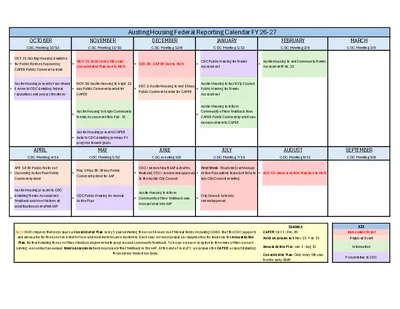
◦ ◦ ◦ ◦ OCTOBER CDC Meeting 10/13 NOVEMBER CDC Meeting 11/10 DECEMBER CDC Meeting 12/8 JANUARY CDC Meeting 1/12 FEBRUARY CDC Meeting 2/9 MARCH CDC Meeting 3/9 Austing Housing Federal Reporting Calendar FY 26-27 OCT 31: Austing Housing deadline for Public Notice of upcoming CAPER Public Comment period ◦ NOV 15, 2029 (every 5th year) - Consolidated Plan due to HUD ◦ DEC 29 - CAPER due to HUD ◦ CDC Public Hearing for Needs Assessment ◦ Austin Housing to end Community Needs Assessment Feb. 15 Austin Housing presents Year Ahead Review to CDC detailing federal regulations and project timelines ◦ NOV 16: Austin Housing to begin 15 day Public Comment period for CAPER ◦ DEC 2: Austin Housing to end 15 day Public Comment period for CAPER ◦ Austin Housing to host City Council Public Hearing for Needs Assessment ◦ ◦ Austin Housing to begin Community Needs Assessment thru Feb. 15 Austin Housing presents CAPER data to CDC detailing previous FY progress toward goals ◦ Austin Housing to inform Community of how feedback from CAPER Public Comment period was incorporated into CAPER APRIL CDC Meeting 4/14 MAY CDC Meeting 5/12 JUNE CDC meeting 6/9 JULY CDC Meeting 7/14 AUGUST CDC Meeting 8/11 SEPTEMBER CDC Meeting 9/8 APR 14-30: Public Notice of Upcoming Action Plan Public Comment period Austin Housing present to CDC detailing Needs Assessment feedback and how it informed modifications in drafted AAP ◦ May 1-May 30: 30 day Public Comment period for AAP ◦ CDC Public Hearing for Annual Action Plan ◦ ◦ CDC review of draft AAP & draft is finalized; CDC recommend approval to the Austin City Council ◦ First Week - Finalized Draft Annual Action Plan added to docket for late July City Council meeting ◦ AUG 15 - Annual Action Plan due to HUD Austin Housing to inform Community of how feedback was incorporated into AAP ◦ City Council late July review/approval Note: HUD requires that we prepare a Consolidated Plan every 5 years detailing the use of 4 sources of federal funds, including CDBG, that the CDC supports and advocates for the use of on behalf of low- and moderate-income Austinites. Each year, we must prepare a reapplication for funds via the Annual Action Plan, further detailing the use of those funds in alignment with progress and community feedback. To be sure we are receptive to the needs of those we …
COMMUNITY DEVELOPMENT COMMISSION RECOMMENDATION 20261013-04 Recommendation on the CDC Election Process RECOMMENDATION Whereas, the Austin Community Development Commission (CDC) consists of eight members democratically selected to represent residents from each of the eight geographic areas of Travis County, in order to represent low-income populations eligible to be served under the Community Services Block Grant (CSBG); Whereas, Board members serve for a term of four years beginning March 1 of the year of appointment; Whereas, the eight democratically selected members shall serve an initial two-year term, with an additional maximum of two consecutive four-year terms; Whereas, a transparent, accessible, and well-communicated election process is essential to ensuring meaningful participation by low-income residents and individuals with lived experience; Whereas, community members have expressed that current election notifications do not provide adequate time for outreach, planning, or participation; Whereas, community members have also noted confusion regarding the steps required to vote or to become a candidate, indicating a need for clearer instructions and educational materials; Whereas, greater engagement between current CDC members, candidates, and community organizations would increase trust, strengthen relationships, and improve civic participation; Now, therefore, be it resolved that the Austin Community Development Commission advises Austin Public Health to widely advertise the CDC election and election process at least one month in advance, using multiple reminders and multiple communication platforms to reach as many community members as possible. Be it further resolved that the Commission advises Austin Public Health to provide training and educational materials on the election process, the history and purpose of the Commission, roles and responsibilities of commissioners, and how community members can participate. Be it further resolved that the Commission advises Austin Public Health to strengthen communication and outreach regarding deadlines, eligibility requirements, and step-by-step voting instructions to prevent confusion and increase accessibility. Be it further resolved that the Commission advises Austin Public Health to provide opportunities for prospective candidates to learn about CDC roles and responsibilities prior to the election cycle. Be it further resolved that the Commission advises increasing community-facing information that highlights the CDC’s focus on low-income populations and people with lived experience, ensuring these communities know the election is intended for them. Be it further resolved that the Commission advises providing clear, accessible instructions—both in writing and through optional training—on how to cast a vote, how to submit candidate information, and how community organizations can properly conduct their elections. Be it further resolved …