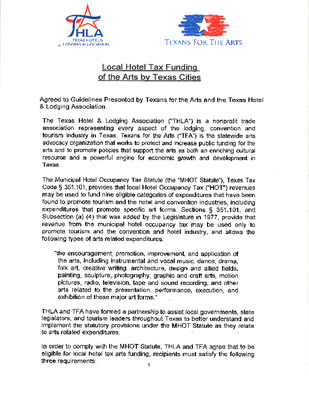
REGULAR MEETING of the TOURISM COMMISSION BOARD WEDNESDAY, JANUARY 14, 2026, AT 2:30 P.M. CITY HALL, COUNCIL CHAMBERS ROOM 1001 300 W. 2ND STREET AUSTIN, TEXAS Some members of the Tourism Commission may be participating by videoconference. The meeting may be viewed online at: http://www.austintexas.gov/page/watch-atxn-live Public comment will be allowed in-person or remotely via telephone. Speakers may only register to speak on an item once either in-person or remotely and will be allowed up to three minutes to provide their comments. Registration no later than noon the day before the meeting is required for remote participation by telephone. To register to speak remotely, contact Felicia Burleson, (512) 978-1325 or felicia.burleson@austintexas.gov CURRENT COMMISSIONERS: Ed Bailey, Chair, D5 Greg Chanon, D2 Francisco “Cisco” Gamez, D1 Anna Panossian, Mayoral Dan Webb, D7 District 9 (vacant) Cristina Masters, Vice Chair, D10 Bishop Chappell, D6 Stefani Mathis, D8 Dani Pruitt, D3 District 4 (vacant) AGENDA CALL TO ORDER PUBLIC COMMUNICATION: GENERAL The first [10] speakers signed up prior to the meeting being called to order will each be allowed a three-minute allotment to address their concerns regarding items not posted on the agenda. APPROVAL OF MINUTES 1. Approve the minutes of the Tourism Commission Board Regular Meeting on December 10, 2025 STAFF BRIEFINGS 2. Staff briefing from Staff Liaison, Felicia Burleson, regarding commission board recent vacancy filled and status, deadlines, resources, and updates. DISCUSSION ITEMS 3. Presentation by the Austin Tourism Public Improvement District (ATPID) regarding the 10- year service plan and introduction of the Executive Director, Tim Sullivan. 4. Presentation by the Texas Hotel & Lodging Association regarding the Legislative actions from the 2025 Regular Session impacting the state’s hospitality industry, as well as upcoming issues anticipated in the next Regular Session. Including an overview of the Austin Tourism Public Improvement District (ATPID) and how TPIDs operate from the state perspective, including examples of other TPID initiatives in Texas cities.), and the use of Hotel Occupancy Tax (HOT) funds, Presentation by Scott Joslove, President & CEO. DISCUSSION AND ACTION ITEMS 5. Discussion and approval of the Tourism Commission 2026 annual schedule and strategic roadmap. WORKING GROUP UPDATE 6. Update from the Short-Term Rental Working Group on any new reports regarding the STR’s new focus and efforts for recommendations. FUTURE AGENDA ITEMS ADJOURNMENT The City of Austin is committed to compliance with the Americans with Disabilities Act. Reasonable modifications and equal access to communications will …
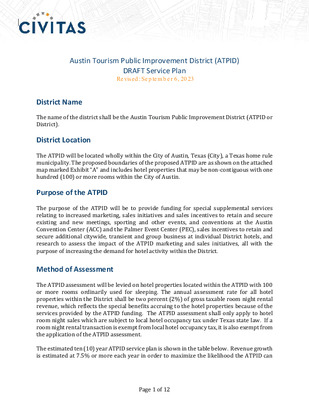
Version 2 Austin Tourism Public Improvement District (ATPID) DRAFT Service Plan Re vise d : Se p te m b e r 6, 20 23 District Name The name of the district shall be the Austin Tourism Public Improvement District (ATPID or District). District Location The ATPID will be located wholly within the City of Austin, Texas (City), a Texas home rule municipality. The proposed boundaries of the proposed ATPID are as shown on the attached map marked Exhibit “A” and includes hotel properties that may be non-contiguous with one hundred (100) or more rooms within the City of Austin. Purpose of the ATPID The purpose of the ATPID will be to provide funding for special supplemental services relating to increased marketing, sales initiatives and sales incentives to retain and secure existing and new meetings, sporting and other events, and conventions at the Austin Convention Center (ACC) and the Palmer Event Center (PEC), sales incentives to retain and secure additional citywide, transient and group business at individual District hotels, and research to assess the impact of the ATPID marketing and sales initiatives, all with the purpose of increasing the demand for hotel activity within the District. Method of Assessment The ATPID assessment will be levied on hotel properties located within the ATPID with 100 or more rooms ordinarily used for sleeping. The annual assessment rate for all hotel properties within the District shall be two percent (2%) of gross taxable room night rental revenue, which reflects the special benefits accruing to the hotel properties because of the services provided by the ATPID funding. The ATPID assessment shall only apply to hotel room night sales which are subject to local hotel occupancy tax under Texas state law. If a room night rental transaction is exempt from local hotel occupancy tax, it is also exempt from the application of the ATPID assessment. The estimated ten (10) year ATPID service plan is shown in the table below. Revenue growth is estimated at 7.5% or more each year in order to maximize the likelihood the ATPID can Page 1 of 12 access all potential revenues during each fiscal year. It is possible that the actual revenues each year will be less than this projection. Fiscal Year* Convention Center Sales & Group Business Incentives (Max 20%) Marketing and Additional Sales Outreach (Min 60%) Hotel Activity Incentive Program (10%) Research & Administration (10%) Total 2023-24 2024-25** …
What Cities Need to Know to Administer Municipal Hotel Occupancy Taxes Texas Hotel & Lodging Association REVISED JUNE 2025 What Cities Need to Know to Administer Municipal Hotel Occupancy Taxes Table of Contents INTRODUCTION ............................................................................................................................... 4 AUTHORIZED MUNICIPALITIES ........................................................................................................ 4 COLLECTING THE TAX ...................................................................................................................... 5 EXEMPTIONS FROM THE LOCAL TAX .............................................................................................. 6 THLA’S SIMPLIFIED HOTEL OCCUPANCY TAX EXEMPTION RULES .................................................. 9 HOW THE CITY RECEIVES THE MUNICIPAL HOTEL OCCUPANCY TAX ........................................... 11 REIMBURSEMENT TO A HOTEL FOR COLLECTION EXPENSES, AND USE OF LOCAL HOTEL OCCUPANCY TAX REVENUES BY A CITY FOR TAX COLLECTION COSTS ......................................... 11 PENALTIES FOR FAILURE TO REPORT OR COLLECT THE TAX ........................................................ 12 ENFORCEMENT AUTHORITY OF A CITY ......................................................................................... 13 USE OF LOCAL HOTEL OCCUPANCY TAX REVENUES ..................................................................... 14 Criteria #1: First, every local hotel occupancy tax revenue expenditure must DIRECTLY enhance and promote tourism AND the convention and hotel industry. ........................................................................................................ 14 Criteria #2: Every expenditure of the hotel occupancy tax must clearly fit into one of nine statutorily provided categories for expenditure of local hotel occupancy tax revenues. ............................................................................ 16 Funding the establishment, improvement, or maintenance of a convention center or visitor information 16 17 Paying the administrative costs for facilitating convention registration. Paying for advertising, solicitations, and promotions that attract tourists and convention delegates to Expenditures that promote the arts. Funding historical restoration or preservation programs. Funding certain expenses, including promotional expenses, directly related to a sporting event within Funding the enhancement or upgrading of existing sports facilities or sports fields for certain 1) center. 2) 3) the city or its vicinity. 4) 5) 6) counties with a population of under one million. 7) municipalities. 8) 9) municipality. Funding transportation of tourists from hotels to attractions Signage directing tourists to sights and attractions that are visited frequently by hotel guests in the 24 Summary of the Nine Uses for the Local Hotel Occupancy Tax ................................................................................... 24 ADMINISTERING HOTEL OCCUPANCY TAX REVENUE EXPENDITURES .......................................... 25 Duty of funded entities to provide a list of activities. ................................................................................................. 25 Delegating management of funded activities.............................................................................................................. 26 2 Texas Hotel & Lodging Association, 2025 17 17 20 20 21 23 What Cities Need to Know to Administer Municipal Hotel Occupancy Taxes Use of hotel occupancy tax revenues to cover administrative expenses. ................................................................... 26 SPECIAL RULES FOR CERTAIN MUNICIPALITIES ............................................................................ 28 QUALIFIED HOTEL PROJECT (QHP) INCENTIVES: .......................................................................... 40 ADDITIONAL INFORMATION ......................................................................................................... 44 3 Texas Hotel & Lodging Association, 2025 …

REGULAR MEETING TOURISM COMMISSION MINUTES WEDNESDAY, JANUARY 14, 2026 The Tourism Commission Board convened in a Regular meeting on 14, January 2026, at 301 w. Second St. in Austin, Texas. Vice Chair Ed Bailey called the Tourism Commission Board Meeting to order at 2:33 p.m. Board Members or Commissioners in Attendance: Chair Ed Bailey, Vice Chair Cristina Masters, Commissioners Greg Chanon, Bishop Chappell, Francisco “Cisco” Gamez, Stefani Mathis, Anna Panossian, and Dani Pruitt Board Members or Commissioners in Absence: Commissioner Dan Webb PUBLIC COMMUNICATION: GENERAL Daniel Ronan, former Commissioner of the Tourism Commission, to give his support. APPROVAL OF MINUTES 1. Approve the minutes of the Tourism Commission Board Regular Meeting on December 10, 2025 The minutes from the Tourism Commission Board Regular Meeting on December 10, 2025, were approved on Commissioner Pruitt’s motion, Commissioner Chanon’s second on an 8-0 vote. Commissioner Dan Webb was absent STAFF BRIEFINGS 2. Staff briefing regarding the reminder of the upcoming 2026 calendar dates have conflict and need discussion and approval of changes needed. The presentation was made by Felicia Burleson, Staff Liaison, Austin Convention Center Department. DISCUSSION ITEMS 3. Discussion regarding the Legislative actions from the 2025 Regular Session impacting the state’s hospitality industry, as well as upcoming issues anticipated in the next Regular Session. Including an overview of the Austin Tourism Public Improvement District (ATPID) and how TPIDs operate from the state perspective, including examples of other TPID initiatives in Texas cities.), and the use of Hotel Occupancy Tax (HOT) funds, Presented by Scott Joslove, President & CEO. 1 Discussed. DISCUSSION AND ACTION ITEMS 4. Discussion and approval of the Tourism Commission 2026 annual schedule and strategic roadmap. Discussed. a. The motion to approve a Special Called Meeting for February 9, 2026, and cancel the Regular Meeting for February 11, 2026, was approved in Commissioner Gamez’s motion, Commissioner Panossian’s second on an 8-0 vote. Commissioner Dan Webb was absent. b. The motion to cancel a Regular Meeting for August 12, 2026, was approved in Commissioner Panossian’s motion, Commissioner Chanon’s second on an 8-0 vote. Commissioner Dan Webb was absent. c. The motion to approve a Special Called Meeting for November 16, 2026, and cancel the Regular Meeting for November 11, 2026, was approved in Commissioner Gamez’s motion, Commissioner Pruitt’s second on an 8-0 vote. Commissioner Dan Webb was absent. d. Commissioner Pruitt recommends inviting C3 and the Moody Center as event industry …