REGULAR MEETING OF THE RESOURCE MANAGEMENT COMMISSION June 16, 2026 6:00 p.m. Austin Energy Headquarters; 1st Floor; Shudde Fath Conference Room 4815 Mueller Blvd, Austin, Texas 78723 Some members of the Resource Management Commission maybe participating by video conference. Public comment will be allowed in-person or remotely by telephone. Speakers may only register to speak on an item once either in-person or remotely and will be allowed up to three minutes to provide their comments. Registration no later than noon the day before the meeting is required for remote participation. To register contact Natasha Goodwin, at Natasha.Goodwin@austinenergy.com or 512-322-6505. Members: Charlotte Davis, Chair Paul Robbins, Vice Chair Kamil Cook CALL MEETING TO ORDER AGENDA Trey Farmer Harry Kennard Martin Luecke Raphael Schwartz Alison Silverstein PUBLIC COMMUNICATION: GENERAL The first 5 speakers signed up prior to the meeting being called to order will each be allowed a three-minute allotment to address their concerns regarding items not posted on the agenda. APPROVAL OF MINUTES 1. Approve the minutes of the Special Called Resource Management Commission Meeting on May 19, 2026. STAFF BRIEFING 2. Staff briefing on highlights of Austin Water’s 2026 Q1 Report on Water Management Strategy Implementation by Kevin Critendon, Assistant Director, Environmental, Planning and Development Services, Austin Water. 3. Staff briefing on the Drought Forecast Update by Kevin Critendon, Assistant Director, Environmental, Planning and Development Services, Austin Water. 4. Staff briefing on Large Industrial and Commercial Customer Water Usage and Conservation Trends by Kevin Critendon, Assistant Director, Environmental, Planning and Development Services, Colleen Kirk, Managing Engineer, Katherine Jashinski, Supervising Engineer, and Christina Romero, Interim Assistant Director, Austin Water. DISCUSSION AND ACTION ITEMS 5. Recommend approval of the Austin Water Capital Improvement Projects located in the Drinking Water Protection Zone for approval to include in the 5-year Capital spending plan as required by Financial Policy #8. 6. Discussion and recommendation regarding an audit of Austin Energy’s District Energy and Cooling System. The City of Austin is committed to compliance with the Americans with Disabilities Act. Reasonable modifications and equal access to communications will be provided upon request. For assistance, please contact the Liaison or TTY users’ route through 711. A person may request language access accommodations no later than 48 hours before the scheduled meeting. Please call or email Natasha Goodwin at Austin Energy, at (512) 322-6505 or Natasha.Goodwin@austinenergy.com to request service or for additional information. For more information on the …
Water Management Strategy Implementation REPORT First Quarter 2026, January - March May 14, 2026 Contents First Quarter Summary Water Conservation Updates Water Loss Reduction Updates Reclaimed Water and Onsite Reuse Updates Conservation Outreach Updates Water Supply Project Updates Water Use and GPCD Notes Regarding Data 2 Fourth Quarter Summary The Water Management Strategy Implementation Report is intended to provide transparency and accountability regarding the execution of strategies from the 2024 Water Conservation Plan and the 2024 Water Forward Plan. The plans include proactive and substantial demand management strategies and innovative local supply strategies, but the hard work necessary to complete the strategies and meet the goals are illustrated in the implementation reports. Austin’s first quarter water use was similar to previous years. Water loss mitigation activities and the development of the reclaimed system continued. While water conservation rebates are generally modest during the first three months of the year, the utility was putting down roots through: Customer outreach, Community events, Pilots of water loss-mitigation equipment, and Progressing with reclaimed water system projects. 3 Water Conservation Updates New water conservation community outreach grant (up to $3,000) was awarded to 5 organizations Shoal Creek Conservancy, 2026 Waterwise Landscapes Tour, March 21 Spring community events focusing on landscaping Landscape transformation limit on irrigation systems for new homes will be clarified as a Rule in late 2026 4 Water Conservation Metrics Residential Rebate Programs Approved Rebates 50 45 40 35 30 25 20 15 10 5 0 Drought Survival Tools Irrigation Upgrades Rainwater Harvesting Rebates WaterWise Landscape WaterWise Rainscape Other Residential Programs Q1 2025-Q4 2025 Q1 2026 5 Water Conservation Metrics Commercial Rebate Programs 5 4 3 2 1 0 Approved Rebates 4 4 3 1 1 Bucks for Business Q1 2025-Q4 2025 Q1 2026 6 Water Conservation Metrics Compliance Assessments Number of Compliant Commercial Facilities Number of Compliant Commercial Facilities 3,500 3,000 2,500 2,000 1,500 1,000 500 0 350 300 250 200 150 100 50 0 Landscape Irrigation Assessment Cooling Tower Assessment Vehicle Wash Assessment Q1 2025-Q4 2025 Q1 2026 Q1 2025-Q4 2025 Q1 2026 7 Water Conservation Strategy Milestones (Water Conservation Plan, p. 35-36, Water Forward Plan, p. 34, 36) 2026 Milestones Commercial Incentives Progress Identify opportunities for CII facility owners/managers to benefit from the My ATX Water alerts and information. Landscape transformation Coordinate with Austin …
Drought Outlook Austin Water | Resource Management Commission Meeting | June 16, 2026 Highland Lakes Inflows 2 Lakes Buchanan & Travis Combined Storage 3 U.S. Drought Monitor 4 NOAA 3-month Outlook: July – September The seasonal outlooks combine long-term trends, soil moisture, and El Nino/Southern Oscillation. 5 NOAA El Niño/Southern Oscillation Forecast El Niño is likely to emerge soon (82% chance in May-July) and continue through the Northern Hemisphere winter 2026-27 (96% chance in Dec 2026 – Feb 2027). 6 Lakes Buchanan & Travis Combined Storage Projections 7 Questions? 8
Large Water User Overview Resource Management Commission Austin Water | June 16, 2026 Current Water Supplies Austin’s Water Supplies Supply: 325,000 Acre Feet Per Year Centralized Reclaimed System State-granted water rights to the Colorado River and a contract with the Lower Colorado River Authority (LCRA) for Highland Lakes stored water Total supplies of up to 325,000 acre- feet per year LCRA reservation and use fees pre- paid in 1999 Additional use payments trigger when average for two consecutive years exceeds 201,000 AFY 3 3 Service Area and Requirement to Provide Service City of Austin Jurisdictions Austin Water Service Area AW's Service Area is the Council-adopted water and wastewater impact fee service area Approved/amended by Council at 5-year cadence Service outside the Service Area is prohibited, unless authorized by Ordinance Water & Wastewater impact fees are assessed within the Service Area 5 City of Austin Jurisdictions Austin Water Service Area Jurisdictions within the Service Area City's full-purpose jurisdiction Limited-purpose jurisdiction Extraterritorial jurisdiction (ETJ) Unincorporated parts of the county (Travis, Williamson, Hays & Bastrop) 6 Austin Water Service Area Wholesale Customers deliver retail service within their designated service area and rely on the City for water and wastewater treatment 5 Surrounding Cities 5 Municipal Utility Districts 2 Water Control and Improvement Districts 5 Other Water Utilities and Water Supply Corporations 7 Austin Water and other Providers CCNs Certificates of Convenience & Necessity (CCN) within the Service Area City of Austin Water CCNs City of Austin Wastewater CCNs Administered by the Public Utility Commission of Texas Grants City the exclusive right to provide retail water or wastewater service Legal obligation to provide "continuous and adequate service" within a geographic area 8 Utility Planning, Development Process and Water Benchmarking Utility Planning Process Overview Water Forward, Integrated Water Resource Plan Planning for a reliable water supply for the next 100 years Long Range Infrastructure Plans Capital Improvement Program Planning Planning for water, wastewater, and reclaimed infrastructure for the next 50 years Infrastructure and investment decisions for the next five and ten years 10 Development Process Overview Service Extension Request Land Development Review • Subdivision Plan Review • Site Plan Review • Water Benchmarking Application Building Review • Building Permit • Construction Inspections Evaluation of suitable and sufficient service for customers seeking to connect to AW systems Engagement …

To: From: Date: Subject: MEMORANDUM Environmental Commission, Resource Management Commission, and Water and Wastewater Commission Shay Ralls Roalson, P.E., Austin Water Director May 28, 2026 Board and Commission Review of Capital Improvement Projects in the Drinking Water Protection Zone The purpose of this memorandum is to provide a report of Capital Improvement Projects (CIP) located within the City’s Drinking Water Protection Zone (DWPZ), in accordance with Austin Water’s Financial Policy No. 8. The DWPZ designation and the associated financial policy, adopted by City Council, are included in the Appendix and outline the requirements for identifying, reviewing, and obtaining Board and Commission input on capital projects within western Austin and Travis County. The DWPZ is subject to development regulations to protect water quality and contains critical water resources that support both the environment and the community. Together, these policies establish the process through which capital projects in the DWPZ are submitted as part of the annual budget process as part of Austin Water’s comprehensive five-year capital improvement plan. The Fiscal Year 27–31 CIP includes projects located throughout the Austin metropolitan area, including the DWPZ. These projects are essential improvements to maintain and enhance Austin Water’s services and operational standards. Austin Water has a robust and comprehensive asset management and capital planning program, in which condition, capacity, and level of service are reviewed annually to validate these investments in resiliency, preparedness, and proactive infrastructure management. The CIP projects in the DWPZ are shown in the attached CIP Subproject Supplemental Information Summary and Map. Should you have any questions, please contact Randi Jenkins, Deputy Director of Technical Services of Austin Water at randi.jenkins@austintexas.gov or 512-972-0133. Page 1 of 6 Date: Subject: May 28, 2026 Board and Commission Review of Capital Improvement Projects in the Drinking Water Protection Zone Index of Attachments Attachment 1: Table outlining the CIP subprojects located within the Drinking Water Protection Zone, including their descriptions, current status, and associated five-year and total spending plans. Attachment 2: DWPZ Map displaying the geographic location of all active CIP subprojects within the Drinking Water Protection Zone. Attachment 3: Appendix provides supporting definitions. Page 2 of 6 Date: Subject: May 28, 2026 Board and Commission Review of Capital Improvement Projects in the Drinking Water Protection Zone ATTACHMENT 1: PROJECT SUMMARY Page 3 of 6 Subproject IDSubproject NameSubproject DescriptionProject StatusFY27-31 Spending PlanTotal Spending Plan2015.118Davis WTP Medium Service Pump Station ExpansionThis project is for the expansion …
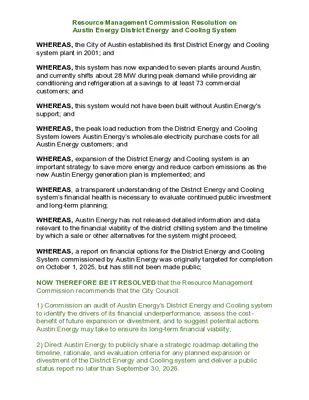
Resource Management Commission Resolution on Austin Energy District Energy and Cooling System WHEREAS, the City of Austin established its first District Energy and Cooling system plant in 2001; and WHEREAS, this system has now expanded to seven plants around Austin, and currently shifts about 28 MW during peak demand while providing air conditioning and refrigeration at a savings to at least 73 commercial customers; and WHEREAS, this system would not have been built without Austin Energy's support; and WHEREAS, the peak load reduction from the District Energy and Cooling System lowers Austin Energy’s wholesale electricity purchase costs for all Austin Energy customers; and WHEREAS, expansion of the District Energy and Cooling system is an important strategy to save more energy and reduce carbon emissions as the new Austin Energy generation plan is implemented; and WHEREAS, a transparent understanding of the District Energy and Cooling system’s financial health is necessary to evaluate continued public investment and long-term planning; WHEREAS, Austin Energy has not released detailed information and data relevant to the financial viability of the district chilling system and the timeline by which a sale or other alternatives for the system might proceed; WHEREAS, a report on financial options for the District Energy and Cooling System commissioned by Austin Energy was originally targeted for completion on October 1, 2025, but has still not been made public; NOW THEREFORE BE IT RESOLVED that the Resource Management Commission recommends that the City Council: 1) Commission an audit of Austin Energy's District Energy and Cooling system to identify the drivers of its financial underperformance, assess the cost- benefit of future expansion or divestment, and to suggest potential actions Austin Energy may take to ensure its long-term financial viability; 2) Direct Austin Energy to publicly share a strategic roadmap detailing the timeline, rationale, and evaluation criteria for any planned expansion or divestment of the District Energy and Cooling system and deliver a public status report no later than September 30, 2026.
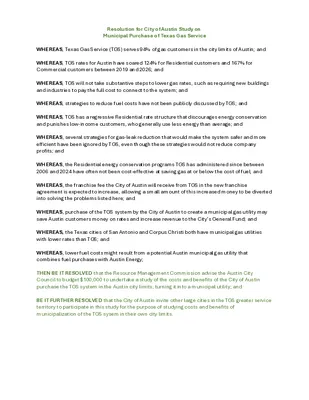
Resolution for City of Austin Study on Municipal Purchase of Texas Gas Service WHEREAS, Texas Gas Service (TGS) serves 94% of gas customers in the city limits of Austin; and WHEREAS, TGS rates for Austin have soared 124% for Residential customers and 167% for Commercial customers between 2019 and 2026; and WHEREAS, TGS will not take substantive steps to lower gas rates, such as requiring new buildings and industries to pay the full cost to connect to the system; and WHEREAS, strategies to reduce fuel costs have not been publicly discussed by TGS; and WHEREAS, TGS has a regressive Residential rate structure that discourages energy conservation and punishes low-income customers, who generally use less energy than average; and WHEREAS, several strategies for gas-leak reduction that would make the system safer and more efficient have been ignored by TGS, even though these strategies would not reduce company profits; and WHEREAS, the Residential energy conservation programs TGS has administered since between 2006 and 2024 have often not been cost-effective at saving gas at or below the cost of fuel; and WHEREAS, the franchise fee the City of Austin will receive from TGS in the new franchise agreement is expected to increase, allowing a small amount of this increased money to be diverted into solving the problems listed here; and WHEREAS, purchase of the TGS system by the City of Austin to create a municipal gas utility may save Austin customers money on rates and increase revenue to the City’s General Fund; and WHEREAS, the Texas cities of San Antonio and Corpus Christi both have municipal gas utilities with lower rates than TGS; and WHEREAS, lower fuel costs might result from a potential Austin municipal gas utility that combines fuel purchases with Austin Energy; THEN BE IT RESOLVED that the Resource Management Commission advise the Austin City Council to budget $100,000 to undertake a study of the costs and benefits of the City of Austin purchase the TGS system in the Austin city limits, turning it into a municipal utility; and BE IT FURTHER RESOLVED that the City of Austin invite other large cities in the TGS greater service territory to participate in this study for the purpose of studying costs and benefits of municipalization of the TGS sysem in their own city limits.
Lowering cost and time for solar deployment in Austin Presented to EUC, RMC, AE, ADS David Levesque, Stan Pipkin 4/30/26 & 6/10/26 Desired outcome ● RMC resolution that creates a working group to find solutions ○ ○ Including all stakeholders: AE Solar, AE Metering, All ADS Dept., Contractors, etc In person meetings to review and implement options that enable achievement of our mutual goals Problem ● Complex slow process for customer sited solar in Austin which increases costs, reduces customer satisfaction, and has potential to miss our Citywide local solar goals. Goals ● 405 MW local solar by 2035 ● Within the values of Austin and Austin Energy ○ Reliable ○ Affordable ○ Clean ○ Equitable ● Healthy solar contractor industry ● Positive view of solar by Austin residents and businesses Who are we? ● Industry ○ Stan Pipkin: 20 year veteran ■ Operating as a Participating Contractor with Austin Energy in Residential, Commercial and Municipal solar projects ○ David Levesque: 1 year novice ■ Operating as Owner’s Representative for Solar Austin Community Solar Program Solutions ● Best practices that lower cost and increase speed ● Develop Repeatable, Scalable Processes ● Normalize Solar Permitting and Interconnection where possible ● Develop Processes that respond to Industry Changes and Innovations rapidly ○ Details to be discussed in the working group Proposed working group members 1. Austin Energy Solar 2. Austin Energy Metering 3. ADS Departments 4. Contractors/EPC/Installers 5. Solar Austin 6. Permit expeditors 7. Feedback from a. EUC b. RMC c. d. Solar customers via a survey TXSES 120 days start to complete on average (Permit to Closeout) This Timeline does not reflect the full elapsed time from Contract to Closeout 2025 may represent outlier due to ITC expiration time pressures Potential areas of improvement ● Single department that can make decisions ● Data management & Process ○ Capture ○ Cleanliness ○ Accuracy ○ Access ○ User experience ○ Error rates ● Time from step to step in the process ○ EECP for example Permit and Inspection Timelines AE stated times (not including ADS) Actual wait times 1. Residential 6-11 weeks 2. Commercial is longer Datasets seem siloed Jotform 1. EECP 2. AMANDA 3. AB+C 4. 5. PDFs 6. Emails 7. Chats 8. Phone calls 9. TCAD Data errors cause months of delays 1. 900 Springdale Rd. Address: 1.5 months 2. KOOP Radio Address: 3 months 3. Vesper shutdown: 1.5 months Data …

Energy Efficiency Services - Commercial and Multifamily Enrollment Pipeline 6/1/2026 Program WFS Location Name Installation Address Commercial Rebates 3-Installation 90 RAINEY STREET, LLC 610 DAVIS ST UNIT MS1 Council District 9 Multifamily Income Qualified Multifamily Income Qualified Multifamily Income Qualified Multifamily Income Qualified Multifamily Income Qualified Multifamily Rebates 3-Installation AAHC CDT BRIDGE AT ASHER 10505 S IH 35 SVRD NB CH 3-Installation LLC FBCC CITY POINT LP 1071 CLAYTON LN UNIT 17 3-Installation 12113 METRIC BOULEVARD HOLDINGS LLC 12113 METRIC BLVD 1 3-Installation WATER PARK BORROWER LP 3401 W PARMER LN 3-Installation ASHFORD COSTA BRAVA LP 6407 SPRINGDALE RD UNIT 1 3-Installation CATH LLC 7601 RIALTO BLVD UNIT TC Multifamily Rebates 3-Installation 740 WEST ELM LLC 1044 CAMINO LA COSTA UNIT 10 5 4 7 7 1 8 4 Measures Est. kWh Savings Est. $ Incentive Cooling Tower, HVAC, Lighting New Construction ECAD Incentive, Smart PPT Eligible Thermostat, HVAC Tune-Up Attic Insulation, ECAD Incentive, Lighting, Smart PPT Eligible Thermostat, Supplemental Measure, HVAC Tune-Up, Water Saving Devices ECAD Incentive, Smart PPT Eligible Thermostat, HVAC Tune-Up Smart PPT Eligible Thermostat, HVAC Tune-Up 682,557.7300 $123,246.11 428,247.0232 $208,074.00 351,388.8342 $232,056.00 309,895.3499 $192,802.00 398,513.4860 $231,440.00 Smart PPT Eligible Thermostat, HVAC Tune-Up 209,398.0262 $111,384.00 Attic Insulation, Duct Sealing and Remediation, Lighting, Smart PPT Eligible Thermostat, HVAC Tune-Up, Water Saving Devices HVAC Tune-Up 307,351.5674 $75,902.21 130,688.6302 $108,576.00 $1,283,480.32 Rebate Fact Sheet - Energy Efficiency Services May 2026 Rebate Program Enrollment Property Information Commercial Rebates 1360039 Customer or Property HYATT CORPORATION Property Address Year Built * 208 BARTON SPRINGS RD AUSTIN, TX 78704 Total Number of Rentable Units N/A Building Total Square Feet 268087 Measure ** Rebates and Estimated Annual Savings Est. Kilowatt (kW) Reduction Est. Kilowatt- hours (kWh) Reduction Est. $/kW Rebate per Tenant Unit Total Rebate Lighting 280.3 722,019 $300 $83,984 Total *** 280.3 * Year built may not include major renovations ** Fact sheets include final inspection information, and some values may have changed since original proposal. *** Assumes 100% Occupancy 722,019 $83,984 $300 Energy Efficiency Rebates in Past 10-Years Date (Year) Measure Rebate Amount N/A Rebate Fact Sheet - Energy Efficiency Services May 2026 Rebate Program Enrollment Property Information Multifamily Income Qualified 1344354 Customer or Property Bridge at Henly Property Address Year Built * Total Number of Rentable Units Building Total Square Feet 6107 E RIVERSIDE DR UNIT CLUB AUSTIN, TX 78741 2020 368 N/A Measure ** Rebates and Estimated Annual Savings Est. Kilowatt …
BOARD/COMMISSION RECOMMENDATION Resource Management Commission Recommendation No. 20260616-006 Recommendation on Austin Energy District Energy and Cooling System WHEREAS, the City of Austin established its first District Energy and Cooling system plant in 2001; and WHEREAS, this system has now expanded to seven plants around Austin, and currently shifts about 28 MW during peak demand while providing air conditioning and refrigeration at a savings to at least 73 commercial customers; and WHEREAS, this system would not have been built without Austin Energy's support; and WHEREAS, the peak load reduction from the District Energy and Cooling System lowers Austin Energy’s wholesale electricity purchase costs for all Austin Energy customers; and WHEREAS, expansion of the District Energy and Cooling system is an important strategy to save more energy and reduce carbon emissions as the new Austin Energy generation plan is implemented; and WHEREAS, a transparent understanding of the District Energy and Cooling system’s financial health is necessary to evaluate continued public investment and long-term planning; WHEREAS, Austin Energy has not released detailed information and data relevant to the financial viability of the district chilling system and the timeline by which a sale or other alternatives for the system might proceed; WHEREAS, a report on financial options for the District Energy and Cooling System commissioned by Austin Energy was originally targeted for completion on October 1, 2025, but has still not been made public; NOW THEREFORE BE IT RESOLVED that the Resource Management Commission recommends that the City Council: 1) Commission an audit of Austin Energy's District Energy and Cooling system to identify the drivers of its financial underperformance, assess the cost-benefit of future expansion or divestment, and to suggest potential actions Austin Energy may take to ensure its long-term financial viability; 2) Direct Austin Energy to publicly share a strategic roadmap detailing the timeline, rationale, and evaluation criteria for any planned expansion or divestment of the District Energy and Cooling system and deliver a public status report no later than September 30, 2026. Date of Approval: June 16, 2026 Vote: 7-0 Motioned By: Commissioner Kennard Seconded By: Commissioner Silverstein For: Against: Abstentions: Off Dais: Absences: Vacancies: Attest: Commissioner Charlotte Davis, Chair; Commissioner Paul Robbins, Vice Chair; Commissioner Kamil Cook; Commissioner Harry Kennard; Commissioner Martin Luecke; Commissioner Raphael Schwartz; Commissioner Alison Silverstein None None None Commissioner Trey Farmer Mayor; District 6; District 8 Natasha Goodwin, Staff Liaison
BOARD/COMMISSION RECOMMENDATION Resource Management Commission Recommendation No. 20260616-007 Recommendation on a City of Austin Study for Municipal Purchase of Texas Gas Service WHEREAS, Texas Gas Service (TGS) serves 94% of gas customers in the city limits of Austin; and WHEREAS, TGS rates for Austin have soared 124% for Residential customers and 167% for Commercial customers between 2019 and 2026; and WHEREAS, TGS will not take substantive steps to lower gas rates, such as requiring new buildings and industries to pay the full cost to connect to the system; and WHEREAS, strategies to reduce fuel costs have not been publicly discussed by TGS; and WHEREAS, TGS has a regressive Residential rate structure that discourages energy conservation and punishes low-income customers, who generally use less energy than average; and WHEREAS, several strategies for gas-leak reduction that would make the system safer and more efficient have been ignored by TGS, even though these strategies would not reduce company profits; and WHEREAS, the Residential energy conservation programs TGS has administered since between 2006 and 2024 have often not been cost-effective at saving gas at or below the cost of fuel; and WHEREAS, the franchise fee the City of Austin will receive from TGS in the new franchise agreement is expected to increase, allowing a small amount of this increased money to be diverted into solving the problems listed here; and WHEREAS, purchase of the TGS system by the City of Austin to create a municipal gas utility may save Austin customers money on rates and increase revenue to the City’s General Fund; and WHEREAS, the Texas cities of San Antonio and Corpus Christi both have municipal gas utilities with lower rates than TGS; and WHEREAS, lower fuel costs might result from a potential Austin municipal gas utility that combines fuel purchases with Austin Energy; THEN BE IT RESOLVED that the Resource Management Commission advise the Austin City Council to budget $100,000 to undertake a study of the costs and benefits of the City of Austin purchase the TGS system in the Austin city limits, turning it into a municipal utility; and BE IT FURTHER RESOLVED that the City of Austin invite other large cities in the TGS greater service territory to participate in this study for the purpose of studying costs and benefits of municipalization of the TGS system in their own city limits. Date of Approval: June 16, 2026 Vote: 6-0-1 Motioned By: …
Lowering cost and time for solar deployment in Austin Presented to EUC, RMC, AE, ADS David Levesque, Stan Pipkin 4/30/26 & 6/10/26 Who are we? ● Industry ○ Stan Pipkin: 20 year veteran ■ Operating as a Participating Contractor with Austin Energy in Residential, Commercial and Municipal solar projects ○ David Levesque: 1 year novice ■ Operating as Owner’s Representative for Solar Austin Community Solar Program Desired outcome ● RMC resolution that creates a working group to find solutions ○ ○ Including all stakeholders: AE Solar, AE Metering, All ADS Dept., Contractors, etc In person meetings to review and implement options that enable achievement of our mutual goals Problem ● Complex slow process for customer sited solar in Austin which increases costs, reduces customer satisfaction, and has potential to miss our City local solar goals. Goals ● 405 MW local solar by 2035 ● Within the values of Austin and Austin Energy ○ Reliable ○ Affordable ○ Clean ○ Equitable ● Healthy solar contractor industry ● Positive view of solar by Austin residents and businesses Principles of solutions ● Best practices that lower cost and increase speed ● Develop Repeatable, Scalable, Resilient Processes ● Normalize Solar Permitting and Interconnection where possible ● Develop Processes that respond to Industry Changes and Innovations rapidly ○ Details to be discussed in the working group 120 days start to complete on average (Permit to Closeout) This Timeline does not reflect the full elapsed time from Contract to Closeout 2025 may represent outlier due to ITC expiration time pressures Permit and Inspection Timelines AE stated times (not including ADS) Actual wait times 1. Residential 6-11 weeks 2. Commercial is longer Datasets seem siloed Jotform 1. EECP 2. AMANDA 3. AB+C 4. 5. PDFs 6. Emails 7. Chats 8. Phone calls 9. TCAD Data errors/inconsistencies cause months of delays 1. 900 Springdale Rd. a. Address data entry error resolution missing 1.5 month delay 2. KOOP Radio a. Address data entry error resolution missing: 3 month delay 3. Haca Rosewood a. Building permit process out of step with adoption of IECC 2024: 6 month delay Data Strategy: Structured vs Unstructured Data 1. PDFs are unstructured data. Checks, computations, can’t happen without a human. When a human gets involved errors occur. 2. Databases are structured data. The software can perform automatic checks, can share data across departments, can easily create reports. a. Is the name on this application …
RESOURCE MANAGEMENT COMMISSION MEETING MINUTES Tuesday, June 16, 2026 RESOURCE MANAGEMENT COMMISSION REGULAR CALLED MEETING MINUTES Tuesday, June 16, 2026 The Resource Management Commission convened in a Regular Called meeting on Tuesday, June 16, 2026, at Austin Energy Headquarters 4815 Mueller Blvd, Austin, TX 78723. Chair Charlotte Davis called the Resource Management Commission meeting to order at 6:07 p.m. Board Members/Commissioners in Attendance: Commissioner Charlotte Davis, Chair; Commissioner Paul Robbins, Vice Chair; Commissioner Kamil Cook; Commissioner Harry Kennard; Commissioner Martin Luecke Board Members/Commissioners in Attendance Remotely: Commissioner Raphael Schwartz; Commissioner Alison Silverstein Commissioners Absent: Commissioner Trey Farmer PUBLIC COMMUNICATION: General- • Santiago Tzawan – Large Industrial and Commercial Customer Water Usage and Conservation Trends • David Hogan- Solar Installation and Permitting Process • Al Braden- Texas Gas Service and Solar Installation and Permitting Process APPROVAL OF MINUTES 1. Approve the minutes of the Regular Called Resource Management Commission Meeting on May 19, 2026. The motion approving the minutes of the Regular Called Resource Management Commission Meeting on May 19, 2026 was approved on Commissioner Kennard’s motion, Commissioner Luecke’s second on a 6-0 vote with Commissioner Silverstein off the dais, Commissioner Farmer absent, and three vacancies. STAFF BRIEFING 2. Staff briefing on highlights of Austin Water’s 2026 Q1 Report on Water Management Strategy Implementation by Kevin Critendon, Assistant Director, Environmental, Planning and Development Services, Austin Water. The briefing on highlights of Austin Water’s 2026 Q1 Report on Water Management Strategy Implementation was presented by Kevin Critendon, Assistant Director, Environmental, Planning and Development Services, Austin Water. 3. Staff briefing on the Drought Forecast Update by Kevin Critendon, Assistant Director, Environmental, Planning and Development Services, Austin Water. The briefing on the Drought Forecast Update was presented by Kevin Critendon, RESOURCE MANAGEMENT COMMISSION MEETING MINUTES Tuesday, June 16, 2026 Assistant Director, Environmental, Planning and Development Services, Austin Water. 4. Staff briefing on Large Industrial and Commercial Customer Water Usage and Conservation Trends by Kevin Critendon, Assistant Director, Environmental, Planning and Development Services, Colleen Kirk, Managing Engineer, Katherine Jashinski, Supervising Engineer, and Christina Romero, Interim Assistant Director, Austin Water. The briefing on Large Industrial and Commercial Customer Water Usage and Conservation Trends was presented by Kevin Critendon, Assistant Director, Environmental, Planning and Development Services, Colleen Kirk, Managing Engineer, Katherine Jashinski, Supervising Engineer, and Christina Romero, Interim Assistant Director, Austin Water. DISCUSSION AND ACTION ITEMS 5. Recommend approval of the Austin Water Capital Improvement Projects located …