Human Rights Commission Community Interest Announcement Online Town Hall on Disability and Policing in Austin Join our virtual event that centers the experiences of people with disabilities and their lived experiences in Austin, Texas. Event sponsored by Mayor Steve Adler, Office of Police Oversight, Equity Office, and the Mayor's Committee for People with Disabilities. Accommodations available. Please contact either David Ondich david.ondich@austintexas.gov or Lee Nguyen lee.ngyuen@austintexas.gov Wednesday, December 2, 2020 6:00 p.m. – 8:30 p.m. Via Videoconference http://bit.ly/2HaMdG6 A quorum of commission members may be present. No action will be taken. For more information, please contact the commission’s staff liaison, Jonathan Babiak, at (512) 974-3203 or by email at Jonathan.Babiak@austintexas.gov.
November 16, 2020 Regular Meeting of the Human Rights Commission Human Rights Commission to be held November 16, 2020 with Social Distancing Modifications Public comment will be allowed via telephone; no in-person input will be allowed. All speakers must register in advance (Sunday, November 15, 2020 by Noon). All public comment will occur at the beginning of the meeting. To speak remotely at the November 16, 2020 Human Rights Commission Meeting, residents must: •Call or email the board liaison at (512) 974-3276 or jonathan.babiak@austintexas.gov no later than noon, Sunday, November 15, 2020 (the day before the meeting). The information required is the speaker name, item number(s) they wish to speak on, whether they are for/against/neutral, and a telephone number or email address. •Once a request to speak has been called in or emailed to the board liaison, residents will receive either an email or phone call providing the telephone number to call on the day of the scheduled meeting. •Speakers must call in at least 15 minutes prior to meeting start in order to speak, late callers will not be accepted and will not be able to speak. •Speakers will be placed in a queue until their time to speak. •Handouts or other information may be emailed to jonathan.babiak@austintexas.gov by Noon the day before the scheduled meeting. This information will be provided to Board and Commission members in advance of the meeting. •If this meeting is broadcast live, residents may watch the meeting here: http://www.austintexas.gov/page/watch- atxn-live Reunión del Human Rights Commission FECHA de la reunion (November 16, 2020) La junta se llevará con modificaciones de distanciamiento social Se permitirán comentarios públicos por teléfono; no se permitirá ninguna entrada en persona. Todos los oradores deben registrarse con anticipación (November 15, 2020 antes del mediodía). Todos los comentarios públicos se producirán al comienzo de la reunión. Para hablar de forma remota en la reunión, los residentes deben: • Llame o envíe un correo electrónico al enlace de (512) 974-3276 or jonathan.babiak@austintexas.gov a más tardar al mediodía (el día antes de la reunión). La información requerida es el nombre del orador, los números de artículo sobre los que desean hablar, si están a favor / en contra / neutrales, y un número de teléfono o dirección de correo electrónico. • Una vez que se haya llamado o enviado por correo electrónico una solicitud para hablar al enlace de la junta, los residentes recibirán …
BOARD/COMMISSION RECOMMENDATION Human Rights Commission Austin, Texas Recommendation 20201116-002a: Designating December 10, 2020 as Human Rights Day in Whereas, Nelson Mandela said, “To deny people their human rights is to challenge their very humanity;” and Whereas, more than 75,000,000 Americans chose a new direction for our country in our recent national election, one in which the issue of human rights will be given the emphasis it deserves; and Whereas, our federal government cannot locate the parents of over 500 immigrant children because of horrendous policies put into place by the current Administration; and Whereas, poverty, slavery, torture, and human trafficking are still in existence; and Whereas, Human Rights Day is the day in 1948 the United Nations General Assembly adopted the Universal Declaration of Human Rights; and Whereas, the formal inception of Human Rights Day dates from 1950, after the U.N. Assembly passed resolution 423(V) inviting all nations and interested organizations to adopt December 10 of each year as Human Rights Day; Therefore, be it resolved, that the Austin City Council proclaim December 10, 2020 as Human Rights Day in Austin, Texas. Date of Approval: _____________________________ Record of the vote: Attest: _____________________________________________
REGULAR MEETING MONDAY, October 26, 2020 HUMAN RIGHTS COMMISSION MINUTES The Human Rights Commission convened in a regular meeting on Monday, October 26, 2020 via teleconference in Austin, Texas. Chair Sareta Davis called the Board Meeting to order at 5:32 p.m. Board Members in Attendance: Chair Davis, Vice Chair Jamarr Brown, Commissioner Breckenridge, Commissioner Garry Brown, Commissioner Caballero, Commissioner Casas, Commissioner Museitif, Commissioner Santana, Commissioner Weigel, and Commissioner White. Staff in Attendance: Jonathan Babiak, Human Resources Coordinator, Human Resources Department 1. APPROVAL OF MINUTES a. The minutes from the regular meeting of October 2, 2020 were approved on a vote of 6-0: Chair Davis motion, Commissioner Caballero second. Voting in favor were Chair Davis, Commissioner Garry Brown, Commissioner Caballero, Commissioner Casas, Commissioner Museitif, and Commissioner White. Vice Chair Jamarr Brown, Commissioner Breckenridge, Commissioner Griffith, Commissioner Santana, and Commissioner Weigel were absent. 2. NEW BUSINESS a. Discussion and possible action on a Recommendation for continued funding for the Hotel Safety Net and Resources for Victims of Domestic Violence, Sexual Assault, and Human Trafficking in Austin/Travis County. (Davis/Santana) The Commission discussed this item. Chair Davis moved for adoption, Commissioner Garry Brown second. The recommendation was adopted on a vote of 9-0. Voting in favor were Chair Davis, Vice Chair Jamarr Brown, Commissioner Garry Brown, Commissioner Caballero, Commissioner Casas, Commissioner Museitif, Commissioner Santana, Commissioner Weigel, and Commissioner White. Commissioner Breckenridge and Commissioner Griffith were absent. b. Discussion and possible action on a Recommendation regarding Black Quality of Life Declaration. (Davis/Santana) The Commission discussed this item. Chair Davis moved for adoption, Vice Chair Jamarr Brown and Commissioner Santana second. The recommendation was adopted on a vote of 10-0. Voting in favor were Chair Davis, Vice Chair Jamarr Brown, Commissioner Breckenridge, Commissioner Garry Brown, Commissioner Caballero, Commissioner Casas, Commissioner Museitif, Commissioner Santana, Commissioner Weigel, and Commissioner White. Commissioner Griffith was absent. 1 c. Discussion and possible action on a Recommendation regarding Block 16 and Block 18 African American Cultural Space. (Davis/Santana) The Commission discussed this item. Chair Davis moved for adoption, Commissioner Santana second. The recommendation was adopted on a vote of 10-0. Voting in favor were Chair Davis, Vice Chair Jamarr Brown, Commissioner Breckenridge, Commissioner Garry Brown, Commissioner Caballero, Commissioner Casas, Commissioner Museitif, Commissioner Santana, Commissioner Weigel, and Commissioner White. Commissioner Griffith was absent. d. Discussion and possible action on a Recommendation regarding Black Arts and the Cultural District in Austin. (Davis/Santana) The Commission …
October 26, 2020 Regular Meeting of the Human Rights Commission Human Rights Commission to be held October 26, 2020 with Social Distancing Modifications Public comment will be allowed via telephone; no in-person input will be allowed. All speakers must register in advance (Sunday, October 25, 2020 by Noon). All public comment will occur at the beginning of the meeting. To speak remotely at the October 26, 2020 Human Rights Commission Meeting, residents must: •Call or email the board liaison at (512) 974-3276 or jonathan.babiak@austintexas.gov no later than noon, Sunday, October 25, 2020 (the day before the meeting). The information required is the speaker name, item number(s) they wish to speak on, whether they are for/against/neutral, and a telephone number or email address. •Once a request to speak has been called in or emailed to the board liaison, residents will receive either an email or phone call providing the telephone number to call on the day of the scheduled meeting. •Speakers must call in at least 15 minutes prior to meeting start in order to speak, late callers will not be accepted and will not be able to speak. •Speakers will be placed in a queue until their time to speak. •Handouts or other information may be emailed to jonathan.babiak@austintexas.gov by Noon the day before the scheduled meeting. This information will be provided to Board and Commission members in advance of the meeting. •If this meeting is broadcast live, residents may watch the meeting here: http://www.austintexas.gov/page/watch- atxn-live Reunión del Human Rights Commission FECHA de la reunion (October 26, 2020) La junta se llevará con modificaciones de distanciamiento social Se permitirán comentarios públicos por teléfono; no se permitirá ninguna entrada en persona. Todos los oradores deben registrarse con anticipación (October 25, 2020 antes del mediodía). Todos los comentarios públicos se producirán al comienzo de la reunión. Para hablar de forma remota en la reunión, los residentes deben: • Llame o envíe un correo electrónico al enlace de (512) 974-3276 or jonathan.babiak@austintexas.gov a más tardar al mediodía (el día antes de la reunión). La información requerida es el nombre del orador, los números de artículo sobre los que desean hablar, si están a favor / en contra / neutrales, y un número de teléfono o dirección de correo electrónico. • Una vez que se haya llamado o enviado por correo electrónico una solicitud para hablar al enlace de la junta, los residentes recibirán …
BOARD/COMMISSION RECOMMENDATION Human Rights Commission Recommendation 20201026-002a Continued Funding for the Hotel Safety Net for survivors of Domestic Violence, Sexual Assault, and Human Trafficking WHEREAS, the many victims of domestic violence, sexual assault, and human trafficking, find themselves displaced and homeless during the COVID-19 pandemic, WHEREAS, during the COVID-19 pandemic, previously full local emergency shelters serving victims; have had to cut their capacity to less than half to avoid infection risk and to ensure the safety of their staff and current residents, WHEREAS, during the COVID-19 pandemic, calls to the COVID-19 Domestic Violence emergency response hotline has increased by 233% since its inception in April 2020, WHEREAS, local law enforcement agencies are now able to place domestic violence, sexual assault, and human trafficking agencies into immediate connection with housing and to provide food access and immediate incidentals for displaced and now homeless victims who have been turned away due to lessened emergency shelter capacity and long waitlists; WHEREAS, local hotels across the city of Austin/Travis County and in the surrounding counties have built a “safety net” of hotels throughout the city for these displaced and now homeless victims as they transition out of their violence; WHEREAS, these victims will now face chronic homelessness, food insecurity, increased unemployment, and the lack of safety and stability that comes with have an address; WHEREAS, before the COVID-19 pandemic, 48% of those victims leaving their violence were being turned away from local shelters and now nearly 90% is being turned away per a 2019-2020 HHSE report from The Texas Council on Family Violence; WHEREAS, domestic violence, sexual assault, and human trafficking should be considered public health concerns and become a permanent consideration for funding resources after the COVID-19 pandemic is deemed over; WHEREAS, There is still a very high demand for the hotel safety net, resources and services provided during to the victims seeking support during COVID-19; NOW, THEREFORE, BE IT RESOLVED BY THE CITY COUNCIL OF THE CITY OF AUSTIN: 1) Implore City Council and the City Manager to continue funding the hotel safety net and resources for victims experiencing domestic violence, sexual assault, and human trafficking. The funding to this NOW ESSENTIAL and RELIED UPON Program going forward, will nurture the trust and relationship between local law enforcement, local referring agencies, and the victims themselves. The Hotel Safety Net has grown to 40 local hotels, providing them revenue to keep their doors …
BOARD/COMMISSION RECOMMENDATION The City of Austin Human Rights Commission Recommendation 20201026-002b : Black Quality of Life Declaration - October 2020 WHEREAS, the African American Resource Advisory Commission (“the Commission”) is authorized by Austin City Codes: 2-1-101 to advise the City Council on issues related to the quality of life for the City’s African American community; and WHEREAS, the Commission is specifically authorized to recommend programs designed to alleviate any inequities that may confront African Americans in social, economic, and vocational pursuits, including (1) health care, (2) housing, including affordable housing, home ownership, and homelessness, (3) entertainment opportunities for professionals and students, (4) employment, (5) cultural venues, including museums, theaters, art galleries, and music venues, and (6) Public Safety; and WHEREAS, on October 27, 2005 the City Council approved the African American Quality of Life Initiative; and WHEREAS, under the Arts, Culture, and Entertainment Recommendation from the African American Quality of Life Initiative, a need for an African American Cultural Heritage District was recognized to enhance the quality of life for African Americans; and WHEREAS, City staff has worked closely with numerous Cultural Arts organizations within the City to determine this area meets the District's criteria; and WHEREAS, the City of Austin has detailed Strategic Direction 2023 to “strive to create a complete community where every Austinite has choices at every stage of life that allow us to experience and contribute to the following outcomes: Economic Opportunities, Mobility, Safety, Health and Environment, Culture and Life-long learning, and Government that Works for “All of Us”; and WHEREAS, City Council’s adoption of the 1928 Master Plan required African Americans to relocate to the “Negro District” in order to receive basic City services, this plan strategically and systematically, along with additional ordinances that were adopted to ensure full compliance with the segregated 1928 Master Plan, and thus the lives of African Americans have been severely impacted socially and economically by years of intentional and systemic racism due to the implementation of the 1928 Master Plan; and WHEREAS, March 2017, the Mayor’s Task Force issued a report on Institutional Racism and Systemic Inequities that is inclusive of a list of recommendations aimed at the dismantling of institutional racism and systemic inequities in the City of Austin and the Austin region; and WHEREAS, In support of Resolution No. 20180215-082 we also ask the City Manager to, among other things, analyze and provide next steps for collaboration …
BOARD/COMMISSION RECOMMENDATION The City of Austin Human Rights Commission Recommendation: Block 16 and Block 18 African American Cultural Space WHEREAS, the African American Resource Advisory Commission (“the Commission”) is authorized by Austin City Codes: 2-1-101 to advise the City Council on issues related to the quality of life for the City’s African American community; and WHEREAS, the Commission is specifically authorized to recommend programs designed to alleviate any inequities that may confront African Americans in social, economic, and vocational pursuits, including (1) health care, (2) housing, including affordable housing, home ownership, and homelessness, (3) entertainment opportunities for professionals and students, (4) employment, (5) cultural venues, including museums, theaters, art galleries, and music venues, and (6) Public Safety; and WHEREAS, the African American Resource Advisory Commission supports the African American Cultural Heritage District Investment Initiative; and WHEREAS, on October 27, 2005 the City Council approved the African American Quality of Life Initiative; and WHEREAS, under the Arts, Culture, and Entertainment Recommendation from the African American Quality of Life Initiative, a need for an African American Cultural Heritage District was recognized to enhance the quality of life for African Americans; and WHEREAS, City staff has worked closely with numerous Cultural Arts organizations within the City to determine this area meets the District's criteria; and WHEREAS, the City of Austin has detailed Strategic Direction 2023 to “strive to create a complete community where every Austinite has choices at every stage of life that allow us to experience and contribute to all of the following outcomes: Economic Opportunities, Mobility, Safety, Health and Environment, Culture and Life-long learning, and a Government that Works for “All of Us”; and WHEREAS, City Council adoption of the 1928 Master Plan required African Americans to relocate to the “Negro District” in order to receive basic City services, this plan strategically and systematically, along with additional ordinances were adopted to ensure full compliance with the segregated 1928 Master Plan, and the lives of African Americans have been severely impacted socially and economically by years of intentional and systemic racism due to the implementation of the 1928 Master Plan; and WHEREAS, In support of Resolution No. 20180215-082 we also ask the City Manager to, among other things, analyze and provide next steps for collaboration and support of an “Austin Cultural Trust” that could create spaces that support artists and arts organizations, preserve historic and iconic cultural buildings and spaces for creative …
BOARD/COMMISSION RECOMMENDATION The City of Austin Human Rights Commission Recommendation 20201026-002d: Black Arts and Cultural District Recommendation WHEREAS, the African American Resource Advisory Commission (“the Commission”) is authorized by Austin City Codes: 2-1-101 to advise the City Council on issues related to the quality of life for the City’s African American community; and WHEREAS, the Commission is specifically authorized to recommend programs designed to alleviate any inequities that may confront African Americans in social, economic, and vocational pursuits, including (1) health care, (2) housing, including affordable housing, home ownership, and homelessness, (3) entertainment opportunities for professionals and students (4) employment, (5) cultural venues, including museums, theaters, art galleries, and music venues, and (6) Public Safety; and WHEREAS, on October 27, 2005 the City Council approved the African American Quality of Life Initiative; and WHEREAS, under the Arts, Culture, and Entertainment Recommendation from the African American Quality of Life Initiative, a need for an African American Cultural Heritage District (AACHD) was recognized to enhance the quality of life for African Americans; and WHEREAS, African American historic landmarks represent only 47 of the 629 historical landmarks in the City of Austin and City staff have worked closely with numerous Cultural Arts organizations within the city to determine the African American Cultural Heritage District meets the City of Austin's criteria; and WHEREAS, the City of Austin has detailed Strategic Direction 2023 to “strive to create a complete community where every Austinite has choices at every stage of life that allow us to experience and contribute to all of the following outcomes: Economic Opportunities, Mobility, Safety, Health and Environment, Culture and Life-long learning, and Government that Works for “All of Us”; and WHEREAS, March 2017, the Mayor’s Task Force issued a report on Institutional Racism and Systemic Inequities that is inclusive of a list of recommendations aimed at the dismantling of institutional racism and systemic inequities in the City of Austin and the Austin region; and WHEREAS, African Americans account for 8% of the population in Travis County, 13% of African Americans live below the poverty line, 34% of the homeless population are African Americans and 25% of those serving sentences in Travis County Jail are African American men and women. In addition, 34% of children in low income homes do not receive any learning support services while African American children make up 90% of children in low income homes; and WHEREAS, on August …
BOARD/COMMISSION RECOMMENDATION Human Rights Commission Recommendation 20201026-002a and Human Trafficking Continued Funding for the Hotel Safety Net for survivors of Domestic Violence, Sexual Assault, WHEREAS, the many victims of domestic violence, sexual assault, and human trafficking, find themselves displaced and homeless during the COVID-19 pandemic, WHEREAS, during the COVID-19 pandemic, previously full local emergency shelters serving victims; have had to cut their capacity to less than half to avoid infection risk and to ensure the safety of their staff and current residents, WHEREAS, during the COVID-19 pandemic, calls to the COVID-19 Domestic Violence emergency response hotline has increased by 233% since its inception in April 2020, WHEREAS, local law enforcement agencies are now able to place domestic violence, sexual assault, and human trafficking agencies into immediate connection with housing and to provide food access and immediate incidentals for displaced and now homeless victims who have been turned away due to lessened emergency shelter capacity and long waitlists; WHEREAS, local hotels across the city of Austin/Travis County and in the surrounding counties have built a “safety net” of hotels throughout the city for these displaced and now homeless victims as they transition out of their violence; WHEREAS, these victims will now face chronic homelessness, food insecurity, increased unemployment, and the lack of safety and stability that comes with have an address; WHEREAS, before the COVID-19 pandemic, 48% of those victims leaving their violence were being turned away from local shelters and now nearly 90% is being turned away per a 2019-2020 HHSE report from The Texas Council on Family Violence; WHEREAS, domestic violence, sexual assault, and human trafficking should be considered public health concerns and become a permanent consideration for funding resources after the COVID-19 pandemic is deemed over; WHEREAS, There is still a very high demand for the hotel safety net, resources and services provided during to the victims seeking support during COVID-19;
Human Rights Commission Community Interest Announcement Austin City-Community Reimagining Public Safety Task Force Tuesday, October 20, 2020 6:00 p.m. Via Videoconference Passcode: RPSTskFrc https://zoom.us/j/98869363824?pwd=TEUrMk9zb1dEQmRweVlCVG84cEU5UT09 Please click the link below to join the webinar: A quorum of commission members may be present. No action will be taken. For more information, please contact the commission’s staff liaison, Jonathan Babiak, at (512) 974-3203 or by email at Jonathan.Babiak@austintexas.gov.
October 2, 2020 Regular Meeting of the Human Rights Commission Human Rights Commission to be held October 2, 2020 with Social Distancing Modifications Public comment will be allowed via telephone; no in-person input will be allowed. All speakers must register in advance (Thursday, October 1, 2020 by Noon). All public comment will occur at the beginning of the meeting. To speak remotely at the October 2, 2020 Human Rights Commission Meeting, residents must: •Call or email the board liaison at (512) 974-3276 or jonathan.babiak@austintexas.gov no later than noon, Thursday, October 1, 2020 (the day before the meeting). The information required is the speaker name, item number(s) they wish to speak on, whether they are for/against/neutral, and a telephone number or email address. •Once a request to speak has been called in or emailed to the board liaison, residents will receive either an email or phone call providing the telephone number to call on the day of the scheduled meeting. •Speakers must call in at least 15 minutes prior to meeting start in order to speak, late callers will not be accepted and will not be able to speak. •Speakers will be placed in a queue until their time to speak. •Handouts or other information may be emailed to jonathan.babiak@austintexas.gov by Noon the day before the scheduled meeting. This information will be provided to Board and Commission members in advance of the meeting. •If this meeting is broadcast live, residents may watch the meeting here: http://www.austintexas.gov/page/watch- atxn-live Reunión del Human Rights Commission FECHA de la reunion (October 2, 2020) La junta se llevará con modificaciones de distanciamiento social Se permitirán comentarios públicos por teléfono; no se permitirá ninguna entrada en persona. Todos los oradores deben registrarse con anticipación (October 1, 2020 antes del mediodía). Todos los comentarios públicos se producirán al comienzo de la reunión. Para hablar de forma remota en la reunión, los residentes deben: • Llame o envíe un correo electrónico al enlace de (512) 974-3276 or jonathan.babiak@austintexas.gov a más tardar al mediodía (el día antes de la reunión). La información requerida es el nombre del orador, los números de artículo sobre los que desean hablar, si están a favor / en contra / neutrales, y un número de teléfono o dirección de correo electrónico. • Una vez que se haya llamado o enviado por correo electrónico una solicitud para hablar al enlace de la junta, los residentes recibirán …
87TH STATE LEGISLATIVE AGENDA Intergovernmental Relations Office – Brie L. Franco, Officer TEXAS LEGISLATURE INCREASINGLY FOCUSED ON CITIES Total Bills Introduced Total Bills Passed City-Related bills introduced City-Related bills passed Year 76th-1999 77th-2001 78th-2003 79th-2005 80th-2007 81st-2009 82nd-2011 83rd-2013 84th-2015 85th – 2017 5,813 5,612 5,633 5,512 6,241 7,464 5,938 5,950 6,476 6,800 1,622 1,601 1,384 1,389 1,481 1,459 1,379 1,437 1,329 1,208 1,230+ 1,200+ 1,200+ 1,200+ 1,200+ 1,500+ 1,500+ 1,900+ 1,900+ 2,500+ 86th – 2019 7,324 1,429 2,300+ 130+ 150+ 110+ 105+ 120+ 120+ 160+ 220+ 220+ 294 338 • 54 % more City- related bills were passed between 2015 and 2019 • 182 % more City – related bills were passed between 2009 and 2019 10/1/2020 87th Legislative Agenda 2 LEGISLATIVE SESSION: IGRO ROLE In the 86th session • 3,970 Bills/JR’s were filed in last 10 business days before filing deadline, March 8th. (54%). • 7,324 bills read and analyzed by IGRO. • Over 2,500 bills were determined by IGRO to affect cities. • 1,296 Bills/JR’s required analysis/action by departments and IGRO. 10/1/2020 87th Legislative Agenda 3 TREND: ANTI-CITY TONE: GOVERNOR ABBOTT "As opposed to the state having to take multiple rifle- shot approaches at overriding local regulations, I think a broad-based law by the state of Texas that says across the board, the state is going to pre-empt local regulations, is a superior approach“ * – Governor Greg Abbott, March 21, 2017 *Source: “Abbott wants "broad-based law" that pre-empts local regulations” Texas Tribune, March 21, 2017 Governor Greg Abbott in 2017 10/1/2020 87th Legislative Agenda 4 TREND: ANTI-CITY LEGISLATION: POST 85TH SPECIAL SESSION "Our cities are still controlled by Democrats…And where do we have all our problems in America? Not at the state level run by Republicans, but in our cities that are mostly controlled by Democrat mayors and Democrat city council men and women. That's where you see liberal policies. That's where you see high taxes. That's where you see street crime." * -Lt. Gov. Dan Patrick, 2017 *Source: “Lt. Gov. Dan Patrick blames city governments for "all our problems in America" Texas Tribune, AUG. 4, 2017 10/1/2020 87th Legislative Agenda 5 Lt Governor Dan Patrick in 2016. Photo by Gage Skidmore. TREND: ANTI-CITY TONE: POST 86TH SESSION “Any mayor, county judge that was dumb ass enough to come meet with me, I told them with great clarity, my goal is for this to be the …
2020 Austin Climate Equity Plan September 2020 Thank you for having us ● We’ve been revising the Community Climate Plan ● Draft for Public Comment out now ● Council in October/November ● We’re looking for your: ○ Comments ○ Areas of Interest ○ Pledge of Support 2 2015 Community Climate Plan Adopted by Council in June 2015 Electricity & Natural Gas Transportation & Land Use Materials & Waste Management 135 qualitative actions directed at departments 2017 Travis County Carbon Footprint 12.5 million metric tons carbon dioxide-equivalent Industrial Processes 3 How was this plan created? • 24 City Staff • 120 Community Members (NGO, Govt, Business) • 12 Ambassadors • 4 Equity Trainings • 5 Community Workshops (over 250 attendees) • 14 Steering Committee Meetings • 60+ Advisory Group Meetings • 50+ Interviews by Ambassadors 4 Steering Committee Members Co-Chairs Mayuri Raja, AZAAD, Google Shane Johnson, Sierra Club Katie Coyne, Asakura Robinson Susana Almanza, PODER Joep Meijer, Citizen Jim Walker, Univ. of Texas Rocio Villalobos, Equity Office Drew Nelson, Mitchell Foundation Rodrigo Leal, Navigant Consulting Rene Renteria, Citizen Kaiba White, Public Citizen Lauren Peressini, Sunrise Movement Shawanda Stewart, Huston-Tillotson Univ. Kenneth Thompson, Solar Austin Ben Leibowicz, Univ. of Texas Suzanne Russo, Pecan Street Inc. Pooja Sethi, Sethi Law Darien Clary, AISD Alberta Phillips, Joint Sustainability Committee, ECHO Also: Nakia Winfield, Brandi Clark Burton, Kurt Stogdill 5 Equity & Climate Health Hazards ● ● ● ● ● The Austin 1928 Master Plan divided the city along racial lines,forcibly displacing Blackresidents into specific, undesirable areas. The Tank Farm fuel storage facility, Eastside Landfill, and the Holly Power Plant exposed people of color to toxic pollution in East Austin neighborhoods. Gentrification is taking place in parts of the city where low-income people and people of color have been forced to live, the African-American share of the Austin population declined from 12% in 1990 to 7.7% in 2010. As of 2015, 52% of white Austin residents were homeowners, only 27% of African-American and 32% of Hispanic/Latinx residents owned homes. Cases of COVID-19, hospitalization and mortality rates are disproportionately affecting Latinx and Black communities 6 We are Changing the Earth’s Climate Warming over 2℃ could be catastrophic to life on earth 7 Climate Projections for Austin Low-income communities and communities of color are disproportionately affected by climate hazards ● Experience climate shocks on top of existing economic stressors ● Have less resources to bounce back from …
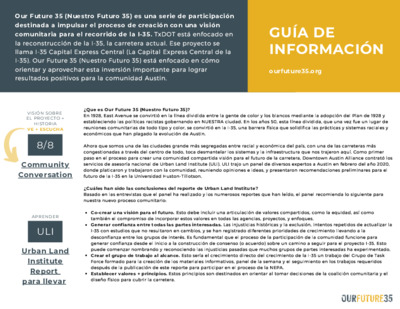
Our Future 35 (Nuestro Futuro 35) es una serie de participación destinada a impulsar el proceso de creación con una visión comunitaria para el recorrido de la I-35. TxDOT está enfocado en la reconstrucción de la I-35, la carretera actual. Ese proyecto se llama I-35 Capital Express Central (La Capital Express Central de la I-35). Our Future 35 (Nuestro Futuro 35) está enfocado en cómo orientar y aprovechar esta inversión importante para lograr resultados positivos para la comunidad Austin. GUÍA DE INFORMACIÓN ourfuture35.org VISIÓN SOBRE EL PROYECTO + HISTORIA VE + ESCUCHA 8/8 Community Conversation APRENDER ULI Urban Land Institute Report para llevar ¿Que es Our Future 35 (Nuestro Futuro 35)? En 1928, East Avenue se convirtió en la línea dividida entre la gente de color y los blancos mediante la adopción del Plan de 1928 y estableciendo las políticas racistas gobernando en NUESTRA ciudad. En los años 50, esta línea dividida, que una vez fue un lugar de reuniones comunitarias de todo tipo y color, se convirtió en la I-35, una barrera física que solidifica las prácticas y sistemas raciales y económicos que han plagado la evolución de Austin. Ahora que somos una de las ciudades grande más segregadas entre racial y económica del país, con una de las carreteras más congestionadas a través del centro de todo, toca desmantelar los sistemas y la infraestructura que nos trajeron aquí. Como primer paso en el proceso para crear una comunidad compartida visión para el futuro de la carretera, Downtown Austin Alliance contrató los servicios de asesoría nacional de Urban Land Institute (ULI). ULI trajo un panel de diversos expertos a Austin en febrero del año 2020, donde platicaron y trabajaron con la comunidad, reuniendo opiniones e ideas, y presentaron recomendaciones preliminares para el futuro de la I-35 en la Universidad Huston-Tillotson. ¿Cuáles han sido las conclusiones del reporte de Urban Land Institute? Basado en las entrevistas que el panel ha realizado y los numerosos reportes que han leído, el panel recomienda lo siguiente para nuestra nuevo proceso comunitario: Co-crear una visión para el futuro. Esto debe incluir una articulación de valores compartidos, como la equidad, así como también el compromiso de incorporar estos valores en todas las agencias, proyectos, y enfoques. Generar confianza entre todas las partes interesadas. Las injusticias históricas y la exclusión, intentos repetidos de actualizar la I-35 con estudios que no resultaron en cambios, y se han …
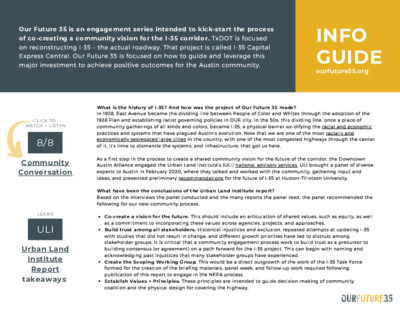
Our Future 35 is an engagement series intended to kick-start the process of co-creating a community vision for the I-35 corridor. TxDOT is focused on reconstructing I-35 – the actual roadway. That project is called I-35 Capital Express Central. Our Future 35 is focused on how to guide and leverage this major investment to achieve positive outcomes for the Austin community. INFO GUIDE ourfuture35.org CLICK TO WATCH + LISTEN 8/8 What is the history of I-35? And how was the project of Our Future 35 made? In 1928, East Avenue became the dividing line between People of Color and Whites through the adoption of the 1928 Plan and establishing racist governing policies in OUR city. In the 50s, this dividing line, once a place of community gatherings of all kinds and colors, became I-35, a physical barrier solidifying the racial and economic practices and systems that have plagued Austin’s evolution. Now that we are one of the most racially and economically segregated large cities in the country, with one of the most congested highways through the center of it, it’s time to dismantle the systems, and infrastructure, that got us here. Community Conversation As a first step in the process to create a shared community vision for the future of the corridor, the Downtown Austin Alliance engaged the Urban Land Institute’s (ULI) national advisory services. ULI brought a panel of diverse experts to Austin in February 2020, where they talked and worked with the community, gathering input and ideas, and presented preliminary recommendations for the future of I-35 at Huston-Tillotson University. LEARN ULI Urban Land Institute Report takeaways What have been the conclusions of the Urban Land Institute report? Based on the interviews the panel conducted and the many reports the panel read, the panel recommended the following for our new community process. Co-create a vision for the future. This should include an articulation of shared values, such as equity, as well as a commitment to incorporating these values across agencies, projects, and approaches. Build trust among all stakeholders. Historical injustices and exclusion, repeated attempts at updating I-35 with studies that did not result in change, and different growth priorities have led to distrust among stakeholder groups. It is critical that a community engagement process work to build trust as a precursor to building consensus (or agreement) on a path forward for the I-35 project. This can begin with naming …
an engagement series intended to kick-start the process of co-creating a community vision for the I-35 corridor For the past decade, there has been talk about reconstructing I-35 through the heart of our city. And this year, TxDOT is advancing the planning process to make it happen. . y r a r b i L c i l b u P n i t s u A , r e t n e C y r o t s i H n i t s u A , c 4 9 5 7 3 - A C P I : T I D E R C With an infrastructure project of this scale, can we co-create a new process that deconstructs the racist, unjust policies of our past and centers our community's needs and desires to determine our own future? We’re designing a community call to action with a creative response. This is a once in a lifetime opportunity to shape a future that benefits all Austinites, especially Communities of Color most affected by I-35. Photo: Giulio Sciorio INTERACTIVE CREATIVE COLLECTIVE An engagement series that includes live and virtual broadcast, video, and participatory conversation. Poetry, music, art and animation as a way for the community to provide input. Compilation of mediums to express community’s collective values for our future I-35. The intent of the series aims to: EXPLORE CO-CREATING a new community-centered decision-making process IDENTIFY shared community values through the co-creation process ESTABLISH an equity framework for the vision based on our community's shared values BUILD THE FOUNDATION for the start of a new community coalition INFORM actions needed next; including community input to TxDOT's NEPA (environmental review) process Engagement Series*: Working Schedule SUMMER 2020 FALL 2020 WINTER 2020 SPRING 2021 Our Future 35 community organize values scoping Series Launch Community Q&A with KAZI 8/8 Episode 2 Co-Creation: Establishing Our Values 9/26 Episode 1 Healing and Futures Thinking: Facing the Past to Co-Create Our Future 8/22 Additional TBD Episode 3 Resilience: Values to Actions 10/24 *This series is a work in progress and will evolve through the community's participation. THE COMMUNITY MENTORS AND CREATIVE TEAM Shaping the content and experience of the series, the Community Mentors and Creative Team bring critical local knowledge and lived experience into the conversations. They will be joined each episode by national experts leading the way in equity-centered initiatives around the country. Dr. Colette Pierce …
COMMISSION RECOMMENDATION Human Rights Commission Possession and Use of Psilocybin Recommendation Number 20201002‐002g: Recommendation for City Council to Decriminalize WHEREAS, our community, in various ways, has expressed a desire to reimagine law enforcement in our city; and, WHEREAS; A 2010 Dutch study comparing 19 different illicit and/or recreational substances placed psilocybin lower on the list for addictive possibility than cannabis, alcohol, and tobacco; and, WHEREAS, A 2017 Johns Hopkins University study identifies psilocybin as a possible therapeutic for addiction, anxiety, and depression; including a possibility to aid in smoking cessation despite tobacco being recognized as possibly the most addictive substance for human consumption; and, WHEREAS, The municipalities of Denver, Colorado, Oakland, California, and Santa Cruz, California have already decriminalized the possession of psilocybin with little ill effects to report; and, WHEREAS, Brazil, Jamaica, The Netherlands, Samoa, have fully legalized possession and use while The British Virgin Islands, Croatia, Cyprus, Czech Republic, Greece, Italy, Portugal, and Spain have all decriminalized use and/or possession in some way; and, WHEREAS, The Drug War has been objectively one of the most negative policies for Black and Brown communities in the United States. NOW, THEREFORE, BE IT RESOLVED that the Human Rights Commission of the City of Austin recommends the City Council of Austin pass an ordinance and/or legal framework which has the effect of decriminalizing possession and individual use of “magic mushrooms”/psilocybin. Date of Approval: _____________________________ Record of the vote: Attest: _____________________________________________
REGULAR MEETING FRIDAY, October 2, 2020 HUMAN RIGHTS COMMISSION MINUTES The Human Rights Commission convened in a regular meeting on Monday, August 24, 2020 via teleconference in Austin, Texas. Chair Sareta Davis called the Board Meeting to order at 1:05 p.m. Board Members in Attendance: Chair Davis, Vice Chair Jamarr Brown, Commissioner Breckenridge, Commissioner Garry Brown, Commissioner Caballero, Commissioner Casas, Commissioner Museitif, Commissioner Santana, Commissioner Weigel, and Commissioner White. Staff in Attendance: Jonathan Babiak, Human Resources Coordinator, Human Resources Department 1. APPROVAL OF MINUTES a. The minutes from the regular meeting of August 24, 2020 were approved on a vote of 7-0: Chair Davis motion, Commissioner Breckenridge second. Voting in favor were Chair Davis, Commissioner Breckenridge, Commissioner Garry Brown, Commissioner Caballero, Commissioner Casas, Commissioner Weigel, and Commissioner White. Commissioner Museitif abstained. Vice Chair Jamarr Brown, Commissioner Griffith, and Commissioner Santana were absent. 2. NEW BUSINESS a. Update and report on Joint Inclusion Committee meetings by the Joint Inclusion Committee Appointed Representatives. (Davis/Brown, J.) The Commission discussed this item. The Commissioner took no action on this item. b. Discussion and possible action on elections for appointee nominations (alternate) to submit to City Council to serve on the Joint Inclusion Committee. (Davis/Brown, J.) The Commission discussed this item. Chair Davis moved to nominate Vice Chair Jamarr Brown as the primary representative and Idona Griffith as the alternate to the Joint Inclusion Committee, Commissioner Garry Brown second. The motion passed on a vote of 10-0 with Commissioner Griffith absent. c. Presentation from Brie Franco, City of Austin Intergovernmental Relations Officer, and discussion regarding 87th State Legislative Agenda. (Davis/Brown, G.) Brie Franco, City of Austin Intergovernmental Relations Officer, addressed the Commission and answered questions from the Commission. The Commission discussed this item. The Commission took no action on this item. 1 d. Presentation from Celine Rendon, City of Austin Office of Sustainability, and discussion regarding the Community Climate Action Plan 2020 Revision. (Davis/ Brown, J.) City of Austin Office of Sustainability staff addressed the Commission and answered questions from the Commission. The Commission discussed this item. The Commission took no action on this item. e. Presentation by Meredith Powell and Miriam Conner with Public City and discussion regarding Our Future I-35 Update. (Davis/Casas) Meredith Powell with Public City addressed the Commission and answered questions from the Commission. The Commission discussed this item. The Commission took no action on this item. f. Discussion and Possible …
Human Rights Commission Community Interest Announcement Austin Housing Coalition Meeting of Members and Friends Wednesday, August 26, 2020 9:00 a.m. - 10:30 a.m. Via Videoconference Registration required: https://us02web.zoom.us/meeting/register/tZMtf-CgrT0uGNcCE9z-9whb21dNP_DPgiUm A quorum of commission members may be present. No action will be taken. For more information, please contact the commission’s staff liaison, Jonathan Babiak, at (512) 974-3203 or by email at Jonathan.Babiak@austintexas.gov.
Regular Meeting of the Human Rights Commission August 24, 2020 Human Rights Commission to be held August 24, 2020 with Social Distancing Modifications Public comment will be allowed via telephone; no in-person input will be allowed. All speakers must register in advance (Sunday, August 23, 2020 by Noon). All public comment will occur at the beginning of the meeting. To speak remotely at the August 24, 2020 Human Rights Commission Meeting, residents must: •Call or email the board liaison at (512) 974-3276 or jonathan.babiak@austintexas.gov no later than noon, Sunday, August 23, 2020 (the day before the meeting). The information required is the speaker name, item number(s) they wish to speak on, whether they are for/against/neutral, and a telephone number or email address. •Once a request to speak has been called in or emailed to the board liaison, residents will receive either an email or phone call providing the telephone number to call on the day of the scheduled meeting. •Speakers must call in at least 15 minutes prior to meeting start in order to speak, late callers will not be accepted and will not be able to speak. •Speakers will be placed in a queue until their time to speak. •Handouts or other information may be emailed to jonathan.babiak@austintexas.gov by Noon the day before the scheduled meeting. This information will be provided to Board and Commission members in advance of the meeting. •If this meeting is broadcast live, residents may watch the meeting here: http://www.austintexas.gov/page/watch- atxn-live 1 HUMAN RIGHTS COMMISSION Monday, August 24, 2020 1:00 p.m. – 2:30 p.m. VIA VIDEOCONFERENCING CURRENT COMMISSION MEMBERS: Sareta Davis, Chair Jamarr Brown, Vice Chair Jared Breckenridge Garry Brown Kristian Caballero Isabel Casas Idona Griffith Maram Museitif Courtney Santana Alicia Weigel Nathan White AGENDA CALL TO ORDER 1. APPROVAL OF MINUTES Regular Meeting. 2. NEW BUSINESS a. Consider approval of the minutes from the Human Rights Commission’s July 29, 2020 a. Discussion and possible action on recommendation to Require the Mayor of Austin Appoint a Democratically Elected Chief of Police. (White/Caballero/Weigel) 3. OLD BUSINESS a. Commissioners will report on and discuss the status of the Commission’s key priority areas of concern for 2020-2021, including plans and strategies for meeting those key priority areas of concern: i. Institutional Equity ii. Environment & Land Use iii. Health Access & Nutrition iv. Autonomy & Human Rights ADJOURNMENT The City of Austin is committed to compliance with the …
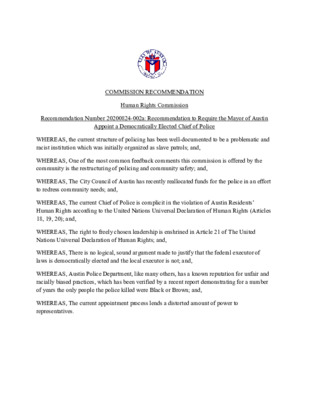
DRAFT COMMISSION RECOMMENDATION COMMISSION RECOMMENDATION Human Rights Commission Recommendation Number 20200824‐002a: Recommendation to Require the Mayor of Austin Appoint a Democratically Elected Chief of Police WHEREAS, the current structure of policing has been well‐documented to be a problematic and racist institution which was initially organized as slave patrols; and, WHEREAS, One of the most common feedback comments this commission is offered by the community is the restructuring of policing and community safety; and, WHEREAS, The City Council of Austin has recently reallocated funds for the police in an effort to redress community needs; and, WHEREAS, The current Chief of Police is complicit in the violation of Austin Residents’ Human Rights according to the United Nations Universal Declaration of Human Rights (Articles 18, 19, 20); and, WHEREAS, The right to freely chosen leadership is enshrined in Article 21 of The United Nations Universal Declaration of Human Rights; and, WHEREAS, There is no logical, sound argument made to justify that the federal executor of laws is democratically elected and the local executor is not; and, WHEREAS, Austin Police Department, like many others, has a known reputation for unfair and racially biased practices, which has been verified by a recent report demonstrating for a number of years the only people the police killed were Black or Brown; and, WHEREAS, The current appointment process lends a distorted amount of power to representatives. NOW, THEREFORE, BE IT RESOLVED the Human Rights Commission recommends the Austin City Council pass an ordinance with the effect of committing the Mayor of Austin to appoint a Chief of Police that has won a local election for that position, either through a formal special‐called election, or an informal, city‐funded and administered process. Date of Approval: _____________________________ Record of the vote: Attest: _____________________________________________ (Staff or board member can sign)
COMMISSION RECOMMENDATION Human Rights Commission Recommendation Number 20200824-002a: Recommendation to Require the Mayor of Austin Appoint a Democratically Elected Chief of Police WHEREAS, the current structure of policing has been well-documented to be a problematic and racist institution which was initially organized as slave patrols; and, WHEREAS, One of the most common feedback comments this commission is offered by the community is the restructuring of policing and community safety; and, WHEREAS, The City Council of Austin has recently reallocated funds for the police in an effort to redress community needs; and, WHEREAS, The current Chief of Police is complicit in the violation of Austin Residents’ Human Rights according to the United Nations Universal Declaration of Human Rights (Articles 18, 19, 20); and, WHEREAS, The right to freely chosen leadership is enshrined in Article 21 of The United Nations Universal Declaration of Human Rights; and, WHEREAS, There is no logical, sound argument made to justify that the federal executor of laws is democratically elected and the local executor is not; and, WHEREAS, Austin Police Department, like many others, has a known reputation for unfair and racially biased practices, which has been verified by a recent report demonstrating for a number of years the only people the police killed were Black or Brown; and, WHEREAS, The current appointment process lends a distorted amount of power to representatives.
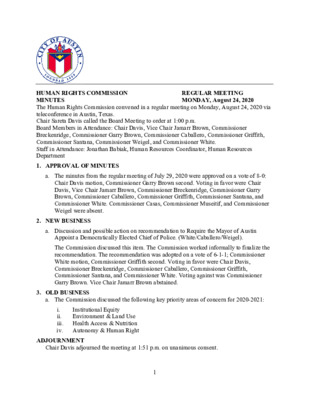
REGULAR MEETING MONDAY, August 24, 2020 HUMAN RIGHTS COMMISSION MINUTES The Human Rights Commission convened in a regular meeting on Monday, August 24, 2020 via teleconference in Austin, Texas. Chair Sareta Davis called the Board Meeting to order at 1:00 p.m. Board Members in Attendance: Chair Davis, Vice Chair Jamarr Brown, Commissioner Breckenridge, Commissioner Garry Brown, Commissioner Caballero, Commissioner Griffith, Commissioner Santana, Commissioner Weigel, and Commissioner White. Staff in Attendance: Jonathan Babiak, Human Resources Coordinator, Human Resources Department 1. APPROVAL OF MINUTES a. The minutes from the regular meeting of July 29, 2020 were approved on a vote of 8-0: Chair Davis motion, Commissioner Garry Brown second. Voting in favor were Chair Davis, Vice Chair Jamarr Brown, Commissioner Breckenridge, Commissioner Garry Brown, Commissioner Caballero, Commissioner Griffith, Commissioner Santana, and Commissioner White. Commissioner Casas, Commissioner Museitif, and Commissioner Weigel were absent. 2. NEW BUSINESS a. Discussion and possible action on recommendation to Require the Mayor of Austin Appoint a Democratically Elected Chief of Police. (White/Caballero/Weigel). The Commission discussed this item. The Commission worked informally to finalize the recommendation. The recommendation was adopted on a vote of 6-1-1; Commissioner White motion, Commissioner Griffith second. Voting in favor were Chair Davis, Commissioner Breckenridge, Commissioner Caballero, Commissioner Griffith, Commissioner Santana, and Commissioner White. Voting against was Commissioner Garry Brown. Vice Chair Jamarr Brown abstained. 3. OLD BUSINESS a. The Commission discussed the following key priority areas of concern for 2020-2021: Institutional Equity i. Environment & Land Use ii. iii. Health Access & Nutrition iv. Autonomy & Human Right ADJOURNMENT Chair Davis adjourned the meeting at 1:51 p.m. on unanimous consent. 1
Regular Meeting of the Human Rights Commission July 29, 2020 Human Rights Commission to be held July 29, 2020 with Social Distancing Modifications Public comment will be allowed via telephone; no in-person input will be allowed. All speakers must register in advance (Tuesday, July 28, 2020 by Noon). All public comment will occur at the beginning of the meeting. To speak remotely at the July 29, 2020 Human Rights Commission Meeting, residents must: •Call or email the board liaison at (512) 974-3276 or jonathan.babiak@austintexas.gov no later than noon, (the day before the meeting). The information required is the speaker name, item number(s) they wish to speak on, whether they are for/against/neutral, and a telephone number or email address. •Once a request to speak has been called in or emailed to the board liaison, residents will receive either an email or phone call providing the telephone number to call on the day of the scheduled meeting. •Speakers must call in at least 15 minutes prior to meeting start in order to speak, late callers will not be accepted and will not be able to speak. •Speakers will be placed in a queue until their time to speak. •Handouts or other information may be emailed to jonathan.babiak@austintexas.gov by Noon the day before the scheduled meeting. This information will be provided to Board and Commission members in advance of the meeting. •If this meeting is broadcast live, residents may watch the meeting here: http://www.austintexas.gov/page/watch- atxn-live 1 HUMAN RIGHTS COMMISSION Wednesday, July 29, 2020 1:00 p.m. – 2:30 p.m. VIA VIDEOCONFERENCING CURRENT COMMISSION MEMBERS: Sareta Davis, Chair Jamarr Brown, Vice Chair Jared Breckenridge Garry Brown Kristian Caballero Isabel Casas Idona Griffith Maram Museitif Courtney Santana Alicia Weigel Nathan White AGENDA CALL TO ORDER 1. APPROVAL OF MINUTES Regular Meeting. 2. NEW BUSINESS a. Consider approval of the minutes from the Human Rights Commission’s June 22, 2020 a. Discussion and possible action on Formal Condemnation and Call for Investigation of Violation of Austin Police Department Policy, and Recommendation to Amend and Ensure Enforcement of Austin Police Department's Policy re Requesting an Officer of a Given Sex or Gender. (Weigel/White) b. Discussion and possible action on a recommendation to City Council to establish the Juneteenth holiday as a City holiday each year beginning in 2021. (Davis/Brown, J.) 3. OLD BUSINESS a. Discussion and possible action on a Recommendation to Address Under-banking by Allowing City Libraries to …
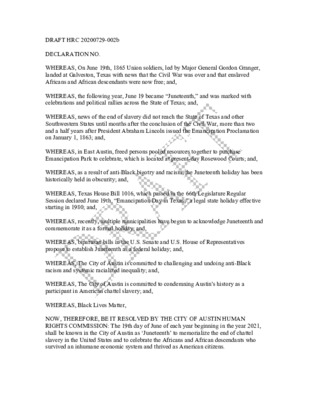
DRAFT HRC 20200729-002b DECLARATION NO. WHEREAS, On June 19th, 1865 Union soldiers, led by Major General Gordon Granger, landed at Galveston, Texas with news that the Civil War was over and that enslaved Africans and African descendants were now free; and, WHEREAS, the following year, June 19 became “Juneteenth,” and was marked with celebrations and political rallies across the State of Texas; and, WHEREAS, news of the end of slavery did not reach the State of Texas and other Southwestern States until months after the conclusion of the Civil War, more than two and a half years after President Abraham Lincoln issued the Emancipation Proclamation on January 1, 1863; and, WHEREAS, in East Austin, freed persons pooled resources together to purchase Emancipation Park to celebrate, which is located at present-day Rosewood Courts; and, WHEREAS, as a result of anti-Black bigotry and racism, the Juneteenth holiday has been historically held in obscurity; and, WHEREAS, Texas House Bill 1016, which passed in the 66th Legislature Regular Session declared June 19th, “Emancipation Day in Texas,” a legal state holiday effective starting in 1980; and, WHEREAS, recently, multiple municipalities have begun to acknowledge Juneteenth and commemorate it as a formal holiday; and, WHEREAS, bipartisan bills in the U.S. Senate and U.S. House of Representatives propose to establish Juneteenth as a federal holiday; and, WHEREAS, The City of Austin is committed to challenging and undoing anti-Black racism and systemic racialized inequality; and, WHEREAS, The City of Austin is committed to condemning Austin's history as a participant in American chattel slavery; and, WHEREAS, Black Lives Matter, NOW, THEREFORE, BE IT RESOLVED BY THE CITY OF AUSTIN HUMAN RIGHTS COMMISSION: The 19th day of June of each year beginning in the year 2021, shall be known in the City of Austin as ‘Juneteenth’ to memorialize the end of chattel slavery in the United States and to celebrate the Africans and African descendants who survived an inhumane economic system and thrived as American citizens. BE IT FURTHER RESOLVED: The Human Rights Commission supports City Council in directing the City Manager to analyze and present several options for amending the City of Austin's Personnel Policies to establish Juneteenth as a paid holiday or other benefit for City employees, to begin in June 2021. Analysis should include detailed and comprehensive evaluations of costs and budget impacts, including personnel costs. Consideration should be given to the value to City employees of …
COMMISSION RECOMMENDATION Human Rights Commission Recommendation Number 20200729-003a: Recommendation to Address Under-banking by Allowing City Libraries to Perform Limited Financial Services WHEREAS, Under-banking is a serious detriment to working people’s ability to build and grow wealth; and, WHEREAS, Online banking services and digital commerce are becoming increasingly ubiquitous; and, WHEREAS, The inability to participate in digital commerce can directly impact one’s quality of life, financial and employment prospects; thus negatively impacting one’s access to human rights; and, WHEREAS, Public institutions, such as the United States Postal Service, have previously provided limited banking services to the public; and, WHEREAS, The entrance of a public enterprise with more affordable rates stimulates competition in the private sector; and, WHEREAS, The definition of what public libraries are able to lend to the public has previously been expanded (i.e. DVDs, CDs, audiobooks, etc.); and, WHEREAS, Libraries are currently, in effect, depositories of a kind; and, WHEREAS, Exclusion from banking services has been a studied and documented symptom of institutional racism and sexism; and, WHEREAS, The right to Social Security is guaranteed by the 22nd Article of the United Nations Declaration of Human Rights; and, WHEREAS, We are now facing unprecedented financial consequences due to COVID-19; and, WHEREAS, It is in the public interest to create a department within a publicly trusted institution dedicated to the financial success and prosperity of all Austin residents. NOW, THEREFORE, BE IT RESOLVED that the Human Rights Commission recommends the Austin City Council to investigate ways to charter the Austin Library System as a state bank to provide basic, free-to-access, financial services to include but not limited to: fee-free ATM services, checking and savings accounts with online access, debit card services, fee-free overdraft protection, etc.
COMMISSION RECOMMENDATION Human Rights Commission Recommendation Number 20200729-002b: Juneteenth Holiday WHEREAS, On June 19th, 1865 Union soldiers, led by Major General Gordon Granger, landed at Galveston, Texas with news that the Civil War was over and that enslaved Africans and African descendants were now free; and, WHEREAS, the following year, June 19 became “Juneteenth,” and was marked with celebrations and political rallies across the State of Texas; and, WHEREAS, news of the end of slavery did not reach the State of Texas and other Southwestern States until months after the conclusion of the Civil War, more than two and a half years after President Abraham Lincoln issued the Emancipation Proclamation on January 1, 1863; and, WHEREAS, in East Austin, freed persons pooled resources together to purchase Emancipation Park to celebrate, which is located at present-day Rosewood Courts; and, WHEREAS, as a result of anti-Black bigotry and racism, the Juneteenth holiday has been historically held in obscurity; and, WHEREAS, Texas House Bill 1016, which passed in the 66th Legislature Regular Session declared June 19th, “Emancipation Day in Texas,” a legal state holiday effective starting in 1980; and, WHEREAS, recently, multiple municipalities have begun to acknowledge Juneteenth and commemorate it as a formal holiday; and, WHEREAS, bipartisan bills in the U.S. Senate and U.S. House of Representatives propose to establish Juneteenth as a federal holiday; and, WHEREAS, The City of Austin is committed to challenging and undoing anti-Black racism and systemic racialized inequality; and,
COMMISSION RECOMMENDATION Human Rights Commission Recommendation Number 20200729-003a: Recommendation to Address Under-banking by Allowing City Libraries to Perform Limited Financial Services WHEREAS, Under-banking is a serious detriment to working people’s ability to build and grow wealth; and, WHEREAS, Online banking services and digital commerce are becoming increasingly ubiquitous; and, WHEREAS, The inability to participate in digital commerce can directly impact one’s quality of life, financial and employment prospects; thus negatively impacting one’s access to human rights; and, WHEREAS, Public institutions, such as the United States Postal Service, have previously provided limited banking services to the public; and, WHEREAS, The entrance of a public enterprise with more affordable rates stimulates competition in the private sector; and, WHEREAS, The definition of what public libraries are able to lend to the public has previously been expanded (i.e. DVDs, CDs, audiobooks, etc.); and, WHEREAS, Libraries are currently, in effect, depositories of a kind; and, WHEREAS, Exclusion from banking services has been a studied and documented symptom of institutional racism and sexism; and, WHEREAS, The right to Social Security is guaranteed by the 22nd Article of the United Nations Declaration of Human Rights; and, WHEREAS, We are now facing unprecedented financial consequences due to COVID-19; and, WHEREAS, It is in the public interest to create a department within a publicly trusted institution dedicated to the financial success and prosperity of all Austin residents.
REGULAR MEETING WEDNESDAY, July 29, 2020 HUMAN RIGHTS COMMISSION MINUTES The Human Rights Commission convened in a regular meeting on Wednesday, July 29, 2020 via teleconference in Austin, Texas. Chair Sareta Davis called the Board Meeting to order at 1:00 p.m. Board Members in Attendance: Chair Davis, Vice Chair Jamarr Brown, Commissioner Breckenridge, Commissioner Garry Brown, Commissioner Caballero, Commissioner Casas, Commissioner Griffith, Commissioner Museitif, Commissioner Santana, and Commissioner Weigel. Staff in Attendance: Jonathan Babiak, Human Resources Coordinator, Human Resources Department 1. APPROVAL OF MINUTES a. The minutes from the regular meeting of June 22, 2020 were approved on a vote of 10-0: Chair Davis motion, Commissioner Garry Brown second. Voting in favor were Chair Davis, Vice Chair Jamarr Brown, Commissioner Breckenridge, Commissioner Garry Brown, Commissioner Caballero, Commissioner Casas, Commissioner Griffith, Commissioner Museitif, Commissioner Santana, and Commissioner Weigel. Commissioner White was absent. 2. NEW BUSINESS a. Discussion and possible action on Formal Condemnation and Call for Investigation of Violation of Austin Police Department Policy, and Recommendation to Amend and Ensure Enforcement of Austin Police Department's Policy re Requesting an Officer of a Given Sex or Gender. (Weigel/White) Commissioner Weigel moved to table this item, Commissioner Garry Brown second. Motion passed on a vote of 9-0; voting in favor were Vice Chair Jamarr Brown, Commissioner Breckenridge, Commissioner Garry Brown, Commissioner Caballero, Commissioner Casas, Commissioner Griffith, Commissioner Museitif, Commissioner Santana, and Commissioner Weigel. Chair Davis and Commissioner White were absent. b. Discussion and possible action on a recommendation to City Council to establish the Juneteenth holiday as a City holiday each year beginning in 2021. (Davis/Brown, J) The Commission discussed this item. Chair Davis moved for adoption, Vice Chair Jamarr Brown second. The recommendation was approved on a vote of 10-0. Voting in favor were Chair Davis, Vice Chair Jamarr Brown, Commissioner Breckenridge, Commissioner Garry Brown, Commissioner Caballero, Commissioner Casas, Commissioner Griffith, Commissioner Museitif, Commissioner Santana, and Commissioner Weigel. Commissioner White was absent. 1 3. OLD BUSINESS a. Discussion and possible action on a Recommendation to Address Under-banking by Allowing City Libraries to Perform Limited Financial Services. (White/Caballero) The Commission discussed this item. Vice Chair Jamarr Brown moved for adoption, Commissioner Caballero second. The recommendation was approved on a vote of 8-0. Voting in favor were Vice Chair Jamarr Brown, Commissioner Breckenridge, Commissioner Garry Brown, Commissioner Caballero, Commissioner Griffith, Commissioner Museitif, Commissioner Santana, and Commissioner Weigel. Chair Davis, Commissioner Casas, and Commissioner White …
Regular Meeting of the Human Rights Commission June 22, 2020 Human Rights Commission to be held June 22, 2020 with Social Distancing Modifications Public comment will be allowed via telephone; no in-person input will be allowed. All speakers must register in advance (Sunday, June 21, 2020 by Noon). All public comment will occur at the beginning of the meeting. To speak remotely at the June 22, 2020 Human Rights Commission Meeting, residents must: •Call or email the board liaison at (512) 974-3276 or jonathan.babiak@austintexas.gov no later than noon, (the day before the meeting). The information required is the speaker name, item number(s) they wish to speak on, whether they are for/against/neutral, and a telephone number or email address. •Once a request to speak has been called in or emailed to the board liaison, residents will receive either an email or phone call providing the telephone number to call on the day of the scheduled meeting. •Speakers must call in at least 15 minutes prior to meeting start in order to speak, late callers will not be accepted and will not be able to speak. •Speakers will be placed in a queue until their time to speak. •Handouts or other information may be emailed to jonathan.babiak@austintexas.gov by Noon the day before the scheduled meeting. This information will be provided to Board and Commission members in advance of the meeting. •If this meeting is broadcast live, residents may watch the meeting here: http://www.austintexas.gov/page/watch- atxn-live 1 HUMAN RIGHTS COMMISSION Monday, June 22, 2020 1:00 p.m. – 2:30 p.m. VIA VIDEOCONFERENCING CURRENT COMMISSION MEMBERS: Sareta Davis, Chair Jamarr Brown, Vice Chair Jared Breckenridge Garry Brown Kristian Caballero Isabel Casas Idona Griffith Maram Museitif Courtney Santana Alicia Weigel Nathan White AGENDA CALL TO ORDER 1. APPROVAL OF MINUTES Regular Meeting. Special Called Meeting. 2. NEW BUSINESS a. Consider approval of the minutes from the Human Rights Commission’s May 18, 2020 b. Consider approval of the minutes from the Human Rights Commission’s June 5, 2020 a. Discussion and possible action regarding Complaints Sent to the Austin Police Department from the Office Of Police Oversight. (Davis/Brown, J./Breckenridge/Santana) Farah Muscadin, Director, Office of Police Oversight, City of Austin b. Discussion and possible action on Recommendation Number (20200622-002a) Human Rights Commission Recommendation to Defund the Police. (White/Davis/Brown, J./Breckenridge/Casas) c. Discussion and possible action in regards to the city's plan and next steps for Oakwood Cemetery. (Caballero/Breckenridge/Davis) Kim McKnight, MSHP, …
1 BOARD/COMMISSION RECOMMENDATION Human Rights Commission Recommendation Number 20200622-002a: Office of Police Oversight Complaints WHEREAS, the City of Austin Police Department (hereinafter APD) exists to serve the community of Austin, Texas; and WHEREAS, The City of Austin’s Office of Police Oversight’s mission is to provide impartial oversight of the Austin Police Department’s conduct, practices, and policies to enhance accountability, inform the public to increase transparency, and create sustainable partnerships throughout the community; and WHEREAS, The City of Austin Office of Police Oversight exists to promote an atmosphere of earned trust between the community and the Austin Police Department; and WHEREAS, The City of Austin Office of Police Oversight makes recommendations to the City Manager and to APD about individual incidents and investigations, as well as broader policy recommendations, and investigated, and resolved; and Internal Affairs Division; and WHEREAS, the City of Austin’s Office of Police Oversight was created in order to ensure community concerns and/or complaints about potential police misconduct are heard, WHEREAS, It has been has reported in the media that community complaints are vetted by OPO and when sent to the APD they do not lead to an automatic investigation by the APD WHEREAS, complaints are vetted by the Office of Police Oversight, sent to APD are not immediately investigated by APD Internal Affairs, but instead are re-reviewed by APD Internal Affairs staff, resulting in less than 1/3 of complaints sent by OPO since January 2020 being investigated by APD Internal Affairs; and WHEREAS, when community members who have demonstrated courage in bringing forth their complaint of misconduct they should at the very least receive procedural justice for their complaint. NOW, THEREFORE, BE IT RESOLVED, that the Mayor and City Council compel City Manager Spencer Cronk to direct APD Chief Brian Manley to initiate automatic investigations of vetted complaints received from the Office of Police Oversight. Chief Manley shall be directed to treat external formal complaints from the Office of Police Oversight in the same manner as APD handles internal complaints. Furthermore, Chief Manley shall be directed that it be compulsory that complaints received by APD from the Office of Police Oversight be sent to APD Internal Affairs for investigation and action. Date of Approval: _____________________________ Record of the vote: Attest: _____________________________________________ (Staff or board member can sign) 2
BOARD/COMMISSION RECOMMENDATION Human Rights Commission Recommendation Number 20200622-002b: De-fund the Police WHEREAS, Officers in The Austin Police Department have repeatedly used excessive force on camera without repercussions; and, WHEREAS, The murder of Mike Ramos by Officer Christopher Taylor is apparent via video evidence when viewed by an unbiased observer; and, WHEREAS, Austin Police Department has a widespread reputation of being more likely to use excessive force than Texas' other large jurisdictions; and, WHEREAS, in the City of Austin Human Rights Community Budget forum, citizens of Austin provided the most consistent feedback this commission has received regarding budgetary concerns and implored us to express to City Council that the Austin Police Department budget should be reduced; and APD funding should be re-directed to Black and Brown communities that have faced brutal trauma from centuries of systemic racism from the police and other institutions; and, WHEREAS, on April 29th, 2019, the Human Rights Commission unanimously voted to send recommendation number 20190429-003b: Fiscal Year 2020 Budget to City Council, and this recommendation in part recommended the City of Austin law enforcement strategy be refocused from traditional policing and criminalization, which has led in the past to over policing in minority communities, toward a greater reliance on diversionary, preventative, and rehabilitation programs. We also indicated this focus should include but not be limited to the diversion of funds into such programs that curb crime before it happens; and, WHEREAS, on April 29th, 2019, the Human Rights Commission unanimously voted to send recommendation number 20190429-003b: Fiscal Year 2020 Budget to City Council, and this recommendation in part recommended the City of Austin deeply analyze the number of victims services counselors, mental health officers and other staff associated with the diversion of activity that is criminal on the surface, to evaluate whether more funds should be allocated to fund these positions. A deeper analysis than requiring a certain number of police officers per year citizen is required; and, WHEREAS, On May 30th and 31st, 2020, Austin Police Department committed a war crime by utilizing tear gas, a substance banned by The Geneva Convention; and, WHEREAS, On those same evenings, APD fired on clearly marked medical professionals, violating the near-century old standard of Medical Neutrality according to the Geneva Convention; and, WHEREAS, The causation of police presence leading to lower crime rates has never been academically proven; and, WHEREAS, The Chief of Police, Brian Manley, has repeatedly …
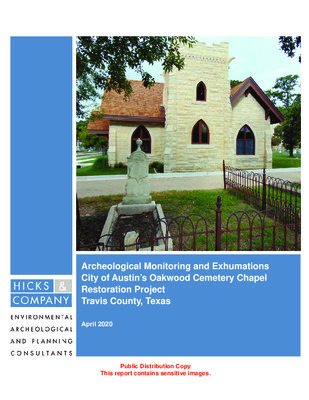
Austin Parks and Recreation Department Oakwood Cemetery Archeological Investigation and Findings Briefing to Boards and Commissions Kim McKnight, MSHP, AICP Program Manager Historic Preservation and Heritage Tourism Austin Parks and Recreation Department Oakwood Cemetery • Established in 1839, Oakwood Cemetery is Austin’s oldest municipal cemetery • 40 acres in size with more than 23,000 burials • Receives approximately 40 burials a year; Lots sold out by early 20th century • Listed on the National Register of Historic Places, Official Texas Historic Cemetery, and a City of Austin Historic Landmark • One of five municipal cemeteries managed by the Parks and Recreation Department Segregated section for People of Color • Entire cemetery relatively informal until 1859, when the mayor designated three sections, including a section for people of color • Approximately 1,200 people were buried in the section designated for people of color between 1859-1880 • Burials include: • Jacob Fontaine (1808-1898) - Political and civic leader, newspaper publisher and established numerous churches throughout Travis County, including the St. John Regular Missionary Baptist Association • Laurine Cecil (L.C) Anderson (1853-1938) - Longtime principal of L.C. Anderson High School; First president of the Colored Teachers Association and president of Prairie View University, the first state-supported Texas college for African Americans • Dr. Everett Givens (1888-1962) - Though recognized as an excellent dentist, is better known for efforts to gain equal privileges, rights, and opportunities for African American citizens of Austin • This section of the cemetery also holds the remains of those of Hispanic and European descent and within or overlapping this section are “stranger grounds” and “pauper grounds” Reverend Jacob Fontaine Oakwood Cemetery Chapel • Built in 1914, the Oakwood Cemetery Mortuary Chapel was designed by Austin architect Charles Page and hosted non-denominational memorial services and temporary interments; Used as office by 1940s • 2015 Historic Cemeteries Master Plan calls for better interpretation of cemetery history including section for People of Color • Master Plan also recommends Chapel be programmed as community space and visitor center • Project Components: Structural stabilization of foundation; drainage improvement; ADA improvements; Rehabilitation of single-occupant restroom; Full architectural, mechanical, electrical, and plumbing rehabilitation Antiquities Permit #7709 • Archeological firm, Hicks and Company, hired to ensure compliance with all requirements and regulations • Antiquities Permit obtained from Texas Historical Commission • Archeological monitoring throughout course of project • Documentation of all cultural resources • Procedures in place …
M E M O R A N D U M TO: FROM: Human Rights Commission Kimberly McNeeley, CPRP Director, Austin Parks and Recreation Department June 18, 2020 DATE: SUBJECT: Oakwood Cemetery Academic Partnership for DNA testing The purpose of this memo is to notify City Council that the Austin Parks and Recreation Department (PARD) is in the early stages of exploring an academic partnership to conduct DNA testing of human remains exhumed at Oakwood Cemetery in 2017. As you may recall the remains were discovered during the Oakwood chapel restoration project and date from the mid to late 1800s. A May 14, 2020 memo to City Council provided a project update regarding recent reports from the archeological and bio-archeological analysis as well as community engagement and educational outreach activities. Since May 14th PARD entered into discussions with Dr. Deborah Bolnick, Associate Professor, University of Connecticut, about how the field of anthropological genetics may be applied to the Oakwood Cemetery archeological investigation. Dr. Bolnick is an anthropological geneticist and biological anthropologist who explores how forces, historical events, and social inequalities shape human genomic and epigenomic diversity, as well as human biology more broadly. While discussions are in the early stages, PARD is interested to learn if Dr. Bolnick’s research can shed more light on the lives of the 36 individuals who were discovered during the restoration of the 1914 Oakwood Chapel. Should the partnership move forward, the city would incur no costs associated with the research or analysis. The extraction and analysis of DNA from the remains offers a unique opportunity to learn more about the identities, familial connections, and life experiences of the exhumed people. DNA analysis may make it possible to shed light on (1) the genetic ancestry and genetic sex of each individual, (2) the individual’s diet and experience with disease, (3) experiences of stress and trauma and the way those lived experiences may have become embodied, (4) patterns of genetic variation and relatedness among these individuals, and (5) relatedness between individuals buried at the Oakwood Cemetery and individuals alive today. If the preservation of the DNA in the Oakwood Cemetery remains is sufficient to permit these analyses, living individuals who think they may have a familial connection may be able to submit a saliva sample to the Bolnick lab for DNA analysis, allowing relatedness to be assessed. All genetic data would be considered in conjunction with osteological, …
Archeological Monitoring and Exhumations City of Austin’s Oakwood Cemetery Chapel Restoration Project Travis County, Texas April 2020 Public Distribution Copy This report contains sensitive images. ARCHEOLOGICAL MONITORING AND EXHUMATIONS FOR THE CITY OF AUSTIN’S OAKWOOD CEMETERY CHAPEL RESTORATION PROJECT TRAVIS COUNTY, TEXAS VOLUME I Public Distribution Copy Texas Antiquities Permit No. 7709 Hicks & Company Archeology Series #298 Submitted to: City of Austin Principal Investigator: Josh Haefner, M.A. Written by: Josh Haefner, M.A. Brittany McClain, M.A. Debra Desarmeaux Gregg Cestaro, M.A. April 2020 Hicks & Company Environmental/Archeological Consultants Abstract Abstract Between November 2016 and January 2018, Hicks & Company Environmental/Archeological Consultants (Hicks & Company) performed archeological monitoring and excavations at the Oakwood Cemetery Chapel prior to planned restoration efforts there by the City of Austin (the City). The Oakwood Cemetery is listed on the National Register of Historic Places and is also a Historic Texas Cemetery and a City of Austin Historic Landmark. As the City is a political subdivision of the State of Texas, the project is subject to the Antiquities Code of Texas (ACT) (Texas Natural Resource Code, Title 9, Chapter 191), which requires state agencies and political subdivisions of the state to notify the Texas Historical Commission (THC) of ground-disturbing activity on public land and work affecting state-owned historic buildings. The law also established the designation of State Antiquities Landmarks (SAL), which may be applied to historic buildings and archeological sites. The accompanying Rules of Practice and Procedure for the ACT are subsumed under Texas Administrative Code (TAC), Title 13, Chapter 26. Cemeteries are specifically addressed under TAC, Title 13, Chapter 22. In addition to the ACT, burials and cemeteries in Texas are also protected under the Texas Health and Safety Code, Chapter 711. Investigations were conducted under Texas Antiquities Permit No. 7709 issued to Principal Investigator Josh Haefner. Together with the Texas Historical Commission and the City of Austin, Hicks & Company developed a plan for monitoring the chapel restoration work to avoid unnecessary impacts to graves anticipated to be encountered below the chapel, as well as outside and adjacent to the chapel. The monitoring of various construction activities between November 2016 and January 2018 resulted in the discovery of 59 unmarked graves of individuals who died in the late nineteenth or early twentieth century (including several infants) and a series of archeological excavations to exhume 37 of those graves from the chapel’s interior. Only 37 …