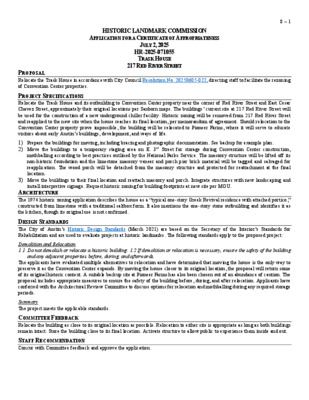
HISTORIC LANDMARK COMMISSION APPLICATION FOR A CERTIFICATE OF APPROPRIATENESS JULY 2, 2025 HR-2025-071055 TRASK HOUSE 217 RED RIVER STREET 8 – 1 PROPOSAL Relocate the Trask House in accordance with City Council Resolution No. 20250605-022, directing staff to facilitate the rezoning of Convention Center properties. PROJECT SPECIFICATIONS Relocate the Trask House and its outbuilding to Convention Center property near the corner of Red River Street and East Cesar Chavez Street, approximately their original locations per Sanborn maps. The buildings’ current site at 217 Red River Street will be used for the construction of a new underground chiller facility. Historic zoning will be removed from 217 Red River Street and reapplied to the new site when the house reaches its final location, per memorandum of agreement. Should relocation to the Convention Center property prove impossible, the building will be relocated to Pioneer Farms, where it will serve to educate visitors about early Austin’s buildings, development, and ways of life. 1) Prepare the buildings for moving, including bracing and photographic documentation. See backup for example plan. 2) Move the buildings to a temporary staging area on E. 3rd Street for storage during Convention Center construction, mothballing according to best practices outlined by the National Parks Service. The masonry structure will be lifted off its non-historic foundation and the limestone masonry veneer and porch pier brick material will be tagged and salvaged for reapplication. The wood porch will be detached from the masonry structure and protected for reattachment at the final location. 3) Move the buildings to their final location and reattach masonry and porch. Integrate structures with new landscaping and install interpretive signage. Request historic zoning for building footprints at new site per MOU. ARCHITECTURE The 1974 historic zoning application describes the house as a “typical one-story Greek Revival residence with attached portico,” constructed from limestone with a traditional saltbox form. It also mentions the one-story stone outbuilding and identifies it as the kitchen, though its original use is not confirmed. DESIGN STANDARDS The City of Austin’s Historic Design Standards (March 2021) are based on the Secretary of the Interior’s Standards for Rehabilitation and are used to evaluate projects at historic landmarks. The following standards apply to the proposed project: Demolition and Relocation 1.1 Do not demolish or relocate a historic building. 1.2 If demolition or relocation is necessary, ensure the safety of the building and any adjacent properties before, during, and …
RESOLUTION NO. 20250605-022 WHEREAS, the City owns the property located 201,201 1/2,205, and 217 Red River Street and 603 East 3rd Street ("City Property"); and WHEREAS, City Property is located across from the existing Austin Convention Center site located at 500 East Cesar Chavez Street; and WHEREAS, the City is currently working on the expansion and redevelopment of the Austin Convention Center (the "Project") which will require a total demolition of the existing Austin Convention Center; and WHEREAS, prior to the commencement of the Project, the District Chilling Plant #4 that was previously located at the Austin Convention Center was decommissioned; and WHEREAS, the Project is planning to install a new stand-alone District Chilling Plant #4.1 on City Property to replace the decommissioned District Chilling Plant #4; and WHEREAS, City Property is the current location of the Castleman-Bull House and Trask House; and WHEREAS, the Project requires relocation ofboth the Castleman-Bull House and Trask House to accommodate the underground installation of the new Downtown District Cooling Plant #4.1 on City Property; NOW, THEREFORE, BE IT RESOLVED BY THE CITY COUNCIL OF THE CITY OF AUSTIN: Council initiates rezoning for City Property. Page 1 of 2 BE IT FURTHER RESOLVED: The City Manager is directed to process the applications for rezoning of City Property, to recommend appropriate rezoning, and take necessary steps to ensure an efficient rezoning process to avoid unnecessary delay. ADOPTED: June 5 , 2025 ATTEST: RAY Erika Bra* City Clerk Page 2 of 2
M E M O R A N D U M TO: Historic Landmark Commission members FROM: Trisha Tatro, Director Austin Convention Center Department DATE: June 25, 2025 SUBJECT: Update on the Historic Trask House The purpose of this memorandum is to update the Historic Landmark Commission members on the City’s plans for the historic Trask house, located at 217 Red River Street ahead of the July 2, 2025, Historic Landmark Commission Meeting. As presented previously during 5/4/25 and 6/11/25 meetings of the Architectural Review Committee, the historic Trask House and its related accessory structure at 217 Red River Street will be relocated as part of the Austin Convention Center redevelopment project, known as UnconventionalATX. Details of the relocation plan are outlined in the Certificate of Appropriateness application, HR-2025-071055 available via Austin Build + Connect, scheduled to be heard at the July 2, 2025, meeting of the Historic Landmark Commission. While the UnconventionalATX are reviewing and confirming details of temporary and permanent relocations, the City of Austin commits to applying historic zoning to both the primary building and its accessory structure within 12 months of the placement of the house in its new location. Please do not hesitate to contact me if you have any questions. cc: Katy Zamesnik, Acting Deputy Director, Austin Convention Center Department Riley Triggs, Capital Delivery Consultant, Capital Delivery Services Department Lauren Middleton-Pratt, Director, Planning Department Andrea Bates, Assistant Director, Planning Department Joi Harden, Zoning Officer, Planning Department Kim McKnight, Division Manager, Historic Preservation Office, Planning Department Kalan Contreras, Principal Planner, Historic Preservation Office, Planning Department Ginny Chilton, Project Director, Page Larry Irsik, Principal, Architexas Ron Zurcher, Associate Principal, Rider Levell Bucknall
Historic Review Application For Office Use Only Date of Submission:_________________________________ Case #:____________________________________________ _________________________________________________ Historic Preservation Office approval Date of Approval:___________________________________ Property Address: ______________________________________________________ Historic Landmark Historic District (Local) National Register Historic District Historic Landmark or Historic District Name:______________________________________________________________________________________________ Applicant Name: _______________________________ Phone #: ______________________ Email: ______________________________ Applicant Address: _______________________________ City: _______________________ __ State: ________________ Zip: __________ Please describe all proposed exterior work with location and materials. If you need more space, attach an additional sheet. PROPOSED WORK LOCATION OF PROPOSED WORK PROPOSED MATERIAL(S) 1) 2) 3) Submittal Requirements 1. One set of dimensioned building plans. Plans must: a) specify materials and finishes to be used, and b) show existing and proposed conditions for alterations and additions. Site Plan Elevations Floor Plan Roof Plan 2. Color photographs of building and site: Elevation(s) proposed to be modified Detailed view of each area proposed to be modified Any changes to these plans must be reviewed and approved by the Historic Preservation Office and/or Historic Landmark Commission. Applicant Signature: ___________________________________________ Date: ____________________________ Submit complete application, drawings, and photos to preservation@austintexas.gov. Call (512) 974-3393 with questions. Design Standards and Guidelines for Historic Properties Adopted December 2012 Design Standards and Guidelines for Historic Properties Landmarks and National Register historic district properties If you are making changes to a historic landmark, the project must comply with these standards to receive a Certificate of Appropriateness. If you are making changes to a contributing property or constructing a new building within a National Register historic district, consider the standards below as advisory guidelines: 1. Use a property for its historic purpose or place it in a new use that requires minimal change to the defining characteristics of the building and its site and environment. 2. Retain and preserve the historic character or a property shall be retained and preserved. Avoid the removal of historic materials or alteration of features and spaces that characterize a property. 3. Recognize each property as a physical record of its time, place, and use. Changes that create a false sense of historical development, such as adding conjectural features or architectural elements from other buildings, shall not be undertaken. 4. Most properties change over time; those changes that have acquired historic significance in their own right shall be retained and preserved. 5. Distinctive features, finishes, and construction techniques or examples of craftsmanship that characterize a historic property shall be preserved. 6. Deteriorated historic features shall …
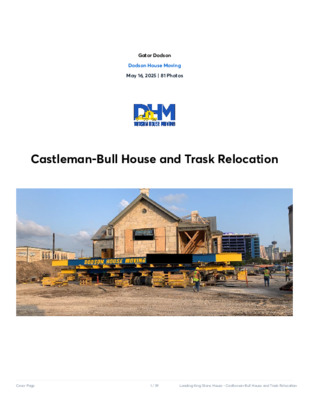
Gator Dodson Dodson House Moving May 16, 2025 | 81 Photos Castleman-Bull House and Trask Relocation Cover Page 1 / 39 Loading King Stone House - Castleman-Bull House and Trask Relocation Castleman-Bull House and Trask Relocation May 16, 2025 Historical Stone and Brick Buildings Historical Stone and Brick Buildings 1. Introduction Relocating historical stone and brick buildings is an intricate and sensitive process. These structures are often fragile due to age, original construction techniques, and exposure to environmental con- ditions over time. Preserving their integrity requires extensive planning, precision, and collaboration among engineers, architects, historians, and preservation specialists. This report outlines the key steps and considerations involved in moving these buildings, with a focus on pre-move assessments, engineering design, stabilization, and execution. 2. Preliminary Assessments and Planning Before any physical work begins on site, hundreds of hours are spent evaluating the building and planning the safest and most practical relocation method. Key activities in this stage include: 2.1 Historical Research • Document the building's historical significance, construction date, and architectural features. • Review archival records, blueprints, and any previous modifications or restoration work. 2.2 Site Survey and Structural Assessment • Conduct a detailed survey of the existing site and building footprint. • Evaluate the structural integrity of the stone and brickwork, including mortar condition and internal framing. • Identify areas of weakness, instability, or prior damage. 2.3 Documentation and Measurement • Create accurate drawings of the building. • Record all architectural details to ensure faithful reconstruction if needed. • Photograph and catalogue each section for reference and potential reconstruction. 3. Engineering Analysis and Relocation Planning 3.1 Structural Calculations • Perform load calculations to determine the weight and stress distribution across the structure. • Assess foundation and soil conditions at both the existing and new sites. 3.2 Method Selection • Decide between full-structure relocation, partial disassembly and reassembly, or façade preser- vation. • Choose a transportation method 3.3 Risk Assessment and Mitigation Planning • Identify potential risks during lifting, transport, and reinstallation. • Develop contingency plans for areas of concern during the loading method. 4. Pre-Move Stabilization and Preparation 4.1 Structural Reinforcement • Install internal and external bracing to prevent collapse or deformation during the move. • Reinforce weak areas using reversible and non-invasive techniques. 4.2 Disconnection and Excavation • Safely disconnect utilities and services. • Excavate around the foundation to install lifting steel or prepare for undercutting. 4.3 Permitting and …
HISTORIC LANDMARK COMMISSION APPLICATION FOR A CERTIFICATE OF APPROPRIATENESS JULY 2, 2025 HR-2025-071074 CASTLEMAN-BULL HOUSE 201 RED RIVER STREET 9 – 1 PROPOSAL Relocate the Castleman-Bull House in accordance with City Council Resolution No. 20250605-022, directing staff to facilitate the rezoning of Convention Center properties. PROJECT SPECIFICATIONS 1) Prepare the building for moving, including bracing and photographic documentation. 2) Move the building to a temporary staging area on E. 3rd Street for storage during Convention Center construction, mothballing according to best practices outlined by the National Parks Service. The masonry structure will be lifted off its non-historic foundation and the limestone masonry veneer and porch pier brick material will be removed and tagged for replacement on the structure in its final location. Non-historic exterior stairs and planters will also be removed. The wood porch will be detached from the masonry structure and protected for reattachment at the final location. 3) Move the building to its final location within the newly H-zoned portion of the property, rotating it 90 degrees to face the Waterloo Greenway trailhead. See site plan in backup. ARCHITECTURE Two-story rectangular structure with elements of the Italianate style, including a low-pitched roof, overhanging eaves set on decorative brackets, tall and narrow arched windows with hooded trim, and a one-story porch across the front façade. The house is symmetrical in plan, each floor having a center hall flanked by two square rooms with fireplaces in the interior walls. DESIGN STANDARDS The City of Austin’s Historic Design Standards (March 2021) are based on the Secretary of the Interior’s Standards for Rehabilitation and are used to evaluate projects at historic landmarks. The following standards apply to the proposed project: Demolition and Relocation 1.1 Do not demolish or relocate a historic building. 1.2 If demolition or relocation is necessary, ensure the safety of the building and any adjacent properties before, during, and afterwards. The applicants have evaluated multiple alternatives to relocation and have determined that moving the house is the only way to preserve it as the Convention Center expands. Rotating the house, which has already been moved from its original location on E. 7th Street in 2001, will not further impact its historic context. The proposal includes appropriate measures to ensure the safety of the building before, during, and after relocation. Applicants have conferred with the Architectural Review Committee to discuss options for relocation and mothballing during any required storage periods. …
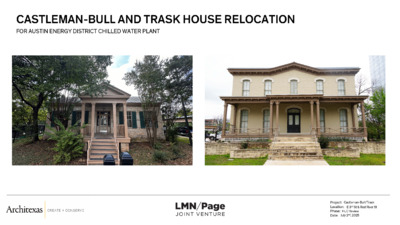
CASTLEMAN-BULL AND TRASK HOUSE RELOCATION FOR AUSTIN ENERGY DISTRICT CHILLED WATER PLANT Castleman-Bull/Trask E 3rd St & Red River St Project: Location: Phase: Date: HLC Review July 2nd, 2025 TRASK HOUSE - THC RTHL BUILT: 1850s RELOCATED: 1990 RENOVATED: 1992 ORIGINAL ADDRESS: 105 Neches Street CURRENT ADDRESS: 217 Red River (sometimes listed as 211 Red River) Note, current site has Historic Zoning Trask House Today Notes From City Planning Commission Meeting on 5/3/77 Trask House at Original Location, Sanborn map from 1900 Castleman-Bull/Trask E 3rd St & Red River St Project: Location: Phase: Date: HLC Review July 2nd, 2025 CASTLEMAN-BULL HOUSE – PROPOSED NEW AUSTIN LOCAL LANDMARK BUILT: 1873 RELOCATED: 2001 EXTERIOR RENOVATED: 2019 ORIGINAL ADDRESS: 308 E 7TH CURRENT ADDRESS: 201 Red River Castleman-Bull House Today Castleman-Bull House in its original location, THC Historic Resources Survey Castleman-Bull/Trask E 3rd St & Red River St Project: Location: Phase: Date: HLC Review July 2nd, 2025 EXISTING SITE TRASK HOUSE HISTORIC ZONING CASTLEMAN-BULL HOUSE Castleman-Bull/Trask E 3rd St & Red River St Project: Location: Phase: Date: HLC Review July 2nd, 2025 EXISTING SITE TRASK HOUSE HISTORIC ZONING FUTURE AUSTIN ENERGY DISTRICT CHILLED WATER PLANT SUBGRADE FOOTPRINT CASTLEMAN-BULL HOUSE Castleman-Bull/Trask E 3rd St & Red River St Project: Location: Phase: Date: HLC Review July 2nd, 2025 TRASK HOUSE – LIMITS OF DECONSTRUCTION LIMITS OF PORCH TO BE DETACHED AND MOVED LINE OF DETACHMENT MASONRY TO BE SALVAGED Castleman-Bull/Trask E 3rd St & Red River St Project: Location: Phase: Date: HLC Review July 2nd, 2025 CASTLEMAN-BULL HOUSE – LIMITS OF DECONSTRUCTION LIMITS OF PORCH TO BE DETACHED AND MOVED LINE OF DETACHMENT MASONRY TO BE SALVAGED Castleman-Bull/Trask E 3rd St & Red River St Project: Location: Phase: Date: HLC Review July 2nd, 2025 HOUSE MOVING Castleman-Bull/Trask E 3rd St & Red River St Project: Location: Phase: Date: HLC Review July 2nd, 2025 TRASK HOUSE – POTENTIAL TEMPORARY LOCATION PROPOSED TRASK HOUSE PERMANENT LOCATION POTENTIAL TEMPORARY LOCATION EXIST. TRASK HOUSE LOCATION APPROX. PROPOSED MOVE PATH Castleman-Bull/Trask E 3rd St & Red River St Project: Location: Phase: Date: HLC Review July 2nd, 2025 CASTLEMAN-BULL HOUSE – POTENTIAL TEMPORARY LOCATION APPROX. PROPOSED MOVE PATH PROPOSED CASTLEMAN-BULL HOUSE PERMANENT LOCATION POTENTIAL TEMPORARY LOCATION EXIST. TRASK HOUSE LOCATION Castleman-Bull/Trask E 3rd St & Red River St Project: Location: Phase: Date: HLC Review July 2nd, 2025 TRASK HOUSE – PROPOSED LOCATION PROPOSED LOCATION 50' WEST OF ORIGINAL LOCATION RELATIONSHIP TO …
Historic Review Application For Office Use Only Date of Submission:_________________________________ Case #:____________________________________________ _________________________________________________ Historic Preservation Office approval Date of Approval:___________________________________ Property Address: ______________________________________________________ Historic Landmark Historic District (Local) National Register Historic District Historic Landmark or Historic District Name:______________________________________________________________________________________________ Applicant Name: _______________________________ Phone #: ______________________ Email: ______________________________ Applicant Address: _______________________________ City: _______________________ __ State: ________________ Zip: __________ Please describe all proposed exterior work with location and materials. If you need more space, attach an additional sheet. PROPOSED WORK LOCATION OF PROPOSED WORK PROPOSED MATERIAL(S) 1) 2) 3) Submittal Requirements 1. One set of dimensioned building plans. Plans must: a) specify materials and finishes to be used, and b) show existing and proposed conditions for alterations and additions. Site Plan Elevations Floor Plan Roof Plan 2. Color photographs of building and site: Elevation(s) proposed to be modified Detailed view of each area proposed to be modified Any changes to these plans must be reviewed and approved by the Historic Preservation Office and/or Historic Landmark Commission. Applicant Signature: ___________________________________________ Date: ____________________________ Submit complete application, drawings, and photos to preservation@austintexas.gov. Call (512) 974-3393 with questions. Design Standards and Guidelines for Historic Properties Adopted December 2012 Design Standards and Guidelines for Historic Properties Landmarks and National Register historic district properties If you are making changes to a historic landmark, the project must comply with these standards to receive a Certificate of Appropriateness. If you are making changes to a contributing property or constructing a new building within a National Register historic district, consider the standards below as advisory guidelines: 1. Use a property for its historic purpose or place it in a new use that requires minimal change to the defining characteristics of the building and its site and environment. 2. Retain and preserve the historic character or a property shall be retained and preserved. Avoid the removal of historic materials or alteration of features and spaces that characterize a property. 3. Recognize each property as a physical record of its time, place, and use. Changes that create a false sense of historical development, such as adding conjectural features or architectural elements from other buildings, shall not be undertaken. 4. Most properties change over time; those changes that have acquired historic significance in their own right shall be retained and preserved. 5. Distinctive features, finishes, and construction techniques or examples of craftsmanship that characterize a historic property shall be preserved. 6. Deteriorated historic features shall …
DODSON HOUSE MOVING, LLC P.O. Box 240339 San Antonio, TX 78224 Building Preparations The initial phase of work on the Trask and Castleman Bull houses involves structural preparations to ensure the buildings are secure and ready for relocation. These tasks will be needed regardless of the storage location. However, should the relocation distance be greater than a quarter to half mile from the current location, the preparation tasks will increase. The key functions include: • Bracing Windows and Doors: We will install temporary bracing to stabilize all windows and doors. We will install plywood over all openings to help secure the buildings for storage. This step is essential to protect these fragile elements during subsequent work. • Removing and Bracing Porches: The existing porch will be carefully removed and braced to allow access and facilitate further structural work. • Preparing Beam Pockets: The beam pockets will be cut out and ready to receive steel support, which will provide the necessary strength for lifting and moving the structures. • Excavation and demolition: Start removing concrete around structures and excavating down to the steel installation level. • Steel Cable Wrapping and Compression: Both structures will be entirely, securely wrapped with steel cable and compressed to reinforce the structure and prevent any shifting or damage. • Clearing AC Ducts and Lines: All air conditioning ducts and related lines will be removed or relocated to create a clear space for steel installation. • Steel Installation: We will begin installing steel supports around the house to prepare for the lift. Importantly, no lifting or detachment from the foundation will occur until the appropriate permits have been obtained. The above work will help expedite the loading phase and shorten the timeline. If we need to remove some of the above steps, that's fine; whatever they will allow us to start on will help with the timeline. Gator Dodson
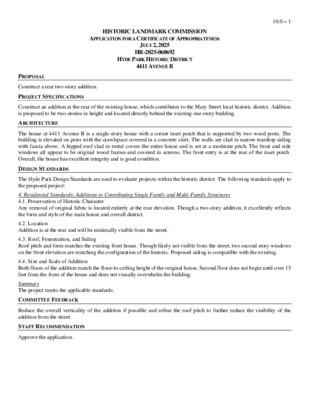
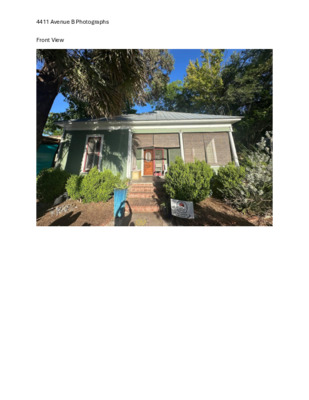
HISTORIC LANDMARK COMMISSION APPLICATION FOR A CERTIFICATE OF APPROPRIATENESS JULY 2, 2025 HR-2025-060692 HYDE PARK HISTORIC DISTRICT 4411 AVENUE B 10.0 – 1 PROPOSAL Construct a rear two-story addition. PROJECT SPECIFICATIONS Construct an addition at the rear of the existing house, which contributes to the Mary Street local historic district. Addition is proposed to be two-stories in height and located directly behind the existing one-story building. ARCHITECTURE The house at 4411 Avenue B is a single-story house with a corner inset porch that is supported by two wood posts. The building is elevated on piers with the crawlspace covered in a concrete skirt. The walls are clad in narrow teardrop siding with fascia above. A hipped roof clad in metal covers the entire house and is set at a moderate pitch. The front and side windows all appear to be original wood frames and covered in screens. The front entry is at the rear of the inset porch. Overall, the house has excellent integrity and is good condition. DESIGN STANDARDS The Hyde Park Design Standards are used to evaluate projects within the historic district. The following standards apply to the proposed project: 4. Residential Standards: Additions to Contributing Single Family and Multi-Family Structures 4.1. Preservation of Historic Character Any removal of original fabric is located entirely at the rear elevation. Though a two-story addition, it excellently reflects the form and style of the main house and overall district. 4.2. Location Addition is at the rear and will be minimally visible from the street. 4.3. Roof, Fenestration, and Siding Roof pitch and form matches the existing front house. Though likely not visible from the street, two second story windows on the front elevation are matching the configuration of the historic. Proposed siding is compatible with the existing. 4.4. Size and Scale of Addition Both floors of the addition match the floor-to-ceiling height of the original house. Second floor does not begin until over 15 feet from the front of the house and does not visually overwhelm the building. Summary The project meets the applicable standards. COMMITTEE FEEDBACK Reduce the overall verticality of the addition if possible and refine the roof pitch to further reduce the visibility of the addition from the street. STAFF RECOMMENDATION Approve the application. LOCATION MAP 10.0 – 2 PROPERTY INFORMATION Photos 10.0 – 3 Permit application, 2025 Zillow listing, 2025
4411 Avenue B Photographs Front View 4411 Avenue B Photographs Rear View 4411 Avenue B Photographs Right side (Curb View) 4411 Avenue B Photographs Left side
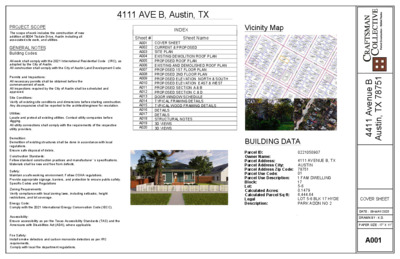
4111 AVE B, Austin, TX Vicinity Map INDEX Sheet Name COVER SHEET CURRENT & PROPOSED SITE PLAN EXISTING DEMOLITION ROOF PLAN PROPOSED ROOF PLAN EXISTING AND DEMOLISHED ROOF PLAN PROPOSED 1ST FLOOR PLAN PROPOSED 2ND FLOOR PLAN PROPOSED ELEVATION NORTH & SOUTH PROPOSED ELEVATION EAST & WEST PROPOSED SECTION A & B PROPOSED SECTION C & D DOOR WINDOW SCHEDULE TYPICAL FRAMING DETAILS TYPICAL WOOD FRAMING DETAILS DETAILS DETAILS STRUCTURAL NOTES 3D VIEWS 3D VIEWS Sheet # A001 A002 A003 A004 A005 A006 A007 A008 A009 A010 A011 A012 A013 A014 A015 A016 A017 A018 A019 A020 BUILDING DATA Parcel ID: Owner Name: Parcel Address: Parcel Address City: Parcel Address Zip Code: Parcel Use Code: Parcel Use Description: Block: Lot: Calculated Acres: Calculated Parcel Sq ft: Legal Description: 0221050907 4111 AVENUE B, TX AUSTIN 78751 01 1 FAM DWELLING 17 5-6 0.1479 6,444.64 LOT 5-6 BLK 17 HYDE PARK ADDN NO 2 PROJECT SCOPE The scope of work includes the construction of new addition at 8004 Tisdale Drive, Austin including all associated site work, and utilities. GENERAL NOTES Building Codes: All work shall comply with the 2021 International Residential Code (IRC), as adopted by the City of Austin. All construction shall comply with the City of Austin Land Development Code. Permits and Inspections: All necessary permits shall be obtained before the commencement of work. All inspections required by the City of Austin shall be scheduled and approved. Site Conditions: Verify all existing site conditions and dimensions before starting construction. Any discrepancies shall be reported to the architect/engineer for resolution. Utilities: Locate and protect all existing utilities. Contact utility companies before digging. All utility connections shall comply with the requirements of the respective utility providers. Demolition: Demolition of existing structures shall be done in accordance with local regulations. Ensure safe disposal of debris. Construction Standards: Follow standard construction practices and manufacturer ’ s specifications. Materials shall be new and free from defects. Safety: Maintain a safe working environment. Follow OSHA regulations. Provide appropriate signage, barriers, and protection to ensure public safety. Specific Codes and Regulations Zoning Requirements: Verify compliance with local zoning laws, including setbacks, height restrictions, and lot coverage. Energy Code: Comply with the 2021 International Energy Conservation Code (IECC). Accessibility: Ensure accessibility as per the Texas Accessibility Standards (TAS) and the Americans with Disabilities Act (ADA), where applicable. Fire Safety: Install smoke detectors and carbon monoxide detectors as per …
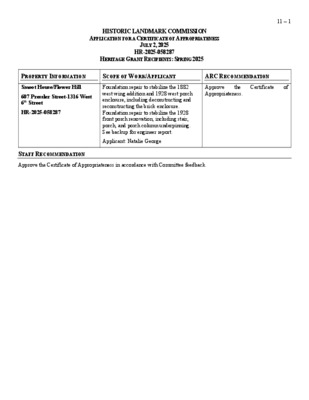
HISTORIC LANDMARK COMMISSION APPLICATION FOR A CERTIFICATE OF APPROPRIATENESS JULY 2, 2025 HR-2025-058287 HERITAGE GRANT RECIPIENTS: SPRING 2025 11 – 1 PROPERTY INFORMATION SCOPE OF WORK/APPLICANT ARC RECOMMENDATION Smoot House/Flower Hill 607 Pressler Street-1316 West 6th Street HR-2025-058287 Foundation repair to stabilize the 1882 west wing addition and 1928 west porch enclosure, including deconstructing and reconstructing the brick enclosure. Foundation repair to stabilize the 1928 front porch renovation, including stair, porch, and porch column underpinning. See backup for engineer report. Applicant: Natalie George Approve Appropriateness. the Certificate of STAFF RECOMMENDATION Approve the Certificate of Appropriateness in accordance with Committee feedback. LOCATION MAP 11 – 2
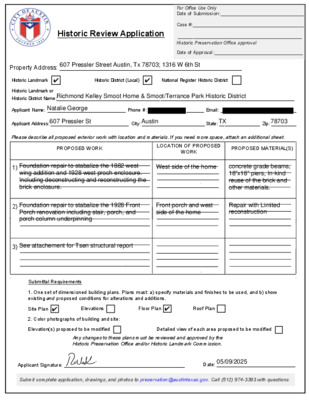
Historic Review Application For Office Use Only Date of Submission:_________________________________ Case #:____________________________________________ _________________________________________________ Historic Preservation Office approval Date of Approval:___________________________________ Property Address: ______________________________________________________ Historic Landmark Historic District (cid:11)(cid:47)ocal) (cid:49)ational (cid:53)egister (cid:43)istoric (cid:39)istrict (cid:43)istoric (cid:47)andmar(cid:78) or (cid:43)istoric (cid:39)istrict (cid:49)ame:__________________(cid:66)(cid:66)(cid:66)(cid:66)(cid:66)(cid:66)(cid:66)(cid:66)(cid:66)(cid:66)(cid:66)(cid:66)(cid:66)(cid:66)(cid:66)(cid:66)(cid:66)(cid:66)(cid:66)(cid:66)(cid:66)(cid:66)(cid:66)(cid:66)(cid:66)(cid:66)(cid:66)(cid:66)(cid:66)(cid:66)(cid:66)(cid:66)(cid:66)(cid:66)(cid:66)(cid:66)(cid:66)(cid:66)(cid:66)(cid:66)(cid:66)(cid:66)(cid:66)(cid:66)(cid:66)(cid:66)(cid:66)(cid:66)(cid:66)(cid:66)(cid:66)(cid:66)(cid:66)(cid:66)(cid:66)(cid:66)(cid:66)(cid:66)(cid:66)(cid:66)(cid:66)(cid:66)(cid:66)(cid:66)(cid:66)(cid:66)(cid:66)(cid:66)(cid:66)(cid:66)(cid:66)(cid:66)(cid:66)(cid:66)(cid:66)(cid:66) Applicant Name: _______________________________ Phone (cid:6): _______ Email: _ _ Applicant Address: _________________________(cid:66)_____ City: ____________(cid:66)(cid:66)(cid:66)________ __ State: ________________ (cid:61)ip: _________(cid:66) (cid:51)(cid:79)(cid:72)a(cid:86)(cid:72)(cid:3)d(cid:72)(cid:86)(cid:70)(cid:85)(cid:76)(cid:69)(cid:72)(cid:3)a(cid:79)(cid:79)(cid:3)(cid:83)(cid:85)(cid:82)(cid:83)(cid:82)(cid:86)(cid:72)d(cid:3)(cid:72)(cid:91)(cid:87)(cid:72)(cid:85)(cid:76)(cid:82)(cid:85)(cid:3)(cid:90)(cid:82)(cid:85)(cid:78)(cid:3)(cid:90)(cid:76)(cid:87)(cid:75)(cid:3)(cid:79)(cid:82)(cid:70)a(cid:87)(cid:76)(cid:82)n(cid:3)and(cid:3)(cid:80)a(cid:87)(cid:72)(cid:85)(cid:76)a(cid:79)(cid:86)(cid:17) If you need more space, attach an additional sheet. PROPOSED (cid:58)(cid:50)(cid:53)(cid:46) LOCATION OF PROPOSED (cid:58)(cid:50)(cid:53)(cid:46) PROPOSED MATERIAL(S) 1) (cid:21)) (cid:22)) Submittal Requirements 1. One set of dimensioned building plans. Plans must: a) specify materials and finishes to be used, and b) show existing and proposed conditions for alterations and additions. Site Plan Elevations Floor Plan Roof Plan 2. Color photographs of building and site: (cid:40)levation(cid:11)s) proposed to be modified Detailed view of each area proposed to be modified Any changes to these plans must be reviewed and approved by the Historic Preservation Office and/or Historic Landmark Commission. Applicant Signature: ___________________________________________ Date: ____________________________ (cid:54)ubmit complete application(cid:15) drawings(cid:15) and photos to preservation(cid:35)austinte(cid:91)as.gov. Call (cid:11)(cid:24)(cid:20)(cid:21)(cid:12) (cid:28)(cid:26)(cid:23)(cid:16)(cid:22)(cid:22)(cid:28)(cid:22) with (cid:84)uestions. Design Standards and Guidelines for Historic Properties Adopted (cid:39)ece(cid:80)(cid:69)er (cid:21)(cid:19)(cid:20)(cid:21) (cid:39)esi(cid:74)n (cid:54)tandards and Guidelines for Historic Properties Landmarks and National Register historic district properties If you are making changes to a historic landmark, the project must comply with these standards to receive a Certificate of Appropriateness. If you are making changes to a contributing property or constructing a new building within a National Register historic district, consider the standards below as advisory guidelines: 1. Use a property for its historic purpose or place it in a new use that requires minimal change to the defining characteristics of the building and its site and environment. 2. Retain and preserve the historic character or a property shall be retained and preserved. Avoid the removal of historic materials or alteration of features and spaces that characterize a property. 3. Recognize each property as a physical record of its time, place, and use. Changes that create a false sense of historical development, such as adding conjectural features or architectural elements from other buildings, shall not be undertaken. 4. Most properties change over time; those changes that have acquired historic significance in their own right shall be retained and preserved. 5. Distinctive features, finishes, and construction techniques or examples of craftsmanship that characterize a historic property shall be preserved. 6. Deteriorated historic features shall be repaired rather than replaced. Where the severity …
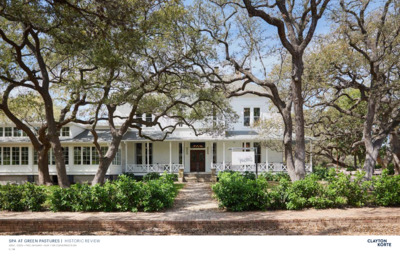
HISTORIC LANDMARK COMMISSION APPLICATION FOR A CERTIFICATE OF APPROPRIATENESS JULY 2, 2025 HR-2025-073763 GREEN PASTURES 811 WEST LIVE OAK STREET 12.0 – 1 PROPOSAL Construct a new hotel building on the grounds of a landmarked property. PROJECT SPECIFICATIONS To the northwest of the existing historic house, construct a three-story hotel building containing 36 guest rooms, spa, pool, and fitness area. Construction will also include site work as part of Phase 3 of a larger project across the Green Pastures complex. Previous phases were presented to HLC and received a Certificate of Appropriateness in November 2022. ARCHITECTURE Green Pastures was built circa 1895 and designated a local historic landmark in 1979. The historic house sits in the approximate center of the property. In addition to the building, the landscaping of large oak trees is a character defining feature of the landmarked property. A previously approved hotel building is located at the southeast corner of the property. DESIGN STANDARDS The City of Austin’s Historic Design Standards (March 2021) are based on the Secretary of the Interior’s Standards for Rehabilitation and are used to evaluate projects at historic landmarks. The following standards apply to the proposed project: Commercial new construction 1. Location The proposed hotel is set to the side of the property, in a corner which allows adequate space between its location and the historic structure. It is proposed to be oriented towards the historic in keeping with the general movement plan of the property. 2. Scale, massing, and height Though the hotel is three stories, its vertical appearance is minimized through its width and other horizontal design elements. Renderings indicate that it will be level with numerous tree canopies on the property, and only slightly taller than the hipped roof of the historic house. 3. Design and style Though very modern in design, choices in color and finishes generally mute the appearance and allow the hotel to fade visually amongst the site features and urban context. Design choices are also compatible with the previously approved hotel construction, which creates a uniformity amongst new construction approved on the site. 4. Materials The materials proposed read as contemporary. Cladding elements emphasize the horizontality with the goal of reducing the vertical appearance of the three-story structure. 5. Storefronts Throughout the property, the pedestrian scale is prioritized, with the hotel and spa designed to be approved on foot or through human-scale methods. 6. Parking structures …
SPA AT GREEN PASTURES | HISTORIC REVIEW J U N E , 20 2 5 • P R E L I M I N A RY— N OT FO R C O N ST RU CT I O N 1 / 19 O V E R A L L S I T E P L A N WE ST LIVE OAK ST SPA AT GREEN PASTURES | HISTORIC REVIEW J U N E , 20 2 5 • P R E L I M I N A RY— N OT FO R C O N ST RU CT I O N 2 / 19 SOUTH OAK CRE ST AVE S I T E P L A N | 1 ” = 8 0 ’ GREEN PASTURES PHASE ONE AND TWO SPA AT GREEN PASTURES | HISTORIC REVIEW J U N E , 20 2 5 • P R E L I M I N A RY— N OT FO R C O N ST RU CT I O N 3 / 19 P H A S E 1 : M A T T I E ’ S COMPLETED P H A S E 1 - O F F I C E & P O R C H A D D I T I O N - 2 0 1 7 P H A S E 1 - M A I N B U I L D I N G E A S T F A C A D E P H A S E 1 - S O U T H P O R C H R O O F A D D I T I O N - 2 0 1 7 P H A S E 1 - S O U T H P O R C H & E A S T E V E N T E N T R Y - 2 0 1 7 SPA AT GREEN PASTURES | HISTORIC REVIEW J U N E , 20 2 5 • P R E L I M I N A RY— N OT FO R C O N ST RU CT I O N 4 / 19 P H A S E 2 : T H E I N N A T G R E E N P A S T U R E S UNDER CONSTRUCTION P H A S E 2 - V …
SPA AT GREEN PASTURES | HISTORIC REVIEW J U LY 20 2 5 • P R E L I M I N A RY— N OT FO R C O N ST RU CT I O N 1 / 20 O V E R A L L S I T E P L A N WE ST LIVE OAK ST SPA AT GREEN PASTURES | HISTORIC REVIEW J U LY 20 2 5 • P R E L I M I N A RY— N OT FO R C O N ST RU CT I O N 2 / 20 SOUTH OAK CREST AVE S I T E P L A N | 1 ” = 8 0 ’ GREEN PASTURES PHASES ONE AND TWO SPA AT GREEN PASTURES | HISTORIC REVIEW J U LY 20 2 5 • P R E L I M I N A RY— N OT FO R C O N ST RU CT I O N 3 / 20 P H A S E 1 : M A T T I E ’ S COMPLETED P H A S E 1 - O F F I C E & P O R C H A D D I T I O N - 2 0 1 7 P H A S E 1 - M A I N B U I L D I N G E A S T F A C A D E P H A S E 1 - S O U T H P O R C H R O O F A D D I T I O N - 2 0 1 7 P H A S E 1 - S O U T H P O R C H & E A S T E V E N T E N T R Y - 2 0 1 7 SPA AT GREEN PASTURES | HISTORIC REVIEW J U LY 20 2 5 • P R E L I M I N A RY— N OT FO R C O N ST RU CT I O N 4 / 20 P H A S E 2 : T H E I N N A T G R E E N P A S T U R E S UNDER CONSTRUCTION - EXPECTED COMPLETION LATE JULY 2025 P H A S E 2 - V I E W …
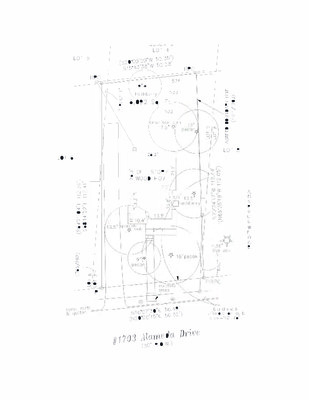
HISTORIC LANDMARK COMMISSION PERMITS IN NATIONAL REGISTER HISTORIC DISTRICTS JULY 2, 2025 PR-2025-029950; GF-2025-033059; HR-2025-056344 TRAVIS HEIGHTS-FAIRVIEW PARK HISTORIC DISTRICT 1703 ALAMEDA DRIVE 14.0 – 1 PROPOSAL Demolish a ca. 1939 house and construct a residence. PROJECT SPECIFICATIONS Demolish the existing one-story house, which contributes to the National Register district. Construct a two-story house in generally the same location on the lot. ARCHITECTURE Built in a simple, minimal traditional form, the house at 1703 Alameda Drive is set at grade slightly above the street and is rectangular in plan with a small front porch cutout at one corner. The exterior is clad in horizontal wood siding, and original screen are present at the four front windows, along with a screen door at the rear of the porch for the main entry. There is minimal overhang from the hipped roof, which is clad in composition shingle. The house features numerous windows on all sides, typically paired or arranged in three units, side-by-side. A pier-and-beam foundation supports the one-story structure. The house is in good condition and has seen minimal alterations since construction. RESEARCH After construction around 1939, the house was first owned by Hiram & Doris Brown, who worked at local businesses such as Texas Cleaners & Shoe Repair. The Browns owned the property through World War II, and shortly after was sold to Charles & Bertha Kinney. Charles Kinney worked as a salesman and Bertha worked for many years as a clerk at the Internal Revenue Service. For a time, their adult son lived with them while attending the University of Texas. DESIGN STANDARDS The City of Austin’s Historic Design Standards (March 2021) are based on the Secretary of the Interior’s Standards for Rehabilitation and are used to evaluate projects in National Register districts. The following standards apply to the proposed project: Residential new construction 1. Location Proposed construction is generally on the same footprint as the existing house and matches setback to other houses on the street. 2. Orientation The proposed residence is oriented towards the street, like the existing house and neighbors on the same street. 3. Scale, massing, and height Generally, the neighbors on the same street have single-story houses or, if there is a second floor, it is setback from the front or visually hidden by a side-gabled roof. There is no setback in this design, nor does the plan call for breaking up the height …
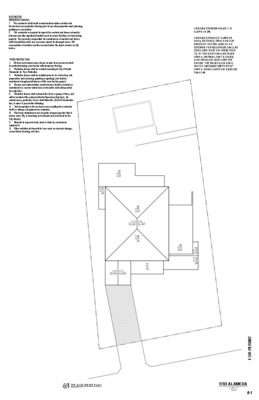
SITE NOTES EROSION CONTROL 1. The contractor shall install erosion/sedimentation controls and tree/natural area protective fencing prior to any site preparation work (clearing, grubbing or excavation). 2. The contractor is required to inspect the controls and fences at weekly intervals and after significant rainfall events to insure that they are functioning properly. The person(s) responsible for maintenance of controls and fences shall immediately make any necessary repairs to damaged areas. Silt accumulation at controls must be removed when the depth reaches six (6) inches. TREE PROTECTION 1. All trees and natural areas shown on plan to be preserved shall be protected during construction with temporary fencing. 2. Protective fences shall be erected according to City of Austin Standards for Tree Protection. 3. Protective fences shall be installed prior to the start of any site preparation work (clearing, grubbing or grading), and shall be maintained throughout all phases of the construction project. 4. Erosion and sedimentation control barriers shall be installed or maintained in a manner which does not result in soil build-up within tree drip lines. 5. Protective fences shall surround the trees or group of trees, and will be located at the outermost limit of branches (drip line) , for natural areas, protective fences shall follow the Limit of Construction line, in order to prevent the following: A. Soil compaction in the root zone area resulting from vehicular traffic or storage of equipment or materials; B. Root zone disturbances due to grade changes (greater than 6 inches cut or fill), or trenching not reviewed and authorized by the City Aborist; C. Wounds to exposed roots, trunk or limbs by mechanical equipment; D. Other activities detrimental to trees such as chemical storage, cement truck cleaning, and fires. VISITABLE EXTERIOR ROUTE 1:12 SLOPE = 8.3% VISITABLE ENTRANCE SURFACE SHALL BE STABLE, FIRM, AND SLIP RESISTANT. PAVERS USED AS AN EXTERIOR VISITABLE ROUTE SHALL BE LEVEL WITH GAPS NO MORE THAN 1/2 IN. THE GAPS SHALL BE FILLED WITH A MATERIAL THAT IS STABLE AND FIRM AND LEVEL WITH THE PAVERS. THE ROUTE ALSO SHALL HAVE A MINIMUM WIDTH OF 36" WITH A CROSS SLOPE NO GREATER THAN 2% E P O L S 2 1 : 6 2 1 : 6 E P O L S E P O L S 2 1 : 6 6:12 SLOPE 6:12 SLOPE 2 1 : 6 E P O L S E P O …
1703 Alameda Historic Landmark Commission Response Introduction We are pleased to submit this architectural proposal for a modest guest house designed in partnership with well known local architects for a young family living in the adjacent home. Unfortunately, we aren’t able to make the meeting, but we remain fully committed to the process. The homeowners—Austin residents with two small children—purchased the neighboring property to create a dedicated space for their elderly mother as well as enhance their outdoor living environment with a park-like setting. Jack Boothe Construction built their current home and has now been entrusted to lead this project as well, with the shared goal of creating a thoughtful, cohesive addition to their property. Over the past decade, Jack Boothe Construction completed several high-quality homes in Travis Heights. We have the reputation to always build with great care to complement the fabric of the neighborhood. We welcome thoughtful feedback from the Committee that can help refine and improve this plan as we continue our commitment to building responsibly and respectfully within this historic community. Scale, massing, and height • HLC Comment: Generally, the neighbors on the same street have single-story houses or, if there is a second floor, it is setback from the front or visually hidden by a side-gabled roof. There is no setback in this design, nor does the plan call for breaking up the height visually from the ground to the top of the second story. • Reply: Both adjacent properties—one of which is a contributing structure—are two-story homes. The proposed second story at 1703 Alameda has been carefully designed with thoughtful setbacks to reduce visual impact: 12 feet from the leftmost forward wall, 4 feet from the front of the porch, and 13 feet from the rightmost portion of the front-facing wall. Additionally, the front porch features its own distinct roofline, which further helps to break up the vertical massing and soften the visual transition from the ground level to the second story. • HLC Comment: The massing features the two-story central mass with a projecting front garage and a corner bedroom on the ground floor, along with a kitchen and living room at the rear.” • Reply: The two-story central mass of 1703 Alameda is set back from the projecting front-facing garage and the corner bedroom on the ground floor. A covered front porch, positioned between these two elements, further breaks up the front …
1703 Alameda Response to questions posed at ARC • Comment made: • Design/Exterior Materials: • Questions about consistency and appropriateness in the historic setting. • Observed that the design appears to take inspiration from a new neighboring house (stucco), rather than fitting the established character of the street. • Response • We have reconsidered using stucco as the primary siding and will be using a combination of Siding from the 1700 Block of contributing houses. Which include: • Board and Batton • Horizontal Siding • Brick/Stone • Renderings and drawings have not been updated as the turnaround time was short, but will re-submit ASAP. Introduction – Response to questions posed at ARC. • Comment made: • Garage Placement and Grade Issues: • Concerns about the garage being set lower relative to the main floor, producing a split-level effect. • Questions about the site plan's handling of natural grade and the garage's elevation, with some confusion based on the submitted drawings. • Excavation is being used to keep the building's profile lower, but this may create practical or visual inconsistencies. • Response • 5’ elevation gain (526’-532’) in house footprint • Visitability of the entire main living area was the primary focus • Combination of excavation in the back yard to help reduce the overall height of the house and grading in the front of the house to help blend the driveway to the natural grade will be used. Introduction – Response to questions posed at ARC. • Comment made: • Suggestions included reconsidering the prominent arch (possibly removing it or replacing with a framed opening) to help scale and reduce visual disjunction. • Response • The Arch will be removed and replaced with a framed opening (Arch still present in Included Renderings). Rough Renderings Rough Renderings
1703 Alameda Response to questions posed at ARC • Comment made: • Design/Exterior Materials: • Questions about consistency and appropriateness in the historic setting. • Observed that the design appears to take inspiration from a new neighboring house (stucco), rather than fitting the established character of the street. • Response • We have reconsidered using stucco as the primary siding and will be using a combination of Siding from the 1700 Block of contributing houses. Which include: • Board and Batton • Horizontal Siding • Brick/Stone • Renderings and drawings have not been updated as the turnaround time was short, but will re-submit ASAP. Introduction – Response to questions posed at ARC. • Comment made: • Garage Placement and Grade Issues: • Concerns about the garage being set lower relative to the main floor, producing a split-level effect. • Questions about the site plan's handling of natural grade and the garage's elevation, with some confusion based on the submitted drawings. • Excavation is being used to keep the building's profile lower, but this may create practical or visual inconsistencies. • Response • 5’ elevation gain (526’-532’) in house footprint • Visitability of the entire main living area was the primary focus • Combination of excavation in the back yard to help reduce the overall height of the house and grading in the front of the house to help blend the driveway to the natural grade will be used. Introduction – Response to questions posed at ARC. • Comment made: • Suggestions included reconsidering the prominent arch (possibly removing it or replacing with a framed opening) to help scale and reduce visual disjunction. • Response • The Arch will be removed and replaced with a framed opening (Arch still present in Included Renderings). Rough Renderings Rough Renderings
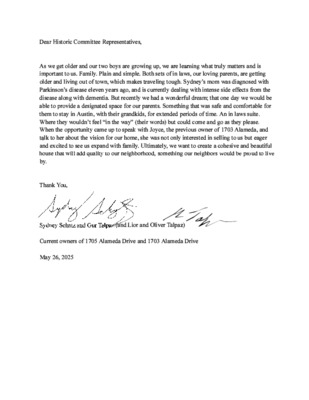
Dear Historic Committee Representatives, eleven disease to us. Family. Plain and simple. along with dementia. a designated As we get older and our two boys are growing important older and living Parkinson's disease able to provide them to stay in Austin, Where they wouldn't feel "in the way" (their When the opportunity 14lk to her about the vision and excited house that will add quality by. to see us expand with family. out of town, which makes traveling tough. years ago, and is currently Both sets of in laws, our loving and is up, we are learning what truly matters parents, with mom was diagnosed from the side effects with intense dream; that one day we would be that was safe and comfortable dealing we had a wonderful Something are getting Sydney's for But recently space for our parents. with their grandkids, for extended words) came up to speak with Joyce, but could come and go as they please. the previous owner of 1703 Alameda, and periods of time. An in laws suite. for our home, she was not only interested in selling to us but eager Ultimately , we want to create a cohesive and beautiful to our neighborhood, something our neighbors would be proud to live Thank You, ' ' �;;;:; and Lior and Oliver Talpaz) � Current owners of 1705 Alameda Drive and 1703 Alameda Drive May 26, 2025
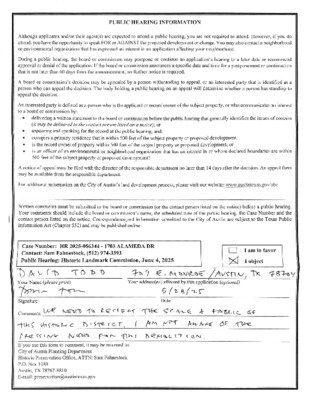
P U B L I C H E A R I N G I N F O R M A T I O N Although applicants and/or their agents) are expected to attend a public hearing, you are not required to attend. However, if you do attend, you have the opportunity to speak FOR or AGAINST the proposed development or change. You may also contact a neighborhood or environmental organization that has expressed an interest in an application affecting your neighborhood. During a public hearing, the board or commission may postpone or continue an application's hearing to a later date or recommend approval or denial of the application. If the board or commission announces a specific date and time for a postponement or continuation that is not later than 60 days from the announcement, no further notice is required A board or commission's decision may be appealed by a person withstanding to appeal, or an interested party that is identified as a person who can appeal the decision. The body holding a public hearing on an appeal will determine whether a person has standing to appeal the decision. An interested party is defined as a person who is the applicant or record owner of the subject property, or who communicates an interest to a board or commission by: ? delivering a written statement to the board or commission before the public hearing that generally identifies the issues of concern (it may be delivered to the contact person listed on a notice); or ? appearing and speaking for the record at the public hearing; and: ? occupies a primary residence that is within 500 feet of the subject property or proposed development. ? is the record owner of property within 500 feet of the subject property or proposed development; or ? is an officer of an environmental or neighborhood organization that has an interest in or whose declared boundaries are within 500 feet of the subject property or proposed development? A notice of appeal must be filed with the director of the responsible department no later than 14 days after the decision. An appeal form may be available from the responsible department. For additional information on the City of Austin's land development process, please visit our website: www.austintexas.gov/abc Written comments must be submitted to the board or commission (or the contact person listed on the notice) before a public hearing. Your …
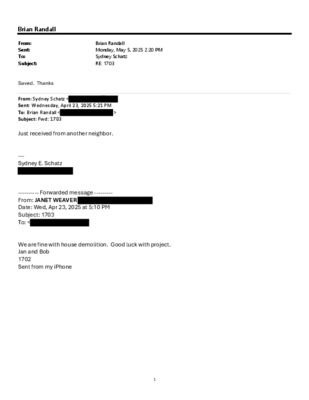
Brian Randall From: Sent: To: Subject: Saved. Thanks Brian Randall Monday, May 5, 2025 2:20 PM Sydney Schatz RE: 1703 From: Sydney Schatz < Sent: Wednesday, April 23, 2025 5:21 PM To: Brian Randall < Subject: Fwd: 1703 > Just received from another neighbor. --- Sydney E. Schatz ---------- Forwarded message --------- From: JANET WEAVER Date: Wed, Apr 23, 2025 at 5:10 PM Subject: 1703 To: < We are fine with house demolition. Good luck with project. Jan and Bob 1702 Sent from my iPhone 1
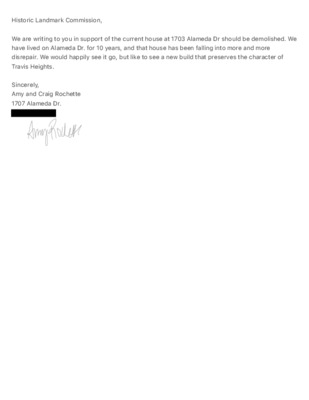
Historic Landmark Commission, We are writing to you in support of the current house at 1703 Alameda Dr should be demolished. We have lived on Alameda Dr. for 10 years, and that house has been falling into more and more disrepair. We would happily see it go, but like to see a new build that preserves the character of Travis Heights. Sincerely, Amy and Craig Rochette 1707 Alameda Dr.
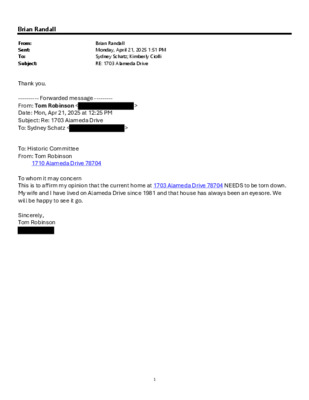
Brian Randall From: Sent: To: Subject: Thank you. Brian Randall Monday, April 21, 2025 1:51 PM Sydney Schatz; Kimberly Ciolli RE: 1703 Alameda Drive ---------- Forwarded message --------- From: Tom Robinson < Date: Mon, Apr 21, 2025 at 12:25 PM Subject: Re: 1703 Alameda Drive To: Sydney Schatz < > > To: Historic Committee From: Tom Robinson 1710 Alameda Drive 78704 To whom it may concern This is to affirm my opinion that the current home at 1703 Alameda Drive 78704 NEEDS to be torn down. My wife and I have lived on Alameda Drive since 1981 and that house has always been an eyesore. We will be happy to see it go. Sincerely, Tom Robinson 1
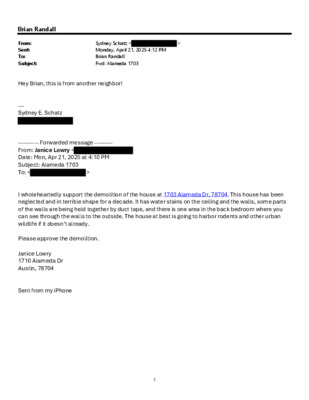
Brian Randall From: Sent: To: Subject: Sydney Schatz < Monday, April 21, 2025 4:12 PM Brian Randall Fwd: Alameda 1703 > Hey Brian, this is from another neighbor! --- Sydney E. Schatz ---------- Forwarded message --------- From: Janice Lowry < Date: Mon, Apr 21, 2025 at 4:10 PM Subject: Alameda 1703 To: < > I wholeheartedly support the demolition of the house at 1703 Alameda Dr, 78704. This house has been neglected and in terrible shape for a decade. It has water stains on the ceiling and the walls, some parts of the walls are being held together by duct tape, and there is one area in the back bedroom where you can see through the walls to the outside. The house at best is going to harbor rodents and other urban wildlife if it doesn’t already. Please approve the demolition. Janice Lowry 1710 Alameda Dr Austin, 78704 Sent from my iPhone 1
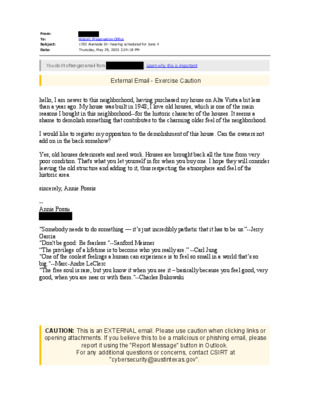
From: To: Subject: Date: Historic Preservation Office 1703 Alameda Dr--hearing scheduled for June 4 Thursday, May 29, 2025 3:24:18 PM You don't often get email from . Learn why this is important External Email - Exercise Caution hello, I am newer to this neighborhood, having purchased my house on Alta Vista a bit less than a year ago. My house was built in 1948; I love old houses, which is one of the main reasons I bought in this neighborhood--for the historic character of the houses. It seems a shame to demolish something that contributes to the charming older feel of the neighborhood. I would like to register my opposition to the demolishment of this house. Can the owners not add on in the back somehow? Yes, old houses deteriorate and need work. Houses are brought back all the time from very poor condition. That's what you let yourself in for when you buy one. I hope they will consider leaving the old structure and adding to it, thus respecting the atmosphere and feel of the historic area. sincerely, Annie Possis -- Annie Possis "Somebody needs to do something — it’s just incredibly pathetic that it has to be us.”--Jerry Garcia "Don't be good: Be fearless."--Sanford Meisner “The privilege of a lifetime is to become who you really are.” --Carl Jung "One of the coolest feelings a human can experience is to feel so small in a world that’s so big."--Marc-Andre LeClerc "The free soul is rare, but you know it when you see it – basically because you feel good, very good, when you are near or with them."--Charles Bukowski CAUTION: This is an EXTERNAL email. Please use caution when clicking links or opening attachments. If you believe this to be a malicious or phishing email, please report it using the "Report Message" button in Outlook. For any additional questions or concerns, contact CSIRT at "cybersecurity@austintexas.gov".
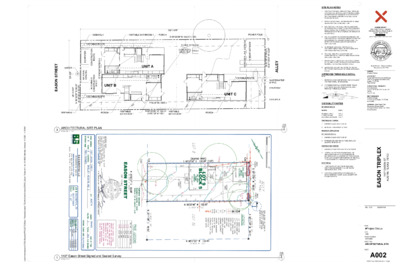
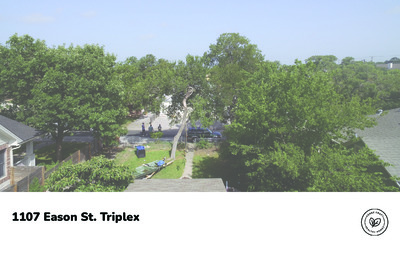
HISTORIC LANDMARK COMMISSION PERMITS IN NATIONAL REGISTER HISTORIC DISTRICTS JULY 2, 2025 HR-2025-057111 WEST LINE HISTORIC DISTRICT 1107 EASON STREET 15.0 – 1 PROPOSAL Construct three residential units. PROJECT SPECIFICATIONS Construct three units through the HOME incentive on the site of a previously non-contributing resource to the National Register district. All three units will be two stories with accessible roof decks. Two of the units will be side-by-side and face Eason Street, with the third to the rear of the property, towards an alley. RESEARCH Not much is known about the original inhabitants of the property at 1107 Eason Street. There is record of a Sidney Ralph Jeffers, associated with this address, who graduated from the University of Texas in 1949, shortly after the first house on the site was constructed. DESIGN STANDARDS The City of Austin’s Historic Design Standards (March 2021) are based on the Secretary of the Interior’s Standards for Rehabilitation and are used to evaluate projects in National Register districts. The following standards apply to the proposed project: Residential new construction 1. Location The front two units will be placed much closer to the street than the previous house, but they will be generally in line with neighboring setbacks. The rear unit will face the alley behind the property 2. Orientation Each of the front units will have their short sides facing the street, which is not typical of the surrounding area. However, when paired, the orientation of both will closer resemble the surrounding properties in terms of width and orientation. 3. Scale, massing, and height Two narrow, two-story housing units are not in keeping with the scale, massing, and height of their neighbors. However, the design has been altered to reduce the verticality of the original proposal. The footprints and exterior design of the two front units are generally the same but rotated 180 degrees from one another along the shared wall. 4. Proportions As mentioned above, the two-story residences have proportions that are much more vertical than surrounding properties. 5. Design and style As a side-by-side duplex, each two stories tall with additional roof decks, the style of the front building is not in keeping with surrounding houses. However, other highly modern designs have been approved in historic districts. Standard 5.4 calls for modern styles to use modern architecture details, which is true here. There is no likelihood of this design to be confused with …
1107 Eason St. Triplex Neighborhood Context Lap Siding Lap Siding & Stone Board & Batten Stone Brick Stucco and Stone Neighborhood Context - Elevations Alley Elevation WW St. Elevation W 12th St Neighborhood Context - West Lynn @ 12th Eason St FACADE A - LAP SIDING & RUNNING BOND 1009 Eason St. 1105 Eason St. 1108 Elm St.
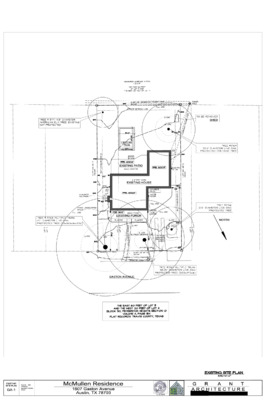
HISTORIC LANDMARK COMMISSION PERMITS IN NATIONAL REGISTER HISTORIC DISTRICTS JULY 2, 2025 PR-2025-055263; HR-2025-060397 OLD WEST AUSTIN HISTORIC DISTRICT 1607 GASTON AVENUE 16.0 – 1 PROPOSAL Construct and expand a side addition and a rear detached pool house structure. PROJECT SPECIFICATIONS 1) Expand existing side addition, including the footprint towards the street as well as towards the rear of the property. Addition will also include two dormer windows at the second floor that face the street. 2) Construct a detached pool house at the rear of the lot, facing the existing in-ground pool. 3) Install new second floor porch covering and supporting columns, replace existing railing, install wood shutters at existing front façade. ARCHITECTURE The house at 1607 Gaston Avenue is built was built in the Colonial Revival style, and has seen several alterations since construction, though the original form remains. These alterations include new cladding on all exterior walls, as well as a side addition that is set back from the front line of the house. The original front elevation, excluding the side addition, is separated into three bays, with the entry door at center. At the first floor, a porch extends the width of the house and is covered with a flat roof that also serves as a porch accessed from the second floor. Above, a low-pitched front gable frames the overall house shape. RESEARCH Constructed around 1950, the house was first occupied by Elmer Hinkel and his family until around 1955. Hinkel served as vice president at Texas State Bank. The next owner was Frank Culver, who had been elected as an associate justice on the Texas State Supreme Court in 1952, where he served through the decade. DESIGN STANDARDS The City of Austin’s Historic Design Standards (March 2021) are based on the Secretary of the Interior’s Standards for Rehabilitation and are used to evaluate projects in National Register districts. The following standards apply to the proposed project: Repair and alterations 1. General standards Porch alterations are generally in keeping with the Standards. Details that are proposed to be removed are non-historic and don’t match the historic appearance. While the construction of a second-floor porch roof is sensitive to the design of the front elevation and appears visually cohesive, it does not appear to be based on any historic images or documentation. 3. Roofs Extension of the front porch roof at the second floor is proposed to …
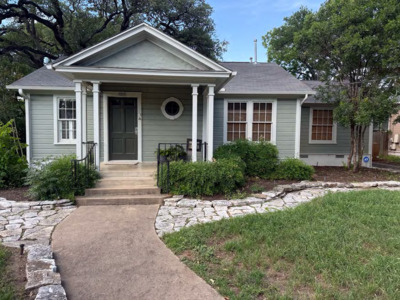
HISTORIC LANDMARK COMMISSION PERMITS IN NATIONAL REGISTER HISTORIC DISTRICTS JULY 2, 2025 PR-2025-061450; GF-2025-064676 WEST LINE HISTORIC DISTRICT 1210 WEST 12TH STREET 17.0 – 1 PROPOSAL Demolish a ca. 1949 contributing house. ARCHITECTURE Built in the early postwar period like many of its neighbors, the house at 1210 West 12th Street is simple in its single-story form but does feature Classical Revival elements, including a projecting pediment covering a front porch and original multi- lite windows. The foundation is elevated slightly above grade, which adds visual importance to the front porch and entry. At this porch, there is a single front door to one side and a small circular window to the other. Aside from the pedimented front gable, the roof is a side gable set at a moderate pitch. The wall is clad in horizontal wood siding that appears original. Together, these elements create an image of a house that has not been modified since original construction and retains excellent integrity. RESEARCH The first owners of the property after construction of the existing house were Lydia and Queenie Littman. Lydia Littman moved to Austin when she was a child, and, after graduating from the University of Texas, worked at a real estate company upon completion of further education and training newly available in the city. She became very successful in this field and became involved in various community groups. By the time she purchased the house on West 12th Street in her 70s, had her own business in real estate, loans, and investments. Upon semi-retirement around the same time, she continued to work out of her home office until her passing at the age of 92. PROPERTY EVALUATION The property contributes to the West Line National Register district. Designation Criteria—Historic Landmark 1) The building is more than 50 years old. 2) The building appears to retain high integrity. 3) Properties must meet two criteria for landmark designation (LDC §25-2-352). Staff has evaluated the property and determined that it does not meet two criteria: a. Architecture. The building is a good example of postwar residential architecture with intact Classical Revival elements. b. Historical association. The property does not appear to have significant historical associations. c. Archaeology. The property was not evaluated for its potential to yield significant data concerning the human history or prehistory of the region. d. Community value. The property does not possess a unique location, physical characteristic, …