04.b - 907 E 13th St - public comment — original pdf
Backup
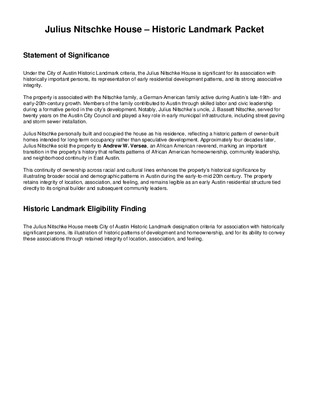
Julius Nitschke House – Historic Landmark Packet Statement of Significance Under the City of Austin Historic Landmark criteria, the Julius Nitschke House is significant for its association with historically important persons, its representation of early residential development patterns, and its strong associative integrity. The property is associated with the Nitschke family, a German-American family active during Austin’s late-19th- and early-20th-century growth. Members of the family contributed to Austin through skilled labor and civic leadership during a formative period in the city’s development. Notably, Julius Nitschke’s uncle, J. Bassett Nitschke, served for twenty years on the Austin City Council and played a key role in early municipal infrastructure, including street paving and storm sewer installation. Julius Nitschke personally built and occupied the house as his residence, reflecting a historic pattern of owner-built homes intended for long-term occupancy rather than speculative development. Approximately four decades later, Julius Nitschke sold the property to Andrew W. Versea, an African American reverend, marking an important transition in the property’s history that reflects patterns of African American homeownership, community leadership, and neighborhood continuity in East Austin. This continuity of ownership across racial and cultural lines enhances the property’s historical significance by illustrating broader social and demographic patterns in Austin during the early-to-mid 20th century. The property retains integrity of location, association, and feeling, and remains legible as an early Austin residential structure tied directly to its original builder and subsequent community leaders. Historic Landmark Eligibility Finding The Julius Nitschke House meets City of Austin Historic Landmark designation criteria for association with historically significant persons, its illustration of historic patterns of development and homeownership, and for its ability to convey these associations through retained integrity of location, association, and feeling. Demolition Rebuttal Statement Demolition of the Julius Nitschke House would result in the irreversible loss of a documented historic resource directly associated with early Austin civic leadership, skilled labor history, and African American community leadership in East Austin. The property is not a vacant or speculative structure, but a surviving example of an owner-built home later stewarded by a prominent African American reverend. The replacement of this structure would permanently sever the physical connection between multiple historically significant communities and the neighborhood they helped build. Preservation of this resource aligns with the City’s adopted preservation goals and supports neighborhood continuity, cultural heritage, and responsible growth. Appendix A: Historical Documentation City Directory and Property History Evidence Historic Austin city directories document Julius H. Nitschke as a carpenter residing at 907 East 13th Street, confirming direct association between the subject property and its original builder. Property records further indicate that approximately forty years later, ownership transferred to Andrew W. Versea, an African American reverend, demonstrating continuity of residential use and community leadership. Newspaper Documentation A contemporaneous newspaper article documents J. Bassett Nitschke as a long-serving Austin City Council member and early municipal infrastructure leader, including oversight of Congress Avenue paving and Austin’s original storm sewer system. This documentation establishes the Nitschke family’s direct involvement in shaping Austin’s civic and physical infrastructure.