04.1 - C14H-2025-0105 - 1112 W 10th St - Application — original pdf
Backup
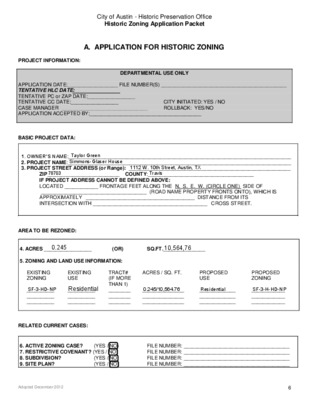
City of Austin - Historic Preservation Office Historic Zoning Application Packet A. APPLICATION FOR HISTORIC ZONING PROJECT INFORMATION: DEPARTMENTAL USE ONLY APPLICATION DATE:__________________ FILE NUMBER(S) _____________________________________________ TENTATIVE HLC DATE: TENTATIVE PC or ZAP DATE:_________________ TENTATIVE CC DATE:_________________ CASE MANAGER _______________________________ APPLICATION ACCEPTED BY:________________________________________ CITY INITIATED: YES / NO ROLLBACK: YES/NO BASIC PROJECT DATA: 1. OWNER’S NAME:________________________________________________________________________________ 2. PROJECT NAME:________________________________________________________________________________ 3. PROJECT STREET ADDRESS (or Range): __________________________________________________________ ZIP__________________________ COUNTY:______________________________________ IF PROJECT ADDRESS CANNOT BE DEFINED ABOVE: LOCATED ____________ FRONTAGE FEET ALONG THE N. S. E. W. (CIRCLE ONE) SIDE OF ______________________________________ (ROAD NAME PROPERTY FRONTS ONTO), WHICH IS APPROXIMATELY _______________________________________ DISTANCE FROM ITS INTERSECTION WITH _________________________________________ CROSS STREET. AREA TO BE REZONED: 4. ACRES _________________ (OR) SQ.FT._______________ 5. ZONING AND LAND USE INFORMATION: EXISTING ZONING EXISTING USE __________ __________ __________ __________ __________ __________ TRACT# (IF MORE THAN 1) ________ ________ ________ ACRES / SQ. FT. PROPOSED USE PROPOSED ZONING _______________ _______________ _______________ _____________ _____________ _____________ ____________ ____________ ____________ RELATED CURRENT CASES: (YES / NO) 6. ACTIVE ZONING CASE? 7. RESTRICTIVE COVENANT? (YES / NO) (YES / NO 8. SUBDIVISION? (YES / NO) 9. SITE PLAN? FILE NUMBER: ______________________________________ FILE NUMBER: ______________________________________ FILE NUMBER: ______________________________________ FILE NUMBER: ______________________________________ Adopted December 2012 6 Taylor GreenSimmons-Glaser House787031112 W. 10th Street, Austin, TXTravis0.24510,564,76SF-3-HD-NPResidential0.245/10,564.76ResidentialSF-3-H-HD-NP City of Austin - Historic Preservation Office Historic Zoning Application Packet D. SUBMITTAL VERIFICATION AND INSPECTION AUTHORIZATION SUBMITTAL VERICATION My signature attests to the fact that the attached application package is complete and accurate to the best of my knowledge. I understand that proper City staff review of this application is dependent upon the accuracy of the information provided and that any inaccurate or inadequate information provided by me/my firm/etc., may delay the proper review of this application. PLEASE TYPE OR PRINT NAME BELOW SIGNATURE AND INDICATE FIRM REPRESENTED, IF APPLICABLE. __________________________________________________ Signature Date __________________________________________________ Name (Typed or Printed) __________________________________________________ Firm (If applicable) INSPECTION AUTHORIZATION As owner or authorized agent, my signature authorizes staff to visit and inspect the property for which this application is being submitted. PLEASE TYPE OR PRINT NAME BELOW SIGNATURE AND INDICATE FIRM REPRESENTED, IF APPLICABLE. ___________________________________________________ Date Signature ___________________________________________________ Name (Typed or Printed) ___________________________________________________ Firm (If applicable) Adopted December 2012 8 Lori Martin, Architectural HistorianO'Connell Architecture, LLCTaylor GreenOctober 9, 2025October 9, 2025 City of Austin - Historic Preservation Office Historic Zoning Application Packet E. ACKNOWLEDGMENT FORM concerning Subdivision Plat Notes, Deed Restrictions, Restrictive Covenants and / or Zoning Conditional Overlays I, ________________________________________ have checked restrictions, (Print name of applicant) for subdivision plat notes, deed restrictive covenants and/or zoning conditional overlays prohibiting certain uses and/or requiring certain development restrictions i.e. height, access, screening etc. on this property, located at ______________________________________________________________________________________ (Address or Legal Description) ______________________________________________________________________________________ If a conflict should result with the request I am submitting to the City of Austin due to subdivision plat notes, deed restrictions, restrictive covenants and/or zoning conditional overlays it will be my responsibility to resolve it. I also acknowledge that I understand the implications of use and/or development restrictions that are a result of a subdivision plat notes, deed restrictions, restrictive covenants and/or zoning conditional overlays. I understand that if requested, I must provide copies of any and all subdivision plat notes, deed restrictions, restrictive covenants and/or zoning conditional overlay information which may apply to this property. _______________________________________ ________________________________ (Applicant's signature) (Date) Adopted December 2012 9 Lori MartinOctober 9, 20251112 W. 10th Street, Austin, TX 78703 City of Austin - Historic Preservation Office Historic Zoning Application Packet F. 1: Historical Documentation - Deed Chronology Deed Research for (fill in address) ________________________________ List Deeds chronologically, beginning with earliest transaction first and proceeding through present ownership. The first transaction listed should date at least back to when the original builder of any historic structures on the site first acquired the property (i.e., should pre-date the construction of any buildings/structures on the site). Please use the format delineated below. For each transaction please include: name of Grantor/Grantee, date of transaction, legal description involved, price, and volume/page number of deed records. If there is a mechanic's lien please copy the entire document. Adopted December 2012 10 1112 W. 10th Street, Austin, TX City of Austin - Historic Preservation Office Historic Zoning Application Packet F. 2: Historical Documentation - Occupancy History Occupancy Research for (fill in address) ___________________________ Using City Directories available at the Austin History Center or other information available, please provide a chronology of all occupants of the property from its construction to the present. For commercial property, please provide residential information on business owner as well. Adopted December 2012 11 1112 W. 10th Street, Austin, TX Historic Narrative Simmons-Glaser House 1112 W. 10th Street Austin, Texas 78703 Summary The land on which this home sits was part of the 1848 Raymond Tract; it subsequently was divided and subdivided by Charles H. Silliman and W 0. Hutchison. The City Directory listings show that the first owner was attorney David E. Simmons and his wife Virgilia in 1903. Simmons was active in the community and worked to clean up the city streets and bring improvements to West Austin and was a founding member of the West Austin Improvement Club. After a short succession of owners, the house was acquired in 1913 by Samuel A. Glaser, who was an Austrian immigrant and a self-taught barber. He and his wife, Emma, and two children resided here for over twenty years. Emma ran a florist business from the house, aided by her son for more than a decade. He was a well-known barber and either owned or was associated with many barber shops in the city, including the first one at Camp Mabry. Samuel was also known to be one of the finest musicians in the city. In 1907, Glaser and seven other local musicians organized the Musicians’ Union Local 433, laying the foundation for musicians’ rights and fair pay and forever solidifying Austin as a hub for musicians to this day. The house was owned and occupied from 1946 to 1973 by two accomplished sisters, Varine Varnell and Dr. Celeste Varnell Dodd. After a series of owners, the current owner purchased the home in August 2025. In 1995, owners James M. Laughead and Lisa Ott Laky made renovations to the residence and opened the passageway from the downstairs hall into the dining room, as it had been originally. The original footprint of the structure had been altered by a previous owner with the addition of a one-story kitchen in the rear. Standing in the kitchen, one sees the original stone outer wall of the house, which is now the south wall of the kitchen. They added a second story to this addition in 1996, creating two bedrooms and a bathroom. More recently, the kitchen has been remodeled, as have the master bedroom and bath. According to records of the Travis Central Appraisal District, the home was built in 1903. Stylistically, the Simmons-Glaser House can be labeled Second Empire, a subset of Victorian design that may imply an earlier construction date for the home. The style was most popular between 1855 and 1885. Its prominent mansard roof uninterrupted except for dormers and its handsome asymmetrical style with prominent bay extension and recessed porch imply an earlier construction date. The cut limestone house retains various original features, such as longleaf pine floors, the stone wall in the kitchen and den, transoms over the exterior doors, and woodwork in the original rooms downstairs. The two front doors and the side door on the west appear to be original, as well.1 The home’s architectural style, materiality and location of the home nestled among others like it on W. 10th and 11th Streets also gives credence to the possibility that the home was built as part of a planned 1 Jewels of Castle Hill. 2009 Heritage Homes Tour Program. Heritage Society of Austin. 12 development built in a short time from about 1894 to 1898 by local builder Nick Dawson. These houses share similar designs, materials, size, height and scale. Lot sizes and setbacks were consistent, and the resulting streetscapes convey an orderly, planned appearance. The current owner purchased the home earlier this year from Patrick R. Maloney, one of many owners in the home’s history. Research of City of Austin permitting records and notes from the current owner indicate the following improvements and changes to the house: DATE WORK PERFORMED ON HOUSE 1980 1996 2006 2010 2016 Repair and remodel existing duplex. Extend 2nd floor at rear of house Interior remodel of primary bath and closet; move plumbing and electrical Replace existing HVAC in primary residence. Enlarge window on 1970s addition; repair flooring on front porch; Kitchen remodel; 3- bathroom remodel/fixture exchange. Interior veneer change. Window service/upgrade. Frame repair/service. Floor service. Electrical Service. Adding two new windows Renovations to existing ADU; replace windows in-kind; repair and replace siding and exterior doors; repair roof. Replace outdated electrical service Add electric vehicle charging station. Removal of two dead trees in back yard 2018 2021 2021 2025 Community Value Samuel Glaser, founding member of Musician’s Local Union 433 Samuel Glaser and his wife, Emma, purchased the home in 1913. Glaser moved to Austin when he was 10 years old and lived in the city until his death at 76. His wife Emma ran Glaser Florist with her son from their home on 10th Street for over a decade between 1925 and 1936 and even sponsored a baseball team over the years.2 Samuel Glaser was a barber by trade, but a musician at heart and spent his free time tirelessly advocating for the rights of his fellow musicians. As a charter member of the Austin Musicians Union No. 4333, Glaser and the Local 433 helped professionalize Austin’s music scene, long before the city was known as the “Live Music Capital of the World.” The rest, as they say, is history and it defined the city we know and love today. The Musicians’ Union Local No. 433 was organized on June 8, 1907, when “eight musicians of Austin, including Samuel Glaser, met and formulated a plan for the betterment and standardization of music conditions.” Local 433 was founded at a time when Austin was emerging as a cultural hub in Central Texas. The union was created to organize professional musicians, giving them collective bargaining 2 Small advertisements are sprinkled throughout The Austin Statesman for the decade 1925-1935. 3 "Austin Musicians' Union Organized here 19 Years Ago: New Building Planned here to Care for Growth of Association." The Austin Statesman. May 9, 1926. Pg. B1. 13 power for fair pay and better working conditions. Prior to the union’s formation, musicians often worked for irregular wages and had little protection against exploitative employers. According to multiple newspaper articles, Glaser was a founding member4 and served as the secretary of Local 433 over the course of several years, including 1913-1921. In the early 20th century, the secretary was one of the most important officers in the local AFM union. As secretary, Glaser handled membership records, correspondence5 and financial reporting to the national American Federation of Musicians headquarters. He kept the minutes of meetings, maintained the union’s roster of musicians and distributed the official scale of prices, the wage guidelines for performances.6 1915 was a critical time as Austin’s live music economy would have been expanding with theaters like the Majestic (1915), now the Paramount and the Lyric (1916), vaudeville and silent film orchestras as well as concerts in the park that were promoted and subsidized by the city.7 The influence of the Local 433 on professionalizing and protecting musicians in Austin cannot be overstated. The union did more than oversee contracts; it directly shaped who got to play, where they could perform and how Austin built its identity as a true music city. The following timeline amplifies the union’s impact since its formation. In the early 1900s, after its organization in 1907 as part of the American Federation of Musicians, Local 433 members provided the backbone for live theater orchestras in Austin, accompanying vaudeville, silent films, and stage productions. These musicians also formed the core of what became the Austin Symphony Orchestra, established in 1911. Many early symphony players were union members, ensuring a dependable standard of performance and pay. Union musicians played a huge role in Austin’s thriving dance hall scene, especially along East Austin, where jazz, swing, and blues flourished in the 1920s-40s. Bigger regional or national acts touring through Texas often relied on Local 433 members to fill orchestras or backing bands, giving Austin musicians access to more prominent artists. Like many unions in the 1950s-60s, Local 433 was historically segregated, with separate locals for Black and white musicians. In the mid-20th century, the Austin Black Musicians’ Union (often connected to Local 496 in Houston) worked alongside 433. By the 1960s, the push for desegregation merged these locals, broadening opportunities for Black musicians in Austin. This integration contributed to the rise of legendary East Austin blues and R&B scenes, influencing artists like T.D. Bell, Erbie Bowser, and eventually Clifford Antone’s music community. Antone’s legacy continues as the club celebrates its 50th anniversary this year. 4 "Austin Musicians' Union Organized here 19 Years Ago: New Building Planned here to Care for Growth of Association." 5 MUSICIANS WON’T LET UNION MEN PLAY WITH NON-UNIONISTS AT DAM. The Austin American. Aug. 31, 1914. Pg. 10 6 Debate is Spirited: Disagreement over summer concert contracts. Austin American-Statesman. May 17, 1911. Pg. 7. 7 Debate is Spirited. 14 Antone’s opened on July 15, 1975 with Zydeco king Clifton Chenier and his Red Hot Louisiana Band. The former furniture store soon became a venue featuring new bands like the Fabulous Thunderbirds and Stevie Ray Vaughan’s Triple Threat Revue. Clifford and his club soon became the standard and a must stop for blues musicians across the country.8 With the explosion of Austin’s rock and country-rock reputation in the 1970s-80s, union musicians gained more visibility. Artists like Willie Nelson and venues like the Armadillo World Headquarters have left their indelible on Austin’s music landscape. The Armadillo became a must-play venue for legends like Willie, Waylon Jennings and Bruce Springsteen. Artists as diverse as Alice Cooper, Barry Manilow, the Ramones and the B-52s all graced the Armadillo stage.9 The list of artists is quite remarkable and truly emphasizes the development of Austin as a destination for musicians and music lover alike. Local 433 advocated for fair treatment in clubs and recording sessions, ensuring that the city’s growing reputation didn’t come at the cost of underpaying musicians. As the complexion of the music industry was evolving in the last decade of the 20th century, Local 433 continued to support musicians by advocating for recording rights and royalties during the cassette and CD boom and continuing to strengthen Austin’s identity as a hub for musicians. Local 433 continues to represent musicians in orchestras, including Austin Symphony and Ballet Austin, theater productions, and touring acts in 11 Central Texas counties. They also support independent artists by negotiating protections for recording, streaming, and live performances — especially important in Austin’s modern “gig economy” for musicians. Local 433 remains active in representing Austin-area musicians, both protecting their labor rights and preserving the city’s reputation as a music-rich community. Thanks to Samuel Glaser and a small group of like-minded musicians, Union Local 433 has been at the center of Austin’s cultural and labor history — from early theater orchestras to modern-day gigging musicians — ensuring fair pay, professional standards, and inclusion in one of the world’s most famous music cities. Historical Associations Nick Dawson’s Sustained Development in the Silliman Addition In 1894, Colonel John Garland James, former superintendent of the Texas Military Institute, sold his 32- acre campus to C.H. Silliman who then subdivided the area into city lots (TMI RTHL file). James had been living in “the castle” and the building continued in use as a private residence with the surrounding lots on W. Tenth and W. Eleventh streets developed for residential use. Well-known Austin contractor Nick Dawson and his sisters designed a number of distinctive stone houses on W. Tenth and W. Eleventh streets in the 1890s. The houses are characteristic of the Dawsons’ work throughout the city; they are primarily 1-story stone houses above basements with some combination of turrets, bay windows and inset porches with turned posts and decorative brackets. Dawson, a native of Pittsburgh, Pennsylvania, came to Austin in 1851 and established a contracting business. His limestone, modest Queen Anne style houses are the hallmark of his trade and a number throughout the city are Austin Landmarks. The collection of houses on W. Tenth and W. Eleventh streets have 8 Antone’s 50. 1975-2025. https://antonesnightclub.com/history/ 9 Armadillo World Headquarters: The legend of the Armadillo. https://armadilloworld.com/the-legend-2/ 15 erroneously been identified as staff housing for the Texas Military Institute, but that institution had been closed for nearly 15 years when the property was redeveloped for housing starts. Dawson died in 1903 after a long career in the construction business. The Dawsons’ work is significant beyond its evident craftsmanship; the collection of houses represents the first sustained building campaign in the West Line Historic District. Almost all of the early houses in the Raymond and neighboring subdivisions (1870-1895) were individual efforts built with little or no consideration for neighboring designs or building types. Lots and blocks were developed piecemeal, and houses varied from architect-designed brick mansions to more modest frame houses built by contractors from plan books. Even within the exclusive Raymond Heights subdivision, there was little consistency beyond the large house and lot; several of the grand houses were of brick construction while others were frame, and their construction spanned nearly 40 years from the ca. 1854 Raymond House to the ca.1891 Joseph Nalle House. Although all were large, 2- to 2 ½ story houses, some display Italianate detailing while others exhibit Queen Anne or Greek Revival stylistic features. Their setback from W. Sixth Street varied according to the site’s elevation so there was no rhythm to the streetscape along W. Sixth Street. In the Silliman Subdivision, on the other hand, W. Tenth and W. Eleventh streets were almost fully built out within a very short period of time – from about 1894 to 1898 – and the houses shared similar designs, materials, size, height and scale. Lot sizes and setbacks were consistent, and the resulting streetscapes convey an orderly, planned appearance.10 David E. and Virgilia Simmons Judge David Edward Simmons (1870–1935) was a prominent Austin attorney and civic leader whose professional and community contributions significantly shaped the early development of West Austin in the first decade of the twentieth century. A graduate of the University of Texas at Austin, Simmons began his legal career in 1898 as Assistant Attorney General of the State of Texas. After several years of public service, he entered private practice in 1904, establishing himself as a respected member of Austin’s legal and civic community. In 1903, Simmons and his wife, Vigilia Finlay Simmons, purchased and occupied the residence at 1012 (now 1112) West 10th Street, where they would reside for many years. Deeply engaged in the social and moral fabric of Austin, Judge Simmons was active in the First Baptist Church, the Boy Scouts of America, and the Temperance Movement. His enduring legacy, however, lies in his leadership and advocacy for civic improvements in the city’s western neighborhoods. In 1908, Simmons joined a group of citizens to form the West Austin Improvement Club, among the earliest neighborhood associations in Austin and reflecting the growing civic consciousness and reform-minded spirit of the early twentieth century. The organization was established to promote the beautification and modernization of the area. The club’s objectives included the improvement of streets, alleys, and sidewalks, the establishment of regular mail service, and the extension of the city’s streetcar lines further west to connect residents with the downtown business district and “in other ways make West Austin prettier and better to live in.”11 10 Language regarding Nick Dawson taken from West Line Historic District, National Register nomination. Listed 2005. 11 West Austin Organizes. 16 As a founding member and chair of the Membership Committee, Judge Simmons emphasized the importance of citizen participation and financial support, setting club dues at fifty cents per month. He was a persuasive advocate for urban reform, often calling upon Austinites to take collective responsibility for their city’s condition. Even before the formal establishment of the West Austin Improvement Club, Simmons was publicly urging residents to clean and maintain the city’s streets, warning of the dangers of stagnant water and poor sanitation during the Yellow Fever outbreaks that had devastated other Texas cities such as New Orleans and San Antonio.12 Simmons’ leadership reflected the spirit of Progressive Era reform, combining civic pride, public health advocacy, and a vision for infrastructural improvement. Under his influence, the West Austin Improvement Club became a focal point for community action and urban advocacy, engaging local residents in efforts to enhance livability and civic responsibility. Although the club experienced periods of dormancy, it was later revived by area residents who continued to pursue the goals first articulated by Judge Simmons and his peers. Through his legal career, community involvement, and leadership in the West Austin Improvement Club, Judge Simmons embodied the ideals of civic engagement and local self-improvement that characterized early twentieth-century Austin. His efforts contributed meaningfully to the development of West Austin as a desirable residential area and to the broader movement toward modernization and urban reform that defined the city’s growth during this period. Impact of the West Austin Improvement Club The West Austin Improvement Club was established by a group of “westsiders” on July 16, 1908 at a meeting held at the West Austin Fire Hall. The movement, conceived of weeks earlier, came to fruition that evening with a large and enthusiastic contingent of neighbors in attendance. The members felt the only option for improvements to their section of town was to organize. Officers were elected, including C. J. Martin as president, Will Shelley, vice president and John McNamara, secretary-treasurer. Judge D.E. Simmons was appointed to the Membership Committee, tasked with enlisting every resident in that part of the city be enrolled in the cause.13 Meetings were held semi-monthly with plans to move to the third Thursday of each month as the group became more established. The West Austin Improvement Club was known as a determined group of citizens who fought diligently for improvements to the west side of the city. One of the issues the club undertook was extension of the streetcar line west to the dam that was to be reconstructed after the flood of 1900. Members of the club advocated for the extension starting as early as 190814 and continued to fight in the ensuing years until 1911, when C.J. Martin, president called a special meeting where W.D. Shelley presented the proposition submitted by the streetcar company.15 Finally, in June 1912, the president of the 12 Austin Should Clean Up Says Judge Simmons. The Austin Statesman. July 28, 1905. Pg. 3. 13 West Austin organizes. 14 WEST SIDE CAR LINE IS STILL A POSSIBILITY. Austin American-Statesman. Sep. 10, 1908. Pg. 6. 15 Important. Austin American-Statesman. Apr. 26, 1911. Pg. 8. 17 Austin Street Railway Company, W.J. Jones, announced that the materials had been ordered for a two- mile extension of the West Sixth Street line to the dam and that construction would begin within thirty days.16 By January 1913, the line was fully operational and was used by hundreds of citizens to visit the incredible engineering feat of the construction of the dam.17 East-West Line Trolleys was the last street cars in operation and were replaced with buses. The trolleys made their last journey along the route in April 1940.18 The West Austin Improvement Club that Simmons helped establish continued influencing city policy and local organization beyond its initial formation. Though the West Austin Improvement Club was intermittently dormant, the Club was revived in 1915 and charged with “looking after the interests of West Austin”.19 Neighborhood residents continued to advocate for infrastructure projects and municipal services throughout the twentieth century. Its founding principles—volunteerism, civic pride, and neighborhood self-organization—established a pattern that would later be echoed by Austin’s numerous neighborhood associations and improvement groups. As one of the city’s earliest and most active civic associations, the West Austin Improvement Club played a formative role in shaping both the physical environment and the community identity of West Austin. Its efforts laid the groundwork for continued public engagement in municipal planning and established a precedent for citizen-led advocacy that remains integral to Austin’s civic culture today. Miss Varine Varnell and Dr. Celeste V. Dodd ( Sisters) Varine Varnell worked for the International Information Division of the State Department in Washington, D.C. and later took a position as personnel director in the U.S. Office of Information under the Marshall Plan and was stationed in Paris, France for three years.20 Miss Varnell died in 1973. Her sister, Celeste Dodd was a speech and language therapist who officed out of their residence at 1112 W. 10th. Dodd also served as general field representative for the American National Red Cross and did her clinical practice in speech pathology in London, England. She was an active member of Delta Kappa Gamma and the author of a textbook, Our Speech.21 Conclusion The residence at 1112 West 10th Street is a handsome yet modest example of Queen Anne architecture exhibiting lingering Second Empire influences. Its prominent mansard roof with dormers and projecting bay window create an asymmetrical primary façade characteristic of the transitional designs of the late nineteenth century. The cut limestone walls contrast with the delicate spindlework porch supports and trim, while the large-pane entry door with incised detailing and fishscale-patterned 16 WEST SIXTH STREETCAR LINE TO BE EXTENDED TO THE DAM. The Austin Statesman. Jun 21, 1912. Pg. 1. 17 HUNDREDS VISIT DAM: SIGHTSEERS GO TO SCENE OF GREAT ENGINEERING WORK. The Austin Statesman. Jan. 20, 1913. Pg. 8. 18 East-West Line Trolleys Roll on Their Last Miles. The Austin American. Mar. 3, 1940. Pg. 1. 19 West Austin Forms Improvement Club. The Austin American. Sep 21, 1915. Pg. 3 20 Miss Varine Varnell. Deaths and Services Austin American-Statesman. Jan. 31, 1973. Pg. 35. 21 Mrs. Celeste Dodd. Obituaries. Waco Tribune-Herald. Dec. 31, 1986. Pg. 36. 18 wood shingles at the mansard roof further illustrate the blending of stylistic elements during this period. Attributed to contractor Nick Dawson, the home contributes to the Castle Hill Historic District as a well- preserved example of this architectural evolution. Beyond its architectural merit, the residence holds significant associative and community value for its early occupants, whose civic and cultural contributions shaped West Austin and the broader city. Judge D. E. Simmons, an early resident, was instrumental in the activities of the West Austin Improvement club, an organization that promoted infrastructure and neighborhood development west of downtown. Later resident Samuel A. Glaser advanced Austin’s cultural life as a founding member of Musicians Union Local 433, helping to establish fair labor standards for musicians and laying the groundwork for Austin’s enduring reputation as the “Live Music Capital of the World.” Together, the architectural character and historic associations of 1112 W. 10th Street make it an important contributor to Austin’s cultural and built heritage. 19