REGULAR MEETING OF THE ENVIRONMENTAL COMMISSION WEDNESDAY, NOVEMBER 4, 2026, AT 6:00 P.M. PERMITTING AND DEVELOPMENT CENTER, ROOM 1405 6310 WILHELMINA DELCO DRIVE AUSTIN, TEXAS Some members of the Environmental Commission may be participating by videoconference. The meeting may be viewed online at: http://www.austintexas.gov/page/watch-atxn-live Public comment will be allowed in-person or remotely via telephone. Speakers may only register to speak on an item once either in-person or remotely and will be allowed up to three minutes to provide their comments. Registration no later than noon the day before the meeting is required for remote participation by telephone. To register to speak remotely, contact Nicole Corona, 737-291-3084, Nicole.Corona@austintexas.gov. CURRENT COMMISSIONERS: Mariana Krueger, Chair Jennifer Bristol, Vice Chair Haris Qureshi, Secretary Sean Atkins Richard Brimer Isabella Changsut AGENDA CALL TO ORDER PUBLIC COMMUNICATION: GENERAL Annie Fierro Justin Fleury Martin Luecke Allison Morrison David Sullivan The first ten speakers signed up prior to the meeting being called to order will each be allowed a three-minute allotment to address their concerns regarding items not posted on the agenda. APPROVAL OF MINUTES 1. Approve the minutes of the Environmental Commission Regular Meeting on October 21, 2026. DISCUSSION AND ACTION ITEMS 2. Approve a recommendation to Council for proposed amendments to the existing Interlocal Agreement between the City of Austin and the University of Texas related to the area generally bounded by Lady Bird Lake (formerly Town Lake) to the south and west, Enfield Road and 8th Street to the north, and Veterans Drive and Hearn Street to the east that establishes the parties' expectations related to the conveyance of Lion's Municipal Golf Course (Muny), development regulations, the vacation of City rights-of-way, the creation of a regulating plan, and the creation of a tax increment reinvestment zone (TIRZ). Sponsored by Chair Krueger and Commissioner Brimer. 3. Approve the creation of a working group for bird-friendly design to update Staff and City Council on data requested in the memorandum and staff report from January 16, 2026. Sponsored by Chair Krueger and Vice Chair Bristol. FUTURE AGENDA ITEMS City Code requires at least two board members sponsor an item to be included on an agenda. This section of the agenda provides members an opportunity to request items for future agendas. Staff should assume that if there is no objection from other members expressed at the meeting, the members’ silence indicates approval for staff to include on the next …
REGULAR MEETING ENVIRONMENTAL COMMISSION MINUTES WEDNESDAY, OCTOBER 21, 2026 The Environmental Commission convened in a regular meeting on Wednesday, October 21, 2026, at the Permitting and Development Center, Room 1405, located at 6310 Wilhelmina Delco Drive in Austin, Texas. Chair Krueger called the Environmental Commission Meeting to order at 6:00 p.m. Commissioners in Attendance: Mariana Krueger, Chair Haris Qureshi, Secretary Richard Brimer Isabella Changsut Justin Fleury Martin Luecke David Sullivan Commissioners in Attendance Remotely: Sean Atkins PUBLIC COMMUNICATION: GENERAL None present. APPROVAL OF MINUTES 1. Approve the minutes of the Environmental Commission Regular Meeting on October 7, 2026. The minutes from the Environmental Commission Regular Meeting on October 7, 2026, were approved on Commissioner Sullivan’s motion, Commissioner Brimer’s, on a 7-0 vote. Commissioner Changsut was off the dais. Vice Chair Bristol and Commissioners Fierro and Morrison were absent. STAFF BRIEFINGS 2. Staff briefing regarding Sustainable Building Materials Forum and hands-on deconstruction workshop to increase local contractors’ capacity, salvage high-quality materials for reuse, and reduce demolition waste. Presentation by Cara Bertron, Program Manager II, Austin Planning; Beth Larkin, Project Manager, Austin Parks and Recreation; and Elizabeth Nelson, Planner Principal, Austin Resource Recovery. 1 The presentation was made by Cara Bertron, Program Manager II, Austin Planning; Beth Larkin, Project Manager, Austin Parks and Recreation; and Elizabeth Nelson, Planner Principal, Austin Resource Recovery. 3. Staff briefing regarding proposed amendments to the existing Interlocal Agreement between the City and the University of Texas related to the area generally bounded by Lady Bird Lake (formerly Town Lake) to the south and west, Enfield Road and 8th Street to the north, and Veterans Drive and Hearn Street to the east that establishes the parties' expectations related to the conveyance of Lion's Municipal Golf Course (Muny), development regulations, the vacation of City rights-of-way, the creation of a regulating plan, and the creation of a tax increment reinvestment zone (TIRZ). Presentation by Trish Link, Division Chief, Land Use and Real Estate, Austin City Attorney's Office, and Kim Olivares, Director, Austin Financial Services. The presentation was made by Trish Link, Division Chief, Land Use and Real Estate, Austin City Attorney's Office, and Kim Olivares, Director, Austin Financial Services. The meeting was recessed from 8:33 p.m. until 8:44 p.m. without objection. DISCUSSION AND ACTION ITEMS 4. Discussion and action to approve a recommendation to Council regarding the Green Infrastructure Initiative. Presentation by David Sullivan, Environmental Commissioner. Sponsored by Chair Krueger …
. RECOMMENDATION TO COUNCIL Environmental Commission Recommendation 20261104-002: City of Austin and University of Texas Brackenridge Interlocal Agreement WHEREAS, the City of Austin and the University of Texas at Austin propose to amend the 1989 Brackenridge Development Agreement (BDA) to preserve Lion’s Municipal Golf Course (Muny) as an open public green space for the people of Austin and prepare the remaining 190 acres of university-owned land for the benefit of the University community; and WHEREAS, the BDA will describe the general process for the conveyance of Muny, a proposed update to the University’s lease of property at Mueller, the exchange of City rights-of-way, the proposed creation of a tax increment reinvestment zone (TIRZ) and the development of a mutually agreed to regulating plan; and NOW THEREFORE, BE IT RESOLVED, the Environmental Commission recommends Council adopt the following additional requirements as part of the amended BDA: • Maximum height limits of all buildings be limited to 75 feet. • Require adherence to City Codes Chapter 6-2, 25-8-520 and 30-5 regarding the environment and storage of hazardous materials by the University and subsequent owners of the property within the amended BDA. • City of Austin’s Heritage Tree Ordinance shall be enforced. Mitigation of trees shall be within the BDA unless authorized by the City Arborist. • Limit impervious cover to 67 percent of each parcel. . • Impervious cover shall not be transferred between sites. • Maximum impervious cover for sites is 70 percent. • Floor area ratio (FAR) per site development shall not exceed .6:1 FAR unless Council authorizes an increase in FAR for the site using the process to rezone property. • Establish a setback of 250 feet landward from the shoreline. • Prohibit impervious cover within the 250-foot setback. • Require adherence cut/fill 5-8-341, and 25-8-342 of the City Code regarding cut and fill requirements. • Require adherence slope regulations including, but not limited to Sections 30-5- 302, 25-2-1122 and 25-2-1123 of City Code. • Require a public easement within the setback from Lady Bird Lake to allow for a hike and bike trail administered by the Austin Parks and Recreation Department. • Require the University to retain the Brackenridge Field Laboratory for a minimum of fifty years under the same conditions as provided by the current BDA agreement. • Should the University decide to close the Brackenridge Field Laboratory, require the University to give the option to the …
RESOLUTION NO. 20241121-073 WHEREAS, the City of Austin is committed to promoting environmental sustainability and biodiversity as a key part of its climate resilience and sustainability initiatives; and WHEREAS, Texas is recognized nationally and internationally for its important migration corridors for birds, with approximately one of every three birds migrating through the U.S. in the spring, and one of every four birds migrating through the U.S. in the fall, or nearly two billion birds, passing through every year; and WHEREAS, tourism generated from bird-watching brings more than $1.8 billion into the state’s economy annually; and WHEREAS, bird populations face significant threats from collisions with buildings, particularly due to glass structures and night lighting, which result in one billion bird fatalities every year from collisions with manmade structures in the United States; and WHEREAS, Audubon Texas initiated the Lights Out, Texas! campaign of education, awareness, and action that focuses on protecting the billions of migratory birds traveling through Texas; and WHEREAS, Resolution No. 20210902-050 previously directed the City Manager to initiate a program to turn off non-essential lighting in City buildings where feasible during peak fall and spring bird migration periods; and WHEREAS, Audubon Texas and the Texas Parks and Wildlife Department created the Bird City Texas campaign to promote science-based bird conservation initiatives and community-centric action; and Page 1 of 4 WHEREAS, the City of Austin became a Bird City in 2023; and WHEREAS, the Travis Audubon Society has been a leading conservation organization in Travis County since 1952, and in 2024, they contracted with bird- friendly design expert Heidi Trudell to present a report on bird friendly building design to the South-Central Waterfront Commission, Design Commission and Environmental Commission; and WHEREAS, the U.S. Fish and Wildlife Service in partnership with the American Bird Conservancy, DarkSky International, and Yale University has developed Bird-Friendly Building Toolkits that provide strategies and guidelines for designing and retrofitting low-rise, mid-rise and high-rise buildings to reduce bird collisions through the use of bird-friendly materials, lighting strategies, landscaping, and architectural designs; and WHEREAS, cities across the United States, including New York, Madison, San Francisco and twenty-three other cities, have successfully adopted bird- friendly building standards, demonstrating the feasibility and benefits of such measures; and WHEREAS, the integration ofbird-friendly building design supports Austin's existing efforts to protect wildlife habitats, promote urban biodiversity and sustainable development practices and provides an opportunity to lead by example in environmental stewardship; …
To: Through: From: Date: Subject: MEMORANDUM Mayor and City Council Susana Carbajal, Assistant City Manager Jorge L. Morales, P.E., CFM, Austin Watershed Protection Director January 16, 2026 Staff Response Related to Bird Friendly Design (Resolution No. 20241121-073) The purpose of this memorandum is to provide a response to Resolution No. 20241121-073 related to bird-friendly design. Staff developed a comprehensive report on bird-friendly building design implementation informed by stakeholder engagement with local developers, environmental organizations, and members of the public using virtual sessions, public tours, and professional roundtable discussions in collaboration with the American Institute of Architects. The staff report provides an overview of the impact that building collisions and light pollution have on bird populations and how Austin can address the problem through an examination of available building solutions, cost feasibility, and regulatory frameworks from peer cities including New York, Madison, Portland, Toronto, Berkeley, and Arlington County, Va. The research also explores how Austin's built environment and land development regulations present many opportunities for bird- friendly design implementation, including already existing regulatory mechanisms and programs like the Austin Energy Green Building program and Planned Unit Development (PUD) Zoning. These findings, while clearly illustrating the broad concern about bird collisions and light pollution, lack the context of robust local data, an issue that was raised several times during the boards and commissions stakeholder engagement process. Staff also acknowledge the significant community concern for affordability. Given these findings, staff suggest the following steps be taken in advance of providing final recommendations on specific code amendments and guidelines: 1. Bird collision data collection over the 2026 spring and fall migration seasons Build off national research data and findings to further explore the impact that Austin’s built environment has on the rate of bird collisions. Staff will engage with local organizations including Travis Audubon and area universities/colleges to encourage and advise on local bird collision data collection during two migration seasons (spring and fall). The data will provide information to tailor any future regulation recommendations to Austin’s unique landscape. Page 1 of 2 City of Austin Climate, Water, Environment, and Parks Committee Meeting Backup: January 28, 2026File ID: 26-2781Page 1 of 38 Date: Subject: January 16, 2026 Staff Response Related to Bird Friendly Design (Resolution No. 20241121-0173) 2. Coordinated updates to Austin Energy Green Building program policies Staff recommend ongoing interdepartmental coordination with Austin Energy to implement progressive enhancements to existing green building frameworks …
RECOMMENDATION TO COUNCIL Environmental Commission Recommendation 20261104-002: City of Austin and University of Texas Brackenridge Interlocal Agreement WHEREAS, the City of Austin and the University of Texas at Austin propose to amend the 1989 Brackenridge Development Agreement (BDA) to preserve Lion’s Municipal Golf Course (Muny) as a public golf course and prepare the remaining 190 acres of university- owned land; and WHEREAS, the BDA will describe the general process for the conveyance of MUNY, a proposed update to the University’s lease of property at Mueller, the exchange of City rights-of-way, the proposed creation of a tax increment reinvestment zone (TIRZ) and the development of a mutually agreed to regulating plan; and WHEREAS, the Environmental Commission was given a Staff briefing at the October 21, 2026 meeting; and NOW THEREFORE, BE IT RESOLVED, the Environmental Commission recommends the Council adopt the following additional requirements as part of the amended BDA: • Require the University to retain the Brackenridge Field Laboratory for a minimum of fifty-years under the same conditions as provided by the current BDA agreement. • Should the University decide to close the Brackenridge Field Laboratory, require the University the option to the City to acquire the property for Water Quality Protection Lands purposes via conservation easements, voter approved municipal bonds, fee simple purchase, or other mechanisms. • Require the University to provide a minimum of five-years notice to the Council of its intent to close or restrict the scope of research at the Brackenridge Field Laboratory. • Establish a setback of 250 feet landward from the shoreline of Lady Bird Lake and prohibit impervious cover within the 250-foot setback. • Require a public easement within the setback from Lady Bird Lake to allow for a multi-use trail on par with the Butler Hike and Bike Trail to be implemented by the Austin Parks and Recreation (APR) and managed by APR or an established partner. • Limit building height to 75 feet. • Require adherence to City Codes Chapter 6-2, 25-8-520 and 30-5 regarding the environment and storage of hazardous materials by the University and subsequent owners of the property within the amended BDA. • Enforce the City of Austin’s Heritage Tree Ordinance. Mitigation of trees shall be within the BDA unless authorized by the City Arborist. • Limit impervious cover to 67 percent of each parcel with a total of 70 percent impervious cover for the entire project. Impervious …
11/3/26, 9:38 AM November 4 Brackenridge Agreement - Request for Permanent Protection of Field Laboratory - Corona, Nicole - Outlook 1. Permanent protection of the full BFL property through a conservation easement or an equally durable, legally enforceable mechanism compatible with continued research and education. 2. An explicit prohibition on non-university development within the laboratory's boundaries. 3. Exclusion of BFL acreage from transferable development entitlements, including impervious-cover and floor-area allowances benefiting development elsewhere. 4. Appropriate ecological buffers and protections against impacts from adjacent construction. 5. A comprehensive, independent environmental assessment before development parameters are finalized. I support the preservation of Lions Municipal Golf Course, but that effort should not compromise another extraordinary resource on the same historic tract. The Brackenridge agreement presents a rare opportunity to protect both public recreation and scientific research for future generations. I hope the Commission will recommend protections that reflect the laboratory's long-term importance to the University, the City, and the wider scientific community. Thank you for your consideration and for the Commission's work on this issue. Please include this letter in the written public comments for the November 4 meeting and distribute it to the commissioners. Sincerely, Stuart Robertson CAUTION: This is an EXTERNAL email. Please use caution when clicking links or opening attachments. If you believe this to be a malicious or phishing email, please report it using the "Report Message" button in Outlook. For any additional questions or concerns, contact CSIRT at "cybersecurity@austintexas.gov". about:blank?windowId=SecondaryReadingPane6 2/2 11/3/26, 9:38 AM Nov 4 Brackenridge Agreement - Protect the Field Lab & Conservation Programs - Corona, Nicole - Outlook 1. Permanent protection of the full BFL property through a conservation easement or an equally durable legal mechanism compatible with continued research, education, and conservation activities. 2. An explicit prohibition on non-university development within the laboratory's boundaries. 3. Continued access to appropriate greenhouse and research infrastructure for university and community conservation programs. 4. Exclusion of BFL acreage from transferable development entitlements, including impervious-cover allowances that could facilitate construction elsewhere. 5. A comprehensive environmental assessment and appropriate ecological buffers before development parameters are finalized. 6. Meaningful consultation with BFL researchers, conservation organizations, and community stakeholders before decisions affecting the laboratory are made. I support preserving Lions Municipal Golf Course, but that effort should not come at the expense of another irreplaceable community resource. Brackenridge Field Laboratory supports scientific research, education, biodiversity conservation, and practical community-based conservation efforts. Its …
REGULAR MEETING OF THE ENVIRONMENTAL COMMISSION WEDNESDAY, OCTOBER 21, 2026, AT 6:00 P.M. PERMITTING AND DEVELOPMENT CENTER, ROOM 1405 6310 WILHELMINA DELCO DRIVE AUSTIN, TEXAS Some members of the Environmental Commission may be participating by videoconference. The meeting may be viewed online at: http://www.austintexas.gov/page/watch-atxn-live Public comment will be allowed in-person or remotely via telephone. Speakers may only register to speak on an item once either in-person or remotely and will be allowed up to three minutes to provide their comments. Registration no later than noon the day before the meeting is required for remote participation by telephone. To register to speak remotely, contact Nicole Corona, 737-291-3084, Nicole.Corona@austintexas.gov. CURRENT COMMISSIONERS: Mariana Krueger, Chair Jennifer Bristol, Vice Chair Haris Qureshi, Secretary Sean Atkins Richard Brimer Isabella Changsut AGENDA CALL TO ORDER PUBLIC COMMUNICATION: GENERAL Annie Fierro Justin Fleury Martin Luecke Allison Morrison David Sullivan The first ten speakers signed up prior to the meeting being called to order will each be allowed a three-minute allotment to address their concerns regarding items not posted on the agenda. APPROVAL OF MINUTES 1. Approve the minutes of the Environmental Commission Regular Meeting on October 7, 2026. STAFF BRIEFINGS 2. Staff briefing regarding Sustainable Building Materials Forum and hands-on deconstruction workshop to increase local contractors’ capacity, salvage high-quality materials for reuse, and reduce demolition waste. Presentation by Cara Bertron, Program Manager II, Austin Planning; Beth Larkin, Project Manager, Austin Parks and Recreation; and Elizabeth Nelson, Planner Principal, Austin Resource Recovery. 3. Staff briefing regarding proposed amendments to the existing Interlocal Agreement between the City and the University of Texas related to the area generally bounded by Lady Bird Lake (formerly Town Lake) to the south and west, Enfield Road and 8th Street to the north, and Veterans Drive and Hearn Street to the east that establishes the parties' expectations related to the conveyance of Lion's Municipal Golf Course (Muny), development regulations, the vacation of City rights-of-way, the creation of a regulating plan, and the creation of a tax increment reinvestment zone (TIRZ). Presentation by Trish Link, Division Chief, Land Use and Real Estate, Austin City Attorney's Office, and Kim Olivares, Director, Austin Financial Services. DISCUSSION ITEMS 4. Discussion of the Congress for the New Urbanism Central Texas Chapter’s draft recommendation regarding the Green Infrastructure Initiative. Sponsored by Chair Krueger and Commissioner Sullivan. FUTURE AGENDA ITEMS City Code requires at least two board members sponsor an item …
REGULAR MEETING OF THE ENVIRONMENTAL COMMISSION WEDNESDAY, OCTOBER 21, 2026, AT 6:00 P.M. PERMITTING AND DEVELOPMENT CENTER, ROOM 1405 6310 WILHELMINA DELCO DRIVE AUSTIN, TEXAS Some members of the Environmental Commission may be participating by videoconference. The meeting may be viewed online at: http://www.austintexas.gov/page/watch-atxn-live Public comment will be allowed in-person or remotely via telephone. Speakers may only register to speak on an item once either in-person or remotely and will be allowed up to three minutes to provide their comments. Registration no later than noon the day before the meeting is required for remote participation by telephone. To register to speak remotely, contact Nicole Corona, 737-291-3084, Nicole.Corona@austintexas.gov. CURRENT COMMISSIONERS: Mariana Krueger, Chair Jennifer Bristol, Vice Chair Haris Qureshi, Secretary Sean Atkins Richard Brimer Isabella Changsut Annie Fierro Justin Fleury Martin Luecke Allison Morrison David Sullivan AGENDA REVISED CALL TO ORDER PUBLIC COMMUNICATION: GENERAL The first ten speakers signed up prior to the meeting being called to order will each be allowed a three-minute allotment to address their concerns regarding items not posted on the agenda. APPROVAL OF MINUTES 1. Approve the minutes of the Environmental Commission Regular Meeting on October 7, 2026. STAFF BRIEFINGS 2. Staff briefing regarding Sustainable Building Materials Forum and hands-on deconstruction workshop to increase local contractors’ capacity, salvage high-quality materials for reuse, and reduce demolition waste. Presentation by Cara Bertron, Program Manager II, Austin 3. Planning; Beth Larkin, Project Manager, Austin Parks and Recreation; and Elizabeth Nelson, Planner Principal, Austin Resource Recovery. Staff briefing regarding proposed amendments to the existing Interlocal Agreement between the City and the University of Texas related to the area generally bounded by Lady Bird Lake (formerly Town Lake) to the south and west, Enfield Road and 8th Street to the north, and Veterans Drive and Hearn Street to the east that establishes the parties' expectations related to the conveyance of Lion's Municipal Golf Course (Muny), development regulations, the vacation of City rights-of-way, the creation of a regulating plan, and the creation of a tax increment reinvestment zone (TIRZ). Presentation by Trish Link, Division Chief, Land Use and Real Estate, Austin City Attorney's Office, and Kim Olivares, Director, Austin Financial Services. DISCUSSION AND ACTION ITEMS 4. Discussion and action to approve a recommendation to Council regarding the Green Infrastructure Initiative. Presentation by David Sullivan, Environmental Commissioner. Sponsored by Chair Krueger and Commissioner Sullivan. FUTURE AGENDA ITEMS City Code requires at least two …
Greening Austin: Sustainable Building Materials Forum & Deconstruction Workshop Austin Energy | Austin Parks & Recreation | Austin Planning | Austin Resource Recovery October 21, 2026 Goals ▪ Broadly define building sustainability: green building, green retrofits, building retention, building deconstruction, and circular materials ▪ Highlight sustainable building initiatives in the Austin area and beyond ▪ Workforce development: build practical local capacity for green practices, especially building deconstruction 2 Sustainable Building Materials Forum: Design, (De)Construction, and the Circular Economy November 13, 2026 Forum ▪ Free, full-day event open to the public ▪ Educational panels ▪ Applied workshops on technical specifications and measuring embodied carbon (EC3) ▪ Tabling by companies and organizations ▪ Breakfast and lunch provided ▪ Continuing education credits for AIA and GBCI available 4 Panels ▪ The Carbon We've Already Invested: Cutting Emissions through Reuse and Retrofits ▪ From Scrappy to Scalable: Building a Reuse Business ▪ Innovating for Circularity: Building Technologies, Materials, and Processes That Transform Waste ▪ Navigating Challenges and Celebrating Success in Building Deconstruction ▪ One Region, Shared Resources: Scaling Material Exchange ▪ Rethinking What's Already Built 5 Deconstruction Workshop November 16-20, 2026 Hands-on Training ▪ Practical workshop for professional contractors led by experienced trainer ▪ Deconstruct a single-family house ▪ Workshop will cover safety, site logistics, structural systems and pathology, deconstruction techniques, and materials management ▪ Limited spaces available ▪ $250 fee 7 Subject Building John Trevino Metro Park ▪ Wood-frame house built in late 1950s ▪ Used as caretaker’s residence ▪ Materials will be salvaged for use on site and in other parks Above: North elevation, 2002 Left: West elevation, 2026 8 Impact ▪ Demolition: ▪ 30 tons of waste (approx.) ▪ 150 cubic yards to the landfill ▪ Deconstruction and salvage: ▪ Old-growth wood for reuse ▪ Less landfill waste ▪ Charitable donation for donated materials 9 SpeakUpAustin.org/SustainableBuilding
MEMORANDUM To: From: Date: Mayor and City Council T. C. Broadnax, City Manager October 14, 2026 Subject: Lions Municipal Golf Course and Brackenridge Development Agreement The purpose of this memorandum is to provide an update on discussions with the University of Texas at Austin to convey full ownership of Lions Municipal Golf Course to the City of Austin as part of proposed amendments to a 1989 interlocal agreement between the City and the University, also known as the Brackenridge Development Agreement (BDA). Staff will brief the Environmental Commission and the Planning Commission prior to bringing the proposed amendments to the City Council on November 19, 2026. Background The University of Texas was gifted nearly 500 acres of land along both sides of Lake Austin Boulevard and has ground lease agreements with many of the commercial businesses in the area. Lions Municipal Golf Course, also known as Muny, first opened in 1924 and occupies about 141 acres of the University-owned property. The City took over the lease for the golf course 13 years later and has operated Muny ever since. In 1950, Muny became the first public golf course in the South to integrate, allowing people of color to play, and is listed on the National Register of Historic Places as a civil rights landmark. Today, it is the most used course in the city, with more than 75,000 rounds of golf played each year. For more than 50 years, the course’s community of golfers, neighbors, students, and other Austinites have been working to save Muny and preserve its role as a public course open to all who want to play. Throughout that time, the City, the University, and community members have discussed various solutions to the issue of ownership, operations, and preservation of Muny. However, without a clear path forward, the City has been operating Muny under a month-to-month lease agreement with UT since 2019. As part of the conversations to preserve Muny, the City and the University also discussed the terms for how the University may use the land it owns on either side of Lake Austin Boulevard for private development. In 1989, the City and University entered into an interlocal agreement known as the Brackenridge Development Agreement. The City and the University have amended the BDA several times throughout the years, but none of those changes have resulted in a long-term plan for Muny, despite a great deal …
EXHIBIT A-1 – USES RESIDENTIAL USES Bed & Breakfast (Group 1 & 2) Single-Family Attached Residential Condominium Duplex Residential Retirement Housing (Large and Small Sites) Single-Family Residential Three-Unit Residential Townhouse Residential Residential Group Residential Multifamily Residential Small Lot Single- Family Residential Two-Unit Residential COMMERCIAL USES Administrative and Business Offices Art Gallery Art Workshop Automotive Rentals Business or Trade School Indoor Sports and Recreation Laundry Services Life Sciences Liquor Sales Medical Offices Business Support Services Communications Services Consumer Repair Services Cocktail Lounge Marina Consumer Convenience Services Exterminating Services Off-Site Accessory Parking Outdoor Entertainment Outdoor Sports and Recreation Pawn Shop Services Financial Services Food Preparation Performance Venue Personal Improvement Services Food Sales Funeral Services Personal Services Pet Services General Retail Sales (Convenience) General Retail Sales (General) Hotel-Motel Research Testing Services Indoor Entertainment Restaurant (General and Limited) Printing and Publishing Professional Office Research Assembly Services Research Services Software Development Theater EXHIBIT A-1 – USES INDUSTRIAL USES Custom Manufacturing Light Manufacturing Community Garden Urban Farm AGRICULTURAL USES CIVIC USES Administrative Services Adult Care Services (General and Limited) Guidance Services Hospital Services (General and Limited) Child Care Services (General) Child Care Services (Limited) College and University Facilities Communication Service Facilities Community Recreation (Private) Community Recreation (Public) Congregate Living Convalescent Services Local Utility Services Major Public or Utility Facilities Park and Recreation Services (General and Special) Private Primary Educational Facilities Public Primary Educational Facilities Postal Facilities Private Secondary Educational Facilities Public Secondary Educational Facilities Counseling Services Cultural Services Religious Assembly Residential Treatment EXHIBIT A-2 RESIDENTIAL Bed & Breakfast Duplex Residential Multifamily Residential Townhouse Residential (Group 1) Bed & Breakfast Single-Family (Group 2) Attached Residential Condominium Group Residential Residential Conservation Mobile Home Single Family Residential Residential Retirement Housing (Large and Small Site) Three-Unit Residential Single-Family Residential Two-Unit Residential Small Lot Single-Family Residential COMMERICAL Administrative and Financial Services Pedicab Storage and Printing and Publishing Business Offices Dispatch Art Gallery Food Sales Personal Improvement Services Professional Office Art Workshop General Retail Sales Personal Services Restaurant (Convenience and General) (General and Limited) Service Station Consumer Convenience Services Medical Offices Pet Services Software Development Consumer Repair Services Off-Site Accessory Parking Plant Nursery Theater AGRICULTURAL Community Garden Urban Farm EXHIBIT A-2 CIVIC USES Administrative College and Guidance Services Public Secondary Educational Services University Facilities Facilities Adult Care Services Communication Local Utility Religious Assembly (General) Service Facilities Services Adult Care Services Community Private Primary Safety Services (Limited) Events Educational Facilities Child Care Services …
Proposed Amendments to the BDA with the University of Texas Page 1 of 5 Non-Regulatory Elements - Convey Muny to the City; - Replace existing affordable student housing on University property (not necessarily in the BDA area); - Vacate rights-of-way listed in Exhibit B if (a) reasonably feasible and public safety can be maintained; and (b) UT covers expenses to relocate utilities. Compensation for these ROWs is captured within this transaction. - Amend the University’s lease at Mueller to adjust timelines and add (1) residential uses; (2) childcare; (3) other uses that support University’s students, staff, or faculty; and (4) some non-University uses if that can be achieved without giving a gift of public funds as part of the larger transaction; and - For non-University projects in BDA: (a) Establish a tax increment reinvestment zone (TIRZ) that complies with the City’s TIRZ policy on affordable housing but not requiring the affordable housing within the TIRZ area; (b) Create a local government corporation (LGC); and (c) Adopt a regulating plan that mirrors the BDA (as amended). Proposed Amendments to the BDA with the University of Texas Page 2 of 5 Regulatory Elements As Applied to Non-UT Projects Summary of Primary Development Standards Entire area = 190.26 acres FAR for the entire area is .6:1 • But because of setbacks from the river, a tributary, and Lake Austin Blvd, the amount of land that can be developed is less than 190.26 acres. • Since the land that can be developed is less than 190.26 acres, the per site development can exceed .6:1 FAR; however, no site can exceed 5:1 FAR unless Council authorizes an increase in FAR for the site using the process to rezone property. • The University understands that the FAR for sites developed later may be less than .6:1 or may be undevelopable because of the FAR limitation as it is applied to the entire area. The University agrees that the City is not responsible for resolving any disputes that may arise due to a lack of remaining FAR. In no instance can a building be taller than 65 feet when measured from LAB. • Max height for buildings constructed contiguous to LAB and north of LAB is 65 feet except that development can utilize Section 25- 2-531 (Height Limit Exception). • Max height for buildings constructed south of LAB but not contiguous to LAB cannot exceed 105 feet …
Congress for the New Urbanism Central Texas Chapter Draft Recommendation to the Austin City Council Regarding the Green Infrastructure Initiative WHEREAS, the Imagine Austin Comprehensive Plan outlines a vision for a complete community where development occurs in connected and pedestrian friendly patterns supporting transit and identifying green infrastructure as a key strategy to achieve these goals; and WHEREAS, the Austin Climate Equity Plan and the Austin Strategic Mobility Plan call for a 50/50 mode share whereby 50 percent of commutes are made in ways other than driving alone and envision completing the Bicycle, Sidewalk, and Urban Trails Plans by 2039; and WHEREAS, in 2013, Council approved Resolution No. 20131212-080 that directed the City Manager to create and implement the Complete Streets Policy which encouraged city streets to integrate nature and green practices into our city including trees, landscaping, and rain gardens, also known as Green Infrastructure; and WHEREAS, street trees are critical infrastructure, providing shade, mitigating urban heat, managing stormwater, improving air quality, and enhancing the safety, comfort, and quality of the public realm; and WHEREAS, on March 21, 2024, the Austin City Council adopted Resolution No. 20240321- 039, directing the City Manager to resolve existing barriers to implementing street trees and advance their integration into public rights-of-way; and WHEREAS, the Austin Roadmap for Advancing Green Infrastructure in the Right-of-Way identifies regulatory, technical, procedural, and institutional barriers and recommends actions to prioritize street trees in the planning, design, construction, and maintenance of Austin's streets; and WHEREAS, tax payers are making substantial, once-in-a-generation investments to make our streets safe, comfortable, and support sustainable mobility options including, Project Connect, East Avenue Trail and I-35 cap and stitch parks, Congress Avenue Urban Design Initiative, Corridor Mobility Bond projects, to which tree-lined streets are essential to the function, return on public investment, and long-term legacy of these projects; and WHEREAS, incorporating tree-lined streets into these improvements relies on the implementation of the Austin Roadmap for Advancing Green Infrastructure in the Right-of- Way, making timely and e(cid:431)ective resolution imperative; and WHEREAS, implementing these recommendations in Austin’s constrained rights-of-way requires reconciling legitimate and sometimes competing infrastructure objectives, including preserving su(cid:431)icient planting sites between the sidewalk and the roadbed to provide a continuous canopy of street trees, providing enough soil volume to support tree health, minimizing the risk that tree root growth will damage utilities, and ensuring fast and cost-e(cid:431)ective utility serviceability in the event of emergencies; …
ENVIRONMENTAL COMMISSION REGULAR MEETING MINUTES WEDNESDAY, OCTOBER 7, 2026 The Environmental Commission convened in a regular meeting on Wednesday, October 7, 2026, at the Permitting and Development Center, Room 1405, located at 6310 Wilhelmina Delco Drive in Austin, Texas. Chair Krueger called the Environmental Commission Meeting to order at 6:01 p.m. Commissioners in Attendance: Mariana Krueger, Chair Jennifer Bristol, Vice Chair Haris Qureshi, Secretary Richard Brimer Justin Fleury Martin Luecke David Sullivan Commissioners in Attendance Remotely: Sean Atkins Isabella Changsut Annie Fierro Allison Morrison PUBLIC COMMUNICATION: GENERAL None present. APPROVAL OF MINUTES 1. Approve the minutes of the Environmental Commission Regular Meeting on September 16, 2026. The minutes from the Environmental Commission Regular Meeting on September 16, 2026, were approved on Commissioner Sullivan’s motion, Commissioner Brimer’s second, on a 9-0 vote. Secretary Qureshi and Commissioner Morrison were off the dais. 1 PUBLIC HEARINGS 2. Conduct a public hearing and approve a recommendation to Council regarding approval or denial of a wastewater service extension request for 1107 Castle Ridge Road, Austin, Texas, 78746. Presentation by Kaela Champlin, Environmental Program Coordinator, Austin Watershed Protection. The public hearing was conducted and a motion to close the public hearing was approved on Commissioner Sullivan’s motion, Vice Chair Bristol’s second, on a 11-0 vote. There was a motion by Secretary Qureshi, seconded by Commissioner Brimer, to deny Wastewater Service Extension Request No. 6451 for 1107 Castle Ridge Road. The substitute motion to approve Wastewater Service Extension Request No. 6451 for 1107 Castle Ridge Road was approved on Vice Chair Bristol’s motion, Commissioner Sullivan’s second, on a 10-0 vote. Commissioner Brimer abstained. WORKING GROUP RECOMMENDATIONS 3. Report of recommendations by the Dog’s Head Working Group. The recommendation was given by Vice Chair Bristol. DISCUSSION AND ACTION ITEMS 4. 5. Approve a recommendation to Council from the Dog’s Head Working Group regarding the regulating plan for the area commonly known as Dog's Head, bounded by the Colorado River, US Highway 183, and State Highway 130. The motion to approve the recommendation to Council regarding the regulating plan for the area commonly known as Dog's Head, bounded by the Colorado River, US Highway 183, and State Highway 130, was approved on Vice Chair Bristol’s motion, Secretary Qureshi’s second, on an 10-0 vote. Commissioner Luecke was off the dais. The following amendment was made by Vice Chair Bristol and seconded by Secretary Qureshi. The amendment was to add item …
City of Austin and The University of Texas Brackenridge Interlocal Agreement Environmental Commission Briefing | October 21, 2026 Agenda ▪ Background ▪ Lions Lease Agreement ▪ Current Agreement ▪ Proposed Amendments o Non-regulatory elements o Regulatory elements ▪ Schedule ▪ Discussion 2 Why are we doing this? ▪ Significantly improve development requirements and standards for the area in comparison to standards in the 1989 BDA. ▪ Address longstanding community concerns about Muny’s future and keep it affordable and accessible to all who want to play, especially given its significance as a civil rights landmark. ▪ This opportunity has come to us through the confluence of decades of work by the Austinites who love Muny, the commitment of UT and the City, and the generosity of the donors. 3 Background - Brackenridge In 1910, George W. Brackenridge, philanthropist and longest serving regent for the University of Texas at Austin, donated approximately 500 acres of land along the Colorado River to the University, known as the “Brackenridge Tract.” 4 Site Boundaries Today, the area includes approximately 350 acres of undeveloped and developed land containing the Lions Municipal Golf Course, UT student housing, the Brackenridge Field Laboratory, a youth sports complex and various commercial buildings. 5 Background - Lions ▪ Lions Municipal Golf Course (Muny) occupies 141 acres of University-owned property. o The Austin Lions Club leased the property in 1924 to design and build a golf course. o The City of Austin took over the lease in 1936/1937 and has operated Muny ever since. o In 1950, Muny became the first public golf course in the South to integrate. o In 1972, Frank Erwin sought to cancel the lease, prompting the “Save Muny” campaign. o For more than 50 years, the course’s community of golfers, neighbors, and students has worked to save Muny and preserve its role as a public course. o Today, Muny is home to a diverse community of golfers of all ages and backgrounds and is Austin’s most-used public golf course, with 75,000 rounds played each year. 6 Lions Lease Agreement ▪ The Lions Municipal Golf Course 1987 lease agreement between the City and the University is separate from the BDA o Golf course (141.4 acres) and West Austin Youth Association (14.6 acres) tracts are excluded from the BDA ▪ Lease was set to terminate in 1990 unless the Texas legislature first adopted a “land use plan acceptable for …
10/20/26, 1:44 PM Re: Brackenridge Tract: Protect Our Remaining Natural Land - Corona, Nicole - Outlook Please note: E-mail correspondence to and from the City of Austin is subject to required disclosure under the Texas Public Information Act. From: Sent: Tuesday, October 20, 2026 12:03 PM To: Corona, Nicole <Nicole.Corona@austintexas.gov> Subject: Re: Brackenridge Tract: Protect Our Remaining Natural Land You don't often get email from . Learn why this is important External Email - Exercise Caution Hi Nicole, Thanks for the follow-up and for passing my comments along. I'd like to speak at the meeting tomorrow, but I have to work. It very frustrating how this process functions. Best, Adam On Tue, Oct 20, 2026 at 11:57 AM Corona, Nicole <Nicole.Corona@austintexas.gov> wrote: Hi Adam, Thank you for reaching out. I forwarded your comments to the Environmental Commission. If you would like to speak on the item at their meeting tomorrow, please let me know. Kind Regards, (cid:0) Nicole Corona (she/her) Program Coordinator Austin Watershed Protection Office: 512-974-3146 | Cell: 737-291-3084 nicole.corona@austintexas.gov Please note: E-mail correspondence to and from the City of Austin is subject to required disclosure under the Texas Public Information Act. From: Sent: Tuesday, October 20, 2026 11:52 AM To: Fortune, Jon <Jon.Fortune@austintexas.gov>; Johnson, Eric <eric.a.johnson@austintexas.gov>; Corona, about:blank?windowId=SecondaryReadingPane12 2/4 10/20/26, 1:44 PM Re: Brackenridge Tract: Protect Our Remaining Natural Land - Corona, Nicole - Outlook Nicole <Nicole.Corona@austintexas.gov> Subject: Brackenridge Tract: Protect Our Remaining Natural Land You don't often get email from Learn why this is important External Email - Exercise Caution Hello, I am deeply concerned about the proposed Brackenridge Development Agreement and the potential loss of some of Austin's last substantial riverfront woodlands. Preserving Lions Municipal Golf Course should not come at the expense of Brackenridge Field Laboratory or the surrounding natural habitat. I support zero additional development on the remaining undeveloped natural land. Before any agreement advances, I want answers to several questions: 1. Why hasn't the City pursued permanent conservation easements protecting the entire field laboratory and remaining natural areas? 2. Where is the independent, comprehensive environmental impact assessment examining biodiversity, wildlife corridors, mature tree canopy, steep slopes, soil disturbance, erosion, stormwater runoff, and water quality in Lady Bird Lake? 3. How can the City consider allowing 75% impervious cover before establishing the ecological consequences and cumulative watershed impacts? 4. Why are critical environmental features and their required buffers being evaluated after development parameters have …
Statement to the Environmental Commission: Brackenridge Field Laboratory and the BDA Amendments Public Comment on Item 3: Brackenridge Field Laboratory October 20, 2026 To the Members of the Environmental Commission Re: Item 3, October 21, 2026 agenda, proposed amendments to the City/UT Brackenridge Interlocal Agreement Dear Commissioners, My name is Meredith Lovelace. I live in Brentwood, I'm a Texas Master Naturalist, and for the past two years I've volunteered at UT's Brackenridge Field Laboratory, where I manage the herbarium. I'm writing as a private resident, not on behalf of the University. I'm glad to see Muny finally saved. But I was surprised that the staff briefing for this item describes the 190 acres UT will keep without once mentioning the field lab, which takes up 81 of them. BFL has been a research and teaching station since 1967. What makes it valuable is that it has stayed undeveloped. Almost sixty years of study on the same stretch of riverfront can't be picked up and moved somewhere else. More than 700 plant species, 1,200 kinds of moths and butterflies, and 160 bird species have been recorded there, and we've found an orchid that hadn't been seen in the area in decades. Research at BFL on parasitic phorid flies helped bring a non-pesticide control for invasive fire ants to Texas. The site also holds a student- and volunteer-run herbarium and one of the largest insect collections in the state. The UT Regents voted in 2009 to keep the lab out of redevelopment, but that was a board vote, not a permanent protection. The tract map on slide 9 of the backup labels the land south of Lake Austin Boulevard as "Development Area" and doesn't show the lab at all. A few other things in the briefing worry me. Setbacks for critical environmental features won't be decided until after a future review, but Council is scheduled to vote on November 19. Impervious cover is capped at 75% across the whole 190 acres and can be shifted between areas. If the lab's open land counts toward that average, other parcels could build more because BFL stays green, with nothing in the agreement keeping it that way. Page 1 of 2 Statement to the Environmental Commission: Brackenridge Field Laboratory and the BDA Amendments Cut and fill and construction on slopes would also stay unregulated. I'd ask the Commission to recommend the following: 1. Show the …
10/21/26, 1:32 PM Brackenridge Tract public comment: The Brackenridge Field Lab is worth more as a natural space than an urban development. - C… Postscript: I have attached a few images of activities at Brackenridge Field Laboratory with sources of the images linked below. Science Under The Stars Facebook Brackenridge Field Lab Shines in National Report Bioblitz at the Brackenridge Field Lab about:blank?windowId=SecondaryReadingPane22 2/3 10/21/26, 1:32 PM Brackenridge Tract public comment: The Brackenridge Field Lab is worth more as a natural space than an urban development. - C… CAUTION: This is an EXTERNAL email. Please use caution when clicking links or opening attachments. If you believe this to be a malicious or phishing email, please report it using the "Report Message" button in Outlook. For any additional questions or concerns, contact CSIRT at "cybersecurity@austintexas.gov". about:blank?windowId=SecondaryReadingPane22 3/3 Enhancing the Value and Sustainability of Field Stations and Marine Laboratories in the 21st Century 14 Enhancing the Value and Sustainability of Biological Field Stations BOX 1-2 Invasive Fire Ants: The Hidden Value of Unwanted Guests Red imported fire ants and a Phorid fly. Photo Credit: John & Kendra Abbott/Abbott Nature Photography. In 1981, red imported fire ants (Solenopsis invicta) invaded the Brackenridge Field Laboratory (BFL) in Austin, Texas, and triggered a cascade of scientific inquiry that has expanded into a long-term research program on effects and biological control of invasive species. Fire ants, native to South America, are invasive pests in the United States, Australia, the Caribbean, and some eastern Asian countries. The United States spends an estimated $8 billion each year on fire ant control, damage mitigation, and medical treatment. Scientists at BFL have conducted extensive natural-history research, and the red ant invasion provided an opportunity to collect additional baseline natural-history data and track the effects of these invasive ants on the native arthropod community. Undergraduate students conducted some of the key initial studies of the ant invasion. A graduate student’s work that documented how parasitoid (phorid) flies disrupt the foraging activities of a different ant species at BFL led directly to a major national program that uses phorid flies as biological control agents for fire ants (Feener 1981). Today, the BFL research group forms a key hub in the international fire ant research network, which includes collaborations that span continents. BFL maintains partnerships with more than 100 private landowners and agencies for region-wide evaluation studies and has established teaching and outreach …
Green Infrastructure Initiative Dave Sullivan Environmental Commissioner and Board-member of the Congress for the New Urbanism Central Texas Chapter What’s it about? • The Imagine Austin Comprehensive Plan outlines a vision for a complete community where development occurs in connected and pedestrian friendly patterns supporting transit and identifying green infrastructure as a key strategy to achieve these goals. • The Austin Climate Equity Plan and the Austin Strategic Mobility Plan call for a 50/50 mode share whereby 50 percent of commutes are made in ways other than driving alone. • Street trees are critical infrastructure, providing shade, mitigating urban heat, managing stormwater, improving air quality, and enhancing the safety, comfort, and quality of the public realm. What’s it about? • Austin City Council Resolution No. 20240321-039 directs the City Manager to review and identify barriers to installing and maintaining green infrastructure (particularly street trees) within the public right-of-way and sidewalk. Now, therefore, be it resolved that the Environmental Commission • 1. Affirms its support for City Council Resolution No. 20240321- 039 and the integration of street trees and other green infrastructure as essential elements of Austin's public rights-of- way. • 2. Recommends that City Council reaffirm its commitment to the Green Infrastructure Initiative and direct the City Manager to provide the leadership, resources, and interdepartmental support necessary to advance implementation of the Austin Roadmap for Advancing Green Infrastructure in the Right-of-Way. Also…. • 3. Recommends that City Council clarify the authority of the Director of Austin Transportation and Public Works to resolve conflicting department priorities and criteria that affect right-of- way design in order to implement Council priorities. • 4. Recommends that City Council clarify the responsibility of the Director of Austin Transportation and Public Works to remove barriers to effectively promote tree-lined streets while maintaining public safety, and infrastructure functionality. Also… • 5. Recommends that City Council direct the City Manager to provide quarterly progress reports to Council or the appropriate Council committee addressing: • Progress toward implementation milestones and Roadmap recommendations; • Proposed, pending, and completed regulatory and procedural changes; • Significant implementation barriers and actions taken to resolve them; • Material departures from Roadmap recommendations and the reasons for alternative approaches; and • Anticipated next steps, schedules, and any additional Council action or resources needed. Lastly… • BE IT FURTHER RESOLVED that the Environmental Commission respectfully requests that the Austin City Council take appropriate action to ensure …
. RECOMMENDATION TO COUNCIL Environmental Commission Recommendation 20261021-004: Green Infrastructure Initiative WHEREAS, the Imagine Austin Comprehensive Plan outlines a vision for a complete community where development occurs in connected and pedestrian friendly patterns supporting transit and identifying green infrastructure as a key strategy to achieve these goals; and WHEREAS, the Austin Climate Equity Plan and the Austin Strategic Mobility Plan call for a 50/50 mode share whereby 50 percent of commutes are made in ways other than driving alone and envision completing the Bicycle, Sidewalk, and Urban Trails Plans by 2039; and WHEREAS, in 2013, Council approved Resolution No. 20131212-080 that directed the City Manager to create and implement the Complete Streets Policy which encouraged city streets to integrate nature and green practices into our city including trees, landscaping, and rain gardens, also known as Green Infrastructure; and WHEREAS, street trees are critical infrastructure, providing shade, mitigating urban heat, managing stormwater, improving air quality, and enhancing the safety, comfort, and quality of the public realm; and WHEREAS, on March 21, 2024, the Austin City Council adopted Resolution No. 20240321- 039, directing the City Manager to resolve existing barriers to implementing street trees and advance their integration into public rights-of-way; and WHEREAS, the Austin Roadmap for Advancing Green Infrastructure in the Right-of-Way identifies regulatory, technical, procedural, and institutional barriers and recommends . actions to prioritize street trees in the planning, design, construction, and maintenance of Austin's streets; and WHEREAS, taxpayers are making substantial, once-in-a-generation investments to make our streets safe, comfortable, and support sustainable mobility options including, Project Connect, East Avenue Trail and I-35 cap and stitch parks, Congress Avenue Urban Design Initiative, Corridor Mobility Bond projects, to which tree-lined streets are essential to the function, return on public investment, and long-term legacy of these projects; and WHEREAS, incorporating tree-lined streets into these improvements relies on the implementation of the Austin Roadmap for Advancing Green Infrastructure in the Right-of- Way, making timely and effective resolution imperative; and WHEREAS, implementing these recommendations in Austin’s constrained rights-of-way requires reconciling legitimate and sometimes competing infrastructure objectives, including preserving sufficient planting sites between the sidewalk and the roadbed to provide a continuous canopy of street trees, providing enough soil volume to support tree health, minimizing the risk that tree root growth will damage utilities, and ensuring fast and cost-effective utility serviceability in the event of emergencies; and WHEREAS, successful implementation requires sustained City leadership, clearly …
REGULAR MEETING OF THE ENVIRONMENTAL COMMISSION WEDNESDAY, OCTOBER 7, 2026, AT 6:00 P.M. PERMITTING AND DEVELOPMENT CENTER, ROOM 1405 6310 WILHELMINA DELCO DRIVE AUSTIN, TEXAS Some members of the Environmental Commission may be participating by videoconference. The meeting may be viewed online at: http://www.austintexas.gov/page/watch-atxn-live Public comment will be allowed in-person or remotely via telephone. Speakers may only register to speak on an item once either in-person or remotely and will be allowed up to three minutes to provide their comments. Registration no later than noon the day before the meeting is required for remote participation by telephone. To register to speak remotely, contact Nicole Corona, 737-291-3084, Nicole.Corona@austintexas.gov. CURRENT COMMISSIONERS: Mariana Krueger, Chair Jennifer Bristol, Vice Chair Haris Qureshi, Secretary Sean Atkins Richard Brimer Isabella Changsut AGENDA CALL TO ORDER PUBLIC COMMUNICATION: GENERAL Annie Fierro Justin Fleury Martin Luecke Allison Morrison David Sullivan The first ten speakers signed up prior to the meeting being called to order will each be allowed a three-minute allotment to address their concerns regarding items not posted on the agenda. APPROVAL OF MINUTES 1. Approve the minutes of the Environmental Commission Regular Meeting on September 16, 2026. PUBLIC HEARINGS 2. Conduct a public hearing and approve a recommendation to Council regarding approval or denial of a wastewater service extension request for 1107 Castle Ridge Road, Austin, Texas, 78746. Presentation by Kaela Champlin, Environmental Program Coordinator, Austin Watershed Protection. WORKING GROUP RECOMMENDATIONS 3. Report of recommendations by the Dog’s Head Working Group. DISCUSSION AND ACTION ITEMS 4. 5. 6. Approve a recommendation to Council from the Dog’s Head Working Group regarding the regulating plan for the area commonly known as Dog's Head, bounded by the Colorado River, US Highway 183, and State Highway 130. Approve a recommendation to Council regarding development agreement amendments for the area commonly known as Dog's Head, bounded by the Colorado River, US Highway 183, and State Highway 130. Approve the 2027 annual schedule of the Environmental Commission. FUTURE AGENDA ITEMS City Code requires at least two board members sponsor an item to be included on an agenda. This section of the agenda provides members an opportunity to request items for future agendas. Staff should assume that if there is no objection from other members expressed at the meeting, the members’ silence indicates approval for staff to include on the next agenda. ADJOURNMENT The City of Austin is committed to compliance with the …
REGULAR MEETING ENVIRONMENTAL COMMISSION MINUTES WEDNESDAY, SEPTEMBER 16, 2026 The Environmental Commission convened in a regular meeting on Wednesday, September 16, 2026, at the Permitting and Development Center, Room 1405, located at 6310 Wilhelmina Delco Drive in Austin, Texas. Chair Krueger called the Environmental Commission Meeting to order at 6:04 p.m. Commissioners in Attendance: Mariana Krueger, Chair Jennifer Bristol, Vice Chair Richard Brimer Justin Fleury Martin Luecke David Sullivan Commissioners in Attendance Remotely: Annie Fierro Allison Morrison PUBLIC COMMUNICATION: GENERAL Chris Flores, Request for Ethics Review Commission review of City Manger’s Office involvement with Dog’s Head. APPROVAL OF MINUTES 1. Approve the minutes of the Environmental Commission Regular Meeting on August 19, 2026. The minutes from the Environmental Commission Regular Meeting on August 19, 2026, were approved on Commissioner Sullivan’s motion, Commissioner Fleury’s second, on a 6-0 vote. Commissioners Luecke and Morrison were off the dais. Secretary Qureshi and Commissioner Changsut were absent. STAFF BRIEFINGS 2. Staff briefing regarding the City of Austin's Municipal Separate Storm Sewer System permit. Presentation by Jacob Johnson, Environmental Program Coordinator, Austin Watershed Protection. Sponsored by Secretary Qureshi and Commissioner Sullivan. The presentation was made by Jacob Johnson, Environmental Program Coordinator, Austin Watershed Protection. 1 3. Staff briefing to provide an update on Austin City Council action taken at the May 21, 2026, and July 23, 2026, meetings and to discuss next steps regarding the area commonly known as Dog's Head, bounded by the Colorado River, US Highway 183, and State Highway 130. Presentation by Liz Johnston, Environmental Officer, Austin Watershed Protection. Sponsored by Commissioners Brimer and Sullivan. The presentation was made by Liz Johnston, Environmental Officer, Austin Watershed Protection. WORKING GROUP UPDATES 4. Update from the Dog’s Head Working Group regarding the meeting on September 10, 2026. The update was given by Vice Chair Bristol. COMMITTEE UPDATES 5. Update from the Urban Forestry Committee regarding the meeting on September 14, 2026. The update was given by Commissioner Brimer. FUTURE AGENDA ITEMS None. ADJOURNMENT Chair Krueger adjourned the meeting at 8:54 p.m. without objection. 2
MEMORANDUM To: From: Mayor and City Council Michael Rogers, Assistant City Manager Susana Carbajal, Assistant City Manager Date: October 5, 2026 Subject: 1107 Castle Ridge Road Wastewater Service Extension Request No. 6451 Service Extension Requests (SERs) located outside of the City of Austin’s full purpose jurisdiction and not within the Desired Development Zone require City Council approval and review by the Environmental and Water and Wastewater Commissions. Austin Water and Austin Watershed Protection staff have completed the review for 1107 Castle Ridge Road Wastewater Service Extension Request (SER) No. 6451, and both departments recommend approval of the request. Summary of Proposed Development The 1107 Castle Ridge Road project consists of approximately 2.85 acres (Property). The Property is located entirely within the City’s 2-mile Extra-Territorial Jurisdiction (ETJ), Impact Fee Boundary, Austin Water’s service area for wastewater, the Drinking Water Protection Zone, the Barton Creek Watershed, the Barton Springs Zone, and the Edwards Aquifer Contributing Zone. The Property is generally located west of Loop 360 and north of Lost Creek Boulevard, near City Council district 8 in zip code 78746. There is an existing single-family home on this lot that receives water service from Travis County Water Control and Improvement District (WCID) No. 10 and has a privately owned and operated onsite sewage facility (OSSF) for its wastewater service. Parkside Homes, LLC (Owner) is proposing to demolish the existing home, abandon the OSSF, and redevelop the tract with three single-family homes. The Owner requested that the City provide centralized wastewater service to the Property. In response to the request, Austin Water determined that the Owner must construct infrastructure to receive wastewater services from Austin Water. These requirements are reflected in SER No. 6451. Travis County WCID No. 10 will continue to provide retail water service to the Property. The Owner previously submitted SER No. 5845 and SER No. 6290. The initial application for SER No. 5845 was approved on consent by City Council on October 10, 2024, but subsequently expired. The Owner later submitted SER No. 6290 but it was denied by City Council on April 23, 2026, over concerns related to the ability for the property to remove itself from the ETJ, thereby no longer being held to the high standards of environmental protections required by the Save Our Springs Ordinance Date: Subject: October 5, 2026 1107 Castle Ridge Road Wastewater Service Extension Request No. 6451 Nearby SER Activity There are …
Dog’s Head Working Group Recommendation Presented to the Environmental Commission on October 7, 2026 WHEREAS, the Environmental Commission formed “the Dog’s Head Working Group to organize and engage community stakeholders; advise the applicant, City of Austin (CoA), and City Council on the regulatory plan; and to make recommendations regarding the regulating plan of the Dog's Head development agreement.”; and WHEREAS, the working group consists of members of the Environmental Commission, the existing communities, and residents living on the Dog’s Head Property and environmental community, which met 10 times between June and September; and WHEREAS, the working group formed a smaller sub-committee to engage with Dog’s Head Land JV, Ltd.; City of Austin (CoA) staff; and Council members. That group met three times at City Hall; WHEREAS, the sub-committee reached agreement with Dog’s Head Land JV, Ltd. and CoA staff to delay the Regulating Plan until March 2027; and NOW THEREFORE BE IT RESOLVED, that the Dog’s Head Working Group recommends the following: 1. Reinstate Environmental Commission involvement in all phases of the Dog’s Head Development, as defined by CoA Code. 2. Dog’s Head Land JV, Ltd. shall share any and all hydrological studies with the Environmental Commission and Austin Watershed Protection annually, with the first study to be released no later than January 1, 2027. 3. Dog’s Head Land JV, Ltd., in partnership with the CoA, shall conduct an Environmental Resource Inventory on the property and in the river within two years of the Effective Date of the Development Agreement. The results of this inventory shall be publicly released, and a briefing shall be given to the Environmental Commission. 4. Austin Watershed Protection shall conduct a hydrological study of the groundwater and aquifers beneath the Dog’s Head Property, inclusive of flood management strategies. These shall be made public via the CoA website, with subsequent updates annually. 5. Projects not related to mining operations or the remediation of the former mines shall obtain approval for Cut Requirements (Section 25-8-341) and Fill Requirements (Section 25-8-342) that exceed four feet, in a manner consistent with 2026 CoA Code. Variance requests shall come before the Environmental Commission according to CoA code. 6. CoA, in partnership with Dog’s Head Land JV, Ltd., shall conduct a full Environmental Assessment Study that includes: water quality, soil quality (including presence of pollutants in the area), baseline assessment of the state of the existing ecology on the site with …
RECOMMENDATION TO COUNCIL Environmental Commission Recommendation 20261007-005: Dog’s Head Development Agreement Amendments WHEREAS, the Environmental Commission was presented with a staff briefing regarding the Dog’s Head on September 16, 2026; and WHEREAS, the Environmental Commission finds multiple areas within the Development Agreement that should be amended to align with current city code that protects the environment; and WHEREAS, the Austin City Council voted on several amendments to the development agreement at the July 23, 2026, City Council meeting, but to date, City Legal and the City Manager’s Office have not finalized or publicized the incorporation of those amendments into the document; NOW THEREFORE BE IT RESOLVED that the Environmental Commission recommends the following amendments be made to the Dog’s Head Development Agreement (DA) prior to City Council approval of the Regulating Plan: 1. Updates from July 23, 2026, City Council Meeting a. Amend the DA to incorporate all amended language approved by City Council at the July 23, 2026, City Council Meeting. 2. Development Agreement Control/Conflicts a. Section 3.06 (d) (at present, the development agreement controls if there is any conflict with either the Regulating Plan or the interim zoning in city code) Amend the DA so that Regulating Plan Controls as soon as it is in place, with the DA, only as amended, controlling in the interim. i. 3. Land Use a. Section 3.03 (at present, the Director of Development Services can authorize any variance to Land Development Code administratively without public process) i. Strike this section and reinstate board and commission approval for all variances. b. Section 3.04 (at present, existing land uses are allowed to continue) i. Phase out autonomous boat testing and prohibit any military or military-adjacent operations. c. Section 3.05 (a-b) (currently, all permitted uses within the Dog’s Head Property will be classified as either Mixed Use Development or Open Space) i. ii. iii. Amend this section to preclude all polluting industrial uses, as described in the Land Development Code (LDC), 25-2-5. In particular, disallow data centers, chip manufacturing, and weapons/ defense-related manufacturing. Prioritize residential, civic, and agricultural uses as described in the Land Development Code (25-2-3, 25-2-6, and 25-2-7). d. Section 3.05 (c) (at present, all new land uses are automatically permitted) Remove this entire sub-section to allow for standard public process. i. e. Section 3.09 (currently, there are no height restrictions for the property) i. Limit building height to 90 feet. f. Section …
DRAFT 2027 ENVIRONMENTAL COMMISSION REGULAR MEETING DATES Permitting and Development Center 6310 Wilhelmina Delco Drive, Austin, Texas 78752 Events Center Room 1405 | 6:00 PM Regular Meeting Dates (1st and 3rd Wednesday of the month, unless otherwise noted) January 6 January 20 February 3 February 17 March 3 April 7 April 21 May 5 May 21 June 2 June 16 July 7 August 4 August 18 September 1 September 15 October 6 October 20 November 3 November 17 December 1
1107 Castle Ridge Road Wastewater Service Extension Request #6451 Austin Watershed Protection | October 7, 2026 What is a Service Extension Request? ▪ A service extension request is an application for City water or wastewater service from a property owner or developer. ▪ Required when: ▪ a property is more than 100 feet from accessible water/wastewater system or ▪ existing infrastructure isn't adequate for the proposed project demands ▪ May involve the construction of a new line/associated facility or upgrades to existing lines/facilities. ▪ Applicant pays for the associated infrastructure, as outlined in the service extension request. 2 Service Extension Request Policy ▪ A Service Extension Request requires Council approval if property: ▪ is in Drinking Water Protection Zone and ▪ is outside of the City's full purpose jurisdiction ▪ AW & WPD staff review plans and present staff findings ▪ Environmental Commission and Water & Wastewater Commission make recommendations for support or denial ▪ No conditions may be placed on Service Extension Requests per State law 3 Request Summary ▪ Wastewater Service Request ▪ 1107 Castle Ridge Road ▪ 2.85 acres ▪ 2-mile extraterritorial jurisdiction ▪ Barton Creek Watershed (Barton Springs Zone) ▪ Edwards Aquifer Contributing Zone ▪ Drinking Water Protection Zone ▪ Subject to Save Our Springs Ordinance 4 Request Summary ▪ Subdivide 2.85-acre lot ▪ Existing single-family home will be demolished ▪ Redevelop the tract with three single-family homes with driveways and a firetruck turnaround entrance ▪ Requesting centralized wastewater service ▪ Travis County WCID No. 10 will continue to provide retail water service to property. 5 Background ▪ Owner previously submitted SERs for this property ▪ The initial SER application (SER No. 5845) was approved by City Council on October 10, 2024, but subsequently expired. ▪ Owner later submitted SER No. 6290 but it was denied by City Council on April 23, 2026, over concerns related to the ability for the property to remove itself from the extraterritorial jurisdiction (ETJ). ▪ Owner requested removal from 2-mile ETJ but was denied due to proximity to the Bee Caves Armory. 6 Service Extension Request #6451 Site Location Austin City Limits Austin extraterritorial jurisdiction Edwards Aquifer Recharge Zone Edwards Aquifer Contributing Zone 7 Austin City LimitsETJRechargeContributingAustin City LimitsETJRechargeContributing Imagine Austin Growth Concept Map 8 Proposed Wastewater Extension ▪ Construct 760 ft of gravity wastewater main from existing 8” gravity wastewater main in Whitemarch Valley Walk ▪ Extend north to …
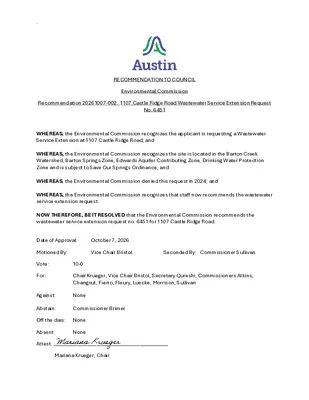
. RECOMMENDATION TO COUNCIL Environmental Commission Recommendation 20261007-002: 1107 Castle Ridge Road Wastewater Service Extension Request No. 6451 WHEREAS, the Environmental Commission recognizes the applicant is requesting a Wastewater Service Extension at 1107 Castle Ridge Road; and WHEREAS, the Environmental Commission recognizes the site is located in the Barton Creek Watershed, Barton Springs Zone, Edwards Aquifer Contributing Zone, Drinking Water Protection Zone and is subject to Save Our Springs Ordinance; and WHEREAS, the Environmental Commission denied this request in 2024; and WHEREAS, the Environmental Commission recognizes that staff now recommends the wastewater service extension request. NOW THEREFORE, BE IT RESOLVED that the Environmental Commission recommends the wastewater service extension request no. 6451 for 1107 Castle Ridge Road. Date of Approval: October 7, 2026 Motioned By: Vice Chair Bristol Seconded By: Commissioner Sullivan Vote: For: 10-0 Chair Krueger, Vice Chair Bristol, Secretary Qureshi, Commissioners Atkins, Changsut, Fierro, Fleury, Luecke, Morrison, Sullivan Against: None Abstain: Commissioner Brimer Off the dais: None Absent: None Attest: _____________________________________________ Mariana Krueger, Chair
. RECOMMENDATION TO COUNCIL Environmental Commission Recommendation 20261007-004: Dog’s Head Regulating Plan WHEREAS, the Environmental Commission formed “the Dog’s Head Working Group to organize and engage community stakeholders; advise the applicant, City of Austin (CoA), and City Council on the regulatory plan; and to make recommendations regarding the regulating plan of the Dog's Head development agreement.”; and WHEREAS, the working group consists of members of the Environmental Commission, the existing communities, and residents living on the Dog’s Head Property and environmental community, which met 10 times between June and September; and WHEREAS, the working group formed a smaller sub-committee to engage with Dog’s Head Land JV, Ltd.; City of Austin (CoA) staff; and Council members. That group met three times at City Hall; WHEREAS, the sub-committee reached agreement with Dog’s Head Land JV, Ltd. and CoA staff to delay the Regulating Plan until March 2027; and NOW THEREFORE BE IT RESOLVED, that the Environmental Commission recommends the following to Austin City Council: 1. Reinstate Environmental Commission involvement in all phases of the Dog’s Head Development, as defined by CoA Code. 2. Dog’s Head Land JV, Ltd. shall share any and all hydrological studies with the Environmental Commission and Austin Watershed Protection annually, with the first study to be released no later than January 1, 2027. 3. Dog’s Head Land JV, Ltd., in partnership with the CoA, shall conduct an Environmental Resource Inventory on the property and in the river within two years of the Effective Date of . the Development Agreement. The results of this inventory shall be publicly released, and a briefing shall be given to the Environmental Commission. 4. Austin Watershed Protection shall conduct a hydrological study of the groundwater and aquifers beneath the Dog’s Head Property, inclusive of flood management strategies. These shall be made public via the CoA website, with subsequent updates annually. 5. Projects not related to mining operations or the remediation of the former mines shall obtain approval for Cut Requirements (Section 25-8-341) and Fill Requirements (Section 25-8-342) that exceed four feet, in a manner consistent with 2026 CoA Code. Variance requests shall come before the Environmental Commission according to CoA code. 6. CoA, in partnership with Dog’s Head Land JV, Ltd., shall conduct a full Environmental Assessment Study that includes: water quality, soil quality (including presence of pollutants in the area), baseline assessment of the state of the existing ecology on the site …
RECOMMENDATION TO COUNCIL Environmental Commission Recommendation 20261007-005: Dog’s Head Development Agreement Amendments WHEREAS, the Environmental Commission was presented with a staff briefing regarding the Dog’s Head on September 16, 2026; and WHEREAS, the Environmental Commission finds multiple areas within the Development Agreement that should be amended to align with current city code that protects the environment; and WHEREAS, the Austin City Council voted on several amendments to the development agreement at the July 23, 2026, City Council meeting, but to date, City Legal and the City Manager’s Office have not finalized or publicized the incorporation of those amendments into the document; NOW THEREFORE BE IT RESOLVED that the Environmental Commission recommends the following amendments be made to the Dog’s Head Development Agreement (DA) prior to City Council approval of the Regulating Plan: 1. Updates from July 23, 2026, City Council Meeting a. Amend the DA to incorporate all amended language approved by City Council at the July 23, 2026, City Council Meeting. 2. Development Agreement Control/Conflicts a. Section 3.06 (d) (at present, the development agreement controls if there is any conflict with either the Regulating Plan or the interim zoning in city code) Amend the DA so that Regulating Plan Controls as soon as it is in place, with the DA, only as amended, controlling in the interim. i. 3. Land Use a. Section 3.01 (a) i. Add “Including, but not limited to Sections 14-18-1,14-18-2, 30-1-253, 2-1-144, Section 4 and 1.3.4.3, 1.3.4.4, and 1.3.4.5 of the Environmental Criteria Manual of the City Code.” b. Section 3.03 (at present, the Director of Development Services can authorize any variance to Land Development Code administratively without public process) i. Strike this section and reinstate standard board and commission approval for all variances and zoning. c. Section 3.04 (at present, existing land uses are allowed to continue) i. Phase out autonomous boat testing and prohibit any military or military-adjacent operations. i. ii. d. Section 3.05 (a-b) (currently, all permitted uses within the Dog’s Head Property will be classified as either Mixed-Use Development or Open Space) Amend this section to preclude all polluting industrial uses, as described in the Land Development Code (LDC), 25-2-5. In particular, disallow data centers (including crypto currency mining), chip manufacturing, gas peaker plants, nuclear power plants, and weapons and defense-related manufacturing. Prioritize residential, civic, and agricultural uses as described in the Land Development Code (25-2-3, 25-2-6, and 25-2-7). Remove research …