
REGULAR MEETING OF THE DESIGN COMMISSION MONDAY, June 22, 2026, 6:00 P.M. PERMITTING AND DEVELOPMENT CENTER, ROOM 1405 6310 WILHELMINA DELCO DRIVE AUSTIN, TEXAS Some members of the Design Commission may be participating by videoconference. The meeting may be viewed online at: http://www.austintexas.gov/page/watch-atxn-live. Public comment will be allowed in-person or remotely via telephone. Speakers may only register to speak on an item once, either in-person or remotely, and will be allowed up to three minutes to provide their comments. Registration no later than noon the day before the meeting is required for remote participation by telephone. To register to speak remotely, call or email Chad Sharrard at 512- 974-8033 or chad.sharrard@austintexas.gov. CURRENT COMMISSIONERS: Marissa McKinney, Chair Kevin Howard, Vice Chair Ramachandra “Rao” Aradhyula David Carroll Nkiru Gelles Saira Khan CALL TO ORDER AGENDA Conners Ladner Josue Meiners Evgenia “Jenny” Murkes Jon Salinas Brendan Wittstruck PUBLIC COMMUNICATION: GENERAL The first five speakers signed up prior to the meeting being called to order will each be allowed a three-minute allotment to address their concerns regarding items not posted on the agenda. APPROVAL OF MINUTES 1. Approve the minutes of the Design Commission regular meeting on May 18th, 2026. Discussion Items 2. 3. 4. Discussion on alley access and promoting the use of alley spaces for economic vitality. Sponsors: Commissioner Nkiru Gelles and Commissioner Jon Salinas. Discussion on clarifying the purpose and mandate of the Design Commission. Sponsors: Commissioner Jenny Murkes and Vice Chair Kevin Howard. Discussion of Downtown Density Bonus Program (DDBP) Phase I background and context, including discussion of the Design Guidelines Working Group recommendations, and discussion regarding the approach, strategy, and stakeholder engagement process for DDBP Phase II. Sponsors: Vice Chair Kevin Howard and Commissioner David Carroll. DISCUSSION AND ACTION ITEMS 5. Discussion and action items regarding the makeup of the Urban Design Guidelines Working Group. Sponsors: Chair Marissa McKinney and Commissioner Brandon Wittstruck. FUTURE AGENDA ITEMS City Code requires at least two board members sponsor an item to be included on an agenda. This section of the agenda provides members an opportunity to request items for future agendas. Staff should assume that if there is no objection from other members expressed at the meeting, the members’ silence indicates approval for staff to include on the next agenda. ADJOURNMENT The City of Austin is committed to compliance with the Americans with Disabilities Act. Reasonable modifications and equal access to communications …
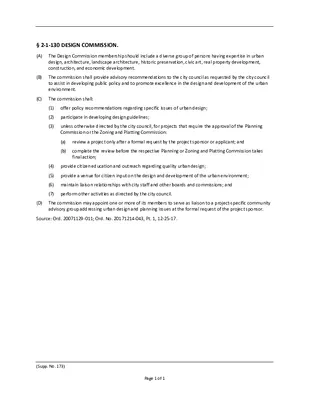
§ 2-1-130 DESIGN COMMISSION. (A) The Design Commission membership should include a diverse group of persons having expertise in urban design, architecture, landscape architecture, historic preservation, civic art, real property development, construction, and economic development. (B) The commission shall provide advisory recommendations to the city council as requested by the city council to assist in developing public policy and to promote excellence in the design and development of the urban environment. (C) The commission shall: (1) offer policy recommendations regarding specific issues of urban design; (2) participate in developing design guidelines; (3) unless otherwise directed by the city council, for projects that require the approval of the Planning Commission or the Zoning and Platting Commission: (a) review a project only after a formal request by the project sponsor or applicant; and (b) complete the review before the respective Planning or Zoning and Platting Commission takes final action; (4) provide citizen education and outreach regarding quality urban design; (5) provide a venue for citizen input on the design and development of the urban environment; (6) maintain liaison relationships with city staff and other boards and commissions; and (7) perform other activities as directed by the city council. (D) The commission may appoint one or more of its members to serve as liaison to a project-specific community advisory group addressing urban design and planning issues at the formal request of the project sponsor. Source: Ord. 20071129-011; Ord. No. 20171214-043, Pt. 1, 12-25-17. (Supp. No. 173) Page 1 of 1
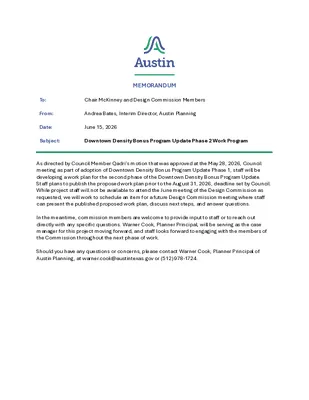
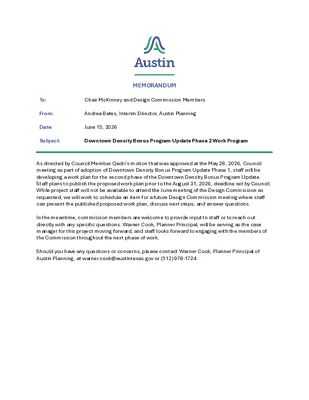
MEMORANDUM To: From: Date: Chair McKinney and Design Commission Members Andrea Bates, Interim Director, Austin Planning June 15, 2026 Subject: Downtown Density Bonus Program Update Phase 2 Work Program As directed by Council Member Qadri’s motion that was approved at the May 28, 2026, Council meeting as part of adoption of Downtown Density Bonus Program Update Phase 1, staff will be developing a work plan for the second phase of the Downtown Density Bonus Program Update. Staff plans to publish the proposed work plan prior to the August 31, 2026, deadline set by Council. While project staff will not be available to attend the June meeting of the Design Commission as requested, we will work to schedule an item for a future Design Commission meeting where staff can present the published proposed work plan, discuss next steps, and answer questions. In the meantime, commission members are welcome to provide input to staff or to reach out directly with any specific questions. Warner Cook, Planner Principal, will be serving as the case manager for this project moving forward, and staff looks forward to engaging with the members of the Commission throughout the next phase of work. Should you have any questions or concerns, please contact Warner Cook, Planner Principal of Austin Planning, at warner.cook@austintexas.gov or (512) 978-1724.

Design Commission Alternative Draft DRAFT 5/4/2026 Downtown Density Bonus Program- Urban Design Standards Downtown Density Bonus Program Urban Design Standards apply only to projects participating in the Downtown Density Bonus Program and are intended to implement public realm and pedestrian environment objectives that currently apply under §25-2-586. Frontage Designations For the purpose of complying with the Downtown Density Bonus Program Urban Design Standards, frontage designations are determined based on the street or trail that is adjacent to the lot line: ● Primary Street- ○ All streets identified as Main Streets are primary streets. A site has multiple primary street frontages where it is adjacent to more than one Main Street. ○ Where a site does not abut a Main Street, the primary street is the street with the highest priority (see Street Priorities below). A site has only one primary street frontage where it is not adjacent to multiple Main Streets. ● Side Street- Side streets are all other streets and listed trails, excluding alleys, not designated as primary streets. ● Street Priorities- are based on Great Streets Master Plan street typologies and named streets and trails within the Downtown Density Bonus Program boundary. Street priorities are as follows, from highest to lowest: 1. Main Streets a. Pedestrian Priority Street (Great Streets) b. Congress Avenue c. Red River Street d. Rainey Street e. 6th Street 2. Bicycle and Local Access Street (Great Streets) 3. Rapid Transit Street (Great Streets) 4. Mixed Mode Street (Great Streets) 5. Waller Creek Trail, Waterloo Greenbelt, 6. Shoal Creek Trail, Shoal Creek Greenbelt 7. Pedestrian Promenade (Great Streets) / Butler Hike and Bike Trail 8. Commuter Street (Great Streets) 9. Commuter Boulevard (Great Streets) Mandatory Standards All projects participating in the Downtown Density Bonus (DDB) program must comply with each of the following mandatory standards: Downtown Density Bonus- Urban Design Standards 1 City of Austin Council Meeting Backup: May 28, 2026File ID: 26-1745 1. Windows a. Ground story facades must include transparent windows for a minimum portion of Design Commission Alternative Draft DRAFT 5/4/2026 the facade area: i. Primary streets: 65% ii. Side streets: 45% iii. Alley: 0% b. Window glazing must have a visible light transmittance of 60% or higher and an external reflectance of 20% or less to be considered transparent. 2. Doors a. Entrances must be provided at the following minimum average frequencies* : i. Primary street: 1 per 75 feet of …

1 2 3 4 5 6 7 8 9 10 11 12 13 14 15 16 17 18 19 20 21 22 23 24 25 26 27 28 29 30 31 32 33 34 35 36 37 38 39 40 ORDINANCE NO. _________________ AN ORDINANCE AMENDING CITY CODE CHAPTER 25-2 TO CREATE NEW DENSITY BONUS ZONING DISTRICTS AND ESTABLISH REGULATIONS AND REQUIREMENTS THAT APPLY TO THE NEW DENSITY BONUS COMBINING DISTRICTS AND TO DECREASE THE ELIGIBILITY AREA AND REMOVE CERTAIN PROPERTIES FROM PARTICIPATING IN THE DOWNTOWN DENSITY BONUS PROGRAM. BE IT ORDAINED BY THE CITY COUNCIL OF THE CITY OF AUSTIN: PART 1. Include as Figure 1 (Figure 1) in Subsection (B)(1) of City Code Section 25-2-586 (Downtown Density Bonus Program) the Downtown Districts Map attached as Exhibit “A” and incorporated herein. PART 2. Replace the maps identified as Figure 2 (Figure 2) in Subsection (B)(3) of City Code Section 25-2-586 (Downtown Density Bonus Program) and with the Downtown Density Bonus Program – Eligibility, Floor Area Ration (FAR) and Height Map attached as Exhibit “B”, which is incorporated herein. PART 3. Subsection (B)(2) of City Code Section 25-2-586 (Downtown Density Bonus Program) is deleted in its entirety and the remaining subdivisions are renumbered accordingly. [Properties in the Rainey Street Subdistrict may participate in the Downtown Density Bonus Program only for floor-to-area ratio that exceeds 8:1 or height above 350 feet. To achieve floor-to-area ratio up to 8:1 or height between 41 feet and 350 feet, properties in the Rainey Street Subdistrict must comply with Subsection (C)(4) of Section 25-2-739 (Rainey Street Subdistrict Regulations) of the City Code] PART 4. Subsection (E)(2) of City Code Section 25-2-586 (Downtown Density Bonus Program) is deleted in its entirety and the remaining subdivisions are renumbered accordingly. [(2) Rainey Street Subdistrict Historic Preservation Community Benefit. (a) A project may achieve bonus area for each historically significant building that is: (i) rehabilitated; and Draft 5/20/2026 Page 1 of 20 COA Law Department City of Austin Council Meeting Backup: May 28, 2026File ID: 26-1745 41 42 43 44 45 46 47 48 49 50 51 52 53 54 55 56 57 58 59 60 61 62 63 64 65 66 67 68 69 70 71 72 73 74 75 76 77 78 79 80 81 (ii) preserved on site, relocated to a site within the Rainey Street Subdistrict, or relocated to a location within the city limits …

Citywide Density Bonus Program – Planning Commission Amendments and Staff Responses Staff Recommendation Not recommended Planning Commission Amendment 1 Allow fee in lieu payments as an option for rental housing developments. Fee in lieu funds generated shall be a) restricted for use as RDHA or OHDA funding, and b) geographically prioritized to affordable developments within 1.5 miles of the originating density bonus development. If no eligible Rental Housing Development Assistance (RHDA) or Ownership Housing Development Assistance (OHDA)-funded projects exist to accept the funds within 3 years of fee-in-lieu payment, fee-in-lieu funds shall revert to general RHDA/OHDA funding for any citywide project receiving this funding. Staff Response Staff’s proposal is for on-site units only for rental developments, consistent with our longstanding policy for density bonuses. The City’s density bonus programs have resulted in nearly 6,000 affordable units (or beds, in the case of some properties in the University Neighborhood Overlay), which would cost up to $600M to subsidize, making density bonus programs the main tool for generating affordable housing without the need for subsidy. However, staff is happy to provide information about the pros and cons of any proposed fee-in-lieu option for rental. If Council decides to include a fee-in-lieu option, staff wants to ensure that it continues to promote geographic dispersion, and avoids concentration of poverty. Planning Commission’s proposed geographic restrictions would not be administratively feasible, as staff would not feasibly be able to maintain, track, and communicate fee availability to prospective RHDA/OHDA applicants for funding if each fee-in-lieu payment had its own geographic restriction and shot clock for spending. If Council chooses to include a fee-in-lieu option, staff recommends that Austin Housing limit the use of fee-in-lieu revenues to High Opportunity Areas as defined by Austin Housing, which would advance the policy intent while remaining administratively workable. Staff also want to ensure that fee-in-lieu does not negate or supersede any requirements for on-site units in cases of redevelopment of existing multifamily buildings. We would therefore recommend that if a fee-in-lieu is adopted for rental developments, it should only be available for developments that do not trigger City Code § 4-18-32 which sets out redevelopment requirements for existing multifamily structures. C20-2024-004 Text Changes No changes were made to the staff version of the ordinance. Aspects of this amendment that are able to be included were included in the Planning Commission version of the ordinance. 1 City of Austin Council Meeting …

DRAFT C20-2024-018 DDB Phase I Downtown Density Bonus Urban Design Standards These standards would apply only to projects seeking Downtown Density Bonus entitlements and are intended to implement public realm and pedestrian environment objectives that currently apply under §25-2-586. In order to participate in the proposed Downtown Density Bonus (DDB) program, projects would be required to adhere to all mandatory design standards and a minimum number of additional urban design standards from a menu of options. For Phase I of the Downtown Density Bonus update, the proposed requirements would be: - - Projects zoned –DDB400 must adhere to all mandatory standards and at least 7 out of the 14 menu standards to participate in the DDB program Projects zoned –DDB850 must adhere to all mandatory standards and least 10 out of the 14 menu standards to participate in the DDB program In future phases of the Downtown Density Bonus program update, additional combining districts may be created that have different requirements for the minimum number of urban design standards that must be met. Additionally, subdistricts may be created that provide additional urban design standards or requirements based on the unique character of specific areas (such as the Red River Cultural District). Additional design standards may be added in the future. If additional design standards are added to the menu, the minimum number of standards that must be met may be modified. The Urban Design team in Austin Planning will review site plans and determine compliance with the urban design standards. Mandatory Urban Design Standards Screening Requirements (A) Utility equipment, mechanical equipment, and solid waste collection areas, including loading docks, truck parking, outdoor storage, trash collection, trash compaction, and other service functions: a. are prohibited in the area between a building and a street; b. must not be visible from a street, adjacent property lines, or the property lines across adjacent public streets; and c. must be screened or located in a public alley. (B) This subsection applies to a site with frontage on an alley 20 feet or more wide. City of Austin Council Meeting Backup: May 28, 2026File ID: 26-1745 DRAFT C20-2024-018 DDB Phase I a. A transformer room or utility vault must be adjacent to and accessible from the alley, unless Austin Energy determines placement is required in another location. b. A pump room, sprinkler room, or other utility or mechanical room must be adjacent to and accessible …

CM Qadri Motion Sheet May 28, 2026 City Council Meeting Item No. 67 MOTION SHEET I move to amend sections of Part 8 of the draft ordinance as follows and reorder the remaining sections accordingly: Part 8. City Code Chapter 25-2, Subchapter C, Article 3, Division 5 (Combining and Overlay Districts) is amended to add a new Section 25-2-657 to read: (G) DDB400 zoning. (1) A building located on a site with DDB400 zoning may exceed the maximum building height in the base zoning district by a maximum of 400 feet except that no building may exceed 750 feet in height. (2) A site with DDB400 zoning seeking bonus area must provide mandatory urban design standards and 6 [7] optional urban design standards described in subsection R below. (H) DDB850 zoning. (1) A building located on a site with DDB850 zoning may exceed the maximum building height in the base zoning district by a maximum of 850 feet except that no building may exceed 1200 feet in height. (2) A site with DDB850 zoning seeking bonus area must provide mandatory urban design standards and provide 9 [10] optional urban design standards described in subsection R below. (M) Mandatory Urban Design Standards (UDS). (1) UDS-1 (Screening) (c) Above-ground parking structures must be screened to prevent spaces from view [from] of a public street and adjacent properties. (4) UDS-5 (Limit Curb Cuts) CM Qadri Motion Sheet May 28, 2026 City Council Meeting Item No. 67 (a) A development shall minimize curb cuts shall be located to preserve a continuous active frontage. (b) Unless [as] required by Austin Fire or Austin Transportation and Public Works, vehicular access from a site to a public street shall be limited to: i) one curb cut for each 140 feet of single street frontage along a street that runs east and west; and ii) one curb cut along a street that runs north and south. (R) Optional Urban Design Standards (UDS). (1) UDS-6 [5] (Enhanced Pedestrian-Oriented Frontage Requirements). (a) A minimum of 75 percent of the total building frontage on the ground floor of must contain one or more commercial or civic uses and must comply with the dimensional requirements found in Section 4.3.3.C in Subchapter E (Design Standards and Mixed Use) of this chapter; and (b) In alignment with Great Streets Streetscape Standards provide a street- facing outdoor amenity space which must: (i) (ii) be located …
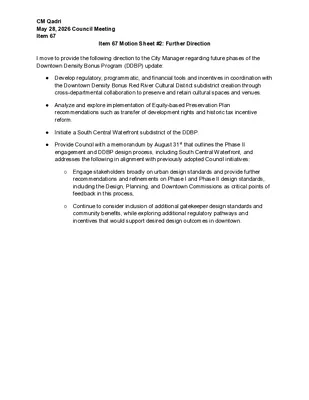
CM Qadri May 28, 2026 Council Meeting Item 67 Item 67 Motion Sheet #2: Further Direction I move to provide the following direction to the City Manager regarding future phases of the Downtown Density Bonus Program (DDBP) update: ● Develop regulatory, programmatic, and financial tools and incentives in coordination with the Downtown Density Bonus Red River Cultural District subdistrict creation through cross-departmental collaboration to preserve and retain cultural spaces and venues. ● Analyze and explore implementation of Equity-based Preservation Plan recommendations such as transfer of development rights and historic tax incentive reform. ● Initiate a South Central Waterfront subdistrict of the DDBP. ● Provide Council with a memorandum by August 31st that outlines the Phase II engagement and DDBP design process, including South Central Waterfront, and addresses the following in alignment with previously adopted Council initiatives: ○ Engage stakeholders broadly on urban design standards and provide further recommendations and refinements on Phase I and Phase II design standards, including the Design, Planning, and Downtown Commissions as critical points of feedback in this process, ○ Continue to consider inclusion of additional gatekeeper design standards and community benefits, while exploring additional regulatory pathways and incentives that would support desired design outcomes in downtown.
MEMORANDUM To: From: Date: Chair McKinney and Design Commission Members Andrea Bates, Interim Director, Austin Planning June 15, 2026 Subject: Downtown Density Bonus Program Update Phase 2 Work Program As directed by Council Member Qadri’s motion that was approved at the May 28, 2026, Council meeting as part of adoption of Downtown Density Bonus Program Update Phase 1, staff will be developing a work plan for the second phase of the Downtown Density Bonus Program Update. Staff plans to publish the proposed work plan prior to the August 31, 2026, deadline set by Council. While project staff will not be available to attend the June meeting of the Design Commission as requested, we will work to schedule an item for a future Design Commission meeting where staff can present the published proposed work plan, discuss next steps, and answer questions. In the meantime, commission members are welcome to provide input to staff or to reach out directly with any specific questions. Warner Cook, Planner Principal, will be serving as the case manager for this project moving forward, and staff looks forward to engaging with the members of the Commission throughout the next phase of work. Should you have any questions or concerns, please contact Warner Cook, Planner Principal of Austin Planning, at warner.cook@austintexas.gov or (512) 978-1724.

DESIGN COMMISSION MINUTES REGULAR OR MEETING Monday May 18, 2026 The Design Commission convened in a Regular meeting on Monday May 18, 2026, at the Permitting and Development Center, Room 1405, located at 6310 Wilhelmina Delco Drive in Austin, Texas. Chair Marissa McKinney called the Design Commission meeting to order at 6:02 p.m. Commissioners in Attendance: Marissa McKinney (Chair) Kevin Howard (Vice Chair) Ramachandra “Rao” Aradhyula (arrived 6:05) David Carroll Jenny Murkes (arrived 6:11) Jon Salinas Commissioners in Attendance Remotely: Nkiru Gelles Saira Khan Josue Meiners Brendan Wittstruck PUBLIC COMMUNICATION: GENERAL None Present APPROVAL OF MINUTES 1. Approve the minutes of the Design Commission Special Called Meeting on May 4th, 2026. The minutes from the Design Commission special called meeting on May 4th, 2026, were approved on Chair McKinney’s motion, Commissioner Gelle’s second on an 8-0 vote. STAFF BRIEFINGS 2. 3. Staff briefing regarding the Barton Springs Road Bridge. Presented by Eric Bailey, Austin Capital Delivery Services. Sponsors: Commissioner Salinas and Commissioner Carroll. Item was discussed. Staff briefing regarding the inclusion of West Campus into the Downtown area. Presented by Shanisha Johnson, Austin Planning. Sponsors: Commissioner Salinas and Chair Meiners. Item was discussed. 1 DISCUSSION AND ACTION ITEMS 4. 5. 6. Discussion and possible action on recommendations regarding the future of the Design Commission and their role in the development review process. Sponsors: Commissioner Murkes and Vice Chair Howard. There was a motion by Vice Chair Howard seconded by Commissioner Jenny Murkes that the design commission repurpose the urban design guideline working group to sort out a recommendation to council regarding the changing role of the design commission on an 8-0 vote. Discussion and action to recommend to City Council whether the project Fiesta Gardens, located at 2101 Jesse E. Segovia St., complies with the City Design and Sustainability Standards. Presented by Clayton Korte and Travis Greig of Clayton Korte. There was a motion by Commissioner Jon Salinas, seconded by Commissioner David Carroll to recommend to City Council that the project Fiesta Gardens, located at 2101 Jesse E Segovia St., complies with the City Design and Sustainability Standards on an 8-0 vote. Discussion and action to appoint a member of the Design Commission to serve as the Commission’s representative on the Downtown Commission. Sponsors: Commissioner Salinas and Chair Meiners. There was a motion by Vice Chair Howard seconded by Commissioner Jon Salinas to appoint Commissioner Jenny Murkes as Design Commission …

DESIGN COMMISSION MINUTES REGULAR MEETING Monday, June 22, 2026 The Design Commission convened in a Regular meeting on Monday, June 22, 2026, at the Permitting and Development Center, Room 1405, located at 6310 Wilhelmina Delco Drive in Austin, Texas. Chair Marissa McKinney called the Design Commission meeting to order at 6:02 p.m. Commissioners in Attendance: McKinney, Marissa (Chair) Howard, Kevin (Vice Chair) Carroll, David Murkes, Evangia “Jenny” Salinas, Jon Commissioners in Attendance Remotely: Aradhyula, Ramachandra “Rao” Gelles, Nkiru (arrived 6:21) Wittstruck, Brendan PUBLIC COMMUNICATION: GENERAL None Present. APPROVAL OF MINUTES 1. Approve the minutes of the Design Commission Regular Meeting on May 18, 2026. The minutes from the Design Commission regular meeting on May 18, 2026, were approved on Vice Chair Kevin Howard motion, Commissioner David Caroll second on a vote of 6-0. Discussion Items 2. Discussion on alley access and promoting the use of alley spaces for economic vitality. Sponsors: Commissioner Nkiru Gelles and Commissioner Jon Salinas. Motion to postpone item to the Design Commission Regular Meeting on August 24th by Commissioner Jon Salinas, Second Vice Chair Howard on a vote of 6-0. 3. Discussion on clarifying the purpose and mandate of the Design Commission. Sponsors: Commissioner Jenny Murkes and Vice Chair Kevin Howard. Item was discussed. 1 4. Discussion of Downtown Density Bonus Program (DDBP) Phase I background and context, including discussion of the Design Guidelines Working Group recommendations, and discussion regarding the approach, strategy, and stakeholder engagement process for DDBP Phase II. Sponsors: Vice Chair Kevin Howard and Commissioner David Carroll. Item was discussed. DISCUSSION AND ACTION ITEMS 5. Discussion and action items regarding the makeup of the Urban Design Guidelines Working Group. Sponsors: Chair Marissa McKinney and Commissioner Brandon Wittstruck. Item was discussed, no action taken. FUTURE AGENDA ITEMS Working group updates, Howard Staff Briefing from Great Streets team regarding implementation of urban design guidelines into great streets update. Sponsors: Vice Chair Howard, Commissioner Nkiru Gelles. ADJOURNMENT Chair Marissa McKinney adjourned the meeting at 7:11 p.m. without objection. The minutes were approved at the August 24, 2026 meeting on Vice Chair Howard’s motion, Commissioner Murkes’ second on a 6-0 vote. 2