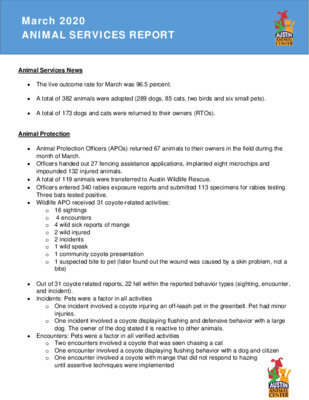
March 2020 March 2020 Animal Services Report ANIMAL SERVICES REPORT • The live outcome rate for March was 96.5 percent. • A total of 382 animals were adopted (289 dogs, 85 cats, two birds and six small pets). • A total of 173 dogs and cats were returned to their owners (RTOs). Animal Services News Animal Protection month of March. • Animal Protection Officers (APOs) returned 67 animals to their owners in the field during the • Officers handed out 27 fencing assistance applications, implanted eight microchips and impounded 132 injured animals. • A total of 119 animals were transferred to Austin Wildlife Rescue. • Officers entered 340 rabies exposure reports and submitted 113 specimens for rabies testing. Three bats tested positive. • Wildlife APO received 31 coyote-related activities: 4 encounters o 16 sightings o o 4 wild sick reports of mange o 2 wild injured o 2 incidents o 1 wild speak o 1 community coyote presentation o 1 suspected bite to pet (later found out the wound was caused by a skin problem, not a bite) injuries. • Out of 31 coyote related reports, 22 fell within the reported behavior types (sighting, encounter, and incident). Incidents: Pets were a factor in all activities • o One incident involved a coyote injuring an off-leash pet in the greenbelt. Pet had minor o One incident involved a coyote displaying flushing and defensive behavior with a large dog. The owner of the dog stated it is reactive to other animals. • Encounters: Pets were a factor in all verified activities o Two encounters involved a coyote that was seen chasing a cat o One encounter involved a coyote displaying flushing behavior with a dog and citizen o One encounter involved a coyote with mange that did not respond to hazing until assertive techniques were implemented March 2020 Animal Services Report Volunteer, Foster and Rescue Programs • A total of 306 volunteers donated 3,385 service hours. • AAC closed to the public and volunteers on March 16. • Due to COVID-19, a plea for help was sent out to find foster homes for animals in the shelter because of the uncertainty of what the next few weeks would look like. • A total of 400 families provided foster care, a 200 percent increase over last month, and a total of 104 animals were adopted directly from foster care. • There are 1487 …
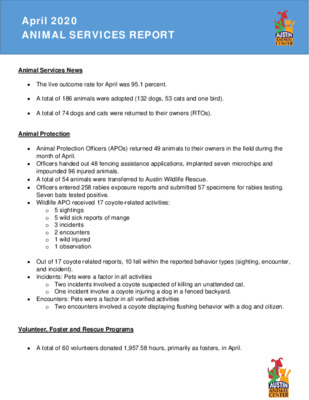
April 2020 April 2020 Animal Services Report ANIMAL SERVICES REPORT • The live outcome rate for April was 95.1 percent. • A total of 186 animals were adopted (132 dogs, 53 cats and one bird). • A total of 74 dogs and cats were returned to their owners (RTOs). Animal Services News Animal Protection month of April. • Animal Protection Officers (APOs) returned 49 animals to their owners in the field during the • Officers handed out 48 fencing assistance applications, implanted seven microchips and impounded 96 injured animals. • A total of 54 animals were transferred to Austin Wildlife Rescue. • Officers entered 258 rabies exposure reports and submitted 57 specimens for rabies testing. Seven bats tested positive. • Wildlife APO received 17 coyote-related activities: o 5 sightings o 5 wild sick reports of mange o 3 incidents o 2 encounters o 1 wild injured o 1 observation • Out of 17 coyote related reports, 10 fell within the reported behavior types (sighting, encounter, and incident). Incidents: Pets were a factor in all activities • o Two incidents involved a coyote suspected of killing an unattended cat. o One incident involve a coyote injuring a dog in a fenced backyard. • Encounters: Pets were a factor in all verified activities o Two encounters involved a coyote displaying flushing behavior with a dog and citizen. Volunteer, Foster and Rescue Programs • A total of 60 volunteers donated 1,957.58 hours, primarily as fosters, in April. April 2020 Animal Services Report from foster care. • A total of 420 families provided foster care and a total of 186 animals were adopted directly • There are 1758 approved fosters in GivePulse, and 1548 new foster applications were processed. • There are currently 394 animals in 329 different foster homes. • 68 live outcomes were attributed to 14 AAC partners: o 28 cats o 39 dogs o 1 ferret Veterinary Services shelter grounds. • Shelter veterinarians were medically responsible for 587 animals; 495 in foster care and 92 on • Veterinarians addressed 95 emergency cases, performed 12 orthopedic surgeries and 18 other specialty surgeries including enucleations, amputations, mass removals, hernia repair, wound repairs and dentals. A total of 478 spay/neuter surgeries were performed and 765 vet exams.
Animal Advisory Commission Meeting, August 7, 2020 Special Meeting of the Animal Advisory Commission Friday, August 7, 3 p.m., 2020 Animal Advisory Commission to be held August 7 with Social Distancing Modifications Public comment will be allowed via telephone; no in-person input will be allowed. All speakers must register in advance by noon, Thursday, August 6. All public comment will occur at the beginning of the meeting. To speak remotely at the Animal Advisory Commission Meeting, residents must: • Email or call board liaison, Belinda Hare, Belinda.hare@austintexas.gov, phone 512-978-0565, no later than noon, August 6. Email works best and most efficiently. The information required is the speaker name, item number(s) they wish to speak on, whether they are for/against/neutral, phone number, and an email address. • Once a request to speak has been emailed to the board liaison, residents will receive either an email or call providing the telephone number to call on the day of the scheduled meeting. •Speakers must call in at least 15 minutes prior to meeting start in order to speak, late callers will not be accepted and will not be able to speak. •Speakers will be placed in a queue until their time to speak. •Handouts or other information may be emailed to Belinda.hare@austintexas.gov by Noon the day before the scheduled meeting. This information will be provided to Board and Commission members in advance of the meeting. •If this meeting is broadcast live, residents may watch the meeting here: http://www.austintexas.gov/page/watch-atxn-live The City of Austin is committed to compliance with the American with Disabilities Act. Reasonable modifications and equal access to communications will be provided upon request. Meeting locations are planned with wheelchair access. If requiring Sign Language Interpreters or alternative formats, please give notice at least 2 days (48 hours) before the meeting date. Please call Board Liaison, Belinda Hare, Austin Animal Services, at 512-978-0565, for additional information; TTY users route through Relay Texas at 711. ANIMAL ADVISORY COMMISSION FRIDAY, AUGUST 7, 3 to 4:30 P.M., 2020 VIA VIDEOCONFERENCING Lisa Mitchell, Vice Chair Edward Flores Monica Frenden Andrea Schwartz Jo Anne Norton Ryan Clinton REVISED AGENDA Animal Advisory Commission Meeting, August 7, 2020 CURRENT COMMISSION MEMBERS: David Lundstedt, Chair Katie Jarl Palmer Neuhaus Craig Nazor Dr. Jon Brandes Nancy Nemer, Parliamentarian District 4 Vacant CALL TO ORDER 1. APPROVAL OF MINUTES 2. STAFF BRIEFINGS 3. OLD BUSINESS a. Minutes from the Animal Advisory Commission’s July …
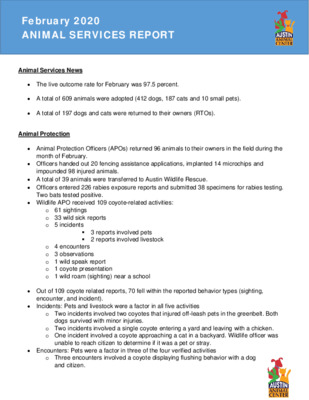
February 2020 February 2020 Animal Services Report ANIMAL SERVICES REPORT Animal Services News Animal Protection • The live outcome rate for February was 97.5 percent. • A total of 609 animals were adopted (412 dogs, 187 cats and 10 small pets). • A total of 197 dogs and cats were returned to their owners (RTOs). • Animal Protection Officers (APOs) returned 96 animals to their owners in the field during the • Officers handed out 20 fencing assistance applications, implanted 14 microchips and month of February. impounded 98 injured animals. • A total of 39 animals were transferred to Austin Wildlife Rescue. • Officers entered 226 rabies exposure reports and submitted 38 specimens for rabies testing. Two bats tested positive. • Wildlife APO received 109 coyote-related activities: o 61 sightings o 33 wild sick reports o 5 incidents 3 reports involved pets 2 reports involved livestock o 4 encounters o 3 observations o 1 wild speak report o 1 coyote presentation o 1 wild roam (sighting) near a school • Out of 109 coyote related reports, 70 fell within the reported behavior types (sighting, encounter, and incident). Incidents: Pets and livestock were a factor in all five activities • o Two incidents involved two coyotes that injured off-leash pets in the greenbelt. Both dogs survived with minor injuries. o Two incidents involved a single coyote entering a yard and leaving with a chicken. o One incident involved a coyote approaching a cat in a backyard. Wildlife officer was unable to reach citizen to determine if it was a pet or stray. • Encounters: Pets were a factor in three of the four verified activities o Three encounters involved a coyote displaying flushing behavior with a dog and citizen. February 2020 Animal Services Report o One encounter involved a coyote with mange that approached a citizen without a dog, but left when it was hazed. Volunteer, Foster and Rescue Programs • A total of 432 volunteers donated 5,223 service hours; 19 groups of volunteers donated 444 hours with their “Giving Group” to the Center; 16 community service restitution volunteers contributed 175 hours toward animal care tasks. • Volunteer Coordinators hosted six New Volunteer Orientations, introducing 132 individuals to our organization and volunteer opportunities. from foster care. • A total of 200 families provided foster care, and a total of 78 animals were adopted directly • There are 806 approved …
May 2020 May 2020 Animal Services Report ANIMAL SERVICES REPORT • The live outcome rate for May was 94.9 percent. • A total of 189 animals were adopted (141 dogs, 46 cats, one bird and one small pet). • A total of 81 dogs and cats were returned to their owners (RTOs). Animal Services News Animal Protection month of May. • Animal Protection Officers (APOs) returned 47 animals to their owners in the field during the • Officers handed out 30 fencing assistance applications, implanted two microchips and impounded 241 injured animals and more than half of those were transferred to Austin Wildlife Rescue. • Officers entered 231 rabies exposure reports and submitted 33 specimens for rabies testing. Three bats tested positive. • Wildlife APO received 44 coyote-related activities: o 21 sightings o 5 incidents o 5 wild sick reports of mange o 5 wild injured o 3 encounters o 3 wild speak o 1 observation o 1 investigate exposure puncture wound. No confirmed incident- dog escaped yard and came back with small • Out of 44 coyote related reports, 29 fell within the reported behavior types (sighting, encounter, and incident). Incidents: Pets and livestock were a factor in all activities • o Two incidents involved a coyote on-camera taking an unattended cat o One incident involved a coyote injuring an off leash dog in a greenbelt o One incident involved a coyote that injured a cat in a front yard o One incident involved a coyote that took chickens from a backyard • Encounters: Pets were a factor in all activities o All encounters involved a coyote displaying flushing behavior with dog and citizen. Volunteer, Foster and Rescue Programs May 2020 Animal Services Report from foster care. • A total of 57 volunteers donated 1,410 hours, primarily as fosters, in May. • A total of 368 families provided foster care and a total of 155 animals were adopted directly • There are 1860 approved fosters in GivePulse, and 257 new foster applications were processed. • There are currently 367 animals in 285 different foster homes. • 108 live outcomes were attributed to 14 AAC partners: o 57 cats o 51 dogs o 1 ferret Veterinary Services shelter grounds. • Shelter veterinarians were medically responsible for 587 animals; 495 in foster care and 92 on • Veterinarians addressed 95 emergency cases, performed 12 orthopedic surgeries and 18 other specialty …
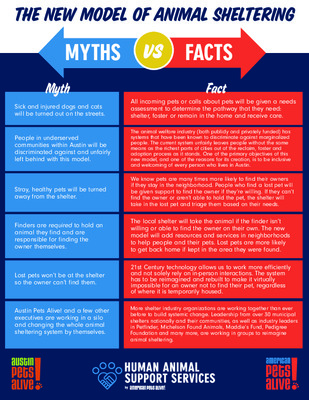
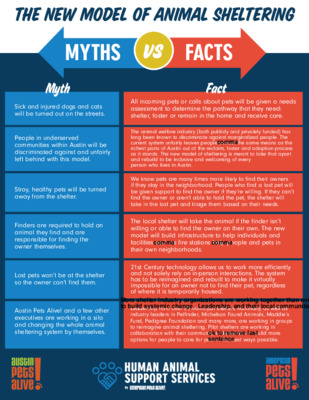
The new model of animal sheltering MYTHS vs FACTS Myth Fact Sick and injured dogs and cats will be turned out on the streets. All incoming pets or calls about pets will be given a needs assessment to determine the pathway that they need: shelter, foster or remain in the home and receive care. People in underserved communities within Austin will be discriminated against and unfairly left behind with this model. Stray, healthy pets will be turned away from the shelter. The animal welfare industry (both publicly and privately funded) has systems that have been known to discriminate against marginalized people. The current system unfairly leaves people without the same means as the richest parts of cities out of the reclaim, foster and adoption process as it stands. One of the primary objectives of this new model, and one of the reasons for its creation, is to be inclusive and welcoming of every person who lives in Austin. We know pets are many times more likely to find their owners if they stay in the neighborhood. People who find a lost pet will be given support to find the owner if they’re willing. If they can’t find the owner or aren’t able to hold the pet, the shelter will take in the lost pet and triage them based on their needs. Finders are required to hold an animal they find and are responsible for finding the owner themselves. The local shelter will take the animal if the finder isn’t willing or able to find the owner on their own. The new model will add resources and services in neighborhoods to help people and their pets. Lost pets are more likely to get back home if kept in the area they were found. Lost pets won’t be at the shelter so the owner can’t find them. 21st Century technology allows us to work more efficiently and not solely rely on in-person interactions. The system has to be reimagined and rebuilt to make it virtually impossible for an owner not to find their pet, regardless of where it is temporarily housed. Austin Pets Alive! and a few other executives are working in a silo and changing the whole animal sheltering system by themselves. More shelter industry organizations are working together than ever before to build systemic change. Leadership from over 30 municipal shelters nationally and their communities, as well as industry leaders …
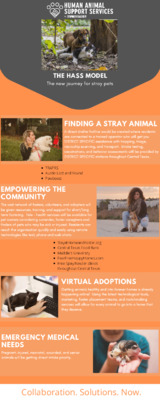
THE HASS MODEL The new journey for stray pets FINDING A STRAY ANIMAL A direct shelter hotline would be created where residents are connected to a trained operator who will get you DISTRICT SPECIFIC assistance with trapping, triage, microchip scanning, and transport. Intake testing, vaccinations, and behavior assessments will be provided by DISTRICT SPECIFIC stations throughout Central Texas. TRAPRS Austin Lost and Found Pawboost EMPOWERING THE COMMUNITY The vast network of fosters, volunteers, and adopters will be given resources, training, and support for short/long term fostering. Tele - health services will be available for pet owners considering surrender, foster caregivers and finders of pets who may be sick or injured. Residents can reach the organization quickly and easily using remote technologies like text, phone and web chats. StayatHomeandFoster.org Central Texas Food Bank Maddie's University FearFreeHappyHomes.com Free Spay/Neuter clinics throughout Central Texas VIRTUAL ADOPTIONS Getting animals healthy and into forever homes is already happening online! Using the latest technological tools, marketing, foster placement teams, and matchmaking services will allow for every animal to go into a home that they deserve. EMERGENCY MEDICAL NEEDS Pregnant, injured, neonatal, wounded, and senior animals will be getting direct intake priority. Collaboration. Solutions. Now.
A Proposal to Make Austin Animal Services (even) Better for People and Pets Ellen Jefferson, DVM Executive Director, Austin Pets Alive!/American Pets Alive! Executive Leadership Team, Human Animal Support Services Project Great News Coming Out of Shelters In March, shelters all over the country, even those that historically never had a foster program, saw the benefit of massive numbers of fosters coming forward to take pets home in an effort to prevent pets from being stuck in shelters in case of govt shutdowns or staff illness. This was extremely eye opening because shelters are entrenched in the “not enough homes” mindset. Lifesaving rates have never been higher. 80,000 foster homes signed up through Greater Good, only 30,000 were used In May, Greater Good did a national push to count foster homes that still wanted a shelter pet (this is more than 30 days after the shelters already emptied out so doesn’t count that initial rush of homes that were already full). Only a fraction were used which means that there is a much larger demand than shelters have ever realized for homes willing to house and help animals. COVID-19 Caused Disruption • The human virus made it impossible to care for animals en masse in a building • Shelter systems pivoted to sustain lifesaving and keep people and pets safe • This pivot fueled a nationwide re-envisioning for how shelters operate image source: unschool.co Because government funded shelters all over the country were able to take a breath from the rat race of intake, kenneling, outcomes due to empty kennels, discussions started about how the entire system needed to be overhauled to more accurately reflect what people want as exemplified by the outpouring of support to keep pets out of shelters. The history of animal sheltering in Austin ● 1900 - emergency of the dog pound model ● Pets are taken from their homes and neighborhoods, rounded up, and reclaimed or killed ● Our movement is built on this old foundation The “taking a breath” also allowed the industry to reflect on how we got here into this system that is so fundamentally broken. In doing research on Austin (which turns out is typical of almost every city), we found that the entire shelter system was created to deal with the pandemic of Rabies. Rabies caused huge amounts of livestock losses, massive public fear of death from it (100% fatal) …
June 2020 June 2020 Animal Services Report ANIMAL SERVICES REPORT Animal Services News • The live outcome rate for June was 93.1 percent. • A total of 306 animals were adopted (172 dogs, 125 cats, three birds and six small pets). • A total of 93 dogs and cats were returned to their owners (RTOs). • A total of 843 animals were brought to the shelter (513 stray, 209 owner surrender, 31 abandoned, 47 public assist and 43 wildlife). Animal Protection month of June. • Animal Protection Officers (APOs) returned 38 animals to their owners in the field during the • Officers handed out 33 fencing assistance applications, implanted 11 microchips and impounded 216 injured animals. • Officers entered 240 rabies exposure reports and submitted 33 specimens for rabies testing. Six bats tested positive. • Wildlife APO received 35 total coyote-related activities: • Out of 35 coyote related reports, 17 fell within the reported behavior types (sighting, encounter, and incident). Incidents: Pets and livestock were a factor in all activities. • o One incident involved a coyote injuring an off-leash cat in a greenbelt near an apartment complex. • Encounters: Pets were a factor in all verified activities. o Encounter involved a coyote displaying flushing behavior with a citizen and a dog. o 15 sightings o 8 wild sick reports of mange o 5 wild injured o 4 wild speak o 1 incident o 1 encounter o 1 observation Volunteer, Foster and Rescue Programs June 2020 Animal Services Report from foster care. • A total of 33 volunteers donated 1,018.17 hours, primarily as fosters, in June. • A total of 340 families provided foster care and a total of 139 animals were adopted directly • There are 1928 approved fosters in GivePulse, and 170 new foster applications were processed. • There are currently 423 animals in 293 different foster homes. • 168 live outcomes were attributed to 20 AAC partners: o 80 cats two to AHS six to Spay-Neuter-Return program with Austin Humane Society 27 behavior/medical cases to Austin Pets Alive! 45 neonates to APA! o 82 dogs 40 to APA! 42 Other partners o Six Other Species Two doves (housing pull) One chicken (medical pull) Two rats (housing pull) One rabbit (medical pull) Veterinary Services • Veterinarians addressed 130 emergency cases, performed five orthopedic surgeries and nine other specialty …
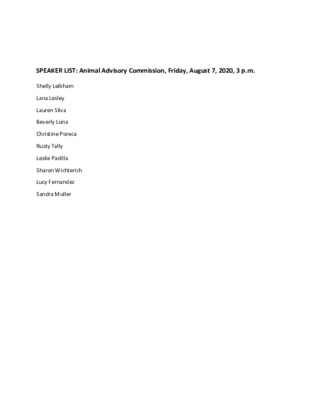
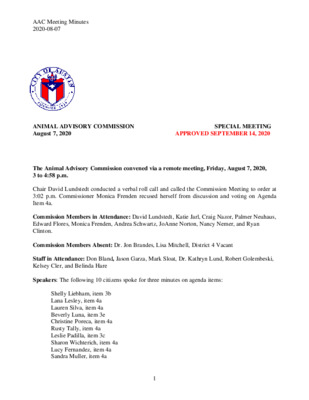
AAC Meeting Minutes 2020-08-07 SPECIAL MEETING APPROVED SEPTEMBER 14, 2020 ANIMAL ADVISORY COMMISSION August 7, 2020 The Animal Advisory Commission convened via a remote meeting, Friday, August 7, 2020, 3 to 4:58 p.m. Chair David Lundstedt conducted a verbal roll call and called the Commission Meeting to order at 3:02 p.m. Commissioner Monica Frenden recused herself from discussion and voting on Agenda Item 4a. Commission Members in Attendance: David Lundstedt, Katie Jarl, Craig Nazor, Palmer Neuhaus, Edward Flores, Monica Frenden, Andrea Schwartz, JoAnne Norton, Nancy Nemer, and Ryan Clinton. Commission Members Absent: Dr. Jon Brandes, Lisa Mitchell, District 4 Vacant Staff in Attendance: Don Bland, Jason Garza, Mark Sloat, Dr. Kathryn Lund, Robert Golembeski, Kelsey Cler, and Belinda Hare Speakers: The following 10 citizens spoke for three minutes on agenda items: Shelly Liebham, item 3b Lana Lesley, item 4a Lauren Silva, item 4a Beverly Luna, item 3e Christine Poreca, item 4a Rusty Tally, item 4a Leslie Padilla, item 3c Sharon Wichterich, item 4a Lucy Fernandez, item 4a Sandra Muller, item 4a 1 AAC Meeting Minutes 2020-08-07 1. APPROVAL OF MINUTES Commissioner Nemer moved to approve the minutes from the July 6, 2020, Special Called meeting, and Commissioner Nazor seconded the motion. Motion passed unanimously, 10 – 0, with Commissioners Lundstedt, Jarl, Nazor, Neuhaus, Flores, Frenden, Schwartz, Norton, Nemer and Clinton voting approval. Commissioners Mitchell and Brandes were absent, and District 4 is vacant. 2. STAFF BRIEFINGS a. Animal Services Office (ASO) Chief Animal Services Officer, Don Bland, and Jason Garza, Deputy Chief Animal Services Officer, presented a summary of the Austin Animal Center and Animal Services Reports for February, March, April, May, and June 2020. b. Don Bland presented an update on the Austin Animal Center’s intake operations. 3. OLD BUSINESS Commissioner Clinton moved to table Old Business; Commissioner Nazor seconded the motion which passed unanimously, 10 – 0, with Commissioners Lundstedt, Jarl, Nazor, Neuhaus, Flores, Frenden, Schwartz, Norton, Nemer and Clinton voting approval. Commissioners Mitchell and Brandes were absent, and District 4 is vacant. a. Update, Discussion and Possible Action on Budget and Priorities Workgroup b. Update, Discussion and Possible Action regarding the Workgroup on Austin Animal Center’s Shelter-Neuter-Release (SNR) Program c. Update, Discussion and Possible Action regarding Code Revision Workgroup d. Update, Discussion and Possible Action regarding Target and Reporting e. Update, Discussion and Possible Action on the Animal Services Budget Categories 4. NEW BUSINESS a. Update, Discussion …
Animal Advisory Commission Special Called Meeting, July 6, 2020 Special Meeting of the Animal Advisory Commission Monday, July 6, 10 a.m., 2020 Animal Advisory Commission to be held July 6 with Social Distancing Modifications Public comment will be allowed via telephone; no in-person input will be allowed. All speakers must register in advance Sunday, July 5, by noon. All public comment will occur at the beginning of the meeting. To speak remotely at the Animal Advisory Commission Meeting, residents must: • Call or email board liaison, Belinda Hare, at 512-978-0565 or Belinda.hare@austintexas.gov no later than noon, July 5. The information required is the speaker name, item number(s) they wish to speak on, whether they are for/against/neutral, and a telephone number or email address. • Once a request to speak has been called in or emailed to the board liaison, residents will receive either an email or phone call providing the telephone number to call on the day of the scheduled meeting. •Speakers must call in at least 15 minutes prior to meeting start in order to speak, late callers will not be accepted and will not be able to speak. •Speakers will be placed in a queue until their time to speak. •Handouts or other information may be emailed to Belinda.hare@austintexas.gov by Noon the day before the scheduled meeting. This information will be provided to Board and Commission members in advance of the meeting. •If this meeting is broadcast live, residents may watch the meeting here: http://www.austintexas.gov/page/watch-atxn-live The City of Austin is committed to compliance with the American with Disabilities Act. Reasonable modifications and equal access to communications will be provided upon request. Meeting locations are planned with wheelchair access. If requiring Sign Language Interpreters or alternative formats, please give notice at least 2 days (48 hours) before the meeting date. Please call Board Liaison, Belinda Hare, Austin Animal Services, at 512-978-0565, for additional information; TTY users route through Relay Texas at 711. Animal Advisory Commission Special Called Meeting, July 6, 2020 ANIMAL ADVISORY COMMISSION MONDAY, JULY 6, 2020 at 10:00 AM VIA VIDEOCONFERENCING CURRENT COMMISSION MEMBERS: David Lundstedt, Chair Katie Jarl Palmer Neuhaus Craig Nazor Dr. Jon Brandes Nancy Nemer, Parliamentarian District 4 Vacant Lisa Mitchell, Vice Chair Edward Flores Monica Frenden Andrea Schwartz JoAnne Norton Ryan Clinton AGENDA CALL TO ORDER 1. APPROVAL OF MINUTES 2. NEW BUSINESS 3. ADJOURNMENT a. Minutes from the Animal Advisory Commission’s February …
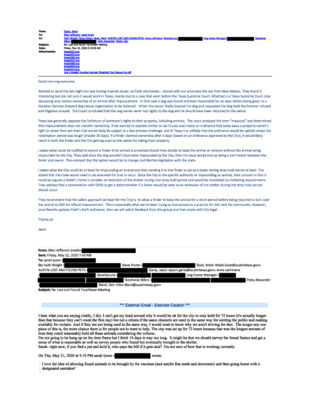
M E M O R A N D U M Mayor and Council TO: THRU: Christopher Shorter, Assistant City Manager June 22, 2020 Don Bland, Chief Animal Services Officer FROM: DATE: SUBJECT: Austin Animal Center Intake Protocols With this memorandum, I would like to clarify any confusion about perceived changes in our shelter model, as noted in recent emails to Mayor and Council. Austin Animal Center is not participating in the National Pilot project that Austin Pets Alive! and other major shelters throughout the nation are participating in. To be clear, none of the participating partners in the national project are advocating closing intake. The new model of sheltering promotes procedures that the Austin Animal Center (AAC) and our Animal Protection Officers (APOs) have been utilizing. Our neighborhood level programs are focused on keeping pets in homes where they are loved and cared for and out of the shelter, as well as assisting those animals that are sick, injured or in danger. Our community assistance model, implemented through our Animal Protection and Public Resource Center (PRC), has provided guidance to shelters and communities for many years and assisted pet owners with the resources needed to keep their animals. During our COVID-19 closure, the community did an amazing job assisting with lost pets. AAC has taken in more than 1,000 sick, injured, aggressive, bite quarantines cases, and animals that were truly in danger. We also know, prior to our Covid-19 closure, that citizens who have contacted us through 311, after finding a stray and taking a few steps in the neighborhood where the pet was found, have a 50 percent success rate at getting the animals back home. Citizens who are able and willing to assist before bringing the animals to the shelter, where the chances of it being reunited with its family are reduced, are greatly appreciated. Our data shows that, if that pet was brought to the shelter, its chance of being reunited with its family dropped to 18 to 20 percent. Our Animal Protection Officers have been keeping data for years, and we have learned that most animals are picked up within 1,000 feet from where they live. Prior to the closure, Animal Protection was in the process of enhancing programs aimed at getting pets home faster, and the PRC was expanding access to free spay and neuter services, free microchips and low-cost veterinary care. We placed 70 …
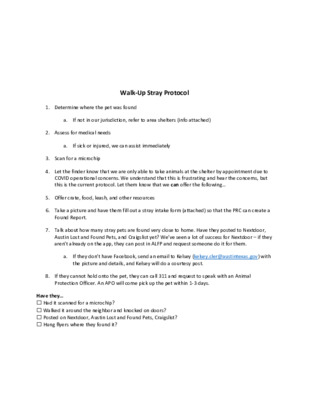
1. Determine where the pet was found Walk-Up Stray Protocol a. If not in our jurisdiction, refer to area shelters (info attached) 2. Assess for medical needs a. If sick or injured, we can assist immediately 3. Scan for a microchip 4. Let the finder know that we are only able to take animals at the shelter by appointment due to COVID operational concerns. We understand that this is frustrating and hear the concerns, but this is the current protocol. Let them know that we can offer the following… 5. Offer crate, food, leash, and other resources 6. Take a picture and have them fill out a stray intake form (attached) so that the PRC can create a Found Report. 7. Talk about how many stray pets are found very close to home. Have they posted to Nextdoor, Austin Lost and Found Pets, and Craigslist yet? We’ve seen a lot of success for Nextdoor – if they aren’t already on the app, they can post in ALFP and request someone do it for them. a. If they don’t have Facebook, send an email to Kelsey (kelsey.cler@austintexas.gov) with the picture and details, and Kelsey will do a courtesy post. 8. If they cannot hold onto the pet, they can call 311 and request to speak with an Animal Protection Officer. An APO will come pick up the pet within 1-3 days. Have they… ☐ Had it scanned for a microchip? ☐ Walked it around the neighbor and knocked on doors? ☐ Posted on Nextdoor, Austin Lost and Found Pets, Craigslist? ☐ Hung flyers where they found it?
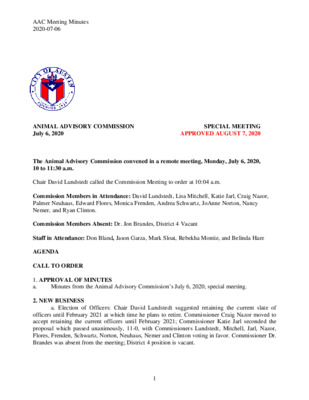
AAC Meeting Minutes 2020-07-06 ANIMAL ADVISORY COMMISSION SPECIAL MEETING July 6, 2020 APPROVED AUGUST 7, 2020 The Animal Advisory Commission convened in a remote meeting, Monday, July 6, 2020, 10 to 11:30 a.m. Chair David Lundstedt called the Commission Meeting to order at 10:04 a.m. Commission Members in Attendance: David Lundstedt, Lisa Mitchell, Katie Jarl, Craig Nazor, Palmer Neuhaus, Edward Flores, Monica Frenden, Andrea Schwartz, JoAnne Norton, Nancy Nemer, and Ryan Clinton. Commission Members Absent: Dr. Jon Brandes, District 4 Vacant Staff in Attendance: Don Bland, Jason Garza, Mark Sloat, Rebekha Montie, and Belinda Hare AGENDA CALL TO ORDER 1. APPROVAL OF MINUTES a. 2. NEW BUSINESS a. Election of Officers: Chair David Lundstedt suggested retaining the current slate of officers until February 2021 at which time he plans to retire. Commissioner Craig Nazor moved to accept retaining the current officers until February 2021; Commissioner Katie Jarl seconded the proposal which passed unanimously, 11-0, with Commissioners Lundstedt, Mitchell, Jarl, Nazor, Flores, Frenden, Schwartz, Norton, Neuhaus, Nemer and Clinton voting in favor. Commissioner Dr. Brandes was absent from the meeting; District 4 position is vacant. Minutes from the Animal Advisory Commission’s July 6, 2020, special meeting. 1 AAC Meeting Minutes 2020-07-06 b. Discussion, Update and Possible Action on Shelter Intake Policies No action taken. Speakers included the following: Peggy Fikac Catherine Chamblee Jean Hubrath Terry Hackworth Lotta Smagula Joanne Molinyawe Stephanie Timko Kayla Murray Heather Newby Cecilia Ryan Chelsea Kotria Mary Ellen Miller Carol Philipson Jill Bailey Beverly Luna Raphael Oyervides Shelly Leibham Rona Distenfeld Pat Valls-Trellis Alice Biggs Rita Cross Sandra Muller Stephanie Martens Stephanie Bilbro 2 3. ADJOURNMENT Chair David Lundstedt adjourned the meeting at 11 a.m.
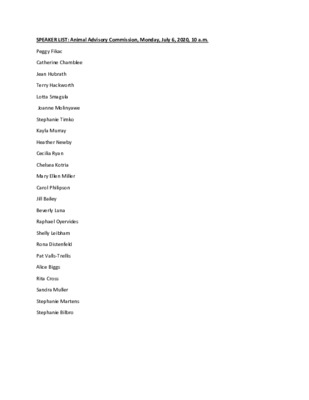
SPEAKER LIST: Animal Advisory Commission, Monday, July 6, 2020, 10 a.m. Peggy Fikac Catherine Chamblee Jean Hubrath Terry Hackworth Lotta Smagula Joanne Molinyawe Stephanie Timko Kayla Murray Heather Newby Cecilia Ryan Chelsea Kotria Mary Ellen Miller Carol Philipson Jill Bailey Beverly Luna Raphael Oyervides Shelly Leibham Rona Distenfeld Pat Valls-Trellis Alice Biggs Rita Cross Sandra Muller Stephanie Martens Stephanie Bilbro
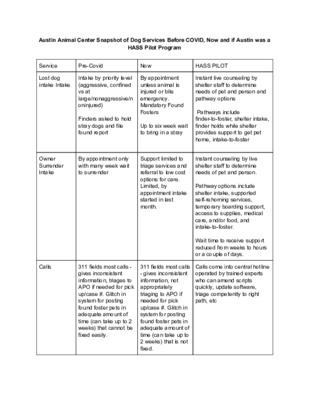
Austin Animal Center Snapshot of Dog Services Before COVID, Now and if Austin was a HASS Pilot Program Service Pre-Covid Now HASS PILOT Lost dog intake Intake Intake by priority level (aggressive, confined vs at large/nonaggressive/n oninjured) Finders asked to hold stray dogs and file found report By appointment unless animal is injured or bite emergency. Mandatory Found Fosters Up to six week wait to bring in a stray Instant live counseling by shelter staff to determine needs of pet and person and pathway options Pathways include finder-to-foster, shelter intake, finder holds while shelter provides support to get pet home, intake-to-foster Owner Surrender Intake By appointment only with many week wait to surrender Support limited to triage services and referral to low cost options for care. Limited, by appointment intake started in last month. Instant counseling by live shelter staff to determine needs of pet and person. Pathway options include shelter intake, supported self-rehoming services, temporary boarding support, access to supplies, medical care, and/or food, and intake-to-foster. Wait time to receive support reduced from weeks to hours or a couple of days. Calls come into central hotline operated by trained experts who can amend scripts quickly, update software, triage competently to right path, etc Calls 311 fields most calls - gives inconsistent information, triages to APO if needed for pick up/case #. Glitch in system for posting found foster pets in adequate amount of time (can take up to 2 weeks) that cannot be fixed easily. 311 fields most calls - gives inconsistent information, not appropriately triaging to APO if needed for pick up/case #. Glitch in system for posting found foster pets in adequate amount of time (can take up to 2 weeks) that is not fixed. Sheltering Most of “normal intake” animals are not sheltered nor case managed. Most animals live at shelter until rto, adopted, transferred or euthanized. Foster placement efforts focus on medical animals and long stay animals Fewer than 3,000 pets to foster annually Centralized in shelter clinic Animals must be surrendered and permanently separated from owner to receive care Medical care for pets Minimal in shelter clinic Majority of animals who need sheltering are marketed to foster home before or at the time of intake. 50% or more pets go to foster homes annually (8-9,000) Case Manager follows animals sheltered in the community to ensure appropriate outcome Most animals can receive care without being …
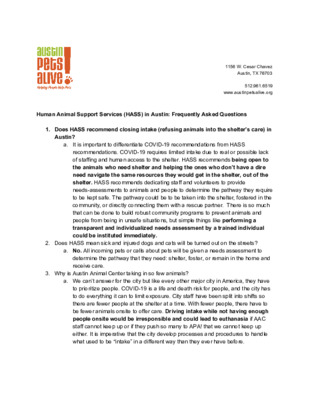
Austin? a. 1156 W. Cesar Chavez Austin, TX 78703 512.961.6519 www.austinpetsalive.org Human Animal Support Services (HASS) in Austin: Frequently Asked Questions 1. Does HASS recommend closing intake (refusing animals into the shelter’s care) in HASS recommends dedicating staff and volunteers to provide It is important to differentiate COVID-19 recommendations from HASS recommendations. COVID-19 requires limited intake due to real or possible lack of staffing and human access to the shelter. HASS recommends being open to the animals who need shelter and helping the ones who don’t have a dire need navigate the same resources they would get in the shelter, out of the shelter. needs-assessments to animals and people to determine the pathway they require to be kept safe. The pathway could be to be taken into the shelter, fostered in the community, or directly connecting them with a rescue partner. There is so much that can be done to build robust community programs to prevent animals and people from being in unsafe situations, but simple things like transparent and individualized needs assessment by a trained individual could be instituted immediately. performing a 2. Does HASS mean sick and injured dogs and cats will be turned out on the streets? a. No. All incoming pets or calls about pets will be given a needs assessment to determine the pathway that they need: shelter, foster, or remain in the home and receive care. 3. Why is Austin Animal Center taking in so few animals? a. We can’t answer for the city but like every other major city in America, they have to prioritize people. COVID-19 is a life and death risk for people, and the city has to do everything it can to limit exposure. City staff have been split into shifts so there are fewer people at the shelter at a time. With fewer people, there have to be fewer animals onsite to offer care. Driving intake while not having enough people onsite would be irresponsible and could lead to euthanasia staff cannot keep up or if they push so many to APA! that we cannot keep up either. It is imperative that the city develop processes and procedures to handle what used to be “intake” in a different way than they ever have before. if AAC 4. Austin Animal Center already does so many progressive programs including neighborhood programming. They probably don’t need …
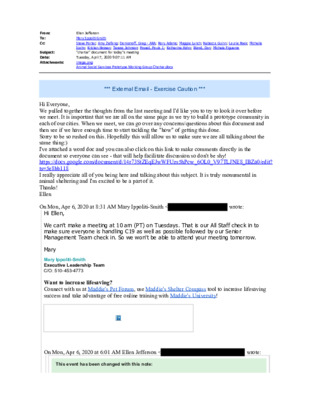
comma comma comma More shelter industry organizations are working together than ever before to build systemic change. Leadership, and their local communities, from... ok to remove last sentence Sick and injured dogs and cats will be turned out on the streets.All incoming pets or calls about pets will be given a needs assessment to determine the pathway that they need: shelter, foster or remain in the home and receive care. Stray, healthy pets will be turned away from the shelter.We know pets are many times more likely to find their owners if they stay in the neighborhood. People who find a lost pet will be given support to find the owner if they’re willing. If they can’t find the owner or aren’t able to hold the pet, the shelter will take in the lost pet and triage them based on their needs.Finders are required to hold an animal they find and are responsible for finding the owner themselves.The local shelter will take the animal if the finder isn’t willing or able to find the owner on their own. The new model will build infrastructure to help individuals and facilities such as fire stations help people and pets in their own neighborhoods. Lost pets won’t be at the shelter so the owner can’t find them.21st Century technology allows us to work more efficiently and not solely rely on in-person interactions. The system has to be reimagined and rebuilt to make it virtuallyimpossible for an owner not to find their pet, regardless of where it is temporarily housed. Austin Pets Alive! and a few other executives are working in a silo and changing the whole animal sheltering system by themselves.Leadership from over 30 municipal shelters nationally, as well as industry leaders in Petfinder, Michelson Found Animals, Maddie’s Fund, Pedigree Foundation and many more, are working in groups to reimagine animal sheltering. Pilot shelters are working in collaboration with their community stakeholders to build more options for people to care for pets in the best ways possible.People in underservedcommunities within Austin will be discriminated against and unfairly left behind with this model.The animal welfare industry (both publicly and privately funded) has long been known to discriminate against marginalized people. The current system unfairly leaves people without the same means as the richest parts of Austin out of the reclaim, foster and adoption process as it stands. The new model of sheltering is meant …
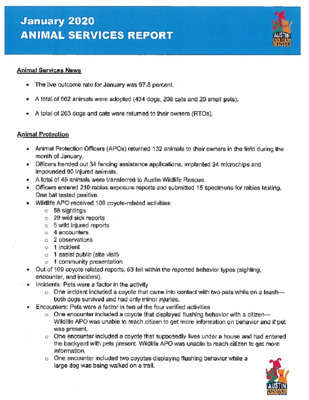
AAC Meeting Minutes 2020-02-10 REGULAR MEETING APPROVED July 6, 2020 ANIMAL ADVISORY COMMISSION February 10, 2020 The Animal Advisory Commission convened in a regular meeting, Monday, February 10, 6 p.m., at Austin City Hall, 301 W. Second St., Boards and Commissions Room 1101, Austin. Chair David Lundstedt called the Commission Meeting to order at 6 p.m. Commission Members in Attendance: David Lundstedt, Lisa Mitchell, Katie Jarl, Craig Nazor, Monica Frenden, Andrea Schwartz, JoAnne Norton, Dr. Jon Brandes, Nancy Nemer, and Ryan Clinton. Commission Members Absent: Palmer Neuhaus, Edward Flores, District 4 Vacant Staff in Attendance: Don Bland, Jason Garza, and Belinda Hare CITIZEN COMMUNICATION: GENERAL The first 10 speakers signed up prior to the meeting being called to order will each be allowed a three-minute allotment to address their concerns regarding items not posted on the agenda. None. 1. APPROVAL OF MINUTES Commissioner Jarl moved to approve the January 13, 2020, minutes; Commissioner Norton seconded the motion. All commissioners present voted to approve, 9 to 0, including Commissioners Lundstedt, Mitchell, Jarl, Nazor, Frenden, Dr. Brandes, Schwartz, Norton. Nemer and Clinton. Commissioners Neuhaus and Flores were absent. District 4 is Vacant. 2. STAFF BRIEFINGS a. Chief Animal Services Officer Report o January 2020 Animal Services Report o January 2020Austin Animal Center Report 3. OLD BUSINESS 1 AAC Meeting Minutes 2020-02-10 a. Update, Discussion and Possible Action on the Wildlife Funding Workgroup b. Update, Discussion and Possible Action on Budget and Priorities Workgroup No action. No Action c. Update, Discussion and Possible Action regarding New Meeting Requirements per the Texas Open Meeting Act (TOMA) No action. d. Update, Discussion and Possible Action regarding the Workgroup on Austin Animal Center’s Shelter-Neuter-Release (SNR) Program Julie Marquis Shelly Liebham No action. No action. No action No action. Budget. No Action e. Update, Discussion and Possible Action on Code Revision Workgroup f. Update, Discussion and Possible Action on Loose Dogs g. Update, Discussion and Possible Action on Target and Reporting Categories 4. NEW BUSINESS a. Update, Discussion and Possible Action regarding the Austin Animal Center’s 5. FUTURE AGENDA ITEMS Commission Chair Lundstedt requested removing Old Business agenda items, 3a, 3c, and 3f while carrying over remaining agenda items under Old Business. Agenda item 4a will move to Old Business. Under New Business Commission Chair Lundstedt moved to add the Election of Officers. 6. ADJOURNMENT a. Chair Lundstedt adjourned the meeting at 6:37 p.m. without …