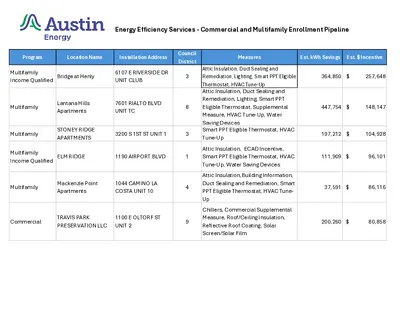
Energy Efficiency Services - Commercial and Multifamily Enrollment Pipeline Program Location Name Installation Address Council District Measures Est. kWh Savings Est. $ Incentive Multifamily Income Qualified Bridge at Henly 6107 E RIVERSIDE DR UNIT CLUB Multifamily Lantana Hills Apartments 7601 RIALTO BLVD UNIT TC Multifamily STONEY RIDGE APARTMENTS 3200 S 1ST ST UNIT 1 Multifamily Income Qualified ELM RIDGE 1190 AIRPORT BLVD Multifamily Mackenzie Point Apartments 1044 CAMINO LA COSTA UNIT 10 Commercial TRAVIS PARK PRESERVATION LLC 1100 E OLTORF ST UNIT 2 3 8 3 1 4 9 Attic Insulation, Duct Sealing and Remediation, Lighting, Smart PPT Eligible Thermostat, HVAC Tune-Up Attic Insulation, Duct Sealing and Remediation, Lighting, Smart PPT Eligible Thermostat, Supplemental Measure, HVAC Tune-Up, Water Saving Devices Smart PPT Eligible Thermostat, HVAC Tune-Up Attic Insulation, ECAD Incentive, Smart PPT Eligible Thermostat, HVAC Tune-Up, Water Saving Devices Attic Insulation,Building Information, Duct Sealing and Remediation, Smart PPT Eligible Thermostat, HVAC Tune- Up Chillers, Commercial Supplemental Measure, Roof/Ceiling Insulation, Reflective Roof Coating, Solar Screen/Solar Film 364,850 $ 257,648 447,754 $ 148,147 197,212 $ 104,928 111,909 $ 96,101 37,591 $ 86,116 200,260 $ 80,858 Rebate Fact Sheet - Energy Efficiency Services January 2026 Property Information Rebate Program Enrollment Multifamily 1297548 Customer or Property SOMERSET TOWNHOMES Property Address Year Built * Total Number of Rentable Units Building Total Square Feet 6800 AUSTIN CENTER BLVD 04 AUSTIN, TX 78731 1995 123 N/A Rebates and Estimated Annual Savings Measure ** Attic Insulation HVAC Tune-Up Smart PPT Eligible Thermostat Est. Kilowatt (kW) Reduction Est. Kilowatt- hours (kWh) Reduction Est. $/kW Rebate per Tenant Unit Total Rebate 33.3 17.3 10.5 26,128 $1,796 67,307 $1,887 59,882 $2,010 $487 $265 $171 $59,857 $32,656 $21,000 Total *** 61.1 * Year built may not include major renovations ** Fact sheets include final inspection information, and some values may have changed since original proposal. *** Assumes 100% Occupancy $113,513 153,317 $5,693 $923 Energy Efficiency Rebates in Past 10-Years Date (Year) Measure Rebate Amount N/A Rebate Fact Sheet - Energy Efficiency Services January 2026 Rebate Program Enrollment Customer or Property Property Address Year Built * Total Number of Rentable Units Building Total Square Feet Property Information Multifamily Income Qualified 1344686 The Amethyst 13401 METRIC BLVD 01 AUSTIN, TX 78727 1996 260 N/A Measure ** Rebates and Estimated Annual Savings Est. Kilowatt (kW) Reduction Est. Kilowatt- hours (kWh) Reduction Est. $/kW Rebate per Tenant Unit Total Rebate Attic Insulation Limited Time Bonus Offer …
REGULAR MEETING OF THE RESOURCE MANAGEMENT COMMISSION February 17, 2026 6:00 p.m. Austin Energy Headquarters; 1st Floor; Shudde Fath Conference Room 4815 Mueller Blvd, Austin, Texas 78723 Some members of the Resource Management Commission maybe participating by video conference. Public comment will be allowed in-person or remotely by telephone. Speakers may only register to speak on an item once either in-person or remotely and will be allowed up to three minutes to provide their comments. Registration no later than noon the day before the meeting is required for remote participation. To register contact Natasha Goodwin, at Natasha.Goodwin@austinenergy.com or 512-322-6505. Members: Charlotte Davis, Chair Paul Robbins, Vice Chair Kamil Cook Trey Farmer CALL MEETING TO ORDER AGENDA GeNell Gary Joseph Gerland Harry Kennard Martin Luecke Raphael Schwartz Alison Silverstein Danielle Zigon PUBLIC COMMUNICATION: GENERAL The first 5 speakers signed up prior to the meeting being called to order will each be allowed a three-minute allotment to address their concerns regarding items not posted on the agenda. APPROVAL OF MINUTES 1. Approve the minutes of the Resource Management Commission Meeting on January 20, 2026. DISCUSSION AND ACTION ITEMS 2. Discussion and recommend residential electric rates implemented by Austin Energy and its effects on energy conservation and equity. STAFF BRIEFING 3. Staff briefing on Water Management Strategy Implementation Report Highlights by Kevin Kluge, Water Conservation Division Manager, Austin Water. 4. Staff briefing on Customer Demand Response Battery Pilot by Hammad Chaudhry, Director, Energy Efficiency Services, Austin Energy and Lindsey McDougall, Manager, Energy Efficiency Services, Austin Energy. DISCUSSION ITEMS 5. Discussion on time of use rates and demand response. FUTURE AGENDA ITEMS ADJOURNMENT The City of Austin is committed to compliance with the Americans with Disabilities Act. Reasonable modifications and equal access to communications will be provided upon request. For assistance, please contact the Liaison or TTY users’ route through 711. A person may request language access accommodations no later than 48 hours before the scheduled meeting. Please call or email Natasha Goodwin at Austin Energy, at (512) 322-6505 or Natasha.Goodwin@austinenergy.com to request service or for additional information. For more information on the Resource Management Commission, please contact Natasha Goodwin at Austin Energy, at 512-322-6505 or Natasha.Goodwin@austinenergy.com .

Resource Management Commission Resolution Fairness of Residential Electric Rates Whereas, progressive Residential utility rates structures that charge less per unit for less consumption and more per unit for greater consumption encourage conservation; and Whereas progressive Residential rate structures also help save money for low-income customers, who generally use less energy; and Whereas, Austin Energy defended raising these rates during the 2025 budget by explaining to City Council and the Electric Utility Commission that Residential bills would actually go down because of lower fuel costs, when in fact this was not the case; and Whereas, Austin Energy’s more regressive Residential rate structure harms some City Council Districts disproportionally, with Districts 3,4,6,7, and 9 seeing the average bill go up between 31 and 34% between 2022 and 2026, while District 10 will see its average bill go up only 20% (See Attachment 1); and Whereas Austin Energy did not inform the City Council and the general public of this; and Whereas, Austin Energy has claimed that low-income customers have had their bills lowered through the Customer Assistance Program, even though the percentage of CAP customers in less than one-third of Austin’s population of low- and moderate-income citizens; and Whereas, due to the increasingly regressive nature of the rate structure, the majority of Residential customers in every City Council District will see their rates rise above average (See Attachment 2); and Whereas, the Resource Management Commission passed a resolution during the last Austin Energy rate case in 2022 that was on record against regressive rates (Recommendation No. 20221018-004B); and Whereas, Austin Energy intentionally avoided bringing this issue to the RMC during the budget and rate review in 2025, making it impossible for the Commission to make a similar recommendation; and Whereas, Austin Energy went on record during the settlement of the rate case in 2022 to raise Residential rates by a prescribed amount, but exceeded this in 2025, calling into question if the utility can abide by its commitments; and Whereas, electric rates were raised though the budget process and not through an evidentiary rate hearing that Austin is accustomed to; and Whereas rate cases were held in 2012, 2016, and 2022, but have since been completely eliminated; and Whereas, Austin Energy has predicted a 5% per year overall rate increase each year for the next four years; and Whereas, the increased Austin Energy budget has been created without allowing ratepayers and stakeholders …
Resource Management Commission Resolution Fairness of Residential Electric Rates WHEREAS, progressive Residential utility rates structures that charge less per unit for less consumption and more per unit for more consumption encourage conservation; and WHEREAS, progressive Residential rate structures also help save money for low-income customers, who generally use less energy; and WHEREAS, Austin Energy has implemented a more regressive Residential rate structure that runs counter to the goals of both energy conservation and of lowering costs for low-income residents; and WHEREAS, Austin Energy defended this change during the 2025 budget by explaining to City Council and the Electric Utility Commission that Residential bills would actually go down because of lower fuel costs, when in fact this has not happened; and WHEREAS, this more regressive Residential rate structure harms some City Council Districts disproportionally, where Districts 3,4,6,7, and 9 experienced rate increases of between 31 and 34% between 2022 and 2026, while District 10 experienced only a 20% rate increase (See Attachment 1); and WHEREAS, Austin Energy did not inform the City Council and the general public of this; and WHEREAS, Austin Energy has stated that low-income customers have had their bills lowered through the Customer Assistance Program, even though the percentage of CAP customers is less than one-third of Austin’s population of low- and moderate-income citizens; and WHEREAS, due to the increasingly regressive nature of the rate structure, the majority of Residential customers in every City Council District have seen their rates rise above average (See Attachment 2) because customers with the very highest energy usage received a rate increase far below the average; and WHEREAS, the Resource Management Commission (RMC) passed a resolution during the last Austin Energy rate case in 2022 that was on record against regressive rates (Recommendation No. 20221018-004B); and WHEREAS, Austin Energy did not mention this major rate change to RMC during the budget review in 2025, making it difficult for the Commission to make a similar recommendation; and WHEREAS, high monthly base fees such as those in Austin ($16.50) contribute to regressive rates, and there are other municipal electric utilities in Texas with lower monthly fees, including San Antonio CPS ($9.50), the City of Brownsville ($6.94); the City of Greenville ($12.15), the City of San Marcos ($12.61), and Bryan Texas Utilities ($11); and WHEREAS, Austin Energy went on record during the settlement of the rate case in 2022 to raise Residential rates by a …
Water Management Strategy Implementation REPORT Fourth Quarter 2025, October - December February 2026 Contents Fourth Quarter Summary Water Conservation Updates Water Loss Reduction Updates Reclaimed Water and Onsite Reuse Updates Conservation Outreach Updates Water Supply Project Updates Water Use and GPCD Notes Regarding Data 2 Fourth Quarter Summary The Water Management Strategy Implementation Report is intended to provide transparency and accountability regarding the execution of strategies from the 2024 Water Conservation Plan and the 2024 Water Forward Plan. The plans include proactive and substantial demand management strategies and innovative local supply strategies, but the hard work necessary to complete the strategies and meet the goals are illustrated in the implementation reports. While the combined water storage in Lakes Buchanan and Travis stayed about 80 percent full throughout the fourth quarter of 2025, Central Texas entered moderate and severe levels of hydrologic drought and remained throughout the quarter. These dry conditions resulted in summer-like water use levels in October before lessening in November. 3 Water Conservation Updates Annual WaterWise Irrigation Program seminar was held on November 6, 2025. Over 130 irrigators and landscapers attended the seminar to learn about landscaping and irrigation. Irrigation inspection anniversary – since October 2024, 1,600 new residential automatic irrigation systems have been inspected to meet State and Austin regulations, providing more efficient and effective landscape irrigation. In 2025, customers saved over 30 million gallons from rebate programs, the highest in 5 years. 4 Water Conservation Metrics Residential Rebate Programs Approved Rebates 50 45 40 35 30 25 20 15 10 5 0 Drought Survival Tools Irrigation Upgrades Rainwater Harvesting Rebates WaterWise Landscape WaterWise Rainscape Other Residential Programs Q4 2024-Q3 2025 Q4 2025 5 Water Conservation Metrics Commercial Rebate Programs Approved Rebates 5 4 3 2 1 0 4 4 3 1 1 0 0 0 0 0 Bucks for Business Other Commercial Programs Q4 2024-Q3 2025 Q4 2025 6 Water Conservation Metrics Compliance Assessments Number of Compliant Commercial Facilities 86% 3,500 3,000 2,500 2,000 1,500 1,000 500 0 Number of Compliant Commercial Facilities 85% 96% 350 300 250 200 150 100 50 0 Landscape Irrigation Assessment Cooling Tower Assessment Vehicle Wash Assessment Q4 2024-Q3 2025 Q4 2025 Q4 2024-Q3 2025 Q4 2025 7 Water Conservation Strategy Milestones (Water Conservation Plan, p. 35-36, Water Forward Plan, p. 34, 36) 2025 Milestones Commercial Incentives Progress Pilot an …
BOARD/COMMISSION RECOMMENDATION Resource Management Commission Recommendation No. 20260217-002 Recommendation on Fairness of Residential Electric Rates WHEREAS, progressive Residential utility rates structures that charge less per unit for less consumption and more per unit for more consumption encourage conservation; and WHEREAS, progressive Residential rate structures also help save money for low-income customers, who generally use less energy; and WHEREAS, Austin Energy has implemented a more regressive Residential rate structure that runs counter to the goals of both energy conservation and of lowering costs for low-income residents; and WHEREAS, Austin Energy defended this change during the 2025 budget by explaining to City Council and the Electric Utility Commission that Residential bills would actually go down because of lower fuel costs, when in fact this has not happened; and WHEREAS, this more regressive Residential rate structure harms some City Council Districts disproportionally, where Districts 3,4,6,7, and 9 experienced rate increases of between 31 and 34% between 2022 and 2026, while District 10 experienced only a 20% rate increase (See Attachment 1); and WHEREAS, Austin Energy did not inform the City Council and the general public of this; and WHEREAS, Austin Energy has stated that low-income customers have had their bills lowered through the Customer Assistance Program, even though the percentage of CAP customers is less than one-third of Austin’s population of low- and moderate-income citizens; and WHEREAS, due to the increasingly regressive nature of the rate structure, the majority of Residential customers in every City Council District have seen their rates rise above average (See Attachment 2) because customers with the very highest energy usage received a rate increase far below the average; and WHEREAS, the Resource Management Commission (RMC) passed a resolution during the last Austin Energy rate case in 2022 that was on record against regressive rates (Recommendation No. 20221018- 004B); and WHEREAS, Austin Energy did not mention this major rate change to RMC during the budget review in 2025, making it difficult for the Commission to make a similar recommendation; and WHEREAS, high monthly base fees such as those in Austin ($16.50) contribute to regressive rates, and there are other municipal electric utilities in Texas with lower monthly fees, including San Antonio CPS ($9.50), the City of Brownsville ($6.94); the City of Greenville ($12.15), the City of San Marcos ($12.61), and Bryan Texas Utilities ($11); and WHEREAS, Austin Energy went on record during the settlement of the rate case in …

To: From: Date: MEMORANDUM Resource Management Commission (RMC) Stephanie Koudelka, Interim Senior VP & Chief Financial Officer February 13, 2026 Subject: February 17, 2026 RMC Agenda Item # 2 This memo clarifies and corrects information in the draft resolution on the February 17, 2026, meeting agenda. Austin Energy is a cost-recovery utility. Austin Energy’s rates are designed strictly to recover the utility’s costs incurred in providing electric service to customers. Austin Energy’s retail rate structure includes base rates, which cover fixed costs outlined below, and pass-through rates, which include the Power Supply Adjustment, Community Benefit Charge, and Regulatory Charge. Information about Austin Energy’s residential rates and charges is available on Austin Energy's website. Austin Energy’s rates are determined using careful planning and analysis, ensuring system reliability and the utility’s financial health. • Base rates are set to recover costs such as billing, metering, debt service, equipment, and employee salaries. Base rates include a customer charge and energy charges. The customer charge is $16.50 per month and remains low compared to our peers. Austin Energy’s Customer Assistance Program (CAP) customers, a set of customers that has been vastly expanded in recent years to reach more low income customers, do not pay the customer charge. Energy charges are based on the actual electricity used by customers each month, through an escalating tier structure. The less a customer uses, the lower their bill. • Customers’ energy usage has decreased consistently over the years due to Austin Energy’s industry leading conservation programs. Austin Energy must recover rising costs through a balanced approach in the fixed customer charge and energy charges. • Base rates are applied consistently to Austin Energy customers, and any difference among customer bills is due to consumption patterns, not Council district. • Rising costs, due mostly to rapid and substantial inflation in our sector but also due to critical system investments, mean that Austin Energy must increase base rates to achieve financial stability. In FY26, Austin Energy’s base rates increased 5% to ensure continued system resilience and effective cost recovery. Current base rates were approved by Council ordinance as part of the FY26 budget process. Page 1 of 2 • Austin Energy presents annual budget forecasts and departmental requests to the Electric Utility Commission and City Council. The EUC has purview over rates and has the opportunity to make recommendations to Council. City Council votes on Austin Energy’s rates every year …

Resource Management Commission Resolution Fairness of Residential Electric Rates WHEREAS, progressive Residential utility rates structures that charge less per unit for less consumption and more per unit for more consumption encourage conservation; and WHEREAS, progressive Residential rate structures also help save money for low-income customers, who generally use less energy; and Here is a chart that I have shown before derived from the U.S. Energy Information Administration’s Residential Consumption Survey. The data comes from Table CE1.4 Summary consumption and expenditures in the South - totals and intensities, “2020 annual household income.” WHEREAS, Austin Energy has implemented a more regressive Residential rate structure that runs counter to the goals of both energy conservation and of lowering costs for low-income residents; and The new tariff was approved by City Council on August 13, 2025. It contains increases in the Customer Charge and the lowest “Tier 1” of consumption, but no increases in the higher 3 Tiers of consumption. It can be found at this link. You can compare these to the older tariffs: Tariffs for FY 2024 and 2025 Pages 5 & 6 WHEREAS, Austin Energy defended this change during the 2025 budget by explaining to City Council and the Electric Utility Commission that Residential bills would actually go down because of lower fuel costs, when in fact this has not happened; and First, this is an example of the utility’s public stance, as taken from a news story. Matt Mitchell, a public information officer for Austin Energy, said...the base rate will rise 5%... However, Austin Energy has been able to lower the power supply adjustment charge...and most customers will see lower electric bills compared to last year. This is calculated in the Austin Energy Budget Presentation given to the EUC in mid-July. See Slide 16. Below is a screenshot. The PSA (fuel charge) here is 5.32¢ per kwh. ($45.77 ÷ 860 kwh.) But the actual fuel charge over the course of the year was 4.352¢. from: Everhart, Amy <Amy.Everhart@austinenergy.com> to: Paul Robbins <paul_robbins@greenbuilder.com> date: Jan 9, 2026, 3:31 PM subject: RE: Request for Information on 2025 PSA Costs Paul, Here is the response to your questions: Fiscal Year 2025 Average residential rate: $.04363 Weighted Average residential rate: $.04352 This EUC presentation was made 9 months into the rate year, so it was virtually impossible that Austin Energy could not know or at least estimate the last 3 months. The bottom line …
Resource Management Commission Residential Rate Structure Resolution Paul Robbins February 17, 2026 Map of Rate Increases by Austin City Council District Between 2022 and 2026 On December 16, 2025, I submitted Public Information Request #X022954 to Stuart Reilly, General Manager of Austin Energy. The answers were provided December 30, including the one below. In the most recent Austin Energy rate increase discussions and deliberations that have taken place since June of 2025, has there been any information provided by Austin Energy to the City Council or public on how the proposed rate increase affects individual City Council Districts? If so, provide this. REPLY: • No responsive information Austin Energy Boasts Bill Savings in 2026 Compared to 2025 Because Fuel Costs Were Lower $45.77 ÷ 860 Kwh = 5.3¢/Kwh Fuel Cost But Austin Energy Recently Stated Fuel Costs Were in Fact Only 4.35¢/Kwh in 2025 So the Total Bill in 2026 is More, Not Less, Than 2025 From Austin Energy February 13, 2026 Energy charges are based on the actual electricity used by customers each month, through an escalating tier structure. AUSTIN ENERGY PROPOSAL IN 2022 RATE CASE 8¢/Kwh Between Tiers vs 1¢/Kwh Differential Between Tiers Thanks for Your Attention Paul Robbins (512) 447-8712 Paul_Robbins@greenbuilder.com
BOARD/COMMISSION RECOMMENDATION Resource Management Commission Revised Recommendation No. 20260217-002 Recommendation on Fairness of Residential Electric Rates WHEREAS, progressive Residential utility rates structures that charge less per unit for less consumption and more per unit for more consumption encourage conservation; and WHEREAS, progressive Residential rate structures also help save money for low-income customers, who generally use less energy; and WHEREAS, Austin Energy has implemented a more regressive Residential rate structure that runs counter to the goals of both energy conservation and of lowering costs for low-income residents; and WHEREAS, Austin Energy defended this change during the 2025 budget by explaining to City Council and the Electric Utility Commission that Residential bills would actually go down because of lower fuel costs, when in fact this has not happened; and WHEREAS, this more regressive Residential rate structure harms some City Council Districts disproportionally, where Districts 3,4,6,7, and 9 experienced rate increases of between 31 and 34% between 2022 and 2026, while District 10 experienced only a 20% rate increase (See Attachment 1); and WHEREAS, Austin Energy did not inform the City Council and the general public of this; and WHEREAS, Austin Energy has stated that low-income customers have had their bills lowered through the Customer Assistance Program, even though the percentage of CAP customers is less than one-third of Austin’s population of low- and moderate-income citizens; and WHEREAS, due to the increasingly regressive nature of the rate structure, the majority of Residential customers in every City Council District have seen their rates rise above average (See Attachment 2) because customers with the very highest energy usage received a rate increase far below the average; and WHEREAS, the Resource Management Commission (RMC) passed a resolution during the last Austin Energy rate case in 2022 that was on record against regressive rates (Recommendation No. 20221018- 004B); and WHEREAS, Austin Energy did not mention this major rate change to RMC during the budget review in 2025, making it difficult for the Commission to make a similar recommendation; and WHEREAS, high monthly base fees such as those in Austin ($16.50) contribute to regressive rates, and there are other municipal electric utilities in Texas with lower monthly fees, including San Antonio CPS ($9.50), the City of Brownsville ($6.94); the City of Greenville ($12.15), the City of San Marcos ($12.61), and Bryan Texas Utilities ($11); and WHEREAS, Austin Energy went on record during the settlement of the rate case …
RESOURCE MANAGEMENT COMMISSION MEETING MINUTES Tuesday, February 17, 2026 RESOURCE MANAGEMENT COMMISSION REGULAR CALLED MEETING MINUTES Tuesday, February 17, 2026 The Resource Management Commission convened in a Regular Called meeting on Tuesday, February 17, 2026, at Austin Energy Headquarters 4815 Mueller Blvd, Austin, TX 78723. Chair Charlotte Davis called the Resource Management Commission meeting to order at 6:05 p.m. Board Members/Commissioners in Attendance: Commissioner Charlotte Davis, Chair; Commissioner Paul Robbins, Vice Chair; Commissioner Kamil Cook; Commissioner Trey Farmer; Commissioner Harry Kennard; Commissioner Martin Luecke; Commissioner Raphael Schwartz; Commissioner Alison Silverstein. Board Members/Commissioners in Attendance Remotely: N/A Commissioners Absent: Commissioner GeNell Gary; Commissioner Commissioner Danielle Zigon. Joseph Gerland; PUBLIC COMMUNICATION: General- • Jay Kamm- Time of use. APPROVAL OF MINUTES 1. Approve the minutes of the Resource Management Commission Meeting on January 20, 2026. The motion approving the minutes of the Resource Management Commission regular called meeting of January 20, 2026 was approved on Vice Chair Robbins motion, Commissioner Silverstein’s second on an 8-0 vote, with Commissioners Gary, Gerland, and Zigon absent. STAFF BRIEFING 3. Staff briefing on Water Management Strategy Implementation Report Highlights by Kevin Kluge, Water Conservation Division Manager, Austin Water. The briefing was presented by Kevin Kluge, Water Conservation Division Manager, Austin Water. 4. Staff briefing on Customer Demand Response Battery Pilot by Hammad Chaudhry, Director, Energy Efficiency Services, Austin Energy and Lindsey McDougall, Manager, Energy Efficiency Services, Austin Energy. The briefing was presented by Hammad Chaudhry, Director, Energy Efficiency Services, Austin Energy and Lindsey McDougall, Manager, Energy Efficiency Services, Austin Energy. RESOURCE MANAGEMENT COMMISSION MEETING MINUTES Tuesday, February 17, 2026 DISCUSSION AND ACTION ITEMS 2. Discussion and recommend residential electric rates implemented by Austin Energy and its effects on energy conservation and equity. The motion approving residential electric rates implemented by Austin Energy and its effects on energy conservation and equity was approved on Vice Chair Robbin’s motion, Commissioner Silverstein’s second on a 7-1 vote, with Chair Davis voting against and Commissioners Gary, Gerland, and Zigon absent. DISCUSSION ITEMS 5. Discussion on time of use rates and demand response. The commission did not discuss time of use rates and demand response. This item was tabled to the March meeting. FUTURE AGENDA ITEMS • District Energy Cooling Recommendations and Plans - Silverstein • Discussion on the time of use of rates and demand response (Sponsors: Farmer and Davis) • Austin Water Briefing ( May)- Silverstein • Green Building …