07 C14-2026-0010.SH - Rowen Vale; District 9 - Staff Report Part 2 — original pdf
Backup
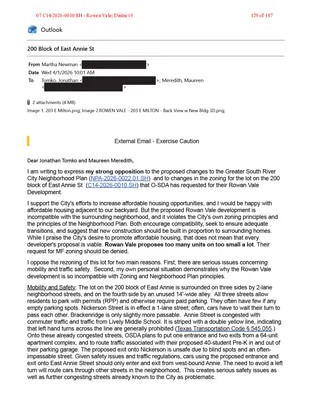
07 C14-2026-0010.SH - Rowen Vale; District 9129 of 187 Incompatibility: MF-3 Zoning allows O-SDA to construct a building that, with the bonuses from Affordability Unlocked, could be as high as 60 feet, and thus is the functional equivalent of MF-5. The building will start less than 20' from the backyards of the houses on the south side of East Milton St. (14' alley +5' setback). City maps suggest that the lots for these single family houses run east- west. They do not. They run north-south. The proposed development is not going up in our side yards (we are very accustomed to houses sited very close together); it is looming over our backyards. The building will be 20 feet from the closest house, and between 50 and 70 feet from the other houses on the south side of East Milton St. Multiple stories of apartments will be looking down into our yard, destroying our privacy, and adding light from apartments, the garage, and security. In mid-winter, the parts of our backyards that are less than 20' from the back fence will receive no sunlight at all. I recognize that there are other MF-3 lots in our neighborhood adjacent to SF-3 housing. But these multi-family units were built according to the City's Zoning principles and were not constructed with the exemptions and multipliers that Affordability Unlocked provides. None so changed the nature of their neighbors' homes. You can see the effects of this proposed development in the attached images. Image 1 shows our current yard, shot from our back deck. The proposed building will be at least 5' closer to our yard than the existing gray church. A three-story building will be approximately the height of the utility pole; a five-story, 50' building will be the height of the trees. Figure 2 shows the projected view of a person standing immediately inside our back door (made with CAD, to scale; please ignore the blocking on top of the fence but imagine windows!). As you can see, even a three-story building constructed so close to the property line, without the usual zoning requirements for setbacks, sightlines, and compatibility, will block any view of the sky from the back of our house as well as from the houses of our East Milton St. neighbors. These proposed changes to Zoning and to the Neighborhood Plan, if granted, will establish a precedent throughout neighborhoods in Austin. It suggests that the City is willing to abandon established zoning principles to facilitate whatever the Council's current policy goals might be. But Zoning and Neighborhood plans exist to mediate between competing land-use goals. Maintaining consistent principles is essential for continued public support. I encourage you to continue to maintain the zoning principles the City has established and to honor the Neighborhood Plan that the community put together at the City's request. Please reject this request for Multiple Family zoning on the 200 block of East Annie St. Thank you for your consideration, best, Martha Newman 203 East Milton, resident since 1989. CAUTION: This is an EXTERNAL email. Please use caution when clicking links or opening attachments. If you believe this to be a malicious or phishing email, please report it using the "Report Message" button in Outlook. For any additional questions or concerns, contact CSIRT at "cybersecurity@austintexas.gov". 07 C14-2026-0010.SH - Rowen Vale; District 9130 of 187 07 C14-2026-0010.SH - Rowen Vale; District 9131 of 187 07 C14-2026-0010.SH - Rowen Vale; District 9132 of 187 07 C14-2026-0010.SH - Rowen Vale; District 9133 of 187 07 C14-2026-0010.SH - Rowen Vale; District 9134 of 187 Key concerns: Pre K pickup and drop off queuing back onto Annie Existing weekend and school traffic already creating peak congestion Known speeding and cut through traffic amplifying risk Proposed egress onto Nickerson raising visibility and safety concerns These concerns become more significant when considered alongside near-term infrastructure work, including the South 1st Street Reclaimed Water Main Project. If key routes such as Monroe experience intermittent disruption over the next two years while this project adds additional congestion and queuing pressure, that combination could materially impact traffic operations, emergency access, and overall neighborhood safety. While the fire department does not formally weigh in on zoning matters, these conditions highlight broader concerns about how well these streets accommodate emergency vehicles today. Taken together, this raises real questions around access, response times, and reliability of key routes. We would encourage staff to take a close look at: Whether parking demand and Pre K activity can realistically be contained on site Whether the proposed Nickerson egress is safe under current conditions Whether the level of intensity is appropriate given the neighborhood’s limited access routes and near term infrastructure impacts Compatibility and Transition From a compatibility and transition standpoint, the nearby MF-3 properties do not appear to be meaningful comparisons for this site. Those parcels are generally adjacent to other multifamily zoning or the park and therefore maintain some level of transition. This lot does not. It is surrounded by SF-3, which makes the compatibility question more significant here. It also appears important to evaluate the actual intensity being proposed, rather than viewing this solely as a base MF 3 request. A 64 unit, 5 story project with an on site Pre K on roughly 0.9 acres is much closer to MF 6 intensity than a typical MF 3 project. Even base MF 3 would be difficult to reconcile with the surrounding SF 3 context, and the actual proposal goes well beyond that. In our view, the project is not built in proportion to surrounding homes, does not encourage compatibility, and does not provide an adequate transition. A Path Forward More broadly, this is not a choice between affordable housing and no affordable housing. Affordable housing can be pursued here in a way that also respects compatibility. If staff believes some zoning change is warranted, SF-5 would allow additional housing while still providing a more appropriate transition from surrounding single-family uses. If the applicant’s economics only work at a much higher intensity, we do not believe that should drive staff’s recommendation. 07 C14-2026-0010.SH - Rowen Vale; District 9135 of 187 The compatibility and transition reasoning staff used in the Heflin Housing case seems directly relevant here as well. For these reasons, we respectfully ask that staff either recommend against the rezoning or, at a minimum, provide an alternative recommendation of SF-5. Thank you again for your time, your consideration, and the work you are doing on this case. Sean Ransenberg- Cecelia Croman 1601 Brackenridge Street Austin, TX 78704 CAUTION: This is an EXTERNAL email. Please use caution when clicking links or opening attachments. If you believe this to be a malicious or phishing email, please report it using the "Report Message" button in Outlook. For any additional questions or concerns, contact CSIRT at "cybersecurity@austintexas.gov". 07 C14-2026-0010.SH - Rowen Vale; District 9136 of 187 Bari Shiva Mayer 1803 Nickerson St. Austin, TX 78704 April 1, 2026 Maureen Meredith, Plan Amendment Case Manager, and Jonathan Tomko, Zoning Case Manager City of Austin via email Re: Neighborhood Planning Case # NPA-2026-0022.01.SH Zoning Case # C14-2026-0010.SH Project Name: Rowen Vale Dear Mr. Tomko and Ms. Meredith, I’m writing in opposition to proposed changes to the Greater South River City Combined Neighborhood Plan, and 206 E Annie St. et al. zoning. As context, I’ve lived in Austin for nearly two decades. For the last 11 years, I’ve owned and resided at 1803 Nickerson St., only 100 feet from the subject site. This is the first time I’ve written to the City on any matter, and I apologize in advance for the length of this letter. Our neighborhood welcomes all without discrimination and regardless of socioeconomic status. I have applauded efforts to promote a compact and connected city, including in my own backyard, through reducing lot size minimums, increasing the supply of “missing middle” housing, and promoting transit and larger-scale development along South Congress Ave. However, I believe the proposed changes are inconsistent with the City’s goals and public interest: 1. The proposed changes do not allow for adequate transitions between adjacent land uses. 2. The proposed changes do not align with the City’s Growth Concept Map when all relevant factors are considered. 3. The proposed changes do not protect the historic character of the neighborhood. 4. The proposed changes do not meet the neighborhood’s urban design guidelines. 5. The proposed changes exacerbate existing parking and traffic issues. The proposed changes do not allow for adequate transitions between adjacent land uses. The first goal of all planning and zoning laws should be to ensure harmonious transitions between land uses. Page 1 of 4 07 C14-2026-0010.SH - Rowen Vale; District 9137 of 187 Along with the GSRCCNP, the City’s comprehensive plan, Imagine Austin, is a guiding document for planning and zoning decisions. Per Imagine Austin (page A-27), “The Austin City Charter mandates that zoning regulations be in alignment with the comprehensive plan.” Imagine Austin policy LUT P4 guides the City to “… recognize that different neighborhoods have different characteristics, and infill and new development should be sensitive to the predominant character of these communities.” The GSRCCNP echoes a similar sentiment: “… respect the established neighborhood character and natural assets.” The subject site sits in the interior of a single-family neighborhood. Many of the surrounding homes are roughly a century old, on small lots, and connected by narrow streets that were typical of the time. Both Imagine Austin and the GSRCCNP require changes to be compatible with that character. The proposed change asks for MF-3 zoning. However, given the Affordability Unlocked density bonus, the applicant proposes to build at a density of roughly 71 units per acre—more like MF-6 zoning—including a pre-K school. It is impossible to transition from a 1930s-era, 1600 square foot, single-story home like my own, to a five-story MF-6-like development next door, in a way that is sensitive to the character of our community. The City has consistently recognized the need for appropriate transitions in previous planning and zoning change cases. For example, in Heflin Housing (C14-2023-0117), City staff recommended denying MF-3-NP for a SMART Housing project on 0.49 acres: “Zoning changes should promote compatibility with adjacent and nearby uses… MF-3-NP would not provide an adequate transition between it and adjacent SF-3-NP land uses.” In E MLK (C14-2020-0031), development of a 2.64-acre SMART Housing site was capped at 50 units with a 40-foot height limit within 300 feet of single-family zoning. In Gunter Street (C14-2024-0109), a 2.75-acre site was limited to 50 units via conditional overlay. The proposed changes do not align with the City’s Growth Concept Map when all relevant factors are considered. Imagine Austin’s Growth Concept Map defines “activity corridors,” including South Congress Ave., to “provide direction for future growth” (page 97). Imagine Austin specifically notes that “a corridor’s character will depend on factors such as road width, traffic volume, the size and configuration of lots, and existing uses” (page 104). In both E MLK and Gunter Street, although the sites were either directly on an activity corridor (E MLK Blvd.) or within 550 ft of an activity corridor (Gunter Street, off Airport Blvd.), the City took careful notice of existing land use. The proposed change—allowing 64 units on just 0.9 acres, not abutting an activity corridor, and surrounded on every side by existing homes—would substantially exceed any prior recommendation, even those made in more favorable locations. Page 2 of 4 07 C14-2026-0010.SH - Rowen Vale; District 9138 of 187 The proposed changes do not protect the historic character of the neighborhood. Protecting historic character is directed by Imagine Austin, the GSRCCNP, and good citizenship. Two Imagine Austin policies, LUT P41 and P42, state: “Protect historic buildings, structures, sites, places, and districts in neighborhoods throughout the City,” and “Retain the character of National Register and local Historic Districts and ensure that development and redevelopment is compatible with historic resources and character.” Further, the first goal of the GSRCCNP is to “[m]aintain the historic fabric” of the neighborhood. A 64-unit apartment building replacing a contributing historic structure in a National Register District challenges these requirements. The applicant acknowledges the Historic Landmark Commission must review the project, but the Imagine Austin policy calls for retaining character and ensuring compatibility, not merely process compliance. For example, in Waverly North (C14-2025-0034), City staff highlighted the restoration of a historic portion of the property as part of their recommendation. Interestingly, the applicant in that case was the same as in this one. In Waverly North, the applicant rightly valued both the applicable Neighborhood Plan and historic preservation, writing in their cover letter, “This proposal aligns with the goals and vision laid out in the [Neighborhood Plan]… by providing multifamily development that reflects and preserves the historic nature and residential character of the neighborhood.” The proposed changes do not meet the neighborhood’s urban design guidelines. The GSRCCNP contains urban design guidelines that were developed in consultation with the public. The very first guideline (NC-1) is, “New single family and multi-family construction should be compatible with existing and historic home architecture. Building heights, construction materials, and architectural details should enhance the existing character of the neighborhood.” Imagine Austin corroborates this, explicitly requiring the protection and enhancement of streetscapes. For absolute specificity, the GSRCCNP elaborates (NC-5), “Multifamily building facades should express the scale of single-family houses and reflect the scale, height, and appearance of surrounding homes.” The enormous size of the proposed building, combined with the small area of the site, make it impossible for the development to be compatible with the neighborhood—regardless of budget. The site plan makes clear that setbacks are minimal, that massing will create vertical walls next to sidewalks and adjoining buildings, and that there is no room for the well-designed streetscapes that make for vibrant communities. To their credit, the applicant has met with neighbors on several occasions and has made some changes to their site and architectural plans. However, design changes cannot create space for compatibility where no space exists. Page 3 of 4 07 C14-2026-0010.SH - Rowen Vale; District 9139 of 187 The proposed changes exacerbate existing parking and traffic issues. Given the narrow streets surrounding the site, existing resident parking limitations (few houses have driveways or garages), widespread non-resident parking from South Congress Ave., and cut-through access to IH-35, our community is uniquely concerned about parking and traffic. The GSRCCNP has long been explicit about parking and traffic concerns in this area. Recommendations D23 and D24 call to “Identify parking spillover problems from multifamily developments into neighborhoods and support residential-parking-only petitions” and “Discourage any variances or waivers for parking reduction on any new or expanding developments.” The proposed changes would add considerably to the parking challenges already faced by the neighborhood. The current design calls for 46 parking spaces—a number limited by the size constraints of the site, as detailed above. This is a dubious choice for a 64-unit development intended to serve families who likely own cars (in addition to walking, cycling, or using public transit), especially since apartment residents are not eligible for the Residential Permit Parking program in effect on all surrounding streets. Traffic is an equally significant matter. In addition to the increased volume of traffic normally associated with 64 units, the development includes a pre-K. The pre-K brings additional traffic pressure, as well as queued cars during drop-off and pick-up. Neither the applicant, nor Transportation and Public Works, have articulated a coherent plan for how this can be accommodated. Continued discussion has raised more issues than it has addressed (such as a prohibited left turn from E Annie St. into the site, a fire hydrant blocking the designated driveway depicted on the site plan, and so on). Traffic and road capacity have been dispositive factors in City decisions. In Saxon 2 (C14-2024- 0099), the recommendation to deny was based on a Neighborhood Traffic Analysis that showed the property would exceed traffic capacity on the small street. In summary Given these factors, I respectfully request a recommendation against the proposed changes to the GSRCCNP and zoning. That said, the goals of the applicant are laudable, and I would encourage them to work with the City to re-scale their development plans on the site to address the aforesaid issues, or to find a larger site better suited to their planned size. Sincerely, _________ _______________ Bari Shiva Mayer Page 4 of 4 07 C14-2026-0010.SH - Rowen Vale; District 9140 of 187 07 C14-2026-0010.SH - Rowen Vale; District 9141 of 187 On Wed, Apr 1, 2026 at 3:08 PM Tomko, Jonathan < > wrote: Martha, Please see comments responsive to your letter below. 1. Site Plan Documenting 65% Impervious Cover A site plan is not required for a rezoning to take place. The impervious cover would be determined during the site planning process which occurs after rezoning. The applicant has stated that they intend to comply with Ordinance No. 20160623-090. 2. Infrastructure Impact The site is within 500 feet of an Imagine Austin Corridor. Imagine Austin the City's Council adopted Comprehensive 30-year Plan aims to direct growth in a compact and connected manner with more intense infrastructure investments along more dense corridors and within centers. This rezoning request is in line with Imagine Austin. 3. Greater South River City Neighborhood Plan This case was submitted on February 6, 2026 and a notice of filing was mailed out on February 24, 2026. A city facilitated meeting with the neighborhood took place on March 23, 2026. The neighborhood can certainly request a postponement if they would like to do, but only the Planning Commission or City Council can grant a neighborhood postponement request, not staff. 4. Impact on Future Congress Avenue Development State and Local Statutes limiting alcohol sales would continue to apply. Jonathan Tomko, AICP Planner Principal Austin Planning, Permitting and Development Center 6310 Wilhelmina Delco Dr., Austin, TX 78752 512-974-1057 From: Phillips < Sent: Tuesday, March 31, 2026 8:05 PM To: Tomko, Jonathan > ; Meredith, Maureen Cc: Subject: RE: Re: request for more information regarding Rowan Vale Project and Zoning ' < > External Email - Exercise Caution Jonathan and Maureen, attached is the complete signed letter requesting more information. I hope this makes it easier to read/file. Again, sorry for the glitch. Thank you so much for your time and consideration. My best to your and yours, Diana Phillips (c) 512 774 8057 07 C14-2026-0010.SH - Rowen Vale; District 9142 of 187 07 C14-2026-0010.SH - Rowen Vale; District 9143 of 187 "Report Message" button in Outlook. For any additional questions or concerns, contact CSIRT at "cybersecurity@austintexas.gov". CAUTION: This is an EXTERNAL email. Please use caution when clicking links or opening attachments. If you believe this to be a malicious or phishing email, please report it using the "Report Message" button in Outlook. For any additional questions or concerns, contact CSIRT at "cybersecurity@austintexas.gov". CAUTION: This is an EXTERNAL email. Please use caution when clicking links or opening attachments. If you believe this to be a malicious or phishing email, please report it using the "Report Message" button in Outlook. For any additional questions or concerns, contact CSIRT at "cybersecurity@austintexas.gov". 07 C14-2026-0010.SH - Rowen Vale; District 9144 of 187 07 C14-2026-0010.SH - Rowen Vale; District 9145 of 187 07 C14-2026-0010.SH - Rowen Vale; District 9146 of 187 07 C14-2026-0010.SH - Rowen Vale; District 9147 of 187 through the neighborhood to avoid South Congress traffic. There is also paid and Residential Permit Parking on both sides of Nickerson, burdening the exit with extremely limited sight lines. So, parents will also be required to queue AGAIN at the parking garage exit - as they wait to pull out onto Nickerson, creating a second queue of folks in the garage after the drop off, and blocking additional residential parking spots. The queue will undoubtedly spill out onto Annie St., blocking traffic in both directions and posing legitimate safety risks to residents, PreK students, and the middle school children who are already coming through this area for Lively Middle School, located a block away - both during the drop off and the pick up - which also corresponds with morning/evening rush hour commutes to & from work. Please note, that in our conversations with Transportation and Public Works (TPW) on March 2nd, they confirmed that cars are not allowed to queue in the ROW (per the City's Transportation Criteria Manual (TCM)), so queuing there is also not an option. So, the issue remains unsolved. *It should also be noted that Annie St. is a main artery for Fire Engine 6 (located 1 block away) to access IH-35.* In development review practice under the the Transportation Criteria Manual (TCM): • Queuing areas must be explicitly shown on the site plan if a use creates predictable vehicle lines. • Queuing is expected to occur in designated internal stacking areas, not in: • parking spaces, • parking aisles, • fire lanes, • or driveway access points. In a recent email to neighbors, in response to our concerns about the PreK queue, one of the developer's staff stated they would have "embedded flexibility to pivot to alternative drop off/pickup models if issues did arise," pointing to another one of their PreK partners that did not have "pre- defined pickup/drop off time at their other locations." Parents need to have a dependable timeframe in the morning before they go to work and in the afternoon after they get off work to rely upon. Most residents that qualify for the Affordable Housing program do not have the luxury of choosing their own schedule - so this is obviously not a credible solution. After multiple meetings with TPW and after reviewing the TCM, it has become increasingly apparent that the developer has failed to demonstrate where the 35+ families will safely queue while they wait to pick up/drop off their children. A 64-unit development, housing approximately 100 residents, with a PreK for 40 students, plus their PreK staff, plus building staff, all on less than a 1-acre lot does not compute, and should NOT be approved for development. I truly appreciate your time and thoughtful consideration. Warmly, Kelly Goodpastor 1611 Nickerson St. 07 C14-2026-0010.SH - Rowen Vale; District 9148 of 187 CAUTION: This is an EXTERNAL email. Please use caution when clicking links or opening attachments. If you believe this to be a malicious or phishing email, please report it using the "Report Message" button in Outlook. For any additional questions or concerns, contact CSIRT at "cybersecurity@austintexas.gov". 07 C14-2026-0010.SH - Rowen Vale; District 9149 of 187 07 C14-2026-0010.SH - Rowen Vale; District 9150 of 187 Construction Impact, Logistics, and Protected Trees A project of this scale would require an extended construction period, including cranes and deep excavation. Given the narrow streets and built-out nature of the area, construction staging and equipment placement remain unresolved logistical challenges. Additionally, the excavation required introduces risk to protected heritage oak trees, which are both environmentally significant and legally protected. Parking, Affordability, and Infrastructure Strain Parking and infrastructure constraints present a significant challenge. The surrounding streets are already under strain, as evidenced by the recent implementation of paid and permitted parking systems in response to documented demand. Introducing high-density housing without sufficient on-site parking will exacerbate these existing pressures. All four streets surrounding the proposed development are designated as paid or resident-only parking, raising concerns about alignment with affordability goals. Requiring residents of an “affordable” development to pay for parking—or rely on limited surrounding streets—creates a practical and financial burden. Overflow into nearby unrestricted areas is a predictable outcome. For example, on Drake, there are consistently significantly more vehicles parked on the unpaid portion than on permitted blocks. Based on three weeks of observation, daily there are 11 cars on the unpaid part of Drake and only 2 on the hybrid parking blocks of Drake. This demonstrates how quickly overflow conditions develop under current constraints. This is goal reality-based zoning to help ensure success for residents rather than creating a long-term struggles. Existing Developments and Unresolved Issues It is also important to consider the performance of existing developments by the same developer. A nearby affordable housing project reportedly faces parking challenges and is not at full occupancy. If existing projects are facing challenges, it is reasonable to question the urgency and readiness of introducing another high-density development in an even more constrained setting. Speculation About Future Residents and Lifestyle Assumptions Several assumptions presented by the developer regarding future residents and transportation patterns are speculative and not supported by sufficient data. Each time the developer engages in discussions they continue to demonstrate a broader pattern of stretching assumptions to fit a narrative. For instance: · identifying Tiny Grocer as a nearby walkable grocery option overlooks the reality that it is a boutique market with pricing that is inaccessible to many residents. Presenting it as an affordability-supporting feature reflects a disconnect between planning assumptions and lived realities of the residents. · Claims that residents will primarily be drawn from nearby service industry workers, or that many will not require vehicles, are not substantiated. Housing decisions are influenced by multiple factors— including community ties, schools, family needs, and overall cost of living—not proximity to employment alone. 07 C14-2026-0010.SH - Rowen Vale; District 9151 of 187 · Stating that many residents may “move in with a car and then realize that they don’t need one” Yet the developer’s own reference to census data indicating that only a small percentage of Austinites do not own cars further underscores this concern. Community Feedback The community feedback has been clear and consistent. There is strong support for increasing housing and affordability, and a need for it be in alignment with planning principles, neighborhood conditions, and community input. There are too many issues regarding this proposal and a zoning change to MF-3 or MF-4 is not warranted for this property. Conclusion There is no need to rush this decision, particularly given the number of concerns, uncertainties and the potential for long-term infrastructure strain, a more measured approach is warranted. Rezoning at this scale is effectively irreversible and should be approached with caution. A widely supported and viable alternative is only months away: Missing Middle housing. Duplexes, fourplexes, and small multi-unit buildings provide increased density while remaining compatible with neighborhood scale and infrastructure. This is what is suited for this site and quite achievable. It balances all the needs and stressors of this lot. Support for this approach is strong and consistent. It is a rare alignment between community input, sound urban planning principles, and long-term sustainability. The city is taking steps to alleviate affordability concerns by creating a viable and sustainable model. It is not mega development OR housing. The City should not be pressured to make a decision regarding rezoning when a viable option is within reach. The developer does not even have their full funding until after July, so let’s not rush to make a decision that is detrimental to future residents. Rowen Vale, as currently proposed, is out of alignment and causes more problems than it solves if placed here. It is a strong concept applied in an unsuitable context. Thank you for your time and careful consideration of these concerns. I urge you to prioritize solutions that respect the character, infrastructure, and long-term health of Travis Heights, both current and future residents. Sincerely, Kimberley Mead 1803 Drake Ave Austin 78704 Kimberley Mead, M.A., LPC-S CAUTION: This is an EXTERNAL email. Please use caution when clicking links or opening attachments. If you believe this to be a malicious or phishing email, please report it using the "Report Message" button in Outlook. For any additional questions or concerns, contact CSIRT at "cybersecurity@austintexas.gov". 07 C14-2026-0010.SH - Rowen Vale; District 9152 of 187 07 C14-2026-0010.SH - Rowen Vale; District 9153 of 187 "Report Message" button in Outlook. For any additional questions or concerns, contact CSIRT at "cybersecurity@austintexas.gov". 07 C14-2026-0010.SH - Rowen Vale; District 9154 of 187 07 C14-2026-0010.SH - Rowen Vale; District 9155 of 187 that designation or transition appropriately—such as SF-5 with civic or compatible residential use— rather than introducing MF-3 apartments. This is ultimately a matter of responsible planning, consistency, and respect for both adopted policy and neighborhood context. We urge you to uphold the City’s guiding plans and support zoning that reflects a thoughtful transition rather than an abrupt and incompatible increase in density. Thank you for your time and consideration. Sincerely, Mónica Ceniceros | 506 Leland Street CAUTION: This is an EXTERNAL email. Please use caution when clicking links or opening attachments. If you believe this to be a malicious or phishing email, please report it using the "Report Message" button in Outlook. For any additional questions or concerns, contact CSIRT at "cybersecurity@austintexas.gov". 07 C14-2026-0010.SH - Rowen Vale; District 9156 of 187 07 C14-2026-0010.SH - Rowen Vale; District 9157 of 187 07 C14-2026-0010.SH - Rowen Vale; District 9158 of 187 With the help of the wonderful TPW staff, we understand that the residents at this development would be eligible to buy up to 120 day passes at $5 each if they wanted to park near their home. These day passes technically would end at midnight, but since the RPP enforcement does not begin until 8:00, they would have a grace period until the next morning. However, if they don't get to their car with a new day pass or to move it by the time enforcement comes after 8:00 am, they are looking at a $50 ticket per offence. And what happens if they go through all of their day passes? Then they have to pay for hourly parking. As a result, how is this affordable housing affordable? And as TPW staff pointed out, as Project Connect becomes a reality in future years, over 300 parking spots will be removed from South Congress, pushing the parking burden onto the neighboring side streets. Certainly, more neighboring streets will apply for RPP. If this happens, the Rowan Vale resident's parking woes become even worse, either competing for the more limited paid parking spots/RPP spots or having to walk farther to find a free spot not designated as paid/RPP parking. We understand there are no longer any parking minimums in Austin, but this is an affordable housing development with a low percentage of on-site parking surrounded by RPP and paid parking; it doesn't make sense. One of the developers, Abby Tatkow, says the residents will "self select" and not have cars. In the City of Austin, 3%-5% of residents don't have cars. Her 'self-select' hope is not a credible solution to this problem. No one at the mobility meeting, during or since, has been able to show us examples of affordable housing (other than student housing) that is surrounded by paid or RPP parking while also not having adequate parking on-site. I have attached a map from the City of Austin RPP site showing how far residents would have to walk to find free parking. As you will see, to find free parking, Rowan Vale residents will need to walk to Drake where other neighbors already depend upon the street for parking. After Drake, Rowan Vale residents will have to walk farther into the neighborhood in search of parking. Building affordable housing in a neighborhood where residents must depend upon paid street parking is not affordable. We urge you to please oppose the Rowan Vale development! Thank you, Melinda Steele CAUTION: This is an EXTERNAL email. Please use caution when clicking links or opening attachments. If you believe this to be a malicious or phishing email, please report it using the "Report Message" button in Outlook. For any additional questions or concerns, contact CSIRT at "cybersecurity@austintexas.gov". 07 C14-2026-0010.SH - Rowen Vale; District 9159 of 187 07 C14-2026-0010.SH - Rowen Vale; District 9160 of 187 07 C14-2026-0010.SH - Rowen Vale; District 9161 of 187 "Report Message" button in Outlook. For any additional questions or concerns, contact CSIRT at "cybersecurity@austintexas.gov". 07 C14-2026-0010.SH - Rowen Vale; District 9162 of 187 07 C14-2026-0010.SH - Rowen Vale; District 9163 of 187 I very much appreciate it. Regards -William On Tue, Mar 31, 2026 at 11:14 AM William Coats < > wrote: I really appreciate that Jonathan. Lots to read! Sent from my iPhone On Mar 31, 2026, at 10:28 AM, Tomko, Jonathan < wrote: > Good morning William, Yes, I make a point to read all correspondence submitted to me on every case and convey all critical points to any colleagues who may not have time to read everything. It is also my practice to visit every site with a rezoning application in which I am the Zoning Case Manager. Thank you again for your well thought out comments. <Outlook- rw5mbwqd.png> Jonathan Tomko, AICP Planner Principal Austin Planning, Permitting and Development Center 6310 Wilhelmina Delco Dr., Austin, TX 78752 From: William Coats < Sent: Monday, March 30, 2026 3:02 PM To: Tomko, Jonathan < Cc: Meredith, Maureen < Subject: Re: Rowen Vale_Scale and Degree > > > External Email - Exercise Caution Ok- I hope you have a chance to read it. I do not get into any technicalities and tried to avoid topics that don't likely move the needle but rather have tried to make the case that there are characteristics of the Rowen Vale that make it considerably less rational than similar projects. Maureen, I sent you one as well. 07 C14-2026-0010.SH - Rowen Vale; District 9164 of 187 Thanks! -W On Mon, Mar 30, 2026 at 2:56 PM Tomko, Jonathan < > wrote: Thank you for your comments and for all your time thinking through this case from so many different angles. We will include your comments with our case backup. Staff does not currently have a recommendation on this case and is continuing to review it. Once scheduled you can attend public hearings and provide public testimony in person or virtually if you would like to. <Outlook- odxwfhfd.png> Jonathan Tomko, AICP Planner Principal Austin Planning, Permitting and Development Center 6310 Wilhelmina Delco Dr., Austin, TX 78752 From: William Coats < Sent: Monday, March 30, 2026 1:53 PM To: Tomko, Jonathan < Cc: Meredith, Maureen < Subject: Rowen Vale_Scale and Degree > > > External Email - Exercise Caution Hi Jonathan First, thank you. I have been throwing random questions at you over the past few weeks, and I really appreciate you taking the time to answer them in an informative and matter fact way. Considering the staff recommendations are coming up, I wanted to share a few thoughts. To me the debate about Rowen Vale is rooted in two concepts, scale and degree. Scale: I will leave specifics to others and just provide opinion and anecdote. The height and footprint being proposed at this location are, frankly, shocking. On several occasions, I have gone to look at buildings of the same scale on major thoroughfares then I have come back to the neighborhood to visualize these projects on 206 E Annie. I have the same internal reaction each time. “What!? No way.” I have shown this to over 20 people and, to a person, they have had a similar reaction. Then, when I throw in the PreK concept the reaction is something like “Absurd” or “you have got to be kidding me”. One of the people is a multi-family developer developing a DB90 project as we speak. Safe to say he is no fan of NIMBYs 07 C14-2026-0010.SH - Rowen Vale; District 9165 of 187 Given the City’s worthy goal of creating more density and affordability and also getting people on board with this movement, I just can’t see why they would want to facilitate such an anomalous project that is so out of proportion to the surrounding single-family homes. I know you hear this a lot, but a project of this size really will fundamentally alter this pocket of old homes for the worse. A special pocket in my opinion. Degree: I imagine you have heard most, if not all, of the arguments that have been made against the Rowen Vale. Parking, congestion, incompatibility, operational challenges etc. I can totally see how Staff, the Zoning Commission and ultimately the City Council might glaze over, hearing the same old thing. That said, while the arguments are the same, it is the degree to which these issues exist with the proposed Rowen Vale project that is uniquely challenging. The parking ratio has vacillated between ~40 and 56 (such a wide range is confusing). It has included (unapproved) designated street parking on some site plans and not others. It does not seem to account for the impact of the preK queuing on Annie and under the building nor does it account for preK staff parking. But let’s take the highest total of 56 and assume and that the staff uses public transit. That is essentially one spot for every two residents. The degree of parking deficiency is too high. Especially given South Congress over-flow and the RPP program (not to mention the Living Streets designation on Milton). Acknowledging the unusually deficient parking, the developer states that people without cars will “self-select”. Meaning the project is intended for that demographic. No families with kids, no one with a mobility issue and no commuter could self-select to live somewhere with such a high degree of parking uncertainty. Incompatibility probably does not rise to the top of concerns in zoning cases, but the proposed project is surrounded by pre-WWII homes and the homes just North of the subject property were built around the turn of the century. The Swisher Addition was platted in 1877. The Rowen Vale midrise, with its non- descript modern design, would tower over these bungalows and early Texas folk-style homes. It would, quite literally, block out the sun for several houses. Austin’s housing stock includes very few areas like this, with a concentration of turn of the century homes. The degree of incompatibility is too high, even if preservation is being somewhat deprioritized out of necessity. When congestion is cited as a reason for not increasing density, it even makes my eyes roll a bit. There are more people so, of course, there will be more cars. But the two-lane streets, existing parking difficulties, Lively pick-up and drop-off, the fire station 200ft away, South Congress activity and public works projects make congestion and mobility a very real concern. Lively parents will tell you how frustrating pick-up and drop-off are. I-35 has closed the Woodward underpass and the Riverside highway entrance. Getting from Congress to our homes is an unpleasant adventure on the weekends with the two land roads becoming 1 lane. Sideswipes are regular. Danger is real. I usually don’t drive on the weekends. Which I am ok with. It’s a city. I get it. But now a purple pipe project is kicking off on Monroe. And I assume light rail construction is coming since it is being cited as a justification for Rowen Vale. Adding a major construction project and over 100 residents is almost cruel. We are already boxed in. Congestion is inevitable in a growing city, but the degree of congestion would be too high. Addressing operational challenges like ingress/egress, dumpsters/deliveries, how the alley will be used, the preK queuing and circulation, are similar to 07 C14-2026-0010.SH - Rowen Vale; District 9166 of 187 challenges associated with any multifamily project. But if you look at them in totality and in the context of 206 E Annie, it becomes clear that this project would have a very hard time operating smoothly and safely. I suspect this is why so little detail about operations has been provided by the developer and may be related to the omission of the PreK on the traffic analysis worksheet. The reason why operating this project would have such a high degree of difficulty is because a project of this size should not be built in a location like this. These are my thoughts. I know you have a lot of thoughts and data to process before sending recommendations so I appreciate the opportunity to present my reasons for opposing the Rowen Vale. -W William Coats CAUTION: This is an EXTERNAL email. Please use caution when clicking links or opening attachments. If you believe this to be a malicious or phishing email, please report it using the "Report Message" button in Outlook. For any additional questions or concerns, contact CSIRT at "cybersecurity@austintexas.gov". -- William Coats CAUTION: This is an EXTERNAL email. Please use caution when clicking links or opening attachments. If you believe this to be a malicious or phishing email, please report it using the "Report Message" button in Outlook. For any additional questions or concerns, contact CSIRT at "cybersecurity@austintexas.gov". -- William Coats 07 C14-2026-0010.SH - Rowen Vale; District 9167 of 187 CAUTION: This is an EXTERNAL email. Please use caution when clicking links or opening attachments. If you believe this to be a malicious or phishing email, please report it using the "Report Message" button in Outlook. For any additional questions or concerns, contact CSIRT at "cybersecurity@austintexas.gov". 07 C14-2026-0010.SH - Rowen Vale; District 9168 of 187 07 C14-2026-0010.SH - Rowen Vale; District 9169 of 187 - Require meaningful green space and a humane relationship to the sidewalk and street. - Mandate quality materials and a coherent architectural language that responds to the surrounding context. - Require the developer to demonstrate genuine community engagement before any approval proceeds. Density done right is a gift to a neighborhood. Density done carelessly is a wound that doesn’t heal. Please don’t let this be the latter. Respectfully, Kathryn Kitchen 1612 Brackenridge Street District 9 CAUTION: This is an EXTERNAL email. Please use caution when clicking links or opening attachments. If you believe this to be a malicious or phishing email, please report it using the "Report Message" button in Outlook. For any additional questions or concerns, contact CSIRT at "cybersecurity@austintexas.gov". 07 C14-2026-0010.SH - Rowen Vale; District 9170 of 187 07 C14-2026-0010.SH - Rowen Vale; District 9171 of 187 only offered after the developer learned they were not likely to receive funding. Adding the pre- school ensured that they would receive funding. This is a critical factor to consider when considering the appropriateness of this site for this project. Having a preschool on site was never a consideration when the property was vetted and selected. Had the developer known a pre-school was required, we believe due to the severe constraints of the site, 206 E Annie would never have been chosen. When O-SDA reconfigured the site to accomodate a pre-school, they had to reduce the number of units and subsequently realized they no longer needed MF-4 zoning to achieve their objectives; they then changed the zoning request to MF-3. While I understand a site plan is not required and need not be approved prior to zoning decisions, future site usage under MF-3 Zoning should be considered. Is this site appropriate for a day care/pre- k and can it be added without compromising safety for its students? Can it be added without exacerbating traffic patterns and congestion on existing residential streets not designed to accomodate commercial traffic? Reasons to deny MF-3 zoning related to the pre-kindergarten. 1. MF-3 zoning combined with a 40 student preschool will create significant congestion within the parking garage, which poses a safety issue. The complex has a single entrance for its 120+ residents, which is on Annie, and is the same entrance that will be utilized by the Pre-k. The even more significant problem relates to exiting, when both residents and pre-k parents will be trying to exit at the same time in the morning. This problem has no solution. 2. It poses a safety risk as it will cause traffic to back up in both directions on Annie. There are only 3- 4 cars that will be able to queue in the parking garage, leaving the remaining 35 cars to queue on Annie. Angel’s Care, the proposed provider, maintains hours from 7AM-5:30PM, which coincide with peak rush hour traffic. There is also a middle school one block away which further compounds the traffic congestion. It is worth mentioning that the traffic study (NTA) on Annie that was recently conducted was done while Annie (Woodward) was closed for construction at I-35. That has markedly changed traffic patterns and reduced traffic counts on Annie as Travis Heights residents now use Cesar Chavez and Oltorf to access northbound I-35. 3. It poses a safety risk to small children who are not visible below the hood of a car. They are expected to load and unload within the parking garage, an inherently dangerous place to load/unload as cars are backing up, entering, exiting, and parents/residents are rushing to get out of the parking garage to get to work.. We believe the developer is trying to mitigate these traffic problems by donating right of way to widen the street. While that is shown on the site plan, we’ve not been able to confirm with the developer. If that is the case, it further demonstrates that the developer recognizes that existing infrastructure can not support the level of density added by the pre-k in combination with the 120+ residents. New development should be designed to adhere to existing infrastructure instead of the other way around, modifying the street to meet the specific needs of the development. While the site is within a quarter mile of South Congress, it is located on an interior local residential street. We agree with Imagine Austin that density is needed. Our hope is that it be done in a careful 07 C14-2026-0010.SH - Rowen Vale; District 9172 of 187 thoughtful way, respecting what is and with a well considered design that introduces density appropriate to the neighborhoods near major transit corridors. This project with this zoning does neither. Thank you for your consideration, Susan CAUTION: This is an EXTERNAL email. Please use caution when clicking links or opening attachments. If you believe this to be a malicious or phishing email, please report it using the "Report Message" button in Outlook. For any additional questions or concerns, contact CSIRT at "cybersecurity@austintexas.gov". 07 C14-2026-0010.SH - Rowen Vale; District 9173 of 187 07 C14-2026-0010.SH - Rowen Vale; District 9174 of 187 Catherine Capers 1807 Nickerson St. Austin, Texas CAUTION: This is an EXTERNAL email. Please use caution when clicking links or opening attachments. If you believe this to be a malicious or phishing email, please report it using the "Report Message" button in Outlook. For any additional questions or concerns, contact CSIRT at "cybersecurity@austintexas.gov". 07 C14-2026-0010.SH - Rowen Vale; District 9175 of 187 April 7, 2026 Mayor Kirk Watson, Council Members, City Manager Broadnax P. O. Box 1088 Austin, TX 78767 DELIVERED VIA EMAIL RE: NPA-2026-0022.01.SH and C14-2026-0010.SH located at 206 E. Annie Street Dear Mayor Watson and Council Members, The City of Austin spent many taxpayer dollars to produce the Greater South River City Combined (GSRCC) Neighborhood Plan in 2005, a plan that exists in ordinance today. The Austin City Council voted to adopt Ordinance 20050929-Z001 as an amendment to Chapter 5 -22 of the Austin Tomorrow Comprehensive Plan. The ordinance is signed by Mayor Will Wynn and City Attorney David Smith reflecting the work of 27 city staff who worked on the plan. Part 2 ADOPTION AND DIRECTION of the plan subsection (B) states that “the City Manager shall prepare zoning cases consistent with the land use recommendations in the Plan”. The proposal to amend the Future Land Use Map from CIVIC to MF-4 is not consistent with the Neighborhood Plan as listed in the above referenced section of the Ordinance. And for the reasons also listed below in this letter, the GSRCC Contact Team DOES NOT support this proposal to amend the FLUM from CIVIC to MF-4. Residents of Travis Heights and Sherwood Oaks spent 16 months in twice monthly meetings with City of Austin planners from 2003-05. The South River City Citizens used membership dues to mail surveys and newsletters to 6,000 households to gather feedback for the creation of the Neighborhood Plan. City staff held neighborhood and preserve walks to see neighborhood concerns, look for opportunities and talk to residents who came outside to engage. The number one Planning Priority recommendation from this use of taxpayer funds and residents’ efforts was that “New construction and remodeling should be built in proportion to surrounding homes. This includes limiting height, massing and maintaining appropriate setbacks”. The proposed development at 206 E. Annie St. does not even adhere to the first Neighborhood Plan recommendation. It proposes a five-story apartment building across an alley from single story homes built in the early 1900’s. This apartment building is not proposed on S. Congress Avenue but instead two blocks interior to the neighborhood on a neighborhood street. The proposal is on property that ostensibly is a church but, while receiving 100% exemption from all property taxes for many years, has not been used as a place of worship during recent times. Neighbors report the church had its corporation involuntarily terminated over ten years ago. With the City of Austin facing dire financial shortfalls, having such a valuable property not contributing to the tax base without proper exemption has cheated the taxpaying residents and other businesses. To add insult to injury, the proposal seeks fee waivers that will create further unequitable burdens to Austin taxpayers AND according to the City’s Smart Housing Certification letter dated February 6, 2026, the Affordability period is ONLY FIVE YEARS. 07 C14-2026-0010.SH - Rowen Vale; District 9176 of 187 Page 2 April 7, 2026 RE: NPA-2026-0022.01.SH and C14-2026-0010.SH located at 206 E. Annie Street In the 38 years prior to the adoption of the GSRCC Neighborhood Plan, the plan area added approximately 2635 multifamily units or about 39 units/year. In the 14 years following adoption of the Plan (ending in 2019), the plan area added approximately 1776 multifamily units or approximately 126 units/year. So following adoption of the FLUM and Plan a THREE FOLD increase in construction of multifamily units has occurred with only a couple of FLUM amendments including one supporting a FLUM amendment for this same applicant to build an appropriately sited multifamily project on the S. IH 35 frontage road. Not one interior to a single family neighborhood. A member of the Neighborhood Plan Contact Team who as a private landlord has provided affordable housing for several decades adds the following about the proposed land use change: “The ‘Affordable Housing’ initiative as envisioned by our local city government will never provide ‘affordable housing’. 1. Housing prices are controlled by hugely powerful external variables that the local city government does not control or influence. 2. The administrative, planning, and implementation cost burden for the city’s efforts serve only to add to the tax burden. These added costs make housing more expensive, not more affordable. 3. The city has no plan or method to measure results from its initiatives. Even if the city can track the costs associated with the initiative, the city has no way to mark success. It’s another perpetual spending boondoggle, guided by vague feelings, not economic reality. 4. Even if the city could reduce local housing cost, the effects of supply and demand would be noticed, and there would be an increase in local demand at the temporarily-reduced cost. Market forces would then cause the supply of those in search of less costly housing to migrate here. That migration would subsequently create greater demand, and that demand would raise the local cost of housing as a result of market forces. In short, the initiative has “good intent” but it will never change the economic reality. It’s entirely a waste of tax money. Concessions to developers in the name of ‘affordable housing’ enrich the developers at the expense of all taxpayers. Taxpayers suffer; developers gain wealth; housing cost is not reduced. Not a good plan for the city of Austin. There is no mandate for our government to compete in the housing market.” Please proceed with reason and intelligence to deny this unwarranted change to the FLUM and support the Neighborhood Plan. Elloa Mathews, NPCT member since 2005 and immediate past Chair David Swann, NPCT member since 2005 Cc: Maureen Meredith, Jonathon Tomko COA Planning Anita Tschurr South River City Citizens Neighborhood Association Zoning Chair 07 C14-2026-0010.SH - Rowen Vale; District 9177 of 187 07 C14-2026-0010.SH - Rowen Vale; District 9178 of 187 When we moved to Austin, we were in our early 20’s and just getting started, barely out of school. Before moving here, we lived in a tiny one-bedroom apartment with a space that was generously called a kitchen. It was part of pretty good-sized apartment complex near Baylor Law School. That way, we could have one car because I could walk to class. Our first Austin home was a triplex that was part of a group of triplexes located in a single-family neighborhood. We weren’t making a ton of dough, but could afford to live in Austin, which played a role in our falling in love with this town and staying here for almost 45 years now. 07 C14-2026-0010.SH - Rowen Vale; District 9179 of 187 My first home in Austin. What’s Missing? “Affordability First” was my mantra while running for mayor. It’s been my agenda since taking office in 2023. Over the past three years, we’ve aggressively worked to add more housing stock through historic land use reforms, cutting regulatory red tape and simplifying our permitting process. Last week, the Council approved a resolution to develop new zoning tools that allow more types of what’s called “Missing Middle” housing. (I’ll just say something that needs to be said: housing experts, housing advocates, and housing nerds have more strange names for things than you see in many other policy areas. There. I feel better getting that off of my chest.) Since I’ve been trying and failing to come up with a better term, “Missing Middle” housing refers to options that are between single family homes on one end of the spectrum and large apartment complexes on the other. It’s housing in the “middle” of the two poles. And, it’s “missing” middle because we don’t have enough of these developments. We tend to have more of the two poles. 07 C14-2026-0010.SH - Rowen Vale; District 9180 of 187 Types of missing middle housing developments. Missing middle developments are usually within the range of 3-16 units and fit better in established neighborhoods because they are lower density than an apartment complex. We have a development down the street from my house that would be described as missing middle. Our first Austin home was also missing middle. Our current land development code was passed in 1984. The code made it harder to create this type of housing. The result we see today is a huge gap and limited options for people who are looking to live in something other than a single-family home or a large apartment complex. This latest initiative allows us to be more responsive and intentional with how we grow in Austin. We’re filling in gaps and building upon the work we’ve done in the past three years to increase housing stock, and we’re doing it in a way that adds to our existing neighborhoods. More Housing Lingo & Needed Changes This sort of responsiveness and adaptability has helped Austin become a national leader in creating more housing. To be successful and get optimal results, we need to be willing to evaluate and reevaluate our work and see if it's doing what we want or causing problems. We can’t be rigid and stuck in our ways—especially if we can see things aren’t working the way we thought they would. I’ve spoken out about my unhappiness with our density bonus program known as DB90. (See what I mean about a strange name? DB90 ought to be the name of 07 C14-2026-0010.SH - Rowen Vale; District 9181 of 187 C3PO’s brother in Star Wars). DB90 is the only tool the city has available to incentivize affordable housing in all parts of Austin. It gives a developer more height for building a housing structure that provides more affordable housing. In some ways, it’s achieved the intended purpose. But DB90 has also created unintended consequences because it’s a rigid tool that can’t be adapted to different situations and neighborhoods. Having just one tool for every job doesn’t make a lot of sense. I wouldn’t use a butcher knife to spread butter on a piece of bread. (Actually, I'm dieting and very hungry. I might do this, but it would be because of irrational and primal instinct. I'd love some bread and butter, and I might use an axe to spread it.) The point is still good: We shouldn’t just use one citywide density bonus program to address our affordable housing hunger in such a large and diverse city. Last June, I initiated amendments to DB90 as well as our other density bonus programs. Council directed city staff to revisit DB90 and to bring back density bonus tiers that consider items such as the affordability requirements, height allowances, redevelopment requirements, and commercial standards. While developers can still request 90 feet in height, neighbors can help the council decide if the height should be more or less. We can also adjust the density, decide whether ground-floor commercial makes sense, make other adjustments so the development is tailored to the neighborhood. This is a far more intentional approach to development and creates the opportunity for robust conversations between neighbors and developers. My hope is that these tiers will replace DB90 and move in a more thoughtful way for increased density. Austin needs to continue work toward being a city that more people can afford, especially young people looking to stay here and plan their futures. The good news is we’re having success and our efforts have been recognized across this country. We’re now a national leader when it comes to housing reforms. We’re building more and making it easier to do so. We’re trying to provide more variety when it comes to the types of homes that are being built. We're paying attention to the results of our efforts and being willing to do some calibration to make things work better. View email in browser Mayor of Austin 301 W 2nd St Austin, TX 78701 4652 USA 07 C14-2026-0010.SH - Rowen Vale; District 9182 of 187 CAUTION: This is an EXTERNAL email. Please use caution when clicking links or opening attachments. If you believe this to be a malicious or phishing email, please report it using the "Report Message" button in Outlook. For any additional questions or concerns, contact CSIRT at "cybersecurity@austintexas.gov". 07 C14-2026-0010.SH - Rowen Vale; District 9183 of 187 07 C14-2026-0010.SH - Rowen Vale; District 9184 of 187 07 C14-2026-0010.SH - Rowen Vale; District 9185 of 187 afterthoughts. A preschool creates peak hour traffic for pick-up/drop-off queuing, and O-SDA’s careless proposal to combine MF-3 density with a preschool on a local residential street is unworkable, and disrespectful to everyone impacted by this project – existing neighbors, future neighbors, the proposed residents of Rowan Vale – everyone. C. An additional anecdotal example to demonstrate the lack of research and understanding at play here: In O-SDA’s initial application, they cited Tiny Grocer as the grocery store that their affordable housing tenants would utilize. Tiny Grocer is a treasured part of our South Congress community but, for the average person, the premium prices and micro-supply make it a humorous resource to cite for anyone’s weekly grocery needs. 2. 200 E. Annie Street is not like other O-SDA projects. A. This site is not even 1 acre. It is surrounded on all four sides by two lane roads. Due to street parking being universally permitted and utilized by residents and visitors to SOCO, the neighborhood’s two-lane roads function in practice as one-lane roads where we, the residents of Travis Heights, dodge and dive and patiently wave oncoming drivers through in order to make our way through the neighborhood. Our neighborhood streets are oversaturated with cars as it stands today... This site is too small, and the infrastructure surrounding the site is inadequate, to properly support a 70+ unit (as originally proposed by O-SDA) high-rise high- density apartment complex, not to mention to accommodate parking for the multiple tenants residing in each unit, parking for a child-care center, daily parking for teachers and parents, a secure toddler drop-off area, a suitable place for queuing parents during pick-up time, space for trash/recycling areas and heating/cooling units sufficient to service a complex of this size… the list of logistical red flags goes on. Zoning intensity should correspond to the street network. MF-3 zoning is not appropriate or advisable on local, residential streets that function as one-lane roads a majority of the day. This is exactly why there are zoning restrictions in play. Rowan Vale is exactly what our City’s zoning restrictions are in place to protect against. B. O-SDA developed and operates Aria Grand, another 70-unit affordable housing complex, less than 1 miles from the proposed 200 E. Annie site. This Aria Grand complex is located at 1800 S I-35 Frontage Rd., and benefits from access to/from Woodland Ave. and I-35. Aria Grand is appropriately located for a development of its size and scale. It did not require Neighborhood Plan amendment to develop because it was not diametrically opposed to any zoning or neighborhood restrictions and it was not built to tower over a property line it shares with one and two story single-family homes. None of these same facts are true about O-SDA’s Rowan Vale proposal. To develop Rowan Vale would require an express exception to the established zoning parameters and neighborhood plan that Travis Heights home owners have respected and lawfully abided by for generations. Why should a large developer, who does not care enough about the potential project to do basic site research prior to application submission, be freely afforded a benefit that local, tax-paying home owners are not? O-SDA would argue they deserve an exception because they are building critical affordable housing (…despite there being a 10-15% vacancy at the Aria Grand complex less than 1 mile away…). While I am in full support of affordable housing at 200 E. Annie St. it must be of appropriate scale and supported by suitable infrastructure. When asked in neighborhood meetings why O-SDA would not consider building town homes consistent with current zoning restrictions or even a lower-density apartment complex on this site, we heard from the O-SDA representatives that if Rowan Vale is not developed to the towering and inappropriate size currently proposed then it becomes a bottom-line issue (i.e., it would not make O-SDA the profit they feel they deserve) and they would not pursue the 200 E. Annie St. site if it had less than the requested number of units. 3. A precedent concern; rewarding blatant disregard for the established rules and guidelines. A. It is my understanding that O-SDA has failed to properly notify the Greater South Austin Neighborhood Plan’s designated contacts who are supposed to make a recommendation before the City acts on a matter like the exceptions sought by Rowan Vale. This failure to notify could be an oversight or it could be that this procedural step was not a high-enough priority to motivate O-SDA 07 C14-2026-0010.SH - Rowen Vale; District 9186 of 187 to satisfy its obligations and abide by the rules. Whether it is a lack of attention to detail or a lack of respect – or both – these deficiencies are traits of O-SDA I have consistently observed throughout this process so far. There is a pattern of O-SDA seeking exceptions to the rules instead of making efforts to abide. Rowan Vale could be a promising development but 200 E. Annie St. is not the right site for it. B. Rowan Vale is a careless attempt to re-zone an entire neighborhood and to overhaul a decades-old Neighborhood Plan. If an exception is granted in this instance, there is precedent formed that can, and will, be used by developers even less diligent than O-SDA in the future. The lack of respect for the checks and balances critical to a healthy, functioning local government and the little-to-no diligence efforts to ensure safe, reliable and sustainable streets and neighborhoods at play in this proposal should raise red flags for the Land Use / Planning Commission and the City Council. As such, I respectfully request that you reject O-SDA’s request for a Neighborhood Plan amendment and re-zoning of the 200 block of East Annie Street. O-SDA has not proven itself to be a responsible, respectful or thoughtful participant in our collective efforts to create more affordable housing where it is needed and where it can be successfully, safely and meaningfully incorporated into our Austin community. Simply put: the Rowan Vale proposal is unreasonable and unworkable in its size/scale on the 200 E. Annie St site. It would create serious safety and logistical concerns for pedestrians and cyclists, for the existing home owners, for the new tenants of Rowan Vale, for the toddlers at the day care, for the parents and teachers of those toddlers, and for the nearly 1000 children going to and from the middle school, with its own particularized traffic patterns and density considerations, that is located less than 1 block from the proposed site. This is not the project that the citizens of Austin, including the affordable housing tenants, want or deserve. Sincere thanks for your consideration. Penelope Shumway Akin 2300 N Field Street | Suite 1800 | Dallas, TX 75201 | USA | Direct | akingump com | Bio This email message was sent from Akin Gump Strauss Hauer & Feld LLP. The information contained in this e mail message is intended only for the personal and confidential use of the recipient(s) named above. If you have received this communication in error, please notify us immediately by e mail, and delete the original message CAUTION: This is an EXTERNAL email. Please use caution when clicking links or opening attachments. If you believe this to be a malicious or phishing email, please report it using the "Report Message" button in Outlook. For any additional questions or concerns, contact CSIRT at "cybersecurity@austintexas.gov". 07 C14-2026-0010.SH - Rowen Vale; District 9187 of 187