06 C14H-2025-0117 - Bethany Cemetery; District 1 - Historic Zoning Application Packet — original pdf
Backup
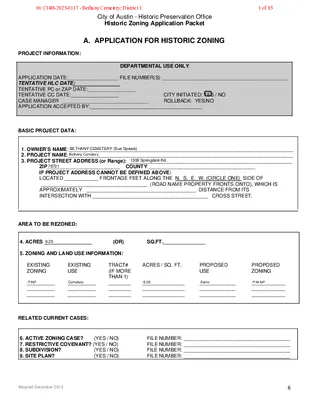
City of Austin - Historic Preservation Office Historic Zoning Application Packet A. APPLICATION FOR HISTORIC ZONING PROJECT INFORMATION: DEPARTMENTAL USE ONLY APPLICATION DATE:__________________ FILE NUMBER(S) _____________________________________________ TENTATIVE HLC DATE: TENTATIVE PC or ZAP DATE:_________________ TENTATIVE CC DATE:_________________ CASE MANAGER _______________________________ APPLICATION ACCEPTED BY:________________________________________ CITY INITIATED: YES / NO ROLLBACK: YES/NO BASIC PROJECT DATA: 1. OWNER’S NAME:________________________________________________________________________________ 2. PROJECT NAME:________________________________________________________________________________ 3. PROJECT STREET ADDRESS (or Range): __________________________________________________________ ZIP__________________________ COUNTY:______________________________________ IF PROJECT ADDRESS CANNOT BE DEFINED ABOVE: LOCATED ____________ FRONTAGE FEET ALONG THE N. S. E. W. (CIRCLE ONE) SIDE OF ______________________________________ (ROAD NAME PROPERTY FRONTS ONTO), WHICH IS APPROXIMATELY _______________________________________ DISTANCE FROM ITS INTERSECTION WITH _________________________________________ CROSS STREET. AREA TO BE REZONED: 4. ACRES _________________ (OR) SQ.FT._______________ 5. ZONING AND LAND USE INFORMATION: EXISTING ZONING EXISTING USE __________ __________ __________ __________ __________ __________ TRACT# (IF MORE THAN 1) ________ ________ ________ ACRES / SQ. FT. PROPOSED USE PROPOSED ZONING _______________ _______________ _______________ _____________ _____________ _____________ ____________ ____________ ____________ RELATED CURRENT CASES: (YES / NO) 6. ACTIVE ZONING CASE? 7. RESTRICTIVE COVENANT? (YES / NO) (YES / NO) 8. SUBDIVISION? (YES / NO) 9. SITE PLAN? FILE NUMBER: ______________________________________ FILE NUMBER: ______________________________________ FILE NUMBER: ______________________________________ FILE NUMBER: ______________________________________ Adopted December 2012 6 BETHANY CEMETERY (Sue Spears)Bethany Cemetery1308 Springdale Rd.787216.25P-NPCemetery6.25SameP-H-NP06 C14H-2025-0117 - Bethany Cemetery; District 11 of 85 06 C14H-2025-0117 - Bethany Cemetery; District 12 of 85 06 C14H-2025-0117 - Bethany Cemetery; District 13 of 85 City of Austin - Historic Preservation Office Historic Zoning Application Packet C: Tax Certificate Adopted December 2012 Page C-1 06 C14H-2025-0117 - Bethany Cemetery; District 14 of 85 06 C14H-2025-0117 - Bethany Cemetery; District 15 of 85 06 C14H-2025-0117 - Bethany Cemetery; District 16 of 85 06 C14H-2025-0117 - Bethany Cemetery; District 17 of 85 06 C14H-2025-0117 - Bethany Cemetery; District 18 of 85 City of Austin - Historic Preservation Office Historic Zoning Application Packet John M. Holland was born around 1850 in Marshall, Texas.2 By 1880, census records indicate that he was working as a farmer in rural Travis County. By 1900, John M. Holland and his family lived in Austin at 1409 San Bernard Street (house no longer extant), and he was working as a sexton at a church.3 Other sources indicate that John M. Holland also worked as a real estate agent.4 By 1920, John M. Holland and his family lived at present-day 1193 ½ San Bernard Street (then addressed as 1189 San Bernard Street).5 William H. Holland—likely the brother of John M. Holland—was born around 1849 in Marshall, Texas.6 William H. Holland went on to become “the superintendent of the Deaf, Dumb and Blind Institute for Colored Youths of Texas.”7 By 1889, city directories indicate that he lived “about 2 ½ miles northwest” of downtown Austin, “north of Mt. Bonnell road.”8 Additional biographical detail regarding William Holland is quoted below: In 1849, William H. Holland was born in bondage. As a slave, he received a college education in Oberlin College. After freedom, William Holland returned to Texas. He worked in Austin's post office, taught school and was elected as a Wharton County representative in the Texas House.(12) There, he wrote and presented the bill for the establishment of Prairie View University. Through his efforts, the bill was eventually passed and today, William M. Holland is recognized as "the Father of Prairie View."(13) Throughout his life, he supported education. During the time he served as president of the Bethany Cemetery Company, William H. Holland helped found the Deaf, Dumb, and Blind Institute for Colored Youth in Austin. For thirteen years, he served as its president. Later, he began the Friends in Need, an organization that supported African Americans.9 William M. Tears was born around 1865 in San Antonio, Texas.10 Census records indicate that Tears worked as a police officer by 1900, living in East Austin at 1702 Chincapin Street (now Rosewood Avenue, house no longer extant).11 Mr. Tears later became known as “Austin’s first Black mortician,” as described below: Two years after founding the Bethany Cemetery Company, William M. Tears became one of Austin's first African American policemen. He served for six years. Then in 1901, he founded the Tears Mortuary, known as the oldest established business in Central Texas.”12 Henderson Rollins’s early background is unclear.13 However, Mr. Rollins appears in Austin City Directories between 1887 and 1893 working as a porter or laborer at the State Comptroller’s Office at 206 W. 16th Street (building no longer extant).14 A newspaper advertisement from 1895 noted that 024, https://www.ancestry.com/search/collections/2272/records/21766178; 2 “John M. Holland,” Texas Death Certificates collection, Ancestry, accessed Sept. 2, 2025, https://www.ancestry.com/search/collections/2272/records/40100459. 3 U.S. Census, 1900, Austin Ward 7, Travis County, Texas, from Ancestry, accessed Sept. 2, 2025, https://www.ancestry.com/search/collections/7602/records/44312262. 4 Edwards, “Bethany Cemetery.” 5 U.S. Census, 1910, Austin Ward 5, Travis County, Texas, from Ancestry, accessed Sept. 2, 2025, https://www.ancestry.com/search/collections/6061/records/93552200. Note that the house at 1193 ½ San Bernard Street is a contributing resource within the San Bernard Historic District, which is eligible for listing in the National Register of Historic Places (nomination currently underway, listing anticipated in early 2026). 6 “William H. Holland,” US Find-a-Grave Index, Ancestry, accessed Sept. 2. 2025, https://www.ancestry.com/search/collections/60525/records/43864203. 7 A. Arro Smith, “Black Cemeteries,” https://www.gentrysmith.org/Black%20mortuaries/Cemeteries.htm, accessed Mar. 23, 2025, citing Simond, A. (1983). “Family Burial Site Holds Special Meaning for Blacks,” in “Looking Back” column, Austin American-Statesman, November 10, 1983. 8 “William H. Holland,” Austin, Texas City Directories, various dates from 1889-1892, from Ancestry. 9 Edwards, “Bethany Cemetery. 10 “William Morgan Tears Sr.,” U.S. Find-a-Grave-Index, from Ancestry, https://www.ancestry.com/search/collections/60525/records/6614432. 11 U.S. Census, 1900, Austin Ward 7, Travis County, Texas, from Ancestry, https://www.ancestry.com/search/collections/7602/records/44311334. 12 Edwards, “Bethany Cemetery. 13 Records on Ancestry document a white man named Asberry Henderson Rollins born in Hopkins County, Texas in 1846, but it is unclear whether this is the same individual as the Black man named Henderson Rollins documented living in Austin by the 1880s. See “Asberry Henderson Rollins,” Hudson Family Tree, Ancestry, https://www.ancestry.com/family-tree/person/tree/2428093/person/- 785537468/facts; “Asberry Henderson Rollins,” U.S. Census, 1860, Beat 4, Hopkins County, Texas, from Ancestry, https://www.ancestry.com/search/collections/7667/records/35073316. 14 “Henderson Rollins,” Austin, Texas City Directories, various dates from 1887-1892, from Ancestry. Adopted December 2012 Page F-3 06 C14H-2025-0117 - Bethany Cemetery; District 19 of 85 City of Austin - Historic Preservation Office Historic Zoning Application Packet “HENDERSON ROLLINS will do house cleaning, putting down and making up carpets, changing ladies rooms, cleaning yards, etc.”15 Mr. Rollins appears to have been involved in other organizations within Austin’s Black community also, such as the Juneteenth celebration committee.16 Allen Bradley appears in Austin City Directories from 1881 to 1893 living and operating a meat market at 1101 or 1108 E. 11th Street in 1881 (likely within the extant Haehnel Store Building, which is individually listed on the National Register and designated as an individual City of Austin landmark); by 1895 his residence appears to have moved to 1600 E. 7th Street (possibly extant).17 Mr. Bradley was also involved in Black community outreach in Austin, and newspapers record his work providing barbeque for Fourth of July celebrations.18 By 1897, a newspaper article notes that Mrs. Allen Bradley owned the restaurant and butcher shop on E. 11th Street, suggesting that Mr. Bradley may have passed away by that time. Tragically, the 1897 newspaper article documents back-to-back fires at both the Bradley home and the butcher shop, with the suggestion that the fires “would naturally lead to the belief that some one has been trying to burn her out” – documenting the violence and persecution that accompanied Black business ownership in the Jim Crow era, especially for a woman.19 EVOLVING LEADERSHIP OF THE BETHANY CEMETERY ASSOCIATION Between the founding of Bethany Cemetery in 1893 and the early 1920s, the Bethany Cemetery Association paid for a caretaker to maintain the grounds.20 By the late 1920s and 1930s, the original founders of the Bethany Cemetery Association had aged or passed away, and the responsibility for maintaining cemetery plots was assumed to fall upon the descendants of interred families. However, responsibility for maintaining and managing unsold plots and the cemetery infrastructure remained unclear. Around this time, Eva Taylor Ross stepped forward to assume responsibility for maintaining Bethany Cemetery. Eva was born to parents Ruthie and John Taylor around 1895, likely in Austin.21 By 1920, she married William Taylor. When her mother passed away in 1931, Eva wanted to bury her mother in Bethany Cemetery, alongside some of her siblings who did not survive to adulthood, but John Taylor questioned the reliability of maintenance at Bethany Cemetery, especially since Evergreen Cemetery had opened in 1928 and promised City-sponsored maintenance.22 As described by seminal Austin Black historian Ada Simond: In 1931 when Ruthie Taylor, mother of Eva Taylor Ross died, Ross’s father decided to bury his wife in Evergreen Cemetery [rather than Bethany Cemetery]…Eva Taylor Ross, touched with the agony of having her mother buried in a different location than some of her children, her family, her parents and close friends promised her father she would dedicate her life to maintaining Bethany as a respected burial ground and honored spot if he would bury her mother there.23 Ms. Ross faithfully cared for the cemetery throughout her life. In 1971, the Bethany Cemetery Association filed official Articles of Incorporation as a non-profit with the State of Texas Secretary of State.24 At that time, members of the Board of Directors included Eva Ross (address 1001 Chicon Street), Carl Wilson (address 1001 Chicon Street) and Burton D. Kennedy (address 1106 Olive Street). As late as the 1980s, Ms. Eva Ross was 15 “Henderson Rollins” [ad], Austin American Statesman [newspaper], Mar. 10, 1895, p. 6, from Newspapers.com, https://www.newspapers.com/image/366599548. 16 “Preparing to Celebrate,” Austin American Statesman [newspaper], May 5, 1894, p. 4, from Newspapers.com, https://www.newspapers.com/image/357503720; “Emancipation Day Meeting,” Austin American Statesman [newspaper], Jun. 15, 1894, p. 2, from Newspapers.com, https://www.newspapers.com/image/366623621. 17 Edwards, “Bethany Cemetery; “Allen Bradley,” Austin, Texas City Directories, various dates from 1881-1895, from Ancestry. For information about 1101 E. 11th Street and 1600 E. 7th Street, see HHM & Associates, Inc., “East Austin Historic Resources Survey,” prepared for the City of Austin, 2016, from the City of Austin, https://www.austintexas.gov/page/historic-survey#strongEastAustin2016strong. 18 “Fourth of July,” Austin American Statesman [newspaper], Jun.26, 1887, p. 4, from Newspapers.com; https://www.newspapers.com/image/364673077/?match=1&terms=%22allen%20bradley%22; 19 “Fire this Morning: restaurant and Buther Shop Burned on Robertson Hill,” Austin American Statesman [newspaper], Nov. 12, 1897, p. 2, from Newpapers.com, https://www.newspapers.com/image/366644169. 20 Chris Peterson, “Old black cemetery falling into disrepair,” Austin American-Statesman [newspaper], Mar. 5, 1980, pp. 16, 20, from Newspapers.com, https://www.newspapers.com/image/358394077/. 21 US Census, 1920, Austin Ward 5, Travis County, Texas, from Ancestry, https://www.ancestry.com/search/collections/6061/records/93554754. 22 Ada Simond, “Family burial site holds special meaning for blacks,” Austin American-Statesman [newspaper], Nov. 10, 1983, p. 25, from Newspapers.com, https://www.newspapers.com/image/362841035. 23 Simond, “Family burial site holds special meaning for blacks.” 24 State of Texas Office of the Secretary of State, “Certificate of Incorporation of Bethany Cemetery Association of Travis County, Inc.,” July 20, 1971, from the City of Austin Historic Preservation Office. Adopted December 2012 Page F-4 06 C14H-2025-0117 - Bethany Cemetery; District 110 of 85 06 C14H-2025-0117 - Bethany Cemetery; District 111 of 85 06 C14H-2025-0117 - Bethany Cemetery; District 112 of 85 06 C14H-2025-0117 - Bethany Cemetery; District 113 of 85 City of Austin - Historic Preservation Office Historic Zoning Application Packet F. 9: Historical Documentation – Historical Narrative (See Attachment A for supplemental documentation related to the significance of the property.) HISTORICAL ASSOCIATIONS Bethany Cemetery is eligible for designation as a City of Austin historic landmark under criteria (ii) for Historical Associations with African American Ethnic Heritage. Bethany Cemetery is known as “Austin’s first black cemetery.”39 Many of the individuals interred at Bethany Cemetery represent significant facets of the Black experience in Austin, as documented by Table 2 above in Section F.3. In addition, the Bethany Cemetery property holds significant community value as a gathering place and sacred site for Austin’s Black community. Brief Historical Background of the Surrounding Area The chronology of the cemetery’s founding and development is summarized within Figure 2 in Attachment A-4. As documented within Figure 2, the earliest known purchase of the land surrounding Bethany Cemetery occurred in 1850, when the land was purchased by John Hemphill and his partner Sabina. The land encompassing the future site of the cemetery was known as Lot 18 ½ of Division B of Austin. (See Figure 3 in Attachment A-2. for the location of Division B in relationship to the City of Austin. Also see the chronology of ownership transactions within Table 1 in Section F.1 above.) John Hemphill was a white man who served as Chief Justice of the Supreme Court of Texas, while Sabina was a formerly enslaved black woman.40 However, it does not appear that the land encompassing Bethany Cemetery was settled at that time – John Hemphill’s primary residence was in Washington County, Texas, and Travis County tax rolls from 1859 documented that he held taxable assets at a property in town in Austin, but not at his property in Division B.41 After John Hemphill’s death, his estate sold the land to J.J. Wheless and W.J. Wheless. Little is known about the Wheless brothers, but in 1890, they subdivided their landholdings in Division B – creating the present-day parcel boundaries of Bethany Cemetery, defined as Lot 2 of Outlot 18 ½ of Division B (as shown above in Section B – Tax Map). Travis County tax records suggest that the parcel remained undeveloped through 1893, when it was purchased by the Bethany Cemetery Company for development of the cemetery, with the exception of the 1879 burial of an infant named Hellen Moore.42 Research to date has been unable to reveal Hellen’s parents’ names or their homestead location, but it is likely that they were tenant farmers or domestic workers nearby, since tax records do not show anyone with the surname Moore owning property in Division B. After the cemetery was established in 1893, the surrounding area remained rural for over half a century. Some local anecdotes of the area’s history recollect that it was known as “Hungry Hill…because its soil was thin and unproductive” – contributing to the slow pace of development in the area.43 (Springdale Road was known as Hungry Hill Road until the 1930s.) By 1928, city plans for Austin consolidated civic amenities for African Americans along E. 12th Street, encouraging Black spatial segregation in East Austin – although Austin’s development had not yet reached as far east as Bethany Cemetery.44 In the 1930s, federal mortgage lending policies reinforced the segregation of East Austin by marking the area as “hazardous” for mortgage lending.45 39 JuanRaymon Rubio and Kevin Koch to Sam Fahnestock, Historic Preservation Office, “Request to consider initiation of historic zoning, Bethany Cemetery (1300 Springdale Rd)” [Letter], June 27, 2024, from the City of Austin Historic Preservation Office Historic Preservation Office. As stated in this letter, “Austin’s first public cemetery, Oakwood Cemetery, allowed a designated corner for ‘colored’ Austinites in 1856, and the nearby Plummers Cemetery was established around 1898 (another private African American rural cemetery later purchased by the City of Austin Historic Preservation Office). Evergreen Cemetery, established in 1926 to serve Austin’s African American Community contains the historic Highland Park Cemetery. Highland Park Cemetery was established in 1891 and reportedly served all races from 1891-1893. Oakwood Cemetery was established by the state in 1839 and later transferred to the City of Astin in 1856. Approximately 1,211 people were buried in the ‘colored’ section of Oakwood Cemetery between 1859-1880. Source: Save Austin’s Cemeteries, Historic Cemeteries Master Plan, 2015.” 40 Thomas W. Cutrer, “Hemphill, John,” Handbook of Texas Online, accessed September 04, 2025, https://www.tshaonline.org/handbook/entries/hemphill-john; David A. Furlough, “A Fire Bell in the Night: Slavery in Texas,” Journal of the Texas Supreme Court Historical Society, vol. 5 no. 1 (Fall 2015), https://www.texascourthistory.org/Content/Newsletters/TSCHS%20Journal%20Fall%202015.pdf; Texas Tax List, 1846, Washington, Texas, from Ancestry, https://www.ancestry.com/search/collections/3575/records/31891733. 41 Texas County Tax Rolls, 1859, Travis County, from Family Search, https://www.familysearch.org/ark:/61903/3:1:939J-4RCK-L. 42 Texas Historical Commission (THC), “Bethany Cemetery” [Historical Marker — Atlas Number 5453012240], 1997, from the Texas Historic Sites Atlas, https://atlas.thc.state.tx.us/Details?atlasnumber=5453012240. 43 “Travis has its Quaint Assortment of “Oddest’ Names,” Austin Statesman, Mar. 6, 1935, p. 1, from Newspapers.com, https://www.newspapers.com/image/364991758. 44 HHM, “Historic Resources Survey of East Austin.” 45 Home Owners' Loan Corporation (HOLC) Map of Austin, Texas, 1934, from “Mapping Inequality: Redlining in New Deal America,” Adopted December 2012 Page F-8 06 C14H-2025-0117 - Bethany Cemetery; District 114 of 85 City of Austin - Historic Preservation Office Historic Zoning Application Packet Analysis of historic maps and aerial photographs of Travis County shows rural land surrounding Bethany Cemetery until about 1950.46 By 1952, aerial photos show new homes within the Cedar Valley subdivision just east of Bethany Cemetery across Springdale Road. The Cedar Valley Addition was marketed to Black homebuyers and, notably, allowed Black homebuyers to qualify for mortgages backed by the Federal Housing Authority (FHA).47 Nearby, the site on the northeast corner of E. 12th Street and Springdale Road would become Sims Elementary School in 1956, named after beloved Black educator Mary Jane Sims.48 By 1964, historic aerial photos show suburban residential development filling the surrounding land, spurred by the new elementary school and availability of affordable housing for purchase. As the area urbanized, new residents held little connection to Bethany Cemetery. Despite the efforts of volunteer caretakers like Eva Taylor Ross and Idella Lewis, the cemetery was largely forgotten, and aerial photos from the 1980s through the early 1990s show the cemetery overgrown and hidden from view. African American Ethnic Heritage Despite ongoing maintenance challenges and a changing demographic with little generational connection to Austin, community leaders like Sue Spears have been able to mobilize community support for Bethany Cemetery because of the pivotal role that cemeteries play in documenting and preserving Black history. Historically, Black genealogies and accomplishments were under-documented in official governmental records and newspapers – especially in nineteenth-century Texas. Black cemeteries often serve as the only written documentation of significant Black stories. As described by the National Trust for Historic Preservation: Cemeteries, along with churches and schools, were some of the first institutions founded by African Americans after the Civil War. Developed by various coalitions, masonic groups, or benevolent associations, they became cornerstones of newly freed communities. Today, they are often a virtual time capsule that provides insight into the social, anthropological, and archaeological history of a community. Headstones may carry the names of little-known yet influential figures whose voices have been left out of the historical record.49 In Austin, Bethany Cemetery is the oldest extant example of a Black Cemetery and includes individuals whose stories of enslavement and emancipation are critical to preserve. The stories embodied at Bethany Cemetery are unique because they illustrate Black communal effort and perseverance in the absence of public support. The other notable example of a Black cemetery in Austin—Evergreen Cemetery—tells a different story because it was founded in 1928 by the City of Austin and continuously maintained with City support. Preservation of both Bethany Cemetery and Evergreen Cemetery is essential in order to tell the full, accurate story of the Black experience in Austin—which often entailed forced self-sufficiency and lack of public support, even in death. Preservation of Bethany Cemetery is also essential because of the unique physical features that hold significance within African American burial traditions. For example: The cemetery records depict the graves in a long, narrow arrangement. Individual burial plots border the cemetery on the north and south sides. Ten family-sized plots are separated by wide grassy pathways, referred to as alleys in the Bethany Cemetery Plat [Figure 3]. All the graves are oriented on an east-west axis, a Southern Christian tradition. This common practice was founded on the belief that during the Second Coming, all souls will rise out of their graves and face Christ on Judgement Day.50 Similarly, from around 1900 through the 1920s, concrete headstones became popular in Black cemeteries nationwide and are found throughout Bethany Cemetery. Often, concrete headstones include embossed https://dsl.richmond.edu/panorama/redlining/map/TX/Austin/context#loc=15/30.2362/-97.7405. 46 Various maps of Travis County, various dates, Texas State Archives Map Collection, Texas State Archives and Library (TSLAC), https://www.tsl.texas.gov/apps/arc/maps/records?subject=Travis+County&sort=scanned&direction=desc. 47 “FOR COLORED…New Homes in Cedar Valley Addition” [ad], The Austin American [newspaper], Nov. 3, 1952, p. 27, from Newspapers.com, https://www.newspapers.com/image/386411665; “New FHA Homes for Colored: Cedar Valley Addition” [ad], The Austin American [newspaper], Oct. 22, 1955, p. 23, from Newspapers.com, https://www.newspapers.com/image/386551887. 48 Sherilyn Brandenstein, “Sims, Mary Jane,” Handbook of Texas Online, accessed September 04, 2025, https://www.tshaonline.org/handbook/entries/sims-mary-jane. 49 Nadia K. Orton, “Recovering and Preserving African American Cemeteries,” from the National Trust for Historic Preservation, published Jun. 2, 2016, https://savingplaces.org/stories/recovering-and-preserving-african-american-cemeteries. 50 “Bethany Cemetery” [unpublished manuscript, n.d., author unknown], from the archives of JuanRaymon Rubio courtesy of Architexas, citing Trry G. Jordan, Texas Graveyards, A Cultural Legacy (Austin: University of Texas Press, 1982), p. 30. Adopted December 2012 Page F-9 06 C14H-2025-0117 - Bethany Cemetery; District 115 of 85 City of Austin - Historic Preservation Office Historic Zoning Application Packet symbols like crosses or gates.51 Other headstones from this era are embossed with symbols from Black social and fraternal organizations, like the Knights of Pythias or the Odd Fellows. (See Current Photos in Attachment B.) Bethany Cemetery includes a unique collection of early examples of representative Black concrete headstones, including many examples that predate the founding of Evergreen Cemetery in 1928. Community Value In addition to its significance to African American Ethnic Heritage in Austin, Bethany Cemetery is also eligible for designation as a City of Austin historic landmark under Criterion (iv) for community value. The decades of community-driven volunteer leadership of Evelyn Taylor Ross, Idella Lewis, and Sue Spears epitomize the spirit of community value. Bethany Cemetery has also long served as a gathering place for the larger Black community in Austin. As described in one oral history: Bethany Association members raised money through homecoming gatherings, and solicitation of donations. Although people continued to maintain their own family plots, they sought assistance with care from county and city officials. Through their efforts and support of local African American organizations, they fenced the property, built a limestone entranceway and placed on its top an arch with the words, Bethany Cemetery.52 Similar community work was required to obtain an Official Texas Historical Marker, commemorating the cemetery, which was erected in 1997. Community efforts also resulted in the Texas Historical Commission’s designation of Bethany Cemetery as a Historic Texas Cemetery on June 27, 2003.53 In 2016, the Austin non- profit organization Six Square—which supports Austin’s Black cultural districts—organized a gathering called “The Homecoming” to celebrate and advocate for Austin’s Black cemeteries. That event helped bring attention to the need for maintenance and protection for Bethany Cemetery.54 As a testament to the community’s value for the cemetery, letters of support for this historic landmark application have been submitted by the Travis County Historical Commission, El Camino Real de los Tejas National Historic Trail Association, Historic Landmarks Commissioner Roxanne J. Evans, and Preservation Austin (compiled within Attachment A-4). 51 Bliss Boaz, “Grave Architecture: Bethany Cemetery” [unpublished manuscript, n.d]. 52 Oral History Interview with Willene Ross Wilson, Monday, June 10, 1996, by the Travis County Historical Commission, cited in “Bethany Cemetery” [unpublished manuscript, n.d., author unknown], from the archives of JuanRaymon Rubio courtesy of Architexas. 53 Texas Historical Commission, “Affidavit of Dedication for Cemetery Purposes for the Bethany Cemetery,” June 27, 2003, from the City of Austin Historic Preservation Office. 54 Kahron Spearman, “A Celebration of Austin’s Black Cemeteries,” The Austin Chronicle [newspaper], Nov. 4, 2016, https://www.austinchronicle.com/news/2016-11-04/a-celebration-of-austins-black-cemeteries/. Adopted December 2012 Page F-10 06 C14H-2025-0117 - Bethany Cemetery; District 116 of 85 City of Austin - Historic Preservation Office Historic Zoning Application Packet Attachment A Attachment A: Historical Documentation to Supplement Section F ATTACHMENT A-1: SUPPLEMENT FOR SECTION F.1 – DEED CHRONOLOGY “BETHANY CEMETERY: Chain of Title Narrative with Citations” by John E. Williams Adopted December 2012 Attachment A | Page 11 06 C14H-2025-0117 - Bethany Cemetery; District 117 of 85 City of Austin - Historic Preservation Office Historic Zoning Application Packet Adopted December 2012 Attachment A | Page 12 06 C14H-2025-0117 - Bethany Cemetery; District 118 of 85 City of Austin - Historic Preservation Office Historic Zoning Application Packet Adopted December 2012 Attachment A | Page 13 06 C14H-2025-0117 - Bethany Cemetery; District 119 of 85 City of Austin - Historic Preservation Office Historic Zoning Application Packet Adopted December 2012 Attachment A | Page 14 06 C14H-2025-0117 - Bethany Cemetery; District 120 of 85 City of Austin - Historic Preservation Office Historic Zoning Application Packet Adopted December 2012 Attachment A | Page 15 06 C14H-2025-0117 - Bethany Cemetery; District 121 of 85 City of Austin - Historic Preservation Office Historic Zoning Application Packet Adopted December 2012 Attachment A | Page 16 06 C14H-2025-0117 - Bethany Cemetery; District 122 of 85 City of Austin - Historic Preservation Office Historic Zoning Application Packet Adopted December 2012 Attachment A | Page 17 06 C14H-2025-0117 - Bethany Cemetery; District 123 of 85 City of Austin - Historic Preservation Office Historic Zoning Application Packet Adopted December 2012 Attachment A | Page 18 06 C14H-2025-0117 - Bethany Cemetery; District 124 of 85 City of Austin - Historic Preservation Office Historic Zoning Application Packet Adopted December 2012 Attachment A | Page 19 06 C14H-2025-0117 - Bethany Cemetery; District 125 of 85 City of Austin - Historic Preservation Office Historic Zoning Application Packet Adopted December 2012 Attachment A | Page 20 06 C14H-2025-0117 - Bethany Cemetery; District 126 of 85 City of Austin - Historic Preservation Office Historic Zoning Application Packet Adopted December 2012 Attachment A | Page 21 06 C14H-2025-0117 - Bethany Cemetery; District 127 of 85 City of Austin - Historic Preservation Office Historic Zoning Application Packet Adopted December 2012 Attachment A | Page 22 06 C14H-2025-0117 - Bethany Cemetery; District 128 of 85 City of Austin - Historic Preservation Office Historic Zoning Application Packet Adopted December 2012 Attachment A | Page 23 06 C14H-2025-0117 - Bethany Cemetery; District 129 of 85 City of Austin - Historic Preservation Office Historic Zoning Application Packet Adopted December 2012 Attachment A | Page 24 06 C14H-2025-0117 - Bethany Cemetery; District 130 of 85 City of Austin - Historic Preservation Office Historic Zoning Application Packet Adopted December 2012 Attachment A | Page 25 06 C14H-2025-0117 - Bethany Cemetery; District 131 of 85 City of Austin - Historic Preservation Office Historic Zoning Application Packet ATTACHMENT A-2: HISTORIC FIGURES Figure 1. Photograph of Ms. Eva Ross (left) and Ms. Idella Lewis (right). Source: Austin American Statesman, Mar. 6, 1980, p. 6. Adopted December 2012 Attachment A | Page 26 06 C14H-2025-0117 - Bethany Cemetery; District 132 of 85 City of Austin - Historic Preservation Office Historic Zoning Application Packet Figure 2. Timeline of the history of Bethany Cemetery. Courtesy of the research files of Ms. Sue Spears. Adopted December 2012 Attachment A | Page 27 06 C14H-2025-0117 - Bethany Cemetery; District 133 of 85 Figure 3. Original 1893 plat for Bethany cemetery. Source: Travis County Clerk, vol. 1, pg. 96, courtesy of the City of Austin Historic Preservation Office, crediting the Travis County Clerk. City of Austin - Historic Preservation Office Historic Zoning Application Packet Adopted December 2012 Attachment A | Page 28 06 C14H-2025-0117 - Bethany Cemetery; District 134 of 85 City of Austin - Historic Preservation Office Historic Zoning Application Packet ATTACHMENT A-3: DIMENSIONED SITE PLAN Figure 4. Dimensioned site plan of the Bethany Cemetery property. Source: Texas Historical Commission, “Affidavit of Dedication for Cemetery Purposes for the Bethany Cemetery,” June 27, 2003, from the City of Austin. Adopted December 2012 Attachment A | Page 29 06 C14H-2025-0117 - Bethany Cemetery; District 135 of 85 City of Austin - Historic Preservation Office Historic Zoning Application Packet Figure 5. Site survey showing the layout of Bethany Cemetery, 1969. Courtesy of the research files of Ms. Sue Spears. Adopted December 2012 Attachment A | Page 30 06 C14H-2025-0117 - Bethany Cemetery; District 136 of 85 City of Austin - Historic Preservation Office Historic Zoning Application Packet ATTACHMENT A-4: ADDITIONAL SUPPORTING DOCUMENTATION Letters of Support Adopted December 2012 Attachment A | Page 31 06 C14H-2025-0117 - Bethany Cemetery; District 137 of 85 City of Austin - Historic Preservation Office Historic Zoning Application Packet Adopted December 2012 Attachment A | Page 32 06 C14H-2025-0117 - Bethany Cemetery; District 138 of 85 City of Austin - Historic Preservation Office Historic Zoning Application Packet Adopted December 2012 Attachment A | Page 33 06 C14H-2025-0117 - Bethany Cemetery; District 139 of 85 City of Austin - Historic Preservation Office Historic Zoning Application Packet Adopted December 2012 Attachment A | Page 34 06 C14H-2025-0117 - Bethany Cemetery; District 140 of 85 City of Austin - Historic Preservation Office Historic Zoning Application Packet Lists of Burials in Bethany Cemetery List of burials from the Travis County 19th Century Pioneers, Date Unknown Adopted December 2012 Attachment A | Page 35 06 C14H-2025-0117 - Bethany Cemetery; District 141 of 85 City of Austin - Historic Preservation Office Historic Zoning Application Packet Adopted December 2012 Attachment A | Page 36 06 C14H-2025-0117 - Bethany Cemetery; District 142 of 85 City of Austin - Historic Preservation Office Historic Zoning Application Packet Adopted December 2012 Attachment A | Page 37 06 C14H-2025-0117 - Bethany Cemetery; District 143 of 85 City of Austin - Historic Preservation Office Historic Zoning Application Packet Adopted December 2012 Attachment A | Page 38 06 C14H-2025-0117 - Bethany Cemetery; District 144 of 85 City of Austin - Historic Preservation Office Historic Zoning Application Packet Adopted December 2012 Attachment A | Page 39 06 C14H-2025-0117 - Bethany Cemetery; District 145 of 85 City of Austin - Historic Preservation Office Historic Zoning Application Packet Table and Key Map of Burials, Source Unknown, Date Unknown Adopted December 2012 Attachment A | Page 40 06 C14H-2025-0117 - Bethany Cemetery; District 146 of 85 City of Austin - Historic Preservation Office Historic Zoning Application Packet Adopted December 2012 Attachment A | Page 41 06 C14H-2025-0117 - Bethany Cemetery; District 147 of 85 City of Austin - Historic Preservation Office Historic Zoning Application Packet Adopted December 2012 Attachment A | Page 42 06 C14H-2025-0117 - Bethany Cemetery; District 148 of 85 City of Austin - Historic Preservation Office Historic Zoning Application Packet List of Burials Compiled by Historian Cynthia Mull, Date Unknown Adopted December 2012 Attachment A | Page 43 06 C14H-2025-0117 - Bethany Cemetery; District 149 of 85 City of Austin - Historic Preservation Office Historic Zoning Application Packet Adopted December 2012 Attachment A | Page 44 06 C14H-2025-0117 - Bethany Cemetery; District 150 of 85 City of Austin - Historic Preservation Office Historic Zoning Application Packet Adopted December 2012 Attachment A | Page 45 06 C14H-2025-0117 - Bethany Cemetery; District 151 of 85 City of Austin - Historic Preservation Office Historic Zoning Application Packet Adopted December 2012 Attachment A | Page 46 06 C14H-2025-0117 - Bethany Cemetery; District 152 of 85 City of Austin - Historic Preservation Office Historic Zoning Application Packet Adopted December 2012 Attachment A | Page 47 06 C14H-2025-0117 - Bethany Cemetery; District 153 of 85 City of Austin - Historic Preservation Office Historic Zoning Application Packet Adopted December 2012 Attachment A | Page 48 06 C14H-2025-0117 - Bethany Cemetery; District 154 of 85 City of Austin - Historic Preservation Office Historic Zoning Application Packet Attachment B Attachment B: Current Photographs Photo 1. Bethany Cemetery entrance gate, facing southwest from Springdale Road. Photo by Emily Payne, 2025. Adopted December 2012 Attachment B | Page 1 06 C14H-2025-0117 - Bethany Cemetery; District 155 of 85 City of Austin - Historic Preservation Office Historic Zoning Application Packet Photo 2. Southeast quadrant of Bethany Cemetery, facing south toward Springdale Road. Photo by Emily Payne, 2025. Photo 3. Northern half of Bethany Cemetery, facing north. Photo by Emily Payne, 2025. Adopted December 2012 Attachment B | Page 2 06 C14H-2025-0117 - Bethany Cemetery; District 156 of 85 City of Austin - Historic Preservation Office Historic Zoning Application Packet Photo 4. Swale in the southern half of Bethany Cemetery marking the historic alignment of El Camino Real through the property. Photo by HHM, 2025. Photo 5. Southwest quadrant of Bethany Cemetery, facing southwest. Photo by HHM, 2025. Adopted December 2012 Attachment B | Page 3 06 C14H-2025-0117 - Bethany Cemetery; District 157 of 85 City of Austin - Historic Preservation Office Historic Zoning Application Packet Photo 6. Representative headstones at Bethany Cemetery, facing southeast with Sims Elementary School in the background. Photo by HHM, 2025. Photo 7. Headstones of World War II veterans, southern half of Bethany Cemetery, facing northwest. Photo by HHM, 2025. Adopted December 2012 Attachment B | Page 4 06 C14H-2025-0117 - Bethany Cemetery; District 158 of 85 06 C14H-2025-0117 - Bethany Cemetery; District 159 of 85 06 C14H-2025-0117 - Bethany Cemetery; District 160 of 85 06 C14H-2025-0117 - Bethany Cemetery; District 161 of 85 06 C14H-2025-0117 - Bethany Cemetery; District 162 of 85 06 C14H-2025-0117 - Bethany Cemetery; District 163 of 85 06 C14H-2025-0117 - Bethany Cemetery; District 164 of 85 06 C14H-2025-0117 - Bethany Cemetery; District 165 of 85 06 C14H-2025-0117 - Bethany Cemetery; District 166 of 85 06 C14H-2025-0117 - Bethany Cemetery; District 167 of 85 06 C14H-2025-0117 - Bethany Cemetery; District 168 of 85 06 C14H-2025-0117 - Bethany Cemetery; District 169 of 85 06 C14H-2025-0117 - Bethany Cemetery; District 170 of 85 Property Profile Report Permitting and Development Center | 6310 Wilhelmina Delco Drive, Austin, TX 78752 | (512) 978-4000 General Information Location: Parcel ID: Grid: 1308 SPRINGDALE RD 0210180514 MM23 Planning & Zoning *Right click hyperlinks to open in a new window. Future Land Use (FLUM): Single Family, Mixed Residential, Mixed Use, Civic Regulating Plan: No Regulating Plan Zoning: P-NP Zoning Cases: Zoning Ordinances: Zoning Overlays: Neighborhood Plan: Infill Options: C14-2020-0003 C14-2020-0014 C14-2020-0089 C14-2023-0038.SH C14H-2024-0103 021107-Z-12C 19990225-070b 20210826-097 20231130-110 Wildland Urban Interface 2024 Selected Sign Ordinances Residential Design Standards: LDC/25-2-Subchapter F ADU Approx Area Reduced Parking Airport Overlay: CONTROLLED COMPATIBLE LAND USE AREA MLK Small Lot Amnesty Infill Option, Residential Infill Option, Mixed Use Building Infill Option Neighborhood Restricted Parking Areas: Martin Luther King Jr. Neighborhood Assn. Mobile Food Vendors: Martin Luther King Jr. NA Historic Landmark: Urban Roadways: -- Yes Zoning Guide The Guide to Zoning provides a quick explanation of the above Zoning codes, however, the Land Use Assistance provides general zoning assistance and can advise you on the type of development allowed on a property. Visit Zoning for the description of each Base Zoning District. For official verification of the zoning of a property, please request a Zoning Verification Letter. General information on the Neighborhood Planning Areas is available from Neighborhood Planning. Environmental Fully Developed Floodplain: FEMA Floodplain: No No Austin Watershed Regulation Areas: URBAN Watershed Boundaries: Fort Branch, Tannehill Branch Creek Buffers: Edwards Aquifer Recharge Zone: Edwards Aquifer Recharge Verification Zone: Erosion Hazard Zone Review Buffer: Political Boundaries No No No No Jurisdiction: AUSTIN FULL PURPOSE Council District: 1 County: TRAVIS School District: Austin ISD Community Registry: Austin Independent School District, Austin Neighborhoods Council, Del Valle Community Coalition, East Austin Conservancy, East MLK Combined Neighborhood Plan Contact Team, Friends of Austin Neighborhoods, Friends of Northeast Austin, Homeless Neighborhood Association, Martin Luther King Neighborhood Association, Overton Family Committee , Preservation Austin, Residents of E 12th St Zoning Map Imagery Map Vicinity Map The Information on this report has been produced by the City of Austin as a working document and is not warranted for any other use. No warranty is made by the City regarding its accuracy or completeness. Date created: 12/17/2025 06 C14H-2025-0117 - Bethany Cemetery; District 171 of 85 06 C14H-2025-0117 - Bethany Cemetery; District 172 of 85 06 C14H-2025-0117 - Bethany Cemetery; District 173 of 85 Kalan Contreras Historic Preservation Office City of Austin October 15, 2025 Subject: Request to consider initiation of historic zoning, Bethany Cemetery (1300 Springdale Rd) Dear Ms. Contreras: We would like to include the Bethany Cemetery, located at 1300 Springdale Road, on the Historic Landmark Commission’s November agenda for consideration of initiation of historic zoning. The owner, the Bethany Cemetery Association, fully supports this request. Bethany Cemetery is a six- acre, private burial ground located in East Austin. The Bethany Cemetery Company was formed in 1893 in response to the needs of the African American community. Bethany Cemetery is considered Austin’s first black cemetery.1 The Cemetery contains graves on site as early as 1871 and is strategically situated along El Camino Real de los Tejas, a 17th/18th- Century Native American and Spanish Colonial trade route. Hundreds of Austinites are buried at Bethany Cemetery, many of which have dedicated their lives to the betterment of African Americans throughout the region. Dozens are associated with local Black churches, benevolent societies, trade unions, lodges, businesses, war veterans, and tragic events such as the Waller and Shoal Creeks Flood of 1915. Bethany Cemetery is a reminder of the development of Austin’s African American Community from the time of slavery and the Civil War through the present. The impact of the site and its interred are felt citywide to this day, as likely remnants of the Camino Real are intact, and Bethany Cemetery Association maintains an active curriculum program for public schools. The Cemetery’s strong community value, historical associations, archeology, and landscape features, more than fulfill the criteria for local landmark designation. Thank you for your consideration and feel free to reach out regarding any questions or concerns. Thank you, Roxanne Evans Roxanne Evans Historic Landmark Commissioner and Vice Chair, District 2 BC-Roxanne.Evans@AustinTexas.gov Motioned By: Commissioner Evans Kevin Koch, AIA Historic Landmark Commissioner, District 3 BC-Kevin.Koch@AustinTexas.gov Seconded By: Commissioner Koch 1 Austin’s first public cemetery, Oakwood Cemetery, allowed a designated corner for “colored” Austinites in 1856, and the nearby Plummers Cemetery was established around 1898 (another private African American rural cemetery later purchased by the City of Austin). Evergreen Cemetery, established in 1926 to serve Austin’s African American Community contains the historic Highland Park Cemetery. Highland Park Cemetery was established in 1891 and reportedly served all races from 1891-1893. Oakwood Cemetery was established by the state in 1839 and later transferred to the City of Austin 06 C14H-2025-0117 - Bethany Cemetery; District 174 of 85 in 1856. Approximately 1,211 people were buried in the “colored” section of Oakwood Cemetery between 1859-1880. Source: Save Austin’s Cemeteries, Historic Cemeteries Master Plan, 2015 06 C14H-2025-0117 - Bethany Cemetery; District 175 of 85 Sam Fahnestock Historic Preservation Office City of Austin June 27, 2024 Subject: Request to consider initiation of historic zoning, Bethany Cemetery (1300 Springdale Rd) Dear Mr. Fahnestock, We would like to include the Bethany Cemetery, located at 1300 Springdale Road, on the Historic Landmark Commission’s July agenda for consideration of initiation of historic zoning. The owner, the Bethany Cemetery Association, fully supports this request. Bethany Cemetery is a six-acre, private burial ground located in East Austin. The Bethany Cemetery Company was formed in 1893 in response to the needs of the African American community. Bethany Cemetery is considered Austin’s first black cemetery.1 The Cemetery contains graves on site as early as 1871 and is strategically situated along El Camino Real de los Tejas, a 17th/18th- Century Native American and Spanish Colonial trade route. Hundreds of Austinites are buried at Bethany Cemetery, many of which have dedicated their lives to the betterment of African Americans throughout the region. Dozens are associated with local Black churches, benevolent societies, trade unions, lodges, businesses, war veterans, and tragic events such as the Waller and Shoal Creeks Flood of 1915. Bethany Cemetery is a reminder of the development of Austin’s African American Community from the time of slavery and the Civil War through the present. The impact of the site and its interred are felt citywide to this day, as likely remnants of the Camino Real are intact, and Bethany Cemetery Association maintains an active curriculum program for public schools. The Cemetery’s strong community value, historical associations, archeology, and landscape features, more than fulfill the criteria for local landmark designation. Thank you for your consideration and feel free to reach out regarding any questions or concerns. Thank you, JuanRaymon Rubio, Associate AIA Historic Landmark Commissioner, District 2 Kevin Koch, AIA Historic Landmark Commissioner, District 3 BC-JuanRaymon.Rubio@AustinTexas.gov Motioned By: Commissioner Rubio BC-Kevin.Koch@AustinTexas.gov Seconded By: Commissioner Koch 1 Austin’s first public cemetery, Oakwood Cemetery, allowed a designated corner for “colored” Austinites in 1856, and the nearby Plummers Cemetery was established around 1898 (another private African American rural cemetery later purchased by the City of Austin). Evergreen Cemetery, established in 1926 to serve Austin’s African American Community contains the historic Highland Park Cemetery. Highland Park Cemetery was established in 1891 and reportedly served all races from 1891-1893. Oakwood Cemetery was established by the state in 1839 and later transferred to the City of Astin in 1856. Approximately 1,211 people were buried in the “colored” section of Oakwood Cemetery between 1859-1880. Source: Save Austin’s Cemeteries, Historic Cemeteries Master Plan, 2015 06 C14H-2025-0117 - Bethany Cemetery; District 176 of 85 June 17, 2024 Subject: Bethany Cemetery Historic Designation To: Austin Historic Landmark Commission It has come to our attention that the Bethany Cemetery Association is applying for a city historic designation. Bethany Cemetery is an historic African American Cemetery purchased and developed by John Holland and William Tears in 1893. It contains the burials of many notable persons and has, for the past years, been overlooked and neglected. There is currently concern that development next door to the cemetery may bring unwanted use and potential damage to the site. The Travis County Historical Commission commends Sue Spears and the members of the Bethany Cemetery Association (BCA) in their efforts to protect and document the deep history of the cemetery and help educate the public about the lives of the important people buried there. We believe that a city historic designation will help provide a layer of recognition and protection to this valuable resource. African American historical research and tourism is quickly gathering importance as the community actively seeks information about lost relatives and the lives of people buried in traditional African American cemeteries. For too many years, much of the needed information has been lacking, and it is only recently that these histories have been available to the general public. There has been a strong uptick in interest from the public and preservation organizations (such as our commission) are now regularly contacted about such data. We feel that a City of Austin Historic Designation for Bethany will serve the community and foster African American Heritage Tourism in Austin. We ask that the City of Austin Historic Landmark Commission carefully review and accept the application of the Bethany Cemetery Association for a city designation in its efforts to protect, document and educate the public about this important historical and cultural site. If we can provide any further assistance, please let us know. 06 C14H-2025-0117 - Bethany Cemetery; District 177 of 85 Respectfully, James Robert “Bob” Ward Chair Travis County Historical Commission 06 C14H-2025-0117 - Bethany Cemetery; District 178 of 85 Board of Directors Adam Adams Tom Byrd Joyce Conner William Doolittle Miguel Ángel Fernández de Mazarambroz John Kisalus Bob Perkins Dave Regan Jesús Treviño Bob Ward Executive Director Steven Gonzales Contact P.O. Box 41286 Austin, Texas 78704 P: 512-850-9073 F: 512-451-3110 June 25, 2024 Subject: Bethany Cemetery Historic Designation To the Austin Historic Landmark Commission, The Bethany Cemetery is one of the oldest African American Cemeteries in Austin. Established by John Holland, William Tears, Henderson Rollins and Allen Bradley in 1893, the cemetery has served the community since that time as the resting place for members of the Austin African American population. Before the creation of the cemetery, a section of the El Camino Real ran through the grounds and traces are still visible on the landscape. The El Camino Real de los Tejas National Historic Trail Association supports the efforts of the Bethany Cemetery Association in obtaining a local landmark designation for the tract. We feel that the presence of the trail serves to remind us of the historical interconnectedness that links us all together. Recognition from the City of Austin and your commission will help further the narrative of both the cemetery and the trail. Please let us know how we can further this effort and if we can be of additional service, please do not hesitate to contact us. Thank you, Bob Ward Public Relations Committee www.elcaminotrail.org 06 C14H-2025-0117 - Bethany Cemetery; District 179 of 85 July 1, 2024 City of Austin Historic Preservation Office and Historic Landmark Commission Members: It is with great enthusiasm that I join Commissioner Rubio in an initiative to grant historic zoning designation to the Bethany Cemetery in East Austin. I have, off and on over the past few years, had the occasion to support the Bethany Cemetery Association. The fact that the association has been a good steward of this land as well as working hard to preserve its impressive history, allows us to have this conversation today. I look forward to a full discussion on the preservation of this cemetery and its history and look forward to hearing how I can be a part of making this initiative a success. Sincerely, Roxanne J. Evans Commissioner Roxanne J. Evans 06 C14H-2025-0117 - Bethany Cemetery; District 180 of 85 July 2, 2024 RE: Bethany Cemetery Historic Landmark Dear Chair Heimsath, Vice Chair Featherston, and Members of the Historic Landmark Commission, Preservation Austin exists to empower Austinites to shape a more inclusive, resilient, and meaningful community culture through preservation. We write today in support of designating Betheny Cemetery as a City of Austin Landmark for its Historic Associations, Community Value, Archeology, and Landscape Features. We commend Sue Spears and the Betheny Cemetery Association for their tenacious advocacy in preserving and celebrating this incredibly significant site of Austin’s Black heritage. Betheny Cemetery was formally established in 1893, though burials at the site date to as early as 1879. The first Black cemetery in Austin, Betheny opened after Oakwood Cemetery ran out of room for Black graves in its small, segregated section. The Bethany Cemetery Company, formed in 1893 by William Holland, Henderson Rollins, Allen Bradley, and William M. Tears, maintained the site until 1933. Bethany Cemetery is the final resting place for hundreds of Black Austinites, including graves of formerly enslaved individuals. Betheny Cemetery tells the story of Austin’s Black community, from slavery and Jim Crow to the present-day advocacy and education efforts of the Betheny Cemetery Association. In alignment with our Underrepresented Heritage Advocacy Priority, we commend the Historic Landmark Commission for taking the initiative to protect one of Austin’s most significant sites of Black heritage. We wholeheartedly support the designation of Betheny Cemetery as a City of Austin Landmark. Thank you for your consideration and your service to our city. Sincerely, Melissa Barry, President 06 C14H-2025-0117 - Bethany Cemetery; District 181 of 85 January 5, 2026 RE: Bethany Cemetery Historic Landmark Designation Dear Chair Heimsath, Vice Chair Evans, and Members of the Historic Landmark Commission Preservation Austin exists to empower Austinites to shape a more inclusive, resilient, and meaningful community culture through preservation. We write today in support of historic landmark designation for Bethany Cemetery for its community value, landscape features, and historical associations. Bethany Cemetery is one of Austin’s most significant sites of Black heritage, and we are honored to partner with the Bethany Cemetery Association and its leader, Sue Spears-Martin, in preparing this nomination. Established in 1893, Bethany Cemetery is the oldest known Black cemetery in Austin, providing burials to African Americans in Austin at a time when there were few options to do so. The cemetery encompasses hundreds of known burials, dating from 1879, before the official founding of the cemetery, to 1985. The people laid to rest at Bethany speak to the plurality of the African American experience in Austin, including stories of enslavement and emancipation, Buffalo Soldiers, State of Texas employees, religious leaders, domestic workers, entrepreneurs, and athletes. During an era when Black life was chronically under-documented in the official record, Bethany Cemetery provides a critical genealogical record for hundreds of lives. Bethany Cemetery exemplifies Black communal effort and perseverance in the absence of public support. With no municipal cemetery available to African Americans at the time, five Black businessmen established the Bethany Cemetery Company in 1893, purchasing the land and providing burials to Black Austinites. By the 1930s, Eva Taylor Ross led the effort to care for the cemetery, working to bring attention and remembrance to Bethany Cemetery until her passing in 1992. In the mid-1990s, the mantle was assumed by Sue Spears-Martin, current president of the Bethany Cemetery Association, whose leadership has mobilized community support, preserved Bethany’s stories, and sustained restoration efforts amid nearby development pressures. Bethany Cemetery provides a critical link to Austin’s Black past that must be preserved for generations to come. We are proud to support the designation of Bethany Cemetery as a City of Austin Landmark. Thank you for your consideration and your service to the City of Austin. Sincerely, Miriam Conner, President 06 C14H-2025-0117 - Bethany Cemetery; District 182 of 85 06 C14H-2025-0117 - Bethany Cemetery; District 183 of 85 06 C14H-2025-0117 - Bethany Cemetery; District 184 of 85 06 C14H-2025-0117 - Bethany Cemetery; District 185 of 85